
The Alphabet Of Lost Pubs
Celebrating the eighth birthday of Spitalfields Life with a week of favourite posts from the past year
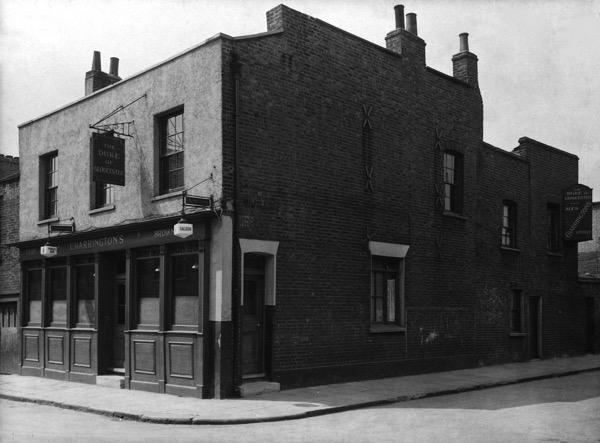
The Duke of Gloucester,
26 Seabright St, Bethnal Green, E2
(Opened prior to 1839 and now demolished)
Sometimes I find myself walking the streets looking for a pub. I am seeking an enclave of civility as a refuge from the barbarity of the city, a friendly bar where the publican lives upstairs and the residents of the street congregate. I am looking for a local.
Oftentimes, in accumulating disappointment, I stand and gaze at the fine buildings which once were pubs, now closed down and converted into flats or shops, or restaurants. So you can imagine my emotion when I discovered this cherished inventory of pubs from the early twentieth century, mostly pictured in their shining moment of glory, when the signwriting was crisp, the mirrors were polished and the lamps gleamed – the beloved drinking palaces of yesteryear. You can almost hear the clink of glasses, the hubbub of voices and distant tinkle of barroom ivories.
In collaboration with Heritage Assets, who work in partnership with The National Brewery Heritage Trust, I am able to publish these historic photographs of the myriad pubs of the East End from Charrington’s archive. It is no exaggeration to say that every street corner was once a pub, thus the catalogue of our loss runs into hundreds and this first instalment of The Alphabet of Lost Pubs only covers A-C.
I wish we could have enjoyed a pint together in every one. Instead we must be thankful we can go there in spirit thanks to the alluring visions conjured by these entrancing photographs, which might have vanished forever if they had not been rescued from a skip twenty-five years ago by some far-sighted soul.

The Adam & Eve, 126 Abbey Rd, West Ham, E15 (Damaged by enemy action 1st July 1944, reopened 2nd April 1948, closed 1994)

The Albert Arms, 66 Bancroft Rd, Mile End, E1 (Destroyed by enemy action 1944)

The Albion, 423 Bethnal Green Rd, E2 (Opened prior to 1870, now known as Coupette)

The Albion, 33 Albion Rd, Dalston, E8 (Opened prior to 1850, closed in 2002 and now residential)

The Albion, 211-212 High St (now The Highway), Shadwell, E1 (Opened prior to 1841, closed 1922 and now demolished)

The Albion, 2 Clissold Rd, Stoke Newington, N16 (Opened prior to 1855, converted to residential use in nineteen nineties)

The Alfred’s Head, 49 Shandy St, Stepney, E1 (Opened prior to 1849, damaged due to enemy action on 12th September 1940 and closed)

The Alma, 41 Spelman St, Spitalfields, E1 (Opened prior to 1870, closed 2001 and now offices)

The Angel & Crown, 170 Roman Rd, Bethnal Green, E2 (Opened prior to 1809, rebuilt in 1951 and still open)

The Astric Lodge, 60 Stepney Green, E1 (Opened prior to 1818 and closed in 1997)

The Barley Mow, 7 New Gravel Lane, Shadwell, E1 (Opened prior to 1778, now demolished)

The Bedford Hotel, 220 Victoria Park Rd, Hackney, E9 (Built 1870, converted to residential use 1999)

The Beehive, 36 Holly St, Dalston, E8 (Opened prior to 1848, closed 1964 now demolished)

The Bell, 116 George St (now The Highway), Shadwell, E1 (Named in 1839, closed 1922)

The Benyon Arms, 155 De Beavoir Rd, Hackney, N1 (Opened prior to 1852, closed 1984 and now residential)

The Black Bull, 192 Stoke Newington High St, N16 (Opened 1826, closed 1981 and now Kentucky Fried Chicken)

The Black Horse, 168 Mile End Rd, E1 (Opened prior to 1856, closed 2010 and currently vacant)

The Blade Bone, 185 Bethnal Green Rd, E2 (Opened in 1823, destroyed by enemy action in World War II and rebuilt, then closed in 1999 and became The Noodle King now a development site for flats)

The Brewery Tap, 17 Stean St, Shoreditch, E8 (Opened prior to 1881, closed 1921 and now demolished)

The British Queen, 31 White Horse Lane, E1 (Opened prior to 1843 and closed 1934, now demolished)

The Bull’s Head, 58 St Katharine’s Way, E1 (Opened 1838, closed 1952)

The Burford Arms, 11 Burford Way, Stratford, E15 (Opened prior to 1872, closed in 1990 and demolished in 1994)

The Camden’s Head, 456 Bethnal Green Rd, E2 (Opened prior to 1816 and still open)

The Carlton, 238 Bancroft Rd, Mile End, E1 (Opened 1836 and still open today)

The Carpenters’ Arms, 151 Cambridge Heath Rd, E1 (Opened prior to 1839, rebuilt in the nineteen-sixties and still open)

The Cat & Mutton, 76 Broadway Market, Hackney, E8 (Opened prior to 1732 and still open)

The City Arms, 2 Dock Rd, Canning Town, E16 (Opened prior to 1867 and closed in 1934)

The Clapton Park Tavern, 9 Chatsworth Rd, Hackney, E5 (Opened prior to 1872, closed and converted to a restaurant in 2001)

The Colet Arms, 94 White Horse Rd, Stepney, E1 (Opened prior to 1851, closed in 2003 and now residential)

The Commercial Tavern, 142 Commercial St, Spitalfields, E1 (Built in 1865 and still open today)

The Commercial Tap, 66 Ben Jonson Rd, Stepney, E1 (Opened 1881 and closed 1934, now demolished)

The Conqueror, Boundary St, Shoreditch, E2 (Opened prior to 1872 and closed in 2007, now residential)
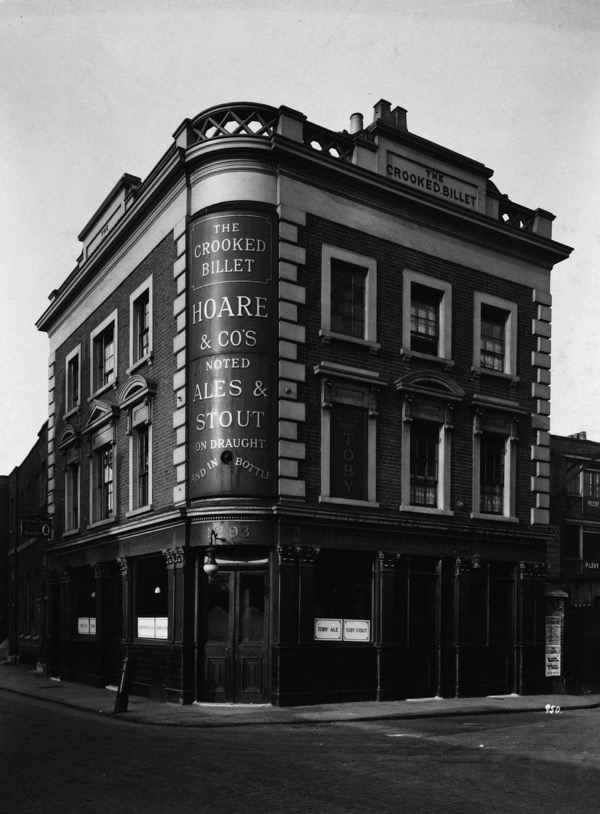
The Crooked Billet, 93 Hoxton St, Hoxton, N1 (Opened prior to 1841, closed 1938 and now demolished)

The Crown & Anchor, 35 Temple St, Bethnal Green, E2 (Opened prior to 1831, closure unknown)

The Crown & Dolphin, 56 Cannon St Rd, Shadwell, E1 (Opened 1851, closed 2002 and now residential)

The Crown, St John St, Clerkenwell, EC1 (Opened in 1910, closed in 1953 and now a shop)

The Crown, 19 Mayfield Rd, Dalston, E8 (Opened 1866 and closed in 1954)

The Crown, 34 Redchurch St, Shoreditch, E2 (Established late seventeenth century and renamed The Owl & The Pussycat in 1990)

The Crown, 14 Goodman St, Whitechapel, E1 (Opened in 1823, closed in 1952 and now demolished)

The Cutlers’ Arms, 2 Cutler St, Houndsditch, E1 (Opened prior to 1839, closed in the nineteen-fifities and is now demolished)
Photographs courtesy Heritage Assets/The National Brewery Heritage Trust
You may also like to take a look at
Misericords In Limehouse
Celebrating the eighth birthday of Spitalfields Life with a week of favourite posts from the past year
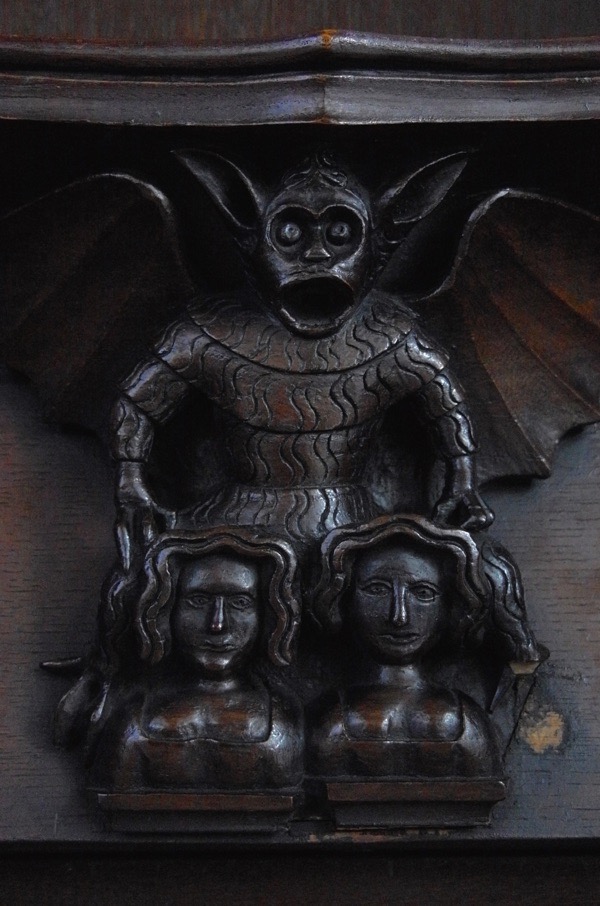
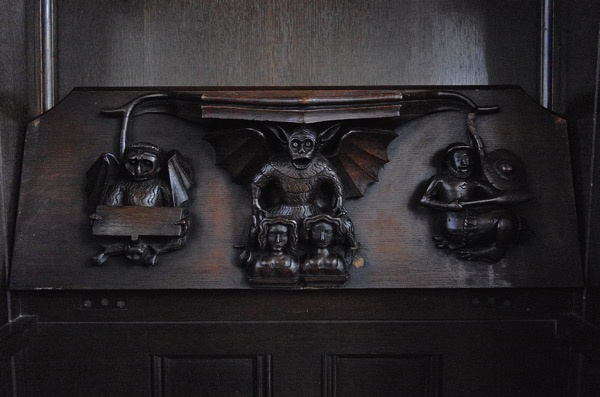
Tutivillus the demon eavesdropping upon two women
I spent yesterday morning on my knees in St Katharine’s Chapel in Limehouse, photographing these rare survivors of fourteenth century sculpture, believed to have been created around 1360 for the medieval St Katharine’s Chapel next to the Tower of London, which was displaced and then demolished for the building of the docks in 1825.
These marvellous carvings evoke a different world and another sensibility, combining the sacred and profane in grotesque and fantastical images that speak across time as emotive and intimate expressions of the human imagination. I am particularly fascinated by the sense of mutability between the human and animal kingdom in these sculptures, manifesting a vision of a mythic universe of infinite strange possibility which was once familiar to our forebears.
Intriguingly, these misericords appear to have been created by the same makers who carved those at Lincoln and Chester cathedrals, and a friary in Coventry.
After a sojourn of over a hundred years in Regent’s Park, the Royal Foundation of St Katharine, originally founded by Queen Matilda in 1147, moved back to the East End to Limehouse in 1948 where it flourishes today, offering an enclave of peace and reflection, sequestered from the traffic roaring along the Highway on one side and Commercial Rd on the other.
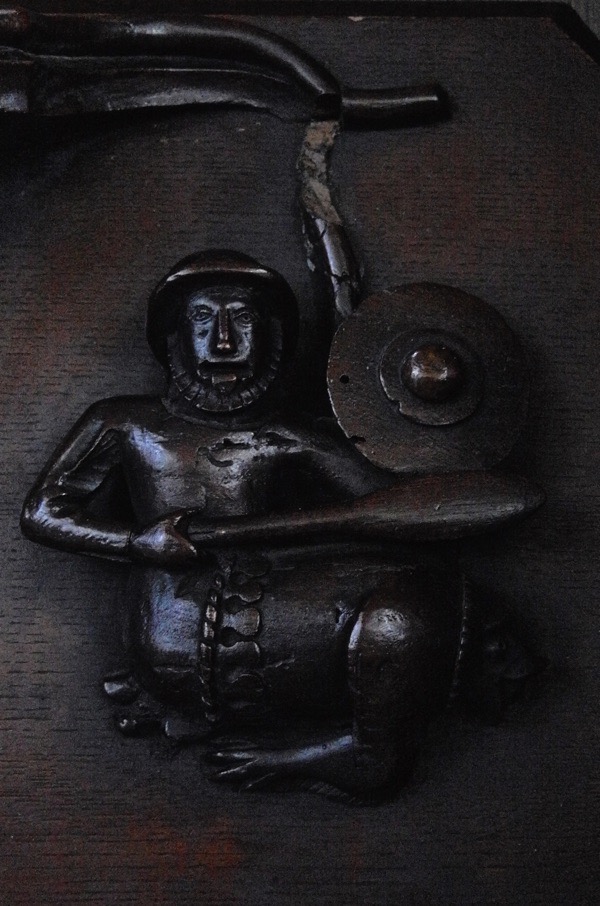
Centaur with club and shield
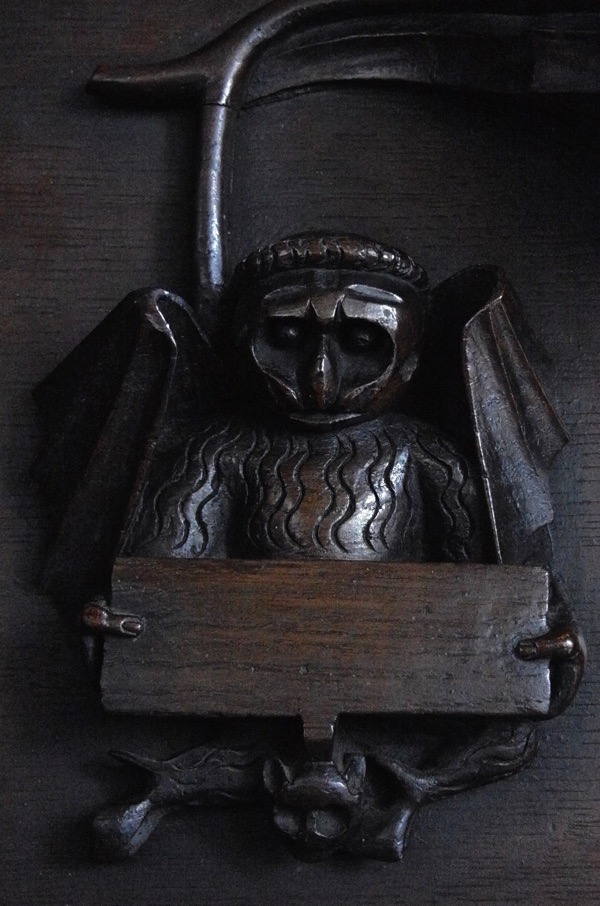
Tutivillus holds the parchment on the Day of Judgement
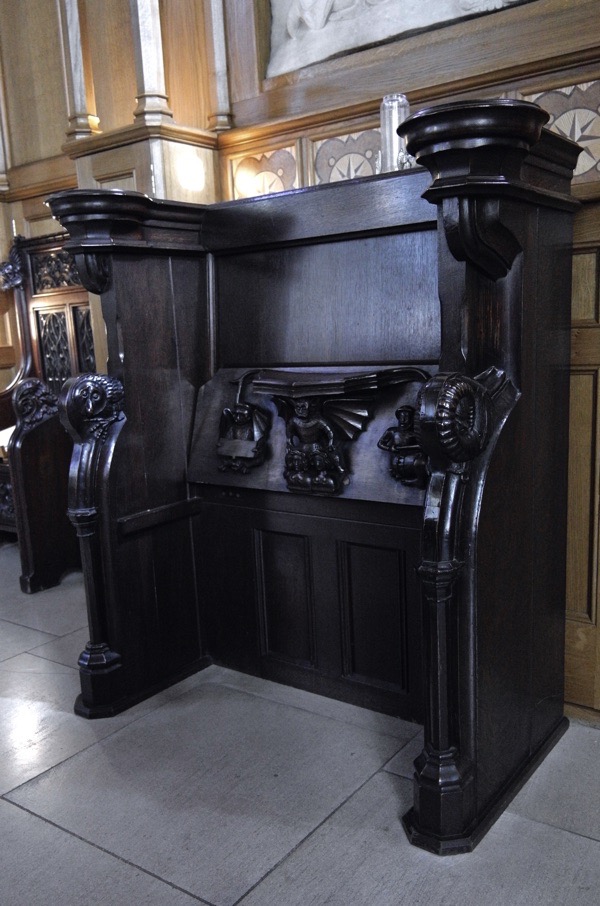
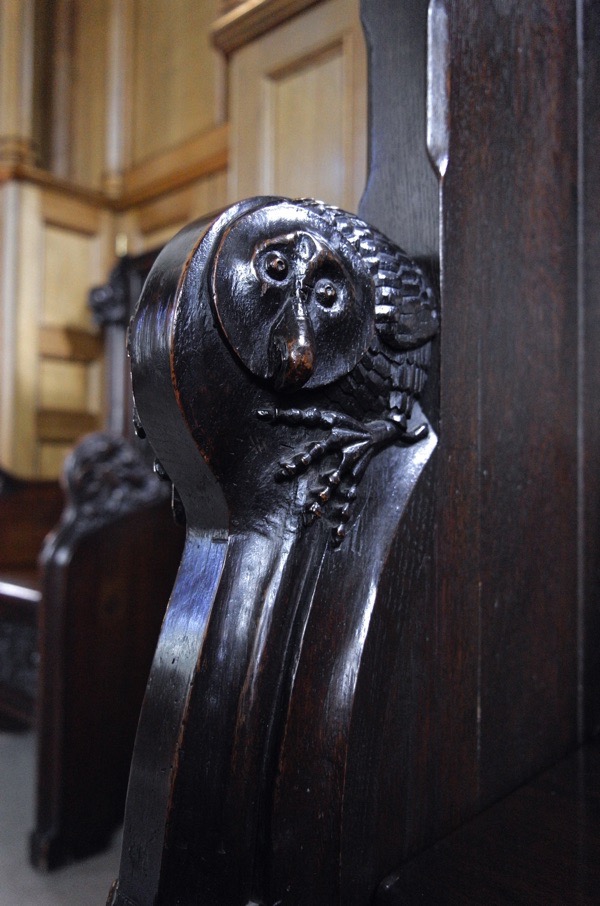
Owl
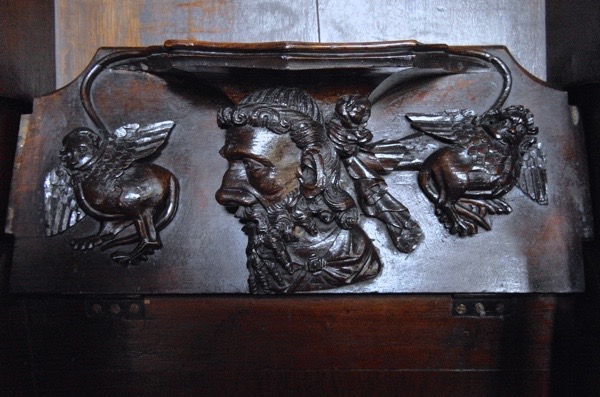
Bust of a bearded man in a striped cap with a cape and trailing drapery
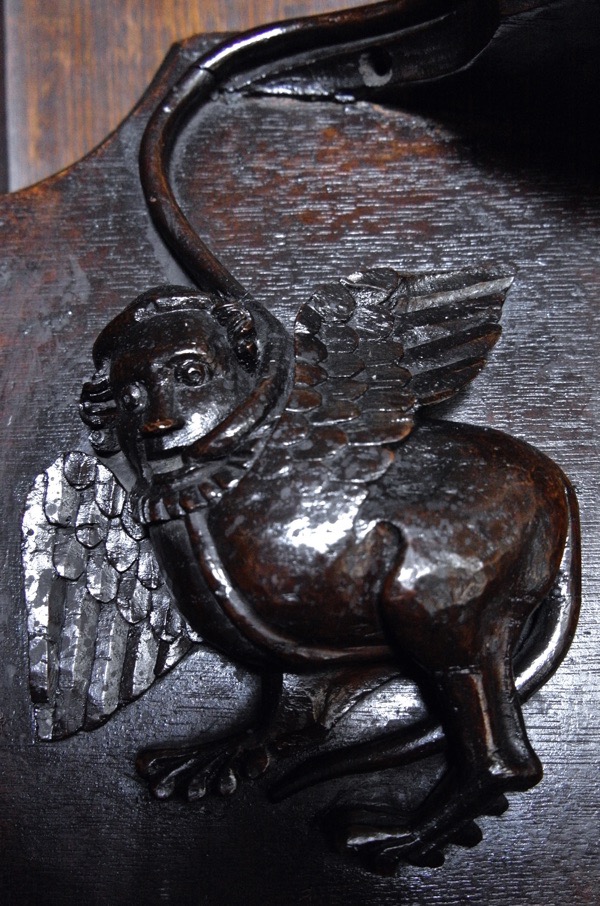
Winged beast with a long tail and human head
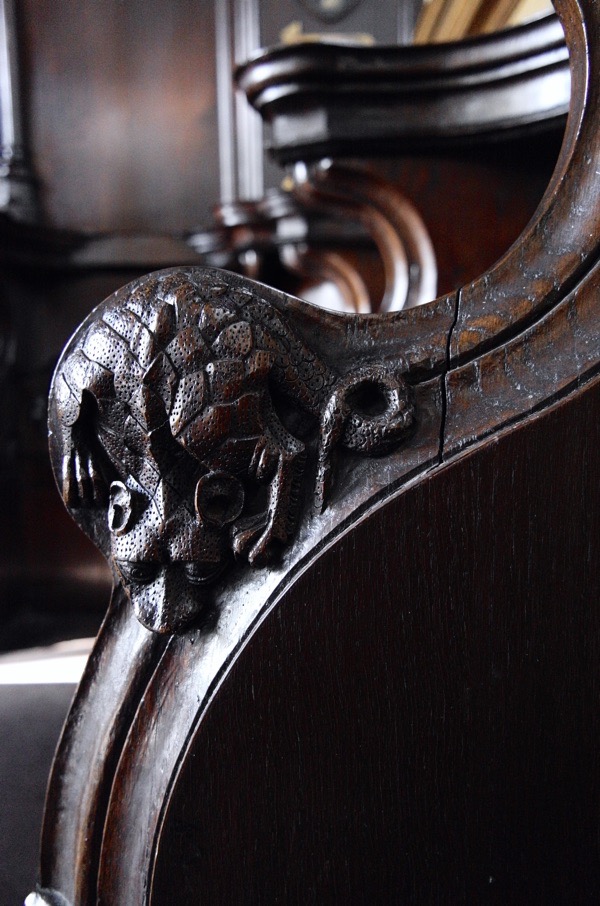
Dragon
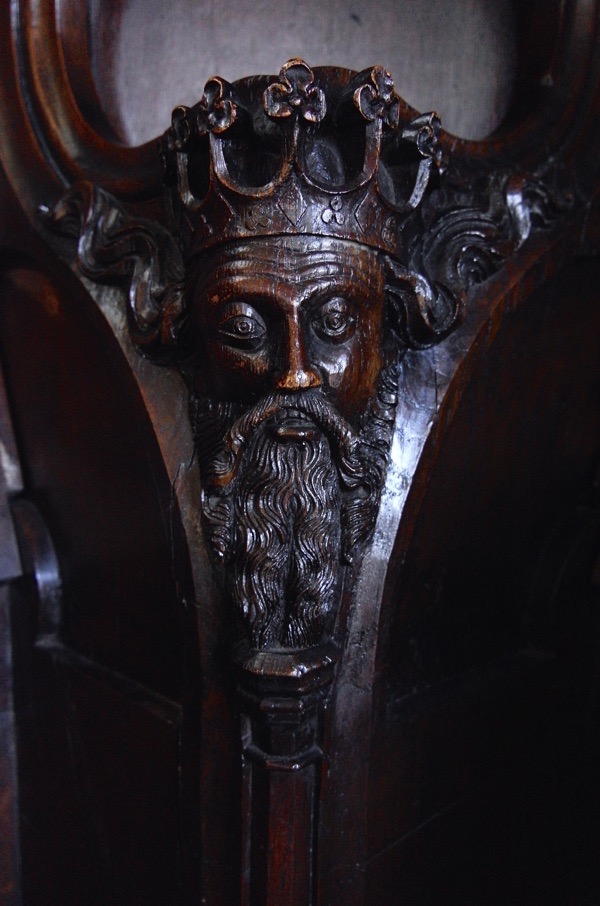
Edward III
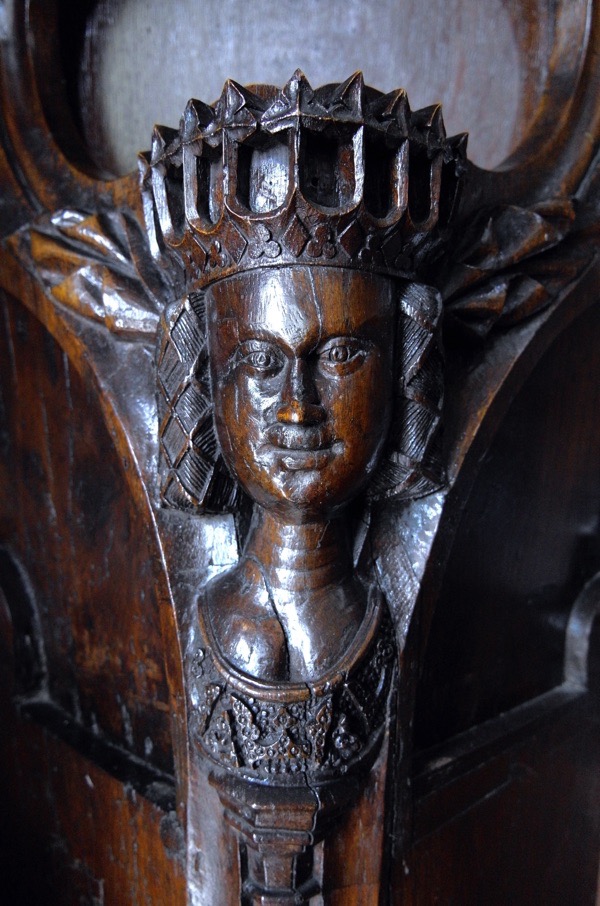
Queen Philippa
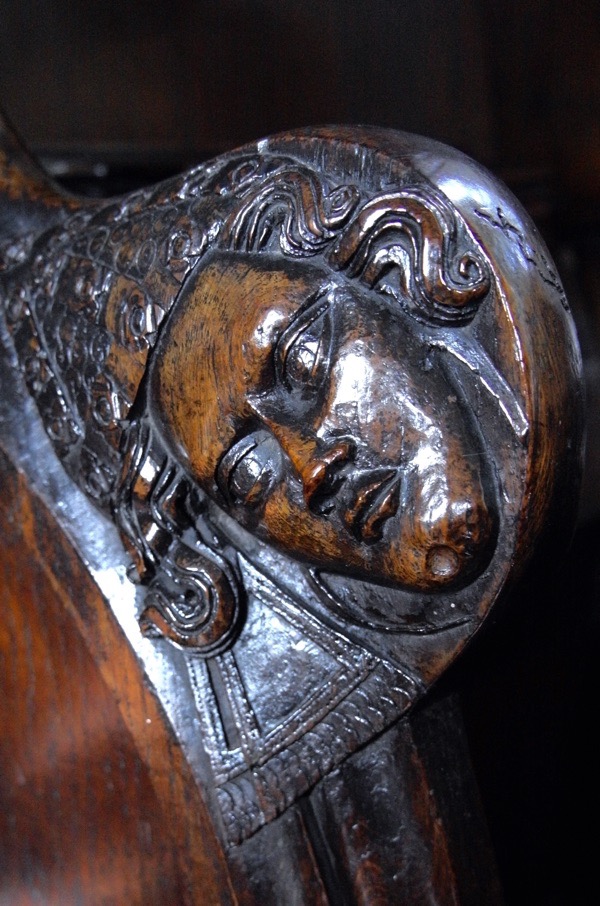
Bishop’s head
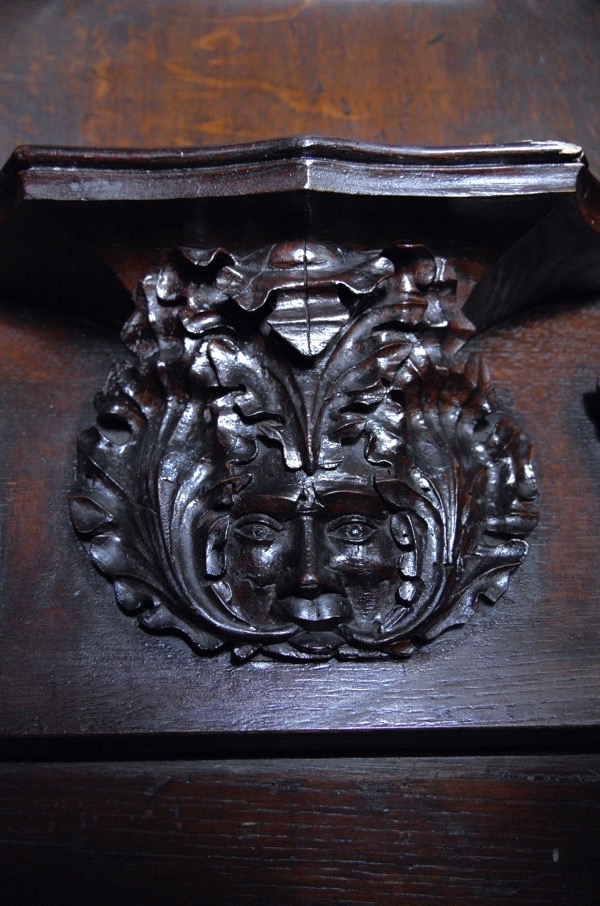
Green man
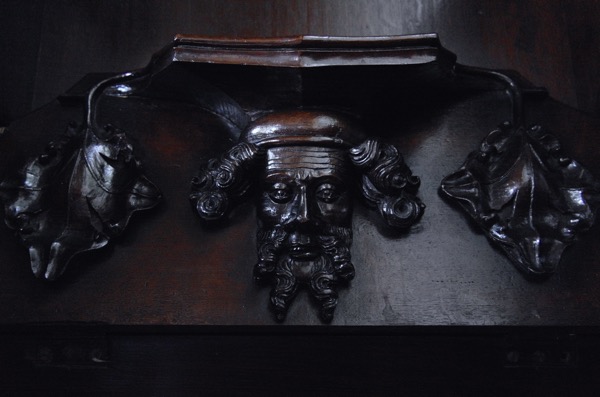
Bearded man wearing a cap
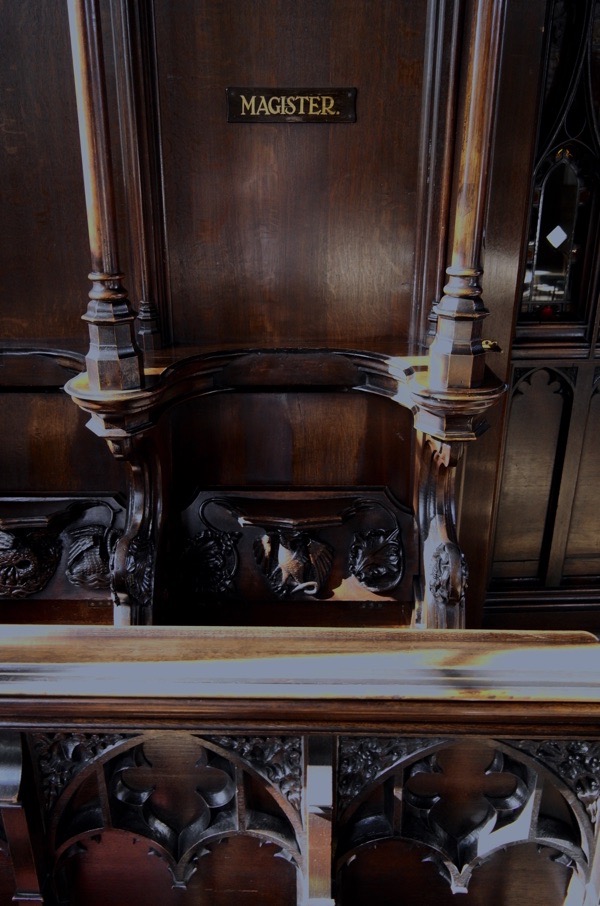
A former Master of St Katharine’s was Chancellor of the Exchequer
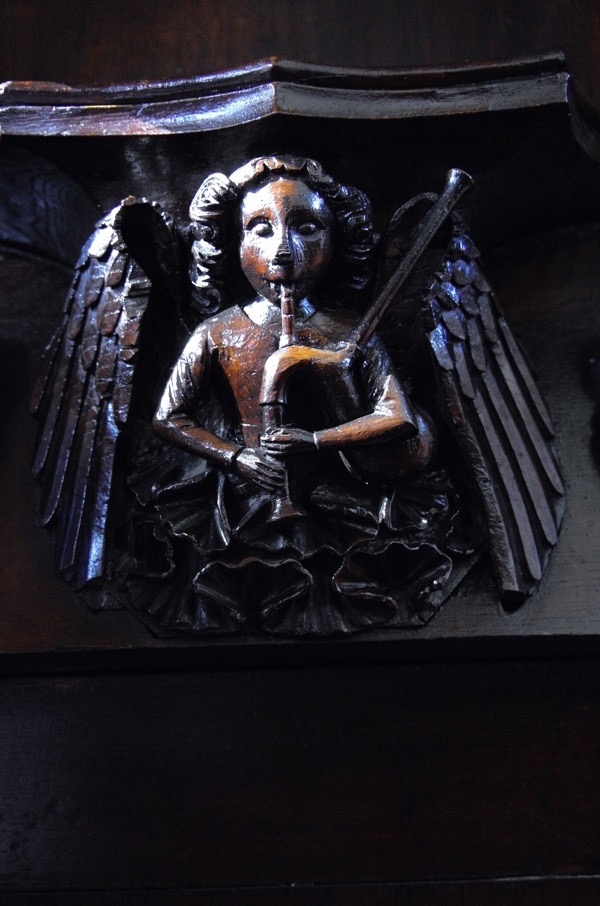
Angel playing the bagpipes
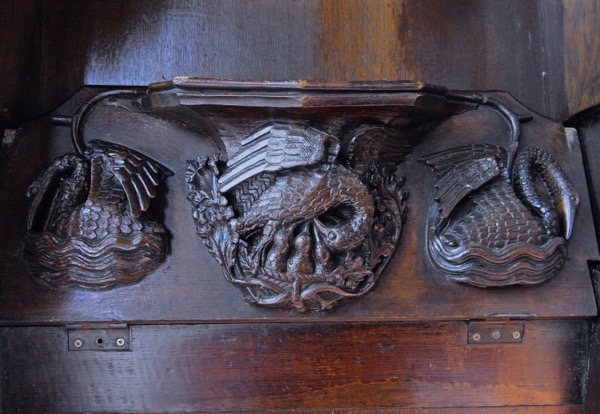
Pelican in her piety with three chicks, supported by a pair of swans
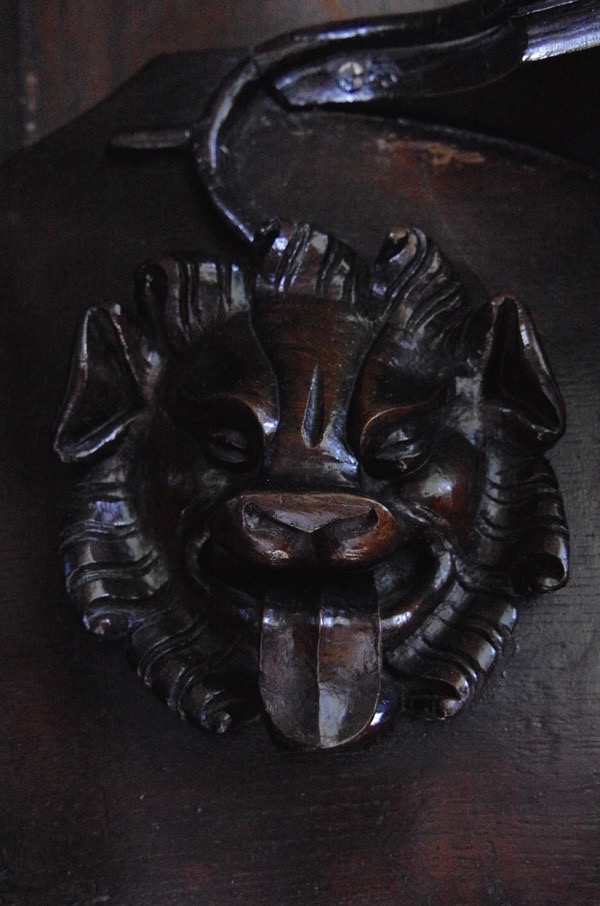
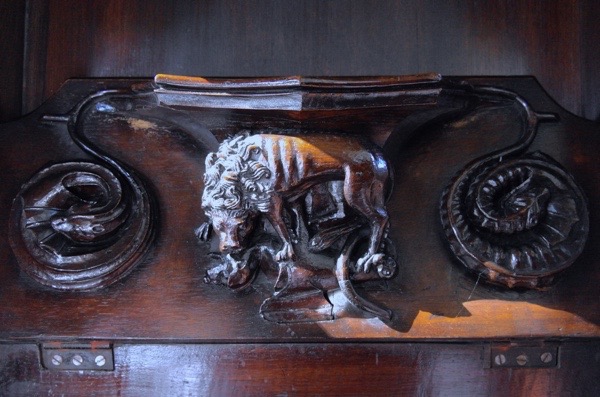
Lion leaping upon the amphisbaena, supported by reptilian monsters
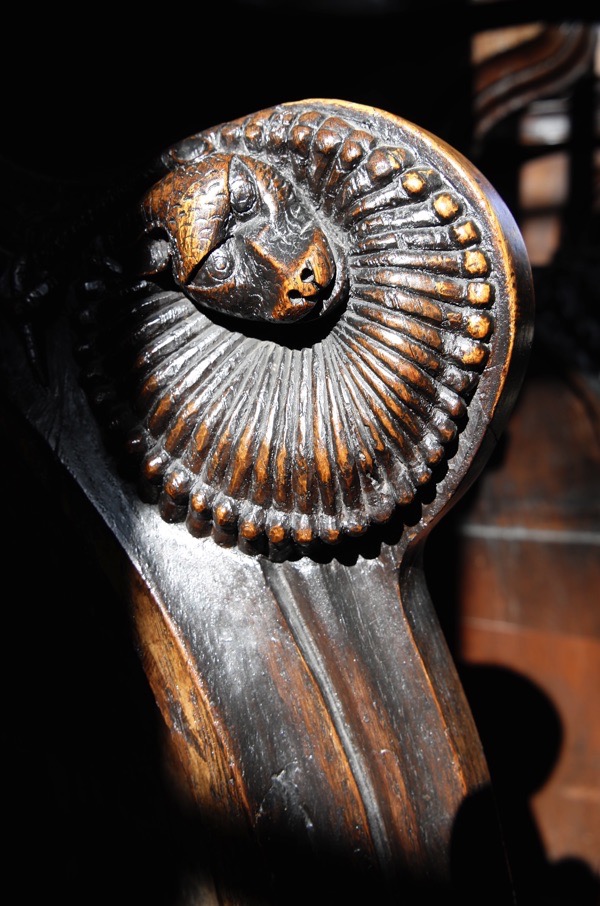
Coiled serpentine monster
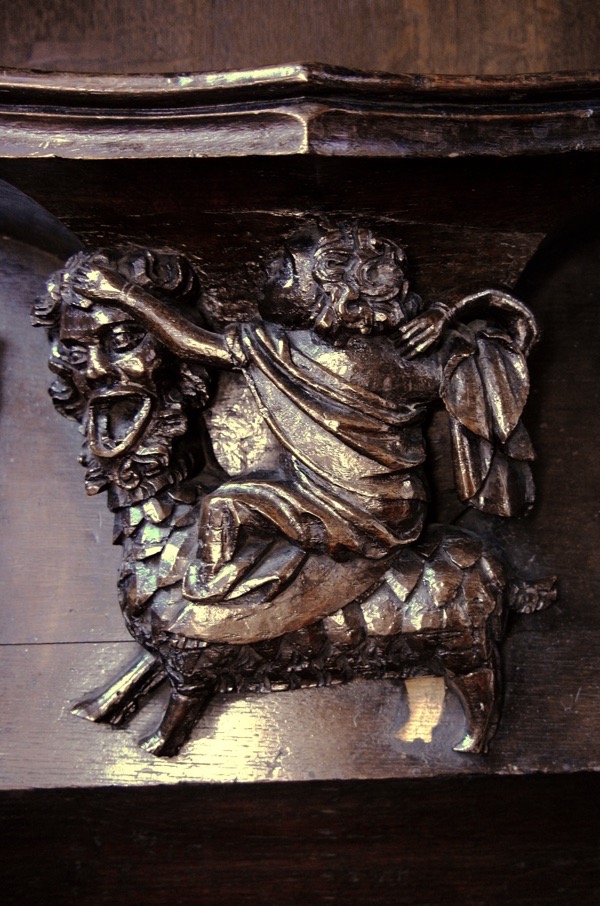
Woman riding a beast with a man’s head
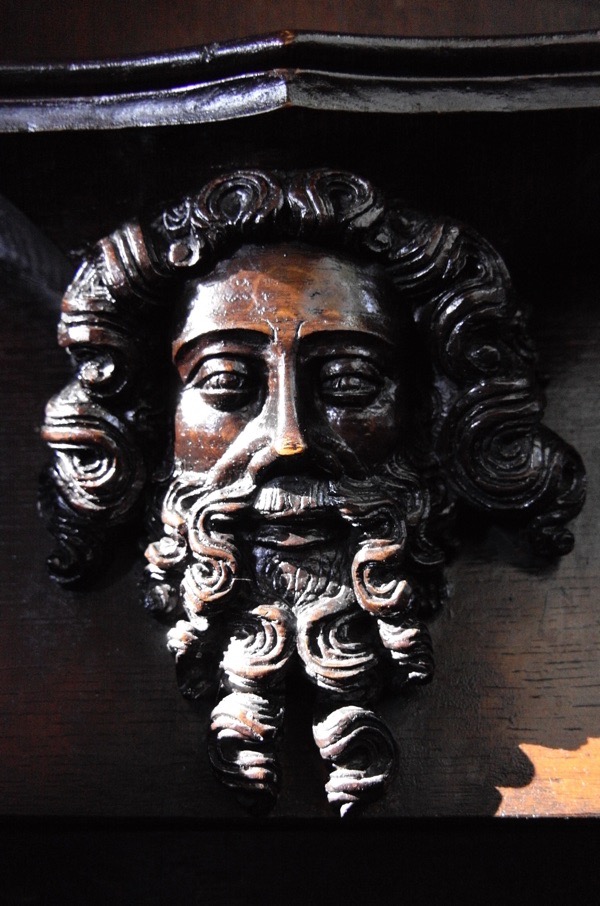
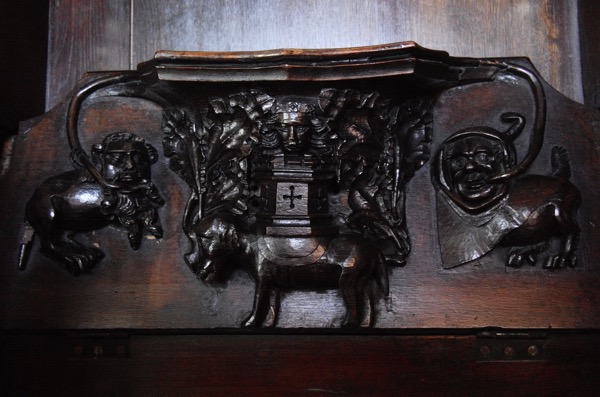
Elephant and castle surmounted by a crowned head
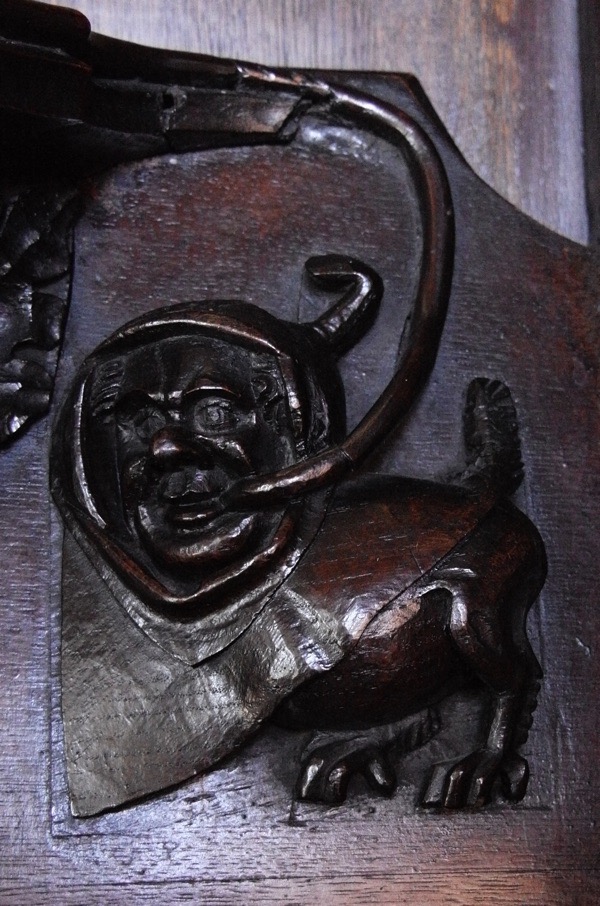
Beast with a hooded human head
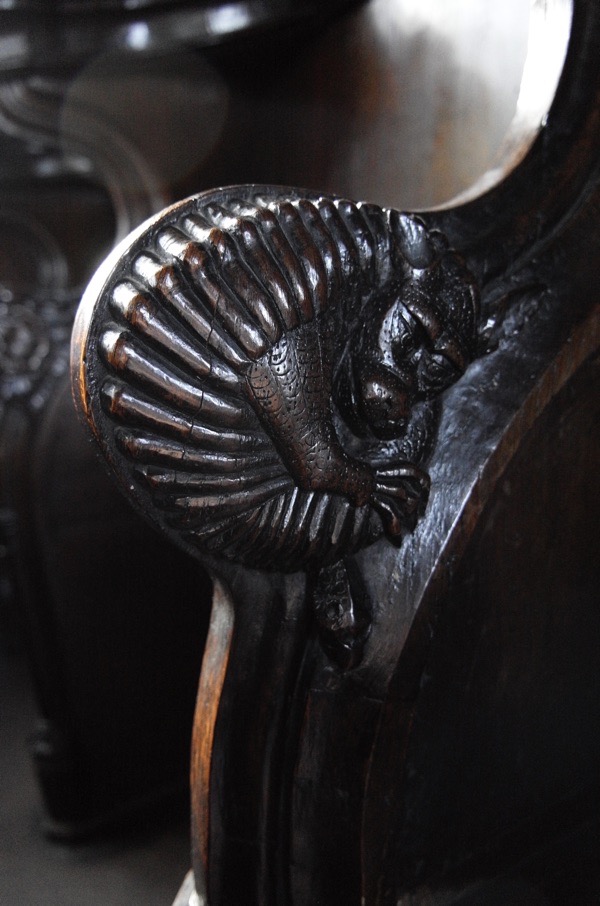
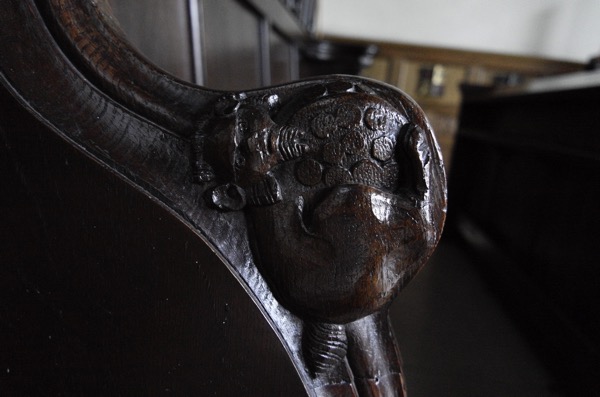
Miser
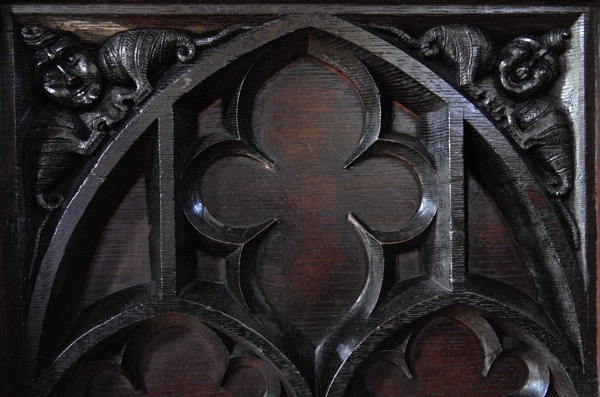
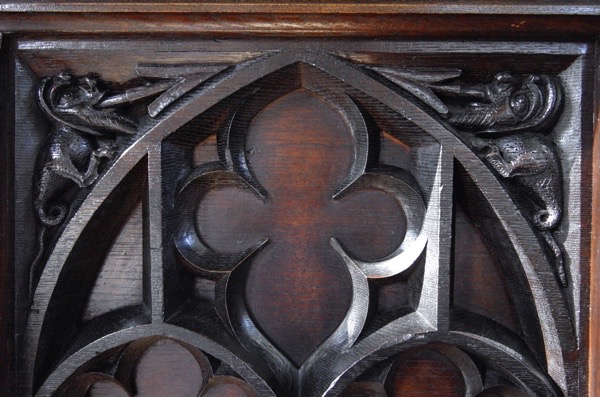
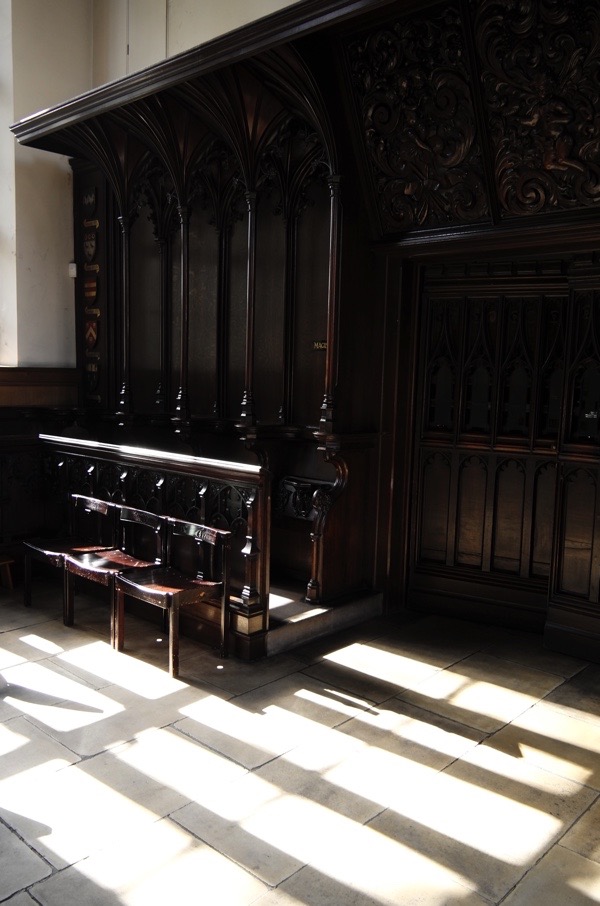
Choir stalls with misericords
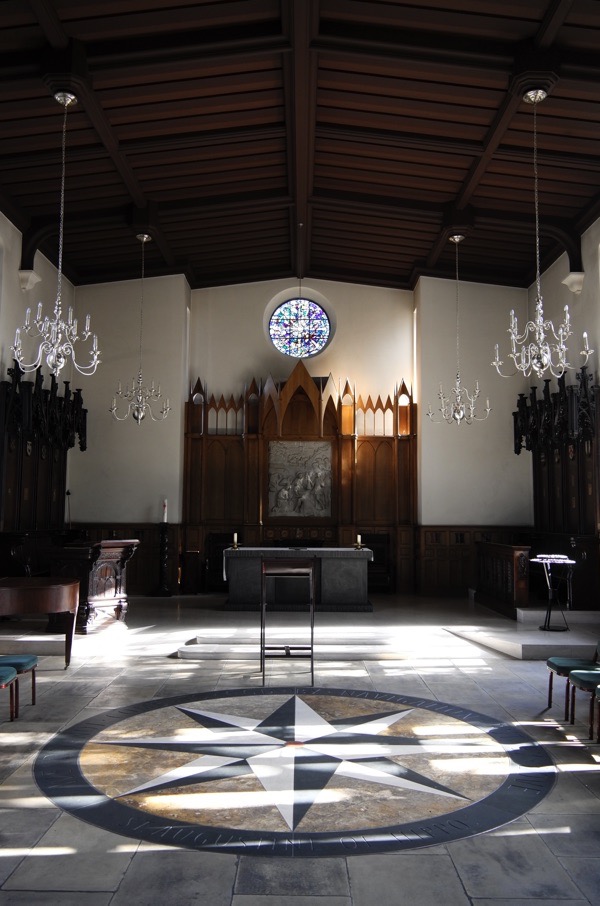
St Katharine’s Chapel was built in 1951 on the site of St James, Ratcliffe, destroyed in the blitz
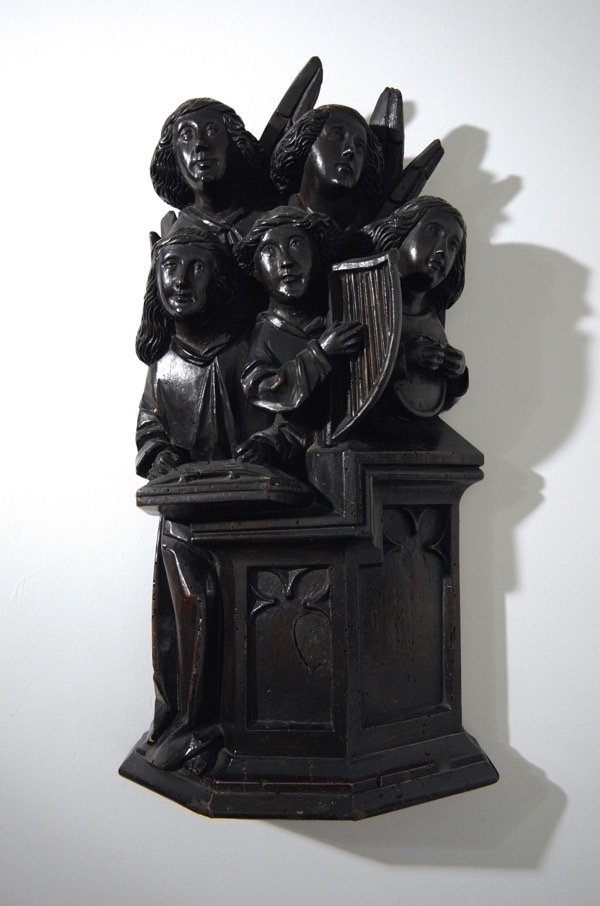
Late fifteenth or early sixteen century carving of angel musicians playing a psaltery, a harp and tabor
The Royal Foundation of St Katharine, 2 Butcher Row, Limehouse, E14 8DS
With thanks to the Master of the Royal Foundation of St Katharine for permission to photograph the misericords
If you are interested to visit St Katharine’s Chapel please write to info@rfsk.org.uk
Eighth Annual Report
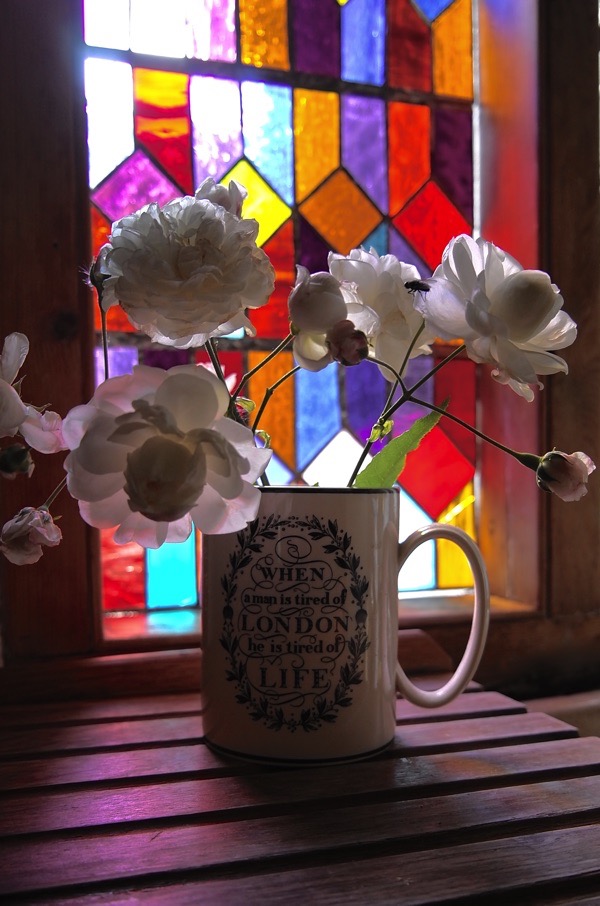
Eight years and three thousand stories ago, I published my first post in these pages. What a journey it has been and what sights we have witnessed. Already, I am approaching a third of the way towards my ambition of ‘at least ten thousand stories.’
Today – as it has become my custom upon this anniversary – I present my annual report looking back over the past twelve months.
One of the wonders of writing and making an account of life is that, even as it makes you aware of loss and time passing, it accumulates to create an ever-growing stack of pages. I take consolation that, thanks to my writing, I am able look back and revisit the people and experiences which I have cherished through the last eight years. Even if they are gone from the world, they will always reside here in this record.
When I began to write stories in the pages of Spitalfields Life, it was never my expectation or intention to become a publisher of books or get involved in politics. Yet both these activities have become an integral part of my work, offering challenges and rewards in equal measure.
This year, I am especially proud to have launched the writing career of Julian Woodford by publishing his debut book The Boss of Bethnal Green. Julian’s brilliant account of the breathtakingly appalling life of Joseph Merceron, the eighteenth century gangster and corrupt East End politician, proved to be a major work of biography, which was recognised as a significant contribution to the history of London by glowing reviews in the Evening Standard, the Times, the Times Literary Supplement.
This spring, I published a handsome new illustrated edition of AS Jasper’s compelling memoir of growing up in the East End at the beginning of the twentieth century, A Hoxton Childhood, accompanied by the first publication of the sequel The Years After, detailing the author’s struggle and eventual triumph in the Shoreditch cabinet-making trade. If anyone ever wonders why it is we need a National Health Service, proper Council Housing or legislation to ensure decent working conditions, they should read this candid and heart-breaking account of life in the world before these things came into existence.
More than two years have passed since five hundred of you joined hands around Norton Folgate to save it from demolition. Readers frequently ask what has become of British Land’s threatened development in these streets. The answer is that the campaign and the Spitalfields Trust’s Judicial Review, challenging Boris Johnson’s ‘calling-in’ of the development over the heads of Tower Hamlets Council, postponed matters long enough for the European Referendum to happen. Overnight, this office development became no longer financially viable and, subsequently, British Land saw an 85% fall in profits. In Spitalfields, people say that the consequence of the Referendum was, ‘We lost Europe but we saved Norton Folgate.’ Yet, as long as the planning permission stands, the door remains open for the revival of this hideous scheme when the economy improves.
We can celebrate two notable successes in conservation in the past year. Largely due to letters of objection written by readers of Spitalfields Life, the murals in the Royal Exchange were saved when the developer withdrew their application to bisect these magnificent paintings. Similarly, the historic Still & Star in Aldgate ( the last ‘slum pub’ in the City of London) was given a reprieve from demolition when it was granted Asset of Community Value status.
Thus another year passes in the pages of Spitalfields Life.
As the season changes and the summer fades away, there is much to look forward to this autumn and I hope I will have the pleasure of meeting you at one these forthcoming events.
14th SEPTEMBER: A HOXTON CHILDHOOD AT V&A BETHNAL GREEN MUSEUM: Celebrating our new edition of AS Jasper’s classic East End childhood memoir, we present an evening of readings from A Hoxton Childhood & The Years After and an interview with the author’s son, Terry Jasper. Additionally, Derrick Porter, Poet of Hoxton, will read a selection of his poems and Henrietta Keeper, Belle of Bethnal Green, will sing. Click here for tickets.
10th OCTOBER: LAUNCH OF EAST END VERNACULAR AT NUNNERY GALLERY: There will be a special viewing for Spitalfields Life readers from 6-8pm of Bow Arts’ exhibition The Working Artist: The East London Group at which I will introduce my new book East End Vernacular, Artists who painted London’s East End streets in the 20th century. Make a note in your diary and watch this space for further details.
4th & 5th NOVEMBER: BLOG WRITING COURSE IN SPITALFIELDS: I have been running these courses for five years now and it is an enduring delight to spend a weekend with readers in an eighteenth century weaver’s house in Fournier St, and hear the wonderful ideas and stories that people bring. With delicious lunch served by Leila’s Cafe and cakes baked by the Townhouse to eighteenth century recipes, we always have a lot of fun. Click here for more information and email spitalfieldslife@gmail.com to book.
Over the next week, I shall be at the printers overseeing the production of EAST END VERNACULAR and, in the meantime, I will be publishing favourite posts from the past year until I resume with new stories on Monday 4th September.
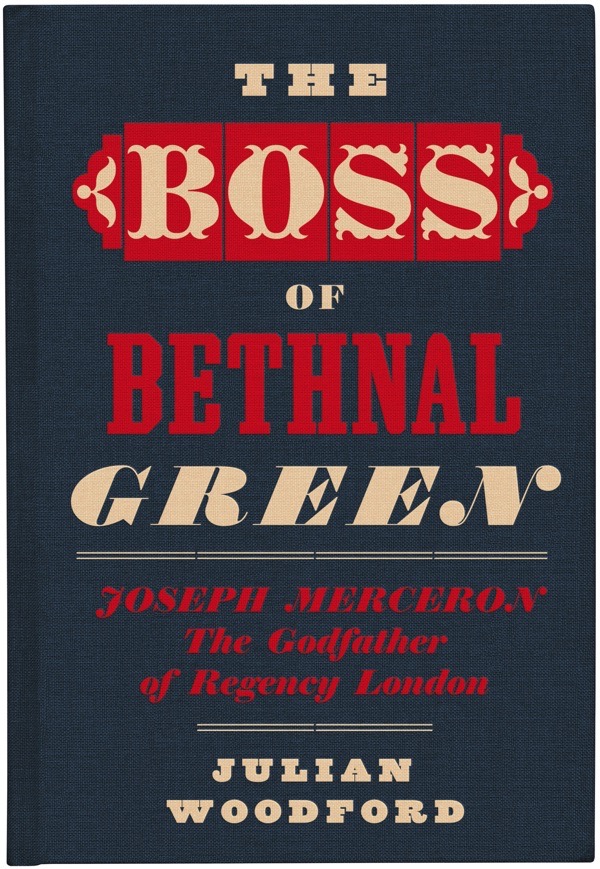
Click here to order a copy of THE BOSS OF BETHNAL GREEN
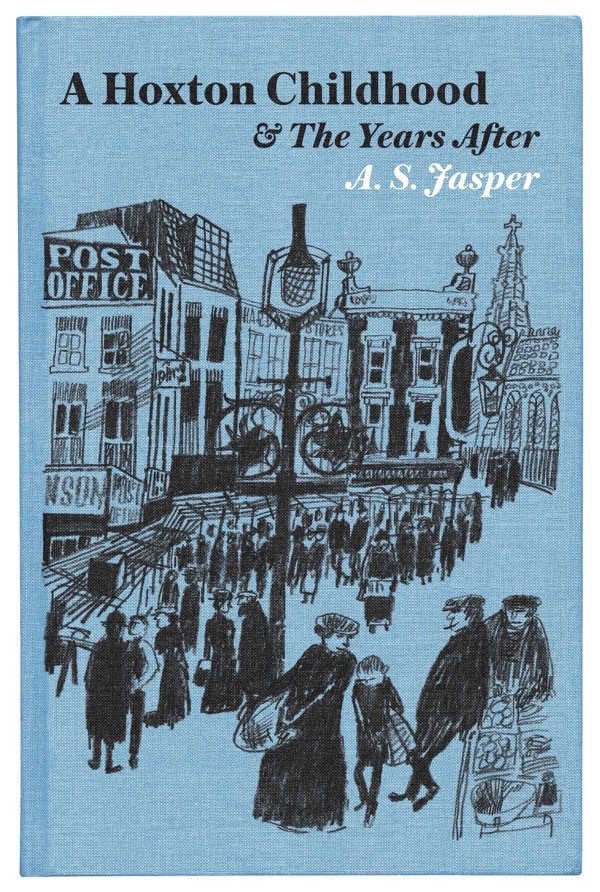 Click here to order a copy of A HOXTON CHILDHOOD & THE YEARS AFTER
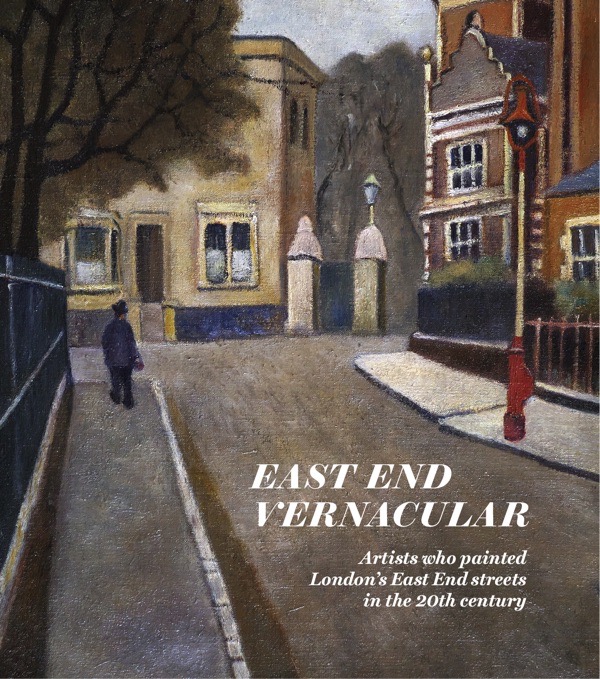
Click here to pre-order a copy of EAST END END VERNACULAR
You may like to read my earlier Annual Reports
Lunch At Mama Thai
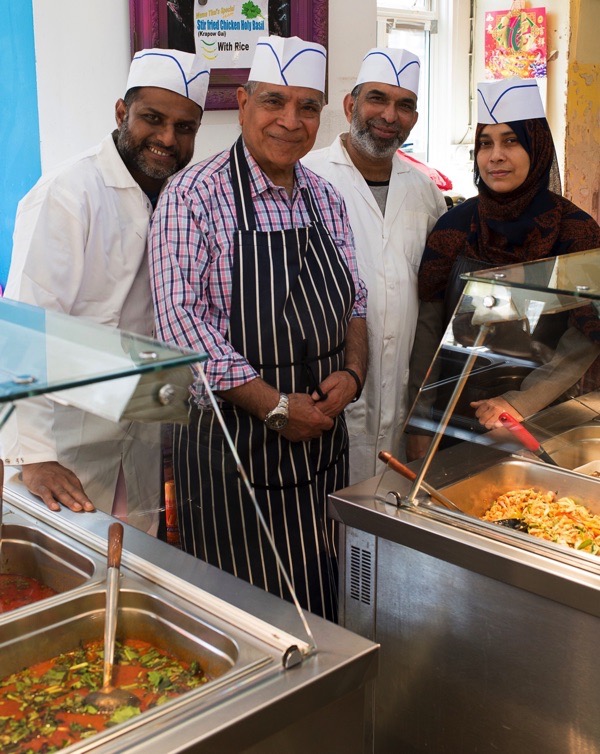
Raj Chawla (centre) and his team at Mama Thai
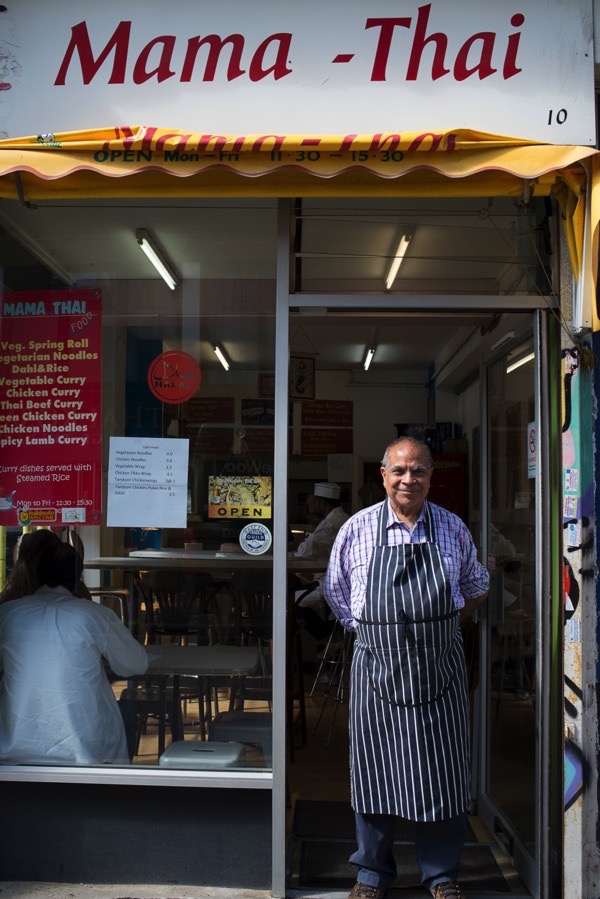
Mama Thai on the corner of Toynbee St and Brune St, just fifty yards from Christ Church, has long been one of my favourite lunch spots. Thus it was with great sadness in 2015 I reported the death of chef Pam Chawla who had run this beloved establishment with her husband Raj since 1991.
Two years later, I am delighted to announce that, under the continuing supervision of Raj, there are new chefs at Mama Thai and the standard of fresh food prepared daily is as high as it has ever been. I know of nowhere else in Spitalfields where you can find such a reliably wholesome lunch for just five pounds. In face of a disappointing proliferation of chain outlets around the Spitalfields Market offering fast pre-prepared food, it is heartening to return to an old haunt and find it reinvigorated with new life.
At least once a week you will find me here tucking in to a tasty plate of vegetables and rice. In my opinion, it is the ideal healthy lunch. I always have the same thing and I am never disappointed by its reliable high quality. Sometimes, Abdus Samad Ajad, the chef who does the serving, asks me which vegetables I should like from the seasonal selection they have cooked that day and my reply is always the same, ‘You decide!’
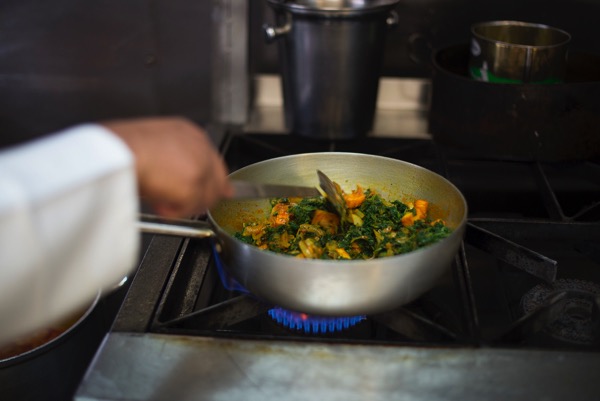
Spinach is one of my favourites and the texture is very important, it should not be overcooked and turn to slush. At Mama Thai, head chef Mohammed Shofique Miah understands this and his spinach is always chewy and freshly cooked. I cannot to pretend to enjoy lentils on the whole, but here they are cooked to such a gentle consistency and so subtly spiced that they are delicious. Similarly, the pumpkin accompanied by ground coconut is another favourite of mine.
Cooking vegetables well is the test of any chef and it is an unexpected delight to discover real cooking in this cosy corner cafe where no dish costs more than five pounds. Among all the junk food and over-hyped pretentious places, Mama Thai is Spitalfields’ best kept culinary secret and I do recommend you seek it out. Raj Chawla is waiting to welcome you in person.
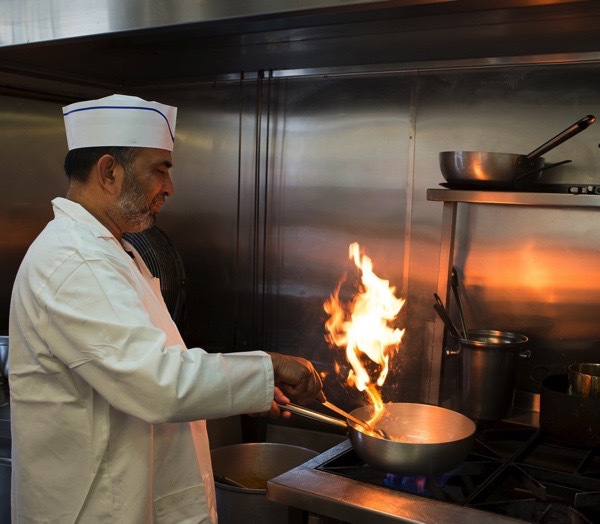
Chef Mohammed Shofique Miah
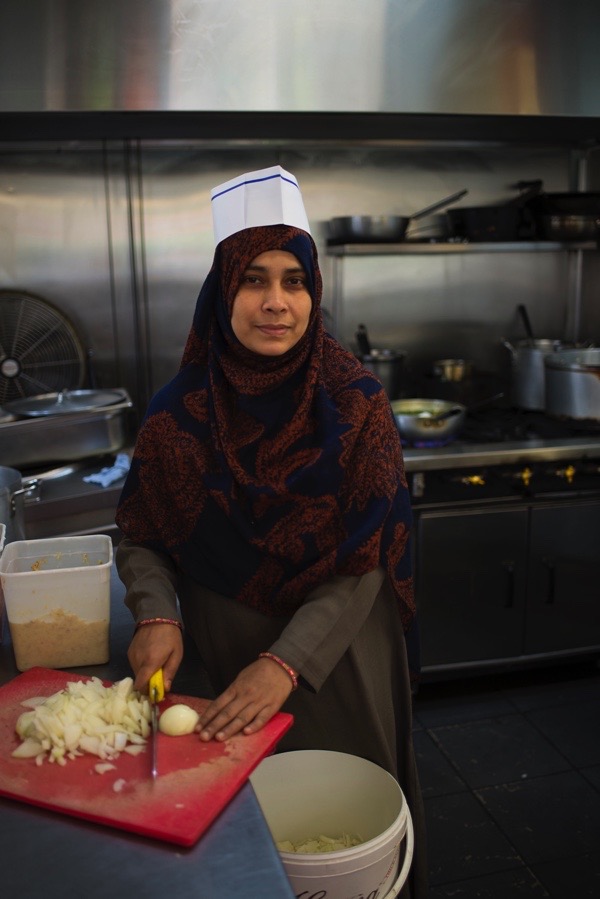
Hajera Begum prepares all the vegetables freshly for the chefs during service
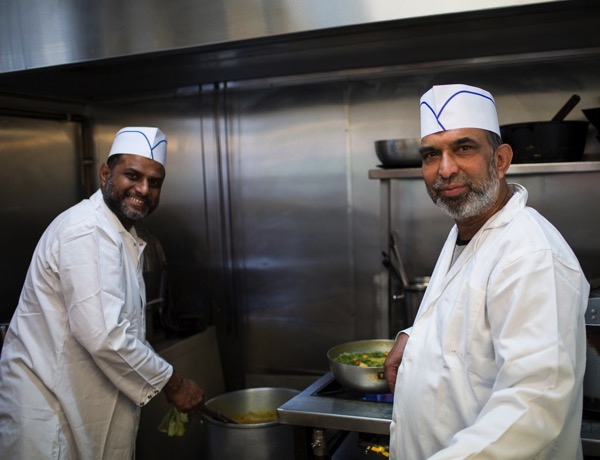
Mohammed with his Deputy Chef Abdus Samad Ajad
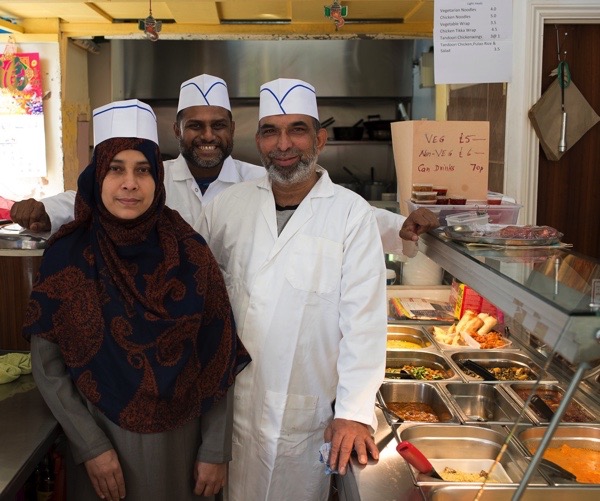
The kitchen team
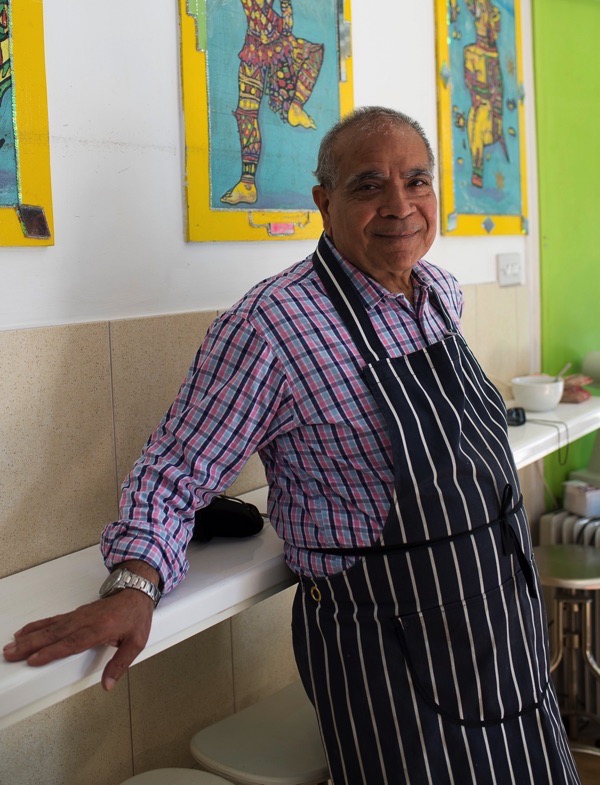
Raj Chawla has run Mama Thai in Spitalfields since 1991
Photographs copyright © Sarah Ainslie
You may also like to read my earlier story about Mama Thai from 2010
Sheila Bell of Great Eastern Buildings

(Click on this photograph to enlarge it)
Can you spot Sheila Bell in this photograph of the residents of Great Eastern Buildings celebrating Victory in Europe Day at the Grey Eagle in Quaker St on 2nd May 1945? Look more closely, there she is sitting in the front row, to the left of the girl in a floppy hat. Sheila has a bow in her hair for this special occasion.
Unfortunately, this picture was not too much use when I met Sheila at Victoria Station recently to hear about her life at Great Eastern Buildings on the corner of Brick Lane and Quaker St. Yet, as Sheila began to tell her story, I quickly recognised the little girl in this photograph of a lifetime ago.
“My grandparents, George & Sarah Keppel, lived in Great Eastern Buildings and my great-grandparents, Emma & Frederic Lewis lived in the same flat before them – before that I do not know. My nan never went out to work, she stayed at home, cooked the dinner and kept the house, and my granddad worked down Spitalfields Market. He started off as a porter but he was a carpenter by trade, so he made the ladders for the guys in the market. He hired two rooms in the next block at the Buildings and did all his carpentry work there. I used walk in there and smell the fresh wood shavings. He had a black iron glue pot and he made me stir it. It looked like toffee but it did not smell like toffee, I can assure you.
My parents lived in the Buildings as well and, as soon as I was born, I was taken to the Buildings, as the fourth generation of my family there. My mother worked in Truman’s Brewery as a bottling girl, she wore a green overall, a white apron and clogs, and my father was a smoked salmon curer in Frying Pan Alley, opposite Liverpool St Station. We lived in flat number sixty-eight Great Eastern Buildings, on the second floor. I was brought up in those Buildings with Jewish, Irish and Maltese, and we all rubbed along very nicely.
There always used to be a lot of workmen in and out of the Buildings, fixing things, and my first memory was of playing with a load of sand and water. Me and my cousins used to make sandcastles in the builders’ sand. That was our life! We lived in two rooms. We shared a wash house with a mangle and three sinks, two normal-sized and one butler’s sink with two taps. There was no hot water and each of the four flats on the landing shared the wash house. If you wanted a bath you had to boil a kettle. We had a tin bath like everybody else and an outside toilet that we shared with the three other families. We took it in turns to clean the toilet on a weekly rota system.
I do not remember a gas stove but I do remember a black range. You could lift the lid with a poker and put coal in. The kettle was always on the hob and there was an oven to the side. On Sunday, my nan would black-lead the range and it used to gleam. It had a white hearth and she used to whiten it, that was her pride and joy. It was always done, and our two rooms were kept clean. One room doubled as a front-room-come-kitchen, -come-everything really. We had old armchairs in there and a settee made of Rexine, that looked like leather but it was plastic and, in the summer, it used to stick to your legs, so we had to put a blanket on it. We had an old piano, I think everybody in those days had a piano. There was a little sink in the corner for the bowl and jug which we kept in the bedroom. That was all you had plus a table and a cupboard.
In the bedroom, we had a double bed and a single bed, if you had more than one child or if anybody came to stay. Unfortunately, that was how it was. We put up with because we did not know any different. I was the eldest and I had a younger brother. Now my nan had two rooms and my mum had two rooms, so my brother slept in the front room which meant mum and dad had the bedroom, my nan and grandad had the other bedroom and I slept in the other front room on a made-up bed. I used to lie on the floor and listen to the trains shunting in the goodsyard. Both flats were opposite each other across the same landing.
When I was fourteen, the flats were modernised by combining two, so then we had two bedrooms, a kitchen and a lounge. They put in electricity. It was amazing because I had only known gaslight since childhood. We did not know we were born! It was like a palace. I had my own room and my brother had his own room. It was our home and they did not move us out while they modernised, they just worked around us.
As children, we used to love to run through Wheler St Arch because it was always dark and gloomy with gas lamps – it was a dare really. We liked to go down Spitalfields Market and pick up the specks – the damaged fruit – and we used to bring them home. We did not have any other fruit. At Christmas time, my granddad came home with a sack full of specks. All the family would get together round the piano. My Auntie used to play the piano fantastically, sitting on a crate of brown ale. My nan never went out all week but on a Saturday night she went with out her friend and they would go either to the Two Brewers on the corner or the Grey Eagle. On a Saturday night, when she did not go out, my nan and I, we would get our pillow and put it on the window sill, and sit with our cups of tea and wait for the pubs to turn out. There would be fights and it was entertainment for us.
My granddad used to have a stall at the top of Brick Lane on Sundays and sell nuts and bolts, and I took tea to him in a white enamel flask. The market was packed in those days and, by the time I got there, the tea would be splashed everywhere, so he only got one cup out of it.
My first job was for Durrants the printers opposite Mount Pleasant Post Office in Clerkenwell and I absolutely hated it. I was sixteen or seventeen and I used to come home black with ink. Then I went into the rag trade, machining at Universal Underwear – it was very highbrow, we made it for Marks & Spencers – just off Shoreditch High St. I loved it and stayed there for ten years. I did an apprenticeship and my first week’s pay was four pounds, nineteen shillings and eleven pence. I thought I was rich!
After three months, they put you on piecework and I used to earn a fortune. Twenty or thirty pounds a week was a lot of money in those days. I was a saver and there would be times when I only had a shilling and sixpence in my purse but that was fine. I have always put a bit by because you never know what might happen. My parents did the same and they taught me not to spend money on non-essentials. Then, if you really need that money you do not have to go to anybody, you have got it there. My mother was very independent and my parents never owed anybody any money. I only ever wanted to pay the rent and put food on the table.
When I was twenty-five, I left Great Eastern Buildings to get married. I met my husband Riaz at Queen’s Ice Skating Rink in Bayswater. It was a ritual, I used to go there every Friday. Every Saturday, we went to the cinema and, every Sunday, we went to the Mecca Ballroom in Leicester Sq. We had a fantastic social life. We moved to a rented two bedroom flat in Hackney Downs when we got married and my daughter was born in Lower Clapton Rd at the Salvation Army Hospital. My husband was an aircraft engineer at Gatwick and the travelling was too much for him, so they offered us a flat down there and we stayed thirty years.
I still miss the community spirit of Great Eastern Buildings. Nobody went without, the people in those Buildings would give you their last ha’penny even if they had nothing.”
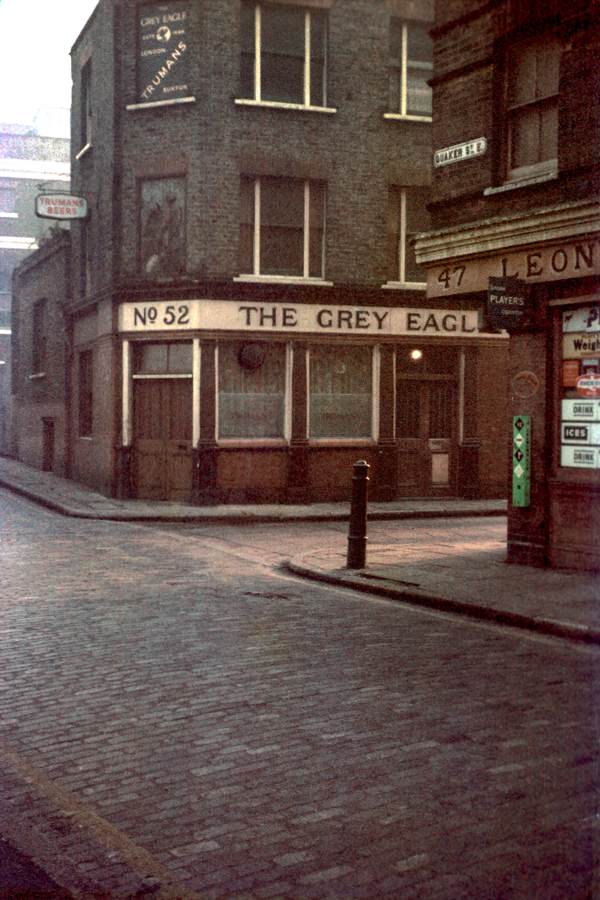
The Grey Eagle photographed by Philip Marriage in 1967
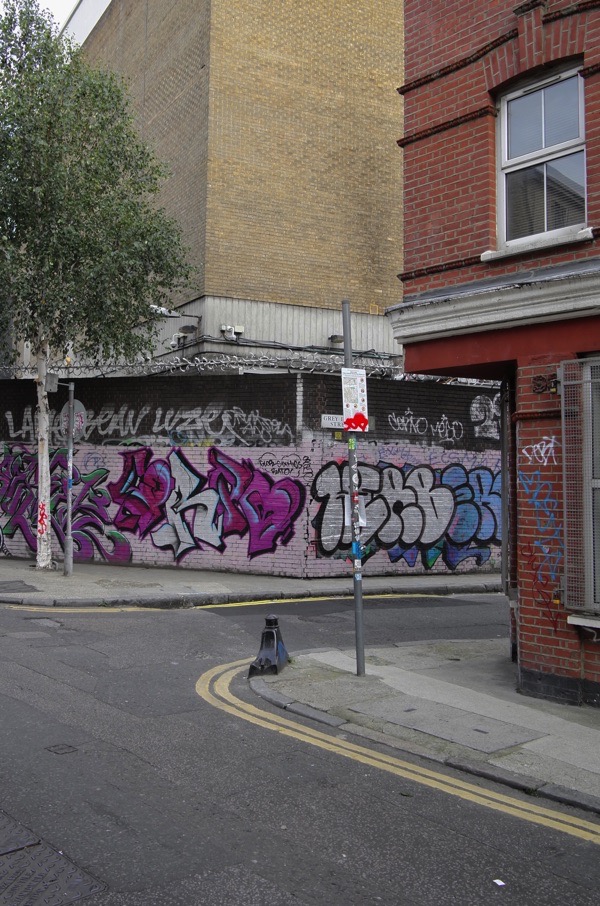
Corner of Grey Eagle St today
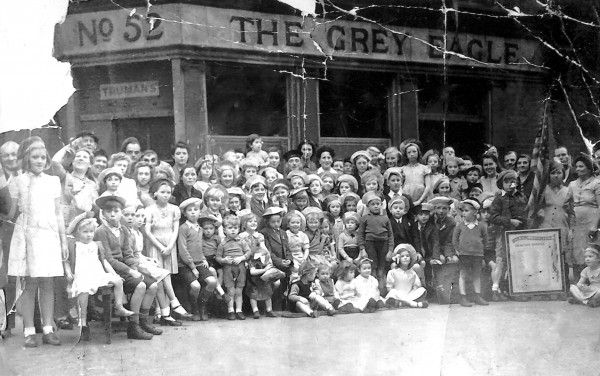
Steven Harris, who also grew up in Great Eastern Buildings, managed to identify these people:
Little girl at front, right of centre, with floppy white hat is Joyce Gibbons (my Aunty Joyce).
Next to floppy white hat, toddler with bow in hair is Sheila Bell herself.
The lady to the left, with her arm up, may well be Franny Vigas.
Behind Franny, with the dark hair is Sarah Keppel (Sheila’s grandmother)
The shorter of the two men, just to Sarah’s right, is Sheila’s granddad, George Keppel.
To George’s right, with her back against the pub wall is Lily Bell (Sheila’s mother)
Further to the right, holding two children (you can just see her head against the pub window) is Bessie Lee, sister to Lily Bell. The two children were Lorraine and Ronnie Lee.
Staying at the back and just along from Bessie Lee and her children, are two dark haired women – they were sisters, Celia and Sarah Bawes.
One forward and three along to the right from Lily Bell is a blond girl with roundish face – that was Betty Wright (who was long standing friends with my Aunty Pat)
Third row back, a little to the left of the roll of honour, with her beret pulled down at a sharp angle and standing slightly alone, is Phyllis Greenslade.
To the extreme right of the photo, sitting next to the honours roll, is Pat Green.
Third row back, to the left of the central line of children, is George Hall (with finger in mouth).
To the left of George is, I believe, my very own nine-year-old dad – Eddie Harris!
George’s sister, Rosie, is the blond girl with big smile, one row forward and three along to the right of George.

Sheila Butt (nee Bell)
You may also like to read about
At Kelmscott House
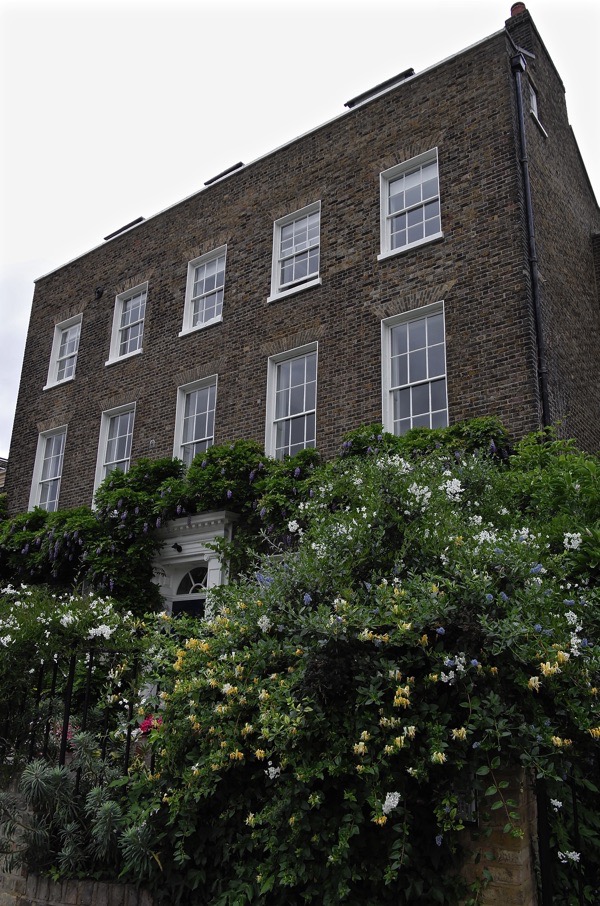
I have walked past William Morris’ former house on the river bank in Hammersmith many times and always wondered what it was like inside but, since it is now a private dwelling, I never expected to visit. However, the residents kindly open their doors to members of the William Morris Society once every two years and thus, a couple of weeks ago, I was permitted to join the tour.
William Morris was forty-three years old when he came to live here. It was to be his last house in a succession that began with his childhood home in Walthamstow and included the Red House in Bexleyheath, designed for him and Jane as their marital home by Philip Webb, and the sixteenth century Kelmscott Manor by the Thames in Lechlade. The rural idyll which William Morris hoped for at Kelmscott Manor had been sullied by the overbearing presence of Dante Gabriel Rossetti whose obsession with Jane Morris had led him to take up permanent residence.
“If you could be content to live no nearer London than that, I cannot help thinking we should do very well there and certainly the open river and the garden at the back are a great advantage,” William wrote tactfully to Jane in February 1877. “If the matter lay with me only, I should be setting about taking the house, for already I have become conscious of the difficulty of getting anything decent. As to such localities as Knightsbridge or Kensington Sq, they are quite beyond our means.”
Built in the seventeen-eighties, the house was known as The Retreat and had once been the home of Sir Francis Ronalds, inventor of the electric telegraph, who had filled the long garden, which stretched all the way back to King St then, with buried cables as part of his experiments. When William Morris came here and renamed it Kelmscott House, it had been the home of the novelist George MacDonald for a decade. However – somewhat ominously for Morris – they chose to leave since MacDonald believed that the proximity to the polluted river was responsible for his family’s ill-health. In those days, the riverfront at Hammersmith was heavily industrialised with factories and wharfs.
I realised that, in my imagination, I felt I had already visited Kelmscott House. Long ago, when I read Morris’ novel News From Nowhere, I was seduced by his vision of a homespun Utopia that had turned its back on industrialism. In my memory, as if in the moonlight of a dream, I joined the characters as they departed Kelmscott House and undertook the journey up the Thames from Hammersmith to Kelmscott Manor in Oxfordshire, travelling a hundred years into the future.
In reality, it was one of the brightest days of our rather disappointing summer when I paid my visit to Kelmscott House. Comparable to the experience of visiting a location from a dream, there were compelling details which evoked that faraway world, even if time and change had wiped away almost all of the evidence of Morris’ occupation of the house. “Let us hope that we shall all grow younger there,” he wrote to Jane with forced optimism in October 1878, just before they moved in.
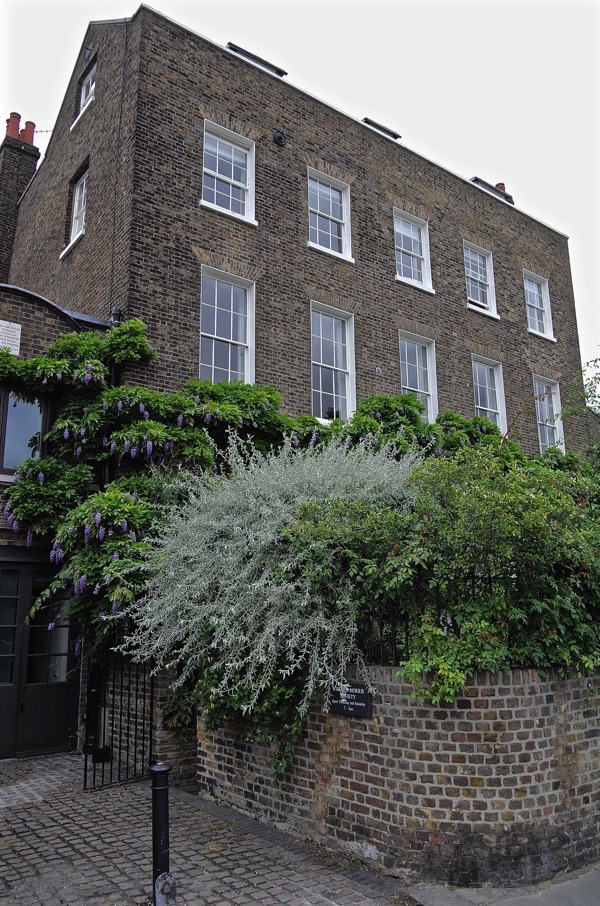
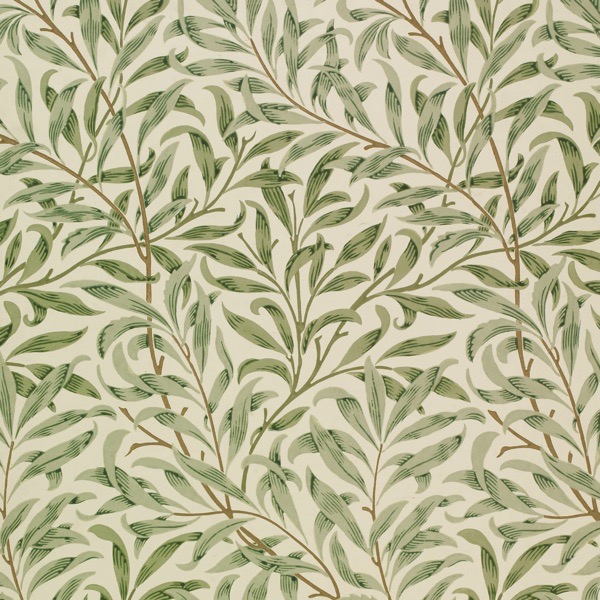
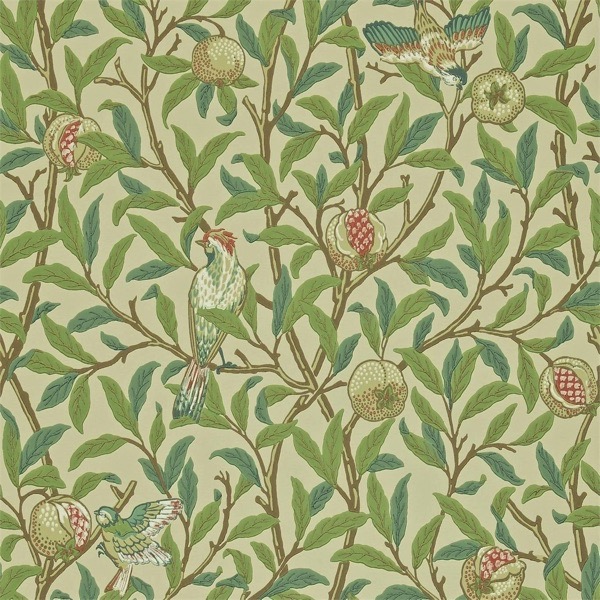
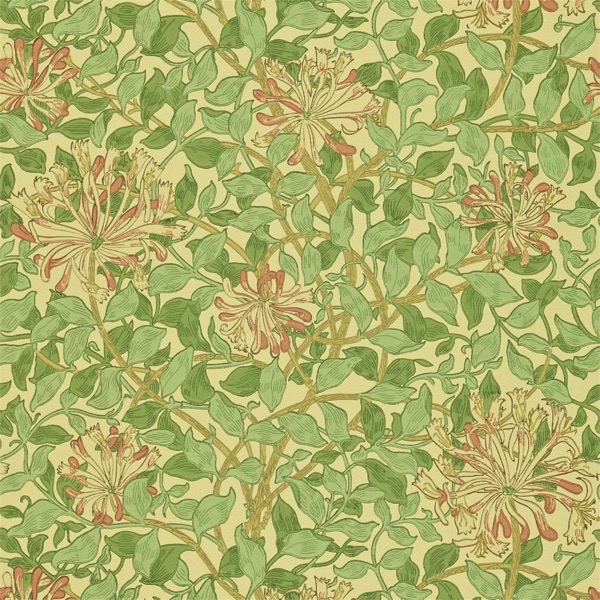
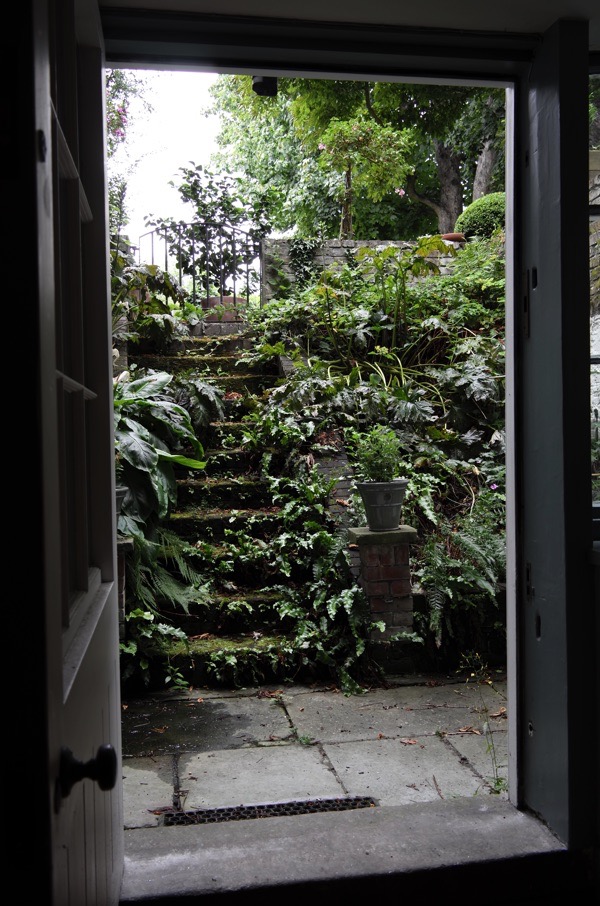
Walking through the narrow passage beside The Dove, you discover the wide expanse of the Thames on the left and Kelmscott House rising up on your right, presenting an implacable frontage to the river. You enter through the area stairs on the left of the house, leading down to the kitchen, and immediately you notice a wall of original trellis wallpaper, designed by Morris with birds drawn by Philip Webb. If no-one told you, you would assume it was a recent reprint since these papers remain in production today. The low-ceilinged basement rooms are now the headquarters of the William Morris Society, where you may admire his Albion Press before climbing stairs again into the former coach house. This long narrow room was employed by Morris as a workshop for knotting carpets, also lectures and meetings of the Hammersmith Socialist League were held here. During his final years at Kelmscott, Morris became increasingly involved with politics and the Socialist cause.
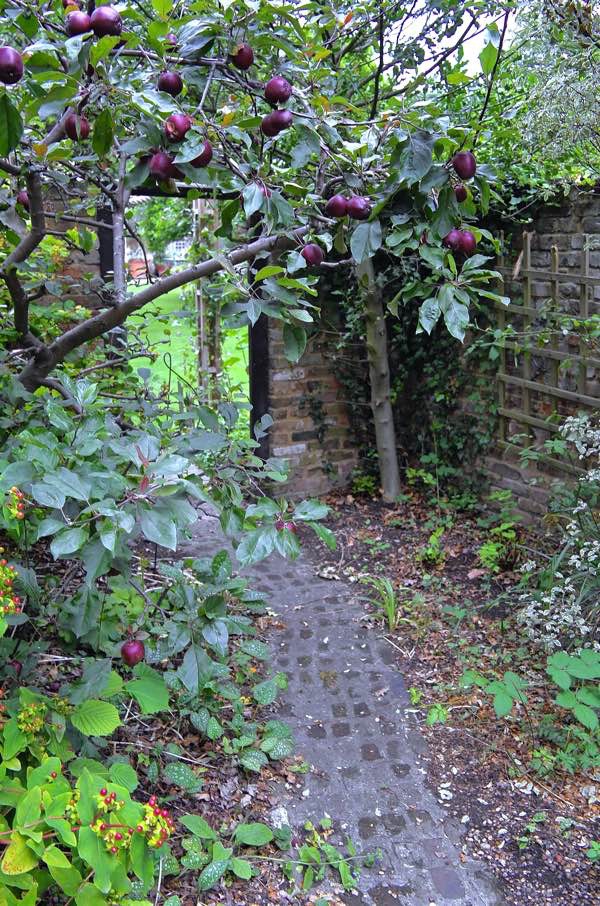
The garden no longer stretches to King St, just as far as M4, yet it is impressively generous for a London garden, with well-kept herbaceous borders and a wide lawn. Most fascinating to me, though, was the strawberry patch – since William Morris’ Strawberry Thief is one of his most celebrated textile designs, inspired by his experiences at Kelmscott Manor where the thrushes raided his soft fruit.
Approaching the house from the rear, it presents quite a different aspect than from the front, with assymetric projections and a bowed turret. The high-ceilinged dining room at the back was especially offensive to Morris with its Adam detailing and Venetian window. This seems a curious prejudice to the modern sensibility. Perhaps our equivalent might be those eighties post-modern buildings which have not aged well. Fortunately, Morris suspended a vast sixteenth century Islamic carpet across one wall and part of the ceiling, drawing the eye from the Georgian elements which he found so hideous.
Emery Walker photographed the interiors, capturing Morris’ personal sense of interior design, employing lush textiles and extravagant antiques, mixed with furniture painted by Philip Webb and fine oriental ceramics. Architecturally, the most impressive space is the first floor drawing room which spans the width of the house, created by George MacDonald by knocking two bedrooms into one. In this south-facing room, the views over Chiswick Reach are breathtaking. Morris lined it with a rich, bluish tapestry of birds in foliage that he designed for this location. A huge settle painted with sunflowers by Philip Webb once sat beside the fireplace, lined with blue and white tiles manufactured by Morris & Co and still in situ.
In 1881, seeing children from the nearby slum known as Little Wapping swinging on his garden gate, Morris recognised, “It was my good luck only of being born respectable and rich, that has put me on this side of the window among delightful books and lovely works of art, and not on the other side, in the empty street, the drink-steeped liquor shops, the foul and degraded lodgings.”
Overlooking the garden at the back was Jane Morris’ room, somewhat detached from the rest of the house, granting her the independence she required as she withdrew from her marriage during the years at Hammersmith. The two front rooms on the ground floor, overlooking the river, comprised William Morris’ workroom and bedroom. It was in the workroom to the left of the front door that he supervised the creation of the Kelmscott Press, publishing fifty-two titles in five years. In his bedroom to the right, he installed a loom to undertake tapestry through the long hours of the night when he could not sleep. Here he died from tuberculosis on 3rd October 1896, aged just sixty-two, nursed by Emery Walker as his breath failed him. His last words were, “I want to get mumbo jumbo out of the world.”
I walked back along King St to the tube, past the Lyric Sq Market where William Morris once spoke. I thought about him taking the District Line back and forth to visit East London for public speaking – and I decided I should trace his footsteps in the East End next.
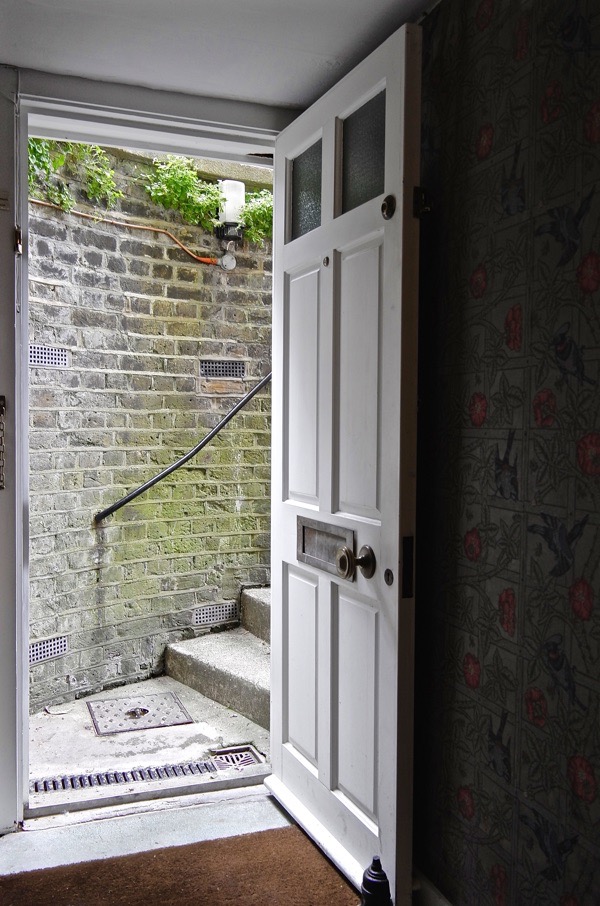
Basement stairs with original Morris ‘Trellis’ wallpaper
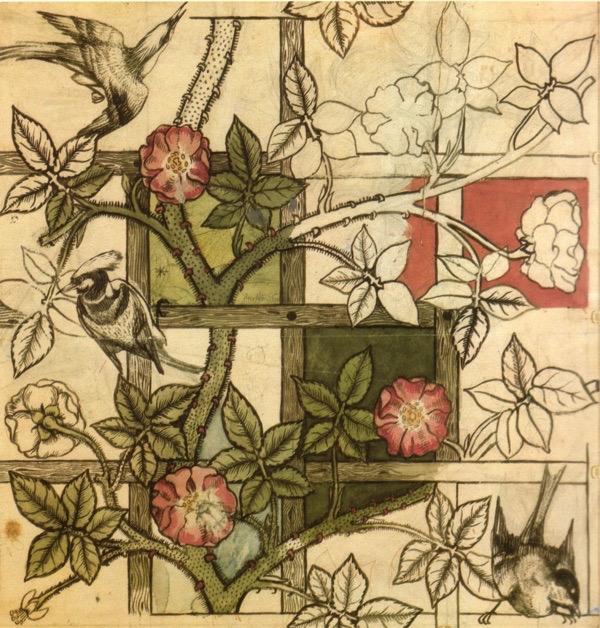
William Morris’ design for ‘Trellis’ wallpaper with birds drawn by Philip Webb
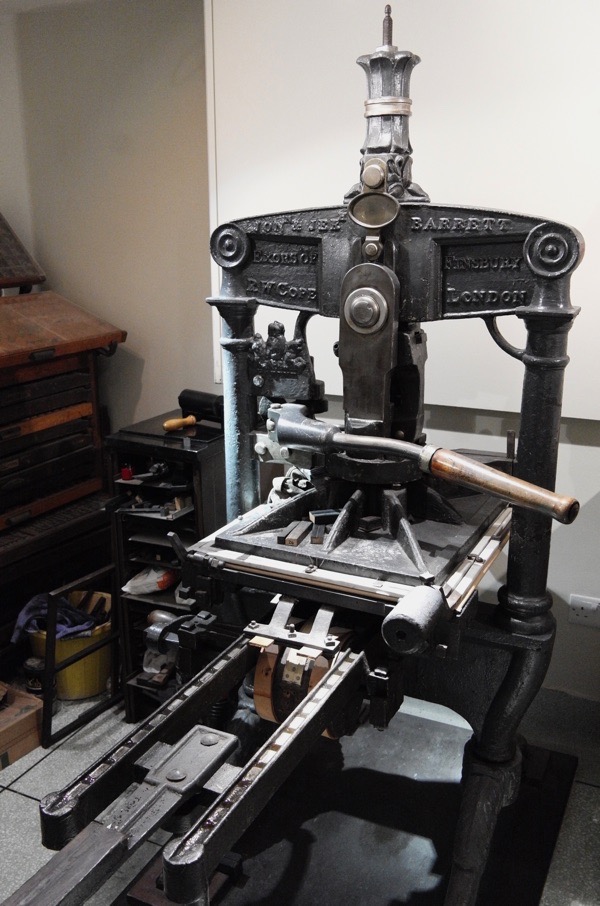
William Morris’ Albion Press
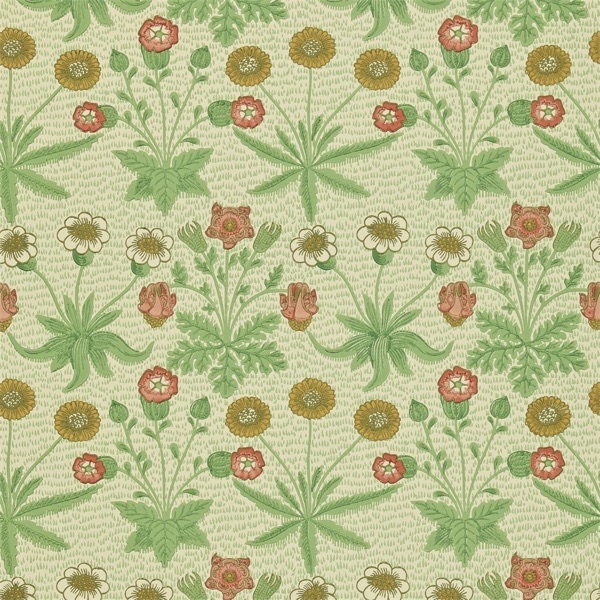
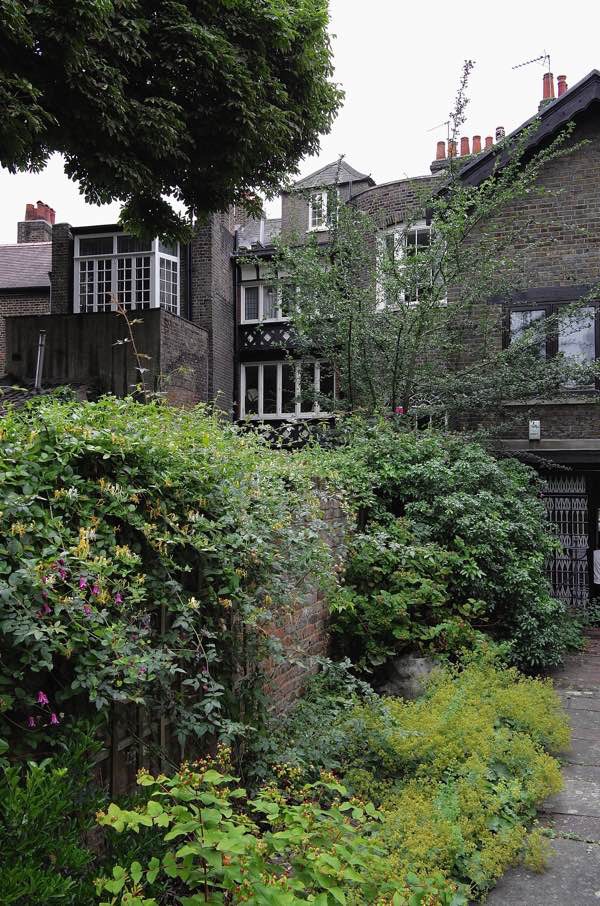
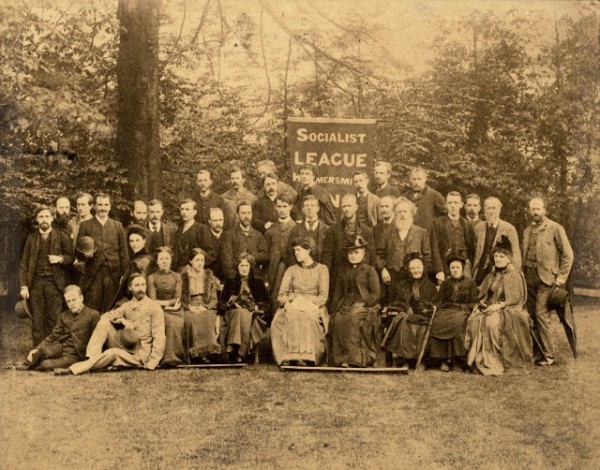
Hammersmith Socialist League gathering on the back lawn at Kelmscott House, 1885
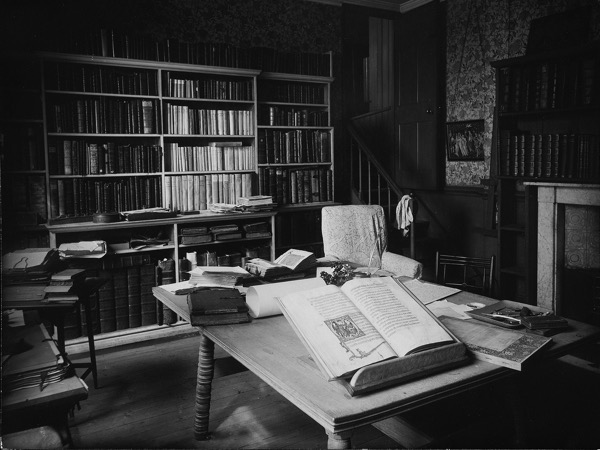
William Morris’ workroom from which he ran the Kelmscott Press, with stairs leading up to the coach house where Hammersmith Socialist League meetings were held (Photograph by Emery Walker)
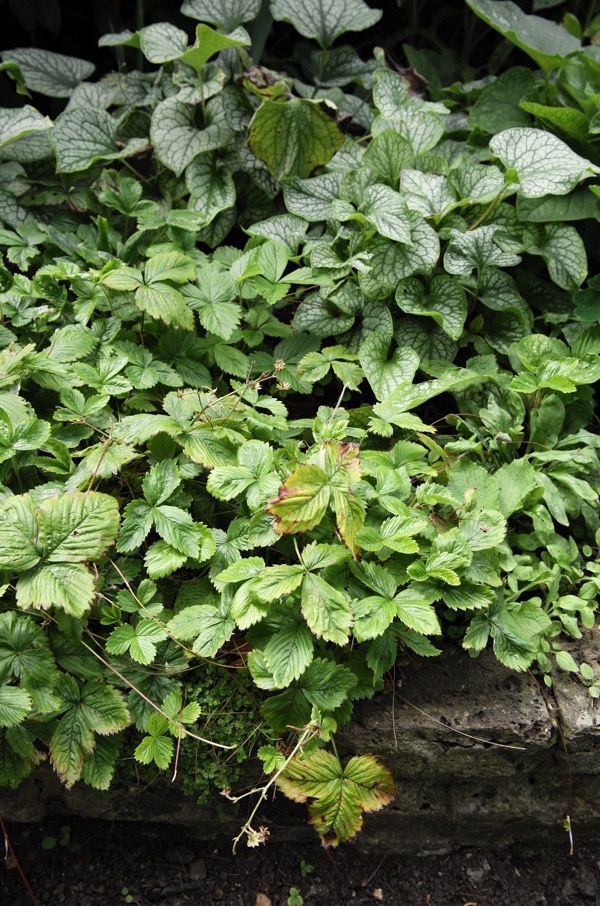
Strawberry patch in the garden at Kelmscott
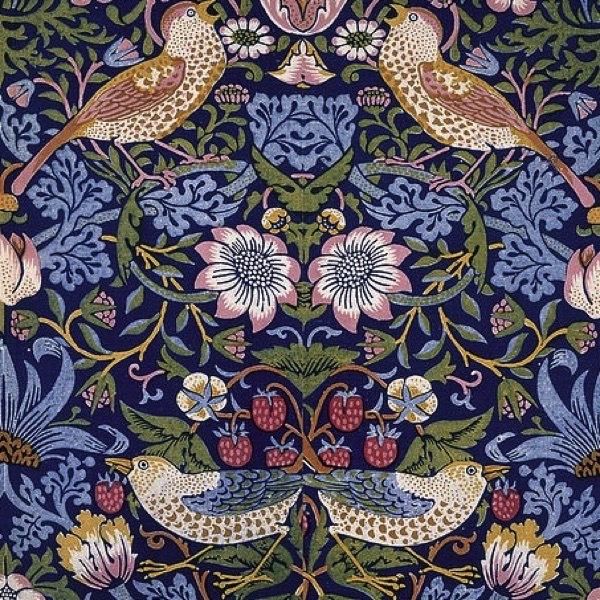
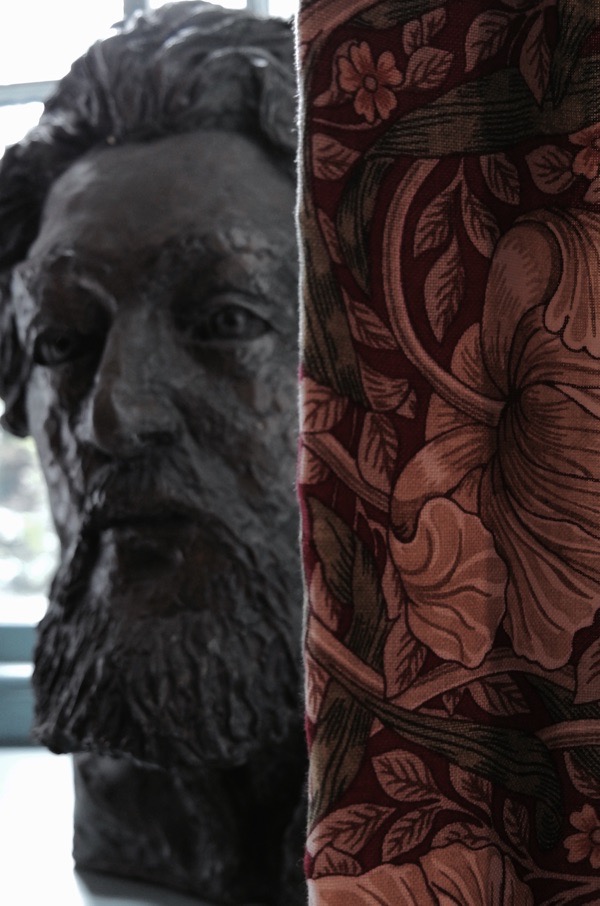
William Morris’ ‘Strawberry Thief’ design
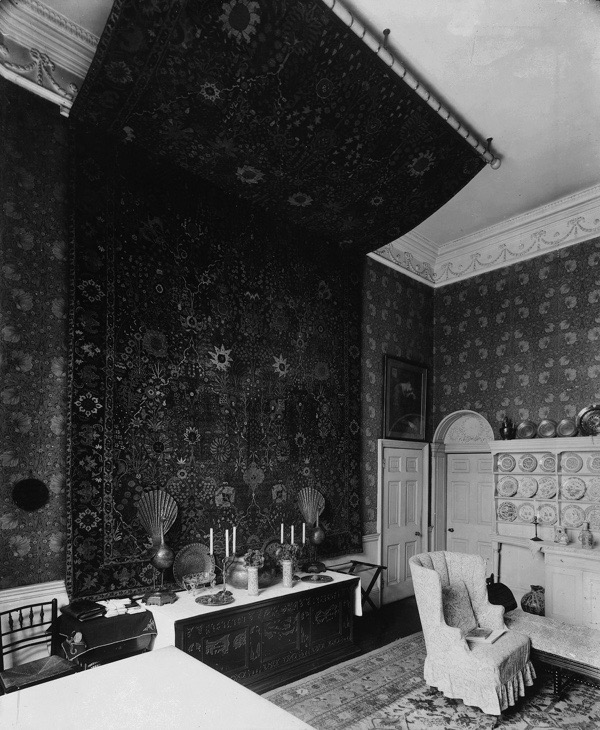
Sixteenth century Islamic carpet displayed by Morris in the dining room at Kelmscott (Photograph by Emery Walker)
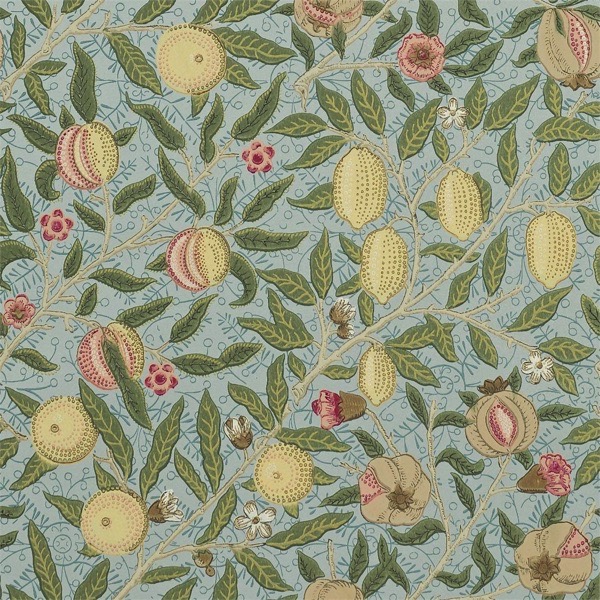
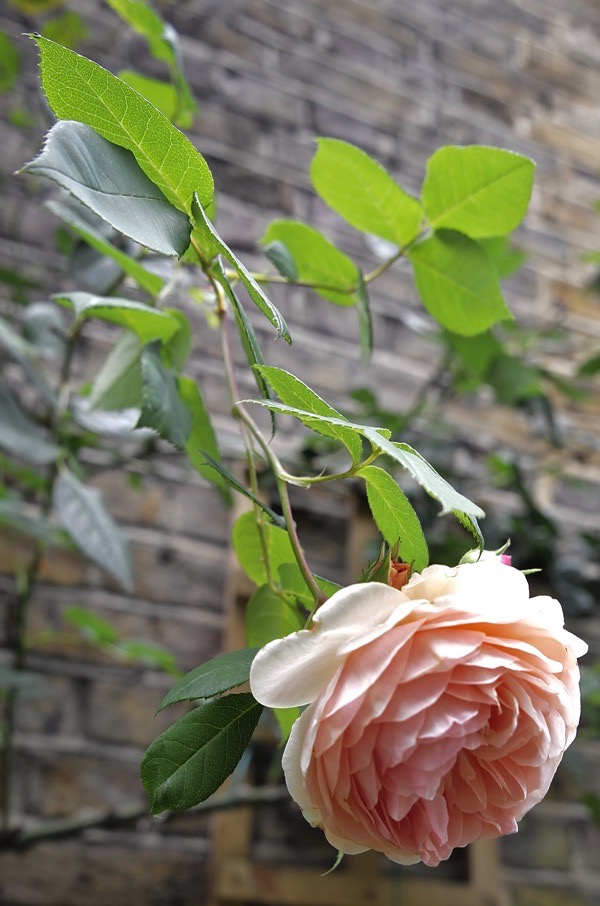
‘William Morris’ rose blooms at Kelmscott
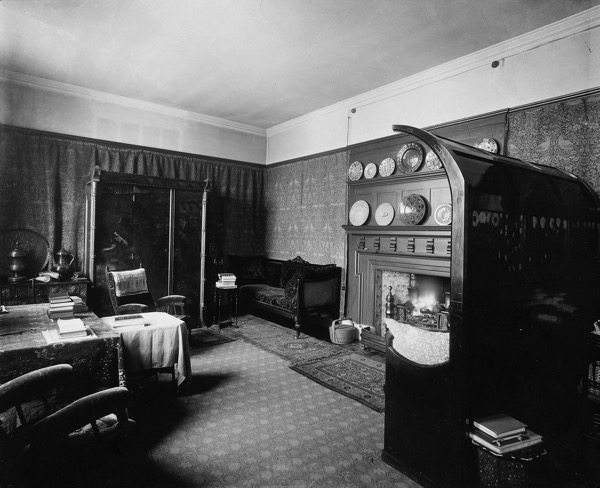
The drawing room at Kelmscott (Photograph by Emery Walker)
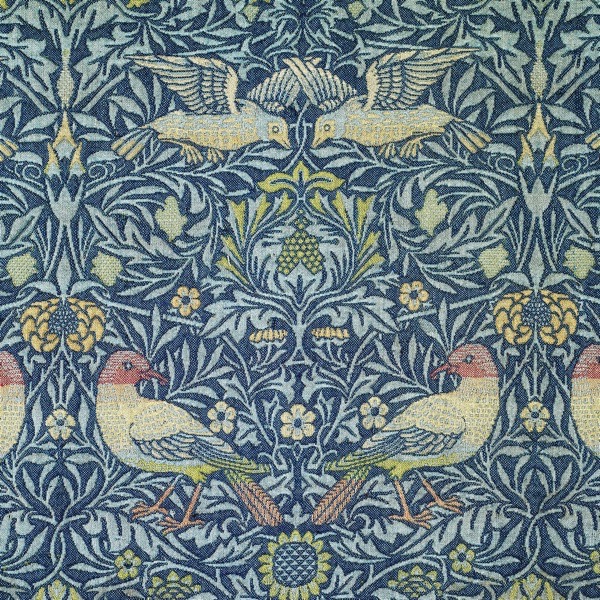
Tapestry designed for the drawing room at Kelmscott
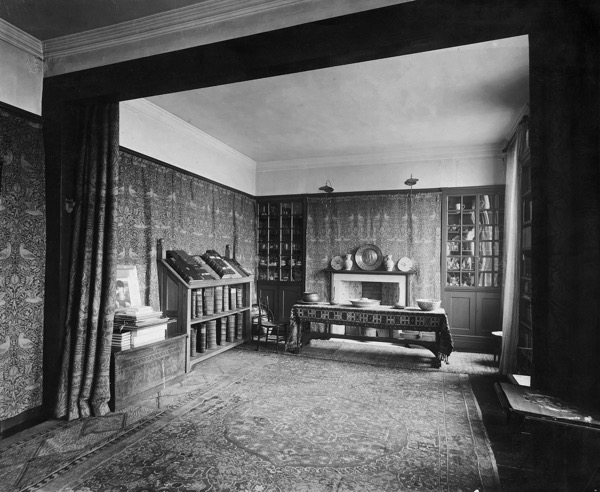
The drawing room at Kelmscott (Photograph by Emery Walker)
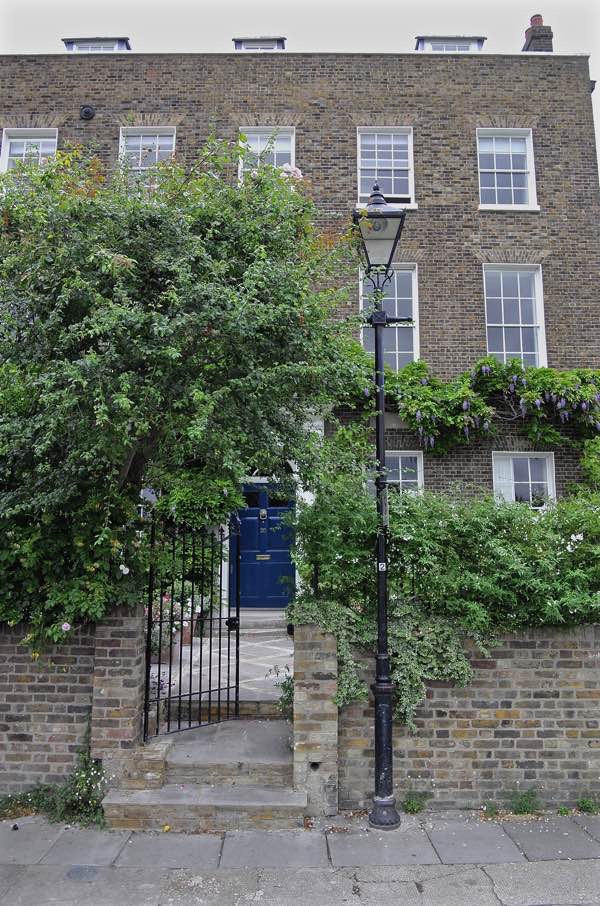
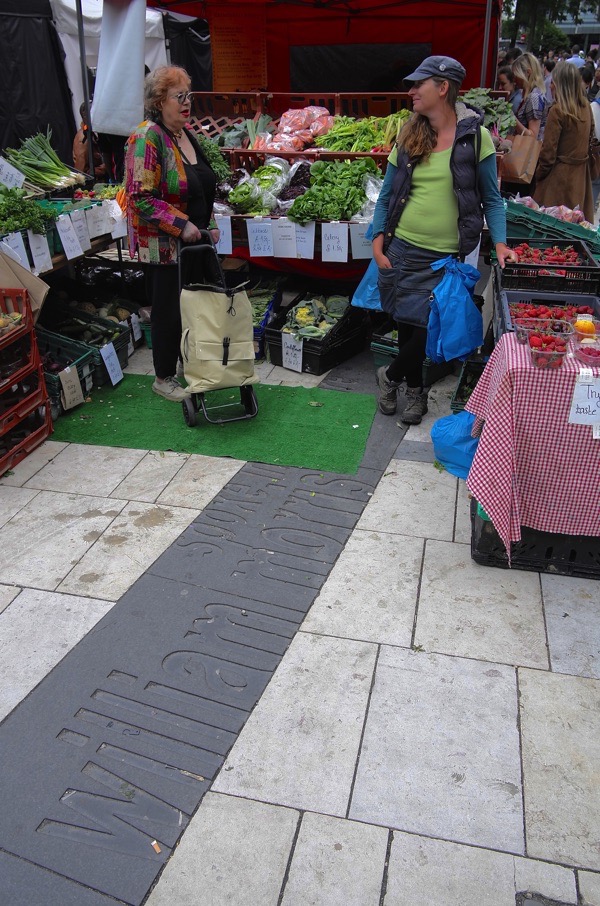
William Morris spoke here – Lyric Sq Market, Hammersmith
Archive photographs courtesy William Morris Society
The lower floor and coach house of Kelmscott House are open on Thursday and Saturday afternoons. Visit the William Morris Society website for further details
You may also like to read about
Ed Gray, Artist
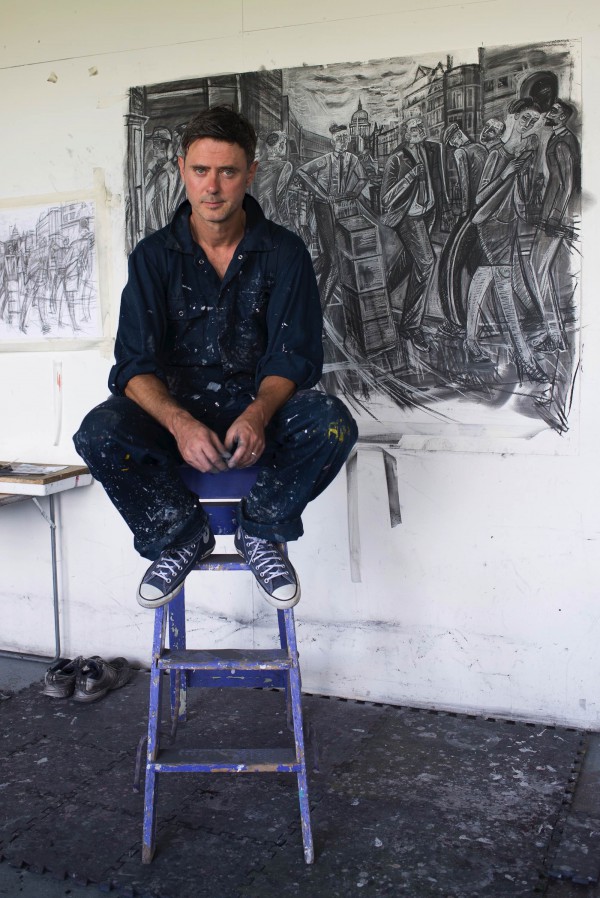
This is Ed Gray sitting in his studio in Mile End, beside the canal and next to the Ragged School Museum, where I visited him last week. I found him in a large empty room with windows overlooking Mile End stadium and just three sketches on the wall for a street scene in the City of London which is his current work in progress.
Ed’s visceral paintings capture the tumultuous street life of the capital superlatively, teeming with diverse characters and delighting in the multiple dramas of daily existence. Despite his mild manners, his is an epic, near-apocalyptic vision that glories in the endless struggle of humanity within the urban stew. Yet the overriding impression is not cynical but rather a life-affirming raucous celebration of the indefatigable vitality of Londoners.
“I paint people and I make art about scenes of daily life. But I do not see this kind of picture represented very much in the contemporary art world. In their view, this work is not cool, happening or sensational. Yet I find so much stimulus when I go out onto the street drawing. I could make dozens of paintings about any single location. London is such a mixture of different places, there are different energies in every place, so I do not want to stay in one place, I keep moving on.
I have been painting a lot for the last twenty years, doing figurative scenes, and I work hard to have exhibitions and find an audience for my paintings, and provoke conversations about the city. It feels like an underground thing. My shows are popular and I am lucky because my paintings sell, so that keeps me going. It seems a shame that more artists do not go out and paint the people of the city.
It is a challenge because the city changes so quickly. If I am working on a painting for three months in my studio and then I go back out into the city, it is different place. The place I painted has changed and the people have changed too. Sometimes buildings I painted are not there anymore, even in a short space of time. It is an incredible challenge and hard to know where to begin.
I studied at art college in Wimbledon and then Cardiff, where I used to go down to the docks. It was before they regenerated them. I painted the docks and the buildings – landscapes without people. Then I got interested in the fish market in Cardiff and I painted the people there. On my mother’s side, my grandfather was a fish merchant in Grimsby so I had an interest in those scenes. It took off from there and I became more and more interested in painting people, which I had always done as a kid but I had not found the confidence to paint people the way that I wanted. It took that experience to put me on that path.
I left college in 1995 and moved back to London, and I had a studio in a squat in the Elephant & Castle. I was trying to paint big oil paintings seven foot across, but I had no money so I could not afford to do it. I lasted a few years doing odd jobs and trying to keep that going. Eventually I thought, ‘I can’t do this!’ so I took a full time job working as a security guard at the Natural History Museum. I thought I would go into some kind of educational work, I had been working in a youth club in Battersea and I knew I had something I could pass on to the kids. I liked making art with them.
So, during my two years at the Natural History Museum, I would paint in the evenings just for myself. And I read all the books I was supposed to read at art college and secured my knowledge. Then I did my PGCE in art education at Exeter University and for a year I was teaching in Cornwall. When I came back to London, I realised I could teach and paint. So I taught part time at a school in Peckham for four years while painting the rest of the time. I had studio on the Old Kent Rd in a building which is no longer there. Over time, I accumulated a lot of paintings in the flat that I was sharing with friends and they said, ‘You need to do something with these pictures.’
By then, I had found a way that I wanted to work, which was based in going to a location, making direct observations with my sketch book for however many days it takes until I have soaked up the scene, before going back to my bedroom and making a paintings over a period of weeks. These were much smaller than the work I am doing now but it was keeping me going, it was an outlet for all the things I wanted to say about the city. In the nineties, there was a negativity about the city and city life, but I had just come back from Cornwall and I thought it was the most exciting place, with so much to paint.
I had all these paintings but I had no experience of galleries, so we took a car load of work around and the only place that would give me an exhibition was a little pop-up space in Brixton. I had my first solo show there in 2001 with ten paintings in it. It was amazing, loads of people came the private view and some could not even get into the building! It was real eye-opener to me that my painting was communicating something. All kinds of people came in from the street in Brixton, there was not a single demographic that came to see that show. It was a really exciting thing.
I applied for a residency in Bermuda and I got it, so I took a sabbatical from my teaching job. I had some money because I had sold a couple of paintings from my show. I had a studio in Bermuda and I had three exhibitions out there. It was the first time I was able to think entirely about making art and not having to pay my rent. It was an incredible time and I can hardly believe it happened. Afterwards, I travelled from Panama to Mexico City, making paintings and drawings. I was learning about making work on the hoof.
When I came back to London, I went back to the school and, after another year, I had another exhibition. A gallery in Camberwell gave me a show in 2003. I did ten paintings and they all sold, so I left my teaching job and concentrated on painting. Acme offered me a studio in Mile End next to the canal in 2006. I have always lived south of the river, first in Bermondsey and now Rotherhithe, so I am very familiar with those scenes and I have painted some of them. But separating where I live and really work is really important to me, coming across the river. The amount of life and lives you encounter here is more diverse in the East End. There is so much I could paint.
My picture of the Whitechapel Rd felt like a beginning for me of the paintings I could make about Whitechapel. I have so many scenes in mind. I wanted to start in the Whitechapel Rd because it is this long ancient road that comes out of the City of London. I used to cycle or walk that way to work and come through the market. I love markets, people are drawn to them and the characters are fantastic for painting. The history and the politics, the combination of the hospital and the market, and so many people from different lands that have come to work in London – for all of theses things, it is a meeting point.”
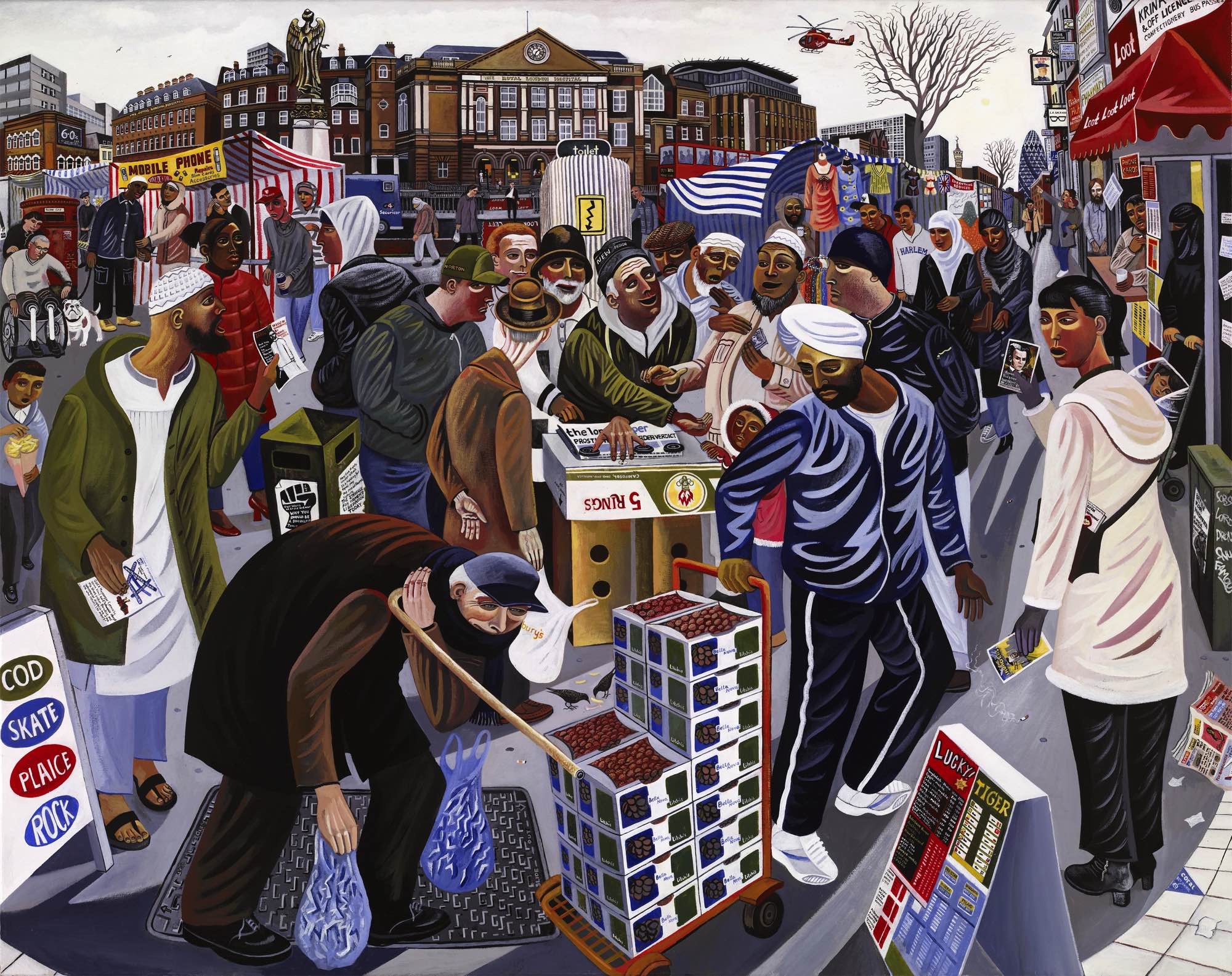
‘Lucky Tiger,’ Whitechapel Road, 2008 (Click on this painting to enlarge)
“I often walk through Whitechapel Market on my way to the studio. From a cafe, I watched the men set up the cardboard boxes and I took out my pencil and I began to draw. There is no ‘Lucky Tiger’ in this painting because there is no luck here, no punter will win. The child senses this and she can see past the man’s arm which is covering the switch he is about to make.”

‘Adoration in the East,’ Mile End Tube, 2014 (Click on this painting to enlarge)

‘Adoration at the Lion’s Den,’ Milwall Football Club, 2014 (Click on this painting to enlarge)
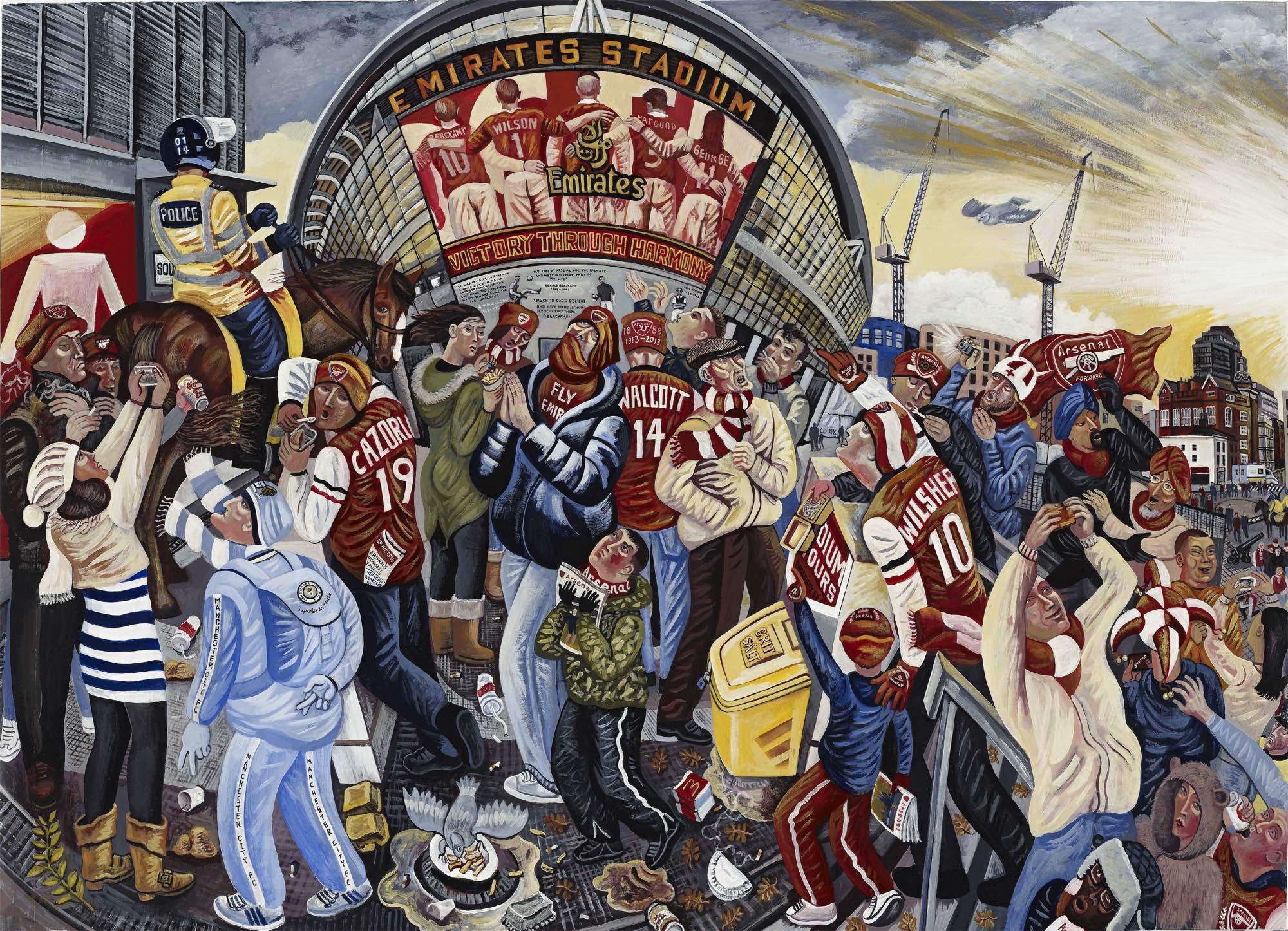
‘Adoration at the Emirates,’ Arsenal Football Club, 2014 (Click on this painting to enlarge)

‘Adoration of Thomas A Becket,’ Old Kent Rd, 2016 (Click on this painting to enlarge)
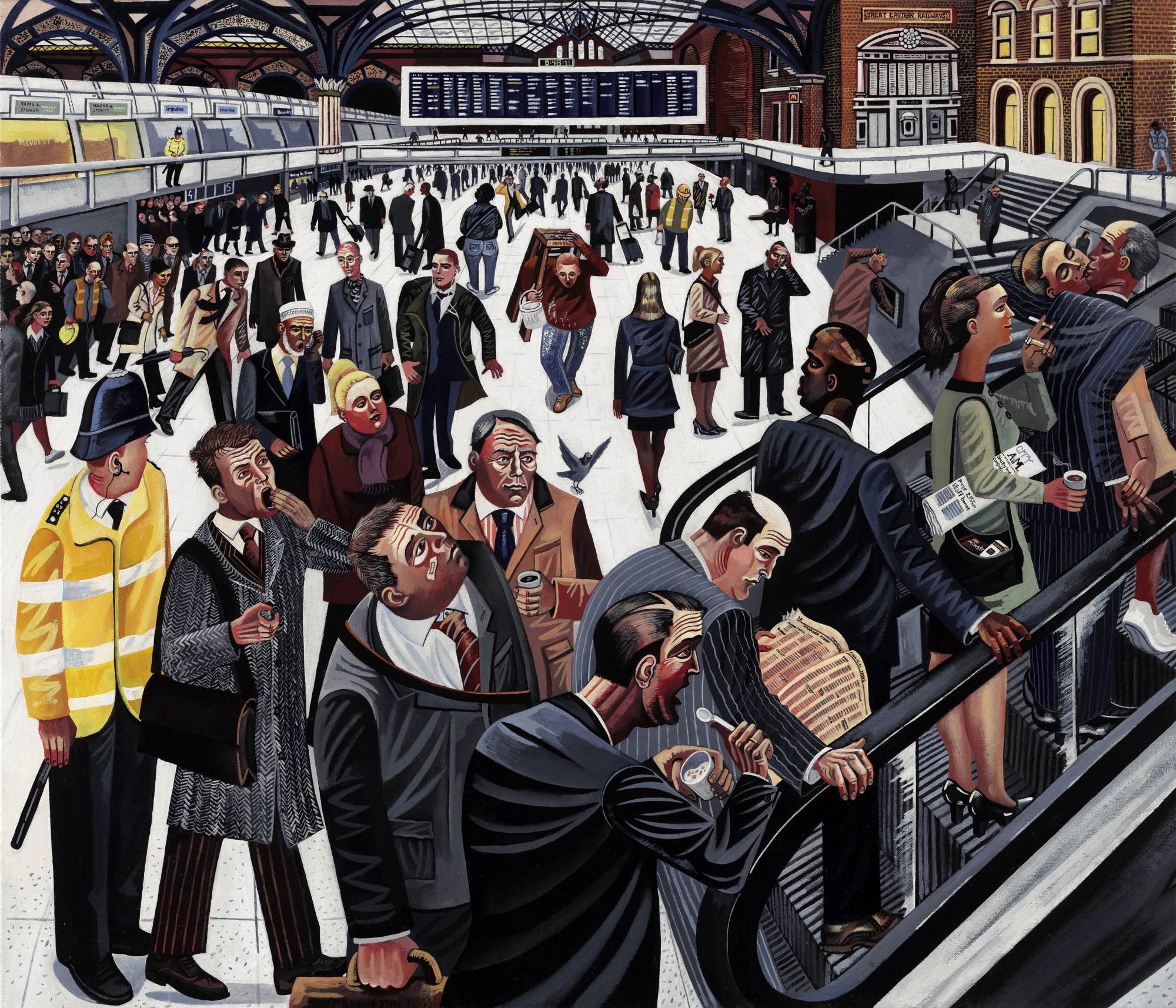
Liverpool St Station, 2007 (Click on this painting to enlarge)
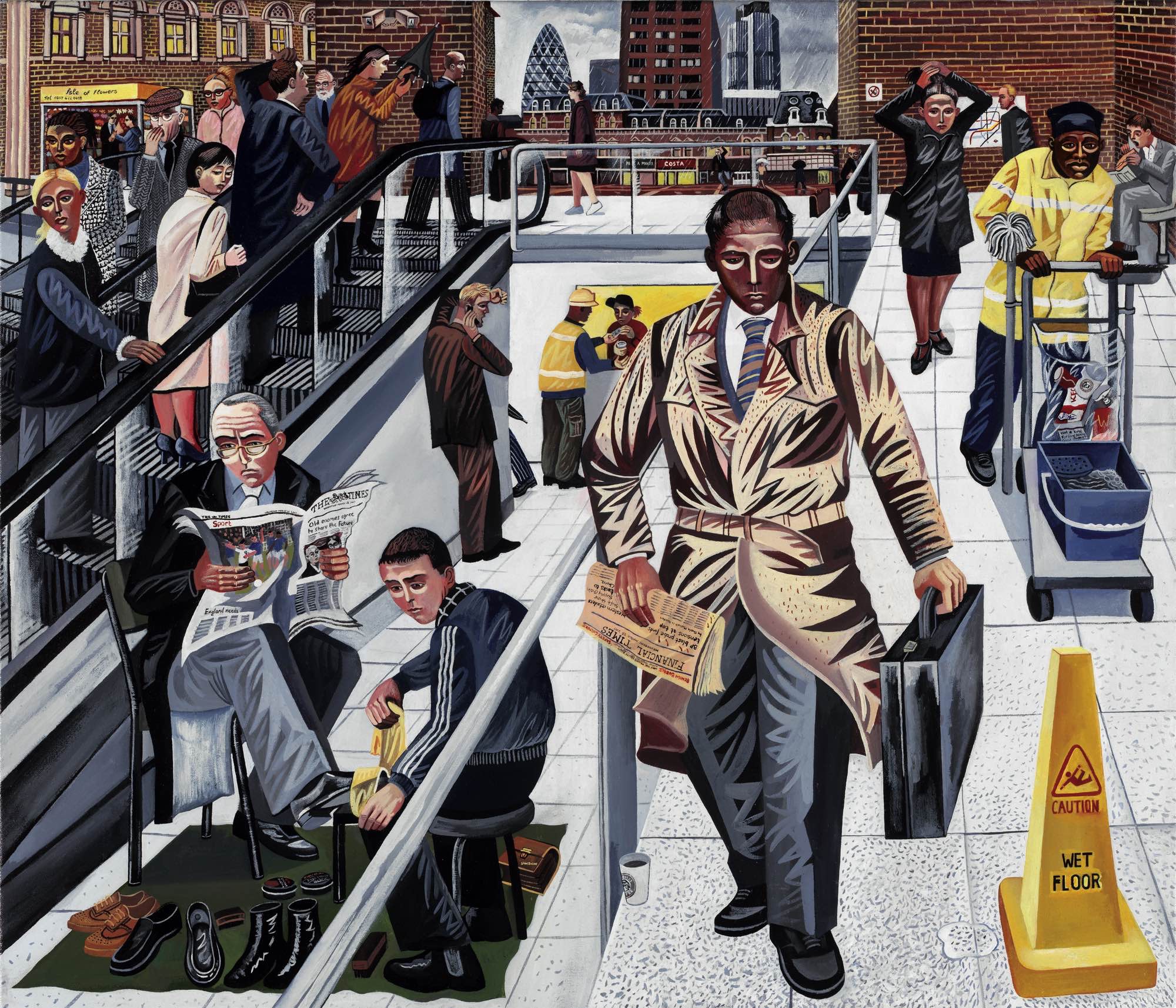
Liverpool St Station, 2007 (Click on this painting to enlarge)
 St Mary Axe, 2012 (Click on this painting to enlarge)
“I have always painted the Gherkin when I can, I use it to navigate around the City while I am drawing. This painting is about the banking crisis that began in 2008. I sat by the Aviva building in windswept St Mary Axe and drew the faces of the brokers and bankers, the secretaries and the construction workers.”

‘Skittles,’ Blackfriars Bridge 2008 (Click on this painting to enlarge)
“For a few wintry mornings, I stood on Blackfriars Bridge in 2008 making sketches of the waves of flowing commuters. An icy wind whipped up the Thames, blowing through me. A boy crept unwillingly to school dragging a figure through the soot on the bridge and leaving his mark in defiance of the journey he had to make. He dropped a ‘Skittles’ wrapper and it occured to me that these Londoners are like skittles bracing themselves against the next blast that could topple them.”
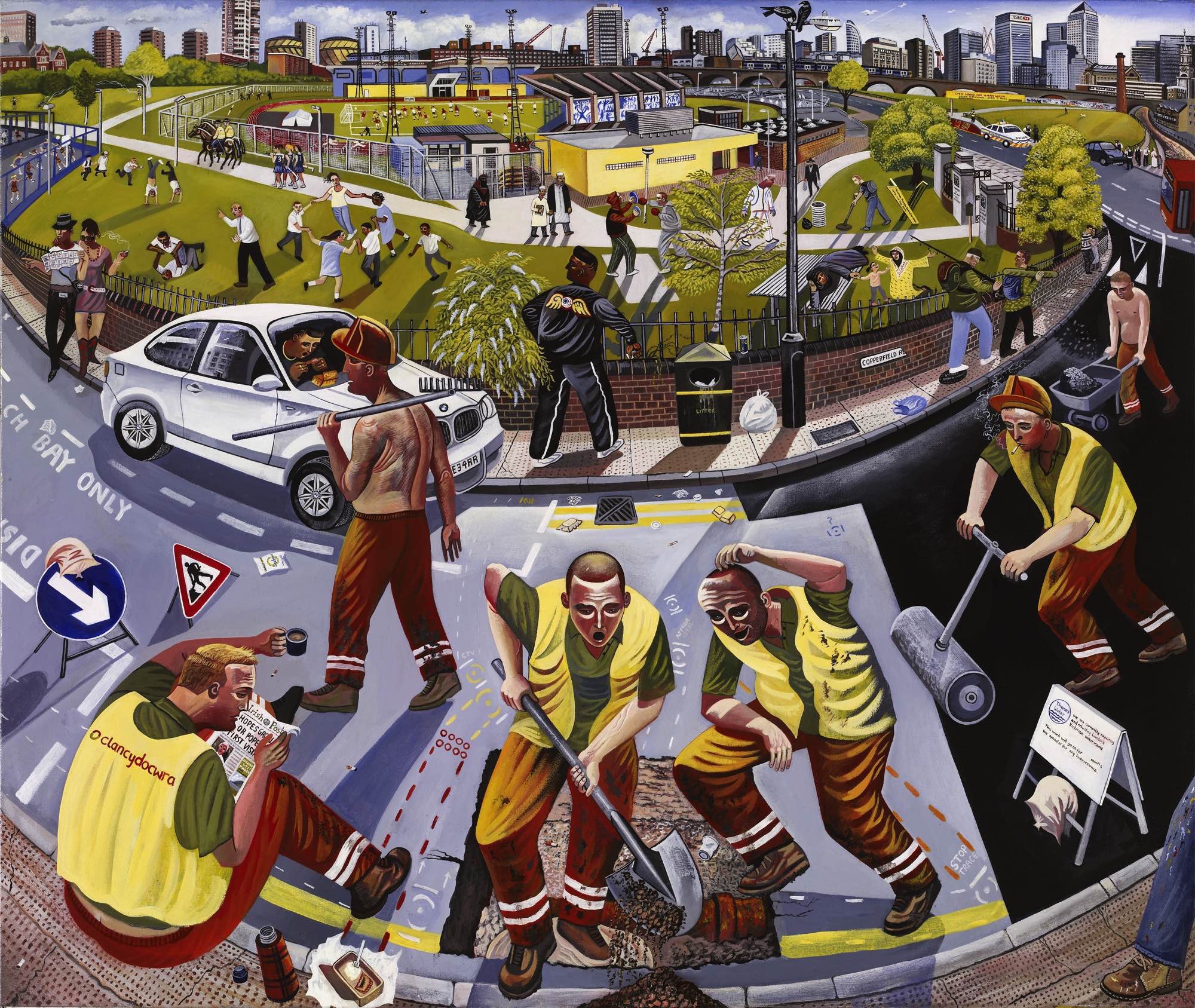
Mile End Beginning, 2008 (Click on this painting to enlarge)
“This pair of Mile End paintings are about my working day and how inspiration arrives for me, they are both views from my studio window. ‘Beginning’ is about arriving at work for the day in the summer, I’m optimistic and full of ideas after walking from home in Rotherhithe through the streets of London.”

Mile End End, 2008 (Clickon this painting to enlarge)
“I began ‘Mile End End’ as the nights became darker and the autumn set in. When I turned out the studio light at night, the glowing green of the Mile End sports stadium seemed so intense that I had to paint it. I wore a head torch while I worked to capture the intensity of the light and I studied the movements of the night time characters – the addicts, the sportsmen, the fishermen and the lovers.”

Night on Mare St, Pig’s Ear Beer Festival 2010 (Click on this painting to enlarge)
“At the Ocean Leisure Centre in Hackney, the faithful gathered for the annual Pig’s Ear Beer Festival, with beer and cider from every corner of the British Isles to be sampled. The painting is a celebration of this country.”
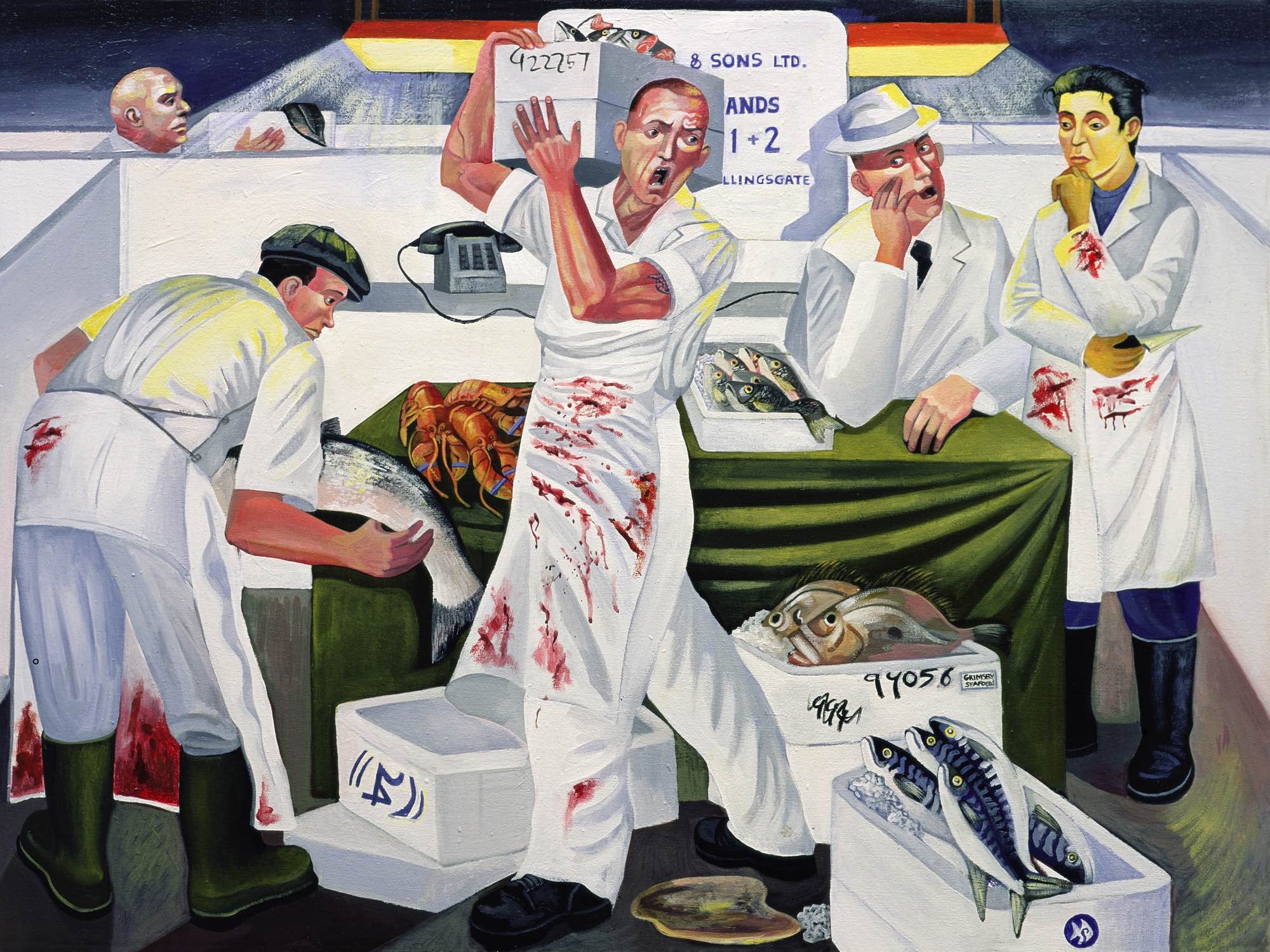
Billingsgate Porters 2005 (Click on this painting to enlarge)
 ‘Rock of Eye,’ Threadneedleman Tailor, Walworth Rd 2014 (Click on this painting to enlarge)
“I have had the pleasure of knowing George Dyer ever since I asked him to make my wedding suit several years ago. A Jamaican by birth with some Cuban added to the mix, young George flew to England aged five to be reunited with his family who had emigrated earlier. George is the go-to man for sharp tailoring in addition to philosophical discussions about our place in the cosmos, all of which he offers from a small shop in the Walworth Rd.”

York Hall Boxers 2011 (Click on this painting to enlarge)
“I spent an evening sketching in the crowd at York Hall thanks to the late great Dean Powell, manager and fight manager for the legendary Frank Warren. Dean is seated at the top of the ring. It was a successful night for him. I filled three sketchbooks, hypnotised by the rhythm of the dancing boxers and jabbing my pencil at the paper with the violence of their blows.”

‘Adoration of the Cockney Rebels,’ Bermondsey Carnival 2016 (Click on this painting to enlarge)
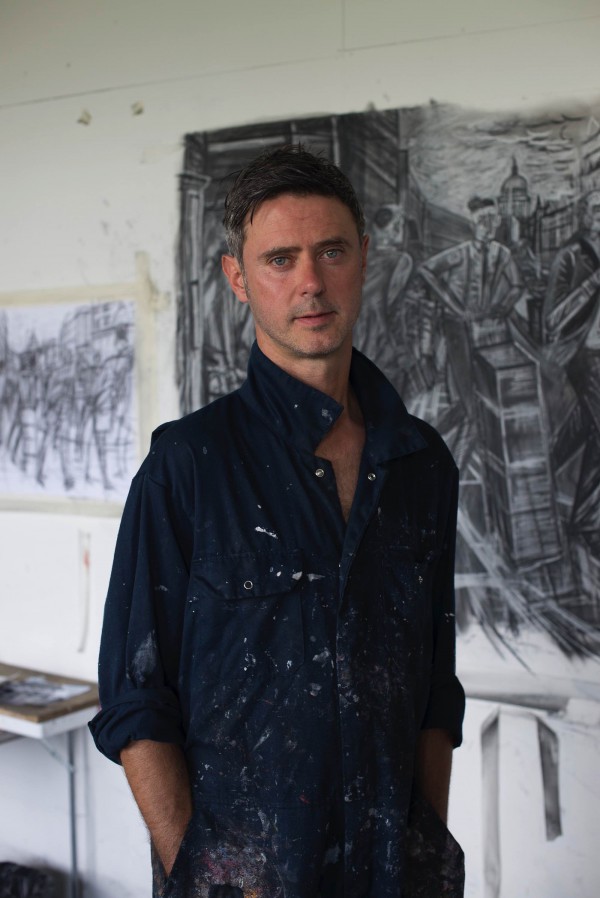
Ed Gray at his studio in Mile End
Paintings copyright © Ed Gray
Photographs copyright © Sarah Ainslie












