Love Tokens From The Thames

These love tokens are from the collection gathered over the last seventeen years by my Thames mudlark friend Steve Brooker, widely known as Mud God.
The magical potential of throwing a coin into the water has been recognised by different cultures in different times with all kinds of meanings. Yet since we can never ask those who threw these tokens why they did it, we can only surmise that engraving your beloved’s name upon a coin and throwing it into the water was a gesture to attract good fortune. It was a wish.
With a great river like the Thames racing down towards the ocean, there is a sense of a connection to the infinite. And there is a sweet romance to the notion of a lover secretly throwing a token into the water, feeling that the strength of their emotions connects them to a force larger than themselves.
Naturally, it was not part of the conceit that someone might ever find these coins, centuries later – which gives them a mysterious poetry now, because each one represents a love story we shall never learn. Those who threw them have gone from the earth long ago, and all we can envisage are the coins tossed by unseen hands, flying from the river bank or a from the parapet of a bridge or from a boat, turning over in the air, plip-plopping into the water and spiralling down to lie for centuries in the mud, until Steve Brooker came along to gather them up. Much as we may yearn, we can never trace them back to ask “What happened?”
In the reign of William III, it was the fashion for a young man to give a crooked coin to the object of his affections. The coin was bent both to become an amulet and to prevent it being reused. If the token was kept, it indicated that the affection was reciprocated, but if the coin was discarded then it was a rejection – which casts a different light upon these coins in the river. Are they, each one, evidence of unrequited affections?
From the end of the eighteenth century and until the early twentieth century, smoothed coins were used as love tokens, with the initials of the sender engraved or embossed upon the surface. Sometimes these were pierced, which gave recipient the option to wear it around the neck. In Steve’s collection, the tokens range from heavy silver coins with initials professionally engraved to pennies worn smooth through hours of labour and engraved in stilted painstaking letters. In many examples shown here, the amount of effort expended in working these coins, smoothing, engraving or cutting them is truly extraordinary, which speaks of the longing of the makers.
Steve has found many thousands of coins in the bed of the Thames over the years but it is these worked examples that mean most to him because he recognises the dignity of the human emotion that each one manifests. Those who threw them into the river did not know that Steve was going to be there one day to catch them yet, whatever the outcome of these romances, he ensures that the tokens are kept safe.

Benjamin Claridge.

The reverse of the Benjamin Claridge coin, from the eighteenth century or earlier.

The intials M and W intertwined upon a Georgian silver coin.

The intial W upon the smoothed face of Georgian silver coin, bent into an S shape.

Crooked Georgian silver coin, as the token of a vow or promise.

The initials AMD upon a smoothed coins that has been pierced to wear around the neck.

A copper penny with the letter D.

C.M. Marsh impressed into a penny.

The letter R punched into a penny within a lucky horseshoe.

Pierced coin set with semi-precious stones.

Who was Snod? Is this a lover’s token or a dog tag?

This pierced silver threepence commemorates the date January 11th 1921.

On the reverse of the silver threepence are the initials, L T. Are these the initials of the giver, or does it signify “Love Token”?

A smoothed penny with the name Voilet upon it. A phonetic spelling of the name “Violet”as the beloved spoke it?

Cut coins from the early twentieth century.
Read my stories
The East End In The Afternoon

There is little traffic on the road, children are at play, housewives linger in doorways, old men doze outside the library and, in the distance, a rag and bone man’s cart clatters down the street. This is the East End in the afternoon, as photographed by newspaper artist Tony Hall in the nineteen sixties while wandering with his camera in the quiet hours between shifts on The Evening News in Fleet St.
“Tony cared very much about the sense of community here.” Libby Hall, Tony’s wife, recalled, “He loved the warmth of the East End. And when he photographed buildings it was always for the human element, not just the aesthetic.”
Contemplating Tony’s clear-eyed photos – half a century after they were taken – raises questions about the changes enacted upon the East End in the intervening years. Most obviously, the loss of the pubs and corner shops which Tony portrayed with such affection in pictures that remind us of the importance of these meeting places, drawing people into a close relationship with their immediate environment.
“He photographed the pubs and little shops that he knew were on the edge of disappearing,” Libby Hall confirmed for me, ‘He loved the history of the East End, the Victorian overlap, and the sense that it was the last of Dickens’ London.”
In 1972, Tony Hall left The Evening News and with his new job came a new shift pattern which did not grant him afternoons off – thus drawing his East End photographic odyssey to a close. Yet for one who did not consider himself a photographer, Tony Hall’s opus comprises a tender vision of breathtaking clarity, constructed with purpose and insight as a social record. Speaking of her late husband, Libby Hall emphasises the prescience that lay behind Tony’s wanderings with his camera in the afternoon. “He knew what he was photographing and he recognised the significance of it.” she admitted.
These beautiful streetscapes are a selection of pictures from the legacy of approximately one thousand photographs by Tony Hall held in the archive at the Bishopsgate Institute.


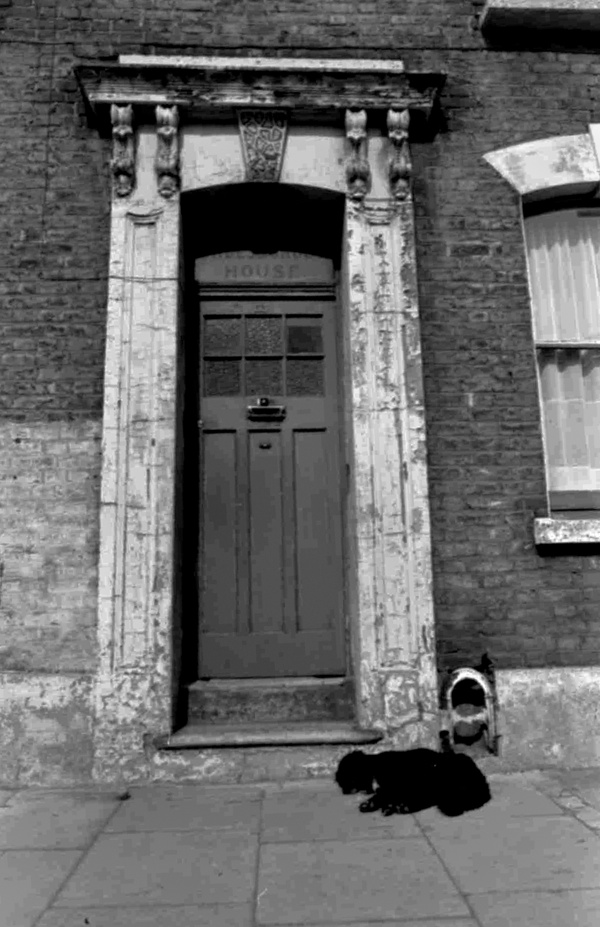


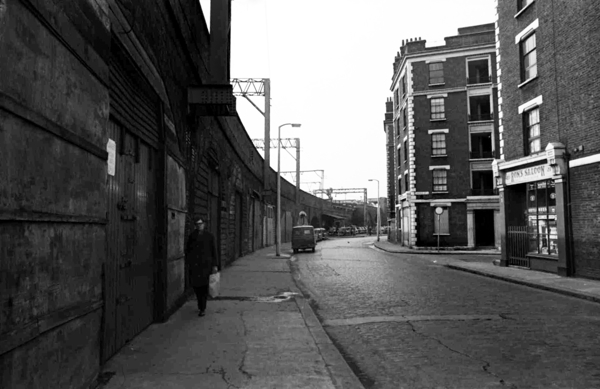
Three Colts Lane

Gunthorpe St


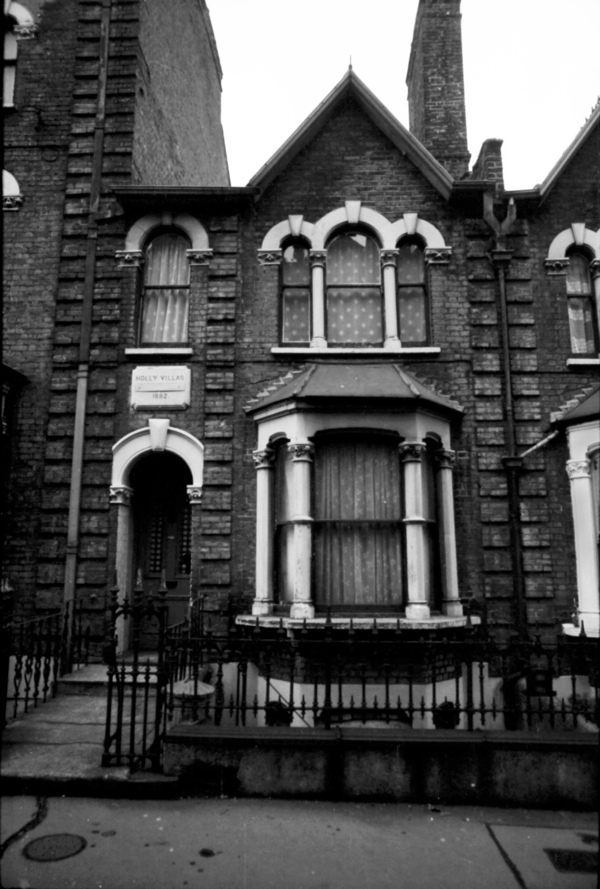


Ridley Rd Market


Stepney Green


Photographs copyright © Libby Hall
Images Courtesy of the Tony Hall Archive at the Bishopsgate Institute
Libby Hall & I would be delighted if any readers can assist in identifying the locations and subjects of Tony Hall’s photographs.
You may also like to read
Tony Hall’s East End Panoramas
At The Drapers’ Hall
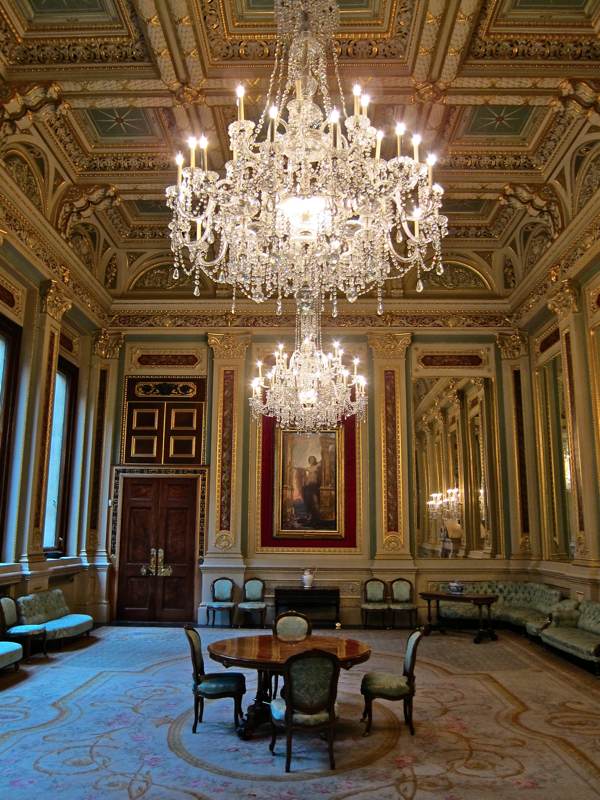
The Drawing Room
As long ago as 1180, the Drapers in the City of London formed a Guild to protect their interests as small traders and help members who fell into distress. The full title of the company was, “The Master and Wardens and Brethren and Sisters of the Guild or Fraternity of the Blessed Mary the Virgin of the Mystery of the Drapers of the City of London.” More than eight hundred years later, it still exists to administer charitable trusts, inheriting headquarters that have been rebuilt over the centuries upon the site of Thomas Cromwell’s house – taken by Henry VIII after Cromwell’s execution at the Tower in 1540 and sold to the Drapers in 1543.
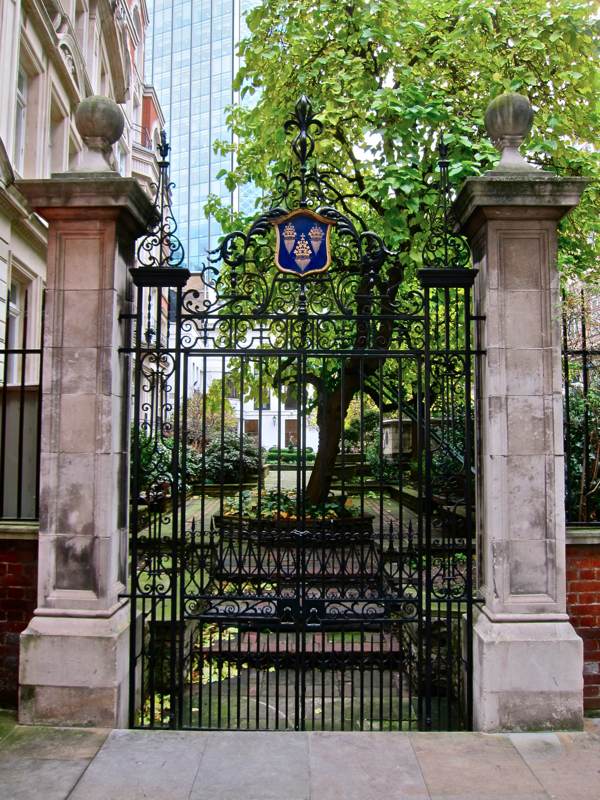
For years, I walked down Throgmorton Avenue and peered through the railings at the Mulberry trees growing there with out knowing that this tiny enclave of greenery in the heart of the city was the last remnant of Thomas Cromwell’s garden. Consequently, I was fascinated to visit the Drapers’ Hall and explore the chambers of the ancient livery company arranged around a hidden courtyard, following the ground plan of the great medieval hall that once stood upon this site. Until then, I had no idea that these palatial spaces existed, sequestered from the idle passerby.
Cromwell’s mansion was destroyed by the Great Fire of 1666, then rebuilt to designs by Edward Jarman in the sixteen seventies and later remodelled in each of the subsequent centuries to arrive at the rambling construction I encountered, which delivers some breathtaking architectural contrasts as you walk from one space to another. Offices occupy the ground floor that give no hint of the grandeur above, unless you step into the courtyard and raise your eyes to peer through the tall windows upon the first storey where the gleam of vast chandeliers reveals lofty painted ceilings. Standing there in the stone yard surrounded by an arcade embellished with heads of the prophets, you might be in Venice or Rome.
A magnificent eighteen nineties staircase by Thomas Graham Jackson, lavishly encrusted with alabaster and red emperor and green chipolina marble, and light by a five thousand piece chandelier, offers a suitable introduction to the wonders at the top, where the grand Dining Room awaits on your left and the even grander Drawing Room on your right. Overlooking the garden, the Dining Room is one of the oldest chambers at the Drapers’ Hall, dating from the seventeenth century yet heavily embellished with coats of arms in the mid-nineteenth century to create a shining firmament overhead, glistening in diffuse chandelier light.
Crossing the landing, you enter the Court Room where Nelson and Wellington face each other from full-length portraits at either end. Lit by tall windows overlooking the courtyard, even the grandeur of this space gives no indication of the vast Livery Hall beyond. In the sepulchral gloom, larger than life-size portraits of British monarchs line up around the walls of this cathedral-like space, where no sound of the city penetrates and the depth of silence hums in your ears. Incredibly, the embellishment in this ornate room was simplified in the eighteen nineties because the original decoration was so elaborate that it prevented the entry of light.
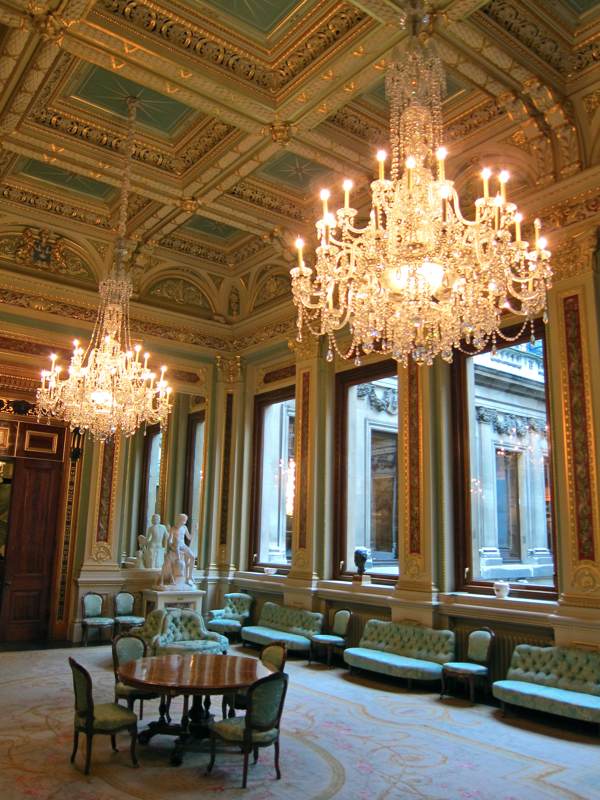
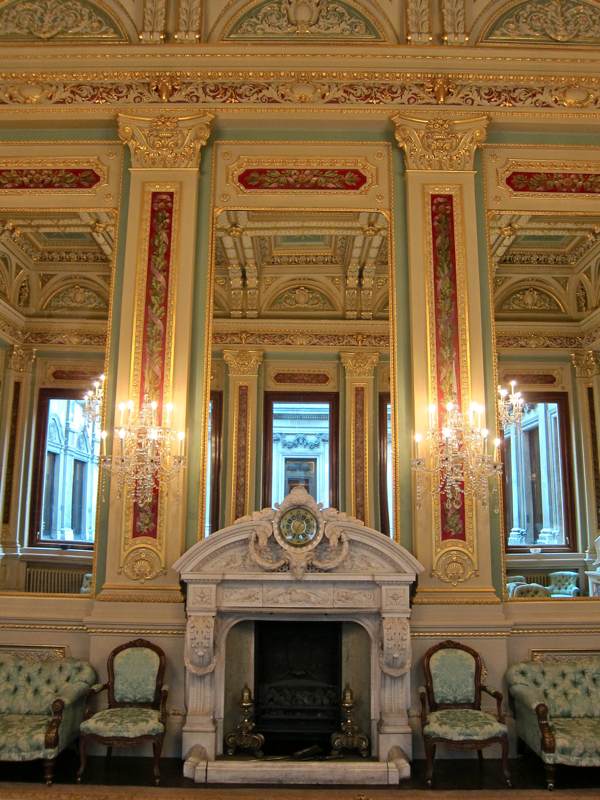
A narrow corridor leading from the hall and overlooking the courtyard holds the company’s succession of charters including Edward III’s Patent of 1364 followed by those granted by James I, Elizabeth I and our own Elizabeth II. Facing the Livery Hall across the courtyard is the Drawing Room, a chamber worthy of any of the royal palaces of Europe. Created by architect Herbert Williams and interior designer John G. Crace, it remains as they left it in 1868, – an exquisitely modulated symphony of gilt panelling and mirrors, glowing golden in the cool northern light.
Over-awed by the majesty of the building and distracted by the collection of old paintings worthy of any museum, I rubbed my bleary eyes when I found myself back in the dusty streets around Liverpool St Station in the grey dusk of the late afternoon, and it caused me to question whether my visit to the Drapers’ Hall had, in fact, been an apparition conjured by a daydream.
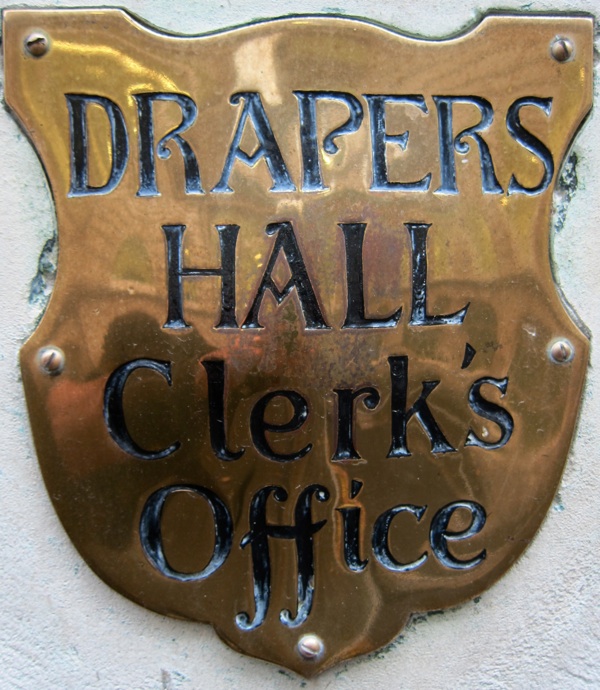
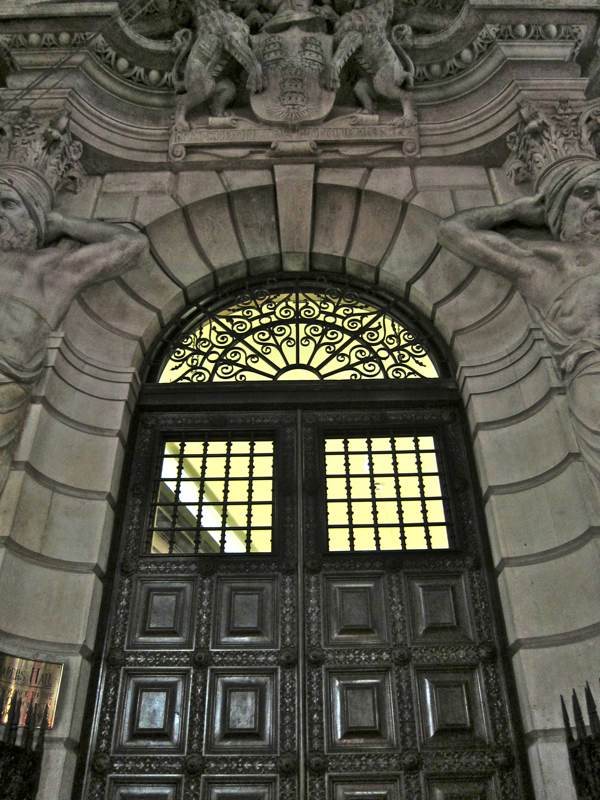
Bearded Persians by Henry Pegram flank the Throgmorton St entrance.
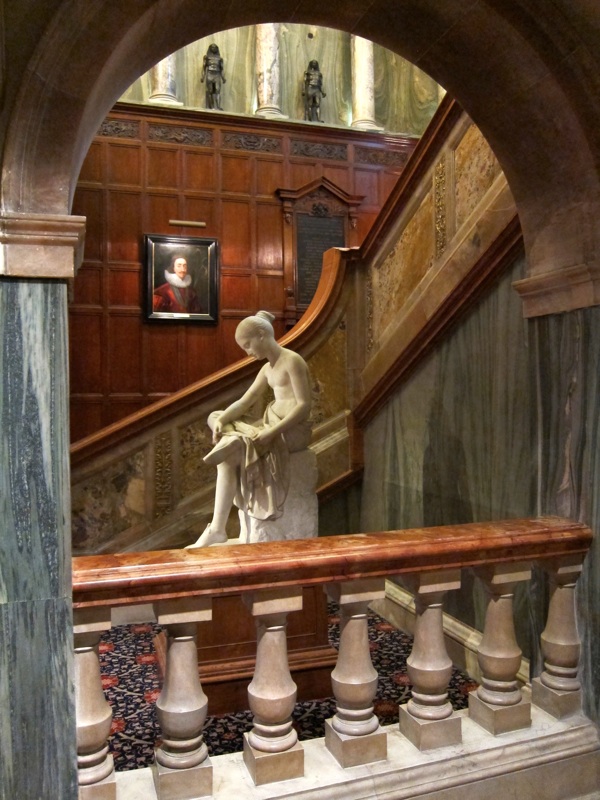
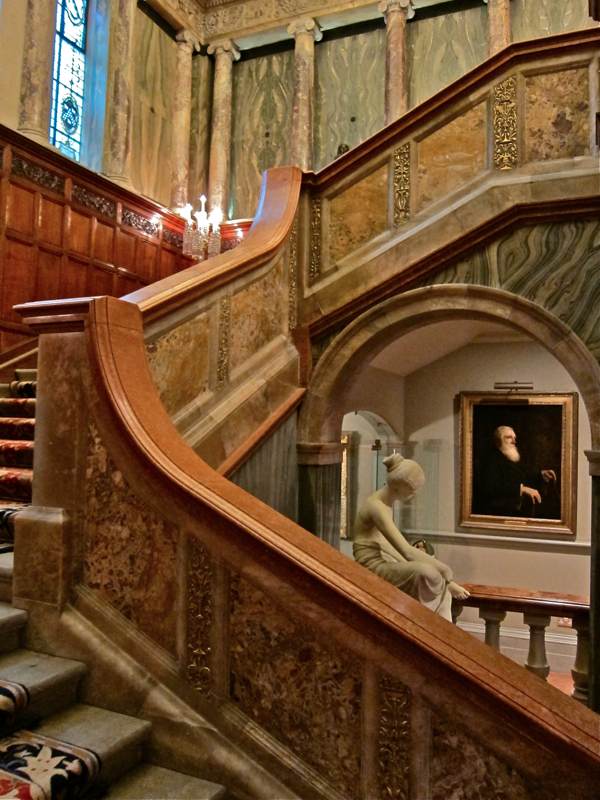
Staircase designed by Thomas Graham Jackson in the eighteen nineties.
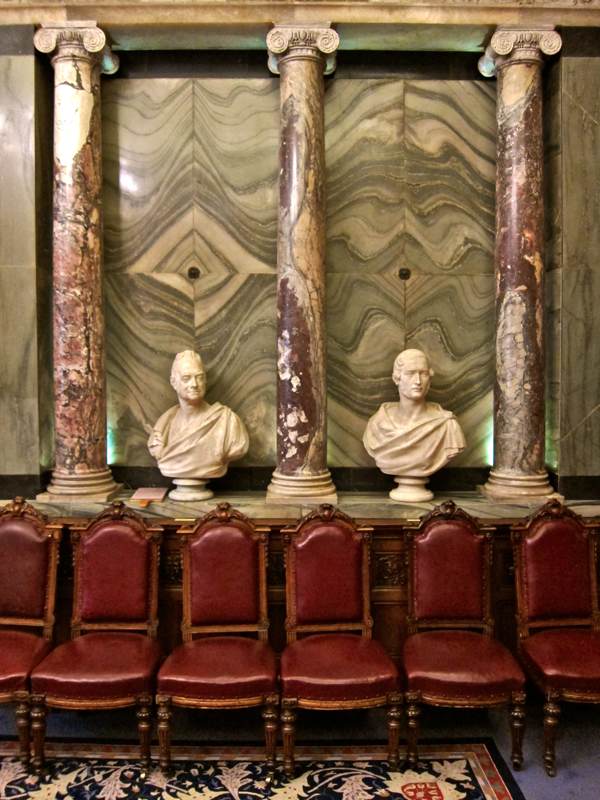
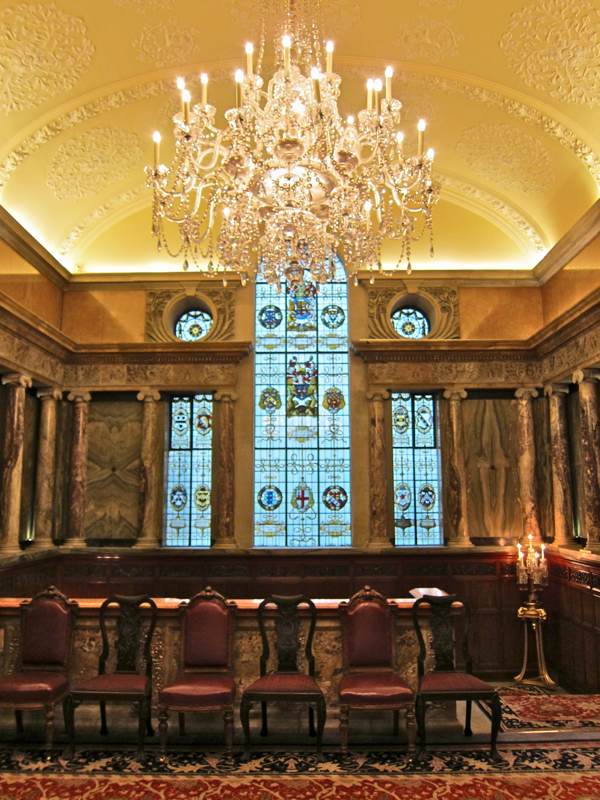
A five thousand piece chandelier lights the staircase.
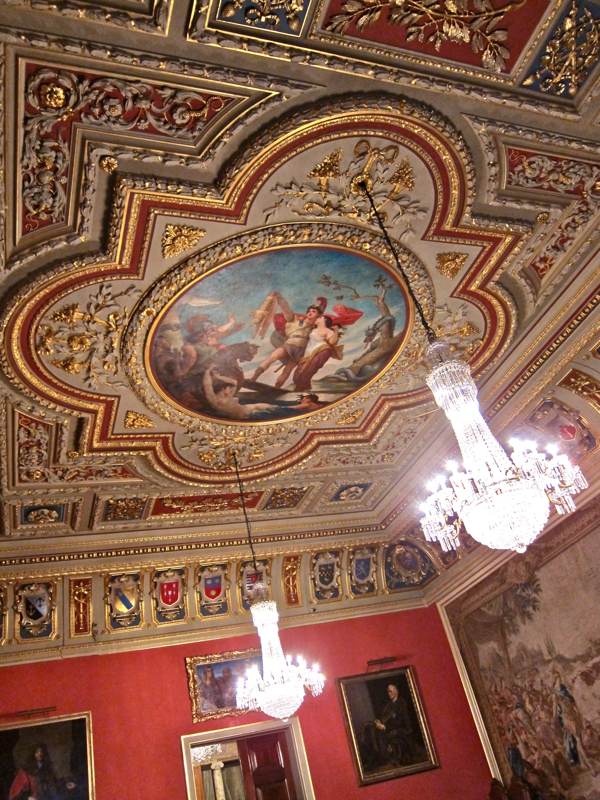
Jason and the Golden Fleece, portrayed upon the celiing of the Court Dining Room
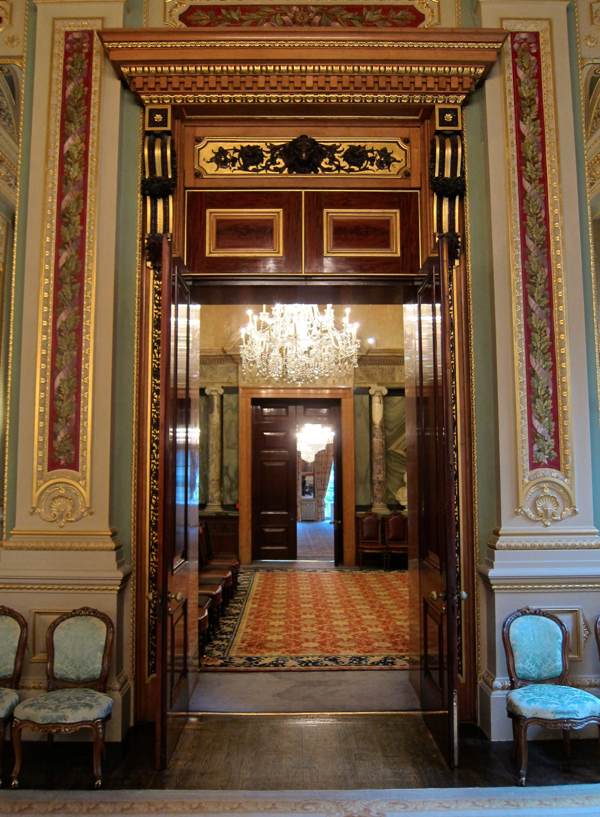
Looking from the Drawing Room through to the Dining Room.
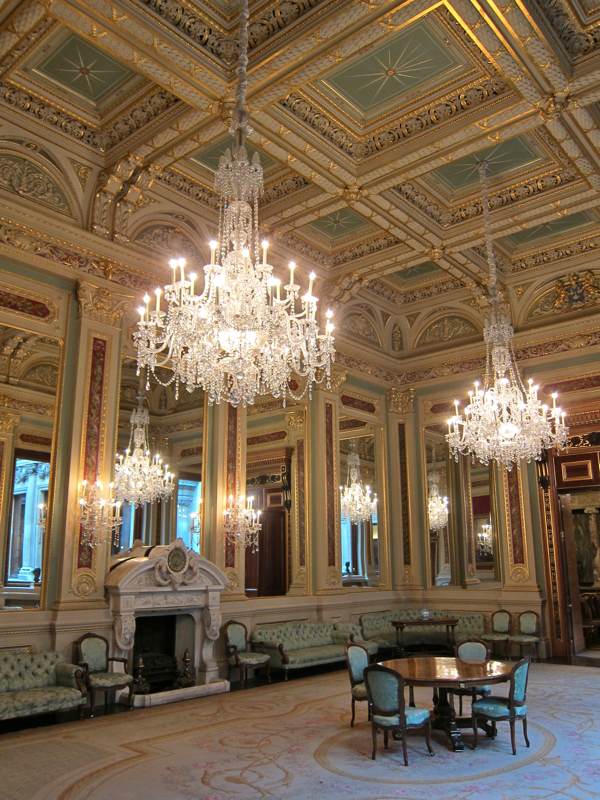
The Drawing Room by architect Herbert Williams and interior designer John G. Crace, 1868.
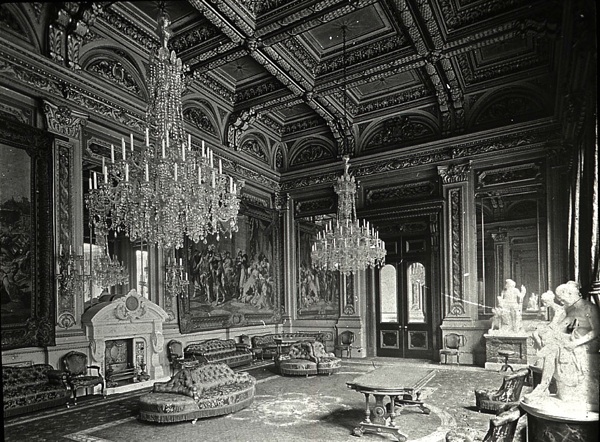
The Drawing Room c. 1920
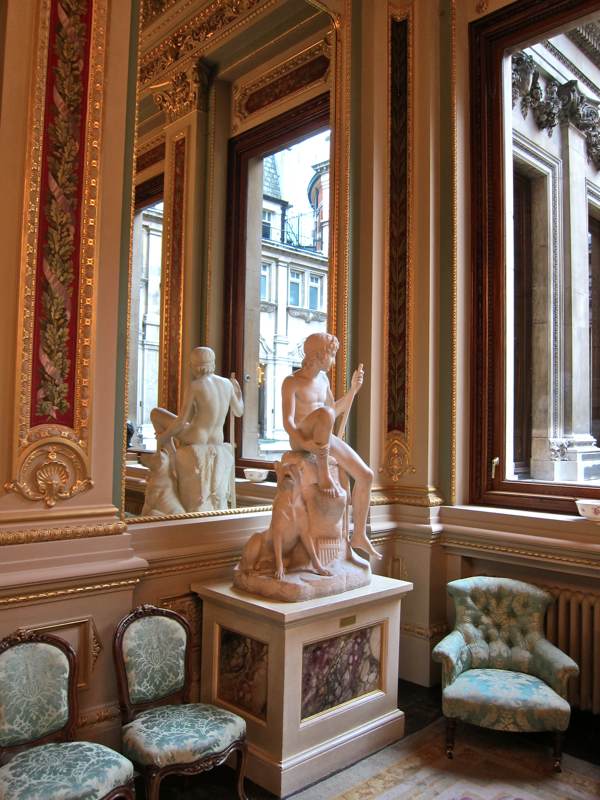
The Shepherd Boy by Thorwaldsen, 1893.
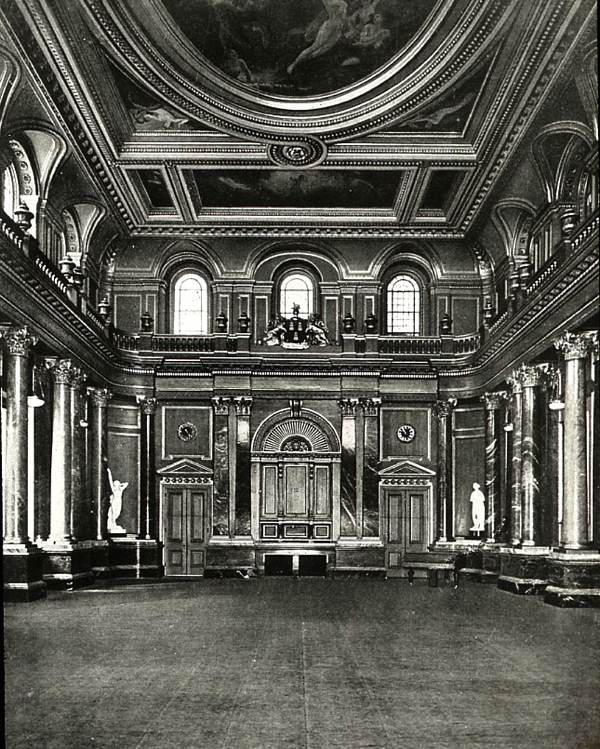
The Livery Hall, c. 1920
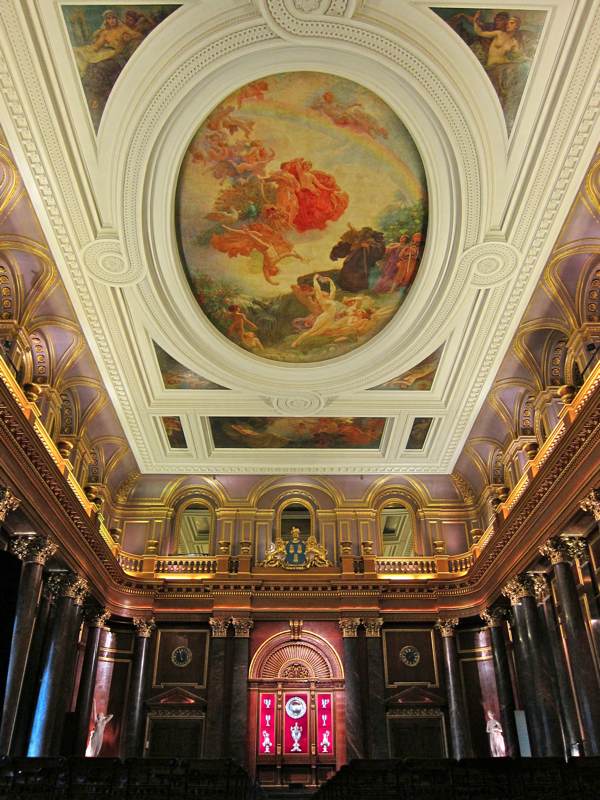
The Livery Hall
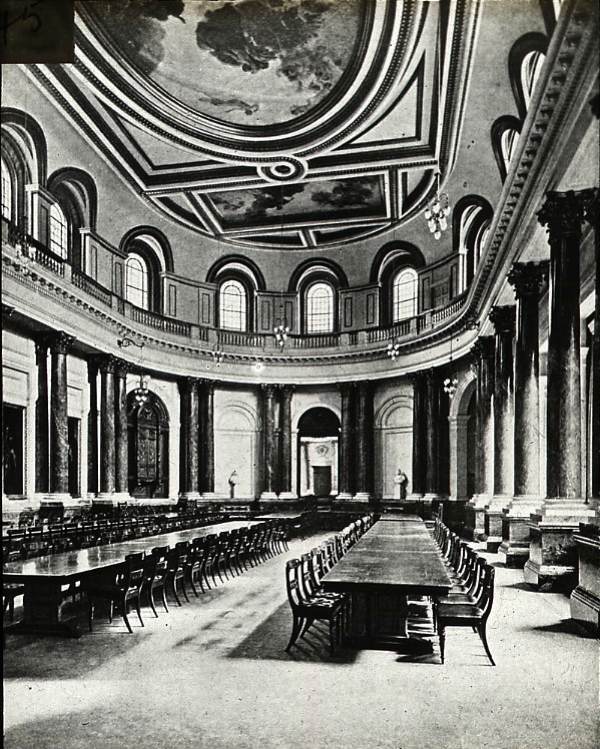
The Livery Hall c.1920
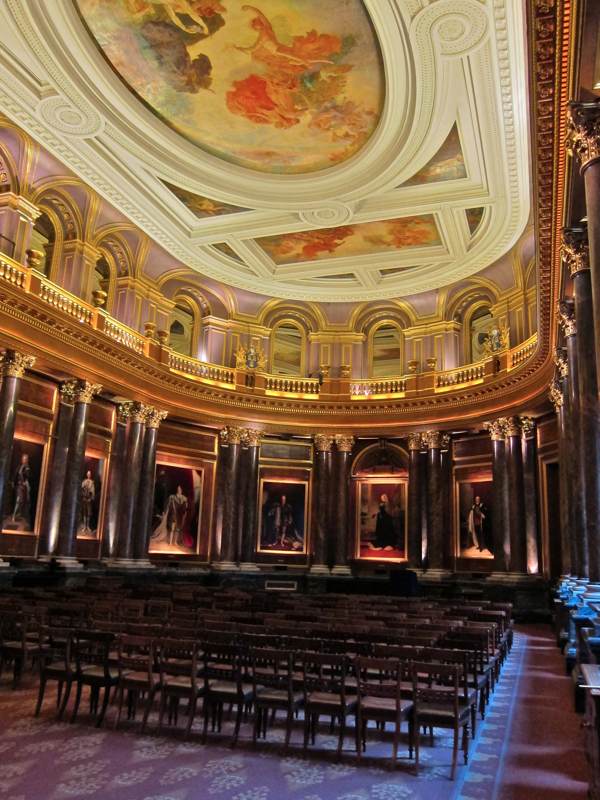
The Livery Hall
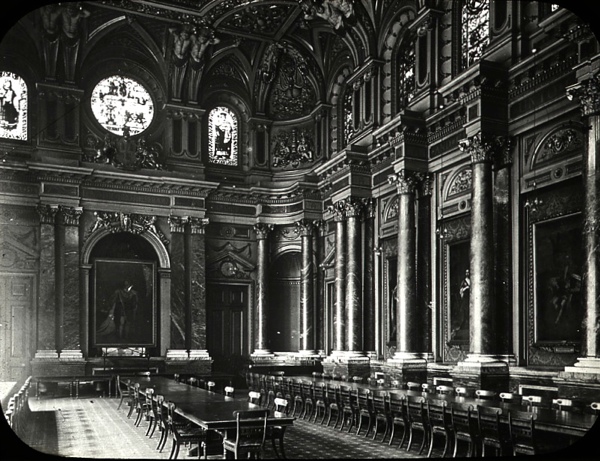
The Livery Hall, c. 1890
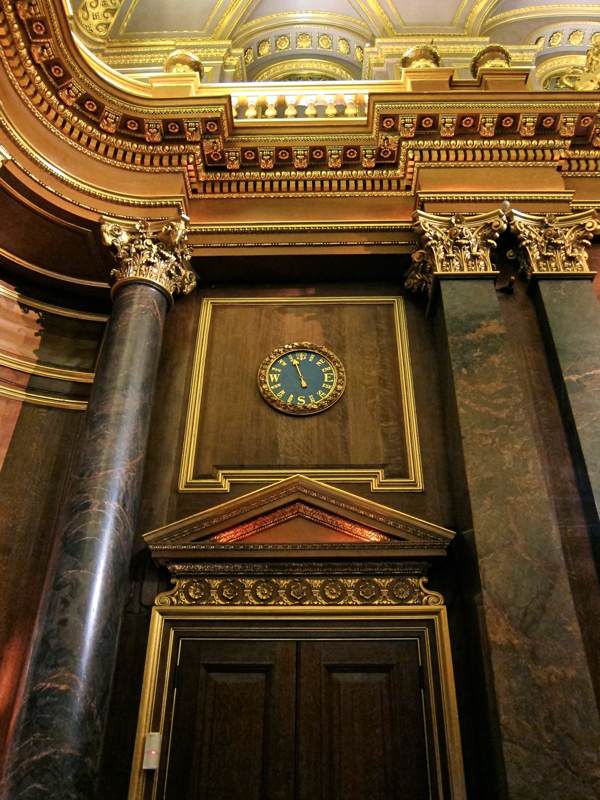
This dial in the Livery Hall indicates the wind direction.
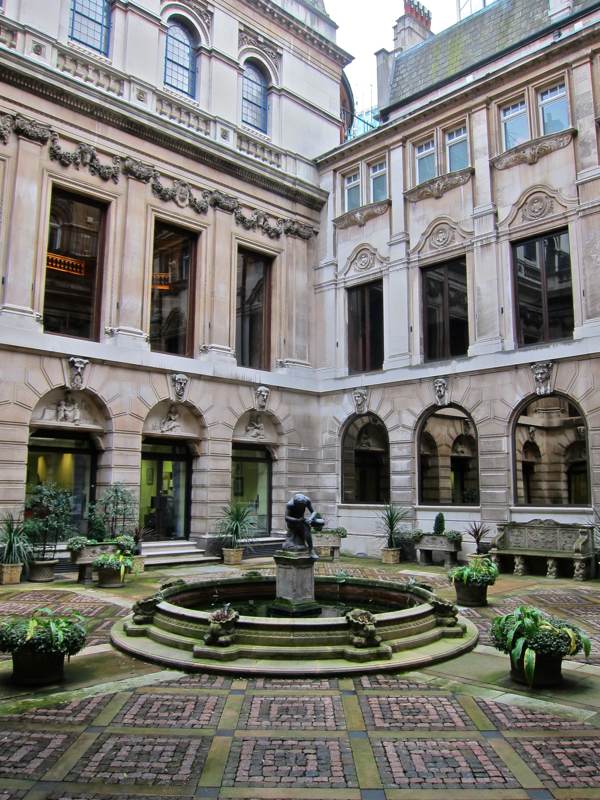
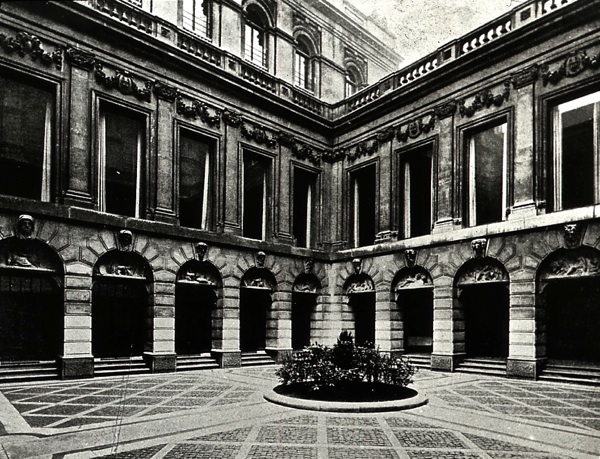
The Courtyard c. 1920
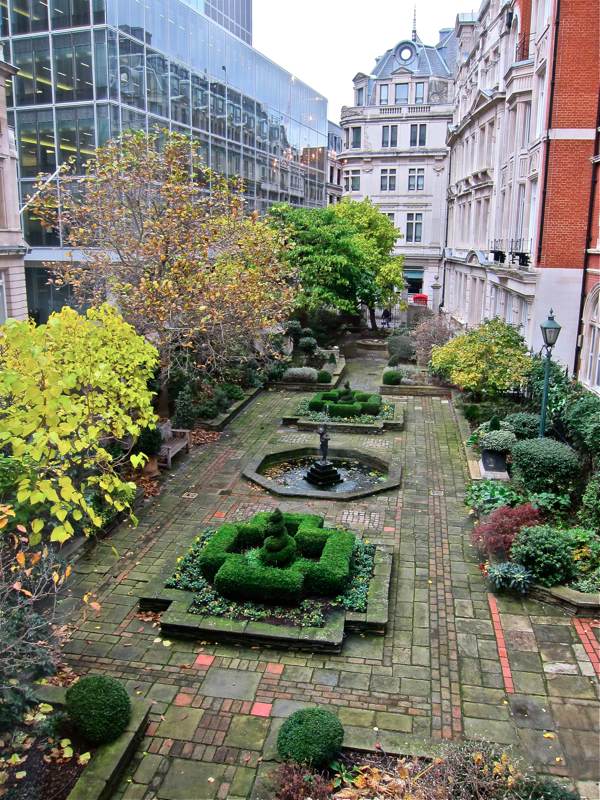
The last remnant of Thomas Cromwell’s garden.
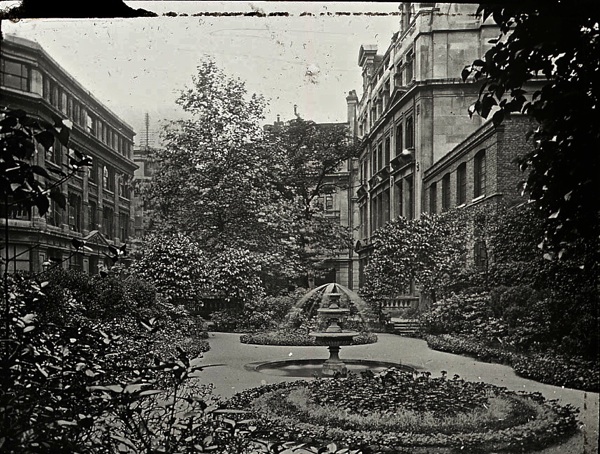
The Garden, c. 1920
Glass slides courtesy Bishopsgate Institute
You can visit the Draper’s Hall on 4th December for the Wellbeing of Women Christmas Fair 11am-8pm.
You may also like to read about
A Dead Man In Clerkenwell

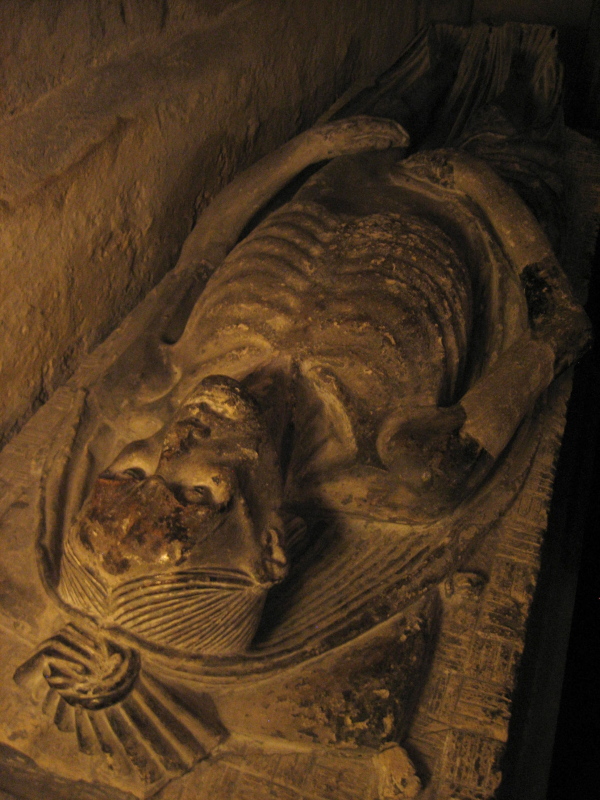
This is the face of the dead man in Clerkenwell. He does not look perturbed by the change in the weather. Once Winters wore him out, but now he rests beneath the streets of the modern city he will never see, oblivious both to the weather and the wonders of our age, entirely oblivious to everything in fact.
Let me admit, although some might consider it poor company, I consider death to be my friend – because without mortality our time upon this earth would be worthless. So I do not fear death, but rather I hope I shall have enough life first. My fear is that death might come too soon or unexpectedly in some pernicious form. In this respect, I envy my father who always took a nap on the sofa each Sunday after gardening and one day at the age of seventy nine – when he had completed trimming the privet hedge – he never woke up again.
It was many years ago that I first made the acquaintance of the dead man in Clerkenwell, when I had an office in the Close where I used to go each day and write. I was fascinated to discover a twelfth century crypt in the heart of London, the oldest remnant of the medieval priory of the Knights of St John that once stood in Clerkenwell until it was destroyed by Henry VIII, and it was this memento mori, a sixteenth century stone figure of an emaciated corpse, which embodied the spirit of the place for me.
Thanks to Pamela Willis, curator at the Museum of the Order of St John, I went back to look up my old friend after all these years. She lent me her key and, leaving the bright November sunshine behind me, I let myself into the crypt, switching on the lights and walking to the furthest underground recess of the building where the dead man was waiting. I walked up to the tomb where he lay and cast my eyes upon him, recumbent with his shroud gathered across his groin to protect a modesty that was no longer required. He did not remonstrate with me for letting twenty years go by. He did not even look surprised. He did not appear to recognise me at all. Yet he looked different than before, because I had changed, and it was the transformative events of the intervening years that had awakened my curiosity to return.
There is a veracity in this sculpture which I could not recognise upon my previous visit, when – in my innocence – I had never seen a dead person. Standing over the figure this time, as if at a bedside, I observed the distended limbs, the sunken eyes and the tilt of the head that are distinctive to the dead. When my mother lost her mental and then her physical faculties too, I continued to feed her until she could no longer even swallow liquid, becoming as emaciated as the stone figure before me. It was at dusk on the 31st December that I came into her room and discovered her inanimate, recognising that through some inexplicable prescience the life had gone from her at the ending of the year. I understood the literal meaning of “remains,” because everything distinctive of the living person had departed to leave mere skin and bone. And I know now that the sculptor who made this effigy had seen that too, because his observation of the dead is apparent in his work, even if the bizarre number of ribs in his figure bears no relation to human anatomy.
There is a polished area on the brow, upon which I instinctively placed my hand, where my predecessors over the past five centuries had worn it smooth. This gesture, which you make as if to check his temperature, is an unconscious blessing in recognition of the commonality we share with the dead who have gone before us and whose ranks we shall all join eventually. The paradox of this sculpture is that because it is a man-made artifact it has emotional presence, whereas the actual dead have only absence. It is the tender details – the hair carefully pulled back behind the ears, and the protective arms with their workmanlike repairs – that endear me to this soulful relic.
Time has not been kind to this figure, which originally lay upon the elaborate tomb of Sir William Weston inside the old church of St James Clerkenwell, until the edifice was demolished and the current church was built in the eighteenth century, when the effigy was resigned to this crypt like an old pram slung in the cellar. Today a modern facade reveals no hint of what lies below ground. Sir William Weston, the last Prior, died in April 1540 on the day that Henry VIII issued the instruction to dissolve the Order, and the nature of his death was unrecorded. Thus, my friend the dead man is loss incarnate – the damaged relic of the tomb of the last Prior of the monastery destroyed five hundred years ago – yet he still has his human dignity and he speaks to me.
Walking back from Clerkenwell, through the teeming city to Spitalfields on this bright afternoon in autumn, I recognised a similar instinct as I did after my mother’s death. I cooked myself a meal because I craved the familiar task and the event of the day renewed my desire to live more life.




Visit the Museum of the Order of St John, 26 St John’s Lane, Clerkenwell, EC1M 4DA
Nicholas Culpeper, Herbalist & Surgeon
Celebrating the birthday this week of Nicholas Culpeper (1616-1654), it is my pleasure to publish this portrait of the famous herbalist of Spitalfields by Patricia Cleveland-Peck, gardener and writer.
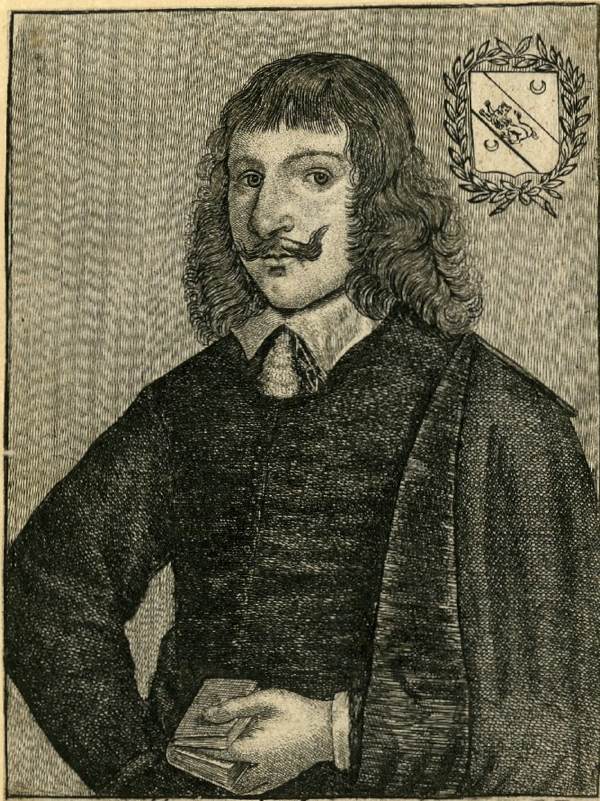
Of all Spitalfields’ past residents, one name stands out above others – Nicholas Culpeper, born on October 18th 1616, a herbalist and medical practitioner operating from Red Lion St (now Commercial St) who devoted his life to healing, and especially to healing the poor.
While apprenticed to the apothecary Francis Drake of Bishopsgate, Nicholas accompanied Thomas Johnson (later editor of the 1633 edition of Gerard’s Herball) on plant hunting excursions. He loved herbs since boyhood and became expert at their identification, essential in those days when almost all ailments were treated with plants. Herbals served as handbooks for doctors in which each plant was named together with its ‘virtues’ or uses. Nicholas’ skill in this subject, coupled with the fact that he was very caring, meant that the people of Spitalfields flocked to him – sometimes as many as forty a morning – and they commonly received treatment for little or no payment.
This was not popular among Nicholas Culpeper’s qualified medical colleagues who were infuriated by his view that, “no man deserved to starve to pay an insulting, insolent physician.” He also believed in “English herbs for English bodies,” and went out gathering his own herbs from the countryside for free which did not endear him to the apothecaries who often insisted on expensive imported exotic plants for their ‘cures’.
In those days, there were strict divisions between what university-educated physicians, apothecaries and barber-surgeons (who drew teeth and let blood) were allowed to do. Physicians were expensive, so for most sick people the first port of call would be their own herb garden or still room, the second the ‘wise woman’ down the road, the third a visit to the apothecary – after which, for many, there was no other option but to let the illness run its course.
In 1649, Nicholas inflamed the establishment by producing an English translation of their latin ‘bible’ the Pharmacopoeia Londinensis which included all the recipes for their medicines. Published as A Physical Directory, it not only revealed the secret ingredients but gave instructions on how to administer them – one of his most important contributions, as it provided the first effective self-help book to which people could turn.
Even more galling for the medical fraternity was the fact Nicholas had never completed his apprenticeship, and chose Spitalfields to set up a semi-legal practice because it was outside the City of London and thus not governed by the rules of the College of Physicians. Spitalfields in those days was quite different from today, beyond the site of huge priory of St Mary Spital stretched the farmland of Spital Field. The priory had been dissolved under Henry VIII although parts of the precincts were still inhabited, and it was an area which attracted outsiders like Nicholas who, as well as treating his patients, was something of a political radical. In his pamphlets, he railed against the king, priests and lawyers as well as physicians. Consequently he was no stranger to controversy and at one point was even accused of witchcraft – just one of the many troubles which accumulated to beset him during his life.
The first of these even occurred thirteen days before his life began, for it was then that his father died leaving his mother without support. She and the new-born Nicholas were obliged to return to the protection of her father, William Attersole, vicar of the little village of Isfield in Sussex. Attersole was not happy about this arrangement but, although he did not welcome the child, he did see it as his religious duty to provide instruction for him as he grew. Young Nicholas learned the scriptures and the classics, he studied mathematics and, under his grandfather’s guidance, began to take an interest in astrology which later featured in his own works. He even stole a book on anatomy out of the library (where he was only supposed to read the bible) and read it in a barn.
Importantly, he also spent a lot of time with his mother who we know owned a copy of Gerard’s Herball. She was responsible for the health of the household and, from his later works, we can glean the fact that he soon became familiar with all the local Sussex ‘simples’ or wild herbs. We know only little of this period of his life, but it is thought that he went to school in Lewes before – at the age of sixteen – setting off for Cambridge ostensibly to follow in his grandfather’s footsteps by studying theology. Once there, he began to attended lectures on anatomy and, perhaps frustrated that he couldn’t change to medicine, he spent most of his time smoking, drinking and socialising in taverns.
Yet the reason for his dropping out is a sad one. Young though he was, before leaving Sussex, Nicholas had fallen in love with Judith Rivers, a local heiress. She reciprocated his love and thus, knowing her family would never consent to the relationship, they planned to elope. They were to meet near Lewes and marry secretly, but on the way Judith’s coach was struck by lightning and she was killed. Nicholas was devastated and spent months sunk in melancholy. There was no question of his returning to Cambridge to study medicine or anything else. Eventually he chose to come to London and become an apothecary. Socially, this was a step down but he enjoyed his time at Bishopsgate and became very proficient.
Nicholas was twenty-four when he found love again. Called to treat a Mr Field for gouty arthritis, his eyes fell upon the fifteen-year-old daughter of the house, Alice. By a stroke of good fortune, she too was an heiress and it was her considerable dowry which enabled Nicholas to build a house in Red Lion St, Spitalfields from which he conducted his practice.
When the Civil War broke out two years later, the anti-royalist Nicholas signed up with Cromwell. Once his profession was discovered however, the recruiting offer commented, “We do not need you at the battlefield…come along as the field surgeon since most of the barbers and physicians are royal asses and we have use for someone to look after our injured.” Later, during the battle of Reading, Nicholas himself was wounded.
On his return to Spitalfields, he devoted himself to study and writing, and produced a number of books including a Directory for Midwives. Nicholas recognised that this was an unusual topic for a male herbalist, writing in the dedication, “If you (the matron) by your experiences find anything not according to the truth ( for I am a man and therefore subject to failings) first judge charitably of me…” Having grown up so close to his mother, Nicholas had a deep respect of women but this book may also have been inspired by some painful experiences in his own family for, although Alice bore him seven children, only one daughter lived to adulthood.
In 1652, Nicholas published his master work The English Physician also known as Culpeper’s Herbal which became the standard work for three hundred years and is still in print. It was sold cheaply and made its way to America where it had a lasting impact too. By 1665, ten years after his death, Nicholas’ name was so well-known that the Lord Mayor of London chose to use it alongside that of Sir Walter Raleigh in a pamphlet about avoiding infection from the Great Plague.
Nicholas Culpeper deserves to be remembered. He was always on the side of the underdog, he opposed the ‘closed shop’ of earlier physicians and he promoted sensible self-help. He also tried to offer reasonable explanations for what he wrote – “Neither Gerard nor Parkinson or any that ever wrote in a like manner ever gave one wise reason for what they wrote and so did nothing else but train up young novices in Physic in the School of Tradition, and teach them just as a parrot is taught… But in mine you see a reason for everything that is written.”
He died in 1654, aged only thirty-eight, of tuberculosis and is believed to be buried beneath Liverpool St Station.

Title page of the 1790 edition of Culpeper’s English Physician & Complete Herbal, published by C.Stalker, 4 Stationer’s Court, Ludgate St.


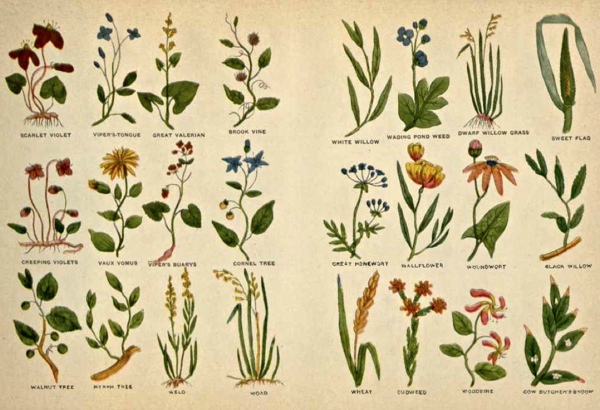


Plates from the edition published by Richard Evans, 8 White’s Row, Spitalfields, August 12th, 1814
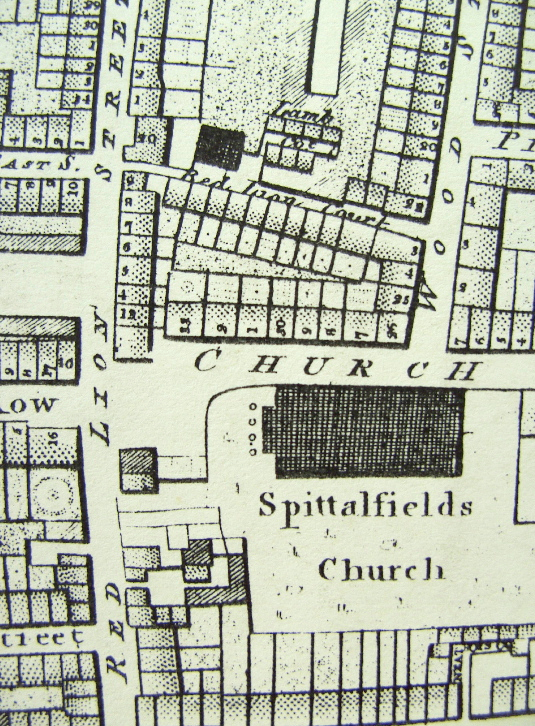
“Culpeper’s house, of which there are woodcuts extant, it is of wood, and is situated the corner of Red Lion Court and Red Lion Street, Spitalfields. It is now and has long been a public house, known by the sign of the Red Lion, but at the time it was inhabited by the sage herbalist, it was independent of other buildings. While in the occupation of Culpeper, who died in 1654, this house stood in Red Lion Field and was as a dispensary of medicines (perhaps the first) of very considerable celebrity.” The European Magazine and London Review, January 1812. Red Lion St and Red Lion Court as shown on John Horwood’s map (1794-99) before Commercial St was cut through in the nineteenth century.

Nicholas Culpeper and his house

Paul Bommer’s delft tile commemorating Nicholas Culpeper
You may also like to read about
Ivor Weiss, Artist
You only have until this Saturday 21st October to catch this rare retrospective at the Weiss Gallery
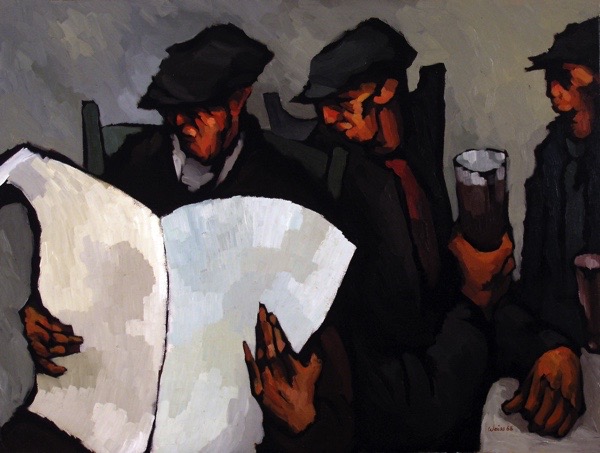
The Onlooker, 1968
I went down to Jermyn St in St James’ yesterday to meet Mark Weiss of the Weiss Gallery to hear about his father, the painter Ivor Weiss (1919-1986) who was born in Stepney. The gallery is filled with a vibrant display of large bold paintings that possess a soulfulness and tender humanity. They embody the cultural memory of the Jewish East End, speaking eloquently of a long life and a significant talent.
“My father was one of four children. His parents were both Romanian Jews who came over to London at the end of the nineteenth century. We don’t know the exact dates, we have very little documentation of family history. My father’s father came from quite a well-to-do family in Bucharest. He was one of four or five children and his wife, whose maiden name was Wiseman, came from a very large family of twelve or thirteen. We don’t know when they got married but we do know they lived, as many immigrant Jews did at that time, in Stepney in the East End around Cable St. So my father was born a Cockney in Stepney in 1919.
His father was a Master Furrier and clearly was quite successful, although he was only naturalised in 1929. By that time, he had clearly made some money and was living in 33 Elgin Crescent, Westbourne Grove. My grandfather was a gambler and my father used to say that his mother was in tears at the end of the week because all the money his father had earned had been spent, betting on dogs and horses.
My father enlisted when war broke out in 1939 when he was only twenty years old. As a nice Jewish boy from the East End, he expected to be put into a force that suited him but instead he was enrolled in a Glaswegian regiment which he hated. He ended up in the Royal Corps of Signals and was posted to the North African campaign, ending up in Malta. There his artistic talents were first recognised and he attended an art school, winning a couple of prizes. When he was demobilised he went to Heatherley School of Art in Baker St and then St Martin’s in the Charing Cross Rd, where he met my mother Joan, who was also an art student and a painter. They married very quickly after that in 1949.
My father’s brother was a pilot in the RAF and had been seconded during the war to teach American pilots how to fly fighter planes and he married a Jewish lady in Montgomery, Alabama. There was still rationing after the war in this country and he invited my father over to Alabama to live. So my parents went to start a new life there and opened an art school called the Weiss Gallery. It was not easy for them because they were committed to their school being desegregated. They hated the situation, but they had spent all their money getting out there. I and my brother were born in America and, by 1955, they had saved enough money to return.
My father had an offer to be a stand-in art teacher at Lancing College for six months and then he got a job in a secondary modern in Brightlingsea, Essex, where my sister was born. To supplement his income, he used to teach evening classes. By chance, he was asked by a local lady if he could sell a painting for her, so my father brokered the sale of the picture to a local antique dealer and earned more money than he could make in a month. My parents drifted into art dealing from our home in Brightlingsea and, within a few years, made enough money to buy a big house in Colchester. My father had an intuitive eye, and he had studied Art History and technique, so he was well placed to become an art dealer, and my mother used to do the restoration. They made quite a formidable team and the business grew rapidly.
Yet he still had aspirations for his art and there came a watershed when Mr Weston, of the wealthy family who owned Fortnum & Mason, invited my father to paint for him and his friends in the south of France, but my father said, ‘No, I don’t want to leave my family.’ It was a fork in the road. If he had done that, he might have developed more of a career as a commercial painter. Having made that choice, painting remained a private exercise. He was never that prolific, and painting remained a personal and emotional thing for him. It was difficult, it was not something that came easy – the creation of pictures.
For the rest of his life, he and my mother concentrated on art dealing with him painting privately. But after a series of minor heart attacks, he had triple heart by-pass surgery and it proved the catalyst for him paint Judaic subjects. They are some of his most powerful works, drawing on the traditions he grew up with in the East End among Hassidic Jews.
My father died of a heart attack in 1986, at the time I opened up my gallery in London which we would have run together. His paintings remained hanging in the houses of members of the family and in storage with my mother until she died aged ninety-two this January. So we thought it was a wonderful opportunity to show his work here in the gallery to commemorate his life and my mother’s life. These are quite emotional paintings for us as a family.
I regret that I never asked my father questions about the East End and he never discussed it. Sorting out my mother’s affairs, I could not even find a marriage certificate, and I realised they had never talked about their wedding and I had never asked, and how sad that is. As children, we never questioned our parents about their past. They grew up through the horrors of the Second World War and, the generation before, they endured the First World War. My grandfather served with great distinction, but had a horrendous time and had nightmares about it for the rest of his life. He did not want to talk about it.
My father was remarkable man and one of the things that strikes me, when I think about him, is that he never made enemies – which is a rare thing in this life. He was multi-talented, he taught pottery, he could make enamel jewellery, he could make furniture, all sorts of things.“
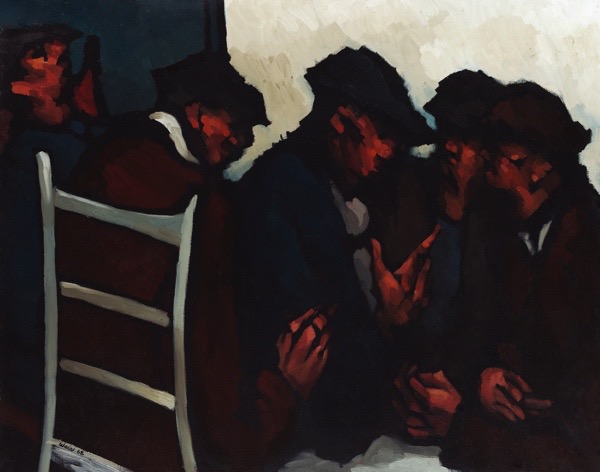
The Discussion, 1968
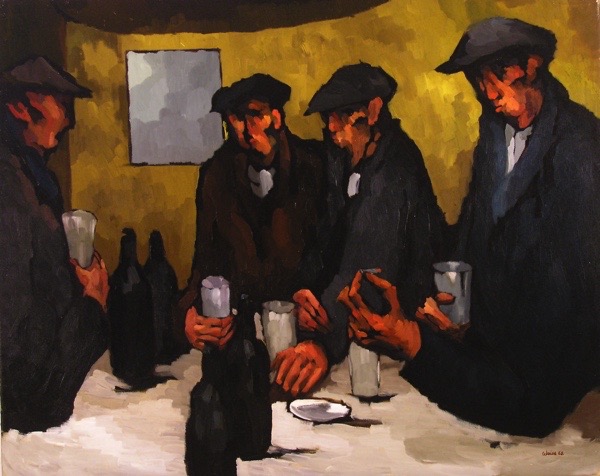
Four Drinkers, 1968
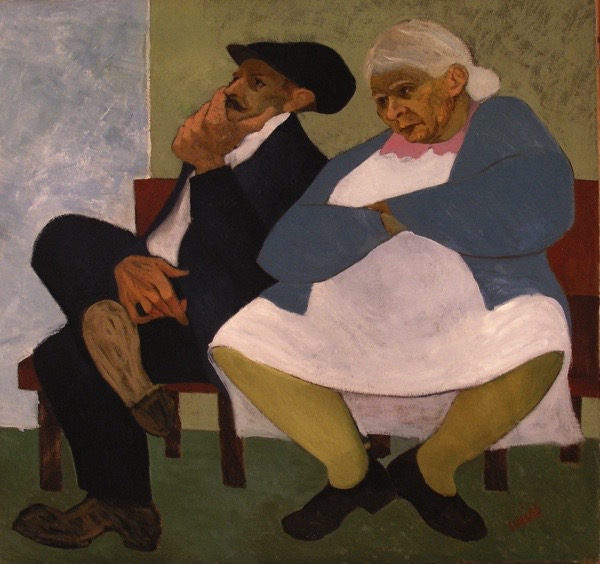
Seated cCouple, fifties
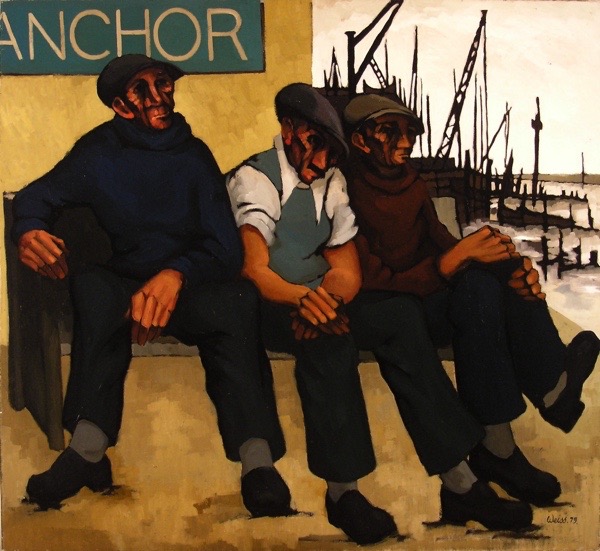
The Anchor Inn, Brightlingsea
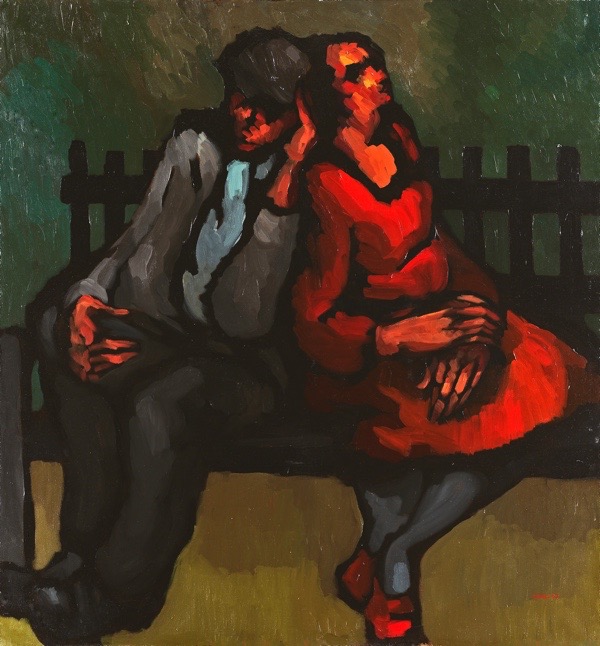
The Park Bench, 1967
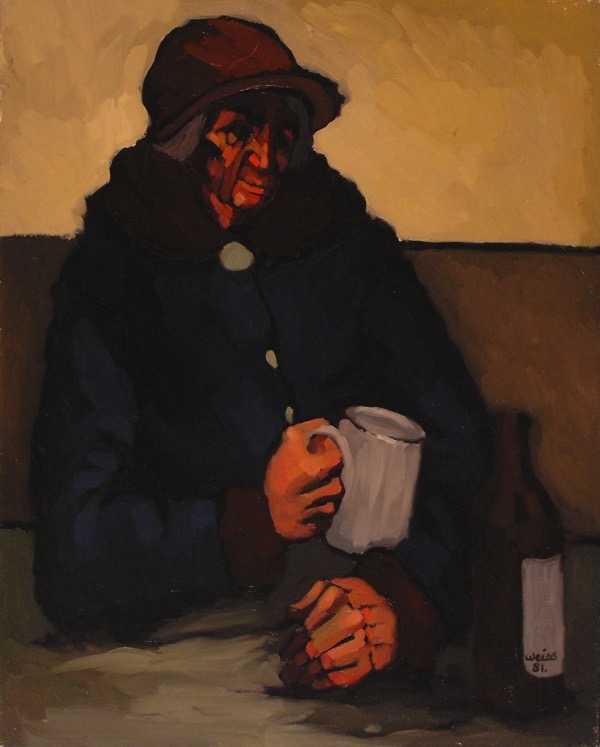
Woman in Pub, 1981
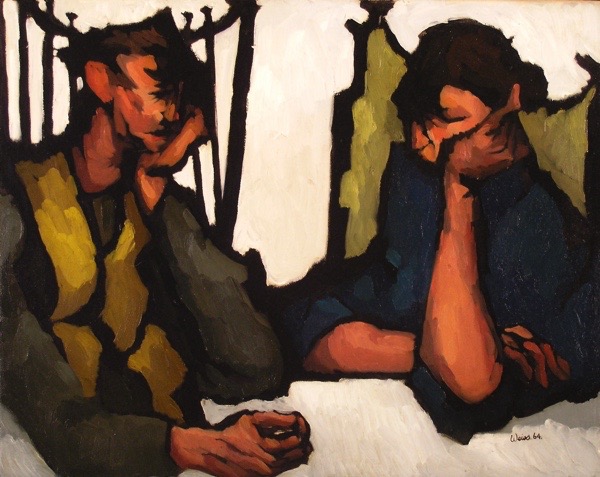
Boredom, 1964
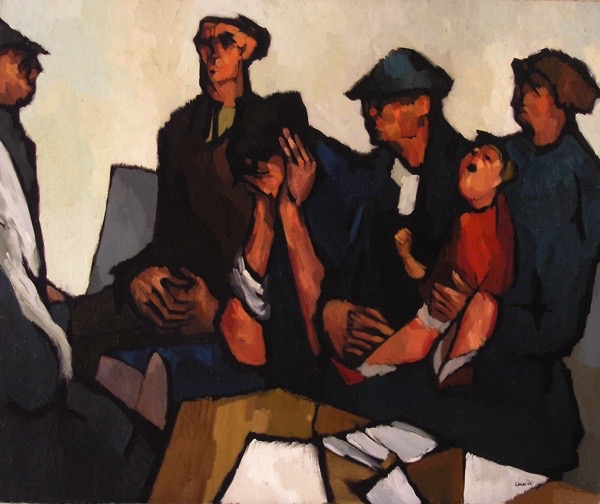
The Waiting Room, 1964
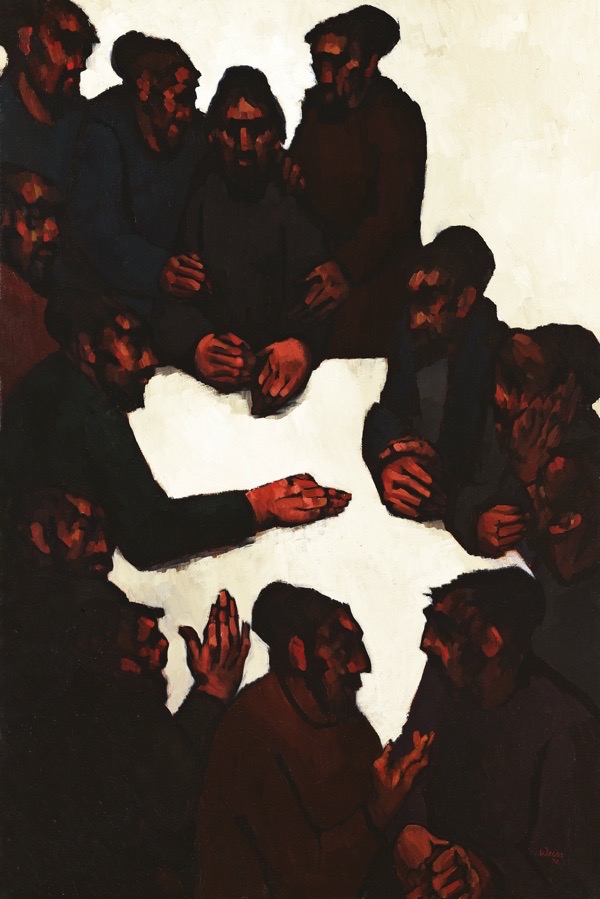
The Last Supper, 1972
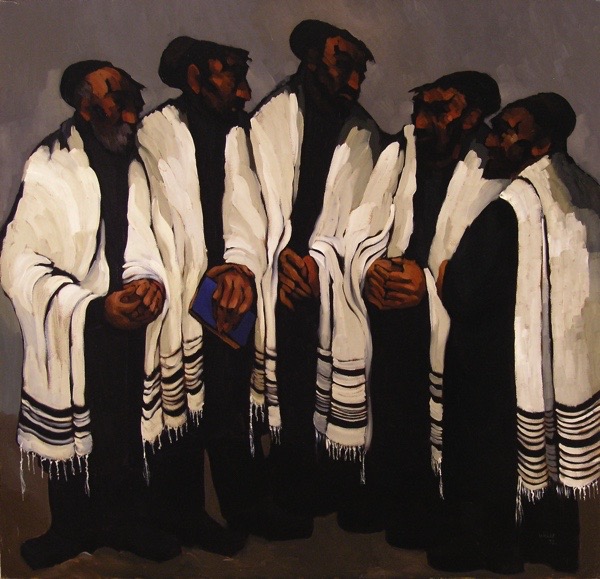
The Elders, 1972
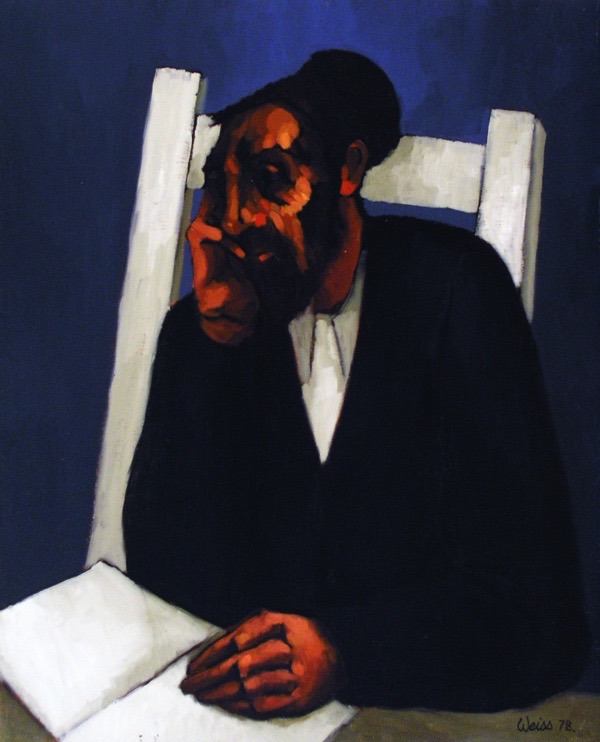
Seated Rabbi, 1972
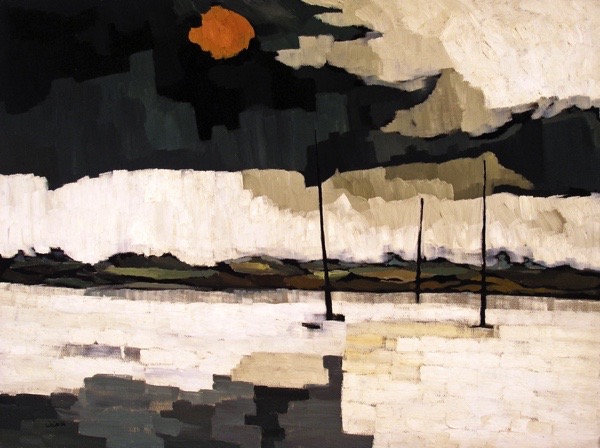
Approaching Storm, 1966
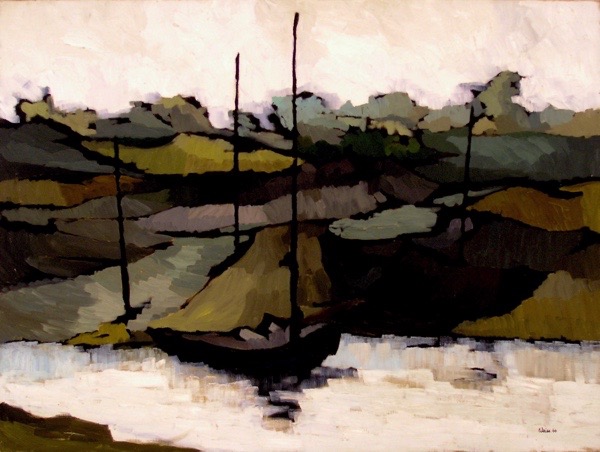
Wivenhoe Creek, 1966
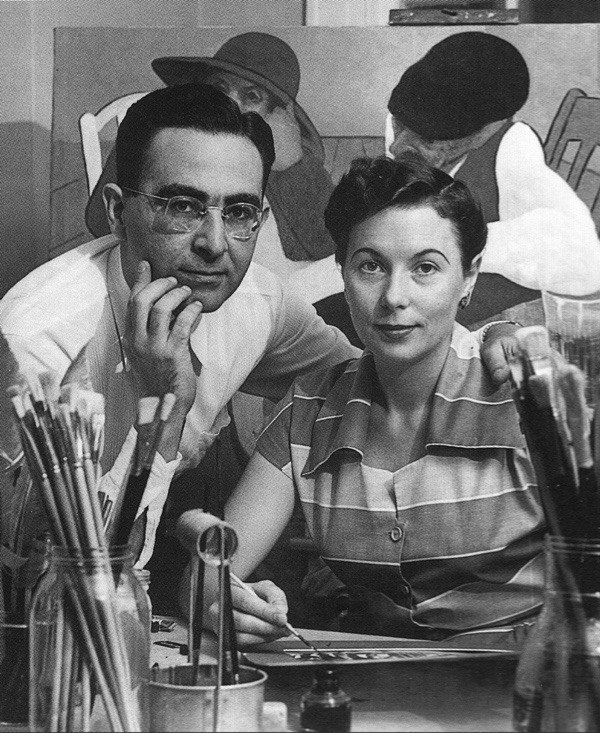
Ivor & Joan Weiss
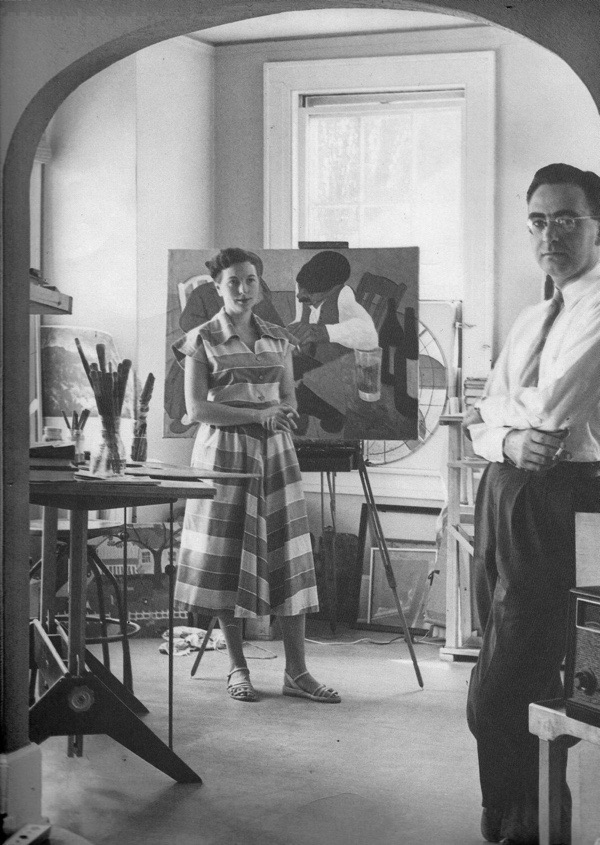
In the studio in the fifties
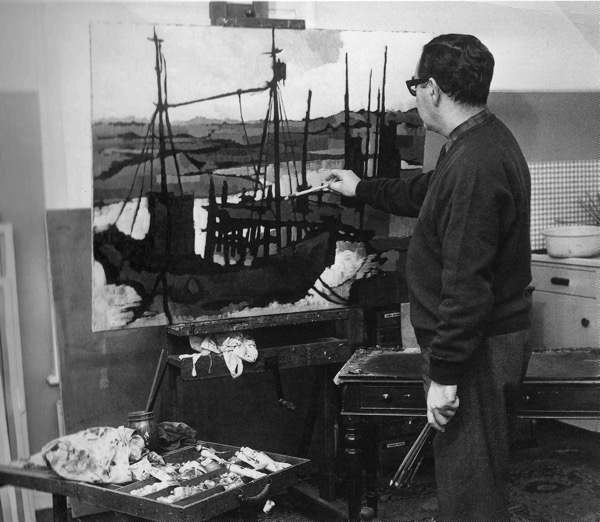
Ivor Weiss painting in the eighties
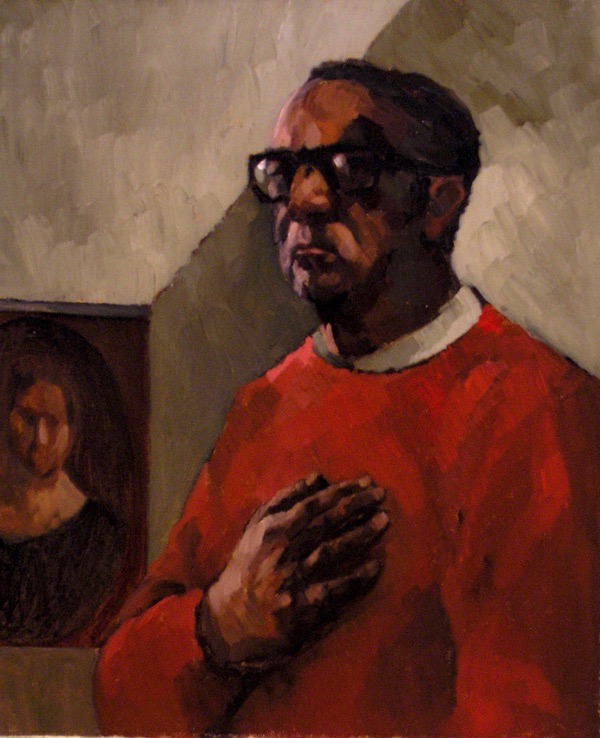
Ivor Weiss (1919-86), Self Portrait mid-eighties
Paintings copyright © Estate of Ivor Weiss
Hope In The Housing Crisis
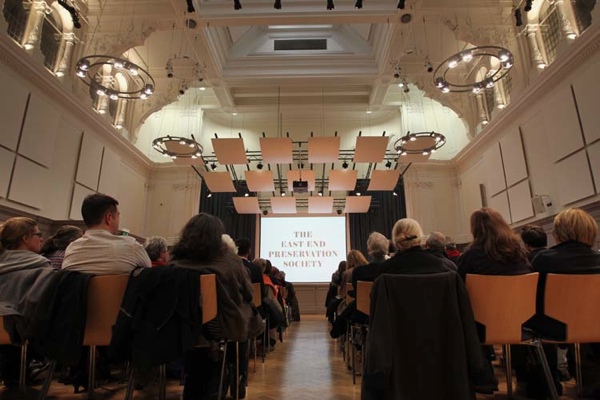
Recognising that housing is the burning question of our generation in the capital, I am very pleased to announce the East End Preservation Society‘s C.R. ASHBEE MEMORIAL LECTURE for 2017: HOPE IN THE HOUSING CRISIS – Three creative and humane initiatives dedicated to delivering homes for Londoners.
Oliver Wainwright, Architecture Critic of The Guardian, introduces speakers from three inspirational projects each pursuing different innovative solutions to the Housing Crisis, which could be replicated in the East End and across London.
The lecture takes place on Monday 13th November at 7:30pm in Shoreditch Church.
CLICK HERE TO BOOK YOUR FREE TICKET.
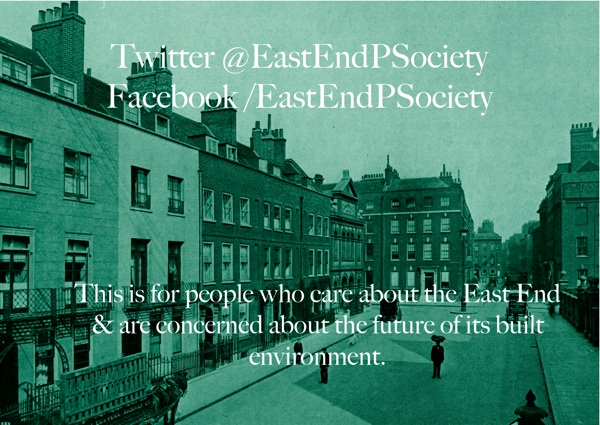
Dan Cruickshank, Will Palin & The Gentle Author founded the East End Preservation Society in 2013 to cherish the built environment of the East End and encourage a notion of development that serves local communities. Below you can read about the Older Women’s Cohousing Community (OWCH), Naked House and the Rural Urban Synthesis Society (RUSS).
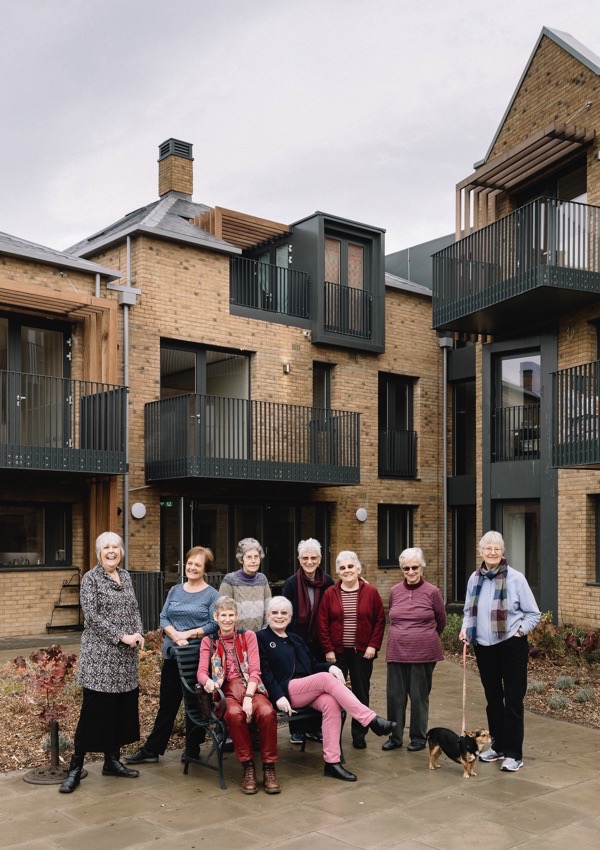
This twenty-five apartment building, two minutes from Barnet High St, was completed just before Christmas 2016. It is home to twenty-six members of the Older Women’s Cohousing Community (OWCH) and is mixed tenure, two thirds leasehold and one third social rental. It is the only senior cohousing community in this country so far. The cohousing model is a way of living as part of an intentional group, where everyone knows each other and is signed up to a common set of core values. In OWCH’s case, these include co-operating and sharing responsiblity, care and support for each other, countering ageist stereotypes and being part of the wider community. OWCH members, aged from fifty-one to eighty-eight, manage the building themselves and use its communal facilities extensively. They had a role in its design, working with Pollard Thomas Edwards, a very user-friendly firm of architects. It won the National Housing Design Award for 2017 and the European Collaborative Housing Award. – Maria Brenton
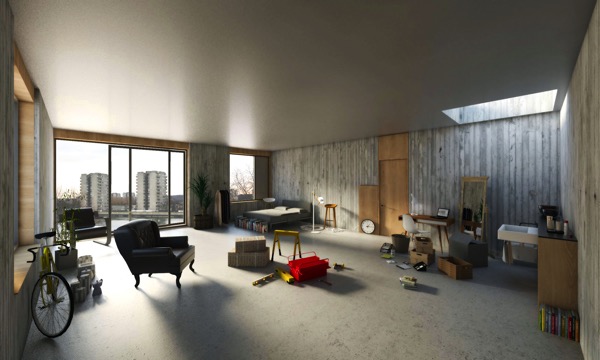
Naked House is a not-for-profit housing developer. We build genuinely affordable homes for people on modest incomes who are being priced out of London. Established by four young Londoners in 2013, who were uninspired by increasingly high-spec and expensive shared ownership flats, we strip back design to the bare essentials. A Naked House is a flat or a house that is complete in a minimalist sense. It is habitable and comes with electricity, heating, and a basic bathroom. However, the homes come with few finishes, fittings or partitions. This makes the homes cheaper to buy and allows people to create their own home over time. We have funding from the Mayor of London to build our first twenty-two homes in Enfield on unused garage sites. – Rachel Bagenal
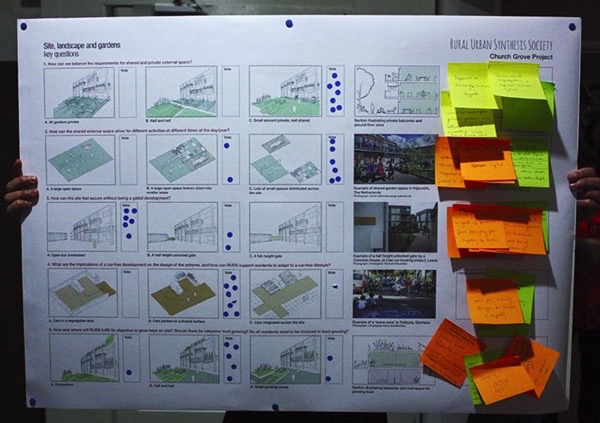
The Rural Urban Synthesis Society (RUSS) is a members-led Community Land Trust in South London, founded in 2009 with the aim of creating sustainable community-led neighbourhoods and truly affordable self-build homes. We have over six hundred members and our mission is to reduce dependence on fossil fuels, increase food security, encourage bio-diversity and provide affordable housing. RUSS aims to establish a model development process for creating homes which will remain genuinely affordable for future generations and which can be replicated across the country. We are seeking to regenerate empty sites across London into sustainable communities with affordable housing and improved environments for people and nature alike. For our first project, we are developing thirty-three homes amongst shared open space at Church Grove in Ladywell, Lewisham. The project, which is planned to start construction in January 2018, offers self-build opportunities for local people. – Kareem Dayes
[youtube R-ZpZG8JfuI nolink]
Dan Cruickshank’s Inugural Address for The East End Preservation Society 2013
“It should now be possible to protect our historic buildings, to maintain and improve our conservation areas, to represent and reinforce traditional communities and to create and sustain well-balanced new communities – ones that build on the rich and inclusive cultural tradition of East London.
But it seems that all these worthy expectations will not be realised without drastic, radical action. East London has reached a critical time in its long and rewarding history. Massive new developments such as the one proposed for Bishopsgate Goodsyard (which includes a series of towers from twenty-eight to five-five storeys in height) threaten to overwhelm adjoining conservation areas and infrastructure, cast shadow over communities and cause irreparable damage to established areas which have a strong character.
There is no strong evidence that developers are actually acting on opinions expressed through the consultation process – and the feeling is that the welfare of many is to be sacrificed for profits for a few.
The sound and handsome nineteen-twenties London Fruit & Wool Exchange in Spitalfields is to be largely demolished for a scheme which includes no housing, and which entails the destruction of the popular local pub, The Gun, and the eradication of the important late seventeenth-century street, Dorset St. The site could hardly be more sensitive, located in a conservation area, and opposite Nicholas Hawksmoor’s Christ Church, one of most moving historic buildings in London.
After much debate and local opposition, the scheme was originally rejected by Tower Hamlets Council – a victory for community action and local democracy – but the Mayor of London intervened and, after acting as judge and jury, overturned the local authority’s decision and granted development consent. An alternative scheme – drawn up by local groups and which kept the important existing buildings and street pattern, which built on the history of the site – which proposed some housing and which would have created local employment – was dismissed out of hand.
This story represents a collapse of local democracy, and a cynical disregard of local people and opinion. So much for democracy when it comes to the protection and enhancement of East London! So much for the opinions of local communities! So much for history!
To me, it is obvious that an East End Preservation Society is needed a) to gather and represent local opinion b) to help East London people stand together c) to give them a voice and make that voice count (to ensure it is not only heard but also that it is acted upon) and d) to reveal and promote an urban vision which is not governed by short-term and personal profit, but which evokes and embraces more worthy and more communal aims – and which enshrines the spirit and character of East London.
Our opinions – the opinions of ordinary Londoners – matter, and must not be cast aside by corporations or corporate politicians. United we stand, divided we fall.
If we become a coherent pressure group, national and local politicians and planners will be obliged to listen to us. We have much to lose but – if we stick together – much to gain.”
You may also like to read about