
Albert Turpin’s Bethnal Green
Below you can read an extract from the memoirs of Albert Turpin (1900-64), Artist, Anti-Fascist, Window Cleaner, & Mayor of Bethnal Green, written between 1945 and 1947 and published now for the first time.
Entitled THE EAST END, My Birthright, it will be launched on Wednesday 18th October from 6pm at the Nunnery Gallery at Bow where a retrospective of Albert Turpin’s paintings is currently on show. There will be readings by Michael Cashman and all are welcome.
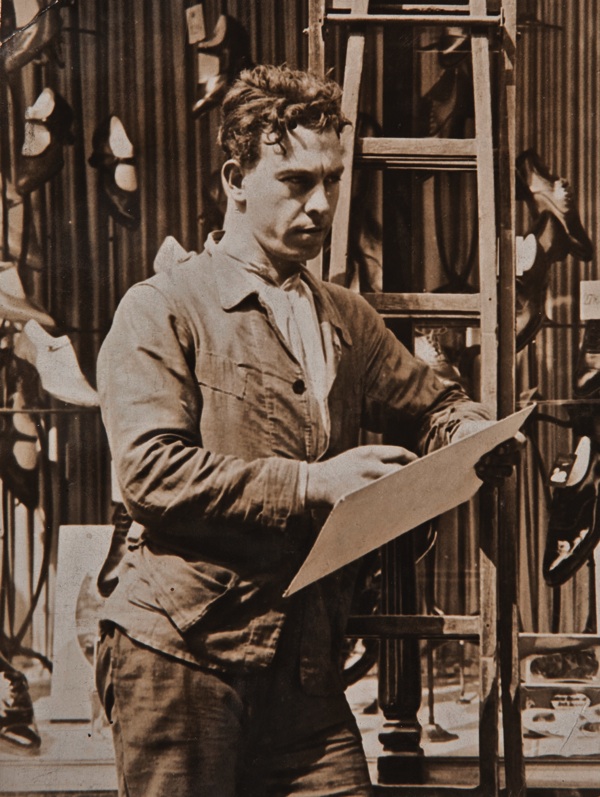
Albert Turpin, Artist, Anti-Fascist, Window Cleaner & Mayor of Bethnal Green
Bethnal Green is accepted all over the world as a typical home of the Cockney who, by his outstanding characteristics, has made himself a well-known figure in story and song. To anyone who has only known Bethnal Green in our times, the name seems very fancy, but for most it has been ordinary working class houses with parts degenerating into the most dilapidated, stinking slum. Alley and narrow street form themselves into a maze that can trap a stranger for long periods. In fact there was, until recently, a patch of these alleys in the Roman Rd area which was called by the locals ‘the bunk’ because it provided an avenue of escape from the police.
Anyway, there were times when Bethnal Green was actually green, the green coming from the fact that the hamlet had the usual village green around which the lads of the village lolled on Sundays. You can see them lolling still, outside the Salmon & Ball.
Less than two hundred years ago, we are told, the district was almost entirely rural and the farmlands were so fertile that they could yield two crops a year. The change from an agricultural parish into an overcrowded slum began when a large number of Huguenots, fleeing from the religious persecution in France, introduced the art of silk weaving into Spitalfields and the south-west portion of Bethnal Green.
Even now, after slum clearance schemes and Hitler’s bombs, there can still be seen the long-windowed, low-ceilinged cottages that housed the weavers, and in many places are the mulberry trees that were planted for the purposes of silk weaving. By the way, it is not uncommon to find in out of the way back gardens, grape vines – very old, but still bearing much fruit.
The origin of the name is not quite clear, although one thing is certain, and that is that it has not always been Bethnal Green. It has at different times been Blithehale, Blythenhale, Bleten Hall and Bednal Green.
It was at Bethnall House that Samuel Pepys brought his famous Diary for safe keeping whilst the Great Fire of London was raging.
By 1740, the population had grown to 15,000, among these being a certain John Turpin. I know, for his name is clearly set down in the Parish Minute Book under the date 1720, the ink being faded but the handwriting with the old quill pen superb.
The most picturesque story connected with this old community is that of Henry de Montfort, son of Simon de Montfort who was slain in the Battle of Evesham in 1265. Henry, it is said, was left for dead in the field of battle and blind through his wounds, was found by a Baron’s daughter who smuggled him away, nursed him and finally tokeep him from his enemies took the livelihood of begging and settled in Old Bethnal Green. The Blind Beggar of Bethnal Green has, through the years since, been the subject of song and story and has been officially recognised by using the Blind Beggar and his daughter Bessie as the Borough emblem.
Coming from Shoreditch, the main thoroughfare, Bethnal Green Rd, runs through the heart of the district. At the very entrance to the Borough there are markets held on Sunday mornings, and people come from all parts of London because of the distinctive flavour of these parts. There is the piece of ground where, for a hundred years, dogs of every sort and price are sold. A little further along are birds, singing birds, for the cockney was a most ardent fancier. He still is, but I can remember when every barber’s shop had a long row of canaries and finches – dozens of them – around the shop, and in the summer they would be hung up outside the shop.
In those early days, on a Sunday morning, one would always see dozens of workmen with their pets in their little cages, taking them to the Victoria Park. There the cages were hung on railings and left for hours at a time, the idea being, I suppose, that the free birds singing in the nearby trees and bushes would prompt the caged bird to sing.
At these markets, all kinds of livestock were sold – rabbits, fowls, ducks and even goats, for the Bethnal Greener was an ardent backyard farmer, while hundreds of gardens held pigeon lofts. At the Bethnal Green Men’s Institute every year many prizes for livestock breeding are still won against people who come from all over England.
Then there is another of these distinctive markets known as the Flower Market which is held in Columbia Road where, down the entire length of the street and on both sides are stalls from which are sold bulbs, flowers, bushes – in fact everything connected with the garden. The fact that this market has been going strong for half a century to my knowledge, will prove the East Ender to be quite a character, for people who have to live all their lives in a jumble of mean, huddled apologies for houses and who try to brighten the gloomy atmosphere with flowers, are obviously fighters.
The Bethnal Greener has always liked to do his shopping in the open street, and in this case almost the whole of one side of Bethnal Green Rd is an open market. Stalls are set side by side in the gutter, and although the market constitutes a danger to traffic, and is a nuisance to the authorities, it still goes on merrily. More than once attempts have been made to do away with Sunday markets and the street market, always without success.
It was in Bethnal Green that an unusual experiment was made to this end, by the Baroness Burdett Coutts, a wealthy and public spirited lady who, at a cost of £200,000, cleared a large tract of slums and had erected modern dwellings and a very fine building to be used as a market. This building had the appearance of a Gothic cathedral. The scheme never took on and was gradually surrounded and finally engulfed by the numerous small woodworking workshops that invaded the district from Shoreditch, and so the cockney trader still gaily shouts his wares from the gutter in Bethnal Green Rd.
In the Victorian days, there must have been a pub on each corner of every street. Many of these are still there but many have been turned into workshops and in more than one case, into boys clubs and social welfare headquarters.
Another feature that linked old Bethnal Green with our times were the many byways and courts that still, when I was a child, clung to their old fashioned cottage front gardens. In many places, building had been such that small group of cottages were built around and hemmed in until they formed a square hidden away from the rest of the Borough. Some of these old landmarks have gone, but for all their tumble-down condition, they always held an appeal for me. In summer, the bright flowers bloomed against the background of white-washed walls, wooden picket fences ran between the gardens, and it was a very poor cottage that did not have a couple of trilling birds hanging over the doorway.
The cockney’s clothing was as full of character as himself. I have seen him, when a boy, on Sunday in moleskin or corduroy trousers almost white in colour, a heavy belt around his middle a heavy waist coat and a jacket that came down well over his hips with plenty of pockets and that most colourful touch, the neckerchief or choker. Collar and tie or bows were never thought of. Because of laziness? Oh no, he wore clothes with an air and took as much time selecting his choker as the old cowboy of Texas did. There was shop in Bethnal Green Rd, until Hitler removed it, that sold nothing but these squares of soft coloured silk and they cost more than a dozen stiff collars and ties. Of course, the cockney never wore anything but a cap and I can only think of the old time cockney as always wearing his cap at the back of his head and over one ear.
Yes, he was a colourful soul with rigid principles and as independent as the nomad arab or the Western cowhand. But, like all these types, he is dying out – so many parts of the East End have changed. Where many of the coffee shops, of the ‘good pull up for the carmen’ fame were, are now Italian cafes with fake marble topped tables instead of the wooden high backed seats. Even the cockney of the coster barrow is being superseded by the cheap jack and our market places, which were once the homes of merry banter and good fellowship, are gradually coming under the influence of outsiders.
That was the Bethnal Green of the past and, as some of the inhabitants have changed, so has the district itself. As I write, plans have been announced for the ceremonial opening of the first Bethnal Green Tube Station which is reported as being the underground station of the future. It has three escalators and is lit throughout with fluorescent lighting. The air is changed four times an hour through bronze grills on the platforms by an improved ventilation system.
What a change in a short life time. When we were kids we used, on a summer’s afternoon, to sit on the curb outside the Salmon & Ball to wait for the horse trams and horse buses to pass with the conductors on top, when we would get on the platform to ride until the conductor came down. I shall think of those times, I know, whenever I use the Tube, for the new station is situated underneath the Fish & Globe, as the locals called the Salmon & Ball.

Salmon & Ball, c. 1955
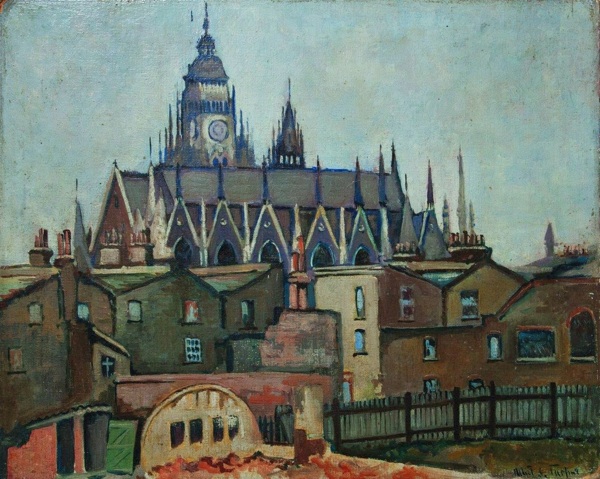
Columbia Market
Paintings copyright © Estate of Albert Turpin
The East End – My Birthright is a memoir of Turpin’s remarkable life. It includes first-hand descriptions of political events in the East End – fights with the Blackshirts, arrests, meetings in Victoria Park, as well as the Battle of Cable St. His descriptions of the Blitz and the destruction of his beloved East End are a rare insight into the lives of ordinary people confronted by unimaginable horrors. The book is illustrated by Turpin’s paintings and drawings as well as cuttings, posters and photographs from his family’s collection.
Albert Turpin lived all his life in Bethnal Green. In the Great War, he served in the Marines and witnessed the massacre of Armenians in Turkey and the Russian Revolution. In the thirties, he became a Socialist, a Labour councillor and prominent anti-Fascist. Indeed, he was accused of being behind the disturbances at the Battle of Cable St, when a march by Mosley’s Blackshirts through the East End was fiercely resisted. In the Second World War he volunteered as a firefighter and saw action throughout the Blitz.
Turpin was an accomplished artist, involved with the East London Group of artists in the twenties and thirties. He sketched and painted throughout his life, after the war depicting the reconstruction of Bethnal Green. In 1946, he became Mayor of Bethnal Green.
Click to buy a copy of THE EAST END, MY BIRTHRIGHT direct from the publisher Francis Boutle.
You may also like to read about
Albert Turpin, Artist, Window Cleaner & Mayor of Bethnal Green
James Mackinnon’s Solo Exhibition
Once, artists came to the East End because it was cheap to live here but James Mackinnon is one of those who can longer afford to stay because it is too expensive, and he has moved from Hackney to Hastings.
Ironically, James’ work is so popular that it has taken years for him to have his first solo show because his pictures usually sell before he can collect enough for an exhibition. So I am delighted to announce the opening of James Mackinnon’s show this week at The Millinery Works, N1 3JS, running from Tuesday 17th October until 12th November.
Spitalfields Life readers are invited to private views on Tuesday 17th from 6pm and Sunday 22nd from noon to 5pm. James Mackinnon is featured in EAST END VERNACULAR, Artists who painted London’s East End streets in the 20th century, and James and I will be introducing the book and signing copies at 3pm on Sunday 22nd.
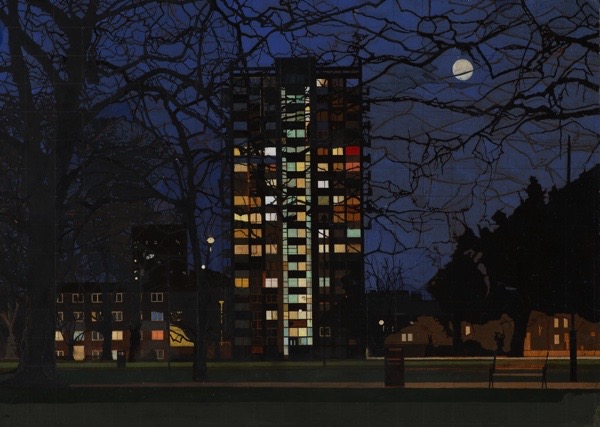
Tower at Night, London Fields
The streetscapes of the East End in general and London Fields in particular by James Mackinnon (born 1968) have captivated me for years. The seductive sense of atmosphere and magical sense of possibility in these pictures is matched by the breathtaking accomplishment of their painterly execution.
Remarkably, James is a third generation artist, with his uncle Blake and grandfather Hugh before him – which perhaps accounts for the classical nature of his technique even if his sensibility is undeniably contemporary.
We sat outside Christ Church, Spitalfields, chatting about the enduring allure of the East End for artists, and I was sorry learn that James has been forced to leave due to rising rents.
Like several others I met while researching my book, he is an artist who is genuinely deserving of appreciation by a much wider audience. It is very disappointing that the rewards for such a prodigiously talented painter as James Mackinnon are so little that he can no longer afford to be in the East End, and the East End is lesser for it.
“I grew up in South London in Lee Green and I used to go to the Isle of Dogs through the foot tunnel under the Thames and I was mystified by the area north of the river. Sometimes I would bunk off school with a sketchbook and go wandering there. It seemed a mysterious land, so I thought ‘What’s further up from the Isle of Dogs?’ I was a kid and I had been taken up to the West End, but I had never been to the East End and I sensed there was something extraordinary over that way.
I had always loved drawing and I got a scholarship in art to Dulwich College when I was eleven. The art department was wonderful and I got massive support, so I used be in the art block most of the time.
Later on, having left home and gone through college, there was a big recession and it was tough, all the students were scrabbling around for work, I had an epiphany. I was sat next to the Thames and I realised I just wanted to look at buildings and paint them. Since I was a child, buildings and their atmosphere, the feeling of buildings always had this resonance that I could not put my finger on.
As a kid, I was painting with poster paint and drawing with felt tips, and I was obsessed with the Post Office Tower. There was an art deco Odeon in Deptford that was derelict for years and it was demolished at the end of the eighties, and that had a huge effect on me. I sat in the back of my dad’s car and we drove past on the way up to London, and I would see this building and almost have a heart attack, I had such strong feelings about it. My God this thing is extraordinary, I am in love with it! It was falling to bits, it had pigeons sitting in the roof and it had wonderful art deco streamlining but it had this atmosphere, an elegance and a sadness. Even with the Post Office Tower, I felt it had this presence as though it were a person. That comes to the fore when you paint and you feel the place. You are not just concentrating on the architecture, it’s an emotional thing.
So with painting and drawing skills, I wanted to explore the landscape and often the hinterland. There is something compelling about going to a place you do not really know about – the mysterious world of places. The atmosphere of places is borne out of people and their residue, it’s about people living in a place.
By exploring, I was slowly drawn to where my heart was guiding me. In the early nineties, I moved to the East End because it was affordable and I had always wanted to explore there. And I was there until around 2013. I lived in Hackney and had a great time there, and made some great friends.
I was struggling as an artist, there was a lot of signing on the dole, but it was an act of faith, I knew it was what I had to do. I had always painted buildings.
I lived near London Fields and there is this little terrace of Georgian houses with a railway line and overhead electric wires, and there are some tower blocks in the distance, and you have all this grass. That was at the bottom of my road, it was such an interesting juxtaposition. A lot of East London landscapes have that, you might get a church sitting next to a railway line, next to tower block, next to the canal and a bit of old railing and some graffiti. That funny mixture. So I would just go and paint what I wanted. I painted what I was drawn to. For a long time, I was obsessed with Stratford. No-one had done anything to it at that time and I would go round the back streets and I roamed the hinterlands. I walked through to Plaistow and it is all part of a certain landscape that you find in the East End. To make a picture, you have got to find something that moves you and it can be something at the bottom of your road that resonates for you and makes the right composition for a painting. It’s hard to explain.
I had a go at having a studio but I was always a struggling artist so, when it came to rent day, it got tricky. It’s lovely having a studio but I could not afford it. I tried living in my studio for a bit to save money on the rent but the landlord found out and there was a cat and mouse game.
By the time I left, I think I had found myself. There is something in the painting that says it is me rather than anyone else and that has evolved from having done it for twenty years. I just about managed to survive. I realised I have got the tenacity and self belief. This is what I love. You find your path after a lot of struggle but it only comes by doing it. You realise that a great painting can come from something very ordinary, you can go for a walk and there might be something round the corner that knocks you out. There was a lot of that in the East End and I am still obsessed by it though it is changing hugely. Some of the landscapes have changed and some of the shops have gone. I miss Hackney in many ways but I do not miss struggling and rents going up. The area has changed.
So now I have moved to Hastings. I had a little boy and it became untenable to carry on living in the East End. I had no choice.”
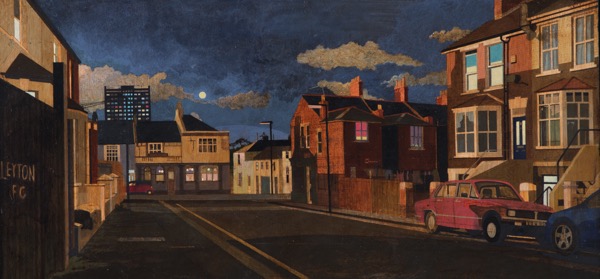
East London Nocturne

Regent’s Canal, Broadway Market
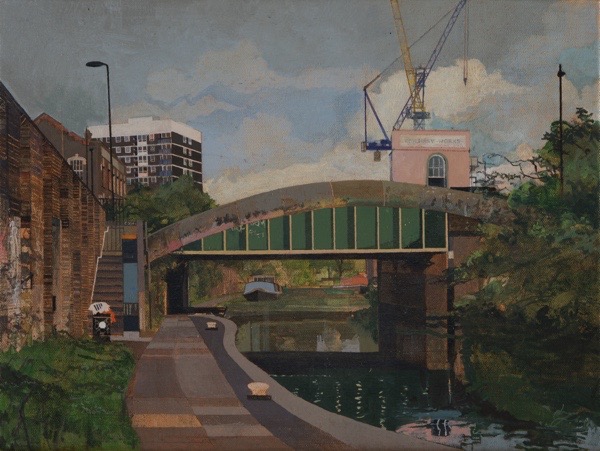
Regent’s Canal, Rosemary Works
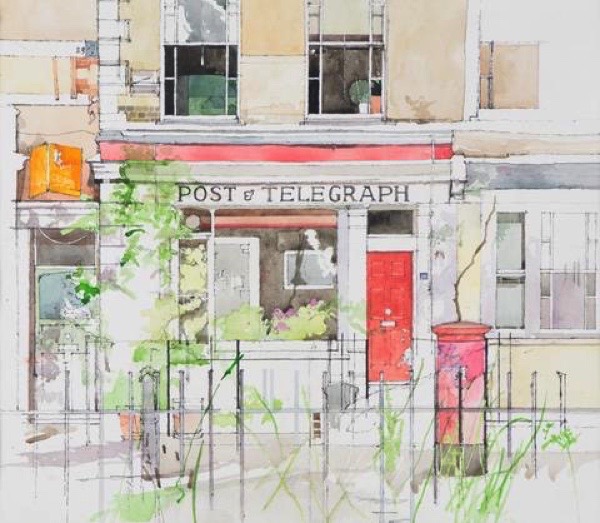
Post & Telegraph, Victoria Park
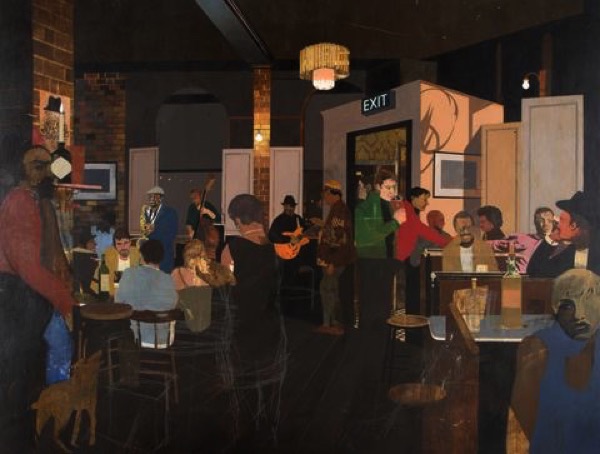
Round Midnight at The Haggerston, Dalston
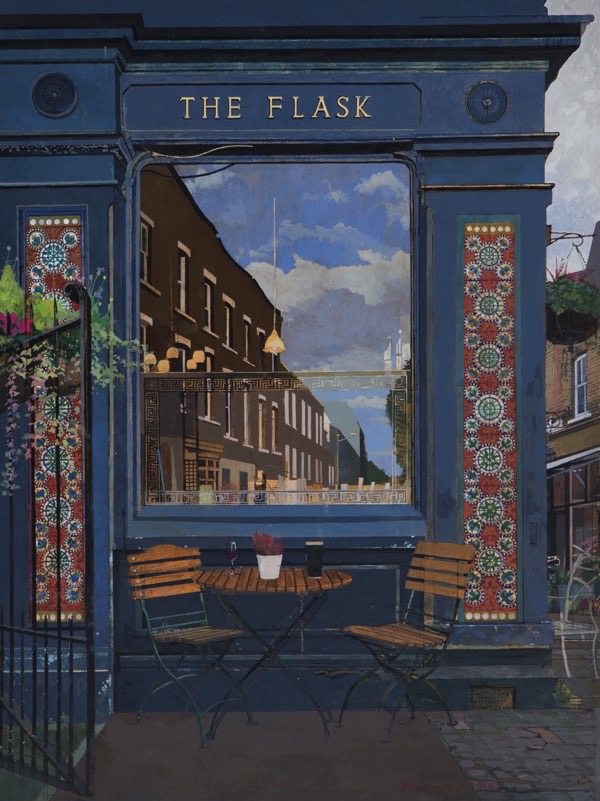
The Flask, exterior
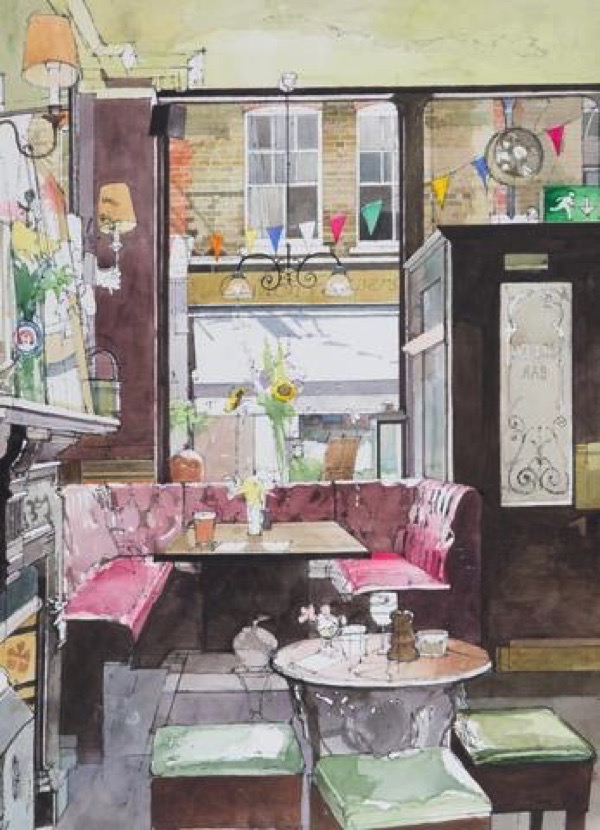
The Flask, interior
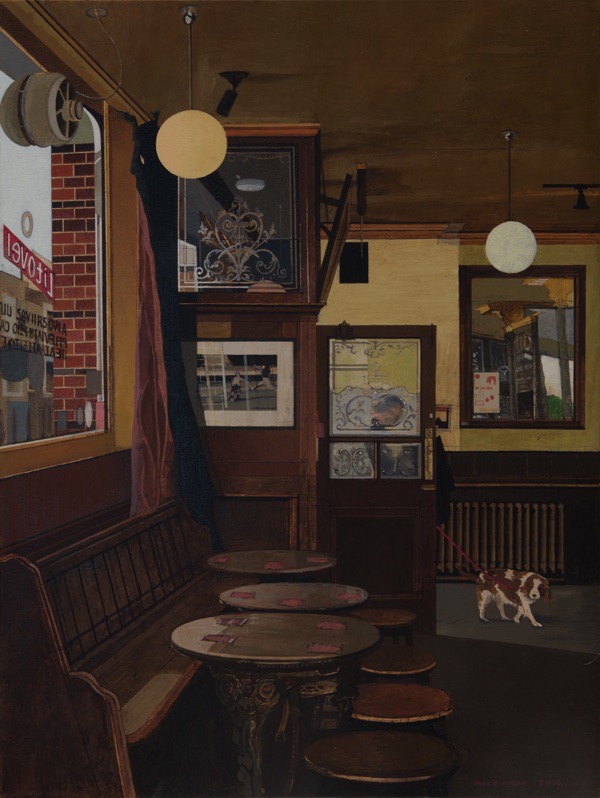
Early Doors, The Shakespeare, Stoke Newington
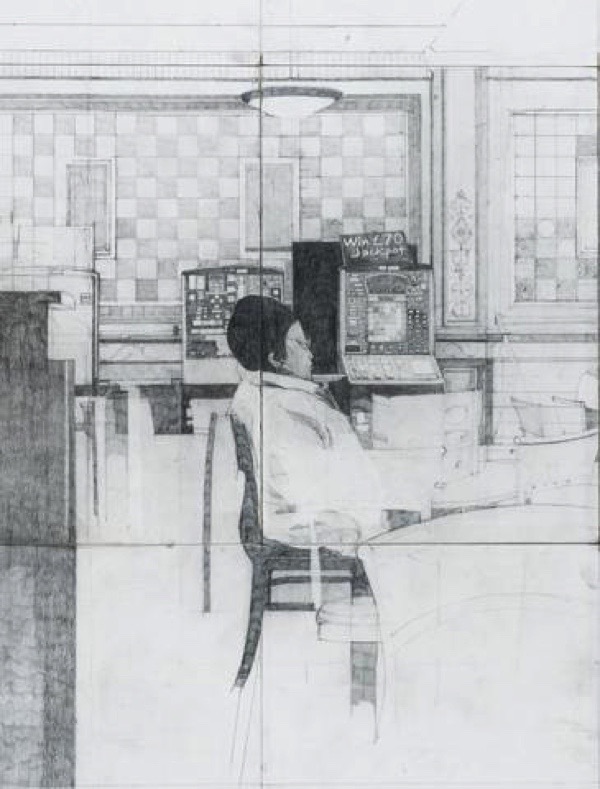
The Rochester Castle, Stoke Newington
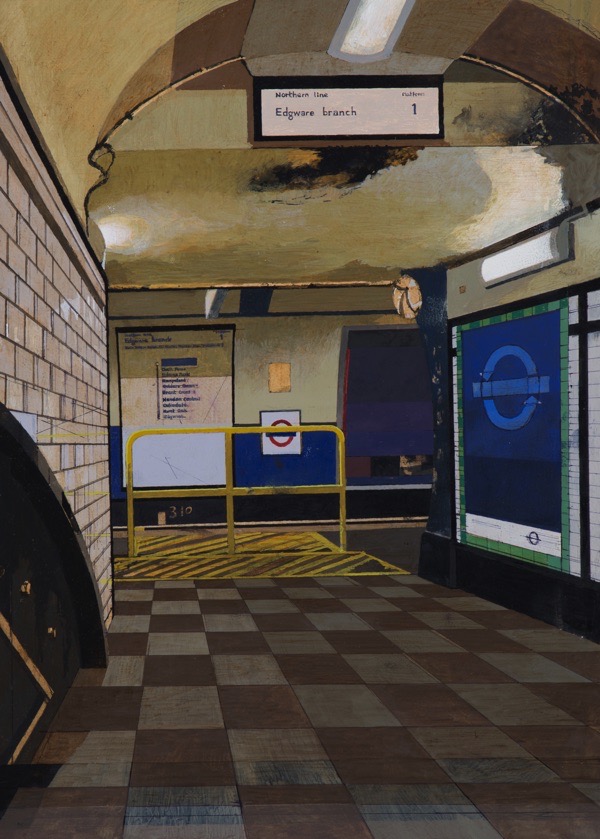
Camden Town Tube
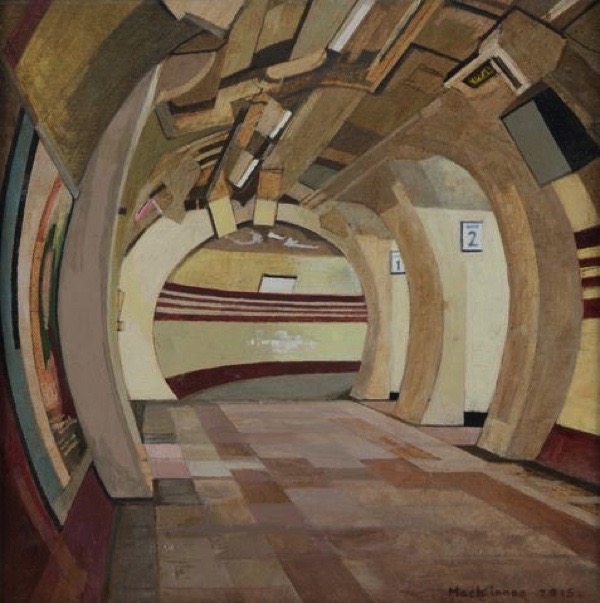
Hampstead Tube
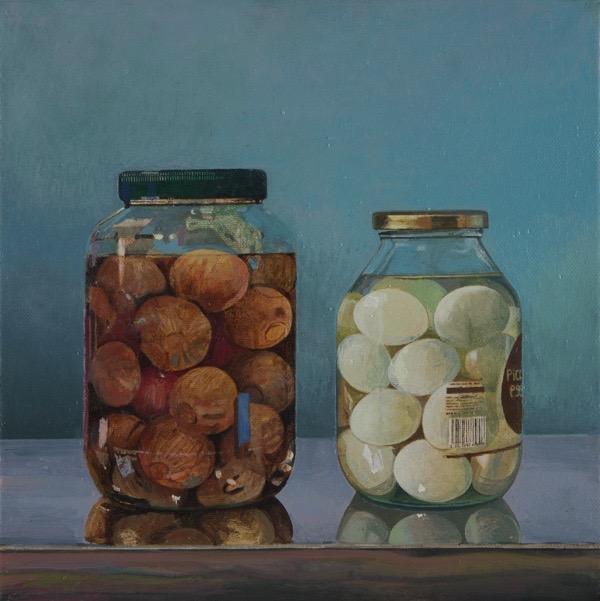
Pickled eggs and onions
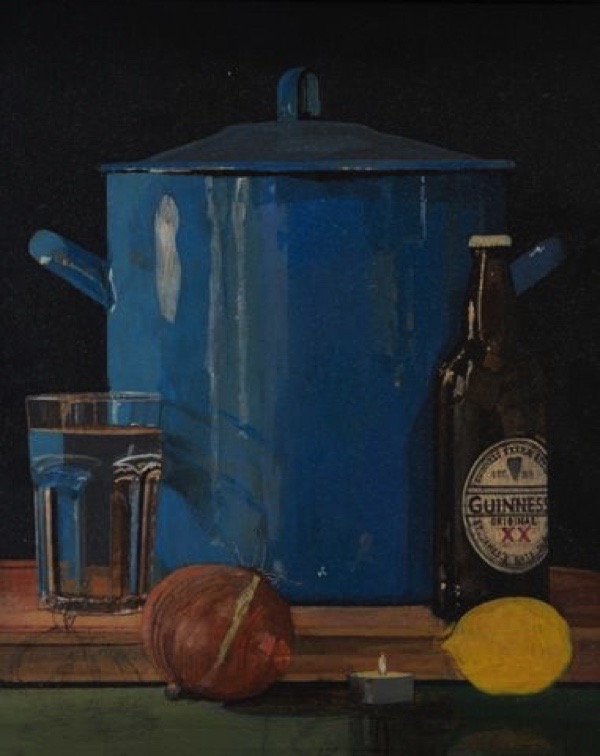
Blue Pot with Guinness Bottle
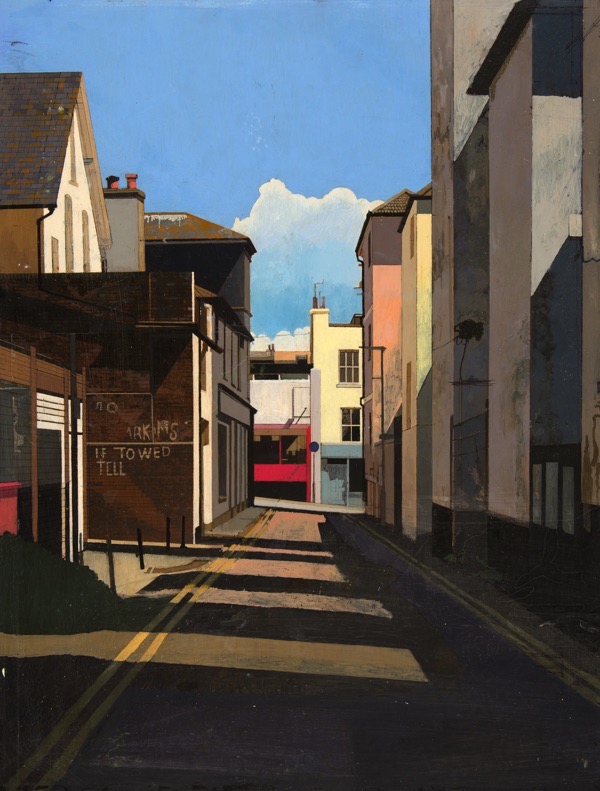
Backstreets, St Leonard’s on Sea
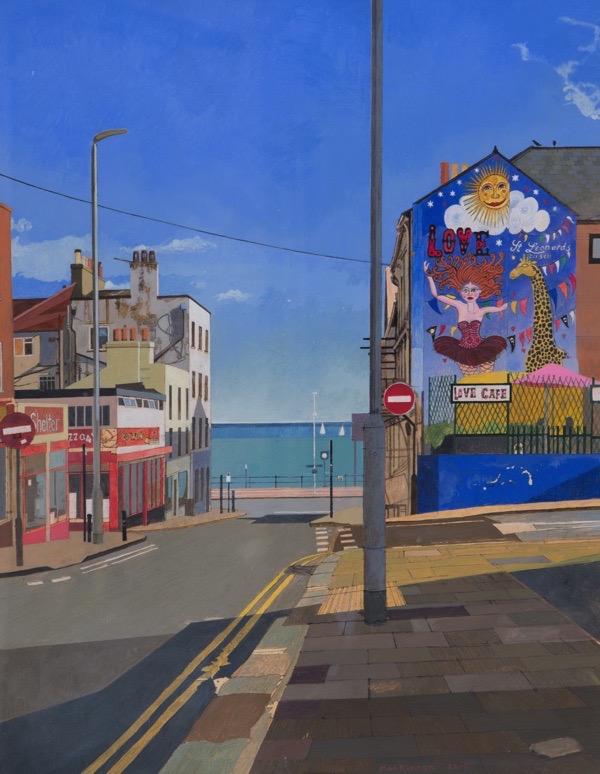
Love Café, St Leonard’s On Sea
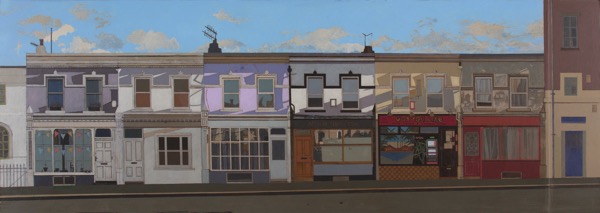
Seaside Terrace
Paintings copyright © James Mackinnon
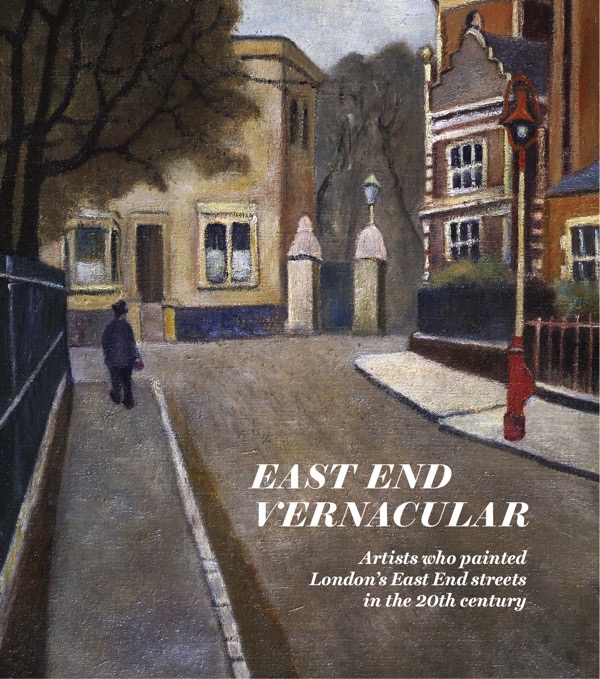
Click here to order a copy of EAST END END VERNACULAR for £25
Learn How To Write Your Own Blog
Join me for a weekend in an eighteenth century weavers’ house in Fournier St and learn how to write your own blog. Learn the secrets of how Spitalfields Life runs, enjoy delicious lunches from Leila’s Cafe and cakes freshly baked to eighteenth century recipes by Townhouse. We always have a lot of fun. Places are available for the weekends of 4th & 5th November and we are also taking bookings for 3rd & 4th February 2018. The course fee of £300 includes lunches, cakes, teas and coffees. Email spitalfieldslife@gmail.com to book your place.

Comments by students from courses tutored by The Gentle Author
“I highly recommend this creative, challenging and most inspiring course. The Gentle Author gave me the confidence to find my voice and just go for it!”
“Do join The Gentle Author on this Blogging Course in Spitalfields. It’s as much about learning/ appreciating Storytelling as Blogging. About developing how to write or talk to your readers in your own unique way. It’s also an opportunity to “test” your ideas in an encouraging and inspirational environment. Go and enjoy – I’d happily do it all again!”
“The Gentle Author’s writing course strikes the right balance between addressing the creative act of blogging and the practical tips needed to turn a concept into reality. During the course the participants are encouraged to share and develop their ideas in a safe yet stimulating environment. A great course for those who need that final (gentle) push!”
“I haven’t enjoyed a weekend so much for a long time. The disparate participants with different experiences and aspirations rapidly became a coherent group under The Gentle Author’s direction in a gorgeous house in Spitalfields. There was lots of encouragement, constructive criticism, laughter and very good lunches. With not a computer in sight, I found it really enjoyable to draft pieces of written work using pen and paper. Having gone with a very vague idea about what I might do I came away with a clear plan which I think will be achievable and worthwhile.”
“The Gentle Author is a master blogger and, happily for us, prepared to pass on skills. This “How to write a blog” course goes well beyond offering information about how to start blogging – it helps you to see the world in a different light, and inspires you to blog about it. You won’t find a better way to spend your time or money if you’re considering starting a blog.”
“I gladly traveled from the States to Spitalfields for the How to Write a Blog Course. The unique setting and quality of the Gentle Author’s own writing persuaded me and I was not disappointed. The weekend provided ample inspiration, like-minded fellowship, and practical steps to immediately launch a blog that one could be proud of. I’m so thankful to have attended.”
“I took part in The Gentle Author’s blogging course for a variety of reasons: I’ve followed Spitalfields Life for a long time now, and find it one of the most engaging blogs that I know; I also wanted to develop my own personal blog in a way that people will actually read, and that genuinely represents my own voice. The course was wonderful. Challenging, certainly, but I came away with new confidence that I can write in an engaging way, and to a self-imposed schedule. The setting in Fournier St was both lovely and sympathetic to the purpose of the course. A further unexpected pleasure was the variety of other bloggers who attended: each one had a very personal take on where they wanted their blogs to go, and brought with them an amazing range and depth of personal experience. “
“I found this bloggers course was a true revelation as it helped me find my own voice and gave me the courage to express my thoughts without restriction. As a result I launched my professional blog and improved my photography blog. I would highly recommend it.”
“An excellent and enjoyable weekend: informative, encouraging and challenging. The Gentle Author was generous throughout in sharing knowledge, ideas and experience and sensitively ensured we each felt equipped to start out. Thanks again for the weekend. I keep quoting you to myself.”
“My immediate impression was that I wasn’t going to feel intimidated – always a good sign on these occasions. The Gentle Author worked hard to help us to find our true voice, and the contributions from other students were useful too. Importantly, it didn’t feel like a ‘workshop’ and I left looking forward to writing my blog.”
“The Spitafields writing course was a wonderful experience all round. A truly creative teacher as informed and interesting as the blogs would suggest. An added bonus was the eclectic mix of eager students from all walks of life willing to share their passion and life stories. Bloomin’ marvellous grub too boot.”
“An entertaining and creative approach that reduces fears and expands thought”
“The weekend I spent taking your course in Spitalfields was a springboard one for me. I had identified writing a blog as something I could probably do – but actually doing it was something different! Your teaching methods were fascinating, and I learnt a lot about myself as well as gaining very constructive advice on how to write a blog. I lucked into a group of extremely interesting people in our workshop, and to be cocooned in the beautiful old Spitalfields house for a whole weekend, and plied with delicious food at lunchtime made for a weekend as enjoyable as it was satisfying. Your course made the difference between thinking about writing a blog, and actually writing it.”
“After blogging for three years, I attended The Gentle Author’s Blogging Course. What changed was my focus on specific topics, more pictures, more frequency, more fun. In the summer I wrote more than forty blogs, almost daily from my Tuscan villa on village life and I had brilliant feedback from my readers. And it was a fantastic weekend with a bunch of great people and yummy food.”
“An inspirational weekend, digging deep with lots of laughter and emotion, alongside practical insights and learning from across the group – and of course overall a delightfully gentle weekend.”
“The course was great fun and very informative, digging into the nuts and bolts of writing a blog. There was an encouraging and nurturing atmosphere that made me think that I too could learn to write a blog that people might want to read. – There’s a blurb, but of course what I really want to say is that my blog changed my life, without sounding like an idiot. The people that I met in the course were all interesting people, including yourself. So thanks for everything.”
“This is a very person-centred course. By the end of the weekend, everyone had developed their own ideas through a mix of exercises, conversation and one-to-one feedback. The beautiful Hugenot house and high-calibre food contributed to what was an inspiring and memorable weekend.”
“It was very intimate writing course that was based on the skills of writing. The Gentle Author was a superb teacher.”
“It was a surprising course that challenged and provoked the group in a beautiful supportive intimate way and I am so thankful for coming on it.”
“I did not enrol on the course because I had a blog in mind, but because I had bought TGA’s book, “Spitalfields Life”, very much admired the writing style and wanted to find out more and improve my own writing style. By the end of the course, I had a blog in mind, which was an unexpected bonus.”
“This course was what inspired me to dare to blog. Two years on, and blogging has changed the way I look at London.”
HOW TO WRITE A BLOG THAT PEOPLE WILL WANT TO READ – 4th & 5th NOVEMBER 2017 and 3rd & 4th FEBRUARY 2018
Spend a weekend in an eighteenth century weaver’s house in Spitalfields and learn how to write a blog with The Gentle Author.
This course will examine the essential questions which need to be addressed if you wish to write a blog that people will want to read.
“Like those writers in fourteenth century Florence who discovered the sonnet but did not quite know what to do with it, we are presented with the new literary medium of the blog – which has quickly become omnipresent, with many millions writing online. For my own part, I respect this nascent literary form by seeking to explore its own unique qualities and potential.” – The Gentle Author
COURSE STRUCTURE
1. How to find a voice – When you write, who are you writing to and what is your relationship with the reader?
2. How to find a subject – Why is it necessary to write and what do you have to tell?
3. How to find the form – What is the ideal manifestation of your material and how can a good structure give you momentum?
4. The relationship of pictures and words – Which comes first, the pictures or the words? Creating a dynamic relationship between your text and images.
5. How to write a pen portrait – Drawing on The Gentle Author’s experience, different strategies in transforming a conversation into an effective written evocation of a personality.
6. What a blog can do – A consideration of how telling stories on the internet can affect the temporal world.
SALIENT DETAILS
The next courses will be held at 5 Fournier St, Spitalfields on 4th & 5th November and on 3rd & 4th February.
The Course runs from 10am -5pm on Saturday and 11am-5pm on Sunday.
Accomodation at 5 Fournier St is available upon enquiry to Fiona Atkins fiona@townhousewindow.com
Email spitalfieldslife@gmail.com to book a place on the course.
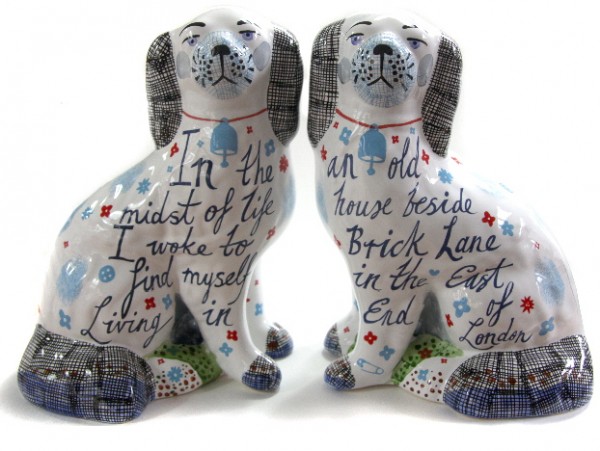
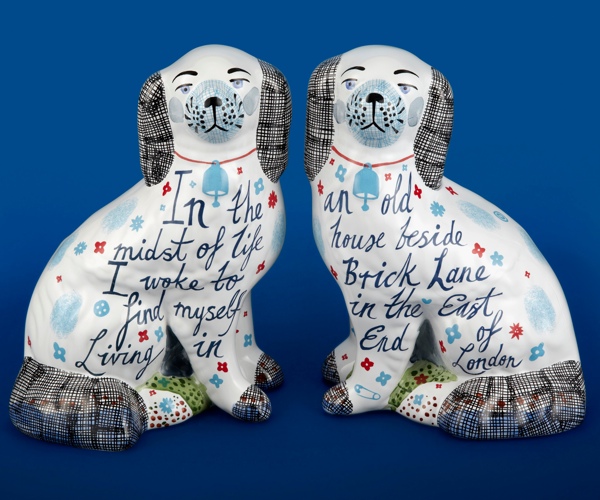
Staffordshire Dogs by Rob Ryan
The Bloody Romance Of The Tower

The Execution of Lady Jane Grey at Tower Green
“It has been for years, the cherished wish of the writer of these pages to make the Tower of London the groundwork of a Romance,” wrote William Harrison Ainsworth in 1840, introducing his novel, “The Tower of London” – and it is an impulse that I recognise, because I know of no other place in London where the lingering sense of myth and the echoing drama of the past is more tangible that at the Tower.
Each time I enter those ancient walls, am struck anew by the mystery of the place. I have to stop and reconcile my knowledge of history with the location where it happened, and each time I become more spellbound by the actuality of the place, which in spite of Victorian rebuilding still retains its integrity as an ancient fortress. I make a point to pause and read the age-old graffiti, to stop in each doorway and take in the prospect at this most dramatic of monuments.
When I discovered “The Tower of London” by William Harrison Ainsworth in the Bishopsgate Institute I was captivated by George Cruikshank’s illustrations, realising that not only had this favourite of mine amongst nineteenth century illustrators once stood in exactly the same places I had stood, but he had the genius to draw the images inspired by these charged locations.
“Desirous of exhibiting the Tower in its triple light of a palace, a prison and a fortress, the author has shaped his story with reference to that end, and he has also endeavoured to combine such a series of incidents as should naturally introduce every relic of the old pile, its towers, halls, chambers, gateways and drawbridges – so that no part of it should remain uninvolved.” explained Ainsworth in his introduction to his sensationalist fictionalised account of the violent end of the short reign of Lady Jane Grey. Yet it is George Cruikshank’s engravings which bring the work alive, providing not just a tour of the architectural environment but also of the dramatic imaginative world that it contains – and done so vividly that I know already that when I return I shall be looking out for his characters in my mind’s eye while I am there.
There is a grim humour and surreal poetry in pictures which, to my eyes, presage the work of Edward Gorey, who like George Cruikshank also created a sinister diaphanous world out of dense hatching. Maurice Sendak is another master of the mystery that can be evoked by intricate webs of woven lines in which – as in these Tower of London engravings – three dimensional space dissolves into magical possibility. But to me the prime achievement of these pictures is that George Cruikshank has given concrete life to the Tower’s past, creating figures that convincingly take command of the stage offered by its charged spaces and, like the acting of Henry Irving, appear as if momentarily illuminated by flashes of lightning. Cruikshank’s pictures are like glimpses of a strange dream, drawing the viewer into a compelling emotional universe with its own logic, peopled by its own inhabitants and where it is too readily apparent what is going on.
The popularity of William Harrison Ainsworth’s novel was responsible for creating the bloodthirsty reputation of the Tower of London which still endures today – even though for centuries the Tower was used as a domestic royal residence and administrative centre, headquarters of the royal ordinances, records office, mint, observatory, and a menagerie amongst other diverse functions throughout its thousand year history. Yet although it may be just one of the infinite range of tales to be told about the Tower of London, William Harrison Ainsworth’s Romance does witness historical truth. There is a neglected plaque in the corner of Trinity Green, just outside Tower Hill station, which is a memorial to those executed there through the centuries – as testament to the reality of the violence enacted upon those with the misfortune to find themselves on the wrong side of authority in past days.

Jane Grey’s first night in the Tower – “Prompted by an undefinable feeling of curiosity, she hastened towards it and, holding forward the light, a shudder went through her frame, as she perceived at her feet – an axe!”

Cuthbert Cholmondeley surprised by a mysterious figure in the dungeon adjoining the Devilin Tower.

Jane Grey interposing between the Duke of Northumberland and Simon Renard.

Jane Grey and Lord Gilbert Dudley brought back to the Tower through Traitors’ Gate – “Never had Jane experienced such a feeling of horror as now assailed her – and if she had crossed the fabled Styx, she could not have greater dread. Her blood seemed congealed within her veins as she gazed around. The light of the torches fell upon the black arches – upon the slimy walls and upon the yet blacker tide.”

Jane imprisoned in the Brick Tower – “Alone! The thought struck her to the heart. She was now captured. She heard the doors of the prison bolted – she examined its stone walls, partly concealed by tapestry – she glance at its barred windows, and she gave up hope.”

Simon Renard and Winwinkle, the warder, on the roof of the White Tower – “There you behold the Tower of London,” said Winwinkle, pointing downwards. “And there I read the history of England,” replied Renard. “If it is written in these towers, it is a dark and bloody history, ” replied the warder.

Mauger sharpening his axe – ” A savage-looking individual seated on a bench at a grinding stone, he had an axe blade which he had just been sharpening, and he was trying its edge with his thumb. His fierce blood-shot eyes, recessed far beneath his bent and bushy brows were fixed upon the weapon.”

Execution of the Duke of Northumberland upon Tower Hill – “As soon as the Duke had disposed himself upon the block, the axe flashed like a gleam of lightning in the sunshine – descended – and the head was severed from the trunk. Mauger held it aloft, almost before the eyes were closed, crying out to the the assemblage in a loud voice, “Behold the head of a traitor!”

Cuthbert Cholmondeley discovering the body of Alexia in the Devilin Tower – “Pushing aside the door with his blade, he beheld a spectacle that filled him with horror. At one side of the cell upon a stone seat, rested the dead body of a woman, reduced almost to a skeleton. On the wall, close to where she lay, and evidently carved by her own hand, the name ALEXIA.”

Queen Mary surprises Courtenay and Princess Elizabeth

Lawrence Nightgall dragging Cicely down the secret stairs in the Salt Tower
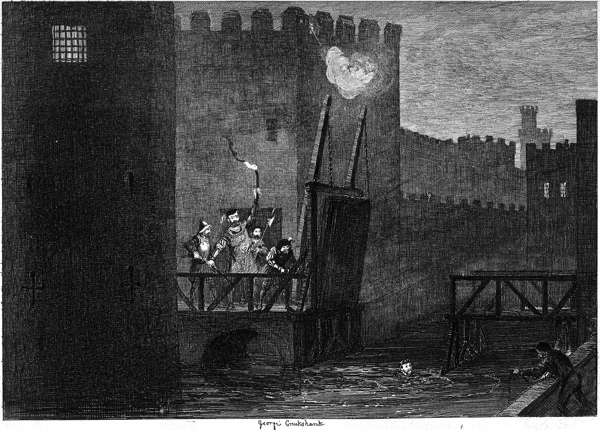
Courtenay’s escape from the Tower

The burning of Edward Underhill at Tower Green – “As the flames rose, the sharpness of the torment overcame him. He lost control of himself, and his eyes started from their sockets – his contorted features and his writhing frame proclaimed the extremity of his agony. It was a horrible sight, and a shudder burst forth from the assemblage.”

The Death Warrant – “Mary tried to ascertain the cause of the animal’s disquietude as its barking changed to a dismal howl. Not without misgiving, she glanced towards the window and there between the bars she beheld a hideous black mask, through the holes of which glared a pair of flashing eyes.”

Elizabeth confronts Sir Thomas Wyatt in the torture chamber – “‘Sir Thomas Wyatt,’ Elizabeth declared in a loud and authoritative tone, and stepping towards him, ‘If you would not render your name forever infamous, you must declare my innocence!'”

The Fall of Nightgall – “Nightgall struggled desperately against the horrible fate that waited him, clutching convulsively against the wall. But it was unavailing. He uttered a fearful cry, and tried to grab at the roughened surface. From a height of nearly ninety feet, he fell with a terrific smash upon the pavement of the court below.”

The Night before the Execution – “In spite of himself, the executioner could not repress a feeling of dread and the contrary urge, which represented his curiousity. He pointed towards the church porch, from which a figure, robed in white, but insubstantial as the mist, suddenly appeared. It glided noiselessly along and without turning its face to the beholders.”

Jane Grey meeting the body of her husband at the scaffold – “She knew it was the body of her husband, and unprepared for so terrible an encounter, uttered a cry of horror.”

Plaque at Trinity Green on Tower Hill
You may also like to read
John Keohane, Chief Yeoman Warder at the Tower of London
A Conversation With Doreen Fletcher
On the eve of Doreen Fletcher’s second exhibition IN BETWEEN, ALMOST GONE which opens this Friday 13th October at Townhouse, Spitalfields, I visited Doreen in her studio to learn the story behind her remarkable urban landscape paintings of the East End
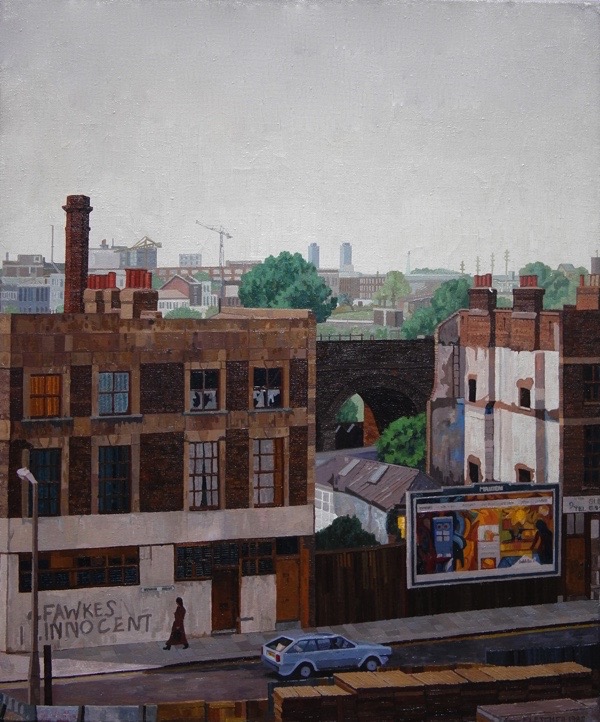
Turner’s Rd, 1998
Doreen Fletcher – Looking back, I suppose I was very spoiled. From a young age I liked painting and my dad used to take me to the toy shop and we had to buy the best, most expensive paints. I was an only child, born into a working class family, and my parents, Colin & Alice, were semi-literate, I guess you would say.
I was a bit of a loner, I liked going for long walks. I passed the eleven-plus but I had a very difficult time at Grammar School because, although I was clever, I came from the wrong side of the tracks. I used to have to wear this hat and every morning, as I was walking to school, the Secondary Modern kids would come and knock it off my head. When I got to school, I had to pretend I was from somewhere else, because all the other kids they came from families who were doctors, solicitors, and so I felt, you know… odd.
The Gentle Author – What was the first landscape that you knew?
Doreen Fletcher – It was grey. Grey, brown streets with sparrows, lots of sparrows and pigeons. I used to long for colour. I grew up in a two-up, two-down terrace in Stoke-on-Trent, but every Sunday my parents used to take me on a bus into the country and I just loved colour.
I remember, when I was five, I was bought a set of encyclopaedias from the guy who came round knocking on street doors and it had colour pictures in it – paintings – and I thought they were wonderful. And I suppose that was when I started to be interested in visual things – plus at Grammar School, when we were doing Art, I did not have to talk and my accent in those days was quite broad. All the other girls spoke with posh accents, so I would paint in silence and it was something I was good at, so I got praise for that.
The Gentle Author – What work did your parents do?
Doreen Fletcher – Oh Alice, my mother, she was a servant. She worked in a munitions factory during the war and then she became a servant afterwards. It gave her ideas about not having the newspaper on the table and no tomato ketchup, and healthy eating. So in her case, there was a slight social mobility. She was very very fussy about the front step being clean. Colin, my dad, started off as a farm worker, he had wanted to be a vet but the fact that he did not like school – could hardly read or write – stood in the way.
After I was born, they moved to the town because he could earn more money and, in the late fifties, when they started putting up pylons he worked on that, and then later he worked putting in pipes for North Sea Gas too. When he was fifty-seven, he had a brain haemorrhage when he was working, probably because of the pneumatic drills, and he did not work again after that.
The Gentle Author – So what took you away from the Potteries?
Doreen Fletcher – I did not like living in a small town. I hated the constrictions and the pettiness. I wanted to go to Art School in London, and I met a boy who got a place in one and I moved with him to London.
The Gentle Author– But did you apply to Art School yourself?
Doreen Fletcher – Yes, I did a Foundation Course in Newcastle but after that I became a model. I did that for a long time.
The Gentle Author – Where did you live when you came to London?
Doreen Fletcher – I moved to Colliers Wood in South West London and I got a job at an Art School as a model. Gradually, I started taking photographs and doing drawings but – at that point – I did not really know what I wanted to paint, except that it was almost a compulsive activity.
I did quite a lot of self portraits and still lives. It was only when I moved to Bayswater in 1976 that I developed a strong interest in urban landscape. For me, it was a very exciting place to be – having come from this small town – and it was close to the Serpentine Gallery, Kensington Gardens, Notting Hill Gate and Portobello Rd. I started painting the local streets – the Electric Cinema, the Serpentine Boathouse – and then I became interested in Underground stations at night – Bayswater, Paddington – and this continued when I moved to the East End.
The Gentle Author – What brought you to the East End?
Doreen Fletcher – Simply that the relationship I was in broke up and I met someone new and the housing was cheap in the East End. It was relatively cheap to rent at that time because lots of people were moving away, so artists were still moving in to places like Bow and Mile End.
The Gentle Author – How do you remember the East End as it was then?
Doreen Fletcher – There was corrugated iron everywhere! I loved it here because I had had enough of the sophistication of the West End. It seemed to me like coming back home here – lots of corner shops and tiny pubs. There was a community but, after a couple of years, I realised that they were not staying, and the corner shops and pubs were closing.
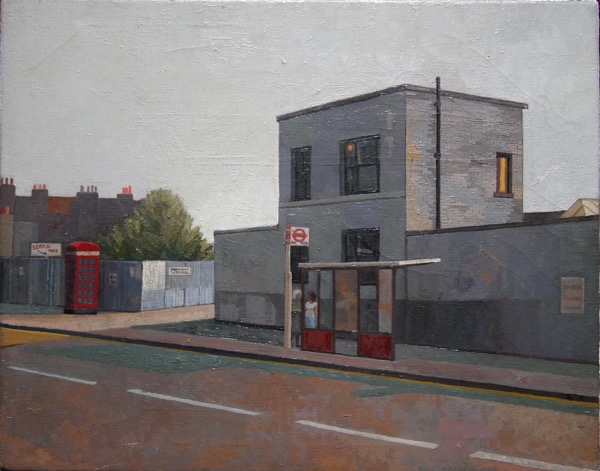
Bus Stop, Mile End, 1983
The Gentle Author – Why did you start painting the East End?
Doreen Fletcher – I was visually excited by being somewhere new. The first painting I did in the East End was the bus stop in Mile End in 1983, and then I think I did Renee’s Café next. Once I realised they were going, it triggered this idea of painting the pubs and the shops.
The Gentle Author – Was this your full time occupation?
Doreen Fletcher – No, I was working as a model. It was the most boring job you could imagine but I just stuck at it during term time, so I would have periods of full-time painting and I could keep myself by working three days a week as model.
The Gentle Author – How central to your life were your paintings at that time?
Doreen Fletcher – Very. That was my focal point. My studio was a small room at the top of a run-down three-storey house in Clements St. It faced north so the lighting was good in the day time.
I spent a lot of time just walking around at all times of day and in different weather conditions. Eventually a specific scene imprinted itself on my mind which I felt could have potential as a painting. I would make thumbnail sketches sketches on the spot and take a picture with my camera.
Once I had gathered as much information as I could, I would make a highly detailed drawing which acted as a basis for the painting. This might evolve gradually over a period of months or even years, as a tension built up between my need to represent reality and the demands made by the painting itself. I always struggled to resolve it in an abstract and objective way as well as recording a recognisable subject.
I used to try and work twenty-eight hours a week, I never wanted to become a Sunday painter.
The Gentle Author – Did you have ambition for this work?
Doreen Fletcher – Yes and I did have some limited success in the eighties. I had a show at Spitalfields Health Centre on Brick Lane and then at Tower Hamlets Library in Bancroft Rd. Local people loved my paintings but there was limited interest from any critics.
The Gentle Author – Did you pursue other avenues to get recognition for your work?
Doreen Fletcher – Once a month, I used to send off for lots of slides in response to competitions and requests for submissions in Artists’ Newsletter but it never seemed to go anywhere.
The Gentle Author – How did you maintain morale through that twenty year period?
Doreen Fletcher – I have an optimistic nature and I remained optimistic up until the late nineties when my interest in the genre waned and I think it affected the quality of what I was doing. I realised I was coming to the end of the series I was doing of the East End.
The Gentle Author – What told you that you were coming to the end?
Doreen Fletcher – The East End was changing and I was not really interested any more. The new build made it very dense, taking away the individuality and the sense of community. At first, I was interested while it was being built – on the Isle of Dogs, for instance – but once it became functional there were just too many people.
The Gentle Author – At the time you concluded the series, were there changes in your life?
Doreen Fletcher – I became more involved in teaching Art to kids with special needs. I grew more interested too, because I appeared to be good at it and my work was successful. Gradually, I became involved in the tutorial side of it as well and supporting other lecturers.
The Gentle Author – Did you find that rewarding?
Doreen Fletcher – Yes, I was earning money from it and it was rewarding working with other people, so I became more and more involved in that.
The Gentle Author – Once you had completed nearly twenty years of painting the East End, what were your feelings about that series of work?
Doreen Fletcher – I felt that I had tried very hard to be successful, to get my work out there and get it seen. I had hoped for some kind of recognition. I was never ambitious in terms of international recognition or anything like that, but I did feel that the work was good enough to be recognised more than it was
The Gentle Author – Were you disappointed?
Doreen Fletcher – Yes. I remember the day I made a conscious decision to pack away my paints. It was November 16th 2004. I said, ‘That’s it!’ I am not going to paint again.
The Gentle Author – Do you think your project reached its culmination?
Doreen Fletcher – At the time I thought not, but looking at the work again, I am very very glad I did it now – what I think was important was that I recorded something which has gone.
The Gentle Author – Do you think that you evolved as a painter by doing this work?
Doreen Fletcher – I think, if I had I been taken on by a gallery, I would have developed more as a painter. Instead, I think I found a method of working that suited what I was doing and I stayed with it. Maybe with a bit more encouragement I would have done what I am doing now – since I have come back to painting – which is pushing the boundaries?
The Gentle Author – Do you have a criterion for judging if one of your paintings is successful?
Doreen Fletcher – Yes, a painting is successful for me when I believe I have captured a moment.
Transcript by Louisa Carpenter
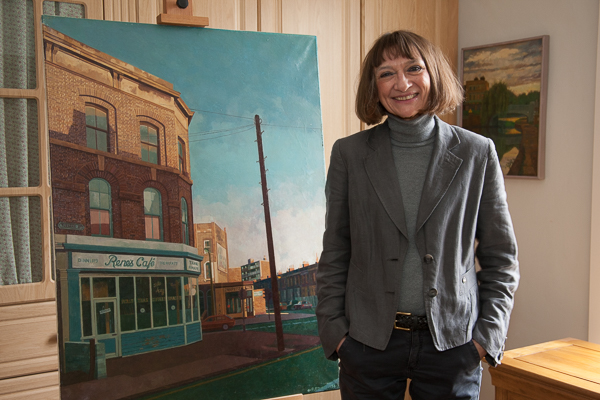
Portrait of Doreen Fletcher by Lucinda Douglas Menzies
Doreen Fletcher’s exhibition IN BETWEEN, ALMOST GONE opens on Friday 13th October at Townhouse, 5 Fournier St, Spitalfields and runs daily until 27th October. Catalogues are available for £5.
You may also like to take a look at
Doreen Fletcher’s New Exhibition
Readers will be familiar with the work of Doreen Fletcher whom I met in 2015, when she had hidden twenty years worth of paintings away in an attic, after giving up her work as an artist ten years earlier due to the lack of any interest in her pictures.
Subsequently, Doreen and her paintings have become acclaimed and this Friday 13th October, following the success of her debut show in 2016, she opens her second exhibition at Townhouse, 5 Fournier St, Spitalfields, which runs until 29th October.
Most excitingly, inspired by the immense positive response to her work, Doreen has started painting again and her exhibition, entitled IN BETWEEN, ALMOST GONE, is a mixture of old and new pictures.
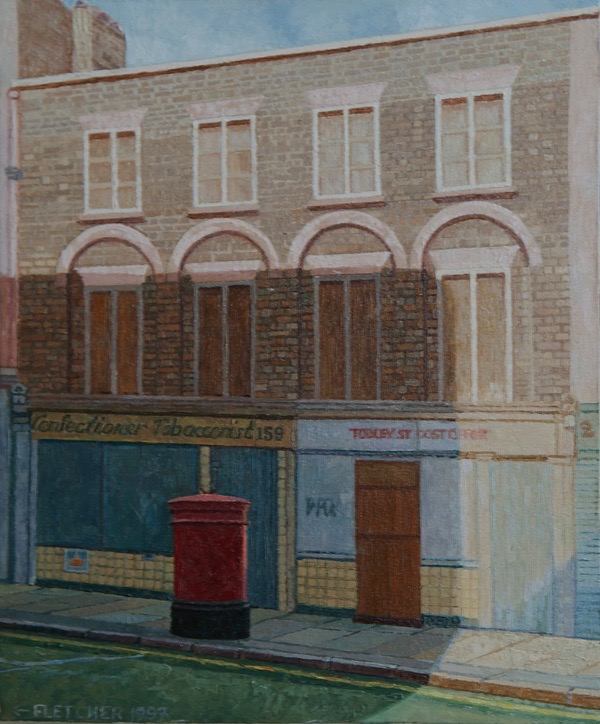
Postbox in Tooley St, 1997
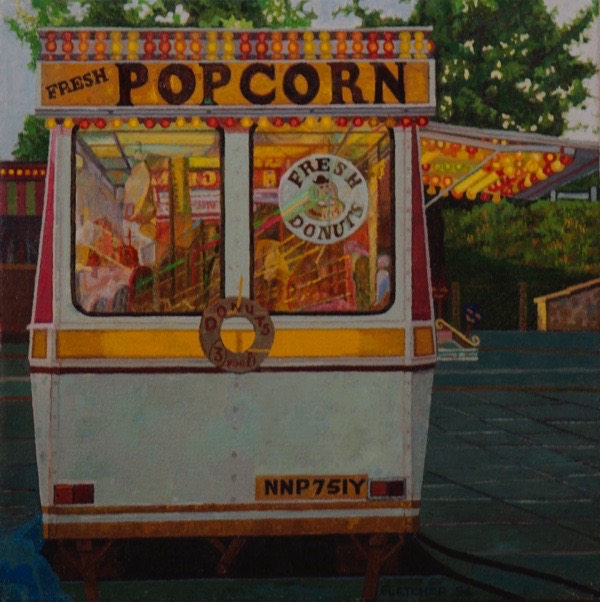
Popcorn Stand at the Wakes, 1994
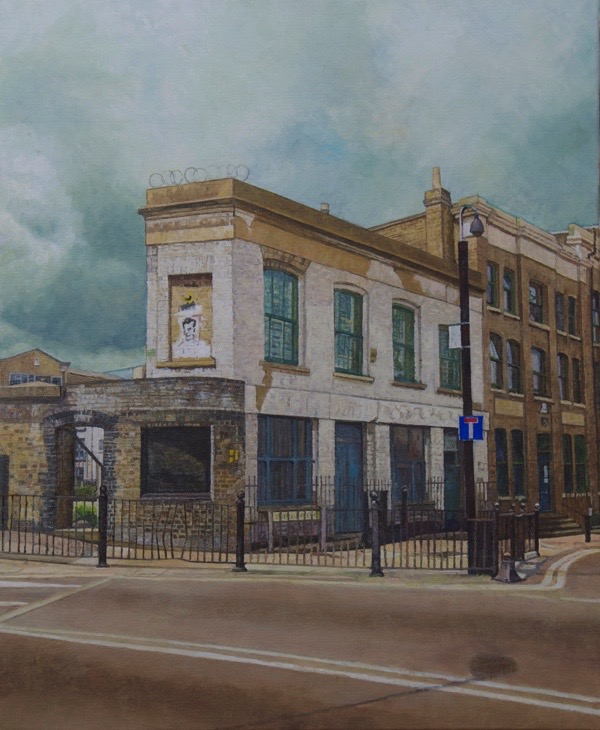
The Ragged School Museum, Copperfield Rd 2017
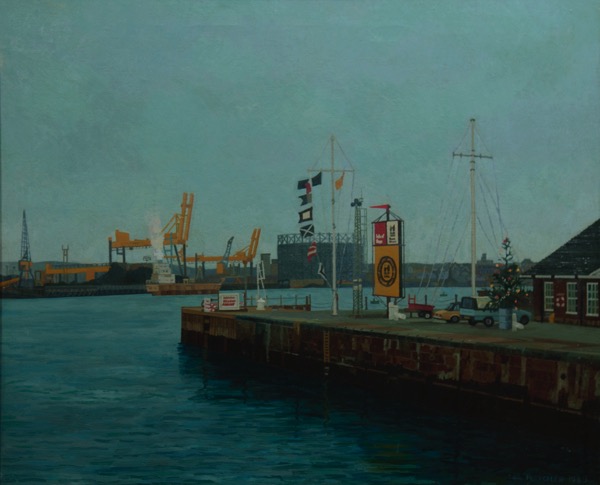
Thames Pier, Isle of Dogs, Boxing Day 1988
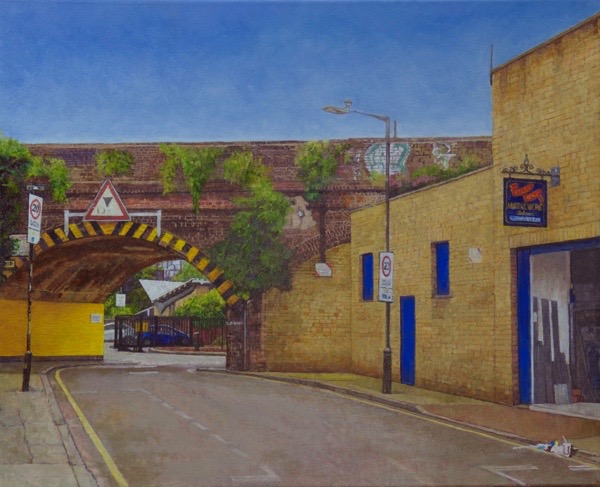
Metalworks, Chasely St, 2017

East End Dentist, 2017
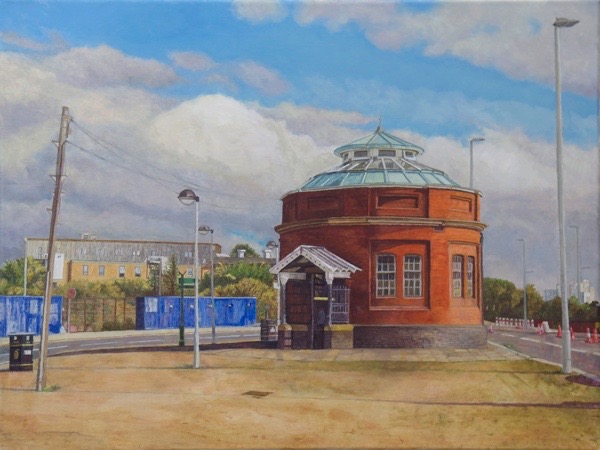
Foot Tunnel, Silvertown, 2017
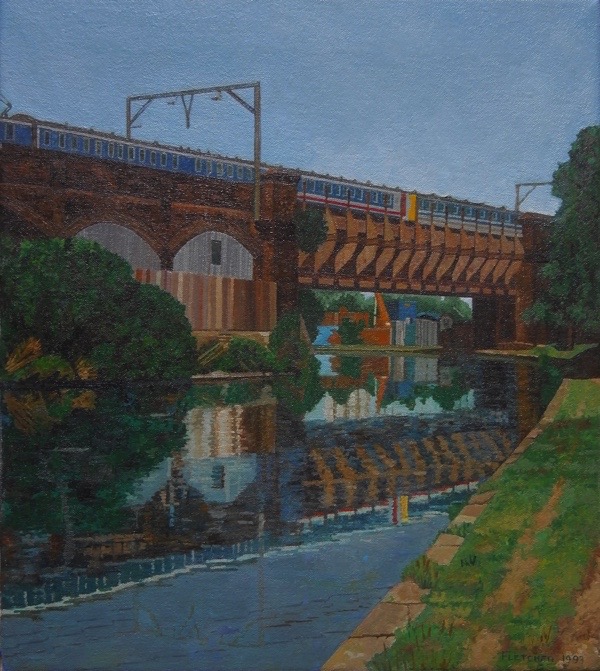
Train Over Canal, 1993
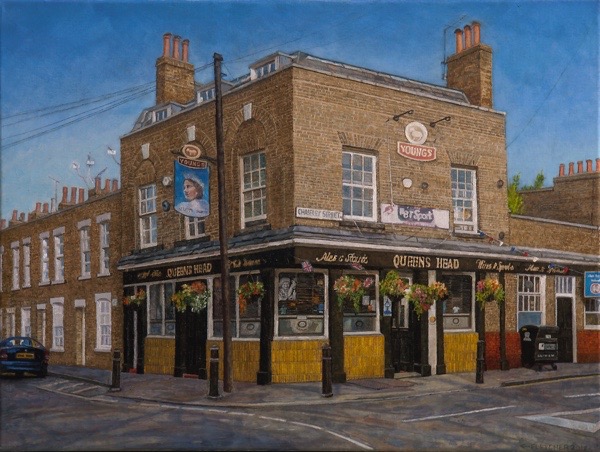
The Queen’s Head, York Sq, 2017
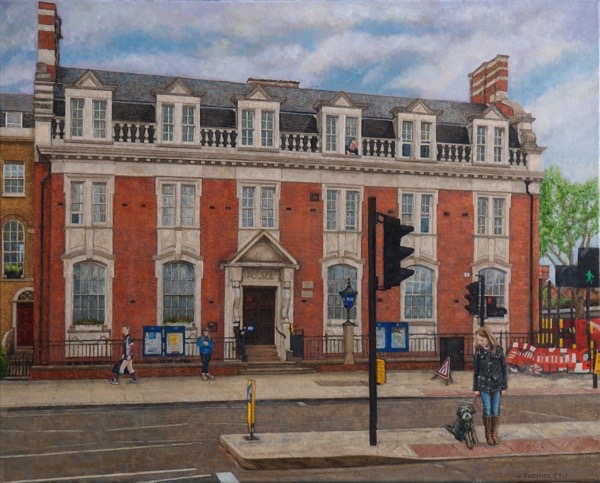
Bow Police Station, 2017

Road To Nowhere, 2013
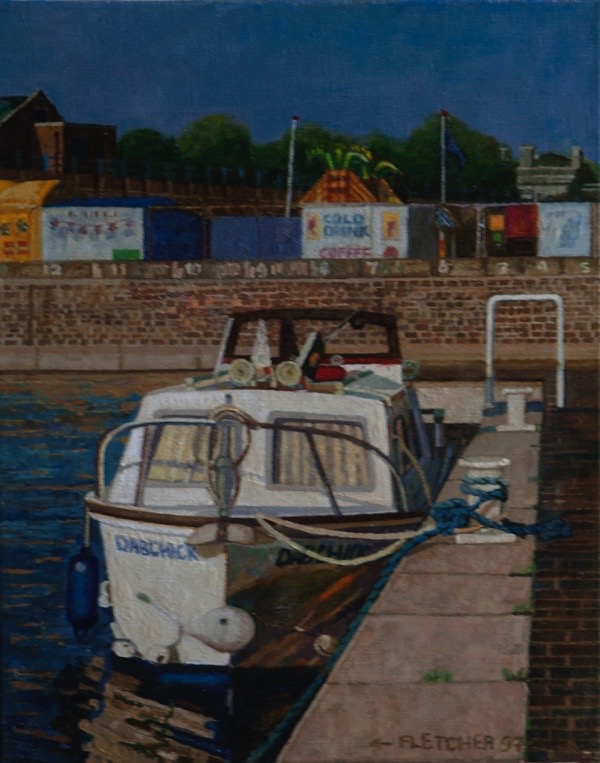
Summer in Limehouse, 1997
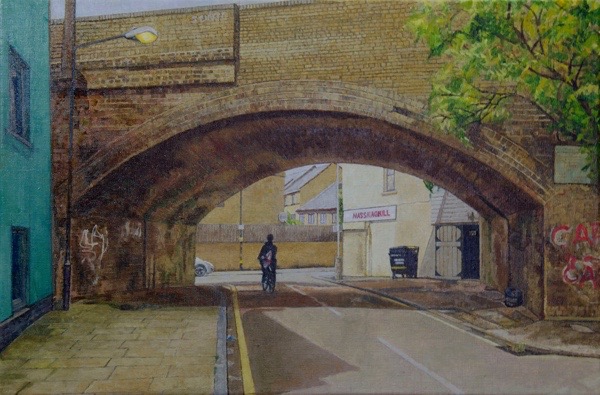
Massala Cafe, E14, 2017
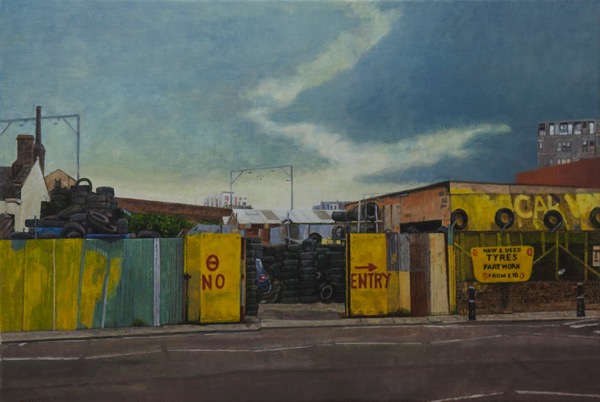
Carwash, Salmon Lane, 2017
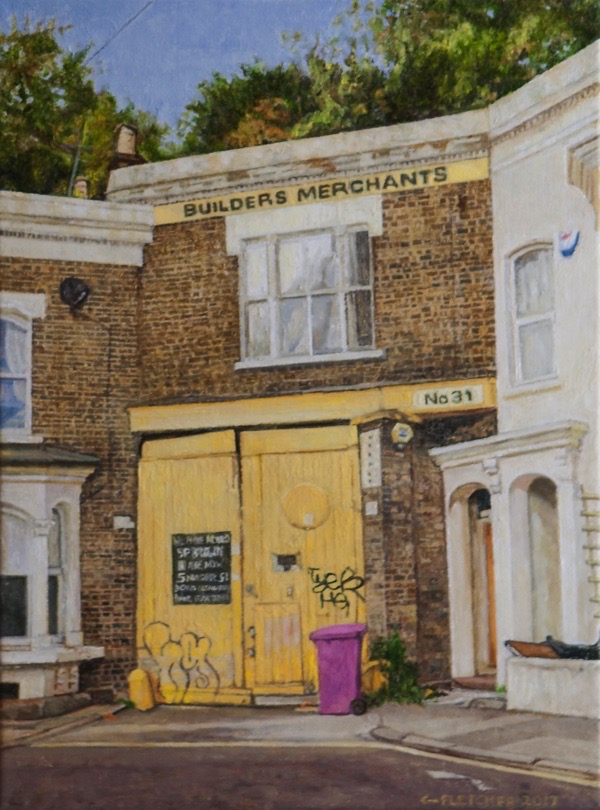
Browns, We Have Moved, 2017
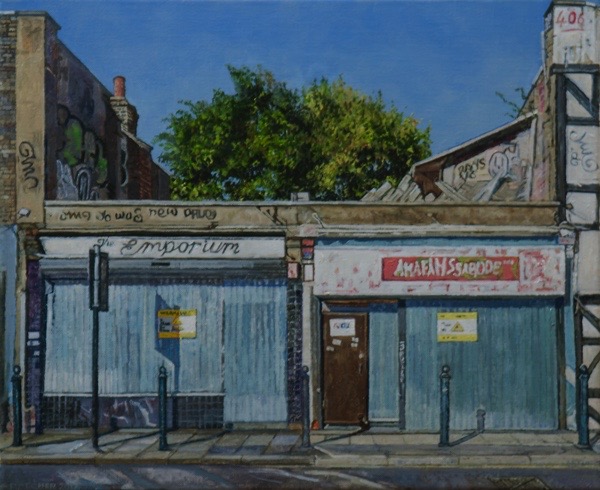
Emporium, Commercial Rd, 2017
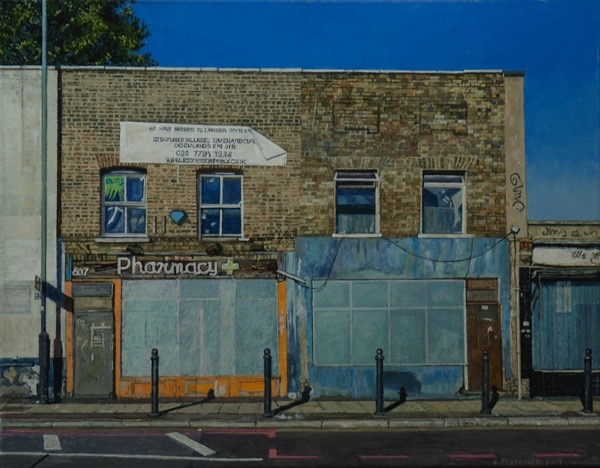
Pharmacy, Commercial Rd, 2017
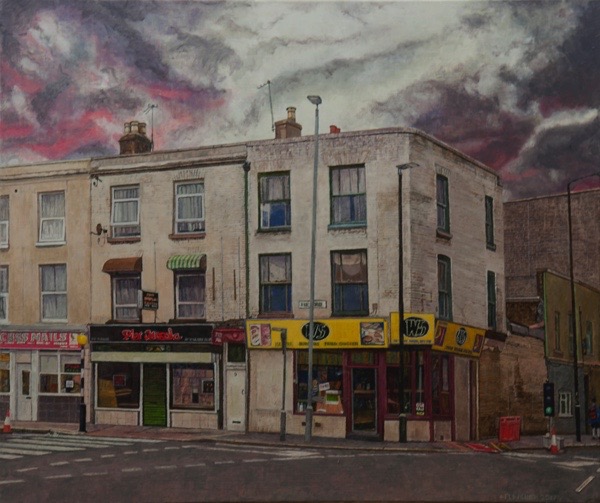
Fried Chicken Shop, 2017
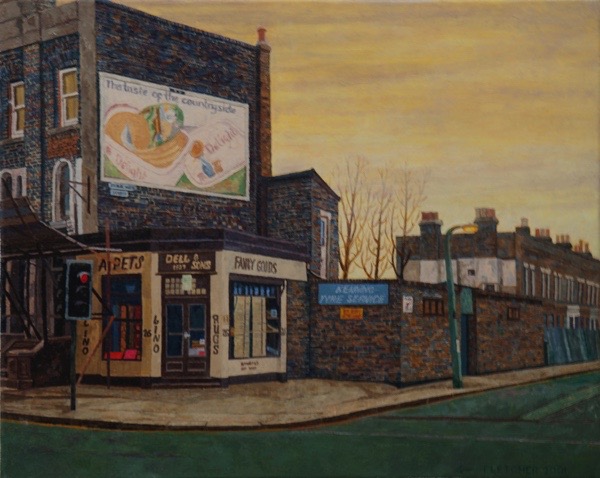
Lino Shop, 2017
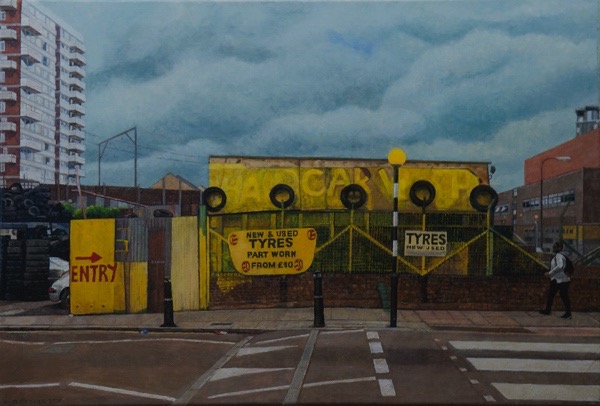
Tyre Shop, Salmon Lane, 2017
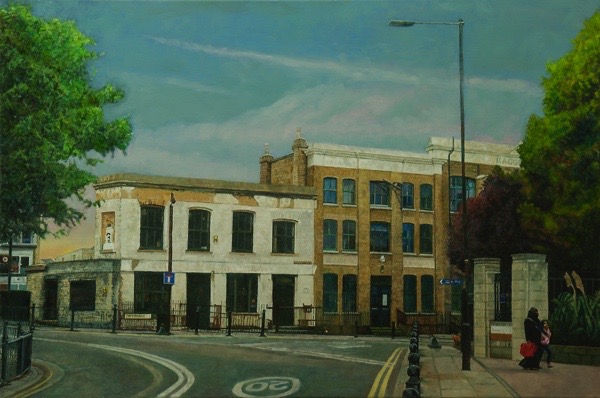
Dr Barnardo’s, Copperfield Rd 2017
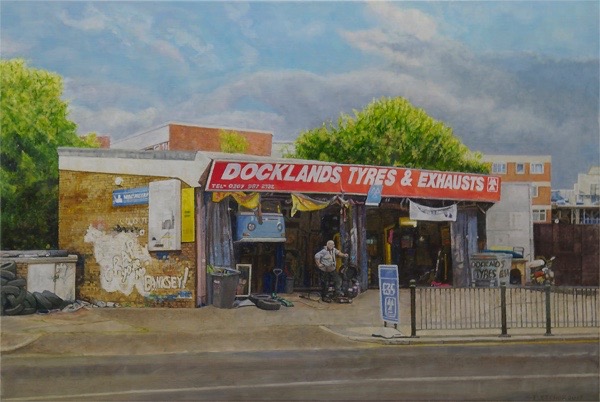
‘Your no Bansky!’ Docklands Tyres & Exhausts, Commercial Rd, 2017
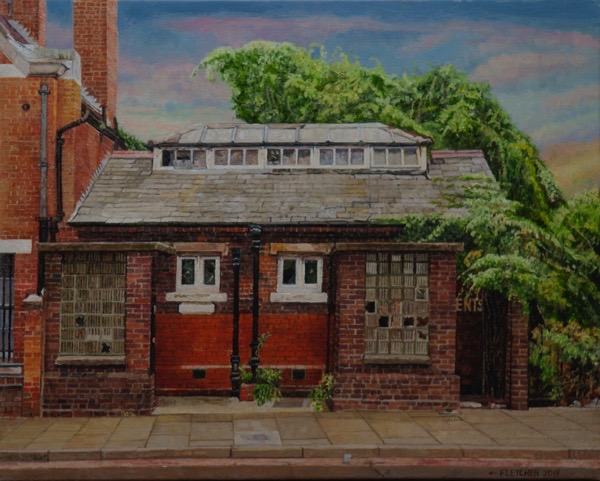
The Little Cottage, Silvertown, 2017
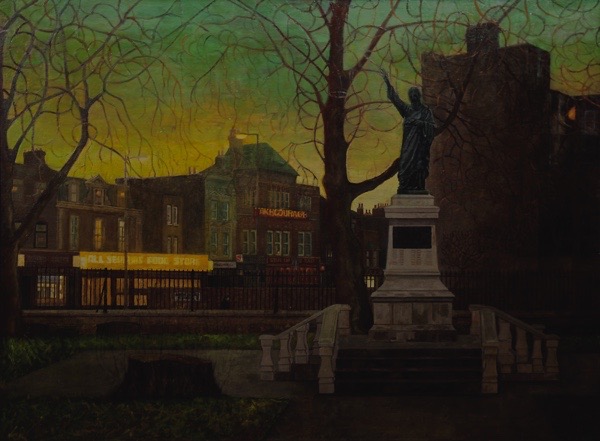
Twilight, St Anne’s Churchyard, 1998
Paintings copyright © Doreen Fletcher
Doreen Fletcher’s work is featured in EAST END VERNACULAR, Artists who painted London’s East End streets in the 20th century
You may also like to read about
Bert Hardy, Photographer
Continuing his series of profiles of photographers who pictured the East End in the twentieth century, Contributing Writer Mark Richards explores the photography of Bert Hardy

Father Joe Williamson, Cable St, 1940
Bert Hardy is the quintessential London photo journalist – confident, skilled and fearless. He was the lead photographer for Picture Post for nearly two decades until it closed in 1957 and won numerous awards. His series ‘Fire Fighters!’ won him his first named credit in Picture Post and he followed this up with a number of equally celebrated series such as ‘East End at War’ and ‘Life in the Elephant.’
When Stefan Lorant came to London and established Picture Post, he revolutionised photo journalism in this country, establishing a format that endured long after he stopped being editor in 1940. The unique character of Picture Post was its ability to tell stories through a balance of photography, captions and text which was immediately accessible to all readers. It reached a circulation of nearly two million and, at the peak, it was estimated that it was read by nearly half of the adult population of Britain.
Lorant’s publications (Weekly Illustrated, Lilliput, Picture Post) gave exposure to many well-known photographers including Brassaï, Bill Brandt and Henry Cartier-Bresson, as well as less well-known but equally accomplished photographers such as Kurt Hutton, Wolfgang Suschitzky and Thurston Hopkins. However, if one photographer encapsulated the spirit of Picture Post it was Bert Hardy.
Hardy was a firmly grounded and talented documentary photographer. The strength of his work lay in his ability to capture a moment, put people at their ease, marshal a crowd, and get in there and take the photographs that others would miss. By all accounts, he was a photographer who would run toward danger rather than from it if that was needed to get the photograph.
Born in May 1913 in Priory Buildings, Webber St just off the Blackfriars Rd, Bert Hardy’s personal confidence and courage was legendary, which perhaps came from being the eldest of seven children and growing up as a Cockney in early twentieth century London. He left school at the age of fourteen and worked for a developing and printing company. This was the start of a long and remarkable career working with film, first as a developer and printer and then as a self-taught freelance photo journalist.
Shortly after beginning work at the Central Photographic Service, he decided to do his own work on the side and set up a processing unit at home. Then he decided to try his hand at photography, having heard that it could be quite lucrative. He purchased an old plate camera from a pawnbroker and that was the beginning of his photographic career.
His first commercial photograph was of the King and Queen on Blackfriars Rd, where he famously used his sister’s head as a rest for the heavy plate camera. After selling two hundred copies of the picture as a postcard, Hardy decided that photography was for him and began photographing people in pubs, on outings and on the street, then selling them the pictures as a way of making money.
As his career developed, it became clear that Bert Hardy was a natural with a camera and this was complemented by his easy way with people and his bold approach to getting a photograph. In 1936, he began working as a freelance photographer with the General Photographic Agency and his photographs began to appear in the Daily Mirror, Weekly Illustrated, and the Illustrated London News among others. Many of the photos were unattributed with the photographer simply being recorded as a ‘stringer,’ yet his reputation began to be established quite early on as someone who enjoyed working under pressure and could produce quality photographs quickly and at a high volume. By 1940, Bert had become a rising star at Picture Post and a whole series of commissions followed, leading to him becoming their top photographer.
He risked his life regularly when photographing the Blitz in London and captured a whole series of photographs of the city burning and of the heroic firefighters dealing with the aftermath. It was an approach that defined him as a photographer both in London and when covering the Second World War in Europe (he was a sergeant in the British Army Film Unit from 1942 to 1946) as well as wars in Korea and elsewhere.
In retrospect, his work now provides us with a unique record of everyday life in London and elsewhere. In particular, his series Life in the Elephant has a quality reminiscent of the work by John Thomson in Street Life in London some seventy years earlier. Bert Hardy had an empathy with his subjects that draws out their humanity and you feel as though you could step through his photographs into the scene.
Bert Hardy’s photographs of the Gorbals in Glasgow in 1948 were one of his most striking series. He was sent there by the Picture Post along with Bert Lloyd to do a follow-up of the commission that was originally given to Bill Brandt. Brandt’s photos were considered too abstract and did not show to the genuine poverty of the area. Picture Post needed someone with a different approach to bring out the essence of the Gorbals. In typical daring fashion, Bert Hardy persuaded the locals to let him photograph some of their living conditions directly. As always, he had his camera pre-set to middle-distance focus – just in case he spotted a potential photograph – when he suddenly came across two urchins in the street. This became the defining image of that series and won a prize from the Encyclopaedia Britannica.
One of Bert Hardy’s most famous photographs was a racy picture of two young women sitting on the railings at Blackpool – the Blackpool Belles. It is instantly recognisable as one of the most loved images of that era and many believe it was spontaneous. Like most similar images, it was staged. Yet the surprising thing about this photograph is not the set-up but the fact that he took it using a Box Brownie camera rather than his usual Leica. He did this to illustrate that it is not the camera that makes a great photograph but the photographer. In his account of this in ‘My Life’ Bert Hardy said:
“With a standard-issue Box Brownie and a close-up lens plus yellow filter and an improvised cardboard viewfinder, I roamed the Golden Mile looking for suitable subjects. In the end, I got a couple of showgirls from the pier theatre to help me. The picture I eventually took of the two girls sitting on the railings with their skirts blowing up has been one of my most popular photographs.”
The woman in the spotted dress was a ‘Tiller Girl’ called Pat Stewart who was wearing a bathing costume under the dress. The striped costume was prominent in the original photograph and was airbrushed away in the darkroom leading to much speculation as to what she was wearing under the dress, if anything at all! The picture has become one of those that is often reproduced without being attributed to the photographer.
When Edward Hulton took over as Editor in 1953 it was the beginning of the end for Picture Post which went into terminal decline, closing in 1957. It was the close of an era for photo journalism in Britain. Hulton blamed its failure on the arrival of television but poor editorial decisions by him and a change of focus in 1953 were significant factors. Although he was kept on doing other work for Hulton publications, Hardy moved into photography for advertising where he had great success and work flowed in.
Then, in 1964, Bert Hardy chose a complete change of direction and bought a farm in Oxted, Surrey. He still kept his printing business going but became a farmer and lived on the farm for the rest of his life. Even as a farmer, he still lectured on photography and was also made a Fellow of the Royal Photographic Society. By all accounts, these were happy times but London had lost one of its most influential photographers. In 1995, he suffered a heart attack which proved fatal but his spirit lives on through his work which has stood the test of time.
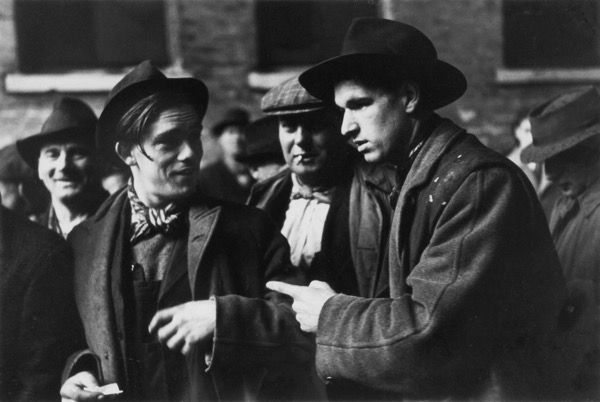
Cockney Life in the Elephant & Castle, 1948
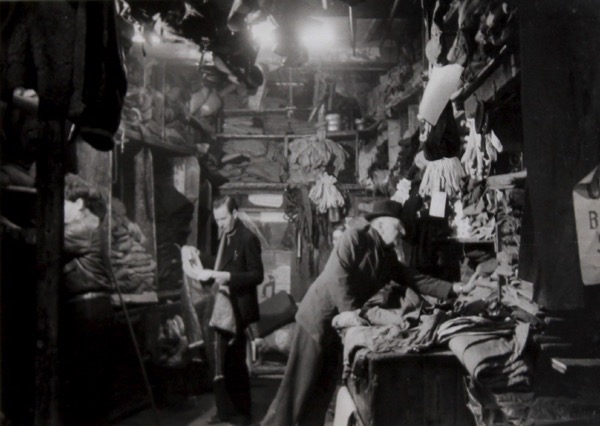
Fabric shop at the Elephant & Castle, 1948
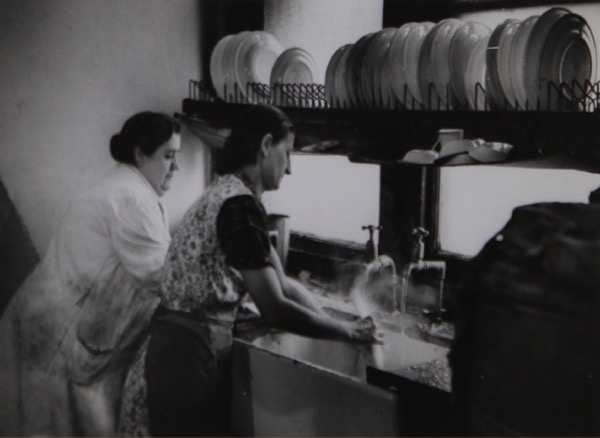
Dishwashers, Life in the Elephant, 1948
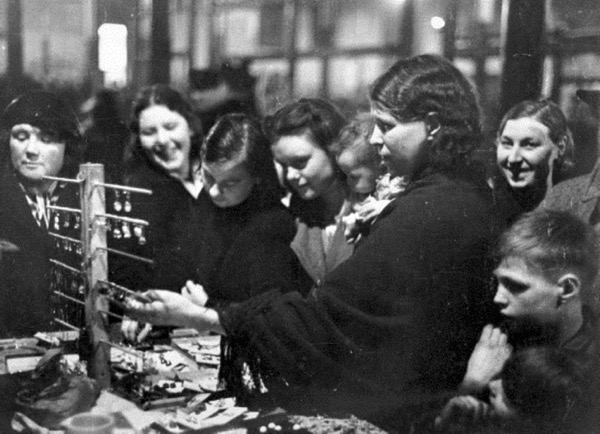
Shopping for jewellery, Life in the Elephant, 1948
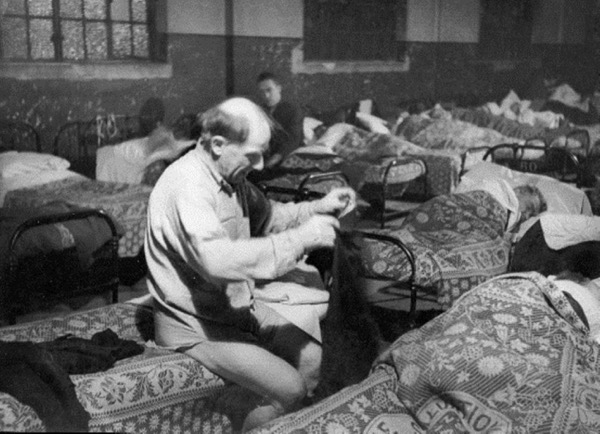
Homeless shelter, Life in the Elephant, 1948
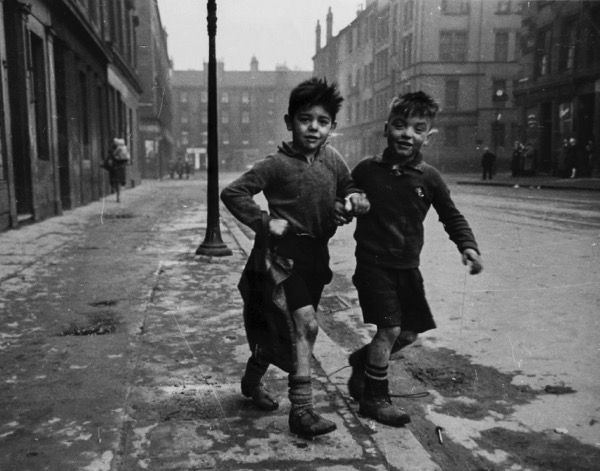
Gorbals boys, Glasgow, 1948
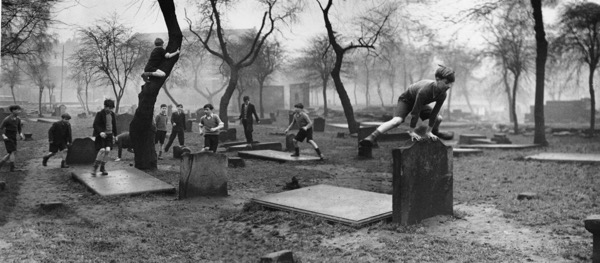
Game of Stones, Gorbals, Glasgow, 1948
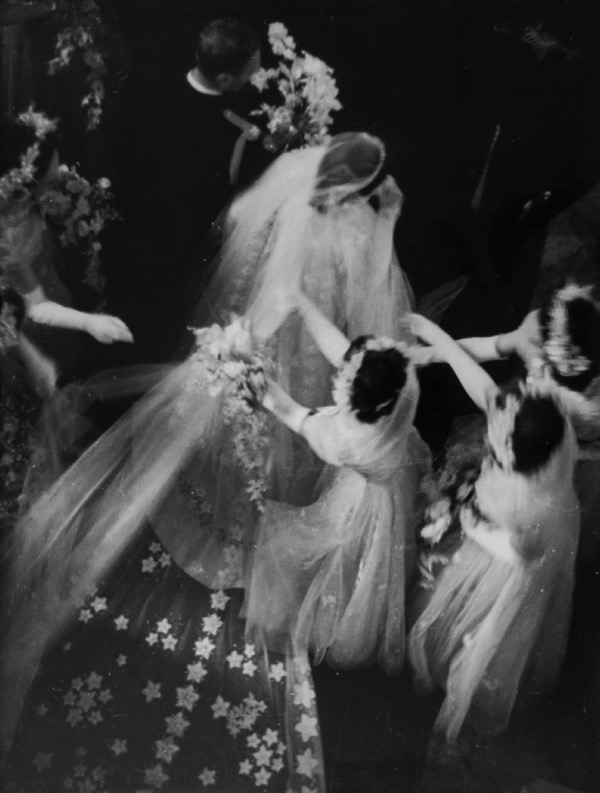
Royal Wedding – King George VI with the bride, Princess Elizabeth 1947
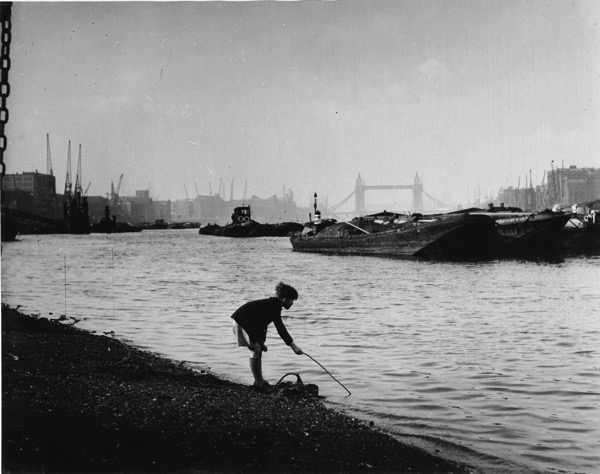
The Pool of London, 1949
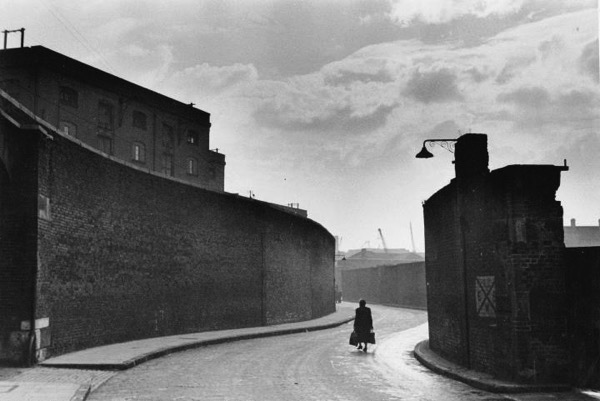
Docks near the Pool of London, 1949
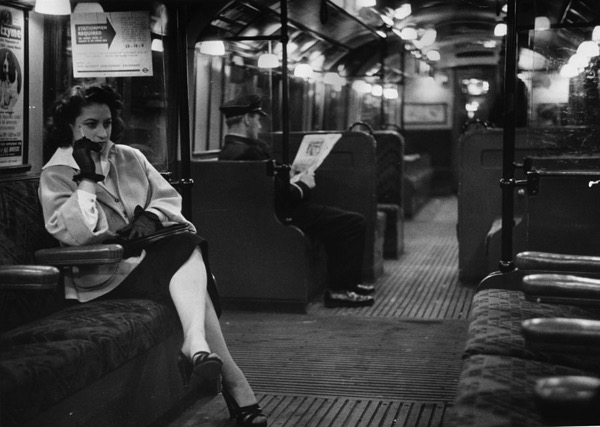
Woman on the London Underground, 1952
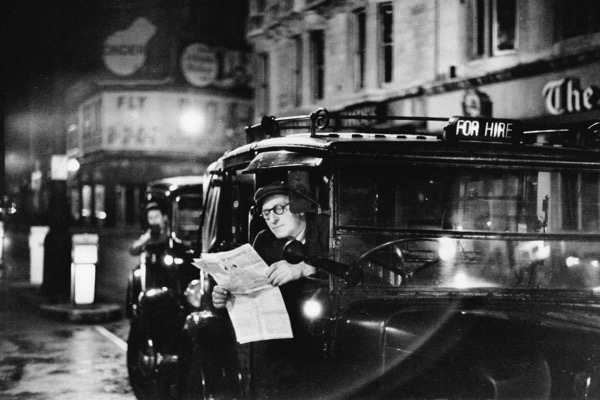
Piccadilly, 1953
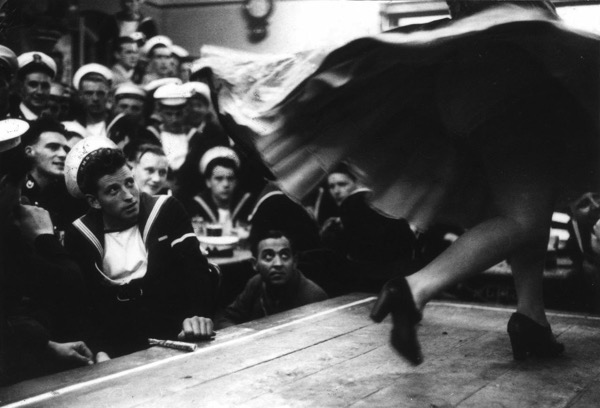
The combined fleets ashore, Gibraltar, 1954
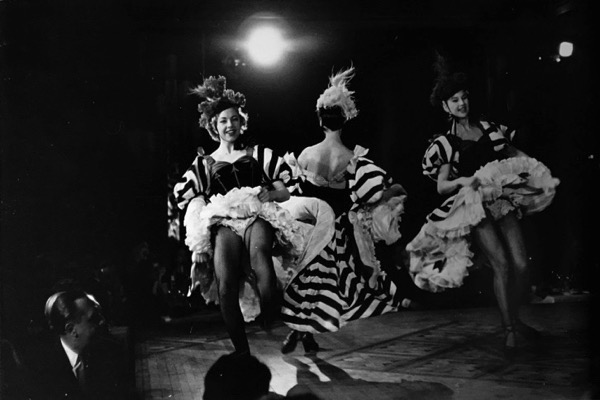
The Bluebell Girls on stage, 1954
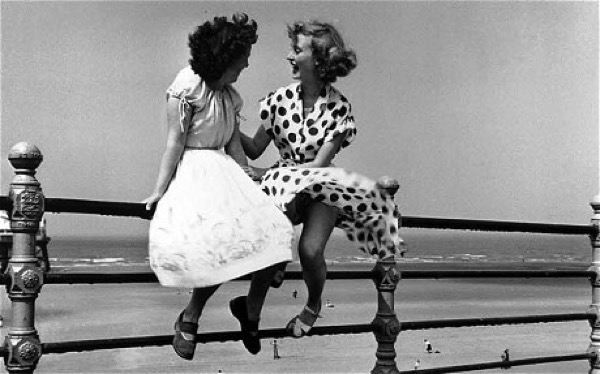
Blackpool belles, 1951
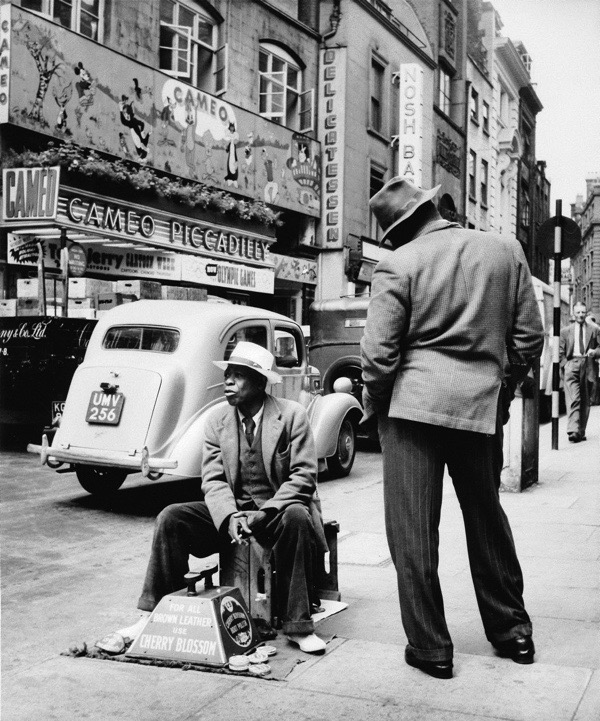
Shoe shiner, Piccadilly, 1953
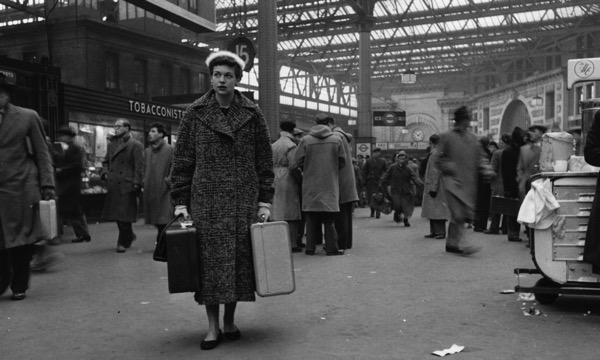
Loneliness in London, Katherine Whitehorn as a new arrival at Waterloo, 1956
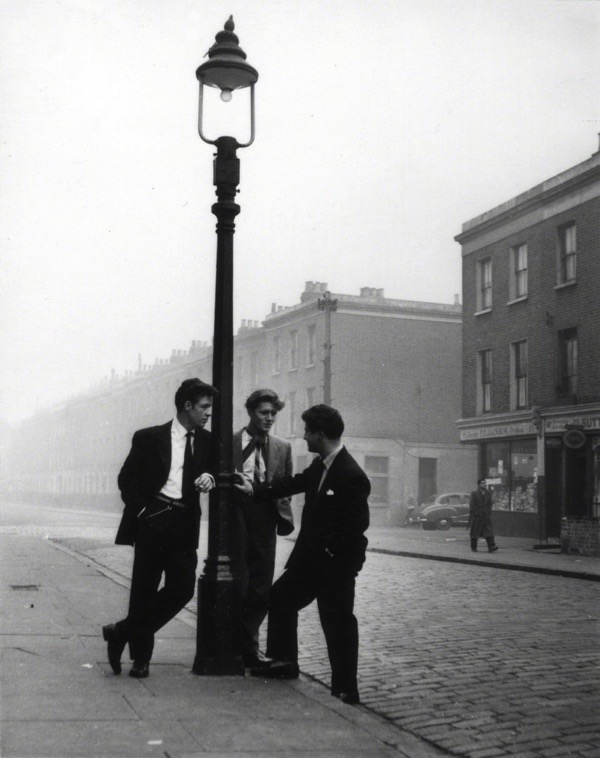
Too Many Spivs, Notting Hill, 1954
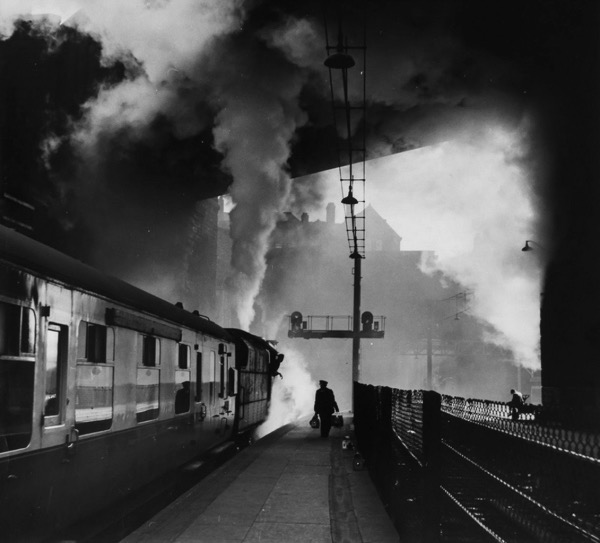
Liverpool, 1950
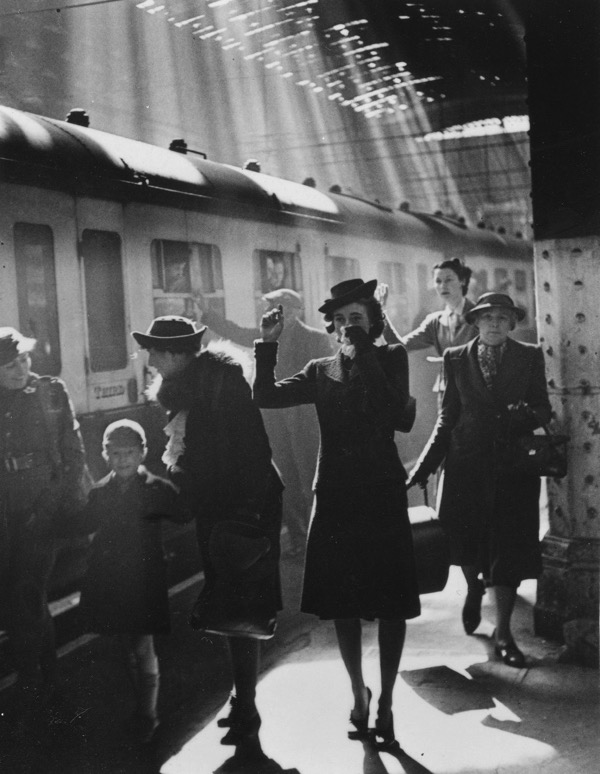
Saying goodbye to a loved one, Paddington Station, 1940
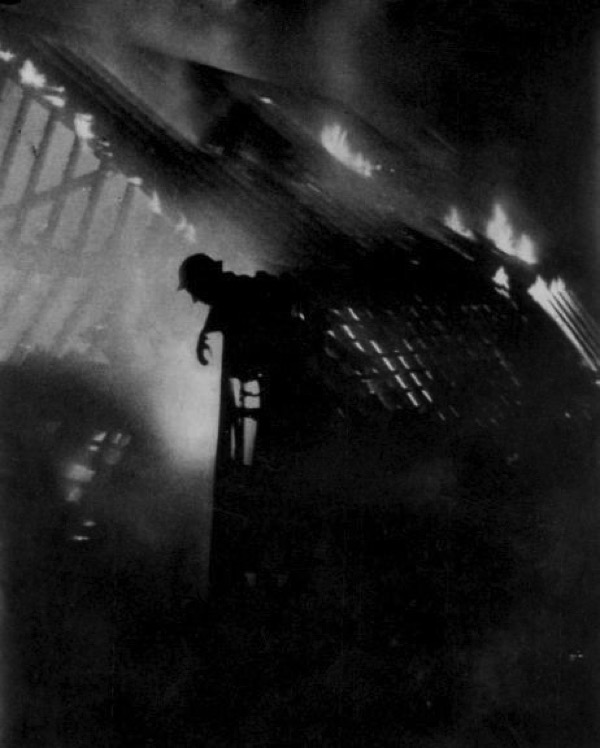
Firefighters during the London Blitz, 1941
Photographs copyright © Estate of Bert Hardy
You may also like to read about
Edith Tudor-Hart, Photographer












