
Tony Hall’s East End Panoramas

In the sixties, Tony Hall bought a Horizont camera of Russian manufacture that was designed for taking panoramic photographs and he used it to take these magnificent pictures of East End streets. Originally trained as a painter, Tony Hall became a newspaper artist in Fleet St and pursued photography in the afternoons between shifts.
“He’d always been passionate about wide-angle lenses, it was his landscape painter’s background – he had a painter’s eye,” Libby Hall, Tony’s wife revealed to me, “When he was sixteen, his paintings were accepted for the Royal Academy but he wanted to do something different, so he gave it up in favour of commercial art and photography.”
The Horizont camera had a lens that rotated in sync with the shutter to create a panoramic view, but they were unreliable and, when the lens became out of sync with the shutter, patches of light and dark appeared on the image. Tony bought three cameras in the hope of getting one to work consistently and in the end he gave up, yet by then he had achieved this bravura series of pictures which emphasise the linear qualities of the cityscape to dramatic effect.
“Tony loved tools of all sorts and he always said that if you had the tool you could work out how to use it,” Libby recalled, “He was very frustrated by the Horizont, but he was very pleased when it worked.”
It is the special nature of Tony Hall’s photographic vision that he saw the human beauty within an architectural environment which others sought to condemn and, half a century later, his epic panoramas show us the East End of the nineteen sixties as we never saw it before.
Click on any of the photographs below to enlarge and enjoy the full panoramic effect.

Corner of Middleton Rd & Haggerston Rd

Haggerston Rd


Old Montague St & Black Lion Yard

Old Montague St

Hessel St


Corner of Lyal Rd & Stanfield Rd

Corner of Lyal Rd & Stanfield Rd


Bridge House, Tredegar Rd

Sclater St

Leopold Buildings, Columbia Rd


Pearson St & Appleby St


Corner of Well St & Holcroft Rd

Hackney Rd

St Leonards Rd


St Leonards Rd


Photographs copyright © Libby Hall
Images Courtesy of the Tony Hall Archive at the Bishopsgate Institute
Libby Hall & I would be delighted if any readers can assist in identifying the locations and subjects of Tony Hall’s photographs.
You may also like to read
So Long, Hackney Rd Bingo Hall

The monumental Odeon in the Hackney Rd opened on 27th July 1939 featuring Max Miller in Thank Evans. This was the 124th Oscar Deutsch Odeon Theatre to be built and one of eleven by architect Andrew Mather.
Designed in the Art Deco style, the cinema was more austere than some of its era. The plain facade was covered in cream faiance tiles, adorned only by a vertical sign just off centre which originally had the Odeon name and an overhanging slab across two-thirds of the top of the building. Inside, seating was arranged in stalls (1,260) and circle (666). There were two large glass light boxes above the circle and decorative ribs across the ceiling with horizontal bands along the walls.
In 1961, the cinema screened its final programme featuring Ian Carmichael in Double Bunk and Johnny Biggs in Wind of Change on 20th May, before becoming the first Odeon to be converted to a Top Rank Bingo Club.
Both incarnations served as a vital community focus for generations for the people who lived in the surrounding streets until eventual closure on July 15th 2015. The building was sold to Jersey-based Hackney Property Holdings LLP for £4.5million. Subsequently, Mecca Bingo have been providing a minibus to ferry local residents to their club in Camden.
In the face of campaigns and a petition to list the Odeon, and demanding a replacement community asset, planning permission was granted last year by Hackney Council for demolition to construct a ten-storey block of luxury flats with just 20% ‘affordable’ housing despite the Borough’s policy of 50%.
All that leaves us is to take one last look around the empty building, courtesy of these photographs by Thomas Best, and say goodbye to this venerable place of public entertainment which has been cherished by so many residents of this corner of Bethnal Green for more than seventy-five years.

Odeon Hackney Rd in 1938

The interior in 1938

Top Rank Bingo Club in the sixties


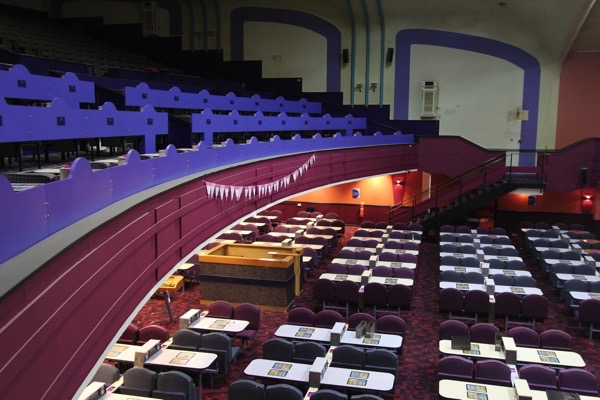


Colour photographs copyright © Thomas Best

Forthcoming development by Jersey-based Hackney Property Holdings replacing Odeon Hackney Rd
You may like to read my interviews with members of the Hackney Rd Bingo Club
The Old Gates Of London
Today I present these handsome Players Cigarette Cards from the Celebrated Gateways series published in 1907. As we contemplate the going-out of the old year and the coming-in of the new, they give me the perfect opportunity to send you my wishes for your happiness in 2018.


You may also like to take a look at these other sets of cigarette cards
On Facadism
This was commissioned by The Architectural Review and is available in print in the current issue

Precast ‘brick’ panels arrive for the Fruit & Wool Exchange development
As if I were being poked repeatedly in the eye with a blunt stick, I cannot avoid becoming increasingly aware of a painfully cynical trend in architecture which threatens to turn London into the backlot of an abandoned movie studio. If walls could speak, these facades would tell tales of bad compromises and angry developers who, dissatisfied with the meagre notion of repair and reuse, are driven solely by remorseless greed.
Meanwhile, bullied into sacrificing historic buildings of merit, cowed planning authorities must take consolation in the small mercy of retaining just a facade. The result is that architects are humiliated into creating passive-aggressive structures – gross hybrids of conflicted intentions that scream ‘Look what you made me do!’ in bitter petulant resentment.
At present in Spitalfields, we are presented with a text book example of such an affront – the London Fruit & Wool Exchange, a high quality building of 1927 by architect Sydney Perks, enhanced by wooden parquet floors, careful detailing and significant craft elements throughout. In recent decades, it was home to more than a hundred independent business employing local people. This redevelopment was forced through against the unanimous wishes of Tower Hamlets’ planning committee by the former Mayor of London, Boris Johnson, and before construction commenced it was pre-let to single tenant, Ashurst an international legal corporation.
Axis Architects, working for the developer Exemplar, retained only the frontage of the building with its stone cornice and brick wall. Currently, precast panels of ‘bricks’ and ‘stone’ are being hung on the steel structure that sits behind it. These panels of bricks have an artful irregularity designed into them and an attempt is being made to match the tone of the cast ‘stone’ with the actual stone on the fragment of the earlier building. Yet these panels are already becoming chipped and damaged even as they being put in place and no-one is fooled by this patronising approach to co-ordinate the old and the new. Indeed, the conflict between these elements manifests the conflict of interests that produced this ungainly chimera.
‘A kind of authenticity’ is the language of British Land’s oxymoronical attempt to sell facadism in the publicity for their proposed Norton Folgate office development by Stanton Williams, where they show an image of the front wall of a nineteenth century warehouse pasted onto the lower floors of a towering office block as if it were a Penny Black glued onto a Jiffy bag. This misguided notion assumes there might be fifty-seven varieties of authenticity, when ‘authentic’ is not a relative term – something is either authentic or it is phoney.
I fear Spitalfields is quickly becoming the epicentre of facadism in London, with the recent completion of Sir Alan Sugar’s shameless redevelopment of The White Hart, dating from 1240, into a cylindrical tower block designed by Rolfe Judd with just the outer wall of one of London’s most historic taverns stuck on the front.
Meanwhile up the road in Bethnal Green, The Duke of Cambridge, dating from 1823, has had an aggressively modernist steel and glass building forceably inserted into the shell of its dignified brick structure by architect Guy Hollaway Associates on behalf of Heath Holdings. Such is the conflict between the old and the new, you can almost feel the humiliation and pain of the original building. The ugliness of the outcome is a pertinent slap in the face, reminding us how blatantly any concern for architecture is being sacrificed in this approach. This disastrous hybrid is an unfortunate totem of where we are now, an object lesson for architectural students of what not to do, and we may be assured future generations will laugh in horror and derision at the folly of it.
Sticking a new building behind the shell of the former building in this manner is a pitiful way to go about things. It is not worthy of the term architecture. As resources grow ever less, the practice of sacrificing good quality buildings for cheapjack disposable replacements cannot be justified. The default choice must always be to repurpose and reconfigure existing buildings. Some of the greatest of our cathedrals and country houses are the outcome of this approach to architecture, palimpsests in which the history of the building’s evolution can be read by the perceptive viewer.
In every case, it is paramount that attention be paid to any structure as an architectural whole, rather than simply sticking a new shed behind an old facade. Taking existing buildings and reworking them sympathetically to serve new purposes requires much more sophisticated thinking from architects and developers than is in evidence in these hideous structures which manifest the lamentable plague of façadism that blights our age.

Fitting a new ‘brick’ panel onto the Fruit & Wool Exchange

Repair to damaged cast ‘stone’ panel on the Fruit & Wool Exchange

Facade of the Fruit & Wool Exchange

The White Hart (dating from 1240), Bishopsgate

The Duke of Cambridge (dating from 1823), Bethnal Green

Toynbee Hall

In Gracechurch St, City of London

In Smithfield

Tottenham Court Rd

British Land’s proposal for Norton Folgate – ‘A kind of authenticity’
You may also like to take a look at my earlier feature
So Long, Juke Box Jimmy
Today I recall a walk I once took with James Phimister (universally known as Juke Box Jimmy), who died on Thursday aged seventy-two. Jimmy was a Scots Cockney who lived for music and became a celebrated regular fixture at Pellliccis in Bethnal Green where he ate lunch for nearly sixty years.

Jimmy at Pelliccis by Colin O’Brien

Jimmy in 1969
Here is Jimmy on his wedding day at St Dunstan’s, Stepney, aged twenty-three, full of life and surveying the world with a grin that indicated a man who knew his way around. Yet only ten years earlier, he came to London from Cowdenbeath where Jimmy’s father was a Scottish miner who wanted a better life for his three young sons.
In their corner of Fife, the only sources of employment were the mines or the docks, both declining industries. With brave foresight, he quit his job and came alone to London to seek a new life for his family and once he had secured a job at the Truman Brewery in Brick Lane, they came to join him.
“I went to Daniel St School and when the teacher asked me to read a story from the book out loud, I said, ‘I’ll have to read it in Scots, Sir,’ and obviously all the kids laughed. I didn’t speak Cockney at that time.” admitted Jimmy, describing his first encounter with cultural displacement, adding that he picked up Cockney at once and never looked back since.
One day, I joined Jimmy for lunch at Pelliccis in Bethnal Green where he had been regular diner since 1959 and, once he had polished off his steamed pudding with custard, we walked briskly westward together, weaving our way through the back streets over to 19 Old Nichol St.

In the nineteen sixties, Jimmy used to work up on the third floor as an optical technician, manufacturing spectacles at Prince’s Optical Company and enjoyed a high old time. “We did have some great laughs,” he confided with a twinkly smile.
In Jimmy’s animated company, the street transformed before my eyes as he pointed out the exact spot in Camlet St opposite, where the foreman became visible as he approached – explaining that someone always had to keep watch at the window, especially if all the staff of the spectacle factory were skylarking up on the roof making comedy home movies with a super eight camera, as they liked to do. Crossing to the corner of Camlet St, Jimmy placed his hand on a sill with a significant grin. Here lived the infamous Nell who threw a bucket of piss from this window onto any car that parked outside. Then, with a gesture in the direction of the site of a hut across the road where Marc Bolan played, Jimmy walked into Redchurch St, that was all cabinet makers in his personal landscape of memory, which, I began to realise, was more vivid to him than the mere shadow of our present day.
I ran at his heels scribbling in my notebook as we made our way east again. Jimmy spoke to me as if to one blind, indicating landmarks that were visible only to him, referring to the names of pubs closed years ago and pointing out the bullet hole from the shooting of Ginger Marks in Cheshire St, in the wall that no longer stands. Passing the Cheshire St washhouse that is now flats, he said, “When we first came down from Scotland we used to come here for lovely baths.” Then he halted in his steps, pointed reverentially and announced, “This is where I spent my youth playing football on the grass.” Such was the limitation of my vision, all I could see was the bare concrete car park in front of us.
Next, we crossed Vallance Rd to arrive at the corner of Menotti St where Jimmy lived when he first arrived from Scotland. “There were five of us living in two rooms on the first floor, a front room and a bedroom. I slept with my dad on the lower bunk and my mum slept on the top bunk with my two brothers. The rent was too high and we had mice in there.” Jimmy recalled dispassionately, as he peered up expectantly to the blank first floor window of the newly-built flats that occupy the site today.

Everything had changed on this side of the street, but a passing train drew Jimmy’s attention to the railway opposite. “It took a while to get used to that!” he said and looked over at the gloomy dripping arch which he was was too frightened to walk under alone as a child. He indicated the corner where his loyal friend Alan, who lived in Whitechapel, would wait until Jimmy was safely inside his front door before turning for home. Then we walked away into Weavers’ Fields in the afternoon sun.“This used to be all debris here – bombsites – we loved it,” declared Jimmy, gazing around at his former playground in delight.
“I feel most at home in Bethnal Green, my roots are here because this is where I was brought up. That’s why I come five days a week to Pelliccis, when you go in there you feel part of a family, and I love all the hospitality that goes with it. There’s two chaps I see on a Friday, they are my friends from seventeen years old. To me, it’s the best place I’ve found for food – when they close for a holiday, I’m lost, I don’t know where to go.”
Walking the streets with Jimmy, each place became familiar and domestic, and I envied his ability to strike up conversations with everyone who walked into his path. To Jimmy, the street was a social environment where he felt entirely at home and could meet anyone as an equal. He expected to speak with everyone and when he received no response to his open-hearted entreaties, he exclaimed in disappointed bewilderment.
Next day, I took the 309 bus from Bethnal Green to Poplar where Jimmy lived alone with his cat in a small flat, to see his famous juke box that he was named for. The glistening handsome machine enjoyed pride of place in the living room which was lined with filing cabinets containing Jimmy’s vast and meticulously organised record collection. Unfairly dismissed from his job one day, Jimmy won justice in the form of a lump sum of compensation at a tribunal, allowing him the once-in-a-lifetime chance of an expensive purchase. So he bought the beautiful Seburg jukebox you see below that he cherished as a symbol of both his self-respecting independence and the love of music that filled his life, even if he rarely played the machine out of consideration for his neighbours.
“I’ve still got the Scottish tongue, though I don’t use it now,” said Jimmy, turning Scottish with complete playful authenticity to surprise me, as if he had switched records in his own internal jukebox.“Even when I go back to Scotland I find it too embarrassing to speak it in front of the Scots, but I always spoke Scots to my parents.” he explained. Then, changing tone and referring back to the moment when his father came South more than half a century ago, he added quietly, “I’ve got him to thank for everything in the first place.”

Juke Box Jimmy at home with his beloved Seburg Juke Box
Listen to Jimmy talking about his life and music
Christmas With Dennis Severs
I often wonder if those who visit the Christmas installation at Dennis Severs’ House in Folgate St in spellbound silence today have any idea of what it was like when the creator of this time capsule interior was alive. The late Rodney Archer was a close friend of Dennis and, in this extract from Volume One of his Diary This Strange Re-collection of People (1980-88), Rodney spills the beans.

Christmas was for me the best time of the year to visit Dennis Severs in his house, which he shared with Mr & Mrs Jervis and their children in the Liberty of Norton Folgate. The hall was festooned with garlands of holly and ivy and mistletoe. No tinsel marred the scene! The smell of Christmas spices assaulted your nostrils as you entered the front door. Oranges stuck with cloves abounded and the warm hospitality of the Jervises’ was almost palpable. Young boys in velvet waistcoats and knee britches and enchanting young girls in Kate Greenaway muslin dresses would greet you as you entered, offering rum punch circa 1730. Steven, who was eventually to run a restaurant from the ground floor of his house in Church St, had found the recipe in an old eighteenth century cookbook and Dennis was delighted. These children bearing punch were the sons and daughters of neighbours, friends and guests. If you were among the favoured, invited to one of Dennis’ private parties, you had to be prepared to join in and not rock the boat. Everything and everyone was highly organised.
As midnight struck, we were all hurried out of the drawing room and upstairs in the dark to the attic. This was the room in which the sitting tenant, who died within minutes of Dennis signing the contract to secure the house, lived and so promptly perished. It was also the room in which Dorian, the most beautiful of Dennis’ footmen, had his lodging. Towards the end of his brief life, when he was dying of AIDS, Dorian was forced to step into the cupboard when the tours came round to see the room inhabited – in the fiction of it – by Tiny Tim and his father, Bob Cratchet. I am not sure how the Jervises were connected to the Cratchets but what with the arrival of the Spinning Jenny in the early nineteenth century, hard times overtook the silk weavers of Spitalfields and perhaps Mrs Jervis had to take in a lodger? Eventually, Dorian was to move to Church St, two doors away from where I lived with my mother.
“Shhh, don’t talk any of you, shhh… Steven, Arlecchino, Quiet!” Dennis ordered like the matron in charge of a hospital ward. Think Hattie Jacques in ‘Carry on Nurse.’ “Where are Beyond & Ken? Not behind again?!” he asked, wondering if the two performance artists who attended the Hornsey School of Art had lost their way.
Beyond & Ken had lingered too long in the front room on the first floor, called somewhat grandly the ‘piano nobile.’ They were duly fetched and fixed in Dennis’ disapproving eye. All ready and inspected, we followed faithfully and quietly behind as he pushed open the door to his bedroom where we saw the four poster bed covered in red velvet. The bed and canopy had been made from pallets and refuse rescued from the nearby fruit and vegetable market – Dennis was an early recycler.
“Nothing here is real,” he cautioned as Judy (Edgar-in-Elder-St’s first wife) dared to touch a papier mache wig stand. In real life, the bed was Dennis’ own but for the purpose of the pantomime had become… “The bed of Ebenezeer Scrooge, just imagine it,” he said in an almost conspiratorial whisper. Dennis took himself very seriously in these moments and woe betide anyone who did not share his enthusiasm. I wondered why I often felt the need to come out of the illusion he had spent so long in creating. Perhaps, even though I was not a ‘Guardian’ reader, there was something in me that felt too manipulated in these moments? A kind of scepticism mixed with jealousy perhaps? After these many years, now Dennis has departed to join the great Ebenezeer in the sky, I ask his pardon if I did not always share his vision. It was complete but unrelenting and did not allow for one’s own response.
“Imagine,” he continued, “the Ghost of Christmas Past, Present and Future flying overhead.”
Being dyslexic, Dennis had probably never read ‘A Christmas Carol,’ although he would have seen and loved that most famous version with the peerless Alistair Sim as the old miser and, of course, he would have remembered his mother, in the years before she fell ill, reading it to him in the far-removed and warm and sunny clime of California, in the town of Escondido where he had been born.
“You must imagine the snow falling on the rooftops and the frost on the windowpanes of Scrooge’s London house,” she might embroider, delighting her enchanted son, who would one day bring back to the land of its origin the very tale that had been exported so far across the world.
The tape of ‘A Christmas Carol’ would be playing in the background as we all stood, unable to hear it clearly, while Dennis in headmistress mode kept us quiet and I suspect, if we were honest, slightly resentful. Or did the others just feel, “Dear Dennis, he’s so eccentric, how wonderful!” ?
Finally, we were ushered into the drawing room on the ‘piano nobile’ floor where wine glasses and Christmas punch awaited. Dennis proposed a toast to Christmas,
“To Christmas, Ebeneezer Scrooge, the Queen and Spitalfields,”
to which we all added,
“And Dennis,”
“And Dennis,”
“And Dennis.”
Lionheart marred the occasion to my mind – I may have stood outside of it a bit but I never deliberately sabotaged the tale – Lionheart laughed and stabbed out with, “The Queen!” stressing Her Majesty in such a way that it was quite clear what queen he had in mind. There was little love lost between Lionheart and Dennis. There always existed between them that false bonhomie that just manages to control the very real dislike underneath.
Later on, I made moves to go. Phyllis, my mother, had already said goodnight amongst much gooing and gahing, cooing and cahing and was waiting for me downstairs. She was always a bit ambivalent about Dennis and the house he shared with the Jervis family. But she responded to his flattering ways and purred appropriately when stroked. Outside, on the way, home her tarter, or perhaps even her Tartar side, would emerge.
“Well, I’m glad that’s over for another year. I can’t bear those garlands made out of nuts. And, as for the Queen,” she added tetchily.
The garlands in question were draped across the panels in Mrs Jervis’ drawing-room and, from a distance, looked remarkably like the Grinling Gibbons’ carvings found in many a stately mansion and English country house. Up close, however, the illusion vanished and you saw that they were an ingenious hodgepodge of walnuts, almonds and brazil nuts sewn together of an evening by Dennis and his friends. Dennis would often have his most trusted fans around for a night in the smoking room. There, clad cap-a-pie in leather, they would celebrate the joys of friendship in a modern version of the eighteenth century Hellfire Club, sharing a pipe of marijuana and a working class lad or two.
“All is illusion and magic, that is the whole point,” he warned, his voice veering into a higher key as his eagle eyebeam struck the further side of the room, where Ian Gladly had been sighted examining a painting of Gainsborough’s ‘Blue Boy’ too closely. It looked real but how could it be?! Had Dennis raided the Tate Gallery? He was known for his daring.
“Do not all charms fly/ At the mere touch of cold philosophy?” – our host amazed nearly everyone by quoting John Keats. I was not amazed, though I was amused, because I had given Dennis the Keats quotation only a week before when he was complaining about the people who had not “got it” because their reading of ‘The Guardian’ and their critical eye got in the way. Duly chastised, Ian scurried away to refill his empty glass with the Christmas punch circa 1730.
“Dennis, I must go now too. Thank you for a wonderful evening,” I ventured, not realising that I was skating on very thin ice. Dennis replied with suave charm,“Thank you, Rodney, thank you for sticking it out for so long.”
For a moment, I did not feel the pain. I genuinely thought he was thanking me and then I realised that his was as much an attack as Lionheart’s had been. Maybe I had sounded rather grand, rather condescending? – I have that effect occasionally but, on this occasion, I chose my words carefully and was genuinely grateful. Perhaps, and this is more likely, he had picked up on my attitude at a much deeper level? Dennis was not an intellectual in any way. He was very much a creature of instinct, emotion and intuition. And he would sniff out any insincerity on your part and snuff you out immediately like a candle in an eighteenth century wall sconce. When riled he was a veritable tiger. He himself was, however, notoriously insincere. He liked to think of himself as very American and straightforward, but he could smile and be a villain with the best of us. In short, he was a ‘character.’
A group of us had gathered in the hall on the ground floor, fumbling for our coats in the Victorian room which opened off the room in which the Christmas goose sat proudly on its big eighteenth century platter, awaiting consumption.
“The wonderful thing about Denny,” Edgar-in-Elder-St drawled, “is he is a confidence man, a trickster. He sold to the English what was already theirs. It’s better than bottled water – and what a swizz that is – And we fell for it completely. We bought it!”
“Very American, that,” Lionheart added, as he struggled to find Arlecchino’s opera cape which had somehow gone missing.
“Lionheart, where ees my cape, I can’t pass thee market porters dressed as a ‘macaroni’, a kind of Yankee Doodle Dandy! I will be a laughing stocking.”
At this point Arlecchino’s eyes met those of Whitechapel, Dennis’ black and white cat, sitting at the bottom of the stairs and enjoying the festivities. Finally, we found the cape and Arlecchino’s costume was hidden from the amused and even scornful eyes of the market porters, through whom he imagined himself moving so perplexingly.
I had confided to Lionheart earlier that I found the house too much of a museum and a bit too Hollywood for my taste. I can say this without doing Dennis any harm at all because, in all these years, I have only met two other people who felt the same as I did. Dennis prided himself on being the real thing. The ‘real thing’ in terms of taste and decoration was distinguished by him as the ‘Joan Collins School of Decoration’ versus the ‘Queen Mother’s School of Decoration.’ There was even a television programme on the area in which Dennis and William Candy, the architectural-historian-who-wore-a-kilt-and-sported-a-pigtail, were seen wandering around Spitalfields and Brick Lane, past the Jewish Soup Kitchen for the Poor, along the Moorish Arcade in Fashion St, examining different facades and door fronts, lintels and fanlights, approving or disapproving as the Queen Mother dictated.
Our door front had been a thing of beauty and a joy forever, until we had to have it taken away and repaired and, in that process, hundreds of years of paint was stripped off – O, God, forgive me – to reveal the original contours sleeping unsuspected beneath and then the door became a bad thing. In vain did I argue that mother and I had very little choice in the matter – the architect insisted – but Dennis would have none of it, and so Phyllis and I had the indignity of hearing Dennis and William Candy, the architectural-historian-who-wore-a-kilt-and-sported-a-pigtail, stop in front of our door and exclaim to the nation in a televised documentary, “This is very much an example of the Joan Collins School of Decoration! We prefer the Queen Mother’s School.” They both shook hands on it and that was that. Our fate was sealed.
My mother and I had been consigned to that uncomfortable circle of Dante’s Inferno shared by homosexuals and failed house restorers. Though he would have been mortally offended to hear it, Dennis’ house had a bit too much of the ‘Metro Goldwyn Mayer School of Decoration’ itself but God protect you if you ever hinted so much. He was not only very sensitive in these matters but also – and the two go together like a horse and eighteenth century carriage – deeply insecure.
I had previously joked with Lionheart about Dennis’ ordering us all about as if we were servants, “Now those of you who are sitting in them, bring the eighteenth century chairs up to the drawing room.”
“Dennis, which ones are they?” I asked.
“O, Rodney, really! The eighteenth century chairs have no arms, thereby enabling Mrs Jervis and her daughter, Sophia, to sit with their farthingales and hoopskirts unimpeded,” he emphasised, somewhat pedantically in his short quick trans-Atlantic accent.
Well, lah-di-bloody-dah, my dears, and God bless you all – Dennis, Ebeneezer Scrooge, the Queen and Spitalfields!


Text copyright © Estate of Rodney Archer
Photographs copyright © Dennis Severs House
Dennis Severs House, 18 Folgate St, Norton Folgate, E1 6BX
Rodney Archer’s diary is preserved in the archive at Bishopsgate Institute
You might also like to read
Dorothy Rendell’s East End Portraits
Since the publication of East End Vernacular, Artists who painted London’s East End streets in the 20th century, several notable artists whose work has never been seen have been brought to my attention, including Dorothy Rendell whose portraits it is my pleasure to show today

Dorothy Rendell trained at St Martin’s School of Art during the Second World War and was encouraged by Henry Lamb, Carel Weight and Orovinda Pissarro at the beginning of her career. While teaching art at Harry Gosling School in Whitechapel for forty years, she undertook portraits of her favourite pupils and, subsequently, drew people in the doctor’s waiting room at the Jubilee St Practice. These dignified and tender images, of which I publish a selection today, comprise an important social record of East Enders in the post-war years.
“When I started teaching I thought I would teach in the West End but they would not take women, so I had to move to the East End – but I don’t regret that at all because I got so wrapped up in it and there were all these places where I could go and draw,” Dorothy admitted to me.

“This little boy was one of the pupils I taught. A little horror! He’d been badly behaved – so the head teacher told me, ‘Take him and make him sit for you!’ So he had to sit still for about two or three days. I think I did a painting of him too”

“This is a nice little girl who had a terrible life. She was pretty and I liked her, so I drew her. I think I probably went to her house. It was squared up for a painting but I don’t know what happened to the painting. Children are very good to draw as long as they are not commissioned, when they are commissioned they are hellish. One mother came to me and wanted a portrait of her daughter. She looked a nice kid and I didn’t charge very much. She wore jeans, but when she turned up she was all dressed up – it was awful!”

“I used to give them their drawings. They used to beg me for them and were so persuasive that I used to hand them over, until one day a boy took my drawing and folded it up in half and put it in his pocket. I nearly screamed! They never did that in Italy, they treasure their drawings there.”

“This is Harry. Miss Parry, the head teacher, she adored this drawing. Harry was really thick and he used to look at you with that blank expression, but he was marvellously funny and he made a tremendous effort. Somebody who used to work with me said, ‘I’m going to bring Harry to Miss Parry’s funeral,’ and I said, ‘But he’ll be middle aged now.’ She found him and he came to the funeral. I couldn’t believe it. He was a lorry driver for Charringtons.”


“This was a little Afghan girl, I thought she was beautiful. She was a vain little girl who would sit for hours in the art room. Miss Parry thought it was better for pupils to sit with me than to sit and do nothing, so she would send the badly behaved ones to the art room and I would draw them. They liked being drawn, they were flattered by it.”

“I never had any absentees from my art classes, they were always very keen. As my head teacher used to say, ‘They’ll always go to art with you!’ They enjoyed doing it. There were always a certain number who could not draw, who found it very difficult. I would get them started making patterns but they would think they could not do that. So I would say, ‘Yes you can.’ I would get something like an electric light bulb and say, ‘Make some patterns from what you can see with that.’ – repeating and so forth. And they would come up with some marvellous things. Then they got keen. You have to think up strange things to get children really interested.”


“This little girl, I got to know her mother and father, and she went on to grammar school. The children of immigrants always did much better than the English ones because their parents wanted them to work.”


“This was in the doctor’s waiting room. Quite a well known doctor round here invited me to draw there.”
Pictures copyright © Dorothy Rendell
You may also like to read about


