Phil Mills, Steeplekeeper At St Vedast’s
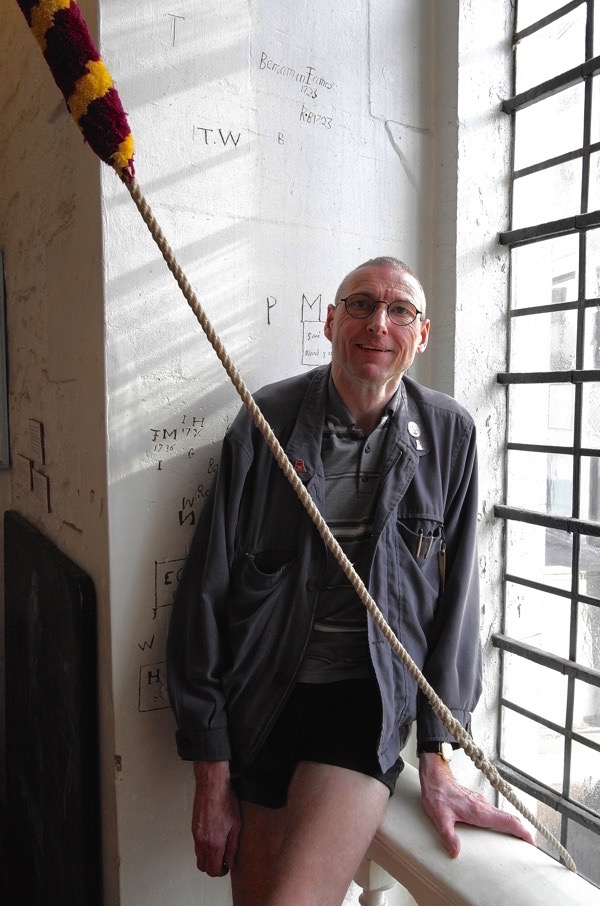
‘I was always very interested in church bells’
Walking around the City of London and admiring all the church steeples piercing the sky, you might imagine that they just stood there of their own accord. In fact, they need constant attention if they are to continue in use and it is the job of the steeplekeeper to care for them.
Recently I enjoyed the privilege of visiting the bell ringers in Christopher Wren’s handsome tower of St Vedast’s in Foster Lane next to St Paul’s Cathedral, where I had the pleasure of meeting steeplekeeper Phil Mills. Intrigued to learn more, Phil agreed to arrive early to meet me the following Monday at the church before bell-ringing practice and talk to me about his job.
It was fascinating to hear Phil speak with such passion and commitment about his chosen role, revealing a rare glimpse of the elaborate hidden world of bell maintenance and steeplekeeping.
“I became a bell ringer at Dorchester Abbey after we moved from Southampton to Oxfordshire in 1986 when I was twenty-two and I stayed a ringer at the Abbey for over thirty years. It took me a year to learn but – once I got the rope handling – I became a member of the Oxford & Diocese Guild of Church Bell Ringers and earned my certificate. Things hastened from there, I became a steeplekeeper in 1987 at twenty-five and I have been with it ever since.
Brian White of Whites, Bellhangers of Appleton Ltd, he thought I might make a good steeplekeeper after I got involved with the restoration of the bells at Dorchester Abbey. So I was appointed steeplekeeper with Alf Cooper as my deputy and – between the two of us – we looked after the bells, keeping them in good working order, and looking after the clock, the clock room, the ringing room and the bell chamber, and maintaining everything.
Brian White sent me on a tower maintenance course, I did a beginners’ one and then I went on to the more advanced one – and I just headed on from there! I was always very interested in church bells and I used to listen to them a lot in Southampton, especially when I went to family weddings. I was captivated by the sound and I already knew something about the different methods of ringing.
Being a steeplekeeper consists of looking after the tower and the bells, and maintaining the interior. Belfry maintenance includes greasing ball bearings and roller pulleys, checking the ropes, greasing the clappers, checking the stays, checking the slider and runner boards, checking the lighting, testing the emergency lighting, checking the tower roof drainage system and checking for ingress of water. The bell ropes also need looking after and many church towers have clock hammers that need to be looked after too.
Some towers do not have steeplekeepers, they can go for years and years without having any work done to them, then all of a sudden they go out of action. That is why you need a steeplekeeper. It is a labouring job but as long as we have got facemasks, proper overalls, hard hats and safety precautions, then we are ok. I can do the maintaining of the bells myself and undertake a full maintenance check, although in the case of replacing pulley wheels or clappers, I need to call in a contractor. Sometimes a tower can be a dangerous environment and this is why we have Health & Safety Issues. They only came out a few years ago but now we have to keep ourselves safe from dangerous activities like trying to put a new clapper in and it ending up landing on top of you. These are the things we have to look out for.
There was a steeplekeeper at Wallingford for quite a good number of years named Jim. Although he had been ringing for sixty-nine years, knew every single method in the book and how to compose and conduct, he also knew the ways of maintenance. He made a rope warmer by using a piece of drainage pipe, a wooden box, a light bulb and a flex. He wired it all up and put the ropes in there and it warmed them. It even had a timer so it came on before we were going to ring and all the ropes were nice and warm, ready for us. Jim died at seventy-nine and I took over from him. Steeplekeepers do not retire but he had already appointed me to take over, so I continue where he left off.
Back in 2006, I decided I was going to get myself a two-hundredth-visited tower because I had visited one hundred and ninety-nine. So I thought, ‘I wonder where I can get my two-hundredth?’ I decided to go to London and I had already seen the ringers at St Vedast’s because they are visible from Foster Lane through the windows of the ringing chamber and I thought, ‘They look a bit friendly.’ I was only down for a promenade concert but I saw them on a Friday doing their lunchtime quarter peals and I thought, ‘Oh this is fantastic, I’ll go along and see what it’s like.’ So I did that on 17th August 2009, I have still got the rail ticket from when I first came here. My instincts were happily right and after a couple of years Tom Lawrence, the ringing master, made me a member of the ringers at St Vedast’s.
I visit every Monday from Wallingford for bell-ringing practice. I always check the bells before we do the ringing. I have many favourite towers but St Vedast’s is definitely near the top of my list because it has such a wonderful ring of bells. I love the sound of them as it comes down through the ringing room. It is quite masterful. You hear this lovely sound coming down towards you and this is my favourite ring of six bells. My favourite ring of eight has got to be St Botloph’s Bishopsgate because the tower is on the move, so it wobbles about a lot as the bells are changing. It is seventeen hundred-weight ring of eight bells. The tower moves and it has a lot of character and that is why I enjoy ringing there, that is another favourite.
We only get paid for ringing when we do weddings but I am semi-retired and I live on my own in Wallingford. I usually get home about twelve or one o’clock on Monday night. I have been ringing for thirty-four years now and I have visited two-hundred-and-fifty-seven towers. I can barely keep track of all these towers! I have definitely clocked up a lot and I am still visiting new ones. The immense pleasure I get out of it is putting something back into a community – that is why I like to keep the bells going through my work as a steeplekeeper.
There is a lot of atmosphere in towers. I could feel it when I was listening to LP I have of the ‘Bells Of London.’ I was listening to it on a Saturday afternoon, this was back in the days when I was still only a learner, and I thought, ‘There’s something strange, I’m beginning to get an atmosphere from this.’ That same atmosphere came back to me when I first rang for a wedding at St Vedast’s and I realised my instincts had been right because that is very, very strange. Ringing in London has definitely got a lot of atmosphere.”
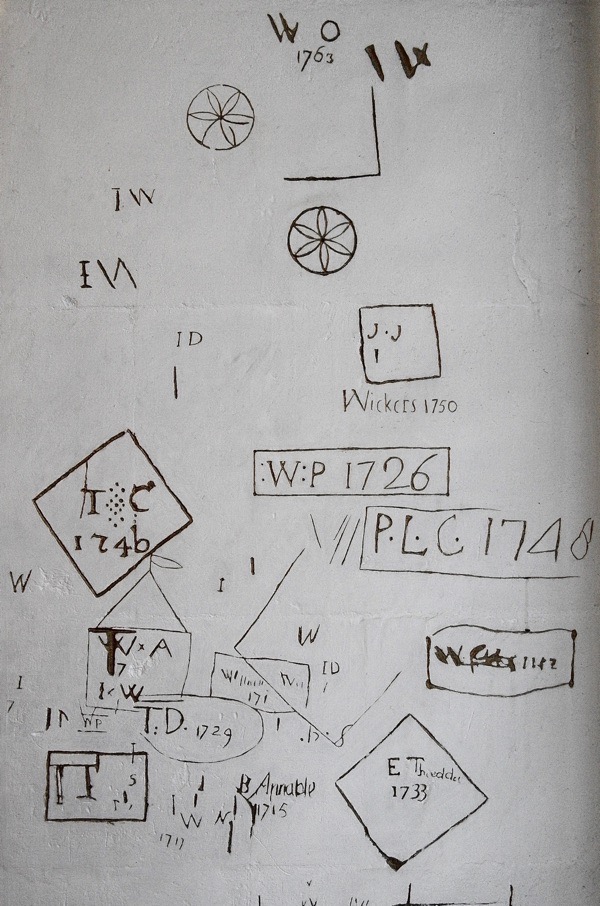
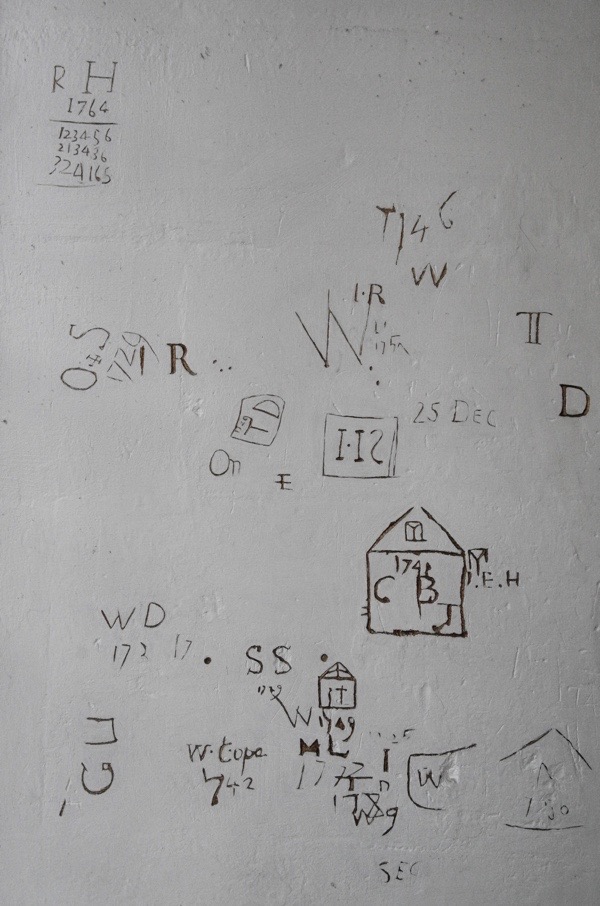
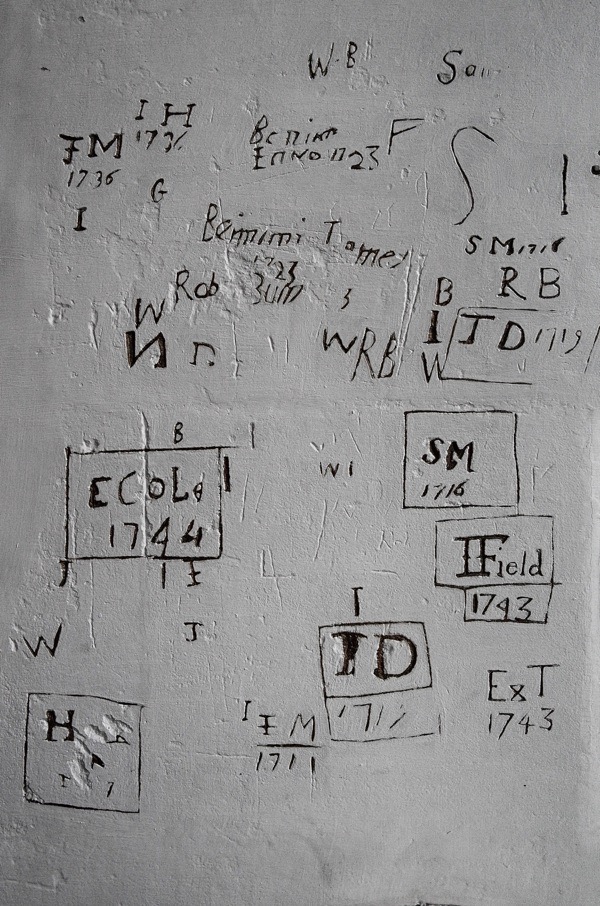
Eighteenth century graffitti in the ringers’ chamber
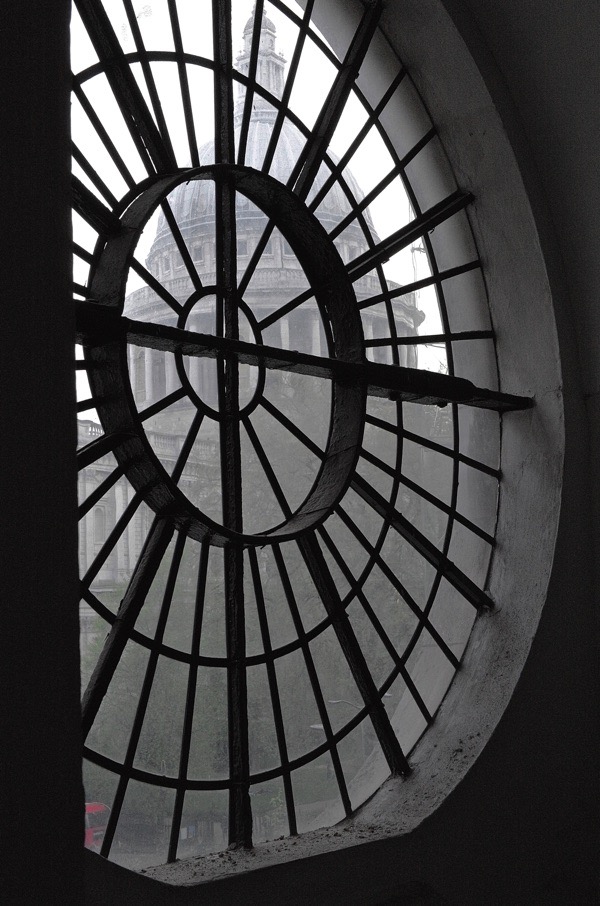
St Paul’s seen from St Vedast’s

St Vedast’s, Foster Lane
You may also like to read about
Vanishing London
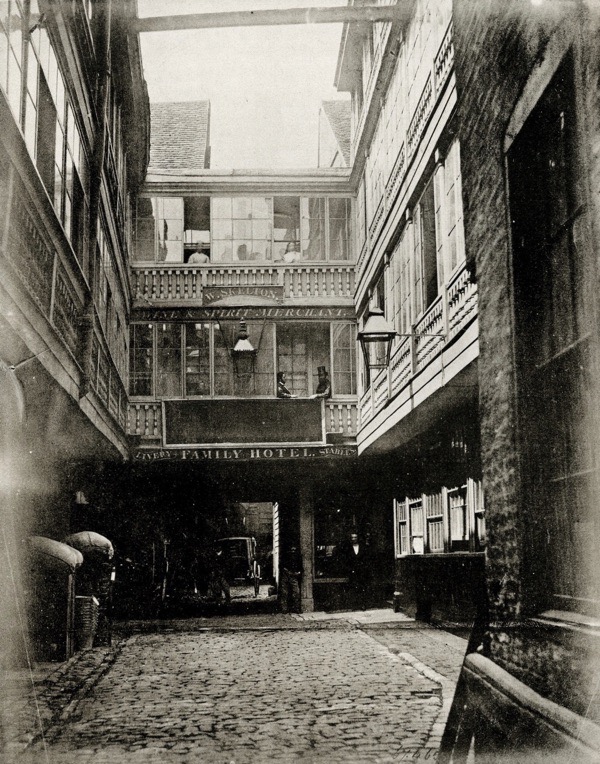
Four Swans, Bishopsgate, photographed by William Strudwick & demolished 1873
In 1906, F G Hilton Price, Vice President of the London Topographical Society opened his speech to the members at the annual meeting with these words – ‘We are all familiar with the hackneyed expression ‘Vanishing London’ but it is nevertheless an appropriate one for – as a matter of fact – there is very little remaining in the City which might be called old London … During the last sixty years or more there have been enormous changes, the topography has been altered to a considerable extent, and London has been practically rebuilt.’
These photographs are selected from volumes of the Society’s ‘London Topographic Record,’ published between 1900 and 1939, which adopted the melancholy duty of recording notable old buildings as they were demolished in the capital. Yet even this lamentable catalogue of loss exists in blithe innocence of the London Blitz that was to come.
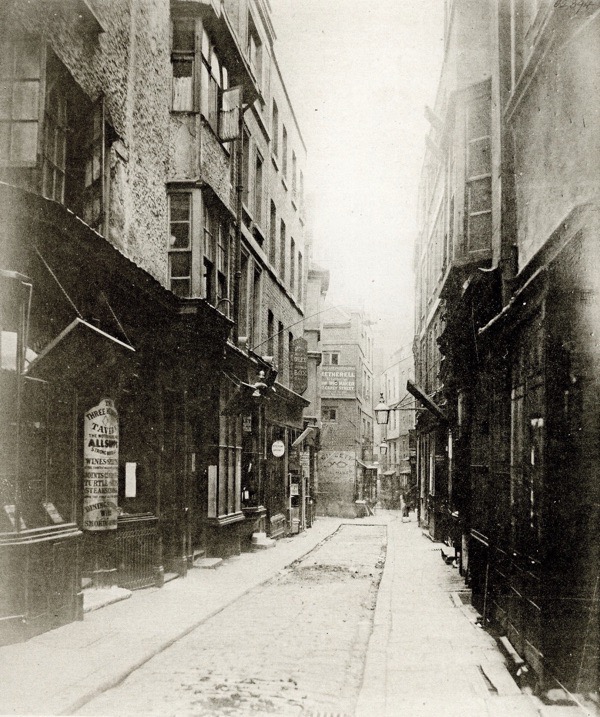
Bell Yard, Fleet St, photographed by William Strudwick
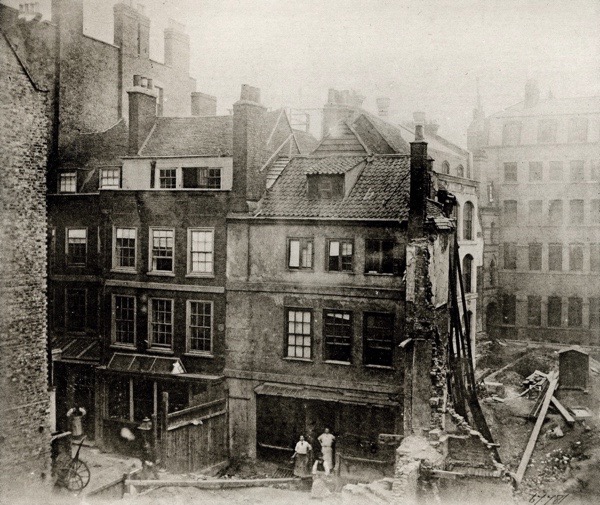
Pope’s House, Plough Court, Lombard St, photographed by William Strudwick
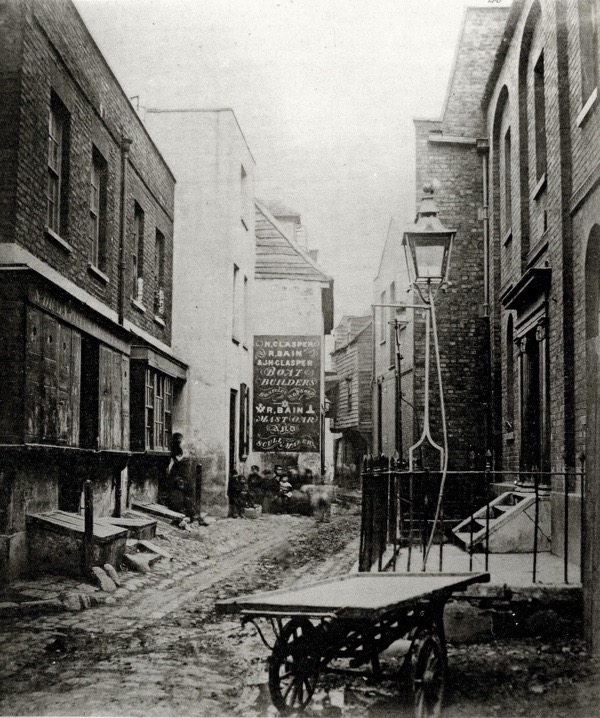
Lambeth High St photographed by William Strudwick
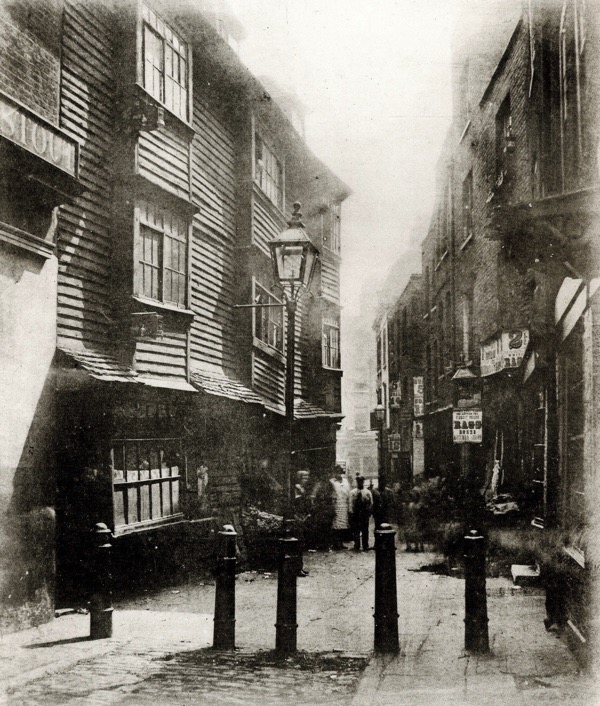
Peter’s Lane, Smithfield, photographed by William Strudwick

Millbank Suspension Bridge & Wharves, August 1906, photographed by Walter L Spiers
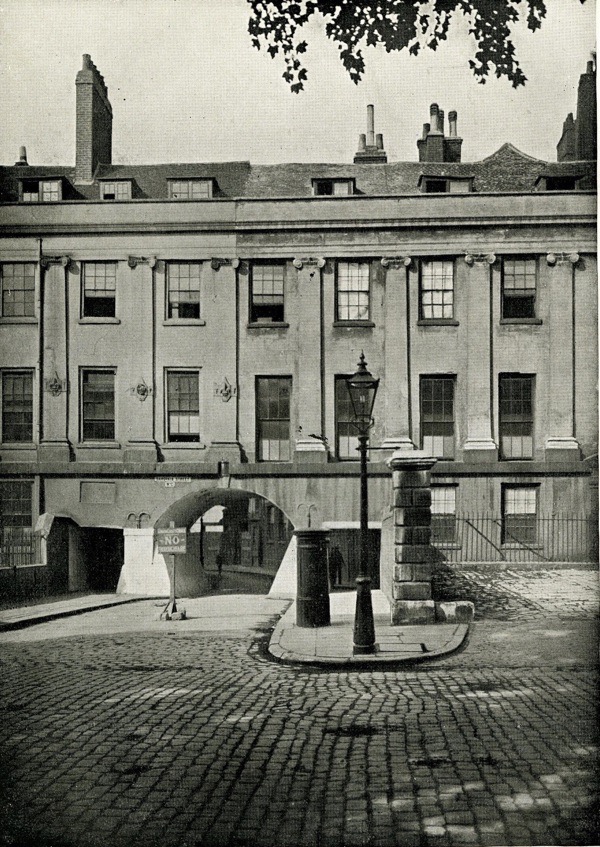
54 & 55 Lincoln’s Inn Fields and the archway leading into Sardinia St, demolished 1912, photographed by Walter L Spiers
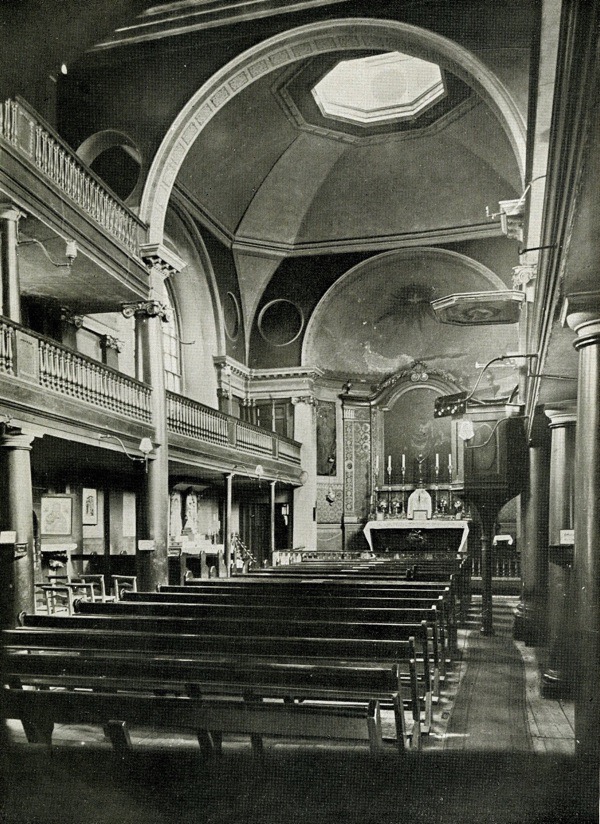
Sardinian Chapel, Lincoln’s Inn Fields, August 1906, demolished 1908, photographed by Walter L Spiers
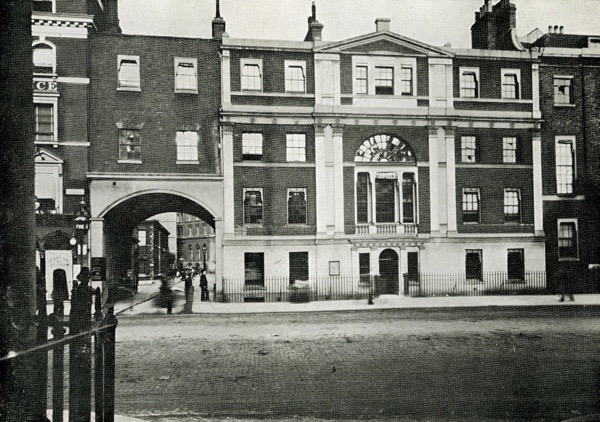
Archway leading into Great Scotland Yard and 1 Whitehall, September 1903, photographed by Walter L Spiers
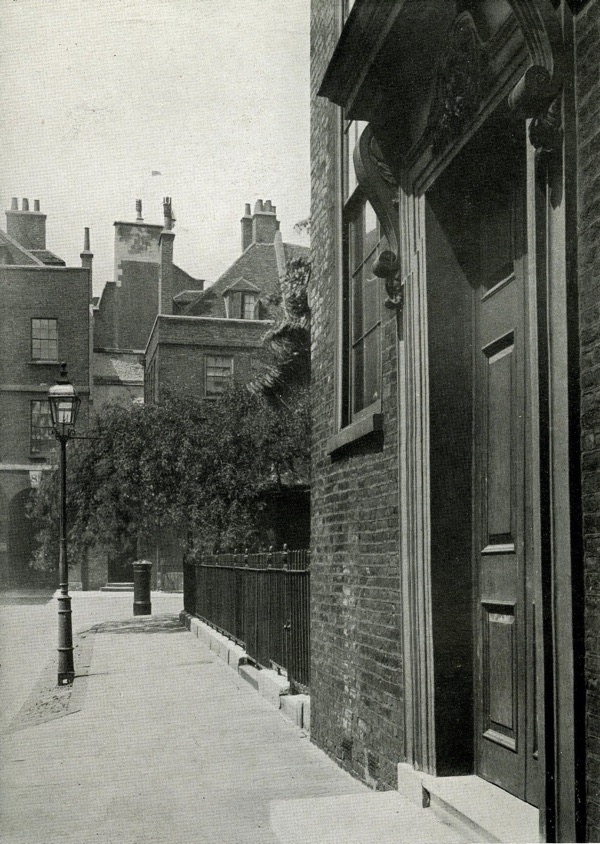
New Inn, Strand, June 1889, photographed by Ernest G Spiers

Nevill’s Court’s, Fetter Lane, March 1910, demolished 1911, photographed by Walter L Spiers
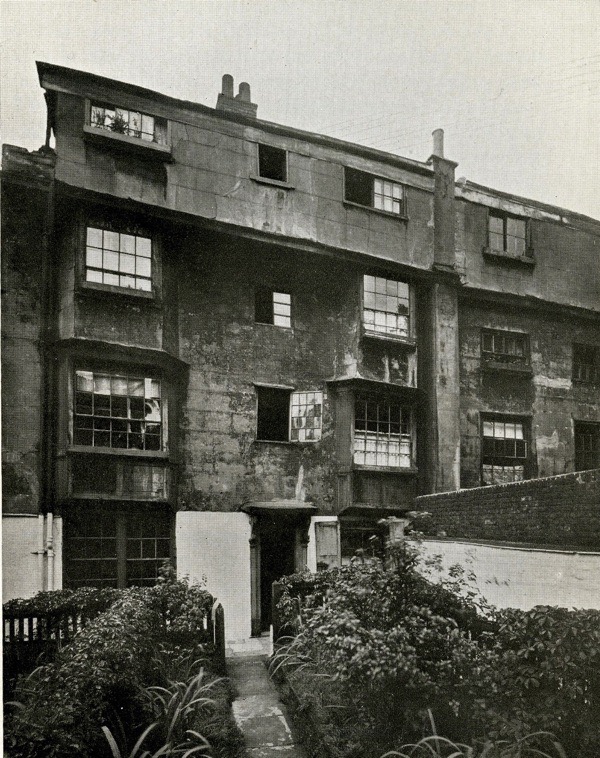
14 & 15 Nevill’s Court, Fetter Lane, demolished 1911
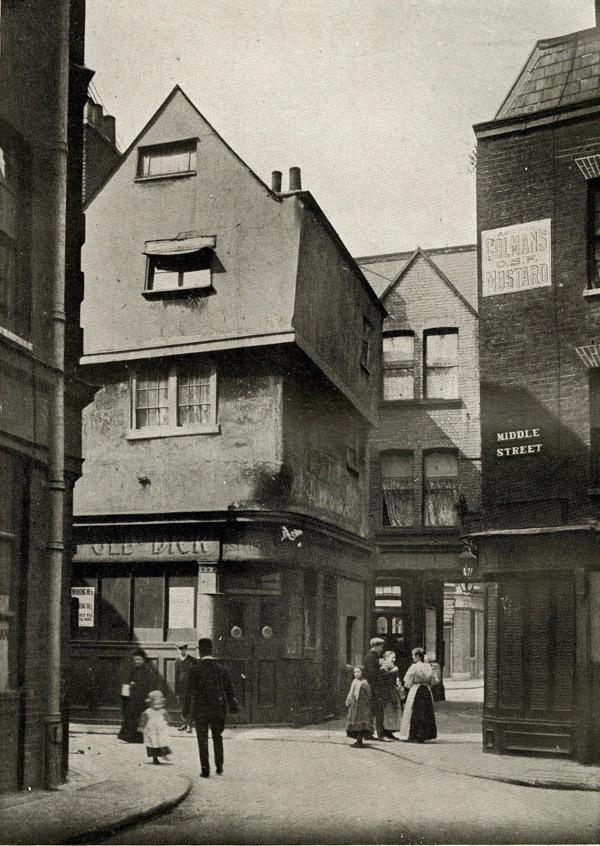
The Old Dick Whittington, Cloth Fair, April 1898, photographed by Walter L Spiers
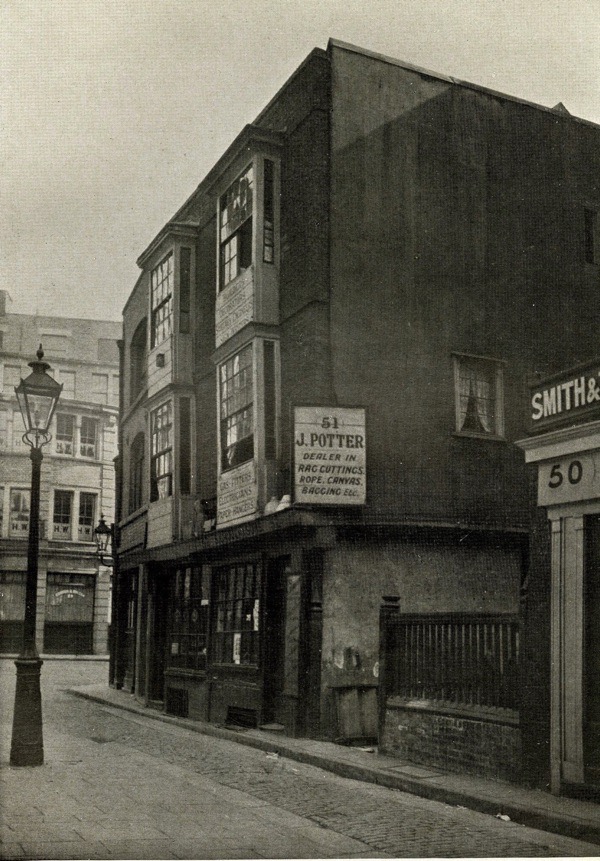
Bartholomew Close, August 1904, photographed by Walter L Spiers
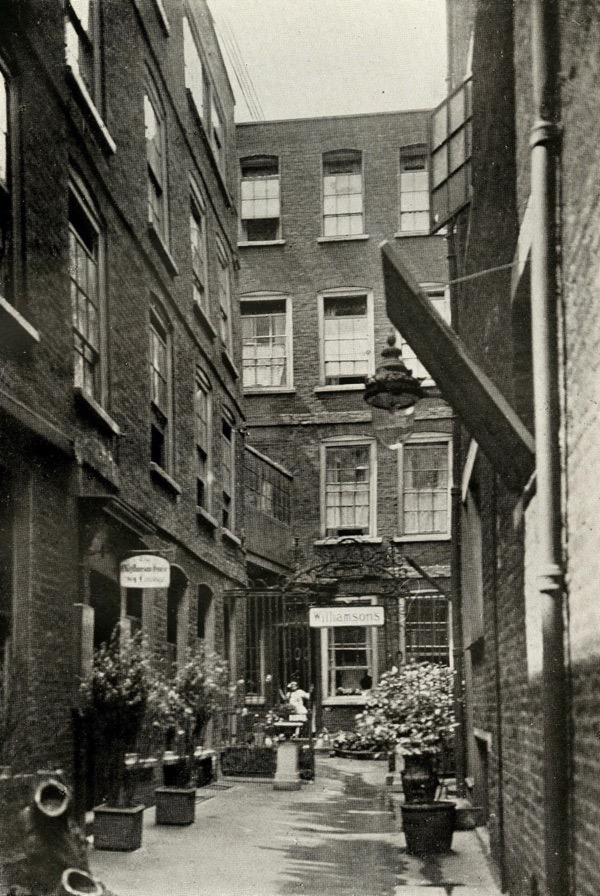
Williamson’s Hotel, New Court, City of London

Raquet Court, Fleet St
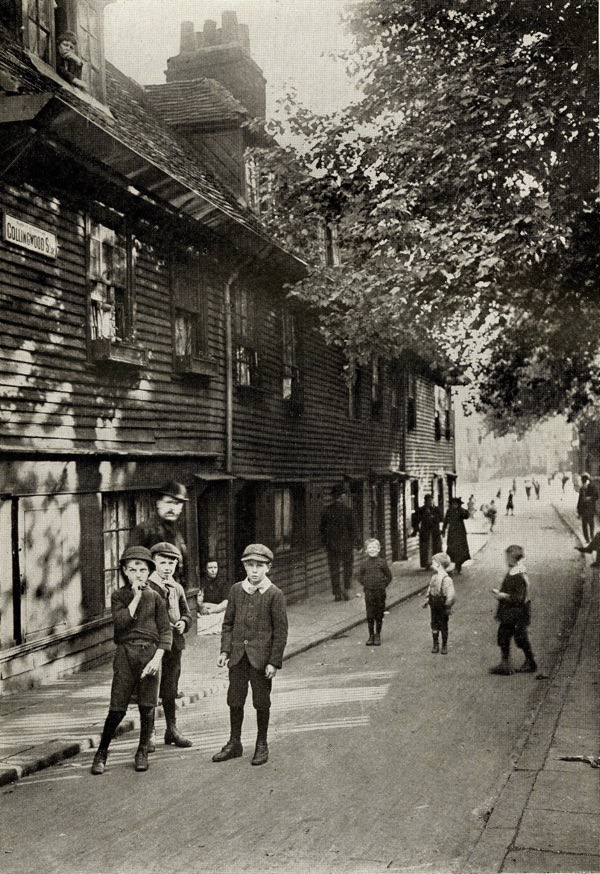
Collingwood St, Blackfriars Rd
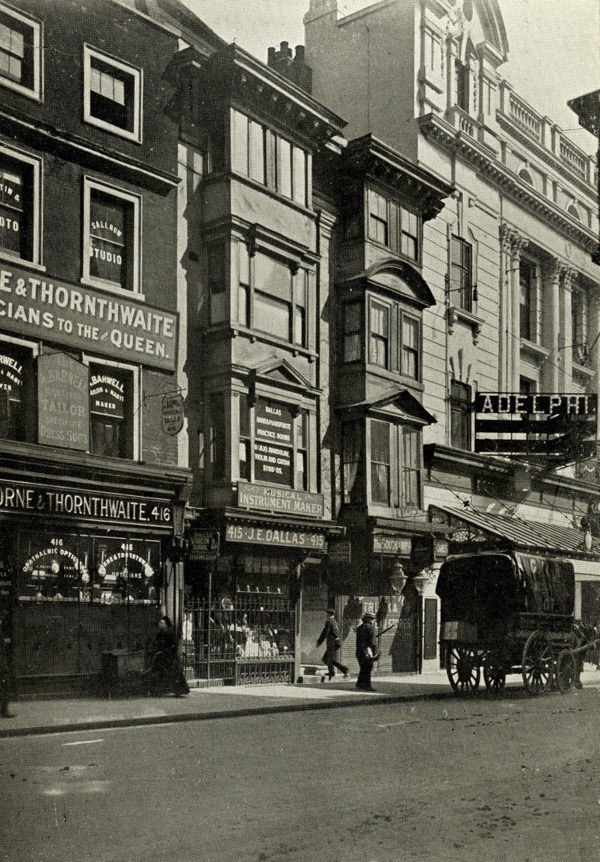
Old Houses, North side of the Strand
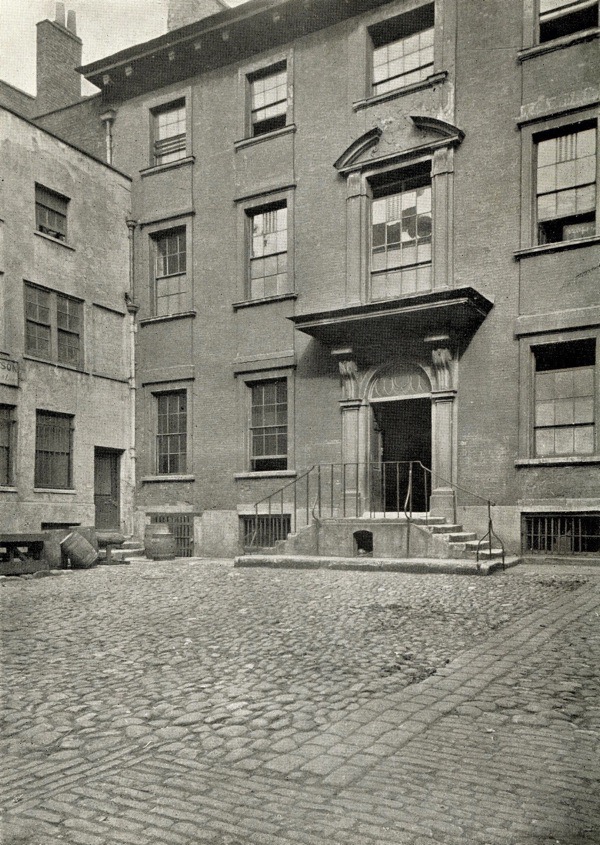
Courtyard of 32 Botolph Lane, April 1905, demolished 1906, photographed by Walter L Spiers

32 Botolph Lane, April 1905, demolished 1906, photographed by Walter L Spiers
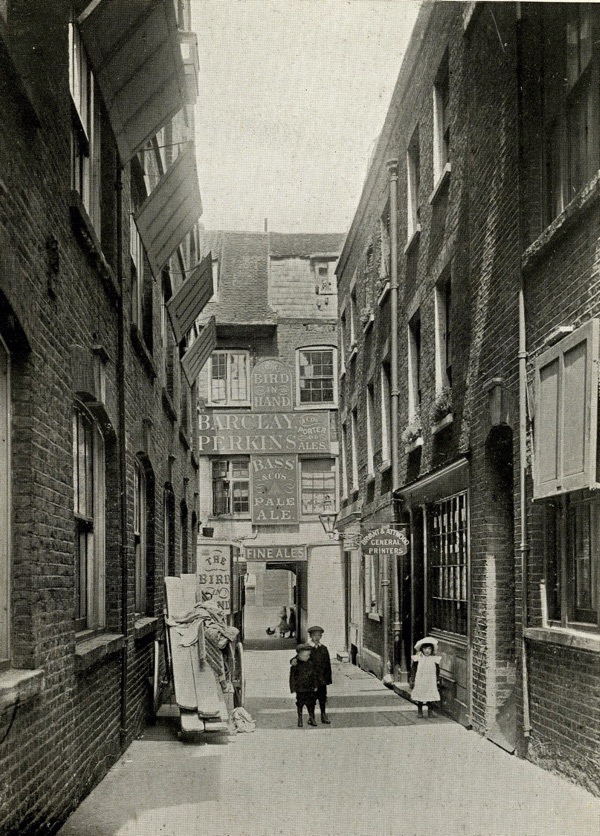
Bird in Hand, Long Acre

Houses in Millbank St, September 1903, photographed by Walter L Spiers
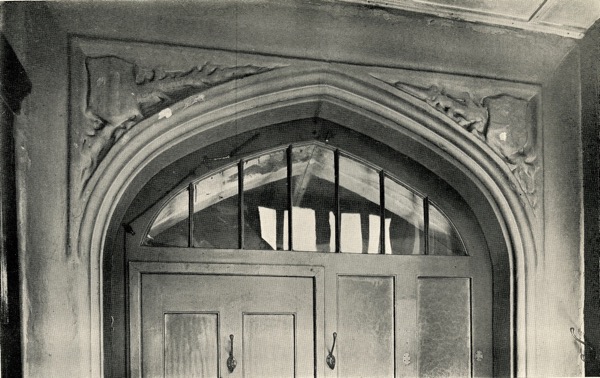
Door to Cardinal Wolsey’s Wine Cellar, Board of Trade Offices, 7 Whitehall Gardens

Old Smithy, Bell St, Edgware Rd, demolished by Baker St & Edgware Railway
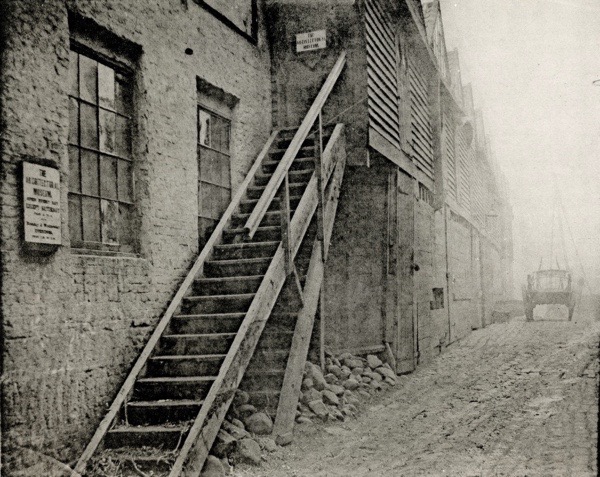
Architectural Museum, Cannon Row, Westminster
Images courtesy Bishopsgate Insitute
You may also like to look at
Dog Days At Club Row

“… furry faces peering incongruously from the jackets of hawkers.”
In 1953, Ronald Searle came here with his wife, Kaye Webb, to report upon the animal market in Club Row for their book, “Looking at London and People Worth Meeting.” A. R. J. Cruickshank wrote in the introduction, ”This book rediscovers for us some of the odd places and odd faces of London that most of us have forgotten, if we ever knew them. The warm-hearted humanity of Kaye Webb’s writing and the tender sympathy of Searle’s drawings are beautifully matched.”
Curious, considering our national reputation, that of all the street markets in London only one should sell dogs. This can be found any Sunday morning by taking a bus to Shoreditch High St and following your ears. a cacophony of whimpers, yaps, yelps and just plain barking will guide you to the spot where Bethnal Green Rd branches off to Sclater St.
There you may find them – the unclaimed pets of a hundred homes : new-born litters of puppies tumbling over each other in children’s cots ( the most popular form of window display) : “mixed bags” of less lively youngsters huddling docilely together in laundry baskets; lively-looking sheepdogs, greyhounds and bulldogs straining at the ends of leashes and furry little faces peering incongruously from the jackets of hawkers, who often look as if they’d be happier in the boxing ring.
The sales technique of their owners is almost as varied as the ware and almost always accompanied by much affectionate handling of the dogs. “It’s good for business and sometimes they mean it,” we were told by an impartial vendor of bird-seed who has been on the same pitch for twenty years. “Hi, mate, buy a dog to keep you warm!” said the man with the Chows to a pair of shivering Lascar seamen. “E’s worth double, lady, but I want ‘im to ‘ave a good ‘ome” or “Here’s a good dog, born between the sheets, got his pedigree in my pocket!” “Who’d care for a German sausage? – stretch him to make up the rations”, the salesman with the dachshund said, demonstrating too painfully for amusement.
R.S.P.C.A. interference is needed less often now. The days are gone when sores were covered with boot polish; when doubtful dogs were dyed with permanganate of potash; when, as tradition has it, you could enter the market at one end leading a dog, lose it half way, and buy it back at the other end. In fact the regular dog hawkers were never the ones to deal in stolen pets. “Stands to reason, this is the first place they’d come, and besides, look at the number of coppers there are about anyway.” But it is still possible to buy pedigree forms “at a shop down the road”, “just a matter of thinking up some good names and being able to write”.
The regular merchants, whose most frequent customers are the pet shops, are mostly old-timers ( some who have been coming for forty years and from as far away as Southend) and since a new law was passed insisting that all animal sellers should have licences, the ‘casuals’ are forbidden. But on the occasion of our visit the law had not yet been made and we passed quite a number of them. Most attractive was a red-cheeked lad with a spaniel puppy – “I call him Gyp; we’ve got his mother, but there’s no room for another, so my uncle said to come here.” Every time he was asked: “How much do you want, son?” he stumbled over his answer and hugged the dog closer. And when the would-be buyer moved on, his eyes sparkled with relief.
That day the dog section of Club Row was not very busy; it was too cold. But the rest of the market waxed as usual. Unlike its near neighbour, Petticoat Lane, Club Row Market has a strong local flavour. The outsiders who make the long journey to its “specialised streets” are mostly purposeful men looking for that mysterious commodity known as Spare Parts.
In Club Row itself are to be found bicycles, tyres, an occasional motor bike or a superannuated taxi. The police are frequently seen about here looking for “unofficial goods”. Chance St sells furniture and “junk”, Sclater St is a nest of singing birds, rabbits, white mice, guinea pigs and their proper nourishment. In the Street of Wirelesses the air is heavy with crooning, and Cheshire St is clamorous with “Dutch auctions”, or demonstrating remarkable inventions like the World’s Smallest Darning Loom (“Stop your missus hating you … now you can say ‘you might darn this potato, dear, while I have shave’ … and she’ll do it before you’ve wiped the soap off!”).
We found one street devoted to firearms, chiefly historic, and another where secretive, urgent men offered us “a good watch or knife”, implying that it was “hot” and therefore going cheap. But we had learned that this was “duffing” and the watch was most probably exactly the same as those sold on the licenced stalls just up the street.
At ten to one the market reaches a crescendo. One o’clock is closing time and many of the stallholders won’t be back until next Sunday. This is the time when the regulars know where to find bargains, but it needs strong elbows. Our way out, along Wheler St, under the railway bridge and past the faded notice which says ‘Behold the Lamb of God Cometh”, brought us back to the dog market. It was surprisingly quiet. On the other side of the road we spotted a small figure hurrying off with the spaniel puppy. It looked as if Gyp was safe for another week anyway.
I hope you will not consider it vain if I reveal that Kaye Webb gave me this book and inscribed it under the title with my name and the text ” – also a person worth meeting!” It was my good fortune that Kaye, the legendary editor of Picture Post, Lilliput and Puffin Books, was the first person to recognise my work and encourage me in my writing. When I used to stay with her in her flat overlooking the canal in Little Venice, I remember she had some of Ronald Searle’s work framed on the wall in the spare room, and I spent many hours admiring both his Japanese prison camp drawings and his portraits of the bargees from the Paddington basin.
Kaye’s marriage to Ronald Searle ended in 1967 and she died in 1995. Today, I keep my copy of “Looking at London and People Worth Meeting” on the shelf as an inspiration to me now I write pen portraits myself, and I sometimes think of Kaye here in these streets over half a century ago and imagine Ronnie – as she referred to him – bringing out his sketchbook in Sclater St where I buy my fruit and vegetables each Sunday.

“…the rest of the market waxed as usual” – a bookseller in action on Brick Lane
You may also like to take a look at
The Map of Shakespeare’s Shoreditch
Each Saturday, we shall be featuring one of Adam Dant’s MAPS OF LONDON & BEYOND from the forthcoming book of his extraordinary cartography to be published by Spitalfields Life Books & Batsford on June 7th.
Please support this ambitious venture by pre-ordering a copy, which will be signed by Adam Dant with an individual drawing on the flyleaf and sent to you on publication. CLICK TO ORDER A SIGNED COPY OF MAPS OF LONDON & BEYOND BY ADAM DANT
Tickets are already on sale for Adam Dant’s illustrated lecture showing his maps at the Wanstead Tap on Thursday June 21st. Click here to book tickets

Click on the image to enlarge & read the text on the map
Adam Dant conjured this extraordinary vision of William Shakespeare’s Shoreditch, by collating the scraps of information and myth about the landscape of London’s lost theatreland of over four hundred years ago. Here Shakespeare arrived as a young actor in 1585, treading the boards at London’s earliest custom-built theatre, The Theatre at New Inn Yard where subsequently his first ventures as a playwright saw the light of day.

Archaeologist raises a Shakespearian goblet to celebrate the excavation of The Theatre, 2011

Staffordshire figure of Shakespeare on my dresser flanked by Sarah Siddons & Edmund Kean
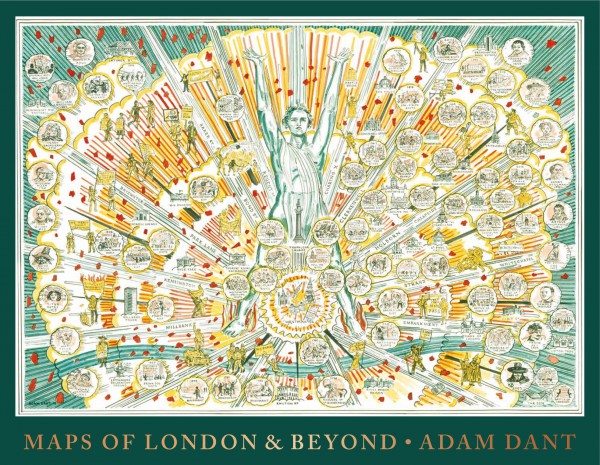
CLICK TO ORDER A SIGNED COPY OF MAPS OF LONDON & BEYOND BY ADAM DANT
Adam Dant’s MAPS OF LONDON & BEYOND is a mighty monograph collecting together all your favourite works by Spitalfields Life‘s cartographer extraordinaire in a beautiful big hardback book.
Including a map of London riots, the locations of early coffee houses and a colourful depiction of slang through the centuries, Adam Dant’s vision of city life and our prevailing obsessions with money, power and the pursuit of pleasure may genuinely be described as ‘Hogarthian.’
Unparalleled in his draughtsmanship and inventiveness, Adam Dant explores the byways of English cultural history in his ingenious drawings, annotated with erudite commentary and offering hours of fascination for the curious.
The book includes an extensive interview with Adam Dant by The Gentle Author.
Adam Dant’s limited edition prints are available to purchase through TAG Fine Arts
The Boss Of Bethnal Green’s Bicentennial
On the two hundredth anniversary of the trial of Joseph Merceron, corrupt magistrate and gangster, who is the subject of Julian Woodford’s book The Boss of Bethnal Green, Julian explores this auspicious event in East End history.
Julian will be speaking at Tower Hamlets Local History Library & Archives, Bancroft Rd, E1 4DQ, on Thursday 31st May at 6pm as part of London History Day. He conducted much of his research at the archives and he will outline how he used the collection to uncover Joseph Merceron’s story. Click here for tickets.

The Court of King’s Bench by Augustus Pugin & Thomas Rowlandson, courtesy Bishopsgate Institute
By nine-thirty of the morning of Saturday 18th May 1818, the public gallery at the Court of King’s Bench in Westminster Hall was full. Joseph Merceron, the tyrant who had controlled almost every aspect of life for the poor in the East End for more than thirty years was finally being brought to book.
It was impossible to conduct business in Bethnal Green without money finding its way into Merceron’s pocket. He owned hundreds of tenements and a significant proportion of the public houses too. Incredibly, he was also licensing magistrate and converted his own inns into brothels and gin palaces, while withholding licences for more reputable competitors. As parish treasurer and government tax commissioner, all rate and tax monies passed through his hands. He was responsible for the public amenities – paving, sewerage, lighting and cleaning. He controlled the workhouse and awarded contracts to supply it with food, bedding and fuel. It was the same with a major prison and even the local charity school. As infrastructure was transformed during the Napoleonic wars, directorships of major private companies provided Merceron with further opportunities for corruption. The finances of water works, the docks and the local militia were all subject to his influence. He made many enemies, yet all attempts to unseat him proved hopeless until now – at last – his dominance was under threat. Was the career of the Boss of Bethnal Green about to end?
Emergence
Joseph Merceron was born on Brick Lane in January 1764, the eighth child of a Brick Lane pawnbroker, former silk weaver and second generation Huguenot refugee. Merceron’s father James had astutely shifted careers a few years earlier as the Spitalfields silk industry entered a depression, and he made a small fortune as former colleagues turned to him in desperation for money for food, clothing and shelter. By the time Merceron reached school age, James had expanded his empire to become a slum landlord and had achieved a position of local importance as an officer within the Bethnal Green parish vestry – the local council of its day.
Merceron was a brash, outgoing child and a natural leader. Throughout his childhood the streets of Spitalfields echoed with the sounds of gunfire and military deployments as the starving weavers rioted and were forcibly suppressed by the authorities. The resultant public executions, almost literally on his own doorstep, and the threat to property and life presented by violent mobs, left a strong impression on the boy and shaped his lifelong attitude to power as a tool to be used strategically and with great effect.
After leaving school, Merceron served brief apprenticeships in his father’s pawnshop and a local lottery office – both perfect finishing schools in the dark arts of finance. At sixteen, his father died and Joseph took over the management of the family’s growing property portfolio – a position of power he expanded exponentially by being appointed as agent to two important local landowners. By his twenty-first birthday, Merceron was collecting the rents from more than five hundred homes and able to evict tenants at will for non-payment. The extent of his ruthlessness was soon illustrated when he arranged for his half-sister to be incarcerated in a lunatic asylum, in order to grab her share of their father’s estate, and when he collaborated with a corrupt clergyman to steal the fortune of a mentally disabled local heiress.
Dominance
Merceron’s astonishing rise to power continued. By June 1786, still just twenty-two, he became a Commissioner of Land Tax, meaning he was now able to collect rates on behalf of the County of Middlesex as well as private rents. Later that year Merceron joined the Bethnal Green vestry and became the parish treasurer – meaning that all the parish funds now passed through his hands. The rudimentary book-keeping systems of the day made it difficult to spot if any of these funds went missing and the power conferred on Merceron by the control of money made it easy for him to dominate the vestry. Bethnal Green was always a poor parish, only formed in 1743 to house the overspill of poor journeymen weavers from Spitalfields as London expanded eastwards over the marshy and typhus-infested fields. There was no ‘squirearchy’ since most of the middling class had the good sense to move out to more attractive locations. The vestrymen of Bethnal Green were uneducated artisans, easily led by the dynamic treasurer who rewarded his supporters with rate reductions and a seat at the vestry table.
By 1795, Merceron had used his power to get himself appointed as a magistrate of the County of Middlesex. These magistrates had been famously corrupt for decades and Merceron had no difficulty in dominating this motley group. He established himself within a core of corrupt leaders, the others being William Mainwaring MP, chairman of the bench, his son George Mainwaring, the County Treasurer, and Sir Daniel Williams, a surgeon and apothecary whose name was guaranteed to be found on any committee where contracts were being awarded.
How could these men amass so much power and influence at the very heart of local government yet remain untouched by central government and the law? The explanation lies in the circumstances of the aftermath of the French Revolution. In the seventeen-nineties, London was beset by the growth of radical and sometimes revolutionary societies fuelled by the increasingly educated yet disenfranchised lower-middle classes, spurred on by events in France. Many of these societies had sprung up in the eastern suburbs including Spitalfields and Bethnal Green. In response, William Pitt’s government established an extensive spy network under the management of the Middlesex magistrates. Merceron and his cronies were instrumental in running these spies. For example, it was a Merceron associate who accosted the madman and would-be assassin James Hadfield as he tried to shoot King George III at the Drury Lane Theatre in May 1800. From the government’s point of view, tough but corrupt magistrates were infinitely preferable to the alternative of revolutionaries who would welcome a French invasion.
So – at least while the Napoleonic Wars lasted – Merceron’s prosperity grew. In Bethnal Green, his positions as landlord, parish treasurer and county magistrate meant he was able to alter rate assessments brazenly, doubling them at a stroke for his opponents and reducing them as a favour – to be called in when required – for his allies. When a serious depression hit Bethnal Green in 1800 and the government awarded an emergency relief grant to assist the starving poor, much of it disappeared into Merceron’s pockets, despite the needs of a thousand inmates of the local workhouses in a year when more than a hundred children and forty adults had died of starvation in Spitalfields alone. When a Home Office official was sent to investigate after complaints were raised, Merceron explained lamely that the receipts for his expenditure had been stolen in a burglary and no action was taken.
Belligerence
Over years, all attempts to challenge Merceron’s corruption met with failure. As early as 1788, The Times – as part of a wider campaign to reform the poor laws – ran a series of articles railing against the ‘bare-faced injustice’ of the ‘feasting junto of the Green.’ Yet this criticism petered out as events in France took hold of the public imagination. In 1799, a radical MP, Sir Francis Burdett, exposed the appalling abuse of political prisoners in Coldbath Fields prison in Clerkenwell, which Merceron and his colleagues had both tolerated and encouraged. But Burdett’s claims were cynically covered up by the Pitt government. In 1804, two Bethnal Green vestrymen succeeded briefly in removing Merceron as treasurer, only for him to return a year later. Then. in 1812, an alliance between Bethnal Green’s new rector, Joshua King, and a local gin distiller, John Liptrap, uncovered extensive evidence of rate tampering by Merceron which resulted in him being tried for perjury and corruption. The trial collapsed when Merceron bribed the prosecution lawyers to drop the case and shortly afterwards Liptrap was declared bankrupt after Merceron used his influence to destroy Liptrap’s business.
In 1813, a new and more robust adversary appeared. John Thomas Barber Beaumont was an astonishingly talented man who was ‘devoted to alleviating the insecurity of the poor, whilst crusading against those who would prey on them’. By turns a successful artist, soldier and businessman, Barber Beaumont attempted to establish a philanthropic property development in Mile End involving houses, shops factories and pubs. Merceron, as licensing magistrate, refused to grant Beaumont a licence unless bribes were paid. Beaumont’s complaints to the Middlesex magistrates went unheard, and open letters to The Times and to the Home Secretary made no difference. In frustration, Beaumont’s response was to present all the evidence he had collected against Merceron to a parliamentary Select Committee in 1816.
Beaumont’s campaign was fuelled by the background of extreme distress on the streets of East London following the end of the Napoleonic wars. A sharp increase in the price of corn led to the number of unemployed in Bethnal Green doubling to 42,000 in the latter half of 2016. The people Merceron was stealing from were starving. Beaumont’s evidence of corruption at the heart of local government created uproar and was used by committee chairman, the Whig MP Henry Grey Bennet, to mount a wider attack on Merceron drawing on the earlier evidence of rate tampering from the failed attempt to prosecute him in 1812.
As Beaumont put it to MPs, while England’s attention was diverted by the long war with France, its domestic ‘vermin had been suffered to feed and fatten undisturbedly… the mite extracted from the widow, and the pound bestowed by the benevolent, are alike wrested from the bank of charity in which they were deposited, to feed a vortex to which I will not trust myself to give a name.’
With the return of peace, the government no longer turned a blind eye to Merceron’s corruption. As Beaumont made clear, the distress in the East End, with hordes of unemployed sailors and soldiers unable to support their starving families was exacerbated by the actions of the government’s own local representative. It was inevitable that something must be done. Yet still the authorities repeatedly refused to act against Merceron and it was left once more to the Reverend Joshua King to bring a private prosecution against him in 1818 for the theft of poor rate funds and corrupt licensing of public houses.
So it was that Joseph Merceron took his place in the dock two hundred years ago today. The people of Bethnal Green, having learned of the full extent of his corruption, had already voted Merceron and his cronies out of all their parish offices by Easter. The evidence against him was extensive, underpinned by his own self-incriminating testimony to Bennet’s 1816 Select Committee. Criminal penalties in Regency London were unforgiving. Young girls found guilty of petty shoplifting were routinely be transported to Australia for seven years and the death penalty still applied for a wide variety of crimes. Surely this was the end for the Boss of Bethnal Green?
[youtube iznWirIaqB0 nolink]
Click here to order a copy of THE BOSS OF BETHNAL GREEN
You may also like to read about:
In Search of the Boss of Bethnal Green
Julian Woodford, Author and Digital Flâneur
At Frost Brothers Ltd, Rope Makers


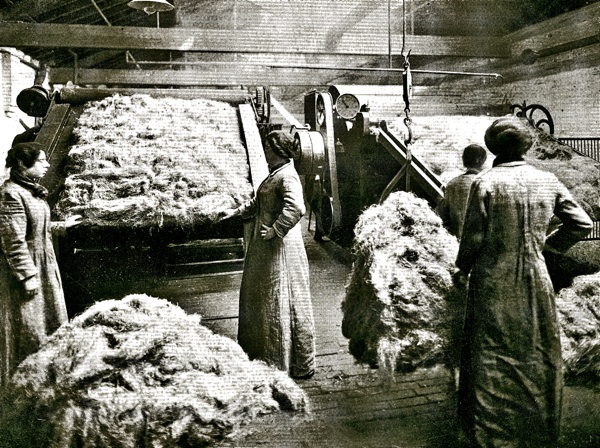
Founded by John James Frost in 1790, Frost Brothers Ltd of 340/342 Commercial Rd was managed by his grandson – also John James Frost – in 1905, when these photographs were taken. In 1926, the company was amalgamated to become part of British Ropes and now only this modest publication on the shelf in the Bishopsgate Institute bears testimony to the long-lost industry of rope making and yarn spinning in the East End, from which Cable St takes its name.


First Prize London Cart Parade – Manila Hemp as we receive it from the Philippines

Hand Dressing

The Old-Fashioned Method of Hand Spinning

The First Process in Spinning Manila – The women are shown feeding Hemp up to the spreading machines, taken from the bales as they come from the Philippines. These three machines are capable of manipulating one hundred and twenty bales a day.

Manila-Finishing Drawing Machines

Russian & Italian Hemp Preparing Room

Manila Spinning
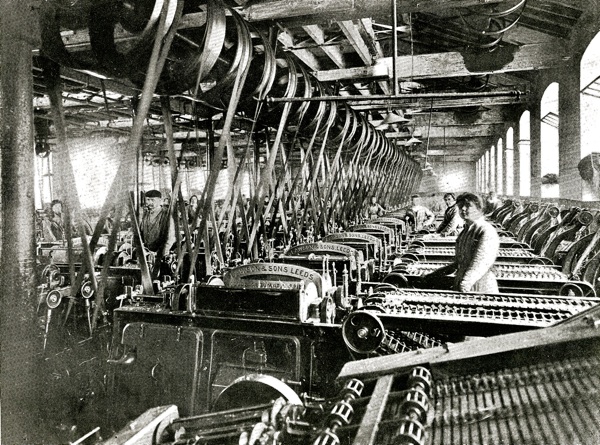
Binder Twine & Trawl Twine Spinning – This floor contains one hundred and fifty six spindles

Russian & Italian Hemp Spinning
Carding Room

Tow Drawing Room

Tow Spinning & Spun Yarn Twisting Room

Tarred Yarn Store – This contains one hundred and fifty tons of Yarn

Tarred Yarn Winding Room

Upper End of Main Rope Ground – There are six ground four hundred yards long, capable of making eighteen tons of rope per ten and a half hour day

Rope-Making Machines – This pair of large machines are capable of making rope up to forty-eight centimetres in circumference

House Machines – This view shows part of the Upper Rope Ground and a couple of small Rope-Making Machines

Number 4 House Machine Room

The middle section of a machine capable of making rope from three inches up to seven inches in circumference, any length without a splice. It is thirty-two feet in height and driven by an electric motor.

Number 4 Rope Store

Boiler House

120 BHP. Sisson Engine Direct Coupled to Clarke-Chapman Dynamo

One of our Motors by Crompton 40 BHP – These Manila Ropes have been running eight years and are still in first class condition.

Engineers’ Shop with Smiths’ Shop adjoining

Carpenters’ Store & Store for Spare Gear

Exhibit at Earl’s Court Naval & Shipping Exhibition, 1905

View of the Factory before the Fire in 1860

View of the Factory as it is now in 1905 – extending from Commercial St

Gang of rope makers at Frost Brothers (You can click to enlarge this image)

Rope makers with a bale of fibre and reels of twine (You can click to enlarge this image )
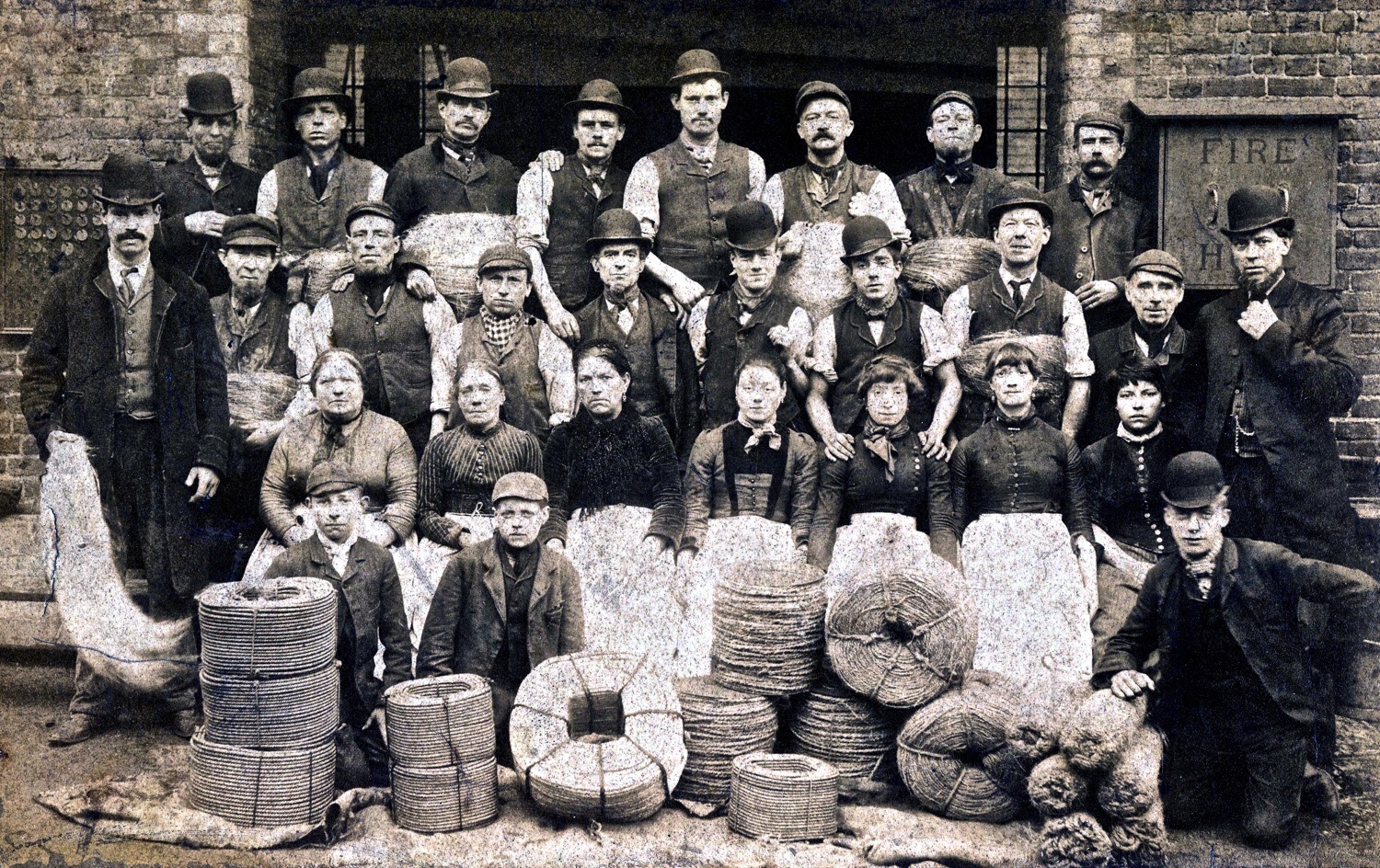
Rope makers including women and boys with coils of rope (You can click to enlarge this image)
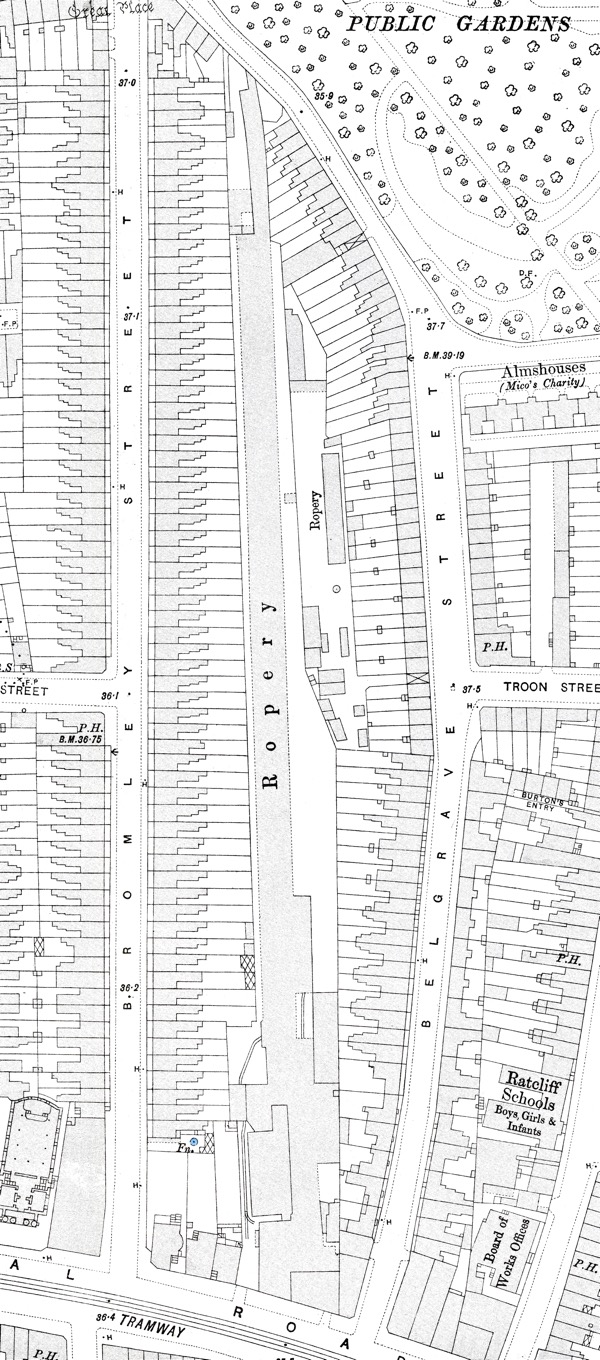
Frost Brothers Ropery stretched from Commercial St to St Dunstan’s Churchyard in Stepney
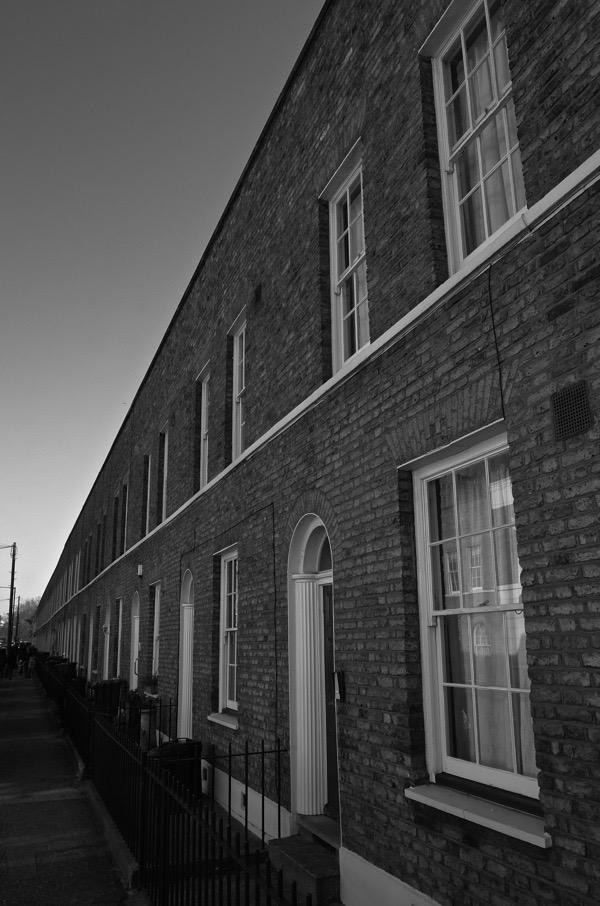
In Bromley St today
Images courtesy Bishopsgate Institute
You may also like to take a look at
A Wedding Dress Of Spitalfields Silk

A modest white satin dress of Spitalfields silk of one hundred and seventy-eight years old is preserved at Kensington Palace, made for a tiny woman with a miniscule waist, barely five feet tall and just twenty years of age. Lain upon the table in the former dining room of Princess Margaret and sequestered from natural light behind closed curtains, it has a delicacy that is almost ethereal, as if it were a gown left behind by a sylph or a passing fairy – but in fact this was the dress that Queen Victoria wore when she wed Prince Albert on 10th February 1840.
Just four months earlier, Victoria had set eyes upon her grown-up cousin for the first time only yards from where I had come to view her dress. And as I was led through the echoing passages at the Palace – where Spitalfields Life was granted special access to see this garment sewn of cloth woven in Spitalfields – I came into a fine stair hall known as the Stone Steps at the core of the building. Victoria was born in a room at the top of these steps, which as a child she was not permitted to climb or descend without another holding her hand, such were the stifling restrictions known as the Kensington System imposed upon the young queen by her mother. Although Victoria had been crowned at eighteen, until she married she could not move out to live independently at Buckingham Palace.
Yet upon these steps on 10th October 1839, Victoria was aroused by a vision of such rapture that it changed her life –“At half past seven I went to the top of the staircase and received my two dear cousins Ernest and Albert, – whom I found grown and changed and embellished. It was with some emotion that I beheld Albert who is beautiful…. so excessively handsome, such beautiful blue eyes, an exquisite nose, and such a pretty mouth with delicate mustachios and slight but very slight whiskers, a beautiful figure, broad in the shoulders and a fine waist.” This was the man who would father her nine children, and five days after their meeting she proposed to him.
When Victoria chose the dress to marry Albert, she broke from the lavish precedent of George IV’s eldest daughter Princess Charlotte who had married in a heavy dress of silk net embroidered with silver. Victoria might have been expected to wear red velvet robes trimmed with ermine and a gown of ostentatious wealth for her marriage, but instead she chose to wear a simple white satin dress that was within the aspiration of any woman of means – a decision that reflected her wish not to emphasise the difference in status between herself and her groom.
The dress was made in two pieces, a skirt and bodice sewn of the finest gauge of ivory silk satin woven in Spitalfields. The simple bell-like skirt was supported by layers of petticoats and Victoria wore a corset of whalebone beneath the bodice. White Honiton lace ruffles adorned her sleeves, with a band of lace at her neckline, while a lace overskirt and train of lace completed the dress. The graceful simplicity of Victora’s youthful conception broke with tradition, expressive of her confident independent spirit, yet it initiated the custom for the white wedding dresses that we know today.
Although plainest among the wedding dresses in the royal collection, Victoria’s is the most radical in its assertion of the wearer’s personality, expressive of her personal desire not to outshine Albert, while equally, in her selection of Spitalfields silk and Honiton lace, celebrating the accomplishment of the native textile industry. A gesture of consummate diplomacy when there were those who might criticise her choice of a foreign husband. But beyond these declared intentions, through its lack of decoration, Victoria’s dress has a human quality as a piece of clothing, emphasised here in the place where she lived, and where one day she walked out of the door forever to commence her new life with Albert.
“10th February 1840, Got up at a quarter to nine, Mamma came and brought me a nosegay of orange flowers. Wrote my journal, had my hair dressed and the wreath of orange flowers put on. Saw Albert for the last time alone, as my bridegroom. Dressed. I wore a white satin gown with a very deep flounce of Honiton lace, imitation of old. I wore my Turkish diamond necklace and earrings and Albert’s beautiful sapphire brooch…”
Once she arrived at Buckingham Palace after her marriage – Victoria wrote – “I went and sat on the sofa in my dressing-room with Albert, and we talked together there from ten minutes to two till twenty minutes past two.” Only this silk gown and its creases were witness to that intimate half hour when Albert and Victoria were first alone together as husband and wife. But we know she carried the affectionate memories of the day, because Victoria continued to wear the train of Honiton lace from the wedding dress for the rest of her life and, even after Albert’s death, as an old lady in black, she wrapped herself in the white lace that enshrined her tenderest emotions.
Standing alone in the small dining room of the apartment in Kensington Palace, I cast my eyes upon the one hundred and seventy-eight year old gown gleaming upon the table for one last time. This dress of Spitalfields silk was an instrument of liberation for Victoria, to leave the restrictions of her childhood and her past, to enter the arms of the man she loved, and to walk out in the wide world of potential that lay before her.


Marriage of Victoria and Albert by George Hayter, 1840
Top: Queen Victoria in her Wedding Dress by Franz Winterhalter, 1840
With grateful thanks to Joanna Marshner, Senior Curator, Kensington Royal Palace.
You may also like to read about Ann Fanshawe’s Dress of Spitalfields Silk.