
Caroline Gilfillan & Andrew Scott’s East End
It is my pleasure to present these poems by Caroline Gilfillan with photographs by Andrew Scott – dating from the early seventies when Caroline & Andrew were squatters in the East End

Spitalfields Street Sweepers
Council issue donkey jackets slung over saggy suits,
the street sweepers get to work,
broom heads shooshing over concrete and tar,
herding paper and peel and fag ends into heaps,
strong fingers grasping the broom handles,
knuckles big and smooth as weathered stones
moving easy in their bags of skin, watchful eyes
on you, your finger-clicks, your lens.


Aldgate Gent
Shoes shined, trilby brushed, ears scrubbed
clean as a baby’s back, he chugs through the
sun drops and diesel clag of Aldgate.
No crumbs in his turn-ups, no fluff in his pockets:
the wife, at home in one of the new flats
over by Mile End, keeps him spruce.
He’s on his way to meet Solly at Bloom’s
for gefilte fish and a chinwag. We flew
past him in a dented van, croaky from
last night’s pints, hair in need of a good cut
and ears a good wash behind. And No,
we didn’t notice him, but he was a good
father to his sons, if inclined to sound off.
His wife went first but his sister cooked for him
after, and the nurses at the London
did him proud when the time came.
Us? We played our gigs and tumbled on,
leaving scraps of quavers and clefs
scattered across the pavement, the kerb,
the bang, rattle and clank of Aldgate East.


Stoneyard Lane Prefabs
Two ticks and the fixer of the Squatters Union
has done the break-in, courtesy of a jemmy.
The door creaks in the fish-mud breeze blowing up
from Shadwell docks. Here you are girls.
Faces poke, glint through curtain cracks.
A man comes back for his hobnailed boots. Stands lit up
by orange street lights, his meek face
breathing beer. We got behind with the rent, he says,
muddy laces spilling over knuckles.
Thought we’d leave before the council chucked us out.
The next morning two hoods from the council break the lock,
bawl through the drunken door, Clear out or we’ll
board you in. Bump-clang of an Audi brings bailiffs.
The fixer flies in, fists up to his chin.
Has words. We hunch on the kerb with our carrier bags.


Mile End Automatic Laundry
Natter chat, neat fold, wheel carts of nets, sheets, blankets, undies, pillow-slips,
feed the steel drum, twirl and swoosh, dose of froth, soaping out the Stepney dirt.
Say hello to the scruffs from the squats off Commercial Road, more of them now,
breaking the GLC doors off their hinges, and I don’t stick my nose
where it’s not wanted, though you can tell a lot by a person’s laundry,
can’t you? That girl with the hacked-off hair, no bras in her bag, and no
fancy knickers, though the boy brings in shirts, must go to work
somewhere smarter than the street where they live and that
pond-life pub on the corner. Speaking of which,
walking home the other night I heard music,
a group, with drums, guitars, the lot,
so I peeped in and there was
the girl, earnest as a nun, singing
You can get it if you really want
and I thought
just you wait
and see.


Poems copyright © Caroline Gilfillan
Photographs copyright © Andrew Scott
You may also like to read about
The Pointe Shoe Makers Of Hackney
Contributing Photographer Patricia Niven and Novelist Sarah Winman visited the Freed of London factory in Well St to create these portraits of the Pointe Shoe Makers, an elite band of highly-skilled craftsmen who make the satin slippers worn by the world’s greatest ballerinas.

It takes two to three years to become a fully trained Pointe Shoe Maker. Hardly surprising, as each shoe is hand-made and two thirds of these shoes (including the toe ‘blocks’ themselves) are made to a Dancer’s individual specifications. Such specifications are printed onto dockets which the Makers work by. One docket was quite illegible to me – a shorthand code with the only clear words: Hessian, strong, slight taper.
There is something inaccessible and mysterious about this world – from the Makers’ symbols, to the language of the shoe, to the exclusive world of the finished product. And yet, I found the Makers to be a pragmatic group of men, into football not dance, who have become blasé about praise and who all refer to the making of these shoes as a job, irrespective of the beauty, the artistry of the finished product. They live in a world of chiaroscuro, where prima ballerinas, surrounded by bodyguards, turn up in limousines to applaud them whilst they stand at their benches six days a week producing nearly forty shoes a day, a quarter of a million shoes a year.
I asked each man if he had ever tried on a ballet shoe to get a sense of the feel – Never! – Even more remarkable then, to think that each shoe is made by touch, look, and imagination alone.
I asked each man whether he had ever been to the ballet.
I asked each man whether he calls himself a Pointe Shoe Maker or a Shoe Maker.
I asked the Maker Taksim (Anchor) what he would like people to know about his work.
He said, “I wish people could try this job. This is the hardest job I’ve ever done. My hands go numb, and I can’t feel them. Over time you get used to the pain.”
I said, “That’s what ballet dancers say about their feet.”
He said,”Really? So, their feet are our hands.”
– Sarah Winman

Taksim known as ‘Anchor’
“I’ve been here for fifteen years. I love my job and no-one tells me what to do. It came easy to me because I used to work in the leather trade and put that experience to good use. I know how the material works and moves.
I haven’t been to the ballet but I have seen my dancers on television – Leanne Benjamin, Jane Taylor to name two. I make Jane Taylor one hundred pairs of shoes a year, all 5 ½ X heel pins. I am proud to make shoes for her. I have met all my prima ballerinas and had photos taken with them. They appreciate us I think.
I have no time to go to the ballet because I work six days a week. I need to rest and put my feet up. I’m a big football fan, enjoying the tennis too, at the moment. We don’t tell people we make ballet shoes, we are just shoe makers. I make thirty-eight pairs a day and am booked up until mid December.
I was born in Cyprus. I never imagined I would have done this. When I came here thirty years ago, I expected to work in a fish and chip shop.”

Taksim’s ‘anchor.’

Taksim’s ‘anchor’ in place upon a pair of his shoes – ballerinas have been known to scratch off their Maker’s symbol to keep him exclusively for her!


Taksim’s work bench.

Fred known as ‘F’
“I was in-between jobs and went to Freed in Mercer St in Covent Garden and learned to be a Maker. I had no idea what I was getting into. My friends all worked in warehouses or were builders so I didn’t tell ‘em what I did until I’d been making shoes for a year.
Have I been to the ballet? No, you’re havin’ a larf, aren’t you?!
When I made my first shoe, I was elated, tell you the truth, that I’d done something. I started off unloading lorries, and it took three months before I got on the bench. Then did soft toes, then hard toes.
I make forty pairs a day and I have a waiting list. I call myself a shoe maker. When you hear a prima ballerina say you’re great, it’s wonderful. Then you hear it so many times…and well…
There’s really nothing glamorous about standing at a bench for ten hours. Do I enjoy making shoes? Look at me. I’m sixty-two and sweating!”

Fred’s ‘F’ on the sole a pair of his shoes.

Fred’s work bench.

Ray known as ‘Crown’
“We are given symbols when we start making shoes, so that if anything is wrong with the shoe they know who to blame! I have been here for twenty-six years. My father-in-law got me a job interview here. I get satisfaction from making the whole shoe myself. Other shoes are made by lots of people.
I love that dancers are wearing my shoes.
You are trained and learn the basics. People teach you their ways and sometimes those ways are conflicting. Then I had to find my own way. There’s a lot of trial and error. I found a style that I like and the dancers like, and I’ve kept to it.
Every dancer likes a different shoe. Each Maker is different – one might use more paste than the other. But dancers come back and stay with you for life. They will tell you what they need.
I’ve never been to the ballet, but if I watch it on the television I look at their feet. I know how to craft the shoe by touch, feel, look. I instinctively know how much paste to use, how much hessian. If the dancer wants a light block she’ll get one. If she wants a shoe with more give I do that. The dancers are fascinated to meet the makers. I make forty pairs a day. I don’t have much time off. People wait weeks to get a shoe from me. I make a lot of shoes for the New York City Ballet.
I love my job. I could never have dreamt of this, or of having my photo taken with dancers or even of someone writing down what I’m saying.
I was born around here – grew up bit with my dad and a bit with my mum. It was all a bit of an adventure. My two daughters take up my time. I made a pair of soft toes for my six year old girl. They don’t do ballet now. They have found their own interests.”

Ray’s work bench.


Ray’s ‘Crown’ on the sole of a pair of his shoes.


Daniel known as ‘Butterfly’
“My wife has been a Pointe Shoe Fitter in the Freed shop since she was sixteen. She was a dancer, went away and travelled the world. We met when she was in the Philippines, and she brought me back with her and we had babies. She went back to the shop and four months ago I started to make shoes here. I have a good teacher in Tksim, he’s a Master.
I do enjoy it. I always found it fascinating when my wife talked about dancing and shows and make-up. I always had the curiosity. Always thought, I want to be part of all that.
I haven’t been to the ballet yet, but I’ve watched it on Youtube.
Since I’ve been making shoes, I look at the dancer’s feet. I used to be a tight-rope walker and a trapeze artist. When I was a trapeze artist, I had to wear a leather glove. We made the leather gloves ourselves and the leather was so important. I understand how the leather is important for the shoe, I’d never realised it before.
I will call myself a Pointe Shoe Maker.I make twenty-four shoes a day. It has come naturally to me, but it’s very hard work. My hands and my shoulders ache. This here is the first ever shoe I made here. It gives me great satisfaction because it is a very important shoe – because this is a shoe that is not to be worn everyday in the street.
It’s craftsmanship.”

Daniel’s first shoe with his ‘Butterfly’ mark on the sole.

Daniel’s mark.

At Daniel’s work bench.

Alan known as ‘Triangle’
“I started next door in Despatch and then I was given the opportunity to come here and make shoes. I made my first pair of shoes nine years ago. Dancers come here and they thank us and applaud us.
I have been to the ballet once. I can’t remember what it was – it wasn’t really my cup of tea. I’m a DJ and prefer a different dance. My kids do ballet and I’ve made one of them a pair of shoes
I call myself a shoe maker.
If I wasn’t here, I would be painting or decorating or a barman.
We don’t see what other people see. You see something beautiful. I see a finished product, a skilled job well done.”

One of Alan’s shoes with his ‘triangle’ on the sole.

An order with the customer’s specifications.


When the block and platform have been created – this is the moment when it rests ghostly on Pointe, unaided, perfectly balanced, dancing its own breathtaking dance.

Alan’s work bench

Darren Plume, Quality Controller & Manager of the London Makers
“My grandfather worked as a storeman here thirty years ago. I left school and joined here when I was fifteen and a half years old. I started off unloading lorries, making tea, that sort of thing. I’ve been here twenty-six years now and have done mostly everything. I took over jobs as people left or retired. I never thought about leaving because I’m happy with what I do.
It’s the people who made me want to stay. I had a lot of father figures. I’ve known Ray (Crown) twenty-six years and we see each other more than we see our own families. My mates used to think I was nuts working here because they were all on building sites, but then they saw the dancers who came in and they changed their minds.
The Makers know more about the shoes than I do. The shoes go into the ovens overnight to bake and harden the block and, first thing in the morning, I check every one of them – that’s my responsibility. I also liaise with the dancers, because if they have a problem they’ll ask to visit us.
Once I used to be in awe of them, now I think they might be a little in awe of us. No shoes, no dance. The dancers rely on us a lot. Their Maker would only have to get an injury and psychologically it could affect them quite a bit.
I’ve been to the ballet twice. I saw Swan Lake at the ENO in the round five years ago. We took a Maker’s bench down there and made shoes in the foyer for the audience to see what we did. Three, four hundred people wanted to shake our hands.
When I was watching the ballet I was only looking at the shoes.
This job’s a bit like a fairytale. You can get caught up in the moment. Some days it flows, some days it’s a pig’s ear and some days you’re as happy as Larry. The most important thing as a manager is to listen to people. Then buy ‘em a coffee and make ‘em happy.”
Photographs copyright © Patricia Niven
You may also like to read about
The Battle Of Tolmers Square
On Monday 5th February at 7:30pm, veteran housing activist Nick Wates will be giving a talk at Leila’s Cafe introduced by Will Palin and hosted by the EAST END PRESERVATION SOCIETY, about his seminal experiences in Camden in the seventies, occupying Tolmers Sq after the council attempted to evict local residents and sell the land off to property developers. Nick will reflect upon the lessons of Tolmers Sq and their relevance for campaigns today.
Click here to book your free ticket

“The Tolmers Sq campaign dominated my life for six years. I was obsessed by it, I lived and breathed it. I spent hours in smoke-filled meetings. I paced the streets and talked to people. I wrote thousands of words and did frequent all-nighters preparing artwork for printers. Then I repeated the process in Limehouse before escaping Inner London to bring up my two children on the South Coast and experiment with community planning.
Yet neighbourhoods all over the country are still facing the destructive power of property speculators and mismanagement by local and central government. The housing crisis is worse than it was then. And community activists are still burning themselves out trying to make the world a better place and create sustainable urban neighbourhoods.
I am looking forward to sharing my memories of our campaign to save Tolmers Sq and revealing some of the tools of our trade as activists at the time, as evidence that it was not all merely a dream.” – Nick Wates


Tolmers Square campaign timeline
1957
Tolmers Sq Tenant Association (TSTA) formed.
1959
Developers submit planning application for a twenty-two-storey office tower on the south side of Tolmers Sq and TSTA launch anti-office campaign.
1960
London County Council (LCC) rejects planning application for office development and starts preparing plans for a comprehensive housing development.
1962
Stock Conversion, a property company headed by Joe Levy, starts buying land in the Tolmers area. TSTA campaign for tenants displaced by the nearby Euston Centre development.
1963
LCC starts trying to demolish ‘unfit’ houses in the area.
1965
Reorganisation of London government. LCC replaced by the Greater London Council (GLC), and the Borough of St Pancras amalgamated into Camden. Central Government refuses to give Camden permission to buy land or to build offices.
1966
Camden Council starts negotiations with Stock Conversion to purchase land in the area and provide support for office development.
1967
Camden Council continues to demolish ‘unfit’ housing.
1968
Camden Council submits Compulsory Purchase Order (CPO) for a small area of housing.
1970
Central Government rejects CPO. Camden Council starts negotiations with Stock Conversion for the whole Tolmers area.
1971
The beginning of opposition from some Labour councillors to a deal involving office development.
1973
The issue starts receiving considerable publicity. Squatters start moving into empty property. Camden Council approves the ‘Levy Deal’. Students from University College London survey the area. Claudius Offer (masterminded by Christopher Booker & Bennie Gray) presented to Camden Council. It still involves building offices but the profits would go to the Council. Tolmers Village Association (TVA) formed. Stop the Levy Deal campaign launched.
Camden Council reject the Levy Deal. House collapses in Hampstead Rd.
1974
General Election. TVA holds exhibition to involve local people in the area’s future. Camden makes CPO on a few buildings. TVA publishes Tolmers Destroyed pamphlet, occupies derelict land and holds first summer carnival. Stock Conversion discloses new plans to develop without the Council. Camden submit a CPO for all of Stock Conversion’s property. General Election.
1975
Squatters summonsed by Stock Conversion. Squatters’ anti-eviction campaign. Locally made film Tolmers: Beginning or end? shown on BBC2. Camden Council buys all of Stock Conversion’s property in the area. Camden Council applies for an Office Development Permit for 300,000 square feet.
1976
Camden Council approves new scheme, a mix of rehabilitation and new build, housing and offices. Publication of The Battle for Tolmers Square by Routledge.
1977
Temporary landscaping of Tolmers Sq
1978
Last Tolmers carnival
1979
Squatters evicted by Camden.
1982
Camden organise ceremony to mark the ‘completion’ of the Tolmers Sq development.
2010
Tolmers photos and posters included in the Goodbye London exhibition in Berlin.
2011
Tolmers in Colour published.
2018
Plans for HS2 show Euston Station expanding into the Tolmers area.
[youtube 7LjAmpFGVCI nolink]


Photographs copyright © Nick Wates
You may also like to read about
The Wonders Of St Michael & All Angels

Such is the overwhelming collection of unlikely paraphernalia that you encounter when you visit St Michael & All Angel’s in Shoreditch, it is as if you have walked into the mansion of Charles Foster Kane. You feel you are exploring chambers in the unconscious mind of some deranged architect or a netherworld filled with keepsakes assembled by an acquisitive time-traveller. The surrealism of multiple architectural elements from different eras arranged in random combinations within a disorienting labyrinth filling the church is as intoxicating as any film by Jean Cocteau.
In his ‘Buildings of England,’ Niklaus Pevsner wrote, “The whole is an eminently picturesque fantasy and it is a great shame that it has fallen into such shocking neglect” – yet today St Michael & All Angels has found an alternative role that proposes a strange complement to its fanciful design. Deconsecrated long ago, the handsome High Victorian Gothic church, designed by James Brooks in 1865, has been a showroom for Westland architectural salvage since 1977 and the eclectic display of statues, fireplaces and chandeliers in this setting is a breathtaking spectacle to behold.


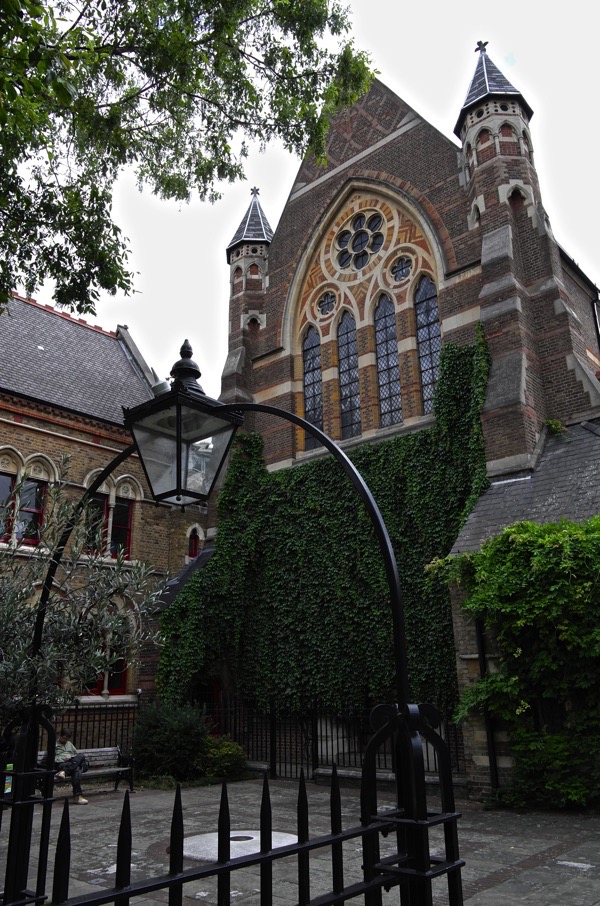
The church and adjoining clergy house

St Michael & All Angels, Leonard St, Shoreditch, 1865

In a strange precursor of its current use, this engraving of 1865 shows the makeshift church built within the structure while it was under construction.
Westland, St Michael & All Angels’ Church, Leonard St, EC2A 4QX
You may also like to read about
Thomas Onwyn’s London

Born in Clerkenwell in 1813, as the eldest son of a bookseller, Thomas Onwhyn created a series of cheap mass-produced satirical prints illustrating the comedy of everyday life for publishers Rock Brothers & Payne in the eighteen forties and fifties. In his time, Onwhyn was overshadowed by the talent of George Cruickshank and won notoriety for supplying pictures to pirated editions of Pickwick Papers and Nicholas Nickleby, which drew the ire of Charles Dickens who wrote of “the singular Vileness of the Illustrations.”
Nevertheless, these fascinating ‘Pictures of London’ that I came upon in the Bishopsgate Institute demonstrate a critical intelligence, a sly humour and an unexpected political sensibility. In this social panorama,originally published as one concertina-fold strip, Onwhyn contrasts the culture and lives of rich and the poor in London with subtle comedy, tracing their interdependence yet making it quite clear where his sympathy lay.

The Court – Dress Wearers.

Dressmakers.

The Opera Box.

The Gallery.

The West End Dinner Party.

A Charity Dinner.

Mayfair.

Rag Fair.
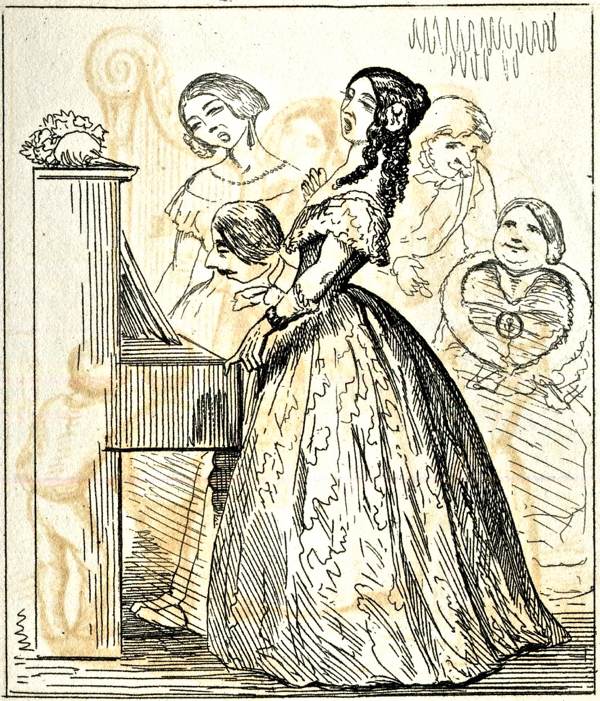
Music of the Drawing Room.

Street Music.

The Physician.

The Medical Student.

The Parks – Day.

The Parks – Night.

The Club – The Wine Bibber.

The Gin Shop – The Dram Drinker.

The Shopkeeper.

The Shirtmaker.

The Bouquet Maker.

The Basket Woman. (Initialled – T.O. Thomas Onwhyn)
Images courtesy Bishopsgate Institute
You may also like to take a look at
Old Trees In Greenwich Park

On the day my cat died last summer, I went for a walk in Greenwich Park to seek consolation and was uplifted to encounter the awe-inspiring host of ancient trees there. I promised myself I would return in the depths of winter to photograph these magnificent specimens on a clear day when they were bare of leaves. So that was what I did last week, braving the bitter wind and the plunging temperatures for an afternoon with my camera.
In the early 1660’s, Charles II commissioned Le Notre, gardener to Louis XIV, to design the layout of the landscape and the impressive avenues of sweet chestnuts remain, many now approaching four hundred years old. These ancient trees confront you, rising up in the winter sunlight to cast long shadows over the grass and dominating the lonely park with their powerful gnarly presences worthy of paintings by Arthur Rackham.
I have always been in thrall to the fairy tale allure cast by old trees. As a small child, I drew trees continuously once I discovered how easy they were to conjure into life upon paper, following the sinuous lines where I pleased. This delight persists and, even now, I cannot look at these venerable sweet chestnuts in Greenwich without seeing them in motion, as if my photographs captured frozen moments in their swirling dance.
Throughout my childhood, I delighted to climb trees, taking advantage of the facility of my lanky limbs and proximity of large specimens where I could ascend among the leafy boughs and spend an afternoon reading in seclusion, released from the the quotidian world into an arena of magic and possibility. Since the life span of great trees surpasses that of humans, they remind us of the time that passed before we were born and reassure us that the world will continue to exist when we are gone.
Secreted in a dell in the heart of the park, lies the Queen Elizabeth Oak, planted in the twelfth century. Legend has it, Henry VIII danced with Anne Boleyn beneath its branches and later their daughter, Elizabeth I, picnicked in its shade when this was a hunting ground for the royal palace at Greenwich. After flourishing for eight hundred years, the old oak died in the nineteenth century and then fell over a century later, in 1991, but still survives within a protective enclosure of iron railing for visitors to wonder at.
If any readers seek an excuse to venture out for a bracing walk in the frost, I recommend a pilgrimage to pay homage to the old trees in Greenwich Park. They are witnesses to centuries of history and offer a necessary corrective to restore a sense of proportion and hope in these strange times.


Queen Elizabeth’s Oak dating from the twelfth century


You may also like to read about
Write Your Own Blog In 2018
Spend a weekend with me in an eighteenth century weaver’s house in Fournier St, enjoy delicious lunches, savour freshly baked cakes from historic recipes, discover the secrets of Spitalfields Life and learn how to write your own blog

HOW TO WRITE A BLOG THAT PEOPLE WILL WANT TO READ – 3rd & 4th FEBRUARY and 19th & 20th MAY
This course will examine the essential questions which need to be addressed if you wish to write a blog that people will want to read.
“Like those writers in fourteenth century Florence who discovered the sonnet but did not quite know what to do with it, we are presented with the new literary medium of the blog – which has quickly become omnipresent, with many millions writing online. For my own part, I respect this nascent literary form by seeking to explore its own unique qualities and potential.” – The Gentle Author
COURSE STRUCTURE
1. How to find a voice – When you write, who are you writing to and what is your relationship with the reader?
2. How to find a subject – Why is it necessary to write and what do you have to tell?
3. How to find the form – What is the ideal manifestation of your material and how can a good structure give you momentum?
4. The relationship of pictures and words – Which comes first, the pictures or the words? Creating a dynamic relationship between your text and images.
5. How to write a pen portrait – Drawing on The Gentle Author’s experience, different strategies in transforming a conversation into an effective written evocation of a personality.
6. What a blog can do – A consideration of how telling stories on the internet can affect the temporal world.
SALIENT DETAILS
The next courses will be held at 5 Fournier St, Spitalfields on 3rd & 4th February and also 19th & 20th May. Each course runs from 10am-5pm on Saturday and 11am-5pm on Sunday.
Lunch will be catered by Leila’s Cafe of Arnold Circus and tea, coffee & cakes by the Townhouse are included within the course fee of £300.
Accomodation at 5 Fournier St is available upon enquiry to Fiona Atkins fiona@townhousewindow.com
Email spitalfieldslife@gmail.com to book a place on the course.

Comments by students from courses tutored by The Gentle Author
“I highly recommend this creative, challenging and most inspiring course. The Gentle Author gave me the confidence to find my voice and just go for it!”
“Do join The Gentle Author on this Blogging Course in Spitalfields. It’s as much about learning/ appreciating Storytelling as Blogging. About developing how to write or talk to your readers in your own unique way. It’s also an opportunity to “test” your ideas in an encouraging and inspirational environment. Go and enjoy – I’d happily do it all again!”
“The Gentle Author’s writing course strikes the right balance between addressing the creative act of blogging and the practical tips needed to turn a concept into reality. During the course the participants are encouraged to share and develop their ideas in a safe yet stimulating environment. A great course for those who need that final (gentle) push!”
“I haven’t enjoyed a weekend so much for a long time. The disparate participants with different experiences and aspirations rapidly became a coherent group under The Gentle Author’s direction in a gorgeous house in Spitalfields. There was lots of encouragement, constructive criticism, laughter and very good lunches. With not a computer in sight, I found it really enjoyable to draft pieces of written work using pen and paper. Having gone with a very vague idea about what I might do I came away with a clear plan which I think will be achievable and worthwhile.”
“The Gentle Author is a master blogger and, happily for us, prepared to pass on skills. This “How to write a blog” course goes well beyond offering information about how to start blogging – it helps you to see the world in a different light, and inspires you to blog about it. You won’t find a better way to spend your time or money if you’re considering starting a blog.”
“I gladly traveled from the States to Spitalfields for the How to Write a Blog Course. The unique setting and quality of the Gentle Author’s own writing persuaded me and I was not disappointed. The weekend provided ample inspiration, like-minded fellowship, and practical steps to immediately launch a blog that one could be proud of. I’m so thankful to have attended.”
“I took part in The Gentle Author’s blogging course for a variety of reasons: I’ve followed Spitalfields Life for a long time now, and find it one of the most engaging blogs that I know; I also wanted to develop my own personal blog in a way that people will actually read, and that genuinely represents my own voice. The course was wonderful. Challenging, certainly, but I came away with new confidence that I can write in an engaging way, and to a self-imposed schedule. The setting in Fournier St was both lovely and sympathetic to the purpose of the course. A further unexpected pleasure was the variety of other bloggers who attended: each one had a very personal take on where they wanted their blogs to go, and brought with them an amazing range and depth of personal experience. “
“I found this bloggers course was a true revelation as it helped me find my own voice and gave me the courage to express my thoughts without restriction. As a result I launched my professional blog and improved my photography blog. I would highly recommend it.”
“An excellent and enjoyable weekend: informative, encouraging and challenging. The Gentle Author was generous throughout in sharing knowledge, ideas and experience and sensitively ensured we each felt equipped to start out. Thanks again for the weekend. I keep quoting you to myself.”
“My immediate impression was that I wasn’t going to feel intimidated – always a good sign on these occasions. The Gentle Author worked hard to help us to find our true voice, and the contributions from other students were useful too. Importantly, it didn’t feel like a ‘workshop’ and I left looking forward to writing my blog.”
“The Spitafields writing course was a wonderful experience all round. A truly creative teacher as informed and interesting as the blogs would suggest. An added bonus was the eclectic mix of eager students from all walks of life willing to share their passion and life stories. Bloomin’ marvellous grub too boot.”
“An entertaining and creative approach that reduces fears and expands thought”
“The weekend I spent taking your course in Spitalfields was a springboard one for me. I had identified writing a blog as something I could probably do – but actually doing it was something different! Your teaching methods were fascinating, and I learnt a lot about myself as well as gaining very constructive advice on how to write a blog. I lucked into a group of extremely interesting people in our workshop, and to be cocooned in the beautiful old Spitalfields house for a whole weekend, and plied with delicious food at lunchtime made for a weekend as enjoyable as it was satisfying. Your course made the difference between thinking about writing a blog, and actually writing it.”
“After blogging for three years, I attended The Gentle Author’s Blogging Course. What changed was my focus on specific topics, more pictures, more frequency, more fun. In the summer I wrote more than forty blogs, almost daily from my Tuscan villa on village life and I had brilliant feedback from my readers. And it was a fantastic weekend with a bunch of great people and yummy food.”
“An inspirational weekend, digging deep with lots of laughter and emotion, alongside practical insights and learning from across the group – and of course overall a delightfully gentle weekend.”
“The course was great fun and very informative, digging into the nuts and bolts of writing a blog. There was an encouraging and nurturing atmosphere that made me think that I too could learn to write a blog that people might want to read. – There’s a blurb, but of course what I really want to say is that my blog changed my life, without sounding like an idiot. The people that I met in the course were all interesting people, including yourself. So thanks for everything.”
“This is a very person-centred course. By the end of the weekend, everyone had developed their own ideas through a mix of exercises, conversation and one-to-one feedback. The beautiful Hugenot house and high-calibre food contributed to what was an inspiring and memorable weekend.”
“It was very intimate writing course that was based on the skills of writing. The Gentle Author was a superb teacher.”
“It was a surprising course that challenged and provoked the group in a beautiful supportive intimate way and I am so thankful for coming on it.”
“I did not enrol on the course because I had a blog in mind, but because I had bought TGA’s book, “Spitalfields Life”, very much admired the writing style and wanted to find out more and improve my own writing style. By the end of the course, I had a blog in mind, which was an unexpected bonus.”
“This course was what inspired me to dare to blog. Two years on, and blogging has changed the way I look at London.”


