
The Weathervanes Of London
There is no more magical sight to glimpse in a London street on a bright spring morning than that of a gilded weathervane, glinting in sunlight high above the rooftops. At once – in spite of all the changes that time has wrought – you know you are sharing in a visual delight enjoyed by three centuries of Londoners before you and it makes your heart leap.
Consequently, I am grateful to Angelo Hornak who photographed this gallery of magnificent golden weathervanes for his book AFTER THE FIRE, London Churches in the Age of Wren, Hawksmoor & Gibbs published by Pimpernel Press.

Spire of St Mary-Le-Bow, Cheapside, by Christopher Wren

Dragon upon St Mary-Le-Bow, representing the City of London

Arrow & pennant on St Augustine, Watling St

Spire of St Bride’s Fleet St by Christopher Wren

Gridiron on St Lawrence Jewry, symbol of the martyrdom of St Lawrence

Weathervane on St Magnus the Martyr by Christopher Wren

Weathervane on St Michael Paternoster Royal, College St

Galleon on St Nicholas Cole Abbey, moved from St Michael Queenhithe after demolition

Weathervane on St James Garlickhythe

Crown on St Edmund King & Martyr, Lombard St

Key on the Tower of St Peter Cornhill

Cockerell on St Dunstan-in-the-East by Christopher Wren

Comet on St Mary-Le-Strand

Spire of St Martin in the Fields by James Gibbs

Square-rigged ship on St Olave Old Jewry

Flaming red-eyed dragon on St Luke, Old St, described as a flea in popular lore

Weathervane on St Stephen Walbrook by Nicholas Hawksmoor

‘Flame’ on the top of the Monument by Christopher Wren
Photographs copyright © Angelo Hornak
You may also like to take a look at
Ron McCormick’s Whitechapel
Ron McCormick photographed Whitechapel & Spitalfields in the early seventies and these pictures were exhibited at the Whitechapel Gallery in 1973. They are included in the new book Whitechapel Boy by Chris Searle, commemorating the centenary of the death of Isaac Rosenberg which is launched with an illustrated lecture at 6.30pm today, Thursday 5th April at Tower Hamlets Local History Library & Archives. All are welcome.

Hessel St

Royal Oak, Whitechapel Rd

Old Montague St

Blooms, Whitechapel High St

Old Montague St

Old Montague St

Princelet St

Black Lion Yard

Fournier St

Brick Lane

Club Row

Brick Lane

Settle St, Whitechapel

Great Eastern Buildings, Quaker St

Woodseer St

Great Eastern Buildings, Quaker St

Sandys Row

Brick Lane Market

Christ Church School

Settle St, Whitechapel
Photographs copyright © Ron McCormick
You may also like to take a look at
Philip Marriage’s Spitalfields
Isaac Rosenberg, Poet & Painter
This week marks the centenary of the death of Isaac Rosenberg, remembered as one of the finest of First World War poets alongside Rupert Brooke, Wilfired Owen, Siegfried Sassoon and Edward Thomas. Rosenberg passed his formative years in the East End, as Chris Searle outlines in these extracts from his new book Whitechapel Boy which is launched with an illustrated lecture at 6.30pm this Thursday 5th April at Tower Hamlets Local History Library & Archives. All are welcome.

Portrait of Isaac Rosenberg (1890-1918) courtesy of Imperial War Museum
Even his name is enough for many English readers to doubt his Englishness. The son of Lithuanian Jews fleeing Tsarist oppression, Isaac Rosenberg was born in Bristol in 1890. His family moved in 1897 to Cable St in the East End, where he began primary school at St Paul’s, Wellclose Sq, and continued his studies at Baker St School from 1899 to 1904.
His headteacher, Mr Usherwood, noticed his talent for Art and arranged for him to attend special afternoon classes at Stepney Green Art School. It sounds like an ordinary enough East London schooling for a talented Jewish working class boy who, on leaving school, became an apprentice for a Fleet St engraver’s and was, as he puts it in his early poem Fleet St fully exposed to the ‘shrieking vortex’ of the City of London.
His working class origins circumscribed his experience as an artist and poet. He hated his work in engraving which made his mind ‘so cramped and dulled and fevered’ and complained, ‘I am bound, chained to this fiendish mangling-machine, without hope and almost desire of deliverance, and the days of youth go by’.
His education at the Slade School of Art was due to the patronage of three wealthy Jewish women that he had accidentally met, and he depended upon the Jewish Educational Aid Society to help with his Slade expenses, trips to the south coast and the cost of his return sea passage to stay with his sister in Cape Town, where he maintained that the climate would help his quasi-consumptive lungs gain strength. Yet he rarely wrote directly of the urban East London world of Stepney and Whitechapel where he spent his most formative years.
His early poems evoked pastoral and pre-Raphaelite images of the countryside that in his real, day-to-day life he rarely imbibed, unless it was walks among the trees of Victoria Park, or Hampstead where he lived for a while or as far east as Epping Forest, where he would sometimes go to paint. ‘So shut in are our lives’, he wrote in The Poet, yet explicit images of brick, concrete and tenements were not common in his poetry, and only rarely did he write about the darkness of East London or the struggles of its people. An exception is A Ballad of Whitechapel, telling of an encounter with a young prostitute, her parents sick and ‘grim hovering in her home’ and ‘her wasting brother in a cold bleak room’.
Three years after his family arrived in East London and moved into 47 Cable St in St George-in-the-East in 1897, the ex-Indian Army officer and founder of the proto-fascist British Brothers’ League, Major William Evans-Gordon, was elected as the new Member of Parliament for Stepney. ‘There is hardly an Englishman in this room who does not live under the constant danger of being driven from his home’, he declared at a public meeting, ‘pushed out into the streets, not by the natural increase of our own population, but by the off-scum of Europe’.
As for St. George-in-the-East, William Booth, founder of the Salvation Army, had written that it was the poorest and ‘most desolate’ district of the East End and it had ‘stagnated with a squalor peculiar to itself ’. In March 1901, the Eastern Post described how a Jewish family new to the area, with a cart full of furniture, arrived in nearby Cornwall St, ready to move into a vacant house. The street-dwellers charged at the van, overturned it and smashed to pieces all the furniture it was carrying. They also broke the windows of the house that the family had arranged to occupy while terrified, its members ran from the scene with their screaming never-to-be neighbours in hot pursuit, eventually managing to escape minus virtually all their possessions. Such events were not uncommon in the neighbourhood where the Rosenbergs found their first London home.
If such racism was rampant enough in the civilian streets of East London, Rosenberg found that in the midst of the British Army, that he had voluntarily joined, it was allied to a class hatred that made it even more loathsome, sometimes launched by young and hostile officers. In a letter to the novelist Sydney Schiff in December 1915 during his training at Bury St. Edmunds, he wrote: ‘we have pups for officers – at least one – who seems to dislike me – and you know his position gives him power to make me feel it without me being able to resist’.
To his longstanding friend, Winifreda Seaton, he wrote, almost desperately and futilely in Spring 1916: ‘How ridiculous, idiotic and meaningless the Army is, and its dreadful bullyisms, and what puny minds control it.’ And in his final letters of March 1918, he told how he had applied for a transfer to the Jewish Battalion of the British Army fighting in Mesopotamia. He was killed before he received an answer.
Yet despite, and perhaps partly provoked by this entanglement of hostility of race and class, not only were Rosenberg’s finest poems created and crafted in the most dire of conditions, but whole generations of Jewish intellectual and cultural genius in East London were conceived and developed from East London streets in profoundly unpromising circumstances. There was Joseph Leftwich, poet, diarist, scholar, translator and anthologist of Yiddish literature – David Bomberg and Mark Gertler, painters – John Rodker and Stephen Winsten, poets. With Rosenberg, poet and painter, these were the Whitechapel Boys, called so because their study and discussion venue and daily rendezvous was the oasis of Whitechapel Library, where during opening hours they could meet until the library doors closed.
After that, there was only one thing to do. ‘We walked the streets until one or two every morning,’ Leftwich told me in 1975. ‘Talking in the darkness or under the gaslight, talking all the time down to Aldgate and back again to Stepney Green.’
These writers, artists, political activists and street intellectuals marked a profound moment in their people’s history and gave birth to a Jewish renaissance in East London which was to spill into the next half-century, through 1936 and the resistance to British fascism, the successful pre-war rent strikes against slum landlords and the election in 1945 of the Jewish communist Phil Paratin as MP for Mile End. Such was the context of the blooming of East London Jewish dramatists like Bernard Kops and Arnold Wesker in the first two decades after the Second World War, and the Whitechapel Boys had been at the birth of all this ferment.

A Ballad Of Whitechapel
God’s mercy shines;
And our full hearts must make record of this,
For grief that burst from out its dark confines
Into strange sunlit bliss.
I stood where glowed
The merry glare of golden whirring lights
Above the monstrous mass that seethed and flowed
Through one of London’s nights.
I watched the gleams
Of jagged warm lights on shrunk faces pale:
I heard mad laughter as one hears in dreams
Or Hell’s harsh lurid tale.
The traffic rolled,
A gliding chaos populous of din,
A steaming wail at doom the Lord had scrawled
For perilous loads of sin.
And my soul thought:
‘What fearful land have my steps wandered to ?
God’s love is everywhere, but here is naught
Save love His anger slew.’
And as I stood
Lost in promiscuous bewilderment,
Which to my ‘mazed soul was wonder-food,
A girl in garments rent
Peered ‘neath lids shamed
And spoke to me and murmured to my blood.
My soul stopped dead, and all my horror
Named At her forgot of God.
Her hungered eyes,
Craving and yet so sadly spiritual,
Shone like the unsmirched corner of a jewel
Where else foul blemish lies.
I walked with her
Because my heart thought, ‘Here the soul is clean,
The fragrance of the frankincense and myrrh
Is lost in odours mean.’
She told me how
The shadow of black death had newly come
And touched her father, mother, even now
Grim-hovering in her home,
Where fevered lay
Her wasting brother in a cold, bleak room,
Which theirs would be no longer than a day,
And then-the streets and doom.
Lord! Lord! Dear Lord
I knew that life was bitter, but my soul
Recoiled, as anguish-smitten by sharp sword,
Grieving such body’s dole.
Then grief gave place
To a strange pulsing rapture as she spoke;
For I could catch the glimpses of God’s grace,
And a desire awoke
To take this trust
And warm and gladden it with love’s new fires,
Burning the past to ashes and to dust
Through purified desires.
We walked our way,
One way hewn for us from the birth of Time;
For we had wandered into Love’s strange clime
Through ways sin waits to slay.
Love’s euphony,
In Love’s own temple that is our glad hearts,
Makes now long music wild deliciously;
Now Grief bath used his darts.
Love infinite,
Chastened by sorrow, hallowed by pure Name-
Not all the singing world can compass it.
Love-Love-0 tremulous name!
God’s mercy shines;
And my full heart bath made record of this,
Of grief that burst from out its dark confines
Into strange sunlit bliss.

Fleet St
From north and south, from east and west,
Here in one shrieking vortex meet
These streams of life, made manifest
Along the shaking quivering street.
Its pulse and heart that throbs and glows
As if strife were its repose.
I shut my ear to such rude sounds
As reach a harsh discordant note,
Till, melting into what surrounds,
My soul doth with the current float;
And from the turmoil and the strife
Wakes all the melody of life.
The stony buildings blindly stare
Unconscious of the crime within,
While man returns his fellow’s glare
The secrets of his soul to win.
And each man passes from his place,
None heed. A shadow leaves such trace.

Self portrait by Isaac Rosenberg, 1916
You may also like to read about
At Verdi’s

Anna & Mimi Orsi
Along the Mile End Rd between the City and Bow, there is only one Italian restaurant of distinction. It is Verdi’s, a fine establishment offering a generous welcome and authentic northern Italian food at highly reasonable prices. Early in the week, a two course meal can be had for a tenner, yet everything – including the pasta – is prepared on the premises from fresh ingredients and the bread is baked daily.
Set in an old terrace between Stepney Green tube and Mile End Place, this restaurant is run with scrupulous devotion and panache by sisters Anna & Mimi Orsi who are continuing a family culinary tradition which extends back a century in the East End. Old photographs on the walls attest to this Orsi legacy, complemented by elegant drawings by local artist Dorothy Rendell whom I interviewed last year.
Contributing Photographer Patricia Niven & I enjoyed the privilege of visiting on St Giuseppe’s Day recently to savour the traditional cuisine and discover the story behind this cherished family restaurant. We learnt it was a significant day in recognition of Giuseppe Verdi but – more importantly – celebrating ‘Giuseppe’ as the name adopted by generations of men in the Orsi family, just as Anna & Mimi have been the chosen names for the women as long as anyone can remember. Yet I must confess we were most excited about the customary St Giuseppe’s Day dish of calves’ liver with spinach, prepared in the time-honoured fashion.
While Patricia Niven disappeared into the kitchen to photograph chef Marcio Polezia preparing his St Giuseppe’s Day speciality, I settled down hungrily to enjoy a dish of home made tortellini in brodo as the first course of this special meal.
Soon enough, the calves’ liver served with spinach, mashed potato and red onions arrived. As one accustomed to eating leathery calves’ liver that is almost dry, this was a succulent treat – still pink inside – complemented by tangy spinach that was cooked just sufficiently to retain its delicious texture.
After such a memorable lunch, I had the pleasure of Mimi & Anna Orsi joining me at the table and telling me the extraordinary story behind their wonderful restaurant. It was only my first visit to Verdi’s but I already knew it would be first of many.
Anna – The story of our family in London begins in Clerkenwell.
Mimi – Our nonno [grandfather] Giuseppe, he came here more than hundred years ago and lived in Warner St, Back Hill at the back of the Italian church. He walked from Parma where we come from and he made his way to Paris, where he stopped and worked there for a year, then he moved over to London.
Anna – He walked to London and – as all Italians did – he knocked on the kitchen door of the Savoy and said ‘I’m Italian’ and they said ‘Come in and start working.”
Mimi – After a while he became a chef and, once made some money, he sold his half of the family house in Parma to his brother. With the money – he had a hundred pounds – he bought his first cafe in Robin Hood Lane, Poplar while he was living in Back Hill. It was called ‘The Grand Cafe.’
Anna – Italians aren’t very adventurous with their names for cafes. You have probably seen those around Liverpool St Station called ‘Savoy,’ that’s because they used to work at the Savoy. My nonno, he called his ‘The Grand Cafe’ because the most expensive and most beautiful one was The Grand Cafe.
Mimi – When the Second World War broke out, he was going to be an Italian in London and he had trouble.
Anna – Mostly – my dad said – they came from Canning Town and they wanted to smash the cafe up. The police came along they would not stop them, so the Irish publican from the next street climbed over the back fence. He said, ‘Joe, get the kids and everybody out,’ so they all went over the fence to the pub. Then the Irish publican and my father stood outside the cafe to face the men who were gathered there.
Mimi – The police stood back and said to the people, ‘You’ve got five minutes to do what you want,’ stealing cigarettes and food.
Anna – It wasn’t that they hated them or had any bad feelings towards Italians personally, it was just an opportunity to grab.
Mimi – It was the war and Italy was the enemy.
Anna – My nonno said to them, ‘There’s more of you than us – there’s only two of us – but the first man that comes near my cafe I will kill.’ So they never came near it! After that, he put up the photograph in the cafe of my uncle in uniform fighting for Britain to stop them doing it again.
Mimi – He hid his wife and children down at Leigh on Sea with his mother.
Anna – She was meant to be interned, so every time a policeman came around they used to push her into the bushes to hide.
Mimi – If she had been caught, she would have been interned and possibly sent on the Andorra Star that sank.
Anna – The layout of our restaurant today is identical to The Grand Cafe
Mimi – When many Italians came over to London, it was their first port of call and they’d work for him for two or three months, washing up or peeling potatoes, and they’d sleep upstairs until they got accommodation.
Anna – After the war, they employed Mimi – a lovely lady.
Mimi – During the war, she had been in Italy. Our family were partisans, helping the British and Americans get over to Switzerland. She had two cellars under where she kept the cows and she hid a British and an American officer when the Germans came. She tripped the German up on purpose to distract his attention, so he got his gun and held it to her head. He was about to shoot her, but she said, ‘No I tripped!’ and pointed to her toe that she had cut working on the farm that morning. There was still blood on it.
Anna – And the British and American soldiers got away! After the war, they used to come to nonno’s cafe to see Mimi because if it weren’t for her, they’d all be dead.
Mimi – She was a nanny and she brought my father up and then she married into the Biffa family, famous for their dustcarts.
Anna – The cafe ran until 1964 when my nonno died…
Mimi – … but my nonna [grandmother] carried it on until the late seventies, though she couldn’t do it on her own.
Anna – We used to love it!
Mimi – We used to run and see our nonna, she always had chocolates to give us and she used to say, ‘Go downstairs to the restaurant and behind the bar.’
Anna – She used to let us take boxes of Blue Ribbon chocolates home.
Mimi – And bottles of Coca Cola.
Anna – We didn’t have sweets at home! Our parents grew up in the war.
Mimi – We wanted so much! We just used to go down and open bottles of Coca Cola. My mother used to go mad.
Anna – We had never had bottles of Coca Cola, we were only allowed lemonade on our birthdays.
Mimi – Nonna always bought us the most amazing Christmas presents, I got Tiny Tears!
Anna – We used to go the cafe and sit down as a family for Christmas dinner and eat really beautiful food.
Mimi – Going my nonna’s room was a bit scary, it was through a side door and full of old things, my father’s and his brothers and sisters’ old toys. It was dark and there was the smell of mothballs.
Anna – There was no bathroom, it was in the back yard. They used to get paid to keep the elephant from the circus in the back yard when it was in town.
Mimi – She used to make the most wonderful tortellini in brodo, which you had today.
Anna – We were always warned against opening a restaurant. Nonna said, ‘No!’
Mimi – Nonna used to pull up her dress to show two little bowed legs with varicose veins. ‘If you want legs like this, go into a restaurant,’ she warned us. She said, ‘It killed your nonno and it’s killing me.’
Anna – But we thought it would be different today.
Mimi – They cooked, they served and they cleaned.
Anna – We used to drive past this place which was once a pub, and had such a beautiful interior and high ceiling. We said, ‘Somebody should do something really amazing with it.’
Mimi – We used to go back to Italy just to eat true home Parma food and in the end we said, ‘There’s nowhere where you can get proper Italian food between Aldgate East and Bow.’ So we opened this place, and nonna was right – it’s killing us!
Anna – We grew up around restaurants and it is in our blood.
Mimi – I love the mornings! I am the early morning person and she’s the late nighter.
Anna – You take care of the cooks.
Mimi – I make sure the deliveries are in and the cleaning is done, and she does front of house. I’m domesticated, she’s not!
Anna – It’s true.
Mimi – We live across the road from each other, round the corner in Mile End. We were always close as children.
Anna – We opened on our nonna’s birthday which was 26th July four years ago.
Mimi – I think my nonna would be so proud of us …
Anna – And especially my nonno!
Mimi – … that we carried the business on.

Tortellini in Brodo

Marcio Polezia fries the calves’ liver on St Giuseppe’s Day


Calves’ liver with red onions and sage, mashed potato and spinach is the St Giuseppe’s Day dish

Marcio Polezia, Chef & Andrea Furia, Sous Chef

Giuseppe Orsi is the boy (second from the left with the neckerchief, behind the gentleman with the big moustache) among other chefs when he worked at the Savoy in 1912

The Grand Cafe with Giuseppe Orsi standing in the long coat accompanied by the Irish landlord of the neighbouring pub in the thirties

Giuseppe Orsi (senior) shows Giuseppe Orsi (junior) how to pour a cup of tea in the early fifties

Giuseppe (junior), Anna & Mimi’s father, took over from Giuseppe (senior)

Mimi Orsi

Anna Orsi

Verdis was formerly The Three Crowns which opened before 1719 and closed in 2010
Colour photographs copyright © Patricia Niven
VERDI’S, 237 Mile End Rd, Stepney, E1 4AA
You may also like to read about
Viscountess Boudica At Easter
On Easter Monday, we celebrate our dearly beloved Viscountess Boudica of Bethnal Green who once entertained us with her seasonal frolics and capers but is now exiled to Uttoxeter

She may be no Spring chicken but that never stopped the indefatigable Viscountess Boudica of Bethnal Green from dressing up as an Easter chick!
As is her custom at each of the festivals which mark our passage through the year, she embraced the spirit of the occasion wholeheartedly – festooning her tiny flat with seasonal decor and contriving a special outfit for herself that suited the tenor of the day. “Easter’s about renewal – birth, life and death – the end of one thing and the beginning of another,” she assured me when I arrived, getting right to the heart of it at once with characteristic forthrightness.
I felt like a child visiting a beloved grandmother or favourite aunt whenever I call round to see Viscountess Boudica because, although I never knew what treats lie in store, I was never disappointed. Even as I walked in the door, I knew that days of preparation preceded my visit. Naturally for Easter there were a great many fluffy creatures in evidence, ducks and rabbits recalling her rural childhood. “When my uncle had his farm, I used to put the little chicks in my pocket and carry them round with me,” she confided with a nostalgic grin, as she led me over to admire the wonder of her Easter garden where yellow creatures of varying sizes were gathering upon a small mat of greengrocer’s grass, around a tree hung with glass eggs, as if in expectation of a sacred ritual.
I cast my eyes around at the plethora of Easter cards, testifying to the popularity of the Viscountess, and her Easter bunting and Easter fairy lights that adorned the walls. There could be no question that the festival was anything other than Easter in this place. “As a child, I used to get a twig and spray it with paint and hang eggs from it,” she explained, recalling the modest origin of the current extravaganza and adding, “I hope this will inspire others to decorate their homes.”
“Cadbury’s Dairy Milk is my favourite,” she confessed to me, chuckling in excited anticipation and patting her waistline warily, “I probably will eat a lot of chocolate on Easter Monday – once I start eating chocolate, I can’t stop.” And then, just like that beloved grandmother or favourite aunt, Viscountess Boudica kindly slipped a chocolate egg into my hands, as I said my farewell and carried it off under my arm back to Spitalfields as a proud trophy of the day.


Viscountess Boudica writes her Easter cards


“yellow creatures of varying sizes were gathering upon a small mat of greengrocer’s grass, around a tree hung with glass eggs, as if in expectation of a sacred ritual”

Viscountess Boudica turns Weather Girl to present the forecast for the Easter Bank Holiday – “I predict a dull start with a few patches of sunshine and some isolated showers. In the West Country, it will be nice all day with temperatures between sixty and eighty degrees Farenheit. There will be a small breeze on the coast and sea temperature of around fifty-nine degrees Farenheit.”


Easter blessings to you from Viscountess Boudica!

Viscountess Boudica and her fluffy friends
Be sure to follow Viscountess Boudica’s blog There’s More To Life Than Heaven & Earth
Take a look at
The Departure of Viscountess Boudica
Viscountess Boudica’s Domestic Appliances
Viscountess Boudica’s Halloween
Viscountess Boudica’s Christmas
Viscountess Boudica’s Valentine’s Day
Viscountess Boudica’s St Patrick’s Day
Read my original profile of Mark Petty, Trendsetter
and take a look at Mark Petty’s Multicoloured Coats
Bow Food Bank Portraits
Contributing Photographer Sarah Ainslie & I visited Bow Food Bank to do portraits of some of the volunteers who run this vital service and learn about their motives and experiences.
Taking place at Bow Church each Monday morning, this is an independent food bank which means vouchers from the Department of Work & Pensions are not required, anyone who is in need of food can come and ask for help. Assistance to those in crisis is offered in the form of ten items of grocery every other week for up to fifteen visits.
If you would like to donate or volunteer, visit Bow Food Bank

Alison Neville, Volunteer
“I have been working here about six months. I was born in Stepney and now I live in Bow. I started coming for myself when I couldn’t work for a while. They helped me and then I became a volunteer. Even when I do the washing up, I enjoy it. Many people are struggling in this city and the price of living now is unbelievable”

Cody Hopper, Studying Modern History at Queen Mary University
“I enjoy volunteering in the community. It’s not like a job where you get paid, your reward is knowing you are helping other people. I have made friends over the last six months and it is a little community of its own here. The food bank is not just about distributing food, it’s about getting people out of their houses and offering social contact to people who might be lonely. Once I graduate and get a job, I will look for other volunteering opportunities because I enjoy it so much.”

Irena Urbonas, Volunteer
“I retired after thirty-eight years teaching in Bethnal Green about three years ago and I was working in a charity shop but I became ill and couldn’t continue. Because I have been seriously ill, I can advise and support others with serious illness. We see all kinds of problems, homelessness, drug and alcohol addiction, job loss. If I can help I will, but I do not impose on them. It is not just a food bank, you can get help for problems and some people come back for the social life. If this was here every day, I would come. I love it. I was born in Bethnal Green but my parents are from Lithuania and I come from a very poor background. Yet I never realised I was poor because my dad was a driver so he could borrow cars and drive us around. My mother was very strict and she realised the value of education, so we all went to grammar school. It all comes back because I have been there, and now I can help in a certain way. You see people at the lowest of the low. I do my best to welcome them and give them what they need. It does humble you. I ask people not to thank me because I don’t need their thanks.”

Trevor Blackman, Founding Director of Ape Media
“I’ve been doing this since 2014. Supposedly, I am in charge of the shop but I am here because I enjoy meeting people. The first Christmas we were open, we had one hundred and sixty people come in. There is a real need. A lot of people saw their benefits cut with the introduction of Universal Credit. It hit people hard. We had people on benefits who are struggling to feed their children and that’s horrible – we give them twenty items. Parents go without food to feed their children.”

Ruth, Volunteer
“I just love it, it gets me out of the house and talking to people. People can come here for ten visits and collect ten items and some of these people are in desperate need. Many of them are working on zero hours contracts and not getting much employment, they can’t earn enough to pay the bills. Some of these people are gutted when they get to the end of their visits and they ask me, ‘Where shall we go now?’ They have nowhere else to turn to.”

Pat O’Sullivan, Supervisor of distribution of extras at the Food Bank
“After they have been in the shop, people come to see me and I give them extras, fruit and veg, soap and women’s sanitary products. I came here myself three years ago and then I became a volunteer because I wanted to help others by giving something back. Some people who come are homeless and I have helped a couple to get jobs and find housing. I count everyone here as my friends. All my life, I have been caring for other people.”

Robert Ricks, Volunteer
“I think this place serves a good purpose, people need our services. I am particularly proud that we run it with as little bureaucracy as possible and all the money is spent on food for distribution. We don’t rely on referrals, we allow anyone to come here and get help. I am a retired lawyer and it allows me to make contact with people and be aware of those those less fortunate, whom I might never meet in any other circumstances.”

Dan Clark, Musician
“I have quite a lot of spare time in the day because I work at night. I need to get up early in the morning to come here which is hard sometimes, but I feel compelled to do it. It’s a damning condemnation of our society that people are short of food in such a rich country.”

Lynn Stone, Food Bank Manager
“We are here to address a need as far as we are able. There could be a food bank every morning of the week and still not meet everyone’s needs. If we can do a little to help some people then that makes it worthwhile, but I am sad we cannot do more. It is embarrassing for us that people are so grateful, that’s not a comfortable feeling. We see that the benefits system is not helping vulnerable people, but pushing them into a spiral of decline and need. It’s so unfair.”

Lorraine Villada, Volunteer
“I do all the administration and step in whenever there’s a gap. I do it because I feel fortunate to help people in need. There are a lot of people struggling to buy food and, with the changes in the benefits system, we are seeing a lot more people coming to sign up. I have lived in Tower Hamlets all my life. I like to give something back to the community where I was born and raised. I worked for Tower Hamlets Council but found myself out of work due to illness, but now I have a new job and I hope I shall be able to carry on here because it means a lot to me.”

Debbie Cummins, Registrar
“I am passionate to help people and I have been in the situations they have been in, so I quite understand and I love doing it. I am an East Ender born in Bethnal Green. The benefits officers haven’t got a clue and people get pushed around and nobody cares. But my job is just registering people, I cannot solve their problems. Sometimes people come who have gone six weeks without money, we have homeless people coming in here too and we try to feed them. These are human beings, some of these people had good jobs and now they are homeless. We can see the problem. We see a lot of people suffering. This is the East End and we are all human and we have to help each other. We have people who have used up their visits but they keep coming for the company and a cup of tea because they do not see anyone else and they are lonely. I love this food bank.”

Bushra Bakar, Legal Adviser
“Many clients are on benefits or homeless, so I can advise them and help with other issues like employment and debt management. I did my undergraduate degree in Law at London Metropolitan University. Public law and employment law are my specialities and now I am training to qualify. I’ve come across a number of clients who are rough sleepers without access to benefits, often because they are asylum seekers without legal rights. I assist a lot of people in need and it makes me realise just how many people out there need help.”

Father Javier, Parish Priest of St Catherine’s Roman Catholic Church
“This brings together the whole community under the umbrella of something that unites us all.”

Reverend Debbie Frazer, Rector of St. Mary & Holy Trinity Bow
“I am one of the founders of the Bow Food Bank. We did not want to restrict access to referrals from Department of Work & Pensions and General Practitioners, we wanted it to be unconditional so that people can come to us and say they need help. In the benefits system, people are treated with mistrust as if they were potential criminals, but I think they get more from being treated with dignity and respect. If people come here because they are in need of food, we let them know that they are welcome.”

Merlin, Most-beloved church dog
Photographs copyright © Sarah Ainslie
You may also like to read about
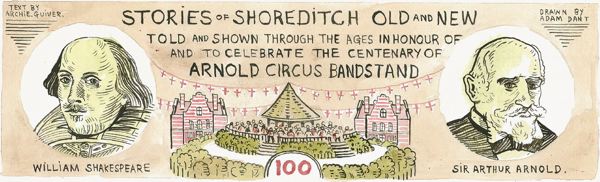
Stories Of Shoreditch Old & New
Each Saturday, we shall be featuring one of Adam Dant’s MAPS OF LONDON & BEYOND from the forthcoming book of his extraordinary cartography to published by Spitalfields Life Books & Batsford on June 7th.
Please support this ambitious venture by pre-ordering a copy, which will be signed by Adam Dant with an individual drawing on the flyleaf and sent to you on publication. CLICK TO ORDER A SIGNED COPY OF MAPS OF LONDON & BEYOND BY ADAM DANT
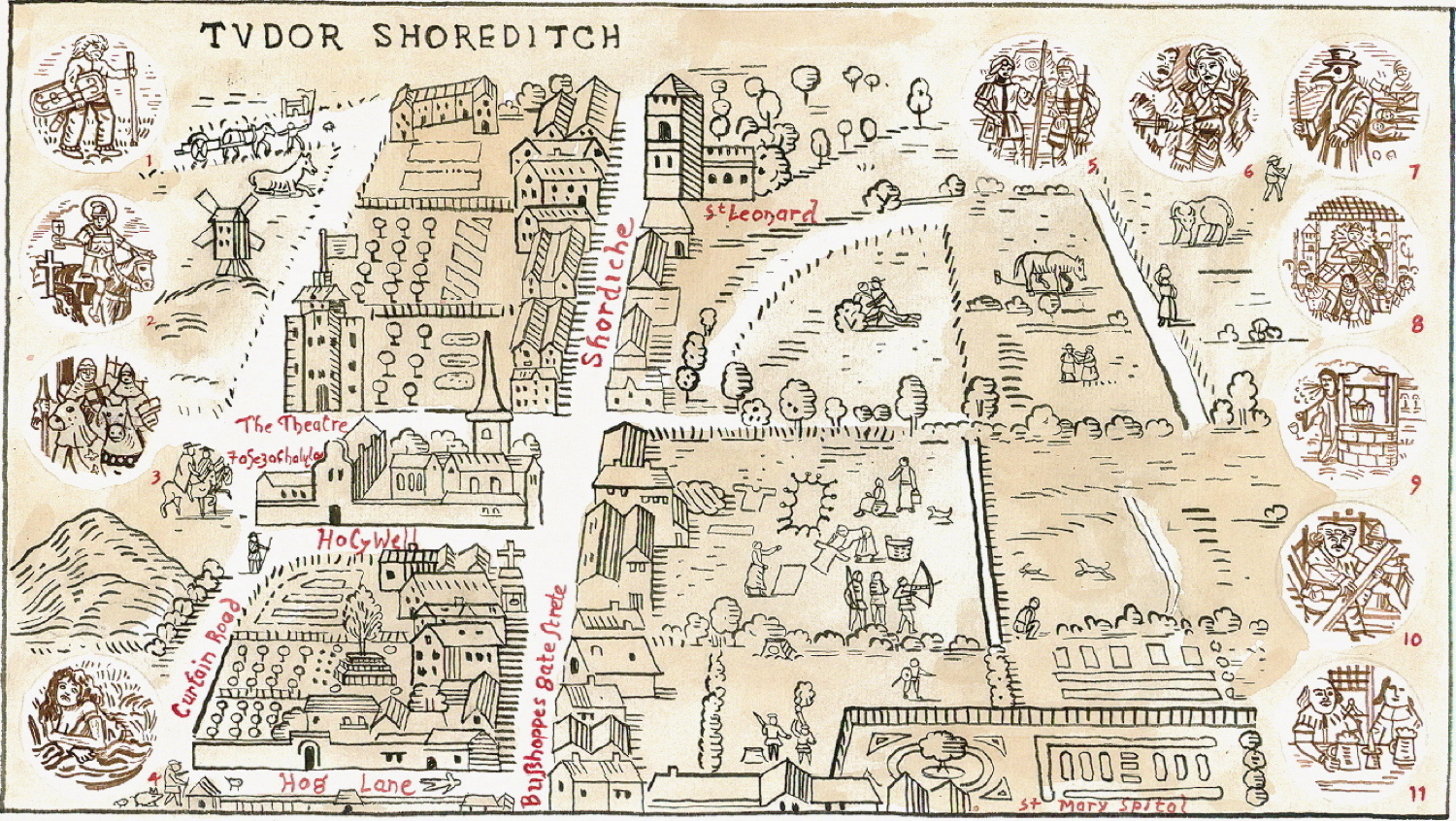
1. Iron Age Man establishes a track along what is now “OLD STREET”.
2. Christian Roman Soldiers worship at the source of the river Walbrook, now St Leonards.
3. Sir John de Soerditch rides against the French Spears alongside The Black Prince.
4. Jane Shore, a goldsmith’s daughter & lover of Edward IV dies in “a ditch of loathsome scent.”
5. “Barlow” the archer is given the dubious title “Duke of Shoreditch” by Henry VIII.
6. Christopher Marlowe murders the son of a Hog Lane innkeeper, he escapes prosecution.
7. Plague burials take place at “Holywell Mound” by the Priory of St John the Baptist at Holywell.
8. Queen Elizabeth I on passing by medieval St Leonards is “Pleased by its Bells.”
9. The sweet water of “The Holywell” is spoilt by manure heaps of local nursery gardens,
10. James Burbage’s sons Cuthbert & Richard dismantle “The Theatre” in two to four days & transport it to the South bank of the Thames where it is rebuilt as “The Globe”.
11. William Shakespeare enjoys a “bumper” at an inn on the site of the present “White Horse.”
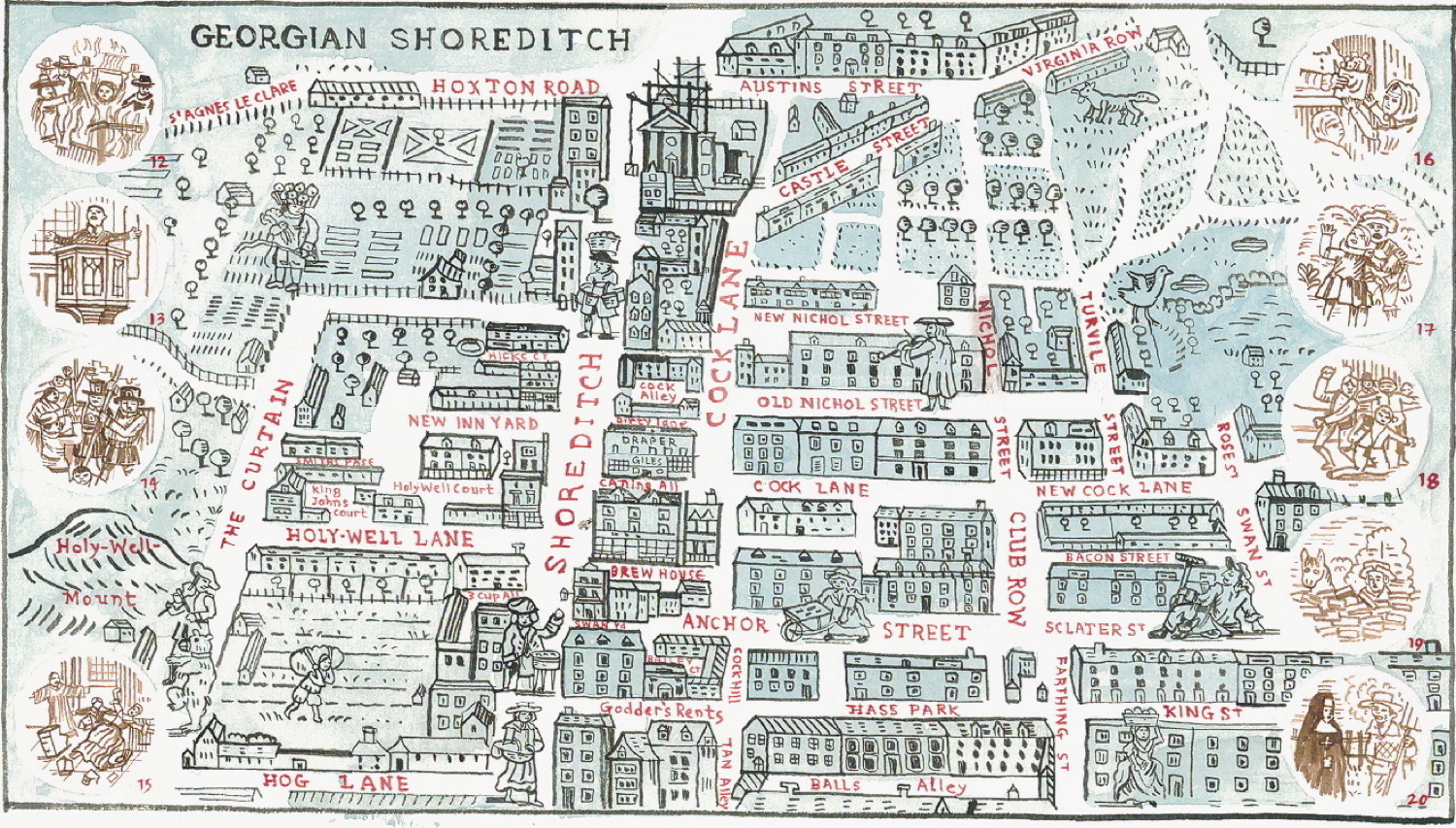
12. Local Huguenot weavers riot for three days protesting against & burning “multi-shuttle looms”.
13. Thomas Fairchild, a gardener, donated £25 to St Leonards for an annual Whitsunday sermon titled “Wonderful Works of God in creation” or “On the certainty of resurrection of the dead proved by certain changes of the animal and vegetable parts of creation.”
14. Militia are called from the Tower to quell four thousand Shoreditch locals rioting against cheap Irish labour being used to build the new George Dance tower of St Leonards.
15. Large lumps of masonry fall onto the congregation during a service at the collapsing old St Leonards.
16. The Huguenot speciality “fish & chips” appear at Britain’s first fish & chip shop on Club Row.
17. The many murders & muggings at Holywell Mount lead to it being levelled.
18. Local theatres such as The Curtain sink to become “no more than sparring rooms.”
19. Brick Lane takes its name from local brickfields, occasional location of furtive criminality.
20. Visitors to James Fryer’s land at Friar’s Mount wrongly assume a monastery stood there.
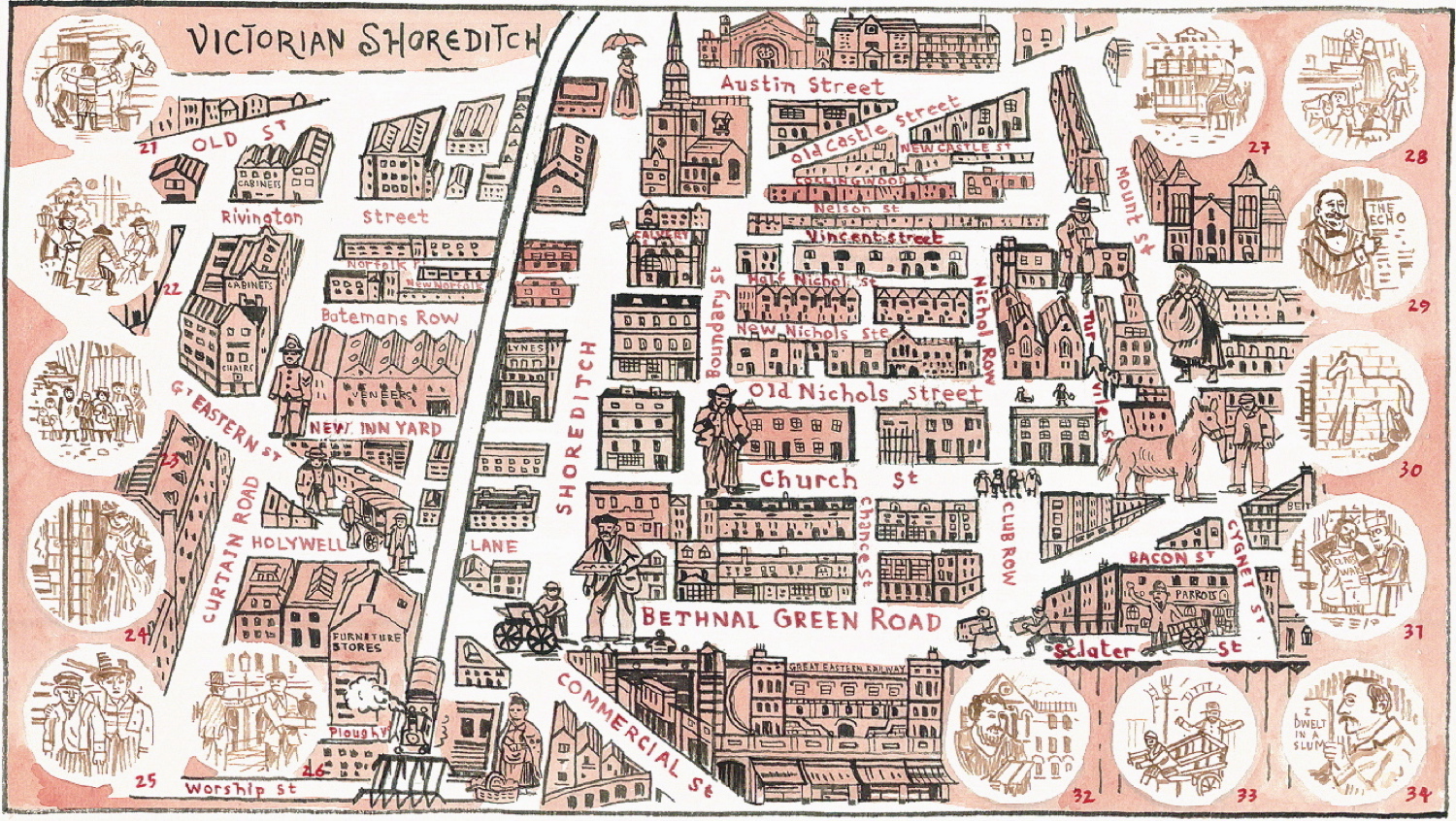
21. Joe Lee, the local horsewhisperer, coaxes improved productivity from working donkeys.
22. “Resurrection Men,” notorious body snatchers pinch recent interred corpses from St Leonards, some coffins in the crypt are found to contain bricks instead of bodies,
23. Four thousand people are dispossessed as Bishopsgate Goods Yard replaces streets around Swan Lane & Leg Alley.
24. Mary Kelly’s funeral procession leaves St Leonards amidst huge crowds. The poor victim of Jack the Ripper is given a second funeral at her own catholic cemetery.
25. Oliver Twist is said to have resided in Shoreditch. Many other unfortunate children arrive each morning at The White St Child Slave Market seeking work.
26. So many unruly pavement-side street vendors populate Shoreditch High St that a regular uniformed Street Keeper is employed.
27. Horse drawn trams add to the general commotion bustle and smell of the High Street.
28. Cats meat sellers, watercress hawkers & dog breeders all cram into the Old Nichol’s filthy tenements.
29. Sir Arthur Arnold, head of the LCC main drainage committee is commemorated at Arnold Circus.
30. For decades the chalk horse on Eastern Counties Railway, Bishopsgate terminus is redrawn by unknown local artist.
31. Enthusiastic Anarchists hoping to bring political awareness to the Old Nichol proletariat through their Boundary St printing operation find the task “like tickling an elephant with a straw.”
32. Artist, Lord Leighton calls the interior of Holy Trinity, Old Nichol St, “The most beautiful in England.”
33. Arthur Harding’s memories of his slum boyhood, “van dragging” etc are recalled in “East End Underworld.”
34. Arthur Morrison pens his slum tale “Child of the Jago” following Reverend Jay’s invitation to the Old Nichol.
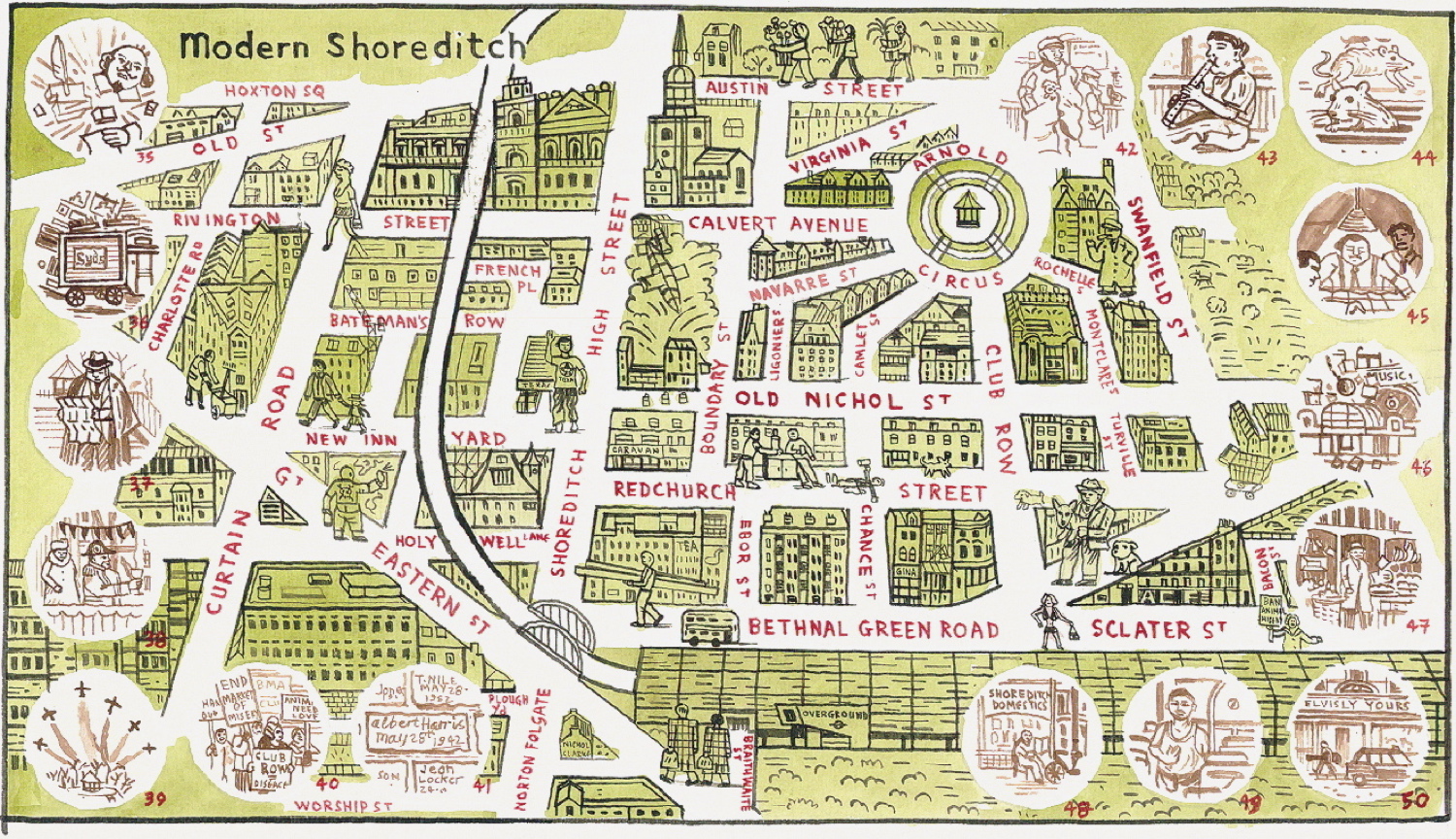
35. The chapel dedicated to Shakespeare on Holywell Lane is destroyed by a WWII bomb.
36. Syd’s Coffee Stall, now Hillary Caterers, is saved from destruction during an air raid as two parked buses shelter it from a bomb blast. Thomas Austen’s medieval chancel window is less fortunate.
37. Novelist Arthur Machen identifies a “leyline” running through the mystic ancient earthwork Arnold Circus.
38. King Edward VIII officially inaugurates Boundary Estate from a platform on Navarre St.
39. The Red Arrows pass over the bandstand en-route once more to the Queen’s Birthday.
40. Protestors eventually force the closure of Club Row animal market, once home to dogs, parrots, pigeons and the occasional lion cub.
41. Navarre St is used as a playground by children who carve their names into the brickwork.
42. Artist, Ronald Searle visits Club Row animal market to illustrate Kaye Webb’s “Looking at London.”
43. The resident Bengali flute player of Arnold Circus is often heard across the Boundary Estate on warm Summer evenings.
44. The IRA bomb which explodes on Bishopsgate disturbs the rats in Shoreditch who emerge in large numbers from the drains,
45. The great train robbers plan their notorious crime upstairs in The Ship & Blue Ball, Boundary St.
46. Jeremiah Rotherham demolishes the Shoreditch Music Hall for another warehouse.
47. Joan Rose‘s father proudly displays his fruit & vegetables on Calvert Avenue whilst she is sent to buy more bags at Gardners Market Sundriesmen (still trading today).
48. Every type of vacuum cleaner bag is sold by “Zammo from Grange Hill’s dad” at Shoreditch Domestics on Calvert Avenue.
49. The failed Suicide Bus Bomber is seen by security camera leaving the No 26 at Shoreditch.
50. Mono-recording virtuoso, Liam Watson strides past Shoreditch’s “Elvisly Yours” souvenir shop en-route to legendary Toe-rag recording studios in French Place.

CLICK TO ORDER A SIGNED COPY OF MAPS OF LONDON & BEYOND BY ADAM DANT
Adam Dant’s MAPS OF LONDON & BEYOND is a mighty monograph collecting together all your favourite works by Spitalfields Life‘s cartographer extraordinaire in a beautiful big hardback book.
Including a map of London riots, the locations of early coffee houses and a colourful depiction of slang through the centuries, Adam Dant’s vision of city life and our prevailing obsessions with money, power and the pursuit of pleasure may genuinely be described as ‘Hogarthian.’
Unparalleled in his draughtsmanship and inventiveness, Adam Dant explores the byways of English cultural history in his ingenious drawings, annotated with erudite commentary and offering hours of fascination for the curious.
The book includes an extensive interview with Adam Dant by The Gentle Author.


