Tavern Tokens Of Bishopsgate

The Ship Tavern, Bishopsgate
There are some artefacts that, in their detail and evidence of wear, can evoke an entire world. Although no larger than a thumbnail, these modest seventeenth century tavern tokens in the collection at the Bishopsgate Institute bring alive that calamitous era after the English Revolution when London was struck by the Great Plague in 1665 and then the Great Fire in 1666.
Bishopsgate was one of the few parts of the City spared by the Fire. It was lined with ancient taverns, used as points of departure and arrival for those travelling up and down the old Roman road north from the City of London. The part inside the City wall was known as Bishopsgate Within and the part outside the wall was Bishopsgate Without, and beyond, where the muddy road widened, was known as Bishopsgate St. The taverns served as hotels, drinking and dining houses, breweries and stables, couriers and coach offices, places of business and of entertainment, and were such significant centres of commerce that they issued their own currency for use as change.
There is a vibrant graphic quality in these miniature token designs, delighting in combining hand-lettering and familiar imagery with an appealing utilitarian irregularity. Long before universal literacy or the numbering of London streets, buildings were adorned with symbols and easily-recogniseable images like those graven upon the front of these tokens. The reverse carries the date and initials of the owner that issued the token, who may latterly be identified from the vintners’ records.
As well as those from Bishopsgate, there is one here from Spittlegate, now known as Widegate St, and another from Bedlam, now known as Liverpool St, which was formerly the location of the Hospital of St Mary of Bethlehem – of all the tokens here, The White Hart is the lone tavern that has weathered the centuries to survive into the present era.
After the Fire, rubble was spread upon the marshy land of Spitalfields, preparing it for the construction of the streets we know today, and, occasionally, charcoal is still uncovered when foundations are excavated in Spitalfields, recalling this distant event. In 1632, Charles I gave a licence for flesh, fowl and roots to be sold in Spitalfields and the market was re-established in 1682 by Charles II, defining the territory with a culture of small-scale trading that persists to this day.
Once, tavern tokens were unremarkable items of small monetary value, passed hand to hand without a second thought, but now these rare specimens are precious evidence of another life in another time, long ago in this place.

King’s Head, Spittlegate, Charles I

King’s Head, Spittlegate, issued by Vintner Thomas Avis in 1658

The Beehive, Bishopsgate Without, issued by Thomas Goss, 1652

The Mitre Tavern, Bishopsgate, issued by Robert Richardson 1644

The Flower Pot, Bishopsgate Within, issued by Ascanius Hicks, 1641

The Helmet, Bishopsgate Without, issued by Robert Studd

At the White Hart, Bedlam

The White Hart at Bedlam, issued by EE, 1637

Red Lion Court, Bishopsgate Without, issued by John Lambe

The Black Raven, Bishopsgate Without

The Black Raven, Halfpenny issued by Sam Salway

The Sunne, Bishopsgate Within

Lion Above a Stick of Candles, Bishopsgate Without

Lion Above a Stick of Candles, issued by Ralph Butcher, 1666

At the Sign Of The Boore, Bishopsgate Without

At The Sign Of The Boore, Bishopsgate Without

The Half Moone Brewhouse, Bishopsgate Without

Edward Nourse Next The Bull In Bishopsgate Street, 1666

The Mouth Tavern, Bishopsgate Without, issued by Robert Sanderson, 1638
Images courtesy Bishopsgate Institute
You may also like to look at
The Gentle Author’s Spitalfields Pub Crawl
Along The Black Path

‘Whan that Aprille with his shoures sote… Than longen folk to goon on pilgrimages’
Taking to heart the observation by the celebrated poet & resident of Aldgate, Geoffrey Chaucer, that April is the time for pilgrimages, I set out for day’s walk in the sunshine along the ancient Black Path from Walthamstow to Shoreditch. The route of this primeval footpath is still visible upon the map of the East End today, as if someone had taken a crayon and scrawled a diagonal line across the grid of the modern street plan. There is no formal map of the Black Path yet any keen walker with a sense of direction may follow it as I did.
The Black Path links with Old St in one direction and extends beyond Walthamstow in the other, tracing a trajectory between Shoreditch Church and the crossing of the River Lea at Clapton. Sometimes called the Porter’s Way, this was the route cattle were driven to Smithfield and the path used by smallholders taking produce to Spitalfields Market. Sometimes also called the Templars’ Way, it links the thirteenth century St Augustine’s Tower on land once owned by Knights Templar in Hackney with the Priory of St John in Clerkenwell where they had their headquarters.
No-one knows how old the Black Path is or why it has this name, but it once traversed open country before the roads existed. These days the path is black because it has a covering of asphalt.
On the warmest day of spring I took the train from Liverpool St Station up to Walthamstow to commence my walk, seeking respite in the sunshine. In observance of custom, I commenced my pilgrimage at an inn, setting out from The Bell and following the winding road through Walthamstow to the market. A tavern by this name has stood at Bell Corner for centuries and the street that leads southwest from it, once known as Green Leaf Lane, reveals its ancient origin in its curves that trace the contours of the land.
Struggling to resist the delights of pie & mash and magnificent 99p shops, I felt like Bunyan’s pilgrim avoiding the temptations of Vanity Fair as I wandered through Walthamstow Market which extends for a mile down the High St to St James, gradually sloping away down towards the marshes. Here I turned left onto St James St itself before following Station Rd and then weaving southwest through late nineteenth century terraces, sprawling over the incline, to emerge at the level of the Walthamstow Marshes.
Then I walked along Markhouse Avenue which leads into Argall Industrial Estate, traversed by a narrow footpath enclosed with high steel fences on each side. Here you may find Allied Bakeries, Bates Laundry and evangelical churches including Deliverance Outreach Mission, Praise Harvest Community Church, Celestial Church of Christ, Mountain of Fire & Miracle Ministries and Christ United Ministries, revealing that religion may be counted as an industry in this location.
Crossing an old railway bridge and a broad tributary of the River Lea brought me onto the Leyton Marshes where I was surrounded by leaves unfurling, buds popping and blossom exploding – natural wonders that characterise the rush of spring at this sublime moment of the year. Horses graze on the marshes and the dense blackthorn hedge which lines the footpath provided a sufficiently bucolic background to evoke a sense that I was walking an ancient footpath through a rural landscape. Yet already the municipal parks department were out, unable to resist taking advantage of the sunlight to give the verges a fierce trim with their mechanical mower even before the the plants have properly sprouted.
It was a surprise to find myself amidst the busy traffic again as I crossed the Lea Bridge and found myself back in the East End, of which the River Lea is its eastern boundary. The position of this crossing – once a ford, then a ferry and finally a bridge – defines the route of the Black Path, tracing a line due southwest from here.
I followed the diagonal path bisecting the well-kept lawn of Millfields and walked up Powerscroft Rd to arrive in the heart of Hackney at St Augustine’s Tower, built in 1292 and a major landmark upon my route. Yet I did not want to absorb the chaos of this crossroads where so many routes meet at the top of Mare St, instead I walked quickly past the Town Hall and picked up the quiet footpath next to the museum known as Hackney Grove. This byway has always fascinated me, leading under the railway line to emerge onto London Fields.
The drovers once could graze their cattle, sheep and geese overnight on this common land before setting off at dawn for Smithfield Market, a practice recalled today in the names of Sheep Lane and the Cat & Mutton pub. The curve of Broadway Market leading through Goldsmith’s Row down to Columbia Rd reveals its origin as a cattle track. From the west end of Columbia Rd, it was a short walk along Virginia Rd on the northern side of the Boundary Estate to arrive at my destination, Shoreditch Church.
If I chose to follow ancient pathways further, I could have walked west along Old St towards Bath, north up the Kingsland Rd to York, east along the Roman Rd towards Colchester or south down Bishopsgate to the City of London. But flushed and footweary after my six mile hike in the heat of the sun, I was grateful to return home to Spitalfields and put my feet up in the shade of the house. For millennia, when it was the sole route, countless numbers travelled along the old Black Path from Walthamstow to Shoreditch, but on that day there was just me on my solitary pilgrimage.

At Bell Corner, Walthamstow

‘Fellowship is Life’


Two quinces for £1.50 in Walthamstow Market

Walthamstow Market is a mile long

‘struggling to resist the delights of pie & mash’

At St James St

Station Rd


‘leaves unfurling, buds popping and blossom exploding which characterise the rush of spring’

Enclosed path through Argall Industrial Estate skirting Allied Bakeries

Argall Avenue

‘These days the path is black because it has a covering of asphalt’

Railway bridge leading to the Leyton marshes


A tributary of the River Lea

Horses graze on the Leyton marshes

“dense blackthorn which line the footpath provided a sufficiently bucolic background to evoke a sense that I was walking an ancient footpath”

‘the municipal parks department were out, unable to resist taking advantage of the sunlight to give the verges a fierce trim with their mechanical mower even before the the plants have properly sprouted’

The River Lea is the eastern boundary of the East End

Across Millfields Park towards Powerscroft Rd

Thirteenth century St Augustine’s Tower in Hackney

Worn steps in Hackney Grove

In London Fields

At Cat & Mutton Bridge, Broadway Market

Columbia Rd

St Leonard’s Church, Shoreditch
You may also like to read about
On Mothering Sunday

Valerie
What are you to do on Mothering Sunday if you have no mother? My mother died in 2005 and each year I confront this troubling question when the annual celebration comes around.
All over the city in recent weeks, I have encountered cards and gifts for Mothering Sunday, exploiting the commercial potential of this medieval Lenten festival which, like St Valentine’s Day and Halloween, has been commodified into a retail opportunity.
If I was religious I might light a candle or lay flowers on a grave, yet neither of these is an acceptable option for me. Contemplating displays in shop windows, I deliberate privately over the tender question as my sense of loss deepens in the approach to Mothering Sunday, only for it to dissipate afterwards. This uneasy resolution brings no peace, serving to remind me how much I miss her. It is a feeling which grows with each Mothering Sunday that passes, as the distance in time that separates us increases and the memories fade. I do not expect or wish to ‘get over it,’ I seek to live in peace with my sadness.
I wish she could see where I live now and I could share the joys of my life with her. I have a frustrated instinct to communicate delights, still identifying sights and experiences that I know she would enjoy.
My picture of her has changed. The painful experience of her final years when she was reduced to helpless paralysis by the onset of dementia has been supplanted by a string of fragmentary images from my childhood – especially of returning from school on summer afternoons and discovering her at work in her garden.
I think of how she raised her head when she smiled, tossing her hair in assertion of a frail optimism. ‘Not too bad, thank you!’ she is admitting, lifting her head to the light and assuming a confident smile with a flash of her eyes. This was her default answer to any enquiry into her wellbeing – whether it was a routine or genuine question – and she maintained it through the years, irrespective of actual circumstances. When life was smooth, it was a modest understatement and when troubles beset her, it was a discreet expression of personal resilience. For her, it was a phrase capable of infinite nuance and I do not believe she ever said it in the same way. Yet although I could always appreciate the emotional reality that lay behind her words, I think for everyone but me and my father it was an opaque statement which efficiently closed the line of enquiry, shielding her private self from any probing conversation. From her I learnt the value of maintaining equanimity and keeping a sense of proportion, whatever life brings.
I realise that I was lucky to have a mother who taught me to read before I started school at four years old. Denied the possibility of a university education herself, she encouraged me to fulfil her own thwarted ambitions and – perhaps more than I appreciate – I owe my life as a writer to her. Yet there is so much I could say about my mother that it is almost impossible to write anything. I recognise that the truth of what she means to me is in a region of emotion that is beyond language, but I do know that what she was is part of who I am today.
Increasingly, I am aware that many of those around me also share this situation of no longer having mothers. Perhaps I should buy them all flowers this Mothering Sunday? Certainly if anyone enquires, I shall reply ‘Not too bad, thank you!’ with a smile and raise my head. In that moment, I shall conjure her robust spirit from deep inside me and she will be present, in my demeanour and in my words, this Mothering Sunday.
You may also like to read about
Blossom Time In The East End
Now is season to welcome the blossom back to the East End again for another year

In Bethnal Green
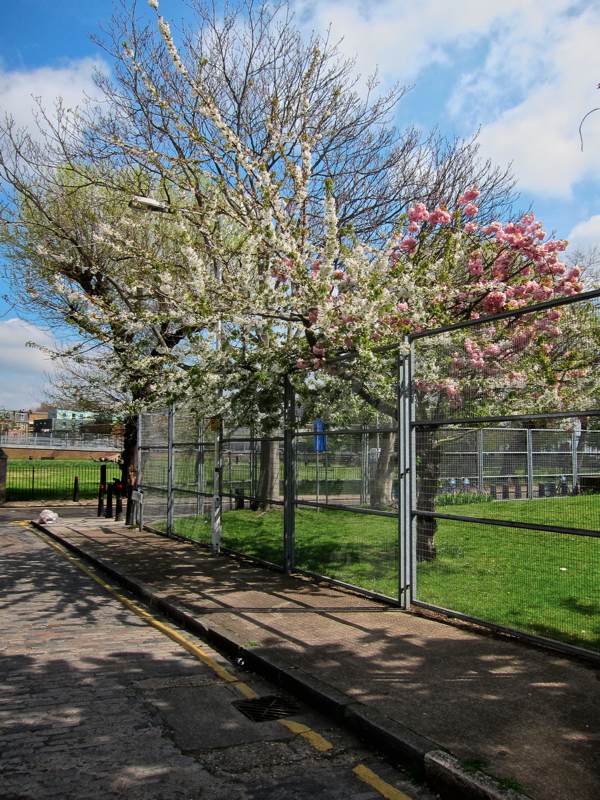
Let me admit, this is my favourite moment in the year – when the new leaves are opening fresh and green, and the streets are full of trees in flower. Several times, in recent days, I have been halted in my tracks by the shimmering intensity of the blossom. And so, I decided to enact my own version of the eighth-century Japanese custom of hanami or flower viewing, setting out on a pilgrimage through the East End with my camera to record the wonders of this fleeting season that marks the end of winter incontrovertibly.
In his last interview, Dennis Potter famously eulogised the glory of cherry blossom as an incarnation of the overwhelming vividness of human experience. “The nowness of everything is absolutely wondrous … The fact is, if you see the present tense, boy do you see it! And boy can you celebrate it.” he said and, standing in front of these trees, I succumbed to the same rapture at the excess of nature.
In the post-war period, cherry trees became a fashionable option for town planners and it seemed that the brightness of pink increased over the years as more colourful varieties were propagated. “Look at it, it’s so beautiful, just like at an advert,” I overheard someone say yesterday, in admiration of a tree in blossom, and I could not resist the thought that it would be an advertisement for sanitary products, since the colour of the tree in question was the exact familiar tone of pink toilet paper.
Yet I do not want my blossom muted, I want it bright and heavy and shining and full. I love to be awestruck by the incomprehensible detail of a million flower petals, each one a marvel of freshly-opened perfection and glowing in a technicolour hue.

In Whitechapel
In Spitalfields

In Weavers’ Fields

In Haggerston

In Weavers’ Fields

In Bethnal Green

In Pott St

Outside Bethnal Green Library

In Spitalfields

In Bethnal Green Gardens

In Museum Gardens

In Museum Gardens

In Paradise Gardens

In Old Bethnal Green Rd

In Pollard Row

In Nelson Gardens

In Canrobert St

In the Hackney Rd

In Haggerston Park

In Shipton St

In Bethnal Green Gardens

In Haggerston

At Spitalfields City Farm

In Columbia Rd

In London Fields

Syd’s Coffee Stall, Calvert Avenue
You may like to take a look back at
Cats Of Hackney Mosaic

(Click to enlarge)
Taking advantage of yesterday’s spring sunshine, I took an excursion up to Hackney Downs to admire the latest masterpiece produced by designer Tessa Hunkin and the Hackney Mosaic Project. At the pavilion in the park, about a dozen mosaic artists were at work under Tessa’s watchful eye, but I persuaded her to accompany me to the private garden where her new commission has just been installed.
Complementing last year’s ‘Hounds of Hackney Downs,’ this mosaic features some members of the local feline population who stray into the garden where it has been installed. I was thrilled by the dynamic sense of movement with three cats leaping – much more exciting and ambitious concept than simply having them sitting around snoozing. In fact, I think I recognised the ginger cat sitting on the roof of the park keeper’s cottage next door.
If you would like to see more of the remarkable achievements of Hackney Mosaic Project under the leadership of Tess Hunkin, they have designed a map which I have featured below that gives you the locations of their public mosaics.

Is this the ginger cat in the mosaic?


A mosaic of thrushes at the same house

Work in progress at Hackney Mosaic Project

Click to enlarge this map of where mosaics may be found in Hackney
THE HACKNEY MOSAIC PROJECT is seeking commissions, so if you would like a mosaic please get in touch hackneymosaic@gmail.com
You may also like to read about
The Mosaic Makers of Hackney Downs
The Award-Winning Mosaic Makers of Hackney
A Dress Of Spitalfields Silk

In 1752, when Ann Fanshawe was twenty-eight years old, her father Crisp Gascoyne was appointed as Lord Mayor of London, and became the first incumbent to take residence in the newly built Mansion House. Since Margaret, her mother, had died back in 1740, it fell upon Ann to assume the role of Lady Mayoress and this spectacular dress of Spitalfields silk, which was purchased by the Museum of London from one of her descendants in 1983, is believed to have been made to be worn just once, upon the great occasion.
Born in 1724, Ann was the eldest daughter of Crisp Gascoyne of Bifrons House in Barking, marrying Thomas Fanshawe of Parsloes Manor in Dagenham at the age of twenty-one. In 1752, when she stepped out as Lady Mayoress, Ann had three children, John six years old, Susanna five years old and Ann four years old. Ten years later, Ann died at the birth of her fourth child Mary, in 1762. Parsloes Manor no longer exists but “The History of the Fanshawe family” by H.C. Fanshawe published in 1927 records this couplet engraved upon one of the windows there by Ann & Thomas.“Time ‘scapes our hand like water from a sieve, We come to die ere we come to live.”
Becoming Lord Mayor of London was an auspicious moment for Ann’s father (who had been Master of the Brewer’s Company in 1746) and he saw his eldest daughter step out in a silk dress that was emblematic of his success. The design contains images of hops and barley interwoven with flowers spilling from silver cornucopia, alternating with anchors and merchants’ packs in silver, all upon a background of white silk threaded with silver. It was a dress designed to be seen by candlelight and the effect of all this silver thread upon white silk, in a dress trimmed with silver lace, upon his eldest daughter adorned with diamonds, was the physical embodiment of Gascoyne’s momentous achievement. To crown it all, H.C. Fanshawe describes a lost portrait of Ann, “which shows her to have been strikingly handsome.”
As the Covent Garden Journal of 3rd November 1752 reported: “The Appearance at Guildhall, on Thursday last, was very noble, particularly that of the Ladies, many of whom were extremely brilliant, a Circumstance which in too great a Measure lost its Effect, their being mixed with an uncommon Crowd of Company… The Ball about ten o’Clock was opened by Mrs. Fanshaw (as Lady Mayoress, who made a most splendid Figure) …”
As everyone in Spitalfields knows, the Huguenot weavers here excelled at creating silk, both in their technical finesse and elegance of design. Such was the skilful incorporation of the expensive silver and coloured threads in the cloth for Ann Fanshawe’s dress that they were only used where they were visible, with very little wasted upon the reverse. According to the American critic, Andrea Feeser, the dye used for the blue flowers was rare indigo from South Carolina, where Ann’s brother-in-law Charles Fanshawe was stationed as a Rear-Admiral and had access to the indigo dye.
When Natalie Rothenstein, the authoritative scholar of Spitalfields silk, wrote to the curator at the Museum of London in July 1983 about the dress, she authenticated the fabric as being of being of Spitalfields manufacture, but also could not resist declaring her distaste for the design.“I am sure that the dress is Spitalfields and indeed the floral style is just right for the date 1752-3. I am sure too, that the design is unique – created for one rich lady. The bales and anchors ought to refer to a merchant, while the ears of corn and horn of plenty reveal the prosperity he brought to the city as well as his family’s execrable taste.”
Commonly, silks were woven in lengths of cloth sufficient for several dresses, but in this instance the design was likely to have been made solely for this garment. A customer bought a design from a mercer and six months was the lead time for the weaving of the silk cloth, which could have been made up into a dress in little more than a week. Natalie Rothenstein describes the chain of transactions thus, “silk was generally imported by a silk merchant. It was then sold through a broker to a silkman who, in turn, supplied the master weaver with the qualities and quantities required. Either the silkman or the master weaver had it thrown and dyed. The master weaver would normally obtain an order from a mercer and instruct his foreman. The latter, based at the master weaver’s warehouse, would measure out the warp for the journeyman, who returned it when completed.” Ann would never have met the people who made her dress and they may never have seen her in it.
When the culmination of this process arrived, once the silk had been designed, the dress manufactured and the great day came, Ann had to get dressed. No underwear was worn, just a shift of fine linen, probably with some lace at the neck, then silk stockings and garters to hold them up. Next came her stays of whalebone, that we should call a corset, and then her hooped petticoat, also with whalebone and cross ties to maintain the oval shape of the dress and not allow it to become circular. At last, Ann could put on her dress, which came in three pieces, first the skirt, then the stomacher followed by the bodice. There were no hooks or buttons to hold it all together, so pins would be used and a few discreet stitches where necessary. Lace sleeve ruffles were added and a lappet upon her head. Finally, diamonds upon the stomacher and around Ann’s neck, plus shoes and a fan completed the outfit.
Now Ann was ready for her appearance, except her dress was two metres wide and she could not walk through a door without turning sideways. Getting in and out of a carriage must have been a performance too. Ann was fully aware that her dress was not designed for sitting down but fortunately she did not to expect to sit.
What can we surmise about Ann’s experience in this dress? I was surprised at the workmanlike manufacture of the garment which was sewn together quickly and presented no finish upon the inside. The quality and expense of the materials was what counted, the tailoring of the dress was not of consequence. Almost like a stage costume, it was a dress to create an effect.
Maybe Ann was the apple of her father’s eye and she was proud to become his angel that incarnated the supremacy of their family in the City of London, or maybe she felt she was tricked out like a tinsel fairy in a ridiculous dress with symbols of brewing woven into the fabric, tolerating it all the for sake of her dad? No doubt her husband Thomas Fanshawe was present at the occasion, but maybe her children, John, Sukey and Nancy (as she called them) stayed behind at Parsloes Manor and did not see their mother wearing the famous dress. Did Crisp Gascoyne, her father, get sentimental on the night, shedding a tear for his wife Margaret and wishing that she had lived to see the day?
We shall never know the truth of these speculations, but everyone wants to have their moment of glory – looking their best at a significant occasion in life – and I should like to think that, on the one day she wore it, this dress delivered that moment for Ann Fanshawe.
You can see Ann Fanshawe’s dress for yourself at the Museum of London


The Gentle Author’s Spring Shirt

I pulled this shirt out of my cupboard this week in advance of the arrival of spring. If you look closely, you will see the collar is wearing through but this does not diminish my affection for this favoured garment that I have worn for years now, bringing it out just for these few months at the end of winter. Although most of the clothes I own are of undecorated design, there is a gentle lyrical quality about this pattern that appeals to me.
When I wear this shirt with a dark jacket, the colours really sing and I feel am doing my bit in participating in the seasonal change. This contrast of formal clothing with a sprigged shirt can express dignified restraint while at the same time revealing an attachment to flowers, plants, gardens and nature – a contrast that I recognise in my own personality.
I love the conceit of having violets on my shirt when those in my garden are in flower and I enjoy the subtle tones of all the flowers portrayed, remaining as recognisable species while artfully stylised to make a pattern. The evocation of the natural world in this simple design touches a chord for me and, as with so many things that trigger an emotional response, I discovered that my passion for these floral patterns from Liberty goes back a long way.
When I came across the familiar photograph of my mother Valerie as a child, which you can see below, I did a double-take when I recognised the pattern on the dress. It was a Liberty print, very similar to my spring shirt which I hold in such affection. In that moment, I recalled that my grandmother Katherine bought fabric at Liberty in London and had it made up into dresses for my mother in the nineteen-thirties. This was a gesture which made such an unforgettable impression on my mother that for her whole life she carried her delight in these cotton dresses, which were so magical to her as a little girl in Somerset. Floral prints fed her innocent imagination, nurtured by ‘Songs of the Flower Fairies’ and performing as one of Titania’s attendants in a school play.
A generation later, I grew up with the received emotion of this memory – a story my mother told me when I was a child. I thought I had forgotten, but I realised it was through an unconscious recollection of the photograph of my mother in the Liberty dress that I was attracted to this flowery shirt, without understanding the origin of my desire at the time.
The story was confirmed when my Uncle Richard moved out of the old house where he and my mother grew up and, in my grandmother’s dressing table, I found a small leather pocket diary from the thirties recording her London trip with the entry, “Stayed at Claridges. Ordered carpet and sideboard at Harvey Nichols and bought materials at Liberty.” My grandmother was the daughter of a diminished aristocratic family who married my grandfather Leslie, a bank manager, and adopted an autocratic manner to ameliorate her loss of status. Consequently, my mother, with admirable resourcefulness, ran away from home at nineteen to escape my bossy grandmother and married my father Peter, who was a professional footballer – an act of social rebellion that my grandmother never forgave.
Nevertheless, the taste I acquired for these old-fashioned designs reflects the fondness my mother carried for that special moment in her childhood which she never forgot, when my grandmother showed maternal kindness to her little daughter in the gift of flowery cotton dresses. An act which came to represent everything about my grandmother that my mother could embrace with unqualified affection, and she encouraged me to remember the best of people too, a prerogative I claim in this instance as the sole living representative of these characters.
Today, I wear my shirt as the sympathetic illustration of a narrative which extends over three generations, culminating in my own existence upon this earth, and as I button my spring shirt, before walking out to celebrate sunshine and a new beginning, I am reminded that I alone carry these emotional stories now, clothing me in the humble affections of my forebears.

The Gentle Author’s mother ‘Valerie’ in the nineteen-thirties

Liberty of London
You may like to read these other stories of The Gentle Author’s family