Jacqueline Billings Of Wellclose Square

Jacqueline Billings
On a particularly bleak day in early spring, when the snow still lay upon the ground, it was my delight to take the train down to Farnborough to meet Jacqueline Billings. She is one of the few people left to recall the fabled beauty of Wellclose Sq in Wapping which was demolished in the last century as part of ‘slum clearance.’
‘I can’t remember anything because I am so old and very little has registered,’ she declared to me, shaking her head in feigned disappointment, before regaling me with the tales of her formative years in Wellclose Sq which you can read below.
In the East End, Jacqueline discovered two prevailing passions which remain with her to this day. She began her career as a teacher in Poplar in her twenties and, seventy years later, still tutors children at home. She remembers visiting the Whitechapel Bell Foundry over half a century ago and has been an enthusiastic handbell ringer for more than forty years, still practising several nights a week.
With high cheek bones, classical features and with her long white hair pulled back, Jacqueline possesses a commanding yet magnanimous spirit. She is well spoken, with precise diction and elegant consonants, and it was my privilege to listen as she told me her story in her own words.
“I was born in 1926 which makes me ninety-two years old. I was born in Ilford and my father, George Thompson, was an analytical chemist and worked for the Gas Light & Coke Company. My mother Elise was French, from Saint Omer in Normandy, she was a hairdresser and people came round to our house to get their hair done. She was coming over to England one day and he had been to France, and they met on the ferry.
My grandfather lived at 7 Campbell Rd in Bow and was a ship’s carpenter in the London Docks. At some point, they asked for a halfpenny an hour wage increase and it was refused. After nine months of stalemate, the company closed and he was out of a job. We used to visit my grandparents in Bow, they had a tiny front room, a backroom and scullery with a tin bath.
The Gas Light & Coke Company had a gas substation in a house in Wellclose Sq in Wapping and we moved there in 1937, when I was ten years old. The first floor rooms were kept locked and my father had to check instruments through a glass panel in the wall. In the kitchen, during the war, there was a disc on the wall and it had a pen attached which we had to fill with ink. It drew a line that recorded the gas pressure. Sometimes the gas pipes were hit by bombs and the line dropped – there was no gas at all.
It was a lovely house with sixty-seven stairs from the bottom to the very top. The bathroom was at the top of the house but at some point somebody had built a lavatory in the yard. It was not very large but it was fascinating because it was castellated. You had to climb thirteen steps from the kitchen to get outside and then walk down this little yard to reach the castle at the bottom. Looking out from the front of the house into Wellclose Square, you could see the church and St Paul’s School and trees. It was very peaceful and I am sorry it has gone.
When we came to the East End from Ilford, it seemed a dirty and noisy place. In those days, it was mainly a Jewish quarter. Old ladies would be sitting outside their front doors after they had whitened the step, which they did every day. I can remember a lot of live chickens being sold.
At school, the East End children thought we spoke funny. We did not know how else to speak. We spoke as we had been brought up. I was never more than an average pupil and I do not remember having school friends. I was only there about a year before I was evacuated although, towards the end of the war, I came back every weekend. St Paul’s School was closed because all the children were evacuated and it never reopened in my time there. Consequently, the square was empty and always very quiet.
I had a brother George and a sister, Andrée. Our bedroom was at the top of the house and my sister did something frightening. The window opened onto a sloping roof, where there there was a gully and parapet. Lo and behold, if she did not get out of the window – which we had done several times – and stood in the gully. She walked along the top of the parapet and she survived. I was something I was never temped to do.
It was always frightening to me because my sister and I, we had to go down North East Passage to get to Cable St and then walk along Cable St. I do not know why it was frightening but I was always frightened in Cable St. People spoke about the blackshirts but not in any detail. We felt there might always be somebody there ready to jump out at us and in fact my sister was attacked one night. In the other direction, we would go down Cable St and walk up Leman St to Aldgate East underground station. On my way back down Leman St, even when I was twenty, I used to go into the Police Station and ask, ‘Please could a policeman accompany me back to the house.’
Sometimes we could hear ships sounding in the docks. Wellclose Square was very big and there was the Highway beyond and the docks were over a wall on the other side of the Highway. It was not traffic we heard, it was the sound of the ships. We never visited the docks. We were well insulated inside our house, I do not think we opened the windows very much. Certainly not at the front. We were never cold, we had gas lights and gas fires. You could go in the front door, walk down the passage and switch on the gaslight, which we thought was very advanced. You had to handle the gas mantle very carefully when you replaced it. I do not know when we got electricity.
We used to swim in the Thames by Tower Bridge. You could go down the steps and when the tide was out there was a gravelly beach. Lots of people went. We were always on our own but we did not come to any harm.
My father was only forty-eight when he died. He was still young but he had been ill all his life. He had a damaged kidney from a fall in the school gymnasium. It atrophied and finally he had it removed. He was born in 1900, so he was too young to serve in the First World War. During the Second World War, he was issued with a gun and he had to be able to shoot at a packet of cigarettes at twenty metres.
I remember hearing the sirens one Sunday morning and I said to my sister, ‘You know that means we’re at war.’ George, Andrée and I were evacuated to Egham in Surrey for four years, next door to where aircraft were being built. It was quite a dangerous spot. Once I looked up and I could see a dogfight overhead. My brother was sent to Virginia Water, and me and my sister were sent to Thorpe Lea. Our school was in a large house in Englefield Green. The lady who took us in was the widow of a Methodist minister and life was very quiet. There was no radio and we were not even allowed to knit on a Sunday. It was a strict life but we survived it.
We came back whenever we could and I remember being in London when the doodlebugs came over. We would come back to London on the Friday night and leave again on Saturday afternoon. There was not a lot of bomb damage around Wellclose Square. Although the eighteenth century houses were jerry built, when bombs came down, the houses blew out and lurched back again. The only shelter we had was a wine cellar underneath the pavement with an iron door. It was the best we could do, but we did not feel vulnerable.
Gradually, people drifted back to London. When I returned to live in Wellclose Sq, I was approaching eighteen and I went off again to college to train as a teacher in Southampton. My brother and my sister moved to Bethnal Green. He had cerebral palsy, so walking was difficult for him but he got around and he became a proofreader for a newspaper.
Once I became a teacher, I taught back in the East End in Poplar. In those days, we had classes of at least thirty and they spoke cockney. I had a pile of comics and I would make the children go to the cloakroom and wash their hands before I handed out the comics, because they were precious. We had to store them and bring them out again and again as a special treat for the children. We wanted to teach respect for the written word.
I enjoyed teaching so much that I have not stopped. I shall be teaching this afternoon. The pupils come to my home in Camberley, they are all Bangladeshi and Pakistani children. The parents are keen for them all to do well and so many of them want to be doctors. I was pleased to leave the East End because I like all the green here in Surrey.”

Stable Yard, Wellclose Sq (London & Middlesex Archaeological Society, Bishopsgate Institute)

The Old Court House, Wellclose Sq (City of London, London Metropolitan Archives)

The former Danish Embassy, c.1930. (City of London, London Metropolitan Archives)

At the corner of Stable Yard, Wellclose Sq. (London & Middlesex Archaeological Society, Bishopsgate Institute)

Geoffrey Fletcher’s drawing of Wellclose Sq, 1968.

Wellclose Sq looking east from the steps of No.5 (City of London, London Metropolitan Archives)

Wellclose Sq, south side, 1961. (City of London, London Metropolitan Archives)

Old Court House, view to first floor landing showing the fine Barbon staircase, 1911 (City of London, London Metropolitan Archives)

Watch House, Wellclose Sq, 1935. (City of London, London Metropolitan Archives)
You may also like to read about
Dorothy Rendell At Whitechapel Bell Foundry
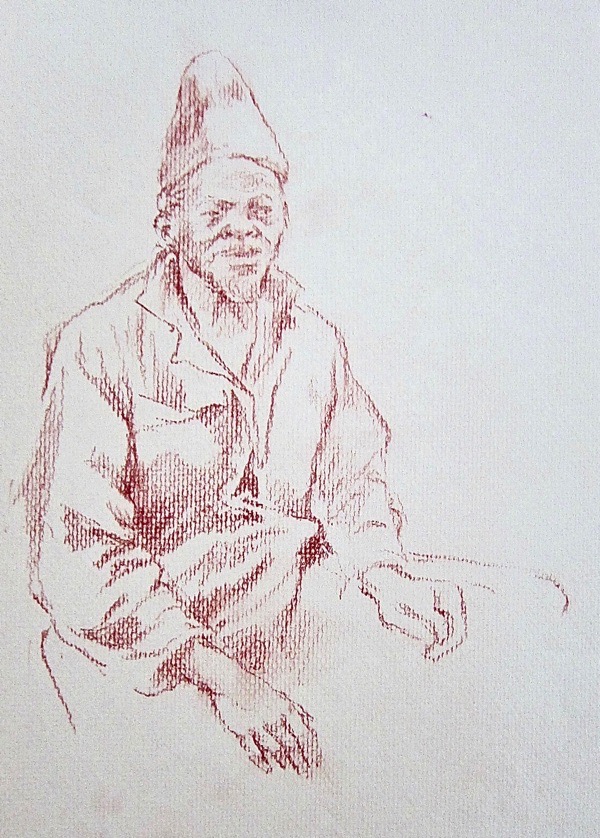
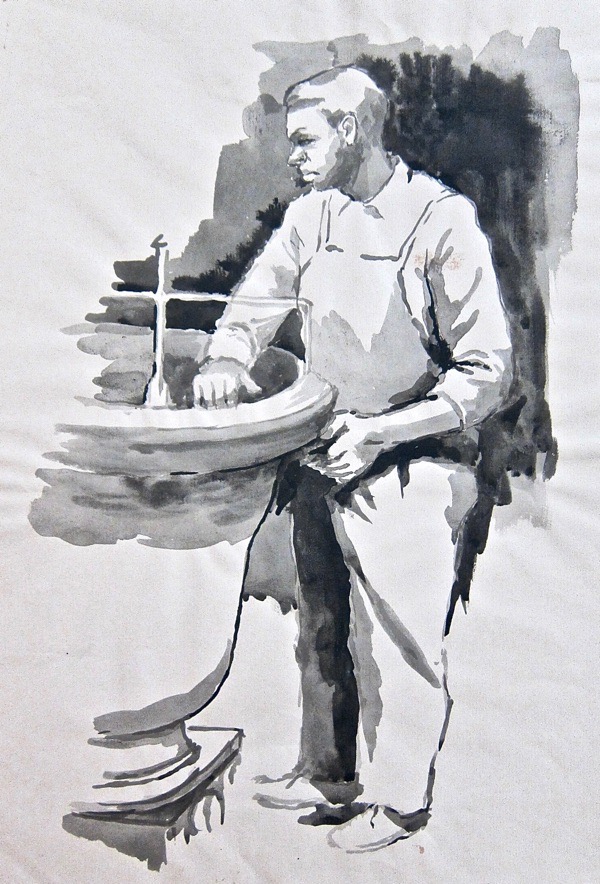
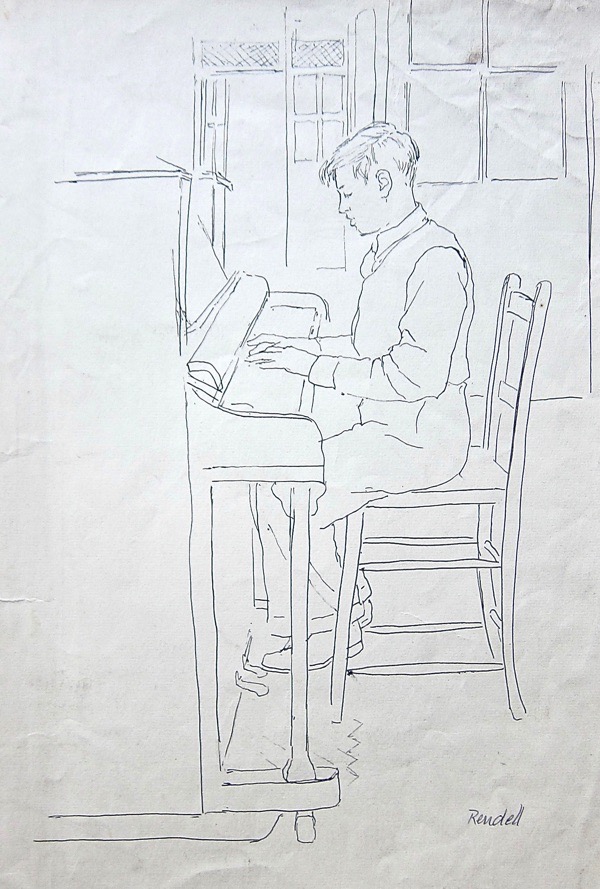
In common with Pearl Binder, Artist Dorothy Rendell was also fascinated by the Whitechapel Bell Foundry and made frequent visits over the years to record the life of this celebrated institution. Significantly, in her drawings Dorothy chose to focus upon the Afro-Caribbean and Asian workers who rarely appear in photographs of the foundry. These pictures are selected from the Dorothy Rendell Archive at Bishopsgate Institute and are published for the first time today.
Meanwhile, Dorothy Rendell’s posthumous solo exhibition runs at Abbott & Holder, 30 Museum St, WC1A 1LH, until 23rd March. I will be speaking about Dorothy at the gallery at noon on Saturday 23rd March.
If you have not yet sent your objection to the proposal to redevelop the Whitechapel Bell Foundry into a bell-themed boutique hotel please do so. You will find instructions for how to do this below. So far, we have lodged over 600 objections versus 3 letters in favour.


Images courtesy Bishopsgate Institute

You can help save the Whitechapel Bell Foundry as a living foundry by submitting an objection to the boutique hotel proposal to Tower Hamlets council. Already we have lodged over six hundred letters of objection but we aim to deliver over a thousand. If you have not already done so, please take a moment this weekend to write your letter of objection. The more objections we can lodge the better, so please spread the word to your family and friends.
HOW TO OBJECT EFFECTIVELY
Use your own words and add your own personal reasons for opposing the development. Any letters which simply duplicate the same wording will count only as one objection.
1. Quote the application reference: PA/19/00008/A1
2. Give your full name and postal address. You do not need to be a resident of Tower Hamlets or of the United Kingdom to register a comment but unless you give your postal address your objection will be discounted.
3. Be sure to state clearly that you are OBJECTING to Raycliff Capital’s application.
4. Point out the ‘OPTIMUM VIABLE USE’ for the Whitechapel Bell Foundry is as a foundry not a boutique hotel.
5. Emphasise that you want it to continue as a foundry and there is a viable proposal to deliver this.
6. Request the council refuse Raycliff Capital’s application for change of use from foundry to hotel.
WHERE TO SEND YOUR OBJECTION
You can write an email to
planningandbuilding@towerhamlets.gov.uk
or
you can send a letter to
Town Planning, Town Hall, Mulberry Place, 5 Clove Crescent, London, E14 2BG

You may also like to read about
Nigel Taylor, Tower Bell Manager
Pearl Binder at Whitechapel Bell Foundry
Hope for The Whitechapel Bell Foundry
A Petition to Save the Bell Foundry
Save the Whitechapel Bell Foundry
Dorothy Rendell’s Solo Show
When I met Dorothy Rendell (1923-2018) in her final months, she admitted to me that it was a matter of great regret that she never had a solo show. Today at 2pm her posthumous solo show opens at Abbott & Holder, 30 Museum St, WC1A 1LH.
I shall be there this afternoon, signing copies of EAST END VERNACULAR, Artists who Painted London’s East End Streets in the 20th Century
Paintings will be sold on a strictly first-come first-served basis, so if you have set your heart on one, please arrive well before 2pm. Dorothy bequeathed all the proceeds of her art to Save the Children. The exhibition runs until Saturday 23rd March.

Studio Self Portrait. Oil on canvas. Signed and dated, 1969

Studio Parrot. Oil on canvas. c.1960

Studio/School Room stove. Oil on canvas. c.1955

Orovida Pissarro (1893-1968). Oil on canvas. c.1960

View across Mount Pleasant from Doughty St. Oil on board. c.1960

‘Jerina’, Harry Gosling School Pupil. Oil on canvas. c.1960

Rotherhithe from Wapping Pierhead. Oil on board. c.1955

Rotherhithe from Wapping Pierhead. Oil on board. c.1955

‘View from Strand End’. Oil on canvas. c.1955

Camille Cottage interior (Castle Hedingham) with red chair. Oil on canvas. c.1970

Camille Cottage Interior (Castle Hedingham) with bathroom mirror. Oil on canvas. c.1970

Camille Cottage Interior (Castle Hedingham) with Japanese print. Oil on canvas. c.1970

Camille Cottage interior (Castle Hedingham) with table-top still life

Tuscan Landscape. Oil on canvas. c.1960

Tuscan Landscape. Oil on canvas. c.1960

Italian market. Oil on canvas. c.1960

Tuscan Landscape. Oil on board. c.1960

Self Portrait. c.1960. Oil on canvas
Images copyright © The Estate of Dorothy Rendell
You may also like to read about
The Metropolitan Machinists’ Co
The plethora of bicycle shops around Spitalfields today is not a new phenomenon as confirmed by this 1896 catalogue for The Metropolitan Machinists’ Co, yet another of the lost trades of Bishopsgate, reproduced courtesy of the Bishopsgate Institute


Images courtesy Bishopsgate Institute
You may also like to take a look at
Watermen’s Stairs

Wapping Old Stairs
I need to keep reminding myself of the river. Rarely a week goes by without some purpose to go down there but, if no such reason occurs, I often take a walk simply to pay my respects to the Thames. Even as you descend from the Highway into Wapping, you sense a change of atmosphere when you enter the former marshlands that remain susceptible to fog and mist on winter mornings. Yet the river does not declare itself at first, on account of the long wall of old warehouses that line the shore, blocking the view of the water from Wapping High St.
The feeling here is like being offstage in a great theatre and walking in the shadowy wing space while the bright lights and main events take place nearby. Fortunately, there are alleys leading between the tall warehouses which deliver you to the waterfront staircases where you may gaze upon the vast spectacle of the Thames, like an interloper in the backstage peeping round the scenery at the action. There is a compelling magnetism drawing you down these dark passages, without ever knowing precisely what you will find, since the water level rises and falls by seven metres every day – you may equally discover waves lapping at the foot of the stairs or you may descend onto an expansive beach.
These were once Watermen’s Stairs, where passengers might get picked up or dropped off, seeking transport across or along the Thames. Just as taxi drivers of contemporary London learn the Knowledge, Watermen once knew the all the names and order of the hundreds of stairs that lined the banks of the Thames, of which only a handful survive today.
Arriving in Wapping by crossing the bridge in Old Gravel Lane, I come first to the Prospect of Whitby where a narrow passage to the right leads to Pelican Stairs. Centuries ago, the Prospect was known as the Pelican, giving its name to the stairs which have retained their name irrespective of the changing identity of the pub. These worn stone steps connect to a slippery wooden stair leading to wide beach at low tide where you may enjoy impressive views towards the Isle of Dogs.
West of here is New Crane Stairs and then, at the side of Wapping Station, another passage leads you to Wapping Dock Stairs. Further down the High St, opposite the entrance to Brewhouse Lane, is a passageway leading to a fiercely-guarded pier, known as King Henry’s Stairs – though John Roque’s map of 1746 labels this as the notorious Execution Dock Stairs. Continue west and round the side of the river police station, you discover Wapping Police Stairs in a strategic state of disrepair and beyond, in the park, is Wapping New Stairs.
It is a curious pilgrimage, but when you visit each of these stairs you are visiting another time – when these were the main entry and exit points into Wapping. The highlight is undoubtedly Wapping Old Stairs with its magnificently weathered stone staircase abutting the Town of Ramsgate and offering magnificent views to Tower Bridge from the beach. If you are walking further towards the Tower, Aldermans’ Stairs is worth venturing at low tide when a fragment of ancient stone causeway is revealed, permitting passengers to embark and disembark from vessels without wading through Thames mud.

Pelican Stairs

Pelican Stairs at night

View into the Prospect of Whitby from Pelican Stairs

New Crane Stairs

Wapping Dock Stairs

Execution Dock Stairs, now known as King Henry’s Stairs

Entrance to Wapping Police Stairs

Wapping Police Stairs

Metropolitan Police Service Warning: These stairs are unsafe!

Wapping New Stairs with Rotherithe Church in the distance

Light in Wapping High St

Wapping Pier Head

Entrance to Wapping Old Stairs

Wapping Old Stairs

Passageway to Wapping Old Stairs at night

Aldermans’ Stairs, St Katharine’s Way
You may also like to read about
Madge Darby, Historian of Wapping
Whistler in Wapping & Limehouse
So Long, The Water Poet
The Water Poet in Folgate St will close forever on 29th March as part of British Land’s redevelopment of Norton Folgate into a hideous corporate plaza, granted planning permission by former Mayor of London, Boris Johnson, in 2016.
Contributing Writer Gillian Tindall first encountered John Taylor the Waterman-Poet (1578 – 1653) when she was researching her book The House by the Thames a dozen years ago. She gives an account of the man behind the legend and the Spitalfields pub that bears his name.

The Water Poet at the edge of Spitalfields and Norton Folgate is a recent berth for John Taylor, although there has been a tavern on the corner where Folgate St meets Blossom St for over two centuries and possibly an ale-house before that. The old name for the muddy pathway that became Folgate St was White Horse Lane, after the brewery situated there since Taylor’s own times. Even longer ago, what became White Horse Lane was formerly the north entrance to the religious house of St Mary Spital.
In the eighteenth century, the street was laid out in stages by a Sir Isaac Tillard, a man of Huguenot descent, who had acquired some of the old Mary Spital land. The earliest evidence of a purpose-built public house appears then and by 1805 it was registered as The Pewter Plate. Those in charge locally have always kept an eye on pubs and publicans, so it is easy to trace the Plate throughout the nineteenth century, the heyday of urban pubs, and into the twentieth. In 1904, when pubs all over the London were being enlarged and made grander, the Plate was rebuilt with the fancy brickwork and the tall, elaborate chimney that you see today.
At some point, probably between the wars, when Spitalfields was becoming ever sootier and more neglected, as its more prosperous citizens took themselves off to greener suburbs, the building was a pub no longer. By the seventies, the erstwhile pub along with two other adjacent properties, became commercial premises owned by`R.Bardigger.’
By and by, the pub was restored to its proper use and the name The Water Poet dates from the current owner’s acquisition in 2003. He undertook the wonderful transformation of the old back yard into a green-leafed garden with fairy lights. It is this area, along with several large rooms created out of a former warehouse, that is to be destroyed as part of British Land’s scheme to redevelop Norton Folgate in the teeth of local opposition. Unfortunately, their hideous corporate plaza with bogus facades received planning permission airily bestowed by the previous and unregretted Mayor of London. John Taylor the water-poet, I believe, would be with us in this struggle.
Those who have enjoyed a drink at The Water Poet in Folgate St may have wondered about this unlikely-sounding figure so far from the water. Yet John Taylor, the seventeenth century Thames ferry-boat man, was a convivial fellow – unless he was waging a vendetta – who was very much at home in pubs. When not on one of his great walks round Britain, he lived most of his life in Bankside, which had many hostelries alongside the theatres and bear-pits. He also had relations who kept inns in Leicester, Abingdon and Norwich whom he sought out in his travels.
Taylor lived through times far more unnerving than ours. Born in Gloucester in the prosperous later days of Queen Elizabeth’s reign, he came up to London to seek his fortune and was apprenticed to an oar-maker, before a spell in the Navy upon dangerous expeditions against Spain in Flores and Cadiz.
Once back in London, he lived through the increasingly turbulent times of the Stuart era, the Civil War and the social oppression of the Cromwellian period. A royalist yet with a liking for Puritan values, he worked as a waterman in the service of the king and was distressed when Charles I lost his head. Taylor was getting on in years by then, complaining bitterly that the Commonwealth had driven the theatres off the south bank and damaged the watermen’s trade, much of which had traditionally consisted of crossings between the City and Southwark. He died in his seventies before Charles II was restored to the throne.
Part subversive journalist, pamphleteer and satirical ballad-maker, part would-be poet and playwright, Taylor longed to join a literary society into which he had not been born. A ferryman by nature, he lived between two worlds socially. As hands-on oarsmen, watermen were tough, rough fellows of their time, competing vociferously for trade, but they met a remarkable range of customers many of whom valued and cultivated them. This was also an era when the Waterman’s Company was being established (with Taylor’s active involvement), fares were being set, intelligent men like him were becoming fully literate and the era of New Learning would soon dawn.
Taylor was a natural self-publicist, a collector of useful friends, but also a genuinely passionate believer in freedom of expression and the rights of the individual in every class. He became an advocate for the destitute watermen who had lost their trade during the ferocious winter of 1620-21 when the Thames froze over for six weeks. He soon discovered that, in spite of all his efforts, there was not much money to be made from a literary life – a truth that still holds today – and developed ingenious means of raising cash. When in difficulty, he would take off on long journeys round Britain on foot for which, anticipating the modern way, he would get sponsorship from rich acquaintances. As a stunt, he once rowed down the Thames in a boat made of paper and later made a much publicised trip – in a rather more solid craft – down the Rhine and the Elbe.
A good talker, Taylor cultivated the society of Bankside actors, advocating their cause against the rising tide of Puritanism. I imagine him as the archetypal cab-driver – “Had Will Shakespeare in the back of my boat the other day… As my good friend Mr Henslowe said to me…” He fought back with some success against the Uber of his time – namely, the wheeled conveyances for hire that were beginning to appear on London’s cobbled streets and alleys as an alternative to the traditional way of travelling by river.
John Aubrey, diarist and man-about-town who was familiar with some of the cleverest men of his era, described John Taylor as `very facetious and diverting company’ and possessing `a good, quick look’. Thomas Decker, the Jacobean playwright, called him `the ferryman of heaven’, but there may have been a touch of irony in that.
Taylor’s poetry has not survived in the public mind, since perhaps it did not really deserve to, but his cheerful and inventive spirit has lived on to this day. He died in an inn in Covent Garden kept by his second wife, and lies buried somewhere behind St Martins in the Fields, where the graveyard of the old church lay, and where present-day travellers and aspirants to fame gather with their backpacks and their own travellers’ tales.

John Taylor the Water Poet
From An Arrant Thief, 1622

John Taylor’s A Swarm of Sectaries & Schismatiques published 1641

Engraving of John Taylor by Thomas Cockson, 1630

The Water Poet in Folgate St (Photograph by Richard Lansdowne)
You may like to read
Dorothy Rendell’s London
As a prelude to my lecture about The Life & Works of Dorothy Rendell (1923-2018) this Thursday 14th at Nunnery Gallery, Bow Arts and the opening of Dorothy’s Rendell’s posthumous solo show this Saturday 16th March at Abbott & Holder, I am publishing this selection of her drawings, seen publicly for the first time today. Click here for tickets for my lecture.
After I picked these drawings, I realised they told the story of Dorothy’s life in London from her art school days in Soho, via her studio in South Kensington, to her job at Harry Gosling School and her home in Mile End Place.

When Dorothy was a student at St Martin’s School of Art in the postwar years, she was fascinated by this view of Frith St, Soho, where men gathered to read prostitutes cards in the newsagents window and she drew the same scene several times from her vantage point of a first floor window across the road.

Frith St

Frith St

Frith St

Old Compton St with Bar Italia in the background

Shepherd Market

Shepherd Market

Shepherd Market

Shepherd Market

‘The Reading Room’

Art School Dance

Art School Model


Dorothy invited the Carl Lewis Quartet to practice in her studio in South Kensington that had formerly belonged to Jacob Epstein


Teaching at Harry Gosling School


In the art room

Mile End Place

Self-portrait by Dorothy Rendell
Drawings copyright © The Estate of Dorothy Rendell
You may also like to read about