Linda Carney, Machinist

This is the lovely Linda Carney working at her machine in Spitalfields in 1963 and looking glamorous in the same way Lynn Redgrave, Julie Christie, Rita Tushingham and Barbara Windsor did playing happy-go-lucky girls in those films of London in the sixties. Linda’s combination of kooky glasses, stylish outfit and optimistic humorous attitude in a mundane workplace was an act of youthful defiance in itself.
Linda worked in factories making clothes all over Spitalfields, in Brune St above the Jewish soup kitchen, in Fournier St in what is now Gilbert & George’s studio and in Fleur de Lys St. It was at the latter address, she once spotted the long-haired seventeen-year-old Dan Cruickshank giving an interview to reporters on the doorstep, explaining why he was squatting an old building in Elder St, “I’m saving our heritage,” he declared. But Linda, with irrepressible anarchic ebullience, wagged her finger and called out, “You just don’t want to pay rent!” It was a scene worthy of a whimsical sixties comedy and I can imagine Linda, tottering off, arm in arm with her girlfriends, all laughing like drains.
When I met Linda outside the Jewish soup kitchen on Brune St, she described the neighbourhood in her time. “It still is busy here, but it was much more busy then because people started out earlier and worked longer hours,” said Linda, excited to return to her former workplace.”If you worked all night, you never felt on your own because you had all-night cafes servicing the market.” Looking up and down Brune St, Linda got quite carried away describing the characters among those coming to the soup kitchen from the surrounding streets of derelict tenements.
In those days – she told me – bales of cotton were carried in and out of the warehouse next door, supplies were delivered to the food warehouses in Tenterground, trucks caused chaos around Spitalfields Market at night, pubs opened at dawn, furriers in Whites Row compared pelts by daylight, Coles’ poulterers in Leyden St slaughtered fowls to order, hatters and button makers and purveyors of ribbons and trimmings worked frantically, while – further afield – the shoemakers of Hoxton and the furniture makers of Bethnal Green were all busy too. Obviously this was only a fraction of the activity but I think you can understand what Linda meant by saying Spitalfields was busier then.
Linda earned three pounds a week doing piecework for companies in Cutler St who provided the cloth, cut ready to sew. She and her co-workers made a hundred pairs of trousers in a day in the factory on the top floor of the soup kitchen. Assembling the clothes, one would sew the seams, another the buttonholes, another the buttons, the zipper and so on. “You couldn’t let anybody down. You couldn’t even go to the toilet” admitted Linda with a frown, showing me the scar where she caught her finger in a machine once and recalling in wry amusement that, in spite of her injury, the others were reluctant to stop the belt that drove all the machines, crying out, “Don’t turn it off! I haven’t finished my piecework yet!” “And that’s what made you a machinist” said Linda, in robust summary of her occupation.
“My mother was a seamstress for Savile Row, a tailoress from home, collecting her work from the West End. My grandmother rolled cigars at home, there was a big industry. It was a skill. Those skills are coming back, I think, because you see the girls today that are making their own clothes and selling them in the market. We used to make our own clothes too, because you need to have something a little different.”
Although Linda’s father worked in the Truman Brewery, his family were all dockers. She told me about the two floors of vaults beneath Wapping High St that stretch as far as Tobacco Dock, built by French prisoners of war imprisoned at the Tower of London. Apparently these cellars were sealed up just as they were when the docks closed and remain untouched to this day, full of a vast stock of the best wine and champagne waiting to be discovered. “We’d go down to the lock-ups,” said Linda with a rapturous grin, “All the best stuff was there, cinnamon, paprika, saffron, rum, ivory, tea and champagne. I’ve drunk all the best teas in the world. If some spilt from a broken chest, you could get a handful for yourself.”
At this point in our pavement chat, an African-American gentleman, who lived in the ground floor flat of the converted soup kitchen, came outside for a cigarette and joined the conversation – which prompted Linda to raise the subject of race. “We always had mixed race here because it was a port,” she declared audaciously, producing a photo of her multiracial school netball team from 1959. “So we all got brought up together. I used to go to clubs to listen to ska and reggae, where coloured groups like the Stylistics were playing to a mixed audience, which the musicians liked because they couldn’t do it in America. We mixed a lot more than our parents thought, because we were enjoying life and we didn’t have any money. We had stop-overs, and a lot of us married Afro-Carribeans, Asians and Chinese. We were a melting pot.”
Touched by Linda’s monologue, our new friend generously invited us into his flat to take a look. We entered the central door that once led to the factory floors up above, rented out to support the soup kitchen. This was the door Linda passed through when she came to work every day. She was entranced, “It feels strange but homely, because it is so familiar” she said. Clasping her hands in delight and raising her eyes to explore the space, Linda explained that, when it was the soup kitchen, one side of his flat was used for distributing clothes and the other side for food.
To my surprise, Linda recalled the smell of bacon here in the early mornings, as the Jewish workers in the kitchen used to enjoy making themselves illicit bacon sandwiches. Then before we left, completing the sentimental pilgrimage, Linda revealed that she last walked through this hallway in 1968. Mesmerised by each other, as Linda and the bemused contemporary resident shook hands in farewell, two worlds met for a fleeting moment, distant by birth yet united in sympathy and mutual curiousity.


Linda Carney in Brune St


Portraits © Sarah Ainslie
You may also like to read about
Jimmy Huddart, Spitalfields Market Porter

A market porter of forty years standing, Jimmy Huddart is proud to display the clothing of his trade. He keeps this apron pristine for ceremonial occasions now, but it is of the traditional design made of the full width of strong canvas, with leather straps and reinforcement across the front where the boxes cause most wear. In use, an apron like this would quickly acquire a brown tinge yet provide its owner with at least two years of wear, with prudent repairs. In the pocket, Jimmy always kept his porter’s knife and string to sew up broken sacks. And the offcuts from these aprons were used to make “cotchel” bags, which held all the fruit and vegetables that the porter might acquire for his own use, gathering it in the lining of his coat as he went about his work. “Cotchelling up,” they called it – and today, although employees in the market now get a vegetable box to take home, it is still referred to as a “cotchel.”
The most significant item in the outfit is the porter’s licence, indicated by the enamel badge. Throughout Jimmy’s time in the market, you could only work as a porter if you had one of these and it was a badge of office, denoting its own rights and privileges which had to be earned. At first, young men entered the market as “empty boys,” collecting and sorting empty wooden boxes and claiming the deposits, until they had earned the right to become licenced porters. Before the introduction of fork-lift trucks, this was intense physical work, manhandling crates of fruit and sacks of vegetables, and manoeuvring the heavy wooden barrows piled high with produce which had a life of their own once you set them going.
“I grew up in Bethnal Green, Brady St, and, at the age of twelve, I used to go to the market to watch all the tussle and bustle, and all the porters with their barrows. At school, I was very much interested in carpentry but I couldn’t get an apprenticeship, although by then I had already been introduced to the market. I loved to go up the Spitalfields with my Uncle Bill, he worked for a haulage company and we used to go around the farms in Kent to collect the English plums and apples and deliver them to the market. There was something about it, the atmosphere and the characters – a love of it developed inside me – and I wanted to become a porter. If you worked in the market or the docks you earned better than the average salary.
When I was fifteen, my uncle got me a job with Percy Dalton at the corner of Crispin St and Brushfield St. He was a well-dressed Jewish man, softly spoken, who had started his business with a barrow selling roast peanuts and he took me under his wing. The first day I started working for Percy Dalton, he showed me how to sweep the shop. He was that sort of person, hands on. He had a fruit shop at the front and in the warehouse there’d be eight people roasting peanuts. The peanut factory backed onto the alley where the lorries came, he had these red vans with Percy Dalton on the side that you always saw outside dog meetings and football matches. He was a likeable man, very popular, and people often came to him for advice. If you were in trouble you could go and speak to him, he would lend you money if you needed it. He always said, get a corner shop and you get two premises for the price of one.
I used to go out with the drivers all around the London Docks to pick up the fruit and make deliveries. I looked forward to it among my duties – being a boy, they took care of me and bought me breakfast, and they taught me how to stack a lorry. But I wanted to be a porter, so I asked in the market if I could work as an empty boy until I came of age. A job come up as a banana boy for Ruby Mollison, helping him to ripen the bananas, hanging them up in the ripening room. I used to wear a leather glove when I had to put my hand under the banana stalk because I was frightened of the spiders. When you cut a bunch of bananas, you cut a “v” shape and they come away from the stalk, and that’s where your spider might be. They could be very dangerous, especially if they were pregnant, and if you were bitten you’d have to go to hospital because your arm could get paralysed by the poison.
Then a chance came up at Gibson Pardoe as an empty boy with the view of getting a licence, and I worked with them for a year until Alf Hayes of the porters’ union came to me and said, “There’s an opportunity to work in the flower market as a porter, would you be interested?” and I was issued a porter’s licence at twenty-one. But there was decline in the fruit trade in the nineteen seventies and they brought in fork-lift trucks. The job changed, it became less physical and where you once needed four porters now you only needed two. I can recall the first time I was given an electric truck. It was one of two milk floats all sprayed up without a scratch on them and they said to me, “treat it like it was new-born baby.” My first trip with it was to go over to Commercial St, and I was making a delivery there when a forty-ton truck came past and clipped it, taking half the fibre-glass roof with it. Luckily, I wasn’t seriously injured, only shaken up. I explained to governor what happened, that it was an accident and he said, “Did you get the number plate ?” He never asked if I was hurt or injured in any way. I suppose you could say, that’s the market sense of humour.
I became elected to the union. In life, I always believed in fairness and I recognise there has to be give and take. I had to build up trust from my members and in dealing with the traders too, yet most of the problems were solved over a cup of tea and a handshake. I was the porters’ representative for ten years but Alf Hayes, who was my inspiration, he had been porters’ representative for forty years before me. The porters’ union was founded in the depression of the twenties and thirties. Although they had to keep it a secret, they invented a form of recognition so they could discuss it – it was “union” backwards, “you’ve got none.” It was lost on those who weren’t in the know, and the union became fully recognised in the late nineteen thirties.
My sport was road running and thirty-five of us formed the Spitalfields Market Runners. Celebrating the tercentenary of the market in 1982, we were supported by the traders and greengrocers and porters in a relay from the Spitalfields Market to Southend Pier and back. We each ran ten miles and the whole of the market came together to do something for charity.“
Jimmy remembers when unemployed porters once waited for work under the clock at the centre of the Spitalfields Market and how the union acquired an office so that traders seeking a porter could telephone, thereby saving the humiliation of the porters. Yet now, in common with the other London markets, the porters are deregulated, losing their licences as the balance in the labour market has shifted again. However, after forty years as a porter, Jimmy chooses to remain positive – because experience has granted him a broad perspective upon the endlessly shifting culture and politics of communal endeavour in market life.

Jimmy’s Huddart’s porter’s licence.

The final year of the licenced porters.

Jimmy’s first year as a porter at twenty-one years old.

Jimmy (right) with his predecessor in the porter’s union Alf Hayes, photographed in the 1980s.

Jimmy Huddart, Honorary Fruit Porter to the Worshipful Society of Fruiterers
You may also like to read about
Peter Thomas, Fruit & Vegetable Supplier
Ivor Robins, Fruit & Vegetable Purveyor
John Olney, Donovan Brothers Ltd
Jim Heppel, New Spitalfields Market
Blackie, the Last Spitalfields Market Cat
and take a look at these galleries of pictures
Malcolm Tremain’s Spitalfields In The Seventies

In Liverpool St Station

Goulston St

Brushfield St

Brushfield St

Crispin St

Railing of the night shelter in Crispin St

Brune St

Holland Estate

Artillery Lane

Looking towards the city from the Spitalfields Market car park

Looking south towards Brushfield St

Looking north towards Spital Sq

Goulston St

Goulston St

Middlesex St

Middlesex St

Alley at Liverpool St Station

Sun Passage

Tunnel at Liverpool St Station

Old Broad St Station

Old Broad St Station

Old Broad St Station under demoliton

Old Broad St Station

Old Broad St Station

Old Broad St Station

Abandoned cafeteria at Old Broad St Station


Pedley St Bridge looking towards Cheshire St

Pedley St Bridge

Pedley St

Pedley St
Photographs copyright © Malcolm Tremain
You may also like to take a look at
Malcolm Tremain’s Spitalfields
Malcom Tremain’s Spitalfields Then & Now
Malcolm Tremain’s City & East End
Hugh Wedderburn, Master Woodcarver

Hugh Wedderburn works every day carving wood in the window of an old shop in the Borough at the meeting point of two Roman roads, Stane St and Watling St. “The ancient approach to London,” Hugh delights to call it, aware that the nature of the work he does has not changed significantly in all the time these roads have been there. Fifty yards behind Hugh’s workshop, a fourth century Roman tablet was found that includes the usage of the name “London.” It gives Huw pleasure to contemplate these things, savouring his position at the centre of this age-old neighbourhood.
While the world races by Hugh’s window, and as the acorns in pots on his bench grow up to become trees, he patiently shaves away superfluous pieces of wood to reveal elegant forms of creatures and foliage, that were just waiting to be uncovered by his keen tools. Or rather, that is the way it seems, because the quality of Hugh’s carving has such natural veracity and grace that it belies the immense skill and laborious application it takes to bring it into existence.
“The chisel makes the shape,” said Hugh, as if his involvement as woodcarver were merely incidental. “So you have to have the right chisel to make the form, and you need to have them in various bent shapes to do the awkward bits,” he added, referring to a handsome array of fifty diverse old chisels laid out in a crescent upon his bench surrounding the current piece of work, all perfectly-sharpened and interlaced with shavings. With these, Hugh can create the extraordinary intricate relief carving of baroque swags, flourishes and foliage that stands proud of the surface and defies the imagination to comprehend how mere mortals could carve it.
“I felt like I was coming home when I moved here to the Borough in 1996,” confessed Hugh brightly, peering out the window at the passersby in Tabard St, “because I was born in Nigeria and there are quite a lot people in Southwark from Nigeria.” In 2001, Hugh was contacted by Margaret Wedderburn Evans who told him they had a common ancestor in Robert Wedderburn, born in the West Indies in 1762 to a Scots’ father and a Jamaican mother. A campaigner against slavery, he came to London and joined the Spencerians, an English radical group that united the working men’s cause.
Today, Hugh’s ancestor is remembered for slogans such as,”It’s demeaning for the oppressed to petition the oppressor,” and “You can take away my weapons but I can still spit.” Sentiments that Huw quotes with relish and a gleeful smile. “I am the answer to the question of what happened to the first Afro-Caribbeans that came to London,” he said, holding up a lithe forearm to display his pale flesh. “Look, that’s what happened to them,” Hugh declared enigmatically, indicating that his perception of the world has a depth and complexity comparable to his work.
Hugh is at the top of his profession, yet in spite of his superlative skill the rewards are ultimately those of esteem rather than wealth. “It would be lovely to earn a fortune, but I get the satisfaction,” he admitted quietly, with a self-possessed grin, turning to the window again, “And I’m here in the middle of London. Office workers pass by on the way to their jobs and tell me how contented I look.”
When Hugh moved into his current workshop it had been a betting shop, but when he pulled out the shopfittings he found old matchboarding, now covered with organised lines of tools that form the background to his crowded yet harmonious work space. Sunlight pours in through the shop window, and filtered through the saplings in pots on Hugh’s work bench, it casts a soft light upon all the bits and pieces of work in progress, souvenirs of past works, cases of books and catalogues, working drawings, sculptures, driftwood and twigs.
“I wanted to be a sculptor but I didn’t want to go to art school,” explained Hugh, casting his eyes upon all the objects disappearing into shade at the rear of the shop. “So I found the City & Guilds School that teaches restoration” he continued, leading me purposefully to a table in a shadowy corner of the workshop, “and after that I became an antiques restorer. Then I made this table in the Queen Anne style and put it in an exhibition. It was shown in a magazine and that brought in a few private clients. And I realised how much more pleasure it was working for them than the antiques trade in general. The most interesting work is when an interior designer commissions a piece and gives you the freedom to be creative.”
I was fascinated to examine Hugh’s first table and see the marks of the chisel still fresh upon this bravura work. Without the varnish, staining and gilding that you expect of old furniture, it had another quality, and the clarity of the expressive wood carving came into relief. “There’s a snobbery about whether you’re an artist or not, as a woodcarver, because it’s a collaborative art,” mused Hugh, while I squatted down to admire the details of his extraordinary table, “but a musician interprets a composer’s work and that’s collaborative, yet it is not seen to compromise their integrity as a fine artist.” It was an interesting question, but not one to trouble Hugh very long because it was time to return to the bench and his current work.
Hugh started carving, making deliberate, slow confident strokes with a sharp chisel in absolute physical concentration, and a transformation came upon him. The man who had been so upbeat in conversation – flashing his startling grey eyes – was gone, and different, quieter, energy filled him. The clamour of the city retreated, the sound of Hugh Wedderburn’s wood carving was the only sound, and peace reigned.


This was Hugh’s first table.


Hugh’s current work-in-progress, these acorns are a detail from a larger composition.

A mirror carved by Hugh Wedderburn to a design by Marianna Kennedy

The title panel for the Cadfael television series, carved by Hugh in oak.

Work in progress upon a mirror frame by Marianna Kennedy sits upon the bench in Hugh’s workshop.
In Jeffrey Johnson’s Footsteps
A few years ago, I published Jeffrey Johnson’s photographs of his favourite pubs from the seventies now held in the archive at Bishopsgate Institute. The author known as Rescue Dog Dexter – a graduate of my blog writing course – set out to discover what had become of Jeffrey Johnson’s pubs and this is what he found. Follow RESCUE DOG DEXTER, Every dog has their day and this is mine
I am now taking bookings for the next courses, HOW TO WRITE A BLOG THAT PEOPLE WILL WANT TO READ on May 11th/12th and November 9th/10th. Come to Spitalfields and spend a weekend with me in an eighteenth century weaver’s house in Fournier St, enjoy delicious lunches from Leila’s Cafe, eat cakes baked to historic recipes by Townhouse and learn how to write your own blog. Click here for details
If you are graduate of my course and you would like me to feature your blog, please drop me a line.

Knave of Clubs, Bethnal Green Rd

Present before 1735, the pub became a restaurant around 1994 before closing in 2001 and reopening as a bar called Dirty Bones

Crown & Woolpack, St John St, Clerkenwell

Believed to date from around 1851, the pub was open until 1990, then closed but has undergone refurbishment and is currently The Chapel, a hairdresser

Dericote St, Broadway Market

This building appears unchanged however it is clearly a private residence now. The history is obscure, although we understand that it was once part of the Guinness empire

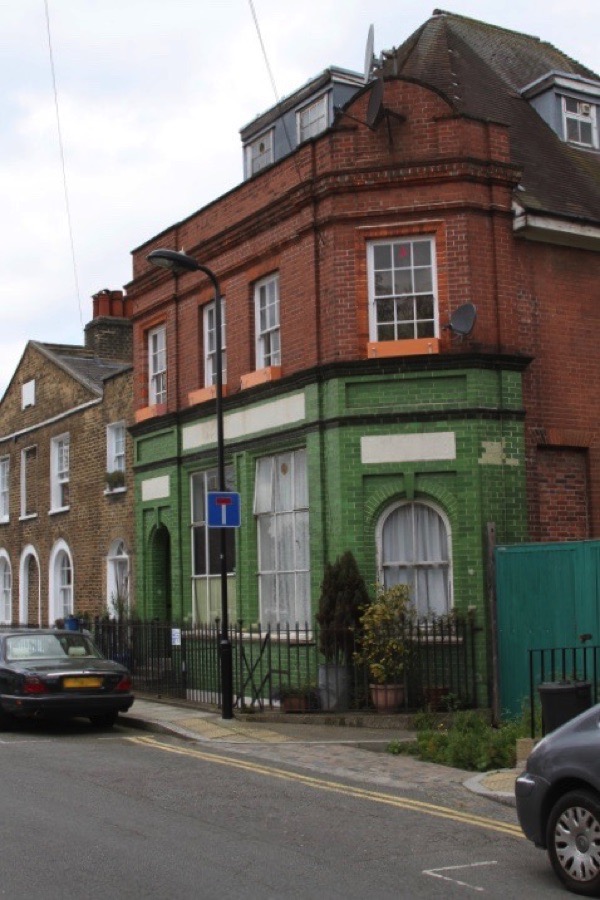
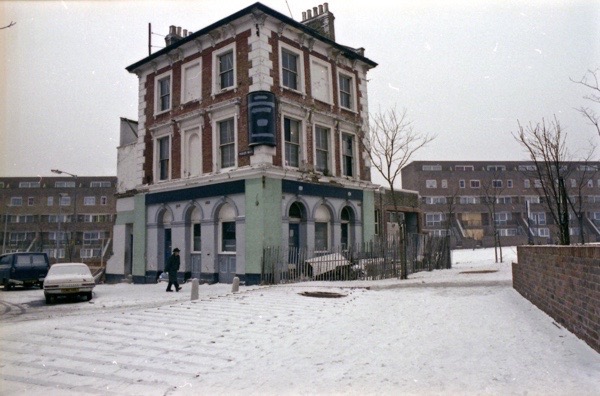
Brunswick Arms, Macdonald Rd, Archway

Demolished in the early eighties, there is no trace of the pub today

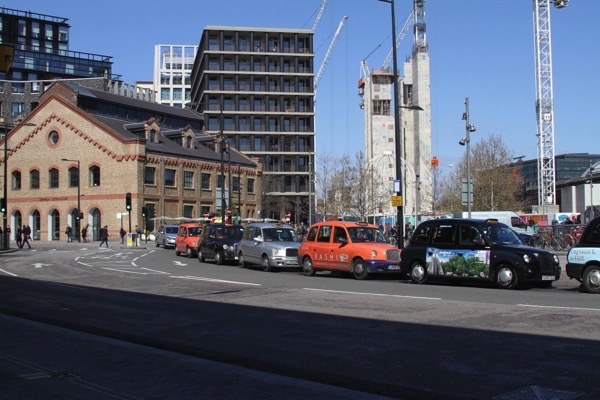
Old Bell Tavern, St Pancras

The same view today

Horn Tavern, Knightrider St, City of London (now known as The Centrepage)

Originally known as the Horn Tavern, the pub can be seen when crossing the foot bridge from Tate Modern to St Pauls. A grade II listed building, built in the mid-nineteenth century – the area around the pub has changed significantly

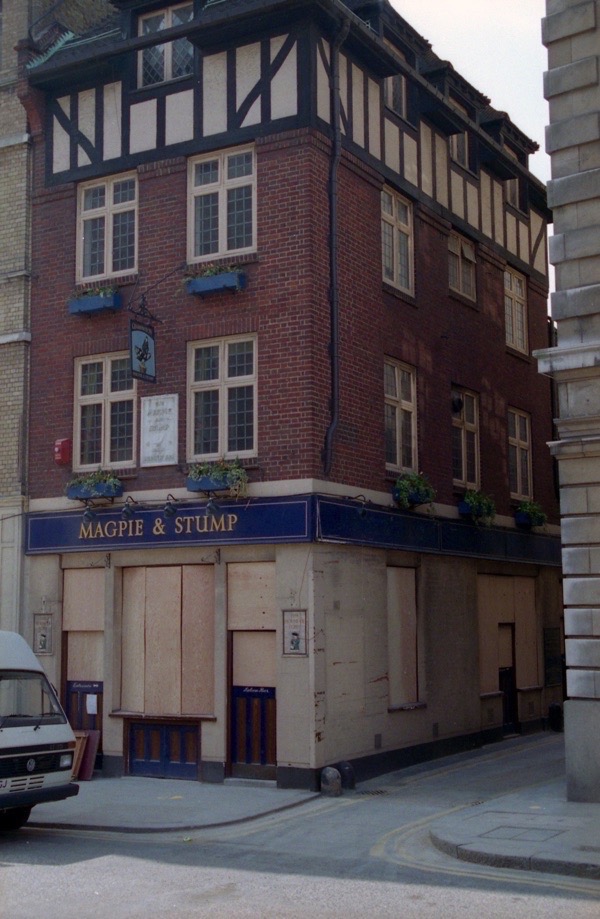
Magpie & Stump, Old Bailey

Opposite the Old Bailey, the Magpie & Stump was apparently nicknamed ‘Court Number 10’ as it was regularly filled with detectives and reporters

The Bull’s Head (Landlords fight to save City pub)

The Bull’s Head was demolished in 1990 to make way for this office development

Marquis of Anglesey, Ashmill St

The pub closed around 2009 and became offices

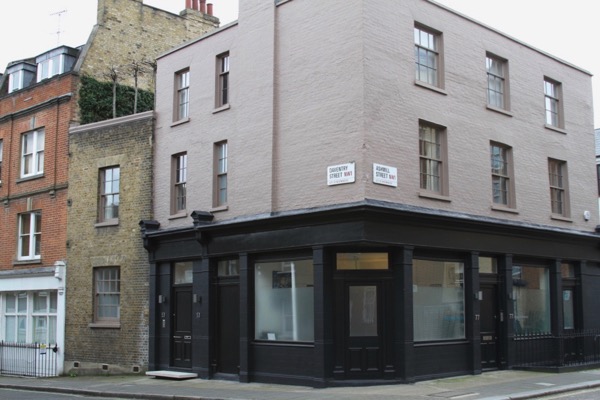
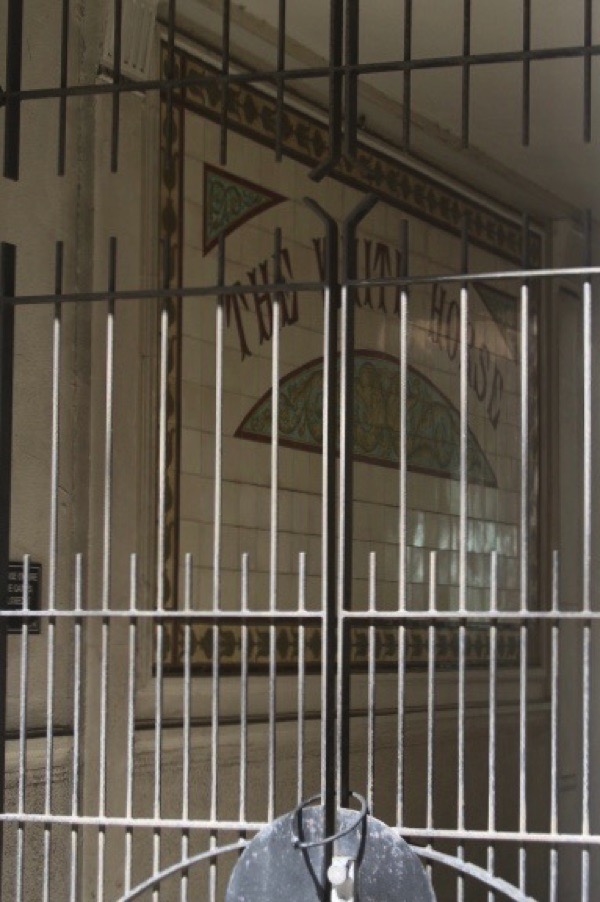
The White Horse, Little Britain

There seems to have been a pub on this site since 1765, it was rebuilt in 1892 but closed around 1971 and converted to offices

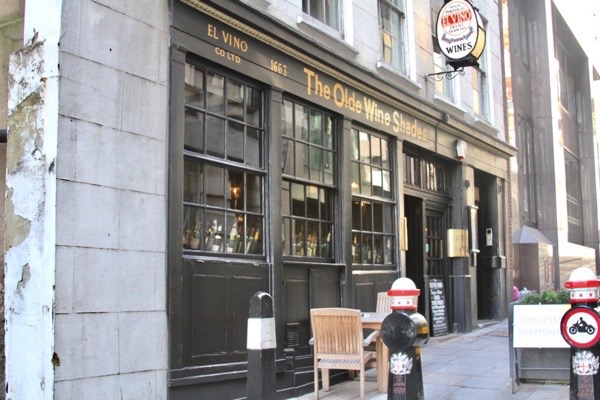
The Olde Wine Shades, City of London

This establishment was built in 1663, predating the Great Fire by three years. Due to the architectural and historical significance, it is grade II listed
Original photographs © Jeffrey Johnson
New photographs copyright © Rescue Dog Dexter
You may also like to take a look at
Ernest George’s Old London

Aldgate
Stefan Dickers, Archivist at Bishopsgate Institute, brought out these fine copper plate etchings by Ernest George (1839-1922) to show me this week. In the eighteen-eighties, George set out to immortalise those fragments of London which spoke of times gone by and Londoners long dead, recording buildings and views which have for the most part now disappeared.
I realise that my affection for these images sets me in line with the generations of chroniclers who have made it their business to document the transience of the city, starting with John Stow who wrote the very first Survey of London between 1560 and 1598 to describe the streets of his childhood that were vanishing before his eyes.
Ernest George’s etchings were published by the Fine Art Society in New Bond St in 1884, a magnificent temple of culture designed by Edward William Godwin which survived through the twentieth century only to close in August 2018.

Bishopsgate

Wych St, Strand

Fouberts Place, Soho

Crown Court, Pall Mall

St Bartholomew, Smithfield


Warwick Lane, City

Tower of London

London Bridge

Staple Inn, Holborn

Drury Lane

St John’s Gate, Clerkenwell

Limehouse

Shadwell
Images courtesy Bishopsgate Institute
You may also like to look at
Mavis Bullwinkle, Secretary

This is the earliest known photo of the remarkable Mavis Bullwinkle, seen here attending a Christmas party in 1932 at the Drill Hall in Buxton St, hosted by Rev Holdstock of All Saints’ Church, Spitalfields – Mavis can easily be distinguished to the left of the happy crowd, because she is a baby in her mother Gwendoline’s arms. In this picture, you see her at the centre of life in Spitalfields and even though this hall does not exist anymore and the church it was attached to was demolished in 1951, and everyone else in this photo has gone now too, I am happy to report that Mavis is still alive and kicking, to carry the story of this world and continue her existence at the centre of things in the neighbourhood.
Mavis’ grandfather, Richard Pugh, was a lay preacher who came to Spitalfields with his wife and family from North Wales in 1898, where he held bible classes at All Saints and spoke at open air meetings and, in the absence of social workers, counselled men from the Truman Brewery in their family problems. His mother paid for him to return alone to Wales to see her for two weeks annual holiday from the East End each year. But Mavis’ grandmother Frances never had a holiday, she said, “Why should people take notice of you when you talk of living the Christian life, when you have an easier time than they do?” Then in 1905, Richard died unexpectedly of pneumonia and Frances was left almost bereft in Spitalfields. She had to leave the church house and take care of her seven children alone. She received a modest pension from the Scripture Readers’ Union until her youngest son, Albert, was fourteen, the Truman Brewery gave her a small grant twice a year and she took work scrubbing floors.
The family moved into Albert Family Dwellings, a large nineteenth century block in Deal St, where subsequently Mavis grew up, living there until it was demolished in 1975 when they were rehoused in a new block in Hanbury St. And today, when I visited Mavis in Hanbury St less than a hundred yards away from the site of Albert Family Dwellings and she described her grandmother who died when she was six, an extraordinary perspective became apparent, connecting our world with that of Spitalfields more than a century ago.“I remember her shape and her North Wales accent, a lilt.” Mavis told me, conjuring the image in her mind’s eye,” She would always call my father Alfred, when everyone else called him Alf. She was short of stature and she worked hard.”
Mavis’ testimony of life in the East End is one of proud working class families who strove to lead decent lives in spite of limited circumstances. “People like to think that they were all drunks who dropped their ‘h’s, and they were dirty,” she said, eager to dispel this misconception, “Years ago, people were poor but they were completely clean. You can wash without a bathroom, but it takes a lot of work. My father used to put the water on to boil and pour it into the bath. And in the Family Dwellings, it was very well maintained, low rents, strict rules and a uniformed superintendent. When my mother was small and people had large families, if the superintendent saw children playing after eight o’ clock, he’d say ‘Go to bed!’ and you had to do it. I often think of it now when I see children playing outside at eleven at night. Then, everyone used to know each other and help one another. If you were going away on holiday, you’d tell everyone and they’d wave you goodbye.”
Mavis’ story of her family’s existence in Albert Family Dwellings spans the original flat where her grandmother lived with her two maiden aunts, and then Mavis’ parents’ flat that she grew up in. Mavis took care of her mother and the two aunts, who lived to be eighty-six,ninety and ninety-five respectively, even after they all moved out – seventy years after they first moved in as an act of expediency. But by then the nature of the place had changed and it was condemned as part of a slum clearance programme. “It suddenly went down hill in the late fifties when the housing association sold it,” admitted Mavis with a regreftul smile, looking from her living room window across the rooftops of Spitalfields to the space where Albert Family Dwellings formerly stood, a space that holds so much of her family history. If Mavis had married, she would have left Spitalfields but instead she stayed to care for the elderly members of her family and worked for forty years as a secretary in the social work department at the Royal London Hospital, where she was born in 1932. A woman of dauntless temperament, even retired now, she returns one day a week on a voluntary basis to do typing for the friends of the hospital and on another day each week she does reading with a reception class at Christ Church School in Brick Lane where she is a governor.
In Mavis’ personal landscape, Spitalfields’ neighbouring territory, the City of London holds an enduring fascination as a symbolic counterpoint to these streets where she makes her home. “I love the City because I went to school in the City at the Sir John Cass School,” she confided with pleasure, “and my father worked as a clerk in the City, at the Royal London Oil Company for fifty-one years. To go from Tower Hamlets to the City, crossing Middlesex St, was like crossing the River Jordan to the Promised Land. Everyone in Stepney used to dream of living in the City. Before the war, all kinds of people lived in the City, caretakers and such, not just rich people like now.” And then Mavis ran into another room to bring a framed certificate to show me and held it up with a gleaming playful smile of triumph. It read, “Mavis Gwendoline Bullwinkle, Citizen of the City of London.”
Mavis Gwendoline Bullwinkle – Citizen of Spitalfields – is a woman who makes no apology to call herself a secretary, because she is inspired by the best of that proud nineteenth century spirit which carried a compassionate egalitarian sense of moral purpose.

Mavis’ mother’s family, the Pughs of North Wales, photographed in Spitalfields in 1900. At the centre, Mavis’ grandmother Frances holds Mavis’ mother Gwendoline as a baby, with her grandfather Richard at her shoulder, a lay preacher who died unexpectedly of pneumonia four years later.


Handbill for one of Mavis’ grandfather’s bible classes at St Matthew’s Mission, Fulham.

Mavis’ mother Gwendoline and her sisters at All Saints School, Buxton St, Spitalfields, 1904. g – Gwendoline, l – Laura, a – Ada and h – Hilda.

Mavis’ father’s family, the Bullwinkles of Bow in 1917. Her grandmother Lousia sits on the left and her grandfather Edwin on the right. Mavis’ father Alfred stands between his two brothers Harry and Ted, both in Royal Air Corps uniform. The eldest daughter standing behind her mother was also Louisa but known as “Sis.”

Mavis, with her parents Gwendoline and Alfred, and younger sister Margaret in Barking Park, 1939 – before Mavis & Margaret were evacuated to Aylesbury.

Mavis stands on the extreme left of this picture of the All Saints Church Spitalfields choir, 1951.

Mavis sits at the centre of the picnic at this Christ Church, Spitalfields, Sunday School outing to Chalkwell in the late fifties – presided over by Mrs Berdoe (top centre).

Mavis Bullwinkle in her Hanbury St flat