
The Bones Of Old London
Inspired by my recent fracture, the distinguished historian Gillian Tindall sent me this wonderful rumination upon the capital’s osteological history. Gillian’s forthcoming memoir, The Pulse Glass: And the Beat of Other Hearts, is published in October.

The Hardy Tree
The name given to this tree commemorates the novelist and poet Thomas Hardy who, as an architectural student, was sent to monitor the place one week in 1865 when Old St Pancras Church and graveyard were threatened by the construction of the new Midland Railway line into St Pancras Station.
Although there is little evidence to link Hardy with the ash tree, people like the story that the superfluous gravestones were stacked around the sapling at his instigation. Even if it is unlikely that Hardy, or the fellow student who accompanied him, had the authority to suggest such a notion, it is fascinating to realise that he was a witness when it became apparent that the Midland Railway’s attempt to dig a tunnel under the ancient graveyard was going wrong.
The Midland Railway directors had failed to get permission for a truly terrible plan to obliterate the church and graveyard altogether. After further discussion, they and the Home Office agreed that a tunnel fifteen feet under would be deep enough to pass beneath any graves. Yet the site had been used for burial for over a thousand years, during which time the green hill had grown steadily higher. Soon the workmen began to complain that they were digging through compacted, rotten coffin wood and a mass of human bones. ‘It was not,’ they said, ‘healthy,’ though whether they were more worried about ancient disease or revenge from the dishonoured dead is unclear.
A top level decision was taken. A high fence was erected and, over one long weekend, a huge quantity of human remains were removed, carted under cover to Paddington Station and thence by train to a cemetery in Bournemouth. Among them were the remains of Mary Wollstonecraft, who died in 1797 after giving birth to the daughter who was to marry Percy Bysshe Shelley, and Mary’s husband the philosopher William Godwin – though their tombstone remains in the garden to this day.
Hardy’s lasting connection to this disgraceful removal drama is a poem he wrote long after, In the Cemetery, imagining an old graveyard that had been summarily dug-up for the passage of a new main drain.
‘… we moved the lot some nights ago,
And packed them away in the general foss
With hundreds more. But their folks don’t know,
And as well cry over a new-laid drain
As anything else, to ease your pain!’
If this saga of the Midland Railway’s misjudgement is well known, few are aware that they had another go at taking the churchyard nine years later. I only know this because I came upon a letter written to The Times in May 1874 by the company directors, who were still hoping to run railway lines over the burial ground.
They claimed they ‘did not propose to create thoroughfares or to take the ground by high-handed powers.’ Nor did they did actually intend ‘to break the soil.’ All they wanted was ‘to use the ground for lines of rails and light sheds… It is also proposed to allow monuments and remains to stay… but the ground would be raised ten feet to bring it on a level with the other property of the company.’
The sheer conceit and nerve of this proposal takes your breath away. Did they really imagine that those visiting a grave between the light sheds and rails would climb up and down ten foot high railway embankments in their crinolines and top-hats, hoping not to be hit by a train?
It was made clear to the railway company that they were not going to win this one. So outraged was public opinion by this example of commercial priority attempting to nullify ancient decency, that Parliament, which had already enacted legislation about old burial grounds earlier in the century, got fiercer on the matter. Henceforth it became illegal to obliterate any such ground, to use it to erect a permanent building or indeed for anything but a park or a playground. And although all ordinary gravestones might be removed for this purpose, they were not to be destroyed but recorded, and then ranged around the perimeter walls or some other convenient place. Such as round a significant tree.
Two hundred and fifty years later, we arrive at the current agitation about the removal of graves from St James Gardens for the High Speed Two scheme, just a short distance from St Pancras Old Church. Until recently this was in use as a back garden for the National Temperance Hospital, but it was created in the late eighteenth century as an overflow burial ground for St James, Piccadilly. Currently it is a huge excavation site, with diggers and archaeologists beavering away.
Since the Disused Burial Grounds Act of 1884, created partly in response to the Midland Railway’s attempts to get their hands on Old St Pancras, it has been illegal to build on or otherwise disturb a burial ground. This is the general principle, but a big government-sponsored scheme may bypass this legislation with its own specific Act of Parliament. The graveyard will still be subject to a raft of rules about the recording of stones, the preservation and re-siting of monuments, the removal of all remains and their eventual reburial or other respectful treatment – but it will go.
You might imagine from the emotion generated about the desecration of St James Gardens that is a uniquely modern disgrace, but it is not. Countless burial grounds on eighteenth century maps have disappeared without any formal record.
Nor is this the first assault on St James Gardens. Between about 1788, when it was laid out, and 1853 when it was shut for burial, some sixty-one thousand people were interred there. Even when it was still in constant use, in the eighteen-thirties, it had a substantial triangular chunk cut out when the London & Birmingham line into Euston was constructed through it. There was no great fuss about this and the bodies were re-buried in the remaining part of the cemetery.
The reality is there are human remains almost everywhere, far under our feet, all over London. It is simply that we are not aware of them, mostly. The fact that St James Garden was laid out as an overflow indicates the scale of the problem that arose. Another new ground to the north was laid out to accommodate the dead of St Martins-in-the-Fields. Similarly, Old St Pancras graveyard was actually two grounds, one belonging to St Pancras parish and the other to St-Giles-in-the-Fields.
Why, you may wonder, did all these ancient graveyards, which had been in use for hundreds of years, all get full all at the same time, in the days of Queen Anne and the Hanoverian Georges?
With the City of London expanding into its surrounding hamlets, the populations of the surrounding country parishes grew. By then coffins had for the first time come into general use, filling up the graveyards. In earlier centuries, most people were buried only in woollen shrouds, with little or no attempt to mark individual graves. That was how churchyards managed for so many centuries to accommodate uncounted numbers: gravediggers simply dug and re-dug the same earth, piling old bones in charnel houses and dumping more earth on top of fresher burials. One may well feel that coffins-for-all has not, by and large, been a good idea. Especially when they are tightly sealed and lined with lead, in flat contradiction of the biblical view that we are dust and should return to dust.
Who is aware, as they hurry down Farringdon Rd towards Blackfriars Bridge, that they are treading over the former graveyard of St Brides, Fleet St? No-one knew until post-war excavations in the fifties revealed the fact. And, going back still further in time, who, wandering round the City today, reflects that in the Middle Ages the Square Mile housed more than fifty religious foundations each with its own burial place, most of which were lost after the Reformation half a millennium ago? We enjoy a large number of tiny gardens in the City, much valued for eating sandwiches in lunch hours. These are the churchyards of the numerous parishes, all of which were shut for burial in 1853 but protected from developers, just in time, by the Act of 1884. Already, many grounds had been appropriated for other uses, both in the City and over the river in Southwark.
Southwark inhabitants were particularly vulnerable to being built on after death, since many non-conformists settled there in the seventeenth and eighteenth centuries, and their graveyards do not have consecrated status. When a site in the area is redeveloped, the builders often come upon old bones and there is often local speculation that it was a plague pit, perhaps because that sounds exciting. Usually, checking an old map confirms that what has been found is just a congregation of early Methodists or Primitive Baptists.
Much excitement has arisen in recent years over the Cross Bones Yard off Borough High St which is widely believed to contain the burials of prostitutes who were put there because they were despised. Yet there is little historical evidence for this nor that it was a pauper yard any more than many other burial places. It was an overflow ground for the parish of St Saviour’s (now Southward Cathedral) and dates from after the South Bank had ceased to be a district of medieval brothels.
Personally, I am glad the Cross Bones Yard is preserved because far too much of historic Southwark was unnecessarily destroyed in the decades after World War Two. Yet we should be wary of automatically regarding the dead as victims of disgraceful treatment in the past. The past was not just ‘a foreign country’ where things were ‘done differently’ as L.P. Hartley wrote. It was also a place full of people just as intelligent as us, leading lives just as complex as our own. In this sense, they were indeed ‘just like us.’ So it follows that we today, with our own prejudices, blind spots and sentimentalities are just like them too. Let us not patronise them.

At the Cross Bones Yard
You may like to read these other stories by Gillian Tindall
Memories of Ship Tavern Passage
At Captain Cook’s House in Mile End
Where The White Chapel Once Stood

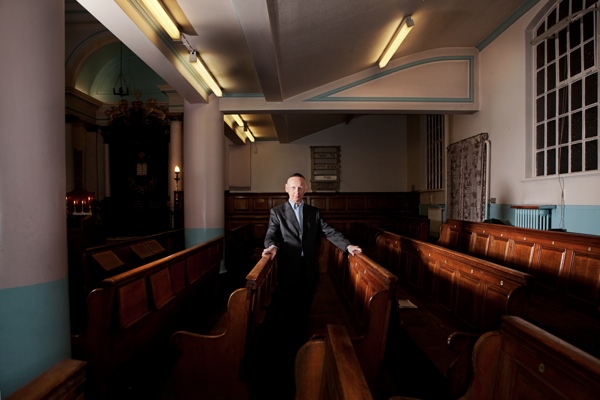
Leon Silver, Nelson St Synagogue

When Leon Silver opened the golden shutter of the ark at the East London Central Synagogue in Nelson St for me, a stash of Torah scrolls were revealed shrouded in ancient velvet with embroidered texts in silver thread gleaming through the gloom, caught by last rays of afternoon sunlight.
Leon told me that no-one any longer knows the origin of all these scrolls, which were acquired as synagogues closed or amalgamated with the departure of Jewish people from the East End since World War II. Many scrolls were brought over in the nineteenth century from all across Eastern Europe, and some are of the eighteenth century or earlier, originating from communities that no longer exist and places that vanished from the map generations ago.
Yet the scrolls are safe in Nelson St under the remarkable stewardship of Leon Silver, President, Senior Warden & Treasurer, who has selflessly devoted himself to keeping this beautiful synagogue open for the small yet devoted congregation – mostly in their eighties and nineties – for whom it fulfils a vital function. An earlier world still glimmers here in this beautiful synagogue that may not have seen a coat of new paint in a while, but is well tended by Leon and kept perfectly clean with freshly hoovered carpet and polished wood by a diligent cleaner of ninety years old.
As the sunlight faded, Leon and I sat at the long table at the back of the lofty synagogue where refreshments are enjoyed after the service, and Leon’s cool grey eyes sparkled as he spoke of this synagogue that means so much to him, and of its place in the lives of his congregation.
“I grew up in the East End, in Albert Gardens, half a mile from here. I first came to the synagogue as a little boy of four years old and I’ve been coming here all my life. Three generations of my family have been involved here, my maternal grandfather was the vice-president and my late uncle’s mother’s brother was the last president, he was still taking sacrament at ninety-five. My father used to come here to every service in the days when it was twice daily. And when I was twenty-nine, I came here to recite the mourner’s prayer after my father died. I remember when it was so crowded on the Sabbath, we had to put benches in front of the bimmah to accommodate everyone, now it is a much smaller congregation but we always get the ten you need to hold a service.
I’m a professional actor, so it gives me plenty of free time. I was asked to be the Honorary Treasurer and told that it entailed no responsibility – which was entirely untrue – and I’ve done it ever since. As people have died or moved away, I have taken on more responsibility. It means a lot to me. There was talk of closing us down or moving to smaller premises, but I’ve fought battles and we are still here. I spend quite a lot of hours at the end of the week. We have refreshments after the service, cake, crisps and whisky. I do the shopping and put out the drinks. The majority here are quite elderly and they are very friendly, everyone gets on well, especially when they have had a few drinks. In the main, they are East Enders. We don’t ask how they come because strictly speaking you shouldn’t ride the bus on the Sabbath. Now, even if young Jewish people wanted to come to return to the East End there are no facilities for them. No kosher butcher or baker, just the kosher counter at Sainsburys.
My father’s family came here at the end of the nineteenth century, and my maternal grandfather Lewis (who I’m named after) came at the outbreak of the First World War. As a resident alien, he had to report to Leman St Police Station every day. He came from part of the Austro-Hungarian Empire and he came on an Austrian passport, but when my mother came in 1920, she came on a Polish passport. Then in 1940, my grandfather and his brothers were arrested and my grandmother was put in Holloway Prison, before they were all interned on the Isle of Man. Then my uncle joined the British army and was told on his way to the camp that his parents had been released. My grandparents’ families on both sides died in the Holocaust. My mother once tried to write a list of all the names but she gave up after fifty because it was too upsetting. And this story is true for most of the congregation at the synagogue. One man of ninety from Alsace, he won’t talk about it. A lot of them won’t talk about it. These people carry a lot of history and that’s why it’s important for them to come together.
When Jewish people first came here, they took comfort from being with their compatriots who spoke the same style of Yiddish, the same style of pronunciation, the same style of worship. It was their security in a strange new world, a self-help society to help with unemployment and funeral expenses.”
Thanks to Leon, I understood the imperative for this shul to exist as a sacred meeting place for these first generation immigrants – now in their senior years – who share a common need to be among others with comparable experiences. Polite and softly spoken yet resolute in his purpose, Leon Silver is custodian of a synagogue that is a secure home for ancient scrolls and a safe harbour for those whose lives are shaped by their shared histories.


Photographs 2 & 3 © Mike Tsang
Chris Miles’ East End

Chris Miles contacted me from Vancouver Island, where he describes himself as a Londoner in exile. ‘In the early seventies, I lived as a recently-graduated student in the East End, firstly on Grove Rd and then on Lauriston Rd above a supermarket,’ he explained and sent me his splendid photographs. Most were taken around Bethnal Green, Roman Rd and Mile End, and Chris & I welcome identification of precise locations from eagle-eyed readers.

George Davis is Innocent, Mile End Rd

Linda ‘n Laura

Getting a loaf, Stepney Green

S Kornbloom, Newsagent & Confectioner, Jubilee St

Corner Shop Groceries & Provisions, Stepney Way

Ronchetti’s Cafe, Piano’s & Kitchen Chairs Wanted

Snacks & Grills

The Bell Dining Rooms, Lot 63 Buildings at back

Leslies Restaurant, Fresh Up with your Meal

Harry’s Cafe, Teas & Snacks, Breakfasts & Dinners

Valente’s Cafe, Hackney Rd

Cafe Restaurant

Dinkie

Station Cafe

Fish Bar

J Kelly, No Prams or Trollie’s, Please

G Kelly

Charlie & Mick’s Cafe

Menu at Charlie & Mick’s Cafe

John Pelican

Joe’s Saloon – ‘We cater for long and short hair styles’

M Evans & Sons, Garn Dairy

Marion’s, Blouses, Trouser Suits, Smock Dresses, Ect.

Sunset Stores

N Berg, Watch & Clock Repairs


S Grant, High Class Tailor, Seamens Outfitter

Littlewood Brothers Ltd, Domestic Stores, Grocery & Hardware

J Galley & Sons, Established 1901

Henry Freund & Son, Established 1837

Rito for Better Roof Repairs

Common Market NO

Alan Enterprises Ltd, L & R Ostroff Ltd, Brick Lane

Photographs copyright © Chris Miles
You may also like to take a look at
Eleanor Crow’s Cafes
Years have passed since we first featured Eleanor Crow’s beautiful watercolours in these pages and Spitalfields Life Books is now publishing a handsome hardback collection of them SHOPFRONTS OF LONDON, In Praise of Small Neighbourhood Shops in collaboration with Batsford Books.
You can preorder to support publication and you will receive a signed copy in the first week of September. Click here to preorder for £14.99
An exhibition of Eleanor’s watercolours opens at Townhouse Spitalfields on 3rd October.
Eleanor will giving an illustrated lecture at Wanstead Tap on Wednesday 9th October, showing her pictures and telling the stories of the shops. Click here for tickets

Syd’s Coffee Stall, Shoreditch High St
Eleanor made this set of watercolour portraits of cafes as a tribute to those cherished institutions which incarnate the essence of civility in the East End. “It’s because they’re individual concerns, often owned by families across generations who get to know all their customers,” admitted Eleanor, revealing the source of her devotion to cafe culture ,“I like the frontages because each is designed uniquely for that café with wonderful sign-writing or lettering and eye-catching colours. Some of these cafés have been here for a very long time and everyone in the area is familiar with them, and is very fond of them. They make the streets into a better place and are landmarks upon the landscape of the East End.”

E. Pellicci, Bethnal Green Rd

Savoy, Norton Folgate

Time for Tea, Shoreditch High St

Dalston Lane Cafe

Paga Cafe, Lea Bridge Rd

Lennies Snack Bar, Calvert Avenue

Marina Cafe, Mare St

Kingsland Cafe, Kingsland Rd

Grab & Go, Blackhorse Lane

Gina’s Restaurant, Bethnal Green Rd

Copper Grill, Eldon St

Billy Bunter’s Snack Bar, Mile End Rd

Beppe’s Cafe, West Smithfield

B.B. Cafe, Lea Bridge Rd

Savoy Cafe, Graham Rd

A.Gold, Brushfield St

Arthur’s Cafe, Kingsland Rd

Cafe Bliss, Dalston Lane

Cafe Rodi, Blackhorse Lane
 Rossi Restaurant, Hanbury St (Gone but not forgotten)

Eleanor Crow at E.Pellicci
Drawings copyright © Eleanor Crow
Portrait copyright © Colin O’Brien
You may also like to read
At Regis Cafe, Leadenhall Market
At Syd’s Coffee Stall, Shoreditch High St

CLICK HERE TO ORDER A SIGNED COPY FOR £14.99
At a time of momentous change in the high street, Eleanor’s witty and fascinating personal survey champions the enduring culture of Britain’s small neighbourhood shops.
As our high streets decline into generic monotony, we cherish the independent shops and family businesses that enrich our city with their characterful frontages and distinctive typography.
Eleanor’s collection includes more than hundred of her watercolours of the capital’s bakers, cafés, butchers, fishmongers, greengrocers, chemists, launderettes, hardware stores, eel & pie shops, bookshops and stationers. Her pictures are accompanied by the stories of the shops, their history and their shopkeepers – stretching from Chelsea in the west to Bethnal Green and Walthamstow in the east.
John Thomas Smith’s Ancient Topography

Bethelem Hospital with London Wall in Foreground – Drawn June 1812
Two centuries ago, John Thomas Smith set out to record the last vestiges of ancient London that survived from before the Great Fire of 1666 but which were vanishing in his lifetime. You can click on any of these images to enlarge them and study the tender human detail that Smith recorded in these splendid etchings he made from his own drawings. My passion for John Thomas Smith’s work was first ignited by his portraits of raffish street sellers published as Vagabondiana and I was delighted to spot several of those familiar characters included here in these vivid streets scenes of London long ago.

Bethel Hospital seen from London Wall – Drawn August 1844

Old House in Sweedon’s Passage, Grub St – Drawn July 1791, Taken Down March 1805

Old House in Sweedon’s Passage, Grub St – Drawn July 1791, Taken Down March 1805

London Wall in Churchyard of St Giles’ Cripplegate – Drawn 1793, Taken Down 1803

Houses on the Corner of Chancery Lane & Fleet St – Drawn August 1789, Taken Down May 1799

Houses in Leadenhall St – Drawn July 1796

Duke St, West Smithfield – Drawn July 1807, Taken Down October 1809

Corner of Hosier Lane, West Smithfield – Drawn April 1795

Houses on the South Side of London Wall – Drawn March 1808

Houses on West Side of Little Moorfields – Drawn May 1810

Magnificent Mansion in Hart St, Crutched Friars – Drawn May 1792, Taken Down 1801

Walls of the Convent of St Clare, Minories – Drawn April 1797

Watch Tower Discovered Near Ludgate Hill – Drawn June 1792

An Arch of London Bridge in the Great Frost – Drawn February 5th 1814
Images courtesy Bishopsgate Institute
You may also like to take a look at
John Thomas Smith’s Vagabondiana
Sophie Spielman, Victorious Campaigner
Sophie Spielman led the residents’ campaign to save Treves & Lister Houses in Whitechapel

Portrait of Sophie Spielman by Sarah Ainslie
I had the pleasure of visiting ninety-five-year-old Sophie Spielman at her immaculate flat in Treves House, an elegant modernist block at the Whitechapel end of Vallance Rd, designed by Ralph Smorczewski and built by Stillman & Eastwick Field in 1956.
As the most senior resident in the building, where she has lived longer than anyone else, and at such a venerable age, you might expect Sophie to be taking it easy. Yet she has reluctantly found herself the focus of recent national media attention as the spokeswoman and figurehead for the residents of Treves House and the neighbouring Lister House, who were confronted with the prospect of losing their homes as part of Tower Hamlets Council’s plans to demolish and redevelop the properties. Thanks to the residents campaign led by Sophie, this week the council abandoned their redevelopment plans and the estate is saved.
Blessed with natural dignity and possessing a innate sense of decorum, Sophie is an heroic figure who faced these recent troubles with fortitude, viewing her situation from the perspective of one who has lived a full life and experienced a great deal. In particular, I was fascinated by the pleasing irony that Sophie who was born into an Iranian Jewish family, resident in India, should find herself at home in Whitechapel for the last half century, living among Jewish and Asian neighbours.
Sophie clasped her hands and gave me a world-weary smile, casting her mind back over the long journey which led her to the domestic happiness she found in Whitechapel, before confessing her disappointment that anyone could be so petty as to challenge her right to live out her days in her home of fifty-seven years.
“I was born in Bombay but my parents were Iranians. My grandmother was called Rachel and my mother was Leah, they were born in Iran. When my grandfather died, my mother was still very small and so my grandmother brought her to Bombay. Those children that were married stayed in Iran but those that were young came with her to Bombay, where there was a Jewish community known as the Sassoons who were from Iraq. They came to Bombay and they were like the Rothschilds of the East, so there was help there. We stayed there and I went to a Jewish school that was founded by the Sassoons.
When I was older, I worked in the Bombay Telephone Company for about twelve years. I joined as a shorthand typist, but I preferred to work with my hands because that is what I like to do. So I went into the Inspection Department checking all the different parts that go into a telephone.
At that time, India was under British rule and I had very good English. Although I had an English and a Jewish education, I felt closest to the English. My brother went to Canada for a while. When he came back, he said, ‘I’m going to England, do you want to come?’ So I said, ‘Oh I’d love to!’ That was my dream to come to England.
When I came here in 1957, I was first in Stamford Hill but, when I met my husband Nathan Spielman and got married, he already had this flat in Whitechapel. He was moved here in 1959 from Anthony St which was demolished and the residents were all given new flats. He worked in the railways, as a ticket collector at Liverpool St Station. He told me had been involved in the anti-fascist movement and was at the Battle of Cable St in 1936. He passed away in 1982 when my daughter Gloria was nineteen. I only had one child, my one and only – but she has five children!
I worked in Nortons, the suitcase factory, as a secretary in the office. I worked there until I got married and Gloria was born. At first, I took her to nursery and, when she was bit older and went to school, I worked part-time in Hatton Garden, in an office where they received and sold jewellery.
When I first moved into Treves House in 1962, it was all new and modern and I thought it was very nice. Now it is different, the council has neglected it for years, but I do not want to move from here. We had very good neighbours. Most of the original residents have died or moved away, apart from me. There is one tenant still living in the flat that was his grandparents, who were the very first to move in. I have Nora, an Irishwoman next door who is a very good neighbour. She always comes and visits me and asks, ‘Are you alright?’ I still walk down to Whitechapel every day, I have done it since I moved in. It is the only place I know now.“
 Sophie in Bombay in 1950

Sophie as a young woman

Nathan & Sophie Spielman

Sophie with her daughter Gloria


Treves House, designed by Ralph Smorkczewski and built by Stillman & Eastwick Field in 1956

Treves House seen from the garden
Treves & Lister Houses Are Saved
In an extraordinary reversal of policy by Tower Hamlets Council – delivering a landmark victory in the fight against redevelopment of council housing in London – Mayor John Biggs announced on Tuesday night that plans for the demolition of Treves & Lister Houses have been abandoned. The residents came together and waged a brave campaign to save their homes and they won.
Below I tell the extraordinary story of the heroic life of the architect Count Ralph Smorczewski.

Treves House, Whitechapel
I doubt if passers-by give a second thought to Treves House or its neighbour Lister House as they hurry up and down Vallance Rd between Whitechapel and Bethnal Green. Yet these two understated modernist buildings with clean lines and elegant proportions – one a long terrace and the other a tall block – were designed in 1956 by the architect Count Ralph Smorczewski, a man whose astonishing story connects to the very essence of the history of Whitechapel.
Until this week, these buildings faced an uncertain future. In recent years, the council failed to maintain them properly, encouraging decay and neglect. Tenants and leaseholders, including long-term resident ninety-five year old Sophie Spielman, feared they would be evicted and their homes demolished. Now these buildings are saved, perhaps they will be better appreciated, especially in the light of the architect’s heroic life and altruistic ambitions.
Ralph Smorczewski (1925-2009) grew up on his family’s estates in Tarnogóra and Stryjów, in the province of Lublin, Poland. Under the Nazi occupation, transports of Jewish people arriving from Germany and Austria began in 1942. In the summer, Ralph’s father realised these people were dying of starvation and applied to the Nazis for the maximum number of farm workers, as a means to feed and keep alive as many Jews as possible. Yet in the autumn, they were rounded up and packed into trains, bound for the death camps.
Ralph was just seventeen years old when this happened. It was a formative experience that informed his actions for the rest of his life. At eighteen years of age, he contacted the Polish Resistance and was sworn into their ranks. As the Red Army invaded, he and his family moved to Warsaw. When the Red Army arrived in August 1944, Ralph fought heroically with the Resistance in the Warsaw Uprising and worked as a surgeon’s assistant in a military hospital, before being arrested and interrogated by the SS. Despite torture and confinement, he gave no information and even convinced them he was Hungarian, leading to his eventual release.
Fleeing Warsaw, Ralph rejoined the Resistance in the forests near Czestochowa and was appointed second-in-command of a troupe. They killed a group of Nazi soldiers who had perpetrated some of the worst atrocities of the Warsaw Uprising, before taking part in a four-day battle against SS near the village of Krzepin.
In 1945, Ralph and his family obtained passes taking them by train to Vienna where they joined a refugee convoy fleeing west. When they reached Italy, Ralph joined the Polish II Corps, part of the Eighth Army. Posted to the 7th Horse Artillery Regiment, he graduated from the Officers’ School in June 1946 and, that autumn, arrived in England with the Corps, possessing little more than his uniform.
Ralph graduated from the Architectural Assocation in 1951 at twenty-six years old and worked at Stillman & Eastwick Field, one of the most notable practices contributing to idealistic post-war reconstruction of schools, hospitals and public housing.
Among the first buildings Ralph designed for Stillman & Eastwick Field were Treves House and Lister House in Whitechapel. This project served as the natural outcome of his experiences in the war. Certainly, it was no accident that he undertook this assignment to provide better homes for Jewish people. One such was Nathan Spielman, who was moved from a slum dwelling in Anthony St to Treves House in 1958, before marrying Sophie in 1962. Thus it is that the story of Sophie, the last of the original Jewish residents, connects to that of Ralph who designed the buildings, and both stories co-exist as part of the story of Whitechapel itself.
Yet Treves House and Lister House do more than reflect an historical moment. In the generosity of their accommodation, they embody the humane values that led to their creation. These fine buildings deserve to be cherished because we need them to remind us of their origin and serve as an inspiration for generations to come.

Lister House, Whitechapel

Residents of Treves & Lister House: (From left to right) Tasahood Choudury, Ashraf Choudury, Hasan Zaman (behind), Muhammad Noor, Usama Noor, Nabiha Haque, Sophie Spielman, Mr Kamal, Ziaul Syed, Ayman Syed (in front), Syed Hass (behind), Muhammad Khan, Mahrisa Khan (in front), Syed Ali, Ayaan Ali, Satyendra Roy, Elif Ozturk, Ismigul Osturk, Mjibur Rahman & Khayrun Begum (in front).

Count Ralph Smorczewski, Architect of Treves House & Lister House
Photograph of residents © Sarah Ainslie


