
Joan Rose At Arnold Circus
Celebrating our tenth anniversary with favourite posts from the first decade

This gracious lady with the keen grey eyes is Joan Rose, standing in the door way of Leila’s Shop, 15 Calvert Avenue, on the spot where her father was photographed in 1902, aged six.
The photograph below was believed to have been taken one Sunday around the time Prince Edward and Princess Alexandra came to open the Boundary Estate. After restaging the photograph in December 2010 with the assistance of a class from Virginia Rd School, I was eager to meet Joan and learn something of her experience as a child growing up in Arnold Circus early in the last century.
Joan (unmarried name Raymond) told me that her father Alfred was born in 1896 and is approximately six years old in the picture. The woman beside him in the doorway is Phoebe Raymond his mother, Joan’s grandmother, and the man on the left is his father, Joan’s grandfather Albert Alfred Raymond (known as Alf), the first proprietor of the newly built shop. They all lived in the flat up above and you can see their songbird in the cage, a cock linnet. Phoebe has her smart apron with frills and everyone is wearing their Sunday best – remarkably for the time, everyone has good quality boots.
Joan believes her family are of French Huguenot origin and the original surname was Raymond de Foir, which means the people you see in the old photograph are probably descended from the Huguenot immigrants that came here in the eighteenth century.
What touched me most was to learn from Joan that Alfred her father – pictured eternally six years old in his Sunday best on the threshold of his father’s shop – went off to fight in the First World War and, aged twenty-two, was there at the battle of the Somme where so many died, but returned to run the shop in Calvert Avenue carrying on his father’s business in the same premises until his death in 1966.
Joan is a remarkably spirited person with an exceptional recall for names and places throughout her long life. An educated woman and former teacher, she can place anyone within London by their accent. Although unsentimental about the past, she talks affectionately about her happy childhood here in Arnold Circus. In 1951 she left to get married and live in Beacontree, but the emotional memory of her time in Shoreditch remains vivid to her. “I am here” she said to me when I met her for tea at Leila’s Cafe and I understood what she meant, even if today she lives on the other side of London.
When she was growing up in the nineteen thirties, Joan told me, she helped her grandfather in the shop and he called her “tangerine” because she always stole tangerines, even though she could have as many as she wanted. “I used to sit on his lap in the corner of the shop and he told me all these stories about the neighbourhood and I thought they were all nonsense – but later I found they were all true. He had a set of Shakespeare in the flat up above the shop and he said, “There’s a plaque to Shakespeare in St Leonard’s Shoreditch.” After he died, I found the plaque and I cried because I had never believed him.”
Joan was very close to her grandfather Albert who taught her the exact science of stacking fruit and vegetables in tall pyramids (stalks up for apples, pears, plums and tomatoes, eyes up for oranges) and when he went to Spitalfields Market in the dawn to buy new stock, he took her with him and they had breakfast together at one of the pubs that opened in the early morning. He kept a pony and trap in the yard at the back of the shop and took Joan for rides around Arnold Circus, that was when she learnt that eight times round the bandstand was a mile.
Born in 1926 as the youngest of four daughters, Lily, Vera and Doris being the names of her sisters, Joan’s family lived in a series of different flats in the Boundary Estate as she was growing up, moving at one point from 20 Shiplake Buildings (eighteen shillings and sixpence a week) to 10 Laleham Buildings (twelve shillings and sixpence a week) to save money.
“Although we had a shop here, my mother went out working as a furrier’s machinist. We never realised that things were hard for our parents. My mother made our clothes and Mr Feldman made our winter coats. It was a system of favours, you deal off me, I’ll deal off you. People were poor but proud, they ate the cheapest food, monkfish or a pig’s head as a Sunday roast. My father hated Christmas because he saw people buy the best of everything and toys for their children, when they could barely afford a loaf of bread, and he knew they would end up in debt, running round to the pawnbrokers in Boundary Passage.”
Joan never felt that she was disadvantaged by her origins until she and her sisters went up to the West End to dances and met boys who asked where they came from. “If you said you were from Shoreditch, that was the last you saw of them,” Joan admitted to me, “We used to say we were from Arnold Circus because they didn’t know where it was.” Occasionally, charabancs of out-of-towners would slow down outside Raymond’s grocers’ shop and the driver would announce to the passengers “And these are the slums,” much to her grandfather’s ire.
Joan’s father was disappointed that he never had a son to carry on the business in his family name but he changed his opinion when World War II came along, declaring he was grateful to have four daughters and not to have a son to send to war. There was a hidden irony to this statement, because he had an illegitimate son, Terry Coughlan, who turned up in the shop once to buy an apple when Joan was serving and her father was out. In a youthful impulse and, to Joan’s eternal regret, she said to her father when he returned, “Your son was here!” Alfred went into the back of the shop, talked with her mother, then came out and said “I spoke to the boy.” That was the last that was ever said of it and Joan never met her younger brother again. Now Joan would like to find him, he will be seventy years old if he lives.
Joan describes the burning of London in 1940, when the warden knocked on all the doors in the Boundary Estate, telling the residents to take refuge in the crypt of St Leonard’s Shoreditch. She was not scared at all until she got down into the crypt and saw the priest in his black robes walking among the hundreds of silent people sitting in the gloom, it was this eerie image that filled her with fear. Joan remembers the wartime shortage of onions and the queue that formed outside the shop stretching all the way round Arnold Circus to Virginia Rd when they came into stock.
Although her grandfather refused to leave during the London Blitz, Joan’s father took the family to Euston and made the spontaneous choice to buy tickets to Blackpool where he quickly found an empty shop to open up as a greengrocer, and they lived there until the war ended. As they left Euston, the sisters sat crying on the train and the other passengers thought a member of their family had been killed in the bombing, when in fact the four girls were weeping for their wire-haired terrier, Ruff, that had to be put down on the morning they left London.
We leave Joan in that railway carriage travelling North, knowing that she will come back to London, get married, have children, become a teacher, have grandchildren, have great-grandchildren and live into the new millenium to return to Arnold Circus and discover that the greengrocers opened by her grandfather in 1900 has reopened again and life goes on and on.
When she speaks, telling her stories, Joan fingers the broad gold ring made from her grandmother Phoebe and mother Lily’s wedding rings. Once, it had the initials JR, standing for Joan’s maiden name Joan Raymond, and it was on her husband’s finger but now that he has gone and the initials have been worn away, Joan wears it as a simple gold band to contain all the memories that she carries of her family and of this place. To many of us born later, even familiar history can appear as unlikely fiction, but meeting someone with Joan’s generosity of spirit, eloquence and grace brings the big events of the last century vividly alive as reality. Joan does not bear grievances or carry complaints, she has not been worn down or become in the least cynical by her life, she is an inspiration to us all.

15 Calvert Avenue, 1902

15 Calvert Avenue, 2010

Alfred was born in 1896 and is approximately six years old in the picture, beside him in the doorway is Phoebe Raymond, his mother

Joan Rose 2010

Alf & Phoebe Raymond, Joan’s grandparents outside their shop in 1900

Joan Rose presided over the cutting of the cake at the centenary of the Arnold Circus bandstand
You may also like to read about
Joan Rose at Gardners Market Sundriesmen

Paul Gardner, Paper Bag Seller
Celebrating our tenth anniversary with favourite stories from the first decade

Paul Gardner, The Paper Bag Baron of Spitalfields
I always delight to drop into the premises of my friend Paul Gardner – the paper bag seller of Gardners Market Sundriesman, 149 Commercial St – to observe the constant parade of long-standing customers who pass through, creating the life of this distinctive business. It was early one morning, when I called round at six-thirty – opening time – to enjoy a quiet chat before the rush, that Paul explained to me his great-grandfather James Gardner began trading here in this building as a Scalemaker when it was built in 1870 – which means Paul is a fourth generation Market Sundriesman and makes Gardners the longest established family business in Spitalfields.
Paul still has his great-grandfather’s accounts from the end of the nineteenth century, when as Scalemakers they serviced the scales for all the traders in the fruit and vegetable market on a regular basis. Turning the pages and scanning the lines of James’ fine copperplate handwriting your eye alights upon the names, Isaac, Isaiah and Ezekiel, indicative of the Jewish population that once defined the identity of Spitalfields. There is an ancient block of wood with three scoops carved out that are smoothed with wear, it has been in use since the days of Paul’s great-grandfather. Then his son Bertie (Paul’s grandfather) used it, then Bertie’s son Roy (Paul’s father) used it and Paul still keeps his cash in it today. As the twentieth century wore on, each of the successive Mr Gardners found that customers began to expect to buy their produce in a paper bag (a trend which is now reversed) and so the trade of dealing in bags supplanted the supply of scales entirely over four generations.
Turn your back on the traffic rattling down Commercial St and stand for a moment to contemplate the dignified Brunswick green frontage of Gardners Market Sundriesman. An old glass signs reads “Paper & Polythene Bag Merchant” and, sure enough, a variety of different coloured bags are festooned on strings like bunting, below them are some scales hinting at the origins of the business and then your attention is distracted by a mysterious wooden sieve, a memento of Paul’s grandfather. Enter the shop to be confronted by piles of bags of every variety in packets stacked up on either side and leaving barely any room to stand. Only two routes are possible, straight ahead leading into the dark recesses where the stacks grow taller and closer together in the gloom or turn right to the makeshift counter, improvised from an old counter-top supported upon yet more packets of bags. Beneath the fluorescent glow, the dust of ages is settling upon everything. You think you have entered a storeroom, but you are wrong because you neglected to notice Paul sitting at the counter in a cosy corner, partly concealed by a stack of bags. You turn to greet him and a vista appears with a colourful display of bags and tags and tapes and those old green-grocers’ signs that say “Today’s price 2/8” and “Morning Gathered” – which creates a pleasant backdrop to the figure of Paul Gardner as he stands to greet you with a genial “Hello!”
With his wavy grey locks, gentle face, sociable manner and innate decency, Paul could have stepped from another age and it is a joy to meet someone who has successfully resisted the relentless imperative to haste and efficiency at any cost, that tyrannises our age and threatens to enslave us all. When you enter the shop, you enter Paul’s world and you discover it is a better place than the one outside.
Paul was thirteen when his father Roy died unexpectedly in 1968, creating a brief inter-regnum when his mother took over for four years until he came of age. “I came here the first day after I left school at seventeen,” said Paul, “It was what I wanted to do. After the first year, my mother stopped coming, though my nan used to live above the shop then. I haven’t had a day off since 1972. I don’t make much money, I will never become a millionaire. To be honest, I try to sell things as cheap as I can while others try to sell them as expensive as they can. I do it because I have done it all my life. I do it because it is like a family heirloom.”
Paul Gardner’s customers are the stallholders and small businessmen and women of East London, many of whom have been coming for more than twenty years, especially loyal are the Ghanaian and Nigerian people who prefer to trade with a family business. Paul will sell small numbers of bags while other suppliers only deal in bulk, and he offers the same price per bag for ten as for a hundred. Even then, most of his customers expect to negotiate the price down, unable to resist their innate natures as traders. Paul explained to me that some have such small turnovers they can only afford to buy ten carrier bags at a time.
In his endeavours, Paul supports and nurtures an enormous network of tiny businesses that are a key part of the economy of our city. Many have grown and come back with bigger and bigger orders, selling their products to supermarkets, while others simply sustain themselves, like the Nigerian woman who has a stall in Brixton market and has been coming regularly on the bus for twenty-three years to buy her paper bags here. “I try to do favours for people,” says Paul and, in spontaneous confirmation of this, a customer rings with the joyous news that they have finally scraped enough money together to pay their account for the last seven years. Sharing in the moment of triumph, Paul laughs down the phone, “What happened, did you win the lottery or something?”
Paul has the greatest respect for his customers and they hold him in affection too. In fact, Paul’s approach could serve as a model if we wish to move forward from the ugliness of the current business ethos. Paul only wants to make enough to live and builds mutually supportive relationships with his customers over the longterm based upon trust. His is a more equitable version of capitalism tempered by mutual respect, anchored in a belief in the essential goodness rather than the essential greediness of people. As a fourth generation trader, Paul has no business plan, he is guided by his beliefs about people and how he wants to live in the world. His integrity and self-respect are his most precious possessions. “I have never advertised,” says Paul, “All my customers come because they have been recommended by friends who are already my customers.”
However, after Gardners survived two World Wars and the closure of the market, there is now a new threat in the form of rent increases demanded by greedy agents on commission, who can easily exploit the situation when chain stores can pay high rents which they do not need to match with turnover. “I earn two hundred and fifty pounds a week,” reveals Paul with frank humility, “If I earned five hundred pounds a week, I could give an extra two hundred and fifty towards the rent but at two hundred and fifty pounds a week, the cupboard is bare.”
Ruminating upon the problem, “They’ve dollied-up the place round here!” says Paul quietly, in an eloquently caustic verdict upon this current situation in which his venerable family business finds itself now, after a hundred and forty years, in a fashionable shopping district with a landlord seeking to maximize profits.
Gardners Market Sundriesmen embodies the spirit of Spitalfields and no-one can truly say they have been here unless they have shaken the hand of Paul Gardner. Yet more important than the history of his business, is the political philosophy that has evolved over four generations of experience. It is the sum of what has been learnt. In all his many transactions, Paul unselfconsciously espouses a practical step-by-step approach towards a more sustainable mode of society. Who would have expected that the oldest traders in Spitalfields might also turn out to be the model of an ethical business pointing the way to the future?


Paul’s grandfather Bertie Gardner, standing with Paul’s father Roy Gardner as child outside the shop around 1930


Roy Gardner, now a grown man, standing outside the shop after World War II, around 1947


Gardners Market Sundriesmen, 149, Commercial St, Spitalfields, E1
You may also like to read about
At Gardners’ Market Sundriesmen
Joan Rose at Gardners’ Market Sundriesmen
James Brown at Gardners’ Market Sundriesmen
Vigil at Gardners’ Market Sundriesmen
Christmas at Gardners’ Market Sundriesmen
Tenth Annual Report

‘How can I ever describe the exuberant richness and multiplicity of culture in this place? This is both my task and my delight.’
Ten years ago this week I promised to publish a story every day here in the pages of Spitalfields Life. When I began, I had no idea of where it might lead and I certainly did not expect to be here ten years later, typing with a single finger of my left hand after breaking my writing arm by falling from a Mulberry tree.
Yet I have no regret because this whole endeavour has enriched my life immeasurably. The hundreds of interviews I have undertaken and published have been an education for me in the nature of humanity. I have learnt that there is no such thing as an ordinary person. But, more importantly, I like people more. The city has become a more human place for me. The privilege of my work is that it has given me the opportunity to meet so many inspiring individuals. I cannot walk down the street now in Spitalfields without someone greeting me.
People sometimes address communications to the ‘Spitalfields Life team’ yet it is only me that puts the stories together and publishes them. Nevertheless I could not do this without a great many talented and magnanimous collaborators. There are so many I cannot name them all here lest I risk missing someone, but you will find their names everywhere in these pages.
Quite soon after I started, I realised that I needed help with photographs and I have been blessed to work with an astonishing team of distinguished photographers, who in turn have taught me to take my own photographs.
It was never my expectation to publish books, yet the success of virtual publishing has led to publishing nineteen volumes. I shall never forget the launch of my first book, Spitalfields Life, in March 2012 when more than three thousand readers stormed Christ Church and, for the first time, I came face to face with those I write to every day.
In my own career, I have known both success and disappointment. Consequently, it has been a great delight to be able to publish the work of writers, photographers and artists whom I admire, bringing sometimes neglected images and texts to the wider audience that they deserve. This whole process has been uplifted by the involvement of the top book designers working in this country.
I always seek the stories that no-one else is writing, but I never anticipated that by telling these stories I would become part of the story myself.
In these ten years Spitalfields has changed greatly. Through hundreds of interviews with shopkeepers, I learnt how many were struggling and, in 2012, two hundred met in Christ Church to form The East End Trades Guild of which I am proud to be one of the founders, advocating the interests of local small businesses.
The successful campaign led by Spitalfields Life saved the 1838 pub The Marquis of Lansdowne in Dalston from demolition in 2013. Out of this came The East End Preservation Society of which I am again proud to be one of the founders, campaigning to protect heritage and challenge exploitative development in the East End. Currently there are campaigns to Save the Whitechapel Bell Foundry and Save the Bethnal Green Mulberry.
When you begin to write a story you never know where it will lead. When I interviewed the master bell founder at the Whitechapel Bell Foundry in 201o, I did not expect to become involved in the story of the foundry myself. When I was taken to see the oldest tree in the East End in 2015, the Bethnal Green Mulberry, I did not know that it would lead to me falling out of a Mulberry tree and breaking my arm, years later….
When I started, I was drawn by the freedom of publishing online and having a direct relationship with my readers, without any of the intermediaries that exist in other media. Over the years a significant readership has accumulated and these loyal readers have encouraged and inspired me in my work, sustaining me through the years in this curious quest.
So I conclude my tenth annual report with a thankyou to you, the readers, because without you none of this would have been possible.
Thus another year passes in the pages of Spitalfields Life.
I am your loyal servant
The Gentle Author
Spitalfields, 24th August 2019
Over the next week or so, I will be publishing favourite stories from the last ten years while I enjoy a short holiday.

You may like to read my earlier Annual Reports
Whitechapel Bell Foundry Alert

We want Tower Hamlets Council to make it their policy to Save the Whitechapel Bell Foundry as a working foundry and reject the developers’ rotten proposal to turn it into a boutique hotel.
To this end, we need two thousand people who live, work or study in the London Borough of Tower Hamlets to sign a petition on the council website. This will trigger a debate on the subject at the next full meeting of the council on 18th September, which will give all the elected councillors the chance to express their opinions and vote on making Saving the Whitechapel Bell Foundry official council policy.
Please click on the link below to sign the petition and then circulate this to all your friends, family, workmates and neighbours in the borough over the holiday weekend.
There is no time to waste. The quicker we can get these two thousand names, the stronger the message it sends of the strength of feeling of residents on this matter.
CLICK HERE TO SIGN THE PETITION IF YOU LIVE, WORK OR STUDY IN THE BOROUGH OF TOWER HAMLETS


Photographs taken by David Hoffman at the Whitechapel Bell Foundry in July 1973 and published for the first time today © David Hoffman
[youtube Rd6_iUF5Kbg nolink]

You may also like to read about
Nigel Taylor, Tower Bell Manager
Four Hundred Years at the Whitechapel Bell Foundry
Pearl Binder at Whitechapel Bell Foundry
Dorothy Rendell at Whitechapel Bell Foundry
Hope for The Whitechapel Bell Foundry
A Petition to Save the Bell Foundry
Save the Whitechapel Bell Foundry
Parkash Kaur, Shopkeeper
Suresh Singh, author of A MODEST LIVING, Memoirs of a Cockney Sikh will in conversation with Stefan Dickers, Archivist of Bishopsgate Institute, at Tower Hamlets Local History Library & Archives at Bancroft Rd in Mile End on Saturday 7th September at 2:30pm. Suresh will be showing photographs and telling the story of his family who lived in Princelet St for seventy years. This event is free and no booking is required

‘We Punjabi girls are strong.’
Contributing Photographer Sarah Ainslie & I first met Parkash Kaur in 2015 when we were making portraits of the residents of the Holland Estate next to Petticoat Lane in Spitalfields. It was evident then that Parkash occupied a revered position among the residents as spiritual mother to the entire estate.
Only last year when I was working with Suresh Singh on his memoir, A MODEST LIVING, did I discover that Parkash was a Sikh who famously ran a grocers shop at 5 Artillery Passage with her husband Jarnail Singh. So close were these two Sikh families in Spitalfields that Suresh and his wife Jagir know Parkash as Aunty Ji and, in Suresh’s childhood, he knew Jarnail as Uncle Jarnail.
Jarnail came to London in 1951 from Jundalar in the Punjab to seek a better life and his wife Parkash joined him in 1953. They had been married when they were children. By 1958, they had saved enough money to put a deposit on a shop in Artillery Passage and in 1963 they bought it and moved in, opening the first Sikh grocer in East London.
Around 2000, they closed their shop and retired to live fifty yards away in the Holland Estate. Since Jarnail died in 2010, Parkash lives alone but Suresh & Jagir visit her regularly. Sarah Ainslie & I accompanied them recently and we shared a delicious dinner of Jagir’s homemade rotis and yoghurt while Parkash told her story to Suresh, who has translated it from Punjabi for us to read.
“Your father and my husband made a pact of love and they called themselves the ‘rodda’ Sikhs (the ones without turbans). They had this silent love that they kept dear between them and always knew of each other’s joy and pain, sometimes even without talking.
They sat and talked all day long in our shop at 5 Artillery Passage where me and your Uncle worked day and night. I would shut the heavy shutters in the evening and sleep on the top floor while your Uncle went to do a night shift at the rubber factory in Southall. I walked back the other day to Artillery Passage and I could not even find the door or the number. No one there spoke Hindi or Punjabi any more and I felt a deep loss. It made me very sad.
Our days started at 4am each morning when your Uncle Jarnail would bring boxes of fruit and vegetables from the Spitalfields Market across the road. Big rats would jump out of some of the boxes. I was so scared of the rats, but we had a lovely niece working for us who could catch them by their tails. She would never kill them, but lift the heavy grate from the sewer and send them back. She said they where gods.
Suresh, this was when you were very little. I remember your mother Chinee would always wave and call out ‘Sat Shri Akal’ (blessings to all) to me from far away, if she saw me in Petticoat Lane or in Itcy Park next to the big white church. She was a very observant women who always stuck by your father, Joginder.
I was so happy when your parents invited me and your Uncle Jarnail to your wedding with Jagir in 1984. It was a joyful occasion for Joginder. After his stroke, your father struggled to walk yet he would always come every day from Princelet St to our shop in Artillery Passage and ask your Uncle Jarnail, ‘Do you think we have enough roti flour?’ For a long time, we were the only shop in East London that sold roti flour and people would come from as far away as Mile End and Plaistow.
Your Uncle Jarnail and Joginder helped each other with money, they never wanted to let each other down. People would say ‘Jarnail is a jatt (a farm owner) but Joginder is a chamar (an untouchable).’ Your uncle would reply, ‘Get out of my shop! We do not believe in castes here. He is my brother.’
All the money earned by Punjabis in East London passed through our shop and we sent it over to the Punjab and exchanged it for rupees, so people could build big houses over there. Once I sat on thousands of pounds in cash all on my own while your Uncle was out, before it was sent to the Punjab. I learnt to be a very good counter of money. In those days, people were naive enough to believe that one day they would all take their families back to the Punjab and live there for ever. But in Joginder’s eyes, he knew the truth.
He was happy to spend time with your Uncle Jarnail in the shop. They often spoke of the assassin Udam Singh who lodged in 15 Artillery Passage in the thirties. He shot Michael O’ Dwyer who ordered the massacre of Sikhs in Amritsar when he was Lieutenant Governor of the Punjab.
When me and your Uncle Jarnail needed a break from the hard work of shopkeeping, dealing with customers who never wanted to pay the asking price and always wanted to barter, we would sit on the wall outside Artillery Passage and eat ice cream from another shop – just to have a change. That was our holiday.
Where are all those people who came to our shop now? All gone. The ones that we helped out, where are they? Not to be seen. But you and Jagir are here with me and you know you are always welcome in my home. I am happy that you and Jagir and look after me. Your Uncle Jarnail died and left me alone but I am strong. We Punjabi girls are strong.”

Portraits by Sarah Ainslie


Parkash Kaur

Jarnail Singh

Jarnail ouside the grocery shop he ran with Parkash at 5 Artillery Passage

Parkash in her flat the Holland Estate (Photograph by Sarah Ainslie)

Jagir Kaur, Parkash Kaur & Suresh Singh (Photograph by Sarah Ainslie)

Suresh Singh & Jagir Kaur at 38 Princelet St last summer (Photograph by Patricia Niven)
You may also like to read about

Click here to order a signed copy of A MODEST LIVING for £20
The Bones Of Old London
Inspired by my recent fracture, the distinguished historian Gillian Tindall sent me this wonderful rumination upon the capital’s osteological history. Gillian’s forthcoming memoir, The Pulse Glass: And the Beat of Other Hearts, is published in October.

The Hardy Tree
The name given to this tree commemorates the novelist and poet Thomas Hardy who, as an architectural student, was sent to monitor the place one week in 1865 when Old St Pancras Church and graveyard were threatened by the construction of the new Midland Railway line into St Pancras Station.
Although there is little evidence to link Hardy with the ash tree, people like the story that the superfluous gravestones were stacked around the sapling at his instigation. Even if it is unlikely that Hardy, or the fellow student who accompanied him, had the authority to suggest such a notion, it is fascinating to realise that he was a witness when it became apparent that the Midland Railway’s attempt to dig a tunnel under the ancient graveyard was going wrong.
The Midland Railway directors had failed to get permission for a truly terrible plan to obliterate the church and graveyard altogether. After further discussion, they and the Home Office agreed that a tunnel fifteen feet under would be deep enough to pass beneath any graves. Yet the site had been used for burial for over a thousand years, during which time the green hill had grown steadily higher. Soon the workmen began to complain that they were digging through compacted, rotten coffin wood and a mass of human bones. ‘It was not,’ they said, ‘healthy,’ though whether they were more worried about ancient disease or revenge from the dishonoured dead is unclear.
A top level decision was taken. A high fence was erected and, over one long weekend, a huge quantity of human remains were removed, carted under cover to Paddington Station and thence by train to a cemetery in Bournemouth. Among them were the remains of Mary Wollstonecraft, who died in 1797 after giving birth to the daughter who was to marry Percy Bysshe Shelley, and Mary’s husband the philosopher William Godwin – though their tombstone remains in the garden to this day.
Hardy’s lasting connection to this disgraceful removal drama is a poem he wrote long after, In the Cemetery, imagining an old graveyard that had been summarily dug-up for the passage of a new main drain.
‘… we moved the lot some nights ago,
And packed them away in the general foss
With hundreds more. But their folks don’t know,
And as well cry over a new-laid drain
As anything else, to ease your pain!’
If this saga of the Midland Railway’s misjudgement is well known, few are aware that they had another go at taking the churchyard nine years later. I only know this because I came upon a letter written to The Times in May 1874 by the company directors, who were still hoping to run railway lines over the burial ground.
They claimed they ‘did not propose to create thoroughfares or to take the ground by high-handed powers.’ Nor did they did actually intend ‘to break the soil.’ All they wanted was ‘to use the ground for lines of rails and light sheds… It is also proposed to allow monuments and remains to stay… but the ground would be raised ten feet to bring it on a level with the other property of the company.’
The sheer conceit and nerve of this proposal takes your breath away. Did they really imagine that those visiting a grave between the light sheds and rails would climb up and down ten foot high railway embankments in their crinolines and top-hats, hoping not to be hit by a train?
It was made clear to the railway company that they were not going to win this one. So outraged was public opinion by this example of commercial priority attempting to nullify ancient decency, that Parliament, which had already enacted legislation about old burial grounds earlier in the century, got fiercer on the matter. Henceforth it became illegal to obliterate any such ground, to use it to erect a permanent building or indeed for anything but a park or a playground. And although all ordinary gravestones might be removed for this purpose, they were not to be destroyed but recorded, and then ranged around the perimeter walls or some other convenient place. Such as round a significant tree.
Two hundred and fifty years later, we arrive at the current agitation about the removal of graves from St James Gardens for the High Speed Two scheme, just a short distance from St Pancras Old Church. Until recently this was in use as a back garden for the National Temperance Hospital, but it was created in the late eighteenth century as an overflow burial ground for St James, Piccadilly. Currently it is a huge excavation site, with diggers and archaeologists beavering away.
Since the Disused Burial Grounds Act of 1884, created partly in response to the Midland Railway’s attempts to get their hands on Old St Pancras, it has been illegal to build on or otherwise disturb a burial ground. This is the general principle, but a big government-sponsored scheme may bypass this legislation with its own specific Act of Parliament. The graveyard will still be subject to a raft of rules about the recording of stones, the preservation and re-siting of monuments, the removal of all remains and their eventual reburial or other respectful treatment – but it will go.
You might imagine from the emotion generated about the desecration of St James Gardens that is a uniquely modern disgrace, but it is not. Countless burial grounds on eighteenth century maps have disappeared without any formal record.
Nor is this the first assault on St James Gardens. Between about 1788, when it was laid out, and 1853 when it was shut for burial, some sixty-one thousand people were interred there. Even when it was still in constant use, in the eighteen-thirties, it had a substantial triangular chunk cut out when the London & Birmingham line into Euston was constructed through it. There was no great fuss about this and the bodies were re-buried in the remaining part of the cemetery.
The reality is there are human remains almost everywhere, far under our feet, all over London. It is simply that we are not aware of them, mostly. The fact that St James Garden was laid out as an overflow indicates the scale of the problem that arose. Another new ground to the north was laid out to accommodate the dead of St Martins-in-the-Fields. Similarly, Old St Pancras graveyard was actually two grounds, one belonging to St Pancras parish and the other to St-Giles-in-the-Fields.
Why, you may wonder, did all these ancient graveyards, which had been in use for hundreds of years, all get full all at the same time, in the days of Queen Anne and the Hanoverian Georges?
With the City of London expanding into its surrounding hamlets, the populations of the surrounding country parishes grew. By then coffins had for the first time come into general use, filling up the graveyards. In earlier centuries, most people were buried only in woollen shrouds, with little or no attempt to mark individual graves. That was how churchyards managed for so many centuries to accommodate uncounted numbers: gravediggers simply dug and re-dug the same earth, piling old bones in charnel houses and dumping more earth on top of fresher burials. One may well feel that coffins-for-all has not, by and large, been a good idea. Especially when they are tightly sealed and lined with lead, in flat contradiction of the biblical view that we are dust and should return to dust.
Who is aware, as they hurry down Farringdon Rd towards Blackfriars Bridge, that they are treading over the former graveyard of St Brides, Fleet St? No-one knew until post-war excavations in the fifties revealed the fact. And, going back still further in time, who, wandering round the City today, reflects that in the Middle Ages the Square Mile housed more than fifty religious foundations each with its own burial place, most of which were lost after the Reformation half a millennium ago? We enjoy a large number of tiny gardens in the City, much valued for eating sandwiches in lunch hours. These are the churchyards of the numerous parishes, all of which were shut for burial in 1853 but protected from developers, just in time, by the Act of 1884. Already, many grounds had been appropriated for other uses, both in the City and over the river in Southwark.
Southwark inhabitants were particularly vulnerable to being built on after death, since many non-conformists settled there in the seventeenth and eighteenth centuries, and their graveyards do not have consecrated status. When a site in the area is redeveloped, the builders often come upon old bones and there is often local speculation that it was a plague pit, perhaps because that sounds exciting. Usually, checking an old map confirms that what has been found is just a congregation of early Methodists or Primitive Baptists.
Much excitement has arisen in recent years over the Cross Bones Yard off Borough High St which is widely believed to contain the burials of prostitutes who were put there because they were despised. Yet there is little historical evidence for this nor that it was a pauper yard any more than many other burial places. It was an overflow ground for the parish of St Saviour’s (now Southward Cathedral) and dates from after the South Bank had ceased to be a district of medieval brothels.
Personally, I am glad the Cross Bones Yard is preserved because far too much of historic Southwark was unnecessarily destroyed in the decades after World War Two. Yet we should be wary of automatically regarding the dead as victims of disgraceful treatment in the past. The past was not just ‘a foreign country’ where things were ‘done differently’ as L.P. Hartley wrote. It was also a place full of people just as intelligent as us, leading lives just as complex as our own. In this sense, they were indeed ‘just like us.’ So it follows that we today, with our own prejudices, blind spots and sentimentalities are just like them too. Let us not patronise them.

At the Cross Bones Yard
You may like to read these other stories by Gillian Tindall
Memories of Ship Tavern Passage
At Captain Cook’s House in Mile End
Where The White Chapel Once Stood

Leon Silver, Nelson St Synagogue

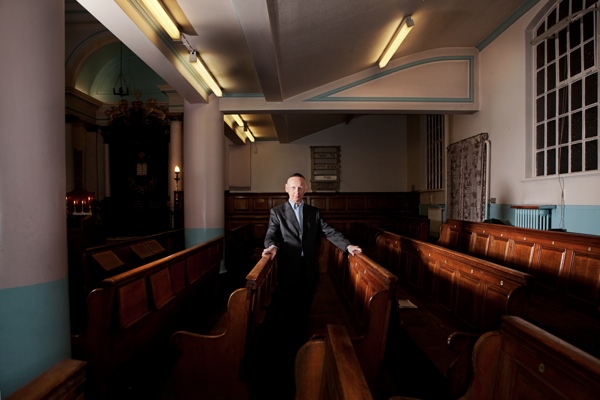
When Leon Silver opened the golden shutter of the ark at the East London Central Synagogue in Nelson St for me, a stash of Torah scrolls were revealed shrouded in ancient velvet with embroidered texts in silver thread gleaming through the gloom, caught by last rays of afternoon sunlight.
Leon told me that no-one any longer knows the origin of all these scrolls, which were acquired as synagogues closed or amalgamated with the departure of Jewish people from the East End since World War II. Many scrolls were brought over in the nineteenth century from all across Eastern Europe, and some are of the eighteenth century or earlier, originating from communities that no longer exist and places that vanished from the map generations ago.
Yet the scrolls are safe in Nelson St under the remarkable stewardship of Leon Silver, President, Senior Warden & Treasurer, who has selflessly devoted himself to keeping this beautiful synagogue open for the small yet devoted congregation – mostly in their eighties and nineties – for whom it fulfils a vital function. An earlier world still glimmers here in this beautiful synagogue that may not have seen a coat of new paint in a while, but is well tended by Leon and kept perfectly clean with freshly hoovered carpet and polished wood by a diligent cleaner of ninety years old.
As the sunlight faded, Leon and I sat at the long table at the back of the lofty synagogue where refreshments are enjoyed after the service, and Leon’s cool grey eyes sparkled as he spoke of this synagogue that means so much to him, and of its place in the lives of his congregation.
“I grew up in the East End, in Albert Gardens, half a mile from here. I first came to the synagogue as a little boy of four years old and I’ve been coming here all my life. Three generations of my family have been involved here, my maternal grandfather was the vice-president and my late uncle’s mother’s brother was the last president, he was still taking sacrament at ninety-five. My father used to come here to every service in the days when it was twice daily. And when I was twenty-nine, I came here to recite the mourner’s prayer after my father died. I remember when it was so crowded on the Sabbath, we had to put benches in front of the bimmah to accommodate everyone, now it is a much smaller congregation but we always get the ten you need to hold a service.
I’m a professional actor, so it gives me plenty of free time. I was asked to be the Honorary Treasurer and told that it entailed no responsibility – which was entirely untrue – and I’ve done it ever since. As people have died or moved away, I have taken on more responsibility. It means a lot to me. There was talk of closing us down or moving to smaller premises, but I’ve fought battles and we are still here. I spend quite a lot of hours at the end of the week. We have refreshments after the service, cake, crisps and whisky. I do the shopping and put out the drinks. The majority here are quite elderly and they are very friendly, everyone gets on well, especially when they have had a few drinks. In the main, they are East Enders. We don’t ask how they come because strictly speaking you shouldn’t ride the bus on the Sabbath. Now, even if young Jewish people wanted to come to return to the East End there are no facilities for them. No kosher butcher or baker, just the kosher counter at Sainsburys.
My father’s family came here at the end of the nineteenth century, and my maternal grandfather Lewis (who I’m named after) came at the outbreak of the First World War. As a resident alien, he had to report to Leman St Police Station every day. He came from part of the Austro-Hungarian Empire and he came on an Austrian passport, but when my mother came in 1920, she came on a Polish passport. Then in 1940, my grandfather and his brothers were arrested and my grandmother was put in Holloway Prison, before they were all interned on the Isle of Man. Then my uncle joined the British army and was told on his way to the camp that his parents had been released. My grandparents’ families on both sides died in the Holocaust. My mother once tried to write a list of all the names but she gave up after fifty because it was too upsetting. And this story is true for most of the congregation at the synagogue. One man of ninety from Alsace, he won’t talk about it. A lot of them won’t talk about it. These people carry a lot of history and that’s why it’s important for them to come together.
When Jewish people first came here, they took comfort from being with their compatriots who spoke the same style of Yiddish, the same style of pronunciation, the same style of worship. It was their security in a strange new world, a self-help society to help with unemployment and funeral expenses.”
Thanks to Leon, I understood the imperative for this shul to exist as a sacred meeting place for these first generation immigrants – now in their senior years – who share a common need to be among others with comparable experiences. Polite and softly spoken yet resolute in his purpose, Leon Silver is custodian of a synagogue that is a secure home for ancient scrolls and a safe harbour for those whose lives are shaped by their shared histories.


Photographs 2 & 3 © Mike Tsang


