
List Of Local Shops Open For Business

Benny’s, Hamlets Way by Janet Brooke
Every Wednesday, I publish the up to date list of stalwarts that remain open in Spitalfields. Readers are especially encouraged to support small independent businesses who offer an invaluable service to the community. This list confirms that it is possible to source all essential supplies locally without recourse to supermarkets.
Be advised many shops are operating limited opening hours at present, so I recommend you call in advance to avoid risking a wasted journey. Please send any additions or amendments for next week’s list to spitalfieldslife@gmail.com
This week’s illustrations are East End shopfront screenprints by Janet Brooke from the eighties. Click here to see the full collection

Jessie’s Provisions, Eric St by Janet Brooke
GROCERS & FOOD SHOPS
The Albion, 2/4 Boundary St
Ali’s Mini Superstore, 50d Greatorex St
AM2PM, 210 Brick Lane
As Nature Intended, 132 Commercial St
Banglatown Cash & Carry, 67 Hanbury St
Brick Lane Minimarket, 100 Brick Lane
The Butchery Ltd, 6a Lamb St (Open Thursdays only)
City Supermarket, 10 Quaker St
Costprice Minimarket, 41 Brick Lane
Faizah Minimarket, 2 Old Montague St
JB Foodstore, 97 Brick Lane
Haajang’s Corner, 78 Wentworth St
Leila’s Shop, 17 Calvert Avenue (Call 0207 729 9789 between 10am-noon on Tuesday-Saturdays to place your order and collect on the same day from 2pm-4pm)
The Melusine Fish Shop, St Katharine Docks
Nisa Local, 92 Whitechapel High St
Pavilion Bakery, 130 Columbia Rd
Rinkoff’s Bakery, 224 Jubilee Street & 79 Vallance Road
Spitalfields City Farm, Buxton St (Order through website)
Sylhet Sweet Shop, 109 Hanbury St
Taj Stores, 112 Brick Lane
Zaman Brothers, Fish & Meat Bazaar, 19 Brick Lane

Billy’s Snack Bar, Pritchard’s Rd by Janet Brooke
TAKE AWAY FOOD SHOPS
Before you order from a delivery app, why not call the take away or restaurant direct?
Absurd Bird Fried Chicken, 54 Commercial St
Al Badam Fried Chicken, 37 Brick Lane
Band of Burgers, 22 Osborn St
Beef & Birds, Brick Lane
Beigel Bake, 159 Brick Lane
Beigel Shop, 155 Brick Lane
Bengal Village, 75 Brick Lane
Big Moe’s Diner, 95 Whitechapel High St
Burro E Salvia Pastificio, 52 Redchurch St
China Feng, 43 Commercial St
Eastern Eye Balti House, 63a Brick Lane
Enso Thai & Japanese, 94 Brick Lane
Holy Shot Coffee, 155 Bethnal Green Rd
Jonestown Coffee, 215 Bethnal Green Rd
Laboratorio Pizza, 79 Brick Lane
La Cucina, 96 Brick Lane
Leon, 3 Crispin Place, Spitalfields Market
Nude Expresso, The Roastery, 25 Hanbury St
E. Pellicci, 332 Bethnal Green Rd
Pepe’s Peri Peri, 82 Brick Lane
Peter’s Cafe, 73 Aldgate High St
Picky Wops Vegan Pizza, 53 Brick Lane
Quaker St Cafe, 10 Quaker St
Rosa’s Thai Cafe, 12 Hanbury St
Shawarma Lebanese, 84 Brick Lane
Shoreditch Fish & Chips, 117 Redchurch St
String Ray Globe Cafe, 109 Columbia Road
Sushi Show, 136 Bethnal Green Rd
Vegan Yes, Italian & Thai Fusion, 64 Brick Lane
Yuriko Sushi & Bento, 48 Brick Lane

Post Office, Bow Common Lane by Janet Brooke
OTHER SHOPS & SERVICES
Boots the Chemist, 200 Bishopsgate
Brick Lane Bookshop, 166 Brick Lane (Books ordered by phone or email are delivered free locally)
Brick Lane Bikes, 118 Bethnal Green Rd
Brick Lane Off Licence, 114/116 Brick Lane
Day Lewis Pharmacy, 14 Old Montague St
Eden Floral Designs, 10 Wentworth St (Order fresh flowers online for free delivery)
Harry Brand, 122 Columbia Road (Order gifts online for delivery)
GH Cityprint, 58-60 Middlesex St
Leyland Hardware, 2-4 Great Eastern St
Post Office, 160a Brick Lane

W. Hasler, Eric St by Janet Brooke
ELSEWHERE
City Clean Dry Cleaners, 4a Cherry Tree Walk, Whitecross St
E5 Bakehouse, Arch 395, Mentmore Terrace (Customers are encouraged to order online and collect in person)
Gold Star Dry Cleaning & Laundry, 330 Burdett Rd
Hackney Essentials, 235 Victoria Park Rd
Quality Dry Cleaners, 16a White Church Lane
Newham Books, 747 Barking Rd (Books ordered by phone or email are posted out)
Region Choice Chemist, 68 Cambridge Heath Rd
Symposium Italian Restaurant, 363 Roman Road (Take away service available)
Thompsons DIY, 442-444 Roman Rd

C K Grocers, Brick Lane by Janet Brooke
Photographs copyright © Janet Brooke
H W Petherick’s London Characters

These London Characters were drawn by Horace William Petherick, a painter and illustrator who once contributed pictures regularly to the Illustrated London News. He also collaborated on some children’s books with Laura Valentine, who wrote under the pseudonym Aunt Louisa, and the prints you see here are the product of such a collaboration.
When I first came across these pictures in the collection at the Bishopsgate Institute, they caught my eye at once with the veracity of their observation. I am fascinated by all the prints that were made through the ages of the street people of London, and I have seen so many now that I have learnt to recognise when these images become generic. Yet, although in form and composition, H.W.Petherick’s London Characters draw upon the traditional visual style of the Cries of London, there is clear evidence of observation from life in his vibrant designs.
The subtleties of posture and demeanour in each trade, and the fluent quality of vigorous movement, are true to those of working people. He captures the stance that reveals the relationship of each individual to the world, whether haughty like the Beadle, weary like the Dustman, playful like the Acrobat, deferential like the Cabman or resigned like the old wounded soldier working as a Commissionaire. In these images, they declare themselves as who they are, both the products and the exemplifiers of their occupations.
It was the Lamplighter that first drew my attention, gazing with such concentrated poise up to the light, which is cleverly placed outside the frame of the composition – indicated only by the cast of its glow. In the foggy street, the Lamplighter pauses for the briefest moment for the flame to catch, while a carriage rolls away to vanish into the mist. An instant later, he will move on to the next lamp, but the fleeting moment is caught. All these Characters are preoccupied with their business – walking with intent, pouring milk steadily, carrying a loaf carefully, cutting meat with practised skill, scrutinising an address on an envelope, pasting up a poster just so, or concentrating to keep three balls up in the air at once.
They inhabit a recognisable city and they take ownership of the streets by their presence – they are London Characters.

The Butcher Boy

The Milkman

The Baker

The Cat’s-Meat Man

The Waterman

The Street Boy

The Dustman

The Chimney Sweeper

The Cabman

The Orange Girl

The Turncock

The Navvy

The Lamplighter

The Telegraph Boy

The Beadle

The Muffin Man

The Basket Woman

The Postman

The Fireman

The Railway Porter

The Policeman

The Newspaper Boy

The Bill Sticker

The Costermonger

The Organ Grinder

The Commissionaire

The Acrobat
Images courtesy Bishopsgate Institute

CLICK TO BUY A SIGNED COPY OF THE GENTLE AUTHOR’S CRIES OF LONDON
You may like to take a look at
John Thomson’s Street Life in London
Aunt Busy Bee’s New London Cries
Marcellus Laroon’s Cries of London
More John Player’s Cries of London
William Nicholson’s London Types
Francis Wheatley’s Cries of London
John Thomas Smith’s Vagabondiana of 1817
Thomas Rowlandson’s Lower Orders
Travelling Roads Through Time
Today is distinguished historian Gillian Tindall‘s birthday and I publish her latest piece, considering how the lockdown is bringing us closer to Londoners of the past

Travelling pedlar by Marcellus Laroon
Since late March, our urban landscape has been given back. I do not just mean the quiet of the London streets, emptied of noisy, polluting traffic, nor the aeroplane-free skies above, nor yet the trees unfolding their leaves, nor even the birds – though the pleasure they are taking in a spring of exceptional peace is clear for all to hear.
No, what I have in mind is the way these streets, so complex and varied in pattern compared with the streets of newer cities, are given back to us by their emptiness in the shapes they had long ago. As we walk down the middle of roads or hail someone from one corner to the opposite one because we can hear each other again, we are not just re-adopting the habits of previous generations. Restricted to expeditions on foot, we are also experiencing the basic geography of the townscape – following a curve where an unmade way once took a detour round some great man’s gates – going downhill because a little ahead, now far beneath the pavement, is a buried river – taking a road that is especially broad because, a thousand years ago, it was the way out of London to Harwich and the Continent.
The East End districts – Spitalfields, Whitechapel,Bethnal Green, Stepney, Limehouse, Bow and the rest – have such a reputation for gritty urbanness that many people are not aware how recent this is. Yet the borough name Tower Hamlets gives a clue. Till well into the nineteenth century much of this was fields and market gardens, interspersed with small villages. For over seven hundred years, wealthy merchants had country houses there – weekend retreats, like those in Sussex, Hampshire or Bedfordshire today. Thomas Cromwell, when not plotting darker things at the City premises he had taken from the Austin Friars, acted in his Stepney house as a local squire. A neighbour was Lord Darcy, who was to lose his head after leading a failed uprising against the King.
Two hundred years later, neighbourly relations were more peaceful. It was then well-to-do sea-captains and those who grew wealthy from international trading companies who built houses in the pastures and gardens along the Mile End Rd. Being outside the official jurisdiction of the City of London, the area also became a haven for people of minority faiths, such as Non-Conformity and Judaism. The oldest Jewish burial ground in Britain, a Sephardi one, is still there off the Mile End Rd, and Bevis Marks – the first grand new synagogue – was opened in the City in 1701.
Yet – at this point – let us narrow our picture down to a handful of obscure people, who are significant only because they typify a mass of others – which is perhaps true, in a larger sense, of almost all of us.
In the decades after Bevis Marks opened, individuals whose various Sephardi family names were Joel, Beavis and Montague, established themselves in the rural outskirts of the City, in Shoreditch and Bethnal Green. Arriving from no one knows from where, over a century before the major influx of Polish-Russian Jews, they quietly made whatever compromises were necessary in their new homeland. They got married in the churches of St Leonard or St Matthew and even had the odd child baptised, probably to ensure their presence on the parish lists in times of hardship. Yet they knew who they were and never ate pork.
One was a pedlar, Solomon Joel, in those days when travelling pedlars were the main source for all sorts of necessary odds and ends, from needles to pepper, mouse-traps to bonny-blue-ribbons. In 1810, Solomon had a son to whom he gave his own name but the boy preferred to be known by the more English ‘Godfrey’. He too was a pedlar or hawker, as they were beginning to be known in towns, and specialised in selling sponges to the stables of the wealthy.
They lived near St Leonards Church, Shoreditch, in a narrow street of small houses that had been built on open ground in recent decades, but there was still a big market-garden just along the road and open country near at hand. Further east along the Mile End Road there was a fringe of elegant terrace-houses but the muddy back lanes full of hawthorn and blackberry bushes were largely untouched.
Not for much longer, however. In his twenties Godfrey married Ann Beavis and a new generation were born. By then a huge transformation had taken place. Once the Napoleonic wars were over, London expanded at a rate never seen before. Stepney was quickly filled up with new terraces. The older streets of Shoreditch such as Old Nichol St, where respectable Huguenot weavers had once had their homes, became a by-word for over-crowding. Bethnal Green still had cottage gardens and pig-styes but became a place where criminals from central London went to ground and slum landlords made fortunes.
Yet as in developing slums all over the world, many people simply pursued more or less respectable lives and kept away from trouble. This appears to have been true of the Joels and the Montagues, living in the same crowded district when a Montague son married Esther, a Joel daughter, in 1876. The couple’s eldest child, another Esther, was born only four months later, but that was commonplace among working people and they went on to have fourteen more children of whom all but one survived.
This Esther was my husband’s grandmother. While she was a child the family moved out, leaving ‘the Nichol’ whose reputation would be further exaggerated in Arthur Harrison’s sensational fantasy Child of the Jago, and travelled the Mile End Rd as far as the rural villages of Ilford and Chadwell. As a teenager, Esther found employment as a servant and was courted by a farm-labourer-turned-road-builder with aspirations to become a police constable. Although she could barely read, she shared his ambition for a better life – and the rest, as they say, is history.
I look today at my grandsons and think: the blood of the Nichol is in your veins too. You with your energies and your good looks might have become pedlars. You could have walked these roads and alleys that are now again revealed to us in their essential shape. You could have talked someone into buying a new mouse-trap or ribbons, as a present for a girl, or a painted plate, like the one we have in our kitchen today.
It was a long-ago gift to Ann Beavis, when she was a girl and there were fields still towards Bow.


Ann & Solomon Joel lived in Shoreditch near St Leonard’s Church in the mid-nineteenth century. Joel gave Ann the plate in the photograph above as a gift before they married.

Esther Joel married into to the Montague family in 1876 and they moved out to rural Essex
Gillian Tindall’s latest book The Pulse Glass & The Beat of Other Hearts is published by Chatto & Windus
You may like to read these other stories by Gillian Tindall
Wenceslaus Hollar at Old St Paul’s
Memories of Ship Tavern Passage
Gillian Tindall’s Wartime Memories
At Captain Cook’s House in Mile End
Where The White Chapel Once Stood
At The Solidarity Britannia Food Bank
Anthropologist and Writer Delwar Hussain spoke to Lynda Ouazar who has been a running a food bank for some of the most needy people in London. Click here to support Lynda’s work

Portrait by Sarah Ainslie
Since the lockdown was announced five weeks ago, Lynda Ouazar and the network of volunteers she has assembled have been feeding hundreds of people, many of whom were starving and homeless. Working from a small community centre in Shoreditch, her team have packed up bags of fresh vegetables, pasta, lentils, cans of tuna, bread, flour, onions, potatoes, cooking oil, tea and coffee. Volunteer motorbike drivers delivered these food parcels to homes across London.
This was until earlier this week when a police raid at the community centre meant they had to leave. Thanks to Jonathan Moberly, one of the other volunteers, they now find themselves at what they hope is a more secure base in Toynbee Hall where they can continue their work undeterred. When I spoke to Lynda on her mobile phone, they had just moved in.
‘When we first started, some people were close to starving,’ Lynda explained to me. ‘They were really struggling. Before we got the delivery drivers organised, some people didn’t even have the money to travel to get the food from us. Now a number of those people that we helped have become volunteers themselves.”
The people that Lynda and the team are feeding are those who have lost their jobs due to the pandemic. Many have no legal status in this country and are not entitled to any benefits. Having worked mainly cash-in-hand, neither are they eligible for the furlough scheme. Their precarious position also means that despite government calls to landlords not to evict tenants during the lockdown, that is precisely what many have faced.
Though apprehensive and anxious about further attempts by the Home Office and the police to disrupt what they are doing, Lynda and her volunteers’ priority is to feed people in need, rather than judging their legal status.
These are people we all know. They are the people who clean our offices and homes, they drive taxis, they cook and serve food to us in restaurants and cafes, they deliver our parcels, and wash our cars. With them, we have a functioning city but, without them, the city comes to a standstill. We are all co-dependent upon each other, and in these times of the pandemic, such people are not only falling through the gaps, but they are falling fast and hard.
Lynda delivers food to one flat, which itself has become a sanctuary to fourteen others who are out of work, unable to pay their rents and now homeless. She told me of another example of a man who was discharged from two weeks in hospital only to return to his room and find that he had been evicted. There are those who live in places with no kitchens, so they have to be given food they can eat without the need for cooking. ‘Are they able to cook?’ – this is one of the first questions volunteers ask when people get in touch.
Lynda has many more examples like this, not only revealing the conditions under which people are surviving but also that they have always lived precariously. The virus has lifted the lid on the recesses and corners of our city and the neo-liberal society we inhabited.
Lynda’s operation is simple, using the money people donate to buy food in bulk and distribute it. Also local businesses are donating supplies. Those who need food either self-refer or – crucially – others do it on their behalf. Asking for food is humiliating for working people who are used to relying on themselves, who most often work in more than one job, often throughout the day and night and in uncertain, unsafe and exploitative situations.
When Lynda talked about her children, I enquired whether she is worried about catching the virus. “People told me to stay at home, why give myself the hassle of doing this?’ she replied. ‘But someone has to do it. I find it hard not to get involved. I am now working seven days a week on this. You won’t believe it but, when the virus first started, I was one of those parents that took my children out of school before they were officially closed. I was that scared for them. But then I forgot all about that fear because, for me, people in this city starving is so much more frightening. It’s a different level of fear to the one I had about the virus. Getting sick from Corona is a risk, but the situation these people find themselves in is worse. The question they are asking themselves is ‘Do you want to die of Corona or do you want to starve to death?’ And that’s not right.”

Jonathan Moberley and Lynda Ouazar


Kamil


Unloading cartons of flour at Toynbee Hall


Lynda, Jonathan & Kamil
Photographs copyright © Sarah Ainslie
You may also like to take a look at
Birds Of Spitalfields
Coming across an early copy of Thomas Bewick’s ‘History of British Birds’ from 1832 inspired me to publish this ornithological survey with illustrations courtesy of the great engraver.
I have always known these pictures – especially the cuts of the robin and the blackbird – yet they never cease to startle me with their vivid life, each time I return to marvel at the genius of Bewick in capturing the essence of these familiar creatures so superlatively.
The book reminded me of all the birds that once inhabited these fields and now are gone, yet it is remarkable how many varieties have persisted in spite of urbanisation. I have seen all of these birds in Spitalfields, even the woodpecker that I once spied from my desk, coming eye to eye with it while looking into a tree from a first floor window to discern the source of an unexpected tapping outside.
 The Sparrow

The Starling
 The Blue Tit
 The Great Tit
 The Pigeon
 The Collared Dove
 The Blackbird

The Crow
 The Magpie
 The Robin
 The Thrush
 The Wren
 The Chaffinch
 The Goldfinch

The House Swallow

The Jay

The Woodpecker

Pied Wagtail – spotted by Ash on the Holland Estate, Petticoat Lane
 Rose-ringed Parrakeet – an occasional visitor to Allen Gardens
 Heron – occasionally spotted flying overhead
 Buzzard – spotted over Holland Estate, Petticoat Lane

Swift – spotted by Ian Harper around Christ Church

Raven – spotted by Ian Harper & Jim Howett around Christ Church

Kite – spotted by Ian Harper & Jim Howett around Christ Church

Long-tailed Tit – spotted in Wapping

Willow Warbler – spotted by Tony Valsamidis in Whitechapel
If any readers can add to my list with sightings of other birds in Spitalfields, please drop me a line
You may also like to take a look at
Agnese Sanvito’s London Queues
Photographer Agnes Sanvito sent me this series of her pictures of queues

Highbury Park

Stoke Newington Church St

Stoke Newington High St

Highbury Park

Belsize Lane

Albion Rd

Highbury Park

Stroud Green

Highbury Park
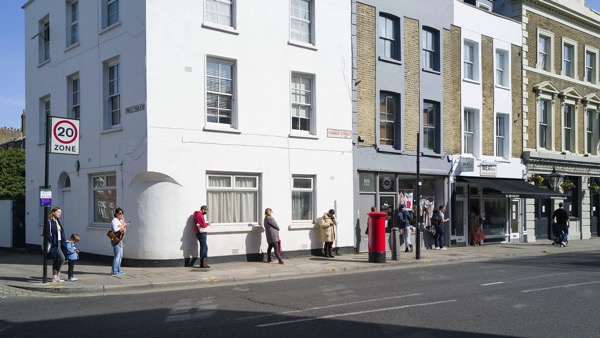
Stoke Newington Church St

“For the past few years I have been documenting people queuing to board a bus, buy a coffee or see an exhibition and most recently, during the current lockdown, for all essential needs.
Coming from Italy, queueing is an alien phenomena to me. No one else queues as the English do. Hungarian-born British author George Mikes wrote, “An Englishman, even if he is alone, forms an orderly queue of one.”
My fascination with queues starts with how people organise themselves into a fair and orderly line. Within this framework, different quirks of behaviour and posture emerge, people are checking their phones, reading, kissing, or just simply staring at the line and feeling satisfied that the queue grows.
Since the lockdown and the requirement of two metre distancing, the lines are growing even longer at local groceries, DIY shops, post offices, pharmacies and supermarket in my neighbourhood.
I hope my pictures lift you up and grant a new perspective on this strange yet significant moment we are living through.” – Agnes Sanvito


Waterloo Rd

Canary Wharf Station

Lincoln’s Inn Fields

Chalk Farm Rd

Peter St

Borough Market

Albion Rd

Stoke Newington High St at Christmas
Photographs copyright © Agnese Sanvito
You may also like to take a look at
Nicholas Culpeper, Herbalist Of Spitalfields
It is my pleasure to publish this profile of the famous herbalist of Spitalfields by Patricia Cleveland-Peck, gardener and writer.

Nicholas Culpeper (1616-1654)
Of all Spitalfields’ past residents, one name stands out above others – Nicholas Culpeper, born on October 18th 1616, a herbalist and medical practitioner operating from Red Lion St (now Commercial St) who devoted his life to healing, and especially to healing the poor.
While apprenticed to the apothecary Francis Drake of Bishopsgate, Nicholas accompanied Thomas Johnson (later editor of the 1633 edition of Gerard’s Herball) on plant hunting excursions. He loved herbs since boyhood and became expert at their identification, essential in those days when almost all ailments were treated with plants. Herbals served as handbooks for doctors in which each plant was named together with its ‘virtues’ or uses. Nicholas’ skill in this subject, coupled with the fact that he was very caring, meant that the people of Spitalfields flocked to him – sometimes as many as forty a morning – and they commonly received treatment for little or no payment.
This was not popular among Nicholas Culpeper’s qualified medical colleagues who were infuriated by his view that, “no man deserved to starve to pay an insulting, insolent physician.” He also believed in “English herbs for English bodies,” and went out gathering his own herbs from the countryside for free which did not endear him to the apothecaries who often insisted on expensive imported exotic plants for their ‘cures’.
In those days, there were strict divisions between what university-educated physicians, apothecaries and barber-surgeons (who drew teeth and let blood) were allowed to do. Physicians were expensive, so for most sick people the first port of call would be their own herb garden or still room, the second the ‘wise woman’ down the road, the third a visit to the apothecary – after which, for many, there was no other option but to let the illness run its course.
In 1649, Nicholas inflamed the establishment by producing an English translation of their latin ‘bible’ the Pharmacopoeia Londinensis which included all the recipes for their medicines. Published as A Physical Directory, it not only revealed the secret ingredients but gave instructions on how to administer them – one of his most important contributions, as it provided the first effective self-help book to which people could turn.
Even more galling for the medical fraternity was the fact Nicholas had never completed his apprenticeship, and chose Spitalfields to set up a semi-legal practice because it was outside the City of London and thus not governed by the rules of the College of Physicians. Spitalfields in those days was quite different from today, beyond the site of huge priory of St Mary Spital stretched the farmland of Spital Field. The priory had been dissolved under Henry VIII although parts of the precincts were still inhabited, and it was an area which attracted outsiders like Nicholas who, as well as treating his patients, was something of a political radical. In his pamphlets, he railed against the king, priests and lawyers as well as physicians. Consequently he was no stranger to controversy and at one point was even accused of witchcraft – just one of the many troubles which accumulated to beset him during his life.
The first of these even occurred thirteen days before his life began, for it was then that his father died leaving his mother without support. She and the new-born Nicholas were obliged to return to the protection of her father, William Attersole, vicar of the little village of Isfield in Sussex. Attersole was not happy about this arrangement but, although he did not welcome the child, he did see it as his religious duty to provide instruction for him as he grew. Young Nicholas learned the scriptures and the classics, he studied mathematics and, under his grandfather’s guidance, began to take an interest in astrology which later featured in his own works. He even stole a book on anatomy out of the library (where he was only supposed to read the bible) and read it in a barn.
Importantly, he also spent a lot of time with his mother who we know owned a copy of Gerard’s Herball. She was responsible for the health of the household and, from his later works, we can glean the fact that he soon became familiar with all the local Sussex ‘simples’ or wild herbs. We know only little of this period of his life, but it is thought that he went to school in Lewes before – at the age of sixteen – setting off for Cambridge ostensibly to follow in his grandfather’s footsteps by studying theology. Once there, he began to attended lectures on anatomy and, perhaps frustrated that he couldn’t change to medicine, he spent most of his time smoking, drinking and socialising in taverns.
Yet the reason for his dropping out is a sad one. Young though he was, before leaving Sussex, Nicholas had fallen in love with Judith Rivers, a local heiress. She reciprocated his love and thus, knowing her family would never consent to the relationship, they planned to elope. They were to meet near Lewes and marry secretly, but on the way Judith’s coach was struck by lightning and she was killed. Nicholas was devastated and spent months sunk in melancholy. There was no question of his returning to Cambridge to study medicine or anything else. Eventually he chose to come to London and become an apothecary. Socially, this was a step down but he enjoyed his time at Bishopsgate and became very proficient.
Nicholas was twenty-four when he found love again. Called to treat a Mr Field for gouty arthritis, his eyes fell upon the fifteen-year-old daughter of the house, Alice. By a stroke of good fortune, she too was an heiress and it was her considerable dowry which enabled Nicholas to build a house in Red Lion St, Spitalfields from which he conducted his practice.
When the Civil War broke out two years later, the anti-royalist Nicholas signed up with Cromwell. Once his profession was discovered however, the recruiting offer commented, “We do not need you at the battlefield…come along as the field surgeon since most of the barbers and physicians are royal asses and we have use for someone to look after our injured.” Later, during the battle of Reading, Nicholas himself was wounded.
On his return to Spitalfields, he devoted himself to study and writing, and produced a number of books including a Directory for Midwives. Nicholas recognised that this was an unusual topic for a male herbalist, writing in the dedication, “If you (the matron) by your experiences find anything not according to the truth ( for I am a man and therefore subject to failings) first judge charitably of me…” Having grown up so close to his mother, Nicholas had a deep respect of women but this book may also have been inspired by some painful experiences in his own family for, although Alice bore him seven children, only one daughter lived to adulthood.
In 1652, Nicholas published his master work The English Physician also known as Culpeper’s Herbal which became the standard work for three hundred years and is still in print. It was sold cheaply and made its way to America where it had a lasting impact too. By 1665, ten years after his death, Nicholas’ name was so well-known that the Lord Mayor of London chose to use it alongside that of Sir Walter Raleigh in a pamphlet about avoiding infection from the Great Plague.
Nicholas Culpeper deserves to be remembered. He was always on the side of the underdog, he opposed the ‘closed shop’ of earlier physicians and he promoted sensible self-help. He also tried to offer reasonable explanations for what he wrote – “Neither Gerard nor Parkinson or any that ever wrote in a like manner ever gave one wise reason for what they wrote and so did nothing else but train up young novices in Physic in the School of Tradition, and teach them just as a parrot is taught… But in mine you see a reason for everything that is written.”
He died in 1654, aged only thirty-eight, of tuberculosis and is believed to be buried beneath Liverpool St Station.

Title page of the 1790 edition of Culpeper’s English Physician & Complete Herbal, published by C.Stalker, 4 Stationer’s Court, Ludgate St.


Plates from the edition published by Richard Evans, 8 White’s Row, Spitalfields, August 12th, 1814.

Red Lion House, Nicholas Culpeper’s home in Spitafields. Becoming the Red Lion Tavern after his death, the building was demolished in the eighteen-forties as part of road widening when Commercial St was cut through to carry traffic from the docks.

“Culpeper’s house, of which there are woodcuts extant, it is of wood, and is situated the corner of Red Lion Court and Red Lion Street, Spitalfields. It is now and has long been a public house, known by the sign of the Red Lion, but at the time it was inhabited by the sage herbalist, it was independent of other buildings. While in the occupation of Culpeper, who died in 1654, this house stood in Red Lion Field and was as a dispensary of medicines (perhaps the first) of very considerable celebrity.” The European Magazine and London Review, January 1812. Red Lion St and Red Lion Court as shown on John Horwood’s map (1794-99) before Commercial St was cut through in the nineteenth century.

Plaque commemorating Nicholas Culpeper installed thanks to a campaign by Spitalfields Life
You may also like to read about


