
Thierry Girard’s East End, 1976
Today it is my pleasure to show these photographs by Thierry Girard from 1976

“More than simply pictures from my early years as a photographer, these are the starting point of my photographic work. At the beginning of 1976, when I was twenty-four, I had just graduated from Paris Institute of Political Studies and I had no specific idea about my future. I was very interested in photography, I bought my first photography books and I went to exhibitions, but I had very little experience.
At that time, my interest was in British photography and photographs taken in Britain by foreigners. I was an Anglophile. I was fond of Bill Brandt’s work, of course, and I was familiar with the photographs of Tony Ray-Jones, Homer Sykes and David Hurn – but the real catalyst was to be Robert Frank’s portfolio of London & Wales published in the 1975 edition of the Creative Camera International Yearbook. Knowing London rather well —I had stayed there several times in the previous years— I immediately related to the atmosphere of Frank’s pictures.
So I decided to go back to London for a challenge, a rite of initiation: to face the outside world and do photography. I stayed in the East End where I had lived as a student, although I did not intend to do a reportage about the East End or Eastenders. I just wanted to walk for hours and days in, snatching bits of life, passing through dilapidated districts, pushing doors of pubs, rambling through markets and playing with kids. I spent time with a wonderful couple, clever and cheerful people, but living in poverty in a damp basement flat while sewing ties for chic French companies. At lunchtime or in the evenings I went to strip pubs. The people attending the shows, both men and women, were locals.
I hope these photographs made in London in 1976 are worth revisiting. Very few of these pictures have ever been published or exhibited, but what I did there at the time has been decisive for my future as a photographer.” – Thierry Girard

At the Elephant, Dalston

In Brick Lane

At the Elephant, Dalston

In Bethnal Green

Alan B, homeworker in Graham Rd, Hackney

In Mare St

In Wapping

In Ridley Rd Market

In Dalston

Betty & Penny B, Graham Rd, Hackney

In Hackney

At Limehouse Social Club

In Wapping

At Limehouse Social Club

In Bethnal Green

In Tower Hamlets

In Hackney

In Hackney

Hackney Empire
Photographs copyright © Thierry Girard
You may also like to take a look at
Philip Marriage’s Spitalfields
George Cruikshank At The Tower Of London

The Execution of Lady Jane Grey at Tower Green
“It has been for years, the cherished wish of the writer of these pages to make the Tower of London the groundwork of a Romance,” wrote William Harrison Ainsworth in 1840, introducing his novel, “The Tower of London” – and it is an impulse that I recognise, because I know of no other place in London where the lingering sense of myth and the echoing drama of the past is more tangible that at the Tower.
Whenever I have entered those ancient walls, I am struck anew by the mystery of the place. I have to stop and reconcile my knowledge of history with the location where it happened, and each time I become more spellbound by the actuality of the place, which in spite of Victorian rebuilding still retains its integrity as an ancient fortress. I always make a point to pause and read the age-old graffiti, to stop in each doorway and take in the prospect at this most dramatic of monuments.
When I discovered “The Tower of London” by William Harrison Ainsworth in the Bishopsgate Institute I was captivated by George Cruikshank’s illustrations, realising that not only had this favourite of mine amongst nineteenth century illustrators once stood in exactly the same places I had stood, but he had the genius to draw the images inspired by these charged locations.
“Desirous of exhibiting the Tower in its triple light of a palace, a prison and a fortress, the author has shaped his story with reference to that end, and he has also endeavoured to combine such a series of incidents as should naturally introduce every relic of the old pile, its towers, halls, chambers, gateways and drawbridges – so that no part of it should remain uninvolved.” explained Ainsworth in his introduction to his sensationalist fictionalised account of the violent end of the short reign of Lady Jane Grey. Yet it is George Cruikshank’s engravings which bring the work alive, providing not just a tour of the architectural environment but also of the dramatic imaginative world that it contains – and done so vividly that I know already that when I return I shall be looking out for his characters in my mind’s eye while I am there.
There is a grim humour and surreal poetry in pictures which, to my eyes, presage the work of Edward Gorey, who like George Cruikshank also created a sinister diaphanous world out of dense hatching. Maurice Sendak is another master of the mystery that can be evoked by intricate webs of woven lines in which – as in these Tower of London engravings – three dimensional space dissolves into magical possibility. But to me the prime achievement of these pictures is that George Cruikshank has given concrete life to the Tower’s past, creating figures that convincingly take command of the stage offered by its charged spaces and, like the acting of Henry Irving, appear as if momentarily illuminated by flashes of lightning. Cruikshank’s pictures are like glimpses of a strange dream, drawing the viewer into a compelling emotional universe with its own logic, peopled by its own inhabitants and where it is too readily apparent what is going on.
The popularity of William Harrison Ainsworth’s novel was responsible for creating the bloodthirsty reputation of the Tower of London which still endures today – even though for centuries the Tower was used as a domestic royal residence and administrative centre, headquarters of the royal ordinances, records office, mint, observatory, and a menagerie amongst other diverse functions throughout its thousand year history. Yet although it may be just one of the infinite range of tales to be told about the Tower of London, William Harrison Ainsworth’s Romance does witness historical truth. There is a neglected plaque in the corner of Trinity Green, just outside Tower Hill station, which is a memorial to those executed there through the centuries – as testament to the reality of the violence enacted upon those with the misfortune to find themselves on the wrong side of authority in past days.

Jane Grey’s first night in the Tower – “Prompted by an undefinable feeling of curiosity, she hastened towards it and, holding forward the light, a shudder went through her frame, as she perceived at her feet – an axe!”

Cuthbert Cholmondeley surprised by a mysterious figure in the dungeon adjoining the Devilin Tower.

Jane Grey interposing between the Duke of Northumberland and Simon Renard.

Jane Grey and Lord Gilbert Dudley brought back to the Tower through Traitors’ Gate – “Never had Jane experienced such a feeling of horror as now assailed her – and if she had crossed the fabled Styx, she could not have greater dread. Her blood seemed congealed within her veins as she gazed around. The light of the torches fell upon the black arches – upon the slimy walls and upon the yet blacker tide.”

Jane imprisoned in the Brick Tower – “Alone! The thought struck her to the heart. She was now captured. She heard the doors of the prison bolted – she examined its stone walls, partly concealed by tapestry – she glance at its barred windows, and she gave up hope.”

Simon Renard and Winwinkle, the warder, on the roof of the White Tower – “There you behold the Tower of London,” said Winwinkle, pointing downwards. “And there I read the history of England,” replied Renard. “If it is written in these towers, it is a dark and bloody history, ” replied the warder.

Mauger sharpening his axe – ” A savage-looking individual seated on a bench at a grinding stone, he had an axe blade which he had just been sharpening, and he was trying its edge with his thumb. His fierce blood-shot eyes, recessed far beneath his bent and bushy brows were fixed upon the weapon.”

Execution of the Duke of Northumberland upon Tower Hill – “As soon as the Duke had disposed himself upon the block, the axe flashed like a gleam of lightning in the sunshine – descended – and the head was severed from the trunk. Mauger held it aloft, almost before the eyes were closed, crying out to the the assemblage in a loud voice, “Behold the head of a traitor!”

Cuthbert Cholmondeley discovering the body of Alexia in the Devilin Tower – “Pushing aside the door with his blade, he beheld a spectacle that filled him with horror. At one side of the cell upon a stone seat, rested the dead body of a woman, reduced almost to a skeleton. On the wall, close to where she lay, and evidently carved by her own hand, the name ALEXIA.”

Queen Mary surprises Courtenay and Princess Elizabeth

Lawrence Nightgall dragging Cicely down the secret stairs in the Salt Tower

Courtenay’s escape from the Tower

The burning of Edward Underhill at Tower Green – “As the flames rose, the sharpness of the torment overcame him. He lost control of himself, and his eyes started from their sockets – his contorted features and his writhing frame proclaimed the extremity of his agony. It was a horrible sight, and a shudder burst forth from the assemblage.”

The Death Warrant – “Mary tried to ascertain the cause of the animal’s disquietude as its barking changed to a dismal howl. Not without misgiving, she glanced towards the window and there between the bars she beheld a hideous black mask, through the holes of which glared a pair of flashing eyes.”

Elizabeth confronts Sir Thomas Wyatt in the torture chamber – “‘Sir Thomas Wyatt,’ Elizabeth declared in a loud and authoritative tone, and stepping towards him, ‘If you would not render your name forever infamous, you must declare my innocence!'”

The Fall of Nightgall – “Nightgall struggled desperately against the horrible fate that waited him, clutching convulsively against the wall. But it was unavailing. He uttered a fearful cry, and tried to grab at the roughened surface. From a height of nearly ninety feet, he fell with a terrific smash upon the pavement of the court below.”

The Night before the Execution – “In spite of himself, the executioner could not repress a feeling of dread and the contrary urge, which represented his curiousity. He pointed towards the church porch, from which a figure, robed in white, but insubstantial as the mist, suddenly appeared. It glided noiselessly along and without turning its face to the beholders.”

Jane Grey meeting the body of her husband at the scaffold – “She knew it was the body of her husband, and unprepared for so terrible an encounter, uttered a cry of horror.”

Plaque at Trinity Green on Tower Hill
You may also like to read
John Keohane, Chief Yeoman Warder at the Tower of London
The Journey Of Martin Nadaud
Contributing Historian Gillian Tindall sent me this account of the life of Martin Nadaud (1815-98), a refugee who came to London in the nineteenth century and worked as a stone mason to survive

The familiar beggars disappeared from the streets of London when the lockdown began, but here and there new homeless faces have taken their place. These men show no sign of alcohol or drug use and are overly grateful – in limited English – for the few coins that come their way. They are immigrants and refugees of uncertain status who did labouring or restaurant work in ordinary times but now have nothing.
Like plagues and wars, it has all happened before in London. One particular long-ago immigrant who struggled to survive on our streets is of special interest to me. He was a stone-mason by trade and his name was Martin Nadaud.
Born in the year of Waterloo in mountainous Central France, far from battles or political conflict, he walked to Paris with his father when he was fourteen. Away from home and learning a trade on the job, this clever boy studied in his own time to replace his regional dialect and taught himself to read and write. Through the turmoils and mini-revolutions of the eighteen-thirties and forties he grew interested in politics and human rights. By the time Emperor Louis-Napoleon (the nephew of the first Napoleon) took over in 1849, Nadaud was such a well-known figure that he was elected as the first working class member of Parliament in France.
Yet his triumph was short-lived. Within two years Louis-Napoleon revealed dictatorial tendencies and sought to rid himself of critics. Nadaud, along with many other left-wingers, was imprisoned and then banished. Where should he go but England, traditionally celebrated for not being a police state and welcoming refugees?
Nadaud took a paddle steamer to Wapping and stayed his first night in a house in Soho that had long been a shelter for French refugees. Next morning he and a compatriot walked to a huge, muddy site in the unbuilt wastes beyond Kings Cross, where the railway stations had yet to appear. There Nadaud got a job building the new Metropolitan Meat-Market.
It was a lonely life. He could not speak with any of his work mates, many of whom were wary of him. Most of the other French political refugees had private means. After that job came to an end Nadaud had to walk, cap-in-hand, to sites elsewhere. “Chance of a job, Master?” was the first English phrase he learnt. As with many highly qualified immigrants today – it was as if, on the way over the Channel, all his achievements and hard-won status of the last twenty years had vanished. In the depths of a bitter winter, when the Crimean War brought a slump in the building trade, he could not even afford coal for a fire to heat his rented room in Greenwich
I am happy to report that after enduring times so dire he passed over them in his memoir, Nadaud made good. An unnamed friend, who may have been Friedrich Engels, arranged a job for him near Manchester where mill-building was flourishing. There, for the first time, he encountered the source of Britain’s manufacturing prosperity.
Later, while lodging with the family of a carpenter in Wimbledon, he observed how well they lived by comparison with families in France of the same social level. “On Sunday, round the dinner table, it is more like being with a prosperous shop-keeper’s family than with a working class one.”
Development was booming in London in the mid-nineteenth century. The population of the capital increased sixfold during the century, making it the largest city in the world. While continental capitals were mostly still corseted within their ancient limits – and Paris was building a new defensive wall – London was already pursuing the suburban dream. The fields and market gardens of Kensington and Chelsea were disappearing under terraces of upmarket housing. Bayswater and Paddington were being colonised, and Camden Town was stretching greedy fingers out all the way towards Hampstead. The inauguration of the Metropolitan Railway in 1863 – the world’s first Underground – opened more distant possibilities. Consequently, the British have been in thrall to the questionable fantasy of ‘living in the country’ while working in the town ever since.
Meanwhile in the older neighbours, enormous redevelopment was underway. Over the previous two hundred years, the surviving Tudor mansions of Bishopsgate and Clerkenwell, Holborn and Westminster, had been destroyed piecemeal. Protests against this vandalism by conservationists including William Morris and C.R. Ashbee lay in the future.
Yet it was not only precious relics of old London that were reduced to dust and smoke. The coherent Georgian urban landscape with its elegant terraces was being superseded by taller and larger housing blocks, usually of red brick in a pseudo-ecclesiastical style. There were also new mansions for the super rich, public institutions, hospitals, schools, model dwellings for the working classes, railway stations with towering hotels, new churches to replace old ones, Holborn Viaduct to cover the dirty Fleet River and, indeed, Barry & Pugin’s new Houses of Parliament.
All this, Nadaud tentatively admired. Eventually, he found more congenial employment in one of the new Gothic school-buildings where he taught French to young gentlemen, concealing from them and his employer that he ever wielded a builder’s trowel. Nadaud remained grateful to England for giving him a new life, even if he had had to struggle for it.
On the Emperor’s downfall in 1870, Nadaud returned to his homeland. Acclaimed as a returning hero, he was given a job in the new administration. A respected but lonely figure, Nadaud lived for another twenty-eight years, writing his semi-fictional memoir and his account of the British working classes, which – perhaps unsurprisingly – proved not to be a big seller in France.
He spent his remaining years trying to persuade those in charge of Paris that they needed an Underground like London’s, although he did not live to see it built. Yet as the Métro began to be constructed in the year of his death, I like to think that he knew at the last that this particular dream would be fulfilled.

Leaving the village to walk in search of employment in the city

Masons at work

Hostel for for casual labourers

Wimbledon School where Nadaud taught

Martin Nadaud (1815-98)
Gillian Tindall’s book The Journey of Martin Nadaud: a life and turbulent times was first published in 1999 and copies can be found online. Her latest book The Pulse Glass & The Beat of Other Hearts is published by Chatto & Windus
You may like to read these other stories by Gillian Tindall
Wenceslaus Hollar at Old St Paul’s
Memories of Ship Tavern Passage
Gillian Tindall’s Wartime Memories
At Captain Cook’s House in Mile End
List Of Local Shops Open For Business

Leila’s Shop by Sebastian Harding
Every Wednesday, I publish the up to date list of stalwarts that remain open in Spitalfields. Readers are especially encouraged to support small independent businesses who offer an invaluable service to the community. This list confirms that it is possible to source all essential supplies locally without recourse to supermarkets.
Be advised many shops are operating limited opening hours at present, so I recommend you call in advance to avoid risking a wasted journey. Please send any additions or amendments for next week’s list to spitalfieldslife@gmail.com
This week’s illustrations are by Sebastian Harding

Taj Stores
GROCERS & FOOD SHOPS
The Albion, 2/4 Boundary St
Ali’s Mini Superstore, 50d Greatorex St
AM2PM, 210 Brick Lane
As Nature Intended, 132 Commercial St
Banglatown Cash & Carry, 67 Hanbury St
Breid Bakery, Arch 72, Dunbridge St
Brick Lane Minimarket, 100 Brick Lane
The Butchery Ltd, 6a Lamb St (Open Thursdays only)
City Supermarket, 10 Quaker St
Costprice Minimarket, 41 Brick Lane
Faizah Minimarket, 2 Old Montague St
JB Foodstore, 97 Brick Lane
Haajang’s Corner, 78 Wentworth St
Leila’s Shop, 17 Calvert Avenue (Call 0207 729 9789 between 10am-noon on Tuesday-Saturdays to place your order and collect on the same day from 2pm-4pm)
The Melusine Fish Shop, St Katharine Docks
Nisa Local, 92 Whitechapel High St
Pavilion Bakery, 130 Columbia Rd
Rinkoff’s Bakery, 224 Jubilee Street & 79 Vallance Road
Spitalfields City Farm, Buxton St (Order through website)
Sylhet Sweet Shop, 109 Hanbury St
Taj Stores, 112 Brick Lane
Zaman Brothers, Fish & Meat Bazaar, 19 Brick Lane

Burro E Salvia Pastificio
TAKE AWAY FOOD SHOPS
Before you order from a delivery app, why not call the take away or restaurant direct?
Absurd Bird Fried Chicken, 54 Commercial St
Al Badam Fried Chicken, 37 Brick Lane
Allpress Coffee, 58 Redchurch St
Band of Burgers, 22 Osborn St
Beef & Birds, Brick Lane
Beigel Bake, 159 Brick Lane
Beigel Shop, 155 Brick Lane
Bellboi Coffee, 104 Sclater St
Bengal Village, 75 Brick Lane
Big Moe’s Diner, 95 Whitechapel High St
Burro E Salvia Pastificio, 52 Redchurch St
The Carpenters Arms, 73 Cheshire St (Open for take away beers)
China Feng, 43 Commercial St
Circle & Slice Pizza, 11 Whitechapel Rd
Dark Sugars, 45a Hanbury St (Take away ice cream and deliveries of chocolate)
Donburi & Co, Korean & Japanese, 13 Artillery Passage
Duke of Wellington, 12 Toynbee St (Open for take away beers)
Eastern Eye Balti House, 63a Brick Lane
Enso Thai & Japanese, 94 Brick Lane
Exmouth Coffee Shop, 83 Whitechapel High St
Grounded Coffee Shop, 9 Whitechapel Rd
Holy Shot Coffee, 155 Bethnal Green Rd
Hotbox Smoked Meats, 46-48 Commercial St
Jack The Chipper, 74 Whitechapel High St
Jonestown Coffee, 215 Bethnal Green Rd
Laboratorio Pizza, 79 Brick Lane
La Cucina, 96 Brick Lane
Leon, 3 Crispin Place, Spitalfields Market
Madhubon Sweets, 42 Brick Lane
Mooshies Vegan Burgers, 104 Brick Lane
Nude Expresso, The Roastery, 25 Hanbury St
E. Pellicci, 332 Bethnal Green Rd
Pepe’s Peri Peri, 82 Brick Lane
Peter’s Cafe, 73 Aldgate High St
Picky Wops Vegan Pizza, 53 Brick Lane
Quaker St Cafe, 10 Quaker St
Rajmahal Sweets, 57 Brick Lane
Rosa’s Thai Cafe, 12 Hanbury St
Shawarma Lebanese, 84 Brick Lane
Shoreditch Fish & Chips, 117 Redchurch St
Sichuan Folk, 32 Hanbury St
String Ray Globe Cafe, 109 Columbia Road
Sushi Show, 136 Bethnal Green Rd
Vegan Yes, Italian & Thai Fusion, 64 Brick Lane
White Horse Kebab, 336 Bethnal Green Rd
Yuriko Sushi & Bento, 48 Brick Lane

Brick Lane Bikes
OTHER SHOPS & SERVICES
Boots the Chemist, 200 Bishopsgate
Brick Lane Bookshop, 166 Brick Lane (Books ordered by phone or email are delivered free locally)
Brick Lane Bikes, 118 Bethnal Green Rd
Brick Lane Off Licence, 114/116 Brick Lane
Day Lewis Pharmacy, 14 Old Montague St
E1 Cycles, 4 Commercial St
Eden Floral Designs, 10 Wentworth St (Order fresh flowers online for free delivery)
Flashback Records, 131 Bethnal Green Rd (Order records online for delivery)
Harry Brand, 122 Columbia Road (Order gifts online for delivery)
Hussain Tailoring, 64 Hanbury St
iRepair, Phones & Computer, 94 Whitechapel High St
GH Cityprint, 58-60 Middlesex St
Leyland Hardware, 2-4 Great Eastern St
Mobile Clinic & Laptop Repairs, 7 Osborne St
Post Office, 160a Brick Lane
Quality Dry Clean, 151 Bethnal Green Rd
Rose Locksmith & DIY, 149 Bethnal Green Rd
Sid’s DIY, 2 Commercial St
Spitalfields Dry Cleaners, 12 Whites Row

E5 Bakehouse
ELSEWHERE
E5 Bakehouse, Arch 395, Mentmore Terrace (Customers are encouraged to order online and collect in person)
Gold Star Dry Cleaning & Laundry, 330 Burdett Rd
Hackney Essentials, 235 Victoria Park Rd
Quality Dry Cleaners, 16a White Church Lane
Newham Books, 747 Barking Rd (Books ordered by phone or email are posted out)
Region Choice Chemist, 68 Cambridge Heath Rd
Symposium Italian Restaurant, 363 Roman Road (Take away service available)
Thompsons DIY, 442-444 Roman Rd

The Albion
Illustrations copyright © Sebastian Harding
You may like to take a look at these other works by Sebastian Harding

TUESDAY 6th OCTOBER is the new date for the commencement of the PUBLIC INQUIRY into the future of the WHITECHAPEL BELL FOUNDRY called by Secretary of State.
We are delighted that this Public Inquiry is going ahead because the Whitechapel Bell Foundry is a priceless cultural treasure of global significance that must be saved. For several years now, we have been campaigning for it to continue as a proper working foundry rather than the developer’s proposal for bell-themed boutique hotel.
The UK Historic Building Preservation Trust (now known as Re-Form Heritage) is offering to buy the foundry from the developers at market value and re-open it to as a fully operational foundry to cast bells in the East End in perpetuity, just as it has done for over five hundred years.
By definition, a Public Inquiry is open to all. Please put the date in your diary now because it very important that as many people as possible turn up to demonstrate the strength of public opinion to the Government Inspector. This is our one chance to save the Whitechapel Bell Foundry, so we hope all community and cultural groups in the East End will send representatives and take advantage of the opportunity offered by the Public Inquiry to read a statement on behalf of their members.
Commencing at 10am on 6th October, the Public Inquiry will run for eight days and take place under socially-distanced conditions.
Email Development.Control@TowerHamlets.gov.uk to get details and attend. Also please say if you want to speak, either as an individual or as a representative of a group.

You may also like to read about
The Secretary of State steps in
A Letter to the Secretary of State
Rory Stewart Supports Our Campaign
The Fate of the Whitechapel Bell Foundry
Nigel Taylor, Tower Bell Manager
Four Hundred Years at the Whitechapel Bell Foundry
Pearl Binder at Whitechapel Bell Foundry
Dorothy Rendell at Whitechapel Bell Foundry
Hope for The Whitechapel Bell Foundry
A Petition to Save the Bell Foundry
Save the Whitechapel Bell Foundry
A Few Pints With John Claridge
Since all the pubs are shut for the foreseeable future, we must instead draw consolation from John Claridge‘s photography

THE DRINK, E14 1964
Photographer John Claridge claims he is not a drinker, but I was not entirely convinced once I saw this magnificent set of beer-soaked pictures that he lined up on the bar, exploring aspects of the culture of drinking and pubs in the East End. “I used to go along with my mum and dad, and sit outside with a cream soda and an arrowroot biscuit,” John assured me, recalling his first childhood trips to the pub,“…but they might let you have a drop of brown ale.”
Within living memory, the East End was filled with breweries and there were pubs on almost every corner. These beloved palaces of intoxication were vibrant centres for community life, tiled on the outside and panelled on the inside, and offering plentiful opportunities for refreshment and socialising. Consequently, the brewing industry thrived here for centuries, inspiring extremes of joy and grief among its customers. While Thomas Buxton of Truman, Hanbury & Buxton in Spitalfields used the proceeds of brewing to become a prime mover in the abolition of slavery, conversely William Booth was motivated by the evils of alcohol to form the Salvation Army in Whitechapel to further the cause of temperance.
“When I was fifteen, we’d go around the back and the largest one in the group would go up to the bar and get the beers,” John remembered fondly, “We used to go out every weekend, Friday, Saturday and Sunday. We’d all have our suits on and go down to the Puddings or the Beggars, the Deuragon, the Punchbowl, the Aberdeen, the Iron Bridge Tavern or the Bridge House.” Looking at these pictures makes me wish I had been there too.
Thanks to John, we can enjoy a photographic pub crawl through the alcoholic haze of the East End in the last century – when the entertainment was homegrown, the customers were local, smoking and dogs were permitted, and all ages mixed together for a night out. Cheers, everybody!

A SMOKE, E1 1982. – “There was a relaxed atmosphere where you could walk in and talk to anybody.”

THE CONVERSATION, E1 1982. – “Who is he speaking to?”

DARTBOARD, E17 1982. -“I used to be a darts player, just average not particularly good.”

SINGING, E1 1962. -“She’d just come out of the pub…”

THE MEETING, E14, 1982. -“You don’t know what’s going on. There’s a big flash car parked there. Are they doing a piece of business?”

SLEEP, E1 1976. – “They used to club together and get a bottle of VP wine from the off-licence, and mix it with methylated spirits.”

BEERS, E1 1964. – “This is Dickensian. You wonder who’s going to step from that door. Is it the beginning of a story?”

ROUND THE BACK, E3 1963.

DOG, E1 1963. -“Just sitting there while his master went to get another pint of beer.”

EX-ALCHOHOLIC, E1 1982. – “He lived in Booth House and seemed very content that he had pulled himself out of it.”

LIVE MUSIC, E16 1982. -“It was a cold winter’s day and raining, but I had to get this picture. Live music and dancing in a vast expanse of nothing?”

THE BEEHIVE, E14 1964. – “She never stopped giggling and laughing.”
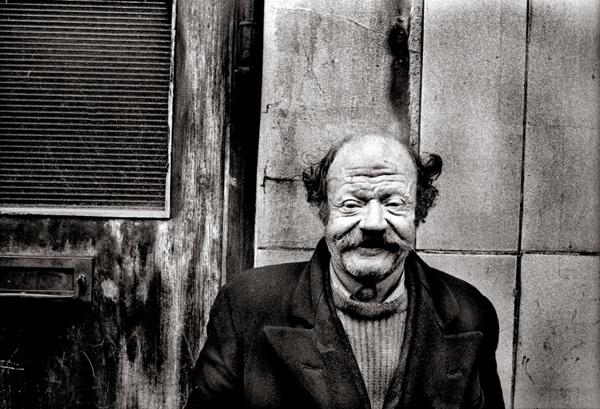
THE SMILE, E2 1962. -“He said, ‘Would you like me to smile?’ He was probably not long for this world, but he was very happy.”

IN THE BAR, E14 1964. -“I’d just got engaged to my first wife and she was one of my ex-mother-in-law’s friends. Full of life!”

THROUGH THE GLASS, E1 1982. -“I think the guy was standing at the cigarette machine.”

THE CALL, E16 1982. -“Terry Lawless’ boxing gym was above this pub. It looks as if everything is collapsing and cracking, and the shadows look like blood pouring from above.”

WHITE SWAN, E14 1982

LIGHT ALE, 1976 -“Four cans of light ale and he was completely out of it.”

CLOSED DOWN, Brick Lane 1982.
Photographs copyright © John Claridge
You may also like to take a look at
Along the Thames with John Claridge
At the Salvation Army with John Claridge
A Few Diversions by John Claridge

On Recovering From The Coronavirus

Recent weeks have passed as if in a dream. I have no more memory of the symptoms of the virus now than if the experience had been itself a dream. Yet I know it was real and I count myself fortunate to have survived and to be here writing to you, lucky to have suffered such a mild version of the symptoms that I am able to recount it placidly from the safety of hindsight.
One day, I was feeling low and so I made myself a hot water bottle and went to bed in the afternoon. That night a fever came upon me and my limbs grew loose until the connection between my body and my self became dislocated. My joints ached as if my shoulders and hips were being wrenched apart like a doll. I took a paracetamol tablet and, twisting and turning in my bed, submitted myself to a slumber so deep that I lost my self entirely.
I was awoken by stomach problems, pacing back and forth to the bathroom endlessly through a day, each time drinking water to replace what I had lost until the clear liquid simply ran through my system as if my body no longer had any substance. I felt cold all over and could not shake off the chills. Daylight hurt my eyes and my feet became sensitive and sore. My head ached and I was overcome with a powerful weariness. After taking a rest on the sofa, on rising I found I did not have the strength to walk to my bedroom and had to wait until I could summon the energy to make it back to bed.
When night came again, the fever returned and I took a second paracetamol tablet. By now, I had a shortness of breath and my throat was sore with the loss of my voice. A few years ago, I had pneumonia and learnt the agony of trying to breathe when your cough reverberates so harshly it bruises your ribs. Now I lay in the dark breathing deliberately, slowly and deeply, fearful that the virus was spreading to my lungs. Without appetite and without eating for two days, feeling the irritation in my chest, I drifted into delirium as if I were possessed by an alien spirit. My loss of self was such that I was passively unaware of the degree or severity of my illness, I was completely in the sway of the virus.
Yet I slept through the night and my stomach problems subsided, even if now my torso was wracked by cramps and aches as well as chills. I lay on my back as weak as I ever felt in my life, dozing with heavy limbs.
How thankful I was for a bowl of soup next day which seemed the most delicious I ever had, soothing my sore throat. After that the fever did not return, instead a midnight craving for cheese on toast surprised and uplifted me, even if it was uncomfortable to digest. That night there was deep sleep without fever, but I awoke with conjunctivitis, my left eye sore and scratchy and watery, the discomfort crowding my consciousness.
For a week I dozed through each day and slept all night without recovering any strength. My shortness of breath and loss of voice persisted and I lay filled with silent anxiety over whether these problems might overwhelm me, taking the breath and the life from me entirely. I realised I was adrift and helpless, a mental paralysis accompanied my physical weakness. Time flew away but there was a stasis in which I was not getting any better.
I recall having influenza as a child and lying in semi-delirium for weeks, enjoying the dreamy otherworldly-ness, secure in the knowledge that recovery would arrive. No such consolation was a available to me with the Coronavirus as I lay waiting to discover whether my condition would deteriorate.
As I have done in the past when afflicted with flu, I took the initiative to recover by rising and doing simple tasks, yet they exhausted me. I recognised I was at the mercy of the virus with no choice but to rest and hope. After ten days, my chest cleared, my voice came back, my eye recovered and my body returned to me. A sense of raw emotionalism and vulnerability remain as if a layer of skin has been removed. Repeatedly, I think of what could have been and what so many have suffered, and how many thousands have died.
Two paracetamol tablets were all I took. Several weeks earlier, I read in the newspaper that this was the necessary medication only to discover that chemists had already sold out. In desperation to be prepared, I visited newsagents and found several selling paracetamol at inflated prices but then another, in Harrow Place off Petticoat Lane, who sold me a whole bottle for one pound and twenty pence. I shall be certain to go back to that shop again.
Now I am – at last – recovered, I look back and appreciate my good fortune to have experienced relatively mild symptoms and been in such good health that I could beat the virus. After this, the beauty of the spring with all the plants sprouting green and shining has overwhelmed me with joy. Each morning, I begin my day by watering the garden and, when I step out of the door into the sunlight, I am startled by the new growth since the day before.
Most of all I am grateful that my fear of catching the virus has ebbed and I hope I may even be immune. I want to get an antibody test to find out, but in the meantime I shall continue to take precautions. Even though I am no longer infectious, I do not want to risk spreading it if I were to become reinfected and, above all, I want to be safe.

You may also like to read


