
Mortlake Jugs
Once, every household in London possessed an ale jug, in the days before it was safe to drink water or tea became widely affordable. These cheaply-produced salt-glazed stoneware items, that could be bought for a shilling or less, were prized for their sprigged decoration and often painstakingly repaired to extend their lives, and even prized for their visual appeal when broken and no longer of use.
All these jugs from the collection of Philip Mernick were produced in Mortlake, when potteries were being set up around London to supply the growing market for these household wares throughout the eighteenth century. The first of the Mortlake potteries was begun by John Sanders and taken over by his son William Sanders in 1745, while the second was opened by Benjamin Kishere who had worked for Sanders, and this was taken over by his son William Kishere in 1834.
These jugs appeal to me with their rich brown colouration that evokes the tones of crusty bread and their lively intricate decoration, mixing images of English country life with Classical motifs reminiscent of Wedgwood. Eighteenth-century Mortlake jugs are distinguished by the attenuated baluster shape that follows the form of ceramics in the medieval world yet is replaced in the early-nineteenth century by the more bulbous form of a jug which is still common today.
There is an attractive organic quality to these highly-wrought yet utilitarian artefacts, encrusted with decorative sprigs like barnacles upon a ship’s hull. They were once universally-familiar objects in homes and ale houses, and in daily use by Londoners of all classes.

1790s ale jug repaired with brass handle and engraved steel rim

A panel of “The Midnight Conversation” after a print by Hogarth

Classical motifs mixed with rural images

A panel of “Cupid’s Procession”

A woman on horseback portrayed on this jug


Agricultural implements and women riders

Toby Fillpot


Panel of Racehorses


Cupid’s procession with George III & Queen Charlotte and Prince of Wales & Caroline of Brunswick


Panel of “Cockerell on the Dungheap”


Panel of “The Two Boors”

Square- based jug of 1800/1810


Toby Fillpot

William Kishere, Pottery Mortlake, Surrey
You may also like to look at
Adam Dant’s Map Of Viral London
Contributing Cartographer Adam Dant has kept himself occupied during the lockdown by drawing this map of contagion in the capital

Click to enlarge
ADAM DANT INTRODUCES HIS VIRAL LONDON MAP
“In my studio next to Liverpool St Station, I was colouring a busy cityscape of Leicester Sq. The drawing was finished in early March but, looking at it now, it struck me that I had created a scene I may not encounter again for a long time – a panorama from a pre-Coronavirus age.
My Viral London is a cartographic representation of how the capital has been assaulted by epidemics throughout history. From the plague of 664AD which struck monastic communities, destabilised the church, to the AIDS crisis and ‘The London Patient’ who was the second case to be cured.
The effect of fifteen hundred years of epidemics, transforming Londoners’ behaviour and their landscape, is characterised not by major social projects but by incidents that are commonly anecdotal and poignant. Walking home through a deserted City of London by night, the narrator of Daniel Defoe’s A Journal of The Plague Year, witnesses a woman open her window to cry, ‘Death, Death, Death!’. Erasmus, visiting London during an outbreak of the Sweyting Sickness, was too scared to enter his lodgings to collect his boots for fear of catching the illness. In 1918, Londoners celebrating the Armistice were unaware that the deadly Spanish Flu was being spread amongst the revellers.
I started wondering how pandemics might have coloured the sensibilities of artists in the past. We always imagine life was much nastier back then.
Many of my artistic predecessors witnessed episodes of viral assault. Brueghel’s The Triumph of Death is underpinned by the ever present risk of plague, Hollar engraved views of London before and after the Great Fire which had followed the pestilence like a purgative, and no Renaissance artist working in Venice was ever safe from the French Pox, also known as Neapolitan bone-ache or syphilis, to give its modern name. Among those paintings by Canaletto teeming with people, La Serenissima contains a masked and wigged figure wearing a beaked mask filled with herbs to ward off the pestilence.
I am wondering if my depictions of packed public spaces will serve as perpetual descriptions of ‘how we used to be’ and whether I should now be drawing more classical crowd scenes in which figures waft past each other at arms’ length, with a courtly grace conferring mandatory social distancing.
Perhaps Leicester Sq, Sloane Sq, Berkley Sq, the Royal Exchange or any of the other teeming centres of life that I have portrayed may never appear the same again after the war on Covid-19, any more than they did after the Blitz?”
Adam Dant’s Viral London Map was commissioned by The Critic

CLICK TO ORDER A COPY OF MAPS OF LONDON & BEYOND BY ADAM DANT
Adam Dant’s MAPS OF LONDON & BEYOND is a mighty monograph collecting together all your favourite works by Spitalfields Life‘s Contributing Cartographer in a beautiful big hardback book.
Including a map of London riots, the locations of early coffee houses and a colourful depiction of slang through the centuries, Adam Dant’s vision of city life and our prevailing obsessions with money, power and the pursuit of pleasure may genuinely be described as ‘Hogarthian.’
Unparalleled in his draughtsmanship and inventiveness, Adam Dant explores the byways of London’s cultural history in his ingenious drawings, annotated with erudite commentary and offering hours of fascination for the curious.
The book includes an extensive interview with Adam Dant by The Gentle Author.
Adam Dant’s limited edition prints including the VIRAL LONDON MAP are available to purchase through TAG Fine Arts
Wonderful London
It is my pleasure to publish these dignified and characterful portraits of Londoners, believed to be by photographer Donald McLeish (1879-1950), selected from the three volumes of Wonderful London edited by St John Adcock and produced by The Fleetway House in the nineteen-twenties.

Telescope Man on Westminster Bridge

Old woman who inhabited the alleys off Fleet St

Breton Onion Seller

Costermonger and child

Cats’ Meat Man

Knife Grinder

Charwoman

Islington Window Cleaner

Flower Seller

Concertina Player

Hurdy-Gurdy Man

Gramophone Man

Escapologist

Wandering Harpist

Street Sweeper

Scavenger

District Messenger

Telephone Messenger

Railway Fireman

Railway Engine Driver

Carman

Railway Porter

Gold Beaters

Gas Fitters

Chimney Sweep

Telephone Cable Man
Photographs courtesy Bishopsgate Institute
You might also like to take a look at
John Thomson’s Street Life in London
William Nicholson’s London Types
List Of Local Shops Open For Business

Every Wednesday, I publish the up to date list of stalwarts that remain open in Spitalfields. Readers are especially encouraged to support small independent businesses who offer an invaluable service to the community. This list confirms that it is possible to source all essential supplies locally without recourse to supermarkets.
Be advised many shops are operating limited opening hours at present, so I recommend you call in advance to avoid risking a wasted journey. Please send any additions or amendments for next week’s list to spitalfieldslife@gmail.com
This weeks illustrations are photographs by Tony Hall from the sixties and seventies. See the full set here

GROCERS & FOOD SHOPS
The Albion, 2/4 Boundary St
Ali’s Mini Superstore, 50d Greatorex St
AM2PM, 210 Brick Lane
As Nature Intended, 132 Commercial St
Banglatown Cash & Carry, 67 Hanbury St
Breid Bakery, Arch 72, Dunbridge St
Brick Lane Minimarket, 100 Brick Lane
The Butchery Ltd, 6a Lamb St (Open Thursdays only)
City Supermarket, 10 Quaker St
Costprice Minimarket, 41 Brick Lane
Faizah Minimarket, 2 Old Montague St
JB Foodstore, 97 Brick Lane
Haajang’s Corner, 78 Wentworth St
Leila’s Shop, 17 Calvert Avenue (Call 0207 729 9789 between 10am-noon on Tuesday-Saturdays to place your order and collect on the same day from 2pm-4pm)
The Melusine Fish Shop, St Katharine Docks
Nisa Local, 92 Whitechapel High St
Pavilion Bakery, 130 Columbia Rd
Rinkoff’s Bakery, 224 Jubilee Street & 79 Vallance Road
Spitalfields City Farm, Buxton St (Order through website)
Sylhet Sweet Shop, 109 Hanbury St
Taj Stores, 112 Brick Lane
Zaman Brothers, Fish & Meat Bazaar, 19 Brick Lane

TAKE AWAY FOOD SHOPS
Before you order from a delivery app, why not call the take away or restaurant direct?
Absurd Bird Fried Chicken, 54 Commercial St
Al Badam Fried Chicken, 37 Brick Lane
Allpress Coffee, 58 Redchurch St
Band of Burgers, 22 Osborn St
Beef & Birds, Brick Lane
Beigel Bake, 159 Brick Lane
Beigel Shop, 155 Brick Lane
Bellboi Coffee, 104 Sclater St
Bengal Village, 75 Brick Lane
Big Moe’s Diner, 95 Whitechapel High St
Burro E Salvia Pastificio, 52 Redchurch St
The Carpenters Arms, 73 Cheshire St (Open for take away beers)
China Feng, 43 Commercial St
Circle & Slice Pizza, 11 Whitechapel Rd
Dark Sugars, 45a Hanbury St (Take away ice cream and deliveries of chocolate)
Donburi & Co, Korean & Japanese, 13 Artillery Passage
Duke of Wellington, 12 Toynbee St (Open for take away beers)
Eastern Eye Balti House, 63a Brick Lane
Enso Thai & Japanese, 94 Brick Lane
Exmouth Coffee Shop, 83 Whitechapel High St
Grounded Coffee Shop, 9 Whitechapel Rd
Holy Shot Coffee, 155 Bethnal Green Rd
Hotbox Smoked Meats, 46-48 Commercial St
Jack The Chipper, 74 Whitechapel High St
Jonestown Coffee, 215 Bethnal Green Rd
Laboratorio Pizza, 79 Brick Lane
La Cucina, 96 Brick Lane
Leon, 3 Crispin Place, Spitalfields Market
Madhubon Sweets, 42 Brick Lane
Mooshies Vegan Burgers, 104 Brick Lane
Nude Expresso, The Roastery, 25 Hanbury St
E. Pellicci, 332 Bethnal Green Rd
Pepe’s Peri Peri, 82 Brick Lane
Peter’s Cafe, 73 Aldgate High St
Picky Wops Vegan Pizza, 53 Brick Lane
Quaker St Cafe, 10 Quaker St
Rajmahal Sweets, 57 Brick Lane
Rosa’s Thai Cafe, 12 Hanbury St
Shawarma Lebanese, 84 Brick Lane
Shoreditch Fish & Chips, 117 Redchurch St
Sichuan Folk, 32 Hanbury St
String Ray Globe Cafe, 109 Columbia Road
Sushi Show, 136 Bethnal Green Rd
Vegan Yes, Italian & Thai Fusion, 64 Brick Lane
White Horse Kebab, 336 Bethnal Green Rd
Yuriko Sushi & Bento, 48 Brick Lane

OTHER SHOPS & SERVICES
Boots the Chemist, 200 Bishopsgate
Brick Lane Bookshop, 166 Brick Lane (Books ordered by phone or email are delivered free locally)
Brick Lane Bikes, 118 Bethnal Green Rd
Brick Lane Off Licence, 114/116 Brick Lane
Day Lewis Pharmacy, 14 Old Montague St
E1 Cycles, 4 Commercial St
Eden Floral Designs, 10 Wentworth St (Order fresh flowers online for free delivery)
Flashback Records, 131 Bethnal Green Rd (Order records online for delivery)
Harry Brand, 122 Columbia Road (Order gifts online for delivery)
Hussain Tailoring, 64 Hanbury St
iRepair, Phones & Computer, 94 Whitechapel High St
GH Cityprint, 58-60 Middlesex St
Leyland Hardware, 2-4 Great Eastern St
Mobile Clinic & Laptop Repairs, 7 Osborne St
Post Office, 160a Brick Lane
Quality Dry Clean, 151 Bethnal Green Rd
Rose Locksmith & DIY, 149 Bethnal Green Rd
Sid’s DIY, 2 Commercial St
Spitalfields Dry Cleaners, 12 Whites Row

ELSEWHERE
E5 Bakehouse, Arch 395, Mentmore Terrace (Customers are encouraged to order online and collect in person)
Gold Star Dry Cleaning & Laundry, 330 Burdett Rd
Hackney Essentials, 235 Victoria Park Rd
Quality Dry Cleaners, 16a White Church Lane
Newham Books, 747 Barking Rd (Books ordered by phone or email are posted out)
Region Choice Chemist, 68 Cambridge Heath Rd
Symposium Italian Restaurant, 363 Roman Road (Take away service available)
Thompsons DIY, 442-444 Roman Rd

Photographs copyright © Estate of Tony Hall
You may like to take a look at these other photos by Tony Hall
Remembering The 43 Group
Photographer Stuart Freedman introduces his fine portraits of the last surviving members of the 43 Group, brave men who fought back against the resurgence of fascism in post-war London. Next month sees the seventh anniversary of when the Group officially disbanded.

Jules Konopinsky
“When I was a boy, I used to walk down Brick Lane with my father on a Sunday. We would sometimes see men selling the National Front’s rag on the corner of Bethnal Green Rd beneath a tatty Union Jack flag. This was the seventies, a troubled time when the certainties of the post-war settlement were under threat. This was the time of Rock Against Racism and the murder of Blair Peach, where racism, nationalism and bigotry were presented in some quarters as appealing and even respectable. How times do not change.
But each generation remembers its own battles. In the nineties I became a photographer and, for a very short time, I started to make images of the ‘Lane and inevitably saw the same men selling the same newspapers under the same tatty flag.
In 1996, I made a set of portraits and interviews for the Independent Magazine of veterans of the International Brigades who had fought fascists in Spain sixty years before. Many had to go and fight the same battles again across the world in 1939. A few talked about the resurgence of fascism after the war and how, when interned Blackshirts were released from prison they started to organise, prompting a far-right revival.
It was then I read Maurice Beckman’s book about the 43 Group, a historically significant but largely forgotten organisation of mostly – but not exclusively – Jewish ex-servicemen, and some extraordinarily brave women, who returned from the horrors of war only to find fascism again on their own doorstep. I read how they resolved to fight back, to physically oppose the menace, to meet violence with violence to protect their communities. And how they had done so against the wishes of their elders and representatives.
My father lived in a poor, bomb-damaged street in Stoke Newington and, as a young man in 1947, had seen the savage violence of the long-forgotten battles of Dalston and Ridley Rd. Battles unremembered but perhaps no less significant than Cable St. I had resolved to find those men that had stood up to a new generation of Oswald Mosley’s thugs and record them for posterity. But I never did, I spent the next two decades working and living across the world as a photo-reporter. I forgot.
Last year, I read Daniel Sonabend’s wonderful, forensic and compelling new history of the 43 Group, We Fight Fascists: The 43 Group and Their Forgotten Battle for Post-War Britain and I knew that I needed to make these images to remember before it was too late.
By the turn of this year, there were only six of the original members left. I photographed them just before lockdown. Tragically, Maurice Podro passed away earlier this month and so these images are shown in his memory.
We forget at our cost.”
Stuart Freedman
 Gerry Kaffin
 Martin White
 Gerry Abrahams
 Maurice Podro
 Harry Kaufman
Portraits copyright © Stuart Freedman
You may also like to take a look at Stuart Freedman’s other work
At Kirby’s Eccentric Museum
Whenever I used to visit collector Mike Henbrey, he always showed me something extraordinary from his collection and he certainly did not disappoint when he pulled two volumes of Kirby’s Eccentric Museum from the shelf for me to take a look

John Biggs was born in 1629 and lived in Denton in the county of Bucks in a cave

This wonderful boy, who in early age outstripped all former calculators, was born in Morton Hampstead on 14th June 1806

In Mme Lefort the sexes are so equally blended that it is impossible to say which has predominance

This gentleman was a bookseller in Upper Marylebone St, remembered today as Shelley’s bookseller

The parachute here represented was used by Monsieur Garnerin at his ascension in London


Thomas Cooke was born in 1726 at Clewer near Windsor as the son of an itinerant fiddler

Robert Coates Esq, commonly called ‘The Amateur of Fashion’


The giant Basilio Huaylas came in May 1792 from the town of Joa to Lima and publicly exhibited himself

Mr James Toller and Mr Simon Paap are presumed to be the tallest shortest men in the kingdom


Miss McAvoy, who distinguished colours by the touch, was born in Liverpool on 28th June 1800

Mr Hermans Bras, designated the gigantic Prussian Youth, was born at Tecklenbourg in 1801


Thomas Laugher, aged 111 years, and known by the name of Old Tommy

Petratsch Zortan in the 185th year of his age, he died on 5th January 1724

John Rovin in the 172nd & Sarah his wife in the 164th year of their respective ages

The turnip represented in the plate grew in 1628

The parsnip here represented grew in 1742

The radish here represented was found in 1557 in Haarlem

You may also like to take a look at
Mike Henbrey, Collector of Books, Epherema & Tools
Vinegar Valentines for Bad Tradesmen
A History Of Gardening In The East End
Plantswoman Margaret Willes sent me this brief horticultural history of the East End

Early twentieth century garden at the rear of WF Arber & C0 Ltd, Printing Works
Today Spitalfields and Shoreditch are intensely urban areas but, four centuries ago, the scene was very different. Maps of this era show that behind the main roads flanked by houses and cottages, there were fields of cattle and, close by the city walls, laundrywomen laying out their washing to dry.
Many craftsmen who needed to be near to the City of London, yet who did not wish to be liable to its trading restrictions, found a home here. At the end of the sixteenth century, Huguenot silk weavers fleeing from religious persecution in the Spanish Netherlands and France, and landing at ports such as Yarmouth, Colchester and Sandwich, made their way to the capital. Records of this first wave of Huguenots and their arrival in Spitalfields are sparse, but there are references to them in the rural village of Hackney for instance.
Just as these ‘strangers’ took up residence east of London, so too did actors and their theatres. William Shakespeare lodged just within the City walls in Silver St, in the fifteen-nineties, in the home of an immigrant family from Picardie, the Mountjoys, who were involved in silk and wire-twisting.
Tradition tells us that these refugees brought with them their love of flowers. Bulbs and seeds may easily be transported, so they could have brought their floral treasures in their pockets. The term ‘florist’ first appears in English in 1623 when Sir Henry Wotton, scholar, diplomat and observer of gardens wrote about them to an acquaintance. He was not using ‘florist’ in its modern sense as a retailer of cut flowers, but rather as a description of an enthusiast who nurtured and exhibited pot-grown flowers such as tulips and carnations. One flower that has been traditionally associated with the Spitalfields silk weavers is the auricula, with its clear-cut colours. Auricalas do not like rain, so those who worked at home were in an ideal position to be able to bring them under cover when inclement weather threatened.
Another ‘outsider’ living in Spitalfields in the mid-seventeenth century was the radical apothecary, Nicholas Culpeper. He set up home in the precincts of the former Priory of St Mary Spital with his wife Alice Ford in 1640, probably choosing to be outside the City in order to able to practise without a licence. A Nonconformist in every sense, he disliked the elitism of the medical profession and in his writings threw down a challenge by offering help to all, however poor they were. He develop his knowledge by gathering wild flowers and herbs, but it is likely he also cultivated them in his own garden. His English Physitian, later known as the Complete Herbal, is one of the most successful books published in the English language and is still available today.
Culpeper’s books are a reminder that the garden has been for centuries the vital source of all medicines and poultices in this country. As London expanded, and private gardens within the City walls were built over, so the supply of medicinal herbs for apothecaries and housewives became of vital importance. Some of the market herbwomen are mentioned by name in the records of 1739-40 of the Fleet Market along with their places of residence. Hannah Smith, for example, came from Grub Sin in Finsbury, but others from further afield, such as Bethnal Green and Stepney Green. The remedies of the period required large quantities of certain herbs, such as wormwood and pennyroyal, and these women cultivated these as market gardeners.
With the Revocation of the Edict of Nantes in 1685 by Louis XIV, a fresh wave of Huguenot refugees arrived, this time from France rather than the Lowlands. We know much more about these people, including their love of flowers, along with singing birds and linnets, which until quite recently could still be bought from Club Row Market. The French king made a mistake in divesting his realm of some of the most talented craftsmen: gunsmiths and silversmiths as well as silk weavers. The skill of the weavers was matched by their love of flowers in the exquisite silks they produced for court mantuas, the ornate dresses made for aristocratic ladies attending the court of St James. In these designs, a genuine attempt was made to produce botanical naturalism rather than purely conventional floral motifs and although today the most famous designer was Anna-Maria Garthwaite, there were others working alongside her in these streets.
As Spitalfields grew more developed in the eighteenth century, so the pressure on land increased and many of the gardens were built over with new houses. Some residents appear to have taken to their rooftops, creating gardens and building aviaries for their birds up there. Thomas Fairchild, who cultivated a famous nursery in Hoxton, recommended the kind of plants that could survive at this height, including currant trees. Others created gardens upon grounds along the Hackney and Mile End roads. A commissioner reporting on the conditions of the handloom weavers in the early nineteenth century described one such area, Saunderson’s Gardens in Bethnal Green.
“They may cover about six acres of ground. There is one general enclosure round the whole, and each separate garden is divided from the rest by small palings. The number of gardens was stated to be about one hundred and seventy: some are much larger than the rest. In almost every garden is a neat summer-house, where the weaver and his family may enjoy themselves on Sundays and holidays …. There are walks through the ground by which access is easy to the gardens.
The commissioner found that vegetables such as cabbages, lettuces and peas were cultivated, but pride of place was given to flowers. “There had been a contest for a silver medal amongst the tulip proprietors. There were many other flowers of a high order, and it was expected that in due time the show of dahlias for that season would not fail to bring glory to Spitalfields. In this neighbourhood are several dealers in dahlias.”
The competitions held for the finest florists’ flowers were fiercely fought. The Old Bailey sessions records include cases where thieves had broken into gardens not only to steal from the summer houses, but to take prize bulbs too. The Lord Mayor’s Day, 9th November, was traditionally the time to plant the bulbs and, in the spring, judges visited the gardens to make their decisions.
But these gardens were doomed, for the eastern parts of London – Bethnal Green, Stepney Green and Hackney – were being overwhelmed by street after street of new terraced houses. The handloom weavers of the area were likewise doomed, as the silk industry was threatened by competition from overseas and by looms powered by machinery in this country. Their love of flowers, however, was not to be dimmed, and a picture of a Spitalfields weaver in 1860 working alongside his daughters in a garret shows plants on the windowsill, while a contemporary account describes a fuchsia in pride of place near a loom, with its crimson pendants swinging to the motion of the treadles.
Root plants could be bought from sellers, especially along the Mile End Rd, and cut flowers from Spitalfields Market. At the beginning of the twentieth century, a market specifically for flowers and plants was established in Columbia Rd in Shoreditch. This followed the failure of an elaborate food market built by the philanthropist, Angela Burdett-Coutts in the nineteenth century. Her project had been based on a prospective railway line to deliver fish, which never materialised, while the traders preferred to sell outdoors and their customers, many of whom were Jewish immigrants, wanted to buy on Sunday. Originally, Columbia Market traded on Saturday but a parliamentary act moved it to Sunday, enabling Covent Garden and Spitalfields traders to sell their leftover stock, and this market thrived, attesting to the persistent love of flowers in the East End of London.

London Herb Woman, late sixteenth century from Samuel Pepys collection of Cries of London

Nicholas Culpeper (1616-1654), the Spitalfields Herbalist

An auricula theatre

The tomb of Thomas Fairchild (1667-1729) the Hoxton gardener

Rue, Sage & Mint – a penny a bunch! Kendrew’s Cries of London

Buy my watercress, 1803

Buy my Ground Ivy, 1803

Chickweed seller of 1817 by John Thomas Smith

This is John Honeysuckle, the industrious gardener, with a myrtle in his hand, the produce of his garden. He is justly celebrated for his beautiful bowpots and nosegays, 1819

Here’s all a Blowing, Alive and Growing – Choice Shrubs and Plants, Alive and Growing, eighteen-twenties

Selling flowers on Columbia Rd in the nineteen seventies Photo by George Gladwell
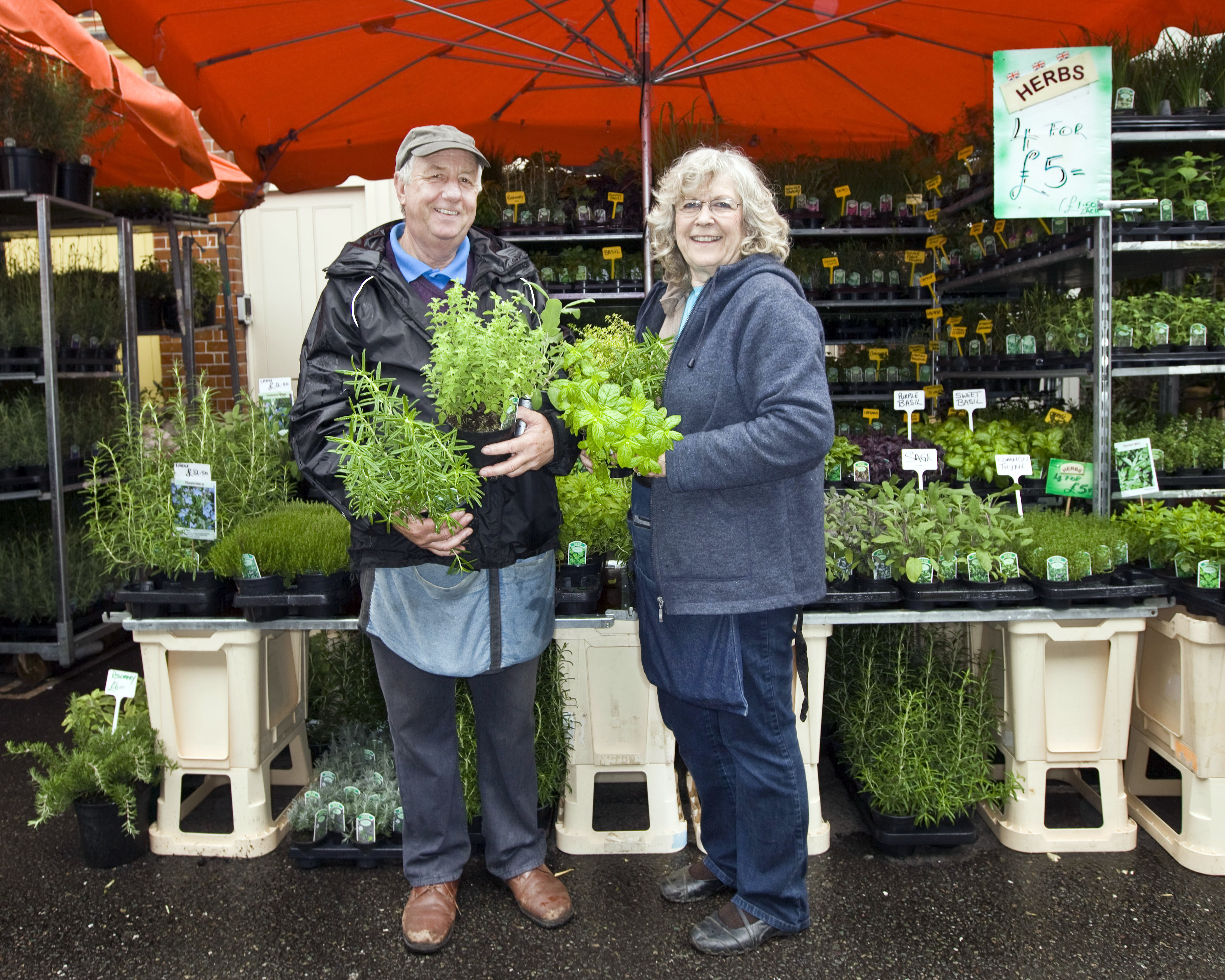
Mick & Sylvia Grover, Herb Sellers in Columbia Rd – Portrait by Jeremy Freedman

Margaret Willes in her garden – Portrait by Sarah Ainslie
The Gardens of the British Working Class by Margaret Willes is published by Yale University Press
You may also like to read about
Nicholas Culpeper, Herbalist of Spitalfields
Thomas Fairchild, Gardener of Hoxton


