
Swan Upping On The Thames
For the first time in living memory Swan Upping is cancelled this year

Since before records began, Swan Upping has taken place on the River Thames in the third week of July – chosen as the ideal moment to make a census of the swans, while the cob (as the male swan is known) is moulting and flightless, and before the cygnets of Spring take flight at the end of Summer. This ancient custom stems from a world when the ownership and husbandry of swans was a matter of consequence, and they were prized as roasting birds for special occasions.
Rights to the swans were granted as privileges by the sovereign and the annual Swan Upping was the opportunity to mark the bills of cygnets with a pattern of lines that indicated their provenance. It is a rare practice from medieval times that has survived into the modern era and I have always been keen to see it for myself – as a vision of an earlier world when the inter-relationship of man and beast was central to society and the handling of our fellow creatures was a important skill. So it was my good fortune to join the Swan Uppers of the Worshipful Company of Vintners’ for a day on the river from Cookham to Marlow, just one leg of their seventy-nine mile course from Sunbury to Abingdon over five days. The Vintners Company were granted their charter in 1363 and a document of 1509 records the payment of four shillings to James the under-swanherd “for upping the Master’s swans” at the time of the “great frost” – which means the Vintners have been Swan Upping for at least five hundred years.
Swan Upping would have once been a familiar sight in London itself, but the embankment of the Thames makes it an unsympathetic place for breeding swans these days and so the Swan Uppers have moved upriver. Apart from the Crown, today only the Dyers’ and Vintners’ Companies retain the ownership of swans on the Thames and each year they both send a team of Swan Uppers to join Her Majesty’s Swan Keeper for a week in pursuit of their quarry.
It was a heart-stopping moment when I saw the Swan Uppers for the first time, coming round the bend in the river, pulling swiftly upon their oars and with coloured flags flying, as their wooden skiffs slid across the surface of the water toward me. Attended by a flotilla of vessels and with a great backdrop of willow framing the dark water surrounding them, it was as if they had materialized from a dream. Yet as soon as I shook hands with the Swan Uppers at The Ferry in Cookham, I discovered they were men of this world, hardy, practical and experienced on the water. All but one made their living by working on the Thames as captains of pleasure boats and barges – and the one exception was a trader at the Billingsgate Fish Market.
There were seven in each of the teams, consisting of six rowers spread over two boats, and a Swan Marker. Some had begun on the water at seven or eight years old as coxswain, most had distinguished careers as competitive rowers as high as Olympic level, and all had won their Doggett’s coat and badge, earning the right to call themselves Watermen. But I would call them Rivermen, and they were the first of this proud breed that I had met, with weathered skin and eager brightly-coloured eyes, men who had spent their lives on the Thames and were experts in the culture and the nature of the river.
They were a tight knit crew – almost a family – with two pairs of brothers and a pair of cousins among them, but they welcomed me to their lunch table where, in between hungry mouthfuls, Bobby Prentice, the foreman of the uppers, told me tales of his attempts to row the Atlantic Ocean, which succeeded on the third try. “I felt I had to go back and do it,” he confessed to me, shaking his head in determination, “But, the third time, I couldn’t even tell my wife until I was on my way.” Bobby’s brother Paul told me he was apprenticed to his father, as a lighterman on the Thames at fifteen, and Roger Spencer revealed that after a night’s trading at Billingsgate, there was nothing he liked so much as to snatch an hour’s rowing on the river before going home for an hour’s nap. After such admissions, I realised that rowing up the river to count swans was a modest recreation for these noble gentlemen.
There is a certain strategy that is adopted when swans with cygnets are spotted by the uppers. The pattern of the “swan voyage” is well established, of rowing until the cry of “Aaall up!” is given by the first to spot a family of swans, instructing the crews to lift their oars and halt the boats. They move in to surround the swans and then, with expert swiftness, the birds are caught and their feet are tethered. Where once the bills were marked, now the cygnets are ringed. Then they are weighed and their health is checked, and any that need treatment are removed to a swan sanctuary. Today, the purpose of the operation is conservation, to ensure well being of the birds and keep close eye upon their numbers – which have been increasing on the Thames since the lead fishing weights that were lethal to swans were banned, rising from just seven pairs between London and Henley in 1985 to twenty-eight pairs upon this stretch today.
Swan Upping is a popular spectator sport as, all along the route, local people turn out to line the banks. In these river communities of the upper Thames, it has been witnessed for generations, marking the climax of Summer when children are allowed out of school in their last week before the holidays to watch the annual ritual.
Travelling up river from Cookham, between banks heavy with deep green foliage and fields of tall golden corn, it was a sublime way to pass a Summer’s afternoon. Yet before long, we passed through the lock to arrive in Marlow where the Mayor welcomed us by distributing tickets that we could redeem for pints of beer at the Two Brewers. It was timely gesture because – as you can imagine – after a day’s rowing up the Thames, the Swan Uppers had a mighty thirst.


Martin Spencer, Swan Marker


Foreman of the Uppers, Bobby Prentice


The Swan Uppers of the Worshipful Company of Vintners, 2011

The Swan Uppers of 1900


The Swan Uppers of the nineteen twenties.


In the nineteen thirties.


The Swan Uppers of the nineteen forties.


In the nineteen fifties.

Archive photographs copyright © Vintners’ Company
You may also like to read about
Philip Cunningham’s East End Shopfronts
It is my pleasure to publish these pictures from Photographer Philip Cunningham‘s astonishing archive of images from the seventies and eighties

Shop in Bow, c.1972
“In 1970 my partner, Sally, was a student on the Foundation Course at Hornsey College of Art. They taught her how to use a camera and process film and, in turn, she taught me. When we moved to the East East in 1971, the Council and GLC were still emptying and demolishing streets. People were being moved into tower blocks, which mostly had poor insulation and were physically alienating. By this time, the mythology of ‘streets in the sky’ was already discredited yet they continued anyway. There was still a lot of bomb damage but the remnants of previous communities could be seen, and I was determined to try and document what was left. I was also interested in the buildings themselves which had their own character. Taking at least a film a month, I built up a large archive. We were customers of some of these shops but others were already derelict. They represented a different life.” – Philip Cunningham

c.1972

Roman Rd, c.1976

Mile End Rd

Mile End Rd, c.1979

Mile End Rd, c.1979

Mile End Rd, c.1979

Mile End Rd, c.1979

Mile End Rd, c.1979

Mile End Rd, c.1978

Mile End Rd

Mile End Rd, c.1981

Mile End Rd, c.1985

Mile End Rd, c.1985

Malplaquet House, Mile End Rd, c.1976

Mile End Rd, c.1976

Mile End Rd, c.1979

Mile End Rd, c.1982

White Horse Lane, c.1979

East End India Dock Rd, c.1978

Roman Rd, c.1977

Stepney Way, c.1971

Antil Rd, c.1980

Hay Currie St, c.1978

Upper Clapton Rd, c.1983

Globe Rd, c.1976

Unknown location, c.1976

Brushfield St

Off Brick Lane, c.1976

Off Brick Lane, c.1976

Quaker St, c.1976

Off Cheshire St, c.1976

Cheshire St, c.1976
Photographs copyright © Philip Cunningham
You may also like to take a look at
Philip Cunningham’s East End Portraits
More of Philip Cunningham’s Portraits
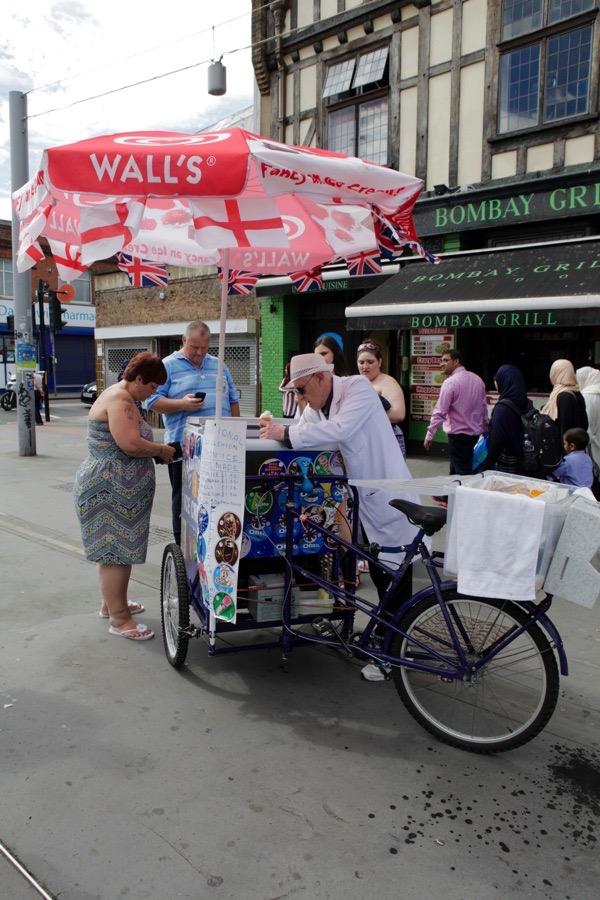
George Parrin, Ice Cream Seller
George is out pedalling around the streets again, so if you see him be sure to stop him and buy one!

‘I’ve been on a bike since I was two’
I first encountered Ice Cream Seller, George Parrin, coming through Whitechapel Market on his bicycle. Even before I met him, his cry of ‘Lovely ice cream, home made ice cream – stop me and buy one!’ announced his imminent arrival and then I saw his red and white umbrella bobbing through the crowd towards us. George told me that Whitechapel is the best place to sell ice cream in the East End and, observing the looks of delight spreading through the crowd, I witnessed the immediate evidence of this.
Such was the demand on that hot summer afternoon that George had to cycle off to get more supplies, so it was not possible for me to do an interview. Instead, we agreed to meet next day outside the Beigel Bakery on Brick Lane where trade was a little quieter. On arrival, George popped into the bakery and asked if they would like some ice cream and, once he had delivered a cup of vanilla ice, he emerged triumphant with a cup of tea and a salt beef beigel. ‘Fair exchange is no robbery!’ he declared with a hungry grin as he took a bite into his lunch.
“I first came down here with my dad when I was eight years old. He was a strongman and a fighter, known as ‘Kid Parry.’ Twice, he fought Bombardier Billy Wells, the man who struck the gong for Rank Films. Once he beat him and once he was beaten, but then he beat two others who beat Billy, so indirectly my father beat him.
In those days you needed to be an actor or entertainer if you were in the markets. My dad would tip a sack of sand in the floor and pour liquid carbolic soap all over it. Then he got a piece of rotten meat with flies all over it and dragged it through the sand. The flies would fly away and then he sold the sand by the bag as a fly repellent.
I was born in Hampstead, one of thirteen children. My mum worked all her life to keep us going. She was a market trader, selling all kinds of stuff, and she collected scrap metal, rags, woollens and women’s clothes in an old pram and sold it wholesale. My dad was to and fro with my mum, but he used to come and pick me up sometimes, and I worked with him. When I was nine, just before my dad died, we moved down to Queens Rd, Peckham.
I’ve been on a bike since I was two, and at three years old I had my own three-wheeler. I’ve always been on a bike. On my fifteenth birthday, I left school and started work. At first, I had a job for a couple of months delivering meat around Wandsworth by bicycle for Brushweilers the Butcher, but then I worked for Charles, Greengrocers of Belgravia delivering around Chelsea, and I delivered fruit and vegetables to the Beatles and Mick Jagger.
At sixteen years old, I started selling hot chestnuts outside Earls Court with Tony Calefano, known as ‘Tony Chestnuts.’ I lived in Wandsworth then, so I used to cycle over the river each day. I worked for him for four years and then I made my own chestnut can. In the summer, Tony used to sell ice cream and he was the one that got me into it.
I do enjoy it but it’s hard work. A ten litre tub of ice cream weighs 40lbs and I might carry eight tubs in hot weather plus the weight of the freezer and two batteries. I had thirteen ice cream barrows up the West End but it got so difficult with the police. They were having a purge, so they upset all my barrows and spoilt the ice cream. After that, Margaret Thatcher changed the law and street traders are now the responsibility of the council. The police here in Brick Lane are as sweet as a nut to me.
I bought a pair of crocodiles in the Club Row animal market once. They’re docile as long as you keep them in the water but when they’re out of it they feel vulnerable and they’re dangerous. I can’t remember what I did with mine when they got large. I sell watches sometimes. If anybody wants a watch, I can go and get it for them. In winter, I make jewellery with shells from the beach in Spain, matching earrings with ‘Hello’ and ‘Hola’ carved into them. I’m thinking of opening a pie and mash shop in Spain.
I am happy to give out ice creams to people who haven’t got any money and I only charge pensioners a pound. Whitechapel is best for me. I find the Asian people are very generous when it comes to spending money on their children, so I make a good living off them. They love me and I love them.”




Photographs copyright © Estate of Colin O’Brien
You might also like to read about
Matyas Selmeczi, Silhouette Artist
Marcellus Laroon’s Cries Of London
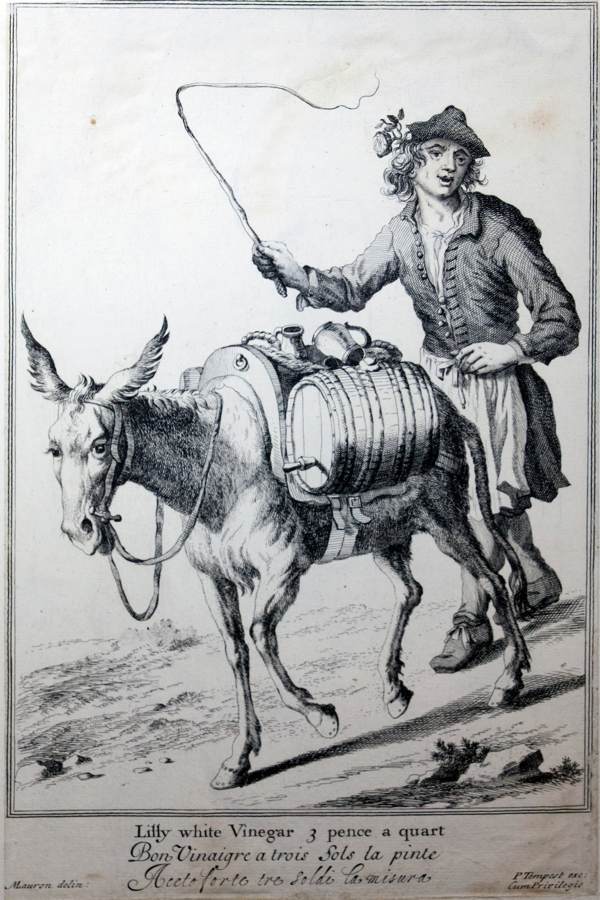
Today it is my pleasure to publish Marcellus Laroon’s vibrant series of engravings of the Cries of London reproduced from an original edition of 1687 in the collection at the Bishopsgate Institute

The death of Oliver Cromwell and the restoration of Charles II made the thoroughfares of London festive places once again, renewing the street life of the metropolis. After the Great Fire of 1666 destroyed the shops and wiped out most of the markets, an unprecedented horde of hawkers flocked to the City from across the country to supply the needs of Londoners .
Samuel Pepys and Daniel Defoe both owned copies of Marcellus Laroon’s Cries of London. Among the very first Cries to be credited to an individual artist, Laroon’s “Cryes of the City of London Drawne after the Life” were on a larger scale than had been attempted before, which allowed for more sophisticated use of composition and greater detail in costume. For the first time, hawkers were portrayed as individuals not merely representative stereotypes, each with a distinctive personality revealed through their movement, their attitudes, their postures, their gestures, their clothing and the special things they sold. Marcellus Laroon’s Cries possessed more life than any that had gone before, reflecting the dynamic renaissance of the City at the end of the seventeenth century.
Previous Cries had been published with figures arranged in a grid upon a single page, but Laroon gave each subject their own page, thereby elevating the status of the prints as worthy of seperate frames. And such was their success among the bibliophiles of London, that Laroon’s original set of forty designs – reproduced here – commissioned by the entrepreneurial bookseller Pierce Tempest in 1687 was quickly expanded to seventy-four and continued to be reprinted from the same plates until 1821. Living in Covent Garden from 1675, Laroon sketched his likenesses from life, drawing those he had come to know through his twelve years of residence there, and Pepys annotated eighteen of his copies of the prints with the names of those personalities of seventeenth century London street life that he recognised.
Laroon was a Dutchman employed as a costume painter in the London portrait studio of Sir Godfrey Kneller – “an exact Drafts-man, but he was chiefly famous for Drapery, wherein he exceeded most of his contemporaries,” according to Bainbrigge Buckeridge, England’s first art historian. Yet Laroon’s Cries of London, demonstrate a lively variety of pose and vigorous spontaneity of composition that is in sharp contrast to the highly formalised portraits upon which he was employed.
There is an appealing egalitarianism to Laroon’s work in which each individual is permitted their own space and dignity. With an unsentimental balance of stylisation and realism, all the figures are presented with grace and poise, even if they are wretched. Laroon’s designs were ink drawings produced under commission to the bookseller and consequently he achieved little personal reward or success from the exploitation of his creations, earning his living by painting the drapery for those more famous than he and then dying of consumption in Richmond at the age of forty-nine. But through widening the range of subjects of the Cries to include all social classes and well as preachers, beggars and performers, Marcellus Laroon left us us an exuberant and sympathetic vision of the range and multiplicity of human life that comprised the populace of London in his day.




Images photographed by Alex Pink & reproduced courtesy Bishopsgate Institute
Peruse these other sets of the Cries of London I have collected
More John Player’s Cries of London
More Samuel Pepys’ Cries of London
Geoffrey Fletcher’s Pavement Pounders
William Craig Marshall’s Itinerant Traders
H.W.Petherick’s London Characters
John Thomson’s Street Life in London
Aunt Busy Bee’s New London Cries
William Nicholson’s London Types
Francis Wheatley’s Cries of London
John Thomas Smith’s Vagabondiana of 1817
John Thomas Smith’s Vagabondiana II
John Thomas Smith’s Vagabondiana III
Thomas Rowlandson’s Lower Orders
More of Thomas Rowlandson’s Lower Orders
Adam Dant’s New Cries of Spittlefields

CLICK TO BUY A SIGNED COPY OF CRIES OF LONDON FOR £20
The Reopening Of Columbia Rd Market

Carl Grover, Herb Seller
When people asked me what I missed most during the lockdown, Columbia Rd Market was always top of the list. So you can imagine my delight now it has re-opened. Photographer Andrew Baker went along before dawn last Sunday to create this photoessay, recording the historic moment when London’s best-loved flower and plant market reawakened after slumbering since March.
It is a different world now and the market has been reconfigured to permit social distancing, with stalls further apart and all on one side of the street, and a one way system from the west to east. As the flower sellers met for the first time in months, many mourned the loss of George Gladwell and Lou Burridge to the Coronavirus – both highly respected market seniors who had traded in Columbia Rd their whole lives.
My friend Carl Grover, the herb seller whose family have been in East End markets for generations, was there with his father in a new spot where Columbia Rd meets Barnet Grove. “We were on our old pitch for forty-seven years,” he confided to me with a nostalgic grin, “Yet I understand that the council have to make changes to accommodate for social distancing. I remember the days before the pitches were marked out in the eighties, we all knew where we were by the cracks in the pavement.”
Then his mood lifted, admitting, “We thought, ‘We have to make the best of it.’ And as soon as we had set up, somebody bought some herbs and Dad said, ‘We’ve broken the ice, we’ve cracked it!’ It seemed like a new beginning. Then more customers arrived and they were rolling off lists of what that they wanted. Someone said to me, ‘Your herbs kept me going during the lockdown.’ We were quite pleased. I think people will be growing their own vegetables more now, even if it means keeping pots of herbs on their window sills. Next week we are going to have aubergines, tomatoes, cucumbers and chilli peppers on sale.”
When I revealed to Carl that Barnet Grove was where the flower market began as a place for weavers to exchange plants in the eighteenth century and where – famously – a rare tulip bulb was sold for £200 in 1820, his face broke into a wide smile and he declared, “We’re going to be selling tulips next year!”
The hustle and bustle of the old market has been replaced by a Sunday calm, although plenty of East Enders turned out to carry off a bunch of flowers to brighten their homes after the long months of lockdown. Many were grateful that the hordes of tourists who come to take photographs were absent. As with the Borough Market, this ancient gardeners’ market has returned to its origins as a source of produce for Londoners, at least for the time being.


After half a century on the corner of Ezra St, Carl Grover has moved to a new pitch on the corner of Barnet Grove where the market began in the eighteenth century
Photographs copyright © Andrew Baker
You may also like to read about
Adam Dant At Sandys Row Synagogue

Click on this image to enlarge
Several years ago, Adam Dant drew a Map of Huguenot Spitalfields and more than two hundred people got in touch to add their ancestors. Now Adam has created this plan of Sandys Row Synagogue, London’s oldest Ashkenhazi Synagogue, we are seeking readers whose ancestors who were part of the shul. The synagogue is launching Our Roots project to collect the stories of members of the congregation since it was founded in 1854, when fifty families formed the Society for Comfort of the Mourners, Kindness, & Truth.
Email admin@sandysrowsynagogue.org if you have stories, photographs or any other information about your ancestors that would like to contribute.
All are welcome to join the launch event on Zoom on Wednesday 22nd July at 7:45pm to learn more about the project and the history of Sandys Row Synagogue.
Click here to sign up for free

Photograph of Sandys Row by Morley Von Sternberg
Click here to learn more about the OUR ROOTS project
You may also like to read about
Inside The Model Of St Paul’s

Simon Carter, Keeper of Collections at St Paul’s
In a hidden chamber within the roof of St Paul’s sits Christopher Wren’s 1:25 model of the cathedral, looking for all the world like the largest jelly mould you ever saw. When Charles II examined it in the Chapter House of old St Paul’s, he was so captivated by Wren’s imagination as manifest in this visionary prototype that he awarded him the job of constructing the new cathedral.
More than three hundred years later, Wren’s model still works its magic upon the spectator, as I discovered last week when I was granted the rare privilege of climbing inside to glimpse the view that held the King spellbound. While there is an austere splendour to the exterior of the model, I discovered the interior contains a heart-stopping visual device which was surely the coup that persuaded Charles II of Wren’s genius.
Yet when I entered the chamber in the triforium at St Paul’s to view the vast wooden model, I had no idea of the surprise that awaited me inside. Almost all the paint has gone from the exterior now, giving the dark wooden model the look of an absurdly-outsized piece of furniture but, originally, it was stone-coloured with a grey roof to represent the lead.
At once, you are aware of significant differences between this prototype and the cathedral that Wren built. To put it bluntly, the model looks like a dog’s dinner of pieces of Roman architecture, with a vast portico stuck on the front of the dome of St Peter’s in the manner of those neo-Georgian porches on Barratt Houses. Imagine a fervent hobbyist chopping up models of relics of classical antiquity and rearranging them, and this is the result. It is unlikely that this design would even have stood up if it had been built, so fanciful is the conception. Yet the long process of designing a viable structure, once he had been given instruction by Charles II, permitted Wren to reconcile all the architectural elements into the satisfying whole that we know today.
I had been tempted to visit the cathedral by an invitation to go inside the model but – studying it – I could not imagine how that could be possible. I could not see a way in. ‘Perhaps one end has hinges and Charles II crawled in on his hands and knees like a child entering a Wendy House?,‘ I was thinking, when Simon Carter, Keeper of Collections opened a door in the plinth and disappeared inside, gesturing me to follow. In blind faith, I dipped my head and walked inside.
When I stood up, I was beneath the dome with the floor of the cathedral at my chest height. There was just room for two people to stand together and I imagined the unexpected moment of intimacy between the Monarch and his architect, yet I believe Wren was quietly confident because he had a trick up his sleeve. From the inside, the drama of the architecture is palpable, with intersecting spaces leading off in different directions, and – as your eyes accustom to the gloom – you grow aware of the myriad refractions of light within this intricately-imagined interior.
Just as Wren directed Charles II, Simon Carter told me to walk to the far end of the model and sit on the bench placed there to bring my eye level down to the point of view of someone entering through the great west door. Then Simon left me there inside, just as I believe Wren left Charles II within the model, to appreciate the full effect.
I have no doubt the King was thrilled by this immersive experience, which quickly takes on a convincing reality of its own once you are alone. Charles II discovered himself confronted by a glorious vision of the future in which he was responsible for the first and greatest classically-designed church in this country, with the largest dome ever built. Such is the nature of the consciousness-filling reverie induced by sitting inside the model that the outside world recedes entirely.
How astonishing, once you have accustomed to the scale of the model, when a giant face appears filling the east window. I could not resist a gasp of wonder when I saw it and neither – I suggest – could Charles II when Christopher Wren’s smiling face appeared, grinning at him from the opposite end of the nave, apparently enlarged to twenty-five times its human scale.
In these unforgettable circumstances, the King could not avoid the realisation that Wren was a colossus among architects and – unquestionably – the man for the job of building the new St Paul’s Cathedral. The model worked its spell.

Behold, the largest jelly mould in the world!


The belfry that was never built


The single portico that was replaced by a two storey version


Just a few fragments of paintwork remain upon the exterior

Original paintwork can be seen inside the model

Charles II’s point of view from inside the model

You may like to read my other stories of St Paul’s


