
Terry Scales, Painter

Terry Scales
Terry Scales has lived for more than fifty years in a quiet back street in a forgotten corner of Greenwich where the tourists do not stray. To find him, I wandered through narrow thoroughfares between modest old terraces that splayed off at different angles with eccentric geometry, just like lines upon a protractor, to reach the park at zero degrees Longitude.
In the front room, Terry’s wife, Cristiana Angelini, was painting and he ushered me past. “She has the best room, but I have the best light,” He whispered with a sly grin as he led me quickly into his crowded studio overlooking the garden. There, among a proliferation of handsome pictures of boats upon the Thames that are his forte, Terry showed me the first oil painting that he did at art school – an accomplished still life in the manner of Cezanne – and a fine pencil drawing of him in his teens by Susan Einzeg. A portrait that is recognisable seventy years later on account of Terry’s distinctively crooked aquiline nose and feverish youthful energy.
I know of no other painter so well placed to paint scenes of the Thames as Terry Scales since, alongside his natural facility with the brush, he is able to draw upon a lifetime’s experience, growing up in a family that made its living upon the river for generations and then working in the Docks himself. “Because of the strikes, people think that dockers were all muscle and brawn, but we had men who left solicitors’ offices to work in Docks. It has to do with the independent lifestyle, you were never working for just one company, you were working all over the shop.” Terry assured me, eager to dispel the notion of dockers as an unsophisticated workforce, “Among that vast body of men, there were many very talented people.”
“They discovered I was a professionally trained artist and asked me to draw portraits,” he revealed, showing me his work for the National Dock Labour Board magazine in the fifties, “but my senior colleagues were very suspicious and conservative. I grew a beard after two years in the Docks and they were all scandalised!”
Terry’s work is the outcome of an intimate relationship with his subject, both the working life of the river and its shifting climate. “Most of the subjects of my paintings have gone now,” he confessed, casting his eyes fondly around the gallery of maritime scenes that surrounded us, evoking the vanished world of the Docks with such vibrant presence. I was fascinated to learn how Terry had combined his employment as a docker with his artistic endeavour – so that each fed the other – and he obliged by telling me the whole story.
“I was born in 1932 in St Olave’s, Rotherhithe, and my family lived in that area for as long as anyone knew. My mother’s people came over from Ireland in the eighteen-fifties after the potato famine, and they were called O’Driscoll which they changed to Driscoll. On both sides, my family worked in the Docks, and my father was a ganger in the Albert Docks and a lighterman. A hundred years ago, they were very adventurous, with my grandfather travelling to Australia and America, taking ships here and there, and picking up work. On my father’s side, they were all dockers in Bermondsey working on the grain wharfs near Cherry Gardens Pier – the lightermen’s stopping point where they changed barges.
I was evacuated to Seaton in the West Country which opened my eyes to the splendour of landscape and I returned after the war with a broad Devon accent to live in one of the prefab villages in Bermondsey. After a good schooling in Devon, I was sent to school in Rotherhithe which was appalling – there was a complete lack of discipline and I learnt absolutely nothing. The Labour government brought in a scheme where pupils that were talented but not academic could go to a college and learn a craft. So, at the age of thirteen, I applied to Camberwell School of Art and was accepted. And when I arrived there it was like heaven, because we had the best painters in England teaching us and, being thirteen I took it very seriously indeed – there was Victor Pasmore, Keith Vaughan, John Minton, William Coldstream and members of the Euston Rd Group.
I think the teachers must have appreciated that I was such a serious student because, by the age of sixteen, I had sold paintings to all the staff and William Coldstream bought a canal scene of mine. So I was doing very well as a student artist. Keith Vaughan, John Minton and Susan Einzig, they were the Neo-Romantic group and they took me under their wing. But the members of the Euston Rd Group taught me to draw because they were keen on observation, so I owe my drawing ability to them. There was an ideological war going on between their subdued English Realism and the Neo-Romantics who were influenced by Picasso and Matisse.
I was the youngest in my year and, when we graduated in 1952, I had to do National Service so I applied to the RAF. A Jazz musician called Monty Sunshine told me I should be a telephonist because it was the cushiest job. So I applied to do signals in the Far East, but they sent me to work at East India Docks and I was able to live at home. By the time I was demobbed all my friends were teaching, but I didn’t fancy that, as I was only twenty-one, so I took a job at a publicity studio in Fleet St that did posters for Hollywood films and I became a background artist. Once, I painted a brooding sky with lightning as the background to the poster for ‘The Night My Number Came Up’ but after they had put a great big aeroplane on it, and the stars’ faces, and the title, you could hardly see any of my work! I was paid a very low wage, the painters who did the stars’ faces got the top money with the lettering artists below them, so I realised it would be a long time before I earned any money.
I was ambitious, so my father said to me, ‘This is peanuts – why don’t you come and work in the Docks? You could build up your bank balance.’ In 1955, I took a docker’s brief at number one sector, Surrey Docks, and over a five year period I worked every wharf from Tower Bridge to Woolwich. In the summer, once the Baltic Sea thawed, I worked on the timber ships. They came with huge cargoes and every strip had to be manhandled into barges. I worked quite hard, earned very good wages and had no accidents.
One day, I finished early after unloading a ship of Belgian chocolates, so I decided to go over to Camberwell and see my old teachers. I dropped in on the Foundation Course and they said, ‘Thank God you’ve turned up because one of the tutors has been taken ill! Can you take the class?’ And afterwards, they said, ‘Can you come back tomorrow?’ Prior to that, I had an exhibition at the South London Gallery and I continued painting while I was working at the Docks. I painted a whole exhibition once during an eight week strike.
I knew the Welfare Officer at the Surrey Docks and I said, ‘I’m going to leave to teach.’ He said, ‘Teaching is a very insecure profession, you shouldn’t give up the Docks.’ But the Docks closed ten years later and I stayed teaching at Camberwell in the Fine Art Department for the next thirty years, until I retired in 1990 to concentrate on my own work.
The appeal of painting the Thames for me is not just because of my personal background, but because the river has space. In London, you are aware of being closed in yet when you see the Thames it has a grandeur, and when the tall ships are there you feel the magnificence of it. You get changes of light and, although I’ve often been prevented from finishing paintings because of surprises, like breaks in the weather or the sudden appearance of smoke, it always adds something. You start to paint a ship on a Monday, it rains on a Tuesday and it’s a different ship there on the Thursday – but if you are a landscape artist seeking qualities of light, ambiguity has to be part of it.”

Terry in his studio, sitting with the first painting he ever did at art school. “A man who paints puts his heart on the wall and in that painting is the man’s life” – John Minton, 1951.

Bert and James, Barges, Prior’s Wharf, 1990

Hungerford Bridge

View from the Festival Hall

Pier at Bankside

Red Tug passing St Paul’s

Shipping off Piper’s Wharf, 1983

Greenwich Peninsula.

The ‘John Mackay,’ Trans-Atlantic Cable Layer, Enderby’s Wharf, 1979

Mike Canty’s Boat Yard, 1988


Terry with his shed that he constructed entirely out of driftwood from the Thames.
Paintings and drawings copyright © Terry Scales
Summer At Arnold Circus

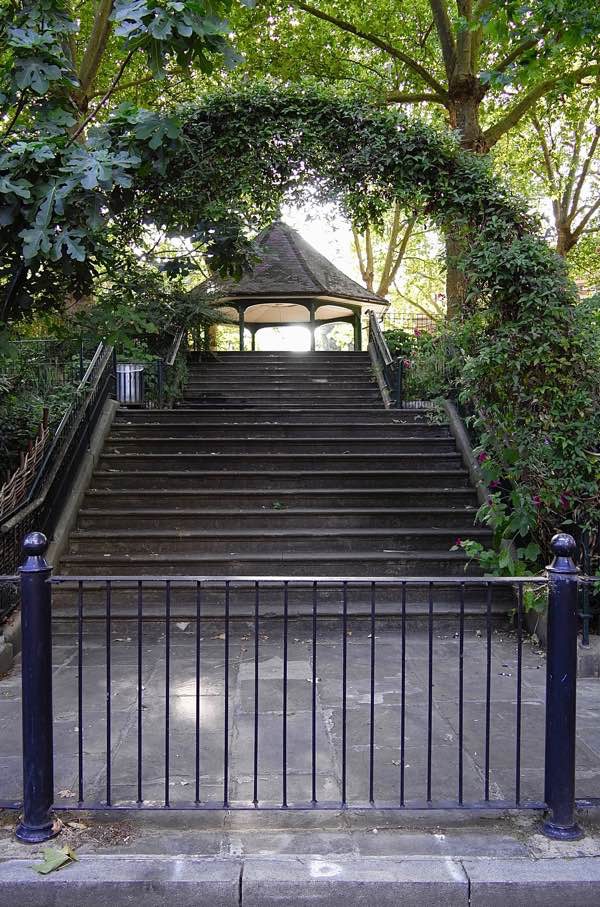
In my opinion, Arnold Circus is the heart of the East End. As you walk up the steps towards the bandstand, with the London plane trees towering overhead, it is as an inspirational space – as if you are entering a vast green cathedral. The depth of the planting enfolding the park is such that you feel a forest has been transplanted into the city.
For more than a decade, the volunteers of the Friends of Arnold Circus have been tending the gardens around the bandstand under the inspirational supervision of gardener Andy Willoughby. It was here that the renewal of the Boundary Estate began when Andy took over the husbandry, enriching the planting with an imaginative range of lush shade-loving varieties. Once the gardens on this once-neglected Estate began to look beautiful again, it encouraged the renovation of the bandstand under the initiative of the Friends.
During the pandemic, funds for the gardens have disappeared and so now the Friends have launched a campaign to raise the money.
Click here to protect the gardens at Arnold Circus


You may also like to read about
Gardening on the Roundabout in Victoria Park
At Waltham Abbey
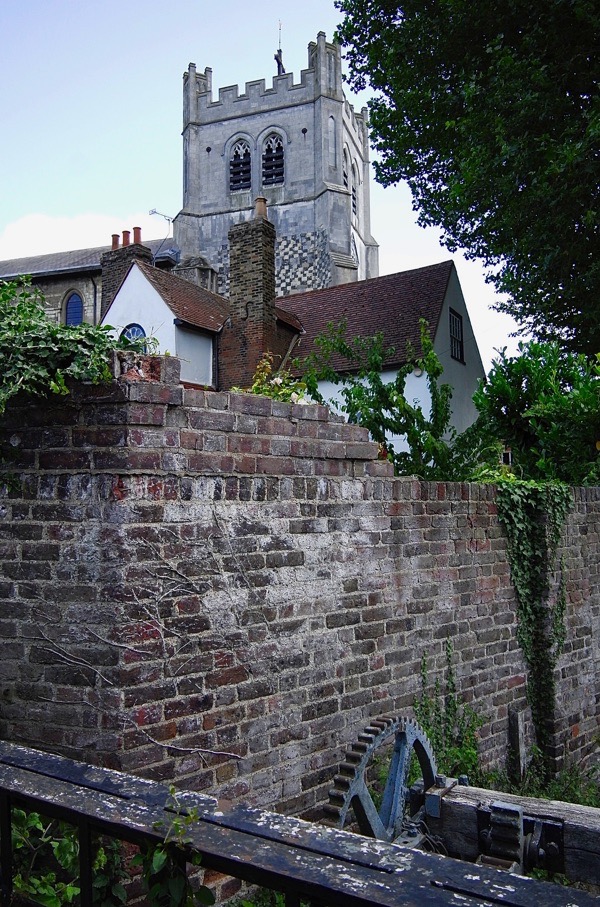
One day last spring – just before the lockdown – I walked along the River Lea as far as Tottenham. Yesterday I returned and continued my journey by bicycle as far as Waltham Abbey. Even from the riverbank I could see the majestic tower rising over the water meadows as the Abbey has done for the past thousand years, commanding the landscape and undiminished in visual authority.
Once you see it, you realise you are following in the footsteps of the innumerable credulous pilgrims who came here in hope of miraculous cures from the holy cross, which had reputedly relieved Harold Godwinson of a paralysis as a child before he became King Harold.
To the south of the Abbey church lies the market square, bordered with appealingly squint timber frame buildings punctuated by handsome eighteenth and nineteenth additions. Despite the proximity of the capital, the place still carries the air of an English market town.
Yet the great wonder is the Abbey itself, founded in the seventh century, built up by King Harold and destroyed by Henry VIII. Despite the ravages of time, the grandeur and scale of the Abbey is still evident in the precincts which have become a public park. Although the church that impresses today is less than half the size of what it was, it is enough to fire your imagination. An imposing stone gateway greets the visitor to the park where long, battered walls outline the former extent of the buildings. A tantalising fragment of twelfth century vaulting, which formerly served as the entrance to the cloisters, encourages the leap to conjure the cloisters themselves where now is merely an empty lawn. A walled garden filled with lavender and climbing roses draws you closest to the spirit of the place.
The outline of the former Abbey church is marked upon the grass and at the eastern end lies a surprise. A plain stone engraved with the words ‘Harold King of England Obit 1066,’ indicating this is where legend has it that he was laid to rest after the Battle of Hastings. I realised that maybe the remains of the man in the tapestry, killed by the arrow in the eye, lay beneath my feet. Coming upon his stone unexpectedly halted me in my tracks.
This was one of those startling moments when there is a possibility of history being real, something tangible, causing me to reflect upon the Norman Conquest. A thousand years ago, their power found its expression in the vast complex of buildings here, which were destroyed five hundred years ago as the expression of another power.
We too live in a time of dramatic transition, still under the shadow of the pandemic while anticipating our country’s divorce from Europe. I cycled from Spitalfields to Waltham Abbey as a respite from this moment, yet here I was confronting it in a mossy green churchyard. The equivocal consolation of the historical perspective is that it reminds us that empires rise and fall, but life always goes on.


Effigy of King Harold

Harold cradles Waltham Abbey in his arm


The Lady Chapel

Victorian villa in the churchyard

The Welsh Harp


These vaults are all that is left of the twelfth century cloisters


Here lies Harold, the last Anglo Saxon King of England

Waltham Abbey
You may also like to read about
At Tim Hunkin’s Workshop
Tim Hunkin’s NOVELTY AUTOMATION is reopening on Saturdays 11-6pm

Tim Hunkin at work on his Small Hadron Collider
Engineer & Cartoonist Tim Hunkin’s workshop sits in a remote spot beside the estuary of the river Blythe in Suffolk. A bumpy ride in Tim’s van along the pot-holed track only served to heighten my expectation as we arrived at the water’s edge, where a vast expanse of mud stretched to the horizon reflecting the dramatic East Anglian sky.
A statue of Michael Faraday, parked beside an enormous clock face, a hen coop and a giant pocket calculator, welcomes you the world of Tim Hunkin. Since 1976, Tim has lived here in a cottage at the end of a long brick farmhouse and worked in a series of venerable black weatherboarded sheds. “Back then, The Observer agreed to pay my train fare to London once a fortnight,” he explained, “and that meant I was able to leave London and come to live out here.”
For decades, Tim contributed his Rudiments of Wisdom cartoon strip to the Sunday magazine, but gradually the slot machines took over and now he has two arcades of them – The Under the Pier Show in Southwold and Novelty Automation in Holborn.
It was a humbling experience to enter the lair of the great inventor and observe him at work. All around were fragments of mechanical devices and intriguing pieces of junk that might one day contribute to one of his creations. Over nearly forty years, Tim has got everything nicely organised, with a wood workshop, a metal workshop, an engineering shop, all kinds of machines, and vast stocks of timber, metal and other stuff.
In spite of the apparent chaos, it is obvious that Tim knows where everything is and can lay his hand upon anything he might require at a moment’s notice. “I’m happiest when I am here in my workshop,” he confided to me and I was startled by the beauty of this unlikely factory, surrounded by trees coming into blossom and all the lush plant growth of summer.
Whenever Tim finds himself at a loose end or in need of inspiration, he jumps into his old van, negotiates the bumpy track and drives over to enjoy the laughter of visitors at his arcade on the pier at Southwold. I had the privilege of accompanying him that day and we met some of Tim’s fans. Most remarkable to me was the woman who took a break from walking her dogs to enjoy the dog-walking machine while her patient husband stood holding the leads. Dumbstruck with wonder, I stood contemplating the profound implication of this curious spectacle.
This woman loved walking her dogs so much that she could not resist Tim’s dog-walking machine which offered a virtual experience of equal or superior quality to actual dog-walking. It was the perfect metaphor of our paradoxical relationship with technology and a personal triumph for Tim.


To the Amusements


Tim solves a problem in Quantum Dynamics on his laptop

Tim searches for a screw

Tim demonstrates his metal pressing machine from Clerkenwell


Tim enjoys a thoughtful moment outside his workshop on the estuary of the river Blythe

At Southwold Pier

A woman takes a break from dog walking


Tim’s water clock

Southwold seen from the pier
NOVELTY AUTOMATION is at 1a Princeton St, Bloomsbury, WC1.
You might also like to read about
Cherishing The Fabric Of Arnold Circus

Original York stone paving and blue granite setts in Boundary St
Use of good quality materials was intrinsic to the Arts & Crafts movement and this principle is evident on the Boundary Estate, built in Shoreditch as Britain’s first council estate. In this development, the choice of materials was part of the ambition of the architects to deliver decent housing that respected and elevated the lives of the residents, in deliberate contrast to the slum which it replaced.
Dan Cruickshank, who is currently writing a book about this visionary endeavour, told me that London County Council spent £36,944 on sewers and paving in constructing the Estate. More than a century later, the legacy of this prudent investment can still be seen in the attractive York paving throughout and the fine blue granite setts in Boundary St.
In recent years, we have seen the successful renovation of the bandstand and the park at the centre of Arnold Circus, thanks to initiative of the Friends of Arnold Circus. Now the park fulfils its original function again, as a peaceful place for residents to meet within the green shade of the magnificent gardens.
Next it is proposed to pedestrianise the road around Arnold Circus as part of Tower Hamlet Council’s Liveable Streets initiative designed to reduce emissions and create more public space for recreation. While this is generally welcomed by the residents, the inferior corporate style designs for street furniture do not reflect the formal dignity of the architecture. And the proposal to use ‘Yorkstone-type pavers’ reveals that the materials intended are of inferior quality to the existing stone pavements.
The original blue granite setts are still visible in Boundary St and Dan Cruickshank believes those in Arnold Circus were simply covered over with asphalt in the twentieth century at the advent of the motorcar. An established technique exists to freeze asphalt and remove it, so the obvious solution is to uncover and repair these setts.
This would be less wasteful than adding new paving and revealing the granite would link all the buildings together visually, as was intended when they constructed the Estate a century ago. Such a heritage-led approach respects the ethos of the surrounding buildings which are all listed and the fact that the Boundary Estate is a Conservation Area. Covent Garden Piazza and the circuses of Edinburgh are granite cobbled public spaces that serve as precedents.
Readers are encouraged to comment on the proposals.
Click here to study the details of the Liveable Streets scheme and download a pdf
Click here to comment – today is the last day to do so online
Alternatively, you can email liveablestreets@towerhamlets.gov.uk

Pedestrianisation proposal for Arnold Circus with corporate street furniture and inferior quality paving

Original granite setts are still visible where Boundary St meets Navarre St

York paving and granite setts in Boundary St

Blue granite setts in Boundary St

South end of Boundary St

North end of Boundary St

Fragment in Navarre St

Glazed bricks and York paving

York paving and blue granite setts

Nearby, at the entrance to Virginia Rd School

Nearby, in Gascoigne Place

Nearby, in Ezra St

Nearby, in Padbury Court

Nearby, in Ebor St

Nearby, in Sclater St

Nearby, in Grimsby St
You may also like to read about
In The Grounds Of Fulham Palace

You enter the park by the Thames and go through a gate in a high wall to find yourself in a beautiful vegetable garden with an elaborate Tudor gate. Beyond the Tudor gate lies Fulham Palace, presenting an implacable classically-proportioned facade across a wide expanse of lawn bordered by tall old trees. You dare to walk across the grass and sneak around to the back of the stately home where you discover a massive Tudor gateway with ancient doors, leading to a courtyard with a fountain dancing and a grand entrance where Queen Elizabeth I once walked in. It was only a short walk from the tube but already you are in another world.
For over a thousand years the Bishops of London lived here until 1975 when it was handed over to the public. But even when Bishop Waldhere (693-c.705) acquired Fulham Manor around the year 700, it was just the most recent dwelling upon a site beside the Thames that had already been in constant habitation since Neolithic times. Our own St Dunstan, who built the first church in Stepney in 952, became Bishop of London in 957 and lived here. By 1392, a document recorded the great ditch that enclosed the thirty-six acres of Britain’s largest medieval moated dwelling.
Time has accreted innumerable layers and the visitor encounters a rich palimpsest of history, here at one of London’s earliest powerhouses. You stand in the Tudor courtyard admiring its rich diamond-patterned brickwork and the lofty tower entrance, all girded with a fragrant border of lavender at this time of year. Behind this sits the Georgian extension, presenting another face to the wide lawn. Yet even this addition evolved from Palladian in 1752 to Strawberry Hill Gothick in 1766, before losing its fanciful crenellations and towers devised by Stiff Leadbetter to arrive at a piously austere elevation, which it maintains to this day, in 1818.
Among the ecclesiastical incumbents were a number of botanically-inclined bishops whose legacy lives on in the grounds, manifest in noteworthy trees and the restored glasshouses where exotic fruits were grown for presentation to the monarch. In the sixteenth century, Bishop Grindal (1559-1570) sent grapes annually to Elizabeth I, and “The vines at Fulham were of that goodness and perfection beyond others” wrote John Strype. As Head of the Church in the American Colonies, Bishop Henry Compton (1675-1753), sent missionaries to collect seeds and cuttings and, in his thirty-eight tenure, he cultivated a greater variety of trees and shrubs than had previously been seen in any garden in England – including the first magnolia in Europe.
At this time of year, the walled garden proposes the focus of popular attention with its lush vegetable beds interwoven with cosmos, nasturtiums, sweet peas and french marigolds. A magnificent wisteria of more than a century’s growth shelters an intricate knot garden facing a curved glasshouse, following the line of a mellow old wall, where cucumber, melons and tomatoes and aubergines are ripening.
The place is a sheer wonder and a rare peaceful green refuge at the heart of the city – and everyone can visit for free .


Cucumbers in the glasshouse


Melon in the glasshouse


Five hundred year old Holme Oak

Coachman’s House by William Butterfield

Lodge House in the Gothick style believed to have been designed by Lady Hooley c. 1815

Tudor buildings in the foreground with nineteenth century additions towards the rear.


Sixteenth century gate with original oak doors

The courtyard entrance

Chapel by William Butterfield

Tudor gables


All Saints, Fulham seen from the walled garden


Freshly harvested carrots and vegetable marrows


Ancient yews preside at All Saints Fulham
Tessa Hunkin In Stoke Newington

In a quiet terraced street in Stoke Newington a new mosaic has appeared, conjured into existence by Tessa Hunkin & Hackney Mosaic Project – as Tessa explained to me.
“The householder had seen our work on Hackney Downs and gave us a brief. They wanted a mosaic path showing their dogs, Pepper & Rocket, chasing a squirrel while a clever fox escaped into their neighbour’s garden. They also gave me a list of local bird life to include – an egret, a kingfisher, a kestrel, a parakeet and a woodpecker. Although it was challenging to fit everything in, this proved a great subject because it is dynamic and mosaic is a medium that expresses movement very well.
It helped that the householder came to our pavilion in the park to make a lot of the path, while Pepper & Rocket supervised. During lockdown, one of our volunteers, Mary Helena, was able to carry on working from home too. She made all the little birds in the porch and the kingfisher, so by the time restrictions had eased it was all ready to be fixed.
As often happens, the fixing was hindered by unexpected showers but my brilliant assistants, including Ken Edwards, carried on working under a tarpaulin while the rain poured down. There was a particularly heavy downpour in the evening of our first day, but luckily the household was on hand to rush out with sponges to dry the mosaic and no harm was done.”
Tessa Hunkin


THE HACKNEY MOSAIC PROJECT is seeking commissions, so if you would like a mosaic please get in touch hackneymosaic@gmail.com
You may also like to read about
Tessa Hunkin’s New Mosaic in Haggerston
The Mosaic Makers of Hackney Downs
The Award-Winning Mosaic Makers of Hackney


