
At The Caslon Letter Foundry

22/23 Chiswell St with Caslon’s delivery van outside the foundry
For centuries, Caslon was the default typeface in the English language. William Caslon set up his type foundry in Chiswell St in 1737, where it operated without any significant change in the methods of production until 1937. These historic photographs taken in 1902, upon the occasion of the opening of the new Caslon factory in Hackney Wick, record both the final decades of the unchanged work of traditional type-founding, as well as the mechanisation of the process that would eventually lead to the industry being swept away by the end of the century.

The Directors’ Room with portraits of William Caslon and Elizabeth Caslon.

Sydney Caslon Smith in his office

Clerks’ office, 15th November 1902. A woman sits at her typewriter in the centre of the office.

Type store with fonts being made up in packets by women and boys working by candlelight.

Another view of the type store with women making up packets of fonts.

Another view of the type store.

Another part of the type store.

In the type store.

A boy makes up a packet of fonts in the type store.

Room of printers’ supplies including type cases, forme trolleys and electro cabinets.

Another view of the printers’ supplies store.

Printing office on an upper floor with pages of type specimens being set and printed on Albion and Imperial handpresses.

Packing department with crates labelled GER, GWR, LNWR, CALCUTTA, BOMBAY, and SYDNEY.

New Caslon Letter Foundry at Rothbury Rd, Hackney Wick, 1902.

Harold Arthur Caslon Smith at his rolltop desk in Hackney Wick with type specimens from 1780 on the wall, Friday 7th November, 1902.

Machine shop with plane, lathes and overhead belting.

Gas engines and man with oil can.

Lathes in the Machine Shop.

Hand forging in the Machine Shop.

Another view of lathes in the Machine Shop.

Type store with fonts being made up into packets.

Type matrix and mould store.

Metal store with boy hauling pigs upon a trolley.

Casting Shop, with women breaking off excess metal and rubbing the type at the window.

Another view of the Casting Shop.

Another view of the Casting Shop.

Founting Shop, with women breaking up the type and a man dressing the type.

Casting metal furniture.

Boys at work in the Brass Rule Shop.

Boys making packets of fonts in the Despatch Shop, with delivery van waiting outside the door.

Machine shop on the top floor with a fly-press in the bottom left.

Woodwork Shop.
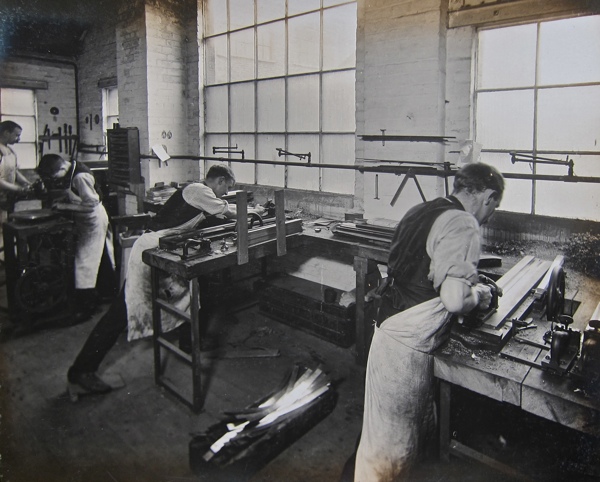
Brass Rule Shop, hand-planing the rules.

Caretaker’s cottage with caretaker’s wife and the factory cat.
Photographs courtesy St Bride Printing Library
You may also like to read about
William Caslon, Letter Founder
On Night Patrol With PC Tassell
We join Constable Lew Tassell on a night patrol in the City of London on Tuesday December 12th 1972

Police Constable Lew Tassell of the City of London Police
“One week in December 1972, I was on night duty. Normally, I would be on beat patrol from Bishopsgate Police Station between 11pm-7am. But that week I was on the utility van which operated between 10pm-6am, so there would be cover during the changeover times for the three City of London Police divisions – Bishopsgate, Wood St and Snow Hill. One constable from each division would be on the van with a sergeant and a driver from the garage.
That night, I was dropped off on the Embankment during a break to allow me to take some photographs and I walked back to Wood St Police Station to rejoin the van crew. You can follow the route in my photographs.
The City of London at night was a peaceful place to walk, apart from the parts that operated twenty-four hours a day – the newspaper printshops in Fleet Street, Smithfield Meat Market, Billingsgate Fish Market and Spitalfields Fruit & Vegetable Market.
Micks Cafe in Fleet St never had an apostrophe on the sign or acute accent on the ‘e.’ It was a cramped greasy spoon that opened twenty-four hours a day, seven days a week. During the night and early morning it served print-workers, drunks returning from the West End and the occasional vagrant.
Generally, we police did not use it. We might have been unwelcome because we would have stood out like a sore thumb. But I did observation in there in plain clothes sometimes. Micks Cafe was a place where virtually anything could be sourced, especially at night when nowhere else was open.”

Middle Temple Lane

Pump Court, Temple

King’s Bench Walk, Temple

Bouverie St, News of the World and The Sun

Fleet St looking East towards Ludgate Circus

Ludgate Hill looking towards Fleet St under Blackfriars Railway Bridge, demolished in 1990

Old Bailey from Newgate St looking south

Looking north from Newgate St along Giltspur St, St Bartholomew’s Hospital

Newgate St looking towards junction of Cheapside and New Change – buildings now demolished

Cheapside looking east from the corner of Wood St towards St Mary Le Bow and the Bank

HMS Chrysanthemum, Embankment

Constable Lew Tassell, 1972
Photographs copyright © Lew Tassell
You may also like to take a look at
The Bridges Of Old London

Traffic from Covent Garden Market crosses Waterloo Bridge, c. 1924
London owes its very existence to bridges, since the location of the capital upon the banks of the Thames was defined by the lowest crossing point of the river. No wonder that the London & Middlesex Archaeological Society collected this edifying series of pictures of bridges on glass plates to use in their magic lantern shows at the Bishopsgate Institute.
Yet until the eighteenth century, the story of London’s bridges was solely that of London Bridge. The Romans created the first wooden crossing of Thames close to the current site of London Bridge and the settlement upon the northern shore grew to become the City of London. When the Saxons tried to regain the City from the Danes in the eleventh century, they attached ropes to London Bridge and used their boats to dislodge the piers, thus originating the myth celebrated in the nursery rhyme “London Bridge is Falling Down.”
The first stone London Bridge was built by Peter de Colechurch in 1209 and lasted over six hundred years, surviving the Great Fire and numerous rebuildings of the houses and shops that clustered upon its structure. When traffic upon grew too crowded in 1722, a “keep left” rule was instated that later became the pattern for all roads in this country and, by 1763, all the houses were removed to provide extra clearance. Then, in 1831, John Rennie’s famous bridge of Dartmoor granite replaced old London Bridge until it was shipped off to Arizona in the nineteen-sixties to make way for the current concrete bridge, with its centrally heated pavements and hollow structure that permits essential pipes and cables to cross the Thames easily.
After London Bridge, next came Putney Bridge in 1726 and then Westminster Bridge in 1738 – until today we have a line of bridges, holding the north and south banks of London together tightly like laces on a boot. The hero of London’s bridges was unquestionably John Rennie (1761-1821) who pioneered the combination or iron and stone in bridge building and designed London Bridge, Waterloo Bridge, Southwark Bridge and Vauxhall Bridge, although only the Serpentine Bridge remains today as his memorial.
Even to the seasoned Londoner, there is something unfailingly exhilarating about sitting on top of a bus, erupting from the narrow city streets onto one of the bridges and discovering yourself suspended high above the vast River Thames, it is one of the definitive experiences of our city.

Tower Bridge took eight year to construct, 1886 -1894

Tower Bridge with barges, c. 1910

St. Paul’s Cathedral from Southwark Bridge, c. 1925

Southwark Bridge, c. 1925

Old wooden bridge at Putney, 1880. The second bridge to be built after London Bridge, constructed in 1726 and replaced by the current stone structure in 1886.

On Tower Bridge, 1905.

Tower Bridge, c. 1910

John Rennie’s London Bridge of 1831 viewed from the waterside, c. 1910

London Bridge, c. 1930. Sold to Robert Mc Culloch in 1968 and re-assembled in Arizona in 1971.

The former bridgekeeper’s house on Tower Bridge, c. 1900

Wandsworth Bridge by Julian Tolme, c. 1910 (demolished in 1937)

Waterloo Bridge, c. 1910. The increased river flow created by the demolition of old London Bridge required temporary reinforcements to Waterloo Bridge from 1884.

Waterloo Bridge, c. 1910

Under an arch of Waterloo Bridge, c. 1910

View under Waterloo Bridge towards Hungerford Bridge, Westminster Bridge, & Palace of Westminster, c. 1910

Westminster Bridge, c. 1910. The third bridge, built over the Thames after London and Putney Bridges, in 1739-1750. The current bridge by Thomas Page of 1862 is painted green to match the leather seats in the House of Commons.

Westminster Bridge, c. 1910

Westminster Bridge, c. 1910

Hammersmith Bridge with Oxford & Cambridge Boat Race, 1928. Dixon, Appleby & Thorne’s bridge was built in 1887.

Battersea Bridge, c. 1910 Sir Joseph Bazalgette’s bridge was built in 1879.

Battersea Bridge from waterside, c. 1910

Blackfriars Bridge, c. 1910

Cannon St Railway Bridge, c. 1910. Designed by John Hawkshaw and John Wolfe-Barry for the South Eastern Railway in 1866.

Serpentine Bridge, 1910. Designed by John Rennie in the eighteen-twenties.

Westminster Bridge, c. 1910

On Hammersmith Bridge, c. 1910

Victoria Embankment, c. 1910

London Bridge, c. 1910
Glass slides copyright © Bishopsgate Institute
You may also like to take a look at
Terry Barns, Knot Tyer

‘There isn’t really a word for it in English,’ admitted Terry Barns, ‘in French, they call it ‘matelotage’ meaning ‘sailors’ knot-making.’
Terry did not become a serious knot tyer until his fifties, yet it was a tendency that revealed itself in childhood. Celebrating the Queen’s Coronation in 1953, when Terry was just nine years old, his mother made him a guardsman’s outfit from red and black crepe paper with a busby fashioned from the shoulders cut out of an old fur coat. Terry’s contribution was to make the chin strap. ‘We got some gold string and I tied reef knots over a core, making what I now know is known as a ‘Pilgrim’s Sennet’ or a ‘Soloman’s Bar,’ he explained to me in wonder at his former precocious self, ‘but I never thought anything about it at the time.’
This is how Terry tells the story of the intervening years –
‘My early life was in the Queensbridge Rd but I was born in Hertfordshire because Hitler was trying to blow up the East End in 1944. My mum was a dress machinist and my dad was a wood machinist, he used to drill the holes in bagatelles and I still have one he made at home. In 1950, when I was six, we got a Council House in Clapton with a bathroom and an inside toilet – it was wonderful.
Somehow, I passed the 11-plus and ended up at Grocers’ Company School in Hackney Downs. When I left school at fourteen, being a prudent person, I joined the General Post Office as a telephone engineer, running around Mare St and Dalston. Nobody told me I could have stayed on at school and I soon realised that if I didn’t leave the GPO, I’d never know anything else. So I became a ‘Ten Pound Pom’ and went off to Australia in 1966.
I met my wife Carol in Pedro St in Hackney at that time and she followed me to Australia shortly after. I was a very quick learner and I had a very good job in Sydney working for a Japanese telephone company, Hitachi, but we had no intention of staying and came back in 1968. Then we got married in 1969, had three children and bought a house, so that occupied me for the next twenty years! I went back to the GPO which became BT and, when I was fifty, they asked if I would like to take some money and not go back again. So I have been living on my BT pension for the past twenty years and that has been the story of my life.’
Yet, all this time that Terry had been working with telephone cables, his tendency with string and rope had been merely in abeyance. ‘In the seventies, my wife bought me a copy of The Ashley Book of Knots,’ he revealed, bringing out a pristine hardback copy of the knotter’s bible containing nearly four thousand configurations. At a stall outside the Maritime Museum in Greenwich, Terry came across the International Guild of Knot Tyers which led to a four day course with legendary knot tyer, Des Pawson in 1994. ‘He’s got a museum of rope work in his back garden,’ Terry confided in awe.
‘I’m an engineer, but Des – he’s artistic,’ Terry informed me, ‘he educated me how to see things, he showed me when things look right.’ For over ten years, Terry has been on the Council of the Guild of Tyers, accompanying Des as his bag man, demonstrating knot work at festivals of matelotage in France – ‘My kind of holiday,’ he describes it enthusiastically.
When a sculptor cast a rope in bronze to symbolise the identity of the East End, it was Terry who wound the strands – and you can see the result at the junction of Sclater St and Bethnal Green Rd today. The largest pieces of rope you ever saw are placed as features in Terry’s front garden in Woodford. Inside the house, walls are hung with nautical paintings and shelves are lined with volumes of maritime history. They tell the story of one man’s lifetime entanglement with cable, rope and string, and remind of us of how the East End was built upon the docks, of which the ancient and ingenious culture of rope work was a major thread, still kept alive by enthusiasts like Terry Barns.

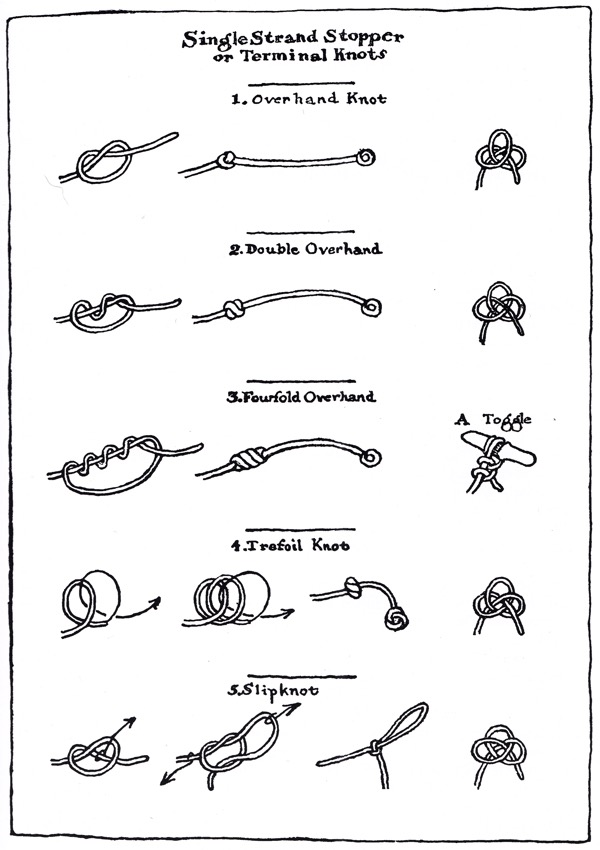


Terry with one he tied earlier
You might like to find out more at International Guild of Knot Tyers
You may also like to read about
Ron McCormick’s Whitechapel
Ron McCormick photographed Whitechapel & Spitalfields in the early seventies and these pictures were exhibited at the Whitechapel Gallery in 1973.

Hessel St

Royal Oak, Whitechapel Rd

Old Montague St

Blooms, Whitechapel High St

Old Montague St

Old Montague St

Princelet St

Black Lion Yard

Fournier St

Brick Lane

Club Row

Brick Lane

Settle St, Whitechapel

Great Eastern Buildings, Quaker St

Woodseer St

Great Eastern Buildings, Quaker St

Sandys Row

Brick Lane Market

Christ Church School

Settle St, Whitechapel
Photographs copyright © Ron McCormick
You may also like to take a look at
Philip Marriage’s Spitalfields
In Search Of ‘Sparrows Can’t Sing’
Dame Barbara Windsor died on Thursday aged eighty-three. I shall always think of her wistfully as the Spitalfields Life interview that I should love to have done but which never happened. My favourite performance of hers was in Sparrows Can’t Sing, the greatest East End film, and in tribute to her I publish my account of going in search Cowley Gardens, one of the primary locations.

This is what happens when you try to carry a ladder the wrong way down a narrow alley, as Roy Kinnear is discovering in this frame from Joan Littlewood’s film Sparrows Can’t Sing.
You can see through the arch to Cowley Gardens in Stepney as it was in 1962. This is where Fred (Roy Kinnear’s character) lived with his mother in the film and here his brother Charlie (James Booth) turned up after two years at sea to ask the whereabouts of his wife Maggie (Barbara Windsor), finding that the old terrace in which he lived with Maggie had been demolished in his absence.
The drama revolves around Charlie’s discovery that Maggie has moved into a new tower block with a new man, and his attempts to woo her back. Perhaps there are too many improvised scenes, yet the film has a rare quality – you feel all the characters have lives beyond the confines of the drama, and there is such spirit and genuine humour in all the performances that it communicates the emotional vitality of the society it portrays with great persuasion. In supporting roles, there is Harry H. Corbett, Yootha Joyce, Brian Murphy and several other superb actors who came to dominate television comedy for the next twenty years. Filmed on location around the East End, many locals take turns as extras, including the Krays – Barbara was dating Reggie at the time – who can be seen standing among the customers in the climactic bar room scenes.
My favourite moment in the film is when Charlie searches for Maggie in an old house at the bottom of Cannon St Rd. On the ground floor in an empty room sits an Indian at prayer with his little son, on the first floor some Afro-Caribbeans welcome Charlie into their party and on the top floor Italians are celebrating too. Dan Jones, who lives round the corner in Cable St, told me that this was actually Joan Littlewood’s house where she and Stephen Lewis wrote the screenplay.
I once met Joan Littlewood at an authors’ party hosted by her publisher. She was a frail old lady then but I recognised her immediately by her rakish cap. She was sitting alone in a corner, being ignored by everyone, and looking a little lost. I pointed her out discreetly to a couple of fellow writers but, too awestruck by her reputation, they would not dare approach. Yet I loved her for her work and could not see her neglected, so I walked over and asked if I could kiss her. She consented graciously and, once I had explained why I wanted to kiss her – out of respect and gratitude for her inspirational work – I waved my pals over. We enjoyed a lively conversation but all I remember is that as we said our goodbyes, she took my hand in hers and said ‘I knew you’d be here.’ Although she did not know me or my writing, I understood what she meant and I shall always remember the night I kissed Joan Littlewood.
Watching Sparrows Can’t Sing again recently, I decided to go in search of Cowley Gardens only to discover that it is gone. The street plan has been altered so that where it stood there is not even a road anymore. Just as James Booth’s character returned from sea to find his nineteenth century terrace gone, the twentieth century tower where Barbara Windsor’s character shacked up with the taxi driver has itself also gone, demolished in 1999. Thus, the whole cycle of social and architectural change recorded in this film has been erased.
I hope you can understand why I personally identify with Roy Kinnear and his ladder problem, it is because I too want to go through this same arch and I am also frustrated in my desire – since nowadays there is a solid wall filling the void and preventing me from ever entering. The arch is to be found beneath the Docklands Light Railway between Sutton St and Lukin St. Behind this brick wall, which has been constructed between the past and the present, Barbara Windsor and all the residents of Cowley Gardens are waiting. Now only the magic of cinema can take me there to join them.

The arch from Sparrows Can’t Sing today
The Battle For Brick Lane

Brick Lane 1978 by Dan Jones
Since September, I have been working behind the scenes to curate an exhibition for the Spitalfields Trust about the culture and history of Brick Lane and the Truman Brewery. It opens tomorrow at 25 Princelet St, E1 6QH, a breathtaking unrestored eighteenth century house and you are all invited to visit under socially-distanced conditions. Dan Cruickshank will cut a ribbon at noon. For those unable to make the journey, some of the contents can be viewed at www.battleforbricklane.com
Exhibition opens noon – 6pm on Saturday 12th, Sunday 13th, Wednesday 16th, Thursday 17th, Friday 18th, Saturday 19th and Sunday 20th December.
It includes a show of Phil Maxwell’s photographs of Brick Lane over the past thirty years, a specially-commissioned model of the Truman Brewery by Sebastian Harding and a diorama of Brick Lane from the Bishopsgate Institute collection.
This opening launches a campaign by the Spitalfields Trust to stop a proposal to build an ugly shopping mall with four floors of corporate offices on top at the Old Truman Brewery. Instead of this arbitrary scheme, the Trust seeks to raise a wide debate to create a plan for the whole brewery site.

Phil Maxwell has photographed Brick Lane for over thirty years

Part of Sebastian Harding’s model

Diorama of Brick Lane from Bishopsgate Institute collection

The ugly big block proposed for the corner of Brick Lane & Woodseer St
HELP US SAVE BRICK LANE
* This development will undermine the authentic cultural quality of Brick Lane.
* The generic architecture is too tall and too bulky, ruining the Brick Lane & Fournier St Conservation Area.
* It offers nothing to local residents whose needs are for genuinely affordable homes and workspaces.
* It is an approach that is irrelevant to a post-Covid world, with more people working from home and shopping locally or online.
* Where it meets the terraces of nineteenth century housing, the development is out of scale and causes up to 60% loss of light.
* Instead of this arbitrary scheme, we need a plan for the entire brewery site that reflects the needs and wishes of residents.
HOW TO OBJECT EFFECTIVELY
You can help us stop this bad proposal by writing a letter of objection to the council as soon as possible.
Please write in your own words and head it OBJECTION.
Quote Planning Application PA/20/00415/A1
Anyone can object wherever they live.
Members of one household can each write separately.
You must include your postal address.
Send your objection by email to Patrick.Harmsworth@towerhamlets.gov.uk
Or by post to Planning Department, Town Hall, Mulberry Place, 5 Clove Crescent, London, E14 2BG


