
The Broderers At St Paul’s
There is a display of Embroidery Treasures featuring vestments and a demonstration by the broderers each day this week in the south nave aisle at St Paul’s Cathedral, until Friday 4th June

Anita Ferrero
Like princesses from a fairy tale, the Broderers of St Paul’s sit high up in a tower at the great cathedral stitching magnificent creations in their secret garret. Contributing Photographer Sarah Ainslie & I climbed up one hundred and forty-one steps to pay a visit upon these nimble-fingered needleworkers.
‘There are fourteen of us, we chat, we tell stories and we eat chocolate,’ explained Anita Ferrero by way of modest introduction, as I stood dazzled by the glittering robes and fine embroidery. ‘It’s very intense work because the threads are very bright,’ she added tentatively, lest I should think the chocolate comment revealed undue levity.
I was simply astonished by the windowless chamber filled with gleaming things. ‘There are thirteen tons of bells suspended above us,’ Anita continued with a smile, causing me to cast my eyes to the ceiling in wonder, ‘but it’s a lovely sound that doesn’t trouble us at all.’
Observing my gaze upon the magnificent textiles, Anita drew out a richly-embellished cope from Queen Victoria’s Jubilee. ‘This is cloth of gold’ she indicated, changing her voice to whisper, ‘it ceased production years ago.’
‘There are still wonderful haberdashers in Kuala Lumpur and Aleppo,’ she informed me as if it were a closely-guarded secret, ‘I found this place there that still sold gold thread. If someone’s going to Marrakesh, we give them a shopping list in case they stumble upon a traditional haberdashery.’ Next, Anita produced a sombre cope from Winston Churchill’s funeral, fashioned from an inky black brocade embroidered with silver trim, permitting my eye to accommodate to the subtler tones that can be outshone by tinsel.
In this lofty chamber high above the chaos of the city, an atmosphere of repose prevails in which these needlewomen pursue their exemplary work in a manner unchanged over millennia. I was in awe at their skill and their devotion to their art but Anita said, ‘As embroiderers, we are thankful to have a purpose for our embroidery because there’s only so many cushions you can do.’
I walked over to a quiet corner where Rachel Rice was stitching an intricate border in gold thread. ‘I learnt my skills from my mother and grandmother, and I always enjoyed sewing and dressmaking but that’s not fine embroidery like this,’ she admitted, revealing the satisfaction of one who has spent a life devoted to needlework. Yet she qualified her pride in her craft by admitting her humanity with a weary shrug, ‘Some of the work is extremely tedious and it’s never seen.’
‘We are all very expert but our eyesight is fading and a few of us are quite elderly,’ confided Anita, thinking out loud for the two of them as she picked up the story and exchanged a philosophical grin with Rachel. Nowhere in London have I visited a sanctum quite like the Broderers chamber or encountered such self-effacing creative talents.
‘We not so isolated up here,’ emphasised Anita, lifting the mood with renewed enthusiasm, ‘Most people who work in the Cathedral know we’re here. We often do favours for members of staff, taking up trouser hems etc – consequently, if we have a problem, we can call maintenance and don’t have to wait long.’
I was curious to learn of the Broderers’ current project, the restoration of a banner of St Barnabas. ‘He’s the one saint I’d like to meet because he’s called ‘The Son of Encouragement’ – he looks like a nice guy,’ confessed Anita fondly, laying an affectionate hand upon the satin, ‘We’re restoring the beard of St Barnabas at present and we’re getting Simon the good-looking Verger up here to photograph his beard.’

Rachel Rice – ‘I learnt my skills from my mother and grandmother’


Sophia Sladden


Margaret Gibberd

‘As embroiderers, we are thankful to have a purpose for our embroidery because there’s only so many cushions you can do.’


Judy Hardy

‘We chat, we tell stories and we eat chocolate..’


Virger Simon Brears is the model for the beard of St Barnabas


View from the Triforium
Photographs copyright © Sarah Ainslie
You may also like to take a look at
London’s Natural History
Contributing Photographer Lucinda Douglas Menzies kindly gave me a copy of LONDON’S NATURAL HISTORY by R S R Fitter published in 1945, in which I discovered this splendid gallery of colour plates by Eric Hosking and other distinguished photographers of the day.

Feeding the pelicans at St James’s Park (Eric Hosking)

Backyard pig farming (Eric Hosking)

Coldharbour Farm, Mottingham – the last farm in London (Eric Hosking)

Feeding the pigeons in front of St Paul’s Cathedral (Wolfgang Suschitzky)

The New River & North-East Reservoir at Stoke Newington (Eric Hosking)

The nearest rookery to London, at Lee Green SE12 (Eric Hosking)

Allotments on Barking Levels (Eric Hosking)

Sand martin colony in a disused sand pit near Barnet bypass (Eric Hosking)

The Upper Pool at sunset with London Bridge in the background (Eric Hosking)

River wall at the confluence of the Ingrebourne with the Thames at Rainham (Eric Hosking)

Cabbage attacked by caterpillars (P L Emery)

A magnolia in the grounds of Kenwood House (Eric Hosking)

The Thames at Hammersmith with mute swans (Eric Hosking)

Sheep grazing at Kenwood House (Eric Hosking)

Teddington Lock (Eric Hosking)

A plum orchard near Chelsfield, Kent (Eric Hosking)

A black-headed gull feeding in St James’s Park (Eric Hosking)

A bold red deer at Richmond Park (C E Maney)

South-African grey-headed sheld duck, pair of mallard and a coot in St James’s Park (Eric Hosking)

Mute swans nesting on the River Lea, Hertingford, Herts (Eric Hosking)

Crocuses at Hyde Park Corner (Eric Hosking)

Roses in Queen Mary’s Garden, Regent’s Park (Wolfgang Suschitzky)

Anglers on the River Lea near Broxbourne, Herts (Eric Hosking)

Almond blossom in a suburban front garden, Ruislip, Middlesex (Eric Hosking)

Pear Tree in Blossom, Crouch End (Eric Hosking)

Rosebay willow herb and Canadian fleabane in a ruined City church (Eric Hosking)

Coltsfoot on a blitzed site (Eric Hosking)

Berkeley Sq plane trees (L Dudley Stamp)

Cress beds at Fetcham, Surrey (Eric Hosking)

Glasshouses in the Lea Valley (Eric Hosking)

Hainault Forest, Essex, from Dog Kennel Hill. The whole of this area was ploughed up a century ago (Eric Hosking)
You may also like to take a look at
So Long, Ron Goldstein
Ron Goldstein died last Saturday 29th May at the fine age of ninety-seven

If – like Ron Goldstein – you were your parents’ tenth child, growing up in a tiny terraced house with a clothing factory on the top floor in Boreham St, Brick Lane, and sharing a room with your three elder brothers, then you might also be impatient to join the boys’ club round the corner in Chance St and have somewhere to let off steam and have fun. Even though strictly you had to be eleven, Ron was able to join the Cambridge & Bethnal Green Boys’ Club in 1933 when he was only ten, because his older brother Mossy was a Club Captain and pulled a few strings.
At this moment a whole new world opened up to Ron. For the price of a halfpenny a week subscription, each night he would be in the front of the throng of boys waiting impatiently in Chance St for the seven o’clock opening of the Club, hungry for fulfilment of the evening’s promise. Squeezing past the office where membership cards were checked, he went first to the canteen in the hope of wolfing a tasty saveloy, while others were already getting stuck into a quick game of table tennis, before the photography class started at seven-thirty. This was the primary focus of the evening for Ron – because as you can see from the picture above, he was the proud owner of a box brownie that he bought for two shillings from Woolworths. Harry Tichener, who ran the classes, was a West End photographer who inspired his East End pupils by teaching them how to use and develop colour film before most people had even seen a colour photograph – encouraging a lifelong enthusiasm for photography in Ron. At eight-thirty sharp the photography class was over, and it was time for Ron and the others to enjoy a brisk run down Bishopsgate to the Bank of England and back again without stopping, followed by a refreshing shower at nine-thirty, then a prayer in the gymnasium before going straight home to bed in Boreham St.
And so at ten years old, life acquired a totally new momentum for Ron. It was so special to him that even today, more than seventy years later, he remains close friends with many of the boys he met then and they are still enjoying regular happy Club reunions, celebrating the lifelong friendships that were forged at the Club.
Opened in 1924 by altruistic undergraduates as a Jewish Boys’ Club, the Cambridge & Bethnal Green Boys’ Club had an ethical intent from the beginning, adopting the motto, “serva corpus, cole mentem, animam cura,” – keep fit, cultivate your mind, think of your soul. These lofty ambitions were reflected in the lively range of activities on offer, including, boxing, art, photography, gym, travel talks with lantern slides, dramatics and play reading, harmonica classes, health lectures, first aid lessons, hobbies, science lectures, swimming, shoe repair, philately, essay writing and debating.
In retrospect, Ron fondly appreciates the raising of expectations that the Club encouraged, “Half of the boys would have ended up as the next generation of gangsters and criminals if it had not been for the Club. It was our first time to mix with people who never had to work from an early age and our first chance to consider the ethical side of life. We were a bunch of young tearaways. The Club managers from Cambridge had a very upper class way of talking and we used to take the mickey, but it was different at the weekend camps, everyone dressed the same and we all mucked in together.”
The photographs speak eloquently of the joy engendered by the Club and of the easy affectionate atmosphere, creating a warm playful environment in which the boys were able to feel free and enjoy the respect of their peers. Each weekend there were rambles when the boys took their cameras and enjoyed afternoon hikes within striking distance of London, stopping off at pubs to quench their thirst with half pints of shandy. During Summer weekends there were camps, when everyone travelled down to the country together, set up their tents, cooked meals and enjoyed outdoor pursuits, returning to the East End weary and sunburnt on Sunday night. Once a year, this was extended to a week’s Summer Camp at a more exotic location such as Frome or Banbury or Wimbourne. Ron only attended two Summer camps but he also recalls with delight the year he was disappointed, when he was unable to go due to a strained heart muscle that confined him to the Royal London Hospital. To his everlasting delight, a basket of fruit from Fortnum & Mason arrived from one of the Club’s wealthy patrons and no-one in the hospital had ever seen such a generous gift to a teenage boy.
When the twin Lotinga brothers, George and Rowland took over in 1936, they removed the Jewish prerequisite of membership of the Club, opening it to everyone, as a radical and egalitarian response to the rise of antisemitism, manifested by Oswald Mosley and the fascists in the East End. In this context, the playful Club photographs take on another quality, because there is something noble in the existence of a social space devoted to nurturing human sympathy, created while others are setting out to breed hatred. The boys were not unaware of the value of their freedom either, as evidenced by the seventeen year old lad that Ron remembers, who told his mother he was going on a weekend camp with the Cambridge & Bethnal Green Boys Club but ran away to fight in the Spanish Civil War instead.
At thirteen years old in 1936, Ron started in Fleet St as a runner for the Associated Press Picture Agency which required working evenings and limited his opportunities to attend the Boys’ Club. But he remained a member until war broke out in 1939, attending the Camp at Greatstones, Hythe at the age of sixteen, during that famously beautiful last Summer before hostilities were declared. These photographs are especially poignant, recording the final moments of a carefree youthful world before it was destroyed forever.
When war commenced, Ron’s father moved the family out of London to Hove and before long Ron and many other members of the Club found themselves enlisted. Some achieved heroism in the service and many died, while others came to prominence in post-war civilian life, yet although the Club finally closed in 1990, there are still enough members of the Cambridge and Bethnal Green Boys’ Club around to remind us of this honourable endeavour which set out to encourage the best in people, despite the tyranny of circumstance.

Waiting in line in Chance St on a Winter’s night for the club to open at seven o’ clock.

George and Rowland Lotinga surrounded by members of the club in Chance St, with Harry Tichener extreme right.

On a visit to Parliament in 1935 as guests of Sir Percy Harris, Liberal MP for Bethnal Green, seen on the right. Ron is the second boy standing to the left of Club manager, Derek Merton.

On a Sunday ramble through the outskirts of London.

Fourth from the left in the front row, Ron cradles his camera on this ramble led by photographer Harry Tichener, who ran the Club all through World War II when the younger managers were enlisted.

At Summer Camp, Ron is riding in the rumble seat at the very back of this car belonging to Harry Moss of Moss Bros. Passengers from left, George Lotinga, Harry Moss, Ronny Coffer, Dave Ross, Mick Goldstein, Syd Curtis and Ron.

A happy scene at Greatstones Summer Camp 1939 with Dave Saunders (bending at centre) and Monty Meth, current chairman of the old boys’ club (bottom row, right, in a dark blouson)

Mealtime at Greatstones Summer Camp 1939.

A race in Victoria Park in 1938, with Odiff Fugler making headway on the left and Dave Saunders in the centre.

High jinks at the Greatstones Camp Tuck Shop 1939.

The cook makes dough in a field at Greatstones – note the makeshift stoves in the background.

Cecil Bright, Dave Ross, Sid Tabor, Freddy Oels, Dave Summers, Monty Griver and Mick Goldstein (Ron’s brother).
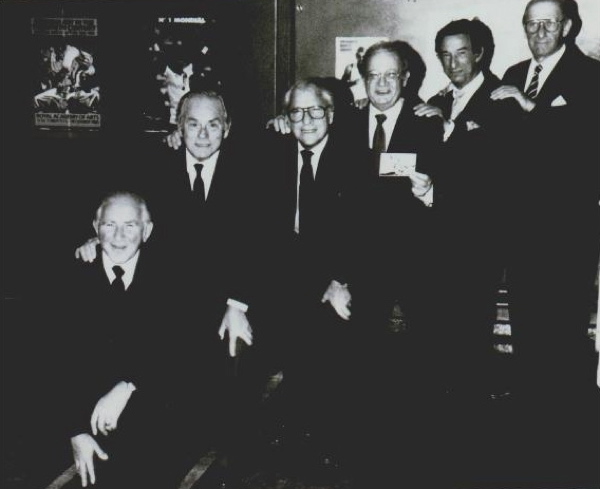
More recently, Cecil Bright, Dave Ross, Sid Tabor, Dave Summers, Monty Griver and Mick Goldstein.

Ron was part of the Club’s Harmonica group named “The Four Harmonica Kids.”
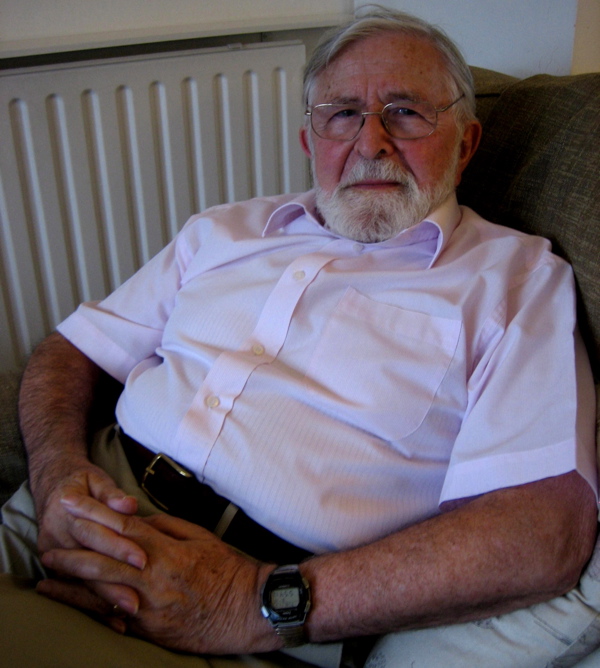
Ron Goldstein (1924-2021)
You may also like to read about
At the Cambridge & Bethnal Green Boy’s Club 86th Renuion Dinner
At the Cambridge & Bethnal Green Boys’ Club 89th Annual Dinner
At the Cambridge & Bethnal Green Boys’ Club Final Dinner
and my interviews with members of the Cambridge & Bethnal Green Boys’ Club
and watch
Hope For The Whitechapel Bell Foundry

It was a dark moment when I heard the news that the Planning Inspector who oversaw the Public Inquiry into the future of the Whitechapel Bell Foundry had made a judgement in favour of the boutique hotel.
An even darker week followed as I awaited the news from the High Court of the verdict on Tower Hamlets Council’s decision to permit developer Crest Nicholson to dig up the four-hundred-year-old Bethnal Green Mulberry. With the Council’s decision upon the Truman Brewery’s application to build a shopping mall due in June, I feared I was presiding over a hat trick of catastrophes for the East End.
Yet Sir Duncan Ouseley ruled Tower Hamlets’ decision to grant permission to dig up the Mulberry tree was unlawful and the planning application for the bad redevelopment of the former London Chest Hospital was quashed. I was overjoyed and sat at my desk shedding tears of relief. The hat trick of catastrophes was averted and there is hope.
Under paragraph 175c of the National Planning Policy Framework, a veteran tree such as the Mulberry cannot be destroyed without ‘wholly exceptional reasons.’ In this instance, there are no ‘wholly exceptional reasons’ and, if the tree is dug up, the obvious risk of killing it cannot be denied. The law has been clarified at the High Court and, after four years of fighting, the Mulberry is now safe.
We expect Crest Nicholson to come back with a revised and better development plan but they cannot touch the Mulberry. We hope they will take public opinion into account and build with less density, more affordable housing, and not sacrifice mature trees. Developers’ generous profit margins are sufficient for their scheme to be entirely viable without the necessity of maximising to such an exploitative level.
The day after the news of the Whitechapel Bell Foundry decision was announced by Luke Hall, a junior minister in Ministry of Housing, Communities & Local Government, there came a tweet expressing regret at the closure of the foundry from Robert Jenrick, Secretary of State, revealing that all was not quite as straightforward as first appeared.
In June 2020, Christopher Pincher MP misspoke on record in the House of Commons, saying that the Secretary of State had called in the Whitechapel Bell Foundry application to stop the boutique hotel. If, in October 2020, the Planning Inspector had made a judgement at the Public Inquiry against the boutique hotel and the Secretary of State had ratified it, then this would be open to the charge of predetermination. By deciding in favour of the hotel, the Inspector asserted the integrity of the Planning Inspectorate and avoided any exposure for the Secretary of State. Yet if Robert Jenrick supported the boutique hotel, he would not have called the Public Inquiry at all.
So this leaves an almighty mess which can only be resolved within parliament. There has always been strong cross party support in Westminster for saving the Whitechapel Bell Foundry, especially since it is where Big Ben was cast. In 2019, Sir Edward Leigh MP recognised the significance of the foundry, writing publicly to encourage Robert Jenrick to call the Public Inquiry and urging his party ‘as Conservatives’ to save the Whitechapel Bell Foundry. Equally, John McDonnell, Shadow Chancellor wrote, ‘London should never countenance the loss of such an iconic national and international business.’
In response to the recent decision, Rushanara Ali, MP for Bethnal Green, wrote, ‘It was a source of pride to have Big Ben and America’s Liberty Bell made right here in Whitechapel. This short-sighted decision destroys the hopes of it ever returning to a working foundry and is a tragic loss of a really important part of our local and national heritage.’
Two major projects already in the pipeline emphasise the need for the Whitechapel Bell Foundry to cast bells that meet important moments in our cultural and political history, as it has done for centuries past.
Artist Grayson Perry has designed an ‘End of Covid Bell’ in support of our campaign which will be produced by Factum Foundation. We plan this will undertake a national tour to major NHS hospitals, starting in Whitechapel. Those who have been bereaved by Covid will be invited to toll the bell and leave a message in remembrance.
Whitechapel was where the Royal Jubilee Bells were cast which now hang in St James Garlickhythe. 2023 sees the 70th anniversary of the Queen’s Coronation and we need the Whitechapel Bell Foundry operational again to cast the ‘Elizabeth Bell’ to celebrate this moment. At the time of the Diamond Jubilee, the bell tower at Westminster was renamed the ‘Elizabeth Tower’ and the Elizabeth Bell would be hung there, replacing a broken nineteenth century bell which has not chimed in over a century.
It is easily within the power of government to save the Whitechapel Bell Foundry for the nation and we hope that all those supporters in Westminster will come together to deliver this outcome.
Beyond the Mulberry Tree and the Whitechapel Bell Foundry campaigns lies the Battle for Brick Lane to prevent the corporate redevelopment of the Truman Brewery in disregard of the needs of the community. It is evident that the current proposal for a shopping mall is the thin end of the wedge and, if consented, would create a precedent permitting the transformation of the entire brewery into another Broadgate, Spitalfields Market or Fruit & Wool Exchange, with a plaza of large office buildings including possible towers.
Despite an all-time record of over seven thousand letters of objection, Tower Hamlets Council appear set on approving this development. At a recent meeting, the Development Committee considered the application but deferred their decision to allow further discussion of the 106 agreement, which outlines the community benefits of the scheme. Councillors recognised that there is a problem with the development driving out existing businesses in Brick Lane and the lack of any housing provision, which is the priority for the local community. Yet their superficially well-intentioned initiative attempts to placing a sticking plaster over a gaping wound.
Jason Zeloof, owner of the brewery, is proposing that he will discount 10% of his workspace to local businesses and offer 20% of his shops to independents. Yet the reality is that the cost of his expensive development will require high rents, which even at a discount will be unaffordable for local businesses, and that his shopping mall will be 80% chain stores.
The increase in land values in Brick Lane resulting from the redevelopment of the Truman Brewery will mean a rise in business rents, driving out the independent shops and the curry restaurants which give the place its identity. Additionally, the rise in already high housing rents will drive out all but those on the highest incomes. Brick Lane is the heartland of British Bangladeshi culture but this development will mean the death of this community in Spitalfields.
For centuries, Brick Lane has been the point of arrival for migrants, representing centuries of struggle by generations of people seeking to build a life and belong, creating the multicultural Britain of today. In this sense, it is of the greatest cultural significance as the closest we have to an ‘Ellis Island’ in this country and it needs to be protected.
Tower Hamlets Council must reject the current application and commission a Planning Brief for the entire brewery site, based on local consultation, which responds to the needs of the community, especially for genuinely affordable housing and workspaces.
The Whitechapel Bell Foundry, the Bethnal Green Mulberry and the Truman Brewery have been fundamental to the identity of the East End for centuries, and we cannot let them to be taken from us and destroyed for the sake of exploitative corporate monetisation.
Visit www.battleforbricklane.com. The accompanying exhibition is open at 25 Princelet St from noon-6 each weekend.

Grayson’s Perry maquette for his ‘End of Covid’ bell
A London Inheritance & The Bug Woman
It is my delight to publish excerpts from two favourite alumni of my HOW TO WRITE A BLOG THAT PEOPLE WILL WANT TO READ course.
There are a couple of places available on my next course on 20th & 21st November. You are invited to spend a weekend with me in an eighteenth century weaver’s house, learn the secrets of Spitalfields Life, enjoy delicious lunches catered by Leila’s Cafe and cakes baked to historic recipes by the Townhouse, and learn how to write your own blog.
Click here for more details. Email spitalfieldslife@gmail.com to book

A LONDON INHERITANCE, a private history of a public city
Walking Brunel’s Tunnel from Rotherhithe to Wapping
I have always been fascinated by what is beneath the surface of London and I can trace this interest back to the seventies when I read one of my father’s books Under London, A Chronicle Of London’s Underground Life-Lines & Relics by F.L. Stevens, published in 1939.
In this book were chapters on the Fleet Drain, Tube Tunnels, Roman London, Crypts and Vaults, Rivers, Wells and Water, and Tunnels under the Thames. There was also a final chapter titled [London Takes Cover’ which at only ten pages looked to be a last-minute addition and began “Queer things are happening under London to-day” before describing preparations being made for Londoners to seek shelter underground from terrors on top. I wonder if they could have imagined what would happen over the next few years and what those terrors would be?
The chapter on Thames Tunnels starts with Brunel’s tunnel connecting Wapping and Rotherhithe, not only the first tunnel driven under the Thames but also the first tunnel under any river.
I learnt of an opportunity to walk this tunnel during closure of the line for maintenance work and joined the queue at Rotherhithe station. Once inside, it was only a short flight of stairs and walk along the platform to reach the entrance to the tunnel.
The Rotherhithe-Wapping Thames Tunnel was not the first attempt at a tunnel under the Thames. In 1799, a tunnel between Gravesend and Tilbury was begun, given up as a bad job and then started again a couple of years later. A shaft was sunk and the tunnel reached within 150 feet of the other bank of the river before it was again abandoned.
A Thames Tunnel was badly needed. It is a four mile circuit between Rotherhithe and Wapping, via London Bridge, and ferries carried 4,000 people across the Thames every day at Rotherhithe. Marc Brunel was convinced that a tunnel could be built and originated the concept of a shield to protect the men digging at the face of the tunnelling work. At a meeting of investors on the 18th February 1824, Brunel was appointed as engineer.
The shaft was begun in March 1825 and all appeared to be going well until January 1826 when the river broke in. Yet work pressed ahead and, by the beginning of 1827, the tunnel had reached 300 feet. As work progressed, there were all manner of problems including strikes, mysterious diseases (the Thames was London’s sewer at this time), and explosions from ‘fire-damp.’ The river continued to break in. On Saturday 12th January 1828, six workman were trapped and drowned and, despite the hole being filled with 4,000 bags of clay, the project was abandoned due to lack of funds. The tunnel was bricked up. No further work happened until seven years later on 27th March 1835 and it carried on for a further eight years.
In March 1843, staircases were built around the shafts and Marc Brunel led a triumphant procession through the tunnel. Marc’s son Isambard worked with his father and was appointed chief engineer in 1827, however his work with the Great Western Railway took him away during the later years of construction. Marc Brunel worked on the tunnel from start to finish.
As one of the sights of London, the Thames Tunnel was a huge success. Within twenty-four hours of the tunnel’s opening, fifty thousand people had passed through and a total of one million visitd within the first fifteen weeks. The Thames Tunnel was purchased by the East London Railway in 1866 and, three years later, became part of the underground railway system.
At the Rotherhithe end of the tunnel, large pipes with the sound of running water descended below the level of the tunnel. According to our guide, if these pumps that drain the water failed then the tunnel would flood within a matter of hours.


THE BUG WOMAN, Adventures in London
Because a community is more than just people
Magpie Wars
Dear Readers, ever since I have been putting live mealworms in the garden I have been ‘adopted’ by a pair of magpies. Goodness, what pirates they are! They terrorise the collared doves by swooping into the tree in a menacing way though I have never seen them actually attack one. I do suspect that they sometimes take an unsuspecting tadpole but so far the starling fledglings have gone unmolested.
Then yesterday there was a ridiculous amount of noise coming from the front of the house, I walked out the front door and almost locking myself out. Two pairs of magpies were facing off on the roof opposite. I remembered that when magpies are in a tree, the most dominant – which often has the longest tail – sits at the top. So I wondered if this was the case here too, with one pair claiming the roof line.
As I watched I concluded that the roof line was maybe the boundary between their territories. My pair seemed much happier once the other pair had departed. After all the cackling and chuckling, there was a return to calm as they popped back to check out the mealworms again.
I have been reading about magpies’ territorial behaviour. A resident pair will be challenged by non-breeding males on a regular basis. Often, as soon as battle commences, a great flock of other magpies will turn up to watch the fun. Apparently, this gives them an opportunity to review the strength of the combatants without putting themselves at risk. If a male fancies his chances, he will be back later. This makes me wonder if what I was seeing was not a fight between two pairs, but between a pair and two males, one fighting and the other watching.
In towns, magpies’ territories tend to be smaller because there is more availability of food, especially for an omnivore who eats everything from tadpoles and mealworms to chips and Kentucky Fried Chicken.
I suspect my garden has the advantage of availability of food but the disadvantage of cats and humans. Yet birds can inhabit territory for as long as eight to ten years, so it looks like the magpies and I have plenty of time to get to know one another.


HOW TO WRITE A BLOG THAT PEOPLE WILL WANT TO READ: 20th & 21st November 2021
This course will examine the essential questions which need to be addressed if you wish to write a blog that people will want to read.
“Like those writers in fourteenth century Florence who discovered the sonnet but did not quite know what to do with it, we are presented with the new literary medium of the blog – which has quickly become omnipresent, with many millions writing online. For my own part, I respect this nascent literary form by seeking to explore its own unique qualities and potential.” – The Gentle Author
COURSE STRUCTURE
1. How to find a voice – When you write, who are you writing to and what is your relationship with the reader?
2. How to find a subject – Why is it necessary to write and what do you have to tell?
3. How to find the form – What is the ideal manifestation of your material and how can a good structure give you momentum?
4. The relationship of pictures and words – Which comes first, the pictures or the words? Creating a dynamic relationship between your text and images.
5. How to write a pen portrait – Drawing on The Gentle Author’s experience, different strategies in transforming a conversation into an effective written evocation of a personality.
6. What a blog can do – A consideration of how telling stories on the internet can affect the temporal world.
SALIENT DETAILS
The course will be held at 5 Fournier St, Spitalfields on 20th-21st November, running from 10am-5pm on Saturday and 11am-5pm on Sunday.
Lunch will be catered by Leila’s Cafe of Arnold Circus and tea, coffee & cakes by the Townhouse are included within the course fee of £300.
Email spitalfieldslife@gmail.com to book a place on the course.

Fifty Years Since The Stepney School Strike
Alan Dein recalls the Stepney School Strike of 1971, fifty years ago this week

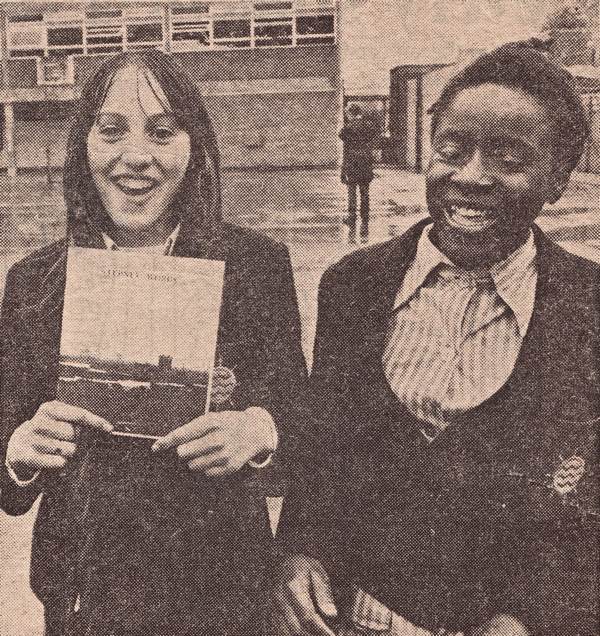
When I found a copy of Stepney Words in a school jumble sale, I had no idea what a remarkable discovery I had made. I can still remember reading the poems while walking home through the very same East London streets depicted in many of the poems. With titles like ‘The Chance,’ ‘Death in a Churchyard,’ ‘The World is Dim and Dull,’ ‘Let it Flow Joe,’ and writing that was vivid and raw and utterly captivating, I had stumbled upon the inner thoughts and observations of young people aged eleven to fifteen years from another time.
The beautifully atmospheric cover photograph confirmed that their Stepney was a world when the dockyard cranes and heavy industry depicted in a brown haze were still a part of the working life of the River Thames. I knew I had found a precious document and I felt compelled to find out more. A visit to Tower Hamlets Local History Library helped me discover the remarkable story and I made a BBC Radio documentary in 1997 about the astonishing impact this thirty-two-page booklet had on so many people’s lives, and upon the meaning of classroom education .
In May 1971, Chris Searle, a young English teacher was sacked by the governors of Sir John Cass Foundation School in Stepney for publishing Stepney Words, a collection of his students’ poems. Searle had encouraged his pupils to write about their lives and their neighbourhood. These were same streets where his own literary hero, the great poet Isaac Rosenberg, had once lived.
In response to Searle’s dismissal, on the 27th May 1971, eight hundred pupils, including those from neighbouring schools, went on strike. With banners aloft and chanting ‘We Shall Overcome’ in the pouring rain, they refused to return to school until Chris Searle was reinstated.
Following a spate of industrial disputes that had seen dustcarts and the postal system out of action, many of the youngsters had seen their parents on picket lines, so they followed their pattern. Several strikers marched into the offices of the local paper, who then called the national papers. The children’s strike was front page news, and the next day the strikers took to the streets of London, marching from Stepney to Trafalgar Sq, making sure that their route took them right through Fleet St which generated even more coverage.
The publication of Stepney Words extended beyond the strike. There was a second volume later in the year, readings by the young writers at poetry festivals, and some of the Stepney poets set up a pioneering arts project in Cable St, the Basement Writers, a multi-disciplinary platform for working class writers and performers.
Behind the scenes, controversy raged surrounding of the reinstatement of Searle. In 1973, with support from the National Union of Teachers and the Inner London Education Authority, Chris Searle did get his job back. The student strikers were vindicated. But by then the older ones had already left school and, on his return, Searle was ostracised by other staff and denied a class of his own.
He moved to Langdon Park School in Poplar where he helped to publish The People Marching On, a ground-breaking anthology of key events in East End history written by the English students.
Stepney Words remained in print throughout the seventies and into the eighties, selling tens of thousands of copies.
In 1973 Hackney’s Centerprise compiled the two volumes of Stepney Words into a single edition and hailed “the great upsurge in community and working class publishing … where the movement to write and publish was taken up in a small area of East London, today it is being continued in many other towns and cities throughout the country.”
Over the years since my documentary, I have been invited to a number of reunions of the Stepney Poets and strikers, along with Chris Searle, who went on to head a secondary school in Sheffield after working in East Africa and the Caribbean. In the course of these gatherings, the events of 1971 have been described as extraordinary and life-changing by those who were there. They are all in agreement that it is their former English teacher whose creativity and vision was their inspiration. For Searle, it was the energy and actions of those young people who set the course of his life’s work in education.
Later this year, we are planning to celebrate the fiftieth anniversary with a symposium held at Queen Mary University in Mile End exploring the events of 1971 and their legacy, with teachers, students, young poets and community groups discussing both the immediate impact and the longer-term influence, encouraging new generations of young people to find their own voices.




You may also like to read about
So Long, James McBarron
James Mc Barron died on Monday at the fine age of ninety-four, he was born in Hoxton on 21st September 1926

James McBarron
When I published Horace Warner’s photographs of Spitalfields Nippers from around 1900, I never expected to meet anyone who knew them. Yet Lynne Ellis wrote to say her father James McBarron recognised Celia Compton whom Horace Warner photographed at the age of fifteen in 1901. By the time James knew Celia, when he was a child in the thirties, she was Mrs Hayday and he encountered her as a money-lender when he was sent to make weekly repayments on his mother’s loans.
Intrigued by this unexpected connection to a photograph of more than a century ago, I took the train from Fenchurch St down to Stanford Le Hope to meet James McBarron and learn more of his story. This is what he told me.
“I am from Hoxton, Shoreditch, I was born in George Sq at the back of Hoxton Sq – it’s not there anymore. There were seven tenements and another building where Mrs Hayday lived, all around a yard with a lamppost in the middle. We attached a rope onto the lamppost and swung on it. We used to have a bonfire there in November and all the families came along. It was like a village and a lot of people were related, and everyone knew each other. We were clannish and there were quite a few families with members in different flats – my grandmother and grandfather lived there in one flat and I had two aunts in another.
Eighty years later I can still remember Mrs Hayday, even though I was only seven, eight or nine at the time. It was in 1936 or thereabouts. She was a money-lender and I was sent by my mother every Sunday to pay sixpence to her, but it didn’t mean anything to me at the time. To my eyes, as young boy, she was overwhelming. I was shown into the bedroom by her daughter and she was always lying there in bed. She took out a book from the bedside and made a note of the money. I recall an impression of crisp white sheets and she had dyed blonde hair. She was a buxom woman, a little blowsy. She smelled of scent – Phul Nana by Grossmith – the only scent I knew as a young boy, the factory was in Newgate St. I was awestruck because she was so unlike any of the other people I knew. There was a never a man there or a Mr Hayday. She was a very nice lady, she said, ‘Hello’ and ‘Say ‘Hello’ to your mum and dad,’And that was Mrs Hayday.’
My father, George, was a carpenter from Sunderland and he served in the Great War. My mother worked at Tom Smith’s Cracker Factory in Old St. My parents met in London and my mother’s family already lived in George Sq. My grandfather, he was an inventor and I admired him very much. He made a little working steam engine, and he tapped the gas main and had a tube with a little flame, so he could light his roll-ups. He played the violin and read music, and he never went to work. My gran used to go round to the pub for a jug of beer and they’d all go upstairs to my grandparents’ flat and play darts, and he’d play the violin.
We kids used to chop firewood to make money. The boys and girls used to go around collecting tea-chests and packing-boxes from the back of all the furniture factories, and say ‘Can we take it away, Mister?’ We chopped it up into sticks and made bundles, and we’d sell them for a penny or a ha-penny. We used to go to Spitalfields Market and ask for ‘Any spunks?’ or ‘Spunky oranges and apples?’ and they’d chuck the fruit that was going bad to us.
We didn’t think we were poor, except there was a family called Laban who were better off than us. He was a bookmaker and had touts. I remember their son had a jacket with pleats in the back and I wanted one like it, but when my mum eventually got me one it wasn’t so good. My father had a blue serge suit and it was pawned each Monday to pay the rent and bought back each Friday when he got paid. On Sundays, we went down to Stephenson’s Bakery in Curtain Rd to get a penny loaf.
When you came out of George Sq, there was a little alleyway leading through to Hoxton Market. There was Marcus the Newsagent, and next to it was Pollock’s and they had toy theatres in the window and these glass bottles with coloured liquid – it was a tiny shop. Next to that was Neville’s where my father bought our boots and shoes. I can remember every shop in the Market. Hoxton St was different then, bustling with stalls and there were barrows selling roasted chestnuts and boiled sheep’s heads.
William was the eldest child in our family, then I was born, then Peter, then Johnny and last of all Margaret. There was twenty-one years between us and she was born while I was away in the army, so she didn’t know me when I came back. I knocked them up at seven in the morning and called, ‘Here’s your boy, back again!’ We had three rooms – two bedrooms and a living room, and that’s why we had to move.
After the war, they moved us up to Haggerston to a new building in Stean St and George Sq was demolished because it was a slum. Everything broke up when people moved out. They took out all our furniture – including a table and chest of drawers my father made – and put it in a closed van and fumigated it because of the bugs. I’ve still got his tool box. It was a ragtag and bobtail existence, but I think we were a little better off than some. “

Celia Compton photographed at age fifteen by Horace Warner in 1901. Years later in 1936, a year after her husband died and when James McBarron was a child, she lived at 5e George Sq and he knew her by her married name of Celia Hayday.

James McBarron with his father’s carpentry box

Margaret & George McBarron in Haggerston

James and his brother Peter

As a boy, James visited Benjamin Pollock’s Toy Theatre shop at 208 Hoxton Old Town

James’ younger brother Johnny in the new flat when the family were rehoused in Stean St, Haggerston, in 1946

James’ elder brother William at the piano

James & June McBarron

James & June McBarron got married in St Leonard’s Shoreditch on 5th June 1954

James McBarron, 1965

James catches mackerel on holiday in Devon

James & June McBarron’s children, Lynne & Ian, in the sixties
You may also like to read these other Hoxton stories
Joseph Markovitch, I’ve live in Hoxton for eight-six and a half years


