
Grace Oscroft, Painter
Spring begins in the northern hemisphere with the vernal equinox this weekend. In celebration, we are having a SPRING SALE with all titles in the Spitalfields Life Bookshop at half price. Enter ‘SPRING’ at checkout to claim your discount.
Click here to visit the Spitalfields Life online bookshop
Grace Oscroft is featured in EAST END VERNACULAR, Artists who painted London’s East End streets in the 20th century which is included in the sale

Bryant & May Factory, Bow
The Oscroft family ran a cycle shop opposite the church in Bow and lived nearby. As the only daughter, Grace Oscroft (1903-72) was expected to keep house for her parents and three brothers upon leaving school at fourteen.
Two of Grace’s brothers were considered to have artistic talent and when, in her early twenties, she accompanied her younger brother John to classes at Bow & Bromley Institute, tutor John Cooper recognised her natural ability.
In later years, John Oscroft recalled that his sister Grace always had an inclination to draw but worked on pictures infrequently. Fellow artist Cecil Osborne offered a simple explanation for this, recalling that Grace would only ever “bring along a painting from time to time” and complained that her domestic duties granted her little opportunity for art work.
As a consequence, all Grace’s street scenes were of locations around Bow and she specialised in rooftop pictures that she could paint from the bedroom windows of the family home. In those days, Bow was heavily industrialised and John recalled that “the only blade of grass being in the churchyard.” Grace painted the factories and foundries that surrounded her. The most notable of these was the huge red brick Bryant & May factory that dominated Bow and it is impossible that Grace was unaware of the matchgirls’ 1888 strike which challenged the exploitative working conditions and suffering they endured from working with phosphorus
Although her brother John did not show any pictures, remarkably Grace had five paintings in the East London Art Club exhibition at the Whitechapel Gallery in 1928 and, to further this success, her picture Garden in Bow was hung at the Tate Gallery the following year. An astonishing achievement for a twenty-six year old. Yet the Evening Standard ran a patronising article featuring Grace entitled, ‘East End Shopgirl Artist’ and the Westminster Gazette reported “Miss Oscroft, who in every day life sells bicycle parts, was surprised when she heard that Sir Joseph Duveen had bought her painting for £5 5s.” In fact, John denied Grace ever served in the cycle shop in Bow.
“It was my first original effort and I am greatly pleased. Mr Cooper had advised me to try something on my own,” declared Grace with understated pride. Subsequently, she contributed paintings to the East London Group shows at the Lefevere Galleries in 1930, 1931 and 1932. As evidence of Grace’s self-assurance and articulacy as an artist, Walter Steggles remembered her earning “sixpence a week pocket money by lecturing on pictures”
In 1935, the Oscrofts took over another cycle business in New Southgate. Grace lived independently there above the shop and although the family’s house in Bow was destroyed in the blitz, fortunately no-one was at home at the time.
After her brothers married and left home, Grace committed to caring for her mother who suffered with rheumatism. After the death of her mother, she took a variety of employment to support herself, as housekeeper to a doctor, despatch clerk at the Co-operative store in Edmonton and then in a glove factory. Grace remained single throughout her life, confessing in 1954, “I only ever had one sweetheart, but he was taken from me,” referring to Elwin Hawthorne who married Lilian Leahy.
She died in St Joseph’s Hospice, Hackney in 1972 and her death certificate recorded her occupation as ‘warehouse clerk (retired),’ yet the authority and accomplishment of Grace Oscroft’s few works testify to a significant artistic talent that might have discovered fuller expression in different circumstances.

Grace Oscroft (bottom left), 1929

St Clement’s Hospital, Bow

Garden in Bow, 1929 (courtesy Hepworth Wakefield)

Iron Foundry, Bow

Old Houses, Bow

A recent photograph of the same view
Paintings copyright © Estate of Grace Oscroft
With grateful thanks to David Buckman for the use of his research
Take a look at some of the other artists featured in East End Vernacular

The Dogs Of Old London
Spring begins in the northern hemisphere with the vernal equinox at 21:58pm tonight. In celebration, we are having a SPRING SALE with all titles in the Spitalfields Life Bookshop at half price. Enter ‘SPRING’ at checkout to claim your discount.
Click here to visit the Spitalfields Life online bookshop
‘The Dogs of Old London’ are published in ‘The Gentle Author’s London Album’ which is included in the sale

Click to enlarge
Sometimes in London, I think I hear a lone dog barking in the distance and I wonder if it is an echo from another street or a yard. Sometimes in London, I wake late in the night and hear a dog calling out to me on the wind, in the dark silent city of my dreaming. What is this yelp I believe I hear in London, dis-embodied and far away? Is it the sound of the dogs of old London – the guard dogs, the lap dogs, the stray dogs, the police dogs, the performing dogs, the dogs of the blind, the dogs of the ratcatchers, the dogs of the watermen, the cadaver dogs, the mutts, the mongrels, the curs, the hounds and the puppies?
Libby Hall, who has gathered possibly the largest collection of dog photography ever made by any single individual, helped me select the dogs of old London from her personal archive. We pulled out those from London photographic studios and those labelled as London. Then, Libby also picked out those that she believes are London. And here you see the photographs we chose. How eager and yet how soulful are these metropolitan dogs of yesteryear. They were not camera shy.
The complete social range is present in this selection, from the dogs of the workplace to the dogs of the boudoir, although inevitably the majority are those whose owners had the disposable income for studio portraits. These pictures reveal that while human fashions change according to the era and the class, dogs exist in an eternal present tense. Even if they are the dogs of old London and even if in our own age we pay more attention to breeds, any of these dogs could have been photographed yesterday. And the quality of emotion these creatures drew from their owners is such that the people in the pictures are brought closer to us. They might otherwise withhold their feelings or retreat behind studio poses but, because of their relationships with their dogs, we can can recognise our common humanity more readily.
These pictures were once cherished by the owners after their dogs had died but now all the owners have died too, long ago. For the most part, we do not know the names of the subjects, either canine or human. All we are left with are these poignant records of tender emotion, intimate lost moments in the history of our city.
The dogs of old London no longer cock their legs at the trees, lamps and street corners of our ancient capital, no longer pull their owners along the pavement, no longer stretch out in front of the fire, no longer keep the neighbours awake barking all night, no longer doze in the sun, no longer sit up and beg, no longer bury bones, no longer fetch sticks, no longer gobble their dinners, no longer piss in the clean laundry, no longer play dead or jump for a treats. The dogs of old London are silent now.


Arthur Lee, Muswell Hill, inscribed “To Ruby with love from Crystal.”


Ellen Terry was renowned for her love of dogs as much as for her acting.


W.Pearce, 422 Lewisham High St.

This girl and her dog were photographed many times for cards and are believed to be the photographer’s daughter and her pet.

Emberson – Wimbledon, Surbiton & Tooting.


Edward VII’s dog Caesar that followed the funeral procession and became a national hero.


A prizewinner, surrounded by trophies and dripping with awards.


The Vicar of Leyton and his dog.


The first dog to be buried here was run over outside the gatekeeper’s lodge, setting a fashionable precedent, and within twenty-five years the gatekeeper’s garden was filled with over three hundred upper class pets.

Libby Hall, collector of dog photographs.
Photographs copyright © The Libby Hall Collection at the Bishopsgate Institute
You may like to read my original profile
On The Eve Of Spring
Spring begins in the northern hemisphere with the vernal equinox at 21:58pm tomorrow. In celebration, we are having a SPRING SALE with all titles in the Spitalfields Life Bookshop at half price. Enter ‘SPRING’ at checkout to claim your discount.
Click here to visit the Spitalfields Life online bookshop

Each year I return to Bow Cemetery in search of signs of spring. Already I have Hellebores and a few Primroses in flower in my Spitalfields garden, but at Bow I was welcomed by thousands of Crocuses of every colour and variety spangling the graveyard with their gleaming flowers. Beaten and bowed, grey-faced and sneezing, coughing and shivering, the harsh Winter has taken it out of me, but feeling the warmth of the sun today and seeing these sprouting bulbs in such profusion restored my hope that benign weather will come before too long.
Some of my earliest crayon drawings are of snowdrops, and the annual miracle of Spring bulbs erupting out of the barren earth never ceases to touch my heart – an emotionalism amplified in a cemetery to see life spring abundant and graceful in the landscape of death. The numberless dead of East London – the poor buried for the most part in unmarked communal graves – are coming back to us as perfect tiny flowers of white, purple and yellow, and the sober background of grey tombs and stones serves to emphasis the curious delicate life of these vibrant blooms, glowing in the sunshine.
Here within the shelter of the old walls, the Spring bulbs are further ahead than elsewhere the East End and I arrived at Bow Cemetery just as the Snowdrops were coming to an end, the Crocuses were in full flower and the Daffodils were beginning. Thus a sequence of flowers is set in motion, with bulbs continuing through until April when the Bluebells will come leading us through to the acceleration of Summer growth, blanketing the cemetery in lush foliage again.
As before, I found myself alone in the vast cemetery save a few Magpies, Crows and some errant Squirrels, chasing each other around. Walking further into the woodland, I found yellow Winter Aconites gleaming bright against the grey tombstones and, crouching down, I discovered wild Violets in flower too. Beneath an intense blue sky, to the chorus of birdsong echoing among the trees, Spring was making a persuasive showing.
Stepping into a clearing, I came upon a Red Admiral butterfly basking upon a broken tombstone, as if to draw my attention to the text upon it, “Sadly Missed,” commenting upon this precious day of sunshine. Butterflies are rare in the city in any season, but to see a Red Admiral, which is a sight of high Summer, in March is extraordinary. My first assumption was that I was witnessing the single day in the tenuous life of this vulnerable creature, but in fact the hardy Red Admiral is one of the last to be seen before the onset of frost and can emerge from months of hibernation to enjoy single days of sunlight. Such is the solemn poetry of a lone butterfly in Winter.
We are at the beginning now, and I offer you my pictures as evidence, should you require inducement to believe it.

The spring bulbs are awakening from their winter sleep


A single Red Admiral butterfly, out of season – “sadly missed”
You may also like to read about
Nik Strangelove’s Brick Lane
Book now for The Spitalfields Trust’s upcoming free web events
The Threat to Brick Lane, Heartland of British Bangladeshi Culture
Dan Cruickshank’s History of the Truman Brewery
A Catalogue of Planning Disasters in Spitalfields

Nik Strangelove‘s father’s family originated from Bow but Nik first came to Brick Lane to take photographs in 1993, when he was studying photography, as picture editor of The London Student. In 1997, Nik returned under commission to photograph Brick Lane for the Express on Sunday but these pictures were not published until twenty years later here on Spitalfields Life.


Photographs copyright © Nik Strangelove
You might also like to to look at
Philip Marriage’s Date Box Labels
Philip Marriage sent me his fascinating collection of date box labels with their ingenious typography and curious array of Orientalist fantasies. How startled I was to recognise one design in particular from my own childhood and recall how these boxes magically transformed into model ships once the dates were eaten.

“Having spent a lifetime in graphic design I have collected far too much stuff that has attracted my eye and even now cannot quite bring myself to throw away. I have always been drawn to items with distinctive typography or design – particularly those which had a style all of their own, like funfair decoration, firework labels and these date box labels.
As a youngster I only remember dates, like tangerines, as a special treat at Christmas. These labels were of their time, replaced nowadays by more sophisticated versions with bar codes and sell-by dates but somehow lacking the charm of these unaffected designs from the seventies and eighties.”
Philip Marriage


You may also like to take a look at
Keren McConnell’s Fruit Wrappers
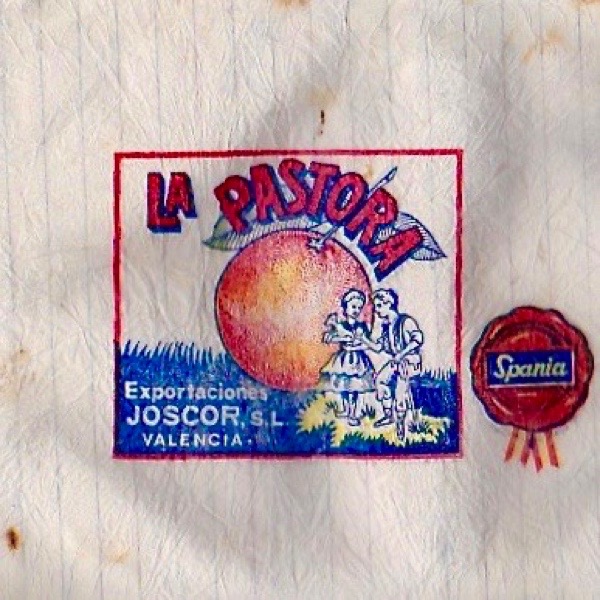
This is the season for oranges and lemons, so I was more than delighted when Keren McConnell kindly sent me her glorious fruit wrapper collection from the seventies to share with you. If any other readers have ephemera collections, please get in touch.

“I started collecting fruit papers when I was six years old, possibly inspired by a holiday in Spain in 1971. Most of the papers stuck in my small scrapbook were picked up while shopping for groceries with my mother at the local greengrocers in Blackheath. I think they reminded me of that holiday with their bright and graphic imagery.
I was drawn to the designs and texture and feel of the crinkly tissue paper. I also collected carrier bags and paper bags for their graphics, but this collection did not survive all our house moves.
Who knows? This book of fruit papers may have even informed my career. I became a print and graphics designer for fashion brands and retailers, sometimes using this scrapbook as reference material to inspire a T-shirt design.
As a child, particular favourites were the designs depicting animals, beautiful ladies and the smiling face on the Sicilian lemon is particularly appealing. I have no idea why the Tower of London was on a fruit paper from Spain. Perhaps the designer thought London was an exotic place, just as I had found Spain so exotic? Some of the designs seem to have been inspired by sport, such as horse racing and Formula One.
Are children today inclined to make collections like this? Mine was born out of boredom, particularly on wet Sundays when the days felt so long.”
Keren McConnell







You may also like to take a look at
George Double, Builder of Boxted Bridge
Contributing Photographer Lucinda Douglas Menzies sent me this missive from rural Essex where she has been spending the lockdown and campaigning to save George Double’s fine old bridge at Boxted. Lucinda has traced the remarkable ascendancy of this forgotten engineer and designer for whom his beautiful bridges serve as his monuments.
Sign the petition to Save Boxted Bridge

View from Boxted Bridge by John Nash, c. 1950 (courtesy Government Art Collection)
From modest beginnings – born in Benton Street, Hadleigh – George Double (1840-1916) rose to be nationally recognised as a bridge builder and civil engineer. As the designer of Boxted, Dedham and Wormingford bridges, he deserves special remembrance in the Dedham Vale.
Through his thirties and forties George worked with with the eminent civil engineer John Dixon, but by the time he came to work in the Stour Valley he had become his own master at the age of fifty-one. The Bury & Norwich Post reported on 10 February 1891 –
“Mr Double, whose contract had been successful for Wormingford Bridge was a very experienced man, having built Westminster Bridge and was also active in the erection of Cleopatra’s Needle.”
What I have found about his early life comes from census records. George is listed as a Scholar, living in Hadleigh in 1851 and as a railway porter in London in 1861. But then a reference to ‘worked on Westminster Bridge’ in 1862, and listed as engineer in the Isle of Man in 1869 and as engine fitter near Lake Windermere in 1871.
The last two may be no more than a coincidence, except John Dixon was in the same place – working on the Iron Pier at Douglas on the Isle of Man and on the Windermere Steam ferry – so an early association between the two men is possible. In any event, we know that George was working as site manager for John Dixon in 1877 on the construction of Llandudno Pier because the Caernarvon & Denbigh Herald of 25th August 1877 reported a serious accident there.
“William Tooth, one of the workmen employed in the construction of the new pier, received very dangerous injuries by a fall…..Mr Cheeseman, the pier-master, and Mr Double, the manager of the works, were both upon the pier at the time of the accident, and they hurried down to where the unfortunate man was lying. Brandy was administered to him, and he was taken to his lodgings…”
In September 1878, George was in the national news as John Dixon’s foreman, erecting Cleopatra’s Needle on the Victoria Embankment.
“Into the enclosed space around the skeleton structure only those responsible for the safe raising of the obelisk were admitted. Mr Dixon, the engineer, with Mr Baker as chief of the staff, and Mr George Double, as the executive foreman, remained there throughout directing the labours of the twenty or thirty men who worked the winches that served to prevent a too sudden movement of the ponderous stone.”
A year later, George was credited with building the hundred and forty-six foot swing bridge over the River Blyth for the Southwold Railway Company, a major civil engineering challenge featuring a pivoting span to allow boats to pass. By April 1887, he was back in London again, as the West London Observer report on the construction of Hammersmith Bridge reveals.
“The cost of the new bridge has been about £85,000. and it has been erected with remarkable expedition under the supervision of Mr George Double, the energetic manager of Messrs. Dixon and Thorne, the building having taken just two years, reckoning from the date of commencement”
Soon George became a successful independent bridge contractor in his own right, as the plaque of 1890 on a wrought iron trellis girder bridge at Curbridge confirms. The next year he won the tender for Wormingford Bridge over the River Stour. George’s experience building over water led to the contract for the new pier and landing stage for steamer ships at Clevedon in Somerset – which is now grade I listed – as the Wells Journal 9th June 1892 noted with approval.
“The work undertaken by the contractor (Mr Double) from designs of Mr Abernethy, the eminent engineer, is being carried out in a very satisfactory and expeditious manner.”
The new pier head was one hundred feet in length and fifty feet wide, with twenty four massive iron columns that suspended it sixty-five feet above the mud. The landing stage was built at an angle in order to align with the prevailing current in the Bristol Channel which the offered extraordinary challenges to any construction. The pier had to withstand the second highest tides in the world and constant immersion in salt water.
George’s tender for £937 to build Boxted Bridge over the River Stour in Essex was accepted on 14th November 1896 and a mere six months later the Evening Star reported –
“The Boxted Bridge, which has been built by Mr George Double of Ipswich, is now completed and opened for traffic so that the road to Nayland is once more available.”
George’s next contract was Dedham Mill Bridge – also on the River Stour – another substantial bridge built in the space of six months as the Ipswich Journal announced on May 12th 1900.
“that the tender of Mr George Double, Ipswich, for £1865, had been accepted, and that the work had to be completed within six months, was adopted.”
The 1911 Census records George and Emma Double, his wife of forty-eight years, living at Kirby Lodge, St John’s, Ipswich. His occupation is listed as Retired Contractor, Bridges, Pier & Bridge. Emma died in 1912 followed by George in 1916. They had no children and his niece inherited the estate. No photograph of George Double has come to light, but perhaps the readers can help?

Workmen posing on the scaffolding surrounding Cleopatra’s Needle on the Embankment in 1878. Is George Double one of these men?

George Double’s Wormingford Bridge, built 1891 (Photo by Lucinda Douglas Menzies)

George Double’s Boxted Bridge, built 1897

George Double’s Dedham Mill Bridge, built 1900

Photo by Lucinda Douglas Menzies
BOXTED BRIDGE
For over a century after George Double’s death, Boxted Bridge carried traffic without any need of repair or maintenance, but wear and tear led to a predictable outcome in the Principal Inspection Report of 1992.
“The bridge has been assessed to be able to carry only three tonnes loading… the proposed remedial measures were to strengthen one of the spans, impose a three tonnes weight restriction, and monitor the structure.”
Yet Essex County Council turned a blind eye, relying on ‘hidden reserves of strength’ in the bridge and permitting traffic to use the bridge, unrestricted, for the next twenty-eight years. It was not until 2018 that ‘Not suitable for HGV’ signs were finally placed on the approaches.
In the most recent Principal Inspection Report of March 2018, it was recommended that ‘design work should be considered to establish maintenance, strengthening or replacement options for the structure’ and a list of repair work was put forward but again ignored, even though this is obviously the preferable option for the bridge over replacement. Repair would cost less, be less disruptive and has less carbon footprint. Essex County Council have declared that they are “committed to reducing Essex’s carbon footprint”.
In spite of this, Essex Highways are finalising a planning application to replace Boxted Bridge with a much wider bridge to accommodate Heavy Goods Vehicles at a conservative estimate of £1 million, delivering road closures for a year and an unknown carbon footprint. This cannot be justified when set against the recommendations for repairs listed in the last Principal Inspection Report which were costed at £122,500.
Consideration for the surrounding Area of Outstanding Natural Beauty must be paramount in any future decision for Boxted Bridge which is listed as a local heritage asset and has strong associations with Alfred Munnings and John Nash. Now that we know it was built by local engineer, George Double, it should not be written off and scrapped as obsolete. This is more than enough justification for Essex Highways to make the extra effort to conserve it.
Sign the petition to Save Boxted Bridge

A View of Boxted Mill by Alfred Munnings, c.1930 (courtesy of artist’s estate)
You may also like to take a look at


