
Twenty Years Ago Today
Twenty years ago this morning, I woke in an apartment in New York City. It was around eight thirty when my friend called from outside the bank in Midtown, where he had gone to deposit cheques. He had left early to be there at opening time and, as he was standing in line waiting for a teller, he saw on the television that there was a fire in one of the towers at the World Trade Centre.
I got out of bed and climbed up onto the flat roof of the apartment. It was a beautiful day, clear and bright with a blue sky after days of rain and cloud, and the humidity which overwhelms Manhattan in July and August had cleared. Although most people try to avoid New York in the summer, and residents who have the option seek refuge in beach houses, it is my favourite time of year in the city. The one time when the pace slows, languor prevails, and there is peace in the shadowy air-conditioned buildings where people linger to avoid the baking temperature and blinding light outside in the streets.
Summer was drawing to an end and there would be no more of the trips to Long Island that had punctuated my time in the City. Just a week earlier, on Labor Day, which marks the change in the season, the beaches had closed for the year.
I stood on this same roof on July 4th and watched the fleet line up in the East River, admiring the firework display as I ate dinner with friends. Looking across Manhattan that morning, I could see the distant plume of smoke from the westerly of the towers. It did not mean anything to me then, but I was puzzled how it could have happened, so I went downstairs and switched on the television. The television was reporting a plane had crashed into the tower. It was an extraordinary event for which the news anchor had no explanation, and so I went back to bed and dozed again.
I was awoken by the return of my friend who had cycled back from his errand at the bank. People were getting really excited about this fire, he told me, and he switched on the television again. For the first time, I sensed the panic and helplessness which was to envelop the city that day, as the presenters struggled to find words and keep their cool in the face of inexplicable and unprecedented events.
Then came the strangest moment of television I ever saw. Upon the screen, a plane jetted out of nowhere and disappeared into one the towers. “That’s a re-run, you’re seeing here, of the plane hitting the tower that we reported earlier,” commented the news-anchor, only to swallow her words – almost choking – as she exclaimed, “Oh no! That’s not a re-run, that’s another plane.”
Exactly a week earlier, at eight thirty in the morning, I visited the World Trade Centre accompanying my friend who was applying to an office there for a street traders’ licence. We came through the subway which opened up into a shopping mall and emerged onto the plaza directly beneath the towers. I recalled the first time I came to New York and stood at the top. Stretching my arms between those external struts and gazing down upon Manhattan from such a height, it was as if looking from the window of an aeroplane. My birthday was in a few days and we vowed to return to the top for a celebration, but we did not go back.
Once the second plane hit the towers, the tenor of events changed. Very quickly, reports came in of hijackings and other planes unaccounted for. I went back up onto the roof of the apartment and looked again to confirm the reality of the television news with my own eyes. Now there were two plumes of smoke in the sky, and sirens erupted through the streets as fire crews and police hurtled down the avenues of Manhattan. I returned to the television and stayed there, compelled. I had a pocket email machine and I was able to write messages to everyone in London to let them know I was alright, before the lines went dead.
A campaign was underway, something I could only comprehend through reference to science fiction such as “The War of the Worlds.” An attack had commenced that morning without indication how long it would last. As I sat there in shock at the accumulating reports of the plane hitting the Pentagon and the crash of United 93, a dread grew inside me. There was no reason to assume that this would not continue all day and it was impossible to know where and when it would end. It felt like the end of the world – there was no way to grasp the nature of what was happening. When I returned to the roof and looked again, the World Trade Centre had gone completely, replaced by a vast black tower of smoke billowing into the blue.
Twenty-one months earlier, I had been in Los Angeles at the time of the Millennium. Somehow, everybody expected a transformation and a new era to begin then. Nobody wanted to admit it was a non-event. But that morning, I realised that I was witnessing the actual moment when one century ended and a different world was born.
For a couple of years, I had been working with producers in Times Sq who were to present a play of mine on Broadway, opening on September 15th 2001. I loved being in New York in those days, it was a true metropolis of glamour and affluence – a world incarnated in the now over-familiar fiction of “Sex & the City.” Many times I enjoyed Cosmopolitans at the Bowery Bar, the location where Candice Bushnell’s novel, which was the origin of that series, began.
Walking out onto the street on that September day, several miles from the unfolding catastrophe at the World Trade Centre, the scene was not dissimilar from usual, except – as people went about their business – I knew what everyone was thinking. We were all looking at each other in fear and knowing that we could only enact the semblance of routine. I went to the grocery story and bought food for the next few days. On my way back to the apartment, I saw a postcard of the World Trade Centre on a rack and, without thinking, I took the entire stack in hand, went into the store and paid for them.
Back at the apartment, I addressed postcards to everybody in my address book in England and then I went to the Post Office and mailed them all. I still do not understand why I did this, because I never wrote any messages on the cards, yet I knew everyone would realise who sent them and why. In fact, half arrived within ten days and half arrived four months later, intercepted perhaps as suspicious material in the collective paranoia that ensued.
On the day J.F.Kennedy Airport reopened, I flew back to London, peering from the window of the jet at the smoke still rising from the foot of Manhattan. At once, I went to see my parents in Devon and found them well, but within a week my father died unexpectedly. My mother had dementia and could no longer live alone, so I chose to move back into the family house to care for her. My play never opened on Broadway and I did not have the American career that I so longed for at that time, but after the events I had witnessed it no longer mattered to me.
Save Brick Lane!

Photo © David Hoffman
Despite 7,476 objections and only 82 letters of support, next Tuesday 14th September, Tower Hamlets Council’s Development Committee appears set upon approving the Truman Brewery’s application for an ugly shopping mall with four floors of offices on top, as the first step in the redevelopment of the entire former brewery site into a corporate plaza.
Back in the spring, the committee deferred the decision when concerns were raised about the damage the development would do to Brick Lane, pushing up rents which in turn will drive out the small independent shops and curry restaurants that characterise Spitalfields. Speaking with admirable social conscience, Councillor Sufia Alam expressed disappointment at the lack of housing in the development when there is a such a chronic shortage locally.
Chairman of the committee Councillor Abdul Mukit recognised the disastrous impact that the proposed brewery development would have upon the Bangladeshi community in particular and was unconvinced by the paltry ‘social benefits’ offered. ‘It’s not enough!’ he declared repeatedly at the meeting with Dickensian eloquence.
So now the Truman Brewery have come back with an enhanced offer to the community and it is still pitiful. In the new development, so-called ‘affordable workspace’ discount is increased from 10% of space at 30% market rent to 10% of space at 45% market rent, but still far above current rents locally. No discount at all is being offered on shops in the mall. The developer’s estimate of £6 per day spent locally on lunch by construction workers is increased to £15 per day when the office workers move in and, no doubt, the usual takeaway food chains open.
If it was not enough before, no-one could reasonably claim it is enough now. But the likely approval of the Truman Brewery shopping mall would unfortunately be true to form for Tower Hamlets Council who are responsible for a line of recent bad decisions including approving the conversion of the Whitechapel Bell Foundry into a boutique hotel, the digging up of the five-hundred-year-old Bethnal Green Mulberry Tree (now quashed) and the disastrous Liveable Streets programme which would see the obliteration of the historic streetscape at Arnold Circus.
I have grow increasingly disillusioned by the leaders of Tower Hamlets Council under Mayor John Biggs who call themselves ‘Labour’ yet pursue neo-liberal policies of furthering developers’ interests at any cost, destroying old buildings and encouraging social cleansing of neighbourhoods, in callous disregard of community and cultural heritage.
The council has been spinning the line that they ‘have no choice’ but to approve the Truman Brewery development since the developer could win on appeal. Yet they have rejected two nearby applications recently by Second Home and Banglatown Supermarket on the basis of harm to the Brick Lane Conservation Area.
To approve the Truman Brewery development would be an abnegation of the council’s responsibility and a betrayal of their constituents, advocating the interests of big money over the needs of residents when there are solid and defensible legal reasons in planning law for rejection. The councillors need to be mindful of the local elections next spring and the widespread disenchantment with their policies across the borough.
By contrast, we are delighted that Rushanara Ali, MP for Bethnal Green & Bow, has declared her support for a community-led master plan for the whole brewery site which could set parameters for future development, ensuring local needs are not ignored.
Planning expert Alec Forshaw of the Spitalfields Trust has prepared a list of reasons why the committee should reject the current Truman Brewery application which you can read below. We hope the councillors will do the right thing next Tuesday and vote in the interests of those who elected them rather than submit to any sinister ‘party line’ which supports development uncritically.
Join the protest march this Sunday 12th September, meeting at Altab Ali Park at 11:30am.
The Battle for Brick Lane exhibition I curated for Spitalfields Trust is open this Saturday and Sunday at 25 Princelet St from noon until 6pm.

A big block on Brick Lane

Shopping mall

Corporate plaza
REASONS WHY THE TRUMAN BREWERY SHOPPING MALL MUST BE REFUSED
The proposed Truman Brewery development of a shopping mall with four floors of corporate offices on top will push up rents and drive out the small independent shops and restaurants which define Brick Lane. Also it will overshadow the low-rise nineteenth century terrace in Woodseer Street and its generic architecture will damage the Brick Lane Conservation Area.
A radical rethink is needed to assess what the entire site of the former Truman Brewery could offer to sustain and strengthen the community in Spitalfields.
There are sound reasons to reject the current proposal, which can be successfully defended at appeal without expensive legal representation, and Tower Hamlets Development Committee must refuse the application on these grounds.
1. HARM TO BRICK LANE
Tower Hamlets Council’s Local Plan requires a mix of uses to revitalise the ‘Brick Lane Town Centre’ and reinforce its character of small independent shops and businesses alongside residential streets (TH Local Plan page 205).
The inclusion of large floor-plate offices in the Truman Brewery development will be harmful to ‘Brick Lane Town Centre.’ Whitechapel and Aldgate Town Centres ARE identified for office growth, but Tower Hamlets’ Local Plan does NOT promote offices in Brick Lane.
Planning policies for the City Fringe require a balance between residential and commercial development. National Planning Policy Framework paragraph 85 states that residential development plays a key role in sustaining town centres – a factor that is even more significant post-Covid.
Despite requests from the community, no Planning Brief or Master Plan exists for the Truman Brewery, a large site which is ideal for a mix of residential and commerce. Yet, if the rest of the brewery is redeveloped as a corporate plaza in line with the current application, there will be no residential.
The proposed commercial development site on Woodseer St would be a natural location for residential development. Currently a car park, it was previously housing and never part of the brewery operations.
2. LACK OF AFFORDABLE WORK SPACE
Construction costs for the new building will be high because of the developer’s requirement of Grade A offices, high-end shops and a two storey basement. Consequently, rents will be expensive. Even with the suggested discounts, the offices will be unaffordable to local businesses and no reduction at all is being offered on shops.
3. HARM TO THE CONSERVATION AREA
Tower Hamlets’ Local Plan seeks to protect the historic character of Brick Lane, but – in considering the Truman Brewery shopping mall – the planning officer’s report ignores this.
The proposed design or the shopping mall is stridently unsympathetic and grossly out of scale. The corner of Brick Lane and Woodseer St will be twice the height of the corner building opposite, harming the setting of the fine Edwardian terrace at 124-138 Brick Lane.
Nowhere does the planning officer’s report acknowledge that Woodseer St contributes positively to the Conservation Area, even though Tower Hamlets Council’s own Conservation Area Appraisal confirms that it does. Like other streets off Brick Lane, Woodseer St is a quiet residential backwater. Busy shops and restaurants will harm its character.
Planning policies aim to protect Spitalfields’ intimate street pattern, including the narrow width of Woodseer St. So the widening of Woodseer St, as proposed in the Truman Brewery scheme, is not a positive response to preserving the existing local context.
The Truman Brewery’s chimney is identified by Tower Hamlets Council as an important landmark and views of it must be protected. The best view of the chimney in Brick Lane is south of Woodseer St. This is the only view of the chimney when approaching from the south and it will be cut in half by the height of the new shopping mall.
4. NOISE, OVERLOOKING & LOSS OF DAYLIGHT FOR RESIDENTS
New shops and a new entry into the brewery on Woodseer St with increase foot-fall and deliveries. The proposed restaurant with external seating at the rear will cause disturbance to residents in Woodseer St. Previously, Tower Hamlets Council refused restaurant use at this location.
While some loss of daylight for residents on the south side of Woodseer St is inevitable if any building takes place on the north side, the proposed scale of the new shopping mall and offices, including the set-back top floors, results in excessive loss.
Tower Hamlets’ Local Plan ‘Vision for the City Fringe’ states “By 2031 the City Fringe will become a more attractive place to live, work and visit.” This scheme will not make Woodseer St a better place to live.
5. SUSTAINABILITY
The report does not mention the environmental implications of digging a double storey basement, requiring the removal of around 50,000 cubic metres of spoil by an enormous number of heavy lorries driving through residential streets. No strategy has been set out for this or any analysis of the implications.
The planning officer’s report does not mention the trees on the site, which include the semi-mature False Acacia that attractively overhangs the street and the six young replacements which the Council made the owner plant after he had damaged the previous trees. Any new trees planted on the north pavement will struggle with a water-table drastically lowered by the proposed adjacent basements.
6. THIS PROPOSAL IS PREMATURE WITHOUT A MASTER PLAN FOR THE ENTIRE TRUMAN BREWERY SITE
The location of the application is a part of the huge complex of buildings and empty spaces, straddling both sides of Brick Lane, which comprise the former Truman Brewery. There are many opportunities for new development, creating new public spaces and pedestrian routes, but – despite previous Council commitments – there is no Planning Brief or Master Plan for the site, and thus no mechanism for the Council to achieve the mix of uses (including residential) and deliver the public benefits that an area of this size should provide to the community.
The site of this application needs to be considered in the context of an overall plan. Of all the vacant sites within the former brewery, Woodseer St provides one of the most suitable for new housing, perhaps affordable live-work units, instead of offices, and perhaps two-storey prefabricated structures to minimise costs and achieve low rents.
A Planning Brief could be prepared, consulted upon and adopted within a six month period and need not present an unreasonable delay to the development process.

You may also like to read about
At Sandwich

CLICK TO DISCOVER THE GENTLE AUTHOR’S TOUR OF SPITALFIELDS

“There’s always something going on in Sandwich,” I was reliably informed by the guide who welcomed me to an old stone church, and the evidence was all around us in this ancient borough which has acquired so many layers of history over the last thousand years.
If you prefer your architecture irregular in form and mellow with age, this is your place – for Sandwich is one of England’s least-altered medieval towns. Yet the appeal lies not in how it has been preserved but in how it has changed, since every building has been melded over time to suit the evolving needs of its occupants, and the charismatic blend of timber with stonework and stonework with brickwork is sublime.
As I wandered through the quiet streets, I thought about the paradoxical nature of the guide’s comment since Sandwich unquestionably defines the notion of ‘sleepy town,’ even if that afternoon there was a concert in the grounds of the Lutyens house by the river and a fete at the quay. Yet in a more profound sense this has been a location of ceaseless activity since Roman times.
Contrary to popular opinion, ‘Sandwich’ means ‘a settlement built on the sand.’ First recorded in the seventh century, a thriving port and fishing industry grew up here on a sandbank in the days when the river was wider than it is today and the sea came right up to the town. A defensive wall with gates was built around this wealthy trading post and storm tides sometimes surrounded Sandwich, isolating it from the land. One of the pre-eminent ‘Cinque Ports,’ the fleet here offered nautical military service to the Crown in return for trading without taxation. Thus merchants from Venice brought their goods direct to Sandwich and even the King came to buy exotic luxury imports.
“You can easily get lost in Sandwich,” I was cautioned unexpectedly by the attendant at the Museum as I bought my copy of the Civic guide to study the history. It was an unlikely observation that the attendant uttered, since Sandwich is a tiny place, but let me confirm that you can quickly lose your sense of direction, strolling in the maze of small streets and lanes with names like Holy Ghost Alley, Three Kings Yard and Love Lane. An afternoon can fly away once you begin to study the glorious detail and rich idiosyncrasy of eight hundred years of vernacular architecture that is manifest to behold in Sandwich.
If your imagination is set on fire by winding streets of crooked old houses and ancient worn churches paved with medieval tiles and roofed with spectacular wooden vaults, then Sandwich is the destination for you. You really can lose yourself in it and there is always something going on.

St Peter’s Church


The King’s Lodging


Demon of 1592 on the corner of the Kings Arms


St Mary’s Church

St Mary’s Church

Tower of St Mary’s Church


Mermaid at the corner of Delf St


January 1601

The Delf stream was channelled to bring freshwater to Sandwich in the thirteenth century


Horse Pond Sluice


St Clement’s Church has an eleventh century Norman tower

In St Clement’s Church

Fisher Gate with the old Customs House on the right

Fourteenth century Fisher Gate

At Herne Bay
CLICK TO DISCOVER THE GENTLE AUTHOR’S TOUR OF SPITALFIELDS

Reculver Towers
Several years ago, I grew fascinated with a ruin upon the seashore in the background of a photograph of members of the Cambridge & Bethnal Green Boys’ Club taken by Harry Tichener in 1938 . When Maxie Lea, who is featured in the picture, told me that it was taken at Herne Bay, I knew that one day I must go and seek this location for myself.
Yet, when I arrived and walked from the railway station to the deserted seafront, I discovered there were many other attractions that make this secluded corner of the Kent coast worthy of a visit. Set back fifty yards from the shingle beach, sits a magnificent line of grand hotels and seafront villas. Some are whimsical Victorian fripperies and others are elegant bow-fronted Georgian, and it makes an appealing backdrop to the well-kept and newly-renovated municipal gardens, basking in the September sunlight beneath an azure sky flecked with feathery trails.
A proud white stucco gatehouse guards a poignant remnant of what was Britain’s second longest pier in 1896, now just a stub attached to the shore with the far end marooned out at sea, unreachable and distant since the storm of 1978. You can take a stroll past the huts, adorned with saucy paintings in the style of Donald McGill, to reach the end of what remains and join a sparse line of fishermen and senior local residents, casting their eyes wistfully towards the horizon and awaiting a miraculous reconstruction.
Turning my gaze to the east, I could already recognise the towers at Reculver shining white in the far distance and encouraging me to take my leave of the town and seek the coastal path. The outskirts of Herne Bay present a curious mixture of dereliction and some cherished Regency villas, culminating in Marckari’s ice cream parlour where I had my first taste of an authentic Turkish delight ice cream. Thus fortified, I strolled onward upon the broad featureless concrete promenade with the towers reassuringly present, constantly in my vision.
Climbing a winding stairway takes you to the cliff path, lined with sloes and hawthorn, and giving way to meadows that descend towards Reculver. Soon, the towers are no longer an image on the horizon but looming above you. You ascend the path beneath them as a colony of swifts swoop and dive over your head, filling the air with their cries before returning to roosting places high in the turrets. You have arrived upon a raised platform of green, overlooking the sea, where the sweet fragrance of nectar hangs in the air. This was where the Romans built a fort in 42AD, when this was the end of the land and the marshes to the east were open water, known as the Wantsum, a channel that isolated the Isle Of Thanet from the mainland.
St Augustine brought Christianity to Kent at the end of the sixth century and, by AD 669, King Ecgbert gave this land for the foundation of a monastery. A tall church was built upon the Roman ruins, creating a landmark that signalled the spiritual significance of this favoured spot, visible from such a great distance. In 1810, the ruins of this church were reconstructed by Trinity House to create a stable structure that could function as a navigational aid. Once there was a thriving village of Reculver, yet the encroachment of the sea and regular flooding led to its decline until only a couple of houses are left today. Yet it retains a distinctive atmosphere and, after all this time, the imposing sea-battered towers are like natural excrescences of rock.
Setting out across the marshes as the afternoon sun declined, I was entranced by the naturally occurring gardens upon the shingle, where grey-green sea kale grew in star shapes complimenting the pink leaves of sorrel spreading close to the ground and interspersed with curious bushes of yellow poppies that seeded themselves all along the beech. Glancing over my shoulder, the towers of Reculver seemed to get no further away, watching over me now as they had beckoned me earlier.
Nine miles to the east of Herne Bay, I arrived at Birchington – a suburban resort with art deco villas, some dignified austere brick farmhouses and an unexpected half-timbered medieval cottage. My feet were sore and my face was burned from wind and sunshine, and I fell asleep upon the train – only waking again as we drew into London to wonder if the whole excursion had been a dream.

Herne Bay pier was once the second longest in Britain


Bow-fronted Georgian terrace on the seafront


Regency villas in a side street

The path to Reculver

At Reculver


Harry Tichner’s photograph of Maxie Lea (standing right) at Herne Bay in 1938

1685 Map of the lost village of Reculver


At Minnis Bay

Cottage at Birchington-on-Sea
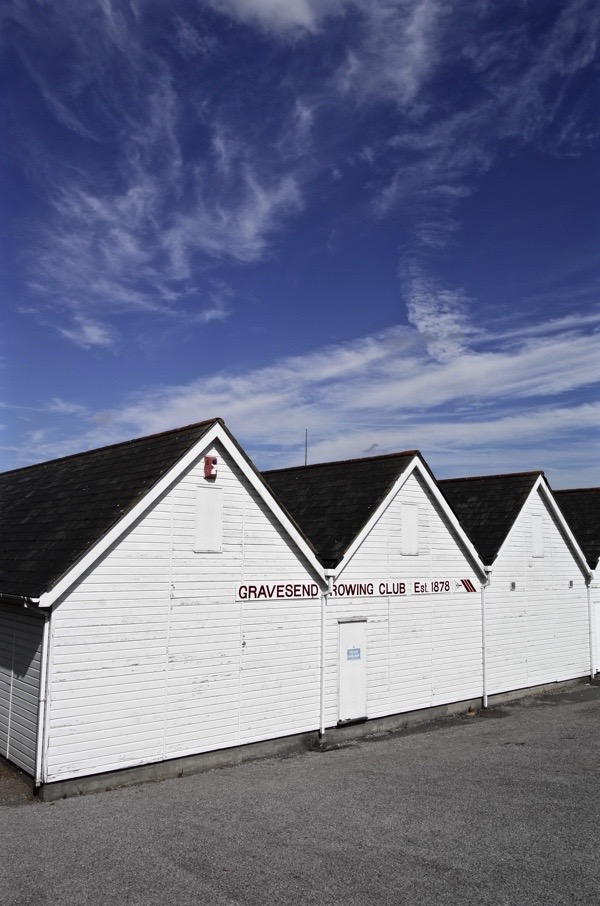
At Gravesend
CLICK TO DISCOVER THE GENTLE AUTHOR’S TOUR OF SPITALFIELDS

There is an undeniable romance about arriving by boat at a place you have never been before. This was how I arrived at Gravesend. Certainly, the vast terminal for cruise liners at Tilbury encourages a sense of expectation, even if your voyage is not across the ocean but simply over the Thames.
Yet as we approached Gravesend, it was a journey of a more melancholy nature that filled my mind. Since it was here that Pocahontas, one of the very first Americans to visit Europe, landed when illness forced her to abandon her return journey on March 21st 1617. The ship turned from its course before it left the Thames estuary and sought harbour at Gravesend where Pocahontas died just a few hours after coming ashore. Only twenty-one, she experienced much in her short life and left a young son, Thomas. He was taken back to London and completed her aborted journey home in adulthood, while his mother was buried at St George’s church, where today a handsome bronze figure embodies her presence to greet the pilgrims.
My arrival in Gravesend and a brisk walk up the steep High St were sufficient to displace these thoughts, replacing them with astonishment at the number of tattoo parlours and nail bars in such a small stretch of shops. Well-tended hanging baskets of flowers at every turn spoke eloquently of civic pride, while the many high quality buildings from earlier centuries evidenced the former wealth of Gravesend.
The appealing architectural vernacular of this shambolic medieval High St, interspersed by the Victorian grandeur of the Market Hall and the Carnegie Library, enticed me up the hill to the square where a group of senior Sikh gentlemen sat, happily passing the time of day and looking dapper in their turbans of multiple hues of blue.
Before long, hunger beckoned and I set off past Bawley Bay, where families once emigrated to the Antipodes, and St Andrew’s Mission church, built out over the water in 1871, and the Clarendon Royal Hotel, conceived as a palace for James II, and the Customs House of 1812, and the fourteenth century Milton Chantry, the oldest building in Gravesend, and the New Tavern Fort, constructed in expectation of an invasion by the French.
My point of arrival was the Promenade Cafe, an elegant thirties pavilion set back from the sea behind a wide lawn, thronging with customers, young and old, and everyone quite at home. This eastern stretch of Gravesend is where local residents, especially families, come to enjoy their leisure, offering paddling, feeding the swans, dog-walking and the quiet spectacle of passing traffic in the estuary. Among other hungry customers, I sat patiently at my table until a waiter should call out the number of my dinner ticket and deliver my plate of fish and chips.
‘Number Six!’ called the waiter, wielding a tray laden with two steaming fish dinners and inspiring everyone to turn their heads to see who was to be the lucky recipient. ‘Number Six?’ the waiter bawled at the top of his voice. Mystified by lack of any response, ‘Number Six?’ he queried, before returning inside shaking his head in disappointment. Puzzled glances passed between the dinners until a senior gentleman in a corner perked up. ‘Did he say Number Six?’ he asked, speaking his thoughts out loud. Observing nods of assent from neighbouring tables, he leapt to his feet clutching his ticket and hurried inside declaiming, ‘He didn’t speak loud enough, did he?’ and ‘What’s wrong with you, can’t you speak up?’
East of the promenade and over the canal, an atmosphere of extravagant post-industrial decay prevails. I walked for a mile along an overgrown narrow path between huge abandoned factories to emerge in a light industrial estate where small businesses still thrive, mostly in maritime related trades. At the very end, where the Higham Marshes begin sits the Ship & Lobster, occupying a position as the first and last pub on the Thames. Of significant history and in a breathtaking location, it was refreshing to encounter this friendly unpretentious local pub that serves the community of workers from the industrial estate, and has successfully evaded tourism or tarting up.
Before I returned to the ferry and the train back to Fenchurch St, I had one more landmark to discover. Sitting on the hill above Gravesend, the Guru Nanak Darbar Gurdwara Sikh Temple looks for all the world as if had been magically transported there by a genie from the Arabian Nights. Built entirely of gleaming white marble, on an equal scale to a European cathedral, this a compelling piece of architecture rendered even more remarkable by its unexpected location. Approaching through the elaborate gatehouse pavilion, I could not resist crossing the car park and walking right up to it – I should not have been surprised if it had vanished like a mirage.
A woman in long coloured robes hurried towards me. Immediately, I felt that I had trespassed and prepared my apology, but instead she welcomed me openly and invited me inside, explaining where I could find a cloth to cover my head and where I could leave my shoes if I wanted to attend a service. The interior of the temple with its enormous blue dome, lined with mosaic, and ceremonial staircase was no less impressive than the exterior. Yet the atmosphere was relaxed and I found myself reciprocating polite nods with worshippers passing in the hallway. My first foray into the world of the Sikhs.
The shadows were lengthening and my feet were sore when I climbed aboard Tilbury ferry at the end of a memorable excursion, crammed with wonders. I was enchanted by my day trip to Gravesend. Gravesend has so much to recommend it, I thought.

The Gravesend ferry ready to leave from Tilbury

Cruise ship at Tilbury seen from the Gravesend ferry

On the ferry

Looking back to Tilbury from Gravesend

Gravesend has the oldest cast iron pier in Britain

Arrival at Gravesend

St George’s where Pocahontas, one of the first Americans to visit Europe, is buried

Gravesend Market

Former manufacturers

Traditional Undertaker at Gravesend

Customs House


At the Promenade Cafe


Along Wharf Rd


In Mark Lane

The Ship & Lobster, the first and last pub on the Thames. Featured in Great Expectations, this pub was supposedly founded when Charles II and his brother James raced barges here.

Guru Nanak Darbar Gurdwara, Sikh Temple

Plan your trip at www.visitgravesend.co.uk
At Walton On the Naze
CLICK TO DISCOVER THE GENTLE AUTHOR’S TOUR OF SPITALFIELDS

All this time, Walton on the Naze has been awaiting me, nestling like a forgotten jewel cast up on the Essex coast, and less than an hour and a half from Liverpool St Station.
Families with buckets and spades joined the train at every stop, as we made our way eastwards to the point where Essex crumbles into the North Sea at the rate of two metres a year. Yet all this erosion, while reminding us of the force of the mighty elements, also delivers a perfect sandy beach – the colour of Cheddar cheese – that is ideal for sand castles and digging. Stepping from the small train amongst the flurry of pushchairs and picnic bags, at once the sea air transports you and the hazy resort atmosphere enfolds you. Unable to contain yourself, you hurry through the sparse streets of peeling nineteenth century villas and shabby weather-boarded cottages to arrive at a rise overlooking Britain’s third longest pier, begun in 1830.
In spite of the majestic pier, this is a seaside resort on a domestic scale. You will not find any foreign tourists here because Walton on the Naze is a closely guarded secret, it is kept by the good people of Essex for their sole use. At Walton on the Naze everyone is local. You see Essex families running around as if they owned the place, playing upon the beach in flagrant carefree abandon, as if it were their own back yard – which, in a sense, it is.
This sense of ownership is manifest in the culture of the beach huts that line the seafront, layers deep, in higgledy-piggledy terraces receding from the shore. These little wooden sheds are ideal for everyone to indulge their play house and dolls’ house fantasies – painting them in fanciful colours, giving them names like “Ava Rest,” and furnishing the interiors with gas cookers and garish curtains. At the seaside, all are licenced to pursue the fulfilment of residual childhood yearning in harmless whimsy. The seaside offers a place charged with potent emotional memory that we can return to each Summer. It is not simply that people get nostalgic for seaside resorts, but that these seasonal towns become the location of nostalgia itself – because the sea never changes and we revisit our former selves when we come back to the beach.
Walton Pier curls to one side like a great tongue taking a greedy lick from an ocean of ice cream, and the beach curves away in a crooked smile that leads your eye to the “Naze,” or “nose” to give its modern spelling. This vast bulbous proboscis extends from the profile of Essex as if from a patient in need of plastic surgery, provided in the form of relentless abrasion from the sea.
With so many attractions, the first thing to do is to sit down at the tables upon the beach outside Sunray’s Kiosk which serves the best fish & chips in Walton on the Naze. Every single order is battered and cooked separately in this tiny establishment, that also sells paper flags for sandcastles and shrimping nets and all essential beach paraphernalia. From here a path leads past a long parade of beach huts permitting you the opportunity to spy upon these domestic theatres, each with their proud owners lounging outside while their children run back and forth, vacillating between their haven of security and the irresistible wonder of the waves crashing at the shoreline.
Here I joined some girls, excitedly fishing for crabs with hooks and lines off a small jetty. They all screamed when one pulled out a much larger specimen than the tiddlers they had in their buckets, only to be reassured by the woman who was overseeing their endeavour. “Don’t be frightened – it’s just the Mummy!” she declared with a wicked smile, as she held up the struggling creature by a claw. From this jetty, I could see the eighty foot tower built upon the Naze in 1720 as a marker for ships entering the port of Harwich and after a gentle climb up a cliff path, and a strenuous ascent up a spiral staircase, I reached the top. Like a fly perched upon the nose of Essex, I could look North across the estuary of the Orwell towards Suffolk on the far shore and South to the Thames estuary with Kent beyond – while inland I could see the maze of inlets, appealingly known as the Twizzle.
I was blessed with a clear day of sunshine for my holiday. And I returned to the narrow streets of Spitalfields for another year with my skin flushed and buffeted by the elements – grateful to have experienced again the thrall of the shoreline, where the land runs out and the great ocean begins.


Sunray’s Kiosk on the beach, for the best fish & chips in Walton on the Naze.


“On this promontory is a new sea mark, erected by the Trinity-House men, and at the publick expence, being a round brick tower, near eighty foot high. The sea gains so much upon the land here, by the continual winds at S.W. that within the memory of some of the inhabitants there, they have lost above thirty acres of land in one place.” Daniel Defoe, 1722


You may like to read about the Gentle Author’s previous holidays
A Walk Along The Ridgeway
While the Gentle Author takes a holiday, we are celebrating the joys of the season with a HARVEST SALE, selling all our books at half price so you can treat yourself and your friends and family. Simply add code ‘HARVEST’ at checkout to claim your discount.
CLICK HERE TO VISIT THE SPITALFIELDS LIFE BOOKSHOP

They say it is the oldest road in Britain, maybe the oldest in Europe. Starting from the highest navigable point of the Thames in prehistoric times, the Ridgeway follows the hilltops to arrive at Salisbury Plain where once wild cattle and horses roamed. When the valleys were forested and impenetrable, the Ridgeway offered a natural route over the downland and into the heart of this island. Centuries of cattle driving wore a trackway that curved across the hillside, traversing the contours of the landscape and unravelling like a ribbon towards the horizon.
Over thousands of years, the Ridgeway became a trading route extending from coast to coast, as far as Lyme Regis in the west and the Wash in the east, with fortresses and monuments along the way. Yet once the valleys became accessible it was defunct, replaced by the Icknield Way – a lower level path that skirted the foot of the hills – and there are burial mounds which traverse the Ridgeway dated to 2000BC, indicating that the highway was no longer in use by then.
In fact, this obsolescence preserved the Ridgeway because it was never incorporated into the modern road network and remains a green path to this day where anyone can set out and walk in the footsteps of our earliest predecessors in this land. Leaving Spitalfields early and taking the hour’s rail journey to Goring & Streatley from Paddington, I was ascending the hill from the river by eleven and onto the upland by midday. In this section, the flinty path of the Ridgeway is bordered with deep hedges of hawthorn, blackthorn and hazel, giving way to the open downland rich with the pink and blue flowers of late summer, knapweed, scabious and harebells.
A quarter of a century has passed since I first passed this way and yet nothing has changed up there. It is the same huge sky and expansive grassy plain undulating into the distance with barely a building in sight. This landscape dwarfs the human figure, inducing a sense of exhilaration at the dramatic effects of light and cloud, sending patterns travelling fast across the vast grassy wind-blown hills. When I first began to write and London grew claustrophobic, I often undertook this walk through the different seasons of the year. I discovered that the sheer exertion of walking all day, buffeted upon the hilltops and sometimes marching doggedly through driving rain, never failed to clear my mind.
As a consequence, the shape of the journey is graven into memory even though, returning eighteen years since my last visit, the landscape was greater than I had fashioned it in recollection. And this is the quality that fascinates me about such epic terrain, which the mind cannot satisfactorily contain and thus each return offers a renewed acquaintance of wonder at the scale and majesty of the natural world.
In those days, I was in thrall to endurance walking and I would continue until I could go no further, either because of exhaustion or nightfall. This vast elevated downland landscape encouraged such excessive behaviour, leading me on and on along the empty path to discover what lay over the brow and engendering a giddy sense of falling forward, walking through the sky – as if you might take flight. I walked until I thought I could walk no more and then I carried on walking until walking became automatic, like breathing. In this state my body was propelled forward of its own volition and my mind was free.
One day’s walk brings you to Uffington and the famous White Horse, carved into the chalk of the downland. Placed perfectly upon the crest of a ridge within a vast fold of the hills, this sparsely drawn Neolithic figure looks out across the arable farmland of Oxfordshire beyond and can be seen for great distances. A mystery now, a representation that may once have been a symbol for a people lost in time, it retains a primeval charisma, and there is such an intensity of delight to reach this figure at the end of a day’s walking. Breathless and weary of limbs, I stumbled over the hill to sit there alone upon the back of the hundred foot White Horse at dusk, before descending to the village of Bishopstone for the night. There, at Prebendal Farm, Jo Selbourne offers a generous welcome and, as well as the usual bed and breakfast, will show you the exquisitely smoothed ceremonial Neolithic axe head found upon the farm.
The second day’s walk leads through the earthen ramparts of Liddington Hill and Barbary Castle, and on either side of the path the fields are punctuated by clumps of trees indicating the myriad ancient burial mounds scattered upon this bare Wiltshire scenery. It is a more expansive land than the fields of Berkshire where I began my journey, here the interventions made in ancient times still hold their own and the evidence of the modernity is sparser. As I made the final descent from the hill towards Avebury, a village within a massive earthwork and stone circle which was the culmination of my journey, I could not resist the feeling that it was all there for me and I had earned it by walking along the old path which for thousands of years had brought people to arrive at this enigmatic location of pilgrimage.
In two days upon the hilltops I had only passed a dozen lone walkers, and now the crowds, the coach parties, the shops and the traffic were a startling sight to behold. And so I knew my journey had fulfilled its purpose – to reacquaint me freshly with the familiar world and restore a sense of proportion. My feet were sore and my face was flushed by the sun. I began my journey in August and ended it in September. In Berkshire, the ripe fields of corn were standing, in Oxfordshire, they were being harvested and, in Wiltshire, I saw the stubble being ploughed in. It had been a walk to arrive at the end of the summer. It had been a walk through time along the oldest road.

Goring Mill

“Join it at Streatley, the point where it crosses the Thames, at once it strikes you out and away from the habitable world in a splendid purposeful manner, running along the highest ridge of the downs.” Kenneth Grahame, 1898

A ninety-two year old man told me this year is the worst harvest he could remember. “It doesn’t want to come in the barn,” he lamented.


At East Illsley

“A broad green track runs for many a long mile across the downs, now following the ridges, now winding past at the foot of a grassy slope, then stretching away through cornfield and fallow.” Richard Jefferies, 1879

“A rough way, now wide, now narrow, among the hazel, brier and nettle. Sometimes there was an ash in the hedge and once a line of spindly elms followed it round in a curve.” Edward Thomas, 1910

On White Horse Hill

“The White Horse is, I believe, the earliest hill drawing we have in England. It is a piece of design, in another category from the other chalk figures, for it has the lineaments of a work of art. The horse, which is more of a dragon than a horse, is cut on the top of the down’s crest, so that it can only be seen completely from the air, or at a long view, from the surrounding country – but it was precisely this aspect of the Horse design that I found so significant.” Paul Nash, 1938

The Neolithic axe head found at Prebendal Farm, photo by Rob Selbourne.

At Bishopstone


At Barbary Castle


“The origin of the track goes back into the dimmest antiquity: there is evidence that it was a military road when the fierce Dane carried fire and slaughter inland, leaving his nailed bark in the creeks of the rivers, and before that when the Saxons pushed up from the sea. The eagles of old Rome were, perhaps, borne along it and yet earlier the chariots of the Britons may have used it – traces of all have been found: so that for fifteen centuries this track of primitive peoples has maintained its existence through the strange changes of the times, til now in the season the cumbrous steam ploughing engines jolt and strain and pant over the uneven turf.” Richard Jefferies, 1879

Since the man suspected of making crop circles died, his protege has adopted a different style of design.

At Avebury

At Avebury


