
Vivian Betts Of The Primrose

Vivian & Toto outside The Primrose
You will not meet many who can boast the distinction of being brought up on the teeming thoroughfare of Bishopsgate but Vivian Betts is one who enjoyed that rare privilege, growing up above The Primrose on the corner of Primrose St where her parents were publicans from 1955 until 1974. Yet it was a different Bishopsgate from that of the present day with its soaring glass towers housing financial industries. In her childhood, Vivian knew a street lined with pubs and individual shops where the lamplighter came each night to light the gas lamps.
Living in a pub on the boundary of the City of London, Vivian discovered herself at a hub of human activity. “I had the best of both worlds,” Vivian confessed to me, when she came up to Spitalfields on a rare visit, “I had the choice of City life or East End life, I could go either way. I had complete freedom and I was never in any danger. My father said to me if I ever had any trouble to go to a policeman. But all my friends wanted to come over to my place, because I lived in a pub!”
Vivian knew Bishopsgate before the Broadgate development swallowed up the entire block between Liverpool St and Primrose St. And as we walked together past the uniform architecture, she affectionately ticked off the order of the pubs that once stood there – The Kings Arms, The Raven and then The Primrose – with all the different premises in between. When we reached the windswept corner of Primrose St beneath the vast Broadgate Tower, Vivian gestured to the empty space where The Primrose once stood, now swallowed by road widening, and told me that she remembered the dray horses delivering the beer in barrels on carts from the Truman Brewery in Brick Lane.
In this landscape of concrete, glass and steel, configured as the environment of aggressive corporate endeavour, it was surreal yet heartening to hear Vivian speak and be reminded that human life once existed there on a modest domestic scale. Demolished finally in 1987, The Primrose had existed in Bishopsgate at least since 1839.
“My brother Michael was born in 1942, while Bill my father was away in the war, and Violet my mother got a job as a barmaid, and when he came back she said, ‘This is how I want to spend my life.’ Their first pub was The Alfred’s Head in Gold St, Stepney, in about 1946, and she told me she was washing the floor there in the morning and I was born in the afternoon. We left when I was three and all I remember of Stepney was walking over a bomb site to look at all the caterpillars.
In 1955, we moved into The Primrose at 229 Bishopsgate, directly opposite the Spitalfields market – you could look out of the window on the first floor and see the market. My first memory of Bishopsgate was lying in bed and listening to the piano player in the pub below. We had three pianos, one in the public bar, one in the first floor function room and one in our front room. On Sunday lunchtimes at The Primrose, it was so busy you could hardly see through the barroom for all the hats and smoke.
I used to go to Canon Barnet School in Commercial St and, from the age of seven, my dad would see me across Bishopsgate and I’d walk through the Spitalfields Market on my way to school where the traders would give me an apple and a banana – they all knew me because they used to come drinking in the pub. It was a completely Jewish school and, because no-one else lived in Bishopsgate, all my friends were over in Spitalfields, mostly in the Flower & Dean Buildings, so I spent a lot of time over there. And I used to come to Brick Lane to go the matinees at the cinema every Saturday. Itchy Park was our playground – in those days, the church was shut but we used to peek through the window and see hundreds of pigeons inside.
My dad opened one of the first carveries in a pub, where you could get fresh ham or turkey cut and made up into sandwiches and, in the upstairs room, my mum did sit-down lunches for three shillings – it was like school dinners, steak & kidney pudding and sausage & mash. She walked every day with her trolley to Dewhurst’s the butchers opposite Liverpool St, she got all her fruit and vegetables fresh from the Spitalfields Market, and she used to go to Petticoat Lane each week to buy fresh fish.
Every evening at 5pm, we had all the banks come in to play darts. On Mondays, it was the ladies of The Primrose darts team and on Wednesdays it was the men’s darts league. And, once each year, we organised the Presentation Dance at the York Hall. Every evening in the upstairs function room, we had the different Freemason’s lodges. Whenever I came out of my living room, I could always see them but I had to look away because it was part of my life that I wasn’t supposed to see. After I left school, I went to work for the Royal London Mutual Insurance Co. in Finsbury Sq – five minutes walk away – as a punchcard operator and, whenever it was anyone’s birthday, I’d say ‘Come on back to my mum’s pub and she’ll make us all sandwiches.’
Then in 1973, Truman’s wrote to my dad and gave him a year’s notice, they were turning the pub over to managers in April 1974, so we had to leave. But I had already booked my wedding for July at St Botolph’s in Bishopsgate, and I came back for that. Eighteen months later, in 1976, my mum and dad asked me and my husband to go into running a pub with them. It was The Alexandra Hotel in Southend, known as the “Top Alex” because there were two and ours was at the top of the hill.
Three months after we moved in, my dad died of cancer – so they gave it to my mum on a year’s widow’s lease but they said that if me and my husband proved we could run it, we could keep it. And we stayed until 1985. Then we had a murder and an attempted murder in which a man got stabbed, and my husband said, ‘It’s about time we moved.’ And that’s when we moved to our current pub, The Windmill at Hoo, near Rochester, twenty-eight years ago. We had a brass bell hanging behind the counter at The Primrose that came off a train in Liverpool St Station which we used to call time and we’ve taken it with us – all these years – but though we don’t call time any more, we still use it to ring in the New Year.
I’ve only ever had two Christmases not in a pub in my life, when you’re born to it you don’t know anything else.”
Vivian told me that she often gets customers from the East End in The Windmill and they always recognise her by her voice. “They say, ‘We know where you come from!'” she confided to me proudly.

The Primrose, 229 Bishopsgate, as Vivian knew it.

Toto sits on the heater in the panelled barroom at The Primrose.

Vivian at Canon Barnet School in Commercial St.

Bill and Vi Betts

“My first Freemason’s Lodge night when I was twelve or thirteen in 1965. My brother Michael with his wife Valerie on the right.”

Vivian stands outside The Primrose in this picture, looking east across Bishopsgate towards Spital Sq with Spitalfields market in the distance.

Vivian was awarded this certificate while a student at Sir John Cass School, Houndsditch.

Vivian on the railway bridge, looking west towards Finsbury Sq.
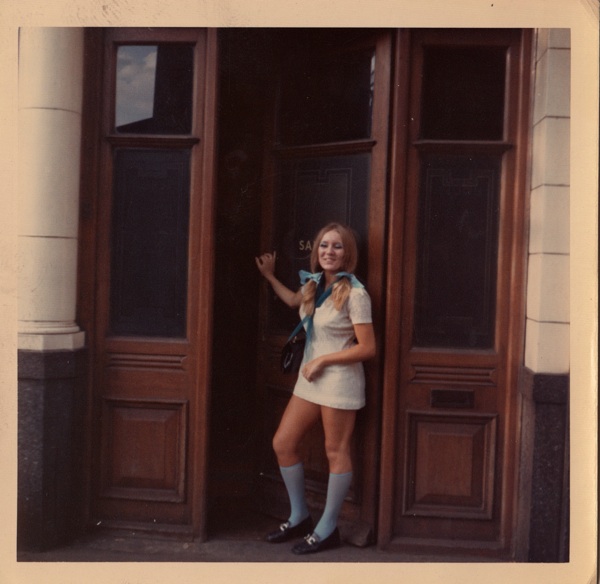
Vivian outside the door which served as the door to the pub and her own front door.

Vivian’s friends skylarking in Bishopsgate – “They always wanted to come over to my place because I lived above a pub!”

“When I was eight, we went abroad on holiday for the first time to Italy, we bought the tickets at the travel agents across the road and, after that, twelve or fourteen couples would come with us – my parents’ friends – and I was always the youngest there.”

Vivian prints out a policy at the Royal London Mutual Insurance Co. in Finsbury Sq.

“And what do you do?” – Vivian meets Prince Charles on a visit to Lloyd Register of Shipping in Fenchurch St.

“Harry the greengrocer and Tom the horse, they used to get their fruit & vegetables in the Spitalfields Market. My husband Dennis worked for this man when he was about twelve years of age, driving around the Isle of Dogs. He loved horses, and we’ve got a piece of land with our pub now and we’ve kept horses since 1980.”

Bill & Vi Betts in later years.
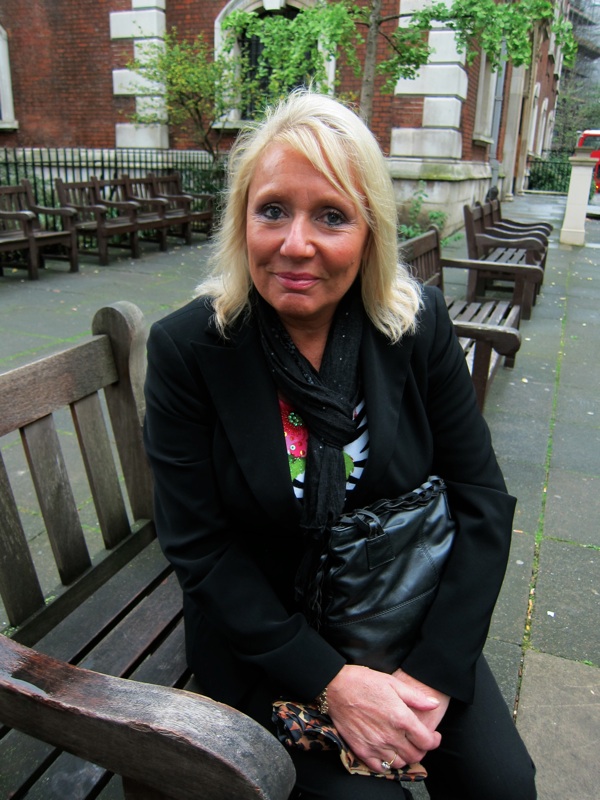
Vivian Betts at St Botolph’s Bishopsgate where she married her husband Dennis Campbell in 1974.

The Primrose in a former incarnation, photographed in 1912.

Bishopsgate with The Primrose halfway down on the right, photographed in 1912 by Charles Goss.
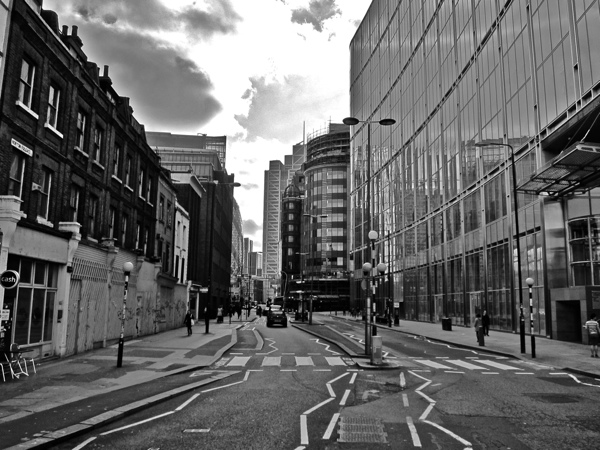
Bishopsgate today.
Archive photographs courtesy Bishopsgate Institute
You might also like to take a look at these other Bishopsgate Stories
The Romance of Old Bishopsgate
A Dead Man In Clerkenwell
At Halloween, it suits my mood to contemplate the dead man in the crypt in Clerkenwell

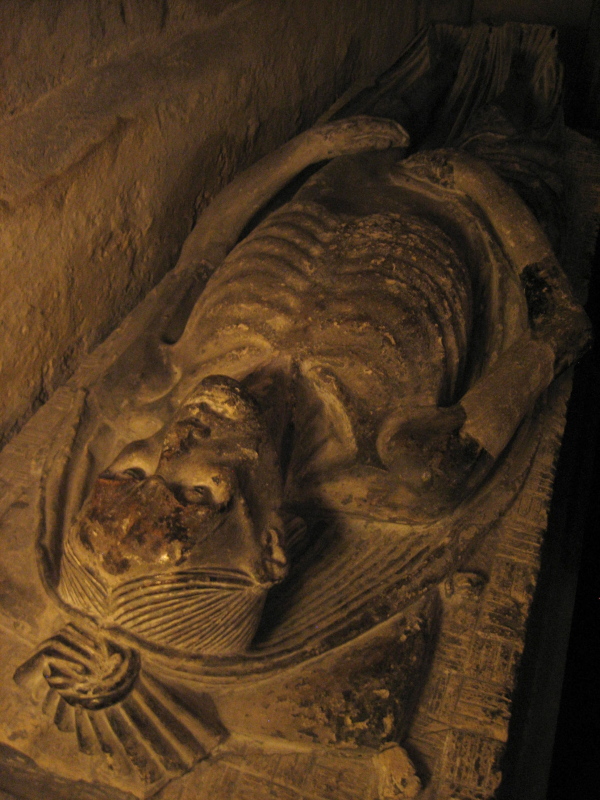
This is the face of the dead man in Clerkenwell. He does not look perturbed by the change in the weather. Once winters wore him out, but now he rests beneath the streets of the modern city he will never see, oblivious both to the weather and the wonders of our age, entirely oblivious to everything in fact.
Let me admit, although some might consider it poor company, I consider death to be my friend – because without mortality our time upon this earth would be worthless. So I do not fear death, but rather I hope I shall have enough life first. My fear is that death might come too soon or unexpectedly in some pernicious form. In this respect, I envy my father who always took a nap on the sofa each Sunday after gardening and one day at the age of seventy nine – when he had completed trimming the privet hedge – he never woke up again.
It was many years ago that I first made the acquaintance of the dead man in Clerkenwell, when I had an office in the Close where I used to go each day and write. I was fascinated to discover a twelfth century crypt in the heart of London, the oldest remnant of the medieval priory of the Knights of St John that once stood in Clerkenwell until it was destroyed by Henry VIII, and it was this memento mori, a sixteenth century stone figure of an emaciated corpse, which embodied the spirit of the place for me.
Thanks to Pamela Willis, curator at the Museum of the Order of St John, I went back to look up my old friend after all these years. She lent me her key and, leaving the bright October sunshine behind me, I let myself into the crypt, switching on the lights and walking to the furthest underground recess of the building where the dead man was waiting. I walked up to the tomb where he lay and cast my eyes upon him, recumbent with his shroud gathered across his groin to protect a modesty that was no longer required. He did not remonstrate with me for letting twenty years go by. He did not even look surprised. He did not appear to recognise me at all. Yet he looked different than before, because I had changed, and it was the transformative events of the intervening years that had awakened my curiosity to return.
There is a veracity in this sculpture which I could not recognise upon my previous visit, when – in my innocence – I had never seen a dead person. Standing over the figure this time, as if at a bedside, I observed the distended limbs, the sunken eyes and the tilt of the head that are distinctive to the dead. When my mother lost her mental and then her physical faculties too, I continued to feed her until she could no longer even swallow liquid, becoming as emaciated as the stone figure before me. It was at dusk on the 31st December that I came into her room and discovered her inanimate, recognising that through some inexplicable prescience the life had gone from her at the ending of the year. I understood the literal meaning of “remains,” because everything distinctive of the living person had departed to leave mere skin and bone. And I know now that the sculptor who made this effigy had seen that too, because his observation of the dead is apparent in his work, even if the bizarre number of ribs in his figure bears no relation to human anatomy.
There is a polished area on the brow, upon which I instinctively placed my hand, where my predecessors over the past five centuries had worn it smooth. This gesture, which you make as if to check his temperature, is an unconscious blessing in recognition of the commonality we share with the dead who have gone before us and whose ranks we shall all join eventually. The paradox of this sculpture is that because it is a man-made artifact it has emotional presence, whereas the actual dead have only absence. It is the tender details – the hair carefully pulled back behind the ears, and the protective arms with their workmanlike repairs – that endear me to this soulful relic.
Time has not been kind to this figure, which originally lay upon the elaborate tomb of Sir William Weston inside the old church of St James Clerkenwell, until the edifice was demolished and the current church was built in the eighteenth century, when the effigy was resigned to this crypt like an old pram slung in the cellar. Today a modern facade reveals no hint of what lies below ground. Sir William Weston, the last Prior, died in April 1540 on the day that Henry VIII issued the instruction to dissolve the Order, and the nature of his death was unrecorded. Thus, my friend the dead man is loss incarnate – the damaged relic of the tomb of the last Prior of the monastery destroyed five hundred years ago – yet he still has his human dignity and he speaks to me.
Walking back from Clerkenwell, through the City to Spitalfields on this bright afternoon in late October, I recognised a similar instinct as I did after my mother’s death. I cooked myself a meal because I craved the familiar task and the event of the day renewed my desire to live more life.




The Museum of the Order of St John, St John’s Gate, Clerkenwell, EC1M 4DA
Luke Clennell’s Dance of Death
Twenty years have passed since my father died at this time of year and thoughts of mortality always enter my mind as the nights begin to draw in, as I prepare to face the spiritual challenge of another long dark winter ahead. So Luke Clennell’s splendid DANCE OF DEATH engravings inspired by Hans Holbein suit my mordant sensibility at this season.
First published in 1825 as the work of ‘Mr Bewick’, they have recently been identified for me as the work of Thomas Bewick’s apprentice Luke Clennell by historian Dr Ruth Richardson.
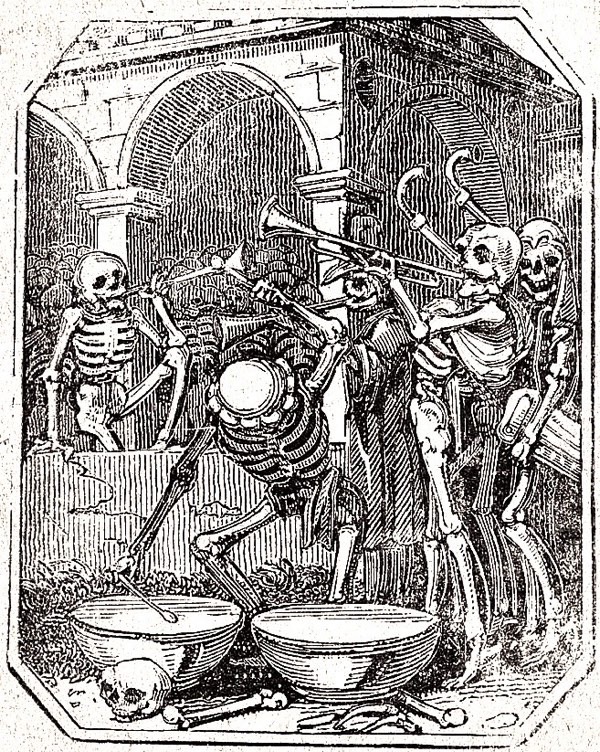
The Desolation
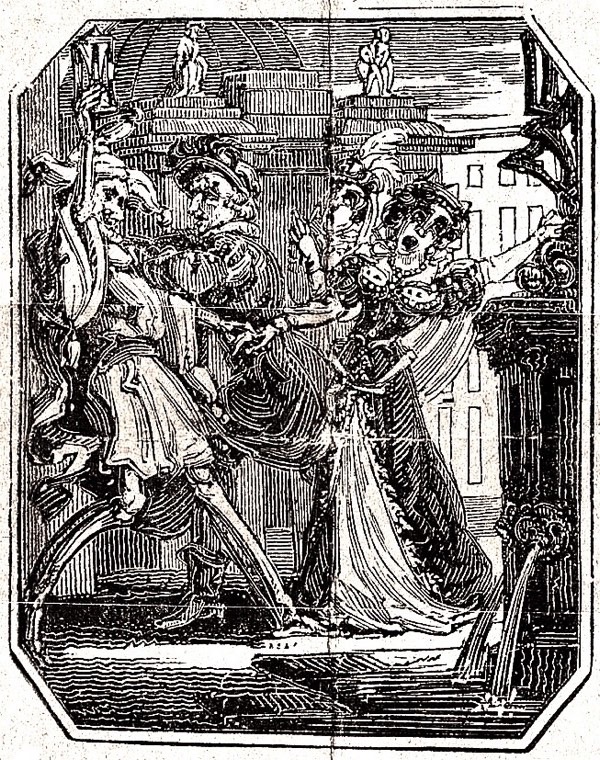
The Queen
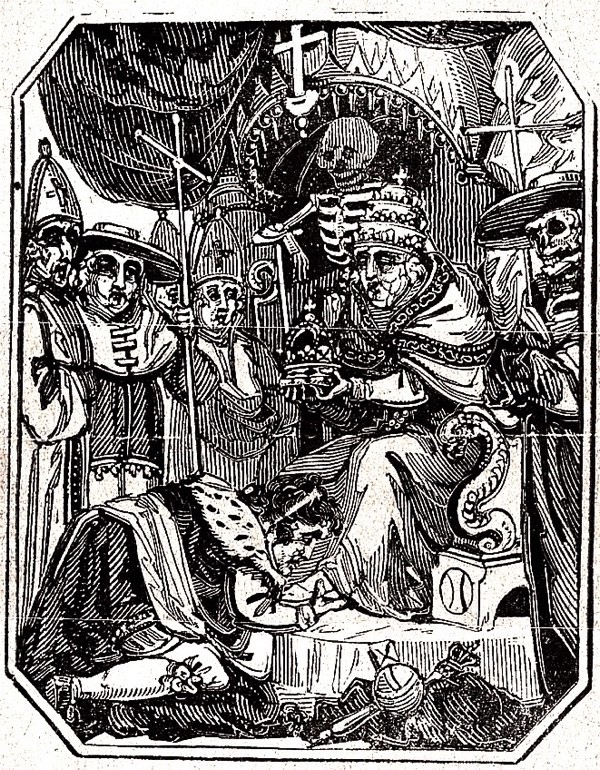 The Pope
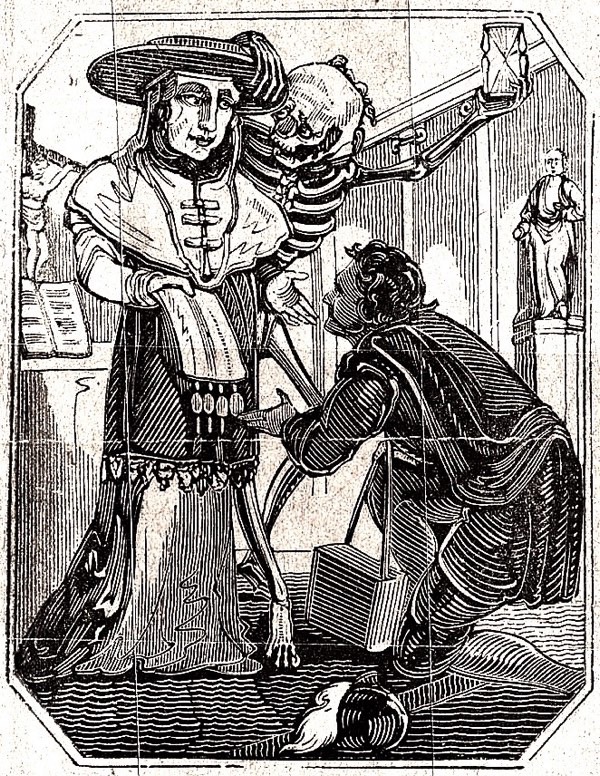
The Cardinal
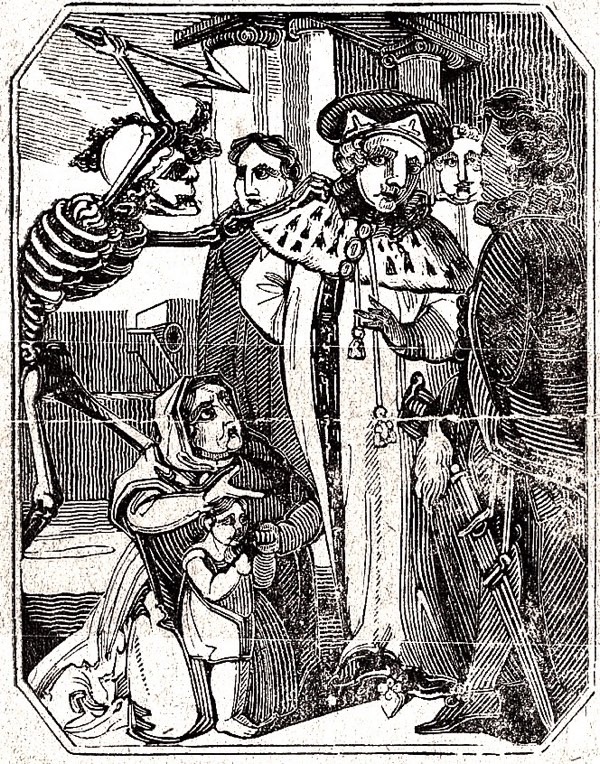
The Elector
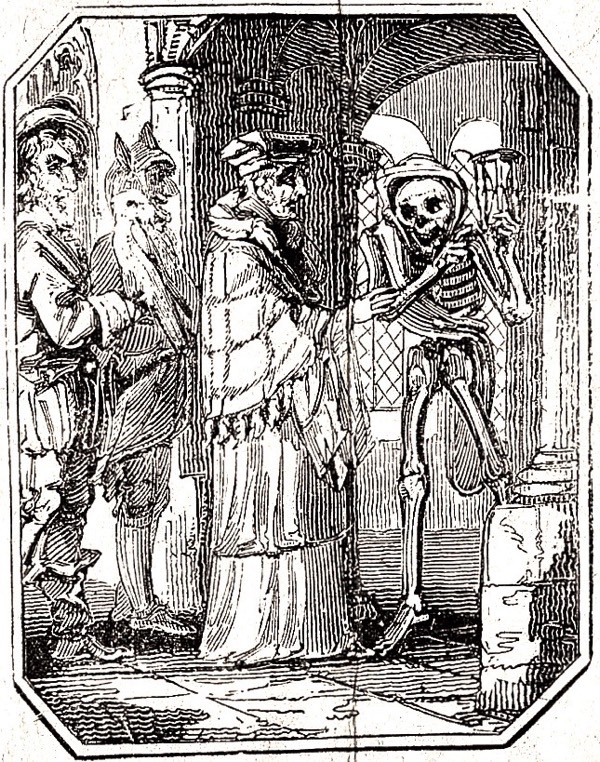
The Canon
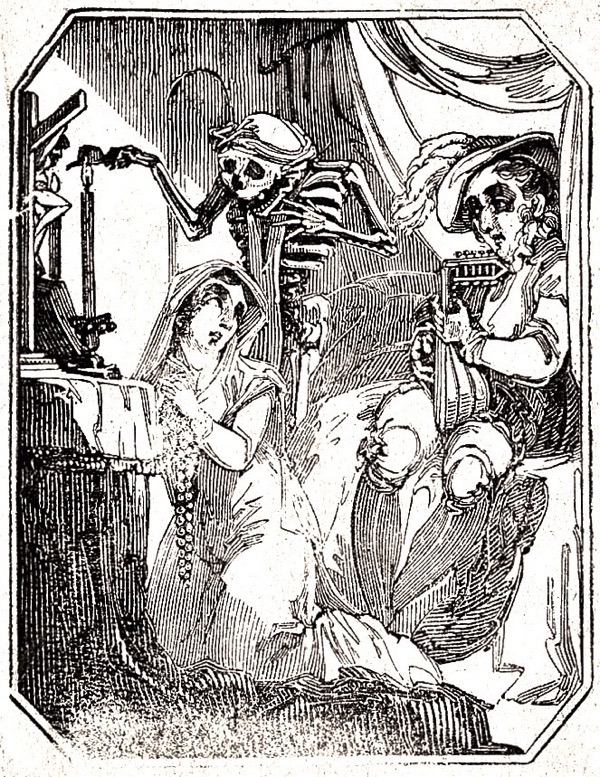
The Canoness
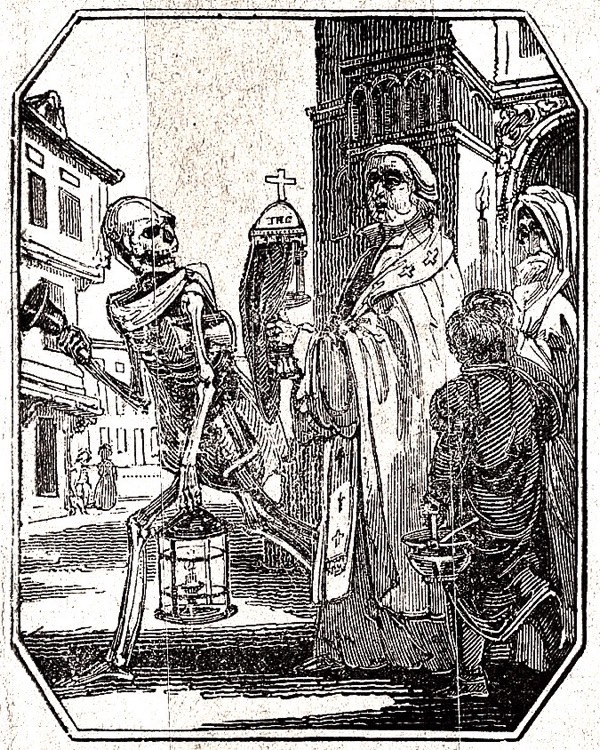
The Priest
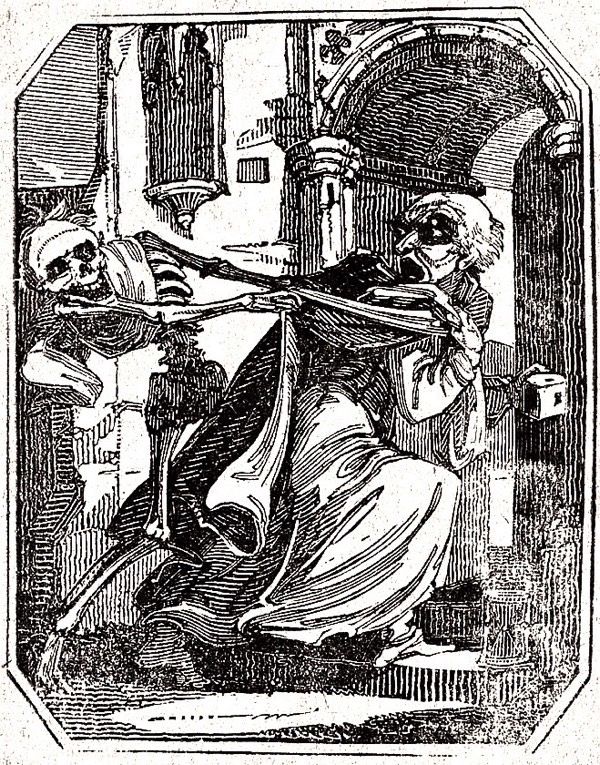
The Mendicant Friar
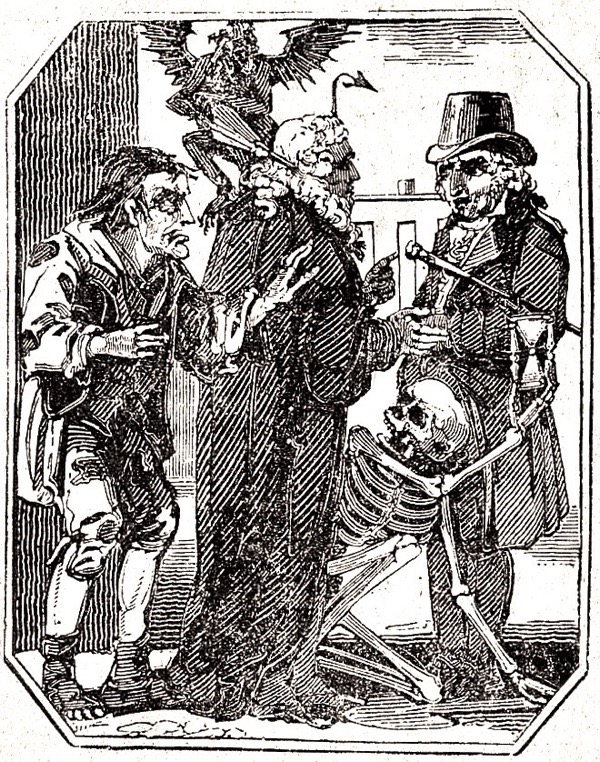 The Councillor or Magistrate
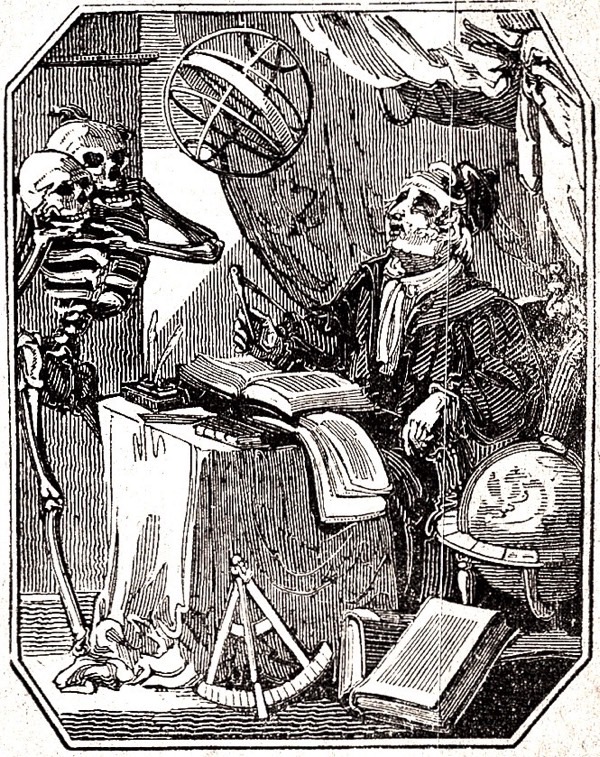
The Astrologer
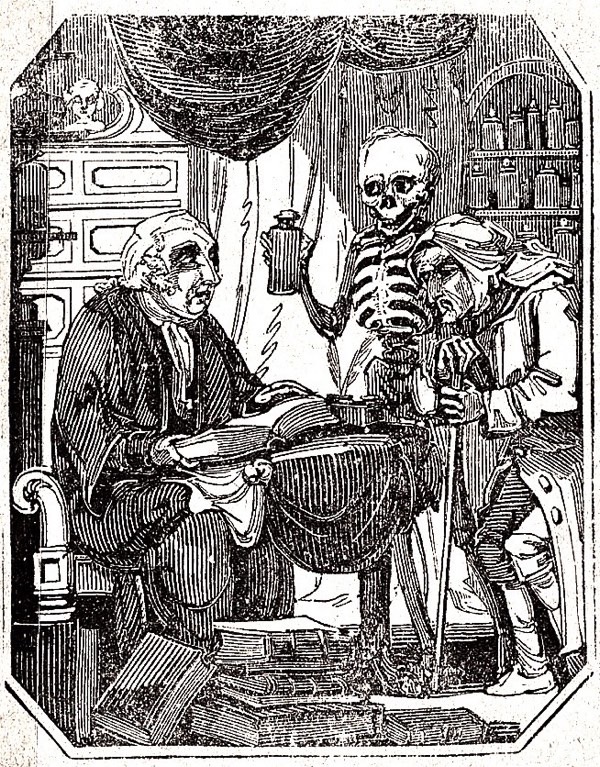
The Physician
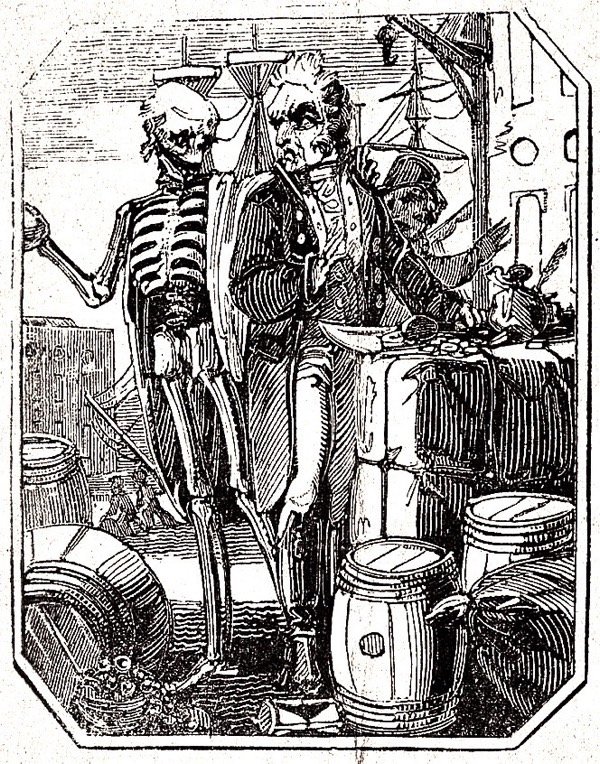
The Merchant
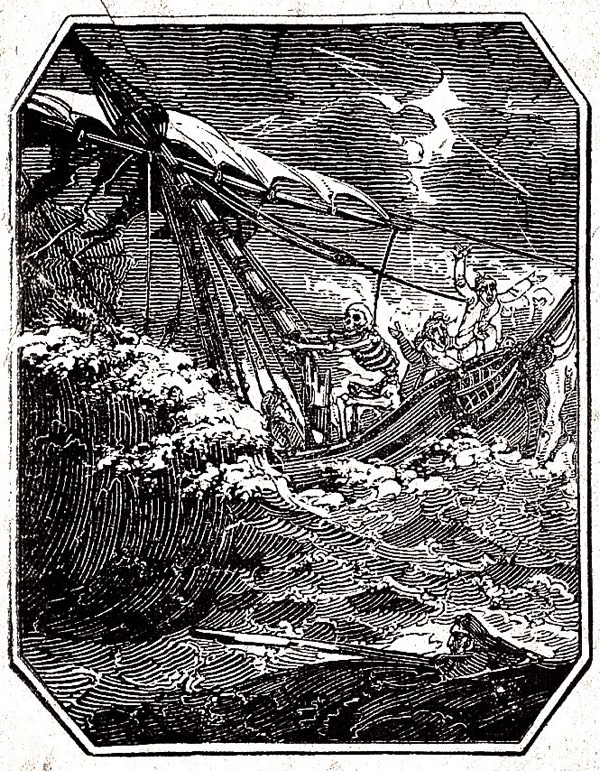
The Wreck
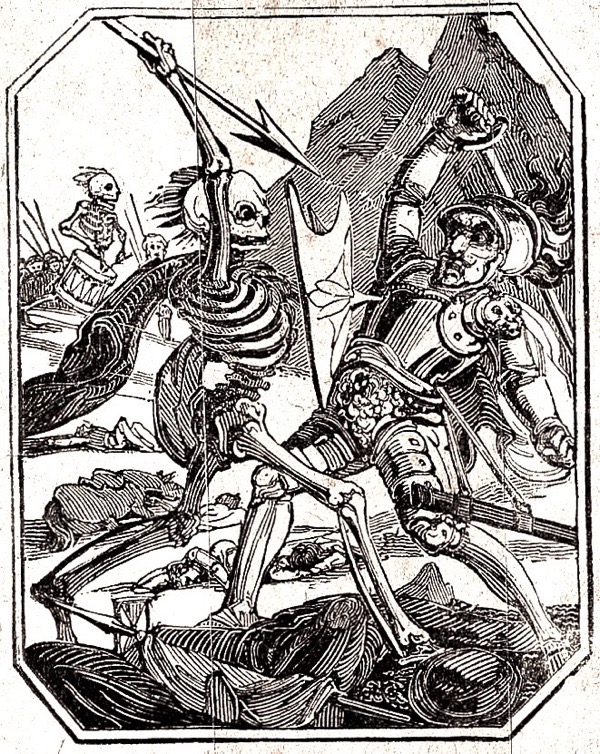
The Swiss Soldier
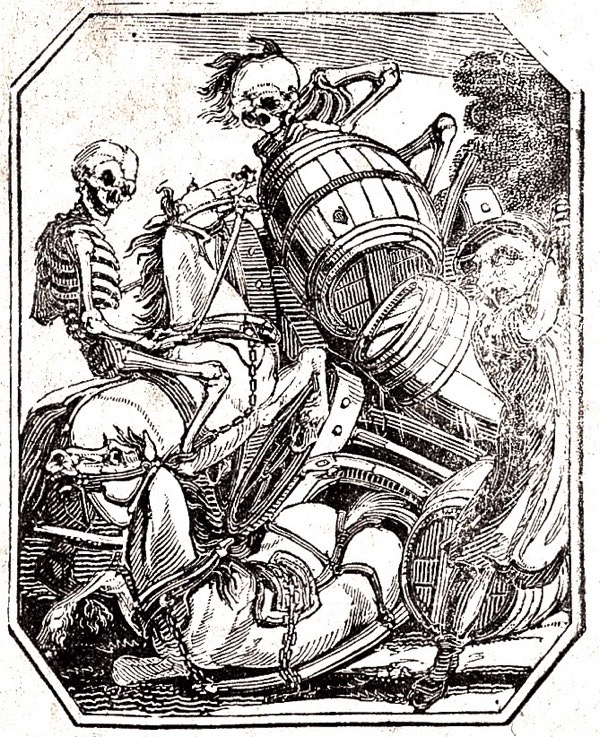
The Charioteer or Waggoner
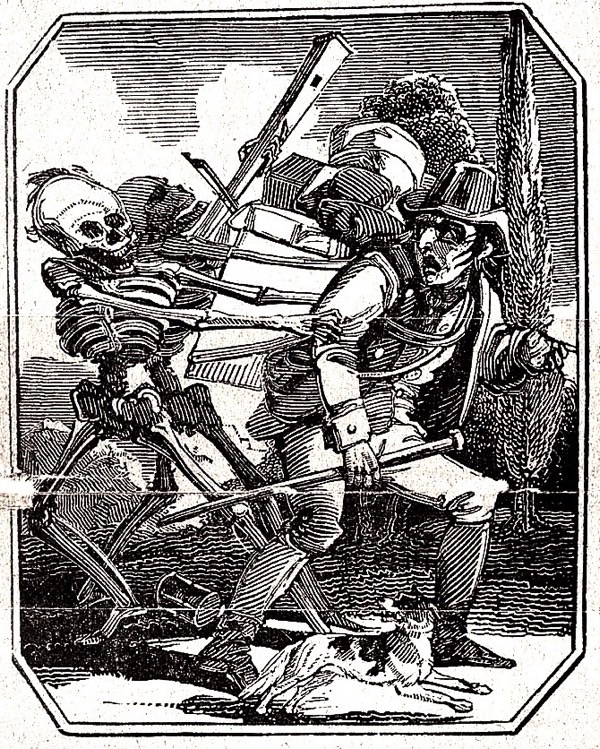 The Porter
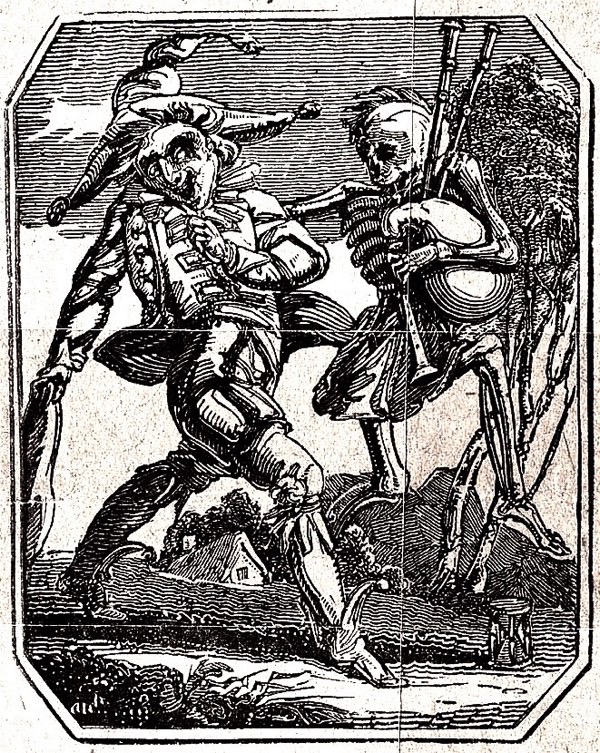
The Fool
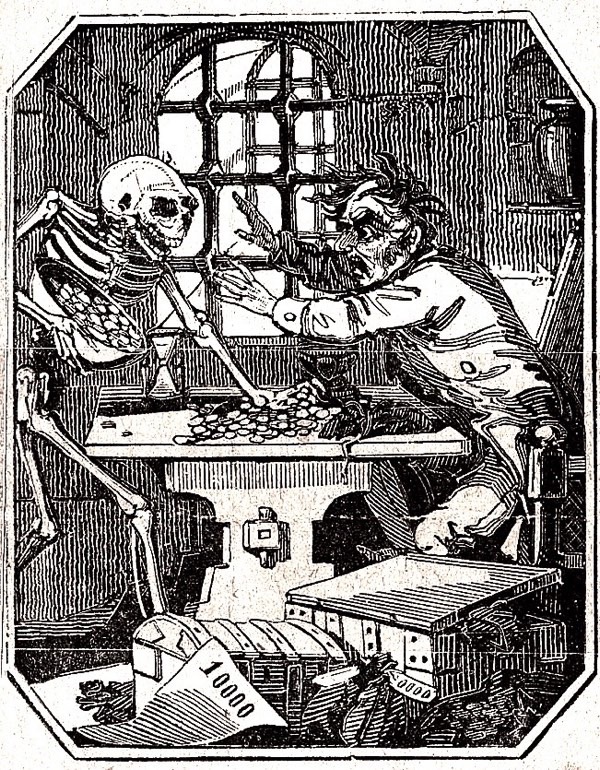 The Miser
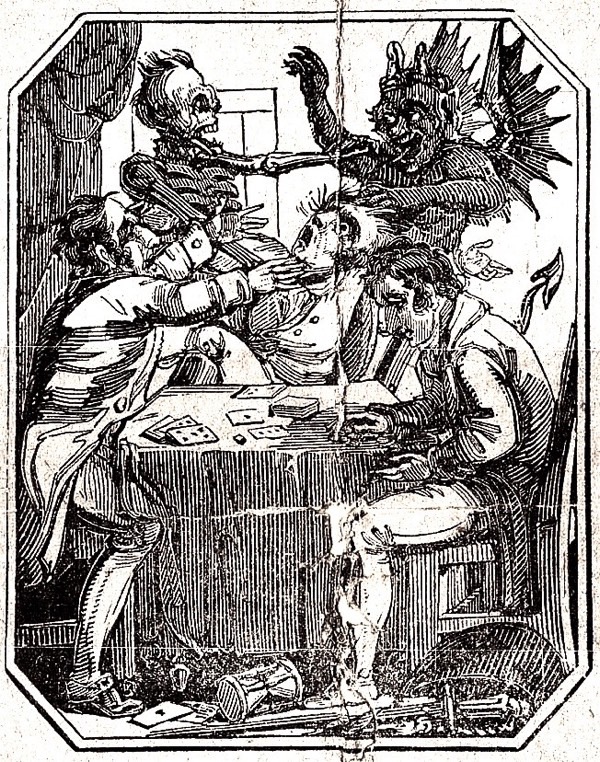 The Gamesters
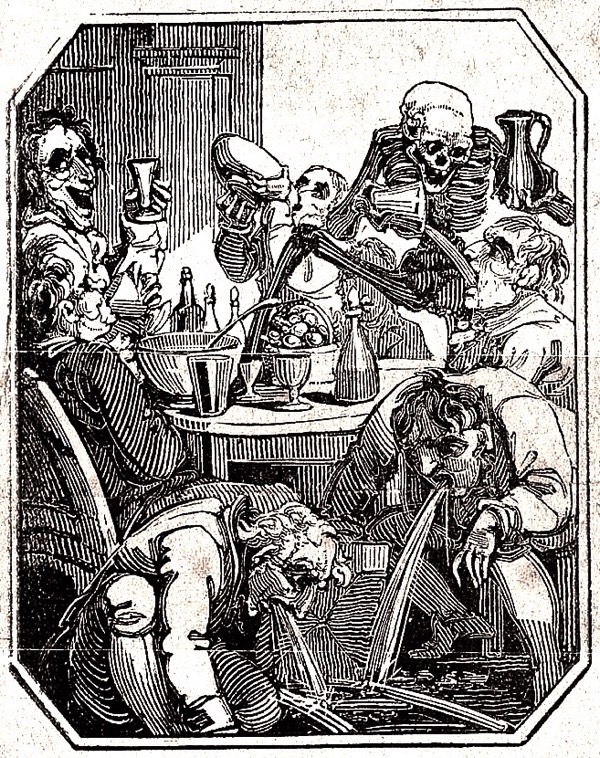
The Drunkards
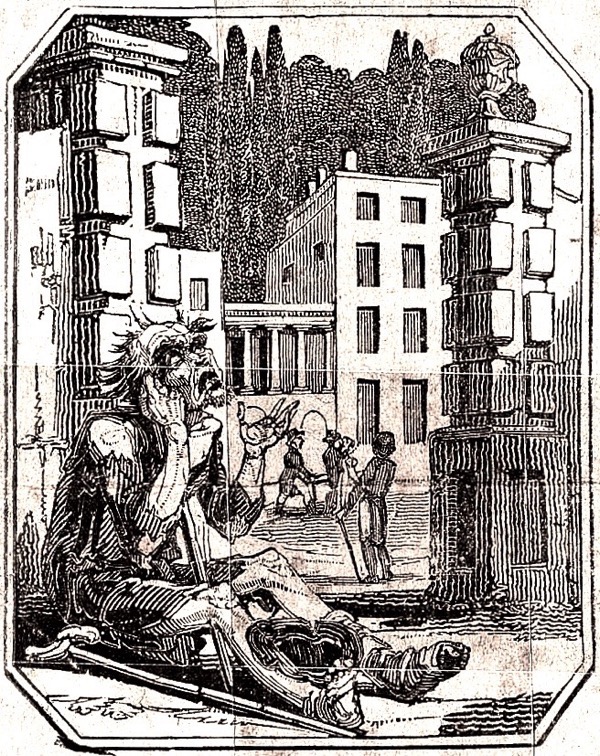
The Beggar
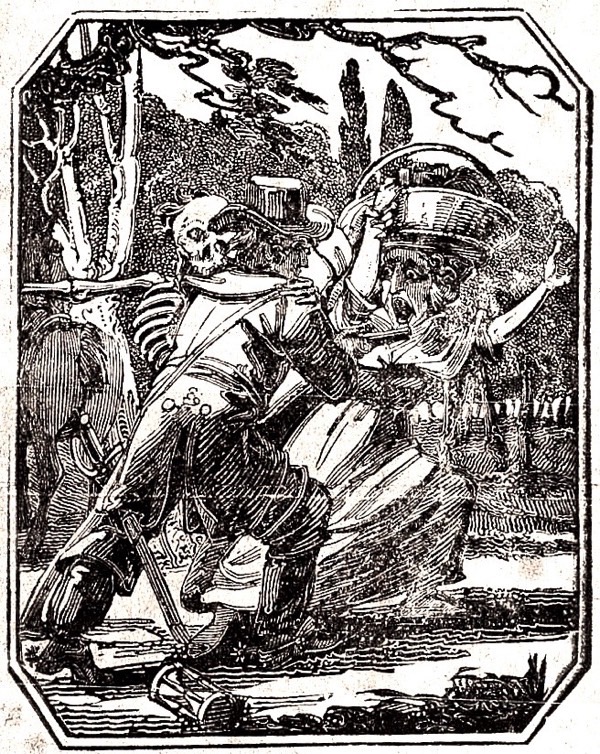
The Thief
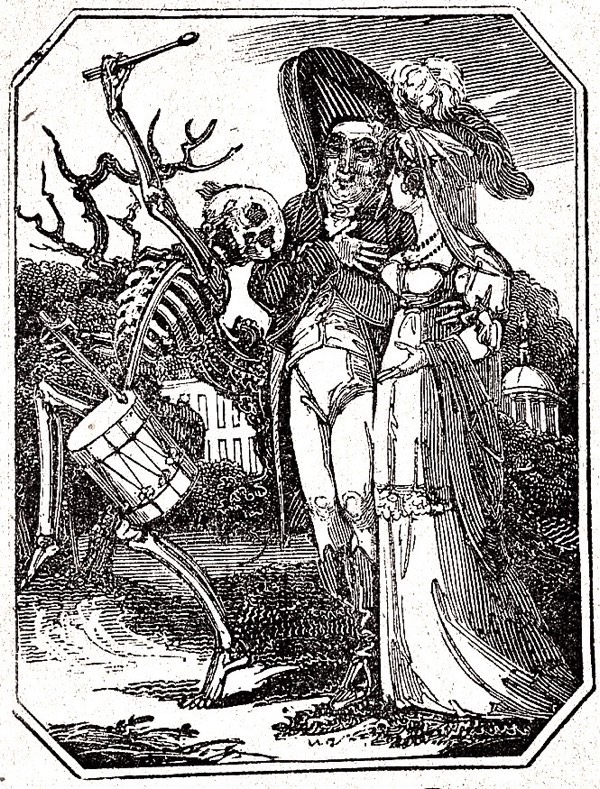
The Newly Married Pair
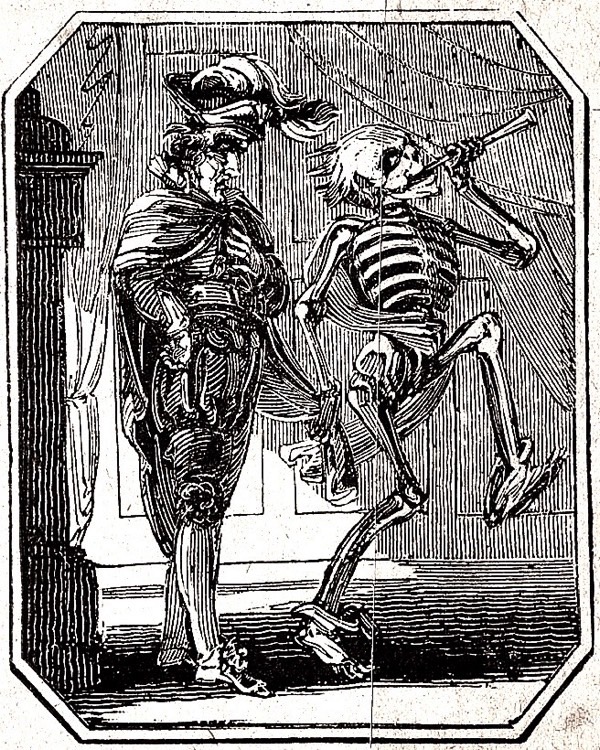
The Husband
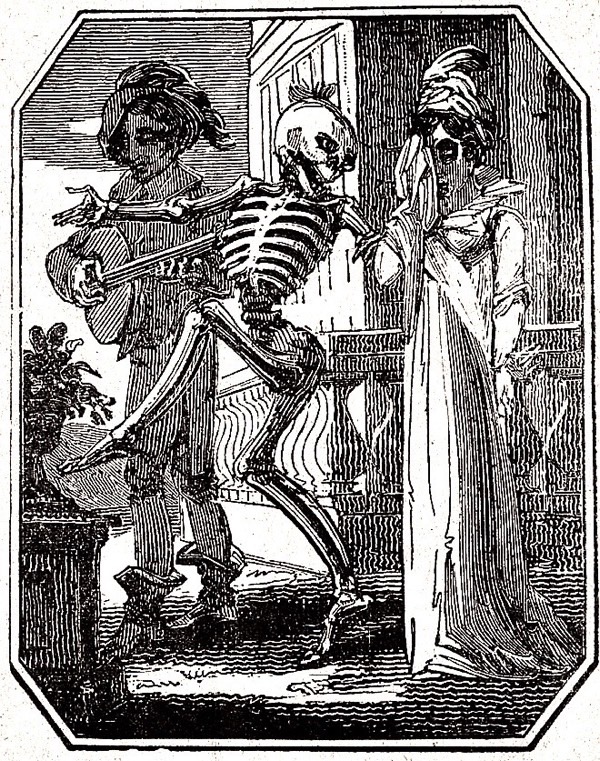
The Wife
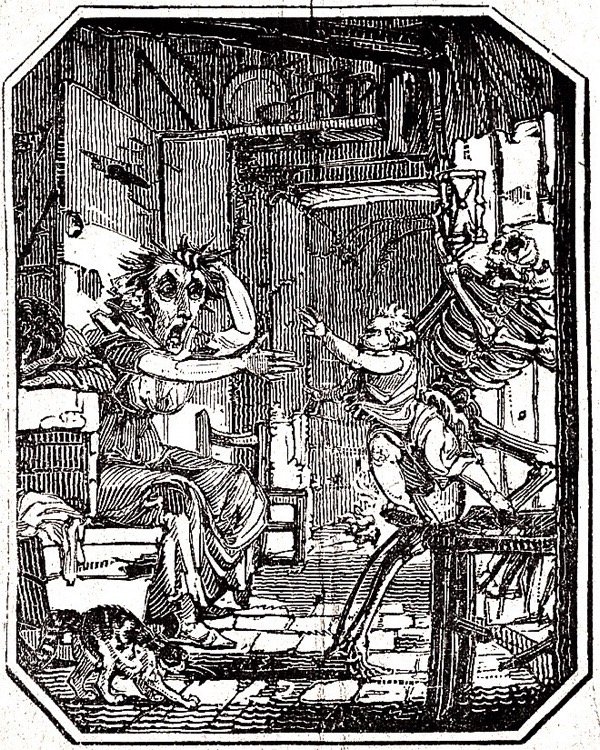
The Child
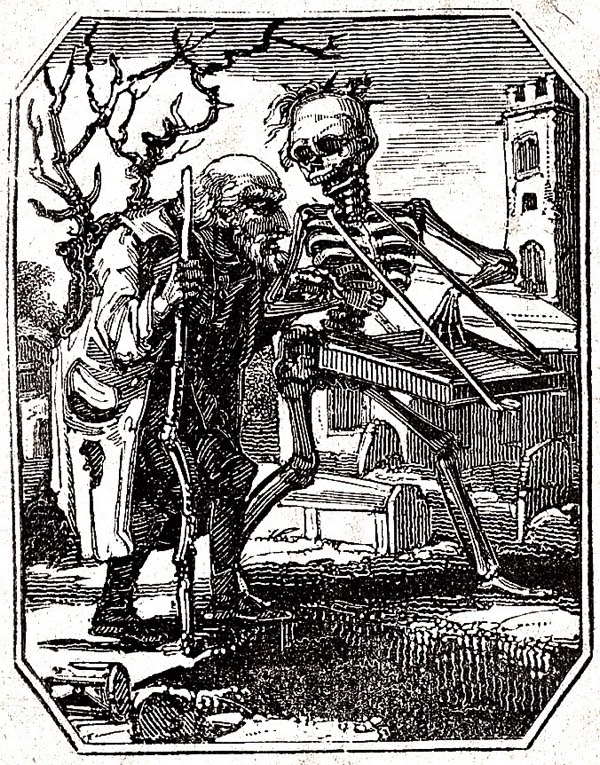
The Old Man
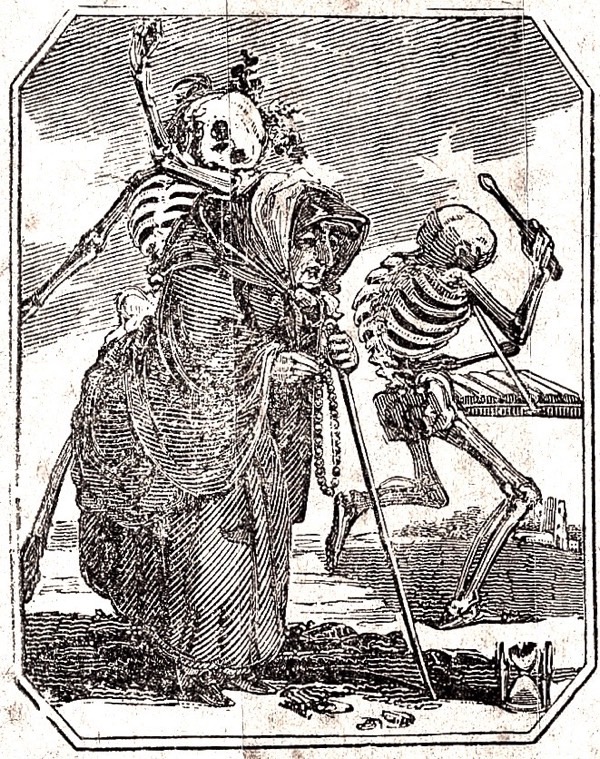
The Old Woman
You may also like to take a look at
Geraldine Beskin, Witch

Geraldine Beskin presides as serenely as the Mona Lisa from behind her desk at the Atlantis Bookshop in Museum St, Bloomsbury – the oldest occult bookshop in the world, one of London’s unchanging landmarks and the pre-eminent supplier of esoteric literature to the great and the good, the sinister and the silly, since 1922. “My father came into the shop one day and Michael Houghton, a poet and a magician, who founded it and knew everyone from W.B.Yeats to Aleister Crowley, took a good look at him and said, ‘You’ll own this place one day,'” Geraldine told me, with a gentle smile that indicated a relaxed acceptance of this happy outcome as indicative of the natural order of things.
“I started working here when I was nineteen, and I’ve read a tremendous amount and I’ve done some of it – because you have to be a reader to be a good bookseller,” she said, casting her eyes around with proprietary affection at the sage green shelves lined with diverse and colourful books old and new, organised in alphabetical categories from angels and fairies, by way of magic and paganism, to werewolves and vampires.“This place was set up by magicians for magicians and that’s a tradition we continue today,” boasted Geraldine, who guards this treasure trove with her daughter Bali, the third generation in the book trade and a fourth generation occultist.
Yet in spite of the exoticism of her subject matter, Geraldine recognises the necessity for a certain rigour of approach.“There are New Age shops that sell dangly things and crystals, but we don’t, we’re a quality bookshop” she said, laying her cards boldly yet politely upon the table,”We are not faddist, we have an awareness of the contents of the books.” Working at her desk, sustained by copious amounts of tea, Geraldine is an enthusiastic custodian of a wide range of esoteric discourse upon matters spiritual. “The esoteric is an endless source of fascination,” she assured me, her eyes sparkling to speak of a lifetime’s passion,“There are so many facets to the esoteric that you need never run out of things to be amazed by.”
I am ashamed to confess that even though I pass it every time I walk to the West End, I never visited the Atlantis Bookshop before because – such is the nature of my credulity – I was too scared. But thanks to Simon Costin of the Museum of British Folklore who arranged my introduction to Geraldine, I made it across the threshold eventually, and once I was in conversation with Geraldine who admits to being a witch and practising witchcraft, although she prefers the term “occultist,” I discovered my fears were rootless. However, my ears pricked up at the innocent phrase, “I’ve done some of it,” which Geraldine dropped into the middle of her sentence quite naturally and so I enquired further, curious to learn more about the nature of “it.”
“My grandmother, me and my daughter all do it. My dad did it.” she declared, as if “it” was the most common thing in the world, “I come from a family of esoterics. I was born into it, so I think it would be immoral to own a shop like this and not appreciate what people are doing. Loosely it could be called witchcraft, but in reality it is a certain perception or background intuition.”
“Our subject has become very fashionable and young academics don’t have a bloody clue, which is very frustrating for us.” she continued, rolling her eyes at the inanity of humanity,“We try to disabuse people of the myths about witches, they are good kind people on the whole. Most witches are as mortgage-bound and dog-walking as everyone else. Most witches do healing, and buy toilet paper. And there is this side of trying to commune with nature and be aware of the cycle of change. It’s a very rich and rewarding way of life. I practise a bit of magic – there’s so much you can’t learn from books and you have to do it yourself.”
With her waist-length grey hair, deep eyes, and amusingly authoritative rhetorical style, Geraldine is an engaging woman of magnanimous spirit. And I cannot deny a certain vicarious excitement on my part, brightening an overcast morning to discover myself seated in this elegant empty bookshop in Bloomsbury in conversation with a genuine witch. Yet I was still curious about the nature of “it.” So I asked again.
“Witchcraft is a very benign religion, where you work around the seasons of the year,” explained Geraldine patiently, in a pleasant measured tone, “You start off in darkness, and, in Mid-Summer, the Holly King and the Corn King have a fight and the Holly King wins and then the light begins to decline. At Yule, they fight again and the Corn King wins and the light begins to come back to the world. In agrarian societies, people got up at dawn and worked until dusk, and they adjusted how they lived by the seasons. It was the Christians who gave us the devil and we don’t know what to do with him. We have a horned god who is the god of positive male energy – not a devil at all, but the poor soul has been demonized over the years.”
Geraldine convinced me that esoteric cultures from the ancient world remain vibrant, by reminding me that witches were always “green,” ahead of their time in ecological awareness, and – although she could not disclose names – by revealing that top celebrities, from princes to pop-stars, have always frequented the Atlantis Bookshop. “We make a play of only giving out the names of our famous dead customers,” she confided to me with a tantalising smirk. “Most of our customers are practitioners – witchcraft has become the default teenage rebellion religion today,” she added with an ambivalent grin, confirming that, in spite of everything, the future looks bright for witches.


The British Museum awaits at the end of the street


Geraldine and her sister Tish outside the bookshop in the nineteen-seventies – “Those were the days when the Rolling Stones and the Beatles used to come in.”
You may also like to read about
Upon The Nature Of Gothic Horror
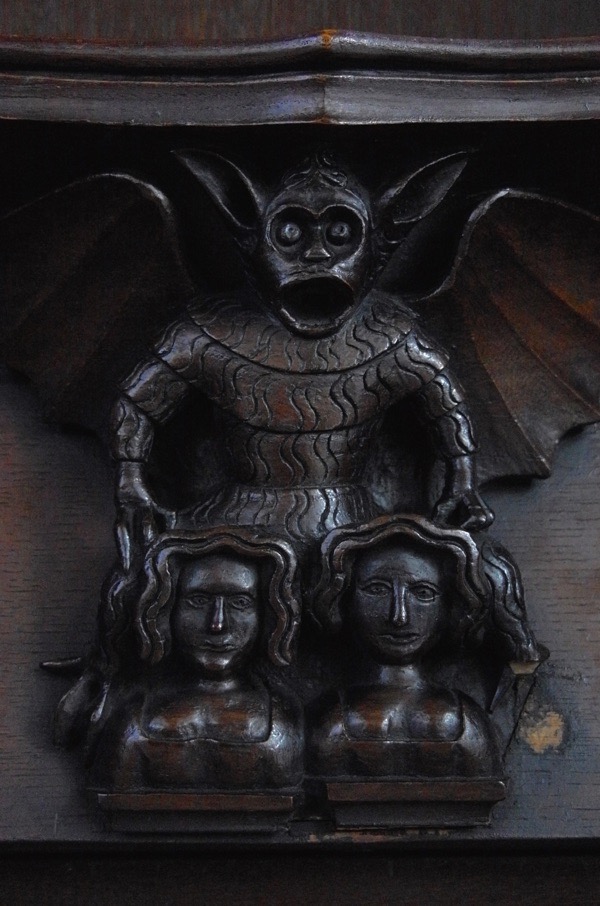
I believe I was born with a medieval imagination. It is the only way I can explain the explicit gothic terrors of my childhood. Even lying in my cradle, I recall observing the monstrous face that emerged from the ceiling lampshade once the light was turned out. This all-seeing creature, peering at me from above, grew more pervasive as years passed, occupying the shadows at the edges of my vision and assuming more concrete manifestations. An unexpected sound in my dark room revealed its presence, causing me to lie still and hold my breath, as if through my petrified silence I could avert the attention of the devil leaning over my bedside.
When I first became aware of gargoyles carved upon churches and illustrated in manuscripts, I recognised these creatures from my own imagination and I made my own paintings of these scaled, clawed, horned, winged beasts, which were as familiar as animals in the natural world. I interpreted any indeterminate sound or movement from the dark as indicating their physical presence in my temporal existence. Consequently, darkness, shadow and gloom were an inescapable source of fear to me on account of the nameless threat they harboured, always lurking there just waiting to pounce. At this time of year, when the dusk glimmers earlier in the day, their power grew as if these creatures of the shades might overrun the earth.
Nothing could have persuaded me to walk into a dark house alone. One teenage summer, I looked after an old cottage while the residents were on their holiday and, returning after work at night, I had to walk a long road that led through a deep wood without street lighting. As I wheeled my bicycle up the steep hill among the trees in dread, it seemed to me they were alive with monsters and any movement of the branches confirmed their teeming presence.
Yet I discovered a love of ghost stories and collected anthologies of tales of the supernatural, which I accepted as real because they extended and explained the uncanny notions of my own imagination. In an attempt to normalise my fears, I made a study of mythical beasts and learnt to distinguish between a griffin and a wyvern. When I discovered the paintings of Hieronymous Bosch and Pieter Breughel, I grew fascinated and strangely reassured that they had seen the apocalyptic visions which haunted the recesses of my own mind.
I made the mistake of going to see Ridley Scott’s The Alien alone and experienced ninety minutes transfixed with terror, unable to move, because – unlike the characters in the drama – I was already familiar with this beast who had been pursuing me my whole life. In retrospect, I recognise the equivocal nature of this experience, because I also sought a screening of The Exorcist with similar results. Perhaps I sought consolation in having my worst fears realised, even if I regretted it too?
Once, walking through a side street at night, I peered into the window of an empty printshop and leapt six feet back when a dark figure rose up from among the machines to confront my face in the glass. My companions found this reaction to my own shadow highly amusing and it was a troubling reminder of the degree to which I was at the mercy of these irrational fears even as an adult.
I woke in the night sometimes, shaking with fear and convinced there were venomous snakes in the foot of my bed. The only solution was to unmake the bed and remake it again before I could climb back in. Imagine my surprise when I visited the aquarium in Berlin and decided to explore the upper floor where I was confronted with glass cases of live tropical snakes. Even as I sprinted away down the street, I felt the need to keep a distance from cars in case a serpent might be lurking underneath. This particular terror reached its nadir when I was walking in the Pyrenees, and stood to bathe beneath a waterfall and cool myself on a hot day. A green snake of several feet in length fell wriggling from above, hit me, bounced off into the pool and swam away, leaving me frozen in shock.
Somewhere all these fears dissolved. I do not know where or when exactly. I no longer read ghost stories or watch horror films and equally I do not seek out dark places or reptile houses. None of these things have purchase upon my psyche or even hold any interest anymore. Those scaly beasts have retreated from the world. For me, the shadows are not inhabited by the spectral and the unfathomable darkness is empty.
Bereavement entered my life and it dispelled these fears which haunted me for so long. My mother and father who used to turn out the light and leave me to sleep in my childhood room at the mercy of medieval phantasms are gone, and I have to live in the knowledge that they can no longer protect me. Once I witnessed the moment of death with my own eyes, it held no mystery for me. The demons became redundant and fled. Now they have lost their power over me, I miss them – or rather, perhaps, I miss the person I used to be – yet I am happy to live a life without supernatural agency.
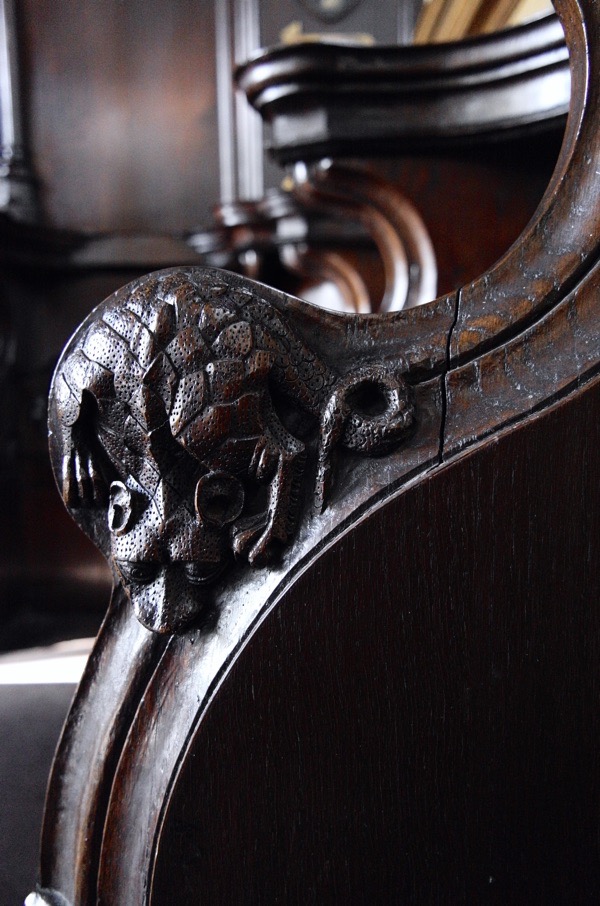
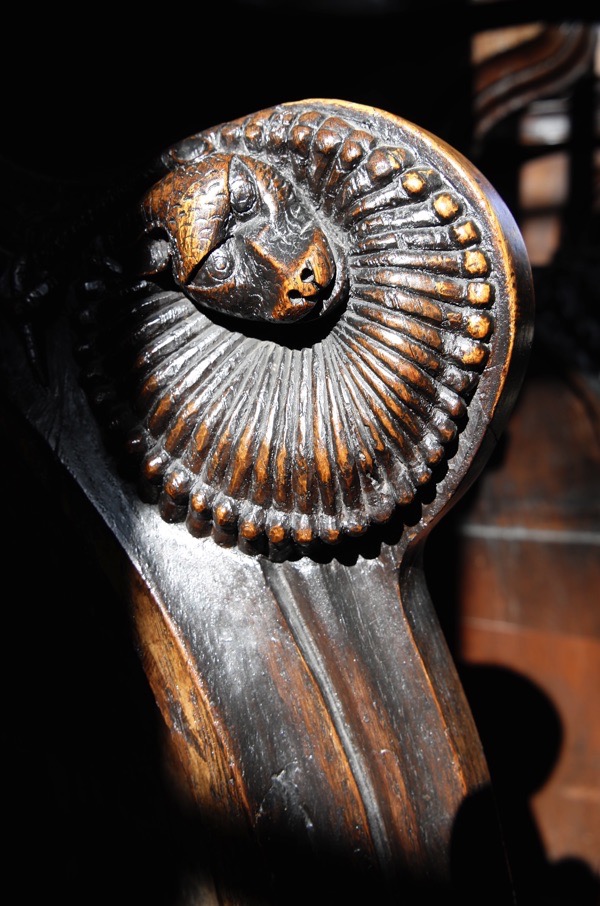
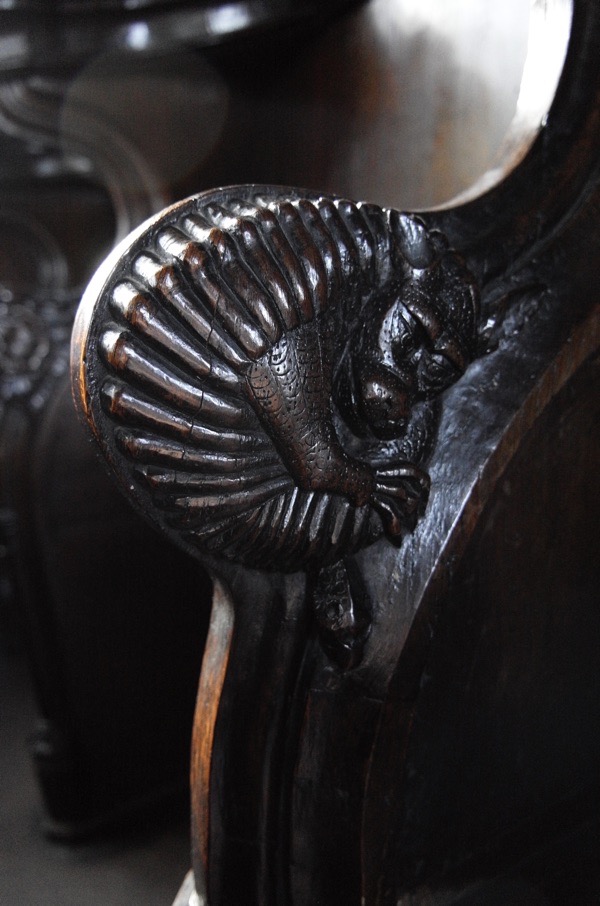
Fourteenth century carvings from St Katherine’s Chapel, Limehouse
You might also like to read about
The Wallpaper Of Spitalfields

One house in Fournier St has wallpapers dating from 1690 until 1960. This oldest piece of wallpaper was already thirty years old when it was pasted onto the walls of the new house built by joiner William Taylor in 1721, providing evidence – as if it were ever needed – that people have always prized beautiful old things.
John Nicolson, the current owner of the house, keeps his treasured collection of wallpaper preserved between layers of tissue in chronological order, revealing both the history and tastes of his predecessors. First, there were the wealthy Huguenot silk weavers who lived in the house until they left for Scotland in the nineteenth century, when it was subdivided as rented dwellings for Jewish people fleeing the pogroms in Eastern Europe. Yet, as well as illustrating the precise social history of this location in Spitalfields, the wider significance of the collection is that it tells the story of English wallpaper – through examples from a single house.
When John Nicolson bought it in 1995, the house had been uninhabited since the nineteen thirties, becoming a Jewish tailoring workshop and then an Asian sweatshop before reaching the low point of dereliction, repossessed and rotting. John undertook a ten year renovation programme, moving into the attic and then colonising the rooms as they became habitable, one by one. Behind layers of cladding applied to the walls, the original fabric of the house was uncovered and John ensured that no materials left the building, removing nothing that predated 1970. A leaky roof had destroyed the plaster which came off the walls as he uncovered them, but John painstakingly salvaged all the fragments of wallpaper and all the curios lost by the previous inhabitants between the floorboards too.
“I wanted it to look like a three hundred year old house that had been lovingly cared for and aged gracefully over three centuries,” said John, outlining his ambition for the endeavour, “- but it had been trashed, so the challenge was to avoid either the falsification of history or a slavish recreation of one particular era.” The house had undergone two earlier renovations, to update the style of the panelling in the seventeen-eighties and to add a shopfront in the eighteen-twenties. John chose to restore the facade as a domestic frontage, but elsewhere his work has been that of careful repair to create a home that retains its modest domesticity and humane proportions, appreciating the qualities that make these Spitalfields houses distinctive.
The ancient wallpaper fragments are as delicate as butterfly wings now, but each one was once a backdrop to life as it was played out through the ages in this tottering old house. I can envisage the seventeenth century wallpaper with its golden lozenges framing dog roses would have gleamed by candlelight and brightened a dark drawing room through the winter months with its images of summer flowers, and I can also imagine the warm glow of the brown-hued Victorian designs under gaslight in the tiny rented rooms, a century later within the same house. When I think of the countless hours I have spent staring at the wallpaper in my time, I can only wonder at the number of day dreams that were once projected upon these three centuries of wallpaper.
Flowers and foliage are the constant motifs throughout all these papers, confirming that the popular fashion for floral designs on the wall has extended for over three hundred years already. Sometimes the flowers are sparser, sometimes more stylised but, in general, I think we may surmise that, when it comes to choosing wallpaper, people like to surround themselves with flowers. Wallpaper offers an opportunity to inhabit an everlasting bower, a garden that never fades or requires maintenance. And maybe a pattern of flowers is more forgiving than a geometric design? When it comes to concealing the damp patches, or where the baby vomited, or where the mistress threw the wine glass at the wall, floral is the perfect English compromise of the bucolic and the practical.
Two surprises in this collection of wallpaper contradict the assumed history of Spitalfields. One is a specimen from 1895 that has been traced through the Victoria & Albert Museum archive and discovered to be very expensive – sixpence a yard, equivalent to week’s salary – entirely at odds with the assumption that these rented rooms were inhabited exclusively by the poor at that time. It seems that then, as now, there were those prepared to scrimp for the sake of enjoying exorbitant wallpaper. The other surprise is a modernist Scandinavian design by Eliel Saarinen from the nineteen twenties – we shall never know how this got there. John Nicolson likes to think that people who appreciate good design have always recognised the beauty of these exemplary old houses in Fournier St, which would account for the presence of both the expensive 1895 paper and the Saarinen pattern from 1920, and I see no reason to discount this theory.
I leave you to take a look at this selection of fragments from John’s archive and imagine for yourself the human dramas witnessed by these humble wallpapers of Fournier St.
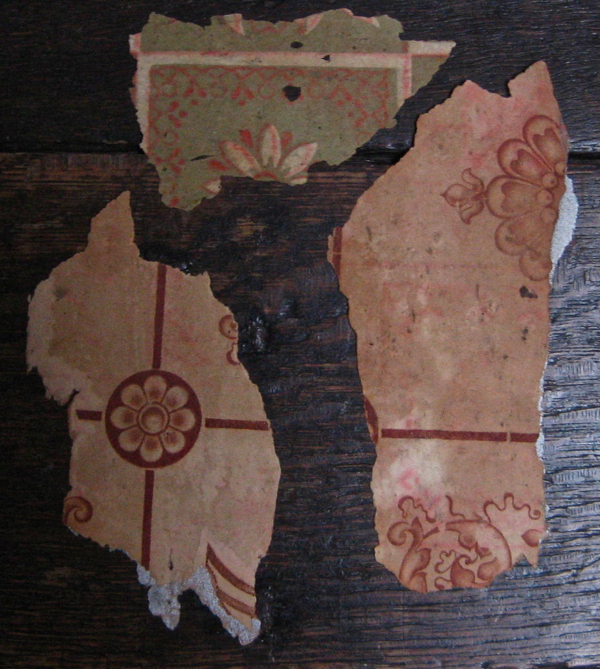
Fragments from the seventeen-twenties

Hand-painted wallpaper from the seventeen-eighties

Printed wallpaper from the seventeen-eighties
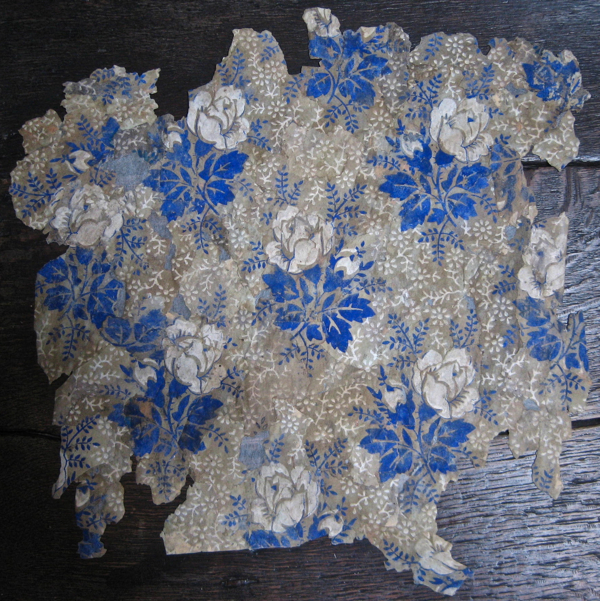
Eighteen-twenties
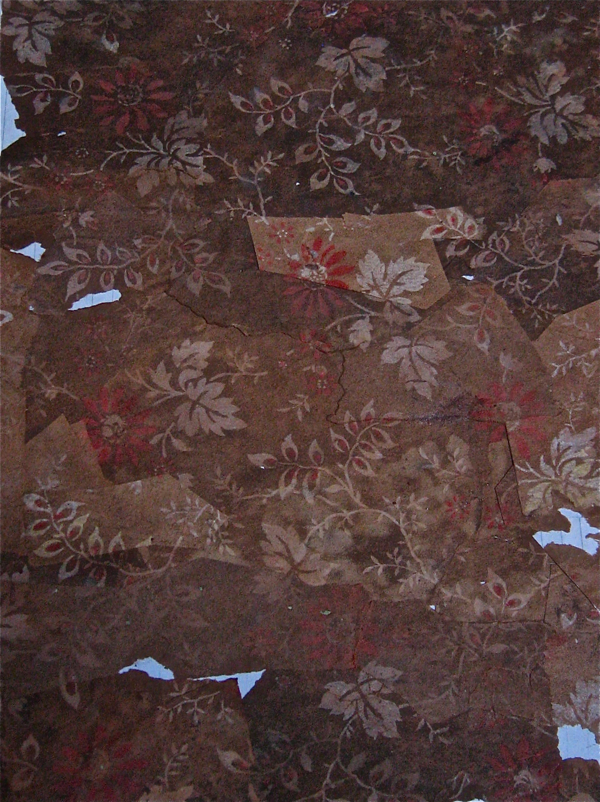
Eighteen-forties

Mid-nineteenth century fake wood panelling wallpaper, as papered over real wooden panelling

Wallpaper by William Morris, 1880
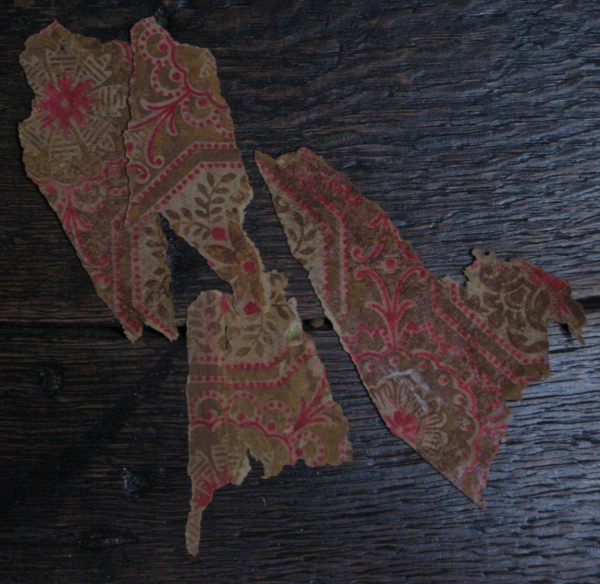
Expensive wallpaper at sixpence a yard from 1885
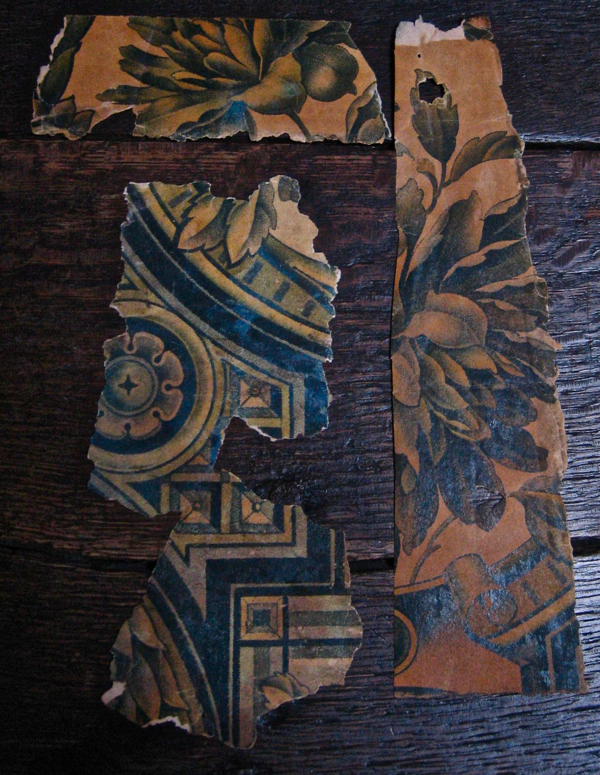
1895
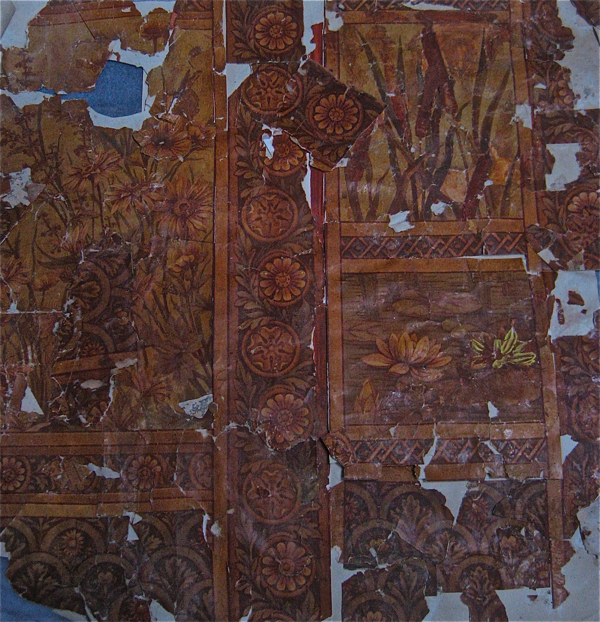
Late nineteenth century, in a lugubrious Arts & Crafts style
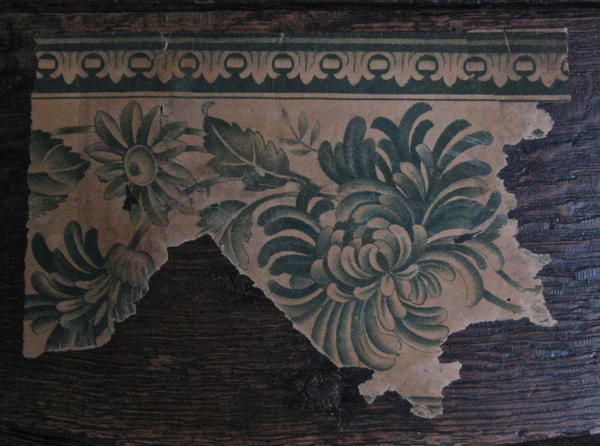
A frieze dating from 1900
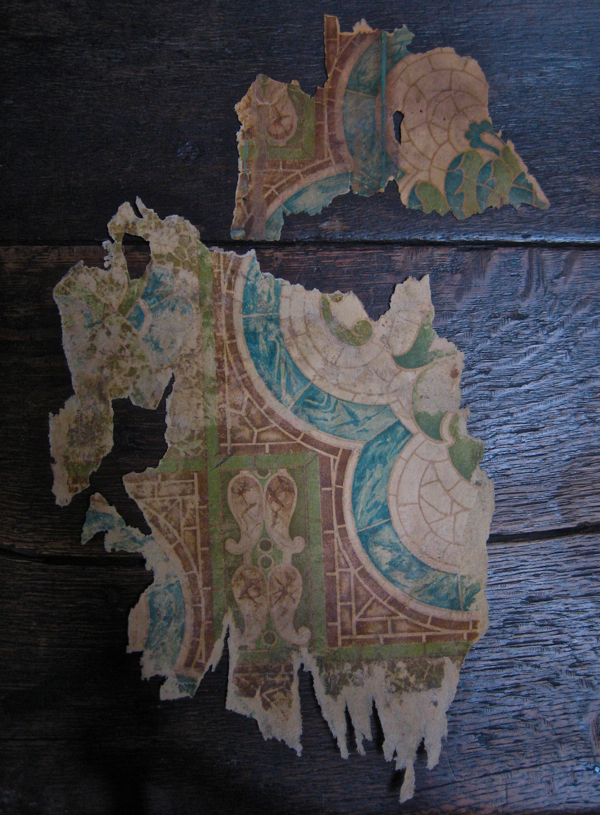
In an Art Nouveau style c. 1900
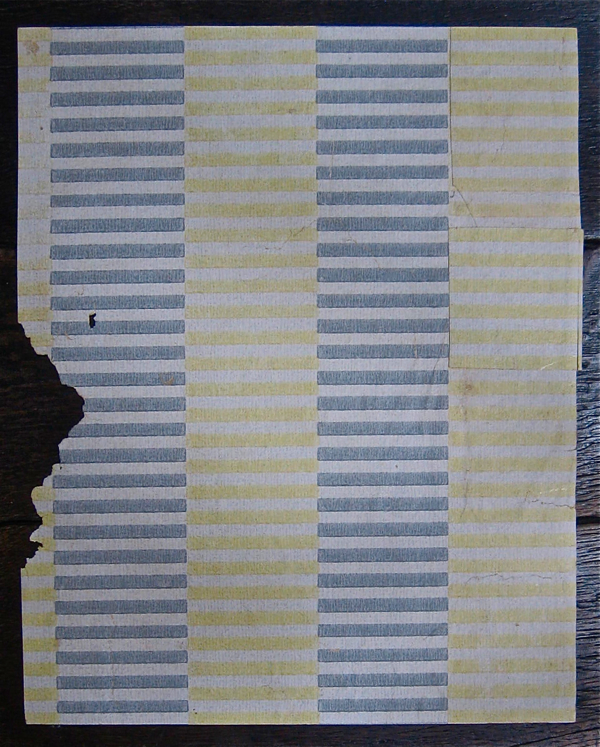
Modernist design by Finnish designer Eliel Saarinen from the nineteen-twenties

Nineteen-sixties floral
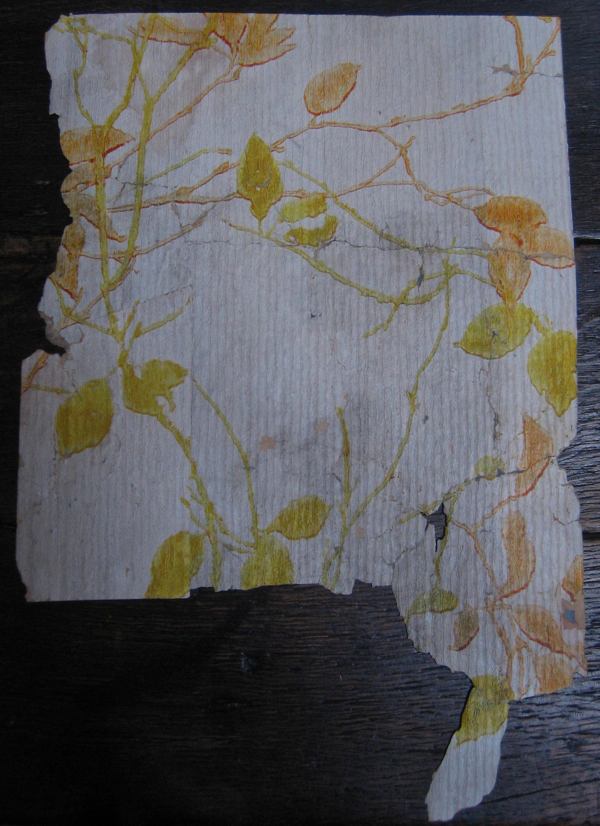
Vinyl wallpaper from the nineteen-sixties

Items that John Nicolson found under the floorboards of his eighteenth-century house in Fournier St, including a wedding ring, pipes, buttons, coins, cotton reels, spinning tops, marbles, broken china and children’s toys. Note the child’s leather boot, the pair of jacks found under the front step, and the blue bottle of poison complete with syringe discovered in a sealed-up medicine cupboard which had been papered over. Horseshoes were found hidden throughout the fabric of the house to bring good luck, and the jacks and child’s shoe may also have been placed there for similar reasons.
In The Charnel House
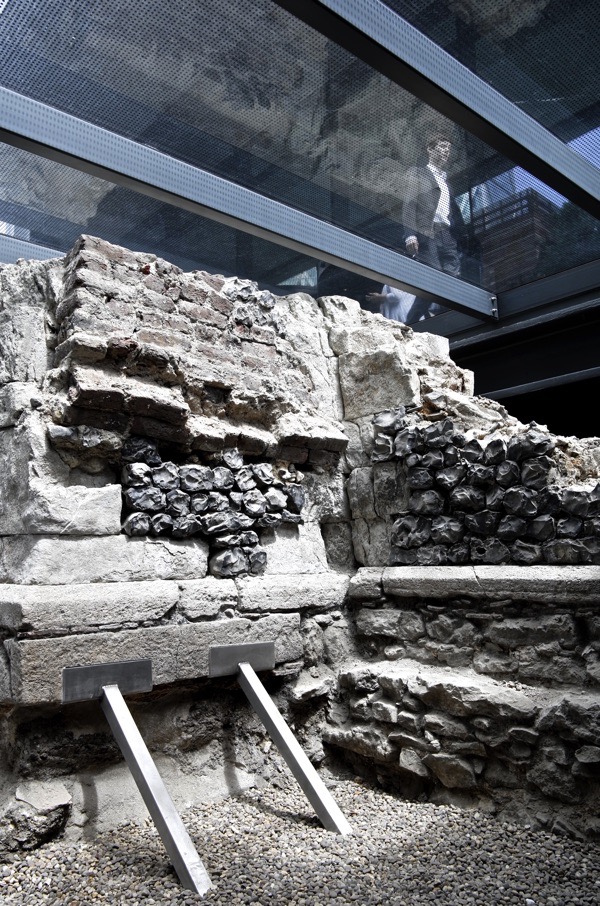
I wonder if those who work in the corporate financial industries in Bishop’s Sq today ever cast their eyes down to the cavernous medieval Charnel House of c. 1320 beneath their feet, once used to store the dis-articulated bones of many thousands of those who died here of the Great Famine in the fourteenth century.
Inspector of Ancient Monuments, Jane Siddell, believes starving people flooded into London from Essex seeking food after successive crop failures and reached the Priory of St Mary Spital where they died of hunger and were buried here. It was a dark vision of apocalyptic proportions on such a bright day, yet I held it in in mind as we descended beneath the contemporary building to the stone chapel below.
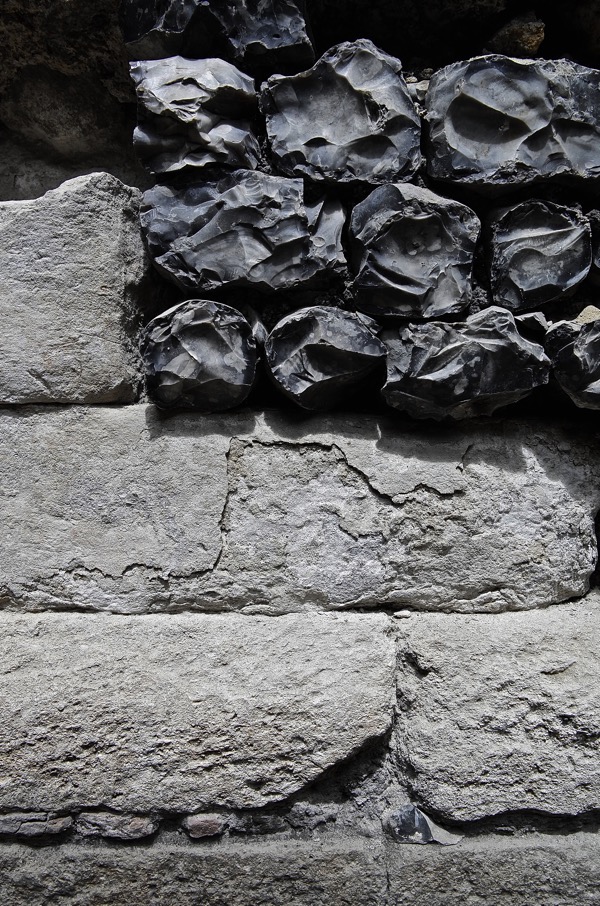
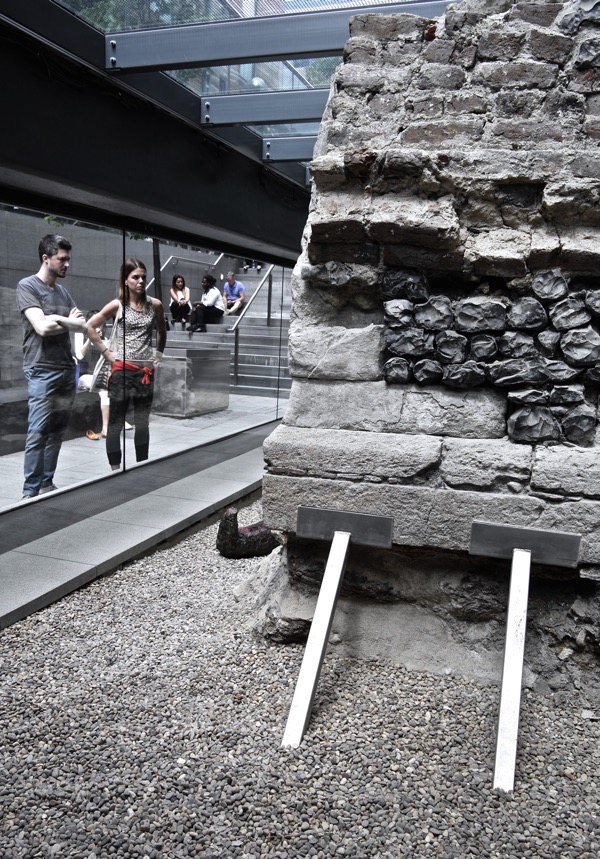
At first, you notice the knapped flints set into the wall as a decorative device, like those at Southwark Cathedral and St Bartholomew the Great. London does not have its own stone and Jane pointed out the different varieties within the masonry and their origins, indicating that this building was a sophisticated and expensive piece of construction subsidised by wealthy benefactors. A line of small windows admitted light and air to the Charnel House below, and low walls that contain them survive which would once have extended up to the full height of the chapel.
When you stand down in the cool of the Charnel House, several metres below modern ground level, and survey the neatly-faced stone walls and the finely-carved buttresses, it is not difficult to complete the vault over your head and imagine the chapel above. Behind you are the footings of the steps that led down and there is an immediate sense of familiarity conveyed by the human proportion and architectural detailing, as if you had just descended the staircase into it.
This entire space would once have been packed with bones, in particular skulls and leg bones – which we recognise in the symbol of the skull & crossbones – the essential parts to be preserved so that the dead might be able to walk and talk when they were resurrected on Judgement Day. Yet they were rudely expelled and disposed of piecemeal at the Reformation when the Priory of St Mary Spital was dissolved in 1540.
Brick work and the remains of a beaten earth floor indicate that the Charnel House may have become a storeroom and basement kitchen for a dwelling above in the sixteenth century. Later, it was filled with rubble from the Fire of London and levelled-off as houses were built across Spitalfields in the eighteenth century. Thus the Charnel House lay forgotten and undisturbed as a rare survival of fourteenth century architecture, until 1999 when it was unexpectedly discovered by the builders constructing the current office block. Yet it might have been lost then if the developers had not – showing unexpected grace – reconfigured their building in order to let it stand.
Around the site lie stray pieces of masonry individually marked by the masons – essential if they were to receive the correct payment from their labours. Thus our oldest building bears witness to the human paradox of economic reality, which has always co-existed uneasily with a belief in the spiritual world, since it was a yearning for redemption in the afterlife that inspired the benefactors who paid for this chapel in Spitalfields more than seven centuries ago
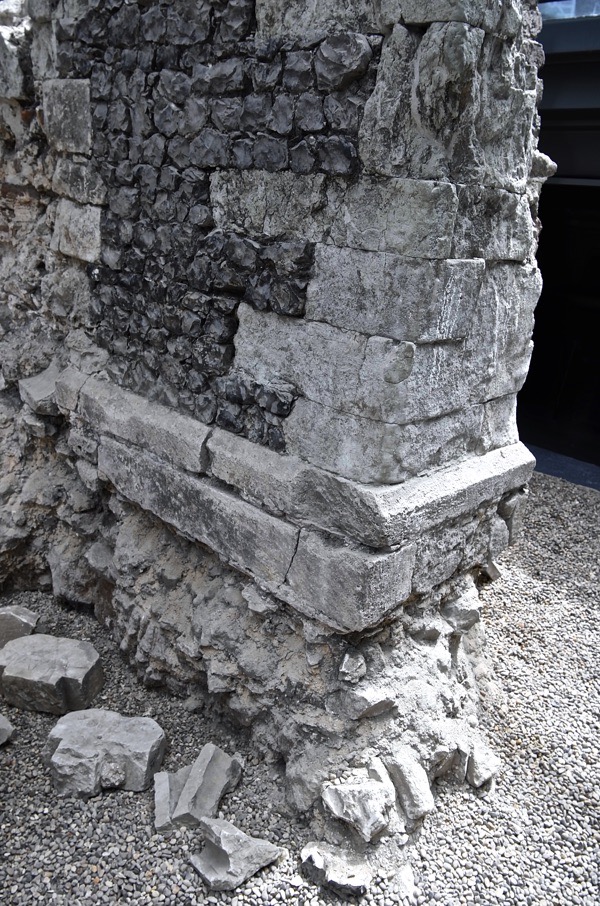
The exterior walls are decorated with knapped flints, faced in Kentish Ragstone upon a base of Caen Stone with use of green Reigate Stone for corner stones
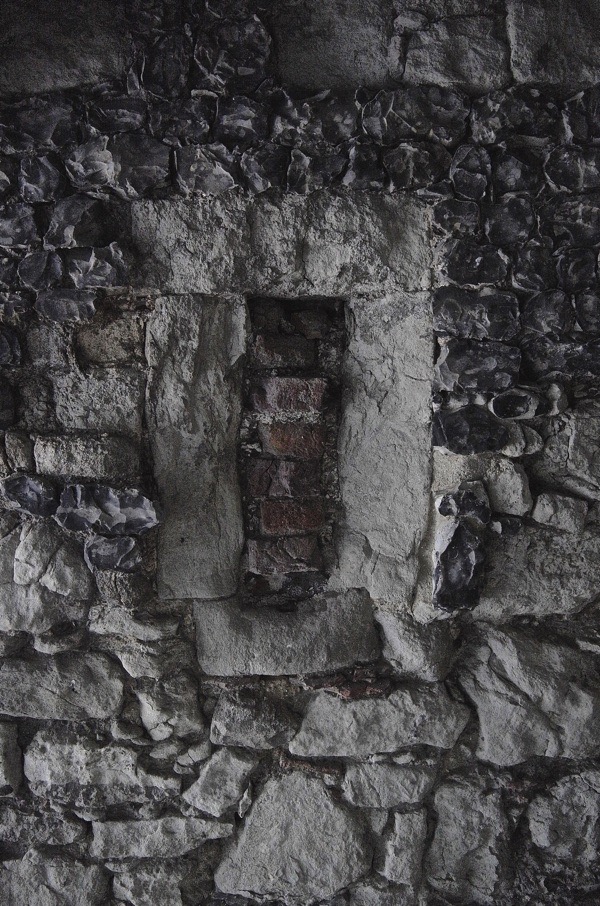
Window bricked up in the sixteenth century
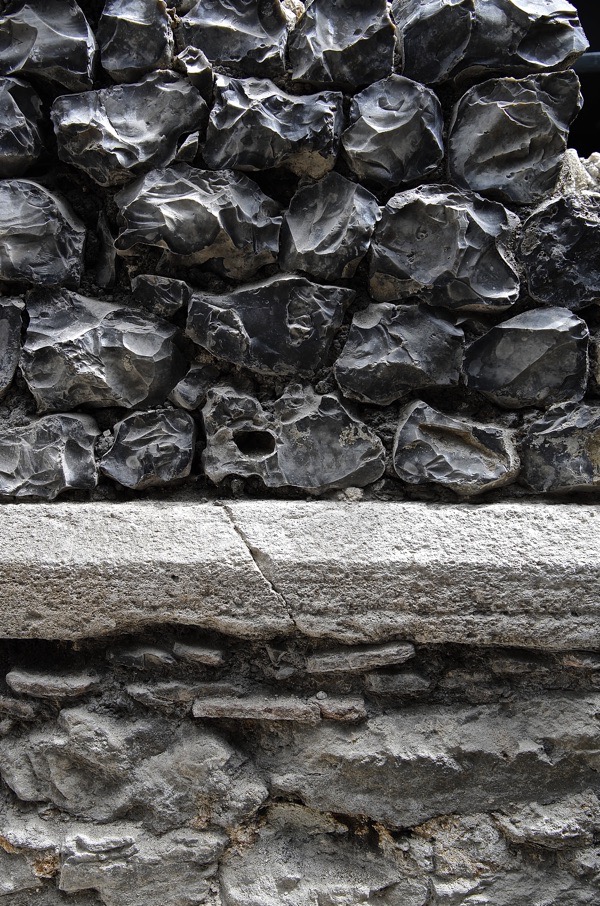
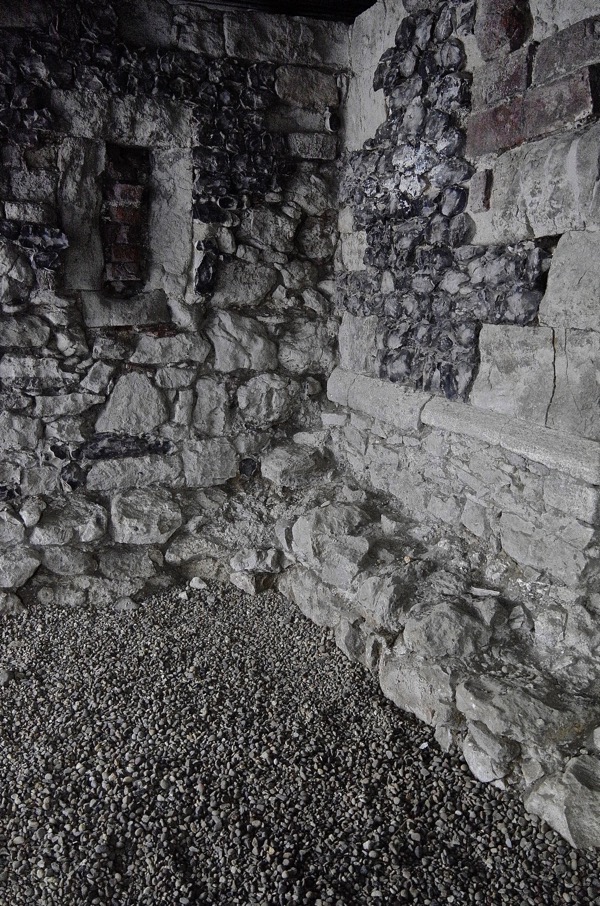
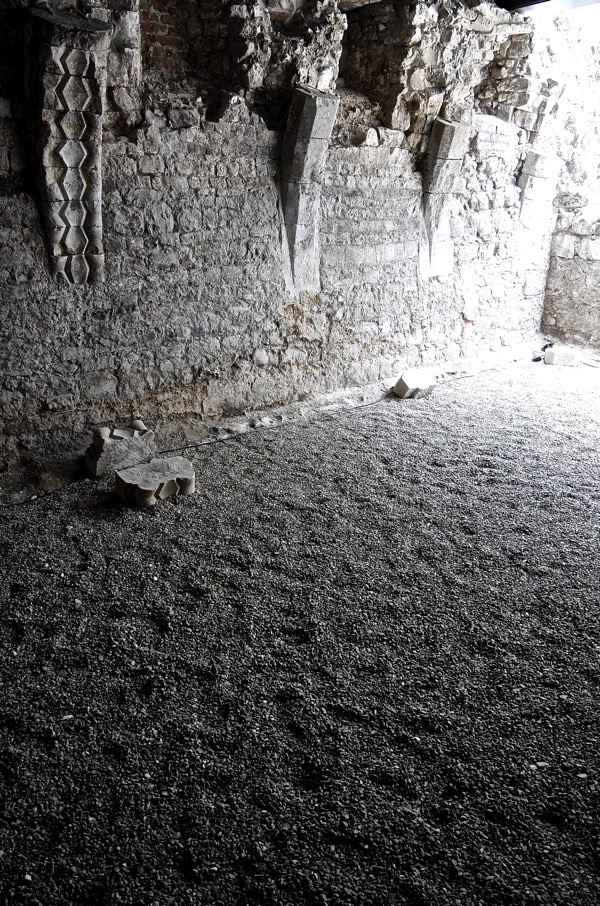
Inside the Charnel House once packed with bones
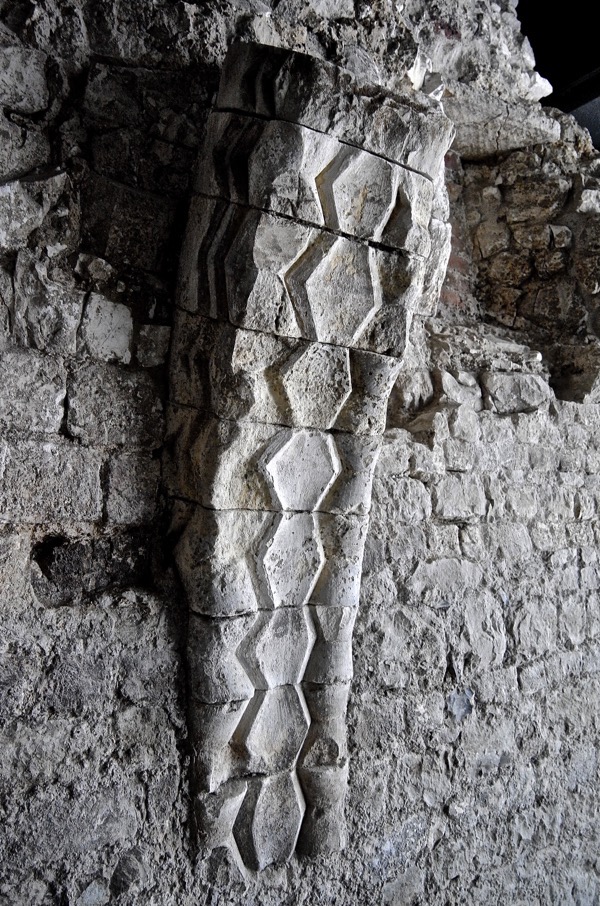
Twelfth century denticulated Romanesque buttress brought from an earlier building and installed in the Charnel House c.1320 – traces of red and black paint were discovered upon this.
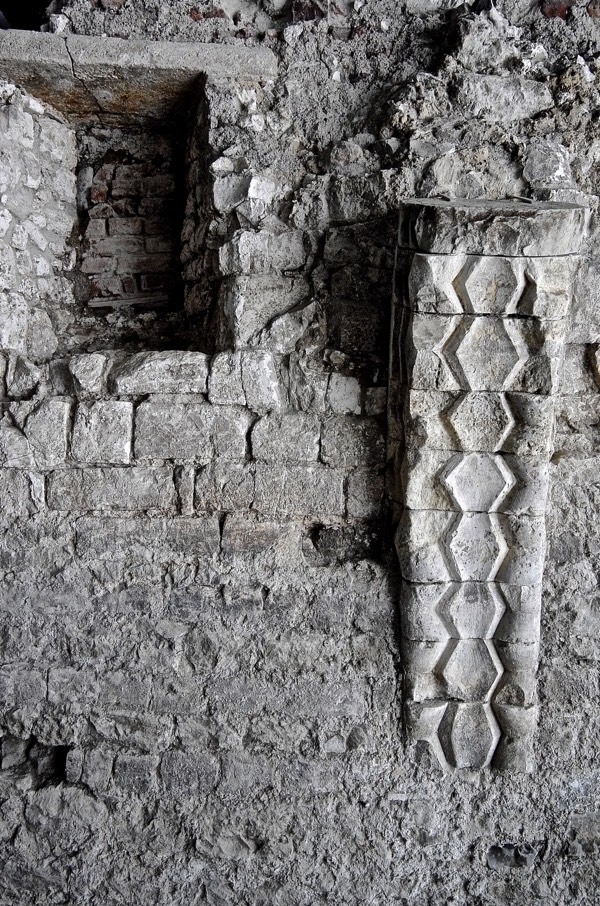
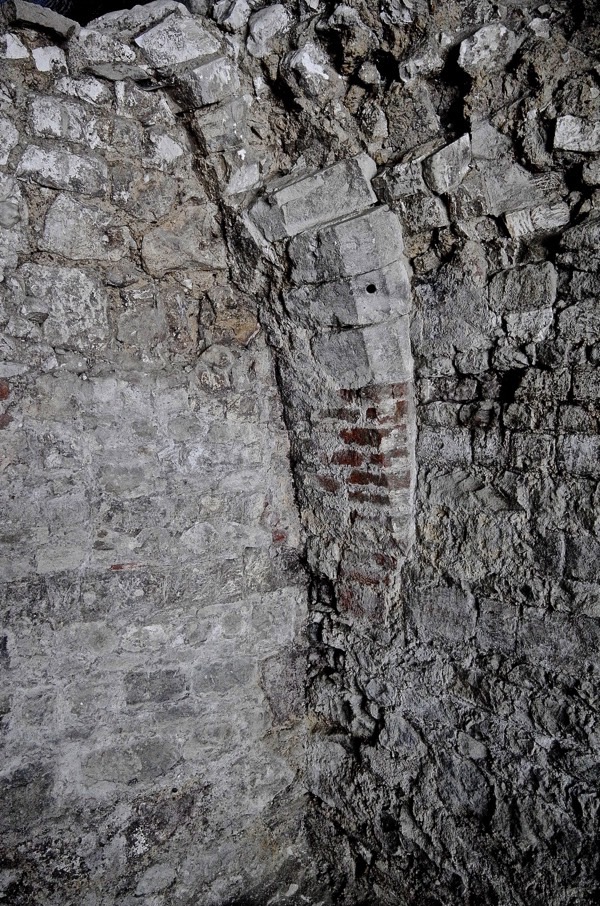
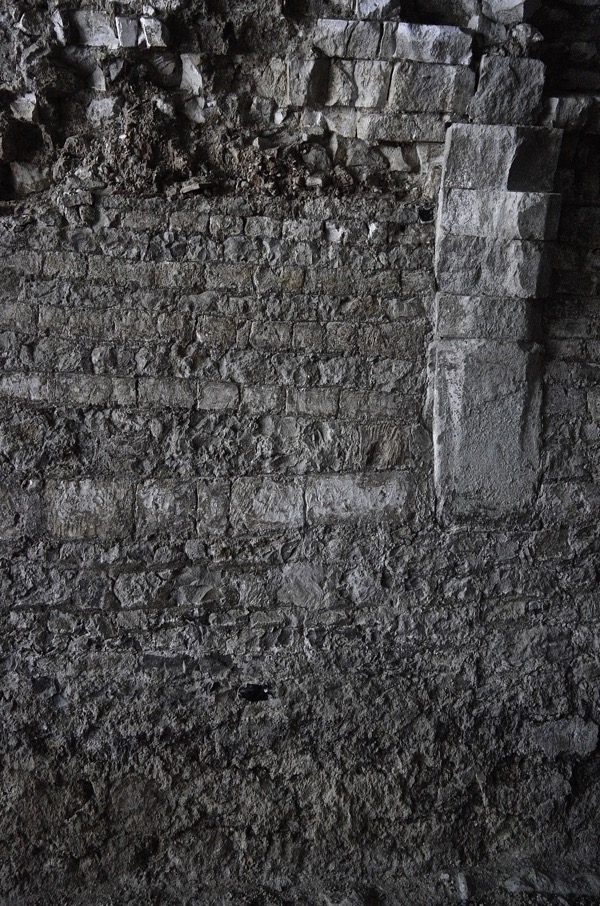
Fine facing stonework within the Charnel House
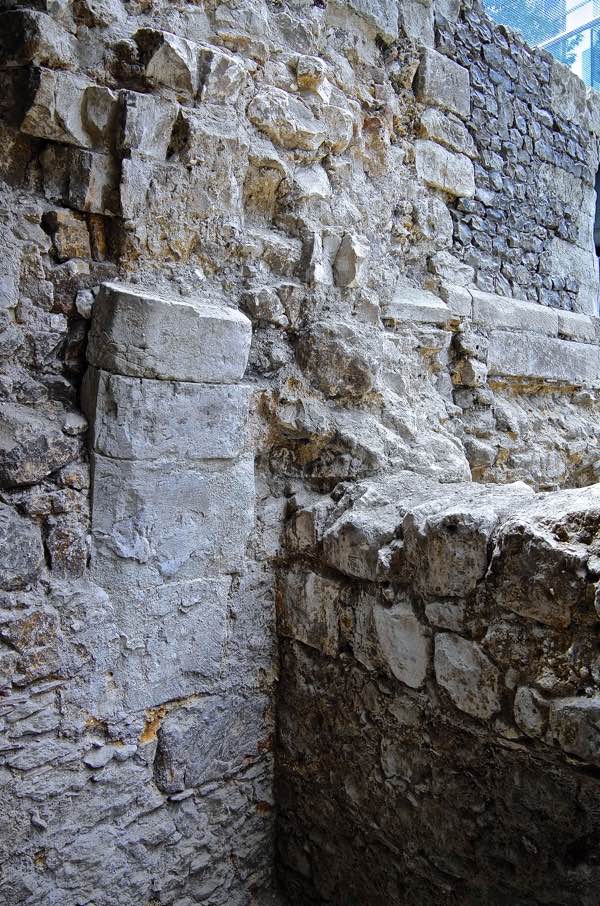
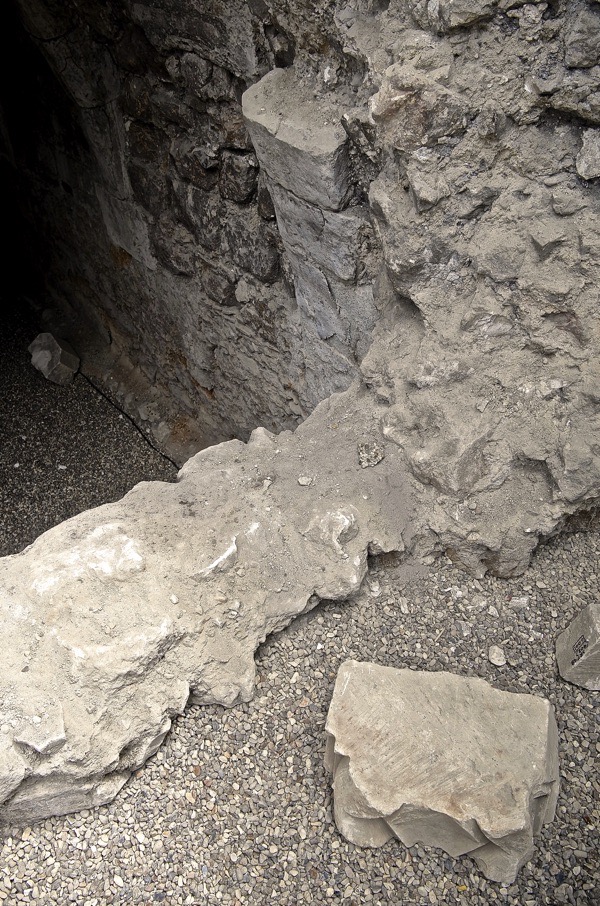
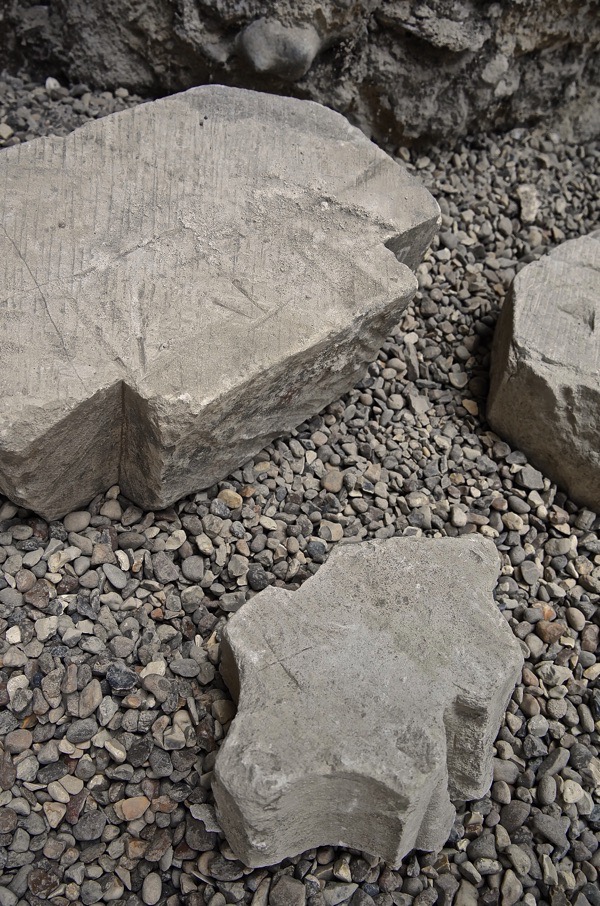
Fourteenth century masons’ marks
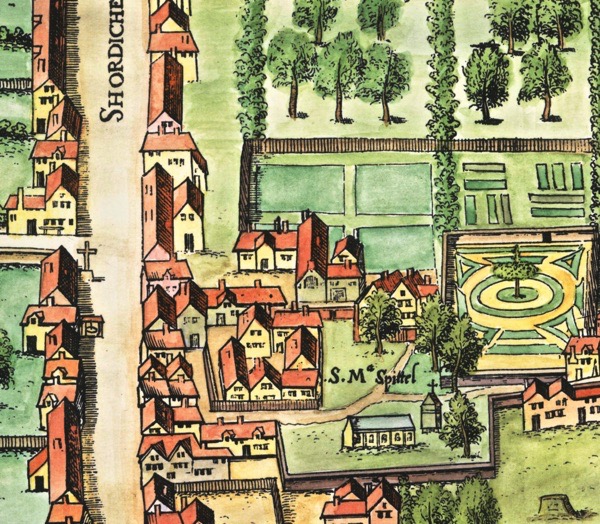
The Charnel House is to be seen in the foreground of this illustration from the fifteen-fifties
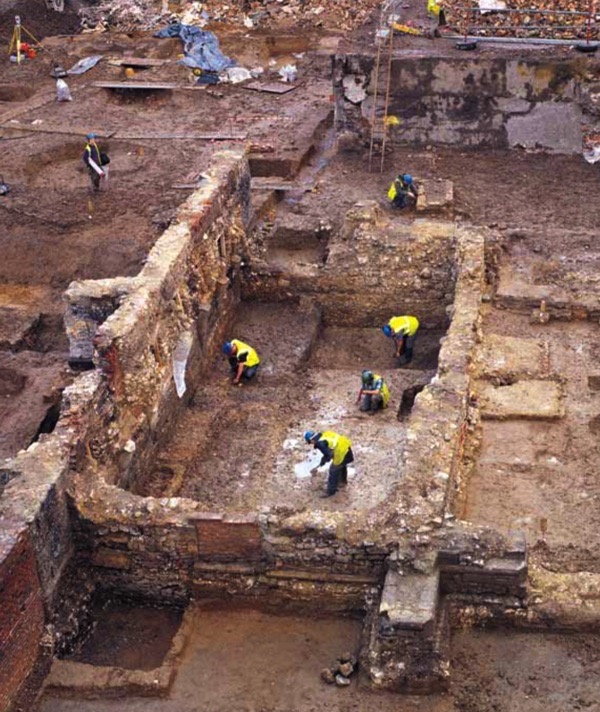
The Charnel House during excavations
You may also like to read about












