
How To Eat A Pomegranate

Now is the season for pomegranates. All over the East End, I have spotted them gleaming in enticing piles upon barrows and Leila’s Shop in Calvert Avenue usually has a particularly magnificent display at this time. Only a few years ago, these fruit were unfamiliar in this country and I do remember the first time I bought a pomegranate and set it on a shelf, just to admire it.
My father used to tell me that you could eat a pomegranate with a pin, which was an entirely mysterious notion. Yet it was not of any consequence, because I did not intend to eat my pomegranate but simply enjoy its intriguing architectural form, reminiscent of a mosque or the onion dome of an orthodox church and topped with a crown as a flourish. This was an exotic fruit that evoked another world, ancient and far away.
As months passed, my pomegranate upon the shelf would dry out and wither, becoming hard and leathery as it shrank and shrivelled like the carcass of a dead creature. A couple of times, I even ventured eating one when my rations were getting low and I was hungry for novelty. It was always a disappointing experience, tearing at the skin haphazardly and struggling to separate the fruit from the pithy fibre. Eventually, I stopped buying pomegranates, content to admire them from afar and satiate my appetite for autumn fruit by munching my way through crates of apples.
Then Leila McAlister showed me the traditional method to cut and eat a pomegranate – and thus a shameful gap in my education was filled, bringing these alluring fruit to fore of my consciousness again. It is a simple yet ingenious technique of three steps. First, you cut a circle through the skin around the top of the fruit and lever it off. This reveals the lines that naturally divide the inner fruit into segments, like those of an orange. Secondly, you make between four and eight vertical cuts following these lines. Thirdly, you prise the fruit open, like some magic box or ornate medieval casket, to reveal the glistening trove of rubies inside, attached to segments radiating like the rays of a star.
Once this simple exercise is achieved, it is easy to remove the yellow pith and eat the tangy fruit that is appealingly sharp and sweet at the same time, with a compelling strong aftertaste. All these years, I admired the architecture of pomegranates without fully appreciating the beauty of the structure that is within. Looking at the pomegranate displayed thus, I can imagine how you might choose to eat it one jewel at a time with a pin. It made me wonder where my father should have acquired this curious idea about a fruit which was rare in this country in his time and then I recalled that he had spent World War II in the Middle East as a youthful recruit, sent there from Devon at the age of nineteen.
Looking at the fruit opened, I realised I was seeing something he had seen on his travels so many years ago and now, more than ten years after he died, I was seeing it for the first time. How magical this fruit must have seemed to him when he was so young and far away from home for the first time. They call the pomegranate ‘the fruit of the dead’ and, in Greek mythology, Persephone was condemned to the underworld because of the pomegranate seeds that she ate yet, paradoxically, it was the fabled pomegranate which brought my youthful father back to me when he had almost slipped from my mind.
Now, thanks to this elegant method, I can enjoy pomegranates each year at this time and think of him.


“its intriguing architectural form, reminiscent of a mosque or the onion dome of an orthodox church and topped with a crown as a flourish”


First slice off the top, by running a sharp knife around the fruit, cutting through the skin and then levering off the lid.

Secondly, make radiating vertical cuts through the skin following the divisions visible within the fruit – between four and eight cuts.

Thirdly, split open the pomegranate to create a shape like a flower and peel away the pith.
Leila’s Shop, 15 Calvert Avenue, London E2 7JP
You may also like to read my other stories about Leila’s Shop
Vegetable Bags from Leila’s Shop
George Dickinson, Sales Manager

George Dickinson, Sales Manager at Jackie Brafman’s in Petticoat Lane
Through the nineteenth and twentieth century, Petticoat Lane market was one of the wonders of London, until deregulation in the eighties permitted shops across the capital to open and the market lost its monopoly on Sunday trading.
One of the most celebrated and popular traders was Jackie Brafman, still remembered for his distinctive auctioneering style, standing on a table in the Lane and selling dresses at rock bottom prices.
George Dickinson worked as Sales Manager for Jackie Brafman for thirty-three years during the heyday of the sixties, seventies and eighties. Losing his father when he was still a child and coming to London from Newcastle as a teenager, George discovered a new family in Petticoat Lane and a surrogate father in Jackie Brafman.
“I was born as George Albert Dickinson in Heaton, Newcastle Upon Tyne, one of six brothers and a sister. We had a very good family life and we were happy until my father died when I was nine. In those days, they did not know whether it was cancer or tuberculosis. He was manager of a brewery and a very good piano player. He used to get behind the piano in the dining room and play the chords.
My mother had to sell our four-bedroomed house and we moved in with an aunt. After three months, the aunt died and we had to get out again. We moved to a small terraced house in Scotswood, and my mother did cleaning and worked in a pub in the centre of Newcastle. Our neighbour was a retired miner and every month he got a ton of coal from the coal board. His wife used to come ask, ‘George, Would you like to shovel it into the coal hole? If anybody wants to buy some coal, it’s sixpence a bucket.’ I used to do that for her and she gave me a shilling.
I lived there until I was fourteen when I was allowed to leave school and go to work because of the situation. My eldest brother became a fireman in Newcastle during the war and another was sent to Burma as a medic. There’s only me and my younger brother left now.
I had two jobs in Newcastle. First in a bedding company, making divans, and then I had a go at French polishing, but I got the sack from that – why I do not know. So I went to try to get a job at a fifty shilling tailors and I think I lasted about two days, I did not like it at all.
At fifteen years old, I decided to come to London. My sister met me at King’s Cross and took me to Camden Town. I was just mesmerised by it all. It was Irish and Greeks. A nice place to live at the time. She had a dairy in Pratt St and I lived with her for a little while. I got a job at a textile firm in the West End as a storeman and travelled back and forth by bus.
Then I got my call-up papers at the age of eighteen in 1956. I did ten weeks training at Winchester Barracks and from there we flew from Luton airport to Singapore where we were given a week’s jungle training before being sent to a rubber plantation which was a base for an army camp.
When I came out of the forces, I returned to the old firm but they went into liquidation, so I went to another firm which I did not like at all. I was walking around the West End and I bumped into a driver from a dress company, Peter. I had known him from the old firm. I said, ‘I’m looking for a job, Peter.’ He asked, ‘Do you mind what you do?’ I replied, ‘No, not at all.’ So he told me, ‘There’s a job going. It’s a Mr Brafman, he owns a place in Petticoat Lane.’ I did not know what Petticoat Lane was. Evidently it was a market but, coming from Newcastle, I did not have a clue.
So I phoned him up, went down the same day for the interview and met him in the dress shop. He asked me, ‘What are you doing now?’ I explained who I had worked for and he must have phoned them up, because he told me, ‘Mr Flansburgh thought a lot of you.’ After that, he said, ‘When can you start?’ ‘Any time,’ I replied. ‘Start on Monday,’ he told me.
Jackie Brafman was a terrific boss. At first, I did general things, sweeping and clearing up hangers. There were two shops, a small one which was retail and the large one was wholesale, full of stock. Over the course of time, I started selling in the wholesale department. Eventually, I met Mrs Brafman who was a pet lover. They bought two dogs and called them George & Albert after me. I built up a reputation as a good salesman and I never had to ask for a rise all the years I was there. If the boss was going to a boxing match, he always took me, even if it was Mohammed Ali. I was ringside with him when Cooper fought Ali and he split his glove. A very good man. He was like another father to me. He insisted I call him ‘Jack’ from the second week at work, so eventually I called him ‘JB.’ He did not mind that at all.
On Sunday, he used to stand on a table and auction goods to the public in Petticoat Lane. I arranged for a special desk to be made that was big enough and strong enough to stand on. We had iron rails suspended above from the ceiling where we could hang dresses, a few of each in different sizes. I used to stand on a ladder and feed the clothes to him. I even picked up a bit of Yiddish, I could count the dress sizes in Yiddish. He would tell the customers he had sizes from ten to eighteen and they put their hands up, asking ‘Have you got a ten? Have you got a twelve?’ and I would be feeding the dress out to the crowd. On two occasions, he was in hospital so I got up and auctioneered. It was at Christmas time and we did very well. He was so well known and liked.
One of his favourite sayings was ‘You’ve heard of Christian Dior, I’m the Yiddisher Dior!’ He always had a bottle of whisky on the shelf and he would say, ‘George, get the paper cups.’ Maggie, a regular customer, would come in and he would ask, ‘Would you like a drink, Maggie?’ He poured whisky into these paper cups and topped it up with cola. He would tell her, ‘I’m only doing this to get you a little but tipsy so you don’t know what you are buying.’
There was another guy who used to come in and stand on the side of the shop, and I realised what he wanted. I asked, ‘Can I help you, Sir?’ and he said, ‘No, I’m waiting for one of the ladies to serve me.’ So I called, ‘Celia, Can you come and look after this gentleman?’ Eventually, I gained his trust and he showed me his photographs of him in dresses with wigs and makeup. He looked brilliant. He was a drag artist, but he did not want the lads to know. He used to spend a lot of money and only Celia could serve him.
I became manager of the wholesale department, a double-fronted shop in Wentworth St, opposite the public toilets. People came from all over the world. Nigeria, Kenya, Ghana, Saudi Arabia and Arabia, as well as from all over this country. There were five girls working in the retail shop and we used to employ schoolkids to stand outside by the stall and make sure nothing got pinched.
Jack would go to the West End and buy stuff from Clifton, which was very big fashion house for larger size women, and Peter Kay and Remark and Kidmark. These were all top names years ago. He would buy ‘over-makes’ from them. If they were given an order from Marks & Spencer for a thousand garments, they might make twelve hundred in case of any problems. Jack would buy the extra at a knock-down price. We might sell a dress for four-fifty retail and three-fifty wholesale, but Jack got them for seventy pence each. He done so well Jackie.
Jackie’s father Maurice Brafman lived in Nightingale House, a home for the elderly.It was a beautiful place and he had his own room. The dining room was just like a hotel. He used to phone me up on a Friday morning and say, ‘George, Can you get me some groceries?’ I would go to Kossoff’s and buy cholla for him, and collect his kosher meat from the butcher. He did like his salami and occasionally a bit of fruit. I would put it all in a bag and, when I was going home, I would make a stop in Nightingale Lane to deliver his groceries. He would always check them and pick an argument about something. He would say, ‘You haven’t brought me so and so!’ and I would reply, ‘Mr Brafman, it’s in the bottom of the bag.’ ‘Alright,’ he would concede but he would always find fault. It was lovely seeing him. He lasted about five years there.
In the end, Jack took very ill. He was only coming in occasionally. He had a silver cloud Rolls Royce and I drove it a couple of times up to the West End to pick up stuff when he was not too well. He ran the business from home and his wife would come in occasionally to collect the takings. Sometimes, he would turn up in his wife’s car and stagger in to say, ‘Hello.’
He had two sons and two daughters and eventually Mark, the eldest brother, opened clothes shops all over London called ‘Mark One.’ His wife caught him with another woman and took him for everything. He was worth a fortune and he had a house with a ballroom in the middle. The youngest son, David, went into the business in Petticoat Lane and closed the shop.
Working at Jackie Brafman’s was the best part of my life, apart from getting married and having daughters. When I first came to London to find work at fifteen years old, I was rather shy and a bit inward. By working with Jack and talking to him, I changed. When he was not too busy, Jack would call me into the retail shop and ask me questions, ‘What do you think of this?’ I would give him my opinion and gradually I built up a bit of confidence. Mrs Brafman told me one day, ‘You know, Mr Brafman says you are the backbone of the business.’ I felt so good about it.”

Jackie Brafman, Petticoat Lane (Photograph courtesy of Jewish East End Celebration Society)

George Dickinson, Sales Manager at Jackie Brafman’s
Read these other stories about Petticoat Lane
Laurie Allen of Petticoat Lane
The Wax Sellers of Wentworth St
At The Drapers’ Hall

The Drawing Room
As long ago as 1180, the Drapers in the City of London formed a Guild to protect their interests as small traders and help members who fell into distress. The full title of the company was, “The Master and Wardens and Brethren and Sisters of the Guild or Fraternity of the Blessed Mary the Virgin of the Mystery of the Drapers of the City of London.” More than eight hundred years later, it still exists to administer charitable trusts, inheriting headquarters that have been rebuilt over the centuries upon the site of Thomas Cromwell’s house – taken by Henry VIII after Cromwell’s execution at the Tower in 1540 and sold to the Drapers in 1543.
For years, I walked down Throgmorton Avenue and peered through the railings at the Mulberry trees growing there with out knowing that this tiny enclave of greenery in the heart of the city was the last remnant of Thomas Cromwell’s garden. Consequently, I was fascinated to visit the Drapers’ Hall and explore the chambers of the ancient livery company arranged around a hidden courtyard, following the ground plan of the great medieval hall that once stood upon this site. Until then, I had no idea that these palatial spaces existed, sequestered from the idle passerby.
Cromwell’s mansion was destroyed by the Great Fire of 1666, then rebuilt to designs by Edward Jarman in the sixteen seventies and later remodelled in each of the subsequent centuries to arrive at the rambling construction I encountered, which delivers some breathtaking architectural contrasts as you walk from one space to another. Offices occupy the ground floor that give no hint of the grandeur above, unless you step into the courtyard and raise your eyes to peer through the tall windows upon the first storey where the gleam of vast chandeliers reveals lofty painted ceilings. Standing there in the stone yard surrounded by an arcade embellished with heads of the prophets, you might be in Venice or Rome.
A magnificent eighteen-nineties staircase by Thomas Graham Jackson, lavishly encrusted with alabaster and red emperor and green chipolina marble, and light by a five thousand piece chandelier, offers a suitable introduction to the wonders at the top, where the grand Dining Room awaits on your left and the even grander Drawing Room on your right. Overlooking the garden, the Dining Room is one of the oldest chambers at the Drapers’ Hall, dating from the seventeenth century yet heavily embellished with coats of arms in the mid-nineteenth century to create a shining firmament overhead, glistening in diffuse chandelier light.
Crossing the landing, you enter the Court Room where Nelson and Wellington face each other from full-length portraits at either end. Lit by tall windows overlooking the courtyard, even the grandeur of this space gives no indication of the vast Livery Hall beyond. In the sepulchral gloom, larger than life-size portraits of British monarchs line up around the walls of this cathedral-like space, where no sound of the city penetrates and the depth of silence hums in your ears. Incredibly, the embellishment in this ornate room was simplified in the eighteen nineties because the original decoration was so elaborate that it prevented the entry of light.
A narrow corridor leading from the hall and overlooking the courtyard holds the company’s succession of charters including Edward III’s Patent of 1364 followed by those granted by James I, Elizabeth I and our own Elizabeth II. Facing the Livery Hall across the courtyard is the Drawing Room, a chamber worthy of any of the royal palaces of Europe. Created by architect Herbert Williams and interior designer John G. Crace, it remains as they left it in 1868, – an exquisitely modulated symphony of gilt panelling and mirrors, glowing golden in the cool northern light.
Over-awed by the majesty of the building and distracted by the collection of old paintings worthy of any museum, I rubbed my bleary eyes when I found myself back in the dusty streets around Liverpool St Station in the grey dusk of the late afternoon, and it caused me to question whether my visit to the Drapers’ Hall had, in fact, been an apparition conjured by a daydream.


Bearded Persians by Henry Pegram flank the Throgmorton St entrance.


Staircase designed by Thomas Graham Jackson in the eighteen nineties.


A five thousand piece chandelier lights the staircase.

Jason and the Golden Fleece, portrayed upon the celiing of the Court Dining Room

Looking from the Drawing Room through to the Dining Room.

The Drawing Room by architect Herbert Williams and interior designer John G. Crace, 1868.

The Drawing Room c. 1920


The Shepherd Boy by Thorwaldsen, 1893.

The Livery Hall, c. 1920

The Livery Hall

The Livery Hall c.1920

The Livery Hall

The Livery Hall, c. 1890

This dial in the Livery Hall indicates the wind direction.


The Courtyard c. 1920

The last remnant of Thomas Cromwell’s garden.

The Garden, c. 1920

Glass slides courtesy Bishopsgate Institute
You may also like to read about
Eleanor Crow’s ‘Step Inside’
A few places are available for my last-ever course HOW TO WRITE A BLOG THAT PEOPLE WILL WANT TO READ on November 20th & 21st. This is your final chance to come to Spitalfields and spend a weekend with me in an eighteenth century weaver’s house in Fournier St, enjoy delicious lunches from Leila’s Cafe, eat cakes baked to historic recipes by Townhouse and learn how to write your own blog. Email spitalfieldslife@gmail.com to book a place.

Portrait of Eleanor Crow at E. Pellicci by Colin O’Brien
I am delighted to present this preview of Eleanor Crow‘s exhibition A Step Inside opening at Townhouse, Spitalfields, next Saturday 20th November. Readers will be familiar with Eleanor’s illustrations that we published in a book as Shopfronts of London, but now she has turned her hand to paintings of interiors and still lifes.
‘I became interested in the play of light across the interiors of shops, kitchens and domestic settings, and this forms the basis of my new work,’ Eleanor admitted to me. ‘I am fascinated by the way light falls from windows across chairs and tables, over pots, brushes and baskets, across lines of bottles and jars – as well as the particular quality of a room. I am attracted to views through doors, a glimpse, a step inside.’

Kitchen at the George Tavern, Stepney
‘I was struck by the asymmetric shape of the kitchen and the huge window casting a soft light across the interior. I love the cream panelled walls and array of pots on the dresser, as well as the blues of the utilitarian plates, bowls and teapot, and the hanging shirts.’

Leila’s Shop, Calvert Avenue
‘The display of wares, backlit by light falling on the ranks of containers and the wedges of cheeses, the pats of butter, the upended bottles, and the arrivals of new produce still in their boxes, exude a calm, quiet beauty. I want to convey how it feels to enter this shop, with its sense of timelessness. I have always admired Dutch interior paintings, and to me this place embodies some of these qualities.’

Straw, Columbia Rd
‘This is a small shop that sells baskets, pots, brushes, candles – items of utility and beauty, new and old. Each basket has its individual form. The daylight is subdued, with a glancing light coming from the west, catching the shapes in the window display. The edges of the room and the baskets frame the composition.’

Berry Brothers Rudd, St James
‘I was delighted to visit the historic rooms at Berry Bros. & Rudd, the family-run wine and spirit merchant founded in the seventeenth century. This interior at No.3 St. James’s St, lit by huge arched windows, is little changed since it opened in 1698. The array of antique wine bottles above the waiting table and chairs, and the wide bench, all attest to the history.’

Courtyard at the Lacquer Chest, Kensington Church St
‘This antique shop opened in the fifties, put on the map by customers including David Hockney, Ossie Clarke, Alan Bennett and Jean Shrimpton. I first encountered it when seeking items for a photograph for a book cover, and have returned to buy pots and vases. I am particularly drawn to this yellow-painted hallway, looking through to the courtyard. Antique shops lure us in with the promise of serendipitous discoveries and this place never disappoints.’

At the George Tavern
‘I am interested in natural light and I liked the brightness of the yellow couch and stool against the soft greys of the room, and the pots not quite symmetrically placed on the mantelpiece. This is a house filled with life and people.’

Kitchen at Sutton House
‘This is the view from the Tudor kitchen of the five hundred-year-old manor house in Hackney. I chose to depict a domestic setting, looking through to a courtyard beyond, and only the face mask and trainers on the woman standing there indicate the modern era.’

Bethnal Green Library
‘Only one door into the library from the entrance hall was open and the library’s future was hanging in the balance of council decision-making. During the pandemic, the library became a vaccine trial centre, causing concern locally whether it would ever reopen. This beautiful building has served the East End for nearly a hundred years, offering the opportunity of reading to countless children and adults, including through the Blitz.’

Kitchen at Townhouse, Spitalfields
‘This basement kitchen is a warm and inviting place, with wooden walls and ceiling painted in muted greys, and copper pans and jelly moulds catching the light. I like the mixture of beauty and utility – the cakes under their glass cloches, the oranges on the counter top and the dark shapes of the cake mixer, coffee grinder and coffee machine, crowned by a pile of white cups.’

Sweetings, City of London
‘This is London’s oldest fish and oyster restaurant, which opened in 1830. The beautiful corner site on Queen Victoria St has been little changed for over one hundred years and is a much-loved institution in the City. I chose this corner because of the light cast from the frosted windows with their blue roller blinds, reflected in the tall mirrored wall panel and bouncing off the rows of glasses and cutlery.’

Bowl of Lemons
‘I like the acidic yellow of the lemons against the blue and white glaze of the bowl, and the imperfections of both.’

So Long, Huguenots Of Spitalfields
A few places are available for my last-ever course HOW TO WRITE A BLOG THAT PEOPLE WILL WANT TO READ on November 20th & 21st. This is your final chance to come to Spitalfields and spend a weekend with me in an eighteenth century weaver’s house in Fournier St, enjoy delicious lunches from Leila’s Cafe, eat cakes baked to historic recipes by Townhouse and learn how to write your own blog. Email spitalfieldslife@gmail.com to book a place.

After more than ten years, the cultural organisation devoted to the Huguenots of Spitalfields is closing down. This unexpected imaginative flourishing was the brainchild of the estimable Charlie De Wet, who worked voluntarily for a decade, inspiring us with stories of this first wave of immigrants and, by doing so, transformed our perceptions of the Huguenots’ contribution to our society.
The wooden spools that you see hanging in the streets of Spitalfields indicate houses where Huguenots once resided. These symbols were put there in 1985, commemorating the tercentenary of the Revocation of the Edict of Nantes which brought the Huguenots to London and introduced the word ‘refugee’ to the English language.
I set out in search of any visual evidence that remains of the many thousands who once passed through these narrow streets and Dr Robin Gwynn, author of The Huguenots of London, explained to me how they came to be here.
“Spitalfields was the most concentrated Huguenot settlement in England, there was nowhere else in 1700 where you would expect to hear French spoken in the street. If you compare Spitalfields with Westminster, it was the gentry that stayed in Westminster and the working folk who came to Spitalfields – there was a significant class difference. And whereas half the churches in Westminster followed the French style of worship, in Spitalfields they were not interested in holding services in English.
The Huguenots were religious refugees, all they needed to do to stop the persecution in France was to sign a piece of paper that acknowledged the errors of John Calvin and turn up at church each Sunday. Yet if they tried to leave they were subject to Draconian punishments. It was not a planned immigration, it was about getting out when you could. And, because their skills were in their hands, weavers could leave whereas those whose livelihood was tied up in property or land couldn’t go.
Those who left couldn’t choose where they were going, it was wherever the ship happened to be bound – whether Dover or Falmouth. Turning up on the South Coast, they would head for a place where there were other French people to gain employment. Many sought a place where they could set their conscience at rest, because they may have been forced to take communion in France and needed to atone.
The best-known church was “L’Eglise Protestant” in Threadneedle St in the City of London, it dealt with the first wave of refugees by building an annexe, “L’Eglise de l’Hôpital,” in Brick Lane on the corner of Fournier St. This opened in 1743, sixty years after a temporary wooden shack was first built there. There were at least nine other Huguenot Chapels in Spitalfields by then, yet they needed this huge church – it was an indicator of how large the French community was. I don’t think you could have built a French Church of that size anywhere else in Britain at that time.The church was run by elders who made sure the religious and the secular sides tied up so, if you arrived at the church in Threadneedle St, they would send you over to Spitalfields and find you work.
It was such a big migration, estimated now at between twenty to twenty-five thousand, that among the population in the South East more than 90% have Huguenot ancestors.“

Sundial in Fournier St recording the date of the building of the Huguenot Church.

Brick Lane Mosque was originally built in 1743 as a Huguenot Church, “L’Eglise de l’Hôpital,” replacing an earlier wooden chapel on the same site, and constructed with capacious vaults which could be rented out to brewers or vintners to subsidise running costs.

Water head from 1725 at 27 Fournier St with the initials of Pierre Bourdain, a wealthy Huguenot weaver who became Headborough and had the house built for him.

The Hanbury Hall in Hanbury St was built in 1719 as a Huguenot Church, standing back from the road behind a courtyard with a pump. The building was extended in 1864 and is now the church hall for Christ Church, Spitalfields.

Coat of arms in the Hanbury Hall dating from 1740, when “La Patente” Church moved into the building, signifying the patent originally granted by James II.

In Artillery Lane, one of London oldest shop fronts, occupied from 1720 by Nicholas Jourdain, Huguenot Silk Mercer and Director of the French Hospital.

Memorial in Christ Church.

Memorial in Christ Church.

At Dennis Severs’ House in Folgate St.

Graffiti in French recently uncovered in a weavers’ loft in Elder St

Former Huguenot residence in Elder St.

The Fleur de Lis was adopted as the symbol of the Huguenots.

Sandys Row Synagogue was originally built by the Huguenots as “L’Eglise de l’Artillerie” in 1766.
Sandys Row Photograph copyright © Jeremy Freedman
You may also like to take a look at
Celebrating The Stepney School Strike
A few places are available for my last-ever course HOW TO WRITE A BLOG THAT PEOPLE WILL WANT TO READ on November 20th & 21st. This is your final chance to come to Spitalfields and spend a weekend with me in an eighteenth century weaver’s house in Fournier St, enjoy delicious lunches from Leila’s Cafe, eat cakes baked to historic recipes by Townhouse and learn how to write your own blog. Email spitalfieldslife@gmail.com to book a place.

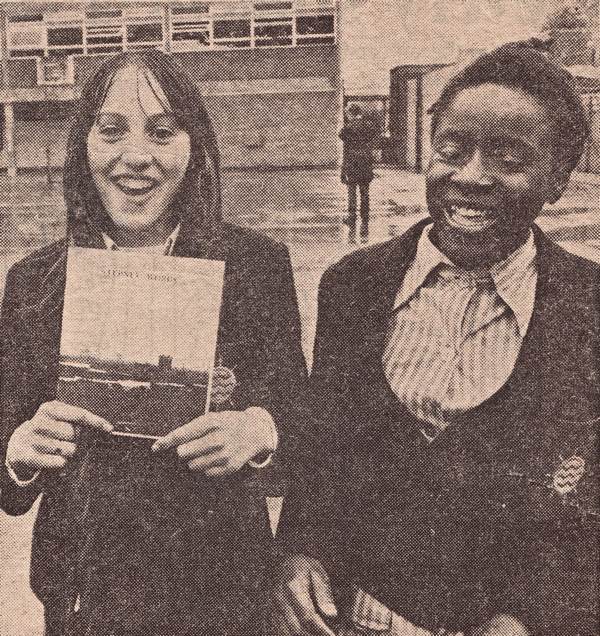
Broadcaster Alan Dein introduces a celebration this Sunday afternoon at Queen Mary University in Mile End, remembering the Stepney School Strike of 1971
‘It was such an extraordinary event. I’ve wanted to do a painting of it for such a long time – and now I’ve done it!,’ admitted Dan Jones, artist and former community worker, speaking of his newly completed banner commemorating the fiftieth anniversary of the Stepney School Strike.
It is the latest painting in a lifetime’s work, depicting the day-to-day lives of Eastenders, past and present. What began as a small picture in acrylic is now a canvas larger than a school blackboard. Yet this is the ideal size to portray hundreds of striking school children and a familiar scale for an artist who has created many beautifully painted banners that have been carried through the East End streets, now hung in galleries, archives and – famously – at the TUC Headquarters.
When Nadia Valman & I visited Dan in Cable St for sneak preview of his painting before it is unveiled publicly this Sunday at the People’s Palace, he revealed his motivation for portraying the celebrated school strike which has a personal meaning for him.
‘The teacher Chris Searle is a friend,’ he told us, ‘this is the story of a gifted writer and remarkable bloke being sacked. He got up the noses of the school governors – at what was then ‘Sir John Cass’ – for publishing a book of his students’ poems, but he was a popular teacher. The kids were furious and eight hundred teenagers marched to Trafalgar Sq protesting and demanding that Chris got his job back.’
Dan Jones did not use archive photographs as a reference, nor did he have access to any portraits of the kids. His approach was to work from imagination and draw inspiration from friends who were there at the time.
‘I’ve painted in about two hundred of the eight hundred schoolchildren who refused to go through the school gates,’ Dan explained. ‘It conveys the positive power of young people. Organised by playground gossip, effectively the whole school said this is an outrage. I wanted to get images of determination and fight. I feel proud to be doing it. There are smiles, banners, some of the poems themselves, I’ve squeezed them in – and you’ll see a portrait of Chris Searle, that’s most probably the only correct part of the painting!’
Like Dan Jones’ other paintings of crowds and public gatherings, there is a wonderful sense of the atmosphere created by people brought together in a fleeting moment for a cause that will change them forever.
Fifty years on, Chris Searle, original Stepney poets and strikers, together with academics, community activists and poets are gathering at Queen Mary University this Sunday 14th November to discuss the legacy of Stepney Words and the school strike.
Now known as ‘Stepney All Saints,’ the school has invited Chris Searle and some of his class of 1971 to collaborate with a group of current pupils in poetry workshops, and film of these sessions will be screened.
‘There were remarkable people in that group of striking kids,’ concluded Dan Jones, ‘it’s a lovely end to the story that fifty years on the sacked teacher has been welcomed back and has taught again at the very school he was sacked from. To be welcomed back as an honoured friend – it’s completely bonkers, and lovely!’
Click here to book for STEPNEY WORDS FIFTY YEARS ON, 2-6:15pm Sunday 14th November 2021




You may also like to read about
Henry Mayhew’s Street Traders
A few places are available for my last-ever course HOW TO WRITE A BLOG THAT PEOPLE WILL WANT TO READ on November 20th & 21st. This is your final chance to come to Spitalfields and spend a weekend with me in an eighteenth century weaver’s house in Fournier St, enjoy delicious lunches from Leila’s Cafe, eat cakes baked to historic recipes by Townhouse and learn how to write your own blog. Email spitalfieldslife@gmail.com to book a place.

The Long-Song Seller
There is a silent ghost who accompanies me in my work, following me down the street and sitting discreetly in the corner while I am doing my interviews. He is always there in the back of my mind. He is Henry Mayhew, whose monumental work,”London Labour & London Poor,” was the first to give ordinary people the chance to speak in their own words. I often think of him, and the ambition and quality of his work inspires me. And I sometimes wonder what it was like for him, pursuing his own interviews, one hundred and fifty years ago, in a very different world.
Mayhew’s interviews and pen portraits appeared in the London Chronicle and were published in two volumes in 1851, eventually reaching their final form in five volumes published in 1865. In his preface, Mayhew described it as “the first attempt to publish the history of the people, from the lips of the people themselves – giving a literal description of their labour, their earnings, their trials and their sufferings in their own unvarnished language.”
These works were produced before photography was widely used to illustrate books, and although photographer Richard Beard produced a set of portraits to accompany Mayhew’s interviews, these were reproduced by engraving. Fortunately, since Beard’s photographs have not survived, the engravings were skillfully done. And they are fascinating images, because they exist as the bridge between the popular prints of the Cries of London that had been produced for centuries and the development of street photography, initiated by JohnThomson’s “Street Life in London” in 1876.
Primarily, Mayhew’s intention was to create a documentary record, educating his middle class readers about the lives of the poor to encourage social change. Yet his work transcends the tragic politics of want and deprivation that he set out to address, because the human qualities of his subjects come alive on the page and command our respect. Henry Mayhew bears witness not only to the suffering of poor people in nineteenth century London, but also to their endless resourcefulness and courage in carving out lives for themselves in such unpromising circumstances.

The Oyster Stall. “I’ve been twenty years and more, perhaps twenty-four, selling shellfish in the streets. I was a boot closer when I was young, but I had an attack of rheumatic fever, and lost the use of my hands for my trade. The streets hadn’t any great name, as far as I knew, then, but as I couldn’t work, it was just a choice between street selling and starving, so I didn’t prefer the last. It was reckoned degrading to go into the streets – but I couldn’t help that. I was astonished at my success when I first began, I made three pounds the first week I knew my trade. I was giddy and extravagant. I don’t clear three shillings a day now, I average fifteen shillings a week the year through. People can’t spend money in shellfish when they haven’t got any.”

The Irish Street-Seller. “I was brought over here, sir, when I was a girl, but my father and mother died two or three years after. I was in service, I saved a little money and got married. My husband’s a labourer, he’s out of worruk now, and I’m forced to thry and sill a few oranges to keep a bit of life in us, and my husband minds the children. Bad as I do, I can do a penny or tuppence a day better profit than him, poor man! For he’s tall and big, and people thinks, if he goes round with a few oranges, it’s just from idleniss.”

The Groundsel Man. “I sell chickweed and grunsell, and turfs for larks. That’s all I sell, unless it’s a few nettles that’s ordered. I believe they’re for tea, sir. I gets the chickweed at Chalk Farm. I pay nothing for it. I gets it out of the public fields. Every morning about seven I goes for it. I’ve been at business about eighteen year. I’m out till about five in the evening. I never stop to eat. I am walking ten hours every day – wet and dry. My leg and foot and all is quite dead. I goes with a stick.”

The Baked Potato Man. “Such a day as this, sir, when the fog’s like a cloud come down, people looks very shy at my taties. They’ve been more suspicious since the taty rot. I sell mostly to mechanics, I was a grocer’s porter myself before I was a baked taty. Gentlemen does grumble though, and they’ve said, “Is that all for tuppence?” Some customers is very pleasant with me, and says I’m a blessing. They’re women that’s not reckoned the best in the world, but they pays me. I’ve trusted them sometimes, and I am paid mostly. Money goes one can’t tell how, and ‘specially if you drinks a drop as I do sometimes. Foggy weather drives me to it, I’m so worritted – that is, now and then, you’ll mind, sir.”

The London Coffee Stall. “I was a mason’s labourer, a smith’s labourer, a plasterer’s labourer, or a bricklayer’s labourer. I was for six months without any employment. I did not know which way to keep my wife and child. Many said they wouldn’t do such a thing as keep a coffee stall, but I said I’d do anything to get a bit of bread honestly. Years ago, when I as a boy, I used to go out selling water-cresses, and apples, and oranges, and radishes with a barrow. I went to the tinman and paid him ten shillings and sixpence (the last of my savings, after I’d been four or five months out of work) for a can. I heard that an old man, who had been in the habit of standing at the entrance of one of the markets, had fell ill. So, what do I do, I goes and pops onto his pitch, and there I’ve done better than ever I did before.”

Coster Boy & Girl Tossing the Pieman. To toss the pieman was a favourite pastime with costermonger’s boys. If the pieman won the toss, he received a penny without giving a pie, if he lost he handed it over for nothing. “I’ve taken as much as two shillings and sixpence at tossing, which I shouldn’t have done otherwise. Very few people buy without tossing, and boys in particular. Gentlemen ‘out on the spree’ at the late public houses will frequently toss when they don’t want the pies, and when they win they will amuse themselves by throwing the pies at one another, or at me. Sometimes I have taken as much as half a crown and the people of whom I had the money has never eaten a pie.”

The Street- Seller of Nutmeg Graters. “Persons looks at me a good bit when I go into a strange place. I do feel it very much, that I haven’t the power to get my living or to do a thing for myself, but I never begged for nothing. I never thought those whom God had given the power to help themselves ought to help me. My trade is to sell brooms and brushes, and all kinds of cutlery and tinware. I learnt it myself. I was never brought up to nothing, because I couldn’t use my hands. Mother was a cook in a nobleman’s family when I was born. They say I was a love child. My mother used to allow so much a year for my schooling, and I can read and write pretty well. With a couple of pounds, I’d get a stock, and go into the country with a barrow, and buy old metal, and exchange tinware for old clothes, and with that, I’m almost sure I could make a decent living.”

The Crockery & Glass Wares Street-Seller. “A good tea service we generally give for a left-off suit of clothes, hat and boots. We give a sugar basin for an old coat, and a rummer for a pair of old Wellington boots. For a glass milk jug, I should expect a waistcoat and trowsers, and they must be tidy ones too. There is always a market for old boots, when there is not for old clothes. I can sell a pair of old boots going along the streets if I carry them in my hand. Old beaver hats and waistcoats are worth little or nothing. Old silk hats, however, there’s a tidy market for. There is one man who stands in Devonshire St, Bishopsgate waiting to buy the hats of us as we go into the market, and who purchases at least thirty a week. If I go out with a fifteen shilling basket of crockery, maybe after a tidy day’s work I shall come home with a shilling in my pocket and a bundle of old clothes, consisting of two or three old shirts, a coat or two, a suit of left-off livery, a woman’s gown maybe or a pair of old stays, a couple of pairs of Wellingtons, and waistcoat or so.”

The Blind Bootlace Seller. “At five years old, while my mother was still alive, I caught the small pox. I only wish vaccination had been in vogue then as it is now or I shouldn’t have lost my eyes. I didn’t lose both my eyeballs till about twenty years after that, though my sight was gone for all but the shadow of daylight and bright colours. I could tell the daylight and I could see the light of the moon but never the shape of it. I never could see a star. I got to think that a roving life was a fine pleasant one. I didn’t think the country was half so big and you couldn’t credit the pleasure I got in going about it. I grew pleaseder and pleaseder with the life. You see, I never had no pleasure, and it seemed to me like a whole new world, to be able to get victuals without doing anything. On my way to Romford, I met a blind man who took me in partnership with him, and larnt me my business complete – and that’s just about two or three and twenty year ago.”

The Street Rhubarb & Spice Seller. “I am one native of Mogadore in Morocco. I am an Arab. I left my countree when I was sixteen or eighteen years of age, I forget, sir. Dere everything sheap, not what dey are here in England. Like good many, I was young and foolish – like all dee rest of young people, I like to see foreign countries. The people were Mahomedans in Mogadore, but we were Jews, just like here, you see. In my countree the governemen treat de Jews very badly, take all deir money. I get here, I tink, in 1811 when de tree shilling pieces first come out. I go to de play house, I see never such tings as I see here before I come. When I was a little shild, I hear talk in Mogadore of de people of my country sell de rhubarb in de streets of London, and make plenty money by it. All de rhubarb sellers was Jews. Now dey all gone dead, and dere only four of us now in England. Two of us live in Mary Axe, anoder live in, what dey call dat – Spitalfield, and de oder in Petticoat Lane. De one wat live in Spitalfield is an old man, I dare say going on for seventy, and I am little better than seventy-three.”

The Street-Seller of Walking Sticks. “I’ve sold to all sorts of people, sir. I once had some very pretty sticks, very cheap, only tuppence a piece, and I sold a good many to boys. They bought them, I suppose, to look like men and daren’t carry them home, for once I saw a boy I’d sold a stick to, break it and throw it away just before he knocked at the door of a respectable house one Sunday evening. There’s only one stick man on the streets, as far as I know – and if there was another, I should be sure to know.”

The Street Comb Seller. “I used to mind my mother’s stall. She sold sweet snuff. I never had a father. Mother’s been dead these – well, I don’t know how long but it’s a long time. I’ve lived by myself ever since and kept myself and I have half a room with another young woman who lives by making little boxes. She’s no better off nor me. It’s my bed and the other sticks is her’n. We ‘gree well enough. No, I’ve never heard anything improper from young men. Boys has sometimes said when I’ve been selling sweets, “Don’t look so hard at ’em, or they’ll turn sour.” I never minded such nonsense. I has very few amusements. I goes once or twice a month, or so, to the gallery at the Victoria Theatre, for I live near. It’s beautiful there, O, it’s really grand. I don’t know what they call what’s played because I can’t read the bills. I’m a going to leave the streets. I have an aunt, a laundress, she taught me laundressing and I’m a good ironer. I’m not likely to get married and I don’t want to.”

The Grease-Removing Composition Sellers. “Here you have a composition to remove stains from silks, muslins, bombazeens, cords or tabarets of any kind or colour. It will never injure or fade the finest silk or satin, but restore it to its original colour. For grease on silks, rub the composition on dry, let it remain five minutes, then take a clothes brush and brush it off, and it will be found to have removed the stains. For grease in woollen cloths, spread the composition on the place with a piece of woollen cloth and cold water, when dry rub it off and it will remove the grease or stain. For pitch or tar, use hot water instead of cold, as that prevents the nap coming off the cloth. Here it is. Squares of grease removing composition, never known to fail, only a penny each.”

The Street Seller of Birds’ Nests. “I am a seller of birds’-nesties, snakes, slow-worms, adders, “effets” – lizards is their common name – hedgehogs (for killing black beetles), frogs (for the French – they eats ’em), and snails (for birds) – that’s all I sell in the Summertime. In the Winter, I get all kinds of of wild flowers and roots, primroses, buttercups and daisies, and snowdrops, and “backing” off trees (“backing,” it’s called, because it’s used to put at the back of nosegays, it’s got off yew trees, and is the green yew fern). The birds’ nests I get from a penny to threepence a piece for. I never have young birds, I can never sell ’em, you see the young things generally die of cramp before you can get rid of them. I gets most of my eggs from Witham and Chelmsford in Essex. I know more about them parts than anybody else, being used to go after moss for Mr Butler, of the herb shop in Covent Garden. I go out bird nesting three times a week. I’m away a day and two nights. I start between one or two in the morning and walk all night. Oftentimes, I wouldn’t take ’em if it wasn’t for the want of the victuals, it seems such a pity to disturb ’em after they made their little bits of places. Bats I never take myself – I can’t get over ’em. If I has an order of bats, I buys ’em off boys.”

The Street-Seller of Dogs. “There’s one advantage in my trade, we always has to do with the principals. There’s never a lady would let her favouritist maid choose her dog for her. Many of ’em, I know dotes on a nice spaniel. Yes, and I’ve known gentleman buy dogs for their misses. I might be sent on with them and if it was a two guinea dog or so, I was told never to give a hint of the price to the servant or anybody. I know why. It’s easy for a gentleman that wants to please a lady, and not to lay out any great matter of tin, to say that what had really cost him two guineas, cost him twenty.”
Images courtesy © Bishopsgate Institute
You may like to take a look at
John Thomson’s Street Life in London
Aunt Busy Bee’s New London Cries
Marcellus Laroon’s Cries of London
More John Player’s Cries of London
William Nicholson’s London Types
Francis Wheatley’s Cries of London
John Thomas Smith’s Vagabondiana of 1817
Thomas Rowlandson’s Lower Orders


