
Around Billingsgate
Tickets are available for my Spitalfields tour throughout October & November
Click here to book for THE GENTLE AUTHOR’S TOUR OF SPITALFIELDS

Fish Porters at Number One Snack Bar next to St Magnus the Martyr
These intriguing photographs are selected from a cache of transparencies of unknown origin acquired by the Bishopsgate Institute. We believe they date from the nineteen-sixties but the photographer is unidentified. Can anyone tell us more?

Looking west along Lower Thames St and Monument St

Sign outside St Mary-At-Hill

Pushing barrows of ice up Lovat Lane

Passage next to St Mary-At-Hill

Carved mice on a building in Eastcheap

Old shop in Eastcheap

Billingsgate Market cat

Inside the fish market designed by Horace Jones

Old staircase near Billingsgate

The Coal Exchange, built 1847 demolished 1962

Part of London Bridge crossing Lower Thames St, now removed

The Old Wine Shades, Martin Lane

Sign of a Waterman, now in Museum of London

In All Hallows Lane

Derelict site next to Cannon St Station

Looking towards Bankside Power Station by Sir Giles Gilbert Scott, now Tate Modern

Old Blackfriars Station

The Blackfriar pub

Sculptures upon the Blackfriar

Sunrise over Tower Bridge
Images courtesy Bishopsgate Institute
You may also like to take a look at
Betty Levy Of Petticoat Lane
Tickets are available for my Spitalfields tour throughout October & November
Click here to book for THE GENTLE AUTHOR’S TOUR OF SPITALFIELDS

Betty
If you walked through the Petticoat Lane Market in the nineteen-twenties, you would frequently have seen Betty Levy with all her sisters playing hopscotch or skipping games in the street. You could easily have distinguished Betty because she was the baby with the mop of curls, and everyone knew Betty’s mother Hannah – famous as the best fish fryer in the Lane.
But maybe you do not remember, because maybe it is just too long ago for you? Yet that was certainly not the case for Betty herself. At ninety-two years of age, she remembered her childhood as if it were yesterday and given any opportunity she delighted to break into the same songs she sang then, accompanied by the ingenious lyrics she composed herself.
Betty left Petticoat Lane in 1954 but occasionally when speaking of the Lane, she said “And I’m still here,” and you realised it was a statement which transcended immediate reality, because while Petticoat Lane has changed almost beyond recognition, Betty still carried a world and a society and an ethos that incarnated the Petticoat Lane she knew, the place she always counted as home.
“I was born here, in Rosetta Place off Frying Pan Alley and my mother Hannah before me. My grandparents, Mark and Phoebe Harris, lived in Rosetta Place too and if we went in their flat, they always gave us something to eat.
My family have been here for generations, I always understood they were of Dutch descent. My father, Isaac, worked in Smithfield Market, he sold sweets to the porters and we never starved, so he must have made a living. They called him ‘Kosher’ and he sold the sweets from a basket round his neck. He got them from a small warehouse in Commercial St run by Mr Sam. If we were well behaved, he gave us one.
I went to the Jews Free School in Frying Pan Alley, it was a good school with good teachers and they treated us well. My grandmother sometimes gave me a plate of roast potatoes and told me to go and give them to the children in the park, and she left fried fish on the window sill for people to take. Nobody starved in the East End.
When I left school at fourteen, I went to work making dresses in Middlesex St, we were taught how to do it at school and I moved from one factory to another to better myself. I made all my family’s clothes, my children and grandchildren, and their bride’s dresses. If you spend your life doing something, you get a talent for it – I got to be as good as anyone at it. And I miss it now, I wouldn’t mind doing it again, part-time.
I was only seven years married when my husband Danny died aged thirty-nine, I think he had a heart attack. I met him at a dance at the Hammersmith Palais. We met dancing, we were both good dancers, not fabulous but pretty good. We were married at the Beaumont St Synagogue and we lived with my family at first. Then we found a house in Milward St, Whitechapel, round the back of the London Hospital. Although I was one of a large family, I only had two children – a boy and a girl, Irene and Stephen. After Danny died, my family offered to support me, but I wanted to be independent. If you’ve got to do it, you do it. I worked making dresses and I kept us, because I didn’t want anyone else to bring up my children.
I love the East End, there’s something in the East End that’s nowhere else. It is my home.”

Four of Betty’s sisters in Rosetta Place c. 1925
“We played among the doorsteps, for hours and hours
We never had gardens, so we couldn’t grow flowers.
Some kids they never had shoes, ’cause their dads were on the booze
But, we all lived together the Christians, the Jews
And the Jewish Free School was in dear old Frying Pan Alley.
Now there is not any doorsteps, they’ve knocked them all down,
They built a tower block where we played around.
The kids don’t play now like we used to,
On everybody’s doorsteps, in the East End of town.”
Betty’s new lyrics to the melody of ‘On Mother Kelly’s Doorstep’

The Levy Sisters. Sally, Phoebe, Lily, Carrie, Jennie, Becky and Betty (in front).

The Mitchell Family, neighbours in Rosetta Place. Betty Mitchell standing with Betty Clasper and little RayRay in front and Anita Mitchell, Barnie Mitchell, Siddy Segal and little Jo in line along the wall.

Some of the Levy grandchildren on the steps of St. Botolph’s Church Bishopsgate c. 1945. Alan, Diana, Bobby, Roy, Richard, Sallyann and little David.

Betty’s grandparents, Mark & Phoebe Harris, Spitalfields, c. 1920

Betty’s mother, Hannah Levy, daughter of Mark & Phoebe Harris, and famous as the best fish fryer in Petticoat Lane.

Betty’s father, Isaac in his ARP uniform.

Hannah Levy and friends in Frying Pan Alley around 1940.

Betty as a Land Army Girl in WWII, based at Sawbridgeworth in Hertfordshire.

Three Bettys (Levy, Cohen and Hyams) and three American airman at Westcliff-on-Sea c. 1945

At the centre (in a headscarf) is Betty with family and friends at the Coronation 0f Queen Elizabeth II. They slept out in Piccadilly to be sure of getting a prime position.

Betty sings at her ninetieth birthday party at Beaumont St Synagogue

Betty dances with her daughter Irene at the party.
You may also like to read these other stories of Petticoat Lane
The Wax Sellers of Wentworth St
Pamela Freedmam, The Princess Alice
The Dioramas of Petticoat Lane
Rob Ryan & The East End Trades Guild
Tickets are available for my Spitalfields tour throughout October & November
Click here to book for THE GENTLE AUTHOR’S TOUR OF SPITALFIELDS

by Rob Ryan
As one of those who conjured the EAST END TRADES GUILD into existence back in November 2012 to advocate for the interests of local small businesses, I am beyond proud to announce the tenth anniversary of the founding of the Guild. During such challenging times for independent enterprises, its role is more vital than ever.
In celebration of such an auspicious moment, the Guild have commissioned ROB RYAN to design this year’s map of East End traders which will be available free from all members on Small Business Saturday 3rd December.
Your deadline to join the Guild and be featured on the map is Monday 10th October. Small businesses, independent shops, social enterprises, charities and self-employed people can join.
CLICK HERE TO JOIN THE EAST END TRADES GUILD
All members will be invited to our huge tenth anniversary party for the East End Trades Guild on 23rd November at the Bishopsgate Institute which will include a presentation by yours truly, and Paul Gardner promises to wear a suit.
I shall be hosting East End Trades Guild walks around Spitalfields on Small Business Saturday, revealing the diverse histories of the shops that make the place and telling the story of the origins of the Guild here in London’s traditional heartland for small traders and independent endeavours.

The founding of the East End Trades Guild in 2012 photographed by Martin Osborne

Paul Gardner, Paper Bag Baron & Founder of the East End Trades Guild

Symbol of the East End Trades Guild designed by James Brown, 2012
You may also like the read about
The Founding of the East End Trades Guild
Frank Merton Atkins’ City Churches
Tickets are available for my Spitalfields tour tomorrow and through October
Click here to book for THE GENTLE AUTHOR’S TOUR OF SPITALFIELDS

Christ Church, Spitalfields, 1 October 1957
A collection of photographs by Frank Merton Atkins – including these splendid pictures of City churches were donated to the Bishopsgate Institute by his daughter Enid Ghent who had kept them in her loft since he died in 1964.
‘My father worked as a cartographer for a company of civil engineers in Westminster and he drew maps of tram lines,’ Enid recalled, ‘Both his parents were artists and he carried a camera everywhere. He loved to photograph old pubs, especially those that were about to be demolished. Sometimes he got up early in the morning to take photographs before work and at other times he went out on photography excursions in his lunch break. He was always looking around for photographs.’
Captions by Frank Merton Atkins

All Hallows Staining Tower, 25 June 1957, 1.22pm

Cannon Street, looking west from corner of Bush Lane, 7 June 1957, 8.21am

St Botolph Aldgate, from Minories, 31 May 1960, 1.48pm

St Bride from Carter Lane, 31 May 1956, 8.20am

St Clement Danes Church, Strand, from Aldwych, 14 October 1958, 1.22pm

St Dunstan in the East (seen from pavement in front of Custom House), 13 June 1956, 1.14pm

St George Southwark, from Borough High Street, 14 August 1956, 8.15am

St James Garlickhithe, from Queenhithe, 20 May 1957, 8.23am

St Katherine Creechurch, 27 May 1957, 8.32am

St Magnus the Martyr, from the North, 26 June 1956, 8.17am

St Magnus the Martyr, Lower Thames Street, 26 June 1956, 8.23am

St Margaret Lothbury, 2 August 1957, 1.12pm

St Margaret Pattens, from St Mary At Hill, 13 June 1956, 1pm

St Mary Woolnoth, 8 August 1956, 5.49pm

St Pauls Church, Dock Street, Whitechapel, 3 September 1957, 1.09pm

St Pauls and St Augustine from Watling Street, 7 May 1957, 8.25am

St Vedast, from Wood Street, 30 July 1956, 8.17am
Photographs courtesy Bishopsgate Institute
You may also like to look at
The Return Of Sue Hadley
Tickets are available for my tour of Spitalfields THIS SATURDAY 1st OCTOBER
Click here to book for THE GENTLE AUTHOR’S TOUR OF SPITALFIELDS

Sue Hadley returned recently for an afternoon to revisit some of her childhood haunts and I had the privilege of accompanying her.
“From the age of three, I grew up here in James Hammett House on the Dorset Estate in Bethnal Green. It was a good old Labour council and each of the buildings was named after one of the Tolpuddle Martyrs. Architecturally they are quite special, designed by the Tecton partnership. I used to slide all the way down the handrail of the spiral staircase, which is similar to the one they did for the penguin pool at the Zoo. We lived at the top of the building, on the tenth floor, and we were the very first residents to move in in 1957. But I stayed up at the top, I was not allowed to come down and play for many years – which was a disappointment. Once I was old enough to be allowed down, then the whole of the estate was my playground. Mum was a machinist working from home and Dad was a leaded light maker working in the Kingsland Rd.”

Sue on the balcony at James Hammett House

“This is Jones Dairy where I used to come with my Mum to do our shopping – cornflakes and tins. It was a proper traditional grocer with a man behind the counter in a white coat, Mr Evans. If you asked for a packet of cornflakes, he would get out his stick and stretch up to the shelf for it. My Mum was uncomfortable shopping here because she did not like people to know what she was buying.”

“At four years old, I started nursery school here at Columbia Rd School. I could see it from my house and I used to walk to school once I was old enough. It was a good school and I had a good education. The East End was being elevated then and we were lucky to have some excellent teachers. It was quite disciplined and I got told off once for being late for morning assembly. I got in with two children who said, ‘Shall we go to the sweetshop and buy sweets instead?’ So I spent my sixpence pocket money on sweets and then I went to school and I got told off. I was placed in front of everyone in the hall and my wrist was slapped several times as punishment. I wasn’t too riotous, I think I was quite academic. English and Art were my best subjects. I still have one long-standing friend, Carol, who I met here. My parents were completely thrilled when I got a place at Central Foundation School and I left at twelve.”

“Round the corner from us was a bomb site known as ‘the black buildings.’ Subsequently, I found out it was the Columbia Rd Market founded by Angela Burdett Coutts. It was an open bomb site and the most dangerous of places to play. We used to dare each other to go in because it was so creepy. There were dead cats and boys threw things at you. It was a place of mayhem but it was fun.”

“When I was eight years old, my sister who was twelve years older than me, got married here at Shoreditch Church. My Mum made the bridesmaid dresses but my sister splashed out on a proper bridal dress from Stoke Newington. It must have been quite a stretch because my sister paid for most of her own wedding. She still has all the original receipts! I remember thinking how boring the service was, it just seemed to go on for ever and ever. They went on honeymoon to Canvey Island. It was a successful marriage, they were married almost sixty years until she lost her husband last year.”

Sue stands central as bridesmaid at the wedding of her sister Barbara to Ron

“When I was a kid, the most exciting thing to do on a Sunday was to come here to Sclater St with my Dad. He would buy sensible things like boxes of broken biscuits and tins with no labels on, he was quite a cheapskate. Afterwards, I would drag him down here to the shops with birds in cages. There was donkey for sale here once and people brought their puppies to sell. It was all a bit dodgy which was why they shut it down eventually. However, for me it was the most exciting thing because I could play with the puppies and kittens although I never got to own one. We always had a budgie at home, it was always called ‘Jackie’ because we had a succession of them. We didn’t keep it in the cage, our bird was free the fly around the flat. Some escaped.”

“Central Foundation School For Girls was prestigious and I had the best education, with the broadest range of subjects. It was the time of the equal rights movement and our teachers were quite right on. The hall was where we did sports and I remember playing volley-ball and smashing one of the lights. I did fencing and my teacher was in the Olympic team, she did well.
I was completely daft because I got engaged at fifteen when I was still at school. Although the world was moving on, in the East End we never quite got it. My parents’ aspiration for me was that I should not work in a factory, so I worked in an office. I left school and went to work at Central Electricity Board in Newgate St as a copy typist. It was clean, it was a step up. I also got married and moved to Gravesend, but it all fell apart after two years because I hated being away from London. I felt like a fish out of water and I came back. When I walk these streets, I feel like I belong.
Ten years ago, I became a Blue Badge Guide. I have always been interested in history, so I did an Open University degree at forty. I have Huguenot ancestry and am descended from Sarah Marchant who was buried in Christ Church, Spitalfields, in the eighteenth century.
It all came good for me in the end because I have so much knowledge in my head and it really helps me doing my guiding. I love it.”

Sue in the fencing team at Central Foundation School for Girls
You may also like to take a look at
Adam Dant, Cartographer Extraordinaire
Tickets are available for my tour of Spitalfields THIS SATURDAY 1st OCTOBER
Click here to book for THE GENTLE AUTHOR’S TOUR OF SPITALFIELDS

The Gentle Author’s Tour Of Spitalfields
Cartographer Extraordinaire ADAM DANT opens the series of eight SPITALFIELDS TALKS I have curated with the Spitalfields Society at the Hanbury Hall in Hanbury St, next Tuesday 4th October at 6:30pm. Adam will be showing a selection of his maps including some of those in his new book, Adam Dant’s Political Maps published by Batsford.
Click here to book your ticket for Adam Dant’s talk for £6
Talks take place on the first Tuesday of each month, running through the winter into next spring. Readers are encouraged to buy season tickets at £35 available from Spitalfields Society.

The Map of Spitalfields Life

The Map of the Coffee Houses

The Map of Shoreditch as the globe

The Map of Shoreditch as New York

The Map of Shoreditch in the year 3000

The Hackney Treasure Map

The Map of Industrious Shoreditch

The Map of Wallbrook
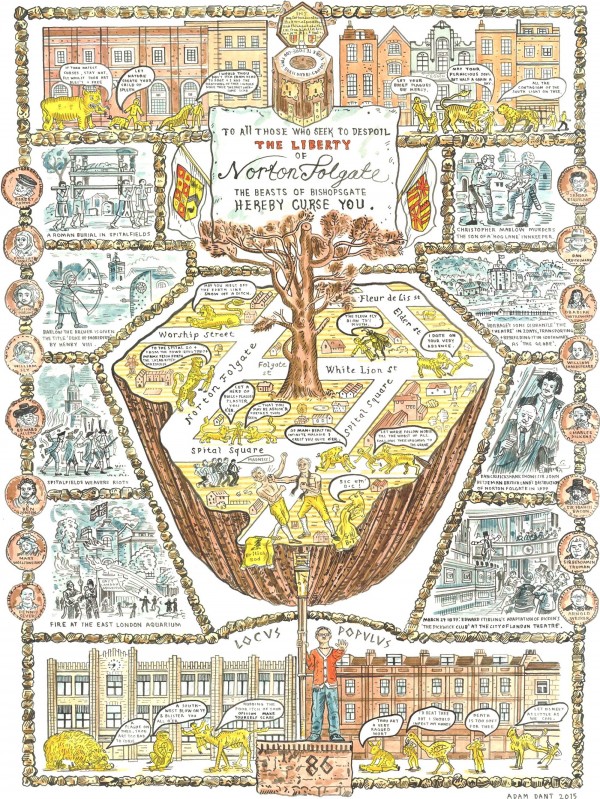
The Map of Norton Folgate

The Map of William Shakespeare’s Shordiche

The Map of Thames Shipwrecks
Maps copyright © Adam Dant
Prints of Adam Dant’s maps are available from TAG Fine Arts
You may like to take a look at the whole series of talks
A Flight In A 1939 Tiger Moth
Tickets are available for my tour of Spitalfields this Saturday 1st October
Click here to book for THE GENTLE AUTHOR’S TOUR OF SPITALFIELDS

What better way could there be to enjoy a warm September afternoon than taking a gentle spin in a 1939 Tiger Moth over Kent? I took off from Damyns Hall Aerodrome in Upminster where the East End pilots of World War Two did their training in exactly such a plane.
A train delivered me to Upminster, then a bus dropped me at Corbets Tey before I walked a mile along the grass verge towards Aveley. Strolling up an unremarkable farm track, I discovered a number of brightly coloured vintage aeroplanes and there, ahead of me, stretched a wide expanse of grass that serves as the runway.
My pilot Alex Reynier – the model of confident expertise in a sleek flight suit – was waiting in the clubhouse and, once I had signed a one day membership of the flying club, we walked out to survey the bright red Tiger Moth – as jaunty as a model plane.
These vehicles were used for pilot training – with two seats, one behind the other, open cockpits and dual controls. The robust simplicity of the vehicle is awe-inspiring, essentially a large kite with a motor engine attached. The wings are made of cloth stretched over a frame and the light-weight body of aluminium. Alex opened up the hood to reveal the engine, fitted upside-down to ensure that oil always reaches the pistons and it cannot stall.
I pulled the nozzle out of the nearby petrol pump and handed it Alex so he could fill the small overhead fuel tank, situated where the wings met. Wrapped in some extra layers for warmth, I climbed into my tiny cockpit then Alex strapped me in and fitted my headphones and microphone so we could communicate in the air.
After such a dry summer, the runway was bumpy but fortunately we did not discover any new rabbit holes and the tiny plane took off effortlessly into the sky, spiralling up at an astonishing speed into the rushing wind.
It is impossible not to be overwhelmed at first by the visceral experience of flight when you are exposed to the air without any barrier between you and the sky. You gaze down from the familiar height of an aeroplane, yet without any of the barriers that are designed to insulate you from the reality of flight in commercial airlines, especially the racing currents of wind and the vibration of the motor. In a Tiger Moth, you are seemingly suspended in air, like an insect.
We were high over the Dartford Bridge, so I turned my head right to see London and left to see the Thames estuary. Without direct reference, the sense of speed was indeterminate.
I was delighted and reassured to be reminded how green the landscape is, mostly undeveloped fields and woods, still peppered with fine old houses and castles – picture book England. Alex pointed out Eynsford Castle, Lullingstone Castle, Chavening House and Chartwell. At Chavening, we descended in a cheeky spiral around the house to take a nosy peek at the gardens. But the climax of the flight was to circle over Knole, just outside Sevenoaks. This is one of my favourite places and the house is often described as resembling a medieval city on account of its vast rambling structure, yet it appeared like a model that I could reach out and pick up if I chose.
Indeed I was beginning to feel that – from above – the world looked like a model of itself, the work of a fanatical enthusiast. This realisation engenders a seductive sense of powerful autonomy, encouraging the notion that it is all laid out from your pleasure and you can fly wherever you please upon a whim. Such was my exhilarated reverie, suspended at 1800 feet over Kent.
I discovered that in these tiny open planes, which take you so high into the air so quickly, the experience of flight has less mystique but a lot more wonder.

Knole

The Thames

Landing safe and sound at Damyns Hall Aerodrome


