
Henry Silk’s Still Life
Join me on an atmospheric autumn walk through the streets of Spitalfields. Click here to book for THE GENTLE AUTHOR’S TOUR OF SPITALFIELDS

In 1930, basketmaker and artist Henry Silk sits alone in his sparsely furnished room in Rounton Rd in Bow surrounded by few personal possessions. He glances in the mirror and realises that he is no longer young. Yet the pair of medals from the Great War laid on the table remind him how lucky he is to be alive.
He wakes in the camp bed in the early morning and the empty green room is flooded with light as dawn rises over the rooftops of the East End and washing flaps on the line. Weaving baskets suits a contemplative nature and, when Henry returns from the kitchen with a cup of tea, he sits at the table with the pink cloth and studies the objects upon the surface in the morning sunlight.
The forms and colours of these familiar things fascinate him. His pipe, his purse and his pocket knife that he carried for years are as commonplace to him as his own hands. Each day, Henry paints a picture to catalogue his personal possessions, comprising the modest landscape of his existence. It is a whole life in a handful of paintings.


Henry Silk and his sister
You may also like to read about
Henry Silk, Basketmaker & Artist

Click here to buy a copy of EAST END VERNACULAR for £25
Peri Parkes, Artist
Join me on an atmospheric autumn walk through the streets of Spitalfields. Click here to book for THE GENTLE AUTHOR’S TOUR OF SPITALFIELDS

House in the East, 1980-81
It was through the artist Doreen Fletcher, who is celebrated for her paintings of the East End, that I first learnt about the work of Peri Parkes.
Doreen wrote, ‘My good friend Peri Parkes was perhaps the artist with the most integrity I have ever met. His standards were so high that he was reluctant to exhibit anything he produced, always finding the outcome lacking somehow. Fellow artists tried hard to persuade him to have a one man show to no avail. He painted the East End assiduously during the eighties until he took a teaching post in Cornwall in 1992, however he continued to revisit to Bow right up until his death too soon at the age of fifty-six.’
On Doreen’s recommendation, I took the train to Hertford to meet Peri’s daughters, Lucie & Zoe who showed me fifty of their father’s paintings which have been mostly stored in a cupboard since he died in 2009. The quality and significance of this work was immediately apparent and I knew at once that I must devote a chapter in my book East End Vernacular, Artists Who Painted London’s East End Streets in the 20th Century to celebrate the rare talent and rigorous vision of Peri Parkes.
Out of the tragedy of a broken relationship, Peri Parkes created a transcendent series of paintings and it is impossible not to touched by the self portraits that he included in his work, of the lonely man walking in the park or climbing onto his bike.
Lucie & Zoe are the custodians of this legacy and they spoke affectionately to me about their father as we sat surrounded by his wonderful paintings.
Zoe – My father was from Hampstead Garden Suburb in Finchley. He had a Greek mother – who named him Pericles, she came from quite a well-to-do family and his father was a solicitor. Dad was born and grew up there but he left home very young, about sixteen. Then he met Lindsey, my mum, and they had me when he was just eighteen. My grandmother bought a house in Ridge Rd Crouch End and we all lived there.
Lucie – When he was nineteen, he got a scholarship to the Slade. I should add that when he was sixteen, he went off to Afghanistan, back-packing. He and mum first met at the railway station, just before he was about to leave and there was obviously a spark. Once he came back, they met up again and married when he was eighteen and mum was seventeen.
Zoe – When I was a baby, he used to take me off to college with him. He put me on his back and off we would go to the Slade.
Lucie – Mum had agoraphobia after she had Zoe, so he had to take her with him – a nineteen-year-old with his baby.
Zoe – They split up when I was six and Lucie was three, around 1979. He went to stay with his friend Martin Ives in a prefab in Conder St, Stepney and we stayed with our mum in her mum’s house. After that he got a housing association flat next to Bow Rd Station and then he moved just around the corner to Mornington Grove.
Lucie – He never had a studio, he just painted in the flat where he lived. He was completely unmaterialistic and his whole flat was his studio with bare floors, bare walls, furniture that he picked up from skips or off the street, boxes and then piles and piles of paints. All over the furniture there was paint splatters and full ashtrays. He did not really ever think about comfort.
Zoe – He was so driven by painting. He had a one track mind. He did not really want anything else in life but to be able to paint and to go to the pub.
Lucie – We used to go and stay with him every other weekend in the prefabs and hang around in the back yard, I remember doing snail races and counting slugs while he painted.
Zoe – He took us round galleries quite a lot, which as children was quite boring to us – but he used to get very enthusiastic about things he wanted to see.
Lucie – To say he was very self-absorbed is only half the picture because he was not egotistical, he was actually quite a humble person, and a loving and affectionate dad. I remember lying in bed in the prefabs when it was freezing cold and he used to tell us stories, and they were brilliant. We loved him and loved being with him, but he was not really able to give to his relationships because everything was about painting.
Zoe – I think he struggled with depression a lot, whether it was to do rejection as an artist or with not getting things right. He was a real perfectionist and he had massive temper flare ups if he was not satisfied with his work. Yet he had a real community in London. He used to go to the Coborn Arms every night and he had a crew of friends there.
Lucie – Nothing he did was ever right or good enough for him. He was always striving to be better. He could not give his paintings away let alone sell them but, if he did give one away to a family member, he took it back because it was not quite good enough. If he was here now, he would be looking at his paintings, very dissatisfied, and he would want to make changes.
He was driven to paint what he saw in front of him. I do not think he was driven to tell the story of the East End, it was just that, wherever he was, he painted obsessively to capture what he was seeing. Most of them are from his window in his living room or the back of his prefab.
Zoe – He was always submitting pictures for exhibitions and competitions, and he took the rejection quite personally.
Lucie – When his relationship broke down with mum he was deeply hurt. I think the more things went wrong in his life, the more he channelled everything into painting. I can remember him taking us home on the tube once and him looking at us and tears pouring down his face. That sticks with me because I knew then that he really cared and was hurt by the whole thing, but he could not express any of that – it all went into his painting.
Zoe – I look at these paintings and I see them as dad’s life at the time, from the time arrived in the East End in 1977 until he left in 1992. The style at the beginning is quite different from the later ones. He went on holiday to the tiny town of St Just on the farmost westerly point of Cornwall and fell in love with it. The day after returning from holiday he saw a job for a part time art teacher there in the newspaper, it was like an act of fate. He had taught Art at the Blessed John Roche School in Poplar and he wanted out of London. He loved it in Cornwall and lived in the most remote place. He said Cornwall was as close as he could get to Greece in this country.
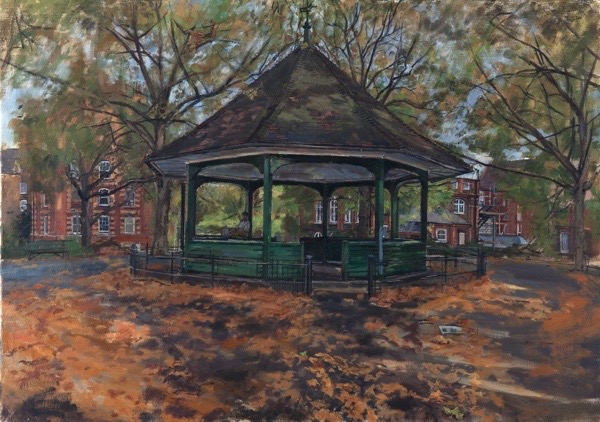
Arnold Circus, 1990-92

The Dinner Ladies, c.1986-9 (Wellington Way School, Bow E3)

Wellington Way School E3, 1985-6

Bow Triangle in Winter, 1990-92

The Departure, c.1992-4 (Mornington Grove, Bow E3)

Bow Church, c.1987-92

Conder St, Stepney, 1977-80

Conder St, Stepney, c.1980

City view from St Bernard’s School, St Matthew’s Row, E2, c.1987 (Click on this image to enlarge)
Paintings copyright © Estate of Peri Parkes
Click here to buy a copy of EAST END VERNACULAR for £25
A Ramble Through Long Forgotten London
Join me on an atmospheric autumn walk through the streets of Spitalfields. Click here to book for THE GENTLE AUTHOR’S TOUR OF SPITALFIELDS
As the dusk gathers, let us go rambling to explore the sights of long forgotten London in the volumes of Walter Thornbury’s London Old & New. It is a shadowy realm, conjured as if from a dream or nightmare.
This was how Londoners of the late nineteenth century looked back upon the city that had gone within living memory, a London that was already vanishing into reminiscence and anecdote in their time – a lost city, only recalled today in dark and dingy engravings such as these.

Golden Buildings, off the Strand

Boar’s Head Yard, Borough High St

Jacob’s Island, Southwark

Floating Dock, Deptford

Painted Hall, Greenwich

Waterloo Bridge Rd

Balloon Ascent at Vauxhall Gardens, 1840

House in Westminster, believed to have been inhabited by Oliver Cromwell

Old shops in Holborn

Mammalia at the British Museum

Rookery, St Giles 1850

Manor House of Toten Hall, Tottenham Court Rd 1813

Marylebone Gardens, 1780

Turkish Baths, Jermyn St

Old house in Wych St

Butcher’s Row, Strand 1810

The Fox Under The Hill, Strand

Ivy Bridge Lane, Strand

Turner’s House, Maiden Lane

Covent Garden

Whistling Oyster, Covent Garden

Tothill St, Westminster

Old house on Tothill St

The Manor House at Dalston

Old Rectory, Stoke Newington 1856

Sights of Stoke Newington – 1. Rogers House 1877 2. Fleetwood House, 1750 3. St Mary’s Rectory 4. St Mary’s New Church 5, New River at Stoke Newington 6. Queen Elizabeth’s Walk, 1800 7. Old gateway
Images courtesy Bishopsgate Institute
You may also like to take a look at
Dee Tocqueville, Lollipop Lady
Meanwhile, you can join me on an atmospheric autumn walk through the streets of Spitalfields. Click here to book for THE GENTLE AUTHOR’S TOUR OF SPITALFIELDS

Cordelia Tocqueville
Contributing Photographer Sarah Ainslie & I made the trip over to Leytonstone to pay homage to Cordelia – known as ‘Dee’ – Tocqueville, the undisputed queen of East End Lollipop Ladies, who has been out on the street pursuing her selfless task every day, come rain or shine, since 1974. “I took the job at first when my daughter was small, because she was at the school and I could be at home with her in the holidays,” Dee admitted to me, as she scanned the road conscientiously for approaching cars,“Though after the first winter in the rain and cold, I thought, ‘I’m not sticking this!’ but here I am more than forty years later.”
Even at five hundred yards’ distance, we spotted Dee Tocqueville glowing fluorescent at the tricky bend in Francis Rd where it meets Newport Rd outside the school. A lethal configuration that could prove a recipe for carnage and disaster, you might think – if it were not for the benign presence of Dee, wielding her lollipop with imperial authority and ensuring that road safety always prevails. “After all these years, I’m part and parcel of the street furniture,” she confessed to me coyly, before stepping forward purposefully onto the crossing, fixing her eyes upon the windscreen of an approaching car and extending her left hand in a significant gesture honed over decades. Sure enough, at the sight of her imperial sceptre and dazzling fluorescent robes the driver acquiesced to Dee’s command.
We had arrived at three, just before school came out and, over the next half hour, we witnessed a surge of traffic that coincided with the raggle-taggle procession of pupils and their mothers straggling over the crossing, all guaranteed safe passage by Dee. In the midst of this, greetings were exchanged between everyone that crossed and Dee. And once each posse had made it safely to the opposite kerb, Dee retreated with a regal wave to the drivers who had been waiting. Just occasionally, Dee altered the tone of her voice, instructing over-excited children at the opposite kerb to “Wait there please!” while she made sure the way was clear. Once, a car pulled away over the crossing when the children had passed but before they had reached the other side of the road, incurring Dee’s ire. “They’re impatient, aren’t they?” she commented to me, gently shaking her head in sage disappointment at human failing.
Complementing her innate moral authority, Dee is the most self-effacing person you could hope to meet.“It gives you a reason to get up in the morning, and you meet lots of people and make lots of friends,” she informed me simply, when I asked her what she got out of being a Lollipop Lady. Dee was born and grew up fifty yards away in Francis Rd and attended Newport Rd School as a pupil herself, crossing the road every day, until she crossed it for good when she married a man who lived a hundred yards down Newport Rd. Thus it has been a life passed in the vicinity and, when Dee stands upon the crossing, she presides at the centre of her personal universe.“After all these years I’ve been seeing children across the road, I have seen generations pass before me – children and their children and grandchildren. The grandparents remember me and they come back and say, ‘You still here?'” she confided to me fondly.
At three-thirty precisely, the tumult ceased and the road emptied of cars and pedestrians once everyone had gone home for tea. Completing her day’s work Dee stowed the lollipop in its secret home overnight and we accompanied her down Newport Rd to an immaculately-appointed villa where hollyhocks bloomed in the front garden. “I have rheumatism in my right hand where the rain runs down the pole and it’s unfortunate where I have to stand because the sun is in my eyes,” she revealed with stoic indifference, taking off her dark glasses once we had reached the comfort of her private den and she had put her feet up, before adding, “A lot of Boroughs are doing away with Lollipop Ladies, it’s a bad thing.” In the peace of her own home, Dee sighed to herself.
The shelves were lined with books, evidence of Dee’s passion for reading and a table was covered with paraphernalia for making greetings cards, Dee’s hobby. “People don’t recognise me without my uniform,” she declared with a twinkle in her eye, introducing a disclosure,“every Thursday, I go up to Leyton to a cafe with armchairs, and I sit there and read my book for an hour with a cup of coffee – that’s my treat.” Such is the modest secret life of the Lollipop Lady.
“When my husband died, I thought of giving it up,” Dee informed me candidly, “but instead I decided to give up my evening cleaning job for the Council, when I reached seventy, and keep this going. I enjoy doing it because I love to see the children. One year, there was an advert on the television in which a child gave a Lollipop Lady a box of Cadbury’s Roses and I got fifteen boxes that Christmas!”


“After all these years, I’m part and parcel of the street furniture”

Dee puts her feet up in the den at home in Newport Rd

Dee with her brother David in 1959 outside the house in Francis Rd where they grew up
Photographs copyright © Sarah Ainslie
You may also like to take a look at
On Night Patrol With Lew Tassell
Meanwhile, you can join me on an atmospheric autumn walk through the streets of Spitalfields. Click here to book for THE GENTLE AUTHOR’S TOUR OF SPITALFIELDS

Police Constable Lew Tassell of the City of London Police
“One week in December 1972, I was on night duty. Normally, I would be on beat patrol from Bishopsgate Police Station between 11pm-7am. But that week I was on the utility van which operated between 10pm-6am, so there would be cover during the changeover times for the three City of London Police divisions – Bishopsgate, Wood St and Snow Hill. One constable from each division would be on the van with a sergeant and a driver from the garage.
That night, I was dropped off on the Embankment during a break to allow me to take some photographs and I walked back to Wood St Police Station to rejoin the van crew. You can follow the route in my photographs.
The City of London at night was a peaceful place to walk, apart from the parts that operated twenty-four hours a day – the newspaper printshops in Fleet Street, Smithfield Meat Market, Billingsgate Fish Market and Spitalfields Fruit & Vegetable Market.
Micks Cafe in Fleet St never had an apostrophe on the sign or acute accent on the ‘e.’ It was a cramped greasy spoon that opened twenty-four hours a day, seven days a week. During the night and early morning it served print-workers, drunks returning from the West End and the occasional vagrant.
Generally, we police did not use it. We might have been unwelcome because we would have stood out like a sore thumb. But I did observation in there in plain clothes sometimes. Micks Cafe was a place where virtually anything could be sourced, especially at night when nowhere else was open.”
Lew Tassell

Middle Temple Lane

Pump Court, Temple

King’s Bench Walk, Temple

Bouverie St, News of the World and The Sun

Fleet St looking East towards Ludgate Circus

Ludgate Hill looking towards Fleet St under Blackfriars Railway Bridge, demolished in 1990

Old Bailey from Newgate St looking south

Looking north from Newgate St along Giltspur St, St Bartholomew’s Hospital

Newgate St looking towards junction of Cheapside and New Change – buildings now demolished

Cheapside looking east from the corner of Wood St towards St Mary Le Bow and the Bank

HMS Chrysanthemum, Embankment

Constable Lew Tassell, 1972
Photographs copyright © Lew Tassell
You may also like to take a look at
The Mind Keeps The Score
Let me take you on an atmospheric autumn walk through the streets of Spitalfields
Click here to book for THE GENTLE AUTHOR’S TOUR OF SPITALFIELDS

Andy Strowman
ANDY STROWMAN is hosting a poetry reading with fellow East End writers at House of Annetta, 25 Princelet St at 3pm on Sunday 30th October. Writers include Shamim Azad, Paul Collins, Jeffrey Kleinman, Roger Mills, Farah Naz, Milton Rahman, Ian Saville and Jamie Strowman.
The event is entitled THE MIND KEEPS THE SCORE, Remembering our past, honouring our future in stories and poems.
All are welcome, admission is free and no booking is required.
Let me introduce Andy Strowman, the poet of Stepney. ‘I’ve kept quiet for long periods of my life,’ Andy confessed to me when I met him recently. ‘I hope this interview will help people not to be ashamed and feel able to talk about whatever subject they want in life.’ Of modest yet charismatic demeanour, Andy is a born storyteller and I was rapt by his tale, unsentimental yet full of human sympathy too.
‘At Bearsted Maternity Hospital in Stoke Newington, the doctors said to my mother, ‘I’m sorry Mrs Strowman, you’re going to have to have a caesarean.’ But she said, ”Oh no you won’t’ and I gave one push and out you came.’ She showed formidable East End spirit. They brought me back to Milward St, where we lived at the back of the Royal London Hospital, one of the oldest streets in Whitechapel.
Rose, my mother – maiden name Cohen – was a true East Ender born at the Royal London Hospital. Her sister, my Aunty Rae, lived with us. Her brother Jack worked at the Cumberland Hotel where he introduced me to Mohammed Ali. Then there was Barney who was also a formidable, beautiful man. He ended up in Wormwood Scrubs because he was a Conscientious Objector. He was in the army but he had no bad bones in his body and refused to fight.
My mother started work at fourteen years old, her first job was in Whitechapel Rd at the junction with New Rd. She was besotted with wanting to be a milliner. She always stood up for herself and, in another generation, she would have been a Suffragette. In her first job, the governor told her to clean the toilets so she went home and told my grandmother.
My grandmother told the governor, ‘I sent my daughter here to get a training and learn a trade, she’s not here to clean toilets.’ He said, ‘But that’s how I started…’ So my grandmother told him, ‘My daughter’s not going to be working for you any more,’ and took her away. God bless her for fighting for her rights! My mother got another job and went up to the West End, copying designs for hats, then making them at home before taking them into her new work place where the manager was very pleased.
Her mother came from Vilna which was then in Russia, escaping the pogroms, the mass slaughter of Jews. She was fourteen when she came over and seventeen when she married. It was an arranged marriage to my grandfather, who was nineteen. He was from Warsaw, most likely the Vola district, and he was in the garment trade.
Sam, my father, was an American who became a black cab driver in London. His parents were Russian, from the Ukraine, who landed in New York. He came over here as a soldier in the Second World War and my mother met him in a night club in Piccadilly Circus. They got married in Philpot St Synagogue in Whitechapel, where I and my brothers had our Bar Mitzvahs.
It is emotional for me to talk about my childhood, because although there were many happy moments there were also many very sad ones. It still stays with me now and it is why I do everything I can to help other people.
There was an expectation that we would go out and play in the street to give our parents a break and we used to play football. We were often tasked with running errands for old people and my mum used to arrange for me to sit with old people in their houses too.
Next door lived Rosie Botcher. Mum and Betty Gillard used to go round and wash her down after she had cancer. When I was born, she was given a year to live but lived another thirteen years. Also in our street was Byla Kahn who was from Poland, I used to love to sit with her because she told me stories. Since I was always a good boy, I waited for that formidable moment when she pulled open a little drawer and produced a bar of Cadbury’s chocolate for me.
One of the stories she told me was about when she was living with her grandparents. One day, she was washing clothes in the river when a resplendent man came along on a horse. He climbed off and started to talk to her. He was beautifully dressed and had a sabre. When she got home and told her grandmother what had happened, her grandmother was furious. That man was a Cossack and they had a terrible reputation for violence against Jewish people.
I have so many memories of Milward St but, like so many good things, it came to an end. We got a letter and my brother Paul, the journalist, read at it and said, ‘We’re going to have to leave.’ By that time, my mum and dad had split up. My father left when I was fourteen and I did not see or hear from him again for nearly seven years. After he left my mother stayed in bed for year and gave up washing. The letter said the houses were ‘unfit for human habitation.’ I did not understand what it meant but my brother told me, ‘We can’t live here anymore.’
We moved to a maisonette in Wager St off Bow Common Lane but we missed the strong community in Milward St where neighbours helped each other. My uncle told me that on a Friday night, before the war, people would go out into the street and talk until one o’clock in the morning. He said that once the war came, people did not do it anymore and the habit never returned afterwards.
Primary school was an adventure for me. I was always the last one in and the first one out. I think I got it from my mother, she was born with a club foot and did not like school because the children used to make fun of her, so she had to leave school after everyone else had gone home.
However I made a lot of good friends at Robert Montefiore School in Hanbury St. My favourite memory is when I was late and got taken upstairs and put into the class room by my mum. She asked ‘Where’s Mr Martin?’ and one of the children said, ‘He’s gone out.’ So she went to the front and announced, ‘I’m going to take the class now – everybody be quiet.’ As you can imagine, I was embarrassed to the hilt but also secretly proud that my mum with so little education had become a teacher. She asked, ‘Anybody going on holiday this year?’ One by one, they announced where they were going to go. Then Mr Martin returned in an advanced state of intoxication and said, ‘Well done, Mrs Strowman, you’re doing a marvellous job, you’d make a great teacher.’
We all had to take the 11-plus exam before we went to a grammar school or a secondary school but we never told our mums. Four of us – Colin McGraw, Keith Britten, Stephen Jones and me – made this pact to sit near each other and fail the exam, so we would all end up in the same school. But, although they failed and stuck together, I got a place at a grammar school, Davenant School in Whitechapel.
There began the tumult of my life. If I had one wish, it would be to have left school at eleven. In the first week, I was completely sabotaged by what was going on. I could not cope or keep up, moving classrooms, and doing homework.
The Chemistry teacher had a formidable stance and a bellowing voice like a ship’s captain. I was beginning to shake in fear and he noticed that – he picked up on my anxiety. He dragged me along the floor by my jacket until we reached the blackboard, where he smashed me to the ground. I could not believe what was going on. He pulled me up and dragged me all the way back. The lesson continued. We were performing our first experiment, a test for hydrogen with a lighted splint. We were all working from textbooks and I was the only one to take it with me at the end of the class. He swore at me and smashed me against the wall with his fist. I was crying on the floor and my head was swollen. No charge was ever made against this man but I later discovered that he was well known for this kind of behaviour. The climate was fully acceptable for violence in that school.
The next day the headteacher pulled me out of class, took me to his office and said, ‘Strowman, you’ve got to learn to take the rough with the smooth. Now get back to class.’ From that moment onwards, my life was hell. Boys made fun of me and I was frightened most of the time, getting beatings off the other kids – sometimes four or five times a week. I had nobody to tell.
I asked to my brother, ‘Why didn’t you warn me?’ He told me, ‘They are all bad in there.’ He told me he was lining up outside the Art room once before class and heard this noise inside, so one of the boys opened the door to discover the headmaster and the Art teacher on the floor, punching each other.
The Geography teacher tried to make it kinder for me. He encouraged me to look beyond. ‘Look out the window and think of the real world,’ he said to me once.
Our English teacher gave the books out quickly and put his feet up on the desk. He would learn back in his chair, while a pupil read ‘The Pied Piper of Hamelin,’ and drink a half bottle of whisky right down at three o’clock in the afternoon. I got endeared to him quite quickly. On my way back to school after lunch at home, I would see him come out of the Blackboard pub and steer him across Valance Rd and back into school.
Eventually, I was put in a separate class with eight others – two of whom were known to the police – and we did not have to do homework. School was very damaging for me. I received an apology from the deputy headteacher, forty-eight years later.
The sun only began to come out when writing came into my life – it happened for two reasons. I had a teacher who encouraged me to write poetry and my brother Paul became a journalist, he was an inspiration to me. When I came back from school after the beatings and the taunts at fourteen years old, I found reading poetry was a great release – I wanted to change my name to W B Yeats! He was my hero, also Dylan Thomas, John Keats, Wilfred Owen and Isaac Rosenberg – also the Yiddish writers. These people inspired me. Without money coming in, like a lot of East End boys, I lived on my wits – so I used to dodge my fare to buy books.
After I had left school, when I was sixteen and a half, I met Becky who was from California at Liverpool St Station, where I used to go in the evenings as write my poetry. I wrote her a poem.
To this day, when I write, I cannot believe it is me. It was a passion. It was the way out for me. Suddenly I learnt I could express myself. For around a year and a half, I was wandering around trying to get someone to take on my poetry. I visited publishers but got nowhere.
In the end somebody said to me, ‘Why don’t you try Chris Searle?’ He was the Stepney English teacher whose pupils went on strike after he was sacked. So went to a phone box in Aldgate by Gardiner’s Corner to call him and he said, ‘Why don’t you come round this evening?’ He became like a surrogate father to me. He recognised my work and helped publish STORY OF A STEPNEY BOY. He opened this magic door and I could go through it.
Poetry elevated my spirit and helped me to see myself more objectively. It took the thorns out of my soul.’

Andy, aged seven


Andy with his mother at the seaside

Andy aged eleven, with his parents


Uncle Davey

Uncle Jack once introduced Andy to Mohammed Ali


Andy’s father with Uncles, Davey and Jack

After Andy’s brother Howard’s Bar Mitzvah – Andy sits front left


Andy’s maternal grandmother

Aunty Rae

The wedding of Andy’s maternal grandparents
Copies of STORY OF A STEPNEY BOY may be obtained direct from Andy Strowman by emailing andy.strowman1@gmail.com
You may also like to read about
Dr Margaret Clegg, Keeper Of Human Remains
Enjoy an atmospheric autumn walk through Spitalfields
Click here to book for THE GENTLE AUTHOR’S TOUR OF SPITALFIELDS

“They were once living, breathing people – they are you.”
In Spitalfields, people often talk of the human remains that were removed from the crypt – nearly a thousand bodies that were once packed in tight during the eighteenth century, safe from resurrectionists and on their way to eternal bliss.
During the nineteen-eighties, they were exhumed and transferred to the Natural History Museum where they rest today under the supervision of Dr Margaret Clegg, Head of the Human Remains Unit, who guards them both with loving attention and scholarly rigour, unravelling the stories that these long-ago residents of Spitalfields have to tell us about the quality of their lives and the nature of the human species.
“From the very first lecture I attended on the subject as an undergraduate, I became fascinated by what human remains can tell us about ourselves,” Dr Clegg admitted to me enthusiastically, “You can’t help but feel some kind of relationship when you are working with them. They were once living, breathing people – they are you.”
Dr Clegg led me through the vast cathedral-like museum and we negotiated the swarming mass of humanity that crowded the galleries on that morning, until we entered a private door into the dusty netherworld where the lights were dimmer and the atmosphere was calm.
“Dr Theya Mollison did the original excavation of the remains in the nineteen-eighties. There were more than nine hundred and for about half we know their age, sex, and when they were born and when they died, from the coffin plates. After they were removed, the remains were brought here to the Natural History Museum for longer-term analysis and study of the effects of occupation and the types of diseases they suffered. We had a large amount of information and could tell who was related to who. We could also tell who died in childbirth, and we have juveniles so we got information on childhood mortality and the funerary practices for children and babies, for example.
We have a special store for human remains at the museum, where each individual is stored in a separate box – it’s primarily bones but some have fingernails and hair. Any bodies that had been preserved were cremated when they were exhumed. The museum applied for a faculty from the Diocese of London to store the bones, the remains are not part of our permanent collection. The first faculty was for ten years and over time a second and third faculty were granted, but this will be the final one during which a decision will be made about the final disposition of the bones. During these years, the bones have been studied intensively. They are quite rare, there are very few such collections in which we know the age and sex of so many. They are probably our most visited and most researched collection. We have our own internal research and visiting researchers come from all over the world – for a wide variety of research purposes, including important work in forensics and evolutionary studies.
I am by training a biological anthropologist, and I am interested in the study of human archaeological remains from the perspective of how they grew and developed and what that can tell us about them.
In Spitalfields, you can compare families of the same age – one that ages quickly and one that ages slowly, which tells us something about the variables when we try to calibrate the date of remains at other sites. You can’t always tell what they did but you can tell, for example, that they used their upper body or that they developed muscles in their arms or legs as a direct result of their occupation. My dad was a printer and when he started out he used a hand press and developed a muscle in his arm as a consequence of using it. He’s seventy-nine and it’s still there. In those days, people started work at twelve or thirteen while the muscles were still developing and these traits quickly became established based upon their occupation. They were the ordinary working people of eighteenth century Spitalfields.
We get half a dozen emails a year from families who want to know if their ancestor who was buried in Christ Church is in the collection, but often I can’t help because they were buried in the churchyard or another part of the church. Occasionally, relatives ask if they can come and see them.”

Bonnet collected during excavations at Christ Church.

Shroud collected during excavations at Christ Church.

Cotton winding sheet collected during excavations at Christ Church.

Gold lower denture formed from a sheet of gold which was cut and folded around the lower molars.

Medicine bottle found in a child’s coffin during excavations at Christ Church.

Archaeological excavations in the crypt of Christ Church, Spitalfields, London, 1984-1986.
Excavation images © Natural History Museum
Portrait of Dr Clegg © Sarah Ainslie
You may also like to read about


