
Daniele Lamarche’s East End
Enjoy an atmospheric autumn walk through the dusk in Spitalfields
Click here to book for THE GENTLE AUTHOR’S TOUR OF SPITALFIELDS

Cheshire St Doorway – “He once ran after me into the beigel shop and urged me to follow him. I had no idea what he wanted, but he led me back to my car on Bethnal Green Rd to show me that I’d left my keys in the door – he was desperately worried I would lose them. It made me chuckle after that when passers-by clutched their shoulder-bags firmly and crossed the street at the sight of him.”
Photographer Daniele Lamarche came to stay in a flat in Wentworth St for two weeks in 1981 and ended up staying on for years. Working as an international news scriptwriter for Independent Television News in Leadenhall St, Daniele first visited Brick Lane when the Indian correspondent brought her here for lunch and she was capitivated. “As you crossed Middlesex St, coming from the City of London, all the windows were smashed and things were desolate.” she recalled, yet for Daniele it was the beginning of a fascination explored through photography which continues until the present day. “I found it interesting that a lot of people would not come and visit me in East London,” she confided to me, “Because it was the first place I found in London with a sense of wonder, a sense of poetry.”
In 1982, Daniele began taking photographs in Brick Lane. It was a time of racial discord in the East End and, working for the GLC Race & Housing Action Team, Daniele employed her photography to record injuries inflicted upon victims of racial assault, the racist graffiti and the damage that was enacted upon the homes of immigrants, the broken windows and the burnt-out flats. “People actually spat at me and shouted at me in the street,” she confessed. Undeterred, Daniele became part of the Bengali community and was called upon to photograph poor living conditions as residents campaigned for better housing – with the outcome that she was also invited to record more joyful occasions too, weddings and community events.
A Californian of French/American ancestry who grew up in Argentina and was taught to ride by a Gaucho, Daniele found herself in her element working at the Spitalfields City Farm for several years where she kept dray horses and rode around the East End in a cart. An experience which afforded the unlikely observation that the lettered fascias on shops and street signs are placed high because they were originally designed to be at eye-level for those sitting in horse-drawn vehicles. Becoming embedded in Spitalfields, Daniele photographed many of the demonstrations and conflicts between Anti-Fascist and Racist groups that happened in Brick Lane, taking pictures for local and national newspapers, as well as building up a body of personal work which traces her intimate relationship with the people here, reflecting the trust and acceptance she won from those whom she met.

George, Nora & the Pigeon Cage – “East Enders who once cared for the ravens at the Tower of London, they soon took to raising racing pigeons for club meetings and competitions.”

Bethnal Green Pensioner – “A delicately-faced woman answered the door when I knocked and talked to me at length about her life, her dreams and her memories…”

Elections – “A group of Bengali women vote in 1992 – when the BNP stood in Tower Hamlets – many for the first time, following a drive made by groups including ‘Women Unite Against Racism.’ This was formed when local women found themselves to be three or four in meetings of over a hundred men and decided that, rather than be patronized as token females, they preferred to reach out to empower and support those women who might not otherwise vote.”

Eva wins the prize – “Eva came from Germany in the fifties, and grew plants and made soups out of what others might consider weeds – nettles, spinach, beet root tops – as well as sewing and embroidering all manners of pillows and textile pieces, from hop-pillows to aid sleep at night to tablecloths in the Richelieu style – and she was always game to show her wares of jams, sewing and plants at local events.”

French waiter in the docklands.

John & John – “This is John Lee, formerly of Spitalfields City Farm, now an organic dairy and pig co-operative farmer in Normandy, and ‘John’ who would often pop in to visit from Brick Lane Market and use the toilet.”

Immigration – “This refers to the moment when individuals of Asian origin in East Africa were told their colonial British passports would be no longer valid after a certain date – thus causing many to come to Britain to establish their rights to nationality, and as a result, many families camped out at the airport waiting to be met.”

Toy Museum Lascars – “a set of nineteenth century figures which represent seamen from a range of ethnicities and cultures who would have once been seen in the docklands.”

Lam at Fire – “Lam who worked for the GLC’s Race and Housing Action Team visits a family of Vietnamese heritage in 1984 in the Isle of Dogs after they were petrol bombed the night before and only saved because the granny awoke and saw smoke. Lam lived as a refugee in Hong Kong, and then in England where he was housed at first in a small village which greeted him with a gift of dog faeces through the letter box. ‘Is it the same in the USA?’ he asked me.”

Minicab – “A traditional minicab sign hovers over a resident whose front door, back door and side doors touched three different boroughs, causing him havoc and much correspondence with council tax officers.”
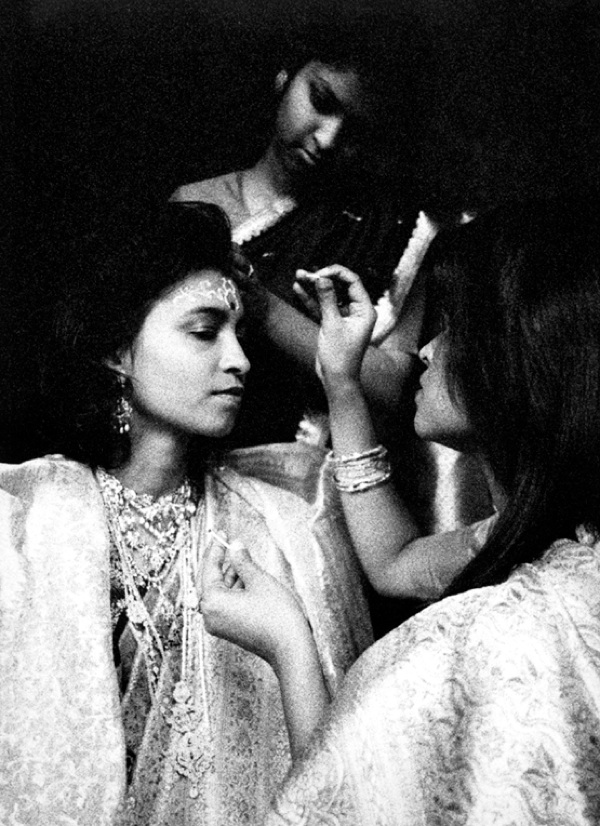
“Noore’s sister-in-law and friends help with wedding preparations, and a spot of toothpaste for intricate designs on her forehead.”

Paula, Woodcarver in her studio.

“Peter’s trades ranged from wheeling an old cart around as a rag & bone man to performing Punch & Judy puppet shows at children’s parties. Furniture and objects of interest flowed through his flat, and overflowed into the courtyard when a boat, which he’d sit in for evening cocktails, wouldn’t fit through the front door….”

Salmon Lane Horses – “A girl and her mother wait for the farrier after returning from school. Stables with horses for work and leisure dotted the streets and yards until developers picked off the remainder of the wasteland and yards where the animals were housed.”

Somali Girl – “This shows one of a group of children playing in a courtyard off Cable St where homes backed onto one another, enabling children to play within sight and ear-reach of parents indoors.”

Vietnamese Baby – “A voluntary sector advocate visits a Vietnamese family to check on their newborn’s progress. Over five hundred Vietnamese children of Chinese origin attended Saturday supplementary school classes at St Paul’s Way School in the eighties and nineties, most from Limehouse and the Isle of Dogs. Many had been housed across Britain but chose to leave the isolation of village homes, offered in a Home Office policy of dispersement, preferring the security of living in the metropolis – sometimes with thirteen family members in two rooms – thereby linking with community networks leading to jobs, further training and more fulfilling lives.”

Members of the Vietnamese Friendship Society.

Lathe, Whitechapel Bell Foundry – “Photographed in the eighties when the Bell Foundry was more a local point of interest, before it grew internationally famous.”

Brick Lane at Night – ” At a time when women were rarely seen on Brick Lane, I was once asked where my ‘friend’ was. I said the person I usually shopped with must be out and about – to which the questioner kindly patted my hand and whispered ‘they always come back…’ Some time passed before it dawned on me that many of the white women accompanying Asian men on the street were ‘working women’….”

Market Cafe Farewell – “Market traders, artists and local characters, ranging from Patrick who directed traffic from the Blackwall Tunnel and Tower Bridge to Commercial St- regardless of whether it flowed without his assistance – all squeezed into this one-room-cafe which opened in the early hours of each morning. Then it vanished one day with only a farewell note left to confirm where it had been.”
Photographs copyright © Daniele Lamarche
At Paul Pindar’s House
Tickets are available for my Spitalfields tour throughout October & November
Click here to book for THE GENTLE AUTHOR’S TOUR OF SPITALFIELDS

House of Sir Paul Pindar by J.W. Amber
If William Shakespeare passed along Bishopsgate around 1600, he might have observed the construction of one of the finest of the mansions that formerly lined this ancient thoroughfare, Sir Paul Pindar’s house situated on the west side of the highway beyond the City wall next to the Priory of St Mary Bethlehem.
Paul Pindar was a City merchant who became British Consul to Aleppo and subsequently James I’s Ambassador to Constantinople. Although he returned home from his postings regularly, he did not take permanent residence in his house until 1623 when he was fifty-eight and between 1617-18 it served as the London abode of Pietro Contarini, Venetian Ambassador to the Court of St James.
Who can say what precious gifts from Sultan Mehmet III comprised the inventory of Ottoman treasures that once filled this fine house in Bishopsgate? Pindar’s wealth and loyalty to the monarch was such that he made vast loans to James and Charles I who both dined at his house, as well as contributing ten thousand pounds to the rebuilding of St Paul’s Cathedral. Yet Charles’ overthrow in 1649 meant that Pindar was never repaid and he died with huge debts at the age of eighty-five in 1650. What times he had seen, in a life that stretched from the glory days of Elizabeth I to the decapitation of Charles I.
Remarkably, Paul Pindar’s house survived the Great Fire along with the rest of Bishopsgate which preserved its late-medieval character, lined with shambles and grand mansions, until it was redeveloped in the nineteenth century. His presence was memorialised when the building became a tavern by the name of The Paul Pindar in the eighteenth century.
Reading the correspondence of CR Ashbee from the eighteen-eighties in the archives of the Society for the Protection of Ancient Buildings in Spital Sq, I was astonished to discover that, after Ashbee’s successfully campaign to save the Trinity Green Almshouses in Whitechapel, he pursued an ultimately fruitless attempt to rescue Paul Pindar’s house from the developers who were expanding Liverpool St Station.
In his poignant letters, arguments which remain familiar in our own time are advanced in the face of the unremitting commercial ambition of the railway magnates. CR Ashbee reminded them of the virtue in retaining an important and attractive building which carried the history of the place, even proposing that – if they could not keep it in its entirety – preserving the facade integrated into their new railway station would prove a popular feature. His words were disregarded but, since Paul Pindar’s house stood where the Bishopsgate entrance to Liverpool St Station is now, I cannot pass through without imagining what might have been and confronting the melancholy recognition that the former glories of Paul Pindar’s house are forever lost in time, as a place we can never visit.
The elaborately carved frontage, which concealed a residence much deeper than it was wide, was lopped off when the building was demolished in 1890 after surviving almost three hundred years in Bishopsgate. Once the oak joinery was dis-assembled, it was cleaned of any residual paint according to the curatorial practice of the time and installed at the Victoria & Albert Museum in South Kensington when it opened in 1909. You can visit this today at the museum, where the intricate dark wooden facade of Paul Pindar’s beautiful house – familiar to James I, Charles I and perhaps to Shakespeare too – sits upon the wall as the enigmatic husk of something extraordinary. It is an exquisite husk, yet a husk nonetheless.

Sir Paul Pindar (1565–1650)

Paul Pindar’s House by F.Shepherd

View of Paul Pindar’s House, 1812

Street view, 1838

The Sir Paul Pindar by Theo Moore, 1890

The Sir Paul Pindar photographed by Henry Dixon, 1890

Paul Pindar’s House as it appeared before demolition by J.Appleton, 1890

Facade of Paul Pindar’s House at the Victoria & Albert Museum

Bracket from Paul Pindar’s House at the Victoria & Albert Museum

Paul Pindar’s Summer House, Half Moon Alley, drawn by John Thomas Smith, c. 1800

Panelled room in Paul Pindar’s House

Bishopsgate entrance to Liverpool St Station
Archive images courtesy Bishopsgate Institute
You may also like to read about
The Romance of Old Bishopsgate
The Canal Club Is Saved!
Tickets are available for my Spitalfields tour throughout October & November
Click here to book for THE GENTLE AUTHOR’S TOUR OF SPITALFIELDS

Toslima Rahman with her daughter Saima & son Ayaan at the Canal Club
I am delighted to report that after an heroic three-year fight by the local community, the proposal for development has been withdrawn by the new regime at the council and the beloved Canal Club and community garden in Bethnal Green is saved.
Here is the feature that Novelist Sarah Winman wrote when she first visited with Photographer Rachel Ferriman to report on the threat to the community spaces at the Wellington Estate.
The Canal Club sits at the corner of Waterloo Gardens and Sewardstone Rd in Bethnal Green. It consists of a playground, a ball park, a community centre and community garden between the vast Wellington Estate to the east, of which it is part, and the Grand Union Housing Coop to the west. At the southern border is Belmont Wharf, a small boating community established by Sally and Dominique who were granted permission by the council nine years ago to have moorings along this stretch of Regent’s Canal and to create a sustainable garden for boat dwellers and land dwellers alike.
The garden is incredibly beautiful, a biodiverse haven. The sound of children playing carries across the water from Victoria Park and faded bunting flutters in the breeze. Flowers of every colour bloom and bees are plenty and go about with purpose. Butterflies delight around the nettles and even bats have found a home here. This garden has been created with care and thought and, more importantly, time. The air is sweet and clean, far removed from the fug of Cambridge Heath Rd and Hackney Rd that pollute nearby.
I met residents Sally, Dominique, Alex, Ricardo, Helga, Erdoo, Mr & Mrs Ali, and Toslima to learn that this beloved site had been selected by Tower Hamlets Council for a housing infill scheme. These schemes are becoming common practise by councils, who target sites – usually recreational – on existing estates and build further.
The proposal for the Wellington Estate was to demolish the Canal Club and remove the open space and community asset it provides. This was to construct a further twenty-two flats on an already densely populated estate which was built in the thirties as an answer to slum clearance – basically, it was taking space from those who have little to start with.
It was a complex situation that was the outcome of thirty years of right-to-buy, money held by central government and the chronic need for housing. However, what was inexcusable to the residents of the estate and the boating community and supportive locals, was the opaque nature of the dealings – the council’s lack of transparency and openness to discussion. Two years earlier, they thought they were simply looking at the refurbishment of their community centre, until they later found out that the decision to demolish the Canal Club site was already under way.
Alex explained that the Canal Club land was given by the GLC to the people of the Wellington Estate in the late seventies and early eighties to offset the overcrowding and the lack of balconies and gardens. It was their land and she believed the council had a responsibility to share their ideas with the residents. The irony was not lost on her too, that Tower Hamlets said they were an Climate Emergency Council and yet were taking away the only green public space on the estate.
Everyone talked about the eighties and nineties when the community centre was thriving. It was hired out for weddings and birthdays then. There was a youth club, opportunities to learn a second language and for recent immigrants to learn English, space for pensioners to get together, and for the residents association to meet and share ideas. Dwight told us he was a member of the youth club and it was the only chance for kids to have day trips out of London. He remembered camping in Tunbridge Wells. The chance to ride horses and canoe – see a different life, be a different person.
There was nothing for kids after that, someone said. So much had already gone. And if you take away the ball park, then what? Looting across the generations, another said. Building slums of the future, said another. Erdoo, who has lived on the state all her life, told me that her dad Joseph looked after the Community Centre for years before the council took away his key and barred the local residents from using it anymore. Then the Community Centre was offered up to private use for private rents. The popular Scallywags nursery is the present tenant, but ill-feeling from that time remains.
This engaging group of people cared so much about their environment and improving the lives of others. Yet what was apparent was how the agency of council tenants was being eroded in the widening chasm of inequality.
The right to space and light and clean air can never only be for the rich.
I stood on the old wharf where the custodians, Sally and Dominique, repaired it with two-hundred-year-old bricks. Wildflowers grew there and nature had reclaimed an area once used for the dumping of waste. Kick the soil and a filament of plastic was revealed, hidden by knapweed or evening primrose, or large swathes of hemp-agrimony. Over the years, composting had built up the fertility of the soil, attracting a diversity of insects and bird population. Dominique explained that the principle of permaculture is to work in sympathy with nature and harness its natural energy. A wild colony of bees appeared every year for a few weeks when the cherry tree blossoms and then disappeared again to their unknown world. Dominique kept a daily diary of the changes and visitations. The secret life that we do not see, either because we move too fast or because the insects are too small.
When the license for this garden expired, Dominique and Sally feared the council will not renew it if the demolition went ahead. I found it unbelievable that such a necessary and beautiful urban green space could be sacrificed especially in a time of declining mental health. The benefits that access to nature provides are irrefutable. This community garden is more than a garden, it is a destination for the carers and patients who come down from the Mission Practise or readers looking for solitude. It is a resource for artists seeking inspiration and children who want to know how the natural world works – or simply those who need to be reminded that they are more than their circumstance.
As I left this corner of East London, I was reminded of a speech delivered by Robert Kennedy back in the sixties about how the value of a country is measured – “It does not allow for the health of our children, the quality of their education or the joy of their play. It does not include the beauty of our poetry… It measures neither our wit nor our courage, neither our wisdom nor our learning, neither our compassion… it measures everything in short, except that which makes life worthwhile.”

The Wellington Estate

Save Our Community Spaces – Refurbish Not Demolish

In the Community Garden

Dominique Cornault at the Canal Club

Sally Hone at the Canal Club

Mr & Mrs Ali outside the Canal Club

Helga Lang at the Canal Club


Dwight James at Belmont Wharf


Erdoo Yongo outside her mum’s house on Wellington Estate


Barbara, resident of the Estate, and Bonny her dog

Photographs copyright © Rachel Ferriman
You may also like to take a look at
Frank Derrett’s West End
Tickets are available for my Spitalfields tour throughout October & November
Click here to book for THE GENTLE AUTHOR’S TOUR OF SPITALFIELDS

Cranbourne St
Fancy a stroll around the West End with Frank Derrett in the seventies?
This invitation is possible thanks to the foresight of Paul Loften who rescued these photographs from destruction in the last century. Recently, Paul contacted me to ask if I was interested and I suggested he donate them to the archive at the Bishopsgate Institute, which is how I am able to show them today.
‘They were given to me over twenty-five years ago when I called at an apartment block in Camden,’ Paul explained. ‘A woman opened the door and, when said I was from Camden Libraries, she told me a solicitor was dealing with effects of a resident who had died and was about to throw these boxes of slides into a skip, and did I want them? I kept them in my loft, occasionally enjoying a look, but actually I had forgotten about them until we had a clear out upstairs.’

Charing Cross Rd

Bear St

Coventry St

Regent St

Earlham St

Long Acre

Dover St

Carnaby St

Carnaby St

Charing Cross Rd

Cranbourne St

Dover St

Perkins Rents

Great Windmill St

Brook St

Conduit St

Frith St

Drury Lane

Dean St

Garrick St

Great Windmill St

Archer St
Images courtesy Bishopsgate Institute
You may also like to take a look at
Alfred Daniels’ Murals
Tickets are available for my Spitalfields tour throughout October & November
Click here to book for THE GENTLE AUTHOR’S TOUR OF SPITALFIELDS

Old Hammersmith Bridge by Alfred Daniels
When I met Alfred Daniels, the painter from Bow, almost the first thing he said to me was, ‘Have you seen my murals in Hammersmith Town Hall? I’m very proud of them.’ So it was with more than a twinge of regret when I went to see the murals for the first time, years since he died, realising I should have gone while Alfred was here to tell me about them.
Yet it proved an exhilarating experience to discover these pictures that declare themselves readily and do not require explanation. Five vast paintings command the vestibule of the old town hall, created with all the exuberance you might expect of a young painter fresh from the Royal College of Art in 1956.
On the south wall, three interlinked paintings show scenes on the riverbank at Hammersmith Mall, which was just across the lawn at the back of the Town Hall before the Great West Road came through. The first looks east, portraying rowers standing outside The Rutland Arms with Hammersmith Bridge in the background. The second painting looks south, showing rowers embarking in their sculls from a pontoon, while the third looks west, showing a Thames pleasure boat arriving at the pier. A walk along this stretch of river, reveals that these pictures are – in Alfred Daniels’ characteristic mode – composites of the landscape reconfigured, creating a pleasing and convincing panorama. In Alfred’s painting the river appears closer to how you know it is than to any literal reality.
These three pictures are flanked by two historical scenes from the early nineteenth century, showing old Hammersmith Bridge and the Grand Union Canal, adding up to an immensely effective series of murals which command the neo-classical thirties interior authoritatively and engagingly, without ever becoming pompous.
This must have once been an impressive spectacle upon arrival at Hammersmith Town Hall, after crossing the small park and then climbing the stairs to the first floor entrance, before they built the brutalist concrete extension onto the front in 1971. This overshadows its predecessor and offers a new low-ceilinged entrance hall on the ground floor which has all the charisma of a generic corporate reception. Yet this reconfiguration of the Town Hall has protected Alfred Daniels murals even if it has obscured them from the gaze of most visitors for the past forty years.
However, the murals can be viewed free of charge when the Town Hall is open and I recommend you pay a visit.. You just need to drop an email to arts@lbhf.gov.uk and make an appointment.


Painted by Alfred Daniels and John Mitchell in 1956, cleaned and restored by Alfred Daniels assisted by Vic Carrara and Robyn Davis, 1983


Mural on the west wall

At Hammersmith Pier
You may also like to read about
At Old St Pancras Churchyard
Tickets are available for my Spitalfields tour throughout October & November
Click here to book for THE GENTLE AUTHOR’S TOUR OF SPITALFIELDS

The Hardy Tree
As I arrived at Old St Pancras Churchyard, the Verger was sweeping leaves from the steps and she informed me there was a wedding taking place inside the church. Yet I was more than happy to explore this most ancient of central London churchyards for an hour while the nuptials were in progress.
The churchyard itself is upon a raised mound that is the result of all the hundreds of thousands of burials upon this ground which is claimed to be one of the earliest sites of Christian worship in London, recorded by the Maximilian Mission as already established by the year 324. Such is the proximity of St Pancras Station, you can hear the announcements from the platforms even as you wander among the tombs, yet an age-old atmosphere of tranquillity prevails here that cannot be dispelled by the chaos and cacophony of contemporary King’s Cross and St Pancras.
However, the railway has encroached upon the churchyard increasingly over the years and, in the eighteen-sixties, architect Arthur Blomfield, employed Thomas Hardy as his deputy, responsible for exhumations of the dead. Tombstones were arranged around an ash tree which has absorbed some of them into its trunk over time and acquired the name ‘The Hardy Tree,’ commemorating this unlikely employment for the young novelist whose subsequent literary works express such an inescapable morbidity.
Once the bride and groom emerged from the church door, the Verger ushered me in through the back and I was delighted by the intimate quality of the church interior, studded with some impressive old monuments. The Verger relished telling the tale of St Pancras, beheaded by the Emperor Diocletian in Rome in 304 at the age of fourteen for refusing to renounce his faith.
When the cloth had been removed from the altar after the ceremony, I was able to view the small sixth century altar stone, marked with five crosses of curious design, of which the only other examples are upon the tomb of Eithne, mother of St Columba, on the Hebridean island of Luing, dated to 567. A modest piece of Kentish rag stone, there is a legend this once served as an altar for St Augustine.
“We try to fall down every two hundred years,” explained the Verger breezily, drawing my attention to the alarming cracks in the wall and outlining the elaborate history of collapse and rebuilding that has produced the appealing architectural palimpsest you discover today.
Outside in the June sunshine, the newly-married couple were getting their wedding photographs taken, while rough sleepers slumbered among the graves just as the long-gone rested beneath the grass. A text carved nearby the entrance of the church reads “And I am here in a place beyond desire and fear,” describing the quality of this mysterious enclave in the heart of London perfectly.


The Vestry


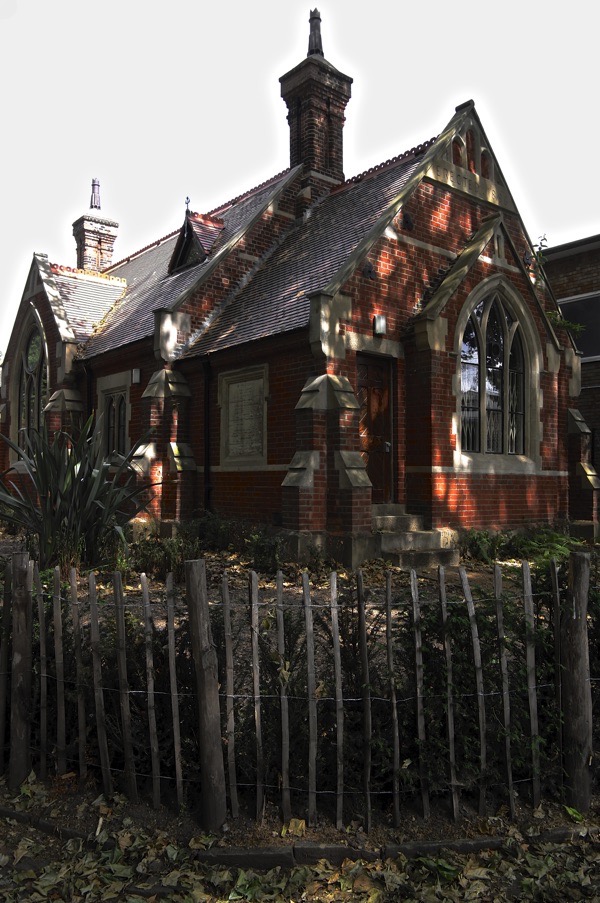
St Pancras Coroners

Sir John Soane’s tomb of 1837 inspired Giles Gilbert Scott’s design for the telephone box


Baroness Burdett Coutts was responsible for the vast gothic memorial sundial


Mary Wollstonecraft, born in Spitalfields and buried in Bournemouth, but commemorated here with her husband William Godwin

The grave of Charles Dickens’ school teacher, William Jones, believed to be the inspiration for the ferocious Mr Creakle in David Copperfield. “By far the most ignorant man I have ever had the pleasure to know … one of the worst tempered men perhaps that ever lived.”


Norman stonework uncovered in the renovation of 1848


The seventh century altar stone is incised with crosses of Celtic design


“O passenger, pray list and catch
Our sighs and piteous groans,
Half stifled in this jumbled patch
Of wrenched memorial stones!”
“We late-lamented, resting here,
Are mixed to human jam,
And each to each exclaims in fear,
‘I know not which I am!’”
Thomas Hardy, The Levelled Churchyard (1882)
You may also like to read about
Tony Jack, Truman’s Brewery Chauffeur
Tickets are available for my Spitalfields tour throughout October & November
Click here to book for THE GENTLE AUTHOR’S TOUR OF SPITALFIELDS

“I was born in Balmoral Castle and I grew up in Windsor Castle …” Tony Jack told me proudly without bragging, “… they were both pubs in Canning Town.” It was a suitably auspicious beginning for an East End hero who was barely out of his teens before he joined the RAF and sent this picture home inscribed, “To Mother, Myself in a rear cockpit of a Harvard with the sun in my eyes. Love Tony.” Yet destiny had greater things in store for Tony, he was appointed to secret government work in Princes Risborough, where his sharp young eyes qualified him as an expert in photographic interpretation of aerial surveys, snooping on Jerry. If Tony spotted activity behind enemy lines, the information was relayed to our spies in the field who went to make a reconnaissance.
From there, young Tony was transferred to work in the Cabinet War Rooms deep beneath Whitehall where he barely saw daylight for weeks on end, taking solace in rooms lit with ultraviolet to induce the sensation of sunlight. Tony was involved in developing photographs of the blitz and making maps, but at the culmination of hostilities he was brought the document that ended the war, to photograph it and make fifty copies. With his outstanding eye for detail, Tony noticed that the date had been altered in ink from 7th May to 8th May 1945, and, with the innocent audacity of youth, Tony tentatively asked Winston Churchill if he would prefer this aberration photographically removed. “The Americans wanted the war to end on one date and the Russians wanted it to end on another,” growled the great man to the impertinent young whippersnapper in triumph, “But I got my way, May 8th!” And thus the correction duly remained in place upon the historic document.
When Tony told me these stories, as we sat drinking tea in a cafe in Spitalfields, I did wonder how he could possibly follow these astounding life experiences when the war ended, but the answer was simple. Tony got a job as a chaffeur driving a Rolls Royce for the Truman Brewery in Brick Lane.
“There were seven of us and we were nicknamed the Black Crows on account of our black uniforms. We used to kick off the day by picking up the directors from railway stations and driving them to the brewery. During the day we used to drive them to and fro visiting pubs and there also was a certain private aspect, which we kept quiet about, taking their wives shopping. Most of the other chauffeurs had once driven delivery trucks for the brewery. They couldn’t tell you the names of the streets but they knew where all the pubs were, that’s how they navigated around London!”
“You couldn’t wish to work in a better environment than a brewery,” admitted Tony in rhapsodic tones, as he opened a worn plastic bag to show us his cherished cap badge and buttons that he keeps to this day. Then, caught in the emotion of the moment and experiencing a great flood of memories, Tony launched into a spontaneous eulogy about the brewery, which gained an elegaic lustre in the description.
He told me the name of the head brewer was Gun Boat Smith. He told me the brewery had two black London taxis for visiting pubs incognito, registration numbers HYL55353 & 4. He told me there were two chefs in the canteen, one named Harry was a woodcarver who carved fancy work for churches and the other was a glass engraver who could put a painting into a glass and copy it onto the surface. He told me that John Henry Buxton asked “What regiment were you in?” and when Tony revealed he was in the RAF, declared, “Well, never mind!” He told me that a man called Cyclops was responsible for the “finings” which filtered the beer, as well as repairing the bottling girls’ clogs and distributing pints of beer to the delivery men in the mornings. He told me that the phone number of John Henry Buxton’s country home was Ware 2, a source of endless amusement when you asked the operator to connect you. He told me that the brewery staff manned the roof with buckets of water when the great Bishopsgate Goods Yard fire of 1964 sent burning cinders drifting into the sky. He told me that the brewery had its own customs officer because beer was taxed as it was brewed in those days. He told me that there was always a cooper on call night and day to make repairs, in case a barrel of beer split in a pub. He told me that the dray horses sometimes got out at night and wandered around which terrified him because they were magnificent creatures. He told me that there was priest who worked in the electrical shop who would marry employees. He told me that there was a man who was solely responsible for all the uniform badges and buttons, who was TGWU representative and also the Mayor of Bethnal Green. He told me that there was a rifle range below Brick Lane which still exists today and the cleaners refused to go there alone because there were so many rats. He told me that the shire horses were all sent to a retirement home in Long Melford. He told me that the brewery organised Sports Days and Beanos on alternating Summers. He told me that the Sports Days were held at Higham Park, Chingford, where they brought in circus acts to entertain the children. He told me that the Beanos were at Margate. He told me that they hired two trains from Liverpool St to get them there, and a paddle steamer to take them on a trip over to Folkestone and back for a sit down dinner at Dreamland. He told me that there was always plenty of beer on the train coming back. He told me that they were wonderful days out. He told me that Truman’s were unique in the sense that they were self-sufficient, you had no need to go outside.
One day, Tony was candidly given advance notice by the chairman, while driving him the Rolls Royce, that the brewery was being sold to Grand Metropolitan and chauffeurs would no longer be required. So Tony switched to working as a security guard for many years. “I know every inch of the brewery,” he assured me authoritatively. Then in 1969, Tony became a cab driver which he continued to do until 2007. “I retired just before I was eighty. I was happy because I was driving around and it was all I wanted to do in life,” he confided to me with a lightness of tone, revealing endearing modesty and impressive stamina.
All the astonishing details of Tony Jack’s vibrant description of life at the brewery were whirling in my mind as we crossed Commercial St and walked down Brushfield St together in the Autumn sunlight, before shaking hands in Bishopsgate. And then he hopped on a bus to Clerkenwell, where he lived, quite the most sprightly octogenarian I have met. It must be something in the beer.

A studio portrait of Tony from the nineteen twenties.

As a young man Tony acquired the nickname “Thumbs up!”

Tony is in the centre with his head down, working on a photographic interpretation of aerial surveys of enemy territory, as part of secret government programme in Princes Risborough during World War II.

The tax disc of the Rolls Royce that Tony drove for the Truman Brewery in the nineteen fifties.

The eagle on the left was Tony’s cap badge, the THB his lapel badge, along with two sizes of buttons, all from his chauffeur’s uniform. The eagle on the right was a truck driver’s cap badge and the key fob was from an ad campaign, “Ben Truman has more hops!” They are all laid upon a letter dated 29th June 1889, analysing the chemical constituents of the beer, that Tony salvaged from a skip when Truman’s were throwing out their archive. It concludes, “I do not think the beer is at all more laxative than any Burton beer would be in this weather.”

John Henry Buxton invited the members of the Brewery Angling Club to clear the weed out of the river at his estate at Wareside, Hertfordshire, in return for letting them fish in it.

Tony’s membership card for the Truman Brewery Sports Club dated 1st March 1959.

Tony photographed his daughter Janet on the roof after a Christmas party in the nineteen fifties.

Tony’s last day as cab driver in 2007, he drove Janet up to the West End for a shopping trip.

Tony Jack
New portrait copyright © Jeremy Freedman


