
Snowmen Of Yesteryear
With snow forecast in the capital, I thought I would look back and consider the transient souls of those long-gone East End snowmen of yesteryear that I was able to immortalise with my camera.

At first I came upon them in yards and gardens, but before long they were scattered all over the parks and open spaces, lonely sentinels with frozen smiles. Snowmen are short-lived beings and many of those I photographed were just completed, only to be destroyed shortly after my pictures were taken. Yet when I returned later, I often found they had been reconstructed, and – as others appeared in the vicinity and the creators sought to be distinctive – a strange kind of evolution was taking place.


Chris Brown, Illustrator
Chris Brown has long been a favourite illustrator with his superlatively elegant and droll linocuts (currently gracing branches of Gail’s Bakery for Christmas), so I am thrilled that he is exhibiting and giving a lecture about his work at the BLOOMSBURY JAMBOREE at the Art Workers Guild tomorrow, Sunday 11th December from 10:30am.
CLICK HERE TO BOOK FOR CHRIS BROWN’S LECTURE AT 12:15pm ON SUNDAY
We need volunteers at the Jamboree on Sunday – if you can help, please email spitalfieldslife@gmail.com

WHAT WE DO TODAY EXISTS BY WHAT WE DID YESTERDAY
Chris Brown introduces his lecture
“My talk is divided into two parts. The first speaks of the present and discusses recent work.
The second part explores the past – why I do what I do and how I came to do it. I shall be talking of my influences, discussing the books I have read and the things I have seen, with examples of my early work dating from when I left Middlesex Polytechnic in 1976, my time at the Royal College of Art (77-80) and my work as an illustrator in subsequent years.
When I started, I felt burdened by the work I did previously, spending months worrying that I would not be able to do something as pleasing or as good again but, as I grew older and perhaps more confident, I grew comfortable with my talent and, in some areas, my lack of talent.
I have learnt that the past is not a burden but something to enjoy. Often now, I look back and think ‘that was not so bad’ and pat my younger self on the back.”

Fleet St

David Hockney

Little Venice


Kew Palace


Ewelme College (founded by Alice Chaucer, granddaughter of Geoffrey Chaucer in 1437)


Avebury


Portland


Mary Anning


Illustrations copyright © Chris Brown
You may also like to read about
The Scholar & His Cat, Pangur Bán

Schrodinger sitting on my desk
I am very grateful to Chris Miles for drawing my attention this ninth century poem written by an unknown monk in Old Irish at or near Reichenau Abbey in what is now Germany. Unsurprisingly, I cannot help but identify with the author.
The Scholar & His Cat, Pangur Bán
(Translated by Seamus Heaney)

Schrodinger sleeping on my desk

The page of Richenau Primer in which Pangur Bán is written
You may also like to read about
Schrodinger’s First Year in Spitalfields
At St Paul’s Cathedral In Old London

At midnight on Christmas Eve, I find myself standing inside St Paul’s Cathedral among the the company of several thousand other souls. The vast interior space of the cathedral is a world unto itself when you are within it, as much landscape as architecture, yet when the great clock strikes twelve overhead, my thoughts are transported to the rain falling upon the empty streets in the dark city beyond. I am thinking of these lantern slides created a century ago by the London & Middlesex Archaeological Society for lectures at the Bishopsgate Institute.
Until 1962, St Paul’s was the tallest building in London and, in my perception of the city, it will always stand head and shoulders above everything else. Even before I saw it for myself, I already knew the shape of the monstrous dome from innumerable printed images and looming skyline appearances in films. Defying all competition, the great cranium of the dome contains a spiritual force that no other building in London can match.
A true wonder of architecture, St Paul’s never fails to induce awe when you return to it because the reality of its scale always surpasses your expectation – as if the mind itself cannot fully contain the memory of a building of such ambition and scale. No-one can deny the sense of order, with every detail sublimated to Sir Christopher Wren’s grand conception, yet the building defies you.
Although every aspect has its proportion and purpose, the elaborate intricacy expresses something beyond reason or logic. You are within the skull of a sleeping giant, dreaming the history of London, with its glittering panoply and dark episodes. The success of this building is to render everything else marginal, because when you are inside it you feel you are at the centre of the world.


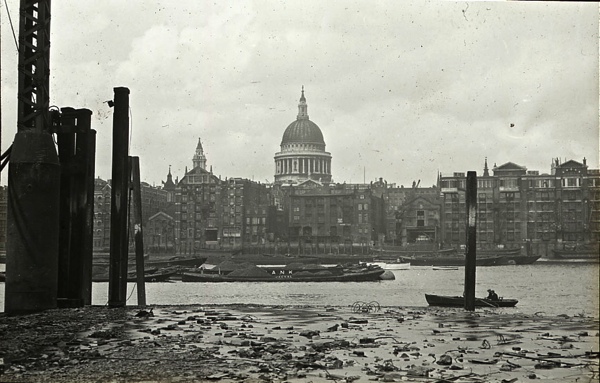


Glass slides courtesy Bishopsgate Institute
You may also like to take a look at
Reading At Burley Fisher Books
Next Thursday 15th December at 6:30pm, I shall be giving a reading in company with my good friends, the novelist Sarah Winman and the poet Stephen Watts at Burley Fisher Books in Dalston, 400 Kingsland Rd, E8 4AA.
Tickets are free – click here to book

Portrait by Patricia Niven
Sarah Winman is the author of four novels When God was a Rabbit, A Year of Marvellous Ways and Tin Man. Her most recent is Still Life, a story that begins in 1944 with the chance meeting on a Tuscan roadside between a young soldier and an ageing art historian. It spans fours decades and moves from the East End of London to Florence.

Portrait by Lucinda Douglas Menzies
Stephen Watts‘ most recent books are Republic Of Dogs/Republics Of Birds & Journeys Across Breath, Poems 1975-2005. A film of The Republics was made by Huw Wahl & two exhibitions related to Stephen’s work were held at PEER Gallery, Hoxton & Nunnery Gallery, Bow. A Book Of Drawn Poems is forthcoming.

Made In London
Contrary to popular belief, London continues to be a city of manufacturing and a new book, MADE IN LONDON by Carmel King & Mark Brearley with additional text by Clare Dowdy, presents a wealth of inspiring examples, many of which have been running for generations – it is my delight to publish this East London selection today.

Blackhorse Lane Ateliers, Walthamstow
Blackhorse Lane Ateliers were established in 2015 by Han Ates, a second-generation Londoner with Turkish-Kurdish ancestry and a family that has deep roots in the textile industry. These days, the twenty-three staff produce more than ten thousand pairs of high quality denim jeans per year. Ates and BLA are part of a rapid revival of tailoring and garment production in London, with the city now hosting around three hundred workrooms and factories whose output is fast expanding.

Freed of London, Hackney
Freed of London is the only company in the world that hand makes pointe shoes for the mass market, available off the shelf. It also custom-makes shoes for individual dancers, and its first famous customer was the prima ballerina Dame Margot Fonteyn. The main production site has been in Well Street in Hackney since the seventies. There its eighty members of staff include twelve makers who are each able to produce around forty pairs a day. Next to the pointe shoe workshop is a bigger workshop where ballroom, Latin, tap, character and stage shoes are made.

Kashket & Partners, Tottenham
Beefeaters, colonels and royalty get their ceremonial and parade uniforms from a factory on a industrial site where the sixty staff produce more than five thousand bespoke items a year, from scarlet tunics and riding breeches to ladies’ regimental ball gowns. The fourth-generation business describes itself as Europe’s biggest bespoke tailoring factory that hand makes from scratch. There is some competition from Savile Row, ‘but we are bigger’ says Nathan Kasket. The Ministry of Defence requires the business to be no more than twenty miles from Wellington Barracks, in case of emergencies.

James Ince, Bethnal Green
Richard Ince’s family started making umbrellas in 1805. He’s the sixth generation, having taken on leadership in 1998. Today the nine strong business makes around seventeen thousand umbrellas a year in its Bethnal Green workshop. Around seventy per cent of production goes to central London retailers, though over the years they have adjusted to fashion and to supply different industries. Extra-big or specially designed umbrellas have been produced to suit welders on the railways or for hotel doormen, newspaper vendors or bookmakers. In a production of Samuel Beckett’s Happy Days a James Ince umbrella burst into flames on the London stage every night.

Barber Wilson & Co, Wood Green
When property developer Jeremy Bigland heard that the premises of Barber Wilson & Co. were for sale, he was initially interested in the site as a potential residential project. But when he visited London’s oldest tap factory he changed his mind, and in 2018 he and his business partner Andy Warren bought the business. Today Bigland is adamant that the business is not going anywhere. ‘for me, it was important to keep the heritage of the company, in London, alive’, he says. Twenty-five London staff roll forward this hundred-and-twenty-three-year-old business that is based in the factory they built in 1905.

Bellerby & Co, Stoke Newington
In Bellerby & Co Globemakers’ workshop, a team of twenty-five make around seven hundred globes per year. Each sphere is made in-house from resins, Perspex and plaster of Paris sometimes inlaid with hessian fibres, using a mould created by Formula 1 fabricators. The pieces of world map – known as gores – are carefully glued to the globe, then painters apply layers of watercolour to represent oceans, mountain ranges and vegetation. It can take as long as eight weeks to paint a large one. Many of the globes are bespoke, and more than half are exported.

BIZ Karts, Brimsdown
BIZ Karts, founded in 1994, are one of the leading go-kart producers. Almost all stages of production take place in their forty-five thousand sq ft factory, from the manufacture of chassis and components to the finishing touches on the karts. Each chassis is fully hand-welded and straightened before the chassis is painted and the kart’s components are added in the assembly section. Currently around twelve hundred are made each year by the forty-strong business, and they continue to grow. A sales office opened in Florida in 2017, and now roughly forty per cent of all karts are exported to the Americas.

Electro Signs, Walthamstow
Welshman Richard Bracey came to London, learnt the neon-sign trade and in 1952 set up his own business making neon advertising signs, including the enormous glitzy ones for Soho’s cabarets such as Raymond Revuebar. Matthew Bracey, grandson of the founder, runs the Walthamstow business today, with a team of sixteen they make hundreds of signs each year, using both neon and LED. The booming London film industry is a major source of work, and the factory’s creations can be spotted in Superman, Batman and James Bond films, as well as Mission Impossible, Lost in Space and many more.

Jochen Holz, Stratford
Jochen Holtz produces organically shaped lampworked glassware. He works alone in his studio in Stratford, surrounded by tools, bunsen burners, oxygen bottles, variously sized glass tubes in boxes, two kilns and a workbench. Before setting up on his own, Holtz spent three years training as a lampworker to make scientific laboratory equipment. He works with borosilicate glass, heating it using torches, giving texture and shape to some pieces by pressing the molten glass against surfaces such as perforated metal or burnt wood.

Cox London, Tottenham
In their building on the Millmead Industrial Estate, Cox London designs and makes highly sculptural pieces of lighting and furniture. Every piece is commissioned, and around ninety per cent of production is based on the line of products shown on the company’s website. Most commissions come from interior designers furnishing private homes. The business has its own foundry within the twenty-thousand sq ft factory, so they can cast bronze, and they have hefty forging machines. At the twelve noisy workstations, items are hammered, wrought, welded and assembled.

Aimer Products, Brimsdown
Glass blowers Aimer Products has its origins in the early 1900s, originally a business that pioneered X-ray tube production in a small workshop off Tottenham Court Rd. They have been in Brimsdown since the mid-1990s. The main focus had been petrochemical glassware – products used in the testing of crude oil and aviation fuels around the world – but in 2021 they branched out, adding a new business, Leverint, which designs and makes glass lighting. There are now plans to bring in a handful more people to the te-strong business, to work on Leverint as it enjoys significant success.

Kaymet, Peckham
This seventy-five-year-old business produces deluxe anodised aluminium trays and trolleys. Around twenty-five thousand trays per year emerge from their factory and are sent to forty countries. In the heyday of the business, sixty years ago, there were not far off two hundred people. In 2013, the business nearly faded away but since then turnover has tripled. The company bought a home for itself in Peckham, and today it employs a dozen who are racing to keep up with burgeoning demand.

Grant Macdonald, Borough
With eighteen staff, Grant Macdonald are one of the biggest silversmithing workshops in the Capital, producing bespoke objets, clocks, trophies and ceremonial swords. They are based in a glazed twenty-first-century building in Borough, where a team of craftspeople mix new technology and tradition. From a concept, a prototype is 3D-printed and shown to the customer. A model of the whole item, or of separate elements, is 3D-printed in wax, and then cast in sterling silver or gold. If there are separate elements, these are welded, soldered and bolted together to create the final piece, which is then polished, plated or lacquered.

William Say & Co, Bermondsey
In a side street near the Old Kent Rd, cans for Fortnum & Mason’s Turkish delight and Myland’s paint are rolling off the production line. William Say & Co’s factory stands on a vast site for Inner London. Inside, a high-speed Soudronic machine turns sheets of tin-plated steel into cylinders, which are then fitted with bases and a variety of lids. Fifty shop-floor staff make eight million items per year. The cans are filled with anything from cakes to paint, polish and aircraft fuel. William Say stamps the bases of its tins with messaging about being made in London using the site’s solar power, and being hundred per cent recyclable.

The Posticherie, Stoke Newington
Catriona Lim’s wig and hairpiece workshop, The Posticherie, is thriving because it provides for one of the many niche needs of London’s vibrant theatre and film economy. Established in 2013 the business is one of the newer ones amongst the city’s cluster. The Stoke Newington location is close enough to London’s theatreland, and many filmmakers, to make it easy to meet clients for fittings. The increasing number of high-definition films – which have higher resolution – has led to good looking hair becoming more important, and hence hairpiece requirements have become more exacting.

Gavin Coyle Studio, Walthamstow
Gaving Coyle runs one of London’s growing number of bespoke and small-batch furniture workshops. For several decades this type of making was in steep decline, but now it is on the up again and today there are at least two hundred and fifty businesses doing this kind of work in the city. Coyle’s is a small set up, just three people in a former car mechanics workshop in Walthamstow. They carry out about nine big fit-out projects a year, with smaller jobs filling in the gaps, and a sideline making items such as the Chirp bird sculpture that is sold through shops including Heal’s and Twentytwentyone.

Hitch Mylius, Ponders End
Hitch Mylius have been making simple, superbly designed and well crafted furniture since 1971. The founders, designers Tristram and Hazel Mylius, acted on frustration with the lack of modern design in British-made furniture, compared with output from Italy and Scandinavia. Of the company’s thirty-four staff, around twenty-five are in production, making five to six thousand pieces a year, from footstools to corner sofas. The first Hitch Mylius design – the MH11 seating system – was a success in Liberty in the early seventies, and it is still sold today as HM18.

Nichols Bros, Walthamstow
On a quiet residential street, behind a grass-green door, hundreds of wooden stair parts are made each day. Inside the floor is thick with sawdust, wood chips fly from the machinery and the walls are adorned with spindles. Nichols Bros’ workshop has changed little since it opened in 1949. ‘It’s very old-fashioned’, says co-owner Geoff Nichols. With the firm’s specialist machinery, including a hundred-year-old wood-twisting machine, Geoff believes, ‘we’re the last proper woodturners left in London, because we can tackle any woodturning project’. That could be a doorknob or ‘an enormous great column for a front door’.

Wyvern Bindery, Hoxton
Craft bookbinderies have been declining in number, and of the dozen or so left in the capital, Wyvern is unusual in that it has a shopfront, so passers-by can see work in progress. It all happens behind the big shop window of a long, deep unit in Hoxton, to where the bindery moved in 2020 from Clerkenwell. At the back of the bindery are big, wide workbenches, with shallow drawers holding traditional marble endpapers. Elsewhere are stacked rolls of leather (mostly goatskin), fake suedes, and cloths used for covering hardback books.

Tate & Lyle Sugars, Silvertown
In buildings and tanks of different shapes, sizes and ages spread across a twenty-hectare site, fifty per cent of the sugar sold in UK shops and eighty per cent of the sugar used in restaurant kitchens and canteens is refined. Mechanisation has led to the elimination of many repetitive jobs. These days the sugar refinery has four hundred and fifty workers, and Tate & Lyle Sugars has a further three hundred support and office staff across their two London Thameside sites. The output is greater than it was in the fifties, when it was the biggest cane-sugar refinery in the world and employed eight thousand people, and substantial investment is further increasing capacity.

Diespeker & Co, Bermondsey
Terrazzo, which originated in sixteenth century Italy, is made of marble, quartz, granite, ceramic or glass chippings set into a cement or resin binder. It is either poured in situ or precast into slabs, to make flooring, wall tiles, worktops, reception desks and furniture. At Diespeker & Co’s Bermondsey base it is even turned into fountains, fireplaces and plinths. Of the company’s forty staff, twenty are on the factory floor. The bespoke workshop has not changed in years. It is known as the ‘green shed’, and uses traditional methods to hand make terrazzo items using each client’s chosen aggregate mix and dye colour.

London Stone Carving, Peckham
Since 2015, London Stone Carving has been specialising in high-end stone carving. They are near the Old Kent Rd in a sturdy brick and concrete sixties unit with lifting equipment at the front and good yard access. The four-strong team take on commissions for lots of architectural restoration work such as the big Soane roses for Pitzhanger Manor in Ealing. Being based in London is a key selling point as clients want to come to the studio, because half the enjoyment for them is seeing the process. Work includes replacement carvings for old churches and other historic buildings, and production on behalf of artists and sculptors.

Wax Atelier, Poplar
Five years ago, two designer/maker friends – Lola Lely and Tesenia Thibault-Picazo decided to collaborate on an experimental project, and picked wax as their material. After making their own tools, sourcing beeswax from a neighbour, and teaching themselves to dip candles by watching YouTube videos, the two fell in love with the process and the product. Today Wax Atelier products, produced by the company’s staff of ten, are stocked by over two hundred retailers worldwide. They have recently moved from Barking to a larger factory space at Poplar Works and they plan to expand into homewares.
Photographs copyright © Carmel King
Copies of MADE IN LONDON can be ordered direct by clicking here
You may also like to read about
Francis Wheatley’s Cries Of London
Only a few tickets remain for my lecture on the CRIES OF LONDON next Sunday 11th December at the Art Workers’ Guild as part of the BLOOMSBURY JAMBOREE

Two Bunches a Penny, Primroses, Two Bunches a Penny!
Francis Wheatley exhibited his series of oil paintings entitled the “Cries of London” at the Royal Academy between 1792 and 1795. Two year earlier, the forty-one year old painter had been elected to the Academy in preference to the King’s nominee and, as a consequence, he never secured any further commissions for portraits from the aristocracy. Losing his income entirely, what should have been the crowning glory of his career was its unravelling – Wheatley was declared insolvent in 1793 and struggled to make a living until his death in 1801, when the Royal Academy paid his funeral expenses.
Yet in the midst of this turmoil, Wheatley created these sublime images of street sellers that – although seen at the time as of little consequence beside his aristocratic portraits – are now the works upon which his reputation rests. Born in Covent Garden in 1747, Wheatley was ideally qualified to portray these hawkers because he grew up amongst them and their cries, echoing in the streets around the market. You will recognise the old stone pillars of the market buildings that still stand today in a couple of these pictures, all of which could be located specifically in that vicinity. However, these pictures are far from social reportage as we understand it, and you may notice a certain similarity between many of the women portrayed in these pictures, for whom it is believed Mrs Wheatley – herself a painter and exhibitor at the Royal Academy – was the model. Look again, and you will also see that variants on the same ginger and white terrier occur throughout these paintings too.
In spite of the idealised quality of these pictures, I am drawn to these “Cries of London,” as a project that places working people at the centre of the picture, and represents them as individuals of stature and presence. The body language of subservience is only present when customers are in the frame, as you will see in the Knife Grinder and Cherry Seller below, whilst the lone Strawberry Seller, Match Seller and Primrose Seller all gaze out at us with assured status, as our equals. Taking this a stage further, the final three pictures, the Ballad Seller, the Gingerbread Seller and the Turnip Seller portray sellers and customers meeting eye to eye – dealing on a level – and with a discernible erotic charge in the air.
Although coming too late to save his career, Wheatley was well served by his engravers who created the prints which brought recognition for his “Cries of London,” as the most beautiful and most popular series of prints on this subject of all time, with editions still available into the early twentieth century. In fact, when I examined this set in the archive of the Bishopsgate Institute, I realised that many were familiar to me from chocolate boxes and biscuit tins, and once glimpsed in frames in the houses of elderly relatives and the seaside hotels of my childhood.
Luigi Schiavonetti, born in Bassano in 1765, engraved the first three plates, the Primrose Seller, the Milk Maids and the Orange Seller, with lush velvety stippled tones – a style that was maintained by the three subsequent engravers (Cardon, Vendramini and Gaugain), when Schiavonetti became too successful and expensive for such a modest project. The “Cries of London” were sold at seven shillings and sixpence for a plain set and sixteen shillings coloured, and the fact all thirteen were issued is itself a measure of their popularity.
It touches me to understand that Francis Wheatley chose to paint these “Cries of London” at the time he was losing grip of his life, struggling under the pressure of increasing debt, because they cannot have been an obvious commercial proposition. And I like to surmise that these graceful images celebrate the qualities of the ordinary working people, which Wheatley experienced first-hand, growing up in Covent Garden, and chose to witness in this subtly political set of pictures, existing in noble contrast to the portraits of aristocratic patrons who had shunned him when he was in need.

Milk Below! – This is believed to be the origin of the more recent milkman’s cry, “Milko!”

Sweet China Oranges, Sweet China.

Do you want any matches?

New Mackerel, New Mackerel

Knives, Scissors & Razors to Grind.

Fresh Gathered Peas, Young Hastings.

Round & Sound, Five Pence a Pound, Duke Cherries.

Strawberrys, Scarlet Strawberrys.

Old Chairs to Mend.

A New Love Song, only Ha’pence a Piece.

Hot Spiced Gingerbread, Smoking Hot.

Turnips & Carrots, ho!

Francis Wheatley R.A. looks askance.
Images courtesy Bishopsgate Institute
You may like to take a look at


