
Learn To Write A Blog This Spring

HOW TO WRITE A BLOG THAT PEOPLE WILL WANT TO READ: 25th-26th March 2023
Spend a weekend in an eighteenth century weaver’s house in Spitalfields this spring and learn how to write a blog with The Gentle Author.
This course is suitable for writers of all levels of experience – from complete beginners to those who already have a blog and want to advance.
We will examine the essential questions which need to be addressed if you wish to write a blog that people will want to read.
“Like those writers in fourteenth century Florence who discovered the sonnet but did not quite know what to do with it, we are presented with the new literary medium of the blog – which has quickly become omnipresent, with many millions writing online. For my own part, I respect this nascent literary form by seeking to explore its own unique qualities and potential.” – The Gentle Author
COURSE STRUCTURE
1. How to find a voice – When you write, who are you writing to and what is your relationship with the reader?
2. How to find a subject – Why is it necessary to write and what do you have to tell?
3. How to find the form – What is the ideal manifestation of your material and how can a good structure give you momentum?
4. The relationship of pictures and words – Which comes first, the pictures or the words? Creating a dynamic relationship between your text and images.
5. How to write a pen portrait – Drawing on The Gentle Author’s experience, different strategies in transforming a conversation into an effective written evocation of a personality.
6. What a blog can do – A consideration of how telling stories on the internet can affect the temporal world.
SALIENT DETAILS
Courses will be held at 5 Fournier St, Spitalfields on 25th-26th March, running from 10am-5pm on Saturday and 11am-5pm on Sunday.
Lunch will be catered with and tea, coffee & cakes by the Townhouse included within the course fee of £300.
Email spitalfieldslife@gmail.com to book a place on a course.
Please note we do not give refunds if you are unable to attend or if the course is postponed for reasons beyond our control.

Comments by students from courses tutored by The Gentle Author
“I highly recommend this creative, challenging and most inspiring course. The Gentle Author gave me the confidence to find my voice and just go for it!”
“Do join The Gentle Author on this Blogging Course in Spitalfields. It’s as much about learning/ appreciating Storytelling as Blogging. About developing how to write or talk to your readers in your own unique way. It’s also an opportunity to “test” your ideas in an encouraging and inspirational environment. Go and enjoy – I’d happily do it all again!”
“The Gentle Author’s writing course strikes the right balance between addressing the creative act of blogging and the practical tips needed to turn a concept into reality. During the course the participants are encouraged to share and develop their ideas in a safe yet stimulating environment. A great course for those who need that final (gentle) push!”
“I haven’t enjoyed a weekend so much for a long time. The disparate participants with different experiences and aspirations rapidly became a coherent group under The Gentle Author’s direction in a gorgeous house in Spitalfields. There was lots of encouragement, constructive criticism, laughter and very good lunches. With not a computer in sight, I found it really enjoyable to draft pieces of written work using pen and paper.Having gone with a very vague idea about what I might do I came away with a clear plan which I think will be achievable and worthwhile.”
“The Gentle Author is a master blogger and, happily for us, prepared to pass on skills. This “How to write a blog” course goes well beyond offering information about how to start blogging – it helps you to see the world in a different light, and inspires you to blog about it. You won’t find a better way to spend your time or money if you’re considering starting a blog.”
“I gladly traveled from the States to Spitalfields for the How to Write a Blog Course. The unique setting and quality of the Gentle Author’s own writing persuaded me and I was not disappointed. The weekend provided ample inspiration, like-minded fellowship, and practical steps to immediately launch a blog that one could be proud of. I’m so thankful to have attended.”
“I took part in The Gentle Author’s blogging course for a variety of reasons: I’ve followed Spitalfields Life for a long time now, and find it one of the most engaging blogs that I know; I also wanted to develop my own personal blog in a way that people will actually read, and that genuinely represents my own voice. The course was wonderful. Challenging, certainly, but I came away with new confidence that I can write in an engaging way, and to a self-imposed schedule. The setting in Fournier St was both lovely and sympathetic to the purpose of the course. A further unexpected pleasure was the variety of other bloggers who attended: each one had a very personal take on where they wanted their blogs to go, and brought with them an amazing range and depth of personal experience. “
“I found this bloggers course was a true revelation as it helped me find my own voice and gave me the courage to express my thoughts without restriction. As a result I launched my professional blog and improved my photography blog. I would highly recommend it.”
“An excellent and enjoyable weekend: informative, encouraging and challenging. The Gentle Author was generous throughout in sharing knowledge, ideas and experience and sensitively ensured we each felt equipped to start out. Thanks again for the weekend. I keep quoting you to myself.”
“My immediate impression was that I wasn’t going to feel intimidated – always a good sign on these occasions. The Gentle Author worked hard to help us to find our true voice, and the contributions from other students were useful too. Importantly, it didn’t feel like a ‘workshop’ and I left looking forward to writing my blog.”
“The Spitafields writing course was a wonderful experience all round. A truly creative teacher as informed and interesting as the blogs would suggest. An added bonus was the eclectic mix of eager students from all walks of life willing to share their passion and life stories. Bloomin’ marvellous grub too boot.”
“An entertaining and creative approach that reduces fears and expands thought”
“The weekend I spent taking your course in Spitalfields was a springboard one for me. I had identified writing a blog as something I could probably do – but actually doing it was something different! Your teaching methods were fascinating, and I learnt a lot about myself as well as gaining very constructive advice on how to write a blog. I lucked into a group of extremely interesting people in our workshop, and to be cocooned in the beautiful old Spitalfields house for a whole weekend, and plied with delicious food at lunchtime made for a weekend as enjoyable as it was satisfying. Your course made the difference between thinking about writing a blog, and actually writing it.”
“After blogging for three years, I attended The Gentle Author’s Blogging Course. What changed was my focus on specific topics, more pictures, more frequency, more fun. In the summer I wrote more than forty blogs, almost daily from my Tuscan villa on village life and I had brilliant feedback from my readers. And it was a fantastic weekend with a bunch of great people and yummy food.”
“An inspirational weekend, digging deep with lots of laughter and emotion, alongside practical insights and learning from across the group – and of course overall a delightfully gentle weekend.”
“The course was great fun and very informative, digging into the nuts and bolts of writing a blog. There was an encouraging and nurturing atmosphere that made me think that I too could learn to write a blog that people might want to read. – There’s a blurb, but of course what I really want to say is that my blog changed my life, without sounding like an idiot. The people that I met in the course were all interesting people, including yourself. So thanks for everything.”
“This is a very person-centred course. By the end of the weekend, everyone had developed their own ideas through a mix of exercises, conversation and one-to-one feedback. The beautiful Hugenot house and high-calibre food contributed to what was an inspiring and memorable weekend.”
“It was very intimate writing course that was based on the skills of writing. The Gentle Author was a superb teacher.”
“It was a surprising course that challenged and provoked the group in a beautiful supportive intimate way and I am so thankful for coming on it.”
“I did not enrol on the course because I had a blog in mind, but because I had bought TGA’s book, “Spitalfields Life”, very much admired the writing style and wanted to find out more and improve my own writing style. By the end of the course, I had a blog in mind, which was an unexpected bonus.”
“This course was what inspired me to dare to blog. Two years on, and blogging has changed the way I look at London.”
Amy Merrick At Dennis Severs’ House
All our books are on sale at half price until New Year and we are including a free copy of THE MAP OF THE GENTLE AUTHOR’S TOUR OF SPITALFIELDS with every order. Simply add the code BOXINGDAYSALE at checkout to get 50% discount.
CLICK HERE TO VISIT THE SPITALFIELDS LIFE BOOKSHOP

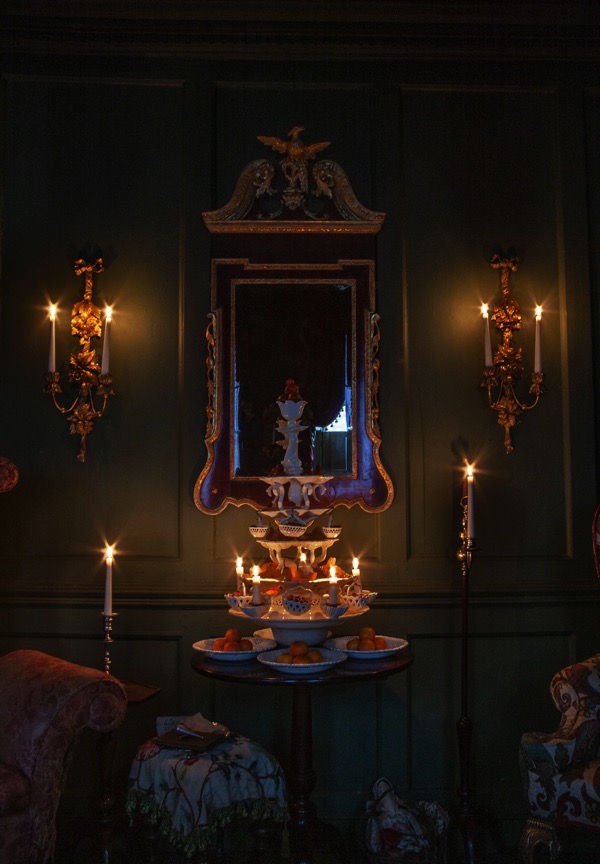
Behold the spirit of Christmas present! This is Amy Merrick, the sylph who waved her wand and conjured the magic of the festive season at Dennis Severs’ House. The decorations have always been applauded as among the best in London but this year Amy brought her own distinctive imaginative creativity to the task, as she explains below.
For those of you unable to get a ticket before Twelfth Night, Contributing Photographer Lucinda Douglas Menzies has recorded the magnificence for your enjoyment.
‘This was far and away the best project of my year – decorating the Dennis Severs’ House for Christmas was an utter delight. The plan was to breathe fresh life into Dennis’ original vision and strike a balance between tradition and something a bit more playful, in a homespun spirit that I hope he would have liked. I made garlands of fir and pine to festoon the hallway, and wove mossy evergreen wreaths with foraged holly, yew and bay leaves, attaching a few hidden snail shells from the innumerable vacant ones in my Whitechapel garden to amuse the observant visitor.
Paper chains bring such a wholesome, jovial charm to Christmas, so I made miles of them from pretty coloured art paper to hang from the windows and ceilings. It took most nights of a week to glue them all but with a glass of sherry to hand and a fire burning, it was a pleasure.
All of the new ornaments for the tree were made around my kitchen table – plaited corn dollies from wheat, woven hearts and pleated pinwheels from antique marble paper which also wrapped a mountain of presents to go under the tree. The Victorian dolls were restored, wigs sorted, limbs reattached and their dresses cleaned. I even replaced the beards on the nutcrackers.
Remaking the eighteenth century sugar loaf – the original of which Dennis obtained from Tate & Lyle – was much easier once I had the brilliant new mould made by Dennis’ friend Jim Howett. Through trial and error, I worked out a recipe: two kilogrammes of granulated sugar, moistened with ten tablespoons of water, packed like a sandcastle, flipped upside down and left to dry.
From my girlhood, I remember the blue-wrapped cones in the general store of Colonial Williamsburg in Virginia and bookbinder Charles Gledhill, who supplied me with stacks of beautiful papers for the project, confirmed that in his trade they still refer to that style as ‘sugar paper’. He gave me samples of different handmade blues which I looked at under candlelight to choose the right shade.
I could not help but make handmade sugar mice to encircle the sugar loaf, shop bought just would not do. If anyone is struggling to find the spirit of Christmas, I strongly recommend spending a quiet evening making pomanders. There is almost nothing that scent alone cannot soothe.
Working to install everything in the house did propose unusual challenges, with the winter darkness creeping in around two in the afternoon and the lack of electric lighting. I had never worked by torchlight before but by the end of the project it felt more natural. It is one thing to make something beautiful in daylight, another thing entirely to set a scene by candlelight.
I found myself making crystallised grapes, then placing them close to votive candles to sparkle and hanging Dennis’ delicate paper-cut strings of dolls, expertly reproduced by Ai Murata, so their shadows would be cast long across the low-slung kitchen ceiling.
So much of the magic of the house is in the marriage of flame, shadow and fragrance. Working with all these elements to imbue the house with Christmas was a thrill.’
Amy Merrick




Photographs copyright © Lucinda Douglas Menzies
You may also like to read
Remembering Gavin Stamp
All our books are on sale at half price until New Year and we are including a free copy of THE MAP OF THE GENTLE AUTHOR’S TOUR OF SPITALFIELDS with every order. Simply add the code BOXINGDAYSALE at checkout to get 50% discount.
CLICK HERE TO VISIT THE SPITALFIELDS LIFE BOOKSHOP
Contributing Writer, Gillian Tindall, remembers Gavin Stamp on the anniversary of his death

Gavin Stamp, Christ Church, Spitalfields, April 1977
On this, almost the last day of the year, my mind turns to my friend Gavin Stamp (1948-2017). It is five years exactly since Gavin, architectural historian and writer, university lecturer, contributor to television and magazines, and passionate defender of good buildings against crass re-development, died at his home in Camberwell.
Until a year or so before he had always appeared young for his age, full of vigour and determination. The very day he died he had gone out to take photographs. He was still in his sixties, and it was less than four years since he and his second wife, the historian Rosemary Hill, had actually been able to marry. He should have had many more years ahead of him.
He disliked cars, perceiving correctly that the post-War conviction that motor vehicles must dictate the future shape of cities had been responsible for wrecking many venerable town centres. One of his most successful books was Britain’s Lost Cities (2007), which pointed out in heartfelt terms the damage that planners of the sixties, seventies and still more recently, have done to Birmingham and Bristol, to Glasgow, Liverpool and many other places.
He never learnt to drive and was a tireless walker. I recall taking him to look at one of the last remaining old houses on Bankside, about which I was myself writing. We and the owners spent a happy hour or two there, discussing the house’s history. Then Gavin and I set off back along the south bank for London Bridge where we would go our separate ways. Soon, like a small child, I found myself running, and clutching at his jacket. Striding along, he simply had not realised I could not keep up.
Yet in spite of his busy life and his constant need to keep the earnings from his writing coming in, no one could be more responsive than Gavin if one alerted him to some fresh conservation battle that might need his support. He was also immensely knowledgeable, not just on buildings and cities at home and abroad but on railways, on the First World War, on old photographs, on statuary and memorials, on the lives of Lutyens and on the Gilbert Scott dynasty of architects, and much, much more.
Because Gavin dressed conventionally, had been a boarder at Dulwich school and then to Cambridge, many people assumed that he came from a well-to-do background. This was not the case. Although he had one or two distinguished forebears, in more recent times a family grocery business failed. Gavin took the eleven-plus exam for a place at Grammar School, and did so well that, under a scheme then in operation, Dulwich offered him a free place. Indeed it was at Dulwich that he found the very first subject for what a friend has described as his ‘combination of passionate enthusiasm and righteous anger.’ At the beginning of one term the stone capitals of the cloisters by the school chapel had been hacked off and replaced by glazing, which Gavin – surely rightly – regarded as vandalism.
He was still a child when the Victorian Society was founded in 1958 to try to save the heritage of fine and often well-loved buildings that were then being unnecessarily destroyed, but years later he wrote as fervently as if he had been there, with Betjeman and Pevsner, trying in vain to get the Euston Arch preserved – ‘There are some crimes which cannot be forgiven or forgotten… Ultimately the murderer was the Prime Minister, that cynical Whig politician Harold Macmillan… The whole affair was an example of the conventional, blinkered prejudice against nineteenth century architecture still prevalent among the ostensibly educated establishment in Britain.’
Later, as public opinion had shifted more in favour of the Victorian heritage, Gavin was a founder member of the Twentieth Century Society. As he pointed out later, ‘the history of conservation has been the art of keeping one step ahead of public opinion.’
Although readiness to understand and forgive was not one of Gavin’s virtues, he was unafraid to change his own mind on a building and to say so. Once implacably opposed to ‘the straight-jacket of modernist ideology’ with its commitment to flat-roofed concrete, he was able to admit ‘I have come genuinely to admire structures I once saw as brutal, insensitive intrusions.’ At his funeral, one of the speakers remarked ‘He said what he thought and didn’t mind people getting cross with him… He wasn’t always trying to be liked – he did not care – and this made him lovable.’
The last time I saw him was when I had invited him to a party to celebrate a book of mine, without much hope that he would appear. I knew he had been ill, and in treatment, and he lived on the far side of London. But he turned up, having come all the way by tube, in a becoming fedora hat to cover what we both supposed would be just a temporary period of baldness, and we sat and talked for a while. I do not think that either of us thought that this would be our last chat.
He was a churchgoer and a believer. So if you are there Gavin – somewhere beyond the constraints of this place and time – I am sure you are pleased that there is now hope for the Whitechapel Bell Foundry and also that the battle is being waged to save Brick Lane from becoming entirely a shopping centre. Your work is being carried on.
Gavin Stamp’s last, unfinished book, on architecture between the Wars, will be published in 2024, and there are plans for an exhibition about his life and work this coming year at the Paul Mellon Centre for British Art.

Euston Arch, demolished 1961

London Coal Exchange, demolished 1963

Lion Brewery, Waterloo, demolished 1949
Gillian Tindall’s The House by the Thames is available from Penguin
You may like to read these other stories by Gillian Tindall
Memories of Ship Tavern Passage
At Captain Cook’s House in Mile End
A Room To Let In Old Aldgate
All our books are on sale at half price until New Year and we are including a free copy of THE MAP OF THE GENTLE AUTHOR’S TOUR OF SPITALFIELDS with every order. Simply add the code BOXINGDAYSALE at checkout to get 50% discount.
CLICK HERE TO VISIT THE SPITALFIELDS LIFE BOOKSHOP

I would dearly love to rent the room that is to let in this old building in Aldgate, photographed by Henry Dixon for the Society for Photographing Relics of Old London. Too bad it was demolished in 1882. Instead I must satisfy myself with an imaginary stroll through the streets of that long lost city, with these tantalising glimpses of vanished buildings commissioned by the Society as my points of reference. Founded by a group of friends who wanted to save the Oxford Arms, threatened with demolition in 1875, the Society for Photographing Relics of Old London touched a popular chord with the pictures they published of age-old buildings that seem to incarnate the very soul of the ancient city. London never looked so old as in these atmospheric images of buildings forgotten generations ago.
Yet the melancholy romance of these ramshackle shabby edifices is irresistible to me. I need to linger in the shadows of their labyrinthine rooms, I want to scrutinise their shop windows, I long to idle in these gloomy streets – because the truth is these photographs illustrate an imaginary old London that I should like to inhabit, at least in my dreams. Even to a nineteenth century eye, these curious photographs would have proposed a heightened reality, because the people are absent. Although the long exposures sometimes captured the few that stood still, working people are mostly present only as shadows or fleeting transparent figures. The transient nature of the human element in these pictures emphasises the solidity of the buildings which, ironically, were portrayed because they were about to disappear too. Thus Henry Dixon’s photographs preserved in the Bishopsgate Insitute are veritable sonnets upon the nature of ephemerality – the people are disappearing from the pictures and the buildings are vanishing from the world, only the photographs themselves printed in the permanent carbon process survive to evidence these poignant visions now.
The absence of people in this lost city allows us to enter these pictures by proxy, and the sharp detail draws us closer to these streets of extravagant tottering old piles with cavernous dour interiors. We know our way around, not simply because the geography remains constant but because Charles Dickens is our guide. This is the London that he knew and which he romanced in his novels, populated by his own versions of the people that he met in its streets. The very buildings in these photographs appear to have personality, presenting dirty faces smirched with soot, pierced with dark eyes and gawping at the street.
How much I should delight to lock the creaky old door, leaving my rented room in Aldgate, so conveniently placed above the business premises of John Robbins, the practical optician, and take a stroll across this magical city, where the dusk gathers eternally. Let us go together now, on this cloudy December day, through the streets of old London. We shall set out from my room in Aldgate over to Smithfield and Clerkenwell, then walk down to cross the Thames, explore the inns of Southwark and discover where our footsteps lead …

This row of shambles was destroyed for the extension of the Metropolitan Railway from Aldgate to Tower Hill, 1883.

Sir Paul Pindar’s House in Bishopsgate was moved to the Victoria & Albert Museum in 1890.

At the corner of St Mary Axe and Bevis Marks, this overhanging gabled house was destroyed in 1882.

In College Hill.

St Giles Cripplegate, which now stands at the centre of Barbican complex.

Old buildings in Aldersgate St.

Shaftesbury House by Inigo Jones in Aldersgate St, demolished after this photo was taken in 1882.

Chimneypiece in the Sessions House, Clerkenwell Green, where Dickens was once a cub reporter.

In Cloth Fair, next to Smithfield Market.

At the rear of St Bartholomew’s Church.

In the graveyard of St Bartholomew the Great.

In Charterhouse, Wash House Court.

The cloisters at Charterhouse.

St Mary Overy’s Dock

Queen’s Head Inn Yard.

White Hart Inn Yard.

King’s Head Inn Yard.

In Bermondsey St.

At the George, Borough High St.
You can see more pictures from the Society for Photographing Relics of Old London in The Ghosts of Old London and In Search of Relics of Old London.
Images courtesy Bishopsgate Institute
The Gentle Author’s Pantomime Season
All our books are on sale at half price until New Year and we are including a free copy of THE MAP OF THE GENTLE AUTHOR’S TOUR OF SPITALFIELDS with every order. Simply add the code BOXINGDAYSALE at checkout to get 50% discount.
CLICK HERE TO VISIT THE SPITALFIELDS LIFE BOOKSHOP

Longer ago than I care to admit, fortune led me to an old theatre in the Highlands of Scotland. Only now am I able to reveal some of my experiences there and you will appreciate that discretion prevents me publishing any names lest those who are still alive may read my account.
It was a magnificent nineteenth century theatre, adorned with gilt and decorative plasterwork. Since this luxurious auditorium with boxes, red drapes and velvet seating was quite at odds with the austere stone buildings of the town, it held a cherished place in the affections of local theatregoers who crowded the foyers nightly, seeking drama and delight.
Although it is inexplicable to me now, at that time in my life I was stage struck and entirely in thrall to the romance of theatre. Perhaps it was because of my grandfather the conjurer who died before I was born? Or my love of puppets and toy theatres as a child? When I left college at the beginning of my twenties, I refused to return home again and I did not know how to make my way in London. So I was overjoyed when I landed a job at a theatre in the north of Scotland. I packed my possessions in cardboard boxes, took the overnight train and arrived in the frosty dawn to commence my adult life.
As soon as it was discovered I had a literary education, I was assigned the task of organising the script and writing the ‘poetry’ for the annual pantomime, which that year was Dick Whittington. In the theatre safe I found a stash of tattered typescripts dating back over a century, rewritten each time they were performed. These documents were fascinating yet barely intelligible, and filled with gaps where comedians would supply their own patter. I discovered that the immortals, in this case Fairy Bow Bells and Old King Rat, spoke in rhyming couplets. Yet to my heightened critical faculties, weaned on Shakespeare and Chaucer, these examples were lame. So I resolved to write better ones and set to work at once.
Fairy Bow Bells:
In the deepest, bleakest Wintertime,
I welcome you to Pantomime.
Here is Colour! Here is Magic!
Here is Love and naught that’s Tragic.
‘You are here to learn the art of compromise, and how to pour a decent gin and tonic, darling,’ the director informed me at commencement with a significant nod of amusement when I submitted my work. I tried to raise an amenable smile as I served the drinks, but it was a line delivered primarily for the benefit of the principals gathered in the tiny office for a production meeting. These were veterans of musical comedy and summer variety who played pantomime every year, forceful personalities who each brought demands and expectations in proportion to their place in the professional hierarchy, with the ageing comedian playing Dame Fitzwarren as the star. Next came the cabaret singer and dancer playing Dick Whittington and then the television personality playing Tommy the Cat.
It was my responsibility to manage auditions for the chorus of boy and girl dancers, sifting through thousands of curriculum vitae and head-shots to select the most promising candidates. Those granted the opportunity were given ten minutes to impress the musical director and the choreographer with a show tune and a short dance sequence. Shepherding them in and out of the room and handling their raw emotions proved a challenge when they lost their voices, broke into tears or forgot their routines – or all of these.
The cast convened for a read-through in the low-ceilinged rehearsal room in a portacabin in the theatre car park. Once everyone had shaken hands and a cloud of tobacco filled the room, the director wished everyone good luck and, turning to me before leaving the room, declared loudly ‘Don’t worry, darling, they know what to do!’, employing the same significant nod I had seen in the production meeting and catching the eye of each of the principals again.
We all sat down, I handed round the scripts and the cast turned to the first page. The principals gasped in horror, exchanging glances of disbelief and reaching for their cigarettes in alarm. Dame Fitzwarren blushed, tore out a handful of pages and spread them out on the table, muttering, ‘No, no, no,’ to himself in condemnation. I sat in humiliated silence as, in the ensuing half hour, my sequence of pages was entirely rearranged with some volatile horse trading and angry words. Was this the art of compromise the director had referred to? I had organised the scenes in order of the story – no-one had explained to me that in pantomime the sequence of opening scenes are a device to introduce the principals in order of status from the newcomers to the seasoned stars. Yet even if I had understood this, it would have made little difference since the cast were all unknown to me.
On the second day, the floor of the portacabin was marked with coloured tapes which indicated the placing of the scenery and it was my job to take the cast through their moves. Dame Fitzwarren was keen to teach his comedy kitchen sequence to the two young actors playing the broker’s men. Once he had walked them through, I suggested we should give it a go. ‘No,’ he said, ‘That was it, we did it.’ I understood that, in pantomime, comedians only rehearse their sequences once as a matter of honour.
The little theatre owed its existence to the wealth of the whisky distilleries which comprised the main industry in the town and many of the directors of these distilleries were members of the theatre board. In particular, I remember a diminutive fellow who made up for his lack of height with an abrasive nature. He confronted me on the opening night, asking ‘Is this going to be good, laddie?’ My timid reply was, ‘It’s not for me say, is it?’ ‘It had better be good because your career depends upon it,’ was his harsh response, poking me in the gut with his finger.
In fact, Dick Whittington – in common with all the pantomimes at that theatre – was a tremendous success, playing to packed houses from mid-December until the end of January. The frantic energy of the cast was winning and the production suited the mechanics of the building beautifully, with brightly coloured flying scenery, drop-cloths and gauzes. The audience gasped in wonder when Fairy Bow Bells waved her wand to conjure the transformation scene and booed in delight when Old King Rat popped up through a trap door in a puff of smoke. They loved the familiar faces of the comedians and laughed at their routines, even if they were not actually funny.
Given the punishing routine of three shows a day, the collective boredom of the run and the fact that they were away from home, the pantomime cast occupied themselves with a rollercoaster of affairs and liaisons which only drew to an end at the final curtain. Once Dick Whittington unexpectedly stuck her tongue down my throat in the backstage corridor on New Year’s Eve and Dame Fitzwarren locked the door of the star dressing room from the inside, subjecting me to his wandering hands when I came to discuss potential cuts in the light of the stage manager’s timings. I found myself entering and leaving the building through the warren of staircases and exit doors in order to avoid unwanted attention of this nature. The gender reversals and skimpy costumes contributed to an uncomfortably sexualised environment which found its expression on stage in the relentless innuendo and lewd references, all within an entertainment supposedly directed at children. ‘Thirty miles to London and no sign of Dick yet!’
I shall never forget the musical director rehearsing the little girls in tutus from a local stage school who supplied us with choruses of sylphs on a rota to accompany Fairy Bow Bells. ‘Come along, girls,’ he instructed the children, thrusting his chest forward and baring his dentures in a frozen smile of enthusiasm,’ Tits and teeth, tits and teeth,’ using the same exhortation he gave to the adult dancers.
Our version of Dick Whittington contained an underwater sequence, when Dick’s ship was wrecked, permitting the characters to ‘swim’ through a deep sea world which was given greater reality by the use of ultra-violet light and projecting an aquarium film onto a gauze. This was also the moment in the show when we undertook a chase through the audience, weaving along the rows. Drawing on the familiar tradition of pantomime cows and horses – and perhaps inspired by the predatory nature of the environment – I devised the notion of a pantomime shark in a foam rubber costume that could chase the characters through the front stalls and around the circle to the accompaniment of the theme from Jaws. I had no idea of the pandemonium that this would unleash but, each night, I made a point of popping in to stand at the back to enjoy the mass-hysteria engendered by my shark.
The actor playing Old King Rat had previously been cast as Adolphus Cousins in Major Barbara, so I decided to exploit his classical technique by writing a death speech for him. It was something that had never been done before and this is the speech I wrote.
Old King Rat:
This is the death of Old King Rat,
Foiled at last by Tommy the Cat.
No more nibbles, no more creeping,
No more fun now all is sleeping.
This is the instant at which I die,
Off to that rathole in the sky…
Naturally this was accompanied by extended death-throes, with King Rat expiring and getting up again several times. Later, I learnt my speech had been pirated by other productions of Dick Whittington, which is the greatest accolade in pantomime. Maybe it is even now being performed somewhere this season?
In subsequent years, I was involved in productions of Cinderella and Aladdin, but strangely I recall little of these. I did not realise I was participating in the final years of a continuous theatrical tradition which had survived over a century in that theatrical backwater. I did not keep copies of the scripts and the fragments above are all I can remember now. I do not know if I learnt the art of compromise but I certainly learnt how to pour a stiff gin and tonic. And I learnt that in any theatre there is always more drama offstage than onstage.

You may also like to read about
David Hoffman & Crisis At Christmas
All our books are on sale at half price until New Year and we are including a free copy of THE MAP OF THE GENTLE AUTHOR’S TOUR OF SPITALFIELDS with every order. Simply add the code BOXINGDAYSALE at checkout to get 50% discount.
CLICK HERE TO VISIT THE SPITALFIELDS LIFE BOOKSHOP
David Hoffman undertook a significant body of photography documenting the East End in the seventies and eighties that I plan to publish as a book entitled, A PLACE TO LIVE, Endurance & Joy in Whitechapel, accompanied by a major photographic exhibition at House of Annetta in Spitalfields.
I believe David’s work is so immensely important as a social document, distinguished by its generous humanity and aesthetic flair, that I must do it next year. If you share my appreciation of David’s photography and might consider supporting this endeavour, please drop me a line at spitalfieldslife@gmail.com

Almost by chance, at the end of the seventies, photographer David Hoffman found himself recording the formation of an organisation called Crisis at Christmas that opened up disused spaces and created temporary shelters staffed by volunteers to provide accommodation for the homeless through the holiday season when other shelters were shut.
As a participant rather than a visitor, David was able to take intimate photographs of those who sought refuge, capturing emotional images which are humane yet void of sentimentality.
There is a timeless quality to many of these pictures that could equally be of refugees from a war zone or in some apocalyptic dystopian vision of the future, yet this is London in the recent past and Crisis at Christmas is still with us and the work goes on.
“At the time, I was known for my photos of the homeless at St Botolph’s in Aldgate and I was going out with a girl named Peta Watts, who was working at Crisis at Christmas – so when she asked me to take pictures there, I leapt at the chance of becoming the Crisis photographer, and I did it for three years.
This was the early days of these shelters and they used derelict churches. One of them was St Philip & St Augustine in Whitechapel, round the corner from the squat where I lived in Fieldgate Mansions, and the next year it was at the Tradescant church of St Mary’s in Lambeth. So there were very little facilities – perhaps only a cold tap and one toilet for hundreds of people – and the whole thing was a chaotic feat of organisation, but somehow it all worked. They got donations of food and clothing and toys. And I remember some of the guys found an old bath tub in a skip and brought it in and filled it with water, so they could wash themselves. There was no regard to Health & Safety or regulation as we know it, but it all worked brilliantly and everyone was very well looked after. There was no hierarchy and the homeless people would be involved in the cooking and arranging the mattresses, and keeping the whole thing running.
I photographed it because it was a wonderful event and – like at St Botolph’s – some of the people were couples, and I took their pictures and brought them prints the next day. Many of these people had been living on the streets all year and the photographs helped them to have a more positive self-image.
Some would be shooting up and and others would be drinking, and an ambulance would come two or three times a day to pick people up. There were fights too, and I remember there was an unspoken rule that only one volunteer would approach to break it up by speaking softly – and it never failed. Many of the volunteers were middle class people who would work eighteen to twenty hours a day. What I liked about it was people coming together and doing things for themselves – and it just worked, and the homeless people looked after each other.”


Photographs copyright © David Hoffman
Click here to donate to Crisis At Christmas
You may also like to take a look at
David Hoffman At St Hilda’s, 1975

Boxing Day Book Sale
All our books are on sale at half price until New Year and we are including a free copy of THE MAP OF THE GENTLE AUTHOR’S TOUR OF SPITALFIELDS with every order.
CLICK HERE TO VISIT THE SPITALFIELDS LIFE BOOKSHOP
Simply add the code BOXINGDAYSALE at checkout to get 50% discount.

“As if I were being poked repeatedly in the eye with a blunt stick, I cannot avoid becoming increasingly aware of a painfully cynical trend in London architecture which threatens to turn the city into the backlot of an abandoned movie studio.”
The Gentle Author presents a humorous analysis of facadism – the unfortunate practice of destroying an old building apart from the front wall and constructing a new building behind it – revealing why it is happening and what it means.
As this bizarre architectural fad has spread across the capital, The Gentle Author has photographed the most notorious examples, collecting an astonishing gallery of images guaranteed to inspire both laughter and horror in equal measure.

The Gentle Author assembles a choice selection of CRIES OF LONDON, telling the stories of the artists and celebrated traders, and revealing the unexpected social realities contained within these cheap colourful prints produced for the mass market.
For centuries, these lively images of familiar hawkers and pedlars have been treasured by Londoners. In the capital, those who had no other means of income could always sell wares in the street and, by turning their presence into performance through song, they won the hearts of generations and came to embody the spirit of London itself.

“a timely reminder of all that modern Britishness encompasses” The Observer
In this first London Sikh biography, Suresh Singh tells the candid and sometimes surprising story of his father Joginder Singh who came to Spitalfields in 1949.
Joginder sacrificed a life in the Punjab to work in Britain and send money home, yet he found himself in his element living among the mishmash of people who inhabited the streets around Brick Lane.
Born and bred in London, his son Suresh became the first Punjabi punk, playing drums for Spizzenergi and touring with Siouxsie & the Banshees.
In the book, chapters of biography are alternated with Sikh recipes by Jagir Kaur.

“This small, beautiful book is an elegy to companionship. Encompassing both the everyday and the profound, it should be judged no less valid for the fact that the friend in question is a cat.” Times Literary Supplement
Anyone that has a cat will recognise the truth of this tender account by The Gentle Author.
“I was always disparaging of those who doted over their pets, as if this apparent sentimentality were an indicator of some character flaw. That changed when I bought a cat, just a couple of weeks after the death of my father. ”
Filled with sentiment yet never sentimental, THE LIFE & TIMES OF MR PUSSY is a literary hymn to the intimate relationship between humans and animals.

The Gentle Author presents a magnificent selection of pictures – many never published before – revealing the evolution of painting in the East End and tracing the changing character of the streets through the twentieth century.
“A fragment of the riches flowing from a continued fascination with London’s topography” – Evening Standard
“Harvested from the thirties to the present day, Spitalfields Life’s gorgeous collection of East End paintings is more knees-up than misery-fest” – Hackney Citizen
Among the artists included are: John Allin, S R Badmin, Pearl Binder, James Boswell, Roland Collins, Alfred Daniels, Anthony Eyton, Doreen Fletcher, Geoffrey Fletcher, Barnett Freedman, Noel Gibson, Charles Ginner, Lawrence Gowing, Harry T. Harmer, Elwin Hawthorne, Rose Henriques, Dan Jones, Nathaniel Kornbluth, Leon Kossoff, James Mackinnon, Cyril Mann, Jock McFadyen, Ronald Morgan, Grace Oscroft, Peri Parkes, Henry Silk, Harold Steggles, Walter Steggles & Albert Turpin.

A handsome photography book collecting together Colin O’Brien’s portraits of the Travellers’ Children in London Fields.
“These pictures record an extraordinary meeting between a photographer and a group of Irish Travellers’ children in London Fields in 1987, yet the subject of Colin O’Brien’s tender and clear-eyed photographs is no less than the elusive drama of childhood itself.”
A hardback bound in yellow cloth, printed in Brick Lane by The Aldgate Press

Around 1900, photographer Horace Warner took a series of portraits of some of the poorest people in London – creating relaxed, intimate images that gave dignity to his subjects and producing great photography that is without comparison in his era.
Only seen by members of Warner’s family for more than a century, almost all of these breathtaking photographs are published here for the first time.
This unique collection of pictures revolutionises our view of Londoners at the end of the nineteenth century, by bringing them startlingly close and permitting us to look them in the eye.

AS Jasper’s tender memoir of growing up in the East End of London at the beginning of the twentieth century was immediately acclaimed as a classic when it was described by the Observer as ‘Zola without the trimmings.’
In this definitive new edition, A Hoxton Childhood is accompanied by the first publication of the sequel detailing the author’s struggles and eventual triumph in the cabinet-making trade,The Years After.
Illustrated with line drawings by James Boswell and Joe McLaren


Between the covers of this magnificent red Album with a gilded cover you will discover more than 600 of the Gentle Author’s favourite pictures of London in print for the first time, setting the wonders of our modern metropolis against the pictorial delights of the ancient city, and celebrating the infinite variety of life in the capital.
This is London seen from an easterly direction – as the centre of gravity in the city has shifted, the Gentle Author of Spitalfields Life has amassed a wealth of extraordinary pictures of London with a special emphasis upon the East End.
Among the multiplicity of visual pleasures to be savoured, garnered from four centuries including our own, enjoy the ostentatious trade cards of Georgian London, the breathtaking lantern slides of Victorian London, the bizarre car crashes of Clerkenwell, the heroic Spitalfields nippers, the soulful dogs of old London, Aaron Biber, London’s oldest barber, and Barn the Spoon, the spoon carver.
Take a walk through time with the Gentle Author as your guide – be equally amazed at what has been lost of old London and charmed by the unfamiliar marvels of London today.
CLICK HERE TO VISIT THE SPITALFIELDS LIFE BOOKSHOP


