
A Charterhouse Sq Childhood

Click here to book for my tours through August, September and October
Click here to buy tour gift vouchers for your family and friends
It is my pleasure to present these extracts from the childhood memoirs of Grace Jackson, sent to me by her great niece Anna O’Donoghue who typed and published them. Grace lived at 5 Charterhouse Sq between 1880 and 1892, when it was the vicarage for St Sepulchre’s Church, with her parents, eight brothers and sisters, and her grandfather, who was the vicar for forty years.
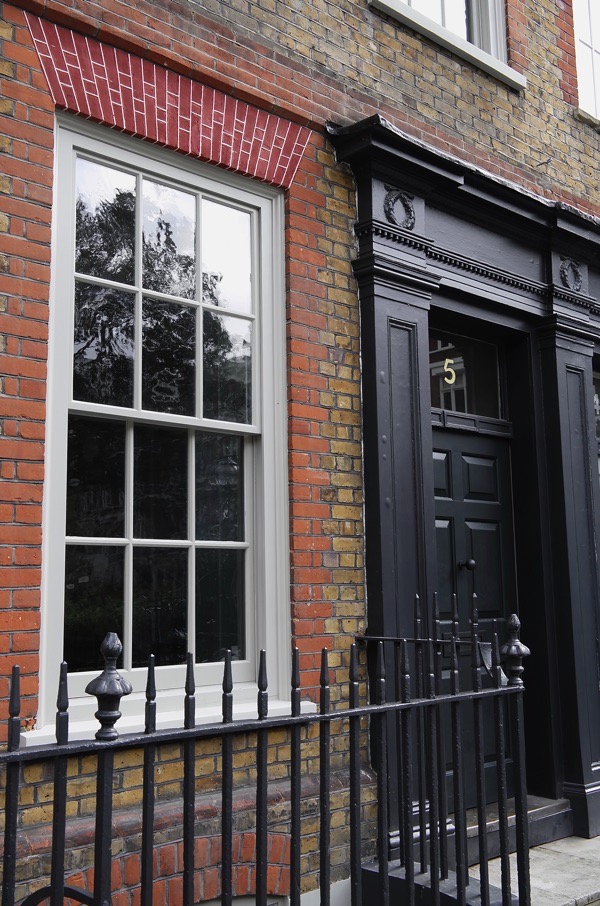
I was born at 5 Charterhouse Sq on January 26th 1880, one of a family of six boys and three girls. I was the seventh child of a seventh child but was never aware of any psychic powers. The only time when I was doubtful was when the craze for table-turning was popular and my name was spelt out as being the medium. I went straight off to bed and left the party to find another person to receive the spirit messages!
5 Charterhouse Sq was a house of four storeys with a basement kitchen and a flat roof, a favourite playing place with two attics opening on to it. The inner attic was used for keeping silkworms which made lovely golden cocoons. My chief concern about them was getting mulberry leaves from the two trees which grew in the central court of the Charterhouse. These had to be picked with caution as it meant going onto the grass, a practice not encouraged by the gardeners. I do not think we were ever looked upon very favourably by the latter as we were also fond of popping the fuchsia buds that grew along the cloisters which ran down two sides of the court.
We always enjoyed playing in the Charterhouse, although we were never sure of a welcome from the warden who kept guard at the gate, and we usually tried to step through when he was having time off in his little room. We liked it as it was a place of cloisters and little courtyards which made good places for playing in.
It was there that my brother Francis and I saw our first and only ghost. We had been told by a friend that if we stood at the far end of one of the little alleys at dusk and whistled three times, a ghost would appear at the opposite opening. And it did! We fled for our lives, screaming and rushing through the walled gardens, pursued by the ghost who, by now, was as frightened as we were disturbing the old pensioners. When we were eventually caught by the friend who had put us up to this escapade, we were all in a state of collapse.
Although we lived practically in the City, being only just without the sound of Bow Bells, we were lucky in having ample space to play in, having the square and the Charterhouse. After school hours we were also allowed to go into the playground where we all enjoyed roller skating. My brothers used to ride on penny farthing bicycles until the fast low one which I remember was called the ‘bantam cycle’ was introduced.
We were always interested in kneeling on the window seats and watching everything that was going on through the open window. There were large gates below us, which could be shut at night to keep the square private, and just inside these was a favourite place for men to settle their differences in a fight. We did not like watching these, but there were more interesting events like a dancing bear, a German band or a barrel organ and May Day processions. One year, I remember a Jack-in-the-Green on November 5th, and funerals with the hearse and the horses’ heads carrying large black plumes.
Balloons would pass over, and one morning the square was covered with small leaflets advertising some sort of drink. On some of these there was a coupon entitling the finder to a free bottle. Although we diligently searched for this coupon we had no success and were quite convinced that the gardener had come out very early. He was a very imposing figure with a very fine brown beard. He treated us very well and even allowed a few of us to have a small piece of earth as a border for our own plants.
The Lord Mayor’s Show was always a great occasion and we were usually given seats in the Civil Service Stores. Street vendors sold panoramic pictures of the show before it took place, which always amused us as they were naturally quite fictitious. I think they were sold as ‘1d plain’ or ‘2d coloured’. One year the Show came along our square, an unusual event, but it was a wet cold day and we were saddened afterwards on hearing that one of the children taking part had died from the effects.
When I was seven, the City was preparing to celebrate Queen Victoria’s Golden Jubilee and we were taken to see the illuminations. These largely took the form of metal shapes with fairy lamps hanging on them. I remember the row which was fastened along the entrance to the Charterhouse. On this and on other royal occasions, we would go along Ludgate Hill or St Pauls to watch the procession and see the Queen. My recollections of her were of a small black figure, rather unsmiling and not looking very regal.
Our nurse used to take some sort of paper with alarming pictures of the events that were likely to happen if Prince Edward ever became King. His accession, according to these papers, would usher in a time of violence. This made me feel very alarmed as I was a very nervous child and was not helped by these pictures, and by being taken by my nurse – who must have belonged to some Second Advent Society – to meetings about the end of the world. I remember my fear at seeing any red in the sky – not an uncommon sight as there were frequent fires in the City – believing this meant the end of the world and we should all be burnt up. My brothers had no fears of this sort and would often go on to the flat roof of our house at night from which there was a good view over the City, to see if there was a fire raging.
Our roof was a favourite playground, it had a tallish parapet and my brothers would occasionally walk along this to the horror of people below who would rush to ring our bell and warn mother what was happening. Personally, I found it made me feel quite dizzy enough even to look over, so there was never any fear of my taking part in this dangerous game.
My mother always seemed busy with her sewing machine so seldom came out with us, and my father, who was head of a room at the War Office was only seen at weekends. He was not really a family man and after office hours would go to his club – The Thatched House – until we younger children were well out of the way. We were all very fond of our parents.
Mother had a gift for telling stories in a very graphic way, although some of those told at bedtime were hardly suitable for a nervous child. Her re-telling of the Old Testament stories was always my favourite, and I am reported to have said after many hearings of the fiery furnace and the three children, ‘Make them really burnt this time’. So I suppose I liked horrors in spite of being easily frightened!
On Sunday afternoons, my father would often take us out. We were always asked if it was a ‘walking’ or a ‘riding‘ Sunday and always decided on the latter which meant a penny ride along the Thames Embankment. My older brothers were encouraged to walk, being given a penny if they went as far as Cleopatra’s Needle. We also enjoyed an occasional outing on a steamboat and one afternoon we went with our nurse for a picnic in Battersea Park. We evidently had return tickets for the steamboat which my nurse lost, and as we did not have enough money to pay for the return journey, we had to walk until we were near enough to home to pay the bus fare.
The Muffin Man with his bell and white cloth-covered tray on his head was always a welcome sound. The Cats’ Meat Man was also frequently heard and his wares were sold skewered to a stick. The Lavender Sellers were more popular with us with their song. Fire engines, with their steam funnels and the men in helmets sitting back to back were always an exciting sight, with the large brass bell clanging to clear the road. And the Lamplighter with his long rod, although so often seen, was usually watched with interest.
We lived near Smithfield Market and would often see sheep being driven along. The fish market was also close and as a luxury we used to buy a pint of winkles. I remember on one occasion, while gloating over my little bag, I walked into a lamp post which I suppose would make an impression on me, although it is a queer thing that some memories remain so vivid.
In the summer when the gardener in the square cut the grass, he would let us gather it and make a sort of nest. Then we would have a feast, keeping some buns and pink and white long-shaped sugar cakes we called meringues. Of course, an occasion like this meant saving up before we could buy them.
To augment our pocket money, we used to make paper spills and on May Day and November 3rd , my grandfather gave us each a tip, probably sixpence. He was instructed to do this by the manservant who looked after him and who, on these special days, insisted that my grandfather should have his purse handy in spite of his protests that he would not need it, not realising that we were going to invade his study during the morning with either a May Day greeting or a request to ‘Remember the Guy’.
My education cannot be called anything outstanding. We had one governess, Miss Burks, who taught us everything: Latin for my brothers, French, the piano and all other subjects for girls. She must have been fairly efficient as I could read the newspaper when I was six, a feat I was called upon to demonstrate to visitors. The facts of life were an entire mystery however, so when I read that the Queen was expecting to be put to bed I was thoroughly mystified and my embarrassed governess hastily made me continue reading.
My mother had never expected to have a large family having been told after the birth of her first child that she could not have any more. However, the babies arrived in quick succession and when the twins increased the number to four, my father was so overwhelmed that he omitted to register their births. So, in later years when certificates were needed, all that could be produced were those for my sister Dolly and brother Wilfred.
Every Christmas, my Godmother, Amy Tyrrell, took me to the pantomime at Drury Lane – the only time I ever went to a theatre. This was a great occasion and the stars were Dan Leno, Little Dick and, I think, Herbert Campbell. The performance always ended with what was called ‘a transformation scene’ which was followed by the Harlequinade with Columbine, the clown with the ‘red hot poker’ and, of course, Harlequin.

Grace Jackson as a young woman

St Sepulchre, Old Bailey

Gardens of the Charterhouse with one of the Mulberry trees
You may also like to read about
Jack Sheppard, Highwayman
Click here to book for my tours through August, September and October
Click here to buy tour gift vouchers for your family and friends

On the morning of 4th September 1724, an inconsequential thief named Jack Sheppard was to be hung at Tyburn for stealing three rolls of cloth, two silver spoons and a silk handkerchief. But instead of the routine execution of another worthless felon, London awoke to the astonishing news that he had escaped from the death cell at Newgate.
With the revelation that this was the third prison break in months by the handsome boyish twenty-two year old Jack Sheppard, he flamed like a comet into the stratosphere of criminality – embodying the role of the charismatic desperado to such superlative effect that his colourful reputation for youthful defiance gleams in the popular imagination two centuries later.
In the spring, he broke out through the roof of St Giles Roundhouse, tossing tiles at his guards. In the summer, with his attractive companion Elizabeth Lyon, he climbed through a barred window twenty-five feet above the ground to escape from New Bridewell Prison, Clerkenwell. And now he had absconded from Newgate too, using a metal file smuggled in by Elizabeth and fleeing in one of her dresses as disguise. Sheppard was a popular sensation, and everyone was fascinated by the inexplicable mystery of his unique talent for escapology.
Spitalfields’ most notorious son, Jack Sheppard, was born in Whites Row on 4th March 1702 and christened the very next day at St Dunstan’s in Stepney, just in case his infant soul fled this earth as quickly as it arrived. Unexceptionally for his circumstances and his time, death surrounded him – named for an elder brother that died before his birth, he lost his father and his sister in infancy. When his mother could not feed him, she gave him to the workhouse in Bishopsgate at the age of six, from where he was indentured to a cane chair maker, until he died too. Eventually at fifteen years old, he was apprenticed to a carpenter in Covent Garden, following his father’s trade, but at age twenty he met Elizabeth Lyon, his partner in crime, at the Black Lion in Drury Lane, a public house frequented by criminals and the infamous Jonathan Wild, known as the “Thief-taker General.”
On 10th September 1724, Sheppard was rearrested after his break-out from Newgate and returned there to a high security cell in the Stone Castle, where he was handcuffed and fettered, then padlocked in shackles and chained down in a chamber that was barred and locked. Yet with apparent superhuman ability – inspiring the notion that the devil himself came to Sheppard’s assistance – he escaped again a month later and enjoyed a very public fortnight of liberty In London, eluding the authorities in disguise as a dandy and carousing flamboyantly with Elizabeth Lyon, until arrested by Jonathan Wild, buying everyone drinks at midnight at a tavern in Clare Market, Lincoln’s Inn Fields. Back in Newgate – now the most celebrated criminal in history – hundreds daily paid four shillings to visit Sheppard in his cell, where he enjoyed a drinking match with Figg the prizefighter and Sir Henry Thornhill painted his execution portrait.
Two hundred thousand people turned out for Jack Sheppard’s hanging on 16th November, just two months since he came to prominence, and copies of his autobiography ghostwritten by Daniel Defoe were sold. Four years later, John Gay’s “The Beggar’s Opera,” with the character of Macheath modelled upon Sheppard and Peachum based upon his nemesis Jonathan Wild, premiered with spectacular success. Biographical pamphlets and dramas proliferated, with Henry Ainsworth’s bestseller of 1839 “Jack Sheppard” – for which George Cruikshank drew these pictures – outselling “Oliver Twist.” Taking my cue from William Makepeace Thackeray, who wrote that, “George Cruikshank really created the tale and Mr Ainsworth, as it were, merely put words to it,” I have published these masterly illustrations here as the quintessential visual account of the life of Spitalfields’ greatest rogue.
And what was the secret of his multiple prison breaks?
There was no supernatural intervention. Sheppard had outstanding talent as a carpenter and builder, inherited from his father and grandfather who were both carpenters before him and developed during the six years of his apprenticeship. With great physical strength and a natural mastery of building materials, he possessed an intimate understanding of the means of construction of every type of lock, bar, window, floor, ceiling and wall – and, in addition to this, twenty-two year old Jack Sheppard had a burning appetite to wrestle whatever joy he could from his time of splendour in the Summer of 1724.

Mrs Sheppard refuses the adoption of her little son Jack

Jack Sheppard exhibits a vindinctive character.

Jack Sheppard committing the robbery in Willesden church.

Jack Sheppard gets drunk and orders his mother off.

Jack Sheppard’s escape from the cage at Willesden.

Mrs Sheppard expostulates with her son.

Jack Sheppard and Blueskin in Mr Wood’s bedroom.

Jack Sheppard in company with Elizabeth Lyon escapes from Clerkenwell Prison.

The audacity of Jack Sheppard.

Jack Sheppard visits his mother in Bedlam.

Jack Sheppard escaping from the condemned cell in Newgate.

The first escape.

Jack Sheppard tricking Shortbolt, the gaoler.

The second escape.

Jonathan Wild seizing Jack Sheppard at his mother’s grave in Willesden.

Jack Sheppard sits for his execution portrait in oils by Sir James Thornhill – accompanied by Figg the prizefighter (to Jack’s right), John Gay, the playwright (to Jacks’s left), while William Hogarth sketches him on the right.

Jack Sheppard’s irons knocked off in the stone hall in Newgate.


Jack Sheppard of Spitalfields (Mezzotint after the Newgate portrait by Sir James Thornhill, 1724) – “Yes sir, I am The Sheppard, and all the gaolers in the town are my flocks, and I cannot stir into the country but they are at my heels baaing after me…”
You may also like to read about
Dan Cruikshank’s Spitalfields Photographs

Click here to book for my tours through August, September and October
Click here to buy tour gift vouchers for your family and friends
Dan Cruickshank took these photographs between 1969 when he first came to Spitalfields and 1977 when he led the campaign to stop British Land destroying Elder St. “I did it to document the buildings that were here then,” he explained to me in regret, “but sometimes you’d go back the next Saturday and there’d be virtually nothing left.”

Barrowmakers in Wheler St

Baker in Quaker St

Quaker St and Railway Dwellings

Junction of Bethnal Green Rd & Redchurch St

Weaver’s House at the corner of Bacon St & Brick Lane

Weavers’ houses in Sclater St, now demolished

Weavers’ houses in Sclater St, only those in foreground remain

Weavers’ houses in Sclater St, now demolished

Corner of Sclater St & Brick Lane

Houses in Hanbury St, now demolished

Houses in Hanbury St, now demolished

Old House in Calvin St, now demolished

Elaborate doorcase in Wilkes St, now gone

Brushfield St

Brushfield St, buildings on the right now demolished

Brushfield St, buildings on the right now demolished

Buildings in Brushfield St, now demolished

Brushfield St, buildings on the left now demolished

Looking from Brushfield St towards Norton Folgate

Selling Christmas trees in Spital Sq

Spital Sq with St Botolph’s Hall

Folgate St with Dennis Severs’ House in the foreground, houses in the background now demolished

House in Folgate St, now demolished

5 & 7 Elder St during squat to prevent complete demolition by British Land

Partial demolition of 5 & 7 Elder St

Rear of 5 & 7 Elder St during partial demolition

Inside 7 Elder St

Douglas Blain of Spitalfields Trust reads a paper in the loft of 7 Elder St after the roof was removed

Alleyway off Folgate St
Photographs copyright © Dan Cruickshank
You may also like to take a look at
Philip Marriage’s Spitalfields
[youtube UMQBhsJCU7Y nolink]
Tower Hamlets Council Planning Committee will make a decision on Norton Folgate on 21st July so you have until then to object. Click here for your guide to how to object.
The Language Of Printing
Click here to book for my tours through August, September and October
Click here to buy tour gift vouchers for your family and friends
Charles Pertwee of Baddeley Brothers, the longest established engravers in the City of London & the East End, lent me his copy of John Southward’s ‘Dictionary of Typography’ from 1875, which lists all the relevant terminology. And I have selected some of my favourite entries – as much for their arcane poetry as for the education of my readers.

ABRIDGEMENT – An epitome of a book, made by omitting the less important matter.
ADVERSARIA – Commonplace books: a miscellaneous collection of notes remarks and extracts.
APPRENTICE – An apprentice is a person described in law books as a species of servant, and so called from the French verb apprendre – to learn – because he is bound by indenture to serve a master for a certain term, receiving in return for his services instruction in his masters’s trade, profession or art.
BASTARD TITLE – The short or condensed title preceding full title of the work.
BATTER – Any injury to the face of the type sufficient to prevent it showing clearly in printing.
BEARD OF A LETTER – The outer-angle of the square shoulder of the shank, which reaches almost to the face of the letter, and is commonly scraped off by the Founders, serving to leave a white square between the lower face of the type and the top part of any ascending letter which happen to come in the line following.
BIENVENUE – An obsolete term by which was meant formerly the fee paid on admittance to a ‘Chapel.’
BODKIN – A pointing steel instrument used in correcting, to pick wrong or imperfect letters out of a page.
BOTCHED – Carelessly or badly-done work.
BOTTLE-ARSED – Type that is wider at the bottom than the top.
BOTTLE-NECKED – Type that is thicker at the top than the bottom.
CANDLESTICK – In former times, when Compositors worked at night by the light of candles, they used a candlestick loaded at the base to keep it steady. A few offices use candlesticks at the present day.
CASSIE-PAPER – Imperfect paper, the outside quires of a ream.
CHAFF – Too frequently heard in the printing office, when one Compositor teases another, as regards his work, habits, disposition etc
CHOKED – Type filled up with dirt.
COVENTRY – When a workman does not conform to the rules of the ‘Chapel,’ he is sent to Coventry. That is, on no consideration, is any person allowed to speak with him, apart from business matters, until he pays his dues.
DEAD HORSE – When a Compositor has drawn more money on account than he has actually earned, he is said to be ‘horsing it’ and until he has done enough work in the next week to cover the amount withdrawn, he is said to be working a ‘dead horse.’
DEVIL – is the term applied to the printer’s boy who does the drudgery work of a print office.
DONKEY – Compositors were at one period thus styled by Pressmen in retaliation for being called pigs by them.
EIGHTEENMO – A sheet of paper folded into eighteen leaves, making thirty-six pages.
FAT-FACE LETTER – Letter with a broad face and thick stem.
FLOOR PIE – Type that has been dropped upon the floor during the operations of composition or distribution.
FLY – The man or boy who takes off the sheet from the tympan as the Pressman turns it up.
FORTY-EIGHTMO – A sheet of paper folded into forty-eight leaves or ninety-six pages.
FUDGE – To execute work without the proper materials, or finish it in a bungling or unworkmanlike manner.
GOOD COLOUR – When a sheet is printed neither too dark or too light.
GULL – To tear the point holes in a sheet of paper while printing.
HELL – The place where the broken and battered type goes to.
JERRY – A peculiar noise rendered by Compositors and Pressmen when one of their companions renders themselves ridiculous in any way.
LAYING-ON-BOY – The boy who feeds the sheets into the machine.
LEAN-FACE – A letter of slender proportions, compared with its height.
LIGHT-FACES – Varieties of face in which the lines are unusually thin.
LUG – When the roller adheres closely to the inking table and the type, through its being green and soft, it is said to ‘lug.’
MACKLE – An imperfection in the printed sheets, part of the impression appears double.
MONK – A botch of ink on a printed sheet, arising from insufficient distribution of the ink over the rollers.
MULLER – A sort of pestle, used for spreading ink on the ink table.
NEWS-HOUSE – A printing office in which newspapers only are printed. This term is used to distinguish from book and job houses.
OCTAVO – A sheet of paper folded so as to make eight leaves or sixteen pages.
ON ITS FEET – When a letter stands perfectly upright, it is said to be ‘on its feet.’
PEEL – A wooden instrument shaped like a letter ‘T’ used for hanging up sheets on the poles.
PENNY-A-LINER – A reporter for the Press who is not engaged on the staff, but sends in his matter upon approbation.
PIE – A mass of letters disarranged and in confusion.
PIG – A Pressman was formerly called so by Compositors.
PIGEON HOLES – Unusually wide spaces between words, caused by the carelessness or want of taste of the workman.
PRESS GOES EASY – When the run of the press is light and the pull is easy.
QUIRE – A quire of paper for all usual purposes consists of twenty-four sheets.
RAT-HOUSE – A printing office where the rules of the printers’ trade unions are not conformed to.
SCORPERS – Instruments used by Engravers to clear away the larger portions of wood not drawn upon.
SHEEP’S FOOT – An iron hammer with a claw end, used by Pressmen.
‘SHIP – A colloquial abbreviation of companionship.
SHOE – An old slipper is hung at the end of the frame so that the Compositor, when he comes across a broken or battered letter, may put it there.
SLUG – An American name for what we call a ‘clump.’
SQUABBLE – Lines of matter twisted out of their proper positions with letters running into wrong lines etc.
STIGMATYPY – Printing with points, the arrangement of points of various thicknesses to create a picture.
WAYZGOOSE – An annual festivity celebrated in most large offices.
You may also like to read about
At Dirty Dick’s
Click here to book for my tours through August, September and October
Click here to buy tour gift vouchers for your family and friends

These are the dead cats that once hung behind the counter of the celebrated “Dustbin Bar” at Dirty Dick’s Old Port Wine & Spirit House in Bishopsgate. It is a location that holds a special place in my affections as the first pub I ever went into in London, one day after work at the Bishopsgate Institute.
Although this was longer ago than I care to admit and regrettably the cats in this picture had already gone by then, yet I still recall the sense of expectation, entering the narrow frontage and walking back, and back, and back through the warren of rooms with sawdust on the floor – descending ever deeper into the bowels of the city, it seemed. And I can only imagine how this strange drama might have been enhanced by the presence of umpteen dead cats suspended from the ceiling.
This was how it was described in 1866 – “A small public house or rather a tap of a wholesale wine and spirit business…a warehouse or barn without floorboards – a low ceiling, with cobweb festoons dangling from the black rafters – a pewter bar battered and dirty, floating with beer – numberless gas pipes tied anyhow along the struts and posts to conduct the spirits from the barrels to the taps – sample phials and labelled bottles of wine and spirits on shelves – everything covered with virgin dust and cobwebs.”
Yet all was not as it might seem, because the presence of these curious artefacts was not due to unselfconscious eccentricity, it was an early and highly successful example of what we should call a “theme pub.” Established in 1745 as The Old Jerusalem, the drinking house took the name of Dirty Dick’s in 1814 and adopted his story along with it. The original of Dirty Dick was Nathaniel Bentley, a successful merchant with a hardware shop and warehouse in Leadenhall St in the mid-eighteenth century. After his bride-to-be died on their wedding day – so the legend goes – he never cleaned up again, never washed or changed his clothes. “It’s of no use, if I wash my hands today, they will be dirty again tomorrow,” he declared. Bentley died in 1809, and the Bishopsgate Distillers appropriated this story of the notorious dirty hardware merchant, adorning their bar with dead cats and cobwebs to perpetuate the legend.
Charles Dickens knew Dirty Dick’s and was fascinated with this myth of one who sealed up the door on the wedding breakfast and left the cake and table decorations to acquire dust eternally. In a letter to the printer of his weekly publication “Household Words” dated 30th December 1852, he wrote “Don’t leave out the Dirty Old Man, he is capital.” And it has been suggested that Nathaniel Bentley was the inspiration for the character of Miss Havisham in “Great Expectations.”
Dirty Dick’s was rebuilt in the eighteen seventies, though the cellars are of an earlier date, and now the bizarre artefacts are banished to a glass case, yet it is still worth a visit. Explore the wonky half-timbered spaces and seek out the secluded panelled rooms at the rear, where you can enjoy a quiet drink away from the commotion of Bishopsgate to contemplate the ancient coaching inns that once lined this street, long before the age of the train and the motor car.

Nathaniel Richard Bentley – the origin of the myth of Dirty Dick.


Dirty Dick by William Allingham
A Lay of Leadenhall
In a dirty old house lived a Dirty Old Man.
Soap, towels or brushes were not in his plan;
For forty long years as the neighbours declared,
His house never once had been cleaned or repaired.
‘Twas a scandal and a shame to the business-like street,
One terrible blot in a ledger so neat;
The old shop with its glasses,black bottles and vats,
And the rest of the mansion a run for the rats.
Outside, the old plaster, all splatter and stain,
Looked spotty in sunshine, and streaky in rain;
The window-sills sprouted with mildewy grass,
And the panes being broken, were known to be glass.
On a rickety signboard no learning could spell,
The merchant who sold, or the goods he’d to sell;
But for house and for man, a new title took growth,
Like a fungus the dirt gave a name to them both.
Within these there were carpets and cushions of dust,
The wood was half rot, and the metal half rust;
Old curtains—half cobwebs—hung grimly aloof;
‘Twas a spiders’ elysium from cellar to roof.
There, king of the spiders, the Dirty Old man,
Lives busy, and dirty, as ever he can;
With dirt on his fingers and dirt on his face,
The dirty old man thinks the dirt no disgrace.
From his wig to his shoes, from his coat to his shirt,
His clothes are a proverb—a marvel of dirt;
The dirt is prevading, unfading, exceeding,
Yet the Dirty Old Man has learning and breeding.
Fine folks from their carriages, noble and fair,
Have entered his shop, less to buy than to stare,
And afterwards said, though the dirt was so frightful,
The Dirty Man’s manners were truly delightful.
But they pried not upstairs thro’ the dirt and the gloom,
Nor peeped at the door of the wonderful room
That gossips made much of in accents subdued,
But whose inside no one might brag to have viewed.
That room, forty years since, folks settled and decked it,
The luncheon’s prepared, and the guests are expected,
The handsome young host he is gallant and gay,
For his love and her friends are expected today.
With solid and dainty the table is dressed—
The wine beams its brightest—flowers bloom their best;
Yet the host will not smile, and no guest will appear,
For his sweetheart is dead, as he shortly shall hear.
Full forty years since turned the key in that door,
‘Tis a room deaf and dumb ’mid the city’s uproar;
The guests for whose joyance that table was spread,
May now enter as ghosts, for they’re everyone dead.
Though a chink in the shutter dim lights come and go,
The seats are in order, the dishes a row;
But the luncheon was wealth to the rat and the mouse,
Whose descendants have long left the dirty old house.
Cup and platter are masked in thick layers of dust,
The flowers fallen to powder, the wine swath’d in crust,
A nosegay was laid before one special chair,
And the faded blue ribbon that bound it is there.
The old man has played out his part in the scene
Wherever he now is let’s hope he’s more clean;
Yet give we a thought, free of scoffing or ban,
To that Dirty Old House and that Dirty Old Man.
(First published by Charles Dickens in Household Words, 1853)

Nathaniel Bentley, Eccentric Character & Hardwareman of Leadenhall St – the well-known Dirty Dick

Archive pictures courtesy of Bishopsgate Institute
You may also like to read about
At St Botolph’s Church Hall
Click here to book for my tours through August, September and October
Click here to buy tour gift vouchers for your family and friends

If you want to know the story of the splendid pair of statues of schoolchildren upon the front of the former School House at St Botolph’s in Bishopsgate, Reg the Caretaker is your man. “When this was a school, these statues used to be coloured – the children repainted them each year – and then we sent them away for a whole year to get all the layers removed,” he explained to me with a sigh. “When they came back, people tried twice to nick them, so then we put them inside but the Council said, ‘They’re listed,’ and we had to send them away again for another year to get replicas cast.”
Old photographs show these figures covered in gloss paint and reduced to lifeless mannequins, yet these new casts from the originals – now that the paint has been removed – are startlingly lifelike, full of expression and displaying fine details of demeanour and costume. The presence of the pair in their symmetrical niches dramatically enlivens the formality of the architecture of 1820 and, close up, they confront you with their implacable expressions of modest reserve. Quite literally, these were the model schoolchildren for the generations who passed through these doors, demure in tidy uniforms and eagerly clutching their textbooks. Their badges would once have had the image of a boy and a sheep with the text, “God’s providence is our inheritance.”
“It’s Coade stone – the woman died with the recipe, but now they’ve rediscovered it again,” added Reg helpfully and – sure enough – upon the base of the schoolboy are impressed the words “COADE LAMBETH 1821.” Born in Exeter in 1733, Eleanor Coade perfected the casting process and ran Coade’s Artificial Stone Manufactory from 1769 at a site on the South Bank, until she died in 1821 aged eighty-eight – which makes these figures among the last produced under her supervision. Mrs Coade was the first to exploit the manufacture of artificial stone successfully and her works may still be seen all over London, including the figures upon Twinings in the Strand, the lion upon Westminster Bridge and the Nelson pediment at the Old Royal Naval College in Greenwich.
Reg took me inside to show me St Botolph’s Hall, lined with oak panelling of 1725 from a demolished stately home in Northamptonshire, where the two original statues peer out from behind glass seemingly bemused at the corporate City functions which commonly occupy their school room now. The Bishopsgate Ward School was begun in 1820 by Sir William Rawlins, a Furniture Maker who became Master of the Worshipful Company of Upholders and Sheriff of the City of London. In twenty years as Treasurer, he had lifted the institution up from poverty and it opened on 1st August 1821 with three hundred and forty pupils, of whom eighty needy boys and girls were provided with their uniforms.
“They used to be the other way round,” admitted Reg mischievously, indicating the pair of figures on the exterior, “their eyes used to meet but now they are looking in opposite directions.” Yet, given all the changes in the City in the last two centuries – “Who can blame the kids if their eyes are wandering now?” I thought. It was a sentiment with which Reg seemed in accord and which the enterprising Mrs Coade exemplified in the longevity of her endeavours too. “I should have retired years ago but I don’t like sitting indoors and couldn’t stand all that earlobe bashing,” he confessed to me, “I like to be outside doing something.”

In St Botolph’s Churchyard, Bishopsgate – Schoolroom and Sir William Rawlins’ tomb

Original figure coated in layers of paint

Modern replica now in place upon St Botolph’s Hall

Original figure coated in layers of paint

Modern replica now in place upon exterior of St Botolph’s Hall

With layers of paint removed, the original figures now stand inside the hall


Reg the Caretaker at St Botolph’s

Coade stone Nelson pediment at Greenwich
Archive photographs courtesy Bishopsgate Institute
You may also like to read about
At The Bishopsgate Bathhouse
Click here to book for my tours through July, August and September
Click here to buy tour gift vouchers for your family and friends

This extravagant domed orientalist edifice topped by the crescent moon is what you see above ground in the churchyard of St Botolph’s Bishopsgate, but it is the mere portal to a secret subterranean world beneath your feet.
These Turkish baths were built in 1895 by Henry & James Forde Nevill to a design by architect G Harold Elphick, and clad with interlocking ceramic tiles worthy of the Alhambra, designed by the architect and manufactured at Craven Dunnill in Shropshire. As you descend the spiral staircase to the larger, cavernous space below, note the ceramic motif of the hand of Fatima raised in blessing.
Yet the current edifice is simply the most recent in a series of bathhouses on this site dating back to 1817. In 1847, it was recorded that a certain Dr Culverwell was offering medicinal baths here. Around 1883, the baths were sold to Jones & Co who named them Argyll Baths and reconstructed them entirely, only for their work to be demolished ten years later and replaced by the building we see today.
In 1963, when Geoffrey Fletcher the author of ‘The London Nobody Knows’ passed by, the brass plate with the words Nevill’s Turkish Baths was still here even though it was merely in use as storage space by then. “Still eloquent of the vanished days when a corpulent company director would while a way an afternoon and a little avoirdupois in these exotic surroundings before taking himself to his green and pleasant villa in Denmark Hill”, he wrote.
In recent years, the grade II listed bathhouse has enjoyed a successful existence as a popular events venue but now it is imperilled by a redevelopment that would see a twenty-four storey office tower cantilevered above and underpinning below. The proposed tower over the Great Eastern Hotel nearby in Liverpool St potentially sets an alarming precedent for the possibility of constructing developments on top of listed buildings.
Readers are encouraged to write and object to this planning application which threatens to overwhelm the grade II listed bathhouse. Be sure to label your comment clearly as an ‘objection.’
Click here to visit the City of London planning website and make your objection

Developers’ proposal for a cantilevered tower that will overwhelm the historic bathhouse


Price list, c. 1885

c.1908


Drawing by Geoffrey Fletcher, 1963

The Boom Boom Club at the bathhouse
Click here to book an event at the Bishopsgate bathhouse
You may also like to read about


