
The Mosaic Makers Of Hackney

Starting in 2013, Spitalfields Life Books published 15 books over 6 years until the pandemic shut us down. Now we are ready to begin again and are crowdfunding to raise enough money to cover production of our next 3 books. We have raised £7,750 so far.
CLICK HERE TO VISIT OUR CROWDFUND PAGE AND CONTRIBUTE
Today we preview Tessa Hunkin’s book
TESSA HUNKIN & HACKNEY MOSAIC PROJECT
Tessa Hunkin and Hackney Mosaic Project have created breathtakingly beautiful and witty mosaics in locations all across the East End over the past ten years. In the process, Tessa has won the reputation as the pre-eminent mosaic designer in this country while leading a community endeavour that has elevated the lives of hundreds of participants.
“A beautiful book about Hackney Mosaic Project will be the best reward for all the people who have worked on the mosaics, bringing their achievement to a wider public and giving them the recognition they so well deserve.”
Tessa Hunkin

Next time you are walking up Shepherdess Walk in Hoxton and you pass that sinister tunnel with the worn flagstones, leading under the shabby nineteenth century terrace, I recommend you take courage and pass through it to the park at the other end where a wonderful surprise awaits you.
For two years, artist Tessa Hunkin and around one hundred and fifty people worked to create an elaborate set of mosaics in Shepherdess Walk Park. These breathtakingly beautiful pieces of work are an attraction in their own right – drawing people from far and wide to this corner of Hoxton.
I had the pleasure of going over to admire them in the company of Tessa and couple of the stalwart mosaic makers, when they contemplated the completion of their mighty task which transformed an unloved part of the park into an inspirational destination.
Taking the lyrical name of Shepherdess Walk as a starting point, the first mosaic portrays the shepherdesses that once drove their sheep through here when Hoxton was all fields. Next to this, a double wall panel illustrates park life throughout the seasons of the year in the East End while, underfoot, a pair of pavement mosaics show the wild flowers that persist, all illustrated in superb botanic detail.
The quality of execution and subtle sense of colour in Tessa Hunkin’s designs have combined with humorous observation of the detail of the social and the natural world to create works of lasting value which residents of Hoxton can enjoy for generations to come.


Ken Edwards
“That’s my little rabbit, I named him ‘Randy.’ I’ve been coming here for over a year but, the first time, I thought it was something I wouldn’t be able to do. Yet Tessa showed me how to do it and I’ve been coming ever since. We work each Wednesday and Thursday afternoon, and every other Saturday when the youngsters from the Estate come to help. Even when you are not here, it’s what you think about. I live over in Well St and I walk here. Coming here, it helps with your sanity. We talk, we laugh, we joke. I love coming here, it’s very therapeutic, it’s a family atmosphere. I was a painter and decorator before and when you paint a flat that’s it, but this work that we’ve done is going to be here long after we’ve all gone and that’s very important to me.”


Katy Dixon
“I joined the summer before last. I am an artist and maker and I believe that art can heal people. We work as a group and enjoy the art of conversation together, and I imagine that’s how people would have worked on mosaics a long time ago in Pompeii. We like to listen to music while we work but it’s not always easy to find music that we can all agree upon. We tend to listen to reggae because it has an earthy quality.”


Tessa Hunkin
“We’ve made a little bit of Carthage here in Hoxton. I was inspired by the Roman mosaics of North Africa. It was my idea, I’ve been making mosaics for twenty-five years and I started working with people with mental health problems. I like working with groups of people on large compositions that they can be proud of. Mosaic-making is very time-consuming and laborious, so it seemed a good idea to work with people who have too much time, for whom filling time can be a problem. Also, I’m very interested in the historical precedents and that gives the work another dimension. This project started in July 2011 and it was going to be for six months but, when we came to end of the first mosaic nobody wanted the empty shop that is our workshop, so we just carried on.”


Nicky Turner
“When Tessa showed me the work, I thought it was interesting and I wanted to try but, originally, it was only going to be until the end of the year and now I’ve been here two years. I live in Stratford, two bus rides away, but I come two or three times a week. It’s always different here, so I never get bored. I worked on the borders, and I get satisfaction and self-esteem from doing this work.


Work in progress on the new Pitfield St mosaic, celebrating the former Hoxton Palace of Varieties

Nicky shows off his rings.

Ken with the poem he wrote about the mosaics


Katy with one of the sheep she led to the unveiling, dressed as a shepherdess

The old tunnel from Shepherdess Walk that leads to the mosaics in the park.

Click on this image to enlarge

Click on this image to enlarge
Women At Work In Hackney
Starting in 2013, Spitalfields Life Books published 15 books over 6 years until the pandemic shut us down. Now we are ready to begin again and we are inspired by a string of new titles that we have ready to publish.
We are launching a crowdfund to raise enough money to cover production of our next 3 books, then income from sales of these will permit us to continue and publish more.
CLICK HERE TO VISIT OUR CROWDFUND PAGE AND CONTRIBUTE
Today we preview more images from Sarah Ainslie’s book
WOMEN AT WORK IN THE EAST END OF LONDON 1992-2023
Sarah Ainslie celebrates the contribution of female labour over the past thirty years in exuberant portraits that capture the passion and struggle of the working life. Drawn from Sarah’s personal archive and her work as Spitalfields Life Contributing Photographer, this is a panoramic survey of social change.
“It means so much to me and will be an important recognition of all the women I have photographed over the years for this book to be published by Spitalfields Life Books, a perfect home for it.”
Sarah Ainslie

Terrie Alderton, Bus Driver

Loretta Leitch, Electrician

Rosemary More, Architect

Fontanelle Alleyne, Environmental Health Officer

Hackney Registrar of Births, Marriages & Deaths

Jenny Amos, Heating & Ventilation Engineer

Carol Straker, Dancer

Annie Johns, Sculptor

Sue Hopkins, Doctor at Lawson Practice Baby Clinic

Lilly Claridge, Age Concern Charity Shop Manager

Karen Francis & Carolyn Donovan, Dustwomen

Helen Graham, Street Sweeper

Denise Martin, Truck Driver

Judy Benoit, Studio Manager

Luz Hollingsworth, Fire Fighter

Diane Abbott, Member of Parliament

Dionne Allacker, Joanne Gillard, Winnifred John, Clothing Warehouse Supervisors

Lanette Edwards, Machinist

Nora Fenn, Buttonholist

Jane Harris, Carpenter

Eileen Lake, Chaplain at Homerton Hospital

Dr Costeloe, Homerton Hospital

Ivy Harris & E Vidal, Cleaners at Homerton Hospital

Sister Ferris Aagee, Homerton Hospital

Joan Lewis, Homerton Hospital

Sister Sally Bowcock

Valerie Cruz, Catering Assistant

K Lewis, Traffic Warden

Gerrie Harris, Acupuncturist

WPC Helen Taylor

Mary, Counter Assistant at Ridley’s Beigel Bakery

Mandy McLoughlin & Angela Kent, Faulkners Fish & Chip Restaurant

Terrie Tan, Driver at Lady Cabs

Maureen McLoughlin, Supervisor at Riversdale Laundrette

Anna Sousa, Hairdresser at Shampers

Jane Reeves, Councillor

Carolin Ambler, Zoo Keeper

Mrs Sherman, Dentist

Eileen Fisher, Police Domestic Violence Unit

Yvonne McKenzie, Jacqui Olliffe & Dirinai Harley, Supervisors at Oranges & Lemons Day Nursery

Jessica James, Active Birth Teacher

Di England, Supervisor at Free Form Arts

Sally Theakston, Chaplain, St John’s Hackney
Photographs copyright © Sarah Ainslie
Photographs courtesy Hackney Museum
A New Season Of Spitalfields Talks
Starting in 2013, Spitalfields Life Books published 15 books over 6 years until the pandemic shut us down. Now we are ready to begin again and we are inspired by a string of new titles that we have ready to publish. We are crowdfunding to raise enough to cover the production of our next 3 books, then income from sales of these will permit us to continue and publish more.
CLICK HERE TO VISIT OUR CROWDFUND PAGE AND CONTRIBUTE

After the popular success of the first season, I have curated another series of eight monthly talks at the Hanbury Hall on subjects of local interest in collaboration with the Spitalfields Society. I am giving an illustrated lecture on the subject of East End Vernacular painting to start the season. The talks take place on the first Tuesday of each month at 7pm, commencing in October and running through the winter to deliver us to next spring.
Tickets are £10 and you can book through the links below. All talks will be accompanied by a bar which opens at 6:30pm and we look forward to welcoming you to this popular social event in Spitalfields. The Hanbury Hall was built as a Huguenot chapel in 1740 as ‘La Patente’ and has recently been renovated.

Click here to book for 3rd October: The Gentle Author on East End Vernacular
The Gentle Author presents a magnificent selection of pictures, revealing the evolution of painting in the East End and tracing the changing character of the streets through the twentieth century.


Christ Church Spitalfields by Anthony Eyton, 1980

Brushfield St, Spitalfields, 1951-60 (Courtesy of Museum of London)

Click here to book for 7th November, Griff Rhys Jones on Save Liverpool Street Station
Griff Rhys Jones discusses the campaign to prevent the destruction of Liverpool Street Station and Historian Robert Thorne outlines the history of the majestic station.

Proposed redevelopment of Liverpool St Station

Click here to book for 5th December: Raymond Francis on Morris Goldstein, The Lost Whitechapel Boy
Raymond Francis shows previously unseen paintings by his father Morris Goldstein, exploring his neglected position among his more celebrated peers in the ‘Whitechapel Boys’ group of painters.

Self portrait by Morris Goldstein

Click here to book for 9th January: Stefan Dickers on The Treasures of the Bishopsgate Institute
Archivist Stefan Dickers gives an illustrated lecture showing rare photographs and artefacts from the rich and diverse collections of the Bishopsgate Institute in Spitalfields.

The Bishopsgate Institute (Courtesy of RIBA)

Click here to book for 6th February: An Audience with Dame Siân Phillips
Former Spitalfields resident and superlative actor Dame Siân Phillips reminisces about her astonishing career in conversation with Basil Comely.

Portrait of Sian Phillips by Lucinda Douglas Menzies

Click here to book for 5th March: Julie Begum on The Bengali East End
Julie Begum of the Swadhinata Trust explores her own East End roots and outlines the long history of the presence of Bengali people on this side of London.

Portrait of Julie Begum by Sarah Ainslie

Click here to book for 2nd April: Geoff Quilley on The East India Company
Geoff Quilley describes the dark and violent history of the East India Company, the world’s first corporation and the driving force in British colonialism.

Shah ‘Alam conveying the grant of the Diwani to Lord Clive, August 1765, by Benjamin West

Click here to book for 7th May: Margaret Willes on The Horticultural History of the East End
Writer & Horticultural Historian Margaret Willes describes the garden of London that once existed here before the East End as we know it today was built in the nineteenth century.

Portrait of Margaret Willes by Sarah Ainslie
The graphics are based on the plaque of delft tiles tiles by Paul Bommer on the exterior of the Hanbury Hall commissioned by the Huguenots of Spitalfields in 2015.
David Hoffman At Fieldgate Mansions
Starting in 2013, Spitalfields Life Books published 15 books over 6 years until the pandemic shut us down. Now we are ready to begin again and we are inspired by a string of new titles that we have ready to publish.
We are launching a crowdfund to raise enough money to cover production of our next 3 books, then income from sales of these will permit us to continue and publish more.
CLICK HERE TO VISIT OUR CROWDFUND PAGE AND CONTRIBUTE
Today we preview David Hoffman’s book
A PLACE TO LIVE: ENDURANCE & JOY IN THE EAST END 1971-87
David Hoffman’s bold, humane photography records a lost decade, speaking vividly to our own times. Living in Whitechapel through the 70s, David documented homelessness, racism, the incursion of developers and the rise of protest in startlingly intimate and compassionate pictures to compose a vital photographic testimony of resilience.
“The old East End was disappearing as I took these photographs, being able to bring back a glimpse of its spirit in this book means a lot to me.”
David Hoffman

Children playing at Fieldgate Mansions, April 1981
This series of photographs by David Hoffman, taken while he was squatting in Fieldgate Mansions off Fieldgate St in Whitechapel from 1973 until 1984, record a vital community of artists, homeless people and Bengali families who inhabited these streets at the time they were scheduled for demolition. Thanks to the tenacity and courage of these people, the dignified buildings survive today, restored and still in use for housing.
David Hoffman’s photographs record the drama of the life of his fellow squatters, subject to violent harassment and the constant threat of eviction, yet these images are counterpointed by his tender and intimate observation of children at play. After dropping out of university, David Hoffman found a haven in Fieldgate Mansion where he could develop his photography, which became his life’s work.
Characterised by an unflinching political insight, this photography is equally distinguished by a generous human sympathy and both these qualities are present in his Fieldgate Mansions pictures, manifesting the emergence of one photographer’s vision – as David Hoffman explained to me recently.
“It was the need for a place to live that brought me here. I’d come down from university without a degree in 1970. I’d dossed in Black Lion Yard and rented a squalid slum room in Chicksand St, before a permanent room came up for very little money in Black Lion Yard in 1971 above Solly Granatt’s jewellery shop. But the whole street was due for demolition, and when he died we squatted in it until they knocked it down in November 1973.
Then I found a place in Fieldgate Mansions which was being squatted by half a dozen people from the London College of Furniture. Bengali families were having a hard time and we were opening up flats in the Mansions for them to live there. We were really active, taking over other empty buildings that were being kept vacant in Myrdle St and Parfett St, because the owners found it was cheaper to keep them empty. We also squatted many empty houses further east in Stepney preventing the council from demolishing them. We took over and got evicted, and came back the next day and, when they put them up for auction, we used to bid and our bid won but, of course, we had no money so we couldn’t pay – it was a delaying tactic. It was a war of attrition to keep the buildings for people rather than for profit.
The bailiffs and police came at four in the morning and got everyone out and boarded up the property and put dogs in. Then we got dog handlers who removed the dogs and took them to Leman St Police Station as strays, and then we moved back in again.
When I moved into Fieldgate Manions it was late November and there was no hot water and the council had poured concrete down the toilet and ripped out the wiring. There was no insulation in the roof, it was just open to the slates and the temperature inside was as freezing as it was outside. I found a gas water heater in a skip and got it working on New Year’s Eve, so I counted in the New Year 1974 with hot water as the horns of the boats sounded on the river.
I decided to do Communication Design at the North East London Polytechnic, because I’d been taking photographs since I was a child and I’d helped set up a darkroom at university. At Fieldgate Mansions, I had a two room flat, one was my bedroom and office and other I made into a darkroom and I did quite a bit of photography. When I left college in 1976, I took up photography full time and began to make a slim living at it and I have done so ever since. While I was a student, I had a grant but I didn’t have to pay rent and it was the first time in my life I had enough money to feed and clothe myself. I stayed in Fieldgate Mansions until 1984 when I moved into a derelict house in Bow which I bought with some money I’d saved and what my mother left me, and where I still live today.”

Waiting to resist eviction in front of the barricaded front door of a squat in Myrdle St, Whitechapel, in February 1973. Ann Pettitt and Anne Zell are standing, with Duncan, Tony Mahoney and Phineas sitting in front.

Doris Lerner, activist and squatter, climbs through a first floor window of a squat in Myrdle St

Max Levitas, Tower Hamlets Communist Councillor, tried unsuccessfully to convince the squatters that resistance to eviction should be taken over by the Communist Party

March on Tower Hamlets Council in protest against the eviction of squatters

Doris Lerner in an argument with a neighbour during the evictions from Myrdle St and Parfett St

Lavatory in squatted house in Myrdle St, Whitechapel, 1973

Police arrive to evict squatters in Myrdle St

Eviction in progress

Out on the street


Sleeping on the street after eviction

Liz and Sue in my flat in Fieldgate Mansions, September 1975

Coral Prior, silversmith, working in her studio at Fieldgate Mansions, 1977

Fieldgate Scratch Band


A boy dances in the courtyard of Fieldgate Mansions. Scheduled for demolition in 1972, it was squatted to prevent destruction until taken over by a community housing trust and modernised in the eighties.
Photographs copyright © David Hoffman
Tessa Hunkin’s Haggerston Mosaic
Starting in 2013, Spitalfields Life Books published 15 books over 6 years until the pandemic shut us down. Now we are ready to begin again and we are inspired by a string of new titles that we have ready to publish.
We are launching a crowdfund to raise enough money to cover production of our next 3 books, then income from sales of these will permit us to continue and publish more.
CLICK HERE TO VISIT OUR CROWDFUND PAGE AND CONTRIBUTE
Today we preview Tessa Hunkin’s book
TESSA HUNKIN & HACKNEY MOSAIC PROJECT
Tessa Hunkin and Hackney Mosaic Project have created breathtakingly beautiful and witty mosaics in locations all across the East End over the past ten years. In the process, Tessa has won the reputation as the pre-eminent mosaic designer in this country while leading a community endeavour that has elevated the lives of hundreds of participants.
“A beautiful book about Hackney Mosaic Project will be the best reward for all the people who have worked on the mosaics, bringing their achievement to a wider public and giving them the recognition they so well deserve.”
Tessa Hunkin

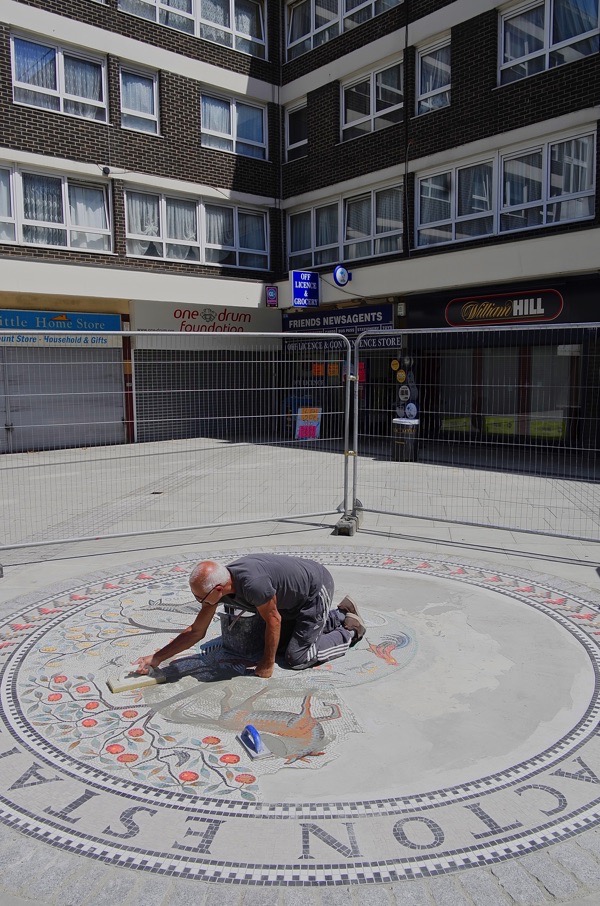
If you are seeking a destination for your walk you can do no better than directing your footsteps towards Haggerston where Tessa Hunkin & Hackney Mosaic Project‘s largest mosaic is installed on the Acton Estate.
Eight months of work by Tessa and her team reached its spectacular culmination when mosaic specialist Walter Bernadin laboured from early morning to install their masterpiece before the sun reached its full heat. Funded by the developers who have redeveloped part of the post-war estate, the mosaic forms the centrepiece to the shopping parade at the heart of the neighbourhood which takes its name from Nathaniel Acton who owned the land in the eighteenth century.
Drawing inspiration from Haggerston’s rural past, Tessa’s design evokes the natural world, illustrating the farm animals and fruit trees that once were here. A closer study reveals hidden initials of local people who were each responsible for different aspects of the work – the animals, plants and birds.
Quickly, a small crowd of residents gathered to admire the new mosaic, appreciative of its lyrical finesse and elegant detail which alleviate the surrounding acres of paving, concrete and brick. Everyone was heartened and uplifted to witness this flourishing of creativity and community spirit, enhancing the urban environment for years to come. It is a symbol of renewal.
The mosaic can be found outside 224 Haggerston Rd, E8 4HT
Mosaic expert Walter Bernadin at work on the installation


Tessa Hunkin surveys her work in progress


Walter checks for missing pieces

Tessa places the final mosaic tile

THE HACKNEY MOSAIC PROJECT is seeking commissions, so if you would like a mosaic please get in touch hackneymosaic@gmail.com
You may also like to read about
The Mosaic Makers of Hackney Downs
The Award-Winning Mosaic Makers of Hackney
Hackney Mosaic Project at London Zoo
The Haggerston Mosaic was created with the participation of Ken Edwards, James Johnson, Nicky Turner, John Friedman, David Lilley, Janice Dressler, Bernard Allen, Mary Helena, Linda Green, Elspeth Worsley, Mark Muggeridge, Shaz, Tessa Nowell, Sheri Lalor, Gabi Liers, Jackie Ormond, Dani Evans, Frances Whitehouse, Rose Woolmer & Jeremy Maddison.
Special thanks to Denise Bingham of the Residents & Tenants Association who fought to have the mosaic on the Acton Estate.
East End Women At Work
Starting in 2013, Spitalfields Life Books published 15 books over 6 years until the pandemic shut us down. Now we are ready to begin again and we are inspired by a string of new titles that we have ready to publish.
We are launching a crowdfund to raise enough money to cover production of our next 3 books, then income from sales of these will permit us to continue and publish more.
CLICK HERE TO VISIT OUR CROWDFUND PAGE AND CONTRIBUTE
Today we preview Sarah Ainslie’s book
WOMEN AT WORK IN THE EAST END OF LONDON 1992-2023
Sarah Ainslie celebrates the contribution of female labour over the past thirty years in exuberant portraits that capture the passion and struggle of the working life. Drawn from Sarah’s personal archive and her work as Spitalfields Life Contributing Photographer, this is a panoramic survey of social change.
“It means so much to me and will be an important recognition of all the women I have photographed over the years for this book to be published by Spitalfields Life Books, a perfect home for it.”
Sarah Ainslie

Merle Curtis, Sultana Begum, Armagan Middlemast & Husna Begum, Tower Hamlets Food Bank

Afa Simpson, Painter, Decorator & Clown

Donna Wood, Postwoman, Royal Mail

Claire Carmelo, Customer Service Assistant, Bethnal Green Station

Kelly Wood, Carer, Silk Court Care Home

Kellyan Saunders, Manager, Oxfam Shop

Lucinda Rogers, Artist

Maria & Anna Pellicci, E Pellicci

Nafisa & Marlene, Newmans’ Stationery

Rachel Hippolyte, Education Manager, Spitalfields City Farm

Anita Patel, Tesco

Sue Venning, Proprietor, G Kelly Pie & Mash, Roman Rd

Iflet, Garage Mechanic, Three Colts Lane

Anjum Ishtaq, Heba Women’s Project, Brick Lane

Mrs Mustapha, Nazal Dry Cleaners, Hackney Rd

Sandra Esqulant, Publican at The Golden Heart, Spitalfields, and Molly

Shakala, Customer Assistant at Favorite Fried Chicken

Fatima Chowdury, Jumara Noor Eli and Sumsun Nahar Shirna at Mahir Sarees in Bethnal Green

Arful Nessa, Home Machinist, Spitalfields

Laura Porter, Powerlifter, Bethnal Green

Carol Burns, Manager, C.E. Burns Waste Paper Merchants, Spitalfields

Chloe Robertson, Electroplater at Margolis Silver, London Fields
Photographs copyright © Sarah Ainslie
You may also like to take a look at
The Relaunch Of Spitalfields Life Books

Starting in 2013 with The Gentle Author’s London Album, Spitalfields Life Books published 15 books over 6 years until the pandemic shut us down. Now we are ready to begin again and we are inspired by a string of new titles that we have ready to publish.
We are launching a crowdfund to raise enough money to cover production of our next three books, then income from sales of these will permit us to continue and publish more. We print within Europe on paper from sustainable sources and we have established relationships with booksellers and distributors. Almost all copies of our previous titles have sold out.
Take a look at our future plans and consider our phenomenal publishing record.
CLICK HERE TO VISIT OUR CROWDFUND PAGE AND CONTRIBUTE
3 BOOKS WE WANT TO PUBLISH NOW

A PLACE TO LIVE: ENDURANCE & JOY IN THE EAST END 1971-87
David Hoffman’s bold, humane photography records a lost decade, speaking vividly to our own times. Living in Whitechapel through the 70s, David documented homelessness, racism, the incursion of developers and the rise of protest in startlingly intimate and compassionate pictures to compose a vital photographic testimony of resilience.

“The old East End was disappearing as I took these photographs, being able to bring back a glimpse of its spirit in this book means a lot to me.”
David Hoffman


TESSA HUNKIN & HACKNEY MOSAIC PROJECT
Tessa Hunkin and Hackney Mosaic Project have created breathtakingly beautiful and witty mosaics in locations all across the East End over the past ten years. In the process, Tessa has won the reputation as the pre-eminent mosaic designer in this country while leading a community endeavour that has elevated the lives of hundreds of participants.

“A beautiful book about Hackney Mosaic Project will be the best reward for all the people who have worked on the mosaics, bringing their achievement to a wider public and giving them the recognition they so well deserve.”
Tessa Hunkin

WOMEN AT WORK IN THE EAST END OF LONDON 1992-2023
Sarah Ainslie celebrates the contribution of female labour over the past thirty years in exuberant portraits that capture the passion and struggle of the working life. Drawn from Sarah’s personal archive and her work as Spitalfields Life Contributing Photographer, this is a panoramic survey of social change.
“It means so much to me and will be an important recognition of all the women I have photographed over the years for this book to be published by Spitalfields Life Books, a perfect home for it.” Sarah Ainslie

Beyond these titles, we are co-publishing a limited edition of The Gentle Author’s short story ON CHRISTMAS DAY with Burley Fisher Books and compiling a monograph of Markéta Luskačová’s photographs of Spitalfields for future publication.

Photograph by Markéta Luskačová, Cheshire St 1979
15 BOOKS WE HAVE ALREADY PUBLISHED
We are emboldened by the great success of our books to date. Here are a few important titles we published that have celebrated the culture of the East End.
In EAST END VERNACULAR, we published the first 20th century art history of the East End and we followed it with DOREEN FLETCHER: PAINTINGS, elevating the work of a major artist who had been unjustly neglected.


Clockwise: Still Standing, Pharmacy Commercial Rd, Hotdog Stand in Mile End Park and Royal London Hospital.
“When my monograph was published by Spitalfields Life Books it was very well received and the edition sold out quickly. I reached an audience I would never have encountered otherwise and those who already held my work gave it more prominence in their collections. The publication made a huge difference to my life and I am very appreciative of the immense support of The Gentle Author.”
Doreen Fletcher

In A MODEST LIVING by Suresh Singh, we published the first biography of a London Sikh, described the Observer as ‘a timely reminder of all that modern Britishness encompasses.’

Photograph of Suresh Singh and Jagir Kaur by Patricia Niven
“Jagir Kaur and I loved working with The Gentle Author on our book, TGA listened and cherished each word of our story giving us wisdom of layout, images and design”
Suresh Singh AKA ‘The Cockney Sikh’

We have championed and celebrated the previously unknown photography of Horace Warner (SPITALFIELDS NIPPERS), Colin O’Brien (LONDON LIFE), John Claridge (EAST END) and Bob Mazzer (UNDERGROUND).

Published 2015

Published 2017

Published 2014

“It was a complete joy to have my first book published by Spitalfields Life Books, and having the wise guidance and swift, brilliant decision-making of The Gentle Author at every turn.”
Eleanor Crow

‘Could hardly be bettered’ The Times
‘Real narrative verve’ Evening Standard
‘Deserves to become a standard work’ TLS
Julian Woodford was appointed as a fellow of the Royal Historical Society on the basis of his ground-breaking history.
“Working with Spitalfields Life Books was a joy from start to finish. Experts in editing, design, production and publicity worked together seamlessly, but the real differentiator was a genuine collective desire to produce a beautiful book. In this they succeeded magnificently and the excitement of seeing the first copy will live with me forever.”
Julian Woodford

Published 2013

Published 2018
“This small, beautiful book is an elegy to companionship. Encompassing both the everyday and the profound, it should be judged no less valid for the fact that the friend in question is a cat.” Times Literary Supplement

Published 2019

Published 2013

Published 2015

Published 2018
‘This book will provide even the most unaccustomed of map readers with hours of entertainment and intrigue’ Independent
‘The artist has a keen eye for pop culture and absurdity, which gives each artwork an unexpected zing’ Matthew Oldham, World of Interiors

Published 2017
‘Zola without the trimmings.’ The Observer

Published 2015
CLICK HERE TO VISIT OUR CROWDFUND PAGE AND CONTRIBUTE


