
Bewick’s Birds Of Spitalfields

Click here to book your tour tickets
Coming across an early copy of Thomas Bewick’s ‘History of British Birds’ from 1832 in the Spitalfields Market inspired me to publish this ornithological survey with illustrations courtesy of the great engraver.
I have always known these pictures – especially the cuts of the robin and the blackbird – yet they never cease to startle me with their vivid life, each time I return to marvel at the genius of Bewick in capturing the essence of these familiar creatures so superlatively.
The book reminded me of all the birds that once inhabited these fields and now are gone, yet it is remarkable how many varieties have persisted in spite of urbanisation. I have seen all of these birds in Spitalfields, even the woodpecker that I once spied from my desk, coming eye to eye with it while looking into a tree from a first floor window to discern the source of an unexpected tapping outside.
 The Sparrow

The Starling
 The Blue Tit
 The Great Tit
 The Pigeon
 The Collared Dove
 The Blackbird

The Crow
 The Magpie
 The Robin
 The Thrush
 The Wren
 The Chaffinch
 The Goldfinch

The House Swallow

The Jay

The Woodpecker

Pied Wagtail – spotted by Ash on the Holland Estate, Petticoat Lane
 Rose-ringed Parrakeet – an occasional visitor to Allen Gardens
 Heron – occasionally spotted flying overhead
 Buzzard – spotted over Holland Estate, Petticoat Lane

Swift – spotted by Ian Harper around Christ Church

Raven – spotted by Ian Harper & Jim Howett around Christ Church

Kite – spotted by Ian Harper & Jim Howett around Christ Church

Long-tailed Tit – spotted in Wapping

Willow Warbler – spotted by Tony Valsamidis in Whitechapel
If any readers can add to my list with sightings of other birds in Spitalfields, please drop me a line
You may also like to take a look at
At Emery Walker’s House
Click here to book your tour tickets

Kelmscott Press & Doves Press editions at Emery Walker’s House
Typographer and Printer, Emery Walker and Designer and Poet, William Morris both lived in houses on the Thames in Hammersmith, but they first met at a Socialist meeting in Bethnal Green and travelled home together on the train to West London.
Both houses are adorned with plaques commemorating their illustrious former residents, and remarkably Emery Walker’s House in Hammersmith Terrace has survived almost as he left it, thanks to the benign auspices of his daughter, Dorothy, and her companion Elizabeth de Haas. Today it boasts one of London’s best preserved Arts & Crafts interiors and stepping through the threshold is to step back in time and encounter the dramas that were played out here over a century ago.
After their first meeting, Emery Walker and William Morris met each other regularly walking on the riverside path and soon became firm friends. Morris once commented that his day was not complete without a sight of Walker and the outcome of their friendship was that Emery Walker took responsibility for the technical side of Morris’ printing endeavours at the Kelmscott Press – designing the Kelmscott typeface – and then subsequently nursing Morris through his final illness.
The previous resident of Emery Walker’s house was Thomas Cobden-Sanderson, who is credited with coining the phrase ‘arts and crafts.’ After Morris’ death, he and Emery Walker established the Doves Press in 1900, for which Walker designed the celebrated Doves typeface. Although this highly successful creative partnership set the precedent for the private press movement of the twentieth century and they employed typographer Edward Johnston, who also lived in Hammersmith Terrace, it came to grief due to Cobden-Sanderson’s volatile emotional behaviour. The nadir arrived when Cobden-Sanderson dumped more than a ton of Doves type off Hammersmith Bridge to prevent Emery Walker having any further use of it. Only in own time have specimens been retrieved from the Thames and the font recreated digitally.
Meanwhile, William Morris’ daughter May and her husband, Henry Halliday Sparling, who was Secretary of the Socialist League moved in next door to Emery Walker – until May’s lover, George Bernard Shaw, moved in with them too and Henry Halliday Sparling moved out.
As with many old houses, you wish the walls could speak to you of the former residents and at Emery Walker’s house they do, because they are all papered with designs by William Morris. Within these richly patterned walls are rare pieces of furniture by Philip Webb, hangings and carpets by Morris & Co, photographs of William Morris by Emery Walker, a drawing of May Morris by Edward Burne Jones, needlework by May Morris and more. Most of the clutter and paraphernalia gathered by Emery Walker remains, including a lock of William Morris’ hair and several pairs of his spectacles.
Yet in spite of these treasures, it is the unselfconsciously shabby, lived-in quality of the house which is most appealing, mixing as many as five different William Morris textile and wallpaper designs in one room. Elsewhere, a Philip Webb linen press has been moved, revealing an earlier Morris wallpaper behind it and a more recent Morris paper applied only on the walls surrounding it.
Thus, the ghosts of the long-gone linger in this shadowy old riverside house in Hammersmith.
Click here to enjoy a virtual tour of Emery Walker’s House

Looking upriver


This seventeenth century chair belonged to William Morris and was given to Emery Walker by May Morris after her father’s death with addition of the tapestry cushion designed and worked by May

Portraits of William Morris taken by Emery Walker

Four different designs by William Morris for Morris & Co combined in the same room

Emory Walker looks down from the chimney breast in his drawing room. The teapot and salts once belonged to Dante Gabriel Rossetti

Fireplace with tiles by William de Morgan

Traditional English rush-seated ladder back chair by Ernest Barnsley and Morris & Co carpet bearing the tulip and lily design which is believed to have belonged to Morris, acquired from the sale at Kelmscott Manor in Oxfordshire

William Morris’ daisy wallpaper and Sussex chairs in the bedroom overlooking the river

Woollen bedcover embroidered by May Morris


Looking downstream

A yellow flag iris at Hammersmith Bridge where Emery Walker’s Doves typeface was dumped in to the Thames by Thomas Cobden-Sanderson
You may also like to take a look at
Music Hall Artistes Of Abney Park
Meet me tomorrow on the steps of St Paul’s Cathedral and we will spend the afternoon walking eastward together through the square mile to explore the wonders and the wickedness of the ancient City of London.

Click here to book for The Gentle Author’s City of London walk on Sunday 4th June
In Abney Park Cemetery I sought the graves of the Music Hall Artistes resting there. John Baldock, Cemetery Keeper, led me through the undergrowth to show me the memorials restored by the Music Hall Guild and then left me to my own devices. Alone in the secluded leafy glades of the overgrown cemetery, I swore I could hear distant singing accompanied by the tinkling of heavenly ivories.

George Leybourne, Songwriter, Vocalist and Comedian, also known as Champagne Charlie (1842 – 1884) & Albert Chevalier (1861- 1923), Coster Comedian and Actor. Chevalier married Leybourne’s daughter Florrie and they all rest together.

George Leybourne – “Champagne Charlie is my name, Champagne Charlie is my name ,There’s no drink as good as fizz, fizz, fizz, I’ll drink every drop there is, is, is!”

Albert Chevalier – “We’ve been together now for forty years, An’ it don’t seem a day too much, There ain’t a lady livin’ in the land, As I’d swop for my dear old Dutch.”

G W Hunt (1838 – 1904) Composer and Songwriter, his most famous works were “MacDermott’s War Song” (The Jingo Song), “Dear Old Pals” and “Up In A Balloon” for George Leybourne and Nelly Power.

G W Hunt

Fred Albert George Richard Howell (1843 – 1886) Songwriter and Extempore Vocalist

Fred Albert

Dan Crawley (1871 – 1912) Comedian, Vocalist, Dancer and Pantomime Dame rests with his wife Lilian Bishop, Actress and Male Impersonator. He made his London debut at nineteen at Royal Victor Theatre, Victoria Park, and for many years performed three shows a day on the sands at Yarmouth, where he met his wife.They married in Hackney in 1893 and had four children, and toured together as a family, including visiting Australia, before they both died at forty-one years old.

Dan Crawley

Herbert Campbell (1844 – 1904) Comedian and Pantomime Star. The memorial behind the tombstone was erected by a few of his friends. Herbert Campbell played the Dame in Pantomime at Drury Lane for forty years alongside Dan Leno, until his death at at sixty-one.

Herbert Campbell, famous comedian and dame of Drury Lane

Walter Laburnum George Walter Davis (1847 – 1902) Singer, Patter Vocalist and Songwriter

Walter Laburnum

Nelly Power Ellen Maria Lingham (1854 – 1887) started her theatrical career at the age of eight, and was a gifted songstress and exponent of the art of male impersonation. Her most famous song was ‘The Boy I Love Is Up In The Gallery.” She died from pleurisy on 19th January 1887, aged just thirty-two.

Nelly Power – Vesta Tilley was once her understudy
Mike Henbrey, Collector
Meet me this Sunday on the steps of St Paul’s Cathedral and we will spend the afternoon walking eastward together through the square mile to explore the wonders and the wickedness of the ancient City of London.
Click here to book for The Gentle Author’s City of London walk on Sunday 4th June

Mike Henbrey (1943-2015)
I met Mike Henbrey in the summer in the last few weeks of his life. I visited him each Saturday afternoon for a month and all these years later I still think of him. On the outside, his council flat looked like any other – but once you stepped inside and glimpsed the shelves of fine eighteenth century leather bindings, you realised you were in the home of an extraordinarily knowledgeable collector. High up in the building, Mike sat peacefully in his nest of books, brooding and gazing out at the surrounding tree tops through his large round steel glasses and looking for all the world like a wise old owl.
Walls lined with diverse pairs of steel dividers and shelves of fat albums testified to his collections of tools and ephemera. It was all the outcome of a trained eye and a lifetime of curiosity, seeking out wonders in the barrows, markets and sale rooms of London, enabling Mike to amass a collection far greater than his means through persistence and knowledge.
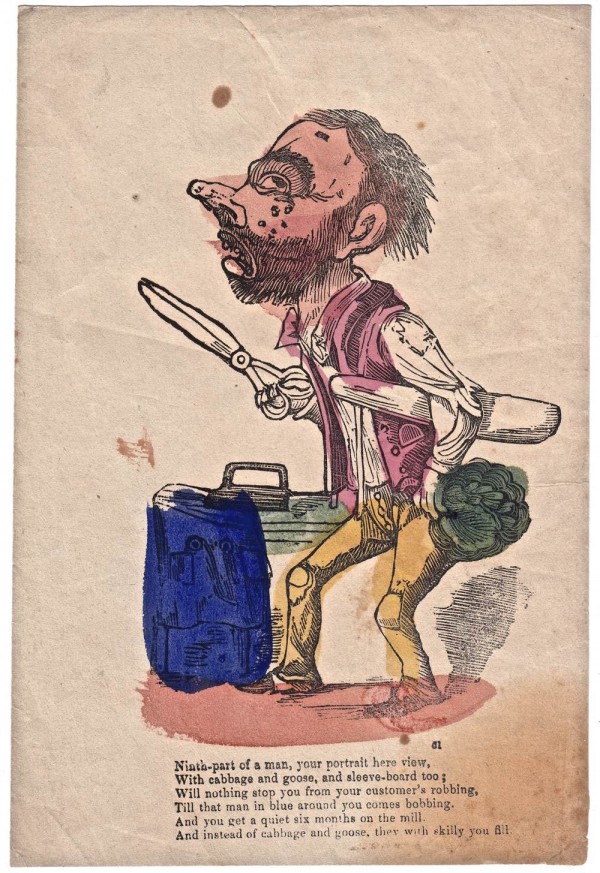
“Of all my collections, the Vinegar Valentines are the one that gives me the most pleasure,” he assured me with characteristic singularity, despite his obviously kind nature. ‘Vinegar Valentines’ were grotesque insults couched in humorous style, sent to enemies and unwanted suitors, and to bad tradesmen by workmates and dissatisfied customers. Unsurprisingly, very few have survived which makes them incredibly rare and renders Mike’s collection all the more astonishing. Immensely knowledgeable yet almost entirely self-educated, Mike was drawn to neglected things that no-one else cared for and this was the genius of his collecting instinct.
Of course, I regret that I never got to pore through all of Mike’s books and albums, but I had to resist this impulse in order to record his own story and learn how it was that he came to gather his wonderful collection.
“I was born in Chingford in 1943 but, unfortunately, we moved to Norfolk when I was eight. I never liked it there, it was a lonely, cold and draughty place. My father James was a furrier and his father – who was also James – had been a furrier before him in the East End, but they moved out. My mother, Laura Lewis, was a machinist who worked for my father and I think she came from the East End too. I grew up playing in the furriers because my father had his factory in the back garden and the machinists gave me sweets. I think that’s where I got my love of tools.
There was quite a lot of bombing in Chingford during the war and the house next to us got a direct hit which left a great big crack in our wall. I played on bomb sites even though I was told not to, and somehow my mother always seemed to know. I think it must have been the mixture of brick dust and soot on my clothes.
It was a filthy dirty job, being a furrier, and, although my father was a good furrier, he wasn’t a good businessman and he ended up in bankruptcy when I was eight. So that’s how we ended up in Mundesley by the sea in North Norfolk in the early fifties.
As soon as I left school at sixteen, I headed back to London. Ostensibly, it was to complete my training in the catering trade but I hated it, I had already done a year at catering college in Norwich. In reality, I was taking lots of drugs – dope and speed mostly – and working at a night club. I got a job on the door of club called The Bedsitter in Holland Park Avenue. I actually had a bedsitter off Holland Park itself for five pounds a week with a gas ring in the corner. That was a good time.
I worked at a hotel in Park Lane for a few months. The chef used to throw things at me. They fired me in the end for turning up late. I drifted through life by signing on and working on the side, and the club gave me a good social life. I’m a vicarious hedonist. I’ve always read a lot, I taught myself to read by reading my brother’s copies of Dandy and Beano. He was ten years older than me and he died in his early thirties.
A hippy friend of mine was a packer at a West End bookshop in Grafton St and he got me a job there. I worked for Mr Sawyer, he was a nice man. He employed hippies because they didn’t mind his cigar smoke and he never noticed the smell of pot in the packing room. He employed me as a porter but he told me to buy a suit and I got a job in the bookshop itself. I learnt such a lot while I was there. It was nice to be around books, so much better than working for a living.
Mr Gibbs was the shop manager, he taught me how to catalogue. He couldn’t understand why he kept finding more money in his pay packet. It was because we youngsters kept asking for a pay rise and Mr Sawyer couldn’t give it to us without giving it to Mr Gibbs too.
Mr Gibbs taught me not to speak to Mr Sawyer until he’d been around to Brown’s Hotel for his ‘breakfast’ and I presume this was because ‘breakfast’ consisted of at least three gin and tonics. He was a kind employer, he didn’t pay much but you learnt a lot. He had a tiny desk hidden behind a bookcase with two old spindly chairs that were permanently on the brink of collapse. The place was a university of sorts. I learnt so much so quickly. You can’t always recognise good stuff until you’ve had it pass through your hands.
Mr Sawyer would go through the auction catalogue of books and mark how much you were to bid and send you off to Sotheby’s. You had to stay on the ball, because sometimes he’d make an agreement with other booksellers not to let him get a lot below a certain price, because he’d be bidding for a customer and he’d be on commission. In those days, it was possible to make living by frequenting Sotheby’s and buying books. You learn a lot about the peculiarities of the bookselling trade. I think I was earning fourteen pounds a week. It was positively Dickensian.
By then I had met my wife Jeanna. We got married in 1965 and moved around between lots of flats we couldn’t afford. Jeanna & I started a book stall in Camden Passage called Icarus. I love the street markets like Portobello and Brick Lane. We made a lot of sales and I bought some wonderful stuff in street markets when you could discover things, and I’ve still got some of it.
We had two daughters, Samantha & Natasha, but Jeanna died young. We were living in Islington in Highbury Fields and I was left on my own to bring up the kids, who were eight and three years old at the time. That’s when I got this council flat, on account of being a single parent, and I’ve been here thirty-eight years. I lived on benefits with bookselling on the side to bring in some extra money and brought up my kids with the help of girlfriends.
A friend of mine had a secondhand tool shop and I worked there for a while. You could buy old tools from the sixteenth and seventeenth century for not very much money then, and we had some that no-one ever wanted to buy, so I brought them home. I am fascinated by tools for specialist professions, each one opens a door to a particular world. I still have my father’s furriers’ tools and they pack into such a small box.
From then on I’ve been a book dealer. Once you fall out of having a regular job, it’s difficult to go back. I think my kids regard me with mixture of mild disappointment and tolerance. On occasion, they have generously put up with me spending money on books instead of dinner.
I’ve always been a collector, reference books mainly, and from there I’ve become a dealer. I’m not interested in fiction but I do love a good reference book.”


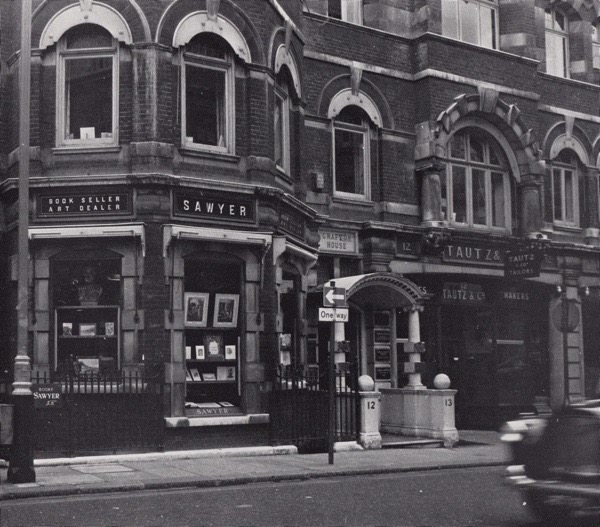
Sawyer, the bookseller in Grafton St where Mike Henbrey once worked


Mr Gibbs, bookshop manager


GLOSSARY
by Spitalfields Life Contributing Slang Lexicographer Jonathon Green


Mike Henbrey, Collector of books, ephemera and tools
Mike Henbrey’s Vinegar Valentines were purchased by Bishopsgate Institute where they are preserved in the archive as the Mike Henbrey Collection
You may like to take a closer look at some of Mike Henbrey’s collections
Mike Henbrey’s Vinegar Valentines
Vinegar Valentines for Bad Tradesmen
The Spitalfields Roman Woman
Meet me this Sunday on the steps of St Paul’s Cathedral and we will spend the afternoon walking eastward together through the square mile to explore the wonders and the wickedness of the ancient City of London.
Click here to book for The Gentle Author’s City of London walk on Sunday 4th June

Curator of Human Osteology, Rebecca Redfern watches over her charge
In his Survey of London 1589, John Stow wrote about the discovery of pots of Roman gold coins buried in Spitalfields and it had long been understood that ancient tombs once lined the road approaching London, just as they did along the Appian Way in Rome. Yet it was only in the nineteen-nineties, when large scale excavations took place prior to the redevelopment of the Spitalfields Market, that the full extent of the Roman cemetery was uncovered.
In March 1999, a Roman stone sarcophagus containing a rare lead coffin decorated with scallop shells came to light, indicating the burial of someone of great wealth and high status. Grave goods of fine glass and jet were buried between the coffin and the sarcophagus. It was the first unopened sarcophagus to be found in London for over a century and when the entire assemblage was removed to the Museum of London, the coffin was opened to reveal the body of a young woman in her early twenties, buried in ceremonial fashion. In the week after the opening of the coffin, ten thousand Londoners came to pay their respects to the Spitalfields Roman woman. She was the most astonishing discovery of the excavations yet, as the years have passed and more has been learnt about her, the enigma of her identity has become the subject of increasing fascination.
Analysis of residue in the coffin revealed that her head lay upon a pillow of bay leaves, her body was embalmed with oils from the Arab world and the Mediterranean, and wrapped in silk which had been interwoven with fine gold thread. Traces of Tyrian purple were also found, perhaps from a blanket laid over the coffin. Such an elaborate presentation suggests she may have been displayed to her family and friends seventeen hundred years ago as part of funeral rites.
The sarcophagus and grave goods are on public exhibition at the Museum but, thanks to Rebecca Redfern, Curator of Human Osteology, Contributing Photographer Sarah Ainslie and I had the privilege to visit the Rotunda where the human remains are stored and view the skeleton of the Spitalfields Roman woman. Deep in a windowless concrete bunker filled with metal shelving stacked with cardboard boxes, containing the remains of thousands of Londoners from the past, lay the bones of the woman. We stood in silent reverence with just the sound of distant traffic echoing.
Rebecca is the informal guardian of the Spitalfields woman and remembers switching on the television to watch news of the discovery as a student. Today, she has a daughter of her own. “The work went on for so many years that a lot of couples met working in Spitalfields,” Rebecca admitted to me, “and there is now a whole generation of ‘Spital babies’ born to those archaeologists.”
“She’s five foot three and delicately built, petite like a ballet dancer,” Rebecca continued, turning her attention swiftly from the living to the dead and gesturing protectively to the bones laid out upon the table. While some might objectify the skeleton as a specimen, Rebecca relates to the Spitalfields Roman woman and all the other twenty thousand remains in her care as human beings. “They’re able to tell us so much about themselves, it’s impossible not to regard them as people,” she assured me.
Recent research into the isotopes present in the teeth of the Spitalfields Roman woman have revealed an exact match with those found in Imperial Rome, which means that her origin can be traced not just to Italy but to Rome itself. “I find it very sad that she came so far and then died so young,” Rebecca confided, recognising the lack of any indication of the cause of death or whether the woman had given birth. Contemplating the presence of the skeleton with its delicate bones dyed brown by lead, it is apparent that the Spitalfields Roman woman holds her secrets and has many stories yet to tell.
More than seventy-five Roman burials were uncovered at the same time as the sarcophagus, many interred within wooden coffins and some only in shrouds. You might say these represented the earliest wave of immigration to arrive in Spitalfields.
“People were so mobile,” Rebecca explained to me, “We found a fourteen-year-old girl from North Africa whose mother was European. A legion from North Africa was sent to guard Hadrian’s Wall and we have found tagine cooking pots that may been theirs. I pity those men – how they must have suffered in the cold.”

The only Roman sarcophagus discovered in London in our time was uncovered in Spitalfields in 1999


Inside the stone sarcophagus an elaborately decorated lead coffin was discovered

At the Museum of London, the debris was removed to uncover the pattern of scallop shells

The lead coffin was opened to reveal the body of a young woman


Photographs of coffin & excavations copyright © Museum of London
Portrait of Rebecca Redfern & photographs of skeletal details copyright © Sarah Ainslie
You may also like to read about
Dan Jones’ East End Portraits
Meet me next Sunday on the steps of St Paul’s Cathedral and we will spend the afternoon walking eastward together through the square mile to explore the wonders and the wickedness of the ancient City of London.
Click here to book for my next City of London walk on Sunday 4th June

In recent years, Dan Jones has painted a magnificent series from different eras for his EAST END PORTRAITS. Many of these are well known but others less familiar, so you can click on any of the names to learn more about the subjects.


Police Constable James Stewart


Portraits copyright © Dan Jones
You may also like to take a look at
Antony Cairns’ Small Shops
Meet me next Sunday on the steps of St Paul’s Cathedral and we will spend the afternoon walking eastward together through the square mile to explore the wonders and the wickedness of the ancient City of London.
Click here to book for my next City of London walk on Sunday 4th June
Today I present Antony Cairns’ ethereal portfolio of small shops, created using nineteenth century Vandyke Brown process, and evoking those commercial premises which exist as receptacles of collective memory for the communities they served.
The first picture is of The Handy Shop, Tony’s first local shop when growing up in Plaistow, and the last picture is W.F.Arber & Co Ltd in Roman Rd, of which my friend Gary Arber was the proprietor.

The Handy Shop, Ruskin Ave, E12

M.J. Evans, Warren St, W1

Unknown shop, Mile End, E1

Unknown shop, Bonsor St, SE5

Unknown shops, unknown street

Unknown shop, Copenhagen St N.1

Unknown shops, Morning Lane, E8

Unknown shop, Oswin St, SE11

Unknown shops, Hackney Rd, E2

Fishmonger, Commercial Rd, E1

Unknown shop, St Pancras Way, NW5

Printworks, Blackfriars Rd, SE1

Gari’s, Northwold Rd, N16

George Harvey, Bougourd Chemist & Droys, Rochester Row, SW1

Gricks Jellied Eels, Rosebery Ave, Manor Park, E12

Arber & Co Ltd, 459 Roman Rd, E3
Photographs copyright © Antony Cairns
You may also like to take a look at
and these other photographs of shops


