
Syd Shelton’s East End

Tickets are available for The Gentle Author’s Tour of Spitalfields on Saturday 25th May

Brick Lane 1978
Photographer Syd Shelton‘s enduring fascination with the East End was sparked by a childhood visit from Yorkshire with an uncle and aunt more than fifty years ago. “My cousin was was working in a mission somewhere off Bethnal Green Rd,” Syd recalled, “It was a scary part of London then and I remember my uncle looked out of the window every few minutes to check the wheels were still on his car!”
“The day I left college in 1968, I came down to London and I have worked here ever since, photographing continuously in Hackney and Tower Hamlets,” Syd admitted to me.
In the seventies, Syd became one of the founders of Rock Against Racism, using music as a force for social cohesion, and his photographs of this era include many affectionate images of racial harmony alongside a record of the culture of racism . “It was an exciting time when, after the death of Altab Ali, the Asian community stood up to be counted and the people of the East End became militant against the National Front,” he explained, “In 1981, I got a studio in the Kingsland Rd and I only gave it up recently because the rents became too expensive.”
Syd’s portraits of East Enders span four decades yet he did not set out consciously to document social change. “I never started this as a project, it’s only when I looked back that I realised I had taken swathes of pictures of people in the East End,” he explained, “So now I come back and spend a day on the streets each week to continue.”
“I say I am not a documentary photographer, because I like to talk to people before I take my picture to see what I can coax out of them,” he qualified,“Taking photos is what makes my heart beat.”

Bethnal Green 1980

Linda, Kingsland Rd 1981

Bethnal Green 1980

Bagger, Cambridge Heath Rd 1979

Columbia Rd 1978

Jubilee St, 1979

Petticoat Lane 1981

Brick Lane 1978

Aldgate East 1979

Hoxton 1979

Tower Hamlets 1981

Brick Lane 1976

Jubilee St 1977

Brick Lane 1978

School Cleaners’ Strike 1978

Petticoat Lane 1978

David Widgery, Limehouse 1981

Sisters, Bow 1984

Sisters, Tower Hamlets 1988

Bow Scrapyard 1984

Ridley Rd Market 1992

Ridley Rd Market 1992

Ridley Rd Market 1995

Whitechapel 2013

Shadwell 2013

Brick Lane 2013

Dalston Lane 2013

Bethnal Green 2013
Photographs copyright © Syd Shelton
You may also like to take a look at
What The Gentle Author Did Next

Regular readers will know that it is not my custom to speak about myself too much, but I was persuaded to give an interview at some length to the estimable Albion Magazine which devotes itself a serious exploration of British culture. Readers may find it of interest to learn of some of my activities beyond this daily blog.
I feel honoured that my interview with Isabel Taylor has been published as the lead feature in the magazine’s twentieth anniversary edition.
You can read it by clicking on this link to ALBION MAGAZINE
Tickets are available for The Gentle Author’s Tour of Spitalfields on Saturday 25th May
Peter Riley, Kitchen Porter & Cleaner
Tickets are available for The Gentle Author’s Tour of Spitalfields on Saturday 25th May

Peter Riley
I was surprised and delighted when Peter Riley joined my tour last Saturday. He was passing Christ Church and grew curious when he heard me talking about Spitalfields as a place of sanctuary and refuge, so he walked over to listen and tagged along.
After the tour Peter apologised that he had not booked a ticket, explaining that he was homeless and had been sleeping under bridges and in parks locally for the past three months. He asked if he could tell me his story and if I would publish it.
It was evident from his manner that Peter was a gentle soul of decent character who deserved better. It was also obvious that he was a vulnerable individual and I could not imagine how he had endured these recent months of cold damp weather, sleeping outdoors and often walking all night.
So I took Peter for lunch in Brick Lane yesterday, and learned of his courage and resilience despite his fractured life. It was disappointing but unsurprising to discover that Peter had been let down by those authorities and institutions whose responsibility it is to help him.
Reliable and hardworking, Peter has a lot to offer. I publish his story today in the hope that one of my local readers might be able to assist him in finding a job and somewhere to live. (Please email spitalfieldslife@gmail.com if you can help).
‘I was born in Burnley, Lancashire, with two brothers and two sisters. My mother worked as a nurse at hospital in Manchester. When I was seven years old, my dad moved to London and we lived in Casson House off Brick Lane. In Burnley, he ran a restaurant but in London he stayed at home and looked after us kids.
In 1980, my dad took me, my mum, and my sister to a village in Bangladesh. We lived in a house surrounded by trees and I liked it there, I felt safe. Yet when we were there, my dad got married to another woman. My mum did not like this, she was upset and wanted to come back to England. My uncle bought her a ticket to return and I was left behind. My dad kept me there in Bangladesh for another sixteen years.
I stayed with my step mum who already had one son. I wanted to attend the local school and study. Instead I was used. She put me to herd the sheep, grow vegetables, run errands to the town and clean the house. If she said something that I did not understand, she beat me up. She thought she had the right to do this. She told me if I did not listen to her she would not let me into the house and I would get no food. She wanted me to work for her all day instead of getting an education. She enslaved me. My passport was taken. I had nothing, not even clothes of my own. It was a hard life.
A Bengali man who was visiting from Nottingham, and who knew my mum, heard about me, how I was struggling. He told me, ‘Don’t worry, I’m going to help you and you are going to go back to England.’ He went to see my mum in Manchester and told her my story. She was very worried but he said he would bring me back. The immigration authorities wanted a DNA test, so my mum gave a sample in Manchester and I went to the immigration centre in Dhaka and gave blood. Two months later, I got a new passport and some people bought me a ticket home.
When I returned to England in 1997, I was twenty-two. My dad was living in Manchester Rd on the Isle of Dogs. I could no longer write or speak English. It was a hard to get a job, but I got one in an Indian restaurant in Guildford. I worked two shifts each day as a kitchen porter, washing up and chopping vegetables. The lunchtime shift was from ten until two and nighttime from five until half past eleven. They wanted me working there all day for twelve or thirteen hours at £2 an hour. I can cook – curried rice and biryani – many things. But they did not want to teach me to be a chef or second chef, they only wanted me to do portering. For a six day week, they paid me £80 though they did not want to give the money. It was hard. I would prefer a council cleaning job where I can earn the right pay for the hours. I have done restaurant work and cleaning, and I am prepared to try anything. I have skills.
My step mum came to live with my dad on the Isle of Dogs and she said, ‘I don’t like him to come here.’ So my dad told me, ‘I don’t have a choice, son. I am old and I going to die soon. Look after yourself.’ I rented a room in Bow Rd for £50 a week and I joined the Tower Hamlets housing register and for fourteen years I was on the housing list. After that, they struck my name off the list. I don’t know why. I went to their office in Chrisp St Market to ask and they told me I was cancelled. It was a long time waiting and now my dad has passed away.
Since February, I have been sleeping under a bridge in Wapping. Crisis sent me to a night shelter in Hackney but I was scared to stay there because the single beds were too close together, three or four in a very small room. I went to Isle of Dogs Law Centre and asked. I said, ‘I don’t know what to do, I need your help. I’m homeless, I don’t know how I’m going to find a place to stay.’ They made an application for me and told me to take it to the council and say, ‘I’m homeless.’
The council housing officer asked me, ‘What’s happening?’ I said ‘I’ve been in Tower Hamlets quite a long time but I have got no address.’ She said, ‘You’ve got no priority. If you’re ill or you’ve got family, it would be different.’
I want to have a life like other people have, a social life. I want a normal life where I can work, have a home and be safe. I want to look after myself and other people. I want peace and quiet. But I don’t know what’s going to happen. It’s very hard.’

Peter Riley outside Casson House off Brick Lane where he grew up
You may also like to read about
At The Charterhouse
Tickets are available for The Gentle Author’s Tour of Spitalfields on Saturday 25th May

Brick buildings of 1531 in Preacher’s Court with the Barbican beyond
Desirous of an excuse to view the magnificence of the Charterhouse, I made a call upon my friend Brother Hilary Haydon one sunny afternoon, using the excuse of undertaking a photoessay, and these pictures – interspersed with lantern slides from the Bishopsgate Institute of the same subject a century ago – are the result.
Hilary is also enamoured by the atmosphere of repose conjured by the ancient buildings and lush gardens at the Charterhouse. “I must say, it is very pleasant to relax here and leave those fellows over in the City doing all that stressful hard work,” he confessed to me, now happily retired and enjoying the peace and quiet, after a long career as a Barrister in the Square Mile.

Carved details of the Gatehouse and the Physician’s House, 1716

Gateway of c1400 with Physician’s House built above in 1716

Cloisters in Preacher’s Court

The Preacher’s House built in the eighteen-twenties

Old pump in Preacher’s Court

Tudor chimneys in Preacher’s Court

The Great Staircase, erected in early seventeenth century and destroyed in 1941

Wash House Court

Passageway into Wash House Court


Master’s Court built in 1546


Great Hall built by Thomas Howard in 1571 while under house arrest here for plotting with Mary Queen of Scots to depose Elizabeth I


Portrait of Thomas Sutton in the Great Hall with Thomas Fenner below

Portrait of Elizabeth Salter attributed to Hogarth in the Great Hall

Chapel Cloister

Chapel Cloister

Tomb of Thomas Sutton, the founder of the Charterhouse

Thomas Sutton

The fifteenth century South Aisle of the Chapel

Brother Hilary Haydon in the North Aisle of the Chapel, added in 1614


Names of Charterhouse schoolboys etched upon the glass in the nineteenth century

Tudor brickwork upon the exterior of Wash House Court


Physician’s House built in 1716

Entrance to the Charterhouse viewed through the former Priory Gate

Knocker upon the main gate
Archive images courtesy Bishopsgate Institute
You may also like to read about
At The Fan Museum
Tickets are available for The Gentle Author’s Tour of Spitalfields on Saturday 25th May

The Fan Museum in Greenwich is the brainchild of Helene Alexander who has devoted her life with an heroic passion to assembling the world’s greatest collection of fans – which currently stands at over five thousand, dating from the eleventh century to the present day.
In doing so, Mrs Alexander has demanded a reassessment of these fascinating objects that were once dismissed by historians as mere feminine frippery but are now rightly recognised as windows into the societies in which they were made and used, and upon the changing position of women through time.

Folding fan with bone monture & woodblock printed leaf commemorating the Restoration of Charles II. English, c. 1660 (Helene Alexander Collection)

Folding fan (opens two ways) with ivory monture. Each stick is affixed to a painted palmette. European (probably French), c. 1670s (Helene Alexander Collection)

Ivory brisé fan painted with curious depictions of European figures. Chinese for export, c. 1700(Helene Alexander Collection)

Ivory brisé fan painted in the style of Hondecoeter. Dutch, c. 1700 (Helene Alexander Collection)

Folding fan with bone monture. The printed & hand-coloured leaf has a mask motif with peepholes. English, c. 1730

Folding fan with ivory monture, the guards with silver piqué work. The leaf is painted on the obverse with vignettes themed around the life cycle of one man. European (possibly German) c. 1730/40 (Helene Alexander Collection)

Folding fan with ivory monture & painted leaf. English, c. 1740s (Helene Alexander Collection)

Folding fan with ivory monture & painted leaf, showing Ranelagh Pleasure Gardens. English, c. 1750s

Folding fan with wooden monture & printed leaf, showing couples promenading. French, c. 1795-1800 (Helene Alexander Collection)

Folding fan with gilt mother of pearl monture & painted leaf, signed ‘E. Parmentier. ’ French, c. 1860s

‘Landscape in Martinique’, design for a fan by Paul Gauguin. Watercolour & pastel on paper. French, c. 1887

Folding fan with blonde tortoiseshell monture, one guard set with guioché enamelling, silver & gold work by Fabergé. Fine Brussels lace leaf. French/Russian, c. 1880s (Helene Alexander Collection)

Folding fan with smoked mother of pearl monture, the leaf painted by Walter Sickert with a music hall scene showing Little Dot Hetherington at the Old Bedford Theatre. English, c. 1890

Folding fan with tortoiseshell monture carved to resemble sunrays. Canepin leaf studded with rose diamonds & rock crystal, & painted with a female figure & putti amidst clouds, signed ‘G. Lasellaz ’92’. French, c. 1892 (Helene Alexander Collection)

Folding fan with horn monture & painted leaf, signed ‘Luc. F.’ French, c. 1900

Folding fan with ivory & mother of pearl monture, the painted leaf, signed (Maurice) ‘Leloir.’ French, c. 1900 (Helene Alexander Collection)

Folding fan with mother of pearl monture & painted leaf, signed ‘Billotey.’ French, c. 1905 (Helene Alexander Collection)

Horn brisé fan with design of brambles & insets of mother of pearl. French, c.1905 (Helene Alexander Collection)

Folding fan with Art Nouveau style tinted mother of pearl monture & painted leaf, signed ‘G. Darcey.’ French, c. 1905 (Helene Alexander Collection)

Folding fan with tortoiseshell monture & feather ‘marquetry’ leaf. French, c. 1920
Visit The Fan Museum, 12 Crooms Hill, Greenwich, SE10 8ER
Remembering London’s Oldest Ironmonger
Tickets are available for The Gentle Author’s Tour of Spitalfields on Saturday 25th May

The frontage at 493-495 Hackney Rd

The factory at the rear of the shop

London’s oldest ironmongers opened for business in 1797 as Presland & Sons, became W.H. Clark Ltd in the eighteen-nineties and was still trading from the same location, over two hundred years later, as Daniel Lewis & Son Ltd – The One Stop Metal Shop. Operating at first from a wooden shack built around 1760, they constructed their own purpose-built shop and factory at the beginning of the nineteenth century, which suited their needs so perfectly that – in an astonishing and rare survival – it stood almost unaltered to the end.
It was architecture of such a utilitarian elegance and lack of ostentation that it did not draw attention to itself. I had no idea there was a complete Georgian shopfront in the Hackney Rd until David Lewis, the proprietor, pointed it out to me and I compared it to the illustration above. Remarkably, even the decorative coloured-glass lozenge above the door was exactly as in the engraving.
When contributing photographer Simon Mooney & I went along to explore, we were amazed to discover a unique complex of buildings that carried two centuries of history of industry in the East End, with many original items of nineteenth century hardware still in stock.
“We were here before the canal, the railway and the docks,” David Lewis informed us proudly,“When the Prince Regent banned horses from being stabled in the city, this area became the centre of the carriage and coach-building industry.” An ironmonger with a lyrical tendency, David reminded us that Cambridge Heath Rd was once a heath, that Bishop Bonnar once built his mansion on this land before the Reformation and that an oval duckpond once existed where the Oval industrial estate stands today behind his premises – all in introduction to the wonders of his personal domain which had been there longer than anything else around.
You entered from the street into the double-height shop, glazed with floor-to-ceiling windows and lined to the roof with meticulously-labelled wooden pigeon-holes, built-in as part of the original architecture. A winding stair led you into the private offices and you discovered beautiful bow-fronted rooms, distinguishing the rear of the terrace that extended two storeys above, offering ample staff quarters. On one side, was an eccentric, suspended office extension built in 1927 and constructed with panelling and paint supplied by the Great Western Railway, who were customers. This eyrie served as David’s private den, where he sat smoking at a vast nineteenth century desk surrounded by his collection of custom number plates, all spelling Lewis in different configurations of numbers and letters.
A ramp down from the shop led to the rear, past cellars lined with pigeon-holes constructed of the flexo-metal plywood that was the source of the company’s wealth for decades. At the back, was a long factory building with three forges for manufacturing ironwork where you could still feel the presence of many people in the richness of patina created by all the those who worked there through the last two centuries. Occasionally, David paused and, in delight, pulled out boxes full of brass fixtures and iron bolts necessary for nineteenth century carriage building. Upstairs, he showed us an arcane machine for attaching metal rims to wagon wheels, essential when the streets of London went from dirt to cobbles in the nineteenth century.
To the left of the factory, stood a long cobbled shed where the carriages came in for repair, and beneath a slab flowed a stream and there were stones of the Roman road that ran through here. In the layers of gloss paint and the accumulation of old things, in the signs and the ancient graffiti, in the all the original fixtures and fittings, these wonderful buildings spoke eloquently of their industrial past. Yet for David they contained his family history too.
“My dad was Lewis Daniel John Lewis, he was known as Lewis Lewis and his father was also known as Lewis Lewis. It went back to my great-great-great-great- grandfather and my father wanted me to be Lewis Lewis too but my mum wasn’t having it, so I am David Richard Lewis. I first came here with my dad as a nipper, when I was four or five years old, on Saturday mornings while he did the books. I played with all the nuts and bolts, and I was curious to see what was in all the boxes. And I used to run up and down the ramp, I was fascinated by it. I’ve learnt that it’s there because the Hackney Rd follows a natural ridge and there were once mushroom fields on either side at a lower level.
My dad started at W.H.Clark in 1948 as a young boy of fifteen, he had already studied book-keeping and he was taken on as an office junior. At eight years old, it was discovered he was diabetic when he was found lying on the pavement here in Hackney Rd, where my grandparents had a grocer and dairy. He always had to have insulin injections after that. He was tall, six foot one, and a little skinny because he didn’t have much of an appetite – except for chocolate biscuits which he shouldn’t have had, but he enjoyed them with a cup of tea.
He learnt the trade and he worked his way up to office manager. Then, in 1970, one of the partners retired and the other suffered a tragedy and turned to drink and became unsteady. So my grandfather bought the business for my father in 1971 and he took over the directorship of the company. He already knew how to run the business and he set out to build the company up with new customers – he got St Paul’s Cathedral as a customer and we still supply them.
Our biggest selling product was flexo-metal plywood, we had the exclusive distribution contract and we supplied it to the coach-building industry across the entire South-East of England for the construction of buses, coaches, lorries and trucks. They used to pull up outside with vehicles that had no body, no cab – just the engine and a chassis with the driver sitting on a tin bucket. They bought flexo-metal plywood to build the body and we could supply them with a windscreen, lights, chains for tailboards, everything – all the components. Any time I see a van in a fifties or sixties film, it is one of ours. At that time, we employed eighteen people.
I joined in 1992. I went to college and did business studies and I wanted to prove to my dad that I could do it on my own. I became a trademark lawyer, working for the Trademarks Consortium in Pall Mall that protected the trademarking for brands like Cadburys, Bass, Tesco and Schweppes. I’ve always been fascinated by labels because of looking at all the different trademarks on the boxes of screws here and I collect custom number plates.
When the business that supplied flexo-metal plywood went to the wall, my father employed Peter Sandrock who used to run it. He was approached by many global companies because he was a genius mathematician who could do figures in his head, but he wanted to work for my dad because they always got on well and would help each other. He worked for my dad for ten years until 1992 and that’s when I came in, just after I got married.
I started as an office junior like my dad but I found it boring because I had already done other things. So I said, ‘Can I go down and serve behind the counter?’ but he said, ‘You haven’t got the build to carry steel.’ I surprised him by developing muscles and soon I could do it with ease – I’ve got broad shoulders now when I didn’t use to have.
When I was made a director, all the carriage-building trade was moving up north, so I refocused the company towards aluminium and steel supply to metal fabricators, architects and sculptors. But in recent years, due to installation of cctv cameras and the council issuing £130 fines to our customers while picking up orders, our trade has dropped by fifty per cent. We have two to three hundred customers a day and I reckon the council have earned £63,000 a year in fines out of them and so, in a few months, after two centuries of business in this location, we are going to move from here .
It was in 2002, I changed the name of the company from W.H.Clark Ltd, who had been a Mayor of Hackney in the nineteenth century, to Daniel Lewis & Son Ltd, in memory of my father. I am the son.”
London’s oldest ironmonger closed in 2014

Nineteenth century storage filled with nineteenth century carriage fittings in the factory

The enamel sign that was taken down from the frontage in 2002

This is the cobbled workshop where the carriages were wheeled in for repair.

The ceiling in the storeroom is lined with timber painted with nineteenth century sign-writing

Carriage bolts are still in stock

The wooden pigeon-holes stretch to the ceiling in the double-height shop and are contemporary with the building

Daniel Lewis & Son Ltd has collets in stock – pins used for attaching cartwheels to the shaft


David in the factory building

Bert left to in 1962 Good By

Machine for applying metal rims to cartwheels in the factory


A threading machine in the factory


This brick was laid by “Ole Bill” 1927 RIP

View towards the bonded warehouse of the Chandlers & Wiltshire Brewery – burnt out in World War II, it is London’s last bombsite and a memorial to the Blitz in the East End

A display of Nettlefolds screws wired to a board in a gilt-crested frame that was displayed at the Great Exhibition of 1851

The glass over the entrance was part of the original design of the building, dating from the early nineteenth century


Packaging for hinged metal indicator lights, still in stock


Keep this door shut

The crackle on the office wall is authentic, achieved by age, not a paint effect

The name of W.H.Clark impressed upon a carriage shaft manufactured in the forge

Before 1920, no road vehicle was permitted to travel at more than 20mph and had a plate attached to this effect – Daniel Lewis & Son Ltd still had them in stock

The Ascot water heater in David’s office was fully-functional

The shop with the ramp going down towards the factory at the back

The steps from the shop going up to the office

David Lewis at his desk in the rear office lined with panelling and paint supplied by the Great Western Railway
Photographs copyright © Simon Mooney
You may also like to take a look at
Tony Hall’s Shops
Tickets are available for The Gentle Author’s Tour of Spitalfields on Saturday 25th May

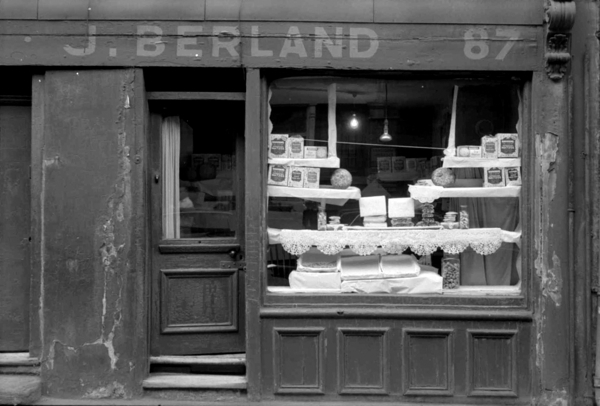
Tony Hall loved shops, as you can see from this magnificent array of little shops in the East End that he captured for eternity, selected from the thousand or so photographs which survive him.
In the sixties and seventies when these pictures were taken, every street corner that was not occupied by a pub was home to a shop offering groceries and general supplies to the residents of the immediate vicinity. The owners of these small shops took on mythic status as all-seeing custodians of local information, offering a counterpoint to the pub as a community meeting place for the exchange of everybody’s business. Shopkeepers were party to the smallest vacillations in the domestic economy of their customers and it was essential for children to curry their good favour if the regular chore of going to fetch a packet of butter or a tin of custard, or any other domestic essential, might be ameliorated by the possibility of reward in the form of sweets, whether there was any change left over or not.
Yet, even in the time these photographs were taken, the small shops were in decline and Tony Hall knew he was capturing the end of a culture, erased by the rise of the chain-stores and the supermarkets. To the aficionado of small shops there are some prize examples here – of businesses that survived beyond their time, receptacles of a certain modest history of shopkeepers. It was a noble history of those who created lives for themselves by working long hours serving the needs of their customers. It was a familiar history of shopkeepers who made a living but not a fortune. Above all, it was a proud history of those who delighted in shopkeeping.




Photographs copyright © Libby Hall
Images courtesy of the Tony Hall Collection at the Bishopsgate Institute
You may also like to read
Libby Hall, Collector of Dog Photography
and take a look at these other pictures of East End Shops


