
Andy Willoughby, Gardener

Over recent years, I have always made the detour up the steps through the park and past the bandstand, whenever I walk through Arnold Circus, in order to admire the planting. I like to see the native flowers on the slopes here, especially the Bluebells, Cowslips and Foxgloves that combine with the tall trees arching overhead and the Ivy garlanding the ironwork to create the effect of a piece of woodland transported to the city. Most intriguing is the inclusion of non-native species, particularly a fine range of diverse Hellebores, which complete the planting in a garden alive with detail at every season of the year, that is clearly the product of a sophisticated horticultural sensibility. So it was a pleasure yesterday to meet Andy Willoughby, the shrewd gardener employed by the Friends of Arnold Circus, responsible for the lyrical planting that has enriched this corner of the neighbourhood so attractively.
In part, it has been the success of Andy’s work, drawing attention to the beauty and potential of this neglected circular park in Arnold Circus at the centre of the Boundary Estate that has led to the major renovation works which have just commenced – involving the restoration of the bandstand, the cleaning of the railings, new lighting and benches, and reinstatement of the soil which has subsided due to the effects of rain and gravity since the park opened in 1900. The irony of this situation is that much of Andy’s work will now get trashed before he can move back in once the restoration is complete and commence gardening all over again. However, as much as possible that can be rescued has been transplanted into pots and tubs that currently litter the Boundary Estate, providing temporary accommodation for the displaced plants, and at the end of this feature you can see the gallery of my favourites, all the wonderfully various varieties of Hellebores flowering in exile.
Unfortunately, it will be impossible to rescue everything because Andy has planted so many thousands of bulbs, though he consoles himself in the knowledge that thanks to his work the soil is rich in seeds that will regenerate once the building work is over. After all his hard toil and conscientious devotion, I can see this is understandably an emotional moment for Andy, so I was happy to spend a couple of hours holding plastic sacks as he salvaged a few more plants, while the earth-moving equipment stood waiting to move in on one side and the ironworkers cut up the railings with an angle-grinder on the other side.
When we met and shook hands in Arnold Circus, I immediately noticed Andy’s intense steel-blue eyes, trademark guernsey sweater and direct manner, which is disarming at first because he requires you to connect with him at the same level of open-ness that he shows to you, but it quickly establishes a mutual understanding which allows an ease of discourse without requirement for small talk. The latter is especially useful when there is a job of work to be done and permits dialogue to be restricted to, “Are you warm enough?”, “Take this coat”, “Pass me the fork” and “Hold this bag.”
It is impossible not to respect the strength of character and physical constitution of a man who works fifty to sixty-hour weeks in all weathers outdoors from Easter to Christmas, and keeps very busy with other tasks in between. I noticed that the other workmen on the site were curious, drawn by respect for the obvious intent sense of purpose with which Andy approaches his work, and I was proud to be recognised as Andy’s silent assistant for the morning. As Andy dug clumps from the soil and I held out the sack for him to place them inside, rescuing them from the bulldozer, I was touched to witness at close hand the reverence he has for plants as living things.
“About fifteen years ago, I was at a bit of a loose end,” said Andy quietly, as we worked, introducing his brief account of how gardening came to take over his life. At first, he did grounds maintenance work and cut lawns, but then a job gardening at a hospice for the terminally ill offered the chance to show more creativity. “I learnt most at St Joseph’s Hospice – they liked to keep everything neat and tidy. A friend was a gardener there, so I worked with her and took over when she went on maternity leave. I have no qualifications as a gardener, I learnt from observation – and, by looking up in books, I learnt how things grow.” Andy told me.
Nowadays, as well as his duties at Arnold Circus, Andy gardens at couple of schools, Blue Gate Fields in Cable St, Bangabandhu in Bethnal Green, plus at children’s nurseries, George Green on the Isle of Dogs and Harry Roberts in Stepney, as well Lady Mico’s Almshouses in Stepney and another senior nursing home in Rotherhithe. Andy spoke passionately of his work with children, “They come and help, because they see me doing the work and I explain to them what I do. It is very important that children get an education in plants, otherwise they trample them without knowing what they are doing.” adding, “My mother had a garden and she liked plants,” in explanation of his earliest education in horticulture and revealing the origin of his own green fingers.
It is apparent that Andy loves gardening, derives fulfillment from it and is held in great esteem too. So I was completely astonished when, as we said our goodbyes, he casually revealed all his other previous jobs and accomplishments that filled his life before he arrived at that loose end fifteen years ago – including being a trained nurse, a Buddhist monk, a qualified carpenter and joiner, a bricklayer, a musical instrument-maker specialising in early woodwind, a dustman, a bicycle courier and a skilled rock climber and mountaineer who scaled peaks in the Rockies, the Cascades and the Alps. Travelling widely, Andy was the last European to catch smallpox in India before it was eradicated thirty-five years ago and has the scars to prove it, when I had merely assumed that his ruddy complexion was the result of years weeding in East London.
Now I understood something of the source of the natural authority that Andy possesses, not simply a down-to-earth quality but an insight that sees right through you. I recognised that he carries a wealth of experience which he chooses not to tell, and I was fascinated that gardening brought him into contact with people at all stages of life, from the youngest children at nursery school to senior nursing homes and the dying. Although into his sixties now, I have never met anyone more vitally and physically present in their body than Andy Willoughby, who after experiencing a great deal of life has, like Michel de Montaigne, discovered happiness in cultivating plants.



Old Town in Fournier St

Over this last weekend, Old Town, the distinctive clothiers from Holt in Norfolk that make classic British workwear, set up shop in Fournier St for three days, as they do each year, to allow their London customers to come and say “hello” while also taking the opportunity to enjoy browsing the complete range of styles and fabrics that have created the company’s reputation for uniquely characterful clothes.
As I have been running around the streets of Spitalfields in the snow, pursuing interviews and carting wooden pallets home for the fire, my only pair of warm Winter trousers have gone in holes. A tailor patched them twice to get me through but now they are entirely finished. Ever since I was a child, I have had an unbroken chain of pairs of tweed trousers that have seen me through all the Winters of my life until now. So this visit by Old Town was the perfect opportunity to go along and get measured up for a new pair all ready for next Winter, because there is no doubt I shall need them.
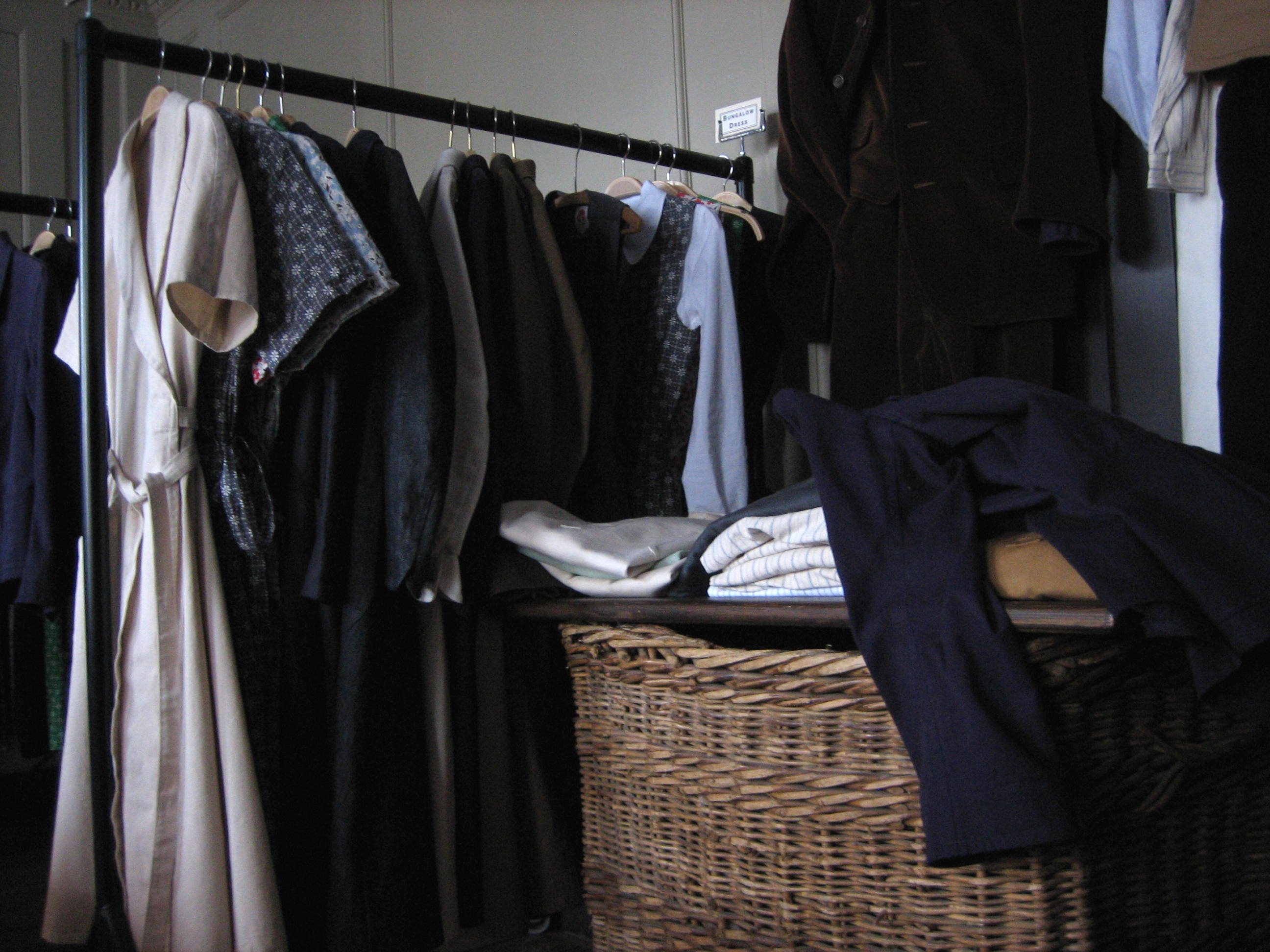
Let me admit, I had been corresponding in advance with Miss Willey up in Holt for months to arrange the crucial assignation on Saturday morning in Fournier St. When she threw open the door to me, I was stunned to silence by the shock of red hair that gave her the appearance of a dazzling pre-Raphaelite beauty, radiant in the low-angled March sunlight in Spitalfields. Swallowing my amazement, I followed her upstairs to enter the drawing-room where I was transported to discover it rigged out in the style of the clothing department of an early twentieth century regional store.
Everyone that lives in these so-called temperate climes, needs a reliable pair of Winter trousers that fit. And the history of my life has taught me the possession of a good pair can make all the difference when the weather turns grim. So I listened attentively as Miss Willey explained the style options to me with practised eloquence. For women, the choice is between The Denes or The Malverns, both of a wide legged cut, buttoning at either side of the waist – The Denes being of a wider leg and more relaxed waist than The Malverns. For men, there are five options, The Plains, Orfords, High Rise Trousers, Vauxhalls and Dreadnoughts which provide various permutations of leg widths and waist heights, some with high backs and others with fall fronts.
Already, I was captivated by the splendid names, their litany was a poem in itself. Once I had selected the style, I was able to rifle through the swatch book to choose between the linens, corduroys, serges, twills, moleskin and tweed. So much possibility, but, because I need maximum insulation when I am carting pallets through the windy streets of Spitalfields in the icy blast, I chose Harris tweed for my trousers. Then I had the option of herringbone or plain, but this was an easy choice because I am one of those who always chooses “plain” whenever it is an option. As they say, I find “plain” exciting. Now I was almost at the end of the multiple choice questionnaire that would lead to my new trousers. It all came down to blue or brown, specifically Lovat or Heather, and experience told me that I choose brown, which will not show the dirt as readily as blue. Now all I have to do is to travel up to Holt in a few weeks time to collect my new trousers, made especially for me.
It was Walt Whitman who first wore workwear with attitude. When he put on a pair of denim workmen’s trousers, he was a poet and liberal intellectual making a deliberate gesture of solidarity with the working people and over a century later we see the result of his powerful innovation all around us in the ubiquitous blue jeans, that are the most democratic item of clothing on the planet today. Old Town take this to a whole new level, making a wide range of work clothes inspired by classic twentieth century models. Neither slavish imitation, nor parody, the design of Old Town clothes manages to evoke the poetry of their origins while creating comfortable well made garments that transcend fashion, yet blend sympathetically with your Paul Smith, Miu Miu, Dries van Noten and Comme des Garçons pieces too. For years I used to go to great lengths seeking out rare original specimens of canvas work jackets and pull-on shirts to wear, so it is wonderful to discover you can get them made in your size. This is why Old Town evokes such passion among aficionados who are happy to travel to Norfolk for a shirt.
Will Brown, an unassumingly charismatic gentleman in a fetching tweed cap who describes himself as a clothesmaker, is the remarkable talent who designs all the clothes and is also responsible for creating the Old Town “look” including the elegantly austere graphics that make such confident use of Gill Sans. His partner in this singular enterprise is Marie Willey, the flame-haired Geordie with a poet’s grasp of the English language who described her role succintly and incontrovertibly thus, “I am the world’s best critic.” before explaining that she deals with the customers, supervises the work of the seven machinists and cutter, as well as personally making sure all the orders get sent out too. “A huge part of my job is trolling down to the laundry and washing and pressing everything,” said Marie, graphically illustrating her hands-on approach to quality control, “You’ve got to keep it tight,” she declared strictly.
I relish the humour and style of Old Town. They even produce a newspaper the “Evening Star” with the byline “Small life is here” that celebrates their playful world view and guarantees a chuckle. You could never have predicted that a business in a remote corner of Norfolk making clothes that are almost anti-fashion could thrive in the way it has. “We are the slowest growing business you could ever find,” said Marie, proudly aware of the absurdity of their success, based nevertheless upon hard work, imagination and flair. Old Town want to stay small, there will never be a chain and they will never sell out. And this is the beauty of it, doing something modest, doing it expertly, earning a decent living, treating everyone with respect and making clothes people love.
In the Spring, you will be able to read about my trip to Holt on the pilgrimage for trousers, but in the meantime you can watch a soundslide sequence about Old Town by clicking here.



My beautiful community launderette

“We see each other three or four times every week to hand over the keys of the launderette, but in spite of this we have developed a solid bond of friendship,” quipped Philip Green affectionately, speaking of his fellow Director of the Boundary Estate Community Launderette, the equable Jean Locker. Both live here on the magnificent Estate, built as the first social housing in Britain and are justifiably proud of their launderette, nestling in Calvert Avenue opposite Leila’s Shop next to Arnold Circus – as they explained to me when I met the two community champions yesterday, for a conference amid the washers and driers, while the customers negotiated around us to manoeuvre their washing in and out of the machines, that churned and rattled as we spoke.
“We needed a launderette”, explained Jean, “And a lot of people came together to develop the idea of a co-operative to run a launderette as a social enterprise in the community.” She told me it took two years of hard work to raise enough money and negotiate the lease, before they could open in September 1992, at a time when most of the other shops in Calvert Avenue were derelict and many of the flats in Arnold Circus were boarded up. But the launderette immediately proved triumphant, not just for laundry but as a vital community centre and symbol of renewal too. Today, hundreds bring their washing each week to the four employees, who also provide a service to many local businesses and, in particular, to the Shoreditch Football Team – who deliver their muddy kit after every game, including their ball in the bag to get it scrubbed up ready for the next fixture.
Although the beautiful launderette has been a storming success for nearly twenty years now, washing clothes only covers running costs. Whenever maintenance is required funding has to be raised elsewhere, because the co-operative is without any financial reserves. “What comes in, goes out!” said Jean, referring not only to the laundry but also the co-operative’s bank account too. As we spoke, one washer was out of action until money for its repair can be found. Passionate advocates, Phil and Jean spend fifteen hours every week writing letters applying for grants from charities to cover the necessary additional expenses. This is on top of sharing the duties of locking up each night. “It’s been hard, it’s not been easy,” admitted Jean, revealing that, after the first ten years, the machines began to pack up and they raised £15,000 to replace them all. She and Phil are the only active directors of the original twelve now (apart from Anita who does the accounts) and Jean confided that she gives up a day each week of her salaried job, to do the unpaid work required to keep the launderette open. They both agreed that some younger directors of the co-operative would be welcomed.
I realised I was in the company of a pair of unsung benefactors, Jean with her bold features and clear-eyed sense of social responsibility and Phil, a kind man with a self-deprecating laugh. They put in all this work just so that everyone has a launderette. Jean told me she always volunteered, “You do it because you live locally and after twenty years here, people rely on us – including the people who work in the launderette. You can’t pull the plug on that.” Phil agreed “I love the estate, I have a lot friends here and I believe things that are needed must be kept.” I was touched by the nobility of these thoughts in such a modest location, but as I cast my eyes around at the brass plaques listing grants given and awards won, the results of their ideals were self-evident. Everyone loves the beautiful community launderette at Arnold Circus.
As we talked, there was another individual I wanted to speak with, whom I observed preoccupied with carrying baskets of laundry around, and loading and unloading machines. Marie Glace has been the manageress of the launderette since 1992, she has been here, day in day out, over all these years, becoming a popular and respected local figure in the process. I am reliably informed that she is a confidante to many people here when they require a trusted counsellor. Eventually, I managed to pull up a chair next to her, and we sat together enjoying the warmth of a washing machine in its hot cycle, sheltered from the icy drafts by the bookshelf that holds the launderette’s free lending library.
At once, I was spellbound by Marie’s gentle features and soft voice that draws you closer to listen. “I get everybody organised, make sure things run smoothly and deal with complaints. I know everyone round here.” she disclosed, “We’ve had a few dramas when someone’s clothes all got dyed red by accident and they blamed me for it – but the people are alright because everybody’s friendly on the whole. It’s nice to have a community to be part of. The elderly people come, they don’t see anyone all day, so they just bring a few things to wash and have a chat. We make coffee for them and maybe give them a biscuit.” This is the woman who really knows everything that goes on in Arnold Circus, I realised, as she went on to tell me about the married couple whose romance first blossomed over the spin-dry.
The Boundary Estate Community Launderette was the initiative at the beginning of the renewal of the neighbourhood twenty years ago and it is an enterprise that is true to the spirit of those who first built Arnold Circus. Now we must ensure that the beautiful launderette continues to exist and thrive as a necessary democratic temple where everyone can meet as equals over wash and tumble-dry.
If you want to show your support for the Boundary Estate Community Launderette click here to go to their facebook page.


Simon Pettet’s tiles

Anyone who has ever visited Dennis Severs’ house in Folgate St will recognise this spectacular chimneypiece in the bedroom with its idiosyncratic pediment designed to emulate the facade of Christ Church, Spitalfields. The fireplace itself is lined with an exquisite array of Delft tiles which you may have admired, but very few people today know that these tiles were made by craftsman Simon Pettet in 1985, when he was twenty years old and living in the house with Dennis Severs. Simon was a gifted ceramicist who mastered the technique of tile-making with such expertise that he could create new Delft tiles in the authentic manner which were almost indistinguishable from those manufactured in the seventeenth century.
In his tiles for this fireplace, Simon made a witty leap of the imagination, using them to create a satirical gallery of familiar Spitalfields personalities from the nineteen eighties. Today his splendid fireplace of tiles exists as a portrait of the neighbourhood at that time, though so discreetly done that unless someone pointed it out to you, it is unlikely you would ever notice amongst all the other beguiling details of Dennis Severs’ house.
Simon Pettet died of Aids in 1993, eight years after completing the fireplace and just before his twenty-eighth birthday, and today his ceramics, especially this fireplace in Dennis Severs’ house, comprise an intriguing and poignant memorial to remind us of a short but extremely productive life. Simon’s death imparts an additional resonance to the humour of his work now, which is touching in the skill he expended to conceal his ingenious achievement. As with so much in these beautiful old buildings, we admire the workmanship without ever knowing the names of the craftsmen who were responsible and Simon aspired to this worthy tradition of anonymous artisans in Spitalfields.
Once Anna Skrine (the former custodian of 27 Fournier St) told me the story, I wanted to go over to Folgate St and take a look for myself. And when I squatted down to peer into the fireplace, I could not help smiling at once to recognise Gilbert & George on the very first tile I saw. Simon had created instantly recognisable likenesses that also recalled Tenniel’s illustrations of Tweedledum & Tweedledee. Most importantly, the spontaneity, colour, texture and sense of line were all exactly as you would expect of a Delft tile. Taking my camera and tripod in hand, I spent a couple of happy hours with my head in the fireplace before emerging sooty and triumphant with this selection of photographs of Simon’s tiles for you to enjoy. Reputedly, there is a portrait of Dan Cruickshank, but it must be hidden behind the fire irons because I could not find it that day.
Mick Pedroli and David Milne, manager and curator at Dennis Severs’ house, who graciously permitted me to invade the fireplace for a morning, were part of the social circle connected to the house that included Simon in the nineteen eighties. They talked about Simon affectionately as a vivid and charismatic presence and revealed that Simon’s clothes remain there in his trunk in his room. Let me also admit my gratitude to Martin Lane for whom Simon made a fine fireplace in the Delft style for his Elder St dining room in 1988. Martin allowed me to photograph the plaque dating his fireplace, which has the order of service from Simon’s funeral in Christ Church, Spitalfields, tucked behind and concealed within the chimney breast.
A week later, I sat down with Marianna Kennedy (who did the gilding on the fireplace) and Jim Howett (who did some of the carpentry) and we enjoyed an afternoon looking at each of these tiles together, as they deliberated over the identities of the people, before arriving at a consensus, accompanied by colourful stories and engaging digressions about the individuals in question. Finally, Hugo Glendinning and Anna Skine told me about the last year of Simon’s life, when he knew he was dying and moved to 27 Fournier St to be cared for there. Hugo described a candlelit party in the last months of Simon’s life, when hundreds of people came to fill the house and celebrate with Simon. Fifteen years on, everyone in Spitalfields who knew Simon remembers him fondly.
When I had almost finished photographing all the tiles, I noticed one placed at the top right-hand side that was entirely hidden from the viewer by the wooden surround on the front of the fireplace. It was almost completely covered in soot too. David Milne used a kitchen scourer to remove the grime and we discovered this most-discreetly placed tile was a portrait of Simon himself at work making tiles. The modesty of the man was such that only someone who climbed into the fireplace, as I did, would ever find Simon’s own signature tile.

Gilbert & George.

Raphael Samuel, foremost historian of the East End.

Riccardo Cinelli , artist

Jim Howett, carpenter, whom Dennis Severs considered to be the fly on the wall in Spitalfields.

Ben Langlands and Nikki Bell, two artists, who made money on the side as housepainters.

Simon de Courcy Wheeler, photographer

Julian Humphreys, who renovated his bathroom regularly, “Tomorrow is another day.”

Scotsman, Paul Duncan, who worked for the Spitalfields Trust.

Douglas Blain, director of the Spitalfields Trust, who was devoted to Hawksmoor.

The person in this illustration of a famous event in Folgate St cannot be named for legal reasons.

Keith and Jane Bowler of Wilkes Street.

Her Majesty the Cat, known as “Madge,” watching “Come Dancing.”

Marianna Kennedy and Ian Harper, who were both students at the Slade.

Phyllis Archer and her son Rodney (featured in Saturday’s post).

Anna Skrine, secretary of the Spitalfields Trust.


Simon Pettet, designer and craftman (1965-93)
Columbia Road Market 25

I walked in sunlight through the frost to discover the market full of life early this morning. The very first thing that caught my eye were these Auriculas (or Laced Primulas) and I bought the only tray of fifteen plants outright for £10. On the very same Sunday last year, I also bought the only tray of Auriculas from Denise who grows them in a nursery at Battlesbridge in Essex, and they were much admired. In fact, I learnt that Auriculas are believed to have been introduced by the Huguenot weavers in the sixteenth century, which makes it especially appropriate to have them here in Spitalfields.
Auriculas have had a special place in my affections since I first saw them when I visited the writer Lucy Boston at the Manor, Hemingford Grey in Cambridgeshire – a twelfth century manor that has been continuously inhabited since it was built and is believed to be one of the oldest houses in England. Lucy was ninety-seven at the time and warned me over the phone that she was no longer walking much, when I called to say I was on my way. So I did not know what to expect, but when she opened the front door, to my surprise, she said “Follow me!” and ran upstairs. When I commented in admiration at the breadth of the ancient floorboards in the upstairs hall, each of which was the size of a whole tree, Lucy replied, “Oh but these are not original, these were put in recently – in the fourteenth century.” The Manor at Hemingford Grey was the house that inspired Lucy Boston to write her celebrated series of children’s books about Greene Knowe and it is the most truly enchanted place I have ever been.
Among many highlights of her remarkable garden, Lucy had a section of black flowers and this is where I came across the Auriculas. Although, in general, I am not an enthusiast of articifial-looking flowers, Auriculas are the exception to my rule. I love the delicate borders on each petal that seem to have been painted on. The ones I bought today from Columbia Rd are a satisfying russet colour with custard-yellow borders to the petals and egg yolk-yellow centres. If I deadhead them conscientiously, they will give me two months of spectacular flowers, as they did last year. And if, by chance, we should get more snow, I shall run outside and carry my pots of Auriculas inside to shelter them from the blast.

Rodney Archer, Aesthete

Rodney Archer kindly took me to lunch at E.Pellicci yesterday, but first I went round to his eighteenth century house in Fournier St to take this portrait of him in front of his cherished fireplace that once belonged to Oscar Wilde. One day in 1970, Rodney was visiting an old friend who lived in Tite St next to Wilde’s house and saw the builders were doing renovations, so he seized the opportunity to walk through the door of the house that had once been the great writer’s dwelling. The fireplace had been torn out of the wall in Wilde’s living room as part of a modernisation of the property and the workmen were about to carry it away, so Rodney offered to buy it on the spot. For ten pounds he acquired a literary relic of the highest order, the fine pilastered fireplace with tall overmantle that you see above, and which today has become a shrine to Wilde that is the centrepiece of Rodney’s first floor living room in Fournier St. You can see Spy’s famous caricature of Wilde up on the chimneypiece, but the gem of Rodney’s Wilde collection is a copy of Lord Alfred Douglas’ poems with pencil annotations by Douglas himself. Encountering these artifacts in this environment – that already possess such a potent poetry of their own, amplified by their proximity to each other – is especially enchanting.
Rodney has allowed the patina of ages to remain in his house, enhanced by his sensational collection of pictures, carpets, furniture, books, china and god-knows-what, accumulated over all the years he has lived in it, which transform the house into three-dimensional map of his vigorous mind, crammed with images, stories and all manner of cultural enthusiasms. In Rodney’s house, anyone would feel at home the minute they walked in the door because the result of all these accretions is that everything has arrived in its natural place, yet nothing feels arranged. It is a relaxing place, with reflected light everywhere, and although there is so much to look at and so many stories to learn, it is peaceful and benign, like Rodney himself. Rodney’s style can never be replicated by anyone else, unless you became Rodney and you could live through those years again.
Rodney made his home in London’s most magical street in 1980. It came about after his mother fell down a well at The Roundhouse and broke her hip while visiting a performance of “The Homosexual (or The Difficulty of Sexpressing Yourself)” by Copi in which Rodney was starring. It was the culmination of Rodney’s distinguished career of just eight years as an actor, that included playing the Player Queen in Hamlet at the Bristol Old Vic in a production with Richard Pasco in the title role and featuring Patrick Stewart as Horatio.
After she broke her hip, Rodney’s mother told him that her doctor insisted she live with her son, much to Rodney’s surprise. Gamely, Rodney agreed, on the condition they find somewhere large enough to live their own lives with some degree of independence, and rang up his friends Riccardo and Eric who lived in Fournier St, asking them to keep their eyes open for any house that went on sale. Within three months, a house came up. It was the only one they looked at and Rodney has lived there happily ever since. Thirty years ago, Spitalfields was not the desirable location it is today, “My mother thought I was joking when I told her where I wanted live,” declared Rodney, raising his eyebrows, “Now it would nice if there were more people living here who were not millionaires. I visit people in houses today where there are ghosts of people I used to know and the new people don’t know who they were, it’s sad.”
Rodney’s roots are in East London, he was born in Gidea Park, but once his father (a flying officer in the RAF) was killed in action over Malta in 1943, his mother took Rodney and his sister away to Toronto when they were tiny children and brought them up there on her own. Rodney came back to London in 1962 with the rich Canadian accent (which sounds almost Scottish to me) that he retains to this day, in spite of the actor’s voice training he received at Lamba which has imparted such a mellifluous tone to his speech. After his brief years treading the boards, Rodney became a teacher of drama at the City Lit and ran the Operating Theatre Company, staging his own play “The Harlot’s Curse” (co-authored with Powell Jones) in the Princelet St Synagogue with great success.
“When I retired, I decided to do whatever I wanted to do,” announced Rodney with a twinkly smile, at this point in his life story. “Now I am having a wonderful third act. Writing about that time, my mother, the cats and me…” he said, introducing the long-awaited trilogy of autobiographical fiction that he is currently working on, in which the first volume will cover his first eight years in Spitalfields concluding with the death of his mother in 1988, the second volume will conclude with the death of his friend Dennis Severs in 1999 and the third with the death of Eric Elstob. (Elstob was a banker who loved architecture and left a fortune for the refurbishment of Christ Church, Spitalfields.) “There is something about the nature of Spitalfields, that fact becomes fiction – as you become involved with the lives of people here, it gets you telling stories.” explained Rodney, expressing a sentiment that is close to my own heart too.
Now it was time for lunch and, as we walked hungrily up Brick Lane towards Bethnal Green in the Spring sunshine, the postman saluted Rodney and, on cue, the owner of the eel and pie shop leaned out of the doorway to give him a cheery wave too, then, as if to mark the occasion as auspicious, we saw the first shiny new train run along the recently completed East London Line, gliding across the newly constructed bridge, glinting in the sunlight as it passed over our heads and sliding away across Allen Gardens towards Whitechapel. This is the elegant world of Rodney Archer, I thought.
Turning the corner into Bethnal Green Rd, I asked Rodney about the origin of his passion for Wilde and when he revealed he once played Algernon in “The Importance of Being Earnest” at school, his intense grey-blue eyes shone with excitement. It made perfect sense, because I felt as if I was meeting a senior version of Algernon who retained all the wit, charm and sagacity of his earlier years, now having “a wonderful third act” in an apocryphal lost manuscript by Oscar Wilde, recently discovered amongst all the glorious clutter in a beautiful old house in Fournier St, Spitalfields.

Pelliccis' celebrity album

For over fifteen years they have kept a celebrity album behind the counter at E.Pellicci, the Italian family-run cafe in the Bethnal Green Rd that was founded in 1900 by Priamo Pellicci. Salvatore (on the extreme left of the picture above) started the album after Julie Christie came in for a cup of coffee years ago and they did not think to ask for her picture until she had gone. So Salvatore decided that any celebrity who passes through must be recorded for posterity, either in a snapshot or at very least by an autograph on a scrap of paper. Regular customers will be familiar with this fat little album which is brought out frequently, whenever anyone feels like leafing through the pages of treasured images and savouring the memorable moments enshrined there, but now thanks to generosity of the Pellicci family I am able to publish a choice selection here for you to enjoy.
The distinguished gentleman with the stylish glasses who recurs throughout these pictures is Nevio Pellicci senior and the skinny young man who grew up to develop Groucho Marx eyebrows is Nevio Pellicci junior (in the green shirt above) whose glamorous sister Anna Pellicci is also to be seen completing the happy family group in many of the photographs.
Colin Farrell and Anna Friel were photographed at Pelliccis just last July whilst filming “The London Boulevard” and there is no doubt that Colin carries the picture above with his graphic features and charismatic emotional presence, just as we are accustomed to seeing him do with such exuberant success in the cinema. But in this instance, while he makes a plausible show of looking cool at first glance, on closer inspection there is an undeniable element of the-rabbit-caught-in-the-headlights about his expression, whereas on the right hand side of the picture Nevio Pellici junior is hamming it up with gleeful reckless abandon.
In fact, as I examined these pictures in detail, it dawned on me that the real star turn here is not delivered by any of the celebrities, it is Nevio Pellicci junior himself with his outrageous cartoon features who reveals the most potent star quality on display. Scrolling through these images, I was almost blinded by his dazzling grin that has a wattage sufficient to light up the entire Bethnal Green Rd at night. Only hoary old troupers like Michael Gambon and Su Pollard manage to avoid being upstaged by young Nevio’s incandescent smile.
The truth is that I find the open-hearted playfulness of this album irresistible. Here you see the Pellicci family (except Maria Pellicci who is always in the kitchen) at home over the last fifteen years as they participate in the long-running drama enacted daily at their beloved cafe. And by the end of this series, Nevio Pellicci junior has taken over from his father Nevio Pellicci senior in Bethnal Green, just as Michael Douglas took over from Kirk Douglas in Hollywood. Interestingly, a comparison of the images of Nevio senior and Nevio junior reveals that Nevio junior inherited his trademark smile from Nevio junior, just as Michael inherited the dimple from Kirk.
If you want to see the full album for yourself and pore over all the autographs too, you simply have to go round to E.Pellicci at 332 Bethnal Green Rd, and if you are a celebrity you should be aware that you cannot truly claim with any credibility to have arrived until you have got your picture in the Pelliccis’ book. Salvatore confided that he was thinking of getting the famous album insured, which sounds like a wise move to me because it is priceless.

Eastenders star Patsy Palmer, who grew up round the corner in Columbia Rd, experiences an emotional return to the cafe where she once enjoyed spaghetti as a little girl.

David Schwimmer takes a break from filming “Run Fat Boy Run” in Columbia Rd to chill with his new friends at Pelliccis in 2007.

Eager young Frank Lampard in 1998 when he played for West Ham before he transferred to Chelsea.

Better known as Sergeant Lynch from “Z Cars,” James Ellis knows how to froth a coffee.

Dizzee Rascal takes a break from filming a video to hang with his brutha in the hood, Nevio.

Clive Owen enjoyed a slap-up breakfast with all the trimmings.

Boxing legend Sir Henry Cooper is proud to make his mark at Pelliccis.

Michael Gambon, who signed himself as Dumbledore, re-enacts a ham sandwich for the camera.

Coronation St’s Ali King and Nevio Pellicci deny all the rumours.
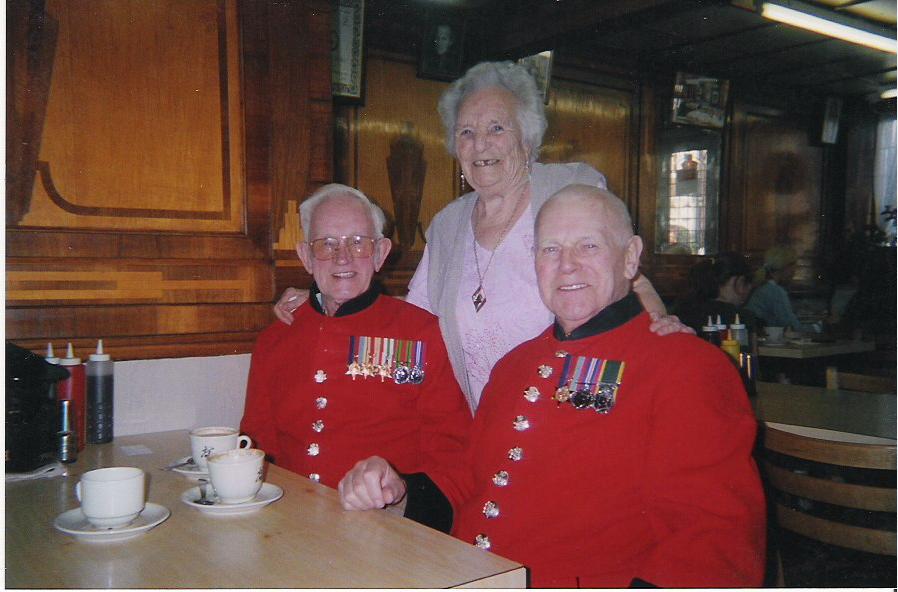
Lil Peters flirts shamelessly with two Chelsea Pensioners.

Ross Kemp and the Pellicci boys.

Jools Holland always pops in when he’s in the East End.

“I’m completely stuffed,” declared Su Pollard.












