
Spitalfields Antiques Market 18

When Marlene was a child growing up in Jamaica, her parents used to have their furniture and even clothes made up locally – copying illustrations from old catalogues – thereby giving Marlene an education in taste and appreciation for the styles of yesteryear that remains with her to this day. Dealing in old china and kitchenalia, Marlene also uses it at home every day. “I never buy anything to put away and I never buy anything I can’t use.” she declared firmly as a matter of principle, before adding with a sentimental smile, “It’s so nice drinking out of an old cup and saucer!” As one who eats off old plates everyday too, I recognise a kindred spirit in Marlene.

This is the erudite Dudley from Kent, once a military photographer in the RAF, pictured here wielding a fine old bell made by Warners of Spitalfields, impressed with the name “Seabird,” indicating its nautical origins. “I like things with a story,” he confided in understatement, showing me a humble bookcase made from the teak of HMS Valiant, nearly sunk in the bay of Naples by a limpet mine in 1948, and a pair of stylish candlesticks of 1929 made from the timber of HMS Ganges, the last sailing ship in the British Navy. Dudley told me his father was an antique dealer in Shropshire dealing exclusively in old oak, revealing the origin of his passion, as a branch of the same tree.

This is Anita from Rochester, bubbling over with irresistible enthusiasm for the costume jewellery and old lace that she sells,“I’ve only been doing it ten years but I wish I’d been doing it longer because I love it so much.” she announced with gleeful vivacity, tossing her wayward blonde locks flirtatiously and showing off the lavish Whitby jet necklace and glittering diamante spider she was modelling herself.“I bring a different selection every week” she emphasised, gesturing persuasively to the sparkling array of trinkets before her,“Where else are going to get a nice vintage necklace for eight pounds?”

This is Tony Travis whose area of expertise is Tudor & Stuart hammered coins, but in Spitalfields he trades in ethnographic currency from Africa. When Tony explained that the iron manillas he sells were cast in Birmingham in the eighteenth century, exchanged with tribal chiefs in Central Africa for slaves, which were then exported to America in return for the cotton that was in turn brought back to Birmingham, it was a moment when the inescapable reality of history became apparent in a single unlikely artifact. A sobering reflection in the market on a Summer’s morning in Spitalfields.
Photographs copyright © Jeremy Freedman
Bengali lunch

With so many places to eat in Brick Lane, I am commonly baffled by too much choice. I stand in the midst of the cacophony of street cries, swept along by the drunken throng, entranced by the spices drifting on the breeze, aware that every restaurant has a prizewinning curry chef and a celebrity endorsement, almost seduced by the offers to “Step right in, the beers are on the house!” yet unable to decide where to go. But when I heard there was a restaurant where you could eat Bengali home cooking, exactly as you would find it in Bangladesh, I knew I wanted to eat there.
Abdul Shahid’s cafe, Gram Bangla, at 68 Brick Lane (opposite Christ Church School) is where Bengalis go to eat. “I used to miss my mother’s cooking when she went back to Bangladesh in 1979, so I thought I must find a way to create it for myself.” explained Abdul, declaring his quest, fulfilled today by the presence of happy family groups and workers from the other restaurants, enjoying the freshly cooked authentic dishes that speak of his homeland. In effect, Gram Bangla caters to the catering industry, with catering workers from all over London and beyond filling the restaurant on their days off, early in the week when their own restaurants are quiet. There is a relaxed yet respectful atmosphere that presides in this unpretentious cafe where large family groups gather in the late afternoon, waiters from rival restaurants exchange professional gossip over extended meals, and all the diners feel comfortable walking to the kitchen at the rear to make their orders.
The first Asian restaurants in Spitalfields in the sixties and seventies were originally to feed the immigrant workers in the garment industry, most of whom were single men without anyone to cook for them. Both the Clifton and the Aladin started as workers’ cafes, but, as Europeans also came to eat there too, gradually the menus changed, moving away from Bengali home cooking towards the Western versions of recipes from the Asian subcontinent that are familiar today.
Unless someone pointed it out to you, among the chaos of neon signs and curry touts in Brick Lane, you would never notice Gram Bangla, which has no need of either. In fact, this intriguingly undemonstrative establishment does not even have a menu because the customers already know exactly what they want to eat. Abdul Shahid, the proprietor, a startlingly healthy-looking man in deep green shirt, is a living advertisement for the Bengali food he serves which consists primarily of freshwater fish and vegetables with rice – utilising less meat and bread than cookery from the North of India. Specifically, this is the country version of Bengali food that agricultural workers would eat at home, conveyed by the name Gram Bangla – “gram” means “village” in Bengali. Even the hours reflect the Bengali working day, closer to a Mediterranean pattern, starting and ending later than the Northern European custom. Lunch at Gram Bangla is from two until four, which corresponds to the bulk of the trade, although the cafe stays open until midnight.
The first thing you do is to walk to the back of the restaurant and wash your hands in the sink. This is necessary because you will be eating with your hands. Crushing the food in your fingers allows you to discover any fish bones, as well as permitting you to rub the spicy food into the rice, encouraging it to absorb the strong flavours that are characteristic of this cuisine. Once you have washed your hands you survey the array of fish and vegetable dishes on the kitchen counter that are specialities here, many of which are to be found nowhere else outside Bangladesh. Behind the counter two cooks are at work, tending blackened pots upon the huge stove, cooking everything daily in small batches. With Abdul’s guidance, I chose a range of dishes which were swiftly delivered to my table in small bowls with plain rice, and that was where my experience of Bengali lunch truly began. People told me it was an acquired taste. “We have had two non-Bengali customers over the years,” admitted Abdul with an indulgent grin.
How can words convey my experience of Bengali lunch? From my first mouthful, I understood that Bengali food proposes its own intense palette of flavours, quite distinct from any “Indian” food I had eaten before. To enjoy these dishes, an appreciation of fish is essential and you must not be squeamish of spices or fish bones either. Abdul explained that one function of the spices was to extend the quantity of food for poor farmers, whose diet is rice with just a small amount of fish. It only takes a tiny amount of hot spicy fish to flavour a meal that is mostly rice. In Bangladesh, the price of fish makes it generally available only to the middle class, and consequently Bengali food is a frugal cuisine using every part of a fish and each part of the vegetables too, even bean pods. I started with Keski – which you might call freshwater anchovies, delicious tiny crunchy spicy fish. Then I ate Chitol – moist spicy fish balls made from the flesh of a large fish with the bones removed, which I enjoyed with Begun Bortha – stewed Aubergines with chopped green Chillis, and Korela – a popular bitter vegetable that reminded me a little of Broccoli.
Once I had whetted my appetite, I went back next day with a better sense what to expect. I had Boal with Uri and lentils with rice. My slice of Boal fish had a pale flesh with a delicate flavour that fell off the bone and the Uri was a tangy bean pod which complemented the fish nicely, while the lentils soaked up some of the spiciness, and it all added up to a satisfying meal. I was delighted. It was the beginning of something new. I cast my eyes around the modest yellow cafe decorated with prints of rural life to observe everyone else absorbed in their food, I felt comfortable. I enjoyed my Bengali lunch.


Mark Petty, trendsetter

This is what I consider a classic Mark Petty outfit. It has the high-waisted flares, wide lapels and tie – all in a vibrant colour scheme – and Mark wears it with the audacious flair that we have come to expect from him. Anyone that frequents Brick Lane on a regular basis will be familiar with Mark and his boldly coloured leather suits, because he has honoured us by adopting these streets as his stage, or rather his catwalk, upon which he performs his celebrated theatrics of fashion.
Mark and his clothing have become part of the fabric of our neighbourhood, and it always lifts my spirits to spot him among a crowd of unremarkably dressed people, bringing a splash of eye-catching colour to elevate the scene. It is a joy that is compounded when I see him later in an entirely different outfit – an event which can occur several times in the same day, increasing the delight and admiration of the many residents who hold Mark in high esteem, as our self-styled ambassador for colour.
Amongst all the snazzy dressers of Shoreditch, what makes Mark special is that he designs his own clothes, not merely to look fashionable but as an unmediated expression of himself. More than anyone else I can think of Mark uses clothing to express who he is. He shows how he feels – revealing his inner self openly – and in the process his liberationist example has become an inspiration to us all.
“The reason I started was because in the seventies I was too young to wear the fashions, and by the time I was old enough flared trousers had gone,” explained Mark as we sat in his pink living room in a quiet corner of Bethnal Green, “So I went round to Mr Singh at Batty Fashions in the Bethnal Green Rd to see if he could make me some. I have no training in fashion yet I cut my own cardboard patterns, though it wasn’t easy at first doing flares.
I tried going out in Bethnal Green and the reaction was very hostile – from children who threw bottles at me – but I thought, ‘I’ll persevere because fashion is too drab and life should be full of colour.’ I’m not the kind of person that gives in. So I went to Ridley Rd Market in my lilac seventies outfit and on the whole the reaction was good. I find each area is different, you can’t ascertain in advance whether you’ll get mugged or chased. The older people here say, ‘You’re a rebel,’ and I get requests to wear particular outfits. My most popular request is for pink.
I’ll never forget the gang of Scottish football supporters I met at a bus stop in Shoreditch High St, they said, ‘It takes a lot of nerve to wear what you’re wearing.’ and asked to be photographed with me. Hopefully something good will come of it and people will realise that life isn’t all beige and black, and you need to express yourself. It needs a kick up the backside. When I went to Tottenham, where they all wear baseball caps, track suits and have designer dogs, they said,’You’re ruining our culture!’ In Croydon, when they realised I was from East London, they said, ‘We don’t get a lot of people from the North here.’
I moved to London from Essex sixteen years ago. I was born in Oxford but my mother decided to marry and live in Essex. I had a problem in Essex at school because I had a West Country accent. They said, ‘You’re a foreigner so we don’t like you!’ My mother’s been there thirty years now and they still say to her, ‘You’ll never be one of us.’ I was forced out of of Braintree. It was all over the newspaper headlines. Once you come through that you can come through anything. I used to lie on the floor of my flat with my three cats in the dark and pretend to be out. This went on for months, until they came round at night with flaming torches and smashed all the windows.
Moving to London, I found people in pubs and clubs very cold, and I settled in London in Tottenham on the Broadwater Estate which had a fearsome reputation. I thought, ‘I’m here on my own,’ so I got Rose an English bull terrier, but it was quite terrifying even walking to the park with the dog. As they said to me in Islington when they saw my outfit, ‘There’s not a lot of people that’s got the courage.’
I must know everyone in Bethnal Green now, they say, ‘You’re quite a celebrity round here,’ but I never thought of it that way, I just did what I had to do. We had a lot of builders round here last year, so I used to try my designs out on them to see what they thought, unfortunately they’ve gone now. I used to get a lot of offers but none have been taken up. I went to Walthamstow Market recently and the girls were holding their boyfriends’ hands because they were looking at me rather than their girls. If only people could experiment more and show their bodies. Even women here dress like men. The worse thing they ever did was invent the remote control, no-one gets any exercise anymore.
I’ve noticed in Romford and Ilford that guys are starting to wear pink. You’d expect it to be the little skinny ones but it’s the big butch guys. A woman said to me in Bethnal Green Tesco, ‘You’re corrupting our men! It’s dirty and perverted.’ I said, ‘That’s pathetic.’ Her twenty-four year old son wants to dress like me apparently and I get the blame. If people don’t express themselves they’re always repressed, but you only have one life and you have to live it as you think fit. The kids still abuse me and the police are useless, so I have to take care of myself. You have to stand up to them. They say they don’t like how I look, and I tell them, ‘If you don’t like it you can put up with it,’ because I’ve been through so much that I’m not going to be persecuted anymore.”
It was a painful journey Mark travelled to realise the truth of himself and square up to the violence, hatred and ignorance he confronted as a consequence of his emotional honesty. Yet in the face of this resistance he has discovered moral courage. I was humbled to recognise Mark’s strength of character as he told his stories filled with magnanimous humour and sympathy for his tormentors.
Nowadays, the clothing he adopted as a declaration of fearless independence has become Mark’s life and, as we talked, he produced outfit after outfit to show me, each more extravagant than the one before. Simultaneously his armour and his joy, Mark takes great delight in his multicoloured wardrobe which incarnates the transformation act he has pulled off to emerge as the peacock of Brick Lane.
“A bit of colour highlights people’s moods,” Mark declared as, with a beaming smile, he proudly modelled his pink leather trousers with cupcake applique motifs which he created as a homage to a dress he saw Fanny Craddock wear. There is a certain holy innocence about Mark, like the jesters of old who were licensed to speak what no-one else dare say. It still takes courage for him to go out, but Mark Petty is a kind man who discovered bravery in the face of cruelty, and a neighbourhood dandy we are all proud to know.


Mark Petty aged nine, in the nineteen seventies.
Jim Howett’s Spitalfields Shopfronts

Over the last fifteen years, the subtle work that Jim Howett has done on numerous shopfronts in Spitalfields has become such an integral part of the identity of the neighbourhood, that most people have no idea these edifices were ever any different from how they are today. This is exactly how Jim would wish it of course – it was his intent. He was always pursuing an art that would conceal itself. Yet there is a story behind each one, and it was by no means inevitable that any of these buildings would survive to become the local landmarks we all recognise.
The nature of the location of Spitalfields at the boundary of the volatile City of London renders the neighbourhood as one that is always in a state of change. It was in the late eighties, when the departure of fruit & vegetable market was imminent and developers were hungrily eyeing up the opportunities, that the Spitalfields Trust set about purchasing buildings in Brushfield St. Ironically this undervalued terrace facing the market was itself created by a brutal stroke in 1780, when a new road named Union St was driven through linking Christ Church with Finsbury Sq (the other half of this road still exists as Sun St on the other side of Liverpool St Station). In the process, structures were sliced in half, leaving buildings only one room thick, and refaced with windows in the odd positions that accommodated to the circumstances, defining the unusual rhythm of this terrace today.
When designer Marianna Kennedy and husband Charles Gledhill, bookbinder, bought 42 Brushfield St from the Trust in 1996, the ground floor had been stripped out for use as a vegetable store and it fell to Jim to design a shopfront that would be in keeping, so that the space could be used as a workshop and showroom. Without money to spend, they were lucky to attract the attention of a film crew that needed a shopfront location for an episode of Maigret. The location fee covered the cost of construction and, once his design was approved by the conservation officer, Jim worked through the night to complete the work. And when the crew arrived on the first morning of filming, the paint was still wet.
Jim’s design was based upon a thorough knowledge of East End shopfronts both existing and as recorded in old photographs, and the success of this key piece of work led to it becoming the model for the other traditional shopfronts at the Bishopsgate end of Brushfield St, but a comparison reveals that these are mechanical reproductions. They lack the idiosyncrasy and craft details of Jim’s work. At number forty-two, he used cedar wood that would provide longevity and a textured grain, and he planed the sashes by hand. It is this attention to intriguing authentic detail – he built-in rising sashes that allow for an open shop window – combined with an understanding of the proportion and the dignity of utilitarian design that makes Jim’s understated work so pleasing.
At the same time, Jim also found Mr Verde’s daybooks from the nineteen thirties recording his visits to farmers in France under the name Jean Verde, farmers in Spain under the name Juan Verde and farmers in Italy under the name Julio Verde. These daybooks revealed that Mr Verde was scrupulously fair with his suppliers, informing them that never less than nine-tenths of their produce had arrived in good order with no more than one tenth spoilt. Recalling Mr Verde and the other vegetable traders of Brushfield St, Jim told me, “They traded in mushrooms, watercress and potatoes, and were in their seventies when I knew them, many fought together during the Italian Campaign, and their families had intermarried. And they ran an unlicensed horse betting racket that earned them more than the vegetable trade!”
While Jim was doing his work at one end of Brushfield St, Peter Sinden’s renovation of the Market Coffee House (the oldest surviving building in Spitalfields, dating from the seventeenth century), bookended the terrace, securing the personality of this block of buildings with so much to tell about Spitalfields history.“It just shows that if you cherish a neighbourhood, you can make it something better than it is.”disclosed Jim, with proprietory delight. In finding such ingenious and modest ways to design shopfronts that are in tune with each of these frontages, Jim Howett has contributed to preserving buildings that are distinctive in Spitalfields. They tell the history of working people here over the last two centuries, allowing their presence to remain visible on the street to remind us every day of those who were here before us.
Next week, I will show you Jim’s shopfronts in Commercial St and Fournier St.

42 Brushfield St as a fruit & vegetable store.

The shopfront that Jim designed in 1996, seen today. The signwriting is nineteenth century, revealed when the paint was picked off the fascia.

The location filming for Maigret that paid for the shopfront

125 Brick Lane in a watercolour of 1914.

125 Brick Lane prior to restoration of the exterior.

Uncovering the door that had been plastered over.

125 Brick Lane today – it is Jim’s regret that circumstances prevented re-instatement of the top storey.

40 Brushfield St, with the brick walls which were added to stabilise the building

40 Brushfield St today, with the original shutters used to conceal the brick walls.
Columbia Road Market 46

With the first day of August, a certain air of languor has settled over the streets of the East End. School is out for Summer and many are departing for their holidays already. An aura of peace lay across the neighbourhood as I made my way early to the market, only to discover I had arrived before most of the traders. As I sat on a wall in the empty market and ate a bagel while the plant sellers wheeled their trolleys out of the vans, I realised that the dry conditions at this time of year are not ideal for planting. Many gardeners, including myself have seen the garden dry out and accepted now that little can be done until the first signs of Autumn.
Seeing the profusion of Sunflowers in the market reminded me of the Summer I spent on the pilgrims’ path to Santiago de Compostella, commencing at Le Puy in the centre of France, I walked across the Auvergne and Gascony down to the Pyrenees at St Jean Pied de Port and then across the North of Spain through Galicia as far as Finisterre. It was an epic journey and where possible, I stayed in the medieval pilgrims’ refuges and monasteries along the path, getting up at dawn to walk before the heat of the day. I shall never forget the first time I saw the miraculous fields of Sunflowers (Helianthus annuus) in the South of France, turning their heads in unison to follow the sun, like a crowd of people in slow motion.
Somewhere in the Haute Garonne, I stayed one night in a remote farmhouse where they gave me Lemon Verbena tea, or Verveine as they referred to it, picked from a pot outside the kitchen window. The intensity of its intoxicating scent and the refreshing flavour of the tea has remained a lifelong favourite to remind me of my roving days. As you can see, I bought a Lemon Verbena (Aloysia citrodora) plant (£3) and a bunch of Sunflowers (£5) today.

Truman's returns to Spitalfields
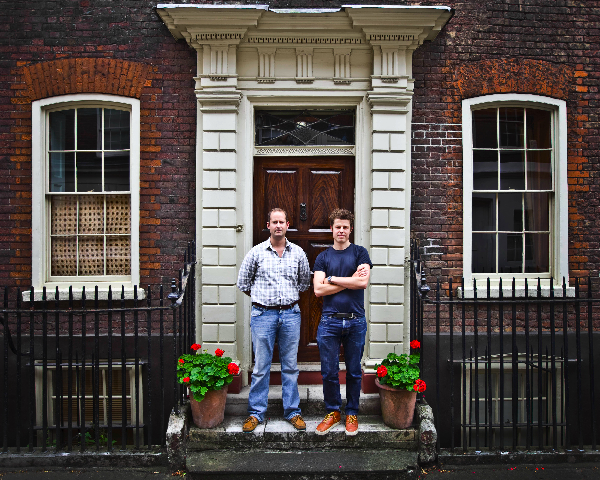
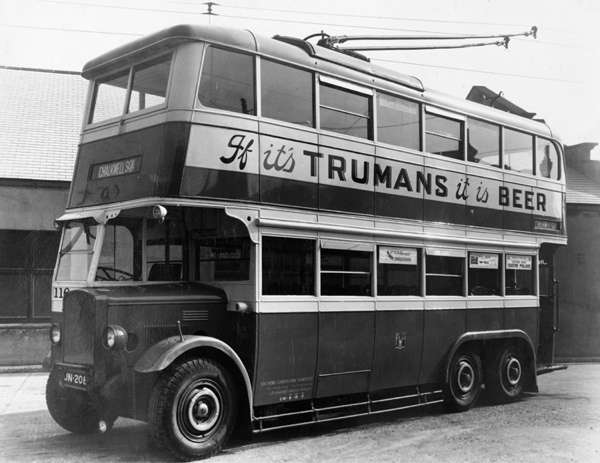
Ever since Truman’s closed the brewery in 1988 after more than three centuries of brewing in Brick Lane, their absence has been felt throughout East London, emphasised by all the ex-Truman’s pubs that are still emblazoned with the name as part of their architecture. Meanwhile, the venerable history and resonant name of Truman’s – which remains synonymous with beer in East London – got lost in series of corporate takeovers at the end of the last century. They were sorely missed. And it looked like it was all over, the barrel was empty, the last glass had been drunk and the dregs had been drained. But now, in an entirely unexpected joyous development, two fearless young men are bringing Truman’s back.
“It was apparent that everyone referred to Truman’s, but you couldn’t taste it – so it was a sad story,” explained Michael-George Hemus who, with his business partner James Morgan, has embraced the audacious challenge to re-establish Truman’s Brewery, working from an attic in Elder St. “There is a legacy of Truman’s that has to be taken up by a brewery of a certain size.” said James with an impressive clear-eyed confidence, declaring his ambition to open a brewery in East London, on a scale than can employ a significant number of people, within two years from now.
If Michael-George & James are successful they will become one more chapter in the long history that has seen many re-inventions for Truman’s Brewery. As Michael-George reminded me, Joseph Truman who gave his name to the brewery was not the one who started it, but an employee who worked his way up and took over the business. Joseph’s son Ben was in charge during the porter boom, building the business to become the largest brewer in East London, exporting overseas, supplying the army, the royal family and creating an imperial stout for the Tsar. When Ben Truman died without an heir, Sampson Hanbury bought up all the shares and took control. Industrialising the process, he was one of the first to use canals for distribution and bought a boat to ship his own exports. His successor Thomas Buxton was William Wilberforce’s right hand man in the campaign for abolition of slavery, who worked altruistically for the people of the East End, insisting all his employees learn to read on company time.
So Michael-George & James are following in the footsteps of some remarkable men, and last December, after two years of wrangling, they signed an agreement to buy the celebrated yet neglected name of Truman’s from the corporate owners. But since November, they had already been stealing a march in the London Metropolitan Archive which houses all Truman’s records, researching the history of their illustrious predecessors, poring through the photographic collection and most significantly studying the “gyle books” which contain the recipes for beer. Stretching from 1812 until the nineteen twenties, these volumes specify the crucial factors, namely the time of day, the weather and the ingredients for every brew. Before it was possible to store hops or malted barley, as it is today, achieving a consistent brew was almost impossible, so brewers blended beers – creating large vats of strong barley wine and carefully blending it proportionally with something weaker to produce a consistency of taste.
Michael-George & James boldly decided to launch their first beer at once, as a means to build up a sales volume that would allow them to open a brewery that matches their ambitions. “We thought about recreating an old recipe, but decided against it because we don’t want this to be a nostalgic project, it’s Truman’s for the twenty-first century.” said Michael-George, emphasising that they do not wish to wind the clock backwards. “We wanted a beer that everyone can drink, because that’s what Truman’s is about,” added James optimistically, stressing the nature of Truman’s as a popular beer, not just for real ale drinkers.
Working with esteemed brewer Tom Knox of Nethergate brewery and in consultation with former Truman’s employees, such as Derek Prentice who was a junior brewer from 1968 until 1989 in Brick Lane, they set to work. The beers brewed in Spitalfields tended to be darker, and so, in opposition to the current fashion for lighter beers, they chose to create a darker beer in the best bitter style, christened “Runner,” meaning the staple brew. A decision that informed the choice of malts, which were Maris Otter pale malt, chocolate malt, crystal rye, wheat and a little dark crystal rye, complimented by a blend of two traditional British hop varieties Fuggles and Goldings.
Let me confess, these were mysterious terms to me, but it was a parching afternoon and I could sense a certain relish in the cadences that Michael-George adopted as he rolled these names off his tongue.“We tried about thirty until we worked out what we liked,” he admitted, in explanation of their research process, exchanging a glance of barely concealed glee with James.“It is a four per cent alcohol best bitter, darker than fashionable, though traditionally well bodied, full rounded, and which drinks stronger than it is.” announced James authoritatively, looking thirsty suddenly as he let these words overcome him, in the process of summing up their debut beer with the precise rhetoric of a professional brewer.
You may be assured that I shall follow this story of the return of Truman’s closely over the coming years, but in the meantime you can try a glass of Truman’s Runner for yourself – because it is already available in the East End. I must admit to having enjoyed a few pints of this delicious bitter myself last week at The Carpenter’s Arms in Cheshire St. You can also find it at The Water Poet in Folgate St, The Griffin in Leonard St, The Haggerston in Dalston, Indo in Whitechapel, The Scolt Head in De Beauvoir Town and The Wenlock Arms in Hoxton, with many more others to follow in time. Cheers!
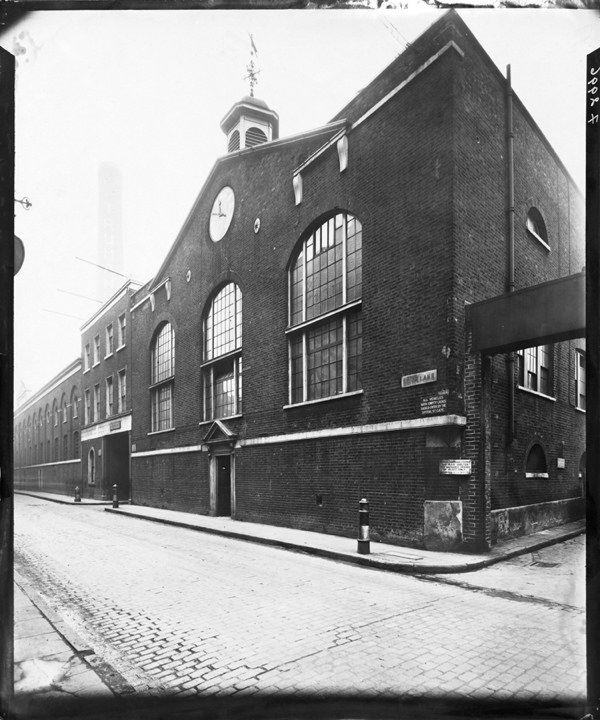
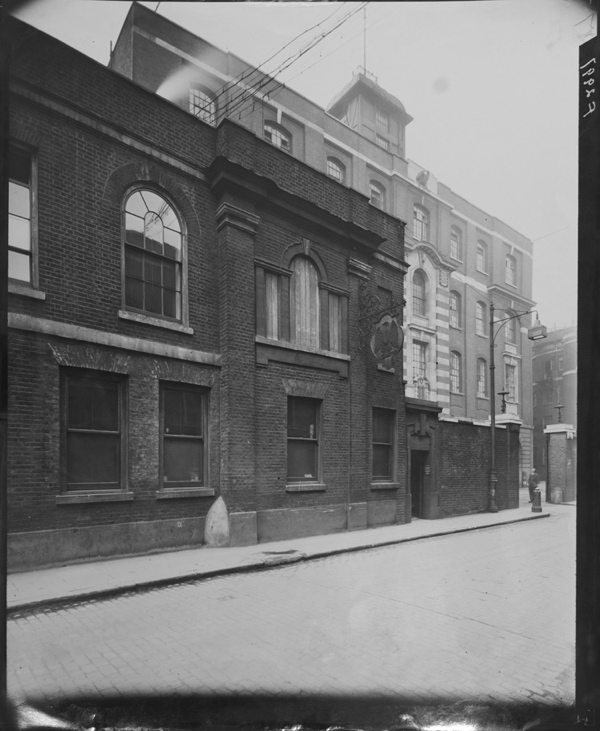
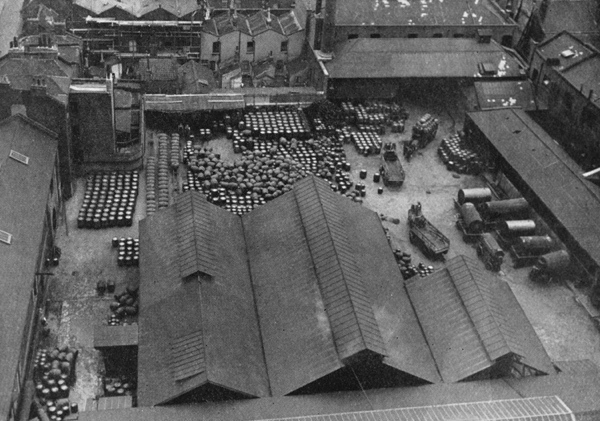
Truman’s cooperage.
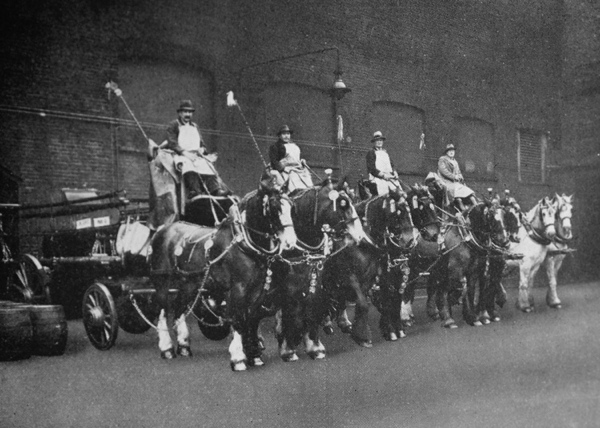
Truman’s draymen.
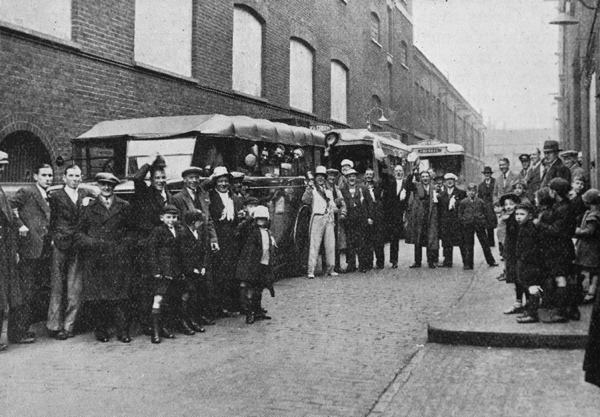
Setting out for on inter-brewery football tournament.
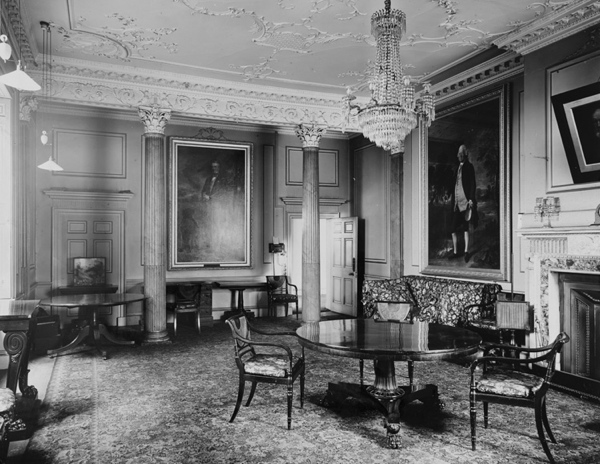
Truman’s directors’ drawing room.
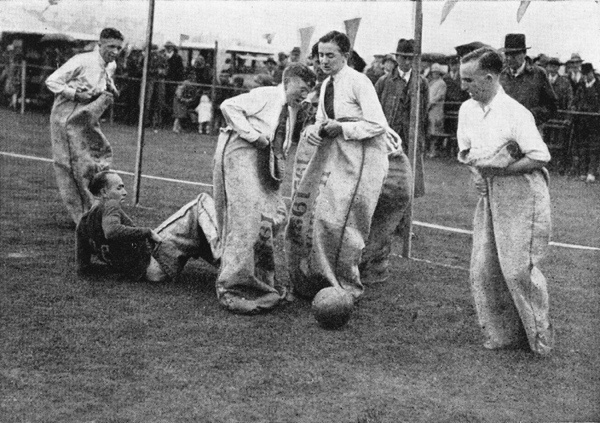
Truman’s workers’ football match.
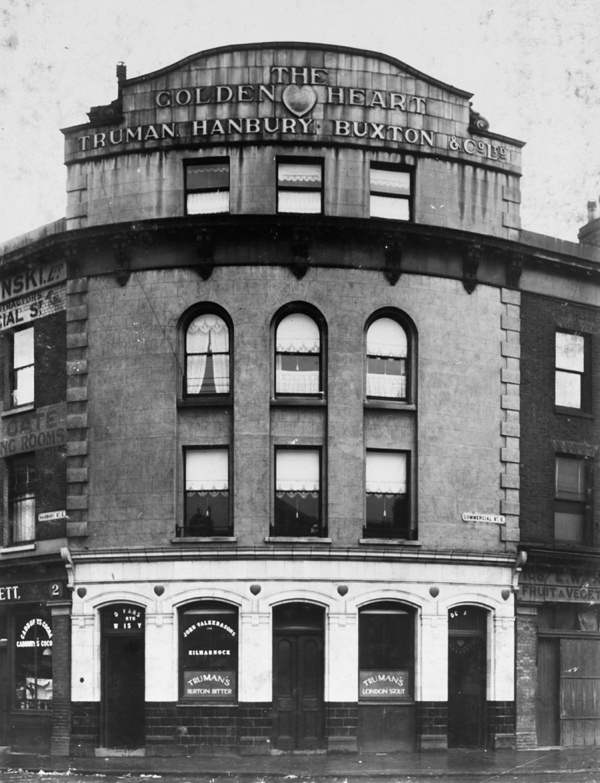
The Golden Heart, Commercial St, Spitalfields, in its previous incarnation.
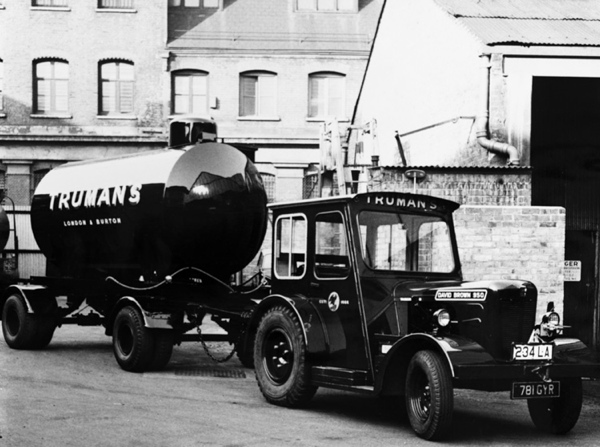
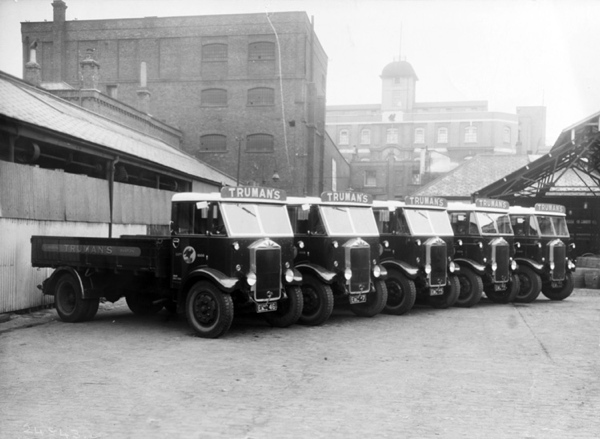
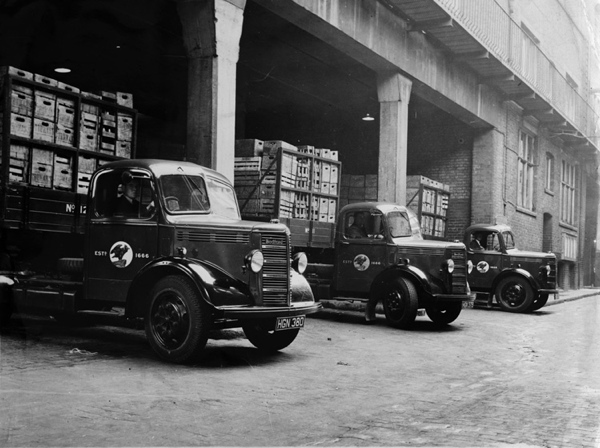
Portrait copyright © Jeremy Freedman Brewery photographs copyright © Truman’s Beer
George Cossington, Steeplejack
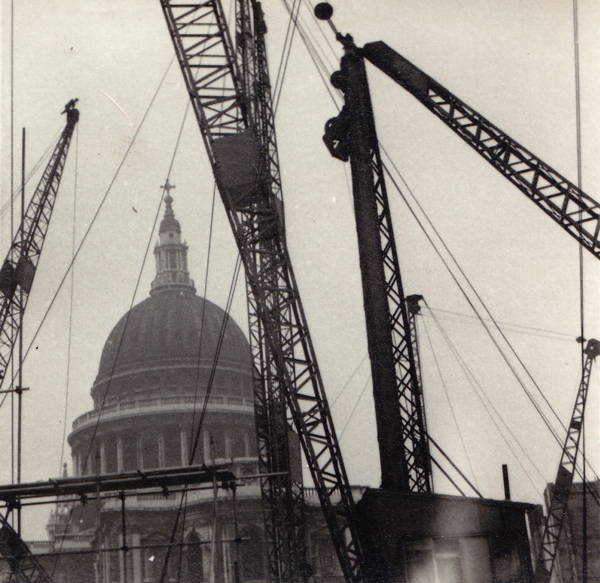
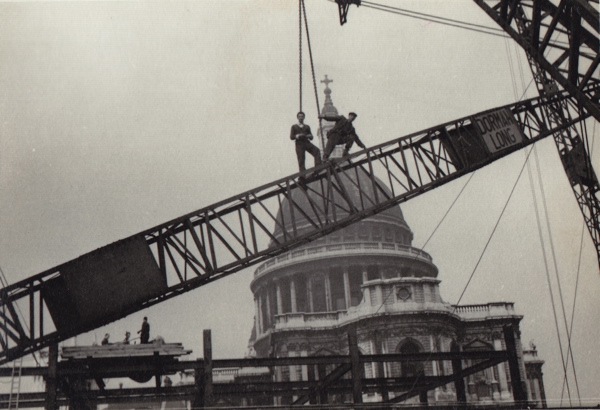
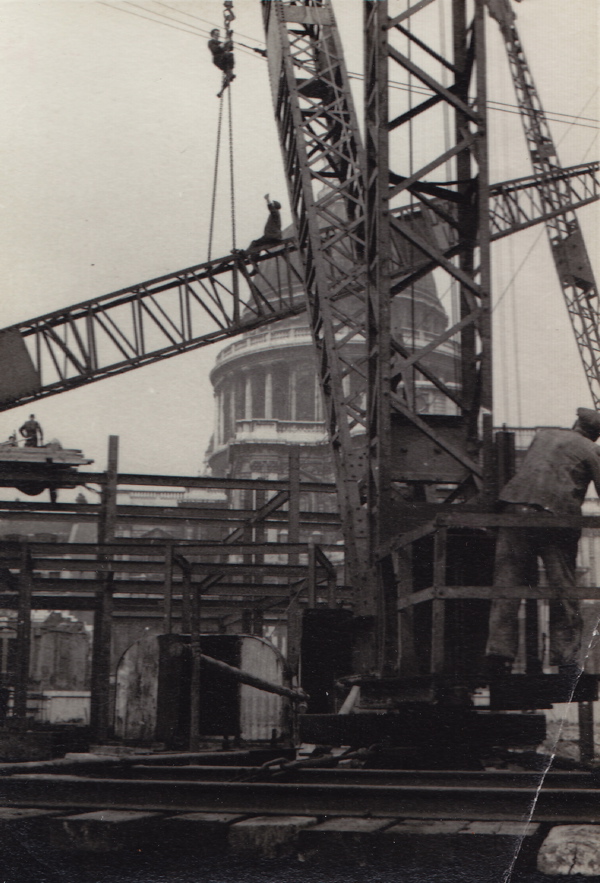
This is George Cossington in the top left of this picture, photographed in the pursuit of his trade as a steeplejack & steel erector, perched at the very top of a one hundred and fifty foot jib during the construction of Paternoster Square, next to St Paul’s Cathedral in 1958. Seeing this vertiginous image, you will no doubt be relieved to know that George survives to tell the tales of his daring aerial adventures, still fit and full of swagger today at seventy-seven. ” In my day, you weren’t called a steel erector, you were called a spider man. I used to run up a sixty rung ladder in less than a minute and come down in less than twenty seconds – you just put your hands and feet on the sides and slid down! ” he bragged, with a modest smile that confirmed it was the truth.
George’s father was a steeplejack who once climbed Big Ben to fix the hands on the clock face and worked as chargehand on the construction on the Bank of England. So in 1947, when George left school at fourteen, there was no question about his future career, “All my friends were going into the Merchant Navy but when I came home with the form, my dad said, ‘No. You’re going into my trade so you get a pension.'” In fact, three out of the five boys in George’s family became steeplejacks, a significant measure of George’s father’s confidence in his own profession.
“My father, uncle and my brothers, we all loved it! There was none of this Health & Safety shit then, you learnt to be careful. What started coming in was the safety harness, a big belt with a hook on it attached to a rope – we hardly used them. There was no such thing as a crash helmet. Me and my brothers, we used to watch each other to check we put the bolts in correctly. It was all done properly, even without today’s safeguards.
I was apprenticed to Freddie Waite of Stratford. I started off as a tea boy. You learn as the months by, and then someone else becomes the tea boy and you learn how to adjust swivel bolts, rigging up steel beams, and how to sling a beam for the crane to lift. It takes well over a year before you start going off the ground. You had to learn rigging, slinging, welding, acetylene burning, and rope splicing. It takes five years to become a steeplejack. We used to walk the purlins that were four inches wide, you can’t do that today. Before scaffolding, we used wooden poles held together with wire bands, like they still do in the Far East. You had to know how to tie the wire bands securely, because it wasn’t an easy job going up to forty feet.
I enjoyed it, but I didn’t enjoy it when it was wet or cold. The crane used to take us in a bucket and put us on top of the steel work. In the Winter you could freeze. If it was a frosty night, we had a big fire in an oil drum and wrapped the chain around the fire to get the frost out of it, because if you didn’t it could snap like a carrot – a fifteen ton chain.
The day I fell, I was cutting some steelwork at Beckton Gas Works and it pissed down with rain, so they called us down. When I went back up again later, I cut one end of a beam without realising I had already cut the other end. I was seventeen years old. I was very lucky – my dad couldn’t believe it – a corrugated iron roof broke my fall. I had a few bruises, and a scar to this day. They called an ambulance but I was standing up by the time it came. I think I was only off work for a week, but I knew a couple of fellows that fell to their deaths.
My dad was still working up high until he was sixty-six. When he was the family foreman, he looked the business in a bowler hat. He taught me splicing and slinging, and he knew every sort of knot there was. He wouldn’t do anything you couldn’t do. He could throw a three-quarter inch bolt forty feet up for me to catch from a beam. Our last job together was on John Lewis in Oxford St. We were a hundred feet up in the air and he walked along beams as if they were on the ground.
I’ve never had a problem with heights. I’ve stood on the spider plate at the very top of a crane, three hundred and fifty feet up without a rope. I did it just for a laugh, but if my dad had seen me he’d have shot me…”
George retired at forty-five when he was required to wear a helmet on site, because he belonged to an earlier world that put more trust in human skill than safety procedures. When he spoke of pegging his own ladder to scale a factory chimney, I recognised a continuum with those that once climbed the spires of cathedrals, trusting their lives in the application of a skill which now exists only in the strictly controlled conditions of sport. Thankfully, with the advent of modern cranes and cherry pickers, men are no longer required to risk their lives in this way, but it only serves to increase my respect for the unacknowledged heroism of George Cossington, his brothers, his father, uncle and all of those in this city who fearlessly undertook these death-defying challenges as part of their daily routine. When you meet a steeplejack at the fine age of seventy-seven, his very existence confirms his skill and proficiency in his former profession.
Because Freddie Waite bought a camera in 1958 to record the construction of Paternoster House, we have the privilege to see these rare images today, photographed by those working on the site. And while Paternoster House may already be history – demolished for a subsequent development – in the meantime there are enough monumental structures still standing that George worked on, like Shell House, the Chiswick Flyover, the Edmonton Incinerator towers and the chimney at the Bryant & May Factory, to remind him of his thirty year career as a steeplejack & steel erector.
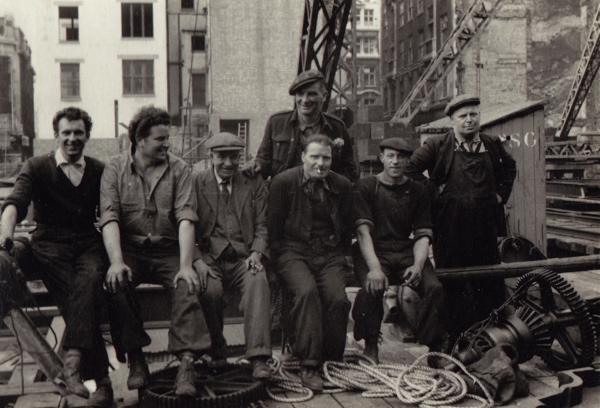
George (on the left) with the team, Kenny the master electrician, Ron the crane driver, then two slewmen and the foreman standing at the end, with Freddie (the master steeplejack that George was apprenticed to) standing at the back.
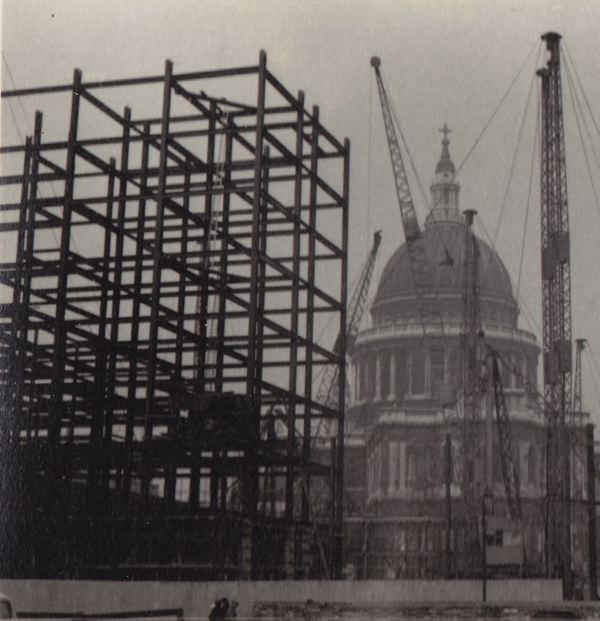
George is to be seen at top of the lower jib on the left, between the steel structure and St Paul’s.
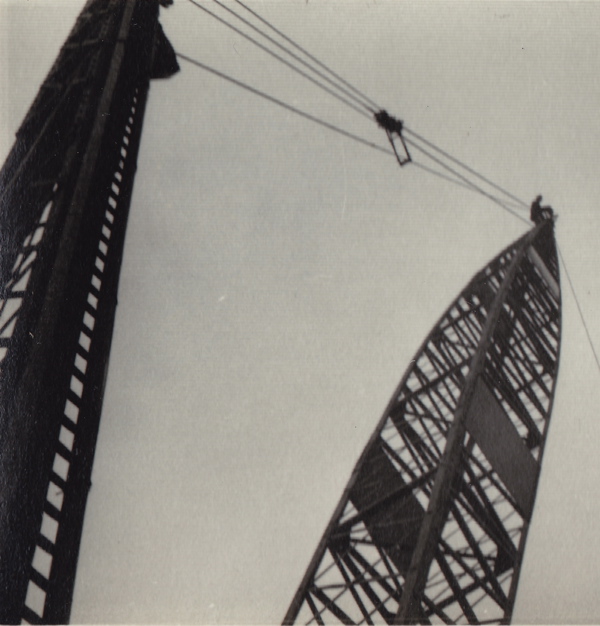
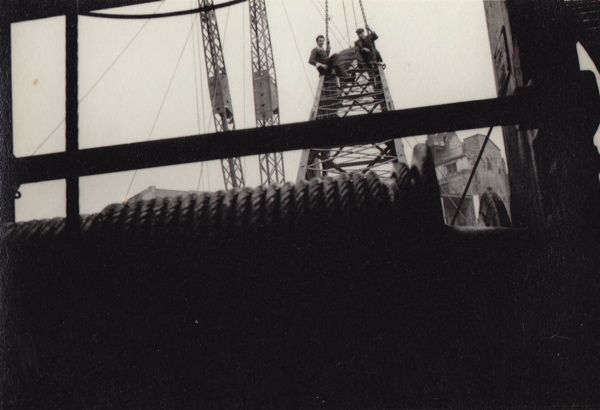
George & Freddie at the end of the jib, as viewed from the boom.
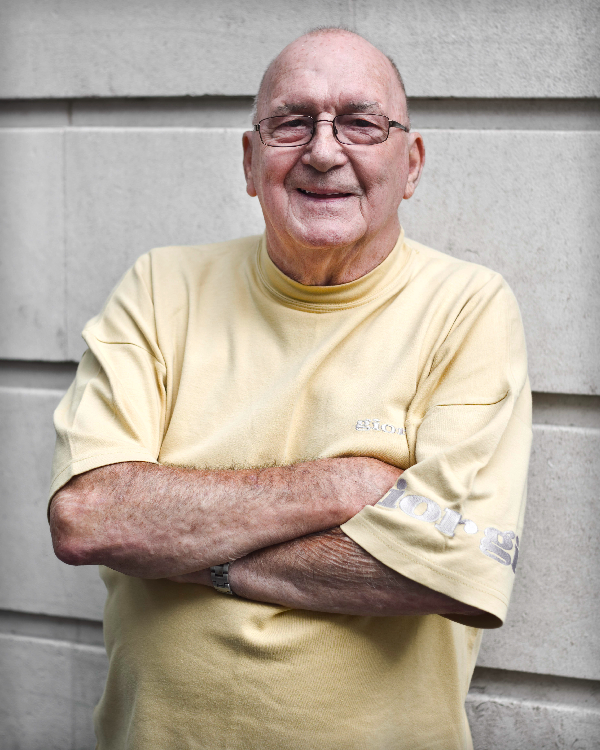
George Cossington
portrait © copyright Jeremy Freedman
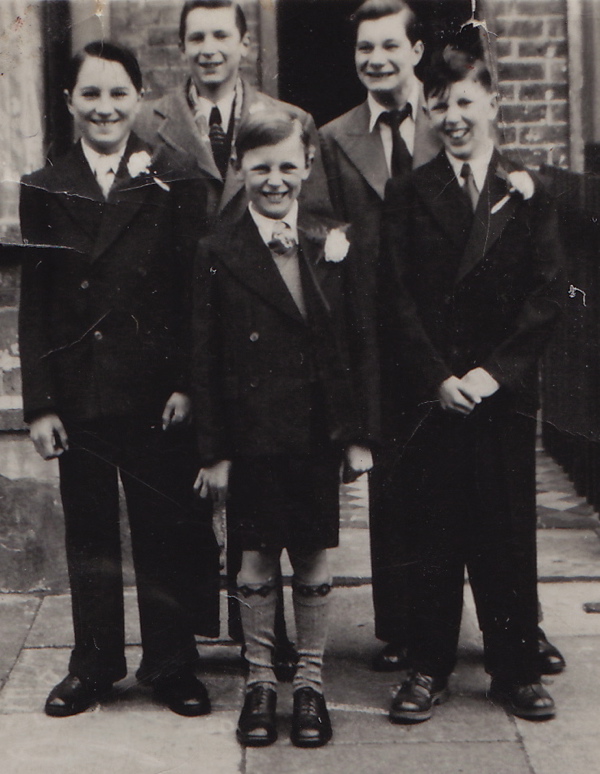
The Cossington boys, George (back left) pictured with his brothers Brian, Sid and Bob (front row, left to right) and Joey (back right) outside the family home in Rochester Avenue, Upton Park, E8. George, Brian and Joey all became steeplejacks like their father, while Sid and Bob became master bricklayers.












