
Fergus Henderson, bookworm
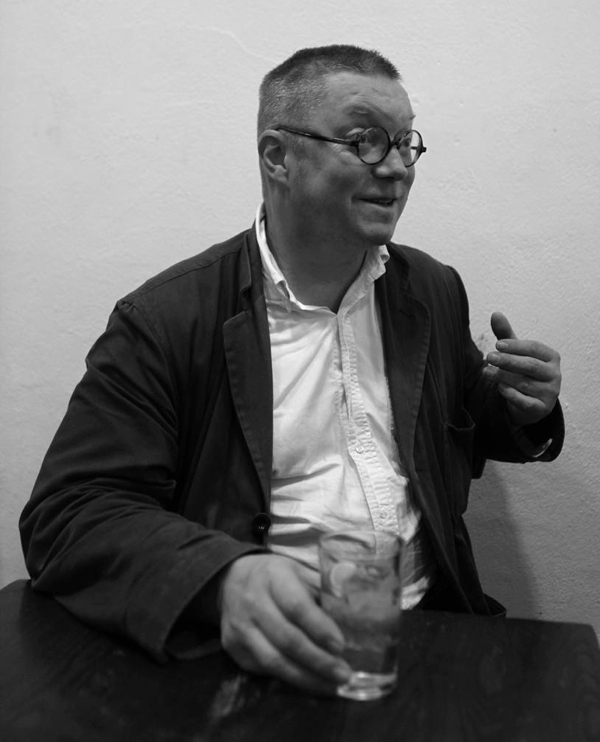
Although Fergus Henderson is widely celebrated as the presiding spirit and co-founder of St John, his literary tendencies are less commonly known. And so, desirous of learning more, I dropped by St John in Smithfield one bright morning, with my City Of London library card in hand, to enjoy a steadying glass of Fernet Branca with Fergus and discover how it is that certain books have become the means by which he communicates the undefinable ethos of this unique culinary enterprise with his staff. Still windswept and tanned from a recent holiday on the Isle of Tiree, Fergus arrived glowing with all the enthusiasm and energy of a schoolboy returning from Summer Camp. “Sometimes I feel that I am not the most clear of chaps,” he confessed to me with a tender grimace – as we each knocked back the bitter liqueur laced with rhubarb and saffron yet possessing a compelling aroma of frankincense and myrrh – adding plainly, “so I amassed this collection of books to explain.”
“It was when I first handed the reins to another chef, Ed Lewis, that I needed some means to convey the essence,” continued Fergus mysteriously.“I chose ‘Master & Commander’ by Patrick O’Brian because I think of the kitchen as very much like an eighteenth century Man o’ War – a confined space. As chef you have to be everybody’s friend, but you must be in charge, so you need to keep yourself at a distance too. My march up and down between the fridges in the kitchen, there’s some similarity there with the Captain’s march up and down the deck, I think.” he said, adopting an unconvincing comic frown of fierce authority as his attempt at a Captain of an eighteenth century Man o’ War. “I have given this book to every head chef and sous-chef.” he explained, before raising his eyebrows with a self deprecatory smile, changing tone as a thought occurred to him, “Maybe I should ask if they read it?”
His second choice appeared more esoteric, though I quickly became aware of a theme emergent. Fergus chose L.T.C. Rolt’s 1957 biography of Isambard Kingdom Brunel, a subjective portrait of the engineer, tracing his triumphs and tribulations to create a narrative that reads like a novel. “Unlike recent biographies that have been critical, Rolt just loves Brunel and so I love him too. What’s so brilliant about Brunel is that he builds the Great Western Railway which is a feat in its own right, gets to Bristol, notices the Atlantic and says we’ll built the SS Great Britain and go across it – What a guy!” said Fergus with an admiring grin, making a lateral connection to St John’s next step, the hotel in Leciester Sq. “With the hotel, we thought,’We’ve fed them, now we’ll bed them.’ Not quite as ambitious as spanning the Atlantic but in his spirit.” he outlined with a deferential shrug. I knew that Fergus himself trained as an architect, so it seemed the appropriate moment to ask if he designed his restaurants, “I am to blame for most of it,” he admitted, drawing a long face of self-parody and casting his eyes around the cavernous white interior.
As we arrived at Fergus’ third title, Thomas Blythe the general manager walked in, adopting a good-humoured smirk when he overheard the subject of our conversation – because he is himself a recipient of these books, and he knew what was coming next, Ian Fleming’s “The Man With the Golden Gun.” “I chose it because I thought Bond and Scaramanga ate whole crabs together and drank pink champagne.” revealed Fergus wistfully before Thomas confirmed, “I read the book and it doesn’t exist, it wasn’t there at all.” and they both exchanged a glance of crazy humour. “That’s why we always serve whole crabs on the menu here…” continued Fergus with supreme logic,”It’s a sad story, but Thomas enjoyed the book – who wouldn’t enjoy it?” Then they both looked at me and smiled in solidarity, like brothers.
This obscure paradox was the ideal introduction to Fergus’ fourth title, John Berger’s “Ways of Seeing.” “What I took from this book was the importance of genus locii, the sense of place.” admitted Fergus, “Restaurants are places rich in genus locii. There is this chaos that happens twice a day, extraordinarily different people coming together. Also, Berger discusses Leonardo’s cartoon that no-one was interested to look at until an American offers to buy it for a million dollars and then a line forms. Restaurants can be a good example of this phenomenon too.”
I took this as a cue to probe Fergus about the origin of St John which has led the renaissance in British cooking in recent years, and is now integral to the identity of both Smithfield and Spitalfields. Explaining that Dickens was appalled by the variety of offal eaten in Spitalfields when he visited in 1851 and that Joan Rose remembers poor people eating a pig’s head when they could not afford a Sunday roast in the nineteen thirties, I asked him about his relationship to the food of the past. “Dickens was narrow-minded and pig’s head is delicious!” he retorted with unexpected fervour, eyes sparkling through his horn-rimmed spectacles as he declared his personal manifesto, “Food is permanent while fashion just changes, but what was good then is good now. I’m not interested in historical recreations. I am a modernist through and through, yet a pickled walnut is something that has been around forever and is still a thing of joy. I think of our food as permanent British. Nose-to-tail-eating is because it’s polite. It is not because of thrift, it’s simply because it is delicious.”
So now I hope I understood something. Many of the elements I recognise at St John are present in these books, the acute drama of collective enterprise, the particularly British glamour of dining incarnated by Bond and the unadorned presentation of good food that resists fashionable categorisation. There is a sensibility that is a synthesis of these literary works, serious yet with levity, and it adds up to the unique quality of tone that characterises St John – which all makes complete sense for a distinctively British restaurant because we are a nation of writers.

Ron Goldstein, Cambridge & Bethnal Green Boys’ Club

If – like Ron – you were your parents’ tenth child, growing up in a tiny terraced house with a clothing factory on the top floor in Boreham St, Brick Lane, and sharing a room with your three elder brothers, then you might also be impatient to join the Boys’ Club round the corner in Chance St and have somewhere to let off steam and have fun. Even though strictly you had to be eleven, Ron was able to join the Cambridge & Bethnal Green Boys’ Club in 1933 when he was only ten, because his older brother Mossy was a Club Captain and pulled a few strings.
At this moment a whole new world opened up to Ron. For the price of a halfpenny a week subscription, each night he would be in the front of the throng of boys waiting impatiently in Chance St for the seven o’clock opening of the Club, hungry for fulfilment of the evening’s promise. Squeezing past the office where membership cards were checked, he went first to the canteen in the hope of wolfing a tasty saveloy, while others were already getting stuck into a quick game of table tennis, before the photography class started at seven-thirty. This was the primary focus of the evening for Ron – because as you can see from the picture above, he was the proud owner of a box brownie that he bought for two shillings from Woolworths. Harry Tichener, who ran the classes, was a West End photographer who inspired his East End pupils by teaching them how to use and develop colour film before most people had even seen a colour photograph – encouraging a lifelong enthusiasm for photography in Ron. At eight-thirty sharp the photography class was over, and it was time for Ron and the others to enjoy a brisk run down Bishopsgate to the Bank of England and back again without stopping, followed by a refreshing shower at nine-thirty, then a prayer in the gymnasium before going straight home to bed in Boreham St.
And so at ten years old, life acquired a totally new momentum for Ron. It was so special to him that even today, more than seventy years later, he remains close friends with many of the boys he met then and they are still enjoying regular happy Club reunions, celebrating the lifelong friendships that were forged at the Club.
Opened in 1924 by altruistic undergraduates as a Jewish Boys’ Club, the Cambridge & Bethnal Green Boys’ Club had an ethical intent from the beginning, adopting the motto, “serva corpus, cole mentem, animam cura,” – keep fit, cultivate your mind, think of your soul. These lofty ambitions were reflected in the lively range of activities on offer, including, boxing, art, photography, gym, travel talks with lantern slides, dramatics and play reading, harmonica classes, health lectures, first aid lessons, hobbies, science lectures, swimming, shoe repair, philately, essay writing and debating.
In retrospect, Ron fondly appreciates the raising of expectations that the Club encouraged, “Half of the boys would have ended up as the next generation of gangsters and criminals if it had not been for the Club. It was our first time to mix with people who never had to work from an early age and our first chance to consider the ethical side of life. We were a bunch of young tearaways. The Club managers from Cambridge had a very upper class way of talking and we used to take the mickey, but it was different at the weekend camps, everyone dressed the same and we all mucked in together.”
The photographs speak eloquently of the joy engendered by the Club and of the easy affectionate atmosphere, creating a warm playful environment in which the boys were able to feel free and enjoy the respect of their peers. Each weekend there were rambles when the boys took their cameras and enjoyed afternoon hikes within striking distance of London, stopping off at pubs to quench their thirst with half pints of shandy. During Summer weekends there were camps, when everyone travelled down to the country together, set up their tents, cooked meals and enjoyed outdoor pursuits, returning to the East End weary and sunburnt on Sunday night. Once a year, this was extended to a week’s Summer Camp at a more exotic location such as Frome or Banbury or Wimbourne. Ron only attended two Summer camps but he also recalls with delight the year he was disappointed, when he was unable to go due to a strained heart muscle that confined him to the Royal London Hospital. To his everlasting delight, a basket of fruit from Fortnum & Mason arrived from one of the Club’s wealthy patrons and no-one in the hospital had ever seen such a generous gift to a teenage boy.
When the twin Lotinga brothers, George and Rowland took over in 1936, they removed the Jewish prerequisite of membership of the Club, opening it to everyone, as a radical and egalitarian response to the rise of antisemitism, manifested by Oswald Mosley and the fascists in the East End. In this context, the playful Club photographs take on another quality, because there is something noble in the existence of a social space devoted to nurturing human sympathy, created while others are setting out to breed hatred. The boys were not unaware of the value of their freedom either, as evidenced by the seventeen year old lad that Ron remembers, who told his mother he was going on a weekend camp with the Cambridge & Bethnal Green Boys Club but ran away to fight in the Spanish Civil War instead.
At thirteen years old in 1936, Ron started in Fleet St as a runner for the Associated Press Picture Agency which required working evenings and limited his opportunities to attend the Boys’ Club. But he remained a member until war broke out in 1939, attending the Camp at Greatstones, Hythe at the age of sixteen, during that famously beautiful last Summer before hostilities were declared. These photographs are especially poignant, recording the final moments of a carefree youthful world before it was destroyed forever.
When war commenced, Ron’s father moved the family out of London to Hove and before long Ron and many other members of the Club found themselves enlisted. Some achieved heroism in the service and many died, while others came to prominence in post-war civilian life, yet although the Club finally closed in 1990, there are still enough members of the Cambridge and Bethnal Green Boys’ Club around to remind us of this honourable endeavour which set out to encourage the best in people, despite the tyranny of circumstance.
You can read more at The Cambridge & Bethnal Green Old Boys’ Club

Waiting in line in Chance St on a Winter’s night for the club to open at seven o’ clock.

George and Rowland Lotinga surrounded by members of the club in Chance St, with Harry Tichener extreme right.

On a visit to Parliament in 1935 as guests of Sir Percy Harris, Liberal MP for Bethnal Green, seen on the right. Ron is the second boy standing to the left of Club manager, Derek Merton.

On a Sunday ramble through the outskirts of London.

Fourth from the left in the front row, Ron cradles his camera on this ramble led by photographer Harry Tichener, who ran the Club all through World War II when the younger managers were enlisted.

At Summer Camp, Ron is riding in the rumble seat at the very back of this car belonging to Harry Moss of Moss Bros. Passengers from left, George Lotinga, Harry Moss, Ronny Coffer, Dave Ross, Mick Goldstein, Syd Curtis and Ron.

A happy scene at Greatstones Summer Camp 1939 with Dave Saunders (bending at centre) and Monty Meth, current chairman of the old boys’ club (bottom row, right, in a dark blouson)

Mealtime at Greatstones Summer Camp 1939.

A race in Victoria Park in 1938, with Odiff Fugler making headway on the left and Dave Saunders in the centre.

High jinks at the Greatstones Camp Tuck Shop 1939.

The cook makes dough in a field at Greatstones – note the makeshift stoves in the background.

Cecil Bright, Dave Ross, Sid Tabor, Freddy Oels, Dave Summers, Monty Griver and Mick Goldstein (Ron’s brother).

More recently, Cecil Bright, Dave Ross, Sid Tabor, Dave Summers, Monty Griver and Mick Goldstein.

Ron was part of the Club’s Harmonica group named “The Four Harmonica Kids.”

Ron Goldstein
More of Jim Howett's shop fronts

This photograph shows numbers one and three Fournier St – a detail of a plate of Christ Church, Spitalfields in a book of old London churches from 1896. As well as being a unique historical record this picture also includes a pitiful old nag outside number three, a hidden realistic incidental detail revealed by the enlargement, at odds with the photographer’s picturesque ambition to illustrate the nobility of our capital’s churches. A century later, this photograph was confirmation that although both premises pictured were empty and neglected after the fruit and vegetable market moved out (an ex-banana importer and an ex-pawnbroker’s premises respectively), the shop fronts were largely unaltered. In fact, both these frontages were themselves alterations, dating from when these eighteenth century houses became shops in the eighteen forties. A consideration that emphasises the continuum of change, while revealing the dilemmas raised by any pursuit of authenticity in Spitalfields.
In 1998, when Jim Howett set about the restoration of number three Fournier St, apart from replacing the doors and opening up the lights to the cellar below, the work entailed repairing what remained. Using a palette knife, through painstaking work, it was possible to pick the paint off the fascia to reveal the earlier signwriting, “W & A. Jones.” The following year, Jim was asked to create the shop front for number one, which had been stripped out for use as a warehouse and there he designed a shop frontage that continued the same structure and style of number three. This discreet work has restored the modest dignity to this pair of houses at the foot of Fournier St, linking Fournier St with the market, and quietly complementing the baroque egoism of Nicholas Hawksmoor’s Christ Church.
Directly round the corner at 86 Commercial St, directly on the other side of the Ten Bells public house which occupies the corner site, Jim had the opportunity in 2004 to design a new frontage for “Beedell Coram” (Andrew Coram’s antique shop) and thereby define the look of this corner which is a key location at the centre of Spitalfields. Interestingly, the frontage at the time attempted a faux period style, yet the low fascia blocked daylight from the interior of the shop and created a strange disjuncture between the shop front and the building above, which only served to emphasise the fakeness of the design. Structurally, what revealed this as a modern shop front was the door cases, which were set on a plane with the window. In the past, door cases were usually set back, allowing people to step in from the rain while opening or closing the door – creating an intermediary space that modern developers seek to avoid, as a potential location for homeless people to shelter.
Working from a photo of the earlier shop front, taken in the nineteen sixties when the premises were Donovan Bros Market Sundriesmen, Jim reconfigured pieces of the current frontage. Setting back the door cases immediately restored the proportion, while raising the fascia reconnected the frontage to the top of the building and allowed more light into the shop too. While addressing these formal considerations, Jim equally considered the function of the space. He reinstated the cellar lights, which allow the basement to become a business premises and installed a metal grille (recycled from the former pawn shop at 11 Princelet St) which better serves an antique dealer than shutters, providing security and permitting window shoppers to peer through the glass at night. Finally, in contrast to the anachronistic Gill Kayo typeface used for “Flowerworks”, Jim took the style of sans-serif relief lettering for the new sign from the lost fascia of an old Jewish delicatessen in Brick Lane, that he photographed when it was briefly uncovered.
The finished result is in revealing contrast to the heritage style design that preceded it, Jim’s shop front looks natural because it was created from an understanding of form and function, based upon a conscientious research of the historical record. There is an austere dignity in this work that is never ostentatious, drawing attention to the contents rather than foregounding the design of the fascia, and now this shop complements the streetscape that surrounds it, becoming part of the larger picture rather than jostling for attention with the neighbours.
When you arrive in Spitalfields from Liverpool St Station, walking up Brushfield St towards the church, you notice Jim’s shop fronts for Verde & Co and A.Gold on your right, and arriving at Commercial St to stand in the shadow of the spire, you see the Ten Bells to your left flanked by Jim’s shop fronts on either side. The irony of the modest aesthetic apparent in each case is that these are all the shops that look most at home, while the others appear interlopers by contrast. Amidst the jostling contrast of the old and new, it is the work that Jim Howett has done which sews everything together, picking up threads of the past and defining a quiet vernacular style that is unique to Spitalfields, as part of the fabric and the personality of this place.
Read the previous feature here Jim Howett’s Spitalfields shop fronts

Three Fournier St, prior to restoration.

Three Fournier St today.

86 Commercial St in the nineteen sixties.

86 Commercial St in the nineteen nineties

86 Commercial St today

The fascia uncovered on Brick Lane that inspired the Beedell Coram lettering

At the corner of Commercial St and Fournier St, the Ten Bells, flanked by Jim Howett’s shopfronts.
At The Grapes in Limehouse

Of a Summer’s evening it has become my habit to take an occasional leisurely stroll from Spitalfields down to Limehouse, to enjoy a few drinks at The Grapes. Out of all the historic riverside pubs, this tiny place dating from 1585, has best retained its idiosyncratic personality and modest charm, still resembling The Six Jolly Fellowship Porters in “Our Mutual Friend,” for which it is believed Charles Dickens took The Grapes as his model in 1865.
“In its whole construction it had not a straight floor and hardly a straight line, but it had outlasted and clearly would yet outlast, many a better trimmed building, many a sprucer public house. Externally, it was a narrow lop-sided wooden jumble of corpulent windows heaped one upon the other as you might heap as many toppling oranges, with a crazy wooden verandah impending over the water, but seemed to have got into the condition of a faint-hearted diver who has paused so long on the brink that he will never go in at all…”
Coming down Narrow St, parallel to the Thames, you arrive at a handsome eighteenth century terrace and walk straight off the pavement into the bar of The Grapes leaving the sunshine behind, to discover that the building is just one room wide – no more than fifteen feet across. In the cool gloom you find yourself in a bare-boarded bar room full of attractively mismatched furniture and look beyond to the source of glimmering light, which is the river. Stepping through into the cosy back bar, no larger than a small parlour, you realise this is the entire extent of the ground floor. With an appealing surfeit of old brown matchboarding and lined with picture frames containing a whole archive of prints, photographs and paintings that tell the story of this venerable pub and outline its connection to the work of Dickens, this is one of the most charismatic spaces I know.
Through the double doors, you find yourself upon the verandah and the full expanse of the water is quite overwhelming to behold at this bend in the river where it twists towards Greenwich, shimmering in the distance. In fact, this is the frontage of the pub because, until recently, most customers would have come directly from the river. The photograph above, dating from 1918, advertises “You may telephone from here” to those passing on the water, while James Mc Neill Whistler’s lithograph of 1859 shows a gangplank laid across from the balcony onto a barge. If you are searching for the riverside atmosphere that once existed here, come one misty Autumn evening, enjoy a drink while watching the lights of passing boats gleaming through the raindrops upon the panes, and relish your proximity to the grim murky depths from the safety and warmth of the parlour.
Dickens described the landlady of The Six Jolly Fellowship Porter thus, “Miss Potterson, sole proprietor and manager… reigned supreme on her throne, the bar, and a man must have drunk himself mad drunk indeed if he thought he could contest the point with her. Being known on her own authority as Miss Abbey Potterson.” It was my pleasure to ascend the narrow staircase to the dining room overlooking the river where Dickens once sat. Here I enjoyed the honour of taking afternoon tea with the current sole proprietor and manager, the gracious Miss Barbara Haigh, who like her fictional predecessor also reigns supreme. As we sipped our tea, sitting close by the curved windows overlooking the water, it was as if we were in the stateroom of a great ship and the passing vessels, which interrupted our conversation – including a magnificent brown sailed Thames Sailing Barge – were there for our sole amusement, displaying themselves simply to enjoy the privilege of Barbara’s inspection.
The redoubtable Barbara, who has been landlady here for the past sixteen years, is a proud ex-Bunny Girl from The London Playboy Club in Park Lane, as well as a keen enthusiast for the works of Dickens and a passionate custodian of the history of The Grapes too. With so many exciting avenues to pursue, we barely knew where to commence our conversation. Speaking fondly of her twelve years at the Playboy Club, working her way up to become top bunny (appointed room director at the club), it was apparent that Barbara still retains the physical confidence and poise from these years. I was stunned when Barbara produced images of herself cavorting with David Frost, describing the camaraderie between the bunny girls, and recalling when the club shut forever in 1982.“We’d all become close friends, and we still have our reunions here each September, but when the club closed, I thought, ‘I’ll offer myself to a brewery and ask, ‘What do you want to do with me?”” Barbara’s Playboy years certainly taught her how to couch a proposition.
Working at first in partnership, Barbara quickly realised she could run a pub better by herself and, after a spell at The Brown Bear in Leman St, she was offered The Grapes although she was not at all enthusiastic at first. “I came down here to take a look at the end of February. It was freezing cold and windy. Quite desolate. I thought, ‘I’m not coming here to the back of beyond.’ All I heard was the creak of the sign blowing in the wind. But I came back for dinner and I fell in love with the place. When I first came here I used to sit in the bar after it was closed. Now I feel I was destined to be here.” explained Barbara, dismissing her former scepticism and casting her grey eyes with a tender smile of proprietary satisfaction around the narrow dining room, where she has created a reputation for serving fish delivered fresh daily from nearby Billingsgate Market.
“I haven’t changed it at all,” continued Barbara, her eyes glittering with defiance and affection, “but not a week went by during the first twelve years without a stand up row, to preserve it as it is and stop the brewery’s unwanted interference. I altered nothing but the atmosphere, I have warmed it up by loving the place. I’ve had three lots of staff in the last sixteen years, terrific teams that ran like clockwork. Then in 2006 I was offered the choice of redundancy or buying the lease, so now it is mine, until the three hundred years’ lease expires in 2042, then we’ll see what happens, because after all this time no-one knows who owns the freehold.”
Over these years, Barbara has lived in the tiny flat with river views perched precariously up on the top, and connected to the pub by a fine seventeen-twenties staircase. Her precious spare time has been spent researching the history and collecting the pictures that line the walls, becoming fascinated with Emily Judge, the model for Abbey Potterson, the landlady in “Our Mutual Friend”. With some remarkable detective work, Barbara has uncovered a portrait of Emily in an oil painting by the Victorian seascape artist Charles Napier Hemy, entitled”Limehouse Barge Builders,” which shows her bringing a basket of vittles to the group of men working on the shore, and wearing a stunning red cape. It cannot be an accident that it is the same hue as the leather jacket Barbara wears in the photograph below. We shall all be waiting to see if the mysterious freeholder appears in 2042, but in the meantime I will continue popping down to the The Grapes in the hope of stumbling upon a Bunny Girls’ reunion.

The grapes as portrayed by James McNeill Whistler in 1859.

“An old tavern on the riverside at Limehouse. There are still many delightful riverside scenes hidden away amongst much that is sordid and unsightly. Few but local inhabitants ever see them.” (This is the original caption from a magazine of a century ago)

A enigmatic face gazes down from the upper window upon landlady Charlotte (Lottie) Higgins in 1918.

This oil painting “Saturday Night at the Grapes” by Alice West in 1949, as exhibited at the Royal Academy, still hangs in the bar room today.

Looking through towards the Thames.

Looking back towards Narrow Street.

In the first floor dining room where Dickens sat.

Barbara in her heyday as a bunnygirl at the Playboy Club

Barbara making a literary connection with with Charles Dickens’ great grandson Cedric.

Barbara Haigh
Portrait copyright © Alice Hawkins
Columbia Road Market 47

Visiting Roy Emmins in his rooftop sculpture garden again this week in Whitechapel, I was inspired by his different varieties of Artemisia that thrive in these dry conditions, so this morning early I made my way through the deserted streets under an occluded pale sky to the market in search of some for myself. The market was peaceful before eight and I found two Artemisia at Lyndon’s stall, Powis Castle (left) which has fine silvery grey foliage and sweet peppery scent when crushed and Oriental Limelight (right) with exciting jagged variegated leaves. There was also this Pelargonium, Lady Plymouth (centre) with deeply veined scented leaves bordered in pale yellow, and I bought all three plants for a fiver. Such arcane poetry in these names. I trust those of you that love flowers will indulge this enthusiasm of mine for dramatically contrasted foliage, because, as you can see, I also found these wonderfully veined wine-red roses that will sit upon my desk to delight my eyes whilst writing next week’s stories for you.

The Return of Pamela Freedman

Pamela Freedman was a West End girl, born in 1923 in The Bricklayers Arms in Berwick St, Soho – the pub managed by her parents, Hetty and Albert Harris, just around the corner from The Blue Posts run by her grandfather. This was the only world Pamela knew, until one fateful day the treasurer of the pub’s Christmas Club absconded with all the savings and her father did the honourable thing, paying back the money to his customers out of his own pocket. It was a noble action that changed his family’s lives forever.
As a consequence, Hetty & Albert lost The Bricklayers Arms and in 1935, when Pamela was thirteen, they started a whole new life in the East End, managing The Princess Alice in Commercial St. “When my mother saw it, she said, ‘Never in a million years! I can’t live in a place like that.’ The state of it was disgusting,” revealed Pamela, when I met her at The Princess Alice on her first return visit since the nineteen sixties, gazing wistfully around at the location that was once central to her life, rendered barely recognisable by alterations now. “The brewery sent the builders in and when they opened up the old counter, the rats ran everywhere. When my mother saw the seamen’s lodging house on the top that was rotten and neglected, she was frightened she might fall through the ceiling – the first thing the brewery was demolish the top floors.” she told me with gleeful satisfaction, explaining the curiously stunted architecture of the building today.
Although it was inauspicious circumstances that brought them to the East End, Hetty & Albert created a vibrant life at The Princess Alice with a large crowd of friendly regulars – as the exuberant picture above testifies. But a far greater challenge was to come when World War II brought bombing, setting the East End ablaze, as Pamela recounted to me. “We had one night when the buzz bombs started, Daddy & I saw a buzz bomb catch three hundred people coming out of work from Old St. They all died. A lot of our customers were killed. We made dugouts in the cellar and we slept down there. We lay there listening to the clicking of the tram lines as the bombs hit. We kept coming up to see if anything was left standing. One night I came up from the cellar and everything was on fire. We told the firemen to take the beer and use it to put out the flames.We had no glass in the windows of the pub and the brewers said, ‘Stay open.’ We had no power and the brewers said, ‘Get candles and stay open.’ On the night the war ended, we sold out and we went up to the West End to celebrate.”
In the midst of this chaos, Pamela got married to Alf Freedman who lived across the street, “We grew up together and we were the same age. He was in the RAF for five years as a meteorological officer in North Africa, while I was a firewarden for three years. He came back from abroad and we decided to get married. Both families knew a lot of people and God forbid anyone should be ignored. It was the first big wedding after the war, Sandys Row Synagogue was too small, so we had it at the New West End Synagogue, St Petersburg Place, Bayswater and four hundred people came to the dinner. I was twenty-four when I got married and left the Princess Alice for good. All the draymen turned up early in the morning outside in the street to see me off. After I got married, I lived in a nice flat in Kensington but my husband was still away in the service. We were married nearly sixty years. We had a very good life. We worked hard and we went all over the world”
Destiny took her back to the West End, her place of origin, and the foray into the East End became a single episode in her long life, but I think Pamela’s experiences here endowed her with a fearless quality and an unsentimental appreciation of the value of existence that have remained with her. On the day in 1964 that her father Alf died at seven in the morning, the brewery expected her mother to open The Princess Alice, and although Hetty technically had a year’s grace as a widow, Pamela and her brother gave notice to the brewery at once. They departed the East End with their mother in a taxi and never looked back, until last week when Pamela returned to The Princess Alice at the invitation of her grandson Jeremy Freedman, Spitalfields Life contributing photographer. Although, wisely, Pamela did ensure they kept the contents of the cellar from The Princess Alice when they left, which she and her family are still drinking to this day, including bottles of whisky now worth over five hundred pounds each. But it was farewell to the East End, as Pamela herself said to me plainly, “We had no cause to come this way.”
Pamela Freedman is a person of extraordinary vitality, a charismatic diminutive woman with bright confident eyes, a shrewd yet upbeat generous matter and shrill energetic way of talking, constantly punctuating her speech with phrases like, “You tell people things, they wouldn’t believe you!”, “So many stories, am I boring you?” and her favourite exclamation, “Unbelievable!” This last word serves as her personal leitmotif when called upon to consider the events of her life. Yet she was as delighted and curious to meet Rebecca Lees and Nick Waring – the young couple who are the current landlady and landlord of The Princess Alice – as they were astounded to meet her.
Recalling her own time behind the bar, Pamela outlined her personal method of dealing with troublesome customers, “My secret weapon was a syphon of soda behind the counter. I could let go as well as anybody, because I didn’t care, even though I was the governor’s daughter.” she declared. Describing Hetty & Albert’s style as landlords, she said, “Everything had to be regimented, if you put a bottle the wrong way round, God help you…” A comment which drew a strong reaction from Rebecca, who dug her partner Nick in the ribs, “Just like me!” she exclaimed. Sizing them up with the benefit of a lifetime’s experience, Pamela revealed her approval of the current management, “You’re what I call ‘of the old school’, but it’s bloody hard work isn’t it?” she confided, as they all exchanged a look of mutual recognition.

Hetty & Albert Harris behind the bar at the Princess Alice

Hetty, Albert & Hetty’s brother Walter.

1. Albert taps a keg.

2. Albert connects the tap.

3. Albert tightens the tap.

These are the photographs that Alf & his wife-to-be Pamela Freedman exchanged when they were both twenty-one, before he left for North Africa in 1942 – “with undying love”

Pamela Freedman at The Princess Alice today, in the week of her eighty-seventh birthday

Pamela stands in Wentworth St, looking across Commercial St to The Princess Alice, on the occasion of her return for the first time in more than forty years.
Photographs copyright © Jeremy Freedman
Phil Maxwell, photographer

In 1981, when Phil Maxwell got a job in the East End and moved to London from Liverpool, he found himself living in a council flat in Pauline House at the end of Hanbury St where he lives to this day. “In Liverpool, they told me, ‘You won’t find people in London as friendly, they don’t have the Scouse humour.”” explained Phil, recalling his arrival in East London, “But when I moved here I found that Scouse humor and East End humour are almost the same, produced by similar forces. Just as in Liverpool, you have the river, the dockers, strong trade unions, a history of unemployment and seasonal work – humour developed out of hardship, people were able to laugh at their own demise. The East End was a small world and a wonderful place in those days. The area was a desert, so much corrugated iron, so many bombed out buildings, and many old Jewish people with a great sense of humour.”
As a teenager, Phil ran away from home in Coventry to Euston, “I stayed two nights at St Anne’s Centre in Soho and I fell in love with the place.” he told me, disclosing the origin of his affection for London. Although he spent his childhood making cameras out of boxes and created a darkroom in his bedroom, Phil’s aspirations were not encouraged at his secondary modern school,”You were basically taught you were useless and you’d be lucky if you got a job in factory,” he admitted regretfully. But it was in Liverpool where he had his first job, as a teacher of religious instruction, that Phil began to take pictures seriously. As he explained, “I was a great admirer of Bill Brandt, Humphrey Spender and Henri Cartier Bresson, and passionate to record the lives of ordinary people.” Living independently for the first time and escaping his catholic upbringing, Phil also came out amongst the teachers at his school and to some of the pupils whose parents he met on the gay scene at this time, which meant that he could no longer continue teaching. “I wasn’t going to be put in a situation where I was forced to be secretive about my sexuality.” he confided to me.
In London, Phil’s work as a media resources officer, preparing visual material for schools, allowed him an income and the time to pursue the photography that was his central concern. At once, he dedicated himself to documenting the lives of working people in the East End, commencing a lifetime’s project that thirty years later has led to the creation of an unparalleled archive of work, both in street photography and as a record of the popular antifascist political movements in London.
“I was obsessed with photography but I never thought I’d be able to make a living. And ultimately I was very lucky, because although I freelanced for some magazines, I never got a job on a major publication – which means that I kept all my negatives. And now I find that I am unique among photographers of my generation because I have complete ownership of my work. In the end, my lack of self-esteem worked to my advantage because it gave me freedom. I’ve found a way of working independently without having the integrity of my work undermined.”, outlined Phil, looking back without regrets upon the evolution of his singular career as a photographer.
The fluent pictures you see here, which serve as an introductory glimpse of his vast archive, are amongst the first Phil took in Spitalfields and the vicinity, after he arrived from Liverpool in 1981. This was the place as he found it – where he discovered his creative and personal freedom – the location which he has photographed ceaselessly throughout the intervening years and continues to photograph today. As well as recording the changes in the neighbourhood, these pictures capture many remarkable personalities that Phil knew personally. Phil’s involvement with his subjects means that he is never merely taking pictures, he is always recording life happening. Every single image is another frame in an ongoing drama, with the same people and places recurring over three decades. For this reason, Phil’s pictures have never contained anonymous faces in the street, because for him these were all the people he lived among every day.
Describing the couple stepping out of Whitechapel Station in the second photo below, Phil explained they lived in the flat below him and, once the wife died, her husband enjoyed the freedom to do all the things he was not allowed to do while she was alive. In the few years that he lived on after his wife’s death, Phil regularly steered him home drunk and left him sleeping in a chair. The demonstrators with bicycles in a lower photo were gathered in Brick Lane in support of Afia Begum, a Bengali woman who was threatened with deportation after her husband died in a fire in 1982.
It is this affectionate yet unsentimental relationship with his subjects that gives Phil Maxwell’s photographs their special quality. As Phil admitted open-heartedly, “I would be nowhere without these people, they are my constant inspiration. I always have a camera in my pocket and whenever I go out I always see something I have never seen before. I love the different cultures and histories that are on the doorstep. Wherever I travel in the world, I always come back and find a little of it here. I’ve always said I couldn’t live anywhere else – such a mixture of class, race, cultures, and aspirations and it’s all here in one go.”


Cheshire St

Whitechapel

Brick Lane

Corner of Brick Lane and Hanbury St


Wilkes St


Bethnal Green Rd

Bethnal Green Rd

Bacon St


Cheshire St


Photographs copyright © Phil Maxwell












