
Stephen "Johnny" Hicks, the boxer-poet

It is my pleasure to publish this account of of the life of Stephen “Johnny” Hicks, the East End boxer-poet, as told in his own words.
When I turned professional, it was the greatest moment of my life and I meant to make the most of it. On my nineteenth birthday I signed a contract with Harry Abrahams for half-a-dozen ten round bouts at two pounds ten shillings each bout. I lost the first one in seven rounds against Wally Gilbert of Fulham who was a much more experienced boxer, but I won the second with a knock-out over Frankie White of Clerkenwell in the second round.
There have been many famous boxing venues in London’s East End but the most noted of all was the Premierland in Back Church Lane. It was a converted warehouse that held about five thousand spectators and almost every paid boxer of note must have fought there during its nineteen years reign from 1911 to 1930. My own luck at this time seemed to be in. Joe Goodwin of Premierland had billed me up for ten rounds with Alf Sheaf of Customs House. In 1927 I had turned twenty-one and I was in my boxing prime. I had a hard fight with Alf Sheaf and just managed to win on points. It was such a good contest that we had a further two meetings at the same venue, and what’s more I got three pounds for each bout. But all my hopes were shattered in my next bout at Premierland when I met an unknown boxer called Tommy Mason who knocked me out in the first round. I’m glad my brother Albert was not there that night. He would have done his nut I think.
I had a rest from boxing by visiting the hop country in Kent with Albert. We picked hops for a month and got quite bronzed and suntanned. We also kept ourselves fit and well by taking long walks through the countryside. Home again, I found that Joe Goodwin of Premierland had billed me for another ten rounds with former Navy champion “Stoker” Cockerel. He wore black tights and was very unorthodox, but it was great fight which ended in a draw after both of us had taken a count. So I regained my place at Premierland. I had learned one thing about a boxer’s life that if you give the fans their money’s worth you will never be out of a job.
On my next fight at Premierland, I got my first taste of a cauliflower ear. Although it was very painful, I got a piece of boracic lint soaked in surgical spirits and layed it on my ear. I had a stiffener of cardboard handy and bandaged it with the lint to the ear. When going to bed, I had to lay on my ear which was the left one. It was very painful of course, but by the next morning it was back to its normal size, although it was still very tender to the touch and it had to be bathed again in boiling water and in surgical spirits.
Then on Whit Monday in June 1930, when I entered the annual open air featherweight at the Crystal Palace, I received an unlucky blow in my right eye from Harry Brown of Northampton which finished me as a professional boxer. I did not realise how serious it was until the next morning when I paid a visit to the Royal Westminster Ophthalmic Hospital and was treated for a haemorrhage and laid on my back for almost six weeks with both eyes bandaged. They could nothing for me and the sight of my right eye was lost forever. I had a job to keep steady on my feet but my brothers Albert and Jack were with me. I thought, “in boxing I was taught to keep a cool head at all times, so I must try to do this now to fight for my existence.”
Albert and Jack came to my rescue. They had hundreds of tickets printed stating the plight I was in and the cause of it. They were bought by friends, neighbours and supporters, in the docks, shops and local boxing halls. I was very grateful for the money that was brought in, although it seemed I was living on charity I was able to pay my way. As soon as I was fit in mind and body for any kind of labour I turned to the docks, but there were hundreds of other unemployed labourers and so every morning it was a fight to the finish in the scramble to get a day’s work. I actually saw the mounted police with batons raised, disperse the hungry mob whose only criminal offence was a willingness to work.
It was 1936 and I was thirty years of age, when I joined Albert in the blacksmith’s shop. We both had experience beforehand of using a fourteen pound hammer as we once did six weeks work digging roads for the Stepney Borough. It certainly came in handy now as we were using the big hammer eight hours a day. In the summer evenings after work, I used to sit in our backyard at home, where we had grown a garden of mixed flowers, and relax in the thick grass that grew abundantly. Among the animals we had as pets were two cats, two rabbits and a tortoise, I used to get much amusement watching them greet each other by almost touching noses. It seemed so peaceful there and so quiet that I often fell asleep.
I was happy and contented, I could not see the war clouds hovering ever near. My home in Bohn St was bombed but luckily I was not in it at the time. I was thirty-four years of age when, because of my eye, I failed my medical test for military service. I was now living in one small room in John Islip St in Westminster. There were plenty of jobs for everyone, and it was while working on a steel cutting machine in my employer’s yard that I composed my first poem.
I always had the idea I could write poetry, as I had written a few on scraps of paper just for the fun of it. The first poem came to me on the Bridge Wharf in Westminster, when in the corner of the yard I noticed a small white flower growing bravely against a host of weeds and brambles and I thought how wonderful it looked in its struggle for survival. I thought that it must surely win through with such daunting courage, and so the first poem was born.
It was during March 1963 that I bought a ticket for a poetry reading at the Toynbee Hall in Aldgate featuring Dame Sybil Thorndike. I showed her a few of my poems and she said, “They are charming, can I keep them?” It was a week later that I received a letter from the famous actress from her home in Chelsea. “Dear Steve Hicks, Your poems are charming, I read them with great pleasure, thank you so much for giving them to me, all good wishes. Yours sincerely Sybil Thorndike.” One day I entered a poetry competition without success, but then I received a letter from the organiser, who reported that John Betjeman who judged the competition said that, “he hopes I continue to write.” Well of course I did. A defeat to me is nothing, I have had too many of them in the past.
Copies of Stephen Hicks’ autobiography “Sparring for Luck,”also containing many of his poems, are available from East Side Books in Brick Lane.
 Johnny Hicks to fight Tommy Mason at Premierland March 12th 1928
Premierland (Back Church Lane 1911-1930)
What lovely fights at Premierland! Three shows a week, no room to stand, A bit rough there but it was grand, it suited you and me.
Oh, Premierland, oh hall of fame, If only you were with us once again, But alas it can never be from now until Eternity.
Some famous fighting men on view Were Phil Scott, Berg, and Harvey too, And ‘Kid” Lewis the mighty Jew They were all there to see.
When Webster fought Al Foreman there, The British lightweight title pair, The place was packed, no room to spare, A fistic rhapsody.
It stands there proudly to this day though it is used in quite a different way. Demolishers, thy hand do stay Break not I beg of thee!
 The Boxer Speaks
I took up boxing just for sport, and though not very clever I’m really glad that I was taught the art of slinging leather.
I was always at my worst with too many back pedals And so I started out at first for cutlery and medals.
So when I learnt to stand my ground I then began to figure That I could punch out every round with all the utmost vigor.
And thus I carried on that way with very small expense ‘Til I was brimful, one might say, of much experience.
The big moment was now at hand and I was mad to go To get fixed up at Premierland as an amateur turned pro.
Needless to say, my luck held out, for there and other shows, With hard earned cash from every bout for punches on the nose.
I’ve had black eyes and swelled up ears and K.O. once or twice But I enjoyed it through the years a fighter at cut price.
And through it all I say with pride most boxers are great pals Because they will stand by your side if everyone else fails.
 Some People
Some people eat and some do not. It depends on how much cash they’ve got. So if you’re hungry now I guess Well, next week you may be getting less.
We don’t have much left over After everything is bought, Many are in clover But some don’t get what they ought.
Things that we need throughout the day Are so fantastically dear. It’s all right for them down Pall Mall way But we don’t get much round here.
The toffs of Knightsbridge and Mayfair Are blessed with all good things They’re never short of anything That’s what the good life brings.
I’ve often wondered to myself ‘Why does this have to be?’ For they’ve got nearly all the wealth And there’s nothing for you or me.”
 Stephen Hicks (1906-1979) – the cover of his first book of poems, published May 1974.
Richard & Cosmo Wise, Rag Dealers

This is Cosmo sitting in the trouser store at the warehouse where he works with his father Richard Wise, tending to the most beautiful collection of secondhand clothes I have ever seen. Father and son live together in the space where they also work together – day in day out – pursuing their joint passion for extravagantly worn out clothing that has a poetry all of its own. “We tidied up before you came!” claimed Cosmo brightly, giving an unconvincing and entirely unnecessary apology for the glorious mayhem of their living space. My eye was drawn in so many directions at once, to all the different specimens of their charismatic shabby clothes scattered everywhere, interspersed with intriguing collections, of guns, of medicine bottles, of flags, of tailor’s dummies, of old photographs, of string puppets and God knows what else. Yet although it looked like a hurricane had just passed through, there was such an atmosphere of calm that I could happily have curled amongst all the old rags and gone to sleep, which is more or less what Richard & Cosmo do each night.
The rags Richard & Cosmo seek are of significant age, from before World War II, peasant and working clothes sourced mostly from France and Japan, as Richard explained to me, rifling through rails to select choice examples. “We are looking for discolouration and holes, when a garment is just about to fall apart that is when it is at its best. I once had this old pair of women’s underpants that were more patches than anything else!” he announced delightedly, holding up the most breathtakingly faded old brown coat I ever saw, informing me with the critical authority of an expert,” The old patching is better than the new patching.” Before Cosmo produced a humble pair of old socks that had been intricately repaired more times than you could count, which we all admired in reverent silence for a moment, until he asked wistfully, “Where will all the darned socks be in fifty years time?”
As father and son showed me one cherished example after another of their shabby old jackets, dresses, trousers and jumpers, moth-eaten, repeatedly patched, stitched and darned, and in fabric softened with use, yet each piece possessing a unique luxurious richness of texture and stories that can never be fathomed – I began to understand how intoxicating this ragged aesthetic could be.
“At a certain age, you realise that what you do is who you are.” said Richard recalling his life working in finance. “I think the office is the most evil invention of the twentieth century, worse even than a factory.” – his caustic verdict on that world today, revealing a strong independent streak. The current venture began at a time of re-evaluation, while Richard was selling off the clothes of his deceased relatives in the Portobello Rd market, after he abandoned his earlier career. “I started to enjoy what I was doing, I got better at it and my eye improved. Although it was when we started to go to France that we really developed.” he admitted, referring to the time when Cosmo gave up working as a chef and joined him. Both love the thrill of the chase, becoming lyrical and completing each other’s sentences, describing the rapture of their quest, rooting around in French provincial markets, even persuading a shepherd living on a mountain above Lourdes to part with his ancestors’ wardrobe – and all in the hope of discovering some rare arcane patched up and worn out specimen to delight their sophisticated customers in Spitalfields and Portobello markets.
“For the first time in my life, I can like the face I am putting on,” admitted Richard with quiet grin of reflection, “because in this line of business you can be yourself. You are your own master and your time is your own. We buy what we like, not what we think we can sell. So you are exposing yourself, showing your own taste and you’re trying to convince people to share your passion.” Cosmo is even more down-to-earth in his perspective on what they do,” A market is the oldest form of commerce, buying in one place, selling at another, and living off the difference – and selling old rags is keeping things going, so you’re not doing any damage.”
The operation divides into three areas. Firstly, Richard & Cosmo sell their well worn finds without any intervention. Secondly, there are clothes that are heavily reconstructed, repaired through careful patching or darning, and replacing missing buttons with old ones, to complement the spirit of the garment. Thirdly, recognising that there are are certain archetypes which come up again and again, Richard & Cosmo have begun making copies using rare examples of old fabric. These clothes made under the label “DE RIEN” have sold as soon as they are made, but as each piece is unique and the fabric is available in limited qualities there are severe limits to how many can be produced. The paradox of these old clothes is that, because we are familiar with more recent styles that are derivative, they actually look more contemporary, as well as being more characterful and idiosyncratic.
It is no longer the rule for families to be in business together, so I was touched to see Richard & Cosmo, both dressed head to toe in their wares and delighting in their working partnership, like some latter day Steptoe & Son pursuing their singular line of business in solidarity. I am fascinated by their radical vision and appealingly contrary opinions, giving value to what many find worthless and respecting the culture that lies behind these garments, of people that did not consider their clothes disposable. And it all came through the love of rags. But as Cosmo put it plainly, peering out from under his mop of curly hair and widening his dark eyes, “The reason we are doing this is because it’s a nice way to make a living and our souls are intact.”


Richard Wise
Blackie, the Last Spitalfields Market Cat

Here you see Blackie, the last Spitalfields market cat, taking a nap in the premises of Williams Watercress at 11 Gun St. Presiding over Blackie – as she sleeps peacefully among the watercress boxes before the electric fire with her dishes of food and water to hand – is Jim, the nightman who oversaw the premises from six each evening until two next morning, on behalf of Len Williams the proprietor.
This black and white photograph by Robert Davis, with a nineteenth century barrow wheel in the background and a nineteen fifties heater in the foreground, could have been taken almost any time in the second half of the twentieth century. Only the date on the “Car Girls’ Calendar” betrays it as 1990, the penultimate year of the Spitalfields Fruit & Vegetable Market, before it moved East to Stratford, the same year that Mark Jackson and Huw Davies took their pictures recording the market, which I published in the Spring.
In spite of Jim the nightman’s fond expression, Blackie was no pet, she was a working animal who earned her keep killing rats. Underneath the market were vaults to store fresh produce, which had to be sold within three days – formalised as first, second and third day prices – with each day’s price struck at two in the morning. But the traders often forgot about the fruit and vegetables down in the basement and it hung around more than three days, and with the spillage on the road which local residents and the homeless came to scavenge, it caused the entire market to become a magnet for vermin, running through the streets and into the labyrinth beneath the buildings.
It must have been paradise for a cat that loved to hunt, like Blackie. With her jet black fur, so black she was like a dark hole in the world running round on legs, vanishing into the shadow and appearing from nowhere to pounce upon a rat and take its life with her needle-sharp claws, Blackie was a lethally efficient killer. Not a submissive creature that could be easily stroked and petted as domestic cats are, Blackie was a proud beast that walked on her own, learnt the secret of survival on the streets and won independent status, affection and respect through her achievements in vermin control.
“They were all very pleased with Blackie for her great skill in catching rats, she was the last great market cat.” confirmed Jim Howett, a furniture maker who first met Blackie when he moved into a workshop above the watercress seller in 1988. “The other traders would queue up for kittens from Blackie’s sister’s litters because they were so good at rat-catching. Blackie brought half-dead rats back to teach them how to do it. Such was Blackie’s expertise, it was said she could spot a poisoned rat at a hundred feet. The porters used to marvel that when they said, ‘Blackie, there’s a rat,’ Blackie would focus and if the rat showed any weakness, would wobble, or walk uncertainly, she would turn her back, and return to the fire – because the rat was ill, and most likely poisoned. And after all, Blackie was the last cat standing,” continued Jim, recounting tales of this noble creature that has become a legend in Spitalfields today. “The story was often told of the kitten trained by Blackie, taken by a restaurant and hotel in the country. One day it brought a half-dead rat into the middle of a Rotary Club Function, seeking approval as it had learnt in Spitalfields, and the guests ran screaming.”
The day the Fruit & Vegetable Market left in 1991, Blackie adjusted, no longer crossing the road to the empty market building instead she concentrated on maintaining the block of buildings on Brushfield St as her territory by patrolling the rooftops. By now she was an old cat and eventually could only control the three corner buildings, and one day Charles Gledhill a book binder who lived with his wife Marianna Kennedy at 42 Brushfield St, noticed a shadow fly past his window. It was Blackie that he saw, she had fallen from the gutter and broken a leg on the pavement below. “We all liked Blackie, and we took care of her after the market left,” explained Jim, with a regretful smile, “so we took her to the vet who was amazed, he said, ‘What are you doing with this old feral cat?’, because Blackie had a fierce temper, she was always hissing and growling.”
“But Blackie recovered, and on good days she would cross the road and sun herself on palettes, although on other days she did not move from the fire. She became very thin and we put her in the window of A.Gold to enjoy the sun. One day Blackie was stolen from there. We heard a woman had been seen carrying her towards Liverpool St in a box but we couldn’t find her, so we put up signs explaining that Blackie was so thin because she was a very old cat. Two weeks later, Blackie was returned in a fierce mood by the lady who taken her, she apologised and ran away. Blackie had a sojourn in Milton Keynes! We guessed the woman was horrified with this feral creature that growled and scratched and hissed and arched its back. After that, Blackie got stiffer and stiffer, and one day she stood in the centre of the floor and we knew she wasn’t going to move again. She died of a stroke that night. The market porters told me Blackie was twenty when she died, as old as any cat could be.”
Everyone knows the tale of Dick Whittington, the first Lord Mayor of London whose cat was instrumental to his success. This story reminds us that for centuries a feline presence was essential to all homes and premises in London. It was a serious business to keep the rats and mice at bay, killing vermin that ate supplies and brought plague. Over its three centuries of operation, there were innumerable generations of cats bred for their ratting abilities at the Spitalfields Market, but it all ended with Blackie. Like Tess of the D’Urbevilles or The Last of the Mohicans, the tale of Blackie, the Last Great Spitalfields Market Cat contains the story of all that came before. Cats were the first animals to be domesticated, long before dogs, and so our connection with felines is the oldest human relationship with an animal, based up the exchange of food and shelter in return for vermin control.
Even though Blackie – who came to incarnate the spirit of the ancient market itself – died in 1995, four years after the traders left, her progeny live on as domestic pets in the East End and there are plenty of similar black short-haired cats with golden eyes around Spitalfields today. I spotted one that lives in the aptly named Puma Court recently, and, of course, there is Madge who resides in Folgate St at Dennis Severs’ House, and Mr Pussy whose origins lie in Mile End but who has shown extraordinary prowess as a hunter in Devon – catching rabbits and even moorhens – which surely makes him a worthy descendant of Blackie.

Blackie at 42 Brushfield St.

Blackie in her final years, in 1991/2.

Mid-nineteenth century print of Dick Whittington & his cat.
Columbia Road Market 48

Change is undeniably in the air. Over this last week, the decline of the season has become discernible as the nights have cooled and the dry spell has given way to showers. And even as I walked up the road to the market beneath a sky heavy with clouds, a fresh breeze spiralling out from the river was sending dry leaves scuttling around the pavements of the East End in the early morning. In Columbia Rd the traders were standing in huddles discussing the chill. No wonder I was seduced by Rudbeckia with its generous deep yellow flowers which confirm Summer has yet a while to run. Over several years I have admired them growing profusely, making an exuberantly gaudy display at the entrance to Haggerston Park as I have passed through on my way to Broadway Market. For just four pounds I bought a healthy specimen of this commonplace hardy perennial, which I have seen thriving in many gardens throughout the neighbourhood, and carried it back to plant in a corner of my garden, now revived by the recent rain, in the hope that it will also grant me some heartening late Summer colour in years to come.
Sanu Miah, Businessman

“Spitalfields is my life,” admitted Sanu Miah with a shy smile, when I sat down with him during a rare quiet half hour in his modest office above a restaurant in Brick Lane, where he works each day, selling plane tickets, doing money transfers and brokering mortgages and loans. We met at the doorway on the street, as Sanu arrived looking fresh and serene in his cool Punjabi against the heat of the day, coming from the mosque and ready to start business. In the peace of the morning, before his customers came tramping up the stairs, Sanu disclosed his story to me plainly yet with a certain dignified reticence – an emotional restraint that served to reveal something of the quiet courage of this unassuming man.
“I have been here since I arrived in London in 1979 at the age of fifteen years old.” he began, “Brick Lane was the first place I came to on the tube, travelling from Heathrow to Aldgate East with my uncle Zillul. I saw Bengali, English and Jewish people, and my uncle explained that Brick Lane was the place every immigrant arrived and then eventually moved out. That was my first day.
I tried to forget about Bangladesh because I knew I was now in a rich country where I had the most opportunity to lead my life, but when I woke up next morning I was a bit upset to discover the house was empty – life in Bangladesh and Brick Lane are completely opposite! I was used to seeing so many people around in the countryside, friends, family and neighbours. At five, my father came home from work and took me to Brick Lane to do the shopping, where I met a few of his friends and that cheered me up again, starting to think about my future. My first priority was going to school and getting a good education.
Unfortunately, I had the problem of language where I could understand yet not speak English, so I went to classes at night and after six months I learnt a bit of English. Then I started looking for a school but as I was nearly sixteen nobody would take me. So I did special classes in English, Maths and Immigrant History and took City & Guilds exams, and I had a place at Jubilee St Sixth Form College. And then my family went back to Bangladesh – but it was too important an experience here for me to leave. Now the problem was how to get an education and feed myself too.
So I took a job as a machinist and did part-time study, until 1985 when I started in business at twenty-one years old, a restaurant in partnership with my uncle in Brick Lane. It wasn’t doing very well, so I carried on working as a machinist by day and in the restaurant at night. After a year it picked up so I left work to concentrate on the restaurant, it wasn’t making any profit but there was a small income. I had a hard time when my father died in 1986 and I visited him for six weeks, that’s when I stopped my education. My uncle and I decided to sell the restaurant and again I went back to work as a machinist and doing part-time study. Eventually, again in partnership with my uncle, I bought another restaurant, in Manchester and each weekend I went up there and helped them out, until the building got compulsorily purchased and demolished.
Next I found a job in insurance, I was looking for a better job that was less tiring than being a machinist. I did it for six months but then I quit because although my East End clients spoke to me nicely, they were back biting and one introduced me as “an insurance thief.” Returning to being a machinist, I became a manager since I knew the trade.
In 1990 when I was twenty-seven, I married Shelena Begum and it was a happy time because we had a son in 1991, our first baby. I had the opportunity to buy another restaurant and my brother managed it for me. By this time I was searching for further study and I started a course in motor vehicles at City & Islington College, but there was a disaster at the restaurant and I had to go and run it. I managed it for two years and there were so many battles, I had to give up my course – even though my ambition was not to be a restaurateur, but to study and do something professionally.
Then one day my son’s teacher said to me, ‘Mr Miah, I have found your son very aggressive, even though he is a good student.’ I was surprised. I couldn’t understand what was wrong. I put a manager in the restaurant on Saturday and Sunday, and I spent two hours each day with my son taking him to school and bringing him back, I talked to him everyday. I was spending more time with him than at work, I was trying to give him comfort. I realised the problem was that when I left he was at school and when I came home he was asleep. I took a few weeks off to be with him, but most parents would not be able to do as I have done.”
Sanu Miah no longer works days in a clothing factory and nights in a restaurant. That is behind him now he has achieved the professional career he always aspired to. What is remarkable about Sanu’s account is that it is a testimony of unceasing labour, counter-balanced by a hungry appetite for learning and study which continues to this day. Coming to London from Bangladesh, work and study were the paths of personal advancement Sanu pursued tenaciously in spite of all the obstacles, until the needs of his own son caused him to re-evaluate his priorities. I asked Sanu if he felt any sense of loss that he left his country of origin and worked all through his youth. Not in the least cynical or world-weary, he is adamant that the opportunities he had, even to labour so many years in menial employment and devote all his spare time to study, were more than worth any sacrifice.
Today the fifteen year old boy who arrived on the District Line – like so many others before him – and walked out of Aldgate East tube station and up Brick Lane in 1979 to seek his own future, has become a respected businessman. After such a long journey and so much work, we are now witnessing the apotheosis of Sanu Miah. “I think I will be here in Spitalfields all my life.”, he reflected soberly, acknowledging past tensions yet hopeful of the future too, “Although there was once hatred between the whites, the Bengalis and the Pakistanis, that was because of the language problem. We could not communicate so we knew nothing of each other. People have changed, learning the language and meeting socially together. Everybody has the habit of living together here. I would like to meet other communities and know different people – because you are in this world not for very long and you have to live with other people…”

Sanu on the left, pictured with friends on the day he left Bangladesh at fifteen years old to come to London in 1979.

Where Sanu’s journey began.

In the rural world of Bangladesh.

Working in a Brick Lane video store, 1986.

The evolution of a young businessman.

Sanu with cousins, 1982
Stanley Rondeau, Huguenot

If you visit Nicholas Hawksmoor’s Christ Church, Spitalfields on any given Tuesday, you will find Stanley Rondeau – where he works unpaid one day each week, welcoming visitors and handing out guides to the building. The architecture is of such magnificence, arresting your attention, that you might not even notice this quietly spoken white-haired gentleman sitting behind a small table just to the right of the entrance, who comes here weekly on the train from Enfield. But if you are interested in local history, then Stanley is one of the most remarkable people you could hope to meet, because his great-great-great-great-great-great-grandfather Jean Rondeau was a Huguenot immigrant who came to Spitalfields in 1685.
“When visiting a friend in Suffolk in 1980, I was introduced to the local vicar who became curious about my name and asked me ‘Are you a Huguenot?'” explained Stanley with a quizzical grin.“I didn’t even know what he meant.” he added, revealing the origin of his life-changing discovery,” So I went to Workers’ Educational Association evening classes in Genealogy and that was how it started. I’ve been at it now for thirty years. My own family history came first, but when I learnt that Jean Rondeau’s son John Rondeau was Sexton of Christ Church, I got involved in Spitalfields. And now I come every Tuesday as a volunteer and I like being here in the same building where he was. They refer to me as ‘a piece of living history’, which is what I am really. Although I have never lived here, I feel I am so much part of the area.”
Jean Rondeau was a serge weaver born in 1666 in Paris into a family that had been involved in weaving for three generations. Escaping persecution for his Protestant faith, he came to London and settled in Brick Lane, fathering twelve children. Jean had such success as weaver in London that in 1723 he built a fine house, number four Wilkes St, in the style that remains familiar to this day in Spitalfields. It is a measure of Jean’s integration into British society that his name is to be discovered on a document of 1728 ensuring the building of Christ Church, alongside that of Edward Peck who laid the foundation stone. Peck is commemorated today by the elaborate marble monument next to the altar, where I took Stanley’s portrait which you can see above.
Jean’s son John Rondeau was a master silk weaver and in 1741 he commissioned textile designs from Anna Maria Garthwaite, the famous designer of Spitalfields silks, who lived at the corner of Princelet St adjoining Wilkes St. As a measure of John’s status, in 1745 he sent forty-seven of his employees to join the fight against Bonnie Prince Charlie. Appointed Sexton of the church in 1761 until his death in 1790, when he was buried in the crypt in a lead coffin labelled “John Rondeau, Sexton of this Parish,” his remains were exhumed at the end of twentieth century and transported to the Natural History Museum for study.
“Once I found that the crypt was cleared, I made an appointment at the Natural History Museum, where Dr Molleson showed his bones to me.” admitted Stanley, widening his eyes in wonder. “She told me he was eighty-five, a big fellow – a bit on the chubby side, yet with no curvature of the spine, which meant he stood upright. It was strange to be able to hold his bones, because I know so much about his history.”, Stanley told me in a whisper of amazement, as we sat together, alone in the vast empty church that would have been equally familiar to John the Sexton.
In 1936, a carpenter removing a window sill from an old warehouse in Cutler St that was being refurbished was surprised when a scrap of paper fell out. When unfolded, this long strip was revealed to be a ballad in support of the weavers, demanding an Act of Parliament to prevent the cheap imports that were destroying their industry. It was written by James Rondeau, the grandson of John the Sexton who was recorded in directories as doing business in Cutler St between 1809 and 1816. Bringing us two generations closer to the present day, James Rondeau author of the ballad was Stanley’s great-great-great-grandfather. It was three generations later, in 1882, that Stanley’s grandfather left Sclater St and the East End for good, moving to Edmonton when the railway opened. And subsequently Stanley grew up without any knowledge of Huguenots or the Spitalfields connection, until that chance meeting in 1980 leading to the discovery that he is an eighth generation British Huguenot.
“When I retired twelve years ago, it gave me a new purpose.” said Stanley, cradling the slender pamphlet he has written entitled, “The Rondeaus of Spitalfields.” “It’s a story that must not be forgotten because we were the originals, the first wave of immigrants that came to Spitalfields,” he declared. Turning the pages slowly, as he contemplated the sense of connection that the discovery of his ancestry has given him, he admitted, “It has made a big difference to my life, and when I walk around in Christ Church today I can imagine my ancestor John the Sexton walking about in here, and his father Jean who built the house in Wilkes St. I can see the same things he did, and when I am able to hear the great eighteenth century organ, once it is restored, I can know that my ancestor played it and heard the same sound.”
There is no such thing as an old family, just those whose histories are recorded. We all have ancestors – although few of us know who they were, or have undertaken the years of research Stanley Rondeau has done, bringing him into such vivid relationship with his ancestors. I think it has granted him an enviably broad sense of perspective, seeing himself against a wider timescale than his own life. History has become personal for Stanley Rondeau in Spitalfields.
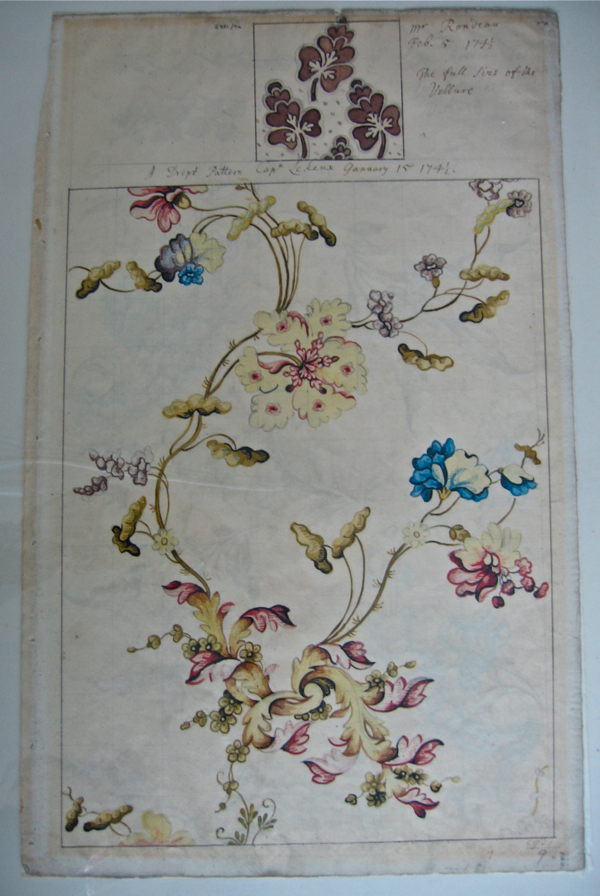
The silk design at the top was commissioned from Anna Maria Garthwaite by Jean Rondeau in 1742. (5981.9A Victoria and Albert Museum. Photo courtesy of V&A images)

4 Wilkes St built by Jean Rondeau in 1723. Pictured here seen from Puma Court in the nineteen twenties, it was destroyed by a bomb in World War II and is today the site of Suskin’s Textiles.

The copy of James Rondeau’s song discovered under a window sill in Cutler St in 1936.

Stanley Rondeau standing in the churchyard near his home in Enfield, at the foot of the grave of John the Sexton’s son and grandson (the author of the song) both called James Rondeau, and who coincidentally also settled in Enfield.
Fergus Henderson, bookworm
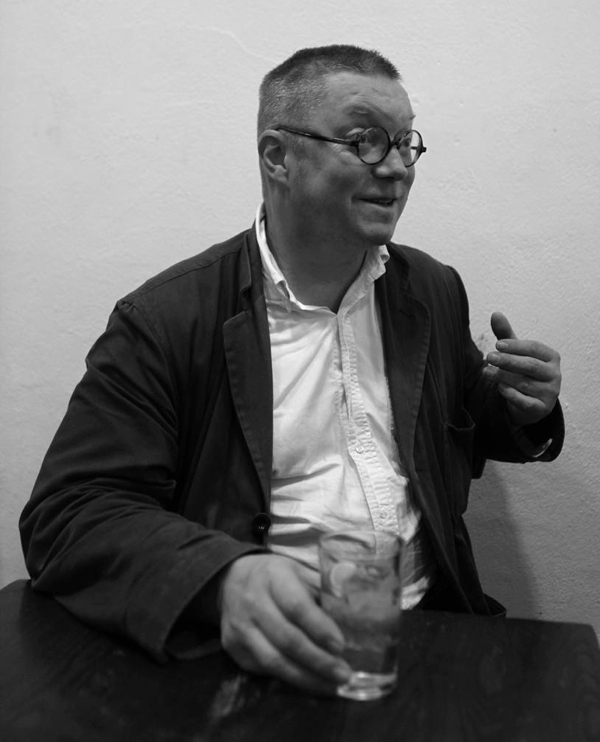
Although Fergus Henderson is widely celebrated as the presiding spirit and co-founder of St John, his literary tendencies are less commonly known. And so, desirous of learning more, I dropped by St John in Smithfield one bright morning, with my City Of London library card in hand, to enjoy a steadying glass of Fernet Branca with Fergus and discover how it is that certain books have become the means by which he communicates the undefinable ethos of this unique culinary enterprise with his staff. Still windswept and tanned from a recent holiday on the Isle of Tiree, Fergus arrived glowing with all the enthusiasm and energy of a schoolboy returning from Summer Camp. “Sometimes I feel that I am not the most clear of chaps,” he confessed to me with a tender grimace – as we each knocked back the bitter liqueur laced with rhubarb and saffron yet possessing a compelling aroma of frankincense and myrrh – adding plainly, “so I amassed this collection of books to explain.”
“It was when I first handed the reins to another chef, Ed Lewis, that I needed some means to convey the essence,” continued Fergus mysteriously.“I chose ‘Master & Commander’ by Patrick O’Brian because I think of the kitchen as very much like an eighteenth century Man o’ War – a confined space. As chef you have to be everybody’s friend, but you must be in charge, so you need to keep yourself at a distance too. My march up and down between the fridges in the kitchen, there’s some similarity there with the Captain’s march up and down the deck, I think.” he said, adopting an unconvincing comic frown of fierce authority as his attempt at a Captain of an eighteenth century Man o’ War. “I have given this book to every head chef and sous-chef.” he explained, before raising his eyebrows with a self deprecatory smile, changing tone as a thought occurred to him, “Maybe I should ask if they read it?”
His second choice appeared more esoteric, though I quickly became aware of a theme emergent. Fergus chose L.T.C. Rolt’s 1957 biography of Isambard Kingdom Brunel, a subjective portrait of the engineer, tracing his triumphs and tribulations to create a narrative that reads like a novel. “Unlike recent biographies that have been critical, Rolt just loves Brunel and so I love him too. What’s so brilliant about Brunel is that he builds the Great Western Railway which is a feat in its own right, gets to Bristol, notices the Atlantic and says we’ll built the SS Great Britain and go across it – What a guy!” said Fergus with an admiring grin, making a lateral connection to St John’s next step, the hotel in Leciester Sq. “With the hotel, we thought,’We’ve fed them, now we’ll bed them.’ Not quite as ambitious as spanning the Atlantic but in his spirit.” he outlined with a deferential shrug. I knew that Fergus himself trained as an architect, so it seemed the appropriate moment to ask if he designed his restaurants, “I am to blame for most of it,” he admitted, drawing a long face of self-parody and casting his eyes around the cavernous white interior.
As we arrived at Fergus’ third title, Thomas Blythe the general manager walked in, adopting a good-humoured smirk when he overheard the subject of our conversation – because he is himself a recipient of these books, and he knew what was coming next, Ian Fleming’s “The Man With the Golden Gun.” “I chose it because I thought Bond and Scaramanga ate whole crabs together and drank pink champagne.” revealed Fergus wistfully before Thomas confirmed, “I read the book and it doesn’t exist, it wasn’t there at all.” and they both exchanged a glance of crazy humour. “That’s why we always serve whole crabs on the menu here…” continued Fergus with supreme logic,”It’s a sad story, but Thomas enjoyed the book – who wouldn’t enjoy it?” Then they both looked at me and smiled in solidarity, like brothers.
This obscure paradox was the ideal introduction to Fergus’ fourth title, John Berger’s “Ways of Seeing.” “What I took from this book was the importance of genus locii, the sense of place.” admitted Fergus, “Restaurants are places rich in genus locii. There is this chaos that happens twice a day, extraordinarily different people coming together. Also, Berger discusses Leonardo’s cartoon that no-one was interested to look at until an American offers to buy it for a million dollars and then a line forms. Restaurants can be a good example of this phenomenon too.”
I took this as a cue to probe Fergus about the origin of St John which has led the renaissance in British cooking in recent years, and is now integral to the identity of both Smithfield and Spitalfields. Explaining that Dickens was appalled by the variety of offal eaten in Spitalfields when he visited in 1851 and that Joan Rose remembers poor people eating a pig’s head when they could not afford a Sunday roast in the nineteen thirties, I asked him about his relationship to the food of the past. “Dickens was narrow-minded and pig’s head is delicious!” he retorted with unexpected fervour, eyes sparkling through his horn-rimmed spectacles as he declared his personal manifesto, “Food is permanent while fashion just changes, but what was good then is good now. I’m not interested in historical recreations. I am a modernist through and through, yet a pickled walnut is something that has been around forever and is still a thing of joy. I think of our food as permanent British. Nose-to-tail-eating is because it’s polite. It is not because of thrift, it’s simply because it is delicious.”
So now I hope I understood something. Many of the elements I recognise at St John are present in these books, the acute drama of collective enterprise, the particularly British glamour of dining incarnated by Bond and the unadorned presentation of good food that resists fashionable categorisation. There is a sensibility that is a synthesis of these literary works, serious yet with levity, and it adds up to the unique quality of tone that characterises St John – which all makes complete sense for a distinctively British restaurant because we are a nation of writers.













