
At Malplaquet House

Walking East from Spitalfields down the Mile End Rd, I arrived at the gateway surmounted by two stone eagles, and reached through the iron gate to pull on a tenuous bell cord, before casting my eyes up at Malplaquet House. Hovering nervously on the dusty pavement with the traffic roaring around my ears, I looked through the railings into the overgrown garden and beyond to the dark windows enclosing the secrets of this majestic four storey mansion (completed in 1742 by Thomas Andrews). Here I recognised a moment of anticipation comparable to that experienced by Pip, standing at the gate of Satis House before being admitted to meet Miss Havisham. Let me admit, for years I have paused to peek through the railings, but I never had the courage to ring the bell at Malplaquet House before.
Ushered through the gate, up the garden path and through the door, I was not disappointed to enter the hallway that I had dreamed of, discovering it thickly lined with stags’ heads, reliefs, and antiquarian fragments, including a cast of the hieroglyphic inscription from between the front paws of the sphinx. Here my bright-eyed host, Tim Knox, director of Sir John Soane’s Museum, introduced me to landscape gardener Todd Longstaffe-Gowan with whom he restored the house. In 1998, when they bought Malplaquet House from the Spitalfields Trust, the edifice had not been inhabited in over a century, and there were two shops,“F.W. Woodruff & Co Ltd, Printers Engineers” and “Instant Typewriter Repairs,” extending through the current front garden to the street.
Yet this pair of single-minded fellows recklessly embraced the opportunity of living in a building site for the next five years, repairing the ancient fabric, removing modern accretions and tactfully reinstating missing elements – all for the sake of bringing one of London’s long forgotten mansions back. Today their interventions are barely apparent, and when Tim led me into his Regency dining room, as created in the seventeen nineties by the brewer Henry Charrington and painted an appetising arsenic green, I found it difficult to believe this had once been a typewriter repair shop. Everywhere, original paintwork and worn surfaces have been preserved, idiosyncratic details and textures which record the passage of people through the house and ensure the soul of the place lingers on. The sum total of the restoration is that every space feels natural, as you walk from one room to another, each has its own identity and proportion, as if it always was like this.
By December 1999, the shops had been almost entirely removed leaving just the facades standing on the street, concealing the garden which had already been planted and the front wall of the house which was repaired, with windows and front door in place. Then, on Christmas Eve an exceptionally powerful wind blew down the Mile End Rd, and Tim woke in the night to an almighty “bang”, only to discover that in a transformation worthy of pantomime, some passing yuletide spirit had thrown the shopfronts down into the street to reveal Malplaquet House restored. It was a suitably dramatic coup, because today the house more than lives up to its spectacular debut – it is some kind of masterpiece.
I hope Tim will forgive me if I confess that while he outlined the engaging history of the house with professional eloquence – as we sipped tea in the first floor drawing-room – my eyes wandered to the mountain goat under the table eyeing me suspiciously. Similarly, in the drawing-room, my attention strayed from the finer points of the architectural detail towards the ostrich skeleton in the corner.
As even a cursory glance at the photos will reveal, Tim & Todd are ferocious collectors, a compulsion that can be traced back to childhoods spent in Fiji and the West Indies. They have delighted in the opportunities Malplaquet House provides to display and expand their vast collection of ethnographic, historical, architectural and religious artefacts, natural history specimens and old master paintings. Consequently, as Tim kindly led me from one room to another, up and down stairs, through closets, opening cupboards in passing, directing my gaze this way and that, while continuously explaining the renovation, pointing out the features and giving historical context, I could do little but nod and exclaim in superlatives that grew increasingly feeble in the face of the overwhelming phantasmagoric detail of the collection.
In fact, the collection has outgrown the house and the startling news I have to impart is that after twelve years, the owners now seek a larger home for their acquisitions, out of London. Gazing from an upper window and turning his back on the collection, Tim explained how fascinated he is by the everyday life of the Mile End Rd and the taxi office across the road that has remained open night and day since he first came to live here. Next, we walked into the walled yard at the rear, canopied by three-hundred-year-old tree ferns, and wondered at the echoing sound of a large community of sparrows that have made their home in this green oasis. It is a curious paradox of submitting to the spell of this remarkable house that the ordinary world becomes exotic by comparison.
I have been in older houses and grander houses, but Malplaquet House has something beyond history and style, it has pervasive atmosphere. It has mystery. It has romance. You could get lost in there. When I came to leave, I shook hands with Tim and lingered, reluctant to move, because Malplaquet House held me spellbound. After my hour’s visit, I did not want to leave, so Tim walked with me through the garden into the street to say farewell, in a private rehearsal for his own departure from Malplaquet House one day.

The basement kitchen (photo by Klaus Wehner)

(photo by Todd Longstaffe-Gowan)

The North-west bedroom (photo by Klaus Wehner)

The South-east bedroom (photo by Derek Henderson)

(photo by Todd Longstaffe-Gowan)

(photo by Todd Longstaffe-Gowan)

(photo by Derek Henderson)

Looking out from the first floor window to the Mile End Rd. (photo by Andrew Lawson)

Malplaquet House, May 2010 (photo by Todd Longstaffe-Gowan)

Malplaquet House, May 1998 (photo by Todd Longstaffe-Gowan)
The photo of the ostrich in the dining room is by Derek Henderson
The rise of Ben Eine, street artist

“It’s been mad!” announced Ben Eine, with a jubilant cock-eyed grin, when I walked over to visit him at work on a new painting in Middlesex St recently. Since I was there in June to record the origin of his project – masterminded by Jessica Tibbles of the Electric Blue Gallery – to paint the complete alphabet on the shutters of the shops, there have been significant developments. Not only did Ben complete the alphabet and the glorious “Happy” painting above, but he also achieved overnight international fame when David Cameron gave his painting “Twenty-first Century City” to Barack Obama as a gift. Now that he is the only British painter to have a picture hanging in the White House, the shopkeepers of Middlesex St are feeling justifiably proud of their foresight in permitting Ben to paint their shutters this Summer.
“For the first time in my life, I am making my living as an artist,” admitted Ben, his eyes gleaming in triumph, revealing the primary outcome of this absurd event which has transformed his reputation from that of a highly respected figure (within the confines of street art) into a household name. In the past, he worked making screenprints for others and it is even rumoured that he was the one employed to do the paintings for Banksy – but now Ben Eine is a star in his own right. And, when I arrived to shake his hand last week, there were three eager photographers and a cameraman following Ben’s every move as he undertook an ambitious mural over successive Saturdays on a wall at the Liverpool St end of Middlesex St.
Once upon a time, Ben used to get arrested regularly and only began painting the letters of the alphabet on shutters, for which he always asks permission, when a judge warned him that another conviction for criminal damage would mean a prison sentence. Happily those days are behind him now, because as a family man of forty years old with three children, this is no longer a risk he can take. He told me, with incredulous delight, that a police car pulled up recently and the officers got out to ask for his autograph for their children.
Pulling a grimace of crazed disbelief, Ben admitted he has shaken hands with the Prime Minister, “I went to visit David Cameron. I rang the doorbell at number ten and they let me in ! I had to sit and wait while he spoke to Mervyn King and then we had a chat, before he went off to have dinner with Berlusconi.” Adding breezily, “He seemed a nice man,” with a non-committal grin, revealing he has never voted in his life. In the Hackney Rd, Ben has painted his vivid personal response to these events in six-foot high letters composed of smiley faces, spelling out “The Strangest Week.” – a work which, with supreme irony, Hackney Council are threatening to paint over imminently.
Down in Middlesex St, all the media attention received by Ben’s alphabet has empowered curator Jessica Tibbles to enlist other artists to paint shutters as the project spills into the adjoining streets. At this moment, Goulston St is currently acquiring a series of monochromatic images of the beasts that once roamed here when London was a prehistoric swamp. Meanwhile Jessica’s sights are set upon Wentworth St, aiming for a total of more than three hundred painted shutters, transforming this neglected neighbourhood into an after hours gallery of street art with Ben Eine’s alphabet as the centrepiece.
Ben’s current work-in-progess uses his trademark shadowed letters to spell phrases that will only be revealed in their legible entirety when the work is completed next Saturday. I watched for several hours as, working with two assistants, Ben painted a series of red squares upon a yellow ground, in an apparently haphazard fashion, moving back and forth across the surface with a spray can in one hand and cigarette in the other, hunching his shoulders a little and cocking his head as transfers his gaze between the detail he is working on and the larger scheme of things. “I haven’t got clue what I am doing,” he declared to me with the spontaneous swagger of an experienced showman, whilst pouring himself a Jack Daniels and coke in a plastic cup, against the chill of the damp afternoon.
The very nature of this work, in which each red square corresponds to a letter spelling out the undisclosed text reveals a grand design that Ben is fully aware of. He cultivates an appealingly ego-free happy-go-lucky manner that denies his own sophistication. Yet after he went off for a break and the rain set in, there was a brightly coloured backpack left on the pavement and I realised it was Ben’s. He left it in assumption of an unspoken trust that we would take care of it for him. There is a certain touching vulnerability about this man who gleefully leaps up unstable ladders in the rain, leaning too far out with his spray can while puffing on a cigarette.
While the conception of Ben’s work is always sharp, there is an innate roughness to his work on the street, always designed to be seen from a distance and while the spectator is in motion. I noticed that some of the letters of the alphabet in Middlesex St were already peeling and usage will damage them further. Part of the mutable world of the street, Ben has accepted the ephemeral nature of his work long ago, fleeting like memories. If you go along to Middlesex St next Saturday you can experience the moment when the latest bright new work is revealed. Take the time to look for yourself, because none of these paintings will be here forever, they are the product of a moment, but – as a result of recent events – this moment belongs to Ben Eine.
You can read my earlier story The return of Ben Eine, street artist

At the North corner of the junction of Wentworth St and Middlesex St.

Looking down Middlesex St.

At the South corner of the junction of Wentworth St and Middlesex St.

Looking up Middlesex St.

Ben Eine’s “The strangest week” in the Hackney Rd.

Off the Hackney Rd.

Ben at work with an assistant in Middlesex St on Saturday August 14th.

Ben choosing the stencils for the individual letters.

Work-in-progress, pictured a week later.

The completed painting.
Columbia Road Market 49

This surreal conical-shaped flower emerging into the sunlight from the deep shadow of a late Summer’s afternoon is Hydrangea, Peniculata Limelight that I bought at Columbia Rd for just four pounds. My garden is too tiny for most hydrangeas but this small variety suits it well, and is especially welcome at this season when the yard is bereft of other flowers. The saving grace has been this rambling rose, Aimée Vibert, a pale noisette cultivated in 1828, that I planted two years ago and which, although it has already climbed to the window of my first floor drawing-room, has only just flowered for the very first time this week – offering just three sprays of fragrant double blooms up to the glass as if seeking approval. I love the form of these sprays, giving forth a cascade of roses all at once and I am especially delighted that it should come into bloom now at the end of August when most other roses are over. Henceforward I shall be able to anticipate the flowering of Aimée Vibert each year, as the last rose of Summer in Spitalfields.

Andy Rider, Rector of Spitalfields
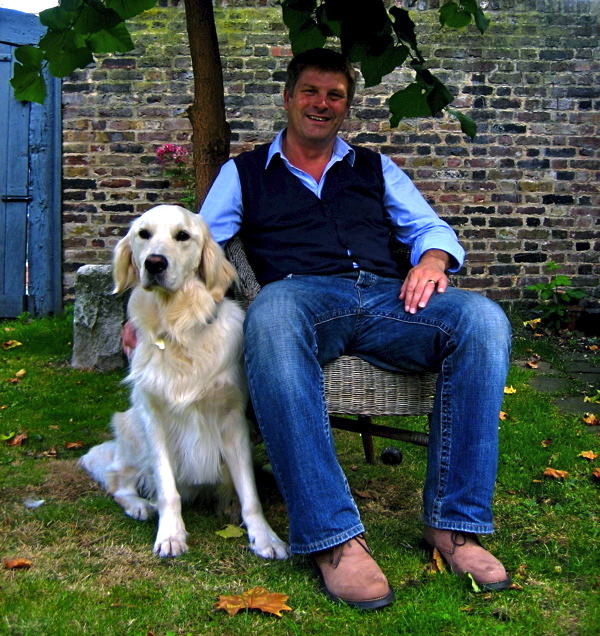
This is Andy Rider sitting peacefully under the Mulberry tree with Archie, his golden retriever, in the garden of his eighteenth century rectory in the shadow of Christ Church, Spitalfields. I was delighted to have the opportunity of tea with Andy at the rectory one afternoon at three o’clock, because, as the one who has been given the “cure of souls” in this parish, he is the man with professional responsibility for my soul. Yet, although Christ Church is one of London’s grandest churches, Andy’s style is a little more relaxed, as signified by the blue jeans in the picture above and the huge dog basket almost filling the hallway, which is the first thing you see when you step through the door of the magnificent rectory.
“People ask if it makes me feel small, living here,” he declared, as we strolled through the elegantly proportioned rooms, which seemed a strange question to me since Andy is a tall man, distinguished by a certain physical confidence revealing he is comfortable in his own body and at home in his rectory too. I suppose I had not expected someone whose primary concern is with spiritual life to be so present in the material world, possessive of a strong handshake, an easy smile and a clear blue-eyed gaze. Taking his London A-Z from the shelf, Andy outlined the geography of the parish and listed the various services that he presides over each week, describing the particulars of his employment in exercising the “cure of souls” in Spitalfields.
Andy’s explanation of the tangible nature of his job made me realise that it was the intangible that I was interested in. “I chose to walk away from the church for ten years,” he admitted, lowering his voice,“but then through a series of events and co-incidences I found answers to the big questions, ‘Who am I? What is life about?’ and ‘Does God exist?’ These were answers that I accepted within my heart, in the knowledge that God is divine and He rose from the dead. And when I was nineteen, about seven months after that experience I found God calling me to become a full-time minister.”
Baffled by this statement, I asked, “Are you talking literally?” “Yes,” he replied at once, speaking openly, without a glimmer of uncertainty, “I actually heard God speak to me. I was camping in Devon with a group of young people from the church. It was late in the evening and I went out to check the guy ropes of the tent in the dark. I was standing alone looking across the fields and marvelling at God’s creation, and then it was as if somebody was speaking and I remember looking around to see if anyone was there. It was a voice quite unlike a human voice, neither a woman nor a man. In the scriptures, the prophets describe God speaking as being like ‘the sound of many waters’ and that was how it sounded to me.” Then Andy looked at me with a shy smile, momentarily self-conscious, before clutching his hands to his head and confessing, “I can’t remember what He said exactly!’
My thoughts were racing in astonishment. Just minutes earlier, he had been searching his A-Z and we were discussing the new ipad, but now our conversation had entered another realm, yet a realm which for Andy carries equal reality. I do not know why I found his testimony shocking or why I was surprised to hear a priest tell me he believed in God. It appears that my personal perception of religion as moral belief, rather than as acceptance of supernatural events misses something fundamental – while for Andy this distinction does not exist. Returning to the bible, he described how the apostles were offered “a glimpse of glory,” a phrase that he applies to his own revelation too. “Most of us don’t look further,” he suggested regretfully, spreading his hands and explaining that he sees the modern day in direct continuum with the biblical world, in which God’s wonders are literally manifest and miracles are possible. “I haven’t seen an angel,” he added with a tinge of disappointment, yet with the undeniable implication that it could happen at any time.
Andy possesses a light touch, talking open-heartedly about big subjects without being borne down by them, while I was perplexed by his declaration. Yet I appreciate it is in the nature of faith to be inexplicable, and so I did not wish pursue my enquiry disingenuously, challenging what is sacred to him with casual scepticism. The world was still the same world to me, except now I knew that Andy embodies his role as rector, not just as the caretaker of a building but as a man with faith in the divine, inhabiting a spiritual universe that defies reason. I do not entirely accept the language of rational science myself, though I cannot make the leap of faith which religion requires either. God has not spoken to me yet. I must admit that as I listened to Andy describing his strange revelation, I envied the consolation that his belief has granted him just as I also know that such credulity is beyond me. Let me say, I was amazed to meet a man who believed in angels.

At Three Colts Lane

Situated midway between Spitalfields and Bethnal Green lies Three Colts Lane. Although many years have passed since there were colts here, today there are many other attractions to make this a compelling destination, especially if you are having problems with your car – because Three Colts Lane is where all the motor repair garages are to be found, gathered together in dozens and snuggled up close together in ramshackle order. Who can say how many repair shops there are in Three Colts Lane, since they inhabit the railway arches in the manner of interconnected troglodyte dwellings carved into a mountain, meaning no-one can ever tell where one garage begins and another ends.
Three Colts Lane is where the lines from the East and the North converge as they approach Liverpool St Station, providing a deep warren of vaulted spaces, extended by shambolic tin shacks and bordered with scruffy yards fenced off with corrugated iron. Here in this forgotten niche, while more fences and signs are added, few have ever been removed, creating a dense visual patchwork to fascinate the eye. Yet even before I arrived in Three Colts Lane, the commingled scents of engine oil and spray paint were drawing me closer with their intoxicating fragrance, because, although I have no car, I love to come here to explore this distinct corner of the East End that is a world of its own.
Each body shop presents a cavernous entrance, from which the sounds of banging and clanging and shouting emanate, every one attended by the employees, distinguished by their boiler suits and oily hands, happily enjoying cigarettes in the sun. Yet standing in the daylight and peering into the gloom, it is impossible to discern the relative size and shape of these garages that all appear to recede infinitely into the darkness beneath the railway arches. An investigation was necessary, and so I invited Sarah Ainslie, Spitalfields Life contributing photographer, to join me in my quest to explore this mysterious parallel universe that goes by the name of Three Colts Lane. And many delights awaited us, because at each garage we were welcomed by the mechanics, eager to have their pictures taken and show us the manifold splendours of their manor.
There is a cheerful spirit of anarchy that presides in Three Colts Lane, incarnated by the senior mechanic with his upper body under a taxicab, who, when we asked gingerly if we might take pictures of the extravagantly vaulted narrow old repair shop deep beneath the arches, declared,“It’s not my garage. Do as you please! Make yourself at home!” To outsiders, these dark grimy spaces might appear alien, but to those who work here it is a zone where everyone knows everyone else, and where you can spend your working life in a society with its own codes, hierarchy and respect – only encountering the outside world through the motorists and cabbies that arrive needing repairs. My father was a mechanic, and I recognise the liberation of filth, how being dirty in your work sets you apart from others’ expectations. The layers of grime and dirt here – in an environment comprised almost exclusively of small businesses where no-one wears a white collar – speak eloquently of a place that is a law unto itself.
Starting at the Eastern end of Three Colts Lane, the first person we met was Lofty, proprietor of the A1 Car Centre, who proved to be a gracious ambassador for the territory. “Some garages, they just want to take the money,” Lofty declared in wonder, his chestnut-brown eyes glinting with righteous ire at the injustice – like a sheriff denouncing outlaws – before he pledged his own personal doctrine of decency, “But I believe it’s how you treat the customers that’s the most important thing, that’s why we are still here after twenty-five years.” And proof that Lofty is as good as his word was evident recently when seven hundred customers signed a petition saving the garage from developers who threatened to build student housing on the site.
We crossed the road to shake hands with Nicky at the Coborn Garage, admiring the fresh and gaudy patriotic colour scheme of red, white and blue, and his decorative signwriting that would not be out-of-place on a gipsy caravan. Under the railway bridge and down the road, we encountered Erdal and his nephew at Repairs R Us, where we marvelled at the monster engine from a Volvo truck that Erdal rebuilt and today keeps as a trophy by the entrance of his tiny arch. Further down, we met Ahmed, a native of Cyprus who grew up above the synagogue in Heneage St and has run his garage here for twenty-eight years. At the corner, across from Bethnal Green Station, we were greeted by Ian & Trevor, two softly spoken brothers who have been here twenty years repairing taxis in a former a scrap yard, still retaining its old weighbridge. We all squinted together at the drain pipe head dated 1870 with the initials of the Great Eastern Railway upon it, declaring the history of the site in gothic capitals, before Ian extracted a promise from me to come back once I had discovered the origin of the name Three Colts Lane.
Apart from calendar girls adorning the walls, the only women we glimpsed were those who restricted themselves to answering the telephone – barely visible in tiny cabins of domestic comfort, sheltering their femininity against the barbaric male chaos of the machine shops. But then, strolling down a back lane and passing one of the governors in a heated altercation with a quivering cabbie who had innocently scraped his Daimler, thereby providing the catalyst for an arresting display of bullish masculinity, we encountered Ilfet. With a triumphant mixture of self-assurance and sharp humour, Ilfet has won the respect of her male colleagues in the body shop, wielding a spanner as well as the next man. A bold pioneer in her field and stirling example to others, I was proud to shake the hand of Ilfet, the only – or rather – the first female mechanic in Three Colts Lane.
Growing bolder, we ventured deeper to discover the paint shops and frames where taxis were hoisted up for major surgery. We left daylight behind us to explore the furthest recesses of the dripping vaults, lined with corrugated iron, where a fluorescent glow pervaded the scene of lurid-coloured motors crouching in the gloom. We had arrived at the heart of Three Colts Lane, vibrating to the diabolic roar of the high speed trains passing overhead, whisking passengers in and out of London, oblivious to the hidden world beneath the tracks.


Photographs copyright © Sarah Ainslie
Spitalfields Antiques Market 19

This is Sarah & Roy, a devoted couple from Dagenham. “I make the money while he’s the hard working one who carries the heavy boxes around,” admitted Sarah mischievously, slipping a protective arm around Roy. On the right hand side of the stall are Sarah’s vintage jewellery and clothes, while on the left are Roy’s childhood plastic toy soldiers, Action Men and Ladybird books. “I do feel sad parting with some because I remember playing with them,” Roy confessed to me with a sentimental smile – inspiring Sarah to wrap her arms around him and plant an emotional kiss, declaring,“Bless him, he loves it!”

This is Rishi Shah from Bethnal Green & Thomas LaRoche from Paris, two pale young gentlemen pedalling charnel house chic. “We came together because we both collect taxidermy and we realised there is a shortage.” explained Thomas, casting an affectionate eye over his depleated collection of animal parts, bones and religious artefacts.“We sell jars with foetal pigs, chicken embryos, octopus and rats in formaldehyde, all of which have died of natural causes,” revealed Rishi, tenderly displaying a sinister white rodent in a bottle for me to admire. Visit www.abattoirbluesanatomy.blogspot.com

This is Shahid & Gillani Arjumand, dealers of repute. Shahid trades in Victorian and Georgian silver, cutlery, coins and fountain pens while Gillani sells antique jewellery. “I used to work for an insurance company and she was in retail, but we both left to go full time in 2000. And we have brought up three children on this, they have been to university, married and bought homes.” recalled Shahid, gesturing to all the piles of broken fountain pens, old knives and forks, brooches and rings, while exchanging a sly private glance of satisfaction with Gillani at the remarkable success of their joint endeavour.

These jovial fellows are John Martin, a dealer in ephemera, and George Jeffery, a bookseller – two independent traders sharing one stall. “Transitory written and printed material not intended to be retained,” was the sagacious John Martin’s modest description of the charismatic ephemera he has dealt in for the past thirty years. While George Jeffery revealed himself as a noble fourth generation bookseller whose great-grandfather George moved the business from the Caledonian Rd to Clerkenwell in 1911, where he (George IV) traded from his famous barrow in the Farringdon Rd until 1995.
Photographs copyright © Jeremy Freedman
Stephen "Johnny" Hicks, the boxer-poet

It is my pleasure to publish this account of of the life of Stephen “Johnny” Hicks, the East End boxer-poet, as told in his own words.
When I turned professional, it was the greatest moment of my life and I meant to make the most of it. On my nineteenth birthday I signed a contract with Harry Abrahams for half-a-dozen ten round bouts at two pounds ten shillings each bout. I lost the first one in seven rounds against Wally Gilbert of Fulham who was a much more experienced boxer, but I won the second with a knock-out over Frankie White of Clerkenwell in the second round.
There have been many famous boxing venues in London’s East End but the most noted of all was the Premierland in Back Church Lane. It was a converted warehouse that held about five thousand spectators and almost every paid boxer of note must have fought there during its nineteen years reign from 1911 to 1930. My own luck at this time seemed to be in. Joe Goodwin of Premierland had billed me up for ten rounds with Alf Sheaf of Customs House. In 1927 I had turned twenty-one and I was in my boxing prime. I had a hard fight with Alf Sheaf and just managed to win on points. It was such a good contest that we had a further two meetings at the same venue, and what’s more I got three pounds for each bout. But all my hopes were shattered in my next bout at Premierland when I met an unknown boxer called Tommy Mason who knocked me out in the first round. I’m glad my brother Albert was not there that night. He would have done his nut I think.
I had a rest from boxing by visiting the hop country in Kent with Albert. We picked hops for a month and got quite bronzed and suntanned. We also kept ourselves fit and well by taking long walks through the countryside. Home again, I found that Joe Goodwin of Premierland had billed me for another ten rounds with former Navy champion “Stoker” Cockerel. He wore black tights and was very unorthodox, but it was great fight which ended in a draw after both of us had taken a count. So I regained my place at Premierland. I had learned one thing about a boxer’s life that if you give the fans their money’s worth you will never be out of a job.
On my next fight at Premierland, I got my first taste of a cauliflower ear. Although it was very painful, I got a piece of boracic lint soaked in surgical spirits and layed it on my ear. I had a stiffener of cardboard handy and bandaged it with the lint to the ear. When going to bed, I had to lay on my ear which was the left one. It was very painful of course, but by the next morning it was back to its normal size, although it was still very tender to the touch and it had to be bathed again in boiling water and in surgical spirits.
Then on Whit Monday in June 1930, when I entered the annual open air featherweight at the Crystal Palace, I received an unlucky blow in my right eye from Harry Brown of Northampton which finished me as a professional boxer. I did not realise how serious it was until the next morning when I paid a visit to the Royal Westminster Ophthalmic Hospital and was treated for a haemorrhage and laid on my back for almost six weeks with both eyes bandaged. They could nothing for me and the sight of my right eye was lost forever. I had a job to keep steady on my feet but my brothers Albert and Jack were with me. I thought, “in boxing I was taught to keep a cool head at all times, so I must try to do this now to fight for my existence.”
Albert and Jack came to my rescue. They had hundreds of tickets printed stating the plight I was in and the cause of it. They were bought by friends, neighbours and supporters, in the docks, shops and local boxing halls. I was very grateful for the money that was brought in, although it seemed I was living on charity I was able to pay my way. As soon as I was fit in mind and body for any kind of labour I turned to the docks, but there were hundreds of other unemployed labourers and so every morning it was a fight to the finish in the scramble to get a day’s work. I actually saw the mounted police with batons raised, disperse the hungry mob whose only criminal offence was a willingness to work.
It was 1936 and I was thirty years of age, when I joined Albert in the blacksmith’s shop. We both had experience beforehand of using a fourteen pound hammer as we once did six weeks work digging roads for the Stepney Borough. It certainly came in handy now as we were using the big hammer eight hours a day. In the summer evenings after work, I used to sit in our backyard at home, where we had grown a garden of mixed flowers, and relax in the thick grass that grew abundantly. Among the animals we had as pets were two cats, two rabbits and a tortoise, I used to get much amusement watching them greet each other by almost touching noses. It seemed so peaceful there and so quiet that I often fell asleep.
I was happy and contented, I could not see the war clouds hovering ever near. My home in Bohn St was bombed but luckily I was not in it at the time. I was thirty-four years of age when, because of my eye, I failed my medical test for military service. I was now living in one small room in John Islip St in Westminster. There were plenty of jobs for everyone, and it was while working on a steel cutting machine in my employer’s yard that I composed my first poem.
I always had the idea I could write poetry, as I had written a few on scraps of paper just for the fun of it. The first poem came to me on the Bridge Wharf in Westminster, when in the corner of the yard I noticed a small white flower growing bravely against a host of weeds and brambles and I thought how wonderful it looked in its struggle for survival. I thought that it must surely win through with such daunting courage, and so the first poem was born.
It was during March 1963 that I bought a ticket for a poetry reading at the Toynbee Hall in Aldgate featuring Dame Sybil Thorndike. I showed her a few of my poems and she said, “They are charming, can I keep them?” It was a week later that I received a letter from the famous actress from her home in Chelsea. “Dear Steve Hicks, Your poems are charming, I read them with great pleasure, thank you so much for giving them to me, all good wishes. Yours sincerely Sybil Thorndike.” One day I entered a poetry competition without success, but then I received a letter from the organiser, who reported that John Betjeman who judged the competition said that, “he hopes I continue to write.” Well of course I did. A defeat to me is nothing, I have had too many of them in the past.
Copies of Stephen Hicks’ autobiography “Sparring for Luck,”also containing many of his poems, are available from East Side Books in Brick Lane.
 Johnny Hicks to fight Tommy Mason at Premierland March 12th 1928
Premierland (Back Church Lane 1911-1930)
What lovely fights at Premierland! Three shows a week, no room to stand, A bit rough there but it was grand, it suited you and me.
Oh, Premierland, oh hall of fame, If only you were with us once again, But alas it can never be from now until Eternity.
Some famous fighting men on view Were Phil Scott, Berg, and Harvey too, And ‘Kid” Lewis the mighty Jew They were all there to see.
When Webster fought Al Foreman there, The British lightweight title pair, The place was packed, no room to spare, A fistic rhapsody.
It stands there proudly to this day though it is used in quite a different way. Demolishers, thy hand do stay Break not I beg of thee!
 The Boxer Speaks
I took up boxing just for sport, and though not very clever I’m really glad that I was taught the art of slinging leather.
I was always at my worst with too many back pedals And so I started out at first for cutlery and medals.
So when I learnt to stand my ground I then began to figure That I could punch out every round with all the utmost vigor.
And thus I carried on that way with very small expense ‘Til I was brimful, one might say, of much experience.
The big moment was now at hand and I was mad to go To get fixed up at Premierland as an amateur turned pro.
Needless to say, my luck held out, for there and other shows, With hard earned cash from every bout for punches on the nose.
I’ve had black eyes and swelled up ears and K.O. once or twice But I enjoyed it through the years a fighter at cut price.
And through it all I say with pride most boxers are great pals Because they will stand by your side if everyone else fails.
 Some People
Some people eat and some do not. It depends on how much cash they’ve got. So if you’re hungry now I guess Well, next week you may be getting less.
We don’t have much left over After everything is bought, Many are in clover But some don’t get what they ought.
Things that we need throughout the day Are so fantastically dear. It’s all right for them down Pall Mall way But we don’t get much round here.
The toffs of Knightsbridge and Mayfair Are blessed with all good things They’re never short of anything That’s what the good life brings.
I’ve often wondered to myself ‘Why does this have to be?’ For they’ve got nearly all the wealth And there’s nothing for you or me.”
 Stephen Hicks (1906-1979) – the cover of his first book of poems, published May 1974.












