All change at Crescent Trading
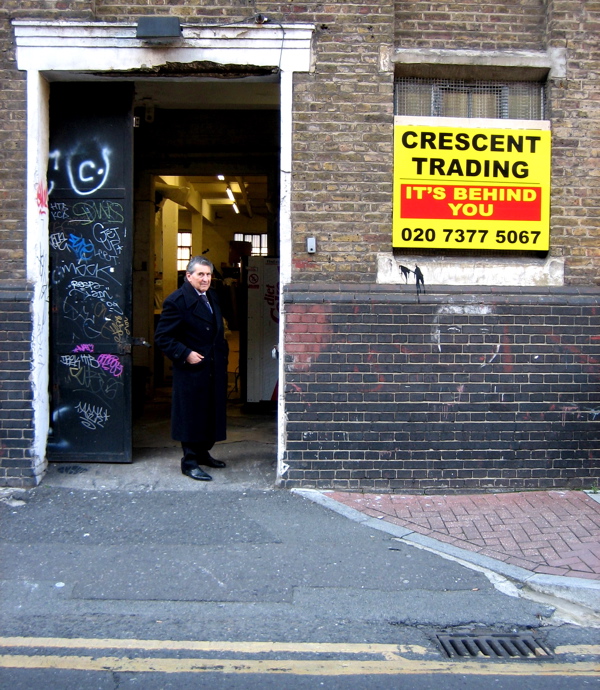
In the Spring, I visited Crescent Trading, the last cloth warehouse in Spitalfields, still operating in a way that Charles Dickens would recognise from his visit to a silk warehouse in 1851. Distinguished proprietors Philip Pittack and Martin White are clearance cloth merchants of the old school who have spent their entire lives in the industry, with more than one hundred and twenty years experience between them. For the past twenty years they traded from a charismatic old stable block in Quaker St, but now that the landlord has acquired planning permission to convert the building into a hotel, they are moving to an industrial unit across the road. These are momentous days for Crescent Trading, so I took my camera along to record the move.
I gasped to see the old warehouse, once packed to the rafters now cleared of cloth, and discovered Martin there, a dignified figure, ruminating like Hamlet in an empty theatre. Meanwhile Philip hauled a trolley piled with of bolts of cloth across the street outside, pink in the face with exertion and yet full of cheery resolve to make it to the new premises, where they have taken out a five year lease. “He’s seventy-nine and I am sixty-seven,” confessed Philip as he ran up a ladder with a roll of fabric over his shoulder, demonstrating the careless abandon of a thirteen-year-old, “When the lease finishes he will be eighty-four and I will be seventy-two.” At just two thousand square feet, the new warehouse, constructed of breezeblocks with a metal shuttered door, is half the size of the old one, so Philip has invested in a racking system which means he can stack the cloth higher, but requires him to climb more ladders.
Not many men at his time of life would take on this challenge, yet with heroic enthusiasm, Philip has embraced the whole process of hauling every one of all the thousands of rolls of cloth across the road manually and installing them in the racks, then taking them down and rearranging them to achieve a satisfactory arrangement. As Martin White declared later, deliberately and without overstatement, “Philip’s done a job which is a mighty one and it is quite incredible how it’s been done.”
Already customers are crossing the road, and they seem to like the new arrangement where everything can be seen at a glance. Crescent Trading is a treasure trove for small designers and design students who can buy cut lengths they could not get anywhere else, discovering rare high quality fabrics at a fraction of the cost they would pay at a mill. Even as Philip and I were talking, Mr Amecci, a designer in a snazzy deep blue serge trench coat with fur collar, fedora and forties moustache interposed. “Don’t write this up,” he begged me with winsome irony, “because I don’t want everyone to know! What I like about this place is that I can get things I wouldn’t get elsewhere, like mohair, mohair mixes and chinchilla at discount prices.” Then Matsuri, another cool-cat designer, entered in a Guy Fawkes hat with waist-length locks straggling out beneath, and eager for blazer-striped fabric. Regretfully, Philip had to send him back across the road to the old warehouse for it.
Simultaneously excited by the custom and frustrated by the circumstance, “We’ve come to the point of no return where we are running back and forth across the road!” Philip admitted to me, rolling his eyes and waving his hands in self-dramatizing resignation. Yet within a month, the move will be complete and so I persuaded Philip to take me on a sentimental tour, visiting the first floor storage space that once had a lift shaft big enough to bring shire horses up to be stabled. We passed a huge reptilian conveyor belt for bringing rolls of cloth upstairs – broken ten years ago, it will never run again – and we entered the vast empty warehouse, breathtaking in its lyrical state of dereliction, and possessing a poetry that no industrial unit can ever match.
These are emotional times at Crescent Trading. “I’m petrified,” admitted Philip when we were in private, revealing the nature of the passion that has driven him to manhandle every roll of cloth across the road, “We were happy. We had our feet under a table for twenty years. Now we eek out a living and times are very difficult. We have to work because all our money is sitting on the floor. This street used to be all small businesses, a trousermaker, three printers, a quilter and a dressmaker. I am angry that the council zoned this street as small businesses, and now it’s going to be just a hotel and a housing block.” And then, concerned that he might have lowered my spirits with this outburst, he put his hand into a box and slipped a bottle of whisky into my bag as I walked out the door.
Let me reveal, my sympathies are with Philip Pittack and Martin White for many reasons, not just because of the whisky, or because they carry the history of the textile industry in Spitalfields with them, but most importantly because they are two of the most soulful and witty gentlemen you could ever hope to meet. They are my heroes, wielding scissors and tape measures. Legends in the rag trade, they know as much as anyone could ever know about cloth and they love meeting all the young fashion students that come seeking inspiration. Whenever you visit Crescent Trading you will discover joy, because they sell it by the yard. Nobody is making a fortune, but everyone takes delight in celebrating all the varieties of fabric and the glorious multifarious human culture that attends it.
Thanks to sheer willpower, canny ingenuity and a superhuman expense of physical energy on Philip Pittack’s part, Crescent Trading is still here. Everything has changed yet nothing has changed.
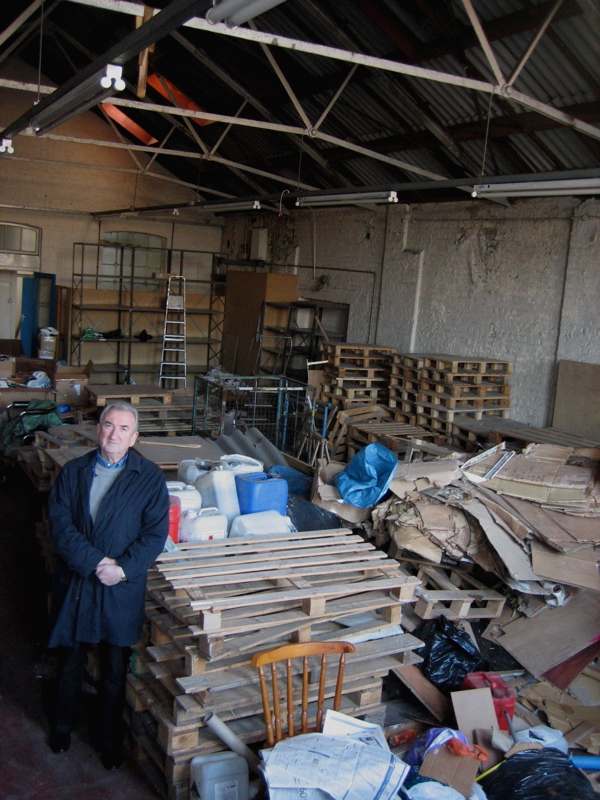
Philip Pittack takes a last look at the warehouse where he stored his cloth for twenty years.
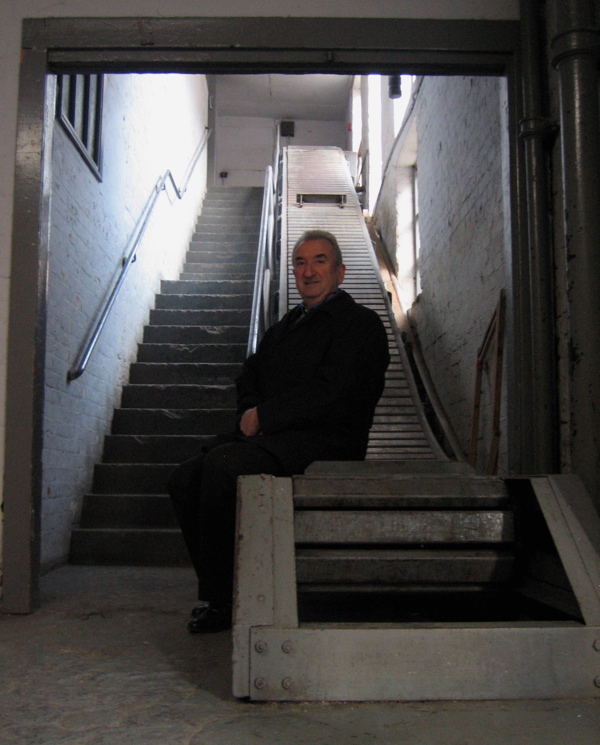
Philip sits upon the conveyor belt that broke ten years ago.
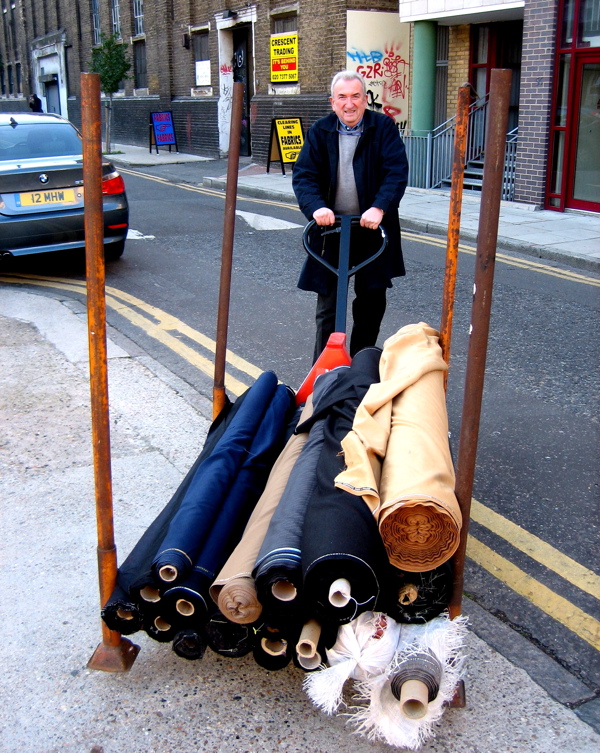
Philip personally manhandled every roll of fabric across Quaker St to the new warehouse.
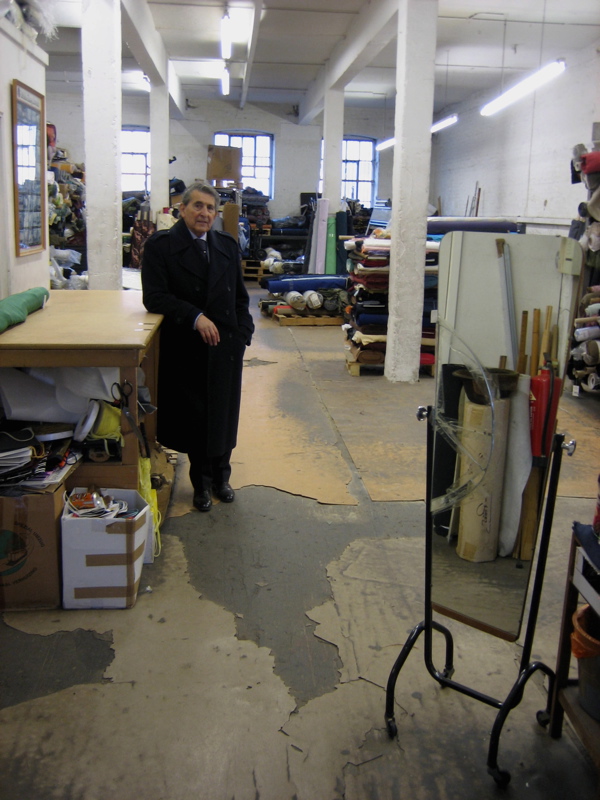
Martin White contemplates the old premises, soon to be a hotel.
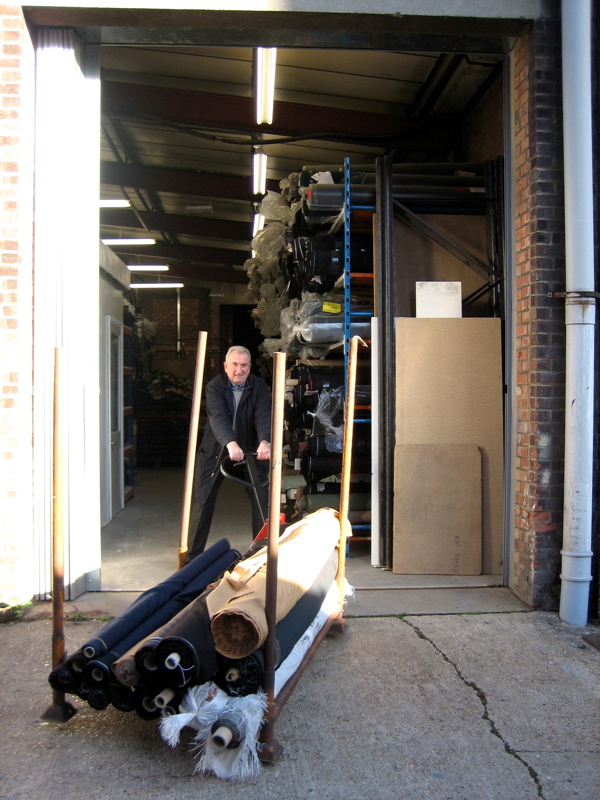
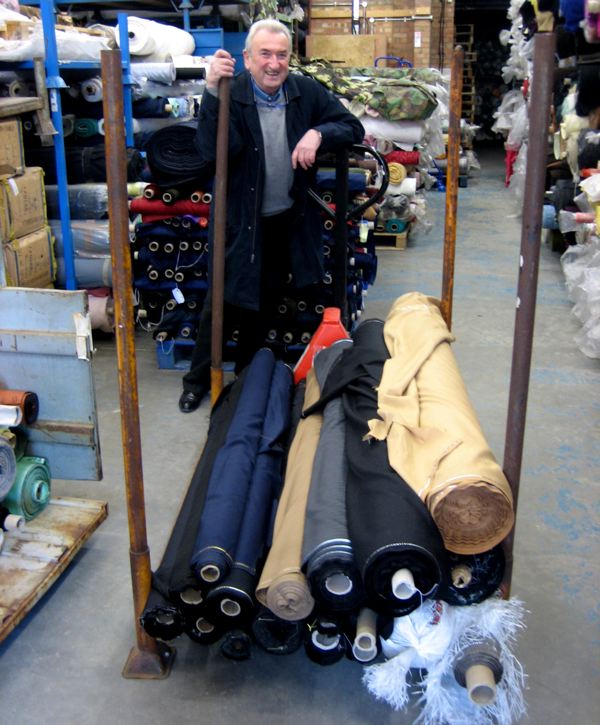
Philip arrives at the new warehouse on the other side of Quaker St.
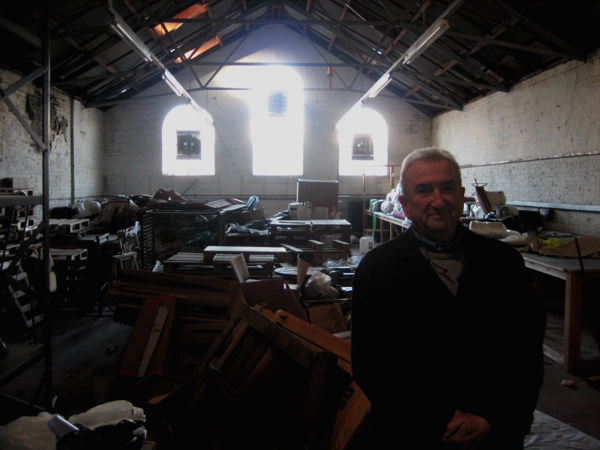
The old warehouse.
The Stripper & the Oral Historian Chit Chat

These pictures illustrate what happens when you put a stripper and an eminent oral historian together in a photobooth. It was the perfect way to record the outcome of the our first Chit-Chat presented last week at Rough Trade East, with Lara Clifton celebrated stripper of Shoreditch in conversation with Clive Murphy, oral historian of Spitalfields and writer of ribald rhymes. For those of you who were not able to be there, here are a few excerpts to give you a flavour of the occasion.
Clive: When I was told I was going to interview a stripper, I was very amazed and very honoured, and I was told there was a photo of you and it’s the most outrageous photo I have ever seen in my life! Are you an exhibitionist by nature?
Lara: I guess I must be.
Clive: Because of lot of people do this (I’ve been to Raymond Revuebar and so on) because they are very shy. It’s very, very strange, they overcome their shyness by stripping
Lara: I completely associate with that, I’m a very shy person.
Clive: Would you like to tell me your first professional performance?
Lara: My very first job was at the Nag’s Head on Whitechapel High St and there was a certain circuit of pubs that we did. It used to be that you were paid to be there (given money to cover your travel), but when I was there it got worse, you were only paid the money that was in your pot – though you didn’t actually have to pay to be there like you do now.
Clive: I’ve read that you had a different way of performing to most strippers…
Lara: I used to jump off the stage with my knickers round my ankles and then run through the crowd because it was funny. Everyone came off the stage and jumped from table to table, but I was maybe a bit more hysterical in my delivery – it made the other girls laugh.
Clive: What do you think of the feminist point of view, that you’re demeaning yourself and you’re opening yourself up to men who will despise you?
Lara: I think it’s wrong. They haven’t been in a strip club if they think that’s the way, there isn’t any victimisation going on there, aside from men being asked to put money in the pot. I think it’s a very fair exchange.
Clive: How do you deal with the hostile punters?
Lara: It’s part of the job that you deal with customers and if anyone’s really awful they get kicked out. You get less verbal abuse from men in a strip club than you would in any other pub on a Friday night. Really the only way to offend a stripper is to not give her a pound in the jug.
Clive: You said the clubs were dying out in this area?
Lara: Yes, they are closing them down right now in Hackney and all of the strippers are campaigning against it, but their word is not valid apparently.
Clive: The White Horse is one that I go into …
Lara: That’s one that is in danger.
Clive: …and I just see people doing the crossword in there.
Lara: Yes, it’s genteel of an afternoon.

Clive: Did you dance entirely nude?
Lara: Yes.
Clive: That was ahead of its time wasn’t it?
Lara: No, no, it has been going on a long time in the East End.
Clive: And did you allow people to touch you?
Lara: No, that’s why it was fun because they knew they weren’t allowed, so you could charge at them and they would all run away because they knew they weren’t allowed to touch.
Clive: I thought that was the whole fun of it, trying to touch you.
Lara: Those were different clubs. It used to be even that if anyone had a camera you stilettoed it.
Clive: I knew you were physical! I have done a lot of interviewing but not of sex bombs. Shall we be natural now and every question I ask, you take off one item of clothing?
Lara: I will if you will.
Clive: You’ve called my bluff! So you don’t hate men, humiliating them by making them drool?
Lara: No. Lots of punters become good friends. You rely on regulars, because it’s more or less the same crowd of people that you see every day in all the pubs.
Clive: They become addicted?
Lara: It’s like trainspotting but more fun!
Clive: Did you go into it for money? Did you find it paid so much better than a humdrum job from nine to five, that you preferred it for that reason above all others?
Lara: Not above, but everyone works for money, so you might as well do something you like.
Clive: So you do enjoy stripping?
Lara: Mmm.
Clive: Is there anything else you want to say?
Lara: Let me ask you about oral history, why did you chose to come and live in Spitalfields and talk to people?
Clive: Because I am very interested in people, their background and why they are where are they now. I had done interviews in Pimlico but then I came to live here because a room was vacant at four pounds a month.
Lara: Yowsa! What people did you interview?
Clive: Lavatory attendants, two of them, a male and female and they were both published and I was asked would I do a hermaphroditic one next – but I think they had their tongue in their cheek a bit! I came here and I did an East End Hosteller and a Singer.
Lara: So my book is similar? It’s an oral history of strippers
Clive: Yes, but I did a whole book about each person.
Lara: Amazing!

Questions from the audience.
Question: What’s the situation with Hackney Council trying to close down the clubs?
Lara: All the strippers are writing in and saying this shouldn’t happen. Yet it looks like its going to happen anyway, even those places that have been here a very long time, even before the rich people started moving in. It’s part of this area’s heritage and history, and if we lose the strip clubs not only will a whole body of women lose their income but it’s a vibrant part of what the East End has always been. I think it would go underground, but the pubs manage the laws, so once it goes underground you loose all the rules and it becomes a lot more dangerous for the women.
Question: Do you think social mores with regard to stripping are changing?
Lara: I think people are getting a lot more prudey. The right wing and feminists are almost on the same line at the moment and that I find odd. I can understand how it’s evolved that way but I think there’s a fundamentalism around sexuality which is growing.
Question: Could it be due to the Islamic community?
Lara: But Muslims love strip clubs! Of course they come, everyone comes. One of the most amazing things about going in a strip club is the different people that are in there, the different classes and the different races. There isn’t one type of man that comes to a strip club, you get a variety of different types of men. I did a strip at a Muslim club on Green Lanes. There are also female Muslim strippers who work mostly on the underground scene. They say if their families found out they would be in trouble, but they are doing it because they enjoy doing it and they want to do it, not because they have to.
Question: Can you tell me about the history of stripping in the East End?
Lara: The strippers that I know now in their fifties were working as go-go dancers in the sixties, but there’s also evidence of Victorian strippers who stripped on metal trays with a candle nearby that would show their reflection, but I think they just stripped under their skirts. There’s a painting in Sir John Soane’s Museum that shows a girl holding a tray and that’s what she’s about to do.
Clive: I’ve got a marvellous idea, what about people arriving naked and then dressing slowly – they bring a costume in a bag and then as the evening goes on everyone gets dressed.
Lara: Sounds good! When shall we do that?

Columbia Road Market 56
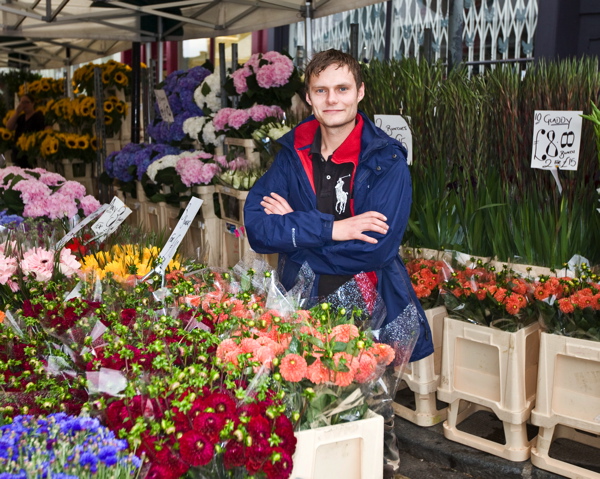
The full moon was still reflecting in the puddles from last night’s downpour as I walked up to Columbia Rd before dawn to speak with young Albert Dean, at his double pitch selling cut flowers at the Western end of the market. With his knitted hat pulled down over his ears, hopping from foot to foot and rubbing his hands together enthusiastically in the cold, this wiry young man with sharp eyes informed me proudly that, although he has only been working there full time for about five years, the stall has been in his family for four generations.
Albert Dean is the fourth Albert Dean since his great-grandfather to run the pitch on this site – as long as the market has been here – which means that at any time during the last century you could have come and bought flowers from an Albert Dean at this street corner. The current Albert Dean has been working on the stall regularly since he was seven and now that his father is in semi-retirement, his energy motors the business into the future. “I don’t see why not, I’d like to think so!” he declared with an eager grin, when I asked if he expects to be here his whole life. “It’s in the blood, I don’t know anything different,” he announced with a hint of absurdity at his rare horticultural pedigree.
Rising at three in the morning, Albert drives down to Columbia Rd with a lorry full of flowers each Sunday, setting up at five-thirty and returning home again with an empty lorry. Taking Monday off, Albert works for the wholesale side of the business based at Golfside in Cheshunt the rest of the week. Flower orders are sent off on Tuesday, for the coming weekend at Columbia Rd and all the wholesale customers, while Wednesday is Albert’s second day off in his curiously syncopated routine. Then on Thursday, Friday and Saturday, Albert is sending out deliveries to restaurants, corporate clients and freelance florists, as well as preparing for Sunday too, including supplying other stalls in Columbia Rd. “We’re about as cheap as you can get,” he assured me with a toothy grin.
And thus the business has rolled on through four generations. Albert already has a daughter of sixteen months, Taylor May, but if a boy comes along there will be no question but that he will become Albert Deane V. Albert is qualified in his hopes that his children can continue the business, “I’d like to think so, though it’s getting a lot harder with the supermarkets getting better at selling flowers.” he confided cautiously. Yet Albert has the necessary optimistic temperament, acquired over these generations, that requires a energetic focus upon the business in hand, telling me that he actually prefers the cold to the heat. “It’s an incentive to keep moving!” he declared brightly, fidgeting in anticipation of all the day’s activities to come, “And it’s harder to keep the flowers looking good in the heat.”
With Halloween approaching, Albert has Chinese Lanterns (Physalis) on sale alongside a fine variety of decorative foliage. “That’s what all the restaurants are ordering this week!” he confirmed with all the inborn swagger and breezy confidence befitting the fourth generation Albert Dean, standing on the street corner that is his birthright.
Photograph copyright © Jeremy Freedman
In Bishopsgate, 1838
Click here to book for THE GENTLE AUTHOR’S TOUR OF SPITALFIELDS throughout November and beyond
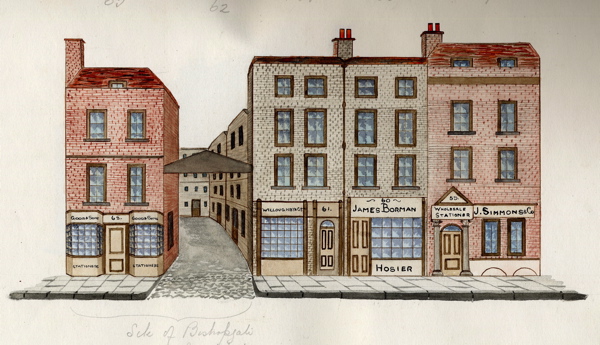
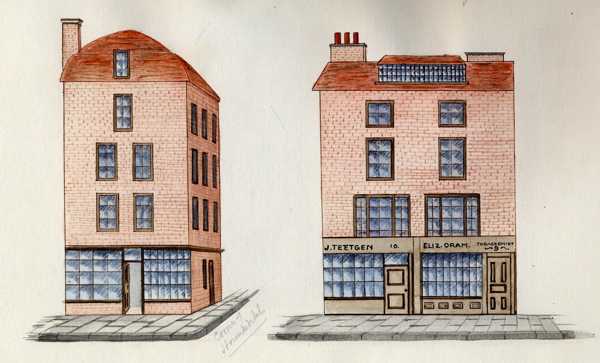
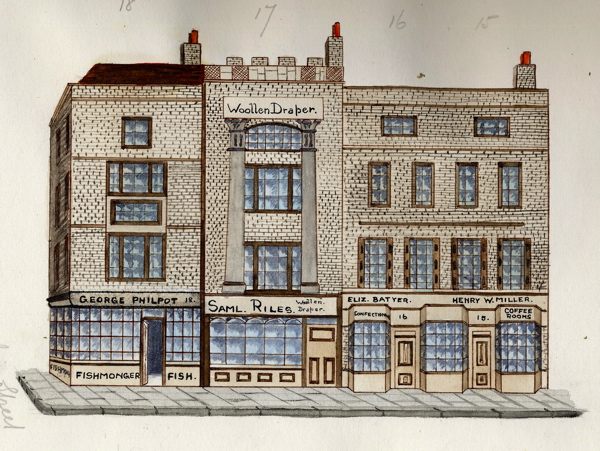
Before anyone ever dreamed of Google’s Street Views, there were Tallis’s London Street Views of the eighteen thirties, “to assist strangers visiting the Metropolis through all its mazes without a guide.” John Tallis created the precedent for a map which included pictures of all the buildings as a visual aid, commissioning the unfortunately named artist Charles Bigot to do the drawings and writer William Gaspey to create the accompanying text. Tallis had his imitators, evidenced by this beautiful set of anonymous watercolours of every single facade in Bishopsgate, Spitalfields, dated to 1838 and preserved in the archive at the Bishopsgate Institute.
There is an infantile obsessive quality to these extraordinary paintings that drew my attention when I first came upon them, the degree of control and attention to detail in creating such perfect representations of the world is awe-inspiring. While there is a touching amateurism to the quality of the brushwork and lettering that recalls folk or outsider art, I cannot deny the attraction of the desire to record every facet of the world – because there is a strange reassurance to be gained from looking at these weird yet neat little pictures. They remind me of the idealised visualisations created for buildings that are yet to be built, in which the less salubrious elements, not just the dog mess and litter but sometimes even the people, are excluded in images designed to endear us to the visionary proposals of architects and planners.
Although these views of Bishopsgate advertise their veracity by recording every single brick, I cannot believe it actually looked like this because the buildings are uniformly clean and well maintained, lacking any wear and tear. You cannot imagine John Thomas Smith’s Vagabondia of 1817 walking down Bishopsgate as it is portrayed in these immaculate representations. In contrast to the distorted chaotic nature of Google Street Views that record our contemporary cityscapes, there is a comic flatness in these drawings that are more reminiscent of street scenes in toy theatres and the houses you find on model railway layouts, tempting me to paste them onto matchboxes and create my own personal Bishopsgate. They are innocent of all the complex poetry and patina of Alan Dein’s East End Shopfronts of 1989. Neat, tidy and eminently respectable, the early nineteenth century society envisioned by these innocuous facades is that of Adam Smith’s “nation of shopkeepers,” family businesses like that of Timothy Marr, the linen draper who opened up half a mile away upon the Ratcliffe Highway in 18o8 and came to such a terrible end in 1811.
Yet although Bishopsgate itself is unrecognisably altered from the time of these drawings, the proportion of the buildings, providing a shop on the ground floor, with family accommodation and sometimes workshops above, is still familiar in Spitalfields today. And the two stocks of brick used, red brick and the London yellow brick remain the predominant colours over one hundred and fifty years later. Sir Paul Pindar’s House, illustrated in the penultimate plate, is the lone survivor from the time before the fire of London when Spitalfields was a suburb where aristocrats had their country residences, including Elizabeth and Essex who once had houses on Petticoat Lane. Today the frontage of Sir Paul Pindar’s House can be viewed at the Victoria & Albert Museum where it was moved in 1890.
Named Ermine St by the Romans, for centuries Bishopsgate was the major approach to the City of London from the North leading straight down to London Bridge, and the Saddler & Harness Makers and Coach Builders present in the street reflect the nature of this location as a point of arrival and departure. There are some age-old trades recorded in these pictures that survived in Spitalfields until recent times, Upholsters, Umbrella Makers and Leatherworkers, while the Straw Hat Makers, Cutlers, Dyers, Tallow Sellers and Corn Dealers went long ago. Yet we still have plenty of Hair Dressers today, though I feel the lack of a Fishmonger and a Butcher sorely. Let me admit, my favourite business here is Mr Waterworth, the Plumber. He could become a credible addition to a set of Happy Families, along with all his little squirts.



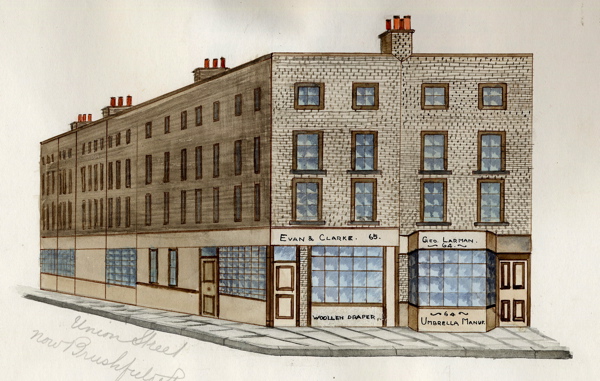


You can see the frontage of Sir Paul Pindar’s House today at the Victoria & Albert Museum.

Images copyright © Bishopsgate Institute
Hosten Garraway, Verger of Spitalfields
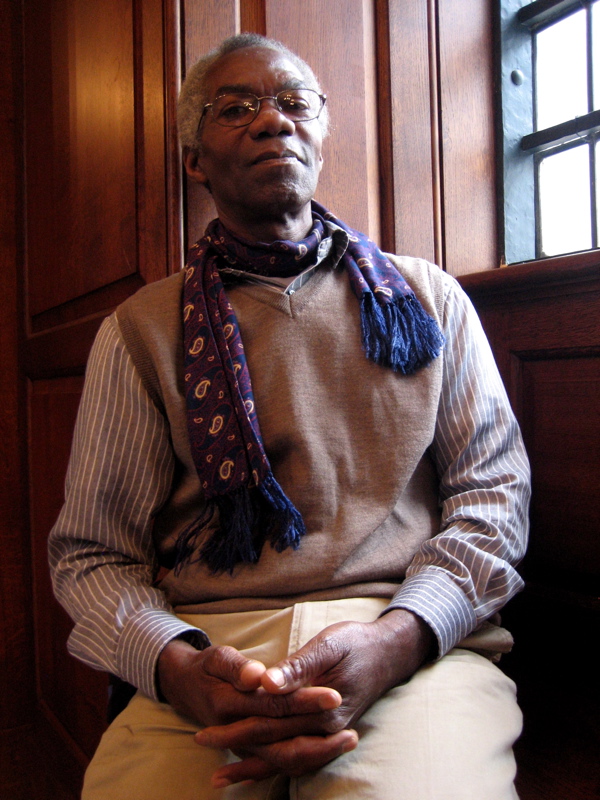
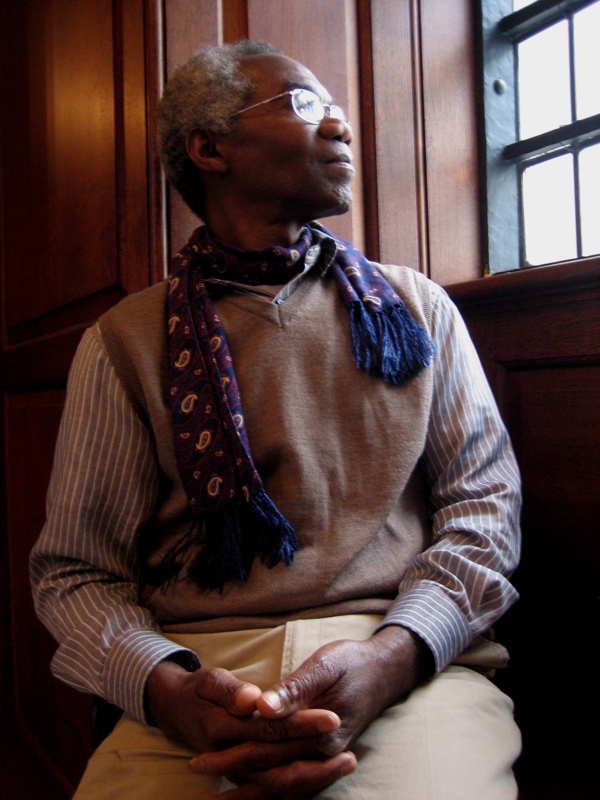
Hosten Garraway, Verger of Christ Church is a well known and widely respected figure in Spitalfields. With a natural gravitas and a warm sympathetic nature, you will find Hosten busy most days around Nicholas Hawksmoor’s magnificent eighteenth century church, the building that has been his charge for many years now. It was Hosten who had the job of reopening the church when it had been shut, over twenty years ago, and he has stayed around through all the restoration and building work to become the esteemed custodian who knows it better than anyone today. One quiet morning recently, Hosten and I sat down together in the deserted church, in a pool of Autumn sunlight, and he told me the story of how he came to be here in Spitalfields as Verger. It is a journey that began far away.
“I left Carriacou, an island off Grenada in the Caribbean, when I was eighteen. My mother came to England first and for a couple of years I lived with my uncle who had a small farm, until she sent for me. One day he said to me, “Would you like to go to England?” And straightaway I said, “Yes!” but I remember my uncle was quite concerned for me. We were travelling by boat, not planes then, and there were other lads on the boat that I knew, some who were coming to study, and we stopped off at other islands along the way to pick up passengers. I came from a family that had sailing boats, schooners, so I had sailed with my uncles, but many people became seasick. I went round getting cups of tea for them until a passenger told me to get him a cup of tea – he thought it was my job – so I had to explain that I was not being paid to do it. The voyage was exciting, I felt were all travelling to the same destination even if our goals were not the same. It was a beautiful trip, in which I saw schools of dolphins for the first time, they were racing the boat.
We landed at Southampton and when I got to Waterloo, there was my mother and a few of her friends and relatives to greet me. I think I must have slept for two days, I was so exhausted. We stayed in Old Montague St, Spitalfields, in one of the houses there, on the very top floor. (They were similar to the houses in Fournier St) It gave you a wonderful view of the rooftops. That was September 1962.
I quickly made friends with others in the neighbourhood, some were Irish, Scots, Welsh and some from other islands of the Caribbean, mostly from Jamaica. It was a closely-knit community with all the different peoples. I made friends with a Jewish family who had a shop, and as the years went by I used to help Sam in his little corner grocer shop in Old Montague St.
Sometimes Sam and I would drive down to Kent to deliver supplies to farms in remote areas. And on one occasion, Sam said, “Can you deliver the goods and collect the money?” and I said “OK.” There was a little child aged six or thereabouts with a basket, and I gave her the eggs and bread, but she did not give me the money so I followed her into the farm to get it. The farmer came out and said, “You don’t have to come in here! Who are you?” I explained that I was delivering the order and collecting the money. He said, “I’m not sure I would want you to come back here again.”
Looking at it now, I’m not sure if it was because I followed his daughter, or the idea of a total stranger on his property, or if it may have been the very first time he came into contact with a non-white person, so he may have been surprised. I don’t know. Sam went and explained the situation to the farmer. I don’t know how many years Sam had been delivering to him, but he wasn’t sure the farmer would want him to deliver goods again. “Next time we come, I’ll let you stay in the van,” said Sam. “That’s wise,” I thought.
Being a Jew, Sam asked me to come to his house and meet his wife and son every weekend. Around six o’clock, he would ask me to switch the light on and light the fire, so I thought, “OK, we’re friends.” But Sam hadn’t explained it to his neighbours who were suspicious when they saw me with a key, “Who are you? What are you doing?” they asked, and I explained, “I’ve come to light the fire.” So this went on quite a while, switching the light on and lighting the fire every Saturday. So eventually, I asked Sam, “Why can’t you switch the light on yourself?” and it was then he explained to me a little bit about Jewish culture and the Sabbath. I thought about it afterwards, “Did we become friends because he needed someone to light the fire?” but I think it was more that he asked me to light the fire because we became friends.
I used to go to Evening Classes in the Hanbury Hall, in the days when Christ Church Spitalfields was out of use. Eddy Stride was the Rector then and I started going to Sunday Service and we got talking from time to time and I got married and had two sons and I asked if he would christen them and he said, “Yes.” I was working as a Class A Welder at the time, but then in 1988 I had an accident whereby I was off work for a couple of years. I still attended church regularly and I began visiting some of the people who were not at church that week, as I was not working. Some people thought it was odd because I never chose whose door I would knock on, and the people who attended Christ Church were of mixed background, among those who were more affluent were those thought it “most strange.” I could tell by the looks on their faces. But I still visited and the news got back to Eddy. So he said to me one day, “I hear you have been visiting people, so I’ll give you a list of people to visit.” It took me up to Bethnal Green and as far as Stepney Green.
Then one day, the builders were doing work in Christ Church and a couple of the parish workers asked, “Can we open the church?” But they had no-one to open it, so I volunteered and Eddy Stride took me on one side and said “How would you like to work for the church?” and that frightened me a bit. He said, “You’ll be able to do the same things, but you’ll have to be more reliable. I want you to turn up for prayers on Monday at eight o’clock. You’ll be opening the church for months to come.” I felt nervous, but then he said, “You can talk to people who come into the church,” and then I became even more nervous. I thought, “What can I say to them?” Then I realised, “I’ll give them a tour of the building.” I’d seen Dan Cruickshank talk and seen how he speaks with hands, so he inspired me, and that’s how I got involved with Christ Church. It was very sad when Eddy retired. I used to think, “How will the church tick over in his absence?” but then it worked out quite well. A lay reader named Hugh Shelburn was here for a while. Part of his encouragement to me was to give this advice, “Thank God, look people in the eye, and just love them.”
With these words Hosten completed his story and looked at me. Raising his benign yet unsentimental gaze to meet mine, he humbled me with his plain testimony of a magnanimous soul who has retained an openness of nature – reconciling himself to all the varied experiences of humanity that he has encountered between Carriacou and Spitalfields. From the first incident on the boat, when Hosten described serving cups of tea to seasick passengers, it was apparent to me that he is an independent thinker who possesses a personal moral sense and a strength of character that will not be discouraged. Hosten is a slightly built man and yet he demonstrates an undeniable stature. There is a remarkable quality of stillness in Christ Church, Spitalfields when it is empty of crowds, and Hosten is at peace there in his spiritual home.
Maria Pellicci, the Meatball Queen of Bethnal Green

With the arrival of the first chills of Autumn in Spitalfields, my mind turns to thoughts of steaming meatballs. So I hot-footed it up the road to Bethnal Green and the kitchen of Maria Pellicci, cook and beloved matriarch at E. Pellicci, the legendary cafe that has been run by her family since 1900. Although I find it hard to believe, Maria told me that meatballs are not always on the menu here because people do not ask for them. Yet she graciously assented to my request, and even granted me the honour of permitting my presence in her kitchen to witness the sacred ritual of the making of the first meatballs of the season.
For many years, meatballs and spaghetti comprised reliable sustenance that could deliver consolation on the grimmest Winter day. If I found myself in a cafe and meatballs were on the menu, I had no reason to think further because I knew what I was having for lunch. But then a fear came upon me that drove away my delight in meatballs, I began to doubt what I was eating and grew suspicious of the origins of the ingredients. It was the loss of an innocent pleasure. Thus began the meatball famine which lasted ten years, that ended this week when Maria Pellicci made meatballs specially for me with fresh meat she bought from the butcher in the Roman Rd. Maria has worked daily in her kitchen in Bethnal Green from six until six since 1961, preparing all the dishes on the menu at E.Pellicci freshly as a matter of principle. More than this, reflecting Maria’s proud Italian ancestry, I can confirm that for Maria Pellicci the quality of her food is unquestionably a matter of honour.
Maria mixed beef and pork together with eggs, parsley, onion and other herbs, seasoned it with salt and pepper, letting it marinate from morning until afternoon. Then, as we chatted, her hazel eyes sparkling with pleasure, she deployed a relaxed skill borne of half a century’s experience, taking bite-sized pieces from the mixture and rolling them into perfectly formed ruby red balls, before tossing them playfully onto a steel baking tray. I watched as Maria’s graceful hands took on independent life, swiftly rolling the meatballs between her flattened palms and demonstrating a superlative dexterity that would make her the virtuoso at any card table. In no time at all, she conjured one hundred and fifty evenly-sized meatballs that would satisfy thirty lucky diners the following morning.
I was at the snug corner table beside the serving hatch in Pellicci’s immaculately cosy cafe next day at the stroke of twelve. After ten years of waiting, the moment was at hand, as Anna Pellicci, Maria’s daughter proudly delivered the steaming dish, while Salvatore, Maria’s nephew, brought the Parmesan and freshly ground pepper. The wilderness years were at an end, because I had spaghetti and meatballs in front of me, the dish of the season. Maria made the tomato sauce that morning with garlic, parsley and basil, and it was pleasantly tangy and light without being at all glutinous. As a consequence, the sauce did not overwhelm the subtle herb-inflected flavour of the meatballs that crumbled and then melted in my mouth, the perfect complement to the deliciously gelatinous spaghetti. Sinking my teeth into the first meatballs of the twenty-first century, I could only wonder how I lived through the last decade without them.
Outside a cold wind was blowing, so I took courage from ingesting a syrup pudding with custard, just to finish off the spaghetti and meatballs nicely, and restore substance to my attenuated soul. The special quality of E. Pellicci is that it is a family restaurant, and that is the atmosphere that presides. When I confided to Anna that my last living relative had died, she told me at once that I was part of their family now. Everyone is welcomed on first name terms at Pellicci’s in an environment of emotional generosity and mutual respect, a rare haven where you can enjoy honest cooking at prices everyone afford.
I call upon my readers to help me keep meatballs on the menu at E. Pellicci now, because we need them to help us get through the Winter, the government cuts, the Olympic games, and the entire twenty-first century that is to come. Let us send a collective message to the Pelliccis, that we love their meatballs with spaghetti, because when we have a cook like Maria Pellicci, the meatball queen of Bethnal Green, we cannot forgo the privilege of her genius.

Maria Pellicci has been making meatballs in Bethnal Green for half a century.

Anna Pellicci with the first meatballs of the season in Bethnal Green.

The coveted corner table, next to the serving hatch at E. Pellicci.
Hogarth at St Bartholomew’s Hospital
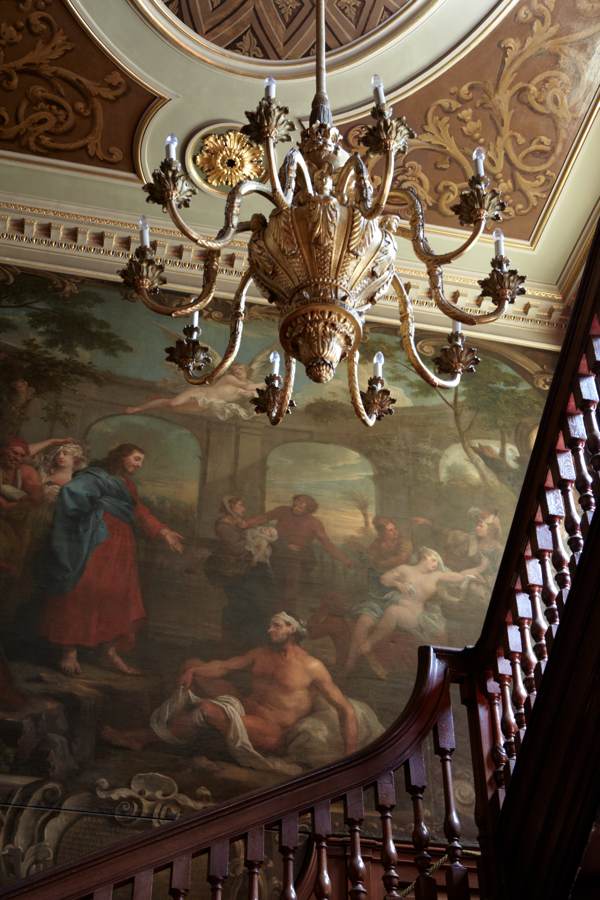
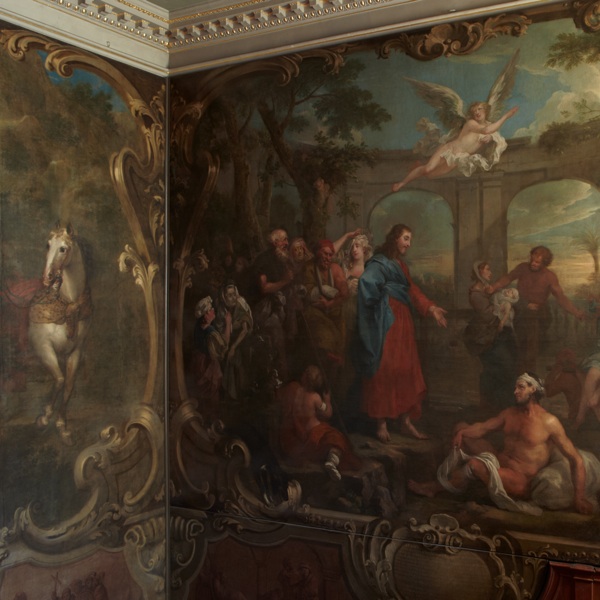
In 1733, when William Hogarth heard that the governors of St Bartholomew’s Hospital in Smithfield were considering commissioning the Venetian artist, Jocopo Amigoni, to paint a mural in the newly constructed North Wing of the hospital, he offered his own services free. Always insecure about his social status, it was a gesture of largesse that made him look good and provided the opportunity for Hogarth to prove that an English artist could excel in the grand historical style. Yet such was the mistaken nature of Hogarth’s ambition that his “Jesus at the Pool of Bethesda” is a curious hybrid at best. Illustrating Christ healing the sick, each of the figures in the painting illustrate different ailments, a bizarre notion that undermines Hogarth’s aspiration to the sublime classical style and results in a surreal vision of a dystopian arcadia instead. In plain words, it is a mighty piece of kitsch.
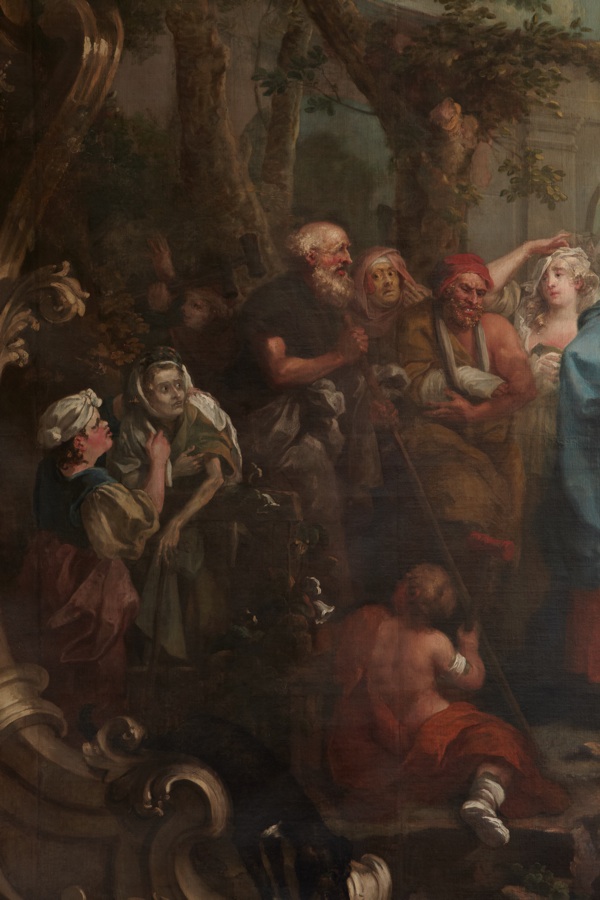
Let me take you through this gallery of maladies. Be warned, it is not a pretty picture, definitely not something you would choose to look at if you were unwell. In the detail below, on the extreme left we begin with two poor women. Some art historians believe the first represents Cretinism, or Down’s Syndrome to use the contemporary description. Another opinion suggests that the forearms of the two women, side by side, one fat and one thin, illustrate two forms of Consumption or Tuberculosis – whereby the thin woman has Phthisis which causes the body to waste, while the fat woman has the Scrofulous form that causes weight gain. The man with the stick is undeniably Blind. The fourth figure, with the anxious yellowish face may have Jaundice, or alternatively this could represent Melancholia, or Depression as we would call it. The bearded man with the red complexion has Gout, while the sling may be on account of a Sceptic Elbow Joint. The distressed woman beside him has an injured breast which may be Mastitis or an Abscess. Meanwhile, the child on the ground below this group has a curved spine and holds a crutch to indicate Rickets.
At the centre of the composition is Christ reaching out to the crippled man at the Pool of Bethesda, as described in the Gospel of St John. The bible tells us this man had been incapacitated by the pool for thirty-eight years, which makes the muscular physique that Hogarth gave him a little far fetched. It owes more to the requirements of the classical style than to veracity, although Hogarth did choose to portray him with a Chronic Leg Ulcer to introduce an element of authenticity to the figure.
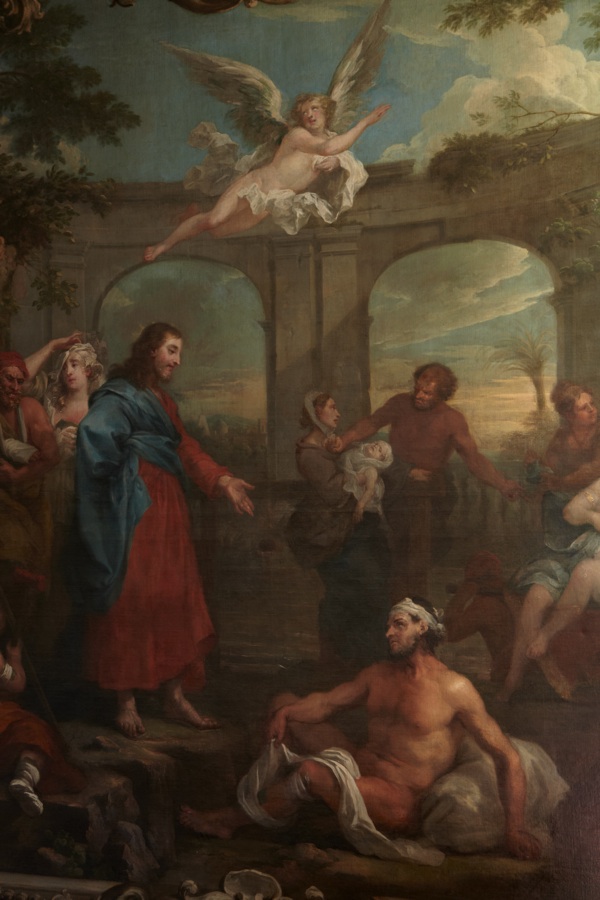
In the background, a man is accepting a bribe from the servant of the naked woman with the wanton attitude on the right of the composition, this is to push the mother with the sick baby out of the way so that his mistress can get to the healing water of the pool first. The reason for her unscrupulous haste is that she has a Sexually Transmitted Disease, most likely Gonorrhea, indicated by the rashes upon her knees and elbows. Finally, we complete the sorry catalogue with the pitiful man with the swollen abdomen on the extreme right of the canvas, he has Liver Cancer.
Hogarth painted “Jesus at the Pool of Bethesda” in his studio in St Martin’s Lane in early 1737 and it was put in place at Bart’s in April. Although it is a huge painting, approximately thirty feet across, its position on the stairwell means that you see just a portion of the picture from the foot of the stairs, then you pass close by it as you ascend the staircase and only achieve a vision of the entire work from the head of the stairs. Let me say that this arrangement does the painting no service. When you see it close up, the broad theatrical brushstrokes of the framing scrolls and of the background, which were painted by George Lambert, scenery painter at Covent Garden, become crudely apparent.
Perhaps these ungainly miscalculations in “Jesus at the Pool of Bethesda” were what led Hogarth to paint the companion piece “The Good Samaritan” in situ, from a scaffolding frame. Did he get seduced by the desire for monumentalism while painting the “Jesus at the Pool of Bethesda” in his studio and forget that it would be seen close to, as well as from a distance? Time has done the picture no favours either. With innumerable cleanings and restorations, the canvas has buckled and now daylight prevents you from seeing the painting without reflections, blanking out whole areas of the image. Maybe this was the reason for Hogarth’s instruction that the picture should never be varnished? It was ignored.
I cannot avoid the conclusion that “Jesus at the Pool of Bethesda” was a misdirection for Hogarth. It has more bathos than pathos. He aspired to be an artist in the high classical style, yet we love Hogarth for his satires and his portraits. We love his humanity, recording the teeming society that flourished in the filth of eighteenth century London. These pictures speak more of life than any idealised visions of nymphs and swains frolicking in a bucolic paradise. And, even in this, his attempt at a classical composition, Hogarth’s natural sympathy is with the figures at the margins. Far from proving that an English artist could excel at the grand historical style,”Jesus at the Pool of Bethesda” illustrates why this mode never suited the native temperament. All the qualities that make this painting interesting, the human drama and pitiful ironies, are out of place in the idealised landscape that suited the tastes of our continental cousins.
Hogarth was born in Bartholomew Close and baptised around the corner from the hospital at St Bartholomew’s Church. At the time of “Jesus at the Pool of Bethesda,” Hogarth’s mother still lived nearby and she must have been proud to see her son’s painting installed in the fine new hospital buildings. It was symbol of how far he had come. Yet, for obvious reasons, the painting is mostly ignored in books of Hogarth’s work today, so the next time you are in Smithfield, go in and take a look, and savour its bizarre pleasures for yourself.
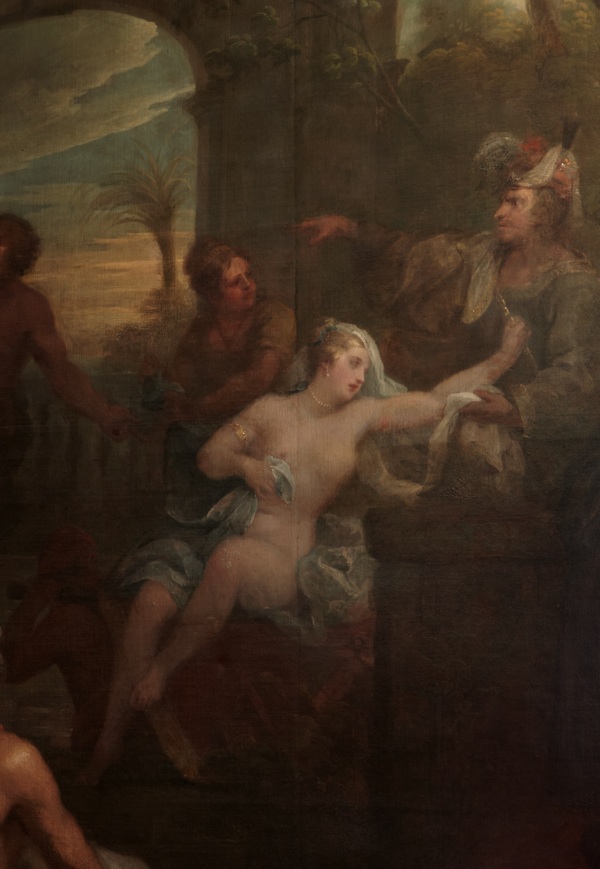
This woman has a sexually transmitted disease.
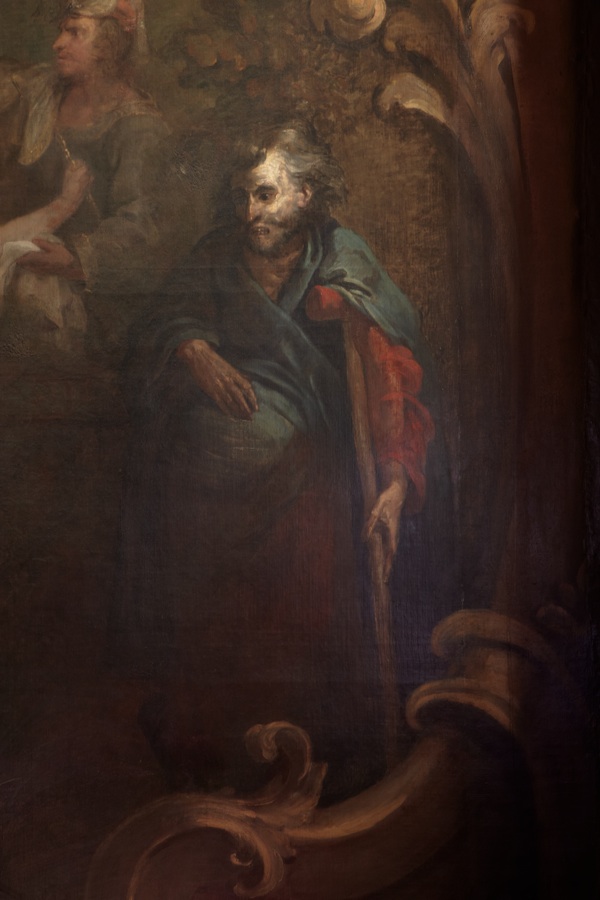
This man has cancer of the liver.
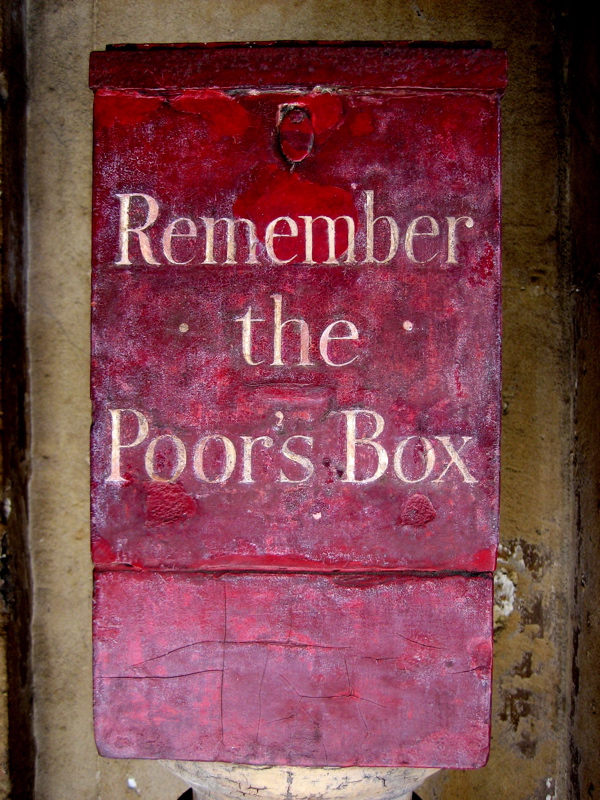
The poor box at the entrance to the North wing.
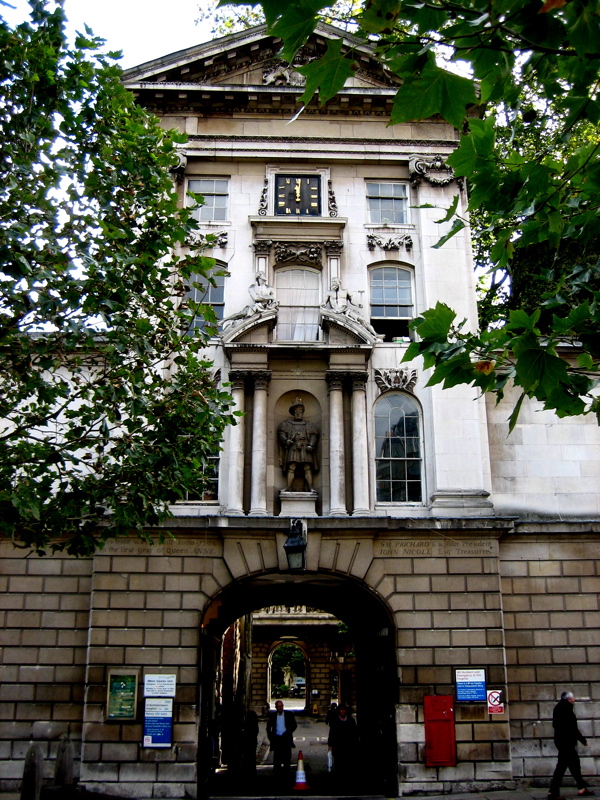
The new entrance to St Bartholomew’s Hospital built in 1702, with the North wing containing Hogarth’s mural just visible through the gate
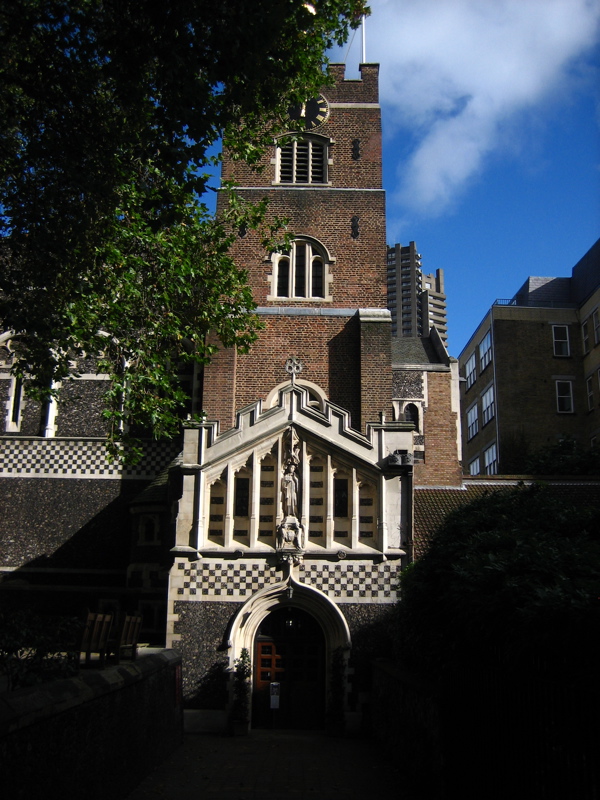
St Batholomew’s Church in Smithfield where William Hogarth was baptised.
Photographs of the mural © Patricia Niven