A Farewell to Spitalfields

In 1988, the Bishopsgate Institute staged an exhibition entitled “A Farewell to Spitalfields” curated by John Shaw and Raphael Samuel, the distinguished historian of the East End. The purpose was to assess the history of Spitalfields in the light of the changes that were forthcoming, as a result of the closure of the Truman Brewery and the Fruit & Vegetable Market – and it is my pleasure to publish these excerpts from Raphael Samuel’s introductory essay accompanied by David Bateman’s photographs of the Spitalfields Market, commissioned as part of this exhibition.
Twenty years later, it is sobering to recognise the prescience of Raphael Samuel’s words. He was a historian with strong opinions who, on the basis of this article alone, demonstrated an ability to write about the future as clearly as he wrote the past. The Spitalfields portrayed in these pictures has gone and now – for better or worse – we live in the Spitalfields that Raphael Samuel, who died in 1996, wrote of yet did not live to see.
Spitalfields is the oldest industrial suburb in London. It was already densely peopled and “almost entirely built over,” in 1701 when Lambeth was still a marsh, Fulham a market garden and Tottenham Court Rd a green. It owes its origins to those refugee traditions which, in defiance of the Elizabethan building regulations, and to escape the restrictions of the City Guilds, settled in Bishopsgate Without and the Liberty of Norton Folgate.
Spitalfields is a junction between, on the one hand, a settled, indigenous population, and on the other, wave upon wave of newcomer. Even when it was known as “The Weavers’ Parish,” it was still hospitable to many others – poor artisans, street sellers, labourers among them. In the late nineteenth century Spitalfields was one of the great receiving points for Jewish immigration and the northern end of the parish provided a smilar point of entry for country labourers. There was a whole colony of them at Great Eastern Buildings in the eighteen eighties, working as draymen at the brewery, and another at the Bishopsgate Goods Station. This “mixed” character of the neighbourhood is very much in evidence today.
Spitalfields Market – threatened with imminent destruction by a coalition of property developers, City Fathers, and conservationists – is almost as old as Spitalfields. It was already in existence when the area was still an artillery range. In John Stow’s “Survey of London” (1601) it appears a trading point “for fruit, fowl and root.” A market sign was incorporated in the coat of arms for the Liberty of Norton Folgate in Restoration times, and the market’s Royal Charter dates from 1682. The market, in short, preceded the arrival of the Hugeunots and has some claim to being Spitalfields’ original core. The market continued as a collection of ramshackle sheds and stalls until it was transformed, in the 1870s, by Robert Horner, who bought the lease of the land from the Goldsmid family in 1875. Horner was a crow scarer from Essex who, according to market myth, walked to London, became a porter in the market and eventually got a share in a firm. Ambitiously, he set about both securing monopoly rights for the existing traders, and replacing the impromptu buildings with a purpose built market hall – the “Horner” buildings which today is the oldest part of the market complex.
The older, eastern portion of the market is the direct product of Robert Horner’s vision of his own situation. It is built in the manner of the English Arts and Crafts movement. On its own terms, the old market is a pleasing piece and a worthy addition to the diversity of Spitalfields. Its rusticated archways on the Commercial Street facade and the repeated peaks of the roof with their smallish sash windows lend a clearly Victorian flavour to Commercial Street, which was largely a Victorian venture anyway. Inside the market it is a vintagely Victorian hall of glass and iron of unassuming beauty, even more so when at work, then its true worth as a genuinely functioning piece of Victorian space is revealed. Like St. Pancras in a different way, it has an element of the museum and an aesthetic that overlays the original construction upon utilitarian principles. Most of all the old market appears as a peculiarly English space. An effect that is heightened by the lavish use of ‘Wimbledon’ green. It is that deep traditional green that characterises English municipal space and that, in this case helps to marry the market to the discordant additions of the late 1920’s and to give distinction to the territorial boundaries of the market that have been historically more fluid.
The old market is a celebration of trade, a great piece of Victorian working space, not only of great historical value itself, but contributing to the visual manifestation of the historical development of the whole of Spitalfields. It is a worthy layer in an area that grew by a sort of architectural sedimentation. Hawksmoor’s Christ Church, the Huguenot fronts of Artillery Passage, the Georgian elegance of Elder Street and the smaller houses of Wilkes Street and Princelet Street, the mid-Victorian utility of the Peabody Buildings, the rustic character of the old market, the twentieth century neo-classicism of the Fruit Exchange and several examples of a more unspeakable modernity are some among many accretions which contribute to make Spitalfields what it is. The most perfect example of a palimpsest in which diversity rather than Georgiana or Victoriana represent the true nature of the area.
The character of a district is determined not by its buildings, but by the ensemble of different uses to which they are put, and, above all, by the character of the users. It should be obvious to all but the self-deceived, that to stick an international banking centre in the heart of an old artisan and market quarter, a huge complex with some six thousand executives and subalterns, is, to put it gently, a rupture from tradition. The whole industrial economy of Spitalfields rests on cheap work rooms: rentals in the new office complex are some eight times greater than they are in the purlieus of Brick Lane, and with the dizzy rise in property values which will follow the new development, accommodation of all kinds, whether for working space or home, will be beyond local people. The market scheme will mean a social revolution, the inversion of what Spitalfields has stood for during four centuries of metropolitan development.
The fate of Spitalfields market illustrates in stark form some of the paradoxes of contemporary metropolitan development: on the one hand, the preservation of “historic” houses; on the other, the wholesale destruction of London’s hereditary occupations and trades and the dispersal of its settled communities. The viewer is thus confronted with two versions of “enterprise” culture: the one that of family business and small scale firms, the other that of international high finance with computer screens linking the City of London to the money markets of the world.
This set of photographs by David Bateman show something of the activity of the market today in what – if the Second Reading of the Market Bill continues its progress through Parliament – are likely to be its closing months.
Raphael Samuel 22nd July 1988
I was fascinated to read these words, because in my own work I have become vividly aware of the rich culture of artisans and small tradesmen – which I have undertaken to record – that still persists in Spitalfields, against all the odds. This year we have seen Gardners’ Market Sundriesmen and Crescent Trading, the last traditional cloth warehouse, challenged respectively with rent increases and the necessity to move to smaller premises. Yet as we approach the end of the year, it is something to be able to report that they are both still here and doing brisk business, thanks to the support of customers who delight in these small businesses that carry the history of the neighbourhood just as much those historic houses which Raphael Samuel refers to.

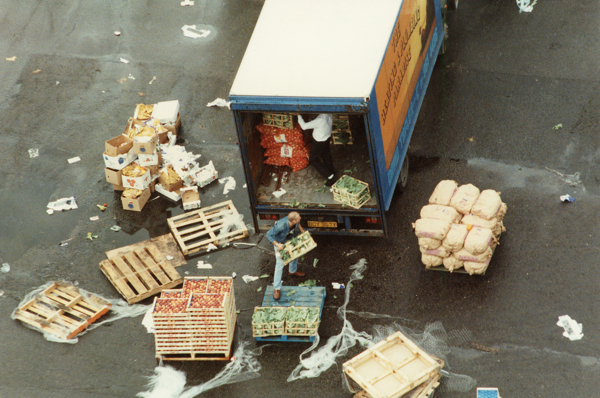


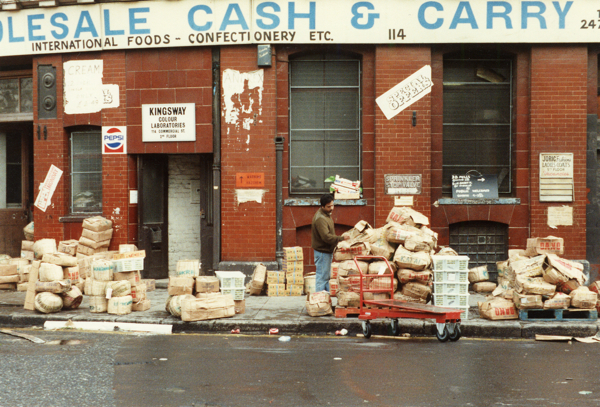


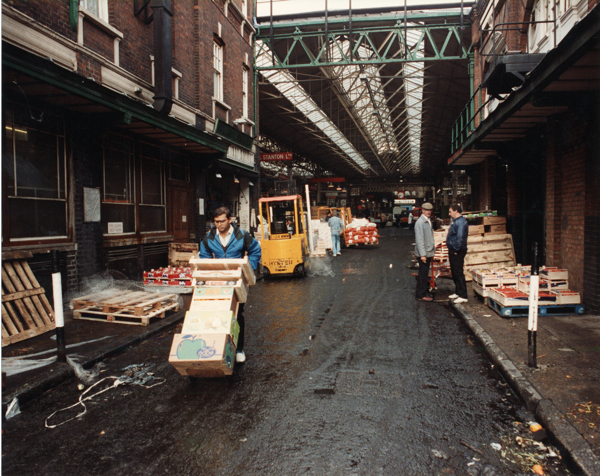


Photographs copyright © David Bateman
Take a look at Mark Jackson & Huw Davies’ photographs of the Old Spitalfields Fruit & Vegetable Market.
The Cat Lady of Spitalfields
When I wrote the story of Blackie, the last Spitalfields Market cat, my friend Phil Maxwell sent me his photographs, taken twenty years ago, of the cat lady of Spitalfields who used to feed all the neighbourhood felines daily. It is my great pleasure to publish these pictures today with Phil’s accompanying text as a means to introduce you to his blog – Playground of an East End Photographer – that he started just last week to publish the entire canon of his life’s work online, at the rate of a few photographs every day. For over thirty years, Phil has been recording the people and the changing life on the streets in Spitalfields, and so for anyone interested in the East End www.philmaxwell.org is an essential daily port of call. Phil & I are eager to learn more of the mysterious cat lady who disappeared twenty years ago, so please get in touch if you know her name or can supply us with further information.

The cat lady on Brick Lane in the late nineteen eighties.
The woman in this photograph was always dressed in a head scarf and large coat. Usually she would pull a shopping bag on wheels behind her. She was the cat lady of Spitalfields. She knew where every cat and kitten lived in the wild and made it her task to feed them every day. Her bag was full of cat food which she would serve on newspaper at designated spots around Spitalfields.

The cat lady pauses for a second beside the Seven Stars pub on Brick Lane. She has just left some food in the ‘private road’ for some cats.

The cat lady floats past Christchurch School on Brick Lane. With her eyes closed she contemplates the next cat awaiting a delivery.

The cat lady waits outside her favourite cafe in Cheshire Street. Now a trendy boutique, in the nineteen eighties you could buy a cup of tea and a sandwich for less than a pound at this establishment.

The cat lady ‘kept herself to herself’ and avoided the company of others.

It must be about twenty years since I last saw the cat lady of Spitalfields. She devoted her life to feeding the stray cats of the area. I have no idea where she lived and I never saw her talking to another person. She seemed to live in her own separate cat world. Even though I was sitting opposite her when I took this photograph, I felt that she had created a barrier and would be reluctant to engage in conversation. It was impossible to make eye contact. I’m pleased I photographed her on the streets and in her Cheshire Street cafe. She would not recognise Cheshire Street and Brick Lane today.
Photographs copyright © Phil Maxwell
Stephen Watts, Poet

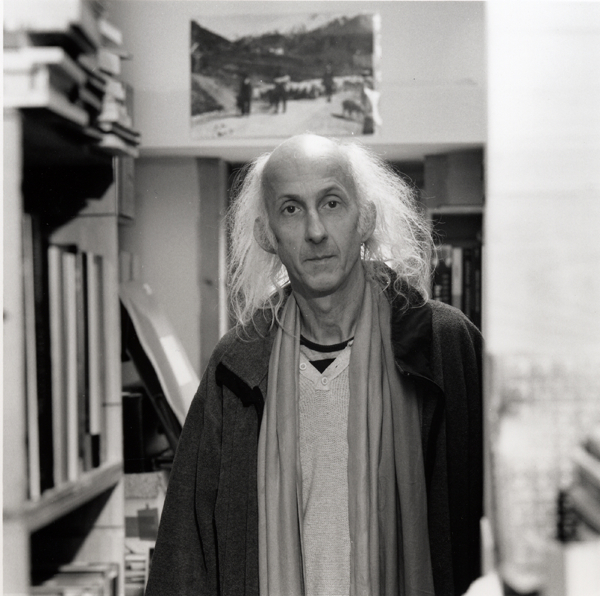
“I remember coming out of the tube in Whitechapel in 1974 and being overwhelmed,” recalled Stephen Watts affectionately, his deep brown eyes glowing with inner fire to describe the spiritual epiphany of his arrival in the East End, when coming to London after three years on North Uist in the Outer Hebrides. Today Stephen lives in Shadwell and has a tiny writing office in the Toynbee Hall in Commercial St where I paid him a call upon him recently.
“Migration is in my awareness and in my blood,” he admitted, referring to his family who were mountain people dwelling in the Swiss Alps on the Italian border – living twelve hundred feet above sea level – and his grandfather who came to London before the First World War, worked in a cafe in Soho and then bought his own cafe. “I realised this was an area of migration since the seventeenth century when the farm workers of Cambridgeshire, Kent and Suffolk began to arrive here, and I immediately felt an affinity for the place,” Stephen continued, casting his thoughts back far beyond his own arrival in Whitechapel, yet wary to qualify the vision too, lest I should think it self-dramatising.
“It is very easy to be romantic about it, but I think migration has been the objective reality for many people in the twentieth and twenty-first century. So it seemed to be something very natural, when I came to live in Whitechapel.” he revealed with an amiable smile. Yet although he allowed himself a moment to savour this thought, Stephen possesses a restless energy and a mind in constant motion, suggesting that he might be gone at any moment, and entirely precluding any sense of being at home and here to stay. Even if he has lived in his council house in Shadwell for thirty years, I would not be surprised if the wind blew Stephen away.
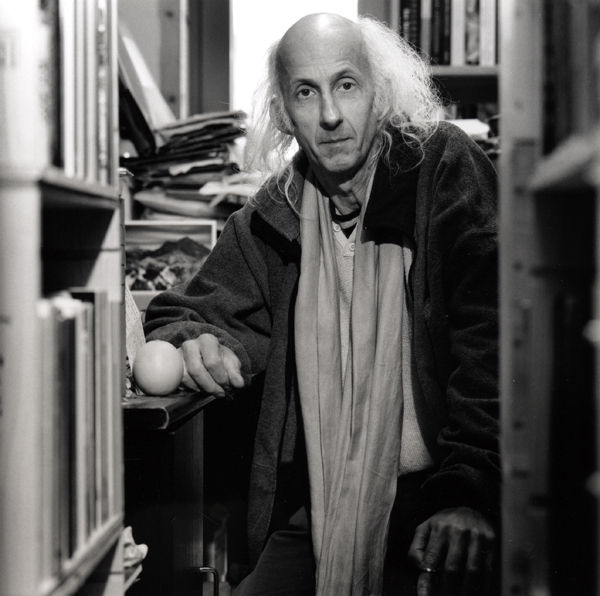
A tall skinny man with his loose clothes hanging off him and his long white locks drifting around, Stephen does present a superficial air of insubstantiality, even other-wordliness. Yet when you are in conversation with Stephen you quickly encounter the substance of his quicksilver mind, moving swiftly and using words with delicate precision, making unexpected connections. “In the Outer Hebrides the unemployment rate was twenty-five per cent and it was the same in Tower Hamlets when I arrived,” he said, informing me of the parallels with precise logic, “also Tower Hamlets had large areas of empty water then, just like the North Uist.” drawing comparison between the abandoned dockland and the Hebridean sea lochs, in regions of Britain that could not be more different in ever other respect.
We took the advantage of the frosty sunlight to make a half hour’s circuit of the streets attending Brick Lane and these familiar paths took on another quality in Stephen’s company, because while I tend to be always going somewhere, Stephen has the sense to halt and look around – indicative of certain open-ness of temperament that has led him befriend all kinds of people in pubs and on the street in Whitechapel over the years. I took this moment to ask Stephen if he chose to be a poet. “I made a choice when I quit university after a year and went to live in North Uist,” he said as we resumed our pace, “and then I made a choice to be a poet. But as a choice it was unavoidable, because I realised that it was so much part of me that not to have done it would be a denial of my humanity.”
Returning to the Toynbee Hall, Stephen allowed me the privilege of a peek into his tiny room on an upper floor, not much larger than a broom cupboard. The walls were lined with thin poetry books in magnificent order, arrayed in wine boxes stacked floor to ceiling and standing proud of the walls to create bays, leaving space only for one as slim as Stephen to squeeze through. It was a sacred space, the lair of the mountain man or a hermit’s retreat. It felt organic, like a cave, or maybe – it occurred to me – a shepherd’s hut carved out of the rock. And there, up above Stephen’s head was an old black and white photo of shepherds on a mountain road, taken in the Swiss Alps whence Stephen’s family originate and where even now he still returns to visit his relatives.
Stephen’s room is a haven of peace in the midst of Whitechapel, yet he delights to complement his life in here by working alongside Bengali and Somali poets in all kinds of projects in schools around Tower Hamlets, and pursues translation alongside his own poetry too, as means to “invite difference” into his work. Possessing a natural warmth of personality and brightness of temperament which make you want to listen and hang off his words, Stephen has a genuine self-effacing charm.“I don’t believe in being a professional poet in the sense of promoting myself, being a poet is about becoming embedded in humanity.” he proposed modestly, presuming to speak for no-one than himself, “And that’s why I lived in the East End and that’s why I still find it inspiring – because of the tremendous range of human presence in Whitechapel.”
BRICK LANE
(after the death of Altab Ali, and for Bill Fishman)
Whoever has walked slowly down Brick Lane in the darkening air and a stiff little rain,
past the curry house with lascivious frescoes,
past the casual Sylheti sweet-shops and cafés
and the Huguenot silk attics of Fournier Street,
and the mosque that before was a synagogue and before that a chapel,
whoever has walked down that darkening tunnel of rich history
from Bethnal Green to Osborne Street at Aldgate,
past the sweat-shops at night and imams with hennaed hair,
and recalls the beigel-sellers on the pavements, windows candled to Friday night,
would know this street is a seamless cloth, this city, these people,
and would not suffocate ever from formlessness or abrupted memory,
would know rich history is the present before us,
laid out like a cloth – a cloth for the wearing – with bits of mirror and coloured stuff,
and can walk slowly down Brick Lane from end to seamless end,
looped in the air and the light of it, in the human lattice of it,
the blood and exhausted flesh of it, and the words grown bright with the body’s belief,
and life to be fought for and never to be taken away.
Song for Mickie the Brickie
Mickie I met down Watney Street and he whistled me across.
“How are you” he said
—and of course really meant “have you a little to spare for some drink”—
but could not bear to ask.
We walked through the decayed market,
a yellow-black sun gazed down over Sainsbury’s as I went to look for change.
Ten pound was hardly enough to get him through the dregs of that bitter day.
We stood on the corner where for centuries people have stood.
Many worlds passed us by.
When he had been in hospital he’d taken his pills and been looked after and had not got worse.
Now he’s barely getting by.
He walks out of the rooming house in Bethnal Green when it gets too loud inside.
His scalp’s flaking and he needs a reliable level and a small brickie’s trowel.
That woman’s son’s inside for good.
That one’s man is a chronic alcoholic.
This one’s on her own and better for it.
But how can you know anyone’s story when every day you walk by without stopping.
Charlie Malone was a good friend. So was John Long.
Now they’re resting in Tadman’s Parlour
—and first thing in the morning Mickie’ll go and say to them words that cannot be answered.
Those are the best words, but they’re hardest to bear.
To me he says : “Always—always—stop me—always—come across.”
And what is the point of centuries of conversation if no-one’s ever there to hear.
FRAGMENT
… And so I long for snow to
sweep across the low heights of London
from the lonely railyards and trackhuts
– London a lichen mapped on mild clays
and its rough circle without purpose –
because I remember the gap for clarity
that comes before snow in the north and
I remember the lucid air’s changing sky
and I remember the grey-black wall with
every colour imminent in a coming white
the moon rising only to be displaced and
the measured volatile calmness of after
and I remember the blue snow hummocks
the mountains of miles off in snow-light
frozen lakes – a frozen moss to stand on
where once a swarmed drifting stopped.
And I think – we need such a change,
my city and I, that may be conjured in
us that dream birth of compassion with
reason & energy merged in slow dance.
Photographs copyright © Lucinda Douglas-Menzies
Albert Hafize, Fish Merchant
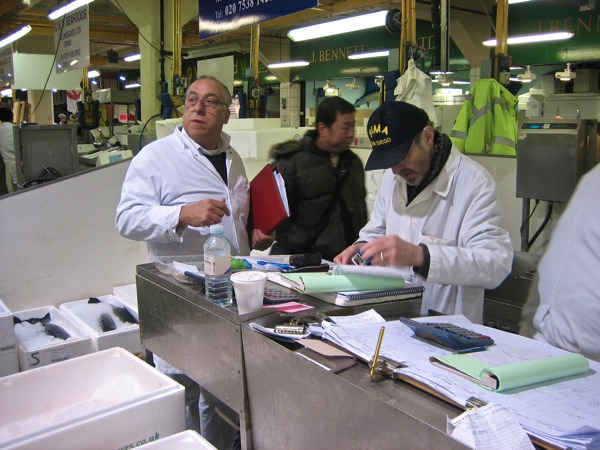
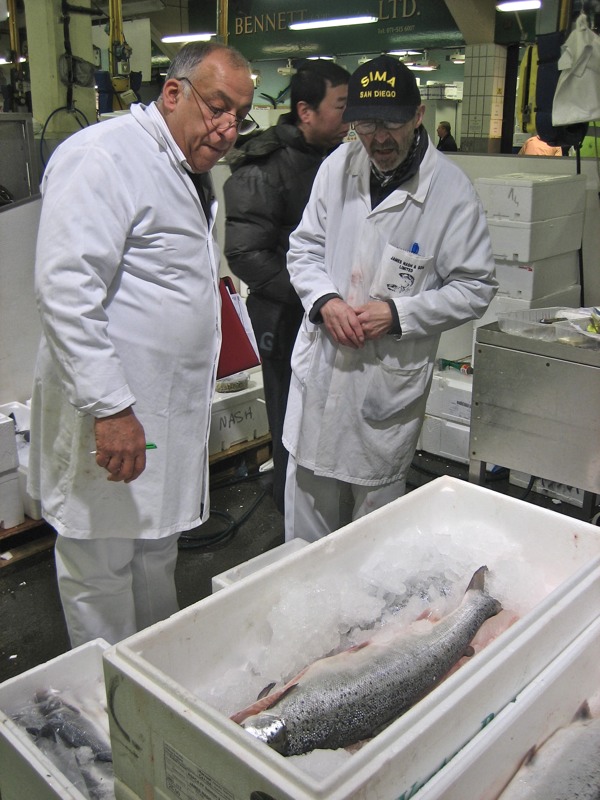
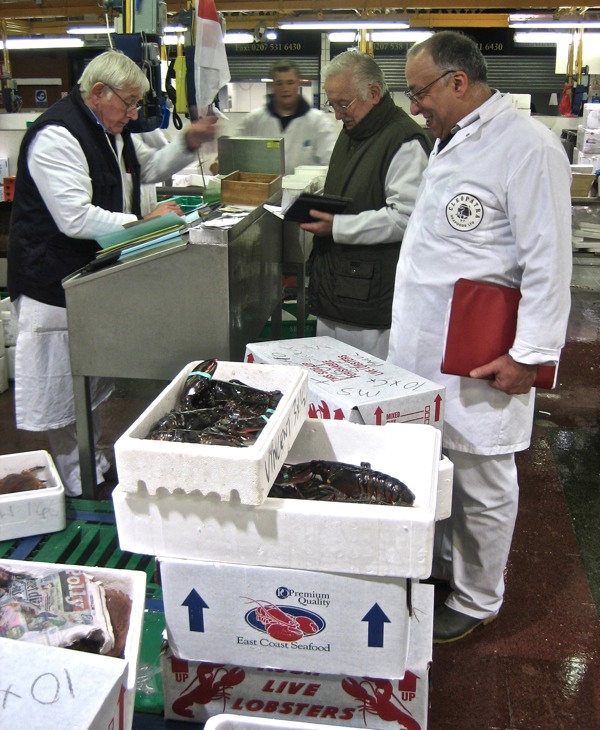
It was the coldest night of the year so far when I arrived in Billingsgate Fish Market at half past five in the morning to meet Albert Hafize, yet he bounced up to greet me warmly outside Mick’s Eel Supply, his spirits undiminished by the Siberian temperatures. For the past thirty-five years, Albert has been coming here six nights a week, between four and seven each morning, personally selecting the highest quality fish for his business Cleopatra Seafoods, based in a modest red brick building in Whitby St, between Redchurch St and the Bethnal Green Rd, where the fish are trimmed, gutted, filleted, cured or smoked according to his customers’ requirements.
In Billingsgate, the doors were wide open and the cold night air circulated freely throughout the building, which suited everyone very well because the sub-zero temperatures provided ideal conditions for all the fish – snug in their blankets of ice and lying head-to-toe in the thousands of white boxes that filled the market – even if the traders were turning blue. No larger than the average supermarket, the central hall has the feel of an intimate marketplace where you walk among narrow aisles between stalls crammed with all the wonders of the deep, laid out before your eyes and gleaming in the halogen glare, wet and shining in all the vibrant tones of the ocean. As I gawped at the variety of Neptune’s kingdom, the large, the small, the colourful and the exotic, with scales, tentacles or claws, I quickly realised that my gaze was returned by myriad fish eyes looking back at me, and some were still alive.
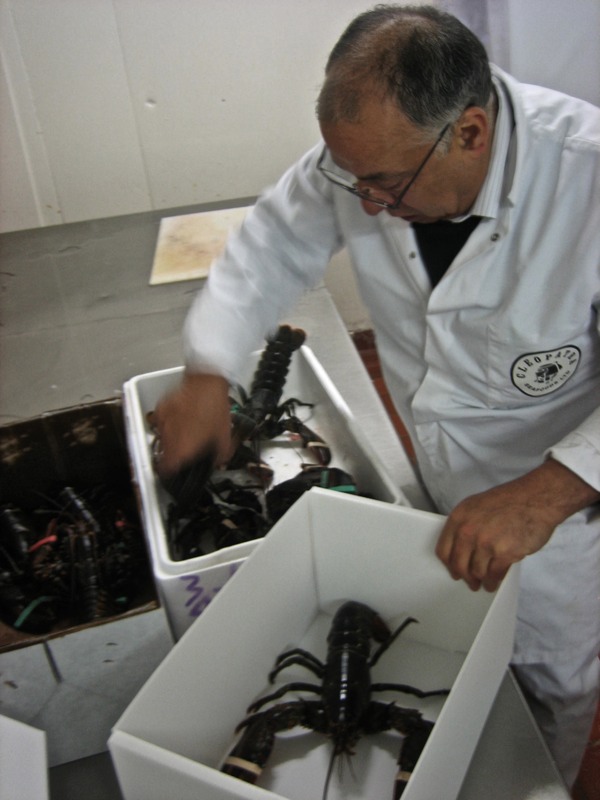
Yet this was Albert’s familiar constituency, and I had to run to keep up with him as he ducked and dived between the stalls, seeking the items upon the list on his red clipboard. Hyper-alert, with acute focus, his eyes never stopped moving, scrutinising the options and checking the prices with the traders, negotiating and collecting the receipts as the porters swept the orders away to his van waiting in the car park. Negotiating the swarm of porters in their long white aprons coming and going with trolleys, we walked outside in the dark beneath the shadow of the Canary Wharf Tower to check the night’s haul, comprising a tall pile of boxes on the tarmac, some with fish neatly packed, others with live lobsters crawling around inside and an enigmatic box with a enormous fish tail protruding from one end. Eager to get back to Shoreditch, Albert started loading them into the van in the halflight and I lifted the boxes, passing them to him while he stacked them inside.
While Albert sought the last few items on his list, he arranged for me to have cup of tea in the cafe with Sheldon Davis, fish porter and chairman of the union. “A year or so ago, we were told the badges wouldn’t be renewed,” he explained regretfully, holding up the red and white enamelled plate that is his licence to work, issued by the City of London in a system established in 1878. Many porters are third or fourth generation in the trade and I spoke to one whose grandfather started here after being discharged from the army, gassed in the trenches of World War I. The badge system allowed the porters to negotiate with the traders’ association and establish working rights which will get wiped out next year. It was a touching encounter, to sit across the table in the corner of the steam-filled cafe and learn the story from this dignified man, who has been labouring here thirty years carrying fish, from three in the morning from Tuesday to Saturday and taking home no more than £450 a week. “You can only fight on and fight on, but the City of London hold all the resources,” he admitted with a grimace.
As we drove back along Commercial Rd in the dawn, Albert told me that he relied upon the porters to keep an eye on his stock while the van was unsupervised in the car park and was dubious of the logic of removing the established system. But once we arrived in Whitby St, there was no time to speak as he unloaded the fish, passing the heavy boxes from the back of van to his handful of staff who had been there all night making preparations. There was not a moment to waste as the boxes were throw open and all the orders for hotels and restaurants were put together in haste to get them out on the road and up to the West End.
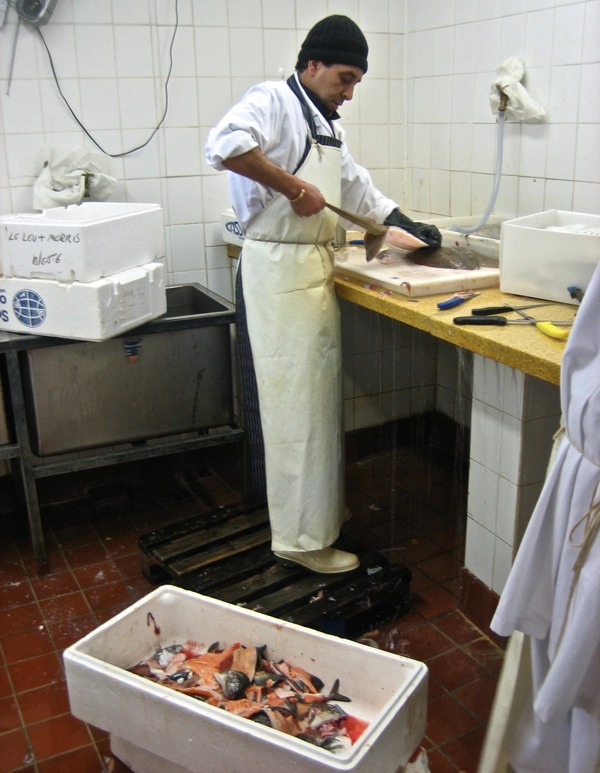
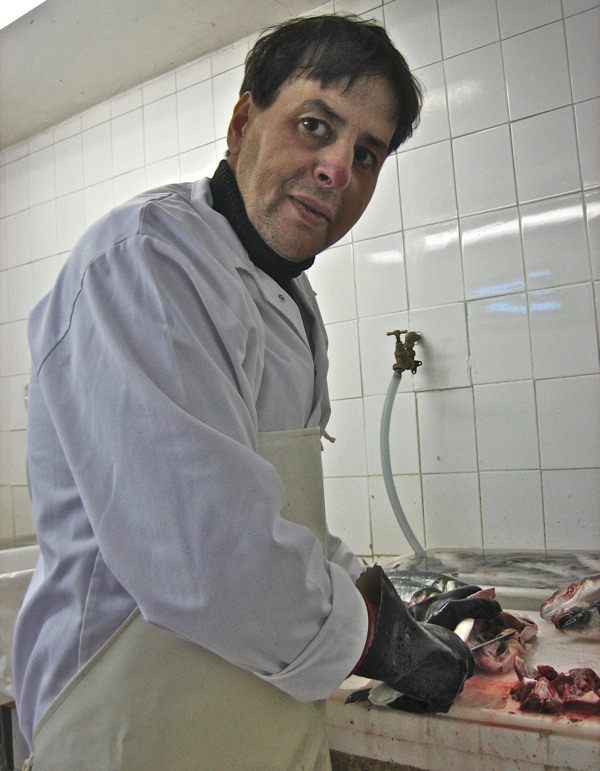
In a tiled room leading off the loading bay, with unceasing motion, Albert was unpacking boxes on a steel bench, lifting fish and scrabbling in the ice with his bare hands to apprise his stock critically and select the choice specimens to deliver to his customers. Next door in a small white room, two men stood at a stone bench where water ran continuously over the work surface, gutting, trimming and skinning fish, with the tireless persistence of machines, working through the chill of the night. Such was the momentum of this intense flurry of concentration and activity that I lost sense of time, perched in the corner with my camera and fascinated by the spectacle.
Once the orders had gone out, I joined Albert upstairs in his office where he gave a sigh of relief to remove his lifting belt, now that the physical activity was over for another day and he could devote himself to paperwork. “The morning is the worst because all the customers want their orders early. It’s very hard work,” he confided to me with a weary shrug, “but you have to enjoy it or else you wouldn’t get up at two in the morning each day. It’s fun at the market where you see people every day and everyone knows you and you do business together. The days go quickly.”
Albert’s origins are in Egypt and his brother Tony first came to London from Cairo in the employ of an international seafood company, before starting upon his own under the Wheler St arches in 1968. Twenty-five years ago, they had the current premises built when the area was all small industrial premises, but now they are the exception – a fish smokery in the midst of the frippery of bars, galleries and boutiques.
“You need to know fish. Once you know fish, you know the origin and quality by experience,” declared Albert, speaking plainly of the knowledge that he employs to make the thousand decisions of each night, selecting, buying and making up orders – thinking in motion, assessing all the options and making the informed choices that earn him his modest ten to fifteen per cent. It made me wonder if so much exposure to fish had engendered an aversion to seafood, but the truth is quite the contrary, as Albert Hafize confessed to me open-heartedly and with a generous smile, “I love fish. I eat fish!”
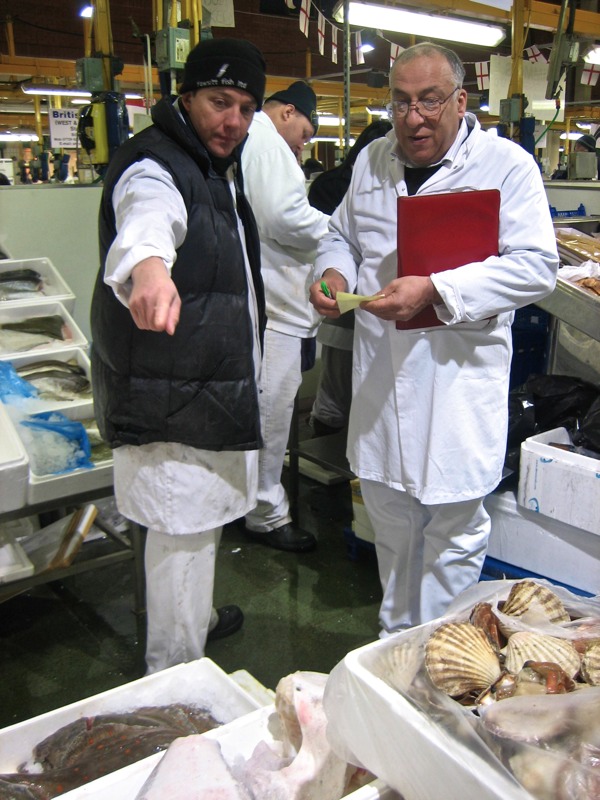
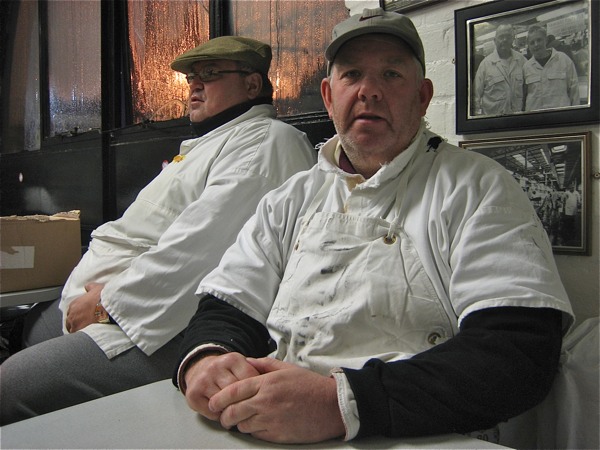
Sheldon Davis, Chairman of the Billingsgate Porters’ Union
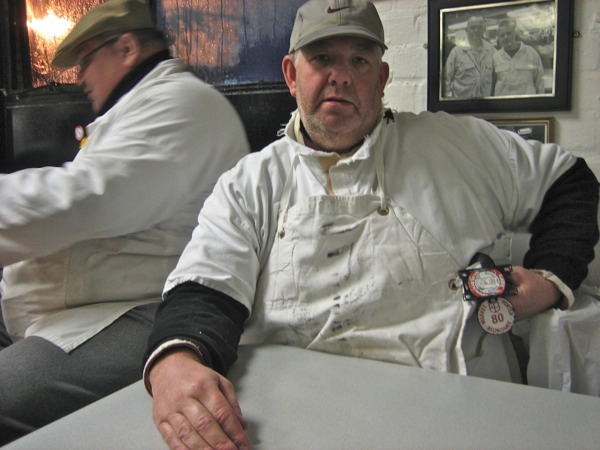
Sheldon shows his porter’s badge, which the Corporation of London is abolishing next year, ending the traditional rights of the Billingsgate porters, formalised in 1878 and dating back to the sixteenth century.

Unloading in Whitby St at seven.
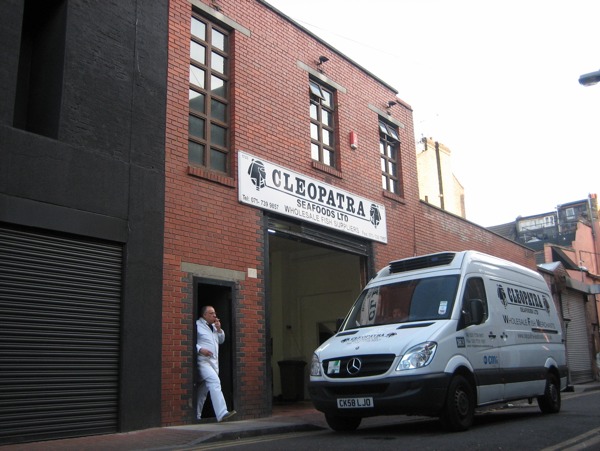
Albert enjoys a cigarette in the morning sunshine.
 Albert Hafize
Columbia Road Market 61

This is Lyndon Osborn, a noble plantsman from New Zealand, who has been trading here for nine years – although he spent the first seven years nearby in Ezra St, while he worked his way up the waiting list for a pitch on Columbia Rd. “It’s only my third year in the firing line,” he declared with characteristic Antipodean bonhomie, “but I built up quite a big customer base round the corner – and now I’ve discovered many others who only walk along Columbia Rd.”
Nine years ago, I bought one of the tree ferns from Lyndon that he imports from New Zealand and which remain his speciality to this day. These extraordinary plants lie dormant, permitting the trunk alone to be transported, apparently a dried-out husk – until you add water and it regenerates, sprouting tendrils from the top and resuming vigorous life in a new continent. Over this time – just like his tree ferns – Lyndon himself has put down roots and shown dramatic growth too, establishing a nursery in High Barnet. And I have found that because Lyndon rears his seedlings in London, they are acclimatised to the conditions which improves their chances of thriving in my garden.
In particular, Lyndon has become famous for his spectacular pelargoniums, especially the deep crimson “Lord Bute,” which I have spied in many of the discerning gardens of the East End over recent Summers. The copyright that exists on more recent strains sent Lyndon back to propagate nineteenth century cultivars, also more hardy and pest resistant that their modern counterparts.
Starting from one trolley in Ezra St Market, Lyndon has now ascended to the lofty heights of plantsman appointed to Dunhill in Mayfair and Selfridges’ Shoe Shop. “Just as the nineteenth century aristocracy gave their gardeners free rein, these clients let me do what I want, and they love the idea of it being a small nursery, supplying plants grown up the road. I plant them up four times a year, and last time I was planting the Dunhill Shop, someone from Claridges came to speak to me…” confided Lyndon proudly, his green eyes shining in eager anticipation of what might follow. I thought of Lyndon when I visited the magnificent fern garden at Malplaquet House, so it was no surprise to discover that he supplied the ferns and is the principal plant supplier to Todd Longstaffe-Gowan, the landscape designer who lives there – collaborating on many of his projects including a forthcoming garden of tree ferns for the central atrium at the Royal College of Art.
Lyndon is a popular character in the market, renowned for his relaxed, droll humour and fascinating mixture of plants, always quick with a cheery greeting and eager to strike up a conversations with customers who share his horticultural enthusiasms. “It has re-ignited my interest in London. I don’t come here to make money, it’s a social event. I’ve gone from meeting people as customers, who have become acquaintances and then friends,” admitted Lyndon with a sentimental smile, expressing his affection for Columbia Rd, “From here, everything has snowballed and that’s why I have such high regard for the market.”

Lyndon Osborn’s pelargonium “Lord Bute,” photographed in my garden last Summer.
Portrait of Lyndon Osborn copyright © Jeremy Freedman
Adam Dant’s Map of Shoreditch in Dreams

For the finale of this series of maps of Shoreditch by Adam Dant, it is my pleasure to publish the Map of Shoreditch in Dreams which Adam drew in 1998 as his first map of the neighbourhood. As before, you simply have to click on the image above to examine it in detail.
“I’d been thinking about how Shoreditch existed in people’s imaginations and subconscious and how I could render that visually,” explained Adam, “So I went to a lecture at the Jungian Society in Hampstead on the subject of ‘Collective Dreaming.’ It turned out to be a circle of people sitting in a room with a ‘dominatrix’ holding a clipboard – bobbed hair, German spectacles and pencil skirt – and she asked people to describe their dreams, with a view to explore common themes that might point to a collective unconscious. It was very embarrassing because people were revealing things about themselves that if they were aware of the language of psychoanalysis they would have kept mum.” Adding later in qualification, “I wasn’t using ‘mum’ in a Freudian sense.”
Taking his cue from the Jungian Society Lecture, Adam set out to collect the dreams of his neighbours and other residents through surveys and in conversation. Then he portrayed them all on the map you see above as a means to illustrate the heaving and teeming collective unconscious of Shoreditch. And I was astounded when Adam showed me the huge original drawing done directly in ink onto a piece of paper that is a metre square, without any single mistake or even an inkblot that might open itself to interpretation – almost obsessive compulsive in its neatness, you might say.
As we commenced our cartographic analysis, Adam explained that his orientation was looking to the West with a rat-infested Shoreditch High St crossing the map laterally, before he began to introduce me to a selection of the motifs. In the bottom left of the map, he pointed out the tiger prowling the streets continously and, further up to the right, the facades of the Boundary Estate propped up by wood, and then, over in Hoxton Square, the giant Teddy Bear at its centre. Images pregnant with meaning yet resisting simple interpretation. Most fascinating to me were the elements of premonition within the map – the giant pizza outside the Tea Building on the corner of the Bethnal Green Rd exactly on the site of the new pizza restaurant which opened more than a decade later and the bendy bus in the centre right of the map, drawn years before these strange vehicles became actuality.
You will note that this map was drawn and published under the name of Donald Parsnips, which was Adam Dant’s creative alter-ego at this time, and it is the image of Donald Parsnips in his tall hat that dominates the centre of the chart, produced when Adam was also publishing “Donald Parsnips’ Daily Journal” distributed in a daily edition of one hundred copies free to the people of Shoreditch. Subsequently, Adam produced maps of Shoreditch under his own name, but whether we can infer some kind of reconciliation of the ego and super-ego as a result of his work in cartographic interpretation of Shoreditch in Dreams, I leave you to decide for yourself.
Or, to quote a speech bubble from the map, “The finer points we’ll leave to the discretion of the silly folk!”

A cross section of Shoreditch in Dreams.
You may also like to take a look at Adam Dant’s Map of Shoreditch in the Year 3000, or his Map of Shoreditch as New York, or his Map of the History of Shoreditch, or his Map of Shoreditch as the Globe. Adam Dant’s current exhibition Dant on Drink runs at Hales Gallery, 7 Bethnal Green Rd until January 8th.
A Dead Man in Clerkenwell

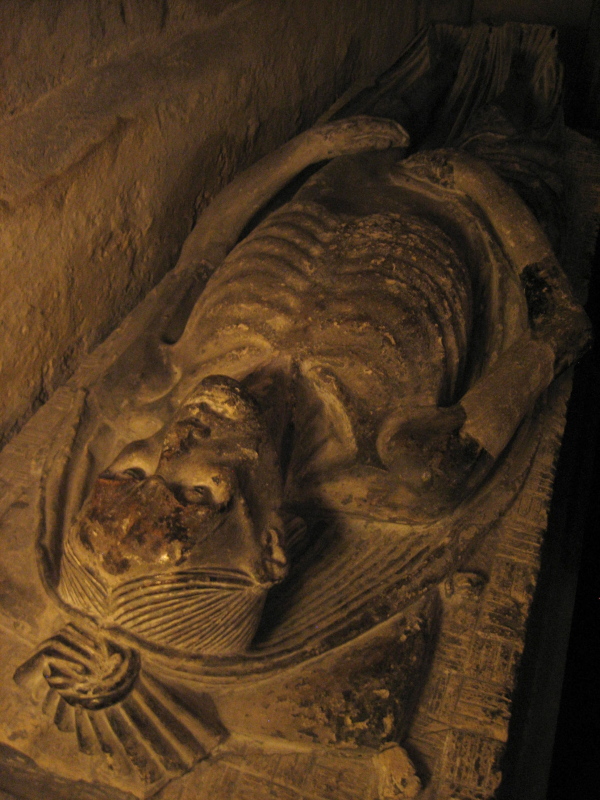
This is the face of the dead man in Clerkenwell. He does not look perturbed by the change in the weather. Once Winters wore him out, but now he rests beneath the streets of the modern city he will never see, oblivious both to the weather and the wonders of our age, entirely oblivious to everything in fact.
Let me admit, although some might consider it poor company, I consider death to be my friend – because without mortality our time upon this earth would be worthless. So I do not fear death, but rather I hope I shall have enough life first. My fear is that death might come too soon or unexpectedly in some pernicious form. In this respect, I envy my father who always took a nap on the sofa each Sunday after gardening and one day at the age of seventy nine – when he had completed trimming the privet hedge – he never woke up again.
It was many years ago that I first made the acquaintance of the dead man in Clerkenwell, when I had an office in the Close where I used to go each day and write. I was fascinated to discover a twelfth century crypt in the heart of London, the oldest remnant of the medieval priory of the Knights of St John that once stood in Clerkenwell until it was destroyed by Henry VIII, and it was this memento mori, a sixteenth century stone figure of an emaciated corpse, which embodied the spirit of the place for me.
Last week, thanks to Pamela Willis, curator at the Museum of the Order of St John, I went back to look up my old friend after all these years. She lent me her key and, leaving the bright November sunshine behind me, I let myself into the crypt, switching on the lights and walking to the furthest underground recess of the building where the dead man was waiting. I walked up to the tomb where he lay and cast my eyes upon him, recumbent with his shroud gathered across his groin to protect a modesty that was no longer required. He did not remonstrate with me for letting twenty years go by. He did not even look surprised. He did not appear to recognise me at all. Yet he looked different than before, because I had changed, and it was the transformative events of the intervening years that had awakened my curiosity to return.
There is a veracity in this sculpture which I could not recognise upon my previous visit, when – in my innocence – I had never seen a dead person. Standing over the figure this time, as if at a bedside, I observed the distended limbs, the sunken eyes and the tilt of the head that are distinctive to the dead. When my mother lost her mental and then her physical faculties too, I continued to feed her until she could no longer even swallow liquid, becoming as emaciated as the stone figure before me. It was at dusk on the 31st December that I came into her room and discovered her inanimate, recognising that through some inexplicable prescience the life had gone from her at the ending of the year. I understood the literal meaning of “remains,” because everything distinctive of the living person had departed to leave mere skin and bone. And I know now that the sculptor who made this effigy had seen that too, because his observation of the dead is apparent in his work, even if the bizarre number of ribs in his figure bears no relation to human anatomy.
There is a polished area on the brow, upon which I instinctively placed my hand, where my predecessors over the past five centuries had worn it smooth. This gesture, which you make as if to check his temperature, is an unconscious blessing in recognition of the commonality we share with the dead who have gone before us and whose ranks we shall all join eventually. The paradox of this sculpture is that because it is a man-made artifact it has emotional presence, whereas the actual dead have only absence. It is the tender details – the hair carefully pulled back behind the ears, and the protective arms with their workmanlike repairs – that endear me to this soulful relic.
Time has not been kind to this figure, which originally lay upon the elaborate tomb of Sir William Weston inside the old church of St James Clerkenwell, until the edifice was demolished and the current church was built in the eighteenth century, when the effigy was resigned to this crypt like an old pram slung in the cellar. Today a modern facade reveals no hint of what lies below ground. Sir William Weston, the last Prior, died in April 1540 on the day that Henry VIII issued the instruction to dissolve the Order, and the nature of his death was unrecorded. Thus, my friend the dead man is loss incarnate – the damaged relic of the tomb of the last Prior of the monastery destroyed five hundred years ago – yet he still has his human dignity and he speaks to me.
Walking back from Clerkenwell, through the teeming city to Spitalfields on this bright afternoon in late November, I recognised a similar instinct as I did after my mother’s death. I cooked myself a meal because I craved the familiar task and the event of the day renewed my desire to live more life.