Remembering the Cat Lady of Spitalfields
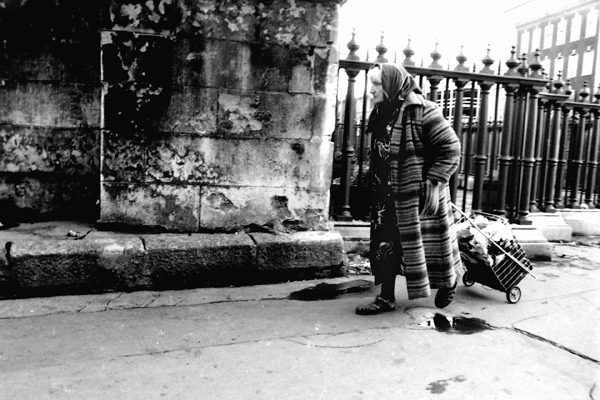
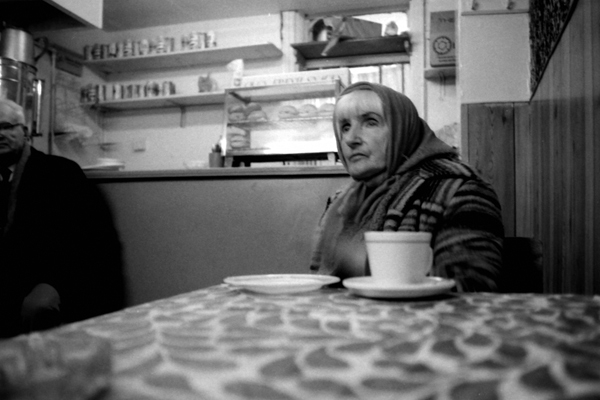
When I published Phil Maxwell‘s wonderful photographs of the mysterious Cat Lady of Spitalfields, my friend Rodney Archer contacted me to say that he used to know her and has even included her as a character in the novel he is writing. So I went round to enjoy a cup of tea and shot of rum with Rodney in his cosy basement kitchen in Fournier St, eager the learn more about this enigmatic presence who made it her business to befriend all the felines in Spitalfields during the nineteen eighties.
Rodney: Joan went all around the neighbourhood feeding the cats regularly and she had names for them. And you’d see her crouching, looking through the corrugated iron surrounding Truman’s Brewery, waiting for the cats to come and then they suddenly all appeared. I think once I saw her there and I asked her what she was doing, and she said ‘I’m waiting for the cats to appear.’
‘My darlings,’ she really did call them, ‘My darlings,’ and it was wonderful in a way that she had this love of cats and spent her life encouraging them and feeding them and keeping them alive.
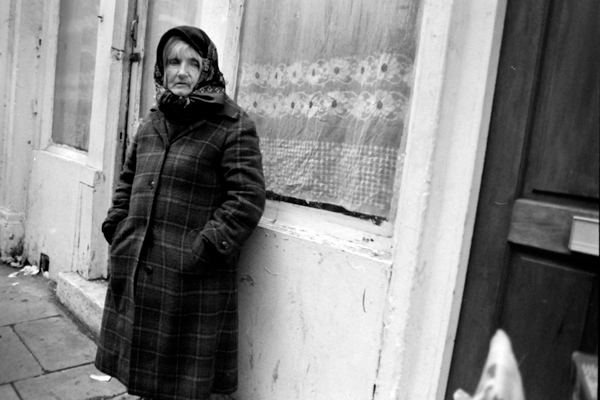
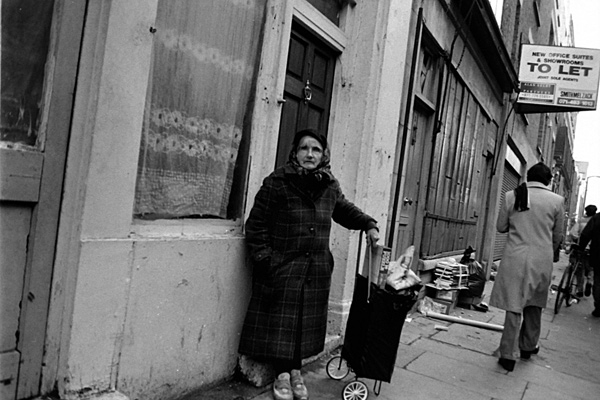
I could never quite work it out, but she had a bag, like one of those trolleys you carry, full of cat food. Now, either she’d taken the tops off the tins or something, since I noticed – because she had a kind of witchlike aspect – that although she put her hands right into the tin to feed them and then just threw it down, I never saw any cat food on her hands. It was like something out of Grimm’s Fairy Tales.
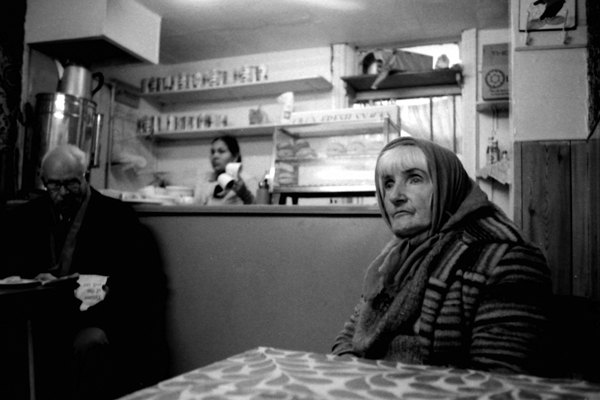
Over the years, I would chat to her and she was someone that you had to have some time for, because once she began she went on and on. She lived down off Brick Lane and she had her own flat, and I don’t know if it was a council flat, but eventually she was moved to South London. I think she was not an easy neighbour and, whether she was surrounded by immigrants, she certainly didn’t like anyone from any other place but England.
So, I’d chat with her when she’d come up from South London on the 40 bus, I think that stops at Aldgate. Every day she would come back, even though she had moved on, and she would make her way round the neighbourhood. She wore these snowboots, I remember once commenting on her new boots, and they were a gift from her sister.
It’s a strange thing about Spitalfields – when I read again what I had written about the Cat Lady, I thought, ‘My God, did I make this up?’ but I wouldn’t have made up that she died. And I do remember going to her funeral and I was one of the only mourners and there was this woman, and we went and had tea together afterwards and it was her sister, and I don’t think there was much contact. She was totally unlike the Cat Lady because the Cat Lady was strange – she spent all her money on the cats – she was like a character out of Dickens. She was almost a street person, except she had a place to live. And she did get benefits and she wasn’t an alcoholic or anything, she was very doughty, she had a bit of a moustache.
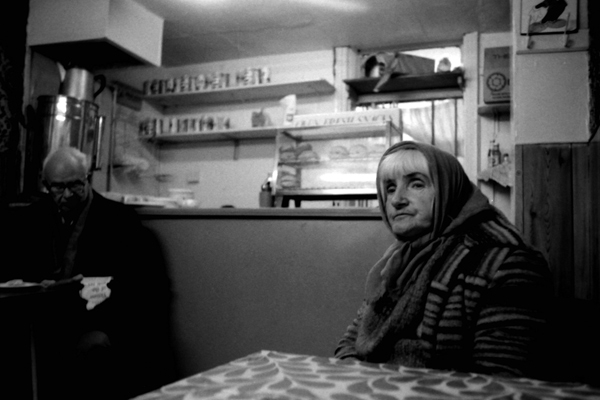
She was the kind of woman that, a hundred years ago, people would have been fearful of in a way. There was something awesome about her, because she had her own aura and she was there to feed the cats, and the cats were much more important to her than people. And I’d talk about my cat to her, and I think once she stopped by my door and I opened it, and my cat sat looking at her and she would ask me about him. I don’t know if she had any cats at home. I don’t know how old she was exactly, she must have been in her sixties or seventies, I suppose. You might look up William Taylor’s description of her in his book “This Bright Field,” – did he get in touch with you?
The Gentle Author: Yes, he wrote to say he thought she was called Joan and she had this mantra which was “Cats are better than rats.” Were there a lot of rats here at that time?
Rodney: I think there were. When the market was still going and you had all the fruit and vegetables, the rats would come out to feed. I never saw that myself, but you might see a rat running along the curb. A lot of people said they were looking forward to the market closing because the area would be cleaner and neater, but I regretted that the market left and there weren’t cabbages everywhere.
The Gentle Author: Can you remember when you first saw the Cat Lady?
Rodney: I think I first saw her on the corner of Fournier St and Brick Lane. She had a huge physical endurance, but I think she must have been exhausted by her journey every day, because she would often stop and she’d stop for quite a long time, and she’d just be there looking around, I suppose she might have been looking for the cats. That’s why you could pass her and catch up with her and ask her how she was doing.
So one day I just spoke to her. Maybe I’d seen her around and I said, ‘Are you feeding the cats?’ And she told me, and I said had a cat and so we talked about cats and the wisdom of cats and all that kind of thing. And afterwards I’d see her quite often, but I couldn’t always stop because sometimes it was difficult to know how to reply if she was saying something you disagreed with.
The Gentle Author: How did you discover that the Cat Lady had died?
Rodney: Somehow, someone who knew her told me. The funeral was out at the East London Crematorium. Her sister was there from the North of England, she seemed of be a kind of middle class woman who’d married and had a family and was quite respectable in a way that Joan wasn’t.
The Gentle Author: Do you know if the Cat Lady had a family?
Rodney: I don’t think she had any close relatives at all – she didn’t talk much about her past life – but she was the great mother of all the cats.
Photographs copyright © Phil Maxwell
Michael Louca, Gunmaker

Gunmaker Michael Louca is the proprietor of Watson Bros, the last independently-owned gun and rifle manufacturer in London, originally established in 1885. Operating from a small workshop in Shoreditch, each year Michael and his close-knit team of employees craft around a dozen of the most superlative shotguns that money can buy. With a client list that includes the Sultan of Turkey and the Shah of Persia, Michael is incontestably at the top of his game.
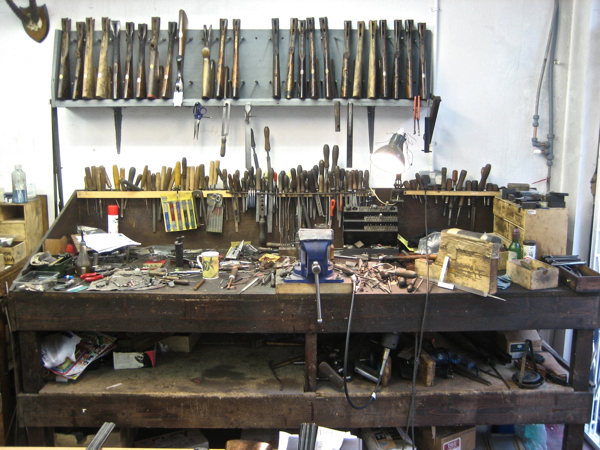
Yet walking in off the street, you find yourself in a modest artisan’s workshop with three workbenches along one wall and all manner of well-worn hand tools on display. It is only upon second glance when you see the gun barrels and wooden stocks lined up, and the animal trophies peering down at you from the walls, that you realise the particular nature of this endeavour. Amongst the detritus of the workbenches my eye was drawn first to tiny metal plates with exquisite engravings upon them of birds in flight surrounded by scrollwork. The technique was breathtaking, and yet these were designed and custom-made for a single shotgun by Michael’s own engraver who works here on the premises. I was told as many as four engravers can work upon the decoration of a single gun. It was the first indicator of the extraordinary degree of application and skill that goes into the manufacture of these amazing pieces.
We are accustomed to the notion that machines are mass-produced, and so there is something quite startling in sophisticated hand-made mechanical devices such as these. Honed to scrupulous perfection and with an action that slides like silk, Michael’s guns seem alive. I never handled a gun before, but when Michael passed me a long shotgun that he took from a secure cupboard in the corner of his private office, I encountered a feeling comparable to the delight in a perfectly balanced kitchen knife in the hand, only amplified a hundred times – sleek, heavy and quick with life, as if it could spring from my fingers. It was a serious weapon, sleek and worthy of respect.
The authority and grace of these devices is derived from centuries of London gunmaking, and the manufacture entails long months of patient work by engineers who undergo a five year apprenticeship to learn the trade. “I grew up on a farm and I grew up shooting,” explained Bradley Hodgson who I spoke with first as he pored over the coffin-shaped metal chamber of a gun gripped in the vice at his workbench. Bradley who originates from the Lake District, has been here three and a half years, and now breezily calls himself a lock, single-trigger and ejector man. “Ninety per cent of the gun is handmade at the bench,” he confirmed proudly, “we make the pins that hold them together, we don’t even buy nuts and bolts. It’s just a beautiful end product, completely bespoke, and getting everything to work right – when you master it – that’s very rewarding.”
Next to Bradley worked James Brown, a nineteen-year-old apprentice who had been there just fourteen months. Both he and Bradley were concerned with painstaking intricate work, upon which Michael cast a discreet eye from the adjoining bench. “I’ve always liked guns,” James explained to me with bright-eyed enthusiasm,“I went into the army cadets at school and then I started clay pigeon shooting, so my dad suggested gunmaking. And I’m not going to change my job after this, it’s my life!” It was an extraordinary declaration, making me wonder how many other occupations could inspire such devotion today.
In the privacy of his upstairs office, away from the mess of the workshop, surrounded by a trophy bison, black bear and polar bear skins, and toting one of his prized shotguns, Michael opened his heart to me. “With our guns, no-one has to have one – it’s a want, a desire.” he said, articulating the intense emotional quality of these charismatic objects that incarnate power in your hands. “They do far more than their purpose, in the same way you might want to drive a Ferrari rather than a Mini.” he confided. “If you want to shoot a pheasant, how do you want to do it?” he asked, catching my eye with an implied challenge and posing a question that transcends the hypothetical for his customers, “It’s about what gives you pleasure.”
“I was always in the trade. I’d done an apprenticeship and I’d started working in the trade when I developed a new gun,” continued Michael, revealing the secret of his success – creating an over-and-under shotgun (with the barrels one above the other) that is as light as a side-by-side (with the barrels on either side). The trick of this innovation lay in Michael’s cunning design of a simpler ejector system, a patent that today is unique to Watson Bros and confirms Michael’s position as top gunmaker in London. Unlike many of his colleagues in the trade, Michael is a shooter. With three hundred gameshoots happening every week during the season Michael likes to be out weekly wielding his shotgun, and he told me it helps him to understand his customers better. All Michael’s guns are made to order, measured to fit their owners’ reach and handsize and in a style that reflects the customer’s taste.
To my untutored eye, I could make no distinction between guns made recently by Michael, those from the nineteen thirties and those the eighteen forties. All these designs appeared to be the near culmination of the perfection of form and function, and notions of modernity did not register in this arena. It did not appear either that Michael’s guns were old-fashioned – this was, equally, a meaningless notion in the context. But what was remarkable and inspiring to me was that guns can still be manufactured today with the accomplishment and skill that matches the masters of centuries past. The making of guns by hand is a vital living tradition at Watson Bros in Shoreditch.


Bradley Hodgson


James Brown


Pieces of Turkish walnut waiting for customers to select them for the stocks of shotguns.

Michael Louca
The Record Dealers of Spitalfields
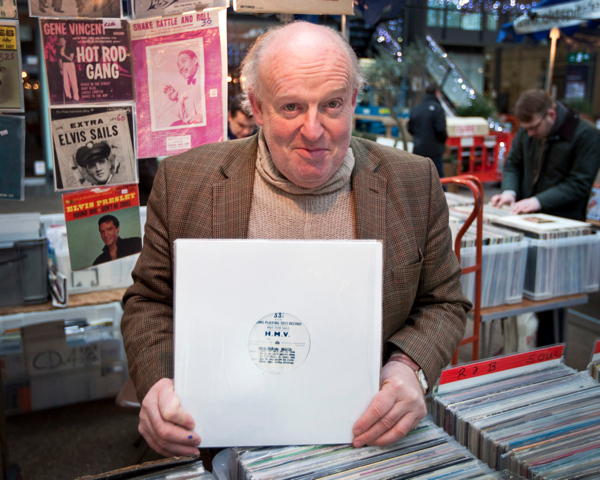
“I was one of the first people who went to the States in the sixties looking for records,” recalled old-school record dealer Piers Chalmers, reminiscing affectionately in his rich baritone voice, while clutching a rare copy of Elvis’ second album worth many thousands of pounds. “It was all word of mouth in those days. You’d get on Greyhound bus and go to Memphis and there’d be two hundred labels. Then I’d be in New York ready to get on the boat with all my sacks of records and there’d be a phone call, ‘Get your ass down here to Jackson.’ And I’d go down there and discover a whole warehouse full of records!”
It was inspiring to encounter the warmth of Piers’ enthusiasm in the sub-zero temperatures of the market, where Spitalfields Life contributing photographer Jeremy Freedman and I had come to seek out the hardy record dealers of Spitalfields who convene there on alternate Fridays throughout the year, whatever the weather. Last Friday, the temperature was too low even for the ink in my pen to flow but these zealots were all passionate to eulogise about vinyls.
Rob Henson who runs Pop Classics, fondly introduced his business partner Damian Jones as “a horrible cockney who knows nothing,” which provoked a brief playful tussle between the two men, after which Rob resumed our conversation by telling me he had collected records from the age of eleven until he was twenty, when he sold his collection and became a dealer. And from this interaction I realised that a certain happy masculine camaraderie of the playground existed among these dealers, who for the most part discovered the affection for vinyl recordings in their youth – which this circumstance of being surrounded by vinyl and kindred vinyl enthusiasts permits them the licence to relive.
Personally, I could not resist the feeling that there was a certain insanity to standing around in the frost, surrounded by stacks of vinyls and chatting about music, but the dealers were blissfully unconcerned. “I used to be in menswear but I got sick of it, so a friend and me went to the States and bought a lot of records and sold them all at Camden Lock,” confessed cool-cat Tony James, recounting the tale of his personal bid for freedom. “It’s nice to be involved with one of your passions,” he declared persuasively, wolfing a hot dish of refried beans while leaning over a table laden with his favourite music,”that way you can take the rough with the smooth more easily.”
“I was a milkman for fifteen years, so I am used to being out in the cold,” claimed Dave Neale, also sprightly with stoic cheeriness. A collector for thirty years and a dealer for the past ten, he now spends his time working his way around record fairs at Luton, Southend, Bexley, Chelmsford and Harlow. Just a fraction of the regular nationwide circuit that exists, he informed me.
A different tone was set by Alan Dallison, a native of Shoreditch. “I was a DJ for the pirate radio ‘Voice of Peace’ in 1974,” he told me proudly, before revealing an ambivalence about recent developments, “And then I learnt how to do leather table tops and I had Dallisons Leather Works in Stratford but nobody wants my trade any more, so now I do this instead.” Adding with a wan smile,“The only good thing is you get to meet some nice people.” A tall spindly man with a table of punk music who would only give his name as Ray extended this melancholy chord. “It’s not a business, it’s just me selling off my record collection to get some money. I’m not working at the moment, so I am doing this until I can find something else to do.” he told me plainly. Yet it was clear that both these men sought consolation and found acceptance amongst the community of record dealers in the market – many of whom had also come, once upon a time, like Ray to sell their own collection to earn some cash and then discovered a new career in the process.
Ritchie Wheeler got a job in a London record shop when he was thirteen, growing up in the eighties and discovering a passion for rare groove and vibe. “After twenty-five years, I am totally absorbed by music, and that’s what keeps my interest.” he explained with gleaming eyes, “It’s not the easiest way to make a living but I get so much out of it.” Ritchie’s pal Chris Energy at the next stall had a similar tale to tell, “I got into buying, selling and collecting music as a teenager,” he admitted, “It’s been my life for the twenty-four years that I’ve been collecting.” As well as dealing here, Chris is DJ at the Vibe Bar in the Truman Brewery and sells his records on Brick Lane at weekends, plus he goes off to buy and sell at the fairs in Paris three times a year and Holland twice a year. My awareness of the international market was further expanded by Pete Flanagan of Soho Music, another dealer who started out as a collector. He sells a lot to Japanese customers and told me that the Spitalfields Record Fair attracts many of the international dealers when they are in the United Kingdom to buy records.
I learnt the entire history of independent record dealing that morning, but it was a growing matter of concern that there were so few customers, beyond me and the dealers – many of whom had fought their way through snowy roads from their homes outside London to get there. Yet by the time I had spoken to everyone, the market had filled up, thereby demonstrating that the record collectors were not discouraged by snow and ice either. And in braving the frost, they had proved themselves every bit as committed as the evangelical record dealers of Spitalfields to the absolute belief that vinyl is the pre-eminent form of recorded music.
There is only one record fair left to buy vinyls before Christmas on Friday 17th December in the Spitalfields Market.
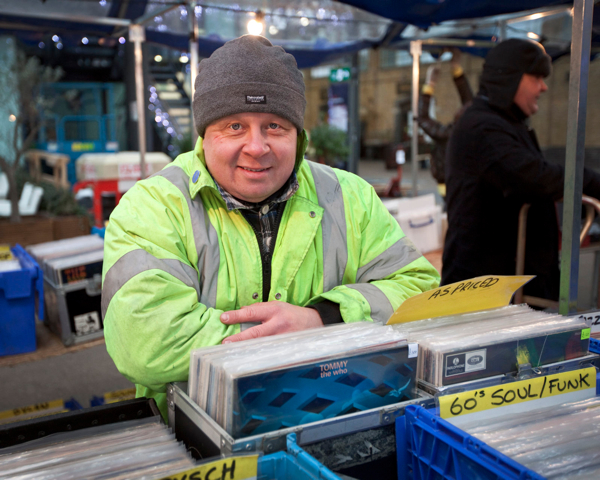
Rob Henson of www.pop-classics.com – “my partner is a horrible cockney”
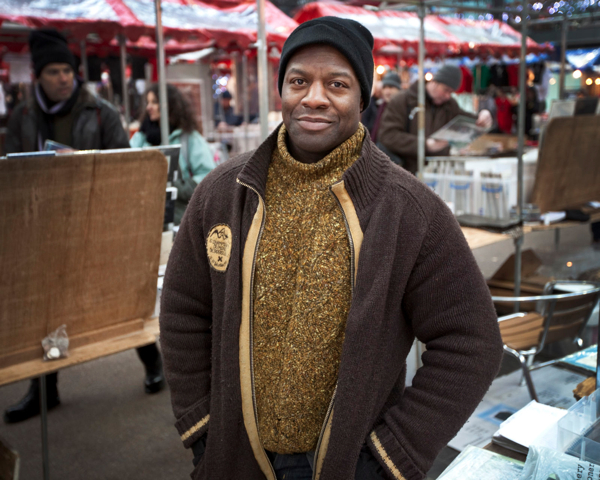
Tony James – “I also do rock and psychedelic”
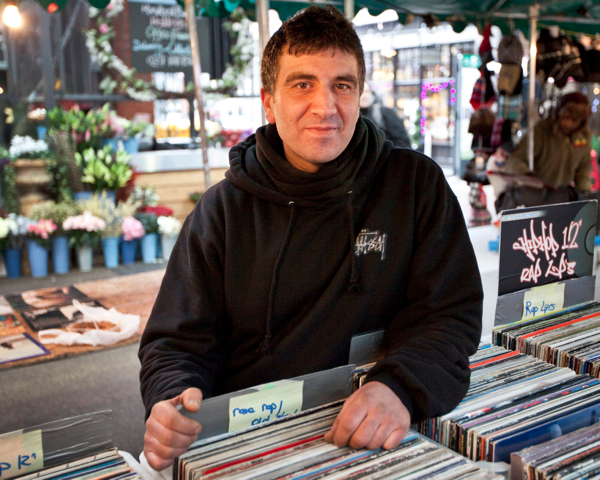
Chris Energy – “It’s been my life for twenty-four years”
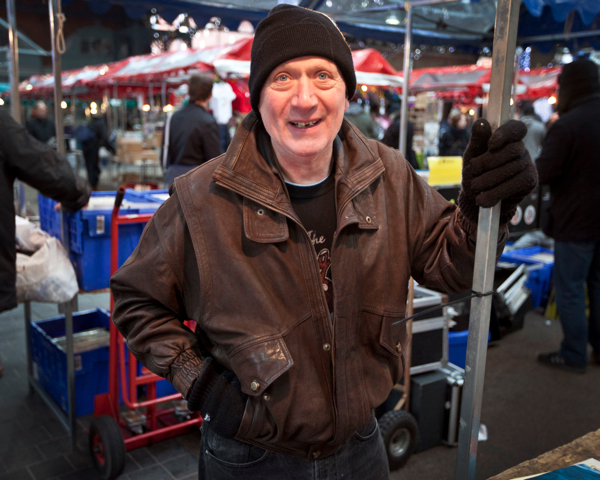
Alan Dallison – “I was a DJ for the ‘Voice of Peace’ in 1974”
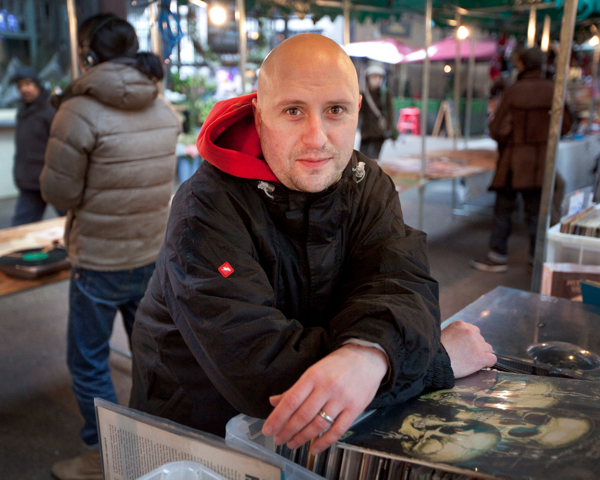
Ritchie Wheeler – “I am totally absorbed by music”
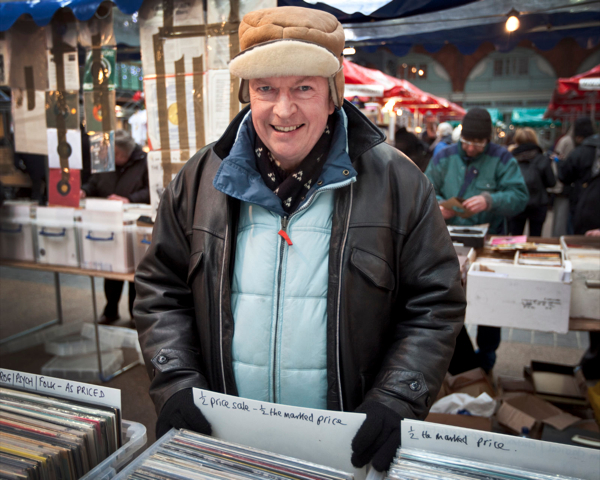
Pete Flanagan of www.sohomusic.com – “I’ve always done it.”
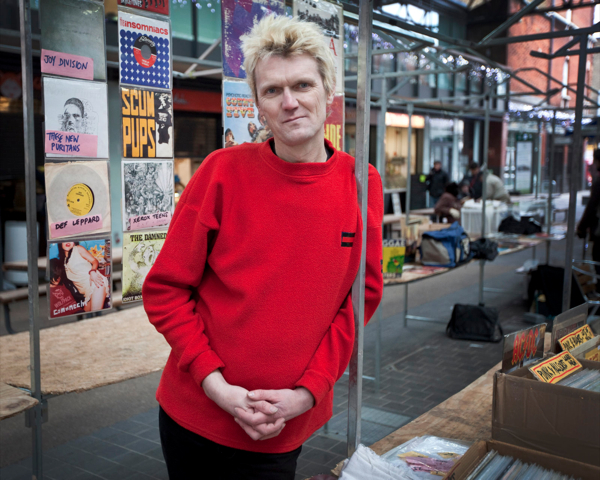
Ray – “selling off my punk”
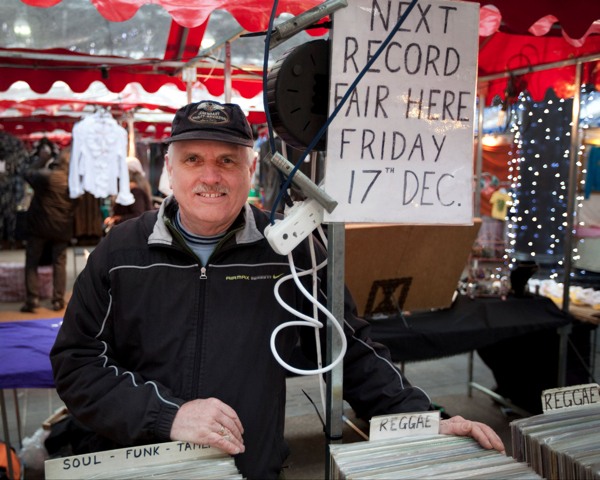
Dave Neale – “I used to be a milkman for fifteen years”
Photographs copyright © Jeremy Freedman
At Lady Sandra Bates’ Birthday Bash

There are some people you meet to whom you cannot say “No,” because it would simply be an affront to their overwhelming generosity of spirit, and the redoubtable Lady Sandra Bates (Bunny Sandie of 1966) who I met at the Bunny Girls’ Reunion at the Grapes in Limehouse is one such person.
So when Lady Sandra invited me and Spitalfields Life contributing photographer Sarah Ainslie to her sixty-fifth birthday bash in Mayfair, it would have been disingenuous not to accept. The truth is that we leapt at the invitation because, now that the season for celebration is upon us, we thought it would be the perfect opportunity to make a rare foray up to the West End and become society reporters for a night, to permit our readers in the East End a glimpse of how the other half lives.
We were walking down Dover St through the driving snow in search of the party venue, and feeling far from our familiar East End streets, when three young ladies imbued with festive spirit rolled out of a taxi, so we thought it pertinent to ask them if they knew where Lady Sandra Bates’ birthday party was taking place. At the very mention of the magic name, all three lit up with delight and anticipation, and the tallest cried out “Batesy, you old bitch, where are you?” to the street, in a reckless shriek of bravado, which was a cause of great relief to us because we knew we had come to the right place.
Before we knew it we were ushered into a high class cellar, where the elite were gathering, drawn together by their shared affection for Lady Sandra Bates who held the focus of attention effortlessly, glittering magnificently in a gold-sequined top, which exemplified her larger than life disposition and sparkling personality. I quickly discovered that almost no-one knew anyone else, and everyone had a different story to tell about how they met Lady Sandra – in a nightclub toilet, or an art gallery in Kensington or at one of Jason’s famous networking parties, these were explanations that cropped up several times. Yet in spite of their diversity of background, everyone was excited to be here “in society,” unified by their passion for Lady Sandra who makes it her business to be the life and soul of any party. Undertaking an impromptu survey, I asked people what they admired most about Lady Sandra and the answered ranged from, “Her hair, eyelashes and nails” – “Her balls” – “Her smile” – “Her tenacity and determination”- “Her ability to bring people together,” to “Her propensity to go in the lift in her pyjamas.”
Lady Sandra’s daughter Charlotte confessed to me how much she admired her mother’s strength of character for taking advantage of the opportunities available to her as a Playboy Bunny in sixties’ London. “She bought her first house with the diamonds Sir Charles Clore gave her, you know?” she told me, flashing her eyes in wonder. Charlotte regaled me with happy childhood tales of learning to ride her bike in Grosvenor Square, and when her mother came to the school fete in a long black wig and ankle-length fur coat, and got drunk with the headmaster. I also had the pleasure of an introduction to mild-mannered East Ender, Frank Gregory, Lady Sandra’s Bates’ gentleman, owner of a Lancia dealership and a block of flats in Whitechapel, or as she put it succinctly, “the one who buys my diamonds and furs, darling.”
The surprise of the evening was an encounter with the amiable Sean McGuigan, full of swagger and charm, flashing a rakish gold tooth, and showing off the flask of vodka that he had concealed “down me nuts.” He was delirious with glee to brag of his recent release from prison following a conviction for blackmailing the Royal family – the first attempt in over a century. The next guest to swerve into my field of vision was a fresh faced thirty-eight year old, Crystyl, from California who explained that she was delighted to be here in London because everyone at parties in Los Angeles looked young. And then she proceeded to share her discovery that Vaseline applied to the lower eyelids takes eight years off your age, as well as being cheaper and less invasive than Botox.
At last, in the midst of the lively throng vying for her attention, hungry myself to gather further morsels of information about Lady Sandra’s charmed life, I managed to snatch the privilege of a few intimate moments with the birthday girl herself. Batting her eyelashes seductively and displaying a blissful smile, she told me she woke to glass of champagne that morning, then it was off to Princess Margaret’s hairdresser to get spruced up, followed by tea at the Ritz with her two daughters. Getting a little dreamy when she admitted that she took a sentimental moment to think of George Best, with whom she once opened a club, Blondes in Dover St, and gazing up into my eyes, for a moment, in her reverie she had the look of a lost child. “That’s all I know, darling, is Dover St.” she declared – as if it were a summation of her existence – flicking her wrist in a gesture of louche resignation and assuming a tone of dreamy innocence. Then she confided she had received a diamond ring worth a quarter of a million and a Gucci handbag that cost nine hundred and fifty pounds.
When I asked about her future plans, entering her sixty-fifth year, Lady Sandra told me that she has bought “a little place in Covent Garden with a turret,” where she plans to set up a salon with all her young artists that she patronises around her. The model is Hugh Hefner’s Playboy Mansion, she explained. Apparently “Hef” has a turret where he surrounds himself with young ladies and now Lady Sandra, with characteristic flamboyance, plans to surround herself with talent in the same way. And if that is how Lady Sandra chooses to grow old gracefully, who are we to deny her such extravagant dreams?
Reluctantly, Sarah and I had to slip away from the party before midnight to catch the bus home, our heads spinning with the night’s adventures, yet although I was delighted to have glimpsed another world – almost like a painting by William Hogarth come to life – I must confess I was not unhappy to return to my modest existence in the East End.
Watch a short film of Lady Sandra Bates introducing herself by clicking here.
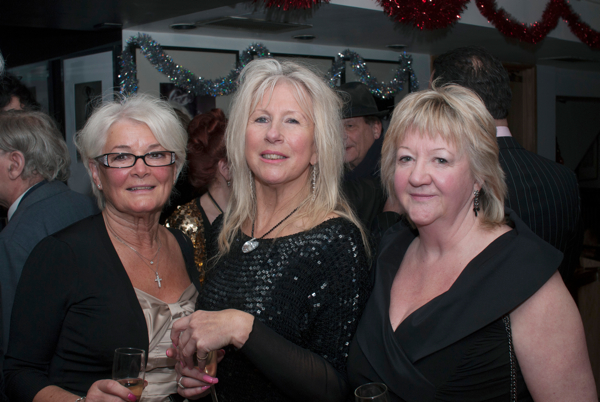
Three belles from Berkhamsted, Carole, Jane and Carolynne.
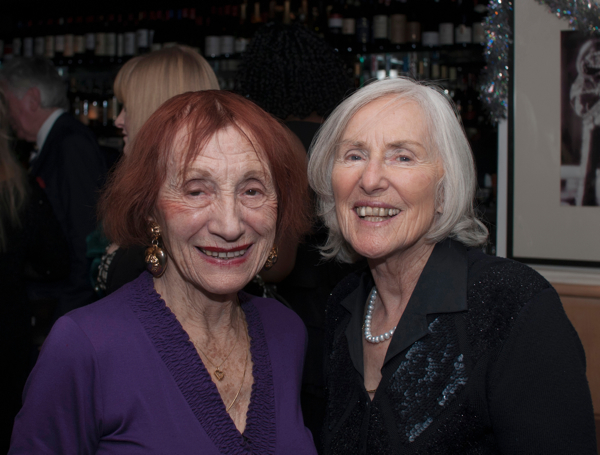
Fay met Lady Sandra in a nightclub toilet and Elaine met Lady Sandra at an art gallery.
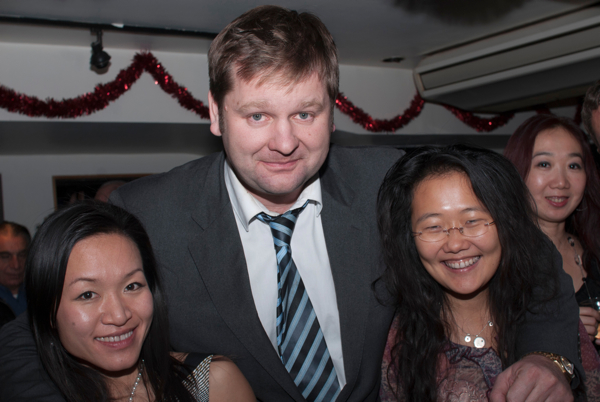
Ed with new friends Wendy and Yang.
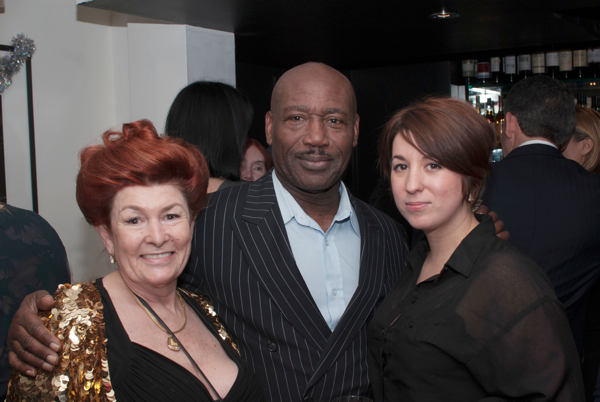
Lady Sandra and her daughter Charlotte, with legendary DJ Fitz Brown from Tramps – back in the glory days when Catherine Zeta-Jones and Mick Hucknall were dating.

Actress Maggie Steed raises a birthday toast to Lady Sandra Bates.

Maggie Steed with Mr & Mrs Collins, a happily divorced couple.

Elizabeth & Crystyl from Los Angeles by way of South Woodford.

Theodora, Davina and Lady Sandra Bates’ gentleman Frank Gregory.
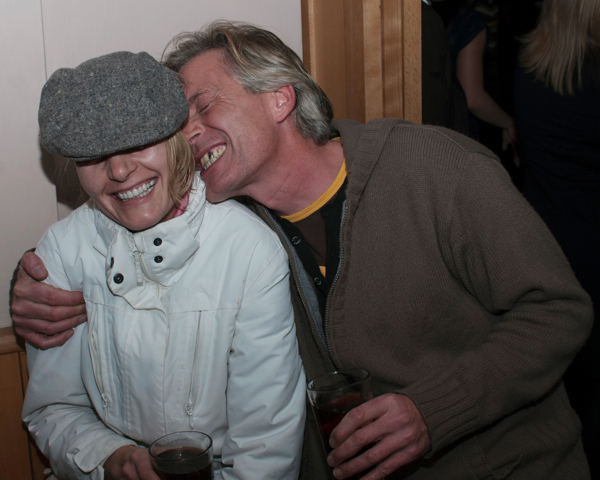
Sean McGuigan and Genevieve, celebrating six months since Sean’s release from prison.
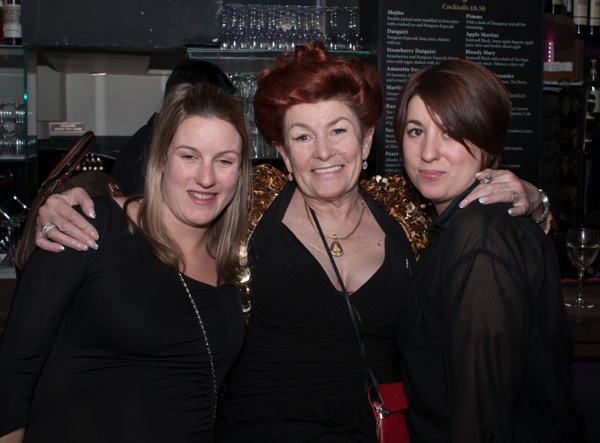
The ever-radiant Lady Sandra Bates with her proud daughters, Camilla and Charlotte.
Photographs copyright © Sarah Ainslie
Columbia Road Market 62
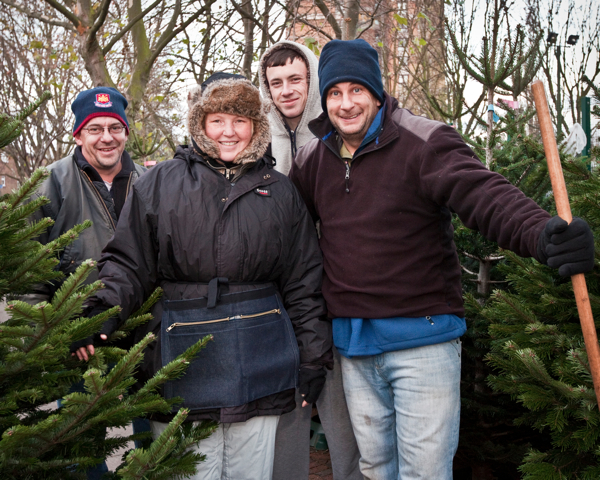
There was an even greater than usual bustle of activity at Columbia Rd early this morning, with big trucks backing up in the darkness, and traders running to and fro, to unload hundreds of Christmas trees that have arrived from Scandanavia to grace the parlours of the East End. It was an extraordinary spectacle to come round the corner and discover the street transformed into a pine forest, with so many trees lined up in such depth to create a magical landscape, as if – like Narnia – you could walk into a thicket and come out in another world.
At the Western end of Columbia Rd, I came across the tree-sellers A.E.Harnett & Sons of Stock in Ingatestone, Essex, who have imported an entire forest of lustrous sweet smelling pines of all sizes. Shane Harnett, a fourth generation nurseryman told me his family have been selling trees here on this spot in Columbia Rd for over a century each Christmas. While Shane and his colleagues busied themselves martialling their stock in preparation for a furious day’s trading, his wife Yvonne graciously spared me a few moments for a chat, clutching a cup of hot soup and a sandwich, as we stood together, surrounded by trees in a temporary forest grove.
Throughout the year, Harnett’s nursery maintain a double pitch and a casual pitch on Columbia Rd selling plants of all kinds, but for four weeks in December the entire family turns out to lend a hand with the mighty endeavour of the Christmas trees. “Shane and the family run the nursery and I stay at home,” confided Yvonne with a good-humoured smirk from beneath her fur-lined hat, but that did not stop her from getting up at twenty past two this morning to be here lending her husband a helping hand, as she has done each Christmas for the past seven years. A woman of spirit, she appeared quite unconcerned by the sub-zero temperatures. “It’s alright,” she reassured me, “We do it every year, we know what it’s going to be like.”
Photograph copyright © Jeremy Freedman
Terry O’ Leary, Joker

“For two years, I cared for my brother – who was diagnosed with HIV in 1987 – in his council flat, but after he died I couldn’t stay there because my relationship with him as his sister wasn’t recognised by the council, and that’s how I became homeless,” said Terry speaking plainly, yet without self-pity, as we sat on either side of a table in Dino’s Cafe, Spitalfields. And there, in a single sentence you have the explanation of how one woman, in spite of her intelligence and skill, fell through the surface of the world and found herself living in a hostel with one hundred and twenty-eight other homeless people.
Terry is a shrewd woman with an innate dignity, and a lightness of manner too. She manages to be both vividly present in the moment and also detached – considering and assessing – though quick to smile at the ironies of life. She wears utilitarian clothing which reveals little of the wearer and sometimes she presents an apparently tentative presence, but when you meet her sympathetic dark eyes, she reveals her strength and her capacity for joy.
No one could deny it was an act of moral courage, when Terry gave up her career as a chef to care for her brother at a time when little support or medication was available to those with AIDS, moving in with him and devoting herself fully to his care. Yet in spite of the cruel outcome of her sacrifice, Terry discovered the resourcefulness to create another existence, which today allows her to draw upon these experiences in a creative way, through her work as performer and teacher with Cardboard Citizens, the homeless people’s theatre company based in Spitalfields.
“I took what I could with me, the rest I left behind. I took photographs and personal things. You fill your car with your TV, records, books and all the rest of it – but then you find it can be quite liberating because you realise all that stuff is not important.” admitted Terry with a wry smile, recounting a lesson born out of necessity. In the Mare St hostel in Hackney, Terry stayed in her tiny room to avoid the culture of alcohol and drug-taking that prevailed, but instead she found herself at the mercy of the absurdly doctrinaire bureaucracy, “I remember the staff coming round and saying, ‘You have to remove one of the two chairs in your room because you’re only allowed to have one.'” Terry recalled.“You find you’re living in a universe where you can get evicted for having two chairs in your room.” she added with a tragic smirk.
A few months after she came to the hostel, Cardboard Citizens visited to perform and stage workshops, permitting Terry to participate and make some friends – but most importantly granting her a new role in life. “I was hooked,” confided Terry, “What I liked about it was the opportunity to talk about our own experiences and how we can make a change. And the best part of it was when the audience became involved and got on stage.” Now that she works for them, Terry describes the aim of the company as being to “give voice to the homeless oppressed and show the situations homeless people face.” Inspired by the principles of theatrical visionary Augusto Boal, the company perform in homeless shelters and hostels, creating vital performances that invite audiences of the homeless to participate, addressing in drama the pertinent questions and challenges they face in life – all in pursuit of the possibility of change.
Terry’s role is central to the company, as mediator, bringing the audience to the play, and raising questions that articulate the discussion manifest in the drama. She carries it off with grace, becoming the moral centre of the performance. And it is a natural role for Terry, one she refers to as “Joker” – somebody who will always challenge – anchoring the evening with her sense of levity and quick intelligence, without ever admitting that she understands more than her audience. Though, knowing Terry’s story, I found it especially poignant to observe Terry’s measured equanimity, even when the drama dealt with issues of grief and dislocation that are familiar territory for her personally.
“You don’t have to accept things as they are. You can fight back.” declared Terry, her dark eyes glinting as she spoke from first hand experience, when I asked how her understanding of life had been altered by becoming homeless. “Why is it that the economic underclass are being hammered for the mess that we’re in?” she asked in furious indignation, “I think what’s opened my eyes is that there’s so much kindness and support coming from people who have got very little. I can’t deal with the big picture, I tend to narrow it down to the people in the room and just keep chipping away at small changes. And I’m going to do this for the rest of my life.” There is an unsentimental fire in Terry’s rhetoric, denoting someone who has been granted a hard won clarity of vision, and at the Code St hostel where I saw the performance I was touched to see her exchanging greetings with long-term homeless people she has known over the eight years she has worked with Cardboard Citizens.
As we left Dino’s Cafe and walked up the steps of Christ Church, Spitalfields, to take Terry’s portrait in the Winter sunlight, she cast her eyes around in wonder at the everyday spectacle of people walking to and fro, and confessed to me, “I teach up at Central School of Speech & Drama now and it’s quite amazing to think ten years ago I was sitting in a hostel, wondering what’s going to happen next and what’s my future going to be? Am I going to be like that woman down the hall, drunk off her head, or on crack?” Then she it shrugged off as she turned to the camera.
Terry still thinks about her brother. “His eyesight started to go and he set fire to the bed,” she told me, explaining why it became imperative to move in with him,“He was a stubborn guy but he had to concede that he needed help. He was developing dementia and his eyesight was fading.” It was his unexpected illness and death that triggered the big changes in her existence, but today Terry O’Leary lives in a flat of her own again and finds herself at the centre of a whole new life.

Terry when she started with Cardboard Citizens in 2002.
The Curry Chefs of Brick Lane

With the blizzard whirling down Brick Lane this week, it was the ideal moment for a hot curry to warm the spirits, and so – dodging the mischievous curry touts’ snowball bouts between rival restaurants – I set out in the company of Spitalfields Life contributing photographer Jeremy Freedman, to make the acquaintance of some of Brick Lane’s most celebrated Curry Chefs. We were privileged to be granted admission to the modest kitchens tucked away at the back or in the basement of the curry houses, where Head Chefs martial whole teams of underchefs in a highly formalised hierarchy of responsibility.
It was a relief to step from the cold street into the heat of the kitchens, where we discovered our excited subjects glistening with perspiration, all engaged in the midst of the collective drama that results in curry. We found that these were men who – for the most part – had worked their way up over many years from humble kitchen porters to enjoy their heroic leading roles, granting them the right to a degree of swagger in front of the lense.
We encountered the charismatic Zulen Ahmed (pictured above) standing over his clay-lined tandoori oven beneath the Saffron restaurant where he has been Head Chef for ten years now. Trained by the renowned Curry Chef, Ashik Miah, Zulen served eight years as a porter before ascending to run his own kitchen, now supervising a team consisting of two chefs who do the spicing and make the sauces, a tandoori chef, two cooks who cook rice and poppadums, a second chef who prepares side dishes and a porter who does the washing up. “The Head Chef listens to everybody,” he explained deferentially, with his staff standing around within earshot, and thereby revealing himself to be a natural leader.
Across the road at Masala, we met Head Chef, Shaiz Uddin, whose mother is a chef in Bangladesh. She taught him to cook when he was ten years old. Shaiz told me he worked in her kitchen as Curry Chef for seven years, before he came to London ten years ago to bring the authentic style to Brick Lane, where today he is known for his constant invention in contriving new dishes for his eager customers.
It was quickly apparent that there is a daily routine common to all the curry kitchens of Brick Lane. At eleven each morning, the chefs come in and work until three to prepare the sauces and half cook the meat for the evening. At three they take a break until six, while the underchefs, who arrive at three, prepare the vegetables and salad. Then at six, when the chefs return, the rice is cooked and – now the kitchen is full – everyone works as a team until midnight, when it is time to throw out the leftovers and make the orders for the next day. This is the pattern that rules the lives of all involved. “I like to be busy,” Nurul Alam, Head Chef at Preem & Prithi, informed me blithely – he regularly cooks three hundred curries a night.
Over at the Shampan, Monzur Hussain, emerged from the kitchen with his brow covered in perspiration to brag about his meteoric rise, commencing as a kitchen porter in 1997, becoming a chef in 2000 and winning Best Chef in the Brick Lane Curry Festival in 2005. Monzur sets an example that is an inspiration to Dayem Ahmed, a porter who has been there just six months, already daydreaming of achieving Best Curry Chef in 2018.
Finally, at the Aladin we met Brick Lane’s most senior Curry Chef, the distinguished Rana Miah who started work in 1980 as a kitchen porter when he arrived from Bangladesh, graduating to chef in 1988. “At that time we served only Bengalis, but by 1995 the customers were all Europeans,” he recalled, describing his tenure as chef at one of Brick Lane’s oldest curry houses, which opened in 1985 and is second only to the Clifton in age. Rana explained that he runs his kitchen upon the system of “Handy Cooking,” based around the use of large stock pots to cook the food. “That’s the way it’s done in Bangladesh,” he confirmed, “This is a traditional restaurant.” As the longest serving Curry Chef, Rana gets frequent consultations from the other chefs on Brick Lane and, remains passionate about his vocation, arriving before everyone each day and leaving after everyone else too.
We never asked the Curry Chefs to cross their arms, but they all assumed this stance, independently and without prompting – even Dayem, the kitchen porter, yet to commence his training as a chef, knew what to do. It is a posture that proposes professionalism, dignity and self-respect, yet it also indicates a certain shared reticence, a reserved nature that prefers to let the culinary creations speak for themselves. So I ask you to spare a thought for these proud Curry Chefs, working away like those engineers slaving below deck on the great steam ships of old, they are the unseen and unsung heroes of Brick Lane’s Curry Mile.

Abdul Ahad Forhad, Curry Chef at Monsoon, 78 Brick Lane – “I’m the master of curry!”

Head Chef Shaiz Uddin with his colleague Monul Uddin, Tandoori Chef at Masala, 88 Brick Lane.

Nurul Alam, Head Chef at Preem & Prithi, 124/6 Brick Lane, cooks three hundred curries a night.

Rana Miah, Brick Lane’s longest serving Curry Chef stands centre, flanked by Kholilur Rahman and Mizanur Khan in the kitchen of the Aladin, 132 Brick Lane.

Monzur Hussain, Head Chef at Shampan, 78 Brick Lane.

Dayem Ahmed, kitchen porter of six months standing and aspiring chef, at Shampan.
Photographs copyright © Jeremy Freedman