Bill Crome, Window Cleaner

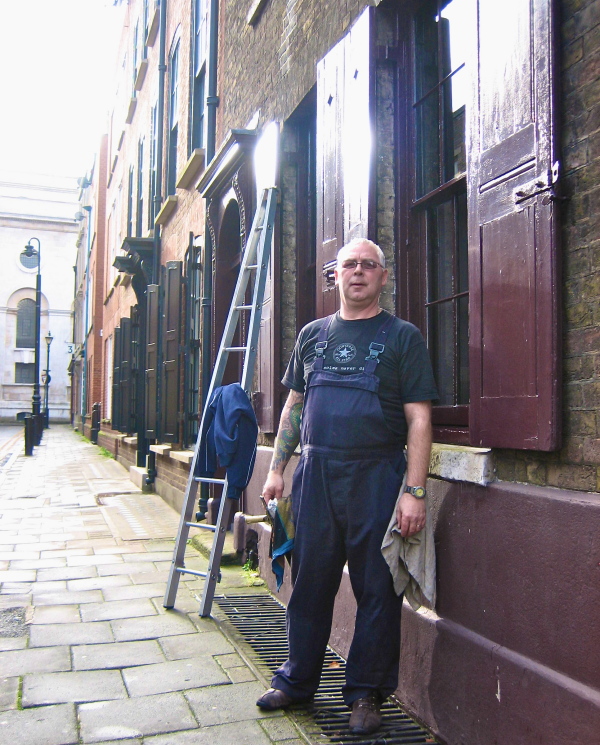
This is Bill Crome, a venerable window cleaner with thirty years’ experience in the trade, who makes a speciality out of cleaning the windows of the old houses in the East End. You might assume cleaning windows is a relatively mundane occupation and that, apart from the risk of falling off a ladder, the job is otherwise without hazard – yet Bill’s recent experiences have proved quite the contrary, because he has supernatural encounters in the course of his work that would make your hair stand on end.
“It wasn’t a career choice,” admitted Bill with phlegmatic good humour, “When I left school, a man who had a window cleaning business lived across the road from me, so I asked his son for a job and I’ve been stuck in it ever since. I have at least sixty regulars, shops and houses, and quite a few are here in Spitalfields. I like the freedom, the meeting of people and the fact that I haven’t got a boss on my back.” In spite of growing competition from contractors who offer cleaning, security and window cleaning as a package to large offices, Bill has maintained his business manfully, even in the face of the recession, but now he faces a challenge of another nature entirely. Although, before I elaborate, let me emphasise that Bill Crome is one of the sanest, most down-to-earth men you could hope to meet.
“I’ve heard there is a window cleaner in Spitalfields who sees ghosts,” I said, to broach the delicate subject as respectfully as I could. “That’s me,” he confessed without hesitation, colouring a little and lowering his voice, “I’ve seen quite a few. Five years ago, at the Society for the Protection of Ancient Buildings in Spital Sq, I saw a sailor on the second floor. I was outside cleaning the window and this sailor passed in front of me. He was pulling his coat on. He put his arms in the sleeves, moving as he did so, and then walked through the wall. He looked the sailor on the Players Navy Cut cigarette packet, from around 1900 I would guess, in his full uniform.
And then I saw a twelve year old girl on the stair, she was bent down, peering at me through the staircase. I was about to clean the window, and I could feel someone watching me, then as I turned she was on the next floor looking down at me. She had on a grey dress with a white pinafore over the top. And she had a blank stare.
I did some research. I went to a Spiritualist Church in Wandsworth and one of the Spiritualists said to me, ‘You’ve got a friend who’s a sailor haven’t you?’ They told me how to deal with it. When we investigated we found it was to do with the old paintings at the Society for the Protection of Ancient Buildings, amongst the collection were portraits of a sailor and of a girl. Once I was walking up to the top floor, and I looked at the picture of the girl and she had a smiling face – but when I went back to collect my squeegee, I looked again and she had a frown. It sounds really stupid doesn’t it? I found a leaflet in the house explaining about the history of the paintings and how the family that gave them was dying off. The paintings are off the wall now, yet they had a nice feeling about them, of sweetness and calm.”
Bill confirmed that since the paintings were taken down, he has seen no more ghosts while cleaning windows in Spital Sq and the episode is concluded, though the implications of these sinister events have been life changing, as he explained when he told me of his next encounter with the otherwordly.
“I was cleaning the windows of a house in Sheerness, and I looked into the glass and I saw the reflection of an old man right behind me. I could see his full person, a six foot four inch very tall man, standing behind me in a collarless shirt. But when I turned round there was no-one there.
I went down to the basement, cleaning the windows, and I felt like someone was climbing on my back. Then I started heaving, I was frozen to the spot. All I kept thinking was, ‘I’ve got to finish this window,’ but as soon as I came out of the basement I felt very scared. Speaking to a lady down the road, she told me that in this same house, in the same window, a builder got thrown off his ladder in the past year and there was no explanation for it.
I won’t go back and do that house again, I can tell you.”
As Bill confided his stories, he spoke deliberately, taking his time and maintaining eye contact as he chose his words carefully. I could see that the mere act of telling drew emotions, as Bill re-experienced the intensity of these uncanny events whilst struggling to maintain equanimity. My assumption was that although Bill’s experience at the Society for the Protection of Ancient Buildings might be attributed to a localised phenomenon, what happened in Sheerness suggests that Bill himself is the catalyst for these sightings.
“I feel that I have opened myself up to it because I’ve been to the Spiritualist Church a few times,” he revealed to me. “I do expect to see more ghosts because I work in a lot of old properties, especially round Spitalfields. I don’t dread it but I don’t look forward to it either. It has also made me feel like I do want to become a Spiritualist, and every time I go along, they say, ‘Are you a member of the church?’ But I don’t know. I don’t know what can of worms I’ve opened up.”
Bill’s testimony was touching in its frankness – neither bragging nor dramatising – instead he was thinking out loud, puzzling over these mysterious events in a search for understanding. As we walked together among the streets of ancient dwellings in the shadow of the old church in Spitalfields where many of the residents are his customers, I naturally asked Bill Crome if he has seen any ghosts in these houses. At once, he turned reticent, stopping in his tracks and insisting that he maintain discretion. “I don’t tell my customers if I see ghosts in their houses.” he informed me absolutely, looking me in the eye,“They don’t need to know and I don’t want to go scaremongering.”
Olha Pryymak, A Painting a Day
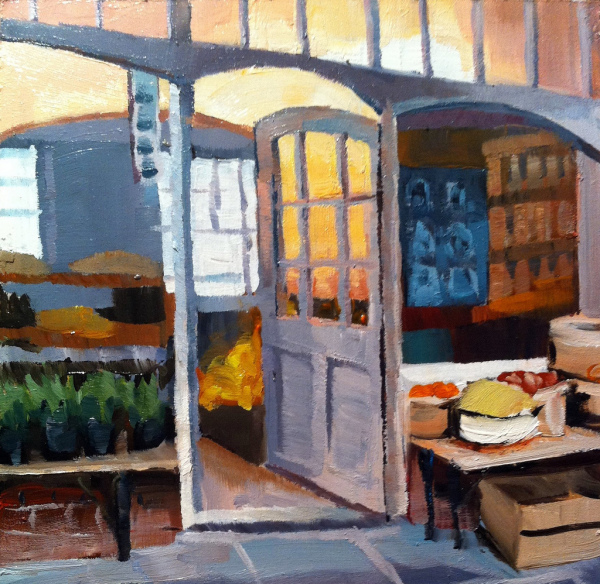
At Leila’s Shop, Calvert Avenue, November 17th 2010
When Olha Pryymak arrived to meet me in Spitalfields on her bicycle, once she had dropped off her son at Columbia Rd Nursery, she was ready and eager to talk about her practice of painting a picture every day. And I recognised an imperative to make the interview brief – because she had to paint her next picture and post it on the internet before getting back to the school gates again at three. Yet Olha herself was sublimely comfortable with the situation, and more than happy to sit with her ipad scrolling through the online gallery of hundreds of her paintings, because she was in her own time.
“This was not my idea,” she declared, clasping her delicate hands and folding her pianist’s fingers with a modest candour, admitting her debt to the international movement of daily painters who show their work on the internet and in particular to Edward B. Gordon. Olha chose to embrace this singular endeavour in 2006, upon her return to her native Ukraine, when she became pregnant after nine years in Washington D.C. where she had done a Communication & Business Degree before landing a job in Financial Statistics at the World Bank. “It was fun, a great working environment,” Olha said, moving on with disarming levity, while also revealing an admirable strength of mind.
“I badly wanted to have the baby in the Ukraine, and to get back to what I always wanted to do. So I did a painting a day for year solid and it sharpened my painting skills. I was busy painting what was in front of me. And it gave me feedback and kept me in touch with the international painting community too. I think being under pressure helped me to make better paintings, because now I am able to keep focus on one or two things at once.” Olha has the self-respecting confidence of a woman who has made her own way in the world and yet she is quick to acknowledge the support she has received too, “It was possible because of my hardworking husband, who didn’t move to the Ukraine, he moved to London. He flew back and forth until 2008 when we were reunited here, living in a flat in Cheshire St.”
Olha’s pictures demonstrate the spontaneity and endearing lack of pretension that is characteristic of the daily painters’ movement which has blossomed on the internet. “Although it’s addictive and I wouldn’t do anything else now, I have a family, so that dictates.” she explained, “I take vacations and I usually paint about five pictures each week. I’m doing really well, I have been accepted for the Royal Academy twice. What I love is that I can do this instead of having to get a job. Though there are limits to it, because people are unlikely to buy something big over the internet unless you have a reputation, that’s why my pictures are all sized fifteen centimetres by fifteen centimetres.” Over time, Olha has embraced these limitations of time and of scale, defining a form as distinctive as the Elizabethan miniaturists. Now she chooses to forgo larger pictures in favour of the dynamic possibilities of her chosen canvas, and prefers posting work online and getting immediate responses over the impersonal environment of the gallery.
Looking back over Olha’s archive of work, I began to see that it has a lot in common with a diary, recording the fleeting impressions of the passing days, created in the moment rather composed retrospectively into something more self-conscious. “I eyeball what’s going to be a good composition and I carry it in mind,” she revealed to me, raising her brows and casting her eyes suspiciously to the looming sky over Spitalfields.“You just can’t paint ‘en pleine aire’ in London, the weather changes too much and it almost always rains.” she declared, from personal experience exemplified in the all-enveloping raincoat she was wearing that day.“I do work from photographs and I am not ashamed of it,” she continued brightly, confident in her own aesthetic,“It’s a visual cue, but it’s the experience I want to capture.” When I asked Olha if she has a studio, “I have a paint box,” was her dignified reply.
Until Olha was five years old, she lived in the forest because her father worked as a woodman, and then the family moved to Lutska, a small town in the North of Ukraine when she started school. “It was fascinating in 1989, with both Chernobyl and Perestroika in the same year,” she admitted with considerable understatement, widening her eyes, before adding,“And when I discovered what had happened in Western Culture since the nineteen sixties, I had quite a culture shock!”
There is a warm celebratory quality to these paintings, appreciating the inconsequential delights that Londoners often ignore, and reflecting Olha’s own affection for this city which brings her pleasure to depict. I can only admire the courage and tenacity of Olha Pryymak, pursuing such an ingenious way to earn her own money and retain an independent creative spirit. She had risen at five that day in order to make time to speak with me about her work, which she has spliced so elegantly into her life.
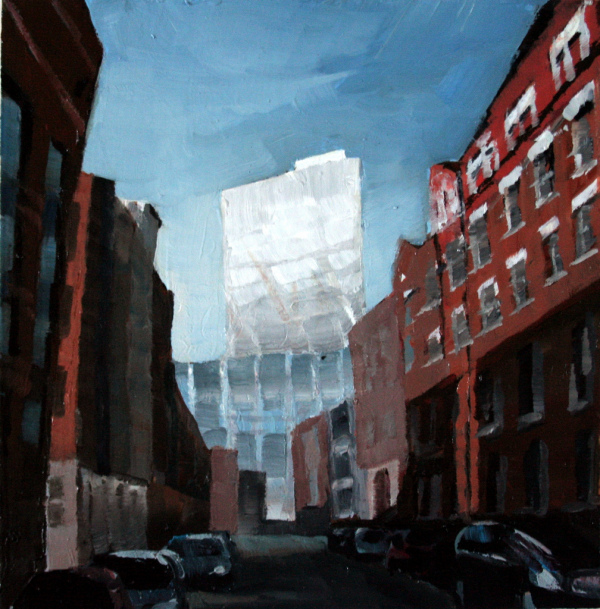
The Broadgate Tower viewed from Folgate St.
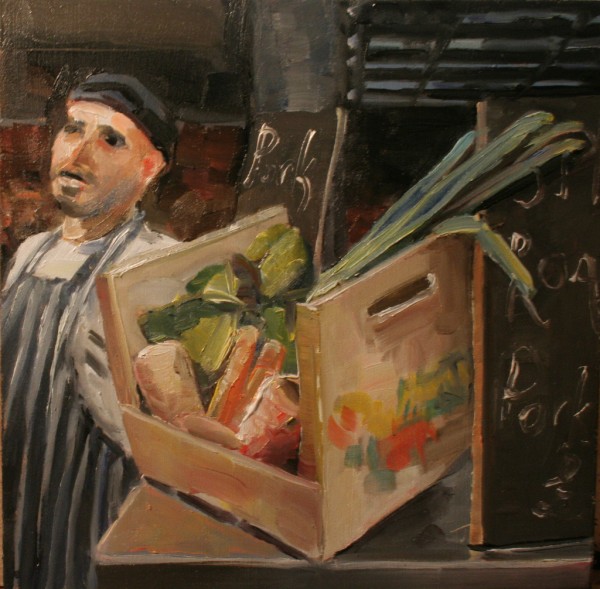
Sunday roast in Spitalfields.
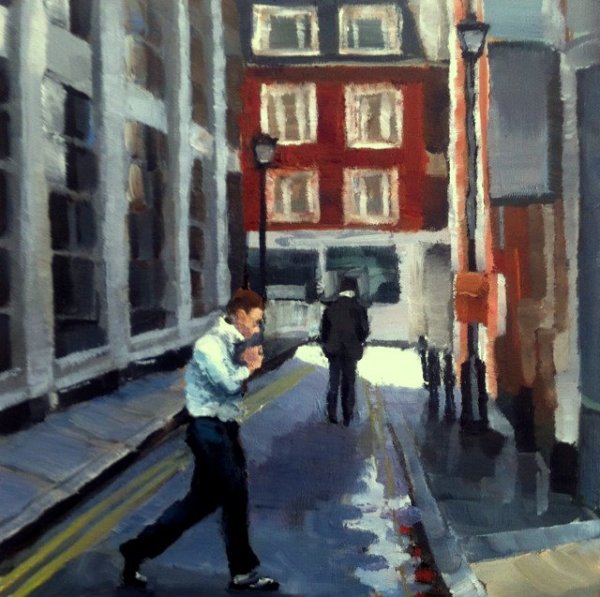
In Gun St.
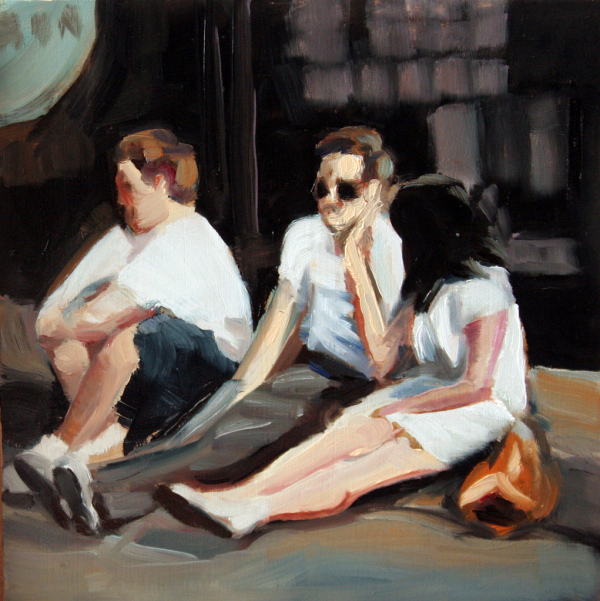
Three on Dray Walk.
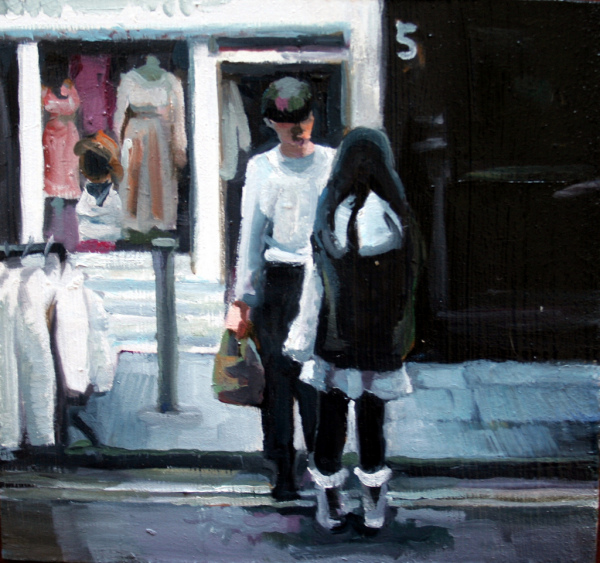
Face hunting in Brick Lane.
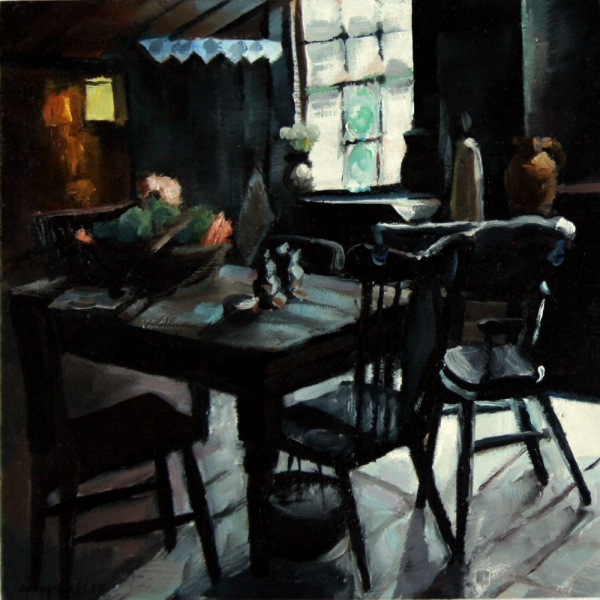
The kitchen at Dennis Severs’ House.
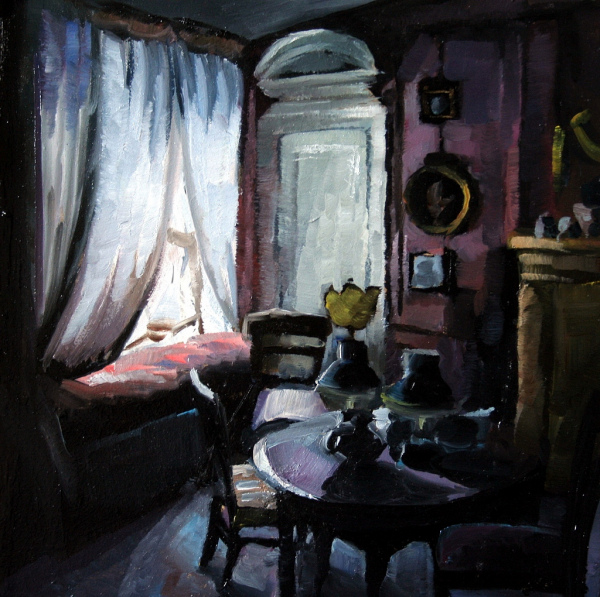
A bedroom at Dennis Severs’ House.
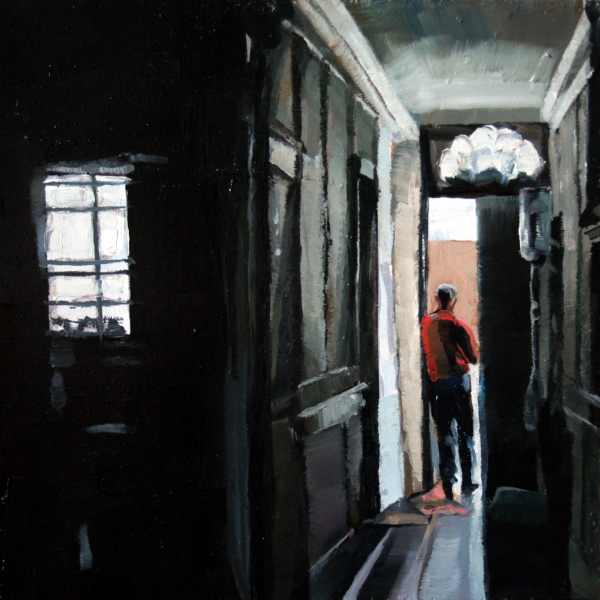
Mick Pedroli at the door, Dennis Severs’ House.
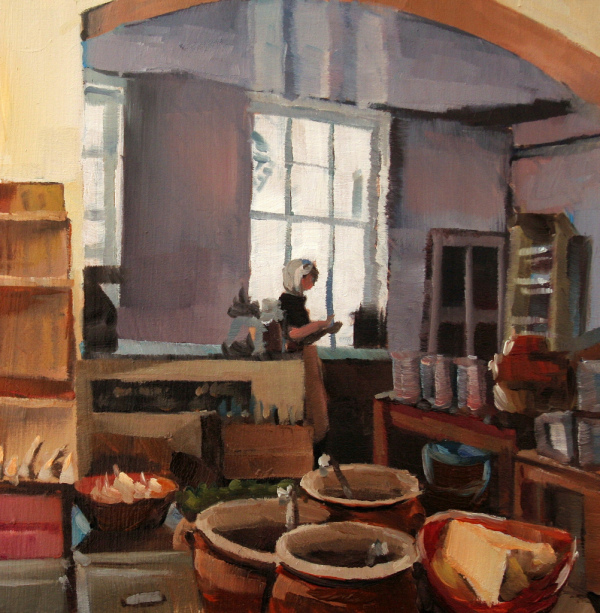
At Leila’s Shop.
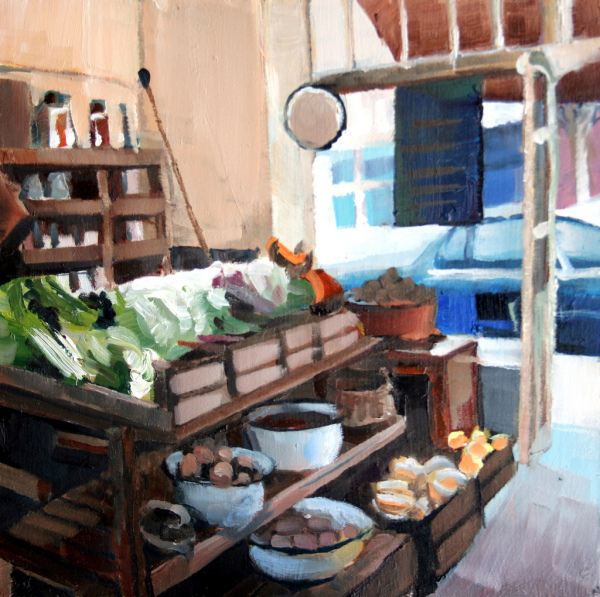
At Leila’s Shop looking out to Calvert Avenue
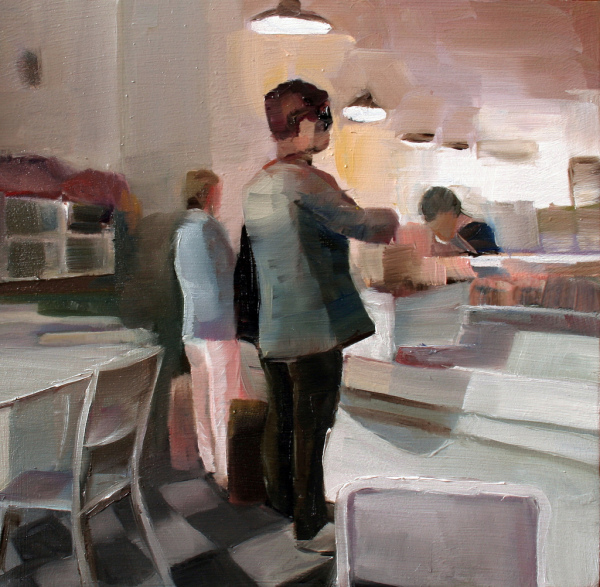
At Franze & Evans, Redchurch St
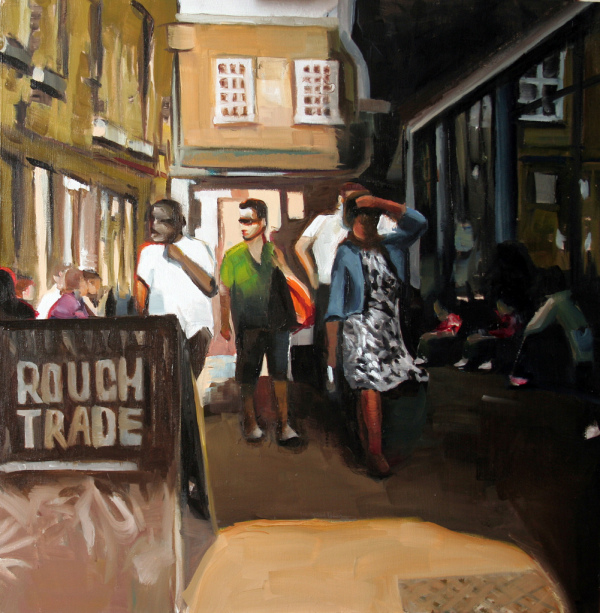
In Dray Walk
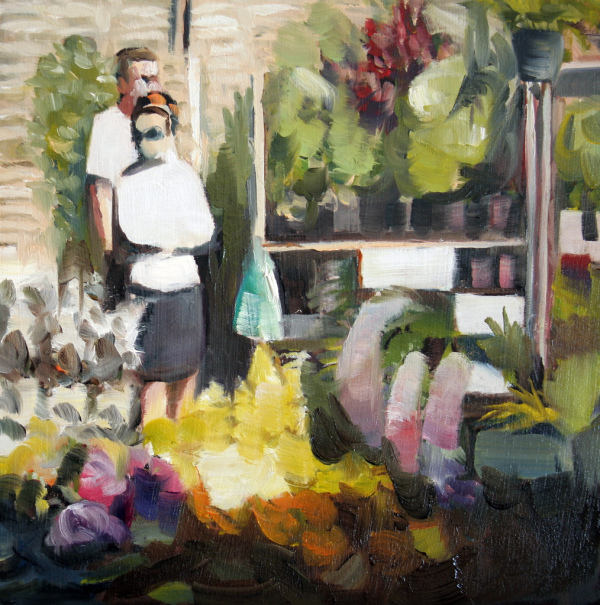
At Columbia Rd
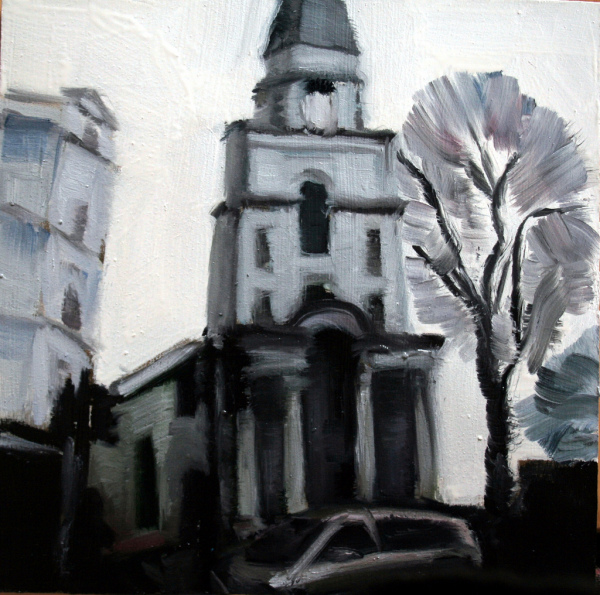
Christ Church, Spitalfields, February 2010
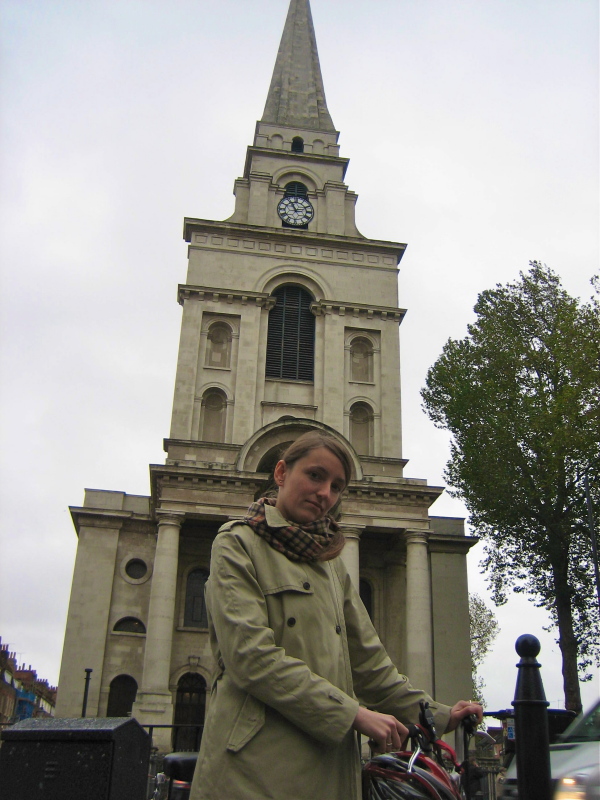
Olha Pryymak
Columbia Road Market 60
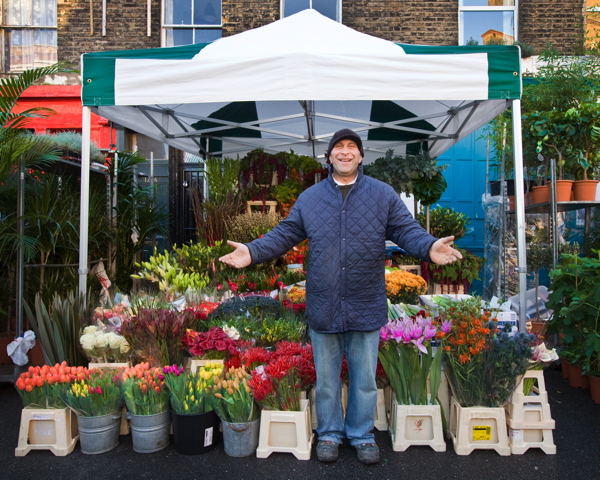
This is Rosario Rospo, universally known as Ross, who told me he has been trading here for fifteen years, but then we did the sums and he realised it was more like twenty five – that is how time passes when you are busy selling flowers every week in Columbia Rd. At the age of nineteen, Ross began working with his uncle Dennis selling cut flowers at the other of the market while worked his way up the waiting list to get a pitch of his own, where he presides today with a irresistible smile. Many of the traders I speak with each week in the grey dawn possess the pallid faces of those who rose too early, but Ross has a ruddy complexion and healthy tan complemented by intense blue eyes. The picture of vigorous health and with the physical presence of an athlete, bouncing around on the balls of his feet and limbering up for day’s trading, Ross bragged he has just lost twenty pounds through the boxercise and karate that he practises with his eleven year old son.
Ross has cut flower stalls at Bishop’s Stortford Market on Thursday and Saturday, and Hertford on Saturday, as well as his regular pitch here in Columbia Rd, which has the reputation as the best-organised flower stall in the market. In fact, it was only on my second attempt that I managed to snatch a conversation with Ross, because each time I asked he was pre-occupied in the all-consuming creative task of arranging his beloved roses, tulips and freesias in perfect ranks to create a masterly floral panorama worthy of an artist. This week Ross recommends buying Amaryllis which will last until Christmas. When I asked what keeps him coming back, “I know nothing else,” Ross answered plainly over his shoulder, his eyes already straying back to the fulsome perfection of his stall awaiting the imminent despoilation of this morning’s customers.
Photograph copyright © Jeremy Freedman
Adam Dant’s Map of Shoreditch in the Year 3000
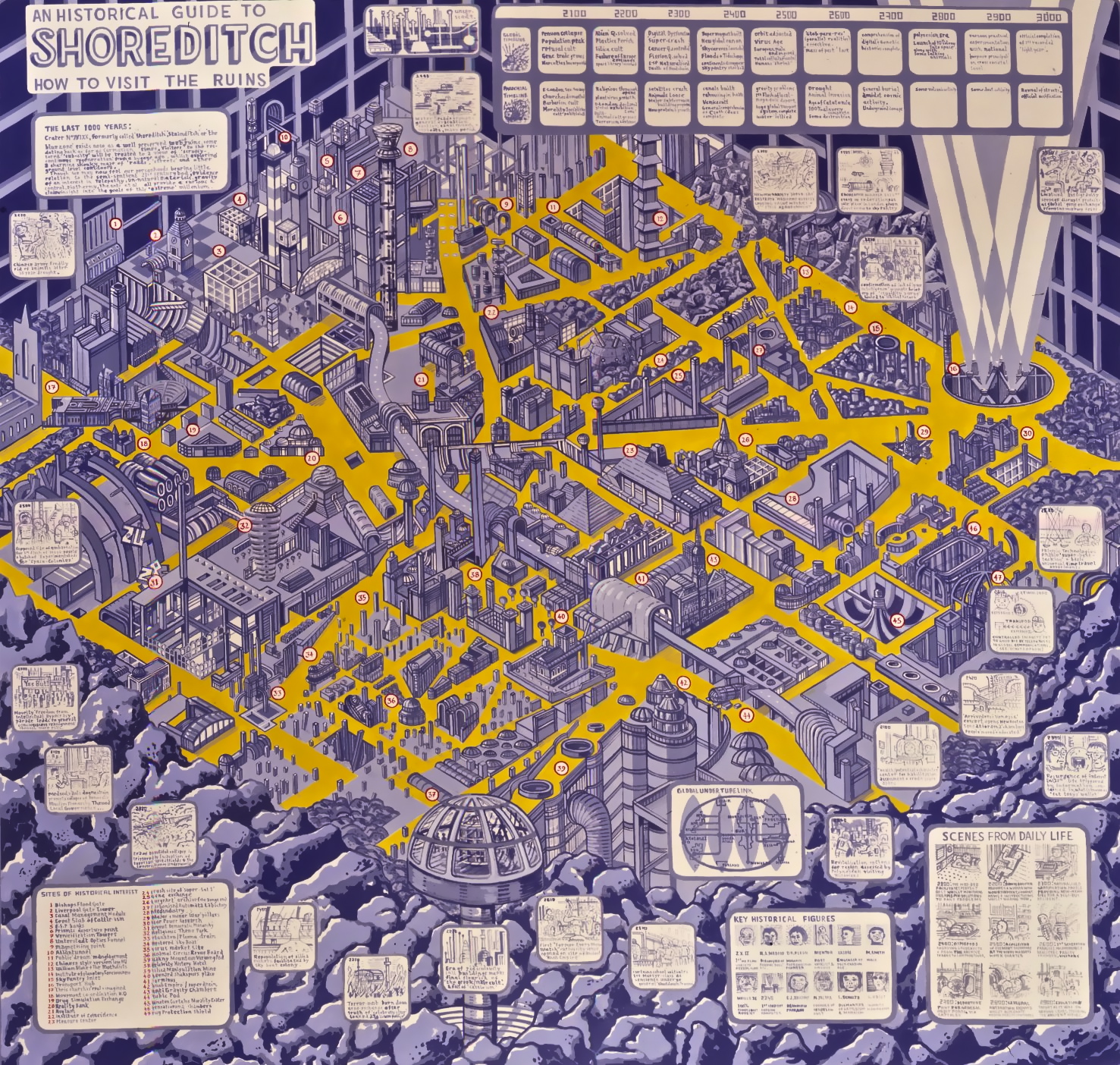
In the year 3000, Shoreditch is all that remains intact among the ruins of human civilisation. Although fortunately none of us are likely to be there to witness it in person, you can click on the map above to scrutinize all the grim details for yourself and discover the primary historical events of the next thousand years too, courtesy of Adam Dant’s dystopian vision created in the year 2000. “But why did only Shoreditch survive?” I asked Adam in horror. “Because it’s subject of the map!” he retorted with good-humoured alacrity, “There is no reason or explanation.”
Casting your eyes upon this disturbing spectacle – like a cavemen peering from the darkness into a glowing shopping mall – be aware that the view is looking South over the remnants of Shoreditch from the Hackney Mountains. On the site of the former Old St roundabout sits the new transport hub enabling passengers to travel upon beams of light through the transformation of micro-particles. On the site of an ancient Shoreditch strip club sits a museum of what used to be – where women go to learn about men, in this world where men have become redundant, ceased to exist and then had to be invented again. Where the Prince’s Drawing School once stood in Charlotte Rd is a collection of British cultural relics including Stonehenge, St Paul’s and Big Ben, in the same manner you might see fragments of lost civilisations at the British Museum today.
Under the spell of the Millennium and inspired by the writings of Jim Dator, Professor of Futurology at the University of Hawaii, Adam Dant asked the residents of Shoreditch about their ideas of the future, and this map was the result. “It’s very loaded. You are asking people to reveal their politics, ideology and world view,” he explained, referring me to the works of Professor Dator, who in his Utopian Coursework proposed the investigation of fictional future worlds on alarming principles such as,“Everyone over or under a certain height could be killed,” qualified by the suggestion, “People under a certain height could be required to wear high heels or tall hats, and people over a certain height could be forced to crouch.”
“People mostly imagined it was going to get worse,” revealed Adam delightedly, speaking of his survey of the residents of Shoreditch,“The future is a nightmare, a de-humanized dream.” When I confessed to Adam that, speaking personally, I still harbour hope for humanity, he put a hand on my shoulder in reassurance. “Paradise is pretty dull,” he informed me with a twinkly smile, revealing his ulterior motive as an artist. Yet, a mere ten years later, history is already eclipsing Adam’s vision of the future. “I was way off with the route of the new highline,” he admitted in gracious acceptance, acknowledging that the new overland train follows a different route from the one he predicted. I take this as a sign that Adam’s map is not the inevitable future for Shoreditch, instead I prefer to see it as the apocalyptic Shoreditch we wish to avoid.
Key to Numbered Sites of Historical Interest on the Map of Shoreditch 3000: 1. Bishops Flood Gate 2. Liverpool Gate Tower 3. Cattle Management Module 4. Great Slab of Cattleism 5. ESP Banks 6. Prismic Departure Point 7. Venicification Towers 8. Understadt Optics Funnel 9. Magnetising Point 10. Atlantunnel 11. Public Dream Management 12. Chinese Style Version Law HQ 13. William Blake & the Mothodists 14. Institute of Planetary Consciousness 15. Sky Pantry Inlet 16. Transport Hub 17. Chris Church real & imagined 18. Movement Co-ordination HQ 19. Drug Simulation HQ 20. Reality Bank 21. Asylum 22. Institute of Coincidence 23. Measure Center 24. Crash Site of Super Sat 1 25. Gene Exchange 26. Large Art Archive (the bongs etc) 27. Carbonised Automata Laboratory 28. Medindustry 29. Major & Minor War Pillars 30. Star Power Research 31. Devout Democratic Monarchy 32. Religious Theme Park 33. Plankton/Plasma Drain 34. Restored Sky Boat 35. Virus Market Site 36. Animal Circus Revue Board 37. Hakny Mountain Viewing Pod 38. Celebrity History Hotel 39. Silica Manipulation Mine 40. Leonard’s Shakspur’s Place 41. Terminus 42. Knob Empire/Superdrain 43. Anti- Gravity Chambers 44. Tubic Pod 45. Honxton Curtalns Morality Crater 46. Sensatiorama Chambers 47. Fug Protection Shield
You may like to take a look at Adam’s Dant’s Map of Shoreditch as New York, or his Map of the History of Shoreditch or his Map of Shoreditch as the Globe. Next time, the Shoreditch You Dream Of. Adam Dant’s current exhibition Bibliotheques & Brothels runs at the Adam Baumgold Gallery, East 66th St, New York City until November 27th, and his forthcoming exhibition Dant on Drink opens at Hales Gallery, 7 Bethnal Green Rd on November 25th and runs until January 8th.
Russella, London’s Top Tranny

Who is that mysterious face in the cafe window in Dalston, lost in such dreamy contemplation? Is it an obscure European princess, taken flight on a state visit to London in the manner of “Roman Holiday” and yearning to discover something of the life the of the common people in the East End? Is it perhaps a Hollywood starlet conscientiously researching her role in a forthcoming romantic comedy about a Hollywood starlet and an East End barrow boy? Or is it Goldilocks in her red cape, who has somehow strayed too far in the forest on her way to grandmother’s house and discovered herself lost on the Kingsland Rd? All of these are possible, though what is certain is that this delicate presence incarnates a rare glamour which captivates the spectator. Yet the simple truth is this picture records an ordinary scene in the daily life of Russella, London’s Top Tranny.
Eager to learn more of the alluring enigma that is Russella, I asked Spitalfields Life contributing photographer Sarah Ainslie to turn paparazza for a day in an attempt to capture some intimate images of Russella’s life in the East End. And it was my privilege to be granted a rare telephone interview with Russella herself which I publish here to accompany Sarah’s affectionate portfolio of cherished tranny pictures.
The Gentle Author: May I ask you about the word “tranny,” what does it mean?
Russella: When I started doing drag, I think “tranny” was a word that was probably derogatory, so we were reclaiming it. I know some people think a tranny is a transvestite but that’s very different, they actually dress up for kicks or they do it on a more full time basis. I don’t really know how to explain “tranny,” it doesn’t really mean anything other than we’ve updated the term “drag queen.”
The Gentle Author: I can’t say the word “tranny” without smiling…
Russella: It’s a fun word isn’t it?
The Gentle Author: Can you tell me about your origins?
Russella: Originally I was a more traditional drag queen and I went by the name Christina Draguilera but then I decided I wanted to be more performance art and avant garde, so I changed my name to Russella. The official story is that I started doing drag because I entered a competition and I won it, and then I was offered more and more work – but I think the reality is I was probably having an identity crisis…
The Gentle Author: Let me say, I think your “Next Top Tranny Contest” is a tour de force and I predict big things for it.
Russella: It’s strange because there’ve been all sorts of competitions, but this format seems to work quite well, even if the first winner was a sixty-five year old truck driver and the last winner was a drag king! And it’s all quite messy isn’t it? I try to make it glamorous but, the more I try, the more of a mess it becomes…
The Gentle Author: Had you ever thought of launching your own chat show?
Russella: I would love to, but I did actually go on the “Weakest Link” and I was quite wooden. A film man once said to me that sometimes when you put people who are quite outgoing in front of a camera they just freeze, so I think I would need more training for that. I do like asking questions actually.
The Gentle Author: Tell me about your ambitions.
Russella: I have a show about Princess Diana that I used to do, it was a really great show and I’ve been thinking about bringing it back for years now. It’s my next biggie. I think it’s time we brought Princess Diana back. It’s such a touchy subject, I performed extracts of it somewhere quite corporate recently and they were a bit disgusted by it, even though it’s twelve years ago. All her dresses have been taken out of Kensington Palace, so she’s officially in the past now but I think she deserves to be remembered.
The Gentle Author: Do you think there’s a spiritual side to trannies?
Russella: I do think there’s an ethereal quality – because it does just come from nowhere. I put on my clothes and my wig and I become something else. I think that for a long time I embodied this thing I’d become, but I actually go to therapy now and, since I’ve been having therapy, I feel more and more like a clown, like I am putting on a costume whereas before I actually became this other character. I suppose it is quite spiritual – something’s going on! I feel like when I am doing drag it’s like becoming a child again, acting and behaving in a way that you wouldn’t in day-to-day life. People find it quite hard to dress up and run around laughing and joking and poking fun at things. But when I am in drag, it’s like you become the person that you are supposed to be.
The Gentle Author: I feel that this performance liberates something in the audience too, a sense of misrule.
Russella: I can’t imagine what it’s like for the audience because I am in the moment, but I suppose it must be like watching a little child play – you do get that feeling of “anything is possible”
The Gentle Author: There was this sense of danger, that it could all go so wrong, and it did and we loved you for it.
Russella: I guess I like chaos, because I’m constantly striving to make everything perfect which it’s not.
The Gentle Author: Are you an East End girl?
Russella: Originally I am from Yorkshire and the reason came to Dalston was because of my friend, who’s actually a pop star now, Paloma Faith who lives up the road from where I live now. I moved from Yorkshire with no job so I slept on her sofa for a year. That’s how I ended up in the East End.
The Gentle Author: But is this your home now? Or is there another part of London you want to be?
Russella: Chelsea! I want to sell out and live a quiet life in Chelsea.
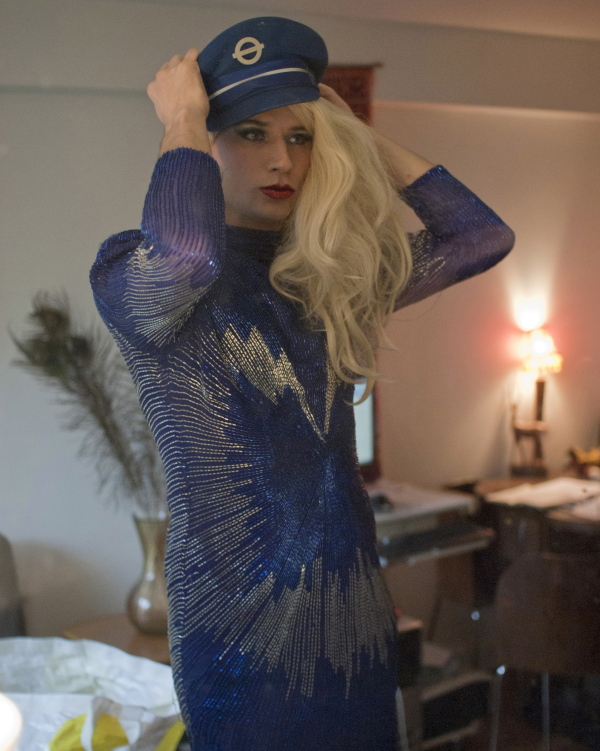
Russella sets her cap straight.
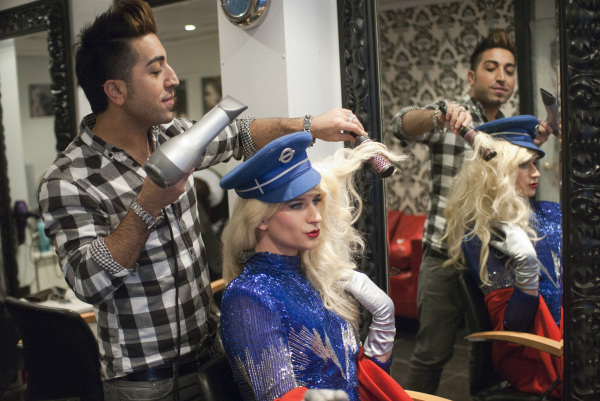
At Avant Garde, 466 Kingsland Rd
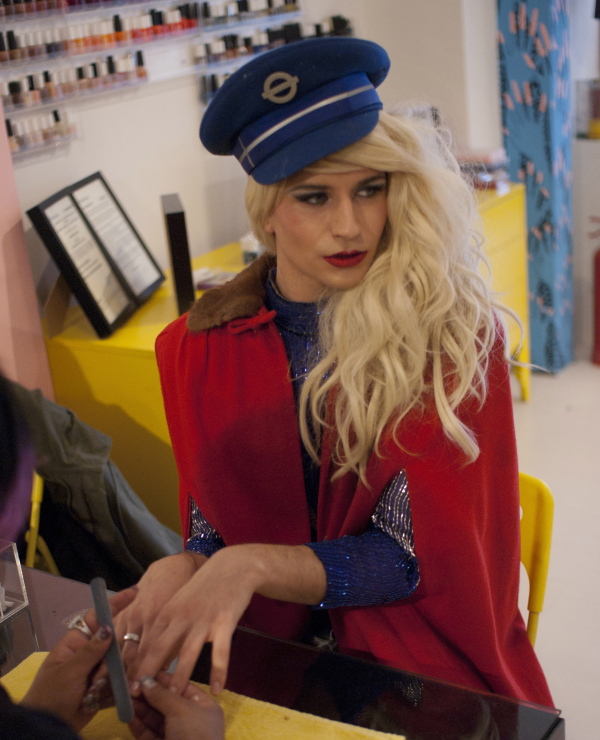
At Wah Nails, 420 Kingsland Rd.

At the First Class Laundrette, 408 Kingland Rd.
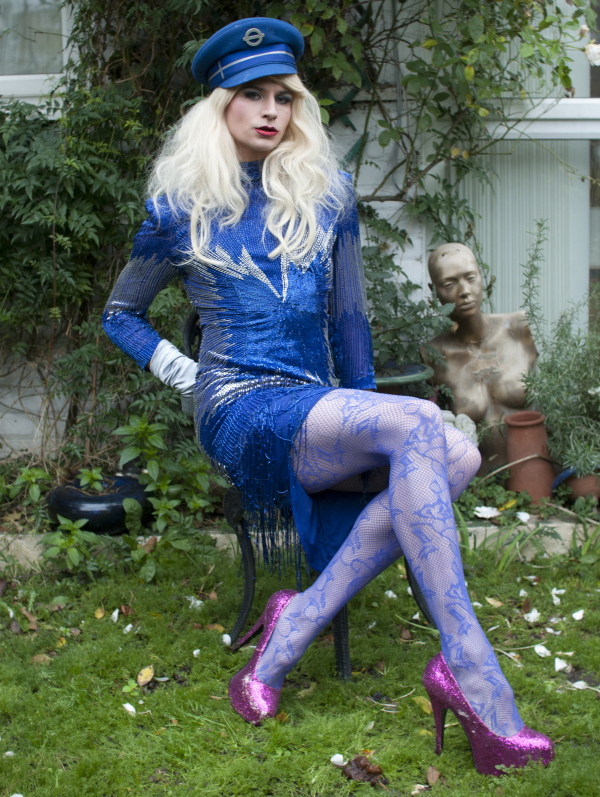
Learn more at Russella’s horticultural blog The Glamorous Gardener.
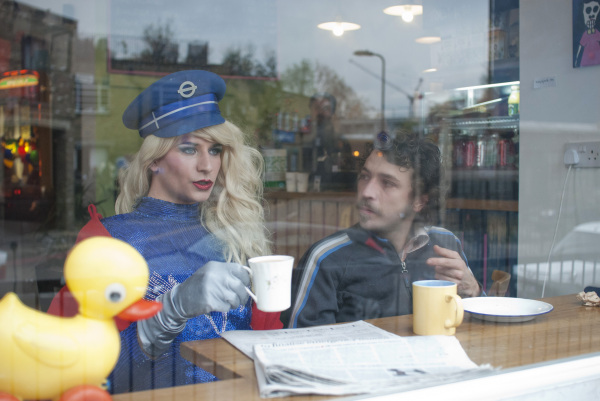
Always gracious with fans who strike up conversations.
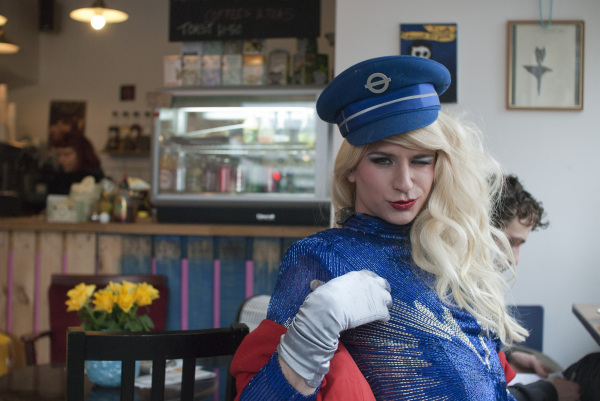
At Tin Cafe, 1 Middleton Rd.
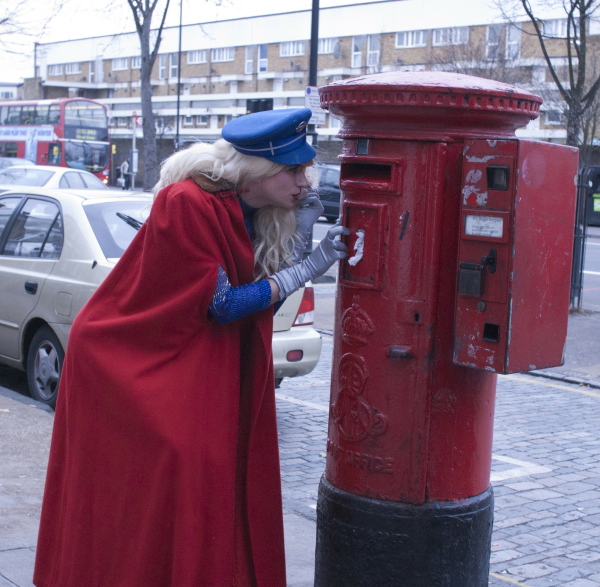
Pondering the mysteries of the postal service.
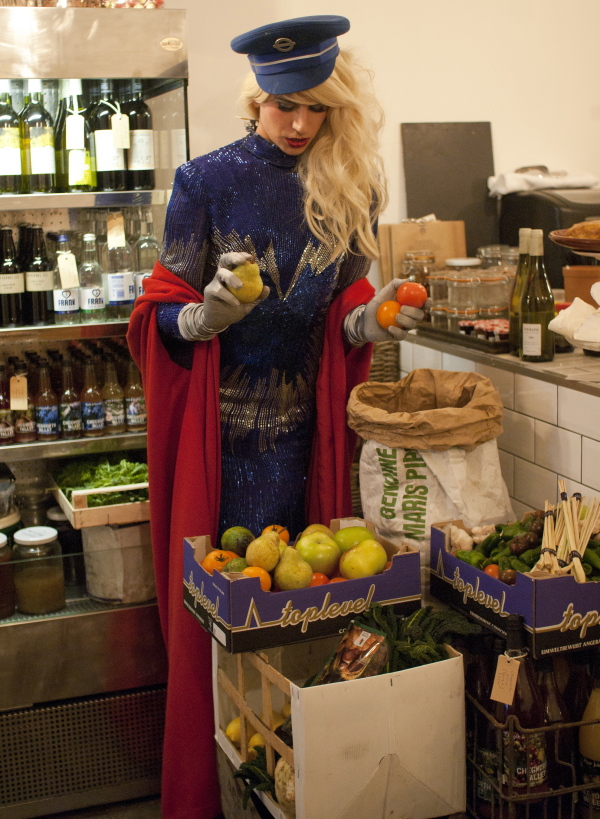
Relentless in her pursuit of five a day.

Enjoying seasonal fruit.

Making good use of her Princess Diana tea towel.

At A Bit of What You Fancy, 465 Kingsland Rd.
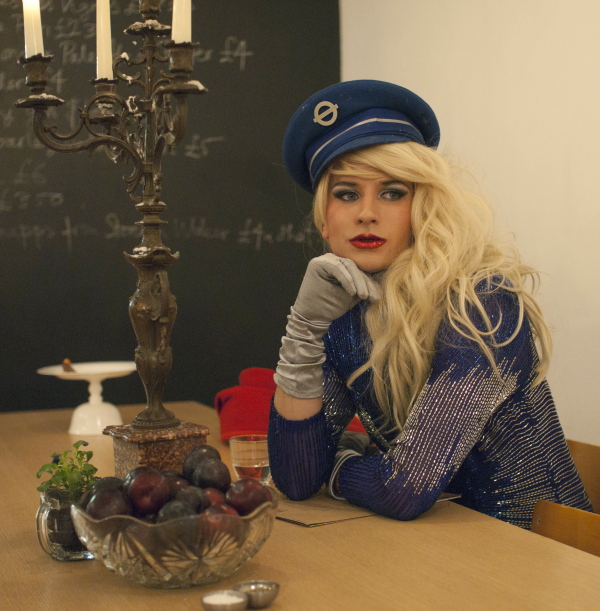
Dreaming of meeting a Mudlark one day…
Photographs copyright © Sarah Ainslie

The Mudlark & The Tranny have agreed to get together for a CHIT-CHAT next Wednesday 24th November at 7pm. Russella, London’s top tranny gets down and dirty with Steve Brooker, London’s top mudlark! This is the second of my CHIT-CHATS in which characters from the pages of Spitalfields Life interview each other live in front of an audience, after hours in the Rough Trade East record shop in Dray Walk, Old Truman Brewery, Brick Lane. Admission is free and no booking is required, just turn up at 7pm. I have no doubt it will be as amusing and informative as The Stripper & The Oral Historian proved to be last time, and we can all go along to the Golden Heart again for a couple of drinks with Sandra afterwards.
John Keohane, Chief Yeoman Warder of the Tower of London
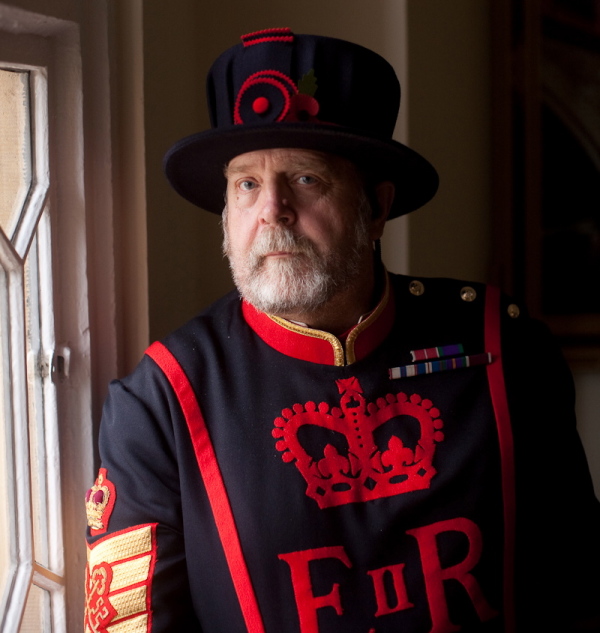
Spitalfields is one of the hamlets in the vicinity of the Tower of London that today make up the Borough of Tower Hamlets and consequently all residents of the Borough enjoy a special relationship with the Tower which means we can gain entry for just one pound, simply by showing a library card. As a result, it is a place that I delight to visit throughout the seasons of the year and each time I discover more wonders. On a recent bright Winter’s day of frost and sunlight I took a walk from Spitalfields down to the Tower, where I found golden leaves scattered across the old yards surrounding the mythic White Tower, gleaming in the light. When William the Conquerer built this citadel nearly a thousand years ago in 1068, there was little else here and while the modern city has grown around it, the White Tower remains almost unchanged.
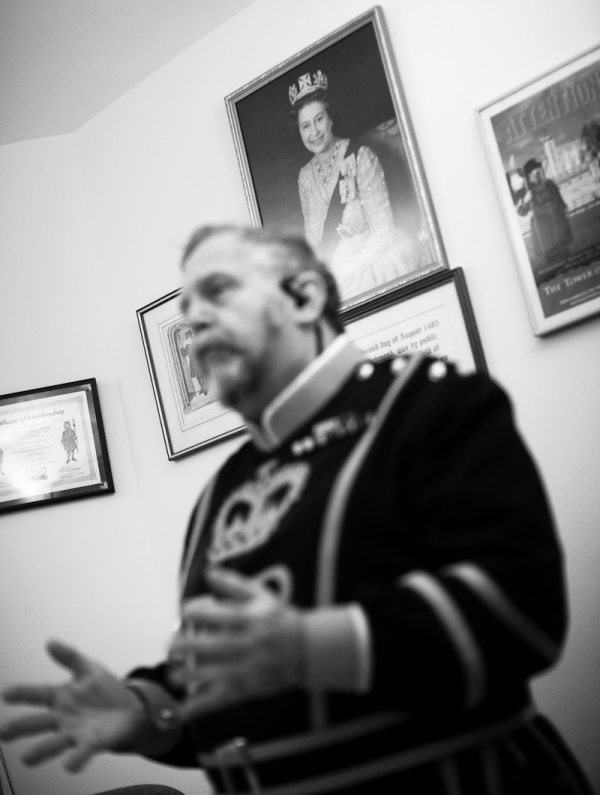
The purpose of my visit was to meet the Chief Yeoman Warder and it was an adventure in itself to be escorted into the inner sanctum of John Keohane’s office overlooking the White Tower, where he sat behind a desk, distinguished in his scarlet and black uniform beneath a portrait of the Queen. John has the quiet eyes of an old soldier, reflecting his long record of military service since 1964, when he signed up for a career that took him to Singapore, Thailand, Oman, the Falkland Islands, Belgium, Germany and Northern Ireland, resulting in a whole string of medals. Though for the sake of levity – in case I should be too overawed by his loftiness – John brought out an iphone from a special pocket in his uniform to show me a picture of him in costume as the Fat Controller on the South Devon steam railway, where he enjoys his month’s holiday each year.
In 1485, when Henry Tudor defeated Richard III at Bosworth Field, he brought his personal bodyguard back to his residence at the Tower and appointed them Yeoman Warders. “The privilege is that the appointment is for life,” explained John Keohane who continues this unbroken line of Chief Warders spanning five centuries,“though at New Year we have a toast, ‘May you never die a Yeoman Warder!'” The toast dates from the period before 1826, when the position, which includes accommodation in the Tower, was purchased, thus creating an imperative for the warder to sell out while they were still alive so that their wives would have a pension fund, because you could not sell the position once you were dead.
“In Northern Ireland, I served at the height of the troubles, and you were restricted where you could go. You had to be careful.”, John confided to me, with a glance to the window. And I understood that when you have spent your life living in barracks, as he has done, then it is a sympathetic transition to move into the Tower of London, an edifice which contains a veritable city within the City. To be eligible to apply, you must have a minimum of twenty-two years service in the armed forces and a record of good conduct, a fact which John was quick to qualify as being not so much about the lack of misbehaviour as the lack of being caught. Year in, year out, John lives and works here with his fellow Beefeaters and their families, pursuing an existence circumscribed by duty and ritual. Even the guard rota follows a time-honoured pattern referred to as the “daily waite.” “It doesn’t mean you can’t go out, but you have to follow the rules. People in civilian life would not be satisfied with it.” admitted John, who has made his home inside these walls since 1991.
He explained to me that, until 1603, the Tower was a royal residence and his predecessors ate at the King’s table. In those days cattle were primarily used for milking and their meat was a luxury food, although beef was served to the King and, by tradition, the Yeoman Warders were entitled to what was left – giving birth to the nickname ‘Beefeater,’ the term by which they are most commonly known today. It was the creation of Beefeater London Gin in 1871 which took this name to world with such success that the Yeoman Warders now accept they will always be Beefeaters in the popular imagination.
“You can get photographed as many as four hundred times in one day. Some of the warders take detours walking outside between the offices and their homes because otherwise you can be photographed five or six times just crossing the yard,” John revealed, rolling his eyes at the absurdity of it. Yet as we left the building, he was entirely magnanimous to the visitors who wanted to be photographed beside him. Then as we walked on beneath the White Tower, looming overhead, John cast his eyes around in pleasure at the spectacle and said, “What a place to bring your children and grandchildren to! That’s what sold the job to me. I hated history at school but now I am passionate about it – because this is where it happened.”
He took me into the Tower of London Club, the private bar lined with hundreds of tributes from all the regiments in which the warders have served, and it was a sober image to manifest the integral connection between the Yeoman Warders and the armed services. Then on another wall I came across evidence of a different kind of recognition, pictures of the Yeoman Warders with celebrities including Johnny Depp, Bruce Willis, Jackie Chan, Barack Obama (John showed Michelle and the girls around), Matt Damon, Bruce Forsyth, Sylvester Stallone, and Paul McCartney. These pictures raised the question of who was being photographed with who. The celebrity with the Beefeater? Or the Beefeater with the celebrity? It does seem Yeoman Warders like being photographed with colourful characters, just like rest of us. There is an undeniable poetry to this notion of senior soldiers having a new life in the Tower of London, sedate yet basking in adulation of the two and half million visitors each year. Secluded in their cloistered existence but leaving the confines to accompany the Queen at state occasions – existing at the very centre of their own particular world.
John says the years pass quickly here. Every night at ten precisely, he supervises the Ceremony of the Keys at which the Tower is locked for the night. Twice a year is the Ceremony of the Constable’s Dues when a visiting Naval ship’s Captain reports to the Tower to pay a due to the Constable of the Tower. Annually in May is the Lillies & Roses Ceremony commemorating Henry VI, the founder of Eton College and Kings College Cambridge, who was murdered at the Tower of London in 1471. Every three years is the Beating of the Bounds Ceremony on Ascension Day when the Yeoman Warders visit all the boundary markers in a circle around the Tower to beat them with willow wands. And every five years a new Constable of the Tower is installed as the monarch’s representative at the Tower.
Aware that his twenty years dwelling among these ancient walls is a mere blink in their nine hundred year history, time runs smoothly for John Keohane, Chief Yeoman Warden of Her Majesty’s Royal Palace of the Tower of London.
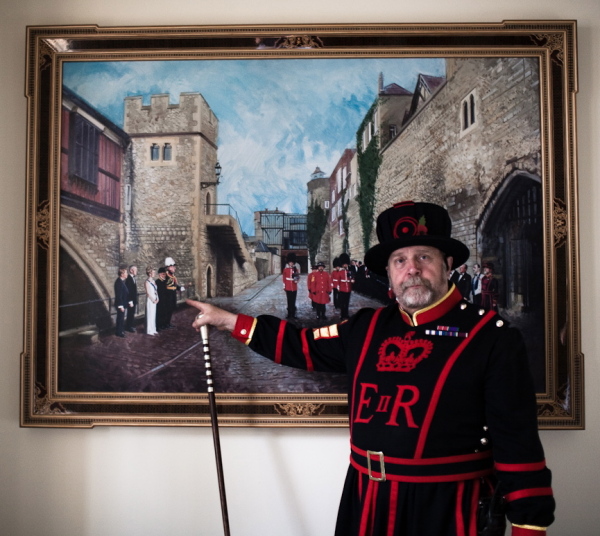
John Keohane points out the figure of the Sultan of Oman in this painting of the state visit to the Tower, of special significance to John because he served in Oman in the seventies.
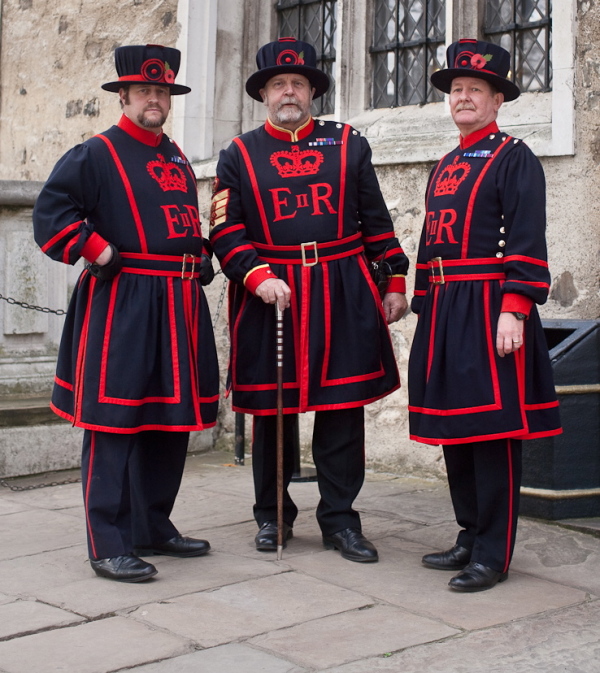
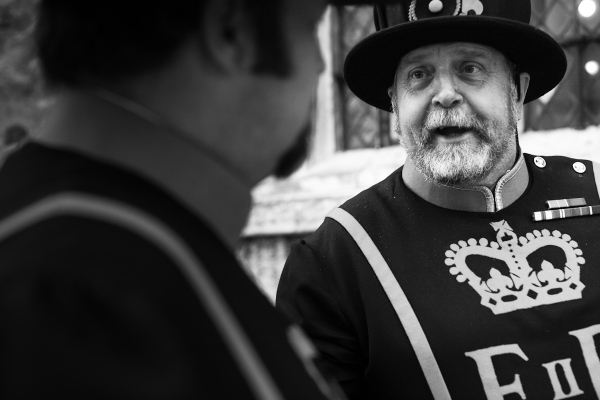
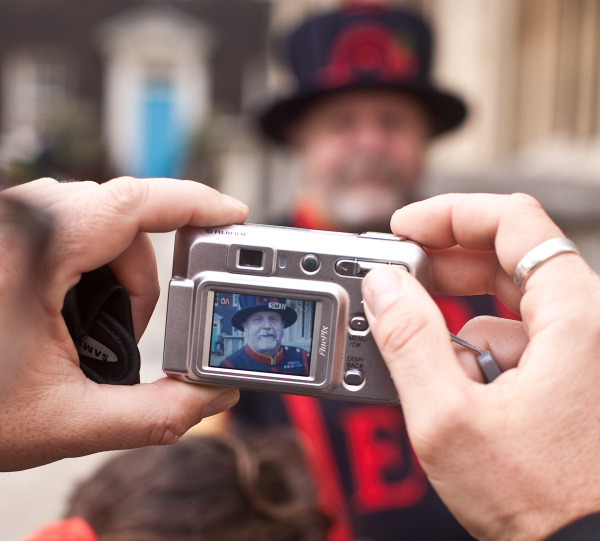
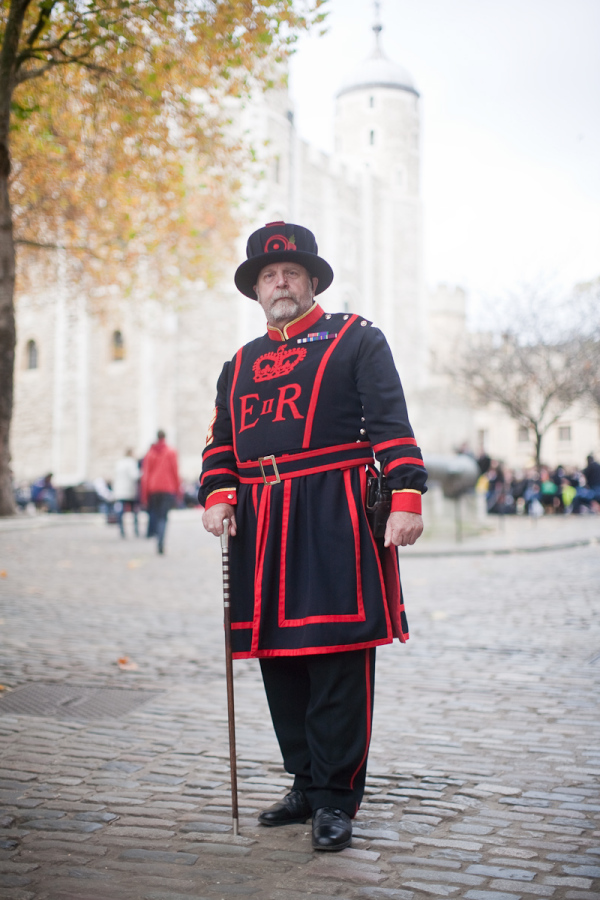
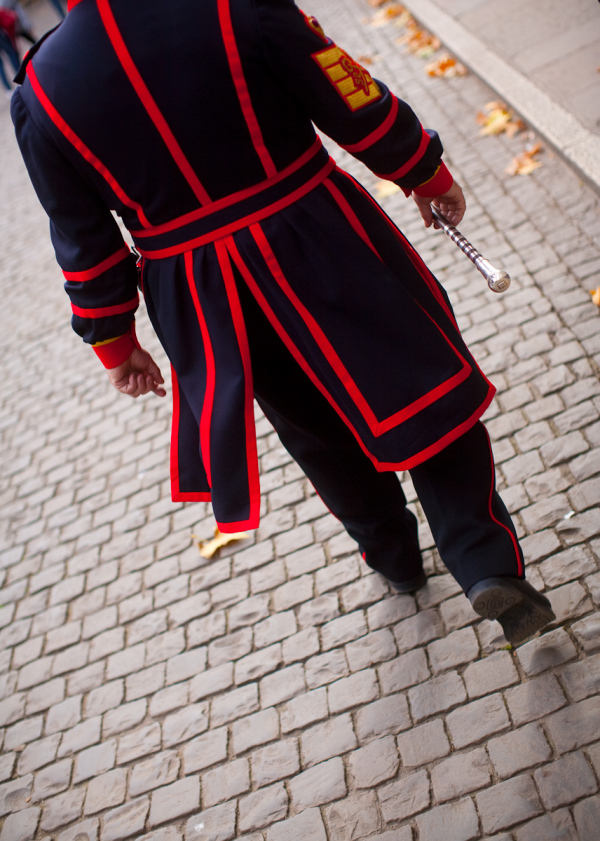
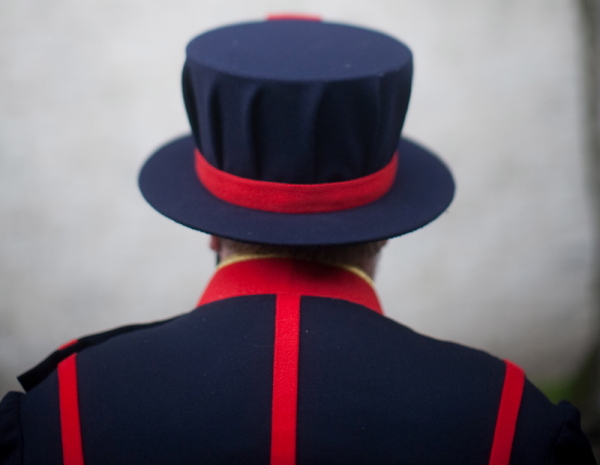
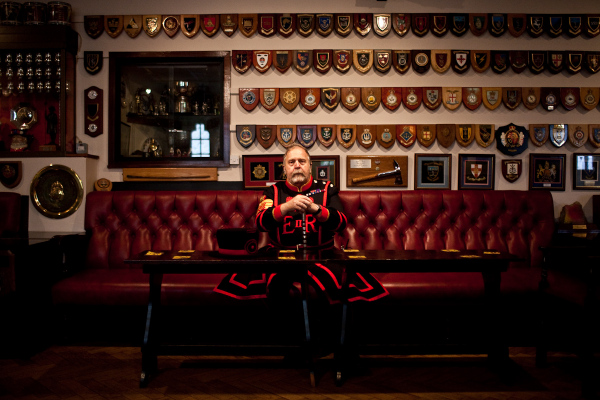
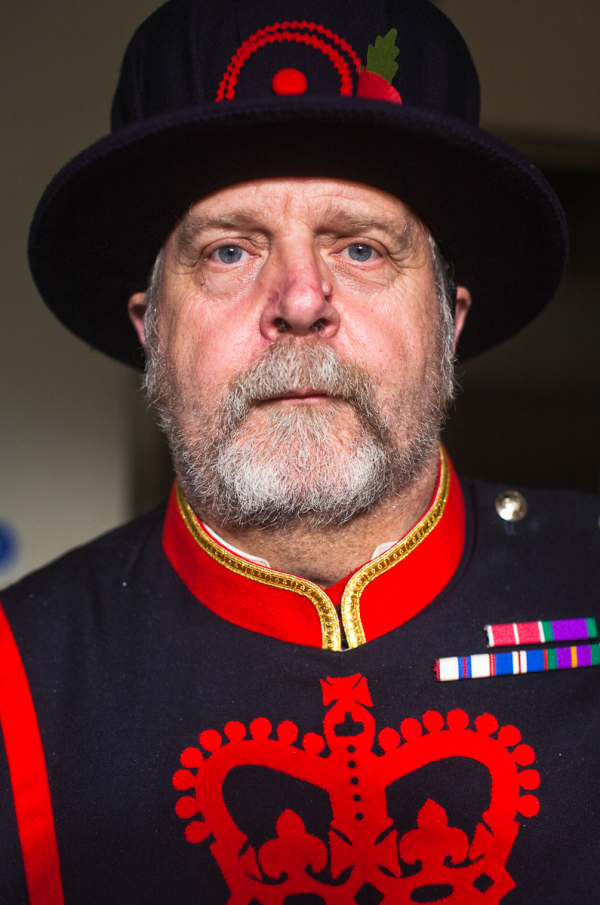
John Keohane, Chief Yeoman Warden of Her Majesty’s Royal Palace of the Tower of London
Photographs copyright © Martin Usborne
On the Papercut Express with Rob Ryan

On Friday, I was thrilled to board a fast train at Euston with Rob Ryan, the papercut supremo, racing North through the dusk to Stafford for the opening of his latest exhibition. “Your job is to take this world apart and put it back together… but even better,” at the Shire Hall Gallery in the Market Square in Stafford, follows just two weeks after the breathtaking sellout success of Rob’s show at the Air Gallery in Dover St, entitled “The stars shine all day too.” He certainly has a way with titles.
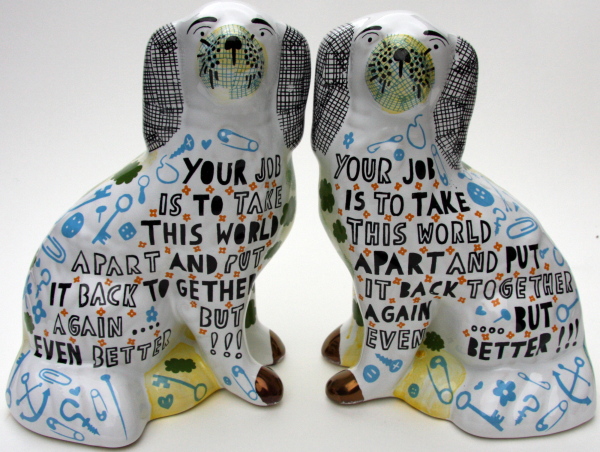
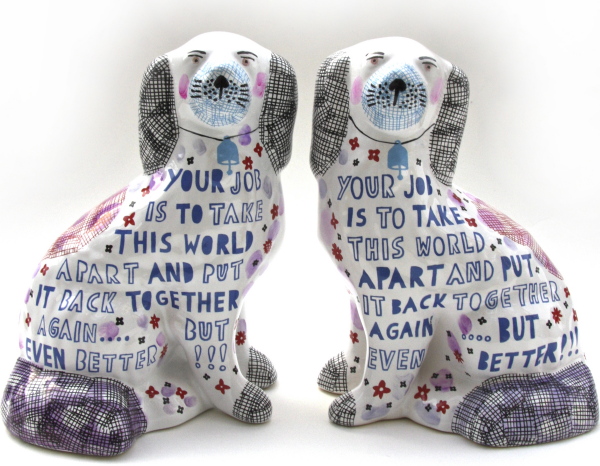
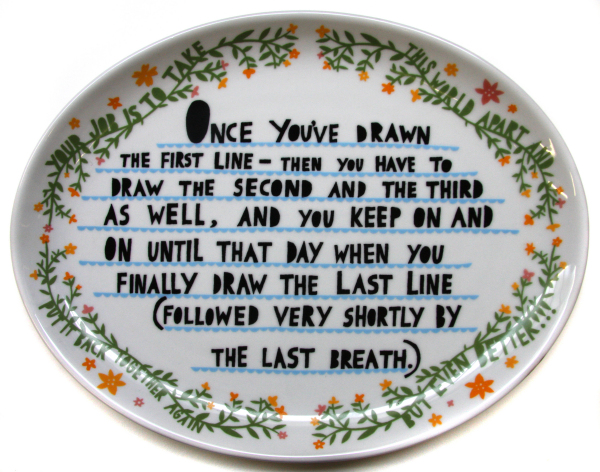
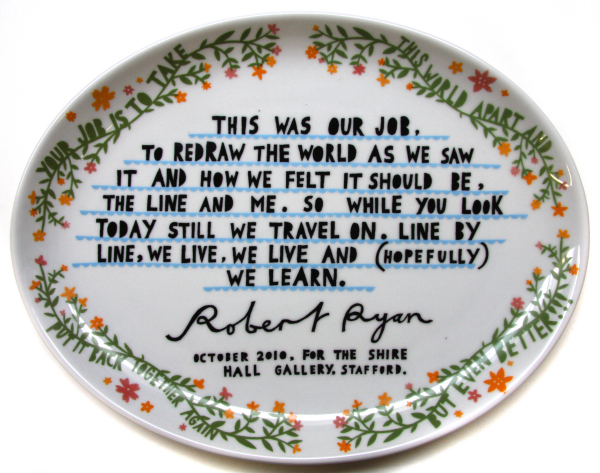
While the London exhibition comprised monochrome papercuts and prints – some of truly astounding size and ambition – this show in Stafford features the papercuts he made as illustrations to complement the text by Carol Ann Duffy for “The Gift,” as well as some remarkable ceramics that signal a new departure for him. The gallery in Stafford sourced nineteenth century moulds for Staffordshire figures and they have cast new ones for Rob to decorate. When I visited Rob at his show at Somerset House in the Summer, there was a Staffordshire china dog that he had already decorated sitting upon his desk. By adding a pair of glasses, Rob had drawn attention to the unlikely resemblance between himself with his luxuriant locks and the spaniel with its curly ears. We used to have a pair upon the sill at the top of the staircase when I was child, so I was fascinated by Rob’s hilariously extrovert reworking of these inscrutable figures. And for months now I have been looking forward to seeing these new works, at their first public showing here in Stafford.
After dozing on the train up, we walked through the dark and frosty Friday-night streets of Stafford, and into the tall bright spaces of the Shire Hall where the rich colours of Rob’s papercuts and prints glowed with exuberant life. I went straight to the cabinet of shelves filled by pairs of china dogs and cats, all staring back at me through the glass. There was an exciting tension between the poise of their nineteenth century form and the lively decorative sensibility of Rob’s designs, animating the figures with idiosyncratic personality. It was the perfect marriage of two disparate threads of folk art, the Staffordshire figure and the papercut, both reinvented by Rob Ryan in an entirely contemporary way. The words which Rob applied exemplify the thoughts I always imagined the dogs on my parents’ staircase harboured. Naturally meditative and sometimes contradictory, reflecting the fact that these creatures are mirror images of each other, the texts are secret insights into the collective psyche of china dogs and cats. Now we know what they were thinking all along.
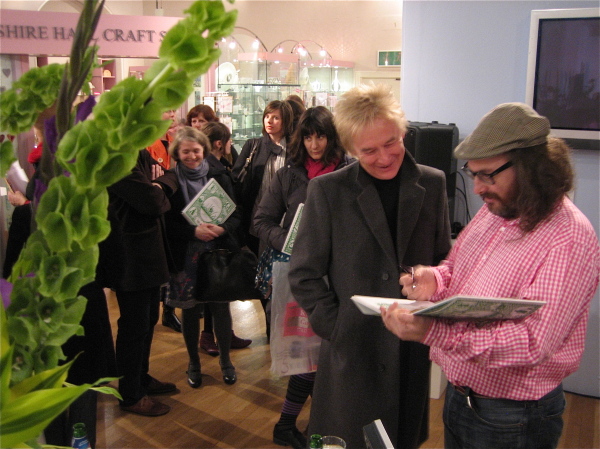
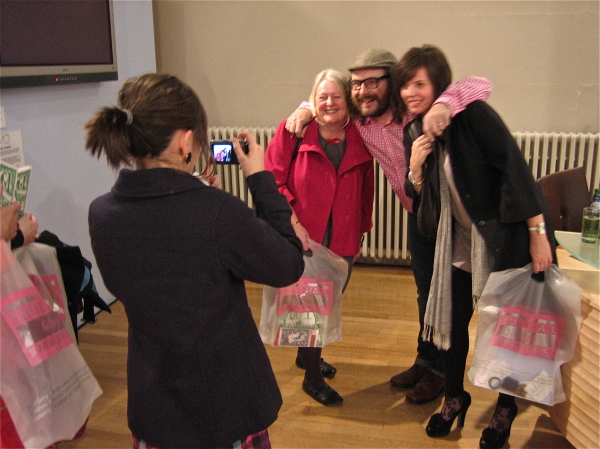
I was interrupted from my reverie by a local councillor giving a speech. He appeared to have stepped from a novel by Arnold Bennett, quick to declare his lack of specialist knowledge, yet eager to give his modest opinions at length about contemporary art, before swelling with pleasure to introduce the poet laureate Carol Ann Duffy, whom he chose to regard as a local lass – the pride of Stafford – in spite of her origins in Glasgow. By now the gallery was full with an enthusiastic crowd and once Carol Ann declared the show open, Rob found himself inundated with a long line of fans eager to make his acquaintance. And as my pictures testify, dressed for the occasion in a bright pink gingham shirt, and with a playful nature and a mantle of unkempt curls comparable to the lion in the Wizard of Oz, he is the consummate showman.
Meanwhile, the rest of the citizens of Stafford spread out to scrutinise the immense detail of the works on display and I slipped among them, taking a closer look for myself. The bright energy of these intricate pieces draws your attention and then the subtle melancholy touches your heart. As I noted all the delighted faces, I realised it was an immense body of achievement and a phenomenal finale to a year of hard graft by Rob Ryan.
Then suddenly it was time to hurry back through the maze of streets to the railway station, riffle the vending machine for snacks and hop onto the last train back to London. Rob brought out his game of Boggle and the happy atmosphere in the darkened carriage rattling through the night was more like that of the returning leg of a school trip than you might expect after a major exhibition by a rising star – yet it was the ideal way to wrap up our adventure on the papercut express.
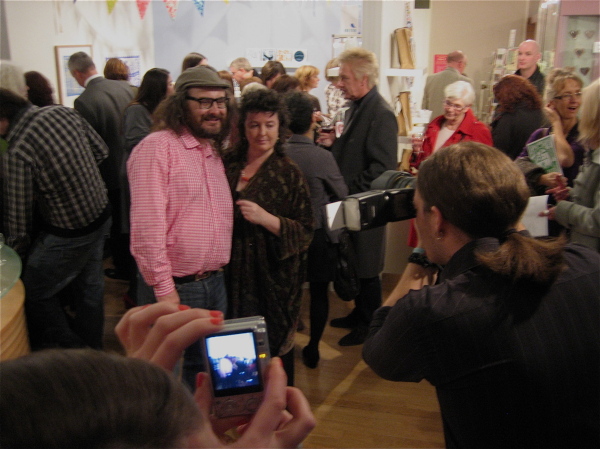
The paparazzi move in on Rob Ryan and Carol Ann Duffy, the poet laureate.

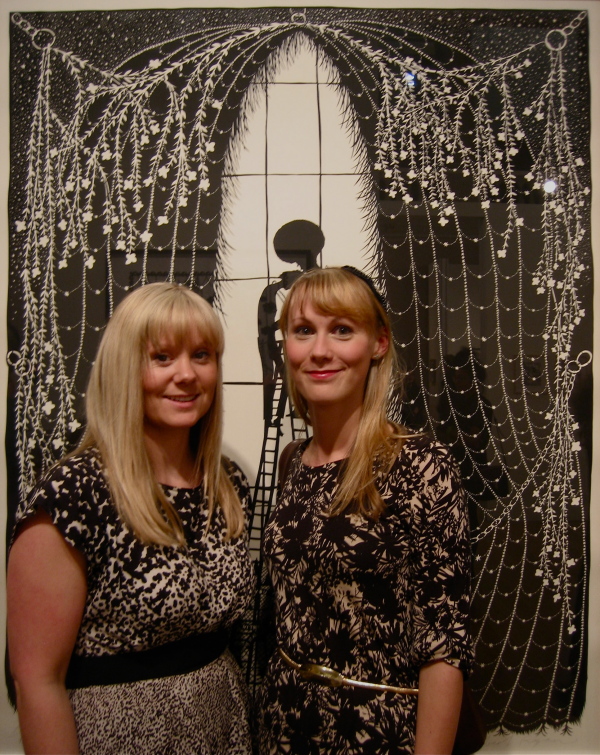
These two ladies wore dresses to camouflage themselves amongst Rob’s papercuts.
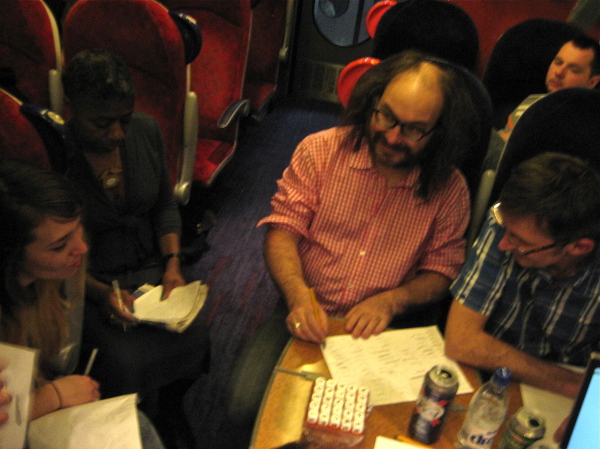
Rob enjoys a game of Boggle on the night train home from Stafford to Euston.
Your job is to take this world apart and put it back together again … but even better runs at the Shire Hall Gallery, Market Square, Stafford until Sunday January 9th and The stars shine all day too runs at the Air Gallery, Dover St, London until Saturday November 20th.