
A Renovation at Trinity Green
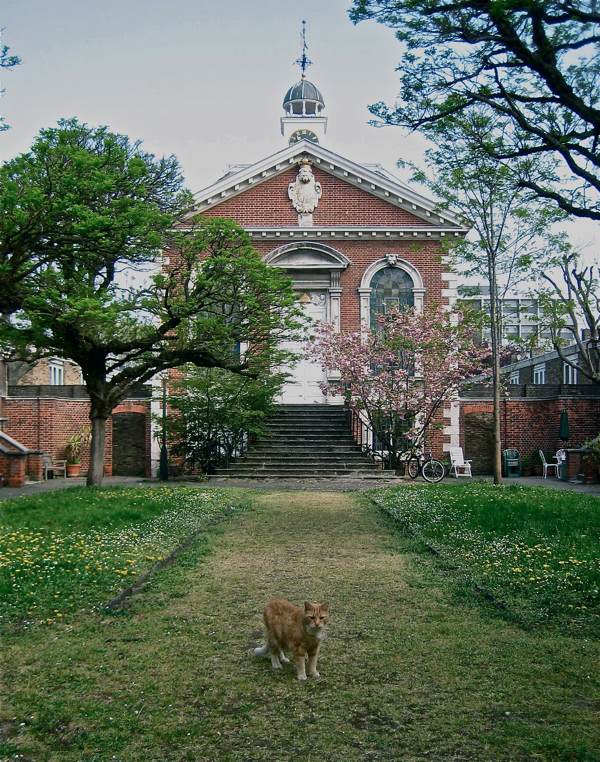
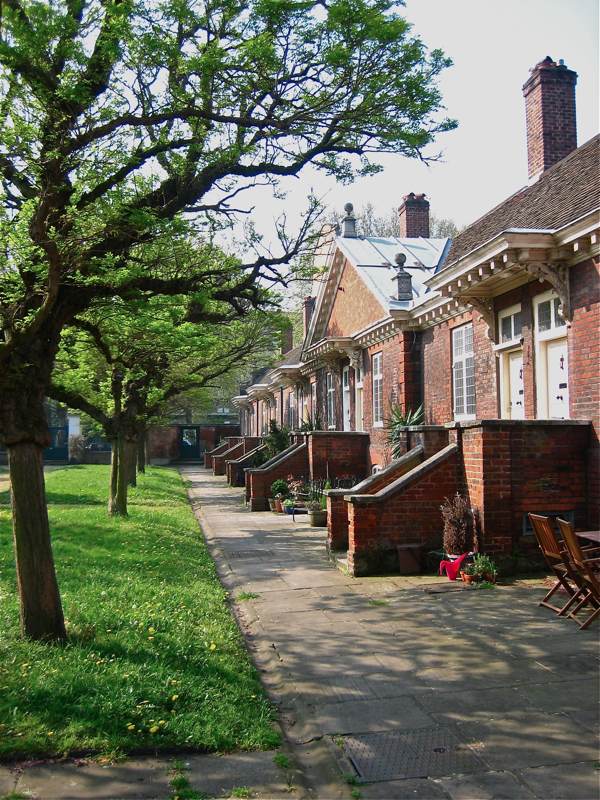
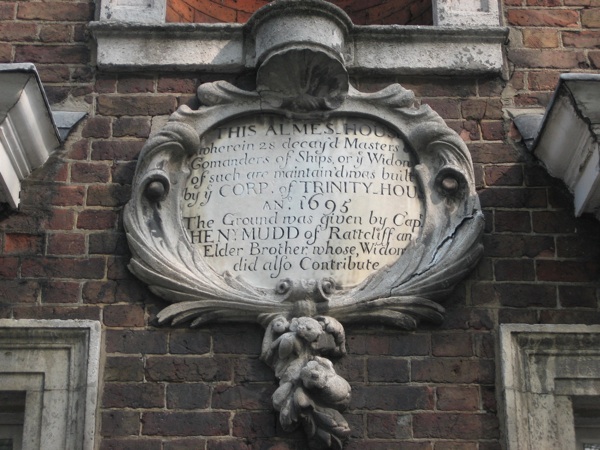
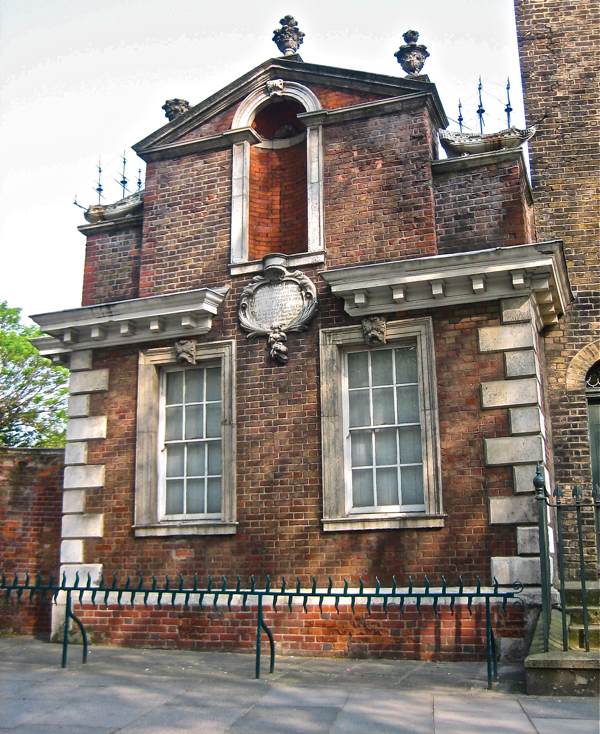
A pair of quaint narrow terraces face each other across a green off the Mile End Rd in Whitechapel. Although they are lined up neatly like ships’ cabins, only the model boats upon the street frontage remain as evidence that these were built for as almshouses for mariners. But, if you step closer and crane your neck, a stone plaque high on the wall proclaims their noble origin thus, “THIS ALMES HOUSE wherein twenty-eight decay’d Masters & Commanders of Ships, or ye Widows of such are maintain’d, was built by ye CORP. of TRINITY HOUSE, ano 1695. The Ground was given by Capt. HENY MUDD of Rattcliff an Elder Brother, whose Widow did alfo Contribute.”
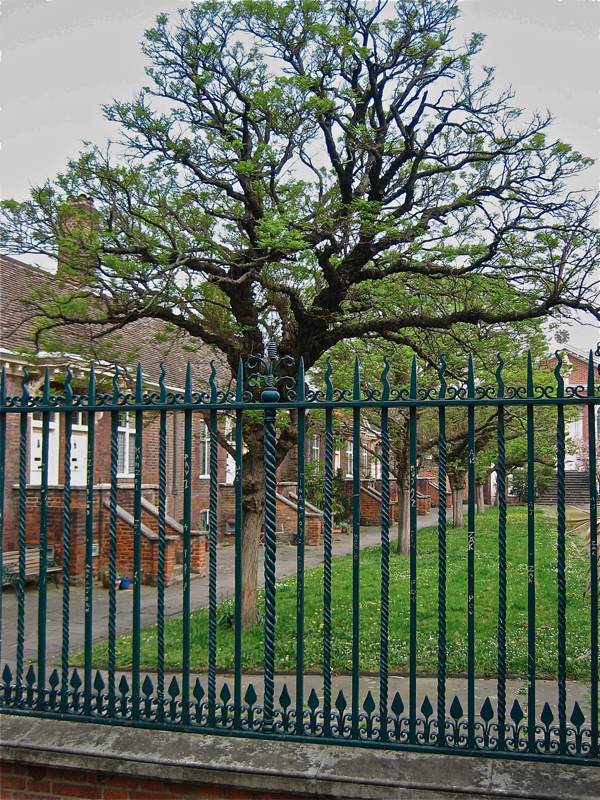
Even today, a certain atmosphere of repose hangs upon this small enclave, protected from the pandemonium of East London traffic by trees and delicate emerald green railings – now a preserve of cats and flowerpots and twisted old trees and lawns strewn with dandelions and daisies – where it is easy to imagine those “twenty-eight decay’d Masters & Commanders” who once sat around here competing to outdo each other with oft-repeated tales of high adventures upon the seven seas.
The architect was Sir William Ogbourne, and his design was ship-shape in its elegant organisation, fourteen dwellings on either side, each one with three rooms stacked up on top of the other, all arranged around a chapel at the centre to provide spiritual navigation. It was a rigorous structure enlivened by lyrical flourishes, elaborately carved corbels above each door, model boats and stone balls topping off the edifice, and luxuriant stone crests adorning the brick work.
In the nineteenth century, a tall mast stood at the centre of the green to complete the whole endeavour as an approximation of a ship upon dry land – complementing the concave walls at the front in place of a hull and the raised chapel in the aft where the poop deck would be. Just a mile from the docks, it was the perfect spot for Masters & Commanders to enjoy their decay, and it might have sailed on majestically, if it had not been sunk by the bombing in 1943, that destroyed the chapel and the rear eight cottages. Taken over by the LCC, Trinity Green experienced benign neglect in recent years and is now a mixture of private and public dwellings where everyone gets along peaceably, unified in their appreciation of this favoured spot.
Ten years ago, Dutch designer Eelke Jan Bles installed a floor at 5 Trinity Green and fell in love with it. He said to the owners, “If ever you want to sell, I will buy it.” and that is exactly what happened last year. Appreciating that centuries of alteration had taken the interior a long way from its original design, Eelke hired architect Chris Dyson to restore its dignity, and Chris was able to apply his experience working on old houses in Spitalfields to reconfigure the spaces, reinstate the lost panelling and create a sympathetic dwelling with modern amenities.
The ground floor room is a perfect square, a geometric elegance that may be the result of an original plan designed by Sir Christopher Wren, and when you ascend the steps from the green and walk in the door you find yourself in an amply proportioned room which catches the morning sunlight to great advantage. It is peaceful and resonant and, with an outlook only onto the wide lawn, you could easily forget you were in London. Undoubtedly, this is the room where anyone who lived here would delight to spend their time, retreating to the snug bedroom and bathroom below at night.
Throughout the cottage, each detail has been considered to create an accommodation where every area is used to maximum efficiency, just like on a ship. And there is an admirable restraint to Chris’ interventions which respect the quality of the building, allowing it to be used to its best advantage, while permitting the spaces to speak for themselves. The success of his work is to have created a sense of unity of design between the outside and the inside of the building.
Chris and Eelke developed a passion for Trinity Green in the course of their collaboration and research, and they were eager to take me on a tour. With delight at the ghostly enigma, Eelke pointed out how the numbering ends at twelve on the far left cottage and picks up at twenty on the top right, leaving a gap of eight for those vanished dwellings bombed in 1943. While Chris drew my attention to the delicate rope design upon the iron hand rail of the chapel steps, a residual nautical detail hinting at the lost naval statuary and long-gone paraphernalia from the time of those “twenty-eight decay’d Masters & Commanders.” And the result of this commitment is that 5 Trinity Green, uniquely, has both its panelling and its character back, and my good fortune in seeing this granted me a vision of how the whole place used to be.
After my visit to the cottage, I loitered on the chapel steps to savour the peace and quiet further, enjoy the sunshine, and commune with the old ginger tom who – judging by the multiple notches in his ears – is the undoubted decay’d Master & Commander at Trinity Green nowadays.
5 Trinity Green is to let, if you like to rent it contact Eelke Jan Bles eelke@solidfloor.co.uk
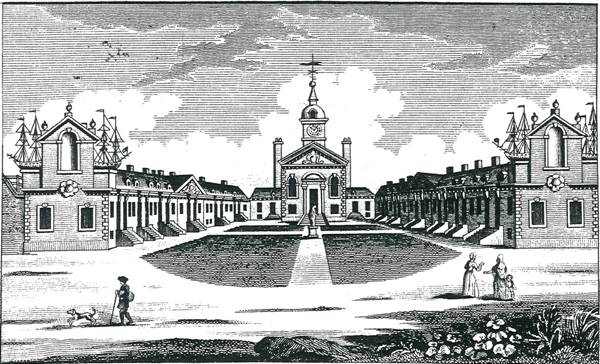
View of Trinity Almshouses, Mile End Rd, 1695.
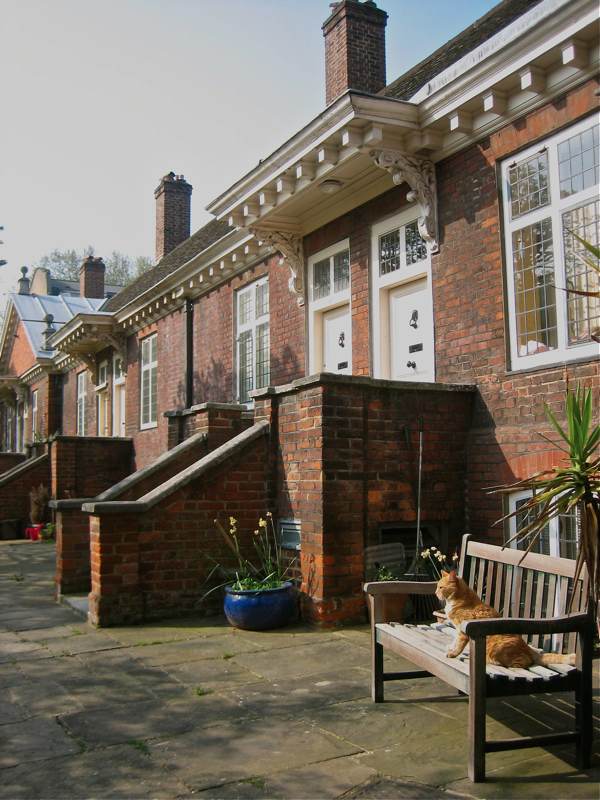
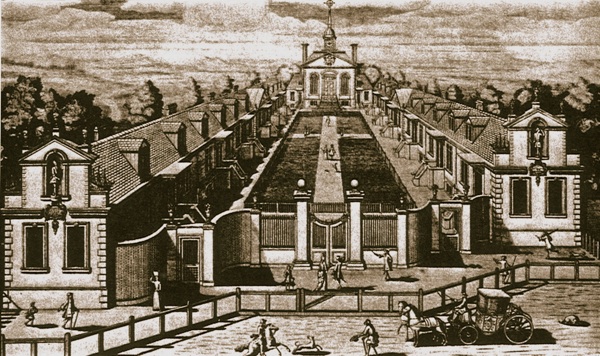
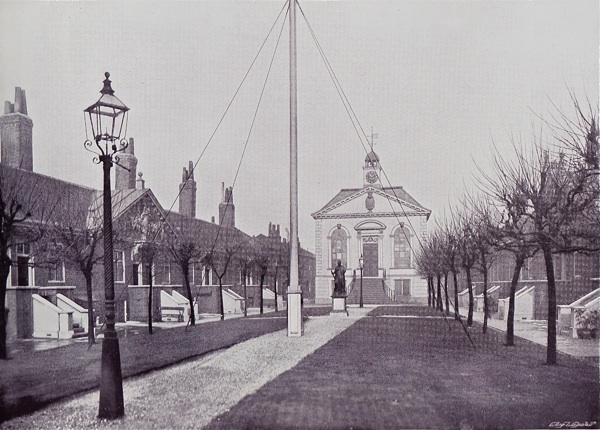
A hundred years ago there was a ship’s mast on the green with flags run up for special occasions.

The lamp post with a rope stem from the previous photograph now stands beside the chapel.
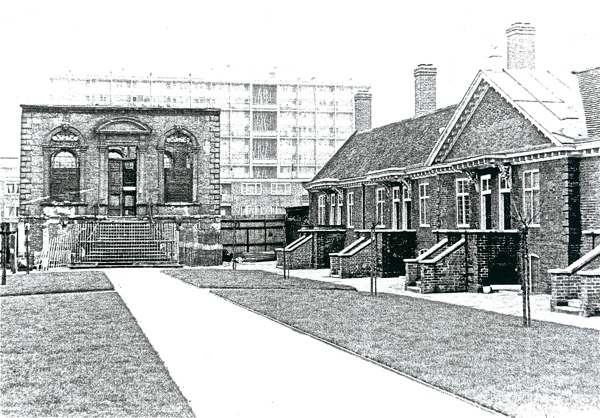
World War II bombs gutted the chapel and destroyed the rear eight cottages.
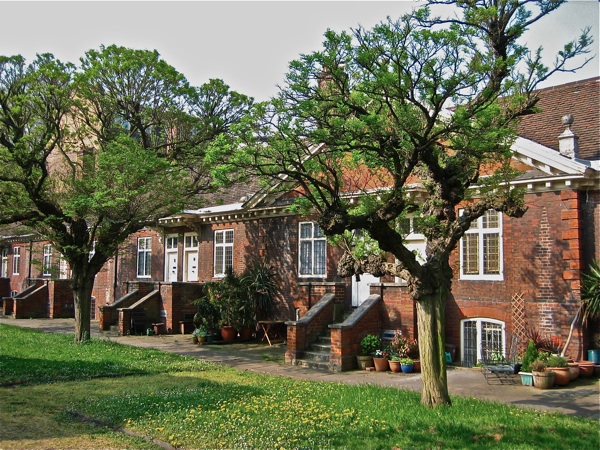
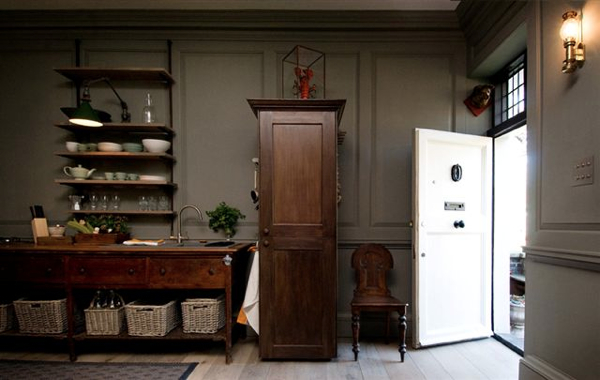
The ground floor of Chris Dyson’s renovation.

The ground floor in its previous incarnation.
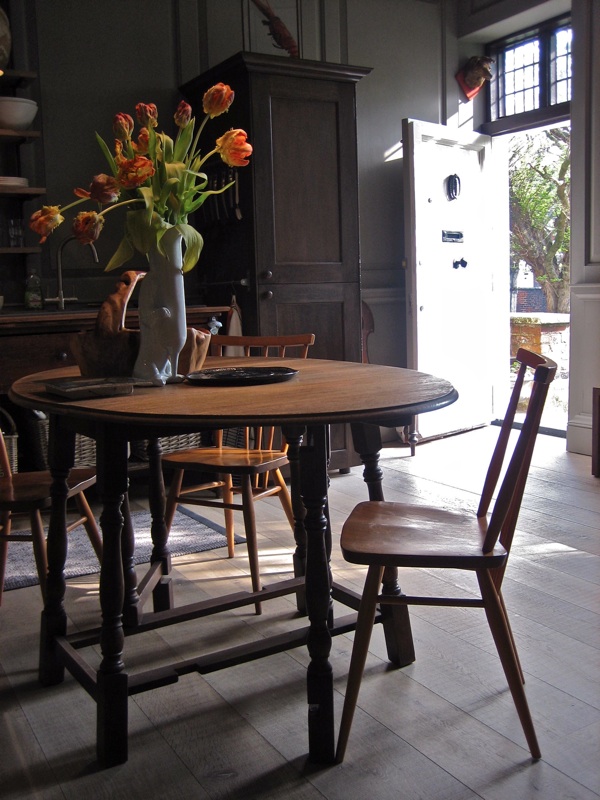
The entrance today.
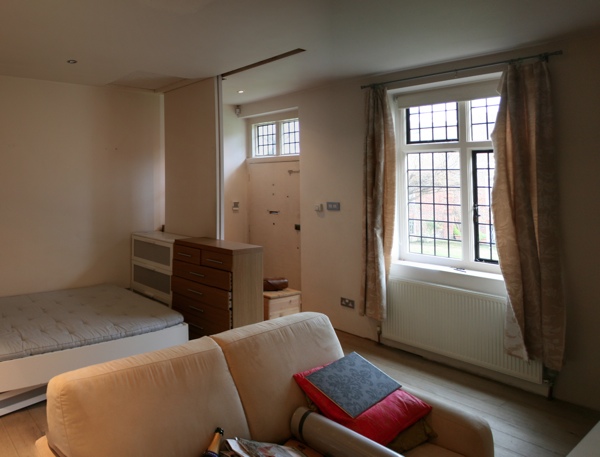
The entrance as it was before.

The panelling was restored by Matt Whittle.
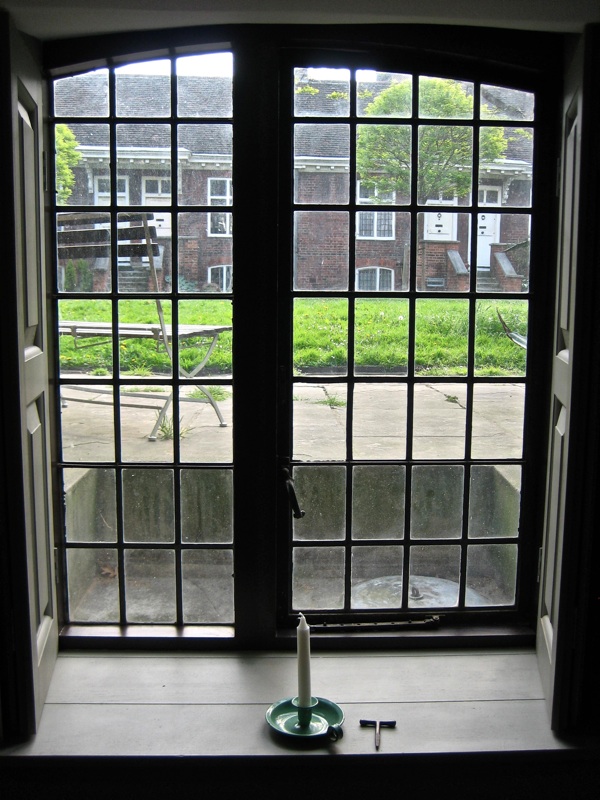
The view from the lower room with coalhole to the right.
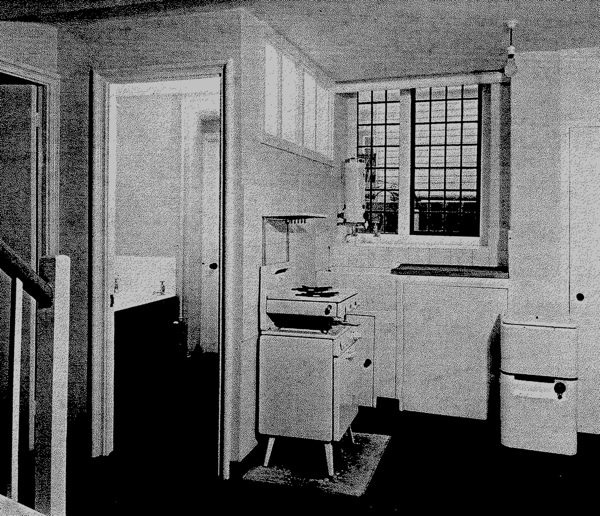
The lower room in 1957.
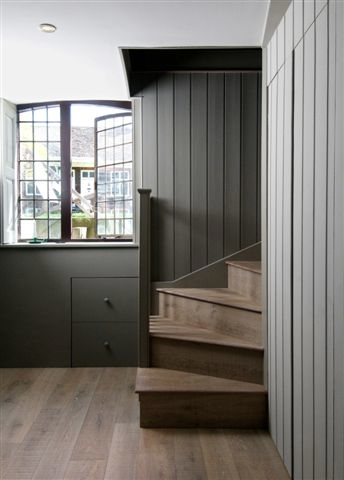
The lower room today.
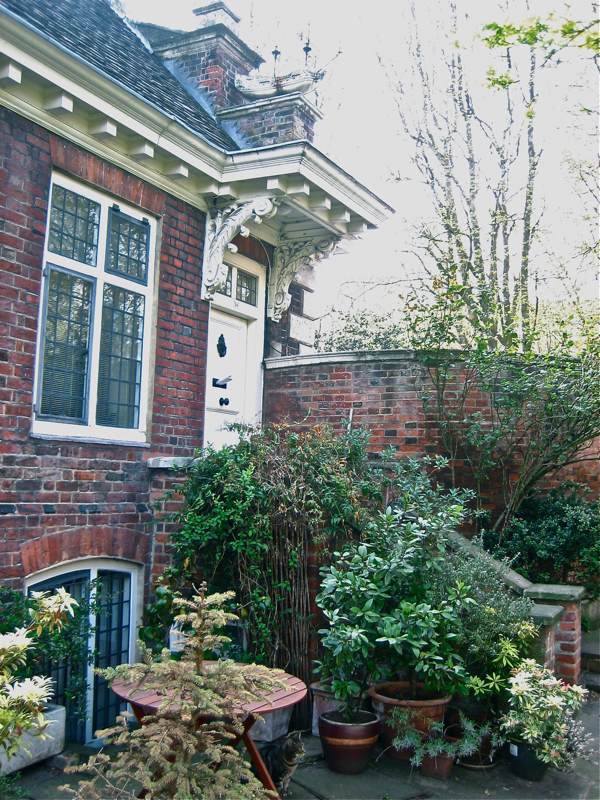
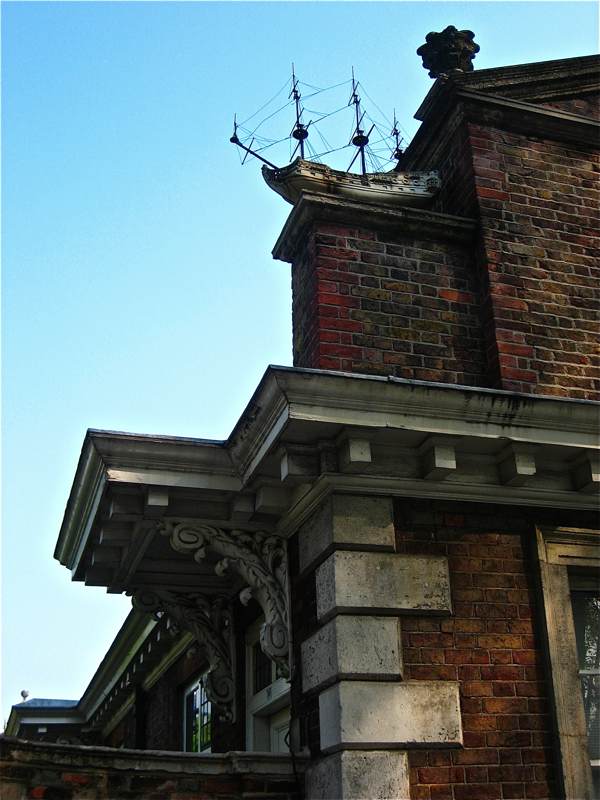
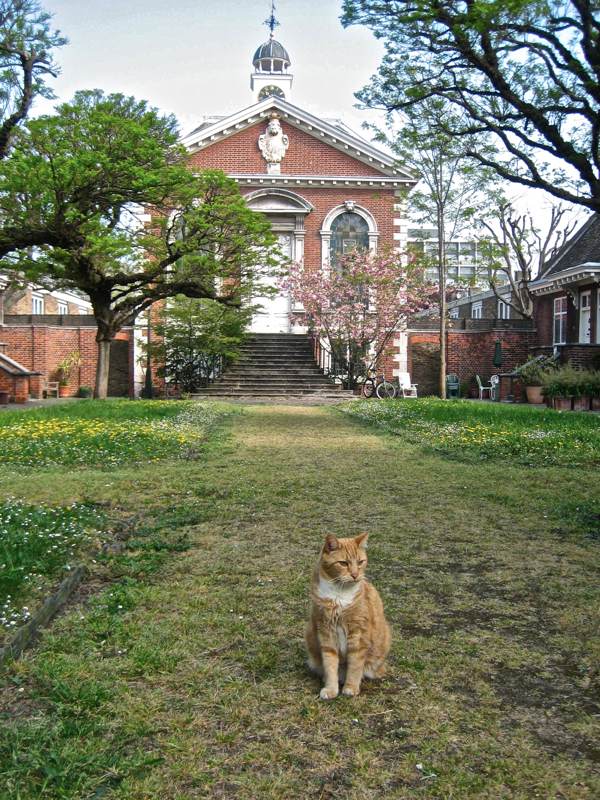
The old ginger tom who is the current Master & Commander of Trinity Green.
The Oldest Ceremony in the World

Each night a lone figure in a long red coat walks down Water Lane, the narrow cobbled street enclosed between the mighty inner and outer walls of the Tower of London. Sometimes only his lamp can be seen through the thick river mist that engulfs him when it rises up from the Thames and pours over the wall to fill Water Lane, but he is indifferent to meteorological conditions because he is resolute in his grave task.
He is the Gentleman Porter and it is his responsibility to lock up the Tower, a duty fulfilled every single night since 1280, when the Byward Tower that houses the guardroom was built. And over seven centuries of repetition without remiss – day after day, down through the ages, through the Plague, the Fire and the Blitz – this time-hallowed ritual has acquired its own cherished protocol and tradition, becoming known as ‘The Ceremony of the Keys.” It is the oldest, longest running ceremony in the world, and it continues today and it will continue when we are gone.
John Keohane, the current Gentleman Porter ( a role also known since 1485 as the Yeoman Porter, and since 1914 by the title of Chief Yeoman Warder) invited me over to the Tower to watch the ceremony, and Spitalfields Life contributing photographer Martin Usborne was granted the rare privilege of taking pictures of a run-through for an event that at the request of the Sovereign has never been photographed.
“Welcome to my little house by the river,” declared John cheerily in greeting, “That’s what the Tower is, it’s my home.” There was a sharp breeze down by the Thames that night, and we were grateful to be led by John into the cosy octagonal vaulted guardroom in the Byward Tower which has been manned night and day since 1280 and has the ancient graffiti (Roger Tireel 1622, among others), the microwave and the video collection to prove it.
Here, John’s old friend Idwall Bellis, a genial Welshman, was preparing to spend a long night on duty. “People try to break in to the Tower of London all the time,” he confided with an absurd smile, explaining, “They climb into the moat and we contact the police to take them away. Occasionally, the Bloody Tower alarm goes off and no-one knows why, and sometimes foxes set off alarms too.” Like John, Idwall joined the Yeoman Warders in 1991 after a long army career and in the last twenty years he has seen it all, except one thing. “My predecessor Cedric Ramshall was here one night and the room filled with frost, he saw two men in doublets with long clay pipes standing at the fireplace and they pointed at him.” he revealed, gesturing to the spot in question, “He never spent another night in here again.”
At 9:53pm, it was time for John to light the huge old brass lantern, take up his bunch of keys and venture out into the glimmering dusk, mindful of the precise timing of the seven minute ceremony that must finish on the exact stroke of ten. The only time this did not happen, he informed me, was 29th December 1940 when a bomb fell within fifty feet and blew the warders off their feet. They picked themselves up, completed the ceremony and wrote a letter of apology to the King for being three minutes late – and he graciously replied to say he fully understood because of the enemy action taking place overhead.
Leaving the guardhouse, John walked alone with his lantern down Water St to the entrance to the Bloody Tower where he picked up an escort of Tower of London Guards uniformed in red with bearskins on their heads, who returned down Water Lane with him to the gates. “At the Middle Tower, I meet Mr Bellis and together we lock, close and secure the gates, while the soldiers offer us protection,” he explained to me with uncomplicated purpose. This prudent addition to the ritual was made in 1381 when an elderly Gentleman Porter was beaten up and left for dead by protesters against Richard II’s poll tax.
My heart leapt in my chest when, as the black doors closed upon the modern City with a thunderous bang, centuries ebbed away and I found myself suddenly isolated in the medieval world, in the sole company of soldiers in scarlet uniforms in a pool of lamplight in the ancient gatehouse – just as I might have done any time in the past seven hundred years. Once the huge doors were shut and barred, while a pair of guards stood on either side and a shorter one held up the lamp as John turned the key in the lock with a satisfying clunk, then the escort reformed and marched swiftly together back down Water Lane into the gathering darkness, with John Keohane at the head, leaving Idwall Bellis to return to his cosy guard room.
Keeping discreetly to the shadows, I followed down Water Lane, creeping along beneath the vast stone walls towering over me. It was at this moment that a sentry stepped from the shadows – in the dramatic coup of the evening – challenging those approaching out of the dusk, crying, “Halt! Who comes there?” With barely concealed affront, John halted his escort, announcing, “The keys!” And in a bizarre moment, centuries of repetition was rendered into the present tense, happening for the first time – as those involved embraced the irresistible drama of the instant and the loaded gun pointed at them.
“Who’s keys?” persisted the sentry – turning either dimwitted or subordinate. “Queen Elizabeth’s keys,” announced John, citing the Sovereign who is his direct employer. “Pass Queen Elizabeth’s keys, for all is well!” responded the sentry, a stooge stepping back into the shadow.
And then John, accompanied by his escort, marched triumphantly up into the precinct of the Tower where he met a contingent of guardsmen, waiting sentinel at the head of the stone steps. They presented arms and the clock started to chime, permitting eleven seconds before the stroke of ten. In a moment of brief exultation, spontaneous even after twenty years, John took two paces forward, raising his Tudor bonnet, and declaiming, “God Preserve Queen Elizabeth!” Finally, a bugler played the last post and the clock struck ten as he made his way up the steps to report to the Constable that the Tower was locked for the night.
The guard marched away to their barracks and I stood alone beneath the vast white tower, luminous with floodlight, and I cast my eyes around Tower Green that was my sole preserve in that moment. Then John returned, descending the staircase, and we walked down to the Bloody Tower where the young princes were murdered by their uncle Richard III and where Walter Raleigh was imprisoned for thirteen years. And before John Keohane and I shook hands and said our “Good Nights,” we lingered there for a moment in silent awe at the horror and the beauty of the place.

Idwall Bellis sits all night in the guard house waiting for people to break into the Tower of London.
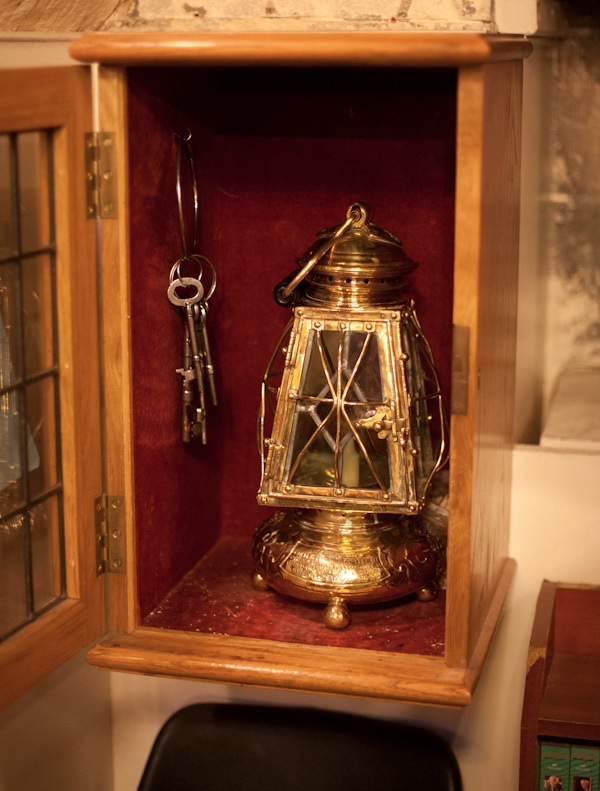
The keys to the Tower of London and the lantern.


“Halt, who comes there?”

“The Keys!”


“God preserve Queen Elizabeth!”


Photographs copyright © Martin Usborne
You may also like to read about
John Keohane, Chief Yeoman Warder at the Tower of London
The Ceremony of the Lilies & Roses at the Tower of London
Constables Dues at the Tower of London
The Bloody Romance of the Tower
You can apply to attend the Ceremony of the Keys through Historic Royal Palaces. A limited number of guests are permitted each night and it is free. Please apply at least six weeks in advance and be sure to include several alternative dates in your application which must be accompanied by a stamped addressed envelope.
Residents of Spitalfields and any of the Tower Hamlets may gain admission to the Tower for one pound upon production of an Idea Store card.
At James Hoyle & Son, Iron Founderers

Brian Barrett, the foreman at James Hoyle & Son invited me to return to the foundry last week to watch the iron casting. The men were in from six and one set of casts had already been poured when I arrived, as they were hastily preparing for the next session. Through the haze, I could see the moulds laid out upon the black sandy floor within the cavernous gloom of foundry building, waiting as the iron cooled within, until they were ready to be broken open and their progeny revealed.
At the far end, illuminated by a fiery glow, Brian was stoking up the furnace again with pig iron, while on the other side, mould makers Raymond Bates and Bill Wakeman were busy pumping sand mixed with quick-setting resin into wooden pattern boxes to make the fresh moulds for the next round of casts. And working alongside Raymond and Bill was twenty-one year Benjamin Hoyle, fourth generation iron founderer and great-grandson of James Hoyle who established the Bee Hive Foundry in 1880 – currently training under Brian Barrett’s instruction to learn all the workings of the foundry that he will take over one day. “I’ve been coming along since I was fourteen,” Benjamin revealed, as he continued work, absorbed in making a mould for a set of railing heads,“but when I was eighteen I told my dad this is what I wanted to do and I’ve been full-time since then.”
“I plan to do it until I feel happy enough that my children are ready to take my place.” he added in passing, almost to himself. It was an extraordinary declaration of commitment, spoken with conviction yet in the midst of work, and Benjamin was ceaselessly engaged with multiple tasks the whole time I was there – wheeling huge barrows of pig iron in and out, as well as energetically breaking open and clearing the sand moulds to release the newly cast pieces of iron. “If Brian is busy, I tend to the furnace, loading the pig iron as well as making the sand moulds – and, as I am the youngest, I do most of the lifting,” Benjamin told me plainly, eager to embrace his responsibility.
“This is very old England, eighteen eighties,” he qualified with a smirk, casting his eyes around this venerable foundry that is a charismatic survivor of the Industrial Revolution, “I wouldn’t have liked to work here when they had to bring in the pig iron by horse and cart,”
“I value it because its my heritage but also because it is interesting.” he confirmed for me as he leant over the completed sand mould in deep concentration, using compressed air to clean off any residue. “We’ve had page three models in here ordering railings,” he bragged, suddenly changing energy and rolling his eyes in excitement, “and we cast some iron balconies for Jennifer Saunders, a fireplace for Elton John, garden furniture for the Queen and we made the railing heads at ten Downing St.”
Then, “I say I am an iron founderer, and people are impressed when I tell them what I do,” he confided shyly, with a bemused grin, “but mostly they haven’t a clue what it is, they think I am a blacksmith.”
The iron was ready to be poured and all the fresh moulds were laid out with lines of weights upon each one to hold them secure. The founderers put on their protective goggles and Brian instructed me to avert my eyes, avoiding the brief magnesium flare when the iron first runs into the crucible.
Then, in a moment of blinding light as the liquid metal was poured, billowing smoke filled the entire space, blocking out the daylight that became supplanted at once by the volcanic glow of molten iron. Brian tilted the motorised furnace to permit the iron to flow into the crucible, before Benjamin and Bill, the moulder, lifted the vessel together. Holding either end of yoke and keeping their glowing load balanced level, equidistant between them, they took slow deliberate paces, like ghosts in the fog, walking over to the moulds and tilting the crucible, while Brian directed the flow of the iron. Returning to the furnace to replenish twice, each of the moulds was filled and this stage of the task was complete, leaving everyone standing together in the miasma momentarily, sharing a point of arrival at the completion of their task, before dispersing in relief to brew tea and open windows onto the canal where trains rattled past on the other side, down towards Liverpool St.
I joined Raymond and Bill, the moulders, for a quiet cup of tea in a grimy peaceful corner where every surface was caked in foundry dust, as they devoured their sandwiches in paper packets from home. Earlier Bill had given me a handful of the sand mixed with resin and told me to squeeze it in my fist. When I opened my fingers minutes later, the sand had recorded an impression of my hand with all the lines and veins visible, as a vivid illustration of the subtlety of the moulding process. Everyone else had gone and we sat to enjoy the silence of the foundry while the dust settled, but the moment was fleeting as all the others quickly returned.
They began breaking open the moulds to reveal the finely detailed pieces of new ironwork, balustrades and finials in nineteenth century designs that are the history, the speciality and the lifeblood of James Hoyle & Son – giving the family a thriving business serving the restoration trade, which has enabled them to continue when all of the East End’s other small foundries have gone.
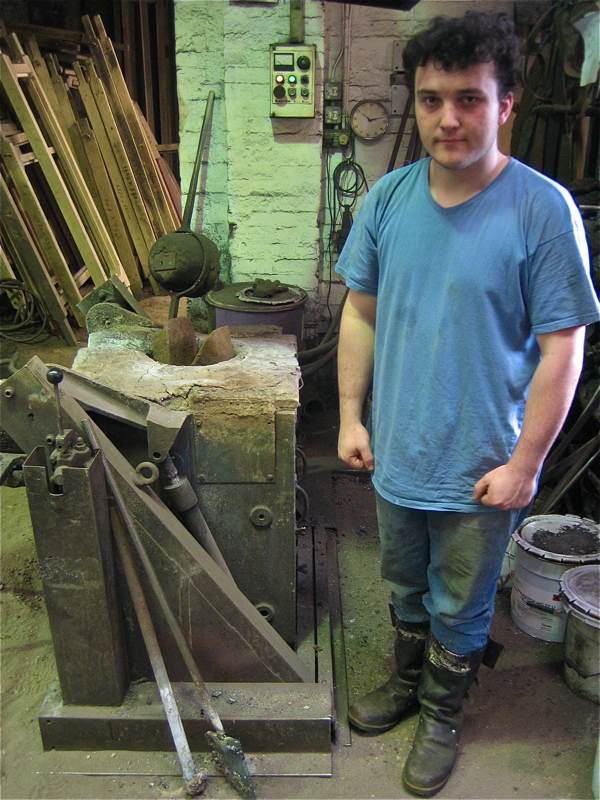
Twenty-one year old Benjamin Hoyle, fourth generation iron founderer, currently training under foreman Brian Barrett at the foundry established by his great-grandfather James Hoyle in 1880.
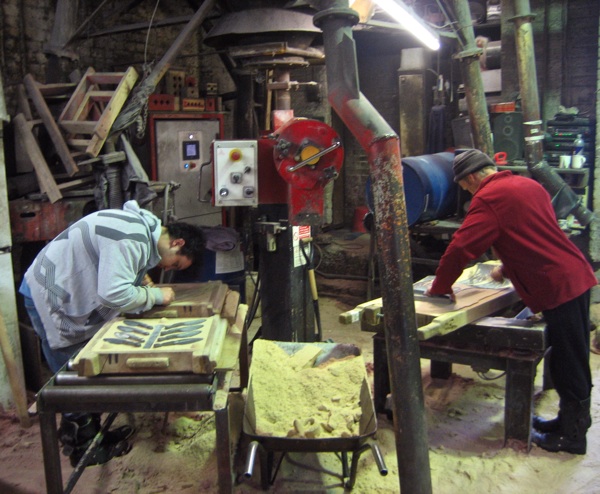


On the right are a set of patterns for railing heads and on the left is one half of the completed mould.
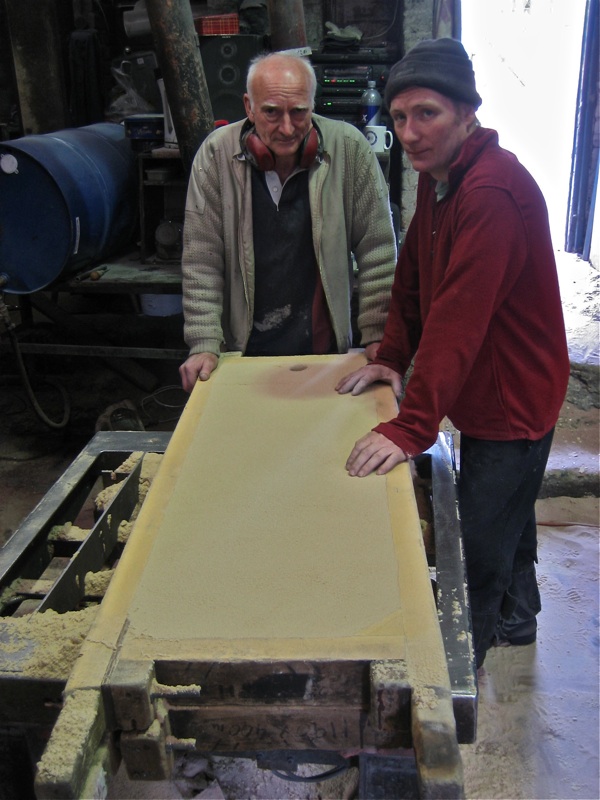
Raymond Bates and Bill Wakeman, mould makers.
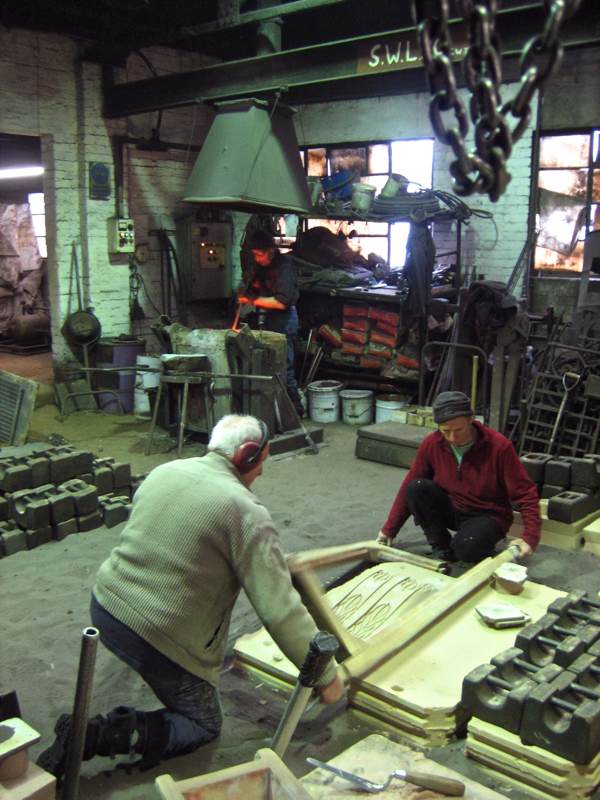

Brian Barrett, foundry foreman, stokes the furnace.

A magnesium flare flickers at the moment the molten iron is poured into the crucible.

Brian, Bill and Benjamin pour the molten iron into the moulds.


You may like to read about Brian Barrett, Foundry Foreman.
Brick Lane Market 7

It is my pleasure to publish this lively account by James Greenwood of the legendary market in birds and animals which once extended from Club Row along Sclater St and filled Cheshire St (formerly known as Hare St) – illustrated by Alfred Concanen, it is one of several closely observed descriptions of East End life and culture that Greenwood wrote at this time, collected together in “The Wilds of London ” in 1874.
At the rear of Shoreditch Church and extending a distance of at least half a mile, is a long narrow thoroughfare, part of which is Hare St, and in that insalubrious locality the reader’s dutiful servant found himself when the bells were ringing on a Sunday morning. One of the churches from which the inviting sound proceeded was in the middle of Hare St and, chiming in with the shouting from the leathern throats of, “Who’ll buy a cock?” – “Who sees three pieball mice for a tanner?” – “Who’ll give three hog (shillings) for a ‘pegging finch?” – the effect was produced was somewhat peculiar.
The pavement being much too narrow to accommodate the pressing throng, the muddy road was crowded as well. It would be more difficult to specify what you might not buy in the way of live stock that morning in Hare St, than to enumerate what was offered for sale.
If you wanted chickens, there they were in baskets, in bags, and held up by the legs, and swinging in feathered bunches from the dirty fists of the vendors. If you wanted Cochin China fowl, there was a prime chance for you, for ploughing through the mire came a gaunt bird of that species struggling with all the pluck of his breed against a boy who had him by the tail, and came splashing after him. Did you want a goat? There were three, “agoin’ for the piece of dawg’s meat,” as the person charged with their disposal declared. Were you desirous of possessing a donkey? There was one, together with a commodious barrow and four “tater sieves” – the lot for two pun’ fifteen! Ferrets, dormice, white mice, black mice, rats for the pits, fancy rats, white with red eyes and ginger-coloured rats, with tremendous teeth and whiskers, hedgehogs for the destuction of black beetles, guinea pigs and tortoises – Is your heart set upon any of these? If so, rejoice that you are in Hare St on a Sunday morning.
But, before all, Hare St is strongest in singing birds. Not so much for sale seemingly, as brought out for an airing. There they were, not here and there one, but by dozens and hundreds – goldfinches and chaffinches chiefly. The cages that contained them were tied in handkerchiefs, silk and cotton, and carried swinging in the hand, and jostling against the rude mob, as though they were of no more account than parcels of the most ordinary merchandise. But the most amazing part of the business was, that not only did the imprisoned and much-hustled finches continue to exist under such circumstances, but they retained their perches and their equanimity in the most perfect manner, and sang as they were carried. To what amount and to what sort of training these poor little birds had been subjected to it is hard to guess. There they were, however, all in the dark, with no purer air to breathe than the ordinary Hare St air, further poisoned by the presence of the foul mob, hung dangling at arm’s length, and jostled, and shook, and spun about, yet raising their tiny pipes as though nothing at all was the matter, and they were as much at ease as their grimy-faced, short-pipe puffing gentry that carried them.
I walked the length of the fair through and through, but as it was now one o’clock and the public house doors were opened, I joined the thirsty throng waiting for admittance at the Tinker’s Arms. It was a hazardous experiment, as the beer of Brick Lane, though strong is peculiar as to its flavour and for anyone not accustomed to it, a little goes a long way. It was not so however with my brother bibers. There were a good many performers before the bar and the conversation was strictly birdy. One was bragging of his “slamming” goldfinch, while another individual button-holed a friend and told him all about his “greypates,” and a third was learned on the subject of linnets, reciting that able bird’s sixty-four distinct notes. But as the man had a very gruff voice and gave the recitation with a strong nasal twang, my idea of the linnet’s song was not exalted by the lesson, and since by now my measure of Brick Lane beer was considerably reduced, I was almost as much in the dark as ever…
The famed Club Row bird market lasted until very recently, but nowadays the only individuals crying out on behalf of animals in this location on Sundays are the anti-fur protesters in Cheshire St, yet anyone desirous of seeing live animals in Spitalfields today need only take a short stroll over the Pedley St railway bridge to the Spitalfields City Farm and they will not be disappointed.
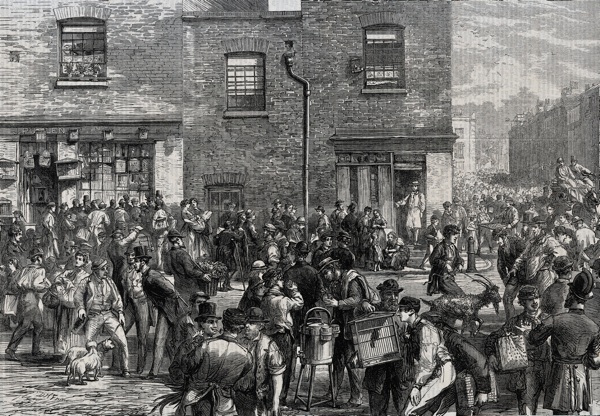
The Sunday morning bird fair at Club Row, Shoreditch, in the nineteenth century. (This building which still stands at the corner of Sclater St and Brick Lane was the original pie and mash shop opened by Robert Cooke in 1862, the great-grandfather of the current Robert Cooke whose family establishment opened in Broadway Marker in 1900. In recent years this building was renovated by Jim Howett.)

From Brick Lane, looking East down Hare St, (now called Cheshire St).

From Brick Lane, looking West down Sclater St.

In Club Row.

Selling puppies in the nineteen twenties at Club Row market.
Images copyright © Bishopsgate Institute
You may also like to read
Dog Days at Club Row Market by Ronald Searle and Kaye Webb
The Labour and Wait Brush Museum

When connoisseurs of traditional hardware, Simon Watkins and Rachel Wythe-Moran, opened Labour and Wait in Spitalfields ten years ago, the very first item of stock to arrive in their shop was a wooden handbrush, but – as you can see from the picture above – there have been developments over the intervening decade. “Rachel’s been obsessed with brushes for years,” revealed Simon with a candid smile, “So one day I said, ‘Why don’t we start collecting them and have a Brush Museum?”
The notion was a brush with genius, and today when you visit their shop in the former Dolphin Pub in Redchurch St you can see a selection of fine specimens from the Labour and Wait Brush Museum occupying a space above the staircase – guaranteed to have any brush lover bristling with delight.
Just like Sir William Hamilton’s small collection of Greek vases that became the origin of the British Museum, these modest artifacts speak eloquently of their culture and society. Already the Brush Museum has won a cult following in Tokyo where Simon and Rachel displayed their collection as part of a Labour and Wait pop-up shop which also included demonstrations of the English Tea Ceremony, complete with mugs of builders’ tea with milk, served with Tunnock’s Tea Cakes. Seeking new acquisitions for the museum, Simon and Rachel visited a master brush maker in Osaka. “His workshop was pitch black, he had no storefront and the place stank of tar and woodsmoke – every surface was blackened – and in the middle sat this little man wrapping wire around cane to make his brushes.” enthused Simon in affectionate reminiscence as he cradled one of the brushes in question.
Simultaneously mundane and surreal, brushes are objects of universal fascination, indicative of a vast range of human activity and evolved into diverse shapes, sizes and materials according to their purpose. They are extensions of the hand with bristles in place of fingers, and their intriguing anthropomorphism reflects this function as substitute limbs. Our intimate relationship with brushes has imbued them with rich ambiguous poetry – from the loneliness of the sole toothbrush and the mystery of the witch’s broom, to the sensuous eroticism of bristles and the cheeky comedy of the tickling stick.
Over the last ten years, Simon and Rachel have sought out the last traditional makers around Europe to supply the extraordinary selection of new handmade brushes for sale in their shop, which are complimented by the growing museum display, creating a veritable temple of delight filled with treasures to delight the brush fancier.

A nineteenth century clothes brush by Jacob’s of Liverpool – from the museum.

A Japanese Plasterer’s Brush that can work in either direction – from the shop.

A clothes brush with the enigmatic letters T A H in different coloured bristles – from the museum.

A pocket clothes brush produced by the Co-operative Society – from the museum.

A nineteenth century barber’s brush with soft bristles – from the museum.

A body brush, can be used wet or dry – from the shop.

London & North Eastern Railway issue 1946, expressive of austerity and utility – from the museum.

A travel coat hanger and clothes brush in one – from the museum.

Swedish Scrubbing Brushes – from the shop.

A brush by the master in Kyoto, for cleaning inside barrels and getting at odd angles – from the museum.

A Computer Brush with a soft side for the screen and a narrow side for between the keys – from the shop.

A soft Cobweb Brush with bristles of Skunk – from the museum.

This massive Scrubbing Brush is curved to allow grip with both hands – from the museum.

Japanese Vegetable Brush from Tawashi – from the shop.

Nineteen-fifties Crumb Sweeper, “the Crab” – from the museum.

A Swedish soft Mushroom Brush for removing the dirt without hurting the fungi – from the shop.

Two nineteenth century clothes brushes with decorative bristle patterns – from the museum.

A sturdy German toilet brush – from the shop.

The Genie with its stiff wire bristles could easily do a lot of damage to your upholstery – from the museum.

Sailors’ Whisk Brush made in Ipswich – from the shop.

A Dish Brush by the Kyoto master – from the museum.

A Portuguese Toilet Brush, also ideal to accompany your dolly’s witch outfit – from the shop.

A Hat Brush by Titterton, curved for ease of use – from the museum.
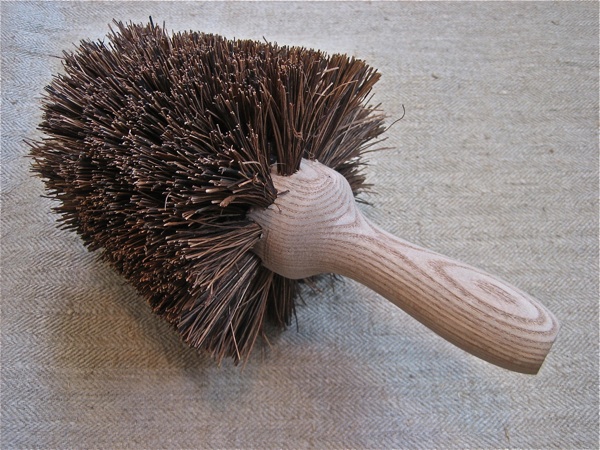
A Flowerpot Brush, essential to prevent cross-contamination between your pots – from the shop.

A stiff Cobweb Brush by Bettaware – from the museum.

A Bannister Brush – from the shop.

The Labour & Wait Brush Museum on tour in Japan.

Simon and Rachel in a group photo outside the Labour & Wait pop-up shop in Tokyo.

Bethnal Green’s previous top brush shop, A.L.R.Marks Ltd – specialising in Skunk Dusters.
John Moyr Smith’s Tiles 2

Back in January, I showed you the first of the nineteenth century Minton tiles designed by John Moyr Smith that I am collecting to line my fireplace, prior to the installation of a stove, and now it is my delight to show you the next twelve which are the result of the last three months’ searching around. I will need forty-five by the Autumn to complete the fireplace so that I can light my stove to keep me warm next Winter – thus far I have around half as many as I require.
As well as being an accomplished designer and draughtsman, John Moyr Smith was an instinctive dramatist – each of his tiles illustrates a the dramatic climax of a story, whether from Shakespeare, the Bible, Fairy Tales, the Idylls of the King, Nursery Rhymes or English History – and unfailingly he found the psychological moment when the drama turned.
I am especially happy with this broken tile at the top, illustrating the heart-stopping moment described by Alfred Tennyson in the “Idylls of the King,” when the hero Pelleas discovers his beloved Ettare sleeping in Gawain’s arms. Pelleas lays his sword across their throats and sneaks away by moonlight, for them to wake and realise that he might have killed them if he chose. The high drama of it all with the morbidly jealous Pelleas leaving on tip-toe, while Gawain and Ettare doze in their post-coital swoon is captured with gratifying precision upon this cracked tile of a hundred and forty years old that I bought for £1.99.
No-one else wants broken tiles but me, because these overwrought designs are out of fashion and serious collectors desire undamaged specimens. But I am thankful to buy cracked tiles cheaper and know that I am providing a safe harbour for them in my fireplace – where they can be preserved safely and appreciated for their merits while their flaws are forgiven. Next Winter, these tiles will serve as a substitute for the flames of the open fire to inspire imaginative reverie at the hearth on dark nights.
Although I have no doubt Moyr Smith intended his tiles to be used in matching sets, I have chosen to mix them up – reflecting both their limited availability, and my own enjoyment in unlikely juxtapositions of different characters such Humpty Dumpty next to King Canute, or Jesus beside Bluebeard.
As my collection grows, I am beginning to appreciate the different imaginative modes of John Moyr Smith’s imagination. Most seductive is the mythic medievalism of Shakespeare and the Idylls of the King, in which everyone wears clingy clothing to outline their athletic limbs and torsos, assuming languorous postures that are never less than graceful, while extending their gestures to draw the eye into the drama unfolding. And the Celtic world is especially sexy with lots of sensuous pattern, louche drapery and exotic furniture in the shape of animals.
By contrast, the pair of Nursery Rhymes evoke a world closer to that of the late nineteenth century, in which Miss Muffet wears a corset and a little girl carries an aesthetic movement peacock fan, while their male companions – the boy, the creepy old man with the snuff box and Humpty Dumpty himself – are dressed in theatrical versions of eighteenth century garb. The presiding influence here is Kate Greenaway.
Yet all this variety of content and style is unified by the circular frames within each design and the limited colour scheme of browns, with touches of blue and soft grey, upon beige and biscuit tiles, creating a pleasant unity when they are arranged side by side. Every one of my tiles has already been around in other fireplaces for over a century. How many rooms and lives they have witnessed. How many babes have fallen asleep in their cots watching Nursery Rhyme figures dancing in the flickering firelight in the Nursery fireplace. How many old dears have drifted off in their fireside armchairs, glancing at the familiar Biblical scenes for the last time, before sleeping never to wake again, in the hope that their Christian souls are saved.
When I sit beside my stove next Winter I shall think not just of the characters in the miscellany of stories in my fireplace, but also of all those other unknown people before me who have wiled away long nights at the hearth, their dreams enlivened by the presence of these wonderful tiles by John Moyr Smith.

Humpty Dumpty from Moyr Smith’s Nursery Rhyme series – tile has broken edge.

Henry IV Part One. Young Hal & Falstaff at the Boar’s Head in Cheapside, from Moyr Smith’s Shakespeare series.

Twelfth Night – the drunken carousing of Andrew Aguecheek, Feste and Sir Toby Belch – this tile was the kind gift of Rodney Archer.
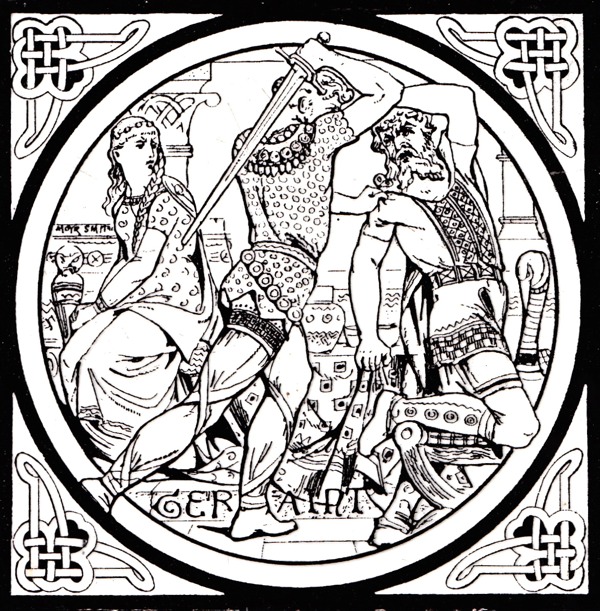
The Welsh hero Geraint rescues his beloved Enid from the attentions of Doorm, the robber chief – from Moyr Smith’s “Idyll’s of the King” series.
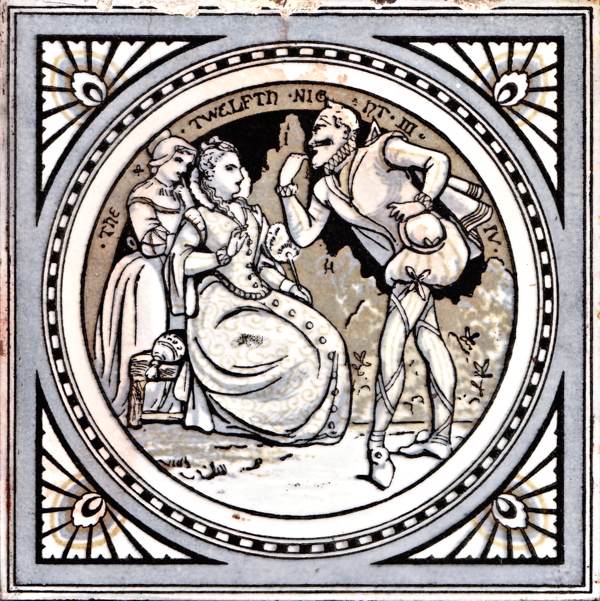
Deceived by a forged love letter, Malvolio comes dressed before Olivia in yellow cross garters, while her maid Maria – the perpetrator – watches in amusement

Little Miss Muffet with the spider and another predatory admirer – tile cracked in three and glued back together again.

Kind Canute steps up onto his thrown to avoid the waves while his sycophantic courtier retreats in horror – from Moyr Smith’s Early English History series.

The Tempest. Trinculino the drunken butler and Stefano the fool meet Caliban gathering wood on Prospero’s magic island.

Troubled Enid and mistrustful Geraint, a tense marriage – tile cracked in two and stuck together again.

Macbeth drops his cup upon seeing Banquo’s ghost at the feast, pointing the finger of guilt for King Duncan’s murder.
You may also like to read about
At the Wyvern Bindery

“We’re inspired by William Morris and by Eric Gill,” explained Mark Winstanley, self-styled “gentleman bookbinder” of the busy Wyvern Bindery in the Clerkenwell Rd – “Morris articulated the three crucial elements you need to run a successful bindery. You need a clientele with an appetite for hand made bindings. You need a skilled labour force to do the binding, And you need a nice rich city like London.”
Fortunately Mark has all three, and is ideally placed to bring the first two together in Clerkenwell, once the historic centre of London’s print trade and now the preserve of media and design companies. “Gill’s idea of a workshop was that everyone should own their personal set of tools,” he continued, recognising the need for individual autonomy within the workplace – a principle evidenced by the diverse group of young bookbinders working on different projects at the Wyvern Bindery, assisting each other and coming regularly to consult Mark whilst we were in conversation.
“There’s always been a bookbinding trade, but without Morris life for a bookbinder would be much more difficult today,” Mark conceded with an affectionate nod, “Hannah More, Rosie Gray and I started the Wyvern Bindery in 1990 in the Clerkenwell workshops. We got it going from nothing and we turned over thirty-five thousand pounds in the first year, with a little bit of luck and some hard work. And after five years, we took this shop at five thousand pounds a year.”
If you pause on the Clerkenwell Rd and look through the window of the Wyvern Bindery, you can witness the entire process of bookbinding enacted before your eyes. Among presses and plan chests, surrounded by racks of multi-coloured rolls of buckram and leather, and shelves of type and tools, the bookbinders work, absorbed at tables and benches, trimming pages and card for covers at guillotines, sewing and gluing and pressing and tooling, working with richly subtly hued canvas and leather, and finally embossing them with type for titles. In a restricted space, they pursue individual tasks while also engaging in an elaborate collective endeavour, sharing equipment and bench space as their projects require different areas of the shared workshop – all within a constant dynamic harmony.
“In the seventies when I started, the trade was opening up and it was easier to get into it without an apprenticeship.” recalled Mark, “I was one of the students on the very first full-time year’s course in craft book binding at the London College of Printing in 1976. My teacher was Art Johnson and he taught me to make books that lasted and were well made, with honesty.”A principle apparent today in the unpretentious work produced at the Wyvern Bindery, creating bindings that do not draw attention to themselves – avoiding ostentation in favour of work that is neat and well finished. “People ring up and say, ‘This is what we want it to look like. Can you work it out in twenty-four hours and we’ll fly off on Monday morning to do a pitch to Coca-Cola with it,’ -not a fancy leather binding that takes six weeks.” admitted Mark, revealing how his ancient trade thrives amongst the new media that surround him “We apply craft skills to a commercial proposition. It might not be art but it’s clean and neat and it’s done on time.” he said plainly.
If you think Mark’s pragmatism is not entirely convincing, your suspicion will be confirmed when he admits to the irresistibly seductive melancholy of damaged old books that demand restoration. A magnetism that led him to Ethiopia recently, where he was invited to restore a sixth century testament, the Abba Garima Gospels written around 560, the oldest illuminated church manuscript in Africa.“Written in one day – because God stopped the sun for three weeks – it is still a living document,” he assured me, his eyes sparkling with passion, “A seriously holy book that people pay to have read to them, believing that it can cure the sick, this is one of the greatest church documents in the world.”And then Mark showed me snaps of fragments of the beloved book, explaining how he painstakingly unpicked the stitches that were causing tears to the pages and reattached them all to the spine with Japanese tissue.
Bookbinding emphasises a sense of time and mortality for the binder, because alongside the bindings that Mark creates to preserve the content of new books, old damaged tomes are coming in for repair, illustrating the fate of his predecessors’ works, a fate that will also come to his own in turn. “When you see the work of the great book binders, like Riviere, Morrells and Bumpus – all dead and gone now – they jump at you, the quality of the leather and gold tooling, the attention to detail, the hand-sewn headbands and good quality card.” Mark declared to me, confiding his sense of personal connection. And I understood that the care he puts into these repairs honours those who came before him, expressing a latent hope that his work will be similarly respected by generations yet to come.
The first printing in London was done in Clerkenwell, while in the nineteenth century it became a place of booksellers and now Mark Winstanley has found an elegant way to make the artisan skills of the bookbinder serve the current inhabitants. The Wyvern Bindery with its hand tools and glue pots may appear the anachronism in Clerkenwell today, yet the truth is it carries the living spirit of the culture that has defined this corner of London for more than five hundred years.
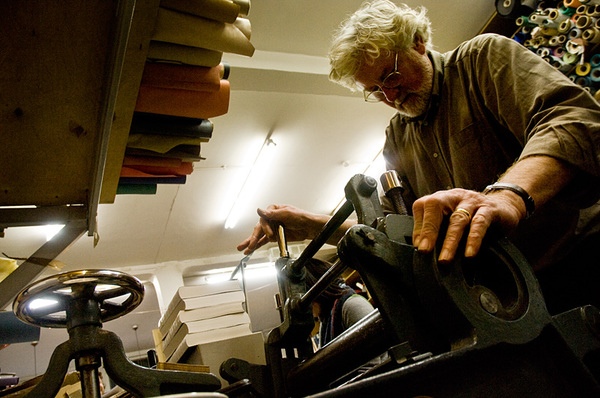


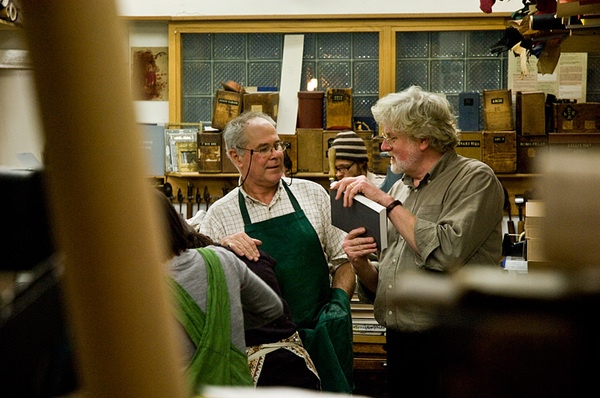


Wyvern Bindery, 56/8 Clerkenwell Road.

Pages from the Abba Garima Gospels dating from before 560.

The Gospels restored with pages mounted on Japanese tissue by Mark Winstanley.

Mark Winstanley at the Clerkenwell Workshops in 1990.
Photographs of the bindery copyright © Nicola Boccaccini












