At 123 Bethnal Green Road
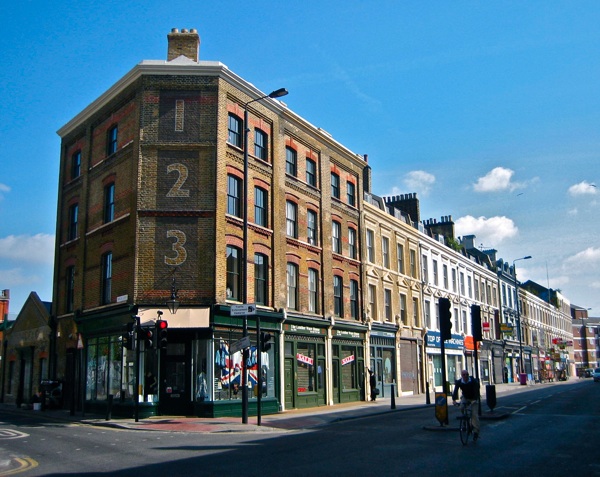
Observe this peaceful scene in the Bethnal Green Rd, with its fine, newly restored Victorian terrace resplendent beneath a benign blue sky and cotton wool clouds. You would never guess that ten years ago these premises harboured London’s most notorious illegal gun supply – selling hundreds of lethal weapons to villains all across Britain at the rate of one a day. “They were supplied to the criminal fraternity, whether to be used in bank robberies, or to threaten people, or to kidnap people, or simply to shoot them,” revealed the prosecutor at the Old Bailey, speaking plainly, when the culprits came to trial in July 2006.
It took a lengthy operation by a team of undercover detectives to discover that “Moderne Buckles, leading makers of air rifles, replicas, buckles, leather goods and accessories” was the hub of a supply and conversion network – the largest ever uncovered by the Metropolitan Police – yet even to the casual observer there was something fishy about the sale of buckles and air guns, which make an unlikely retail combination.
When Ross Barry (of Lawrence M. Barry & Co, the largest textile recycling company in the South East) bought the property a few years later, he found some remaining gun parts in the basement which was once the centre of the operation converting replica pieces to active firearms. Yet of greater concern to him were the three tons of buckles left behind by the previous owners before they departed swiftly to gaol. “I think the business selling buckles to the local clothing industry had been established for many years, but it was failing and then the owner’s son-in-law got involved and it became a front for selling guns” Ross told me. The building was left empty and “There were a couple of leaks in the roof, where they had simply moved the stock downstairs when the water came in.” he recalled ruefully as he took me on a tour, rambling up and down this tottering tower.
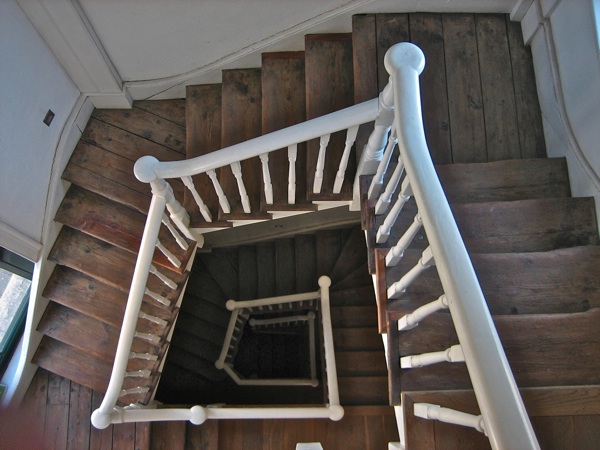
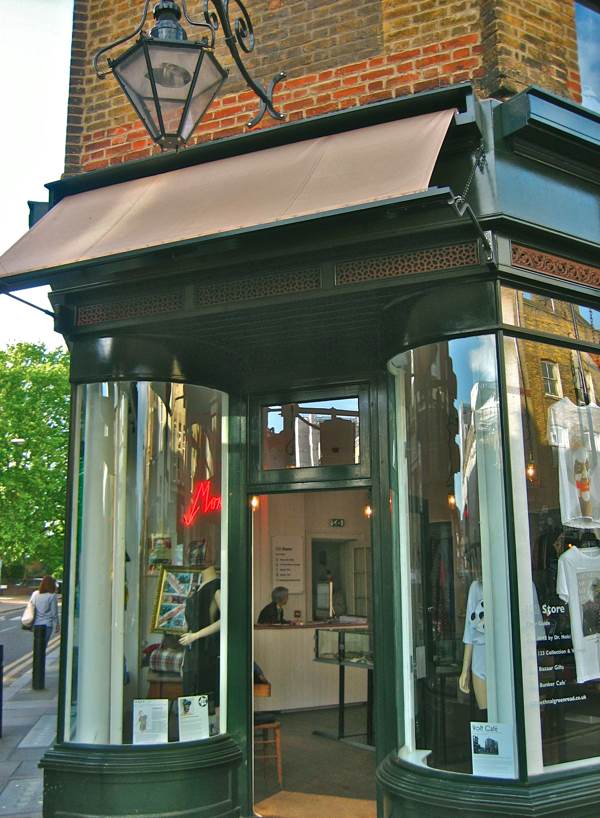
Dating from between 1878 and 1883, when the Bethnal Green Rd was widened, 123 forms a bold culmination to the terrace stretching East that has also been spruced up recently – revealing an entire block which retains its original architectural form, dignified by elongated proportion and modest Italianate decoration. What architect Chris Dyson found at 123 was a building in poor repair, subdivided by partition walls and with an awkward twentieth century shopfront at street level. Under his supervision, the structure was repointed, the roof replaced and the windows remade, and working from precedents in the vicinity, a new shopfront was constructed matching in style and proportion with others in the terrace. Internally, the original staircase has been repaired and matchboarding replaced, while removing the partition walls opens up each floor as a single space, ideal as showrooms or workshops. The result is a nineteenth century building in tip-top condition, architecturally consistent throughout, serviceable and full of character. Rather than drawing attention to itself, the work that has been done leads you to look at the building freshly.
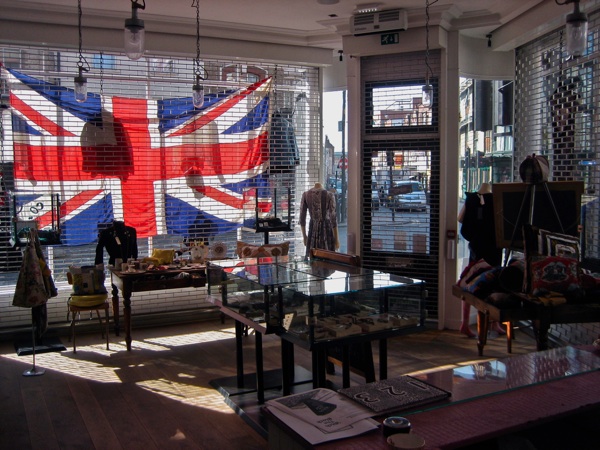
Raise your eyes, next time you walk up Brick Lane – once you pass under the railway bridge – and you will see the numbers one, two and three newly emblazoned vertically in block numerals upon the end of the terrace in the Bethnal Green Rd beyond, visible in the centre of your vision at the top of the lane. This distinctive landmark, now known simply as 123, is a favoured destination today for those seeking innovative fashions by new British designers, manufactured in London. Here upon three floors stacked on top of each other, reached by a precarious winding staircase and offering views of the crowds down Brick Lane, is a twenty-first century department store with rails of clothes that have been “upcycled” – recut and individually embellished, retaining their history yet restyled to suit a contemporary sensibility.
It makes perfect sense for Lawrence M. Barry & Co to explore imaginative ways to put old clothes back on sale, and the thoughtful restoration of this fine utilitarian building out of a former buckle company incarnates the change in East End textile manufacturing, from mass production to the small-scale designer operations that define the industry today. 123 Bethnal Green Rd has restored its reputation as well as its fabric now and, putting its criminal past behind it, has acquired a new life.
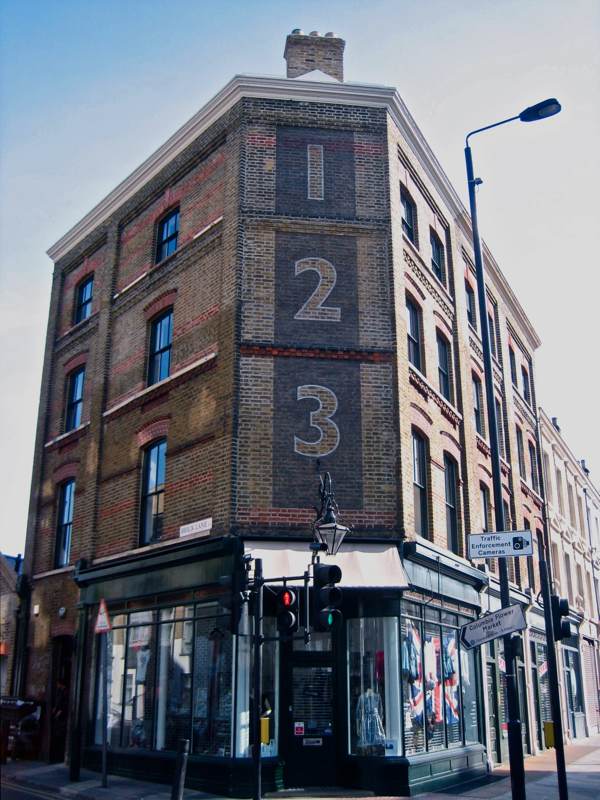
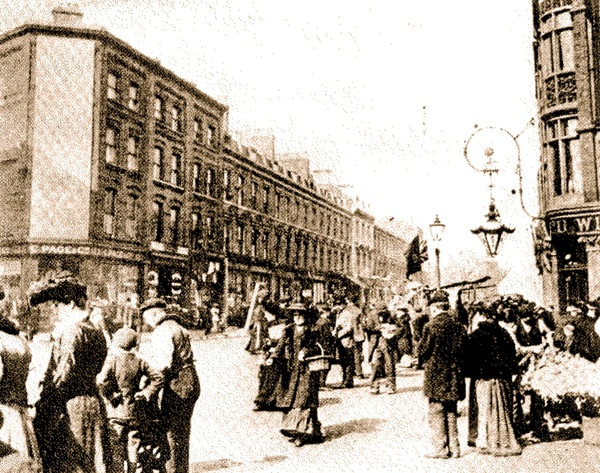
The view of 123 Bethnal Green Rd from the top of Brick Lane, a hundred years ago.
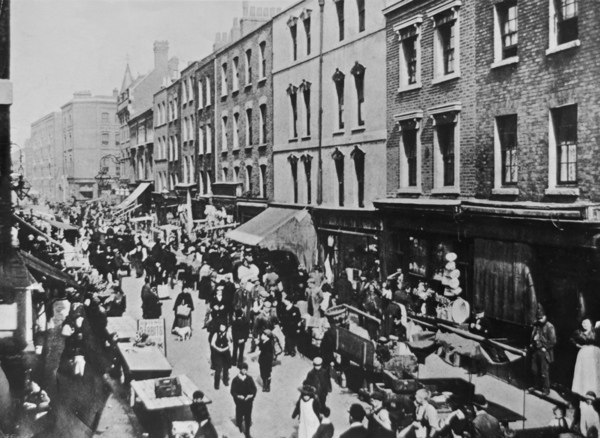
Looking up Brick Lane to 123 Bethnal Green Rd, a hundred years ago.
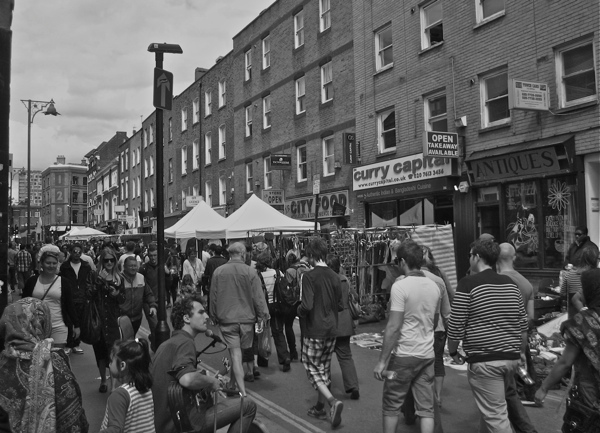
Looking up Brick Lane towards 123 Bethnal Green Rd today.
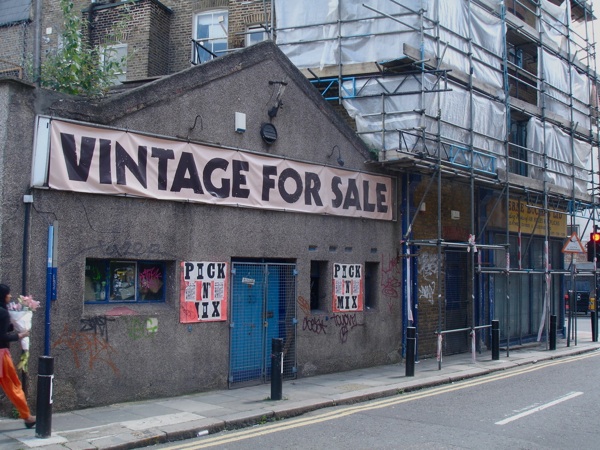
The scout hut at the rear prior to renovation.
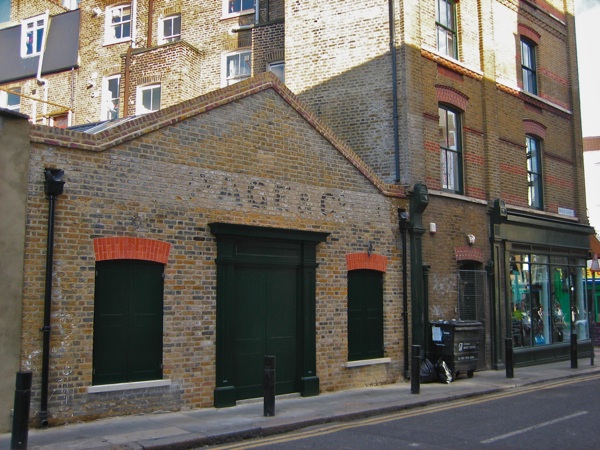
The scout hut today with original lettering of the former garage, Page & Co, uncovered.
Henry Mayhew’s Punch & Judy Man
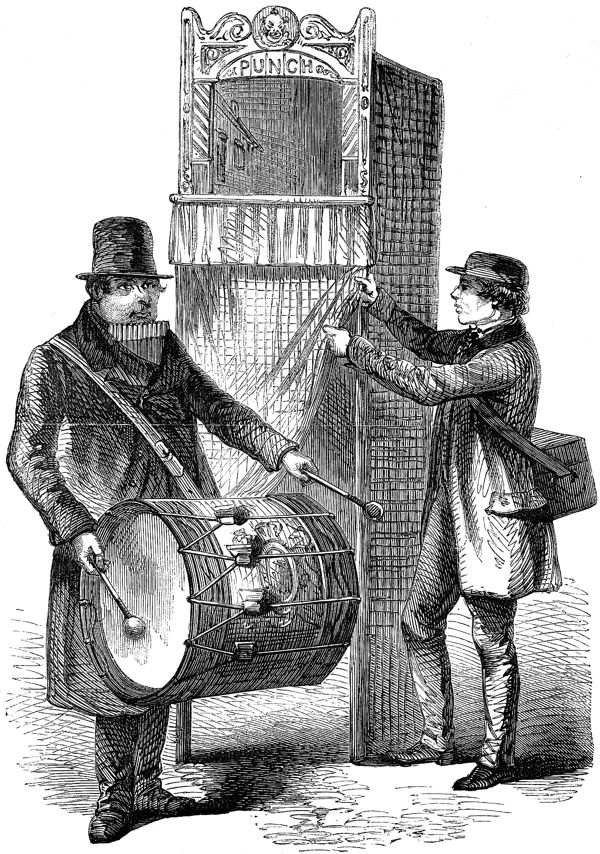
“Ladies & Gentlemen, I’m now going to exhibit a performance worthy of your notice, and far superior to anythink you hever had an hopportunity of witnessing before”
There were none to be found in Spitalfields, when Henry Mayhew set out to find a Punch & Judy man for his interviews that were first published – appropriately enough – in Punch magazine before they were collected in three volumes as “London Labour & the London Poor” in 1851. As the Punchman that Mayhew spoke with explained, “The boys is the greatest nuisance we have to contend with, and many parts is swarming with boys, such as Vitechapel. Spitalfields, that’s the worst place for boys I ever come a-near, they’re like flies in Summer there, only much more thicker. They’ll throw one another’s caps into the frame and, do what we will, we can’t keep ’em from poking their fingers through the baize and making holes to peep through. But the worst of all is, most of ’em ain’t got a farthing to bless themselves with.”
Yet the City of London was not much better for Punch & Judy either -“People ‘as their heads all full of business there and them as is greedy arter the money ain’t no friend of Punch’s.” Then, as now, it was the West End that was the preferred location for street performers. “The best pitch of all in London is Leicester Sq, there’s all sorts of classes you see passing there.” confirmed the Punchman, “Then comes Regent St, the corner of Burlington St is uncommon good and there is a good publican there besides.” And I have no doubt that he was grateful of refreshment because, as this engaging testimony reveals, the life of a Punchman constituted thirsty and demanding work.
“The performer of Punch that I saw was a short, dark, pleasant looking man, dressed in a very greasy and very shiny green shooting jacket. He was very communicative and took great delight in talking like Punch, with his call in his mouth, while some children were in the room, and who, hearing the well-known sound of Punch’s voice, looked all about for the figure.
“I am the proprietor of a Punch’s show,” he said. “I goes about with it myself, and performs inside the frame behind the green baize. I have a pardner what plays the music – the pipes and drum, him as you see’d with me. I have been five-and-twenty year now at the business. I wish I’d never seen it, though it’s been a money-making business – indeed the best of all, street hexibitions I may say. I am fifty years old. It’s a business that once you’ve got into it you can never get out. It’s a great annoyance being a public kerrackter, I can assure you, sir. Go where you will, it’s, ‘Punchy, Punchy!’ Something else might turn up, to be sure. We can’t say what the luck of the world is. I’m obliged to strive very hard – very hard indeed, sir, now, to get a living and at times, compelled to go short often. It’s the march of hintellect wot’s a doing all this, sir.
But I was a going to tell you about my first jining the business. The first time I ever went out with Punch was in the beginning of August, 1825. My dignity was being hurt at being hobligated to take to the streets for a living. I used to stand outside and patter to the figures. There was not much talk, to be sure, required then, and what little there was consisted merely in calling out the names of the figures as they came up and these my master prompted me from inside the frame. I know I could never have done it, if it hadn’t been for the spirits (a little drop of gin), as my master guv me in the morning. Yet the first time I ever made my appearance in public I collected as much as eight shillings, and my master said after the performance was over, ‘You’ll do!’
I kept on going with my master for two years and at the end of that time I had saved enough to start a show of my own. I bought the show off old Porsini, the man who first brought Punch into the streets of England. I’ve heard tell that old Porsini used to take very often as much as ten pounds a-day, and he used to sit down to his fowls and wine, and the very best of everything. But he never took care of a halfpenny he got. He didn’t study the world nor himself neither. At last, he reduced himself to want, and died in the St Giles’s Workhouse. He was past performing when I bought my show of him and werry poor. I gave him thirty-five shillings for the stand, figures and all. I bought it cheap, you see, for it was thrown on one side and of no use but such as myself.
The great difficulty in performing Punch consists in the speaking, which is done by a call or whistle in the mouth. Porsini brought the calls into this country with him from Italy and I larnt the use of mine from Porsini himself. I was six months in perfecting the use of it and now I’m reckoned one of the best speakers in the whole purfession. When I made my first appearance as a regular performer of Punch on my own account, I did feel uncommon narvous, to be sure, though I know’d the people couldn’t see me behind the baize, still I felt as if the eyes of the country were upon me. It was as much as ever I could do to get the words out, and keep the figures from shaking. The fust person who went out with me was my wife. She used to stand outside and keep the boys from peeping through the baize and she used to collect the money afterwards as well. She’s been dead these five years now.
Take one week or another, throughout the year, I should say I made then five pounds regular. You can see Punch has been good work, a money making business. Twenty years ago, I have often got eight shillings for one hexhibition in the streets, and many times I’d perform eight or ten times in a day. We didn’t care much about work then, for we could get money fast enough. Arter performing in the streets of a day we used to attend private parties in the hevening. I have performed afore almost all the nobility.
There are altogether as many as sixteen Punch & Judy frames in England, and to each of these frames there are two men. We are all acquainted with one another, are all sociable together. If two of us happen to meet in one town, we jine and share the money. We all know one another, and can tell in what part of the country the others are. We have intelligence by letters from all parts. There’s a Punch I knows is either in the Isle of Man or on his way to it.”
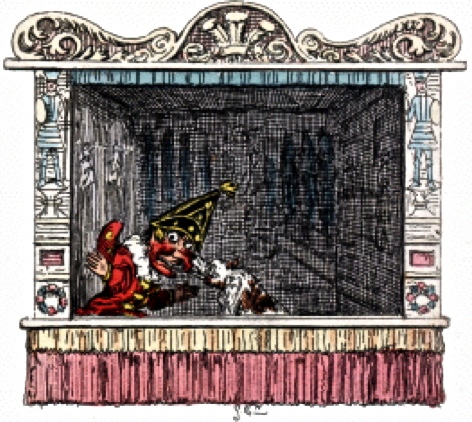
Punch: What Toby, are you cross this morning?
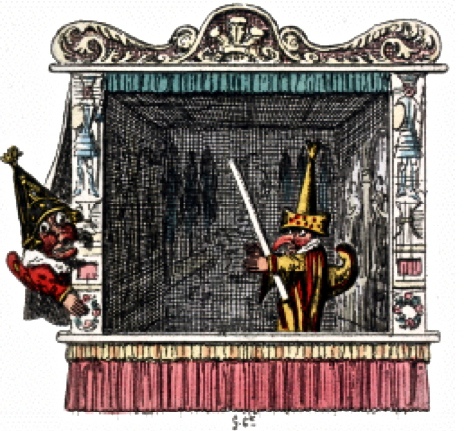
Scaramouch: You have been beating and ill-using my poor dog, Mr Punch!

Judy: Here’s the child. Pretty dear! It knows its Papa. Take the child.

Punch: What is the matter with it? Poor thing! It has got the stomach ache, I dare say.

Punch: Get away, nasty baby.

Judy: I’ll teach you to drop my baby out the window!

Punch: How do you like my teaching, Judy, my pretty dear?

Punch: Stand still, can’t you, and let me get my foot up to the stirrup.

Punch: Oh Doctor! Doctor! I have been thrown, I have been killed.
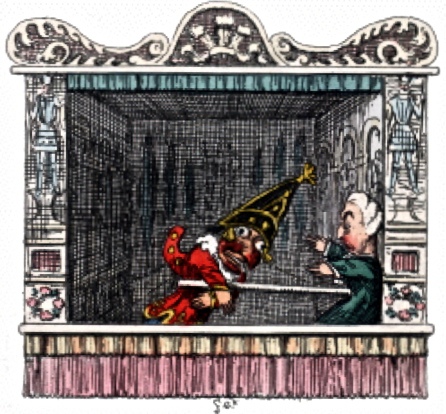
Punch: Now Doctor, your turn to be physicked!
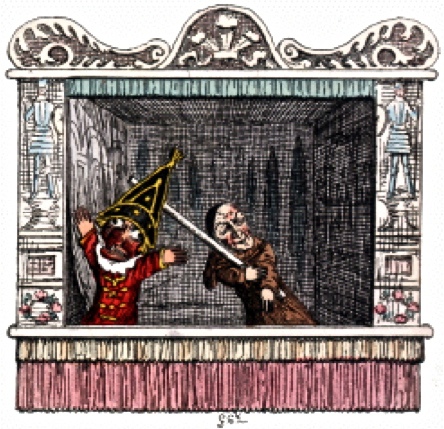
Blind Man: Pray Mr Punch, bestow your charity upon a blind man.

Jack Ketch: Mr Punch, you’re a very bad man.

Jack Ketch: Come out and be hanged!

Punch: Only shew me how and I will do it directly.
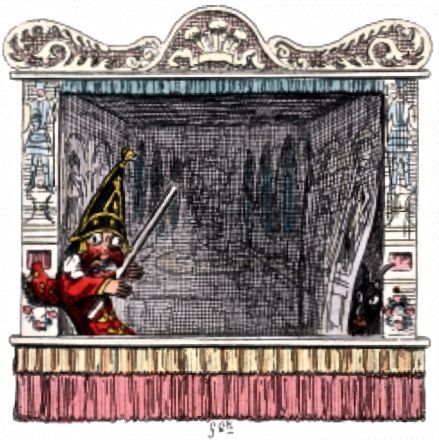
Punch: Here’s a stick to thump Old Nick!

Punch: Pray Mr Devil, let us be friends.

Punch: Huzza, huzza! The Devil’s dead!
Drawings by George Cruikshank, 1827, illustrating Giovanni Piccini’s “The Tragical Comedy or Comical Tragedy of Punch & Judy.”
At the Punch & Judy Festival
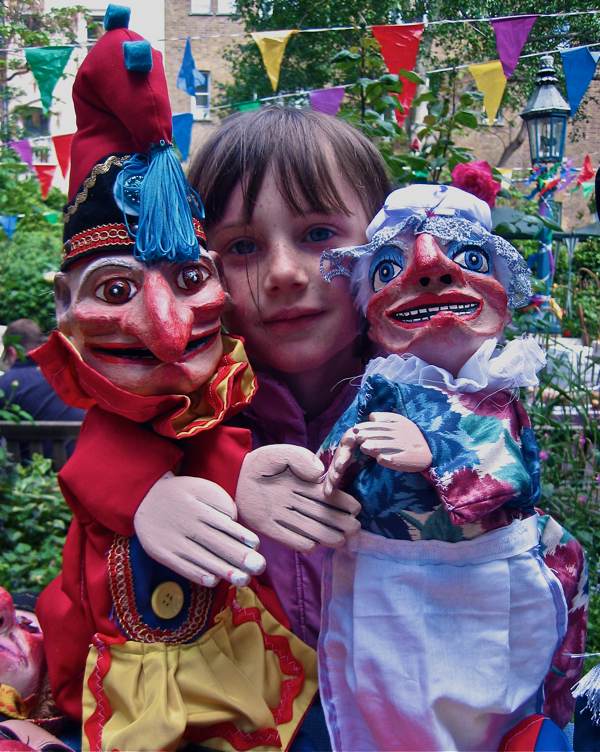
Carmen Baggs with figures made by her father
On 9th May 1662, Samuel Pepys wrote in his diary “Thence to Covent Garden… to see an Italian puppet play that is within the rayles there, which is very pretty, the best that ever I saw, and a great resort of gallants …” It was the first record of a Punch & Judy show in London and, as a consequence, May 9th has become celebrated as Mr Punch’s birthday – and yesterday I walked up to Covent Garden myself to meet the Punch & Judy “professors” gathering there, as they do every year at this time upon the leafy green behind the church.
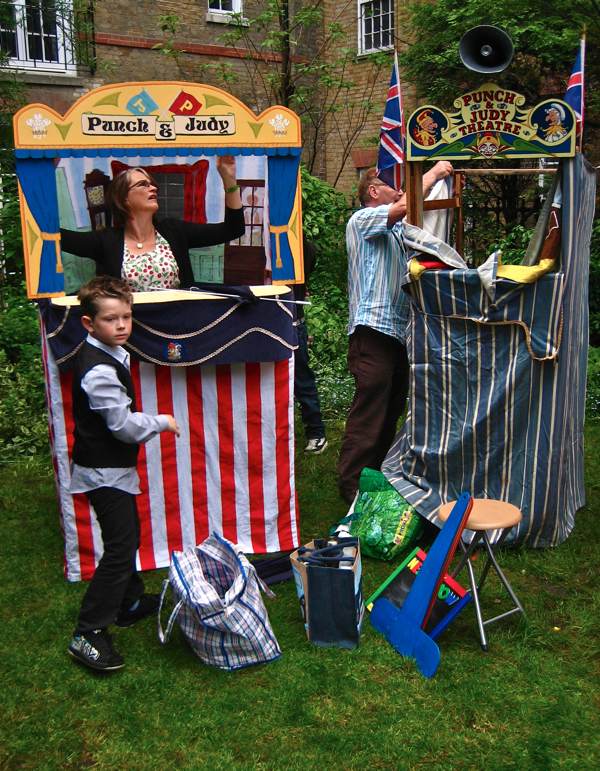
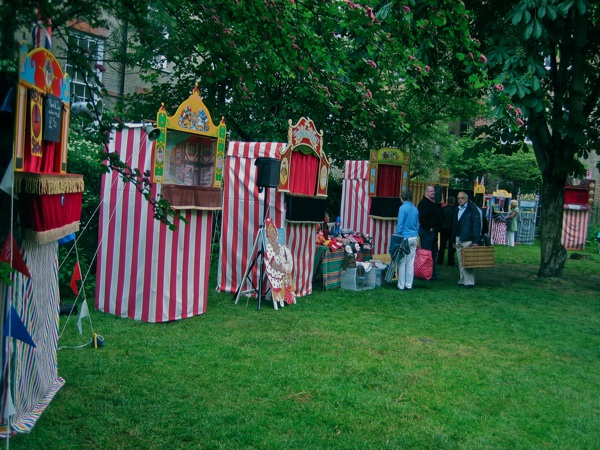
After an early morning shower, the sun broke through to impart a lustre to the branches of may blossom growing in the churchyard, which create an elegant foliate surround to the freshly sprouting lawn, where the Punch & Judy booths were being assembled as the centrepiece of the Covent Garden May Fayre. As they set up their booths, the professors were constantly interrupted by the arrival of yet another member of their clan, and emotional greetings were exchanged as they reunited after another year on the road. Yet before long, a whole line of booths encircled the lawn and vibrant red stripes filled my vision whichever direction I chose to turn.
Peter Batty, a Punch & Judy professor of forty years, who has been coming here for thirty years, could not help feeling a touch of melancholy in the churchyard in spite of the beauty of the morn. “We go from one box to another,” he said, reaching up with the hand that was not holding Mr Punch to touch his booth protectively, and recalling those professors who will not be seen upon this green again. “I think of Joe Beeby, Percy Press – the first and the second, Hugh Cecil and Smoky the Clown,” he confided to me regretfully – “People keep getting old.”
Yet Peter works in partnership with his youthful wife Mariake and their fourteen year old son Martin who is just starting out with his own shows. “It’s such a lovely way of life, we’re really lucky when so many people have to do proper jobs, and it’s a brilliant way to bring up children.” she assured me, cradling Judy, while Martin nodded in agreement, holding the Policeman. “We play together and have a fantastic time – it suits us very well and it’s completely stress free.” she declared. They were an appealing paradox, this contented family who had found happiness in performing Mr Punch and his bizarre drama of domestic violence.
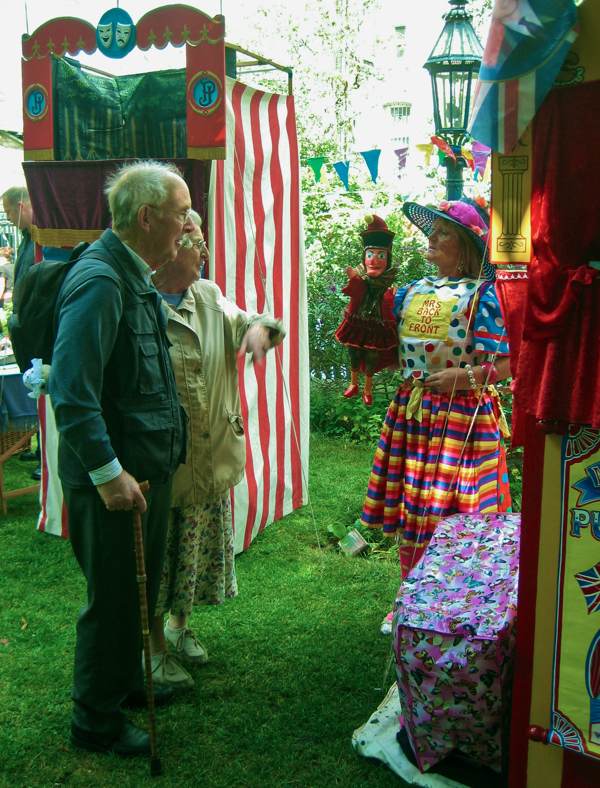
“I was just a bored housewife,” recalled Mrs Back to Front, a lively Punch & Judy professor with her brightly coloured clothes reversed, “twenty-nine years ago, I had a six month old baby and a three year old son, and I was asked to do a puppet show for a fete at his school and I was converted to it. I came here to Covent Garden and I bought a set of Punch & Judy puppets, and I got a swozzle too and found I could use it straightaway.” Then, with a chuckle of satisfaction at the exuberant life she has invented for herself and batting her glittery eyelashes in pleasure, she announced – “My six month old baby is now Dizzy Lolly – she does magic and she’s very good with a monkey puppet too.”
My next encounter was with Geoff Felix, an experienced puppeteer with a background in film, television and theatre who has been doing Punch & Judy since 1982.“I was influenced by Joe Beeby,” he explained, revealing his source of inspiration, “he saw a show in 1926, which the player learnt from someone in the nineteenth century, and Joe kept it going. And that’s how the oral tradition has been preserved.” Geoff explained that the Punch & Judy characters we recognise today, both in appearance and in the story, are based upon those of Giovanni Piccini whose play was transcribed by John Payne Collier in 1828 and illustrated by George Cruikshank. Casting his eyes around at his peers, “It is the swozzle that unites us,” he whispered to me, as if it were a sacred bond, when referring to the metal instrument in the mouth used to make the shrill voice of Mr Punch – “it forces us to create shows based in action.”
Then, Alix Booth, a feisty Scotswoman in a top hat, who has been a Punch & Judy professor for thirty-seven years, told me, “When I was eleven, I inherited a set of paper mache figures. I started working with them and in the end I was doing small shows in Lanark. I still have the figures, over a hundred years old, and although I had to replace Mr Punch’s coat, his waistcoat and trousers are perfect. My figures are based on the Piccini book of 1828, they have their mouths turned down at the ends and huge staring eyes – nowadays Mr Punch is sometimes given a smile, but I prefer him with his mouth turned down, it’s more realistic.”
“I have learnt my craft, and I can keep a children’s party happy for an hour and a half without any trouble at all.” she informed me plainly. “But it was very much for adults originally – entertainment for the Georgian man in the street and it’s full of laughs – it’s all in the timing.”
After my conversations with the professors, I was delighted to stand and enjoy the surreal quality of all the booths lined up like buses at a terminus when I have only ever seen them alone before – yet what was fascinating were the differences in spite of the common qualities. There were short fat ones and tall skinny ones, plain and fancy, with the height defined by the reach of each individual puppeteer. And while the red and white theatres standing under the great chestnut tree awaited their audiences, the professors enjoyed the quiet of the morning to catch up and swap stories.
“It has established a club, brought us all together and kept the tradition alive,” Alix asserted, turning impassioned in her enthusiasm, “And that’s so important, because every year new young performers come along and join us.” But then we were interrupted by the brass band heralding the arrival of Mr Punch and we realised that, as we had been talking, crowds of people had gathered. It was a perfect moment of early Summer in London, but for Punch & Judy professors it was the highlight of the year.
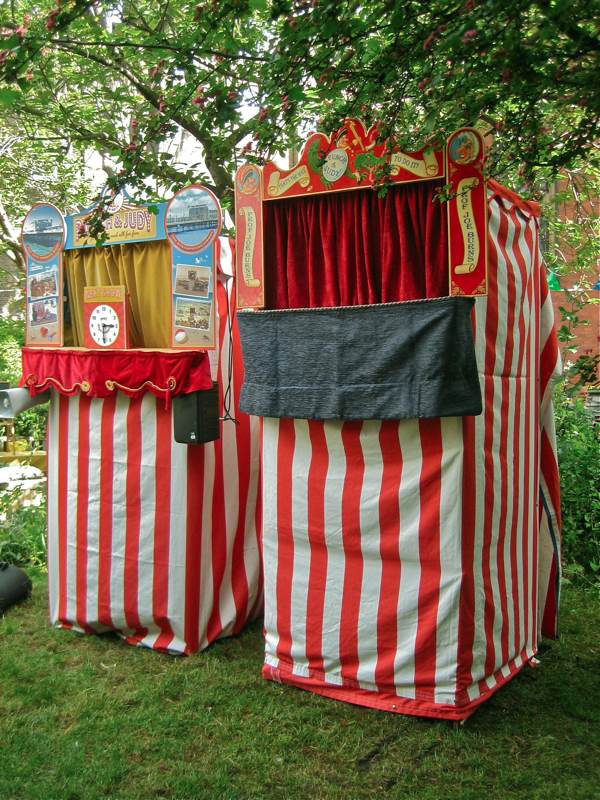
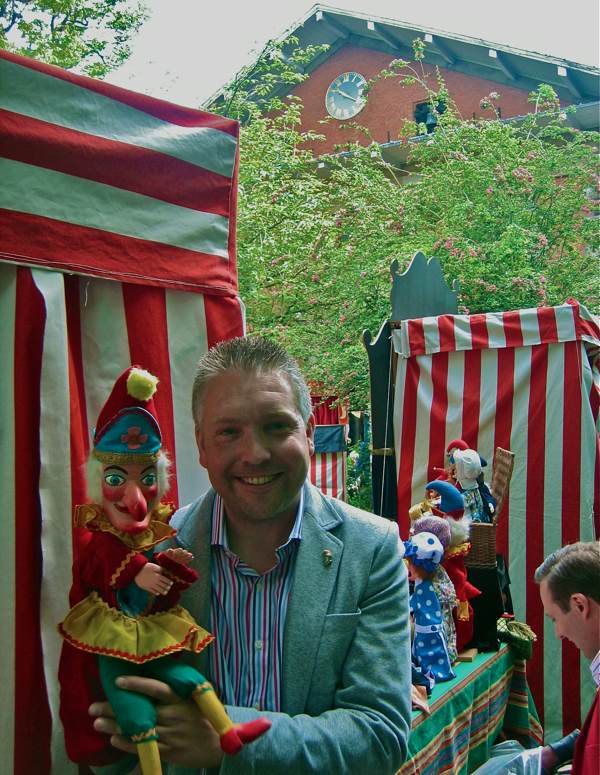
Professor David Wilde has the largest collection of Punch & Judy puppets – over six hundred.
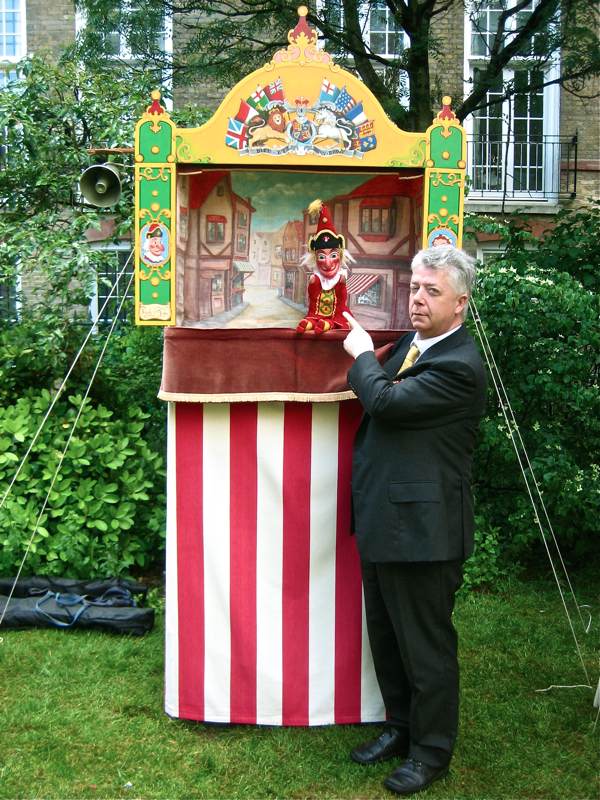
Professor Geoffrey Felix, scenery based upon a design by Jesson and Mr Punch in the style of Piccini.

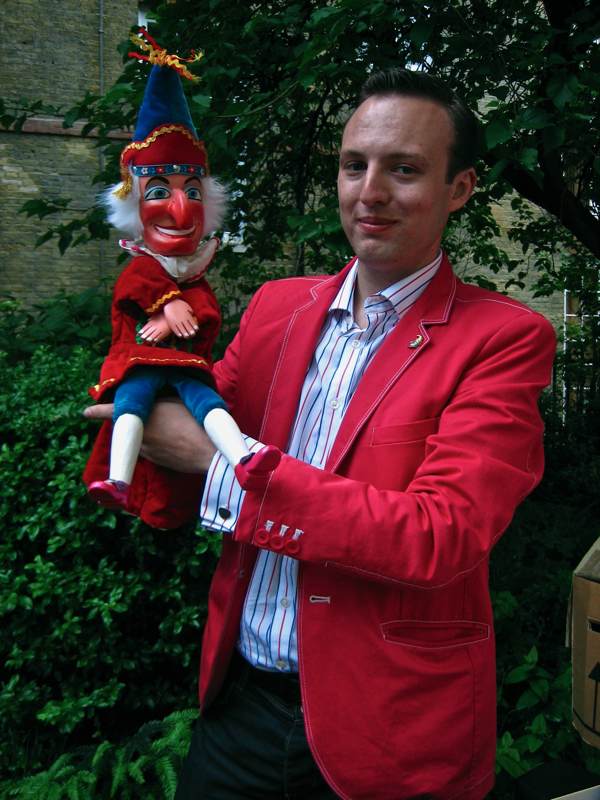
Professor James Arnott restores and repaints old figures.

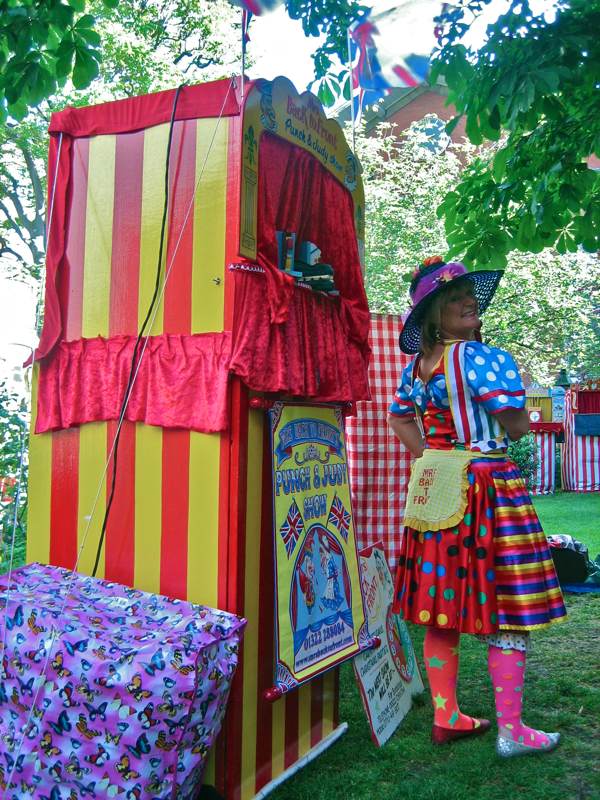
Mrs Back To Front

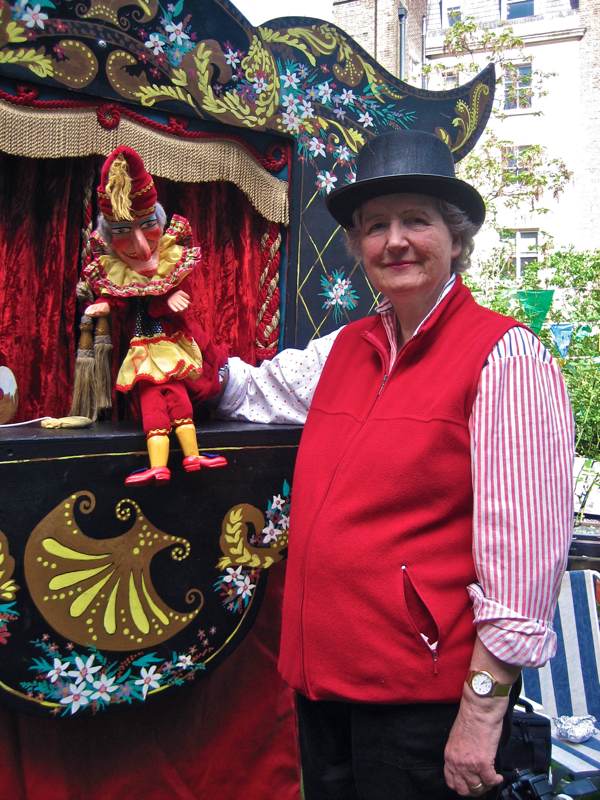
Professor Alix Booth, thirty-seven years doing Punch & Judy professionally.
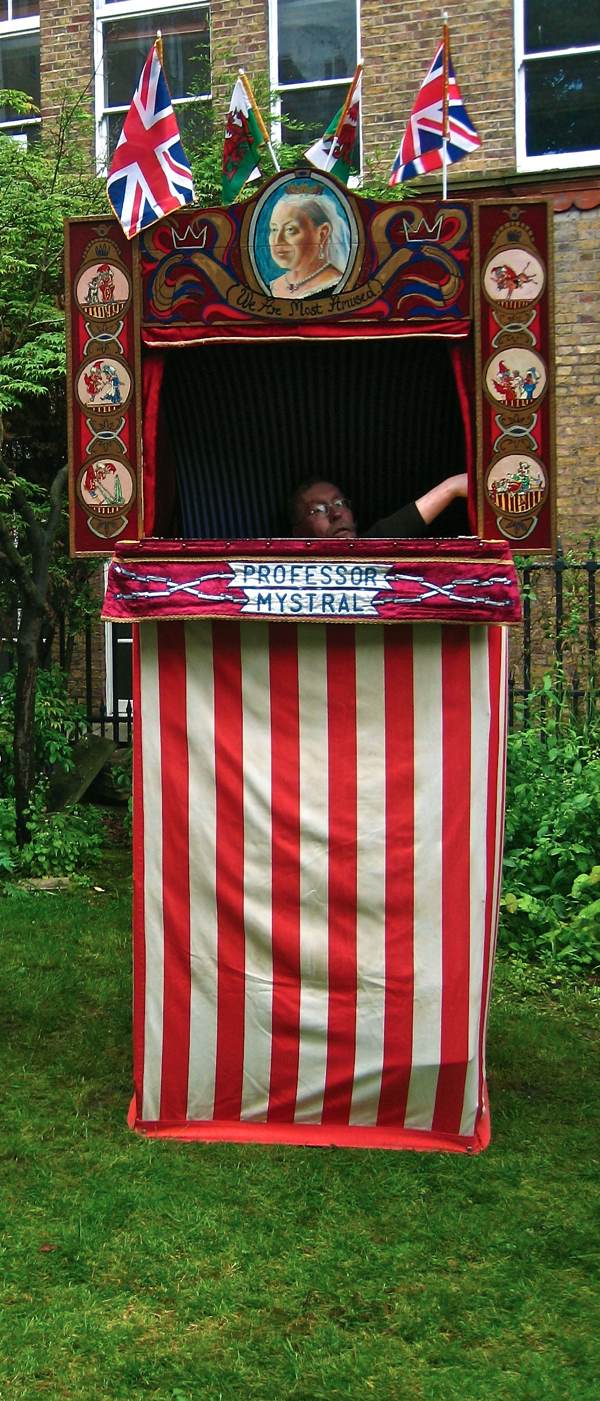
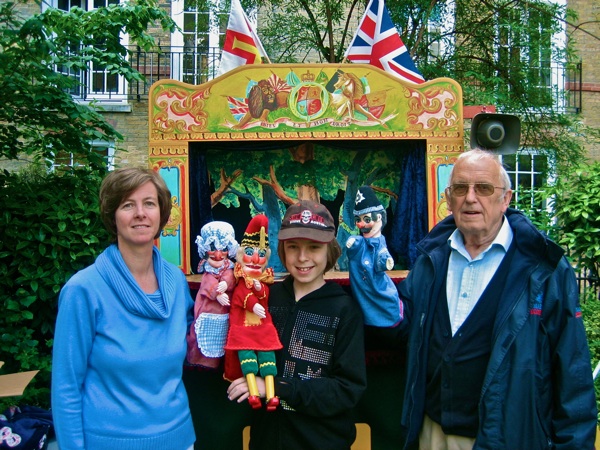
The Batty Family of Puppeteers, Mariake, Martin and Peter.
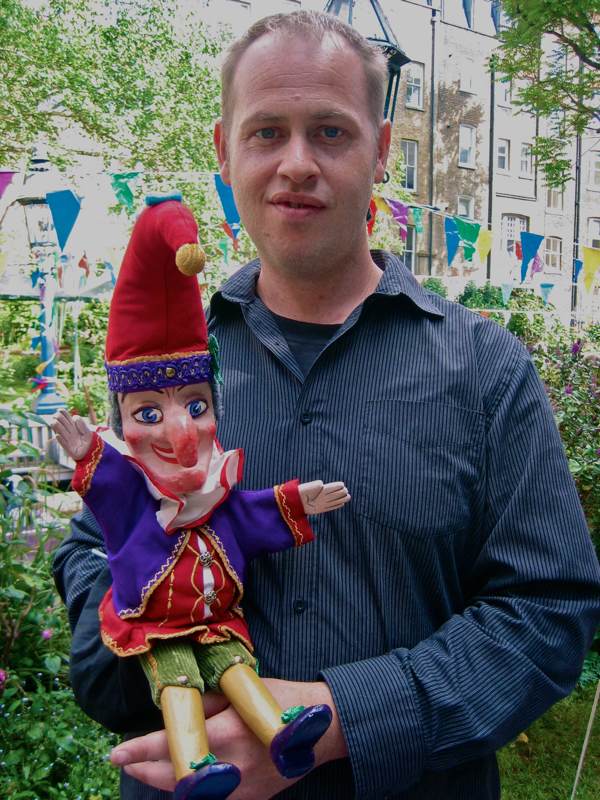
Professor Brian Baggs, also known as “Bagsie.”
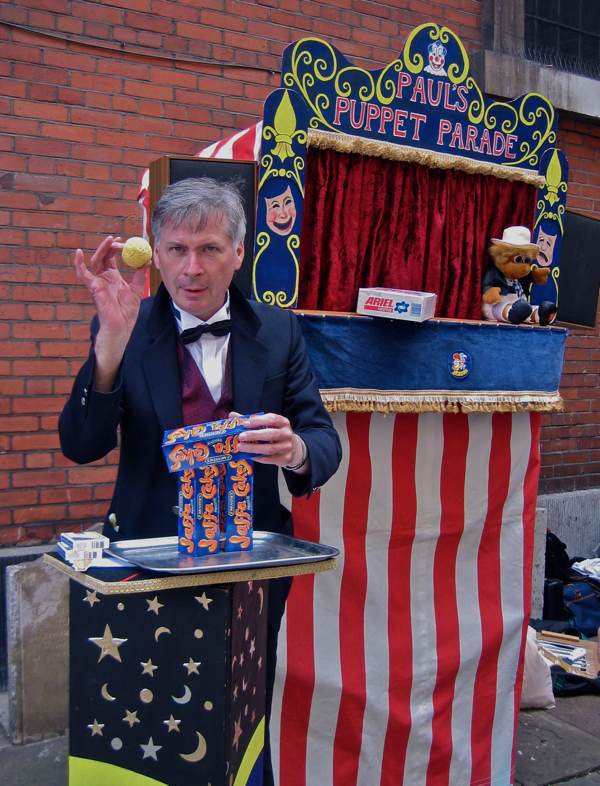
Professor Paul Tuck – “I’ve only been let out for today – I’m really a ladies’ hairdresser.”

Parade to celebrate the arrival of Mr Punch in Covent Garden.
With grateful thanks to the Punch & Judy Fellowship for making the introductions
You may also like to read about
At the Pearly Kings & Queens Harvest Festival
At the 65thAnnual Grimaldi Service
Beating the Bounds in the City of London
Brick Lane Market 9
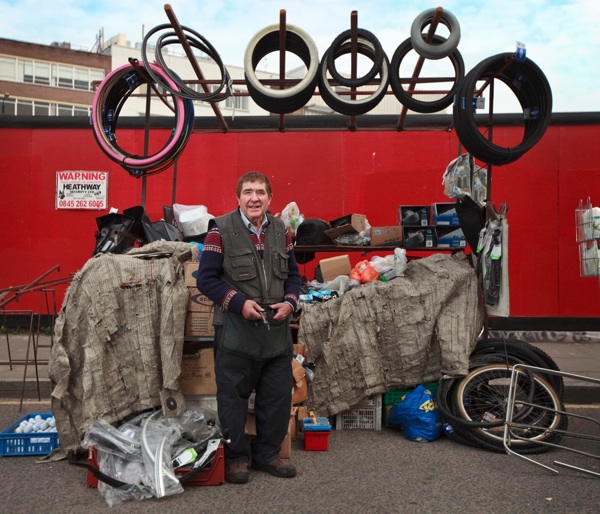
Henry William Lee began selling bicycles from a stall in Sclater St each Sunday in the eighteen eighties, a trade carried on by his son Henry George Lee and – a hundred and thirty years later – his grandson Richard Lee still continues to do good business there today. A remarkable feat in the apparently transient world of the street market, making Richard the stallholder with the longest continuous business in Brick Lane, by far.
“My dad was born into it in 1913, died at eighty-six, and he was here ’til the end,” recalls Richard, “I first came down here when I was five, and I was thirteen when I started working on the stall.” With a vital spirit, thick ginger hair and a constant expression of eagerness, Richard is commonly to be seen in front of his stall in Sclater St with his oily hands wrapped around his body and tucked into his armpits, rocking back and forth on the balls of feet, in readiness for the next customer.
“People know me,” he declares, “I was selling to them when they were kids and now I’m selling to their kids. I don’t tuck anybody up, I sell quality stuff and I sell it cheap.” Even as he spoke, cyclists of all ages were arriving – children included – pulling up and balancing on their bikes to ask, “How much for coloured tyres?” – “Any back wheels?” – and “How much are your D -locks?” And Richard has an answer for everyone off the top of his head, reaching back into the organised chaos of his stall, where everything is miraculously no further than arm’s length, to produce straight handlebars or brake calipers or anything else that might be required, cyclewise.
It was no surprise to learn that his son Ray is a magician because there is an aura of the conjurer about Richard ‘s performance – producing the unexpected with an ease that denies his expertise. “I’m due to retire but I can’t afford to retire,” he pleads with a smirk, “I do a sixteen hour day. It’s not easy getting up at four and then when you go home, there’s all the bookwork.” Yet I was unconvinced by Richard’s entreaty, because it gives him such visible pleasure to be in the spot where his father and grandfather were before him – even in a street that has changed beyond all recognition – and I hope we shall see him there for many years to come, because this is the longest running show on Brick Lane.

This is cheery Maurice, known as “Mo” who works the rest of the week as a paediatric nurse at Outpatients in the Chelsea & Westminster Hospital and treats Sunday trading on Brick Lane as “a bit of a day out.” Most weeks you will find him with his folding table selling colourful trinkets at the entrance to Bacon St, set back from the main drag – “It’s a choice location,” he reveals, “People spend more time.”
Lean and nimble, and blessed with restless energy, Mo would rather be in Brick Lane than at home with his feet up on Sunday –“I’m quite active, I cycle to the hospital and I’m used to being on my feet all day,” he admits. Originally from Hackney, Mo used to trade here years ago but then he worked overseas for eight years for the Romanian Relief Fund and in Australia. Upon his return, he found himself living in West London, so going East every Sunday is way for Mo to return to home territory. “Very enjoyable and profitable too!” he declares, “It’s just like the hospital outpatients, you meet everybody.”
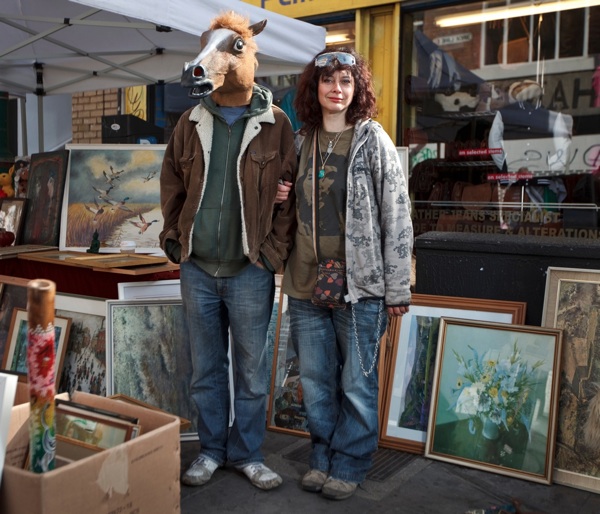
This is Jeremiah, an artist, and her friend Alan, a psychologist, who sell art and antiques, trading as Crazy Horse Collectibles. “It’s my business but Alan helps me out,” explained Jeremiah, flashing her dark eyes and tossing her red curls proudly, “We’ve been at it for a year and a half, and since we came here it really took off.” Jeremiah was speaking from behind a line of tables stacked with all kinds of weird and wonderful paintings and kitschy figures that were attracting a fascinated crowd.
“I had to get out of dire financial difficulties and Alan reached the point where he couldn’t get into his flat because of the collectibles,” she confessed in whisper, “so we both needed to offload stuff in Brick Lane, and it’s all come about in a spontaneous hippy way.” Then, not to be outdone, Alan removed his horse’s head and gave his estimation of their endeavour, “Jeremiah ‘s stuff is ‘fine art and collectibles’ while I call mine,”obscenities and corruptibles.'” he announced with a broad smile, rolling his eyes provocatively. “In other words antiques over here and junk over there!” Jeremiah retorted, pointing in Alan’s direction.
Photographs copyright © Jeremy Freedman
Boiling the Eels at Barney’s Seafood

On most mornings throughout the year, just a stone’s throw from the Tower of London, you will find them boiling the eels at Barney’s Seafood, under an old railway arch in Chambers St. For the past twenty-eight years Mark Button has presided there over the business that his father Eddie Button took over in 1970 from Barnet Gritzman (brother of Solomon Gritzman, the owner of Tubby Isaac’s), who was here boiling eels since before World War II. Thus you will know that this is an established location for the pursuit of one of the East End’s most traditional culinary tasks, the preparation of jellied eels.
Yesterday morning, I joined Stuart – a blocksman of twenty-two years’ experience – with a firm jaw and resolute eyes, at the rear of the arch in a room awash in pools of water, where he brandishes a fearsome curved blade with striking accomplishment, making short work of gutting and chopping great gleaming piles of eels. Arriving fresh from the tanks in Canning Town, Stuart tipped the morning’s eels out onto the bench where at first they slithered and slid in a shining mass. Then, gripping each one firmly by the head, Stuart decapitated it in the manner of those traitors of old across the road at Tower Hill, before slicing it open with a flick of the knife and disposing of both the head and the gut into the bin. It is a neat series of honed gestures that require both skill and years of practice, and you can be assured, Stuart has got the knack.
Interspersed with constant sharpening, since the eels’ back bone quickly blunts the long blade, Stuart likes to keep his knife razor sharp. “I’d rather cut my finger with a sharp blade than a blunt one!” he joked with enthusiastic grim humour as another eel’s head plopped into the bin. Yet make no mistake, Stuart has the greatest respect for eels. “Eels are very mysterious,” he said, turning philosophical and standing in absent-minded contemplation, with an eel and a blade in each hand, “There’s not a lot people know about eels. It’s funny how they know how to go to the Sargasso Sea, they’ve got a homing instinct.”
Once Stuart had chopped them up neatly, Paul the personable cook of ten years experience cooking eels, came from next door to collect the baskets of sliced fish and carry them through to the pots for boiling. Four tall steel cooking pots stood in a line on gas rings, each with filled with salt water and a bundle of parsley, some with eels already cooking and others just bubbling up to the boil, creating a wonderfully pungent sweet salty warm atmosphere. Paul tipped the eels straight into the hot water to cook, a process that can take between forty-five minutes to an hour and a half, depending on the type of eel, and he turned to lay out the bowls in neat lines upon shelves on the other side of the room, all ready for the eels when they are cooked. “Today we’ve got fresh Dutch eels and some frozen Chinese eels,” he explained helpfully, “Yesterday we had New Zealand eels and in a couple of weeks we’ll have the native Irish eels – they are best, seasonal, grown in the wild, nice texture and nice to eat.” Adding politely, “Have you ever thought of working in the fish industry?” he enquired – eager to make me feel included in such an enthralling process and flattering me with the question.
“You need to get them just before they’re cooked, when they’re as soft as possible” he continued, “because they harden afterwards,” – educating me, as he lifted a spoonful from the water and tasted one critically, before switching off the flames below and performing the delicate manoeuvre of sliding the pot off the cooking ring and onto a trolley. Catching me unawares so early in the morning, “Would you like to try one?” he asked – sensing my fascination – and naturally I assented. He passed me the morsel of pale eel flesh and I put it in my mouth. It was sweet and warm and it crumbled when I sank my teeth into it, releasing a delicate salty tangy flavour. In that instant, I wanted a plate of hot mashed potato to go with it, and I wanted more eels too. Paul did not know it was my first time, yet although I will have to wait until my next visit to a pie and mash shop to eat a plate of hot eels, I was converted.
Then Paul set about methodically distributing the eels equally into bowls, letting them cool and set in the jelly that is their natural preservative. And by then it was time for him to collect more baskets of sliced eels from Stuart and tip them into the cooking pot. Meanwhile, a stream of customers were pulling up outside and coming in excitedly to shake hands with Mark Button and carry away their bowls of fresh jellied eels for the weekend, as a tasty treat to restore their spirits. No other food excites such passion in the East End as the eel, and that is why East Enders delight to make the pilgrimage to Barney’s – they come to claim the dish that is their right.


“Eels are very mysterious, there’s not a lot people know about them”


Stuart, a blocksman of twenty-two years experience who learnt the trade from Eddie Button.


Eels simmering with parsley in cooking pots of salt water.


Paul the cook – “Have you ever thought of working in the fish industry?”


Mark Button, proprietor of Barney’s Seafoods
You may also like to read about
At William Gee Ltd, Haberdashers

Speaking as a lifelong connoisseur of quality haberdashery, let me say that if you are in need of a button or a reel of thread, there is no finer place to go than William Gee Ltd at 520 Kingsland Rd. For the haberdashery lover, even the windows at William Gee set the pulse racing with their ingenious displays of words contrived from zips – yet it was my privilege recently to explore behind the scenes at this glamorous theatre of smallwares, trimmings, threads, buttons and zippers, visiting the mysterious warren of storerooms at the rear of the shop, where I met the self-respecting guardians of this beloved Dalston institution that styles itself as “trimmings for all trades.”
My guide was Jeffrey Graham, maestro of the proud company boasting London’s largest selection of zip fasteners. He led me up an old brown lino-covered staircase between walls panelled in wood-effect formica to the locked, dusty upper room lined with happy photos of works’ outings and jamborees of long ago. Here Jeffrey brought the title deed to the property dating from the sixteenth century when this was Henry VIII’s land – Henry was the king that the Kingsland Rd refers to – and he had stables here for hunting when there was still forest, recalled today only in the name of Forest Rd. Then, once we had established this greater chronological perspective, Jeffrey brought out the tiny sepia photograph of William Goldstein that illustrates where the haberdashery business began.
“William Goldstein started in 1906 with two pounds in the kitty selling buttons and trimmings, and he changed the company name to William Gee. This was across the road where Albert’s Cafe is now, but after several years he needed larger premises and moved into the current building. He had two sons, Alfred & Sidney, and I knew both of them. Alfred died in 1970 and Sidney worked until he was eighty-five, and died four or five years ago. They grew the business and made it one of the largest of its type in the country, at a time when there was a large textile industry in the East End – which was full of clothing factories until a few years ago.
In the middle of the last century, there were more than eighty people working here. I remember coming in as a child and there were twelve ladies who all had their own button-making machines for covering buttons and they’d all be sitting there jabbering away making buttons, and some had machines at home and even carried on making them there too. When I was twelve or fourteen, I did a holiday job helping out and going out on deliveries with the drivers, so I saw a lot of the places we delivered to. My impression was that everything was bustling, everyone was busy, no-one had any patience and everyone knew everyone.
My father, David Graham, had a similar business at 77 Commercial St. He served all the factories in the little streets around Spitalfields and my grandfather had a haberdashery shop before him, on Brick Lane, M.Courts – it was still there in name until very recently. In the early sixties, the two businesses merged and my father became managing director of William Gee and we were supplying manufacturing companies that made uniforms and corporatewear, brideswear companies, hospitals, sportswear companies, hatters in Luton, – anyone really.We were doing a wholesale business in bulk that was very competitive.
The heyday was in the sixties through into the eighties, before manufacturers began to have their clothes made by cheaper labour in Eastern Europe, North Africa, or the Far East where much of the clothing is made today. It closed many factories and suppliers, they could not compete. It was no accident that people talk about “sweatshops,” because there wasn’t legislation to control how they should be organised then, but after legislation was enforced employers could not compete with overseas competitors.
It became a thing that you were delivering to shippers rather than factories, and then the types of customers became smaller and more varied – from engineers and printers, to film and theatre companies like the Royal Shakespeare Company and the Royal Opera, and lots of designers including, Gareth Pugh, Alexander McQueen Matthew Williamson, Vivienne Westwood, Caroline Charles and Old Town. What has come instead is a cottage industry, where individual designers are setting up and making a business out of it, and one of the largest sources of sales in recent years have been the colleges for fashion, textiles and art departments. But there are so many of them now that I wonder what will all the students do afterwards?”
Leaving this question to resolve itself we set out to visit the departments. First the button department which fills the shop next door, where buttonmaker, Janet Vanderpeer, presides over neat shelves stacked with rare ancient buttons from companies that closed years ago. Here I found her secreted behind a curtain in a cosy den, placidly making fabric-covered buttons at a press. Did she like it? A nod to the affirmative. How long had she been doing it? “A good while.” And without missing a beat she kept the buttons coming.
From here, we passed behind the shop to the three storey warehouse where the comprehensive supply of zip fasteners are kept and tended by their own designated keeper “You might think a zip is just zip,” said Jeffrey, rolling his eyes and gesturing to the lines of shelves. Then we stepped out into Forest Close whence the works’ coach parties departed in the nineteen fifties and crossed the road to the large warehouse where Janet’s brother David Vanderpeer, despatch manager, who joined the company thirty years ago at the age of sixteen, inhabits his own cosy den complete with microwave and ceramic leopard.
All fourteen staff at William Gee today have been there at least ten years and there is a sense of quiet mutual understanding which enables everything to run smoothly. Jeffrey told me a man will come in to say that his grandmother sent him here to buy buttons as a child and then ten minutes later another senior gentleman will come in to say the same thing. Yet in this appealingly utilitarian shop, that appears sublimely unaffected by any modern intervention, whoever comes through the door to stand between the two long counters is met with respect and patience. Even the old lady who did a high kick to place her ankle on the counter, when I was there, in order to display the kind of elastic she required was met with unblinking courtesy. And when Jeffrey Graham informed me authoratively, “The styles of clothing may have changed but the basic components are the same whatever the fashion.” I could hardly disagree.

William Goldstein’s haberdashery shop in 1906, that became William Gee.

A leaving party for Ivy Brandon in the seventies, with David Graham on the far right and Sidney Gee on the far left.

Sidney Gee & David Graham celebrate the seventy-fifth anniversary in 1981

The warehouse round the corner in Forest Rd.

Princess Diana in a coat with lining supplied by William Gee, 1986.


Jeffrey Graham, Managing Director of William Gee.

Janet Vanderpeer, Buttonmaker.

David Vanderpeer, Despatch Manager.


Stephen Selby, Antiquarian

Stephen Selby lives in a wonderfully rambling flat above Broadway Market which – as he will be sure to inform you – was once an ancient trackway continuing down through Columbia Rd and cutting a swathe across the grid of more recent East End streets. And where it crosses the Hackney Rd – he will add – was the Nag’s Head, a coaching inn that was the haunt of Dick Turpin, the notorious highwayman. Thus, from the moment you begin a conversation with Stephen, you are swept up into his beguiling vision of London that romances the familiar city to become an undiscovered landscape of myth and legend. And some of the stories he has to tell – especially of the founding of London as New Troy by Aeneas’ grandson Brutus three thousand years ago – are quite mind-boggling.
Chain-smoking, sporting snazzy red braces, surrounded by old maps, classical texts, pale brocade sofas, bottles of malt whisky and half-eaten packets of cream crackers, sits the debonair and courteous Stephen Selby – who worked in advertising in New York in the sixties and today is Chairman of the Broadway Market Traders’ Association – who recently unravelled the story of the Hackney hoard – and who now devotes himself to reading the ancient historians in their original Latin and Greek as part of his ongoing investigation into the lost prehistory of London. “I was looking for prehistoric London, so I looked up ‘Prehistoric London’ as a matter of course and I came across Elizabeth Gordon’s 1914 book ‘Prehistoric London, Its Mounds & Circles’,” admitted Stephen, and such is his passion for what this book has to say that he would only give me an interview once I had read it.
“What amazed me was the wide picture of our prehistory that exists and has been around for centuries, yet for the last three hundred and fifty years much of these legends were eradicated,” he told me, with emphatic enthusiasm, showing me – as illustration – a map of London dated 1582 with the inscription, “This ancient and famous City of London was founded by Brutus the Trojan.” Stephen is disappointed that since the foundation of the Royal Society, modern historians set themselves apart from legend and myth though an insistence upon verifiable fact, thereby denying the possibility that legend might contain a version of historical truth which has its own validity. Yet to Stephen’s delight, Elizabeth Gordon worked in the opposite direction, making sense of legend as history and it has inspired him to continue her work a century later.
Geoffrey of Monmouth, writing in the twelfth century, created the most widely read account of how, after the Greeks burnt Troy, Brutus rounded up dispossessed Trojans and led them to Britain – the country to which he gave his name – where he founded London as New Troy upon a marshy river valley which resembled Troy. Stephen has been seeking surviving evidence of Brutus and his dynasty that might confirm the veracity of the story. His first discovery was the etymology of Watling St which he believes derives from the Latin “Vates” meaning priest (as in “Vatican”), and his second discovery was that, like Troy, the ancient landscape of London was once scattered with mounds, erased by the modern city yet recorded upon old maps. Holywell Mound (at the junction of Curtain Rd and Great Eastern St) and Whitechapel Mound (upon the current site of the Royal London Hospital) were two in the East End, both of enigmatic origin and both removed in the eighteenth century.
According to Elizabeth Gordon, four mounds in London were of special significance to King Brutus -“Upon the two natural eminences of the Llandin and the Penton, the eyes of Brutus must have rested when he made the choice of his capital, while the two smaller artificial mounds of the White Mound and Tothill may have been erected by the Trojan King as trade increased under his rule.” Llandin (from which London took its name) that we know as Parliament Hill, was the centre of political activity, Penton (at Pentonville) was the centre of worship and observation of the stars, the White Mound (where the Tower of London now stands) was the place of royal burial and Tothill (located at Westminster) was a religious sanctuary. Elizabeth Gordon also tells us that Brutus’ descendant Molmutius laid out the roads, a task completed by his son Bellinus (who gave his name to Billingsgate Market) – especially fascinating to Stephen, eager to suggest that the straight roads usually credited to the Romans might be of greater age, and the mounds could have been instrumental in laying out their courses.
Stephen delights to draw upon old maps, extending straight trackways and linking the mysterious mounds to create a web of connecting coloured lines that hint at a greater scheme without revealing its significance, teasing and fascinating him equally. “The mystery of history,” as he terms it, his eyes misting just a little in captivated amusement as he takes a contemplative puff upon yet another of his Pall Mall cigarettes.
Down below, hipsters were perched like crows in a line sipping coffees in Broadway Market, whilst secluded up above in his Georgian green study Stephen Selby, the antiquarian and classical scholar, was reading Herodotus in Greek, consulting his Homeric dictionary and dreaming of an epic ancient world, as on a page of his old schoolboy atlas he traced the line that the Scythians travelled in their exodus from China across Asia to settle in Scotland – a journey evidenced, he assured me, by the tartan clad mummies of Urumchi in Xinjiang.

What is the significance of the Spitalfields Triangle? A perfect equilateral triangle links the sites of the former Whitechapel Mount and Holywell Mount, and St Mary Woolnoth in the City of London, shown here on John Roque’s map of 1746. (Click to enlarge)

Mount Terrace in Whitechapel is the only visible evidence today of the ancient mound that once stood here before the Royal London Hospital was built in the eighteenth century.