Walter Breindel, Sewing Machine Repairs & Rentals

Walter Breindel knows everything there is to be known about sewing machine repairs & rentals – more than anyone else alive, probably. So how long has he been in the business? “Take fifteen – the age I started – from seventy-six – the age I am now,” proposed Walter, “that leaves fifty-one.”
And then a voice from the other side of the mass of sewing machines that filled the room – like a flotilla of yachts crowding a harbour – yelled, “Sixty-one, Walter!” correcting him. This was the voice of Alan Stroud, a sewing machine mechanic who has been around Walter, working on a self-employed basis for twenty-six years. “I’m sixty-six, I’ve been doing it over fifty years,” volunteered Alan cheerily, chipping in. Completing the trio at Cruisevale Industrial Sewing Machine Rental in Hessel St, Stepney, was Al Jaw, driver and electrician, who has been part of the company for thirty-six years. He sat with Alan, tinkering with a sewing machine silently, not wishing to get drawn into this one.
“I worked for the company in Osborn St, Whitechapel, for thirty-nine years until they went broke and I bought it from the liquidators.” continued Walter unruffled by Alan’s interjection, maintaining his composed expression with arms crossed, perched upon a precarious tall stool at the counter, and speaking with perfect diction and well-articulated consonants, “I live in Hendon, I press the knob on the car and it automatically gets me to the East End. I would have given it up, but my wife died six years ago and it gives me something to do.”
Then Alan delivered me a swift cup of tea with a pleasant smile. “I got a job when I was fifteen, because there was clothing factory in my back garden, and I was the tea boy. Now I’m making tea at sixty-six – I’ve gone full circle!” he quipped, “I went to a funeral the other day and this guy said, “Look, there’s ‘the boy’!'” Walter nodded in sober agreement, “They’re all dead now.”
“We’re the only two alive, and Geoffrey,” Alan qualified. And then they commenced a litany between the two of them -“Pinky’s gone” – “Alfred’s gone” – “Charlie’s gone” – “Monty’s gone” -“Lou’s dead” – “Rhoda’s dead” – “Most of them who worked for the old company are dead.”
Yet in the workshop there were sewing machines of sixty and eighty years old, still in working order, sturdy and shining, and ready to go.”That one is good for another hundred years,” declared Walter with a flourish to a Reece Keyhole Buttonhole machine. “Yes, but the mechanic won’t be!” protested Alan, prompting Walter to shake his head, accepting there are some things beyond human control. “Sewing machines have two faults,” he confessed to me, “They were made too well, so people don’t need to change them. And the costs for fixing them have always been set too low, half the price of car repairs. We’ve not followed the American way, buy it, throw it away and buy another. We’re not like that, we are used to cleaning up rusty old machines and putting them back together.” And he appeared almost apologetic of a business policy that would strike many as enlightened.
“I joined the company in 1950, they were established in 1896 and were the largest sewing machine rental in the country at one time – now I have one employee.” Walter continued, with a deferential nod to Al, before turning elegiac,“The Jewish Board of Guardians in Middlesex St got me the job, I started on a Wednesday and they paid me six pounds a week. And because I was unable to work Saturdays on religious grounds, they made me come in on Sundays and clean cars. We called the governor ‘Uncle,’ and the first thing he asked me was, ‘Would you pick up a penny?’ I said, ‘On these wages, I would pick up a ha’penny.’ So he said, ‘Pick up that screw.'”
Not to be outdone, Alan revealed that although he also started work at fifteen, and although it was ten years later than Walter in 1965, he was only paid three pounds a week with ten shillings a week taken off for tax. A comment which occasioned considerable controversy between the pair, although I could not ascertain which way the rivalry went between the higher and lower wage. “With me it was the girls,” Alan enthused, revealing a youthful spirit, and shifting the terms of comparison as he outlined the origin of his passion for the sewing machine rental business, “There were so many women! As a mechanic, you were always out on the road – the independence you had was unbelievable – and you had a new car every three years.” he admitted. And he gave me a sly grin, that left me to draw my own synonym for his euphemistic use of “independence.”
“I never had a day off in thirty-nine years,” Walter announced in a dry dignified tone, “But I had my lunch paid every day, a new car every two years and all the Jewish holidays off with pay.” And then he led me into the office where he brought out cherished back copies of Sewing Machine Times for which he was once advertising manager. There were yellowed copies going back before his time to the nineteen twenties when sewing machine companies also sold mangles and prams. Then suddenly his eye fixed upon a button hole machine illustrated in one of these pre-war publications, “Look!” he cried spontaneously in wonder, “Alan come here!” And Alan rushed in, and together they delighted over the illustration of an early model that they still had in service, exchanging mutual smiles of excitement, unified by their lifelong passion for sewing machines.
“I was in sales, I once walked from here to Stratford and went into every building down Commercial Rd – there and back – and it was a clothing factory.” recalled Walter, growing enraptured, “There wasn’t a home that didn’t have a factory in it, you could walk from one building to another. They used to say you could walk down the Kingsland Rd and earn a day’s wages, going in and out of the factories, working as you went. But the clothing industry has gone, there were sixty to seventy machine rental companies and now there are just three. We are the only one left in the East End.”
“Somebody walked in that door yesterday who hadn’t been in for twenty years, and I could remember what machines they had in their factory, but I can’t remember what I had for breakfast yesterday, isn’t that strange? ” he said, turning contemplative and casting his eyes over the ranks of sewing machines, as if they were witnesses to his life in the business. “There was a togetherness – even if on the financial side we were always fighting.” he mused, thinking back over the years with pleasure, “I used to enjoy it. It was a trade at one time.”


Walter shows off his machine for sewing tarpaulins.

Charlie Sparks used to say, “With sewing machines, you’re never going to be rich but you’re never going to be poor.”

“Everyone I know is dead”

Al Jaw, Alan “the boy” Stroud & Walter Breindel of Cruisevale Industrial Sewing Machines.
The Bloody Romance of the Tower

The Execution of Lady Jane Grey at Tower Green
“It has been for years, the cherished wish of the writer of these pages to make the Tower of London the groundwork of a Romance,” wrote Henry Ainsworth in 1840, introducing his novel, ” The Tower of London” – and it is an impulse that I recognise, because I know of no other place in London where the lingering sense of myth and the echoing drama of the past is more tangible that at the Tower.
It is my recurring pleasure to visit John Keohane, the Chief Yeoman Warder, attending the age-old ceremonies that he officiates throughout his final year at the Tower, and each time I am struck by the mystery of the place. Each time, I have to stop and reconcile my knowledge of history with the place where it happened, and each time I become more spellbound by the actuality of the place, which in spite of Victorian rebuilding still retains its integrity as an ancient fortress. I make a point to pause and read the age-old graffiti, to stop in each doorway and take in the prospect at this most dramatic of monuments.
When I discovered “The Tower of London” by Henry Ainsworth in the Bishopsgate Institute I was captivated by George Cruikshank’s illustrations, realising that not only had this favourite of mine amongst nineteenth century illustrators once stood in exactly the same places I had stood, but he had the genius to draw the images inspired by these charged locations.“Desirous of exhibiting the Tower in its triple light of a palace, a prison and a fortress, the author has shaped his story with reference to that end, and he has also endeavoured to combine such a series of incidents as should naturally introduce every relic of the old pile, its towers, halls, chambers, gateways and drawbridges – so that no part of it should remain uninvolved.” explained Ainsworth in his introduction to his sensationalist fictionalised account of the violent end of the short reign of Lady Jane Grey. Yet it is George Cruikshank’s engravings that bring the work alive, providing not just a tour of the architectural environment but also of the dramatic imaginative world that it contains – and done so vividly that when I go back this weekend for the ceremony of the Lilies & the Roses, I know already I shall be looking out for his characters in my mind’s eye while I am there.
There is a grim humour and surreal poetry that draw me to these pictures which, to my eyes, presage the work of Edward Gorey, who like George Cruikshank also created a sinister diaphanous world out of dense hatching. Maurice Sendak is another master of the lyricism that can be evoked by intricate webs of woven lines in which, as in these Tower of London engravings, three dimensional space dissolves into magical possibility. But to me the prime achievement of these pictures is that George Cruikshank has given concrete life to the Tower’s past, creating figures that convincingly take command of the stage offered by its charged spaces and, like the acting of Henry Irving, appear as if momentarily illuminated by flashes of lightning. Cruikshank’s pictures stand alone, like glimpses of a strange dream, drawing the viewer into a compelling emotional universe with its own logic, peopled with its own inhabitants and where it is too readily apparent what is going on.
The popularity of Henry Ainsworth’s novel was responsible for creating the bloodthirsty reputation of the Tower of London which still endures today – even though for centuries the Tower was used as a domestic royal residence and administrative centre, headquarters of the royal ordinances, records office, mint, observatory, and a menagerie amongst other diverse functions throughout its thousand year history. Yet although it may be just one of the infinite range of tales to be told about the Tower of London, Henry Ainsworth’s Romance does witness historical truth. There is a neglected plaque in the corner of Trinity Green just outside Tower Hill tube station which bears witness to those executed there through the centuries – as testament to the reality of the violence enacted upon those with the misfortune to find themselves on the wrong side of authority in past days.

Jane Grey’s first night in the Tower – “Prompted by an undefinable feeling of curiosity, she hastened towards it and, holding forward the light, a shudder went through her frame, as she perceived at her feet – an axe!”

Cuthbert Cholmondeley surprised by a mysterious figure in the dungeon adjoining the Devilin Tower.

Jane Grey interposing between the Duke of Northumberland and Simon Renard.

Jane Grey and Lord Gilbert Dudley brought back to the Tower through Traitors’ Gate – “Never had Jane experienced such a feeling of horror as now assailed her – and if she had crossed the fabled Styx, she could not have greater dread. Her blood seemed congealed within her veins as she gazed around. The light of the torches fell upon the black arches – upon the slimy walls and upon the yet blacker tide.”

Jane imprisoned in the Brick Tower – “Alone! The thought struck her to the heart. She was now captured. She heard the doors of the prison bolted – she examined its stone walls, partly concealed by tapestry – she glance at its barred windows, and she gave up hope.”

Simon Renard and Winwinkle, the warder, on the roof of the White Tower – “There you behold the Tower of London,” said Winwinkle, pointing downwards. “And there I read the history of England,” replied Renard. “If it is written in these towers, it is a dark and bloody history, ” replied the warder.

Mauger sharpening his axe – ” A savage-looking individual seated on a bench at a grinding stone, he had an axe blade which he had just been sharpening, and he was trying its edge with his thumb. His fierce blood-shot eyes, recessed far beneath his bent and bushy brows were fixed upon the weapon.”

Execution of the Duke of Northumberland upon Tower Hill – “As soon as the Duke had disposed himself upon the block, the axe flashed like a gleam of lightning in the sunshine – descended – and the head was severed from the trunk. Mauger held it aloft, almost before the eyes were closed, crying out to the the assemblage in a loud voice, “Behold the head of a traitor!”

Cuthbert Cholmondeley discovering the body of Alexia in the Devilin Tower – “Pushing aside the door with his blade, he beheld a spectacle that filled him with horror. At one side of the cell upon a stone seat, rested the dead body of a woman, reduced almost to a skeleton. On the wall, close to where she lay, and evidently carved by her own hand, the name ALEXIA.”

Queen Mary surprises Courtenay and Princess Elizabeth

Lawrence Nightgall dragging Cicely down the secret stairs in the Salt Tower
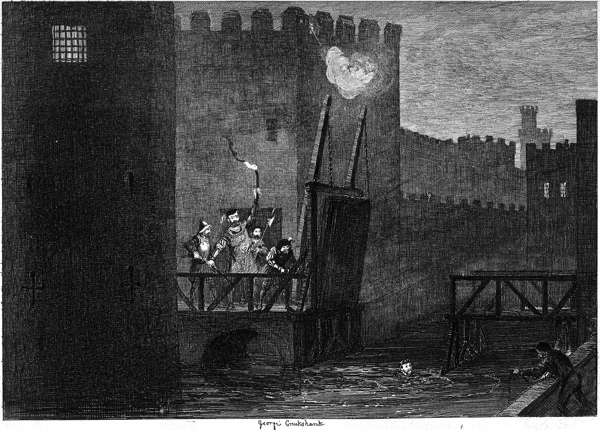
Courtenay’s escape from the Tower

The burning of Edward Underhill at Tower Green – “As the flames rose, the sharpness of the torment overcame him. He lost control of himself, and his eyes started from their sockets – his contorted features and his writhing frame proclaimed the extremity of his agony. It was a horrible sight, and a shudder burst forth from the assemblage.”

The Death Warrant – “Mary tried to ascertain the cause of the animal’s disquietude as its barking changed to a dismal howl. Not without misgiving, she glanced towards the window and there between the bars she beheld a hideous black mask, through the holes of which glared a pair of flashing eyes.”

Elizabeth confronts Sir Thomas Wyatt in the torture chamber – “‘Sir Thomas Wyatt,’ Elizabeth declared in a loud and authoritative tone, and stepping towards him, ‘If you would not render your name forever infamous, you must declare my innocence!'”

The Fall of Nightgall – “Nightgall struggled desperately against the horrible fate that waited him, clutching convulsively against the wall. But it was unavailing. He uttered a fearful cry, and tried to grab at the roughened surface. From a height of nearly ninety feet, he fell with a terrific smash upon the pavement of the court below.”

The Night before the Execution – “In spite of himself, the executioner could not repress a feeling of dread and the contrary urge, which represented his curiousity. He pointed towards the church porch, from which a figure, robed in white, but insubstantial as the mist, suddenly appeared. It glided noiselessly along and without turning its face to the beholders.”

Jane Grey meeting the body of her husband at the scaffold – “She knew it was the body of her husband, and unprepared for so terrible an encounter, uttered a cry of horror.”

Plaque at Trinity Green on Tower Hill
You may also like to read
John Keohane, Chief Yeoman Warder at the Tower of London
At the Dolls’ House Festival

Gary Masters of Masters Miniatures
I made a rare visit to Kensington at the weekend to visit the popular annual Dolls’ House Festival, now in its twenty-fifth year and drawing larger crowds than ever before. Yet although it was my love of tiny things which drew me, I soon realised that I was a mere naive enthusiast once I encountered the giants of the miniature world, who welcomed me kindly with indulgent largesse.
The first lesson I learnt was that it is not appropriate to speak of “Dolls’ Houses” because this might imply a childish pursuit, when I was in the adult world of miniaturists. And I had only to look around to confirm the self-evident truth of this – because there were no children amongst the excited crowds filling Kensington Town Hall that day. In fact, strictly speaking there were not any Dolls’ Houses at the Doll’s House Festival, because those I did see were described by their makers as “miniature architecture.” Yet even this term might be stretching it a little to describe model-making supremo Robert Dawson’s ten foot high replica of the Vatican, perfect in every detail.
Like Alice stepping through the looking glass, I simply had no idea what I was getting into – I had no idea of the scope and ambition and scale of the world of miniaturists, and let me confess to you, it is quite wondrous. As well those who make miniature furniture – of many historical periods and modern styles – there are people who specialise in miniature food, plants & flowers, trees, fruit & vegetables, bread, biscuits & cakes, groceries, glasses, crockery, ceramics, kitchenware, tapestry, baskets, books, lamps & lighting, bathroom fixtures, prams, tapestry, bronze sculpture, silverware, ironwork, thatch, locks & latches, oil paintings, baths & bathroom fittings, pets, fireplaces & architectural mouldings, wallpapers & fabrics, chimneypots, bird baths, and teddy bears & toys & dolls. Although I must qualify that last item by adding that as well as dolls for your dolls house, dolls are also available for your dolls, just for the sake of completeness.
There were so many little things of such breathtaking detail to draw my eye that I barely knew where to look when I first entered the huge hall, filled with stalls manned by the miniaturists who had come out from their sheds and attics, climbed into cars and planes – some travelling from as far as Australia – to converge upon Kensington for the festival. A tiny bunch of radishes, a Staffordshire figure of Dick Turpin, an electric two-bar fire, a Dundee cake, a pot of lilies of the valley, a three legged stool and a tin of Brasso, these were some of the small wonders that spoke to me personally. And on each occasion, I would lift my gaze from the object of my fascination to meet that of the maker, who was observing my pleasure with proprietorial satisfaction. Invariably, they wore spectacles, a badge of the trade that relies upon close inspection of tiny things and equally, they shared the hunch that I adopted while I was there, arching my spine and craning forward to better focus upon the beloved miniatures.
“My favourite is the working miniature bacon slicer!” admitted Karen Griffiths, of Stokesay Ware based in Stoke Newington who has been making miniature bone china dinner services and earning a living out of it since 1981. Karen trained as a ceramicist at the Royal College of Art and created some miniatures to earn a little money after college, then never looked back. It was a similar story with many of the miniaturists I spoke with, trained craftsmen and women who have discovered both a facility for working on a tiny scale and a demand for what they produce. “I used to restore antique furniture and then somebody suggested I do this,” explained Brian Underhay, gesturing cavalierly to the magnificent array of tiny tables, chairs, cabinets and chest of drawers laid out as examples of his handiwork.“We did Thomas Hardy’s cottage and Beatrix Potter’s farmhouse for a museum in Tokyo,” Graham Wood informed me with relish. He has a degree in Industrial Engineering and lives in the New Forest where he runs “The Little Homes of England,” making miniature cottages for which his wife Anne-Marie crafts realistic thatched roofs from the same bristles that are used for brushes.
They were just three examples among hundreds who have won an independent existence, devoting themselves to lives of painstaking labour, often living in remote corners of the country and making a steady and reliable income through internet sales and international Dolls’ House fairs, of which Kensington is pre-eminent in Europe. This weekend, fans travelled from across the country and serious collectors from around the world to pay homage to these top miniaturists, who, in spite of their natures – preferring retiring to work in the garden shed to stepping out into the spotlight – were uplifted by the delight that their handiwork drew from the crowds. Even modest individuals need to be appreciated. And there is an irresistible poetry to this highly skilled work, in which so many talents come together for the sake of the strange yet compulsive joy of small things.
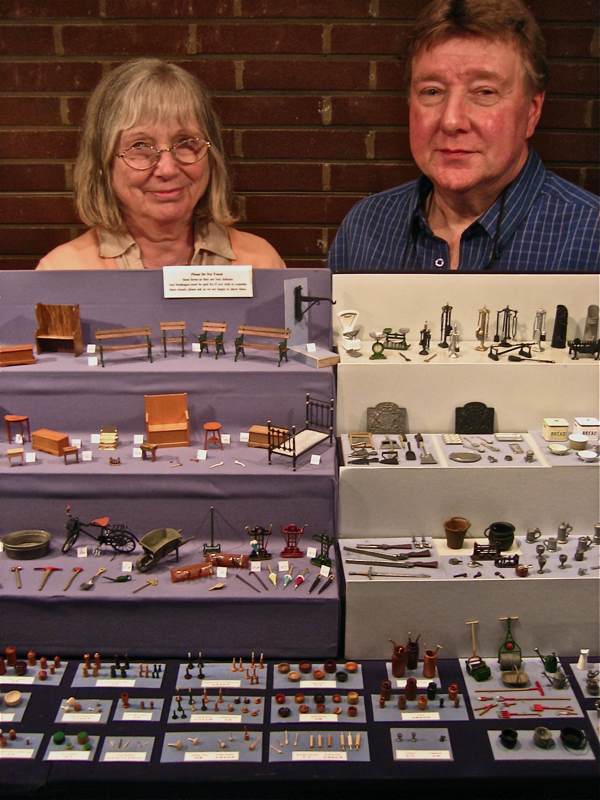
Hilary & Martin Pearce of Willow Models have made miniatures together for nineteen years.
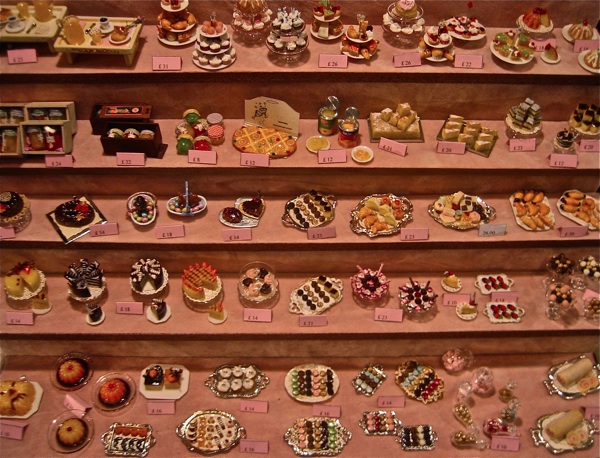
Cakes by Tiny Ter Miniatures of Barcelona.
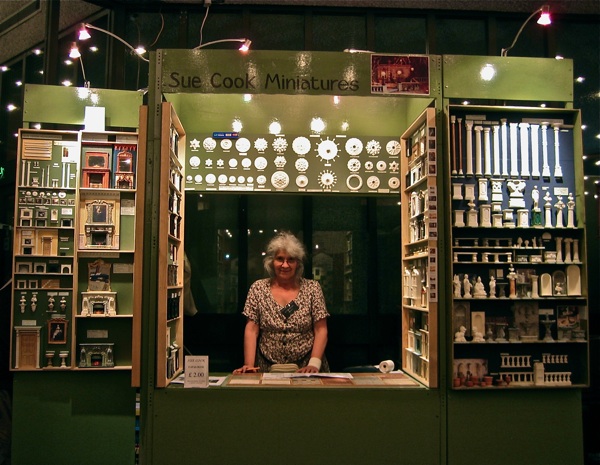
Sue Cook began when she made a dolls’ house for her son thirty years ago.

Graham Wood of “The Little Homes of England” with his miniature outside toilet.
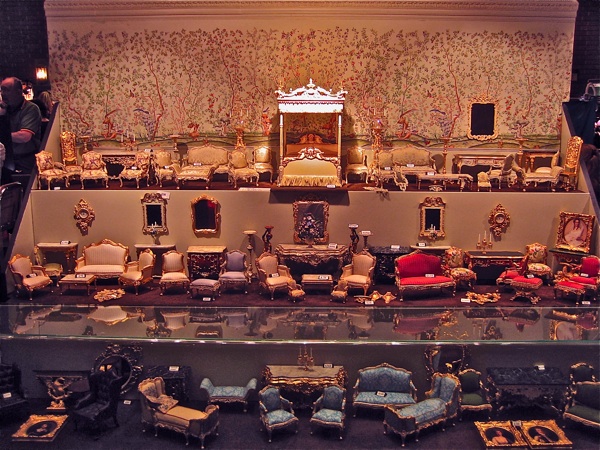
French gilt furniture by John & Sue Hodgson.
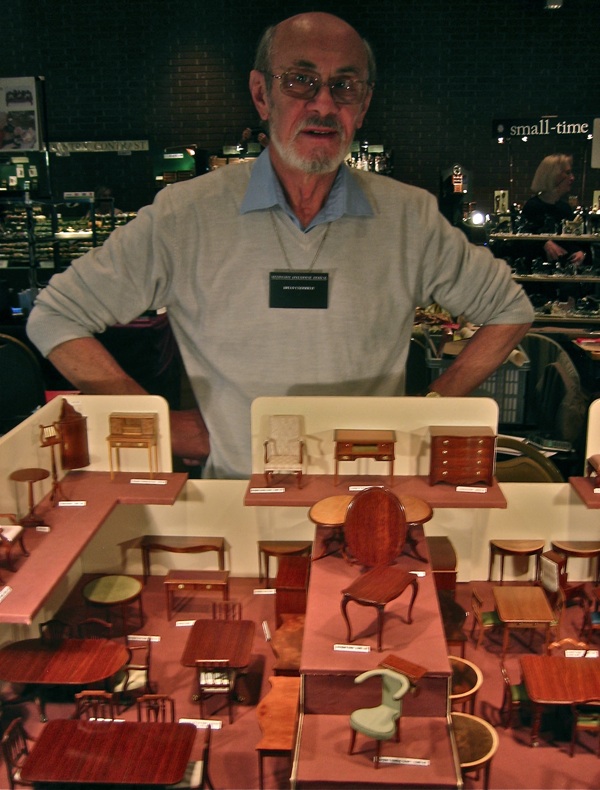
Brian Underhay, with his miniatures made of wood salvaged from old furniture.

Vegetables by Mouse House Miniatures.
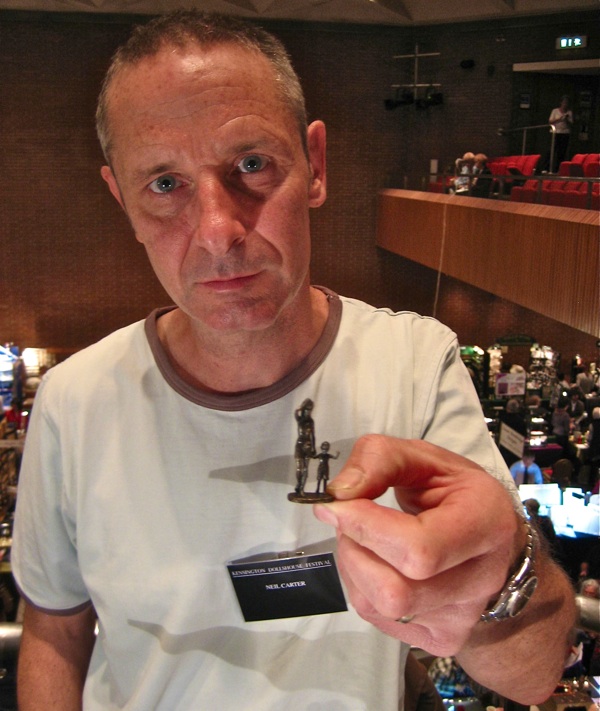
Neil Carter who casts miniature sculptures in bronze, with his wife and daughter.

Maria Fowler of the Little Dolls’ House Company, Toronto, with a selection of miniature chandeliers.
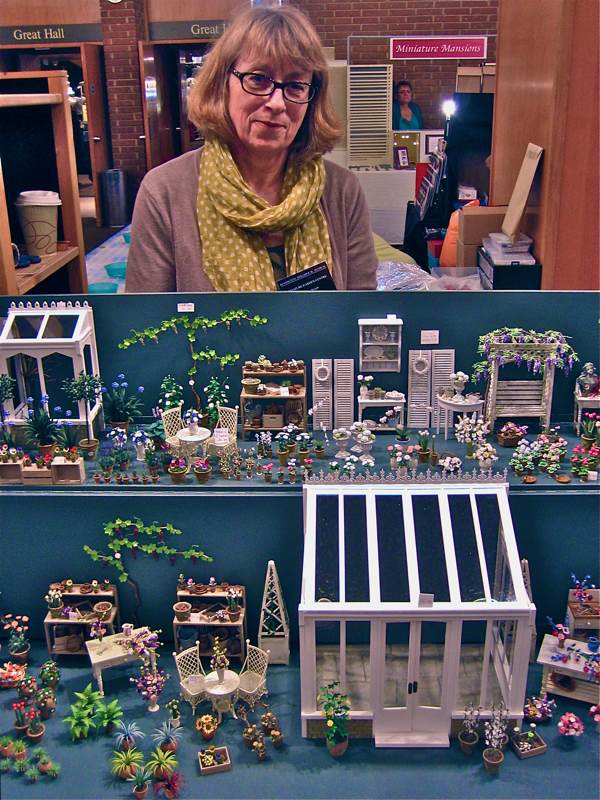
Georgina Steeds of The Miniature Garden Centre – “I had a miniature florist’s shop and I couldn’t get any plants for it so I made my own and it grew from there…”
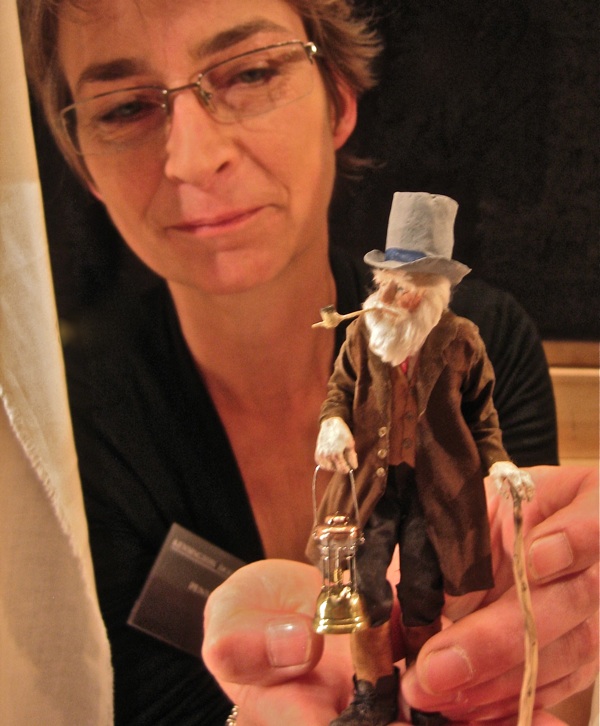
Penny Thomson who specialises in characterful figures, with a Nightwatchman made in paper maché.

William ( £139) and Kate (£135 ) by Georgina Ritson Dolls
Brick Lane Market 10
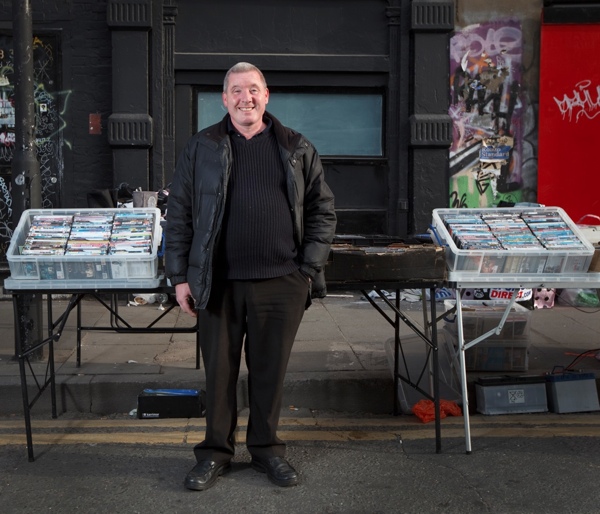
This is Andrew who, with his partner Maria, has been running this stall at the Shoreditch end of Sclater St selling cut price DVDs and training shoes for twenty -three years, and making a quiet living out of it. “Twenty-five years ago, we came to look around and decided to set up a stall,” he told me, exaggerating his consonants to be heard over the blaring music that advertises the existence of his pitch.
A modest figure, standing to the rear in dark clothes against a black wall, Andrew is almost invisible behind the barrage of sound and the noisy customers riffling through his DVDs, yet he has an ideal vantage point upon the market. “It’s got more yuppified,” he admitted, observing the change in the neighbourhood, “But it helps us – especially the younger ones with money to spend.” A noble example of the resilience of the street traders, Andrew is phlegmatic in the face of the big buildings springing up around him to overshadow the market.
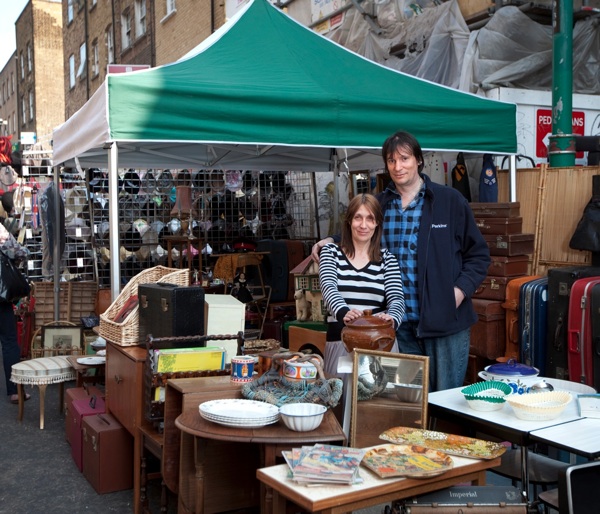
“I came here when I was a little girl and I remember when they sold pets – there was a man on the corner with a pair of owls on his shoulders.” recalled Emily, whose parents run “This Shop Rocks” opposite her stall on Brick Lane, “When I was nine, I bought a terrier who we called J.Burstein & Son after the shop where we bought him. It was a big adventure coming here in those days and I never imagined then I’d be trading in the market one day.”
Emily has a keen sense of the drama of Brick Lane, both its joy and turbulence. “I love all this,” she confessed open-heartedly, gesturing around to her stock, “I only buy things I love, so I like it when people appreciate something and I know it’s going to a good home.” Emily spends all week collecting the small pieces of furniture, luggage, crockery, mirrors and household things that she brings here each Sunday but, in such busy location, she can hardly keep an eye on everything –“Mike comes to help me and make sure I don’t get robbed.” she admitted candidly.“We get up at six thirty and we come, rain or shine. In the Winter, we were scraping the snow off the pitch before we set up.” Emily continued with a equivocal smile, revealing the tenacity and strength of character it takes to be a trader on Brick Lane.

“I am from a land where everyone’s very relaxed,” declared Albert enigmatically from beneath his green felt hat, when I went along to have chat at seven o’clock, after all the other traders had gone and his stall remained alone upon the empty yard, while Ernest Ranglin’s mellow jazz drifted off down Sclater St. Albert was speaking of his distant homeland of Vojvodina, but nowadays he drives to Spitalfields every week from Sheffield in his van full of curiosities. “There is a guy who comes each week to chat, he says, ‘I can’t afford to buy anything but I like your music'” Albert revealed to me, cherishing the delicate compliment.
“I used to do lots of things, I’m a furniture maker and I used to be teacher of geography – I like challenges,” he confided with gentle melancholic irony, whilst presiding upon the square of tables that defines his personal oasis of thoughtfulness. Albert is the philosopher of Sclater St market, who can always be relied upon to turn up intriguing finds, whether old cameras, photographs, tools, records, musical instruments, carpets, hats – or almost anything else you care to imagine – and accompanies them with superlative absurdist patter.
Photographs copyright © Jeremy Freedman
Joy Harris, Dressmaker

Joy with her engagement ring, at seventeen.
Fifty years after she was apprenticed as a dressmaker in Spitalfields, Joy Harris returned this week for the first time to visit the streets where she began her career, and found them much changed. The sweatshops and factories have new uses today, and the textile industry itself has gone but, as we walked around in search of her long-lost haunts, Joy told me her story – and it all came back to life.
“Dressmaking was all I was interested in, and I wanted to be a court dressmaker. My mother made her own clothes and she made mine too. She was from Stepney and she had done an apprenticeship as a dressmaker in the East End. I think I was born with it and I can’t ever remember not being able to sew, even at twelve or thirteen I made clothes for other people.
In 1961, at fifteen years old, I was offered an apprenticeship at Christian Dior in Paris but my mum and dad couldn’t afford to send me there. So Eastex in Brick Lane was the next best option – very disappointing that was! I left school in July and went straight to Eastex where I earned a pittance, it only covered my fare. Eastex were a middle range clothing company and I worked on the third floor at the corner of Brick Lane and Wentworth St. I started off making shoulder pads by the hundred and then you did darts and gradually we were taught to make a whole garment. Zips were measured and everything had to be in the right place. We used to sing, “Daisy, Daisy, Give me your answer do!” all day at work. It was boring. We spent all day making darts and then we’d take it up to show what we’d done, and we’d be sent back to do it all over again.
My friend Sandra already worked in Fashion St and we travelled up together to Aldgate East on the train from Barking each day. In Wentworth St, there was an underground butcher where there’d always be these men up against the grilles whistling at us, in our miniskirts at fifteen. They’d get locked up now. My mother let me keep my money for the first three weeks, and the first week I bought her a watch and, on the second week, I bought these black patent leather Italian slingbacks in Commercial St. I love shoes and I can remember everybody looking at my slingbacks. Of a Friday, we’d go down Petticoat Lane where there was a table that sold forty-fives and I bought my first Beatles record there and everybody asked me, “Who’s the Beatles?” I was a teenager and everybody I knew bought records, I had loads because they were really cheap.
I’ve known Larry since I was fourteen. We met at the youth club where I was friends with this guy called John. I’d seen Larry and I thought he looked nice and he had a scooter. John and Larry went on an Outward Bound trip for a month, and I was quite taken aback when John turned up with Larry. We got engaged after I finished my apprenticeship at seventeen, and John became the best man at our wedding.
And then I went to work in Fashion St which was a very stupid thing to do. But it was where my friend Sandra worked and they were paid three times as much at Lestelle Modes as I got at Eastex. It was a sweatshop they used to make very cheap clothes for C&A and market stalls. It ended my ambition to become a court dressmaker but all I wanted to do was get married and have children. Yet I didn’t make any money at first because I’d been trained to make clothes properly whilst at this place they were running them up quickly. The other girls made fifty dresses a day yet I only made ten because I was trying to make them as I was taught at Eastex. It took me ages to get the hang of throwing them together! It was a big problem and I used to go home crying with frustration, because I’d given up my apprenticeship to do this and I thought I’d be making more. But after a few weeks, I managed to do it.
It was a horrible place, a filthy dirty shed in a back yard with eight or ten machinists, and a tea table at the end of the line. The whole workshop was thick with fluff and people used to smoke there. We didn’t have overalls we just wore our old clothes. Yet it was a fun time in my life. They were wonderful people that owned it, Les and his sister Estelle – and Estelle and her husband Jack managed it. It was a relaxed place. We had a record player and took in our own records and played them while we worked. We played “Hit the Road Jack!” on Fridays when Jack left early and ran out the door afterwards, once he’d gone. We curled our hair with cotton reels, permed it in our lunch break and washed it out in the afternoon tea break, ready for the evening. We spent most of our money down the Lane. The motto there was, “If it don’t fit, cut it off!” – if you had spare fabric left over anywhere on the dress.
I stayed there two years, and then me and my friend left and went to a place in Chadwell Heath, until I had my first baby at twenty-one. Then I machined at home for a company from Hackney. It was bloody hard work, but he was a very good baby. Returning to work, I went to a really posh place and my dressmaking training was essential there. It was evening wear and it was all beaded, made of satin and chiffon, and my skills came back because it all had to be done properly.”
In spite of her sojourn in a sweatshop in Fashion St, Joy discovered the fulfilment of her talent as a dressmaker. “I’ve done it all my life!” she informed me proudly, “I made four thousand costumes for a dance contest once, and me and my friend we work self-employed making bridal gowns and bridesmaid’s dresses. Last year, I made twelve Disney costumes for my daughter’s twenty-first birthday party and it took me six months.”
Walking up Fashion St together past the newly renovated Eastern Bazaar that Joy remembers as crowded sweatshops and scruffy fabric warehouses, we met young women sitting on the curb enjoying the sunshine. Joy’s contemporary counterparts, they explained they were at fashion school training to be stylists and while Joy was delighted to see that life goes on here, they were even more excited to meet Joy and learn of the clothing manufacturing that was once in Fashion St half a century ago, before they born.
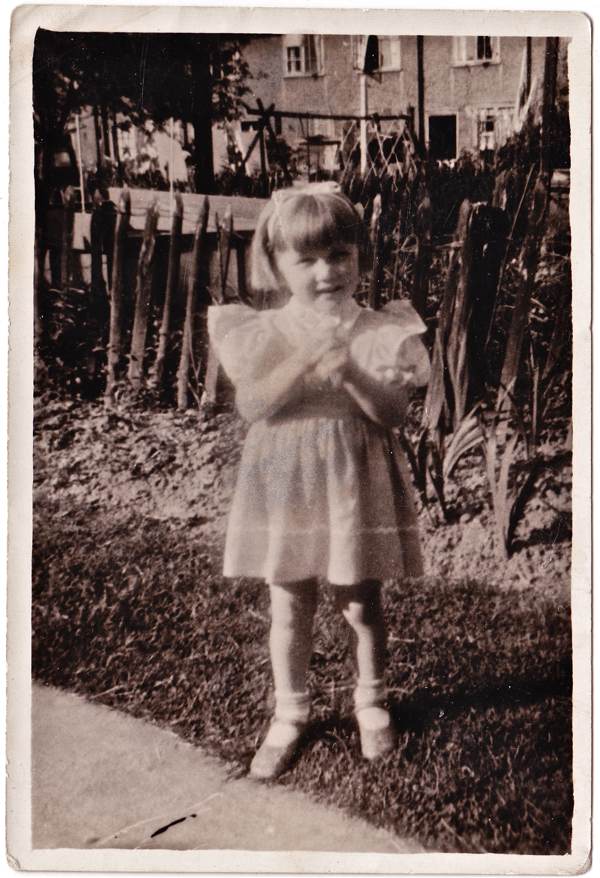
Joy aged four in a dress made by her mother, taken in Dagenham where Joy was born – “My parents moved from Stepney in 1939, both were from the East End.”
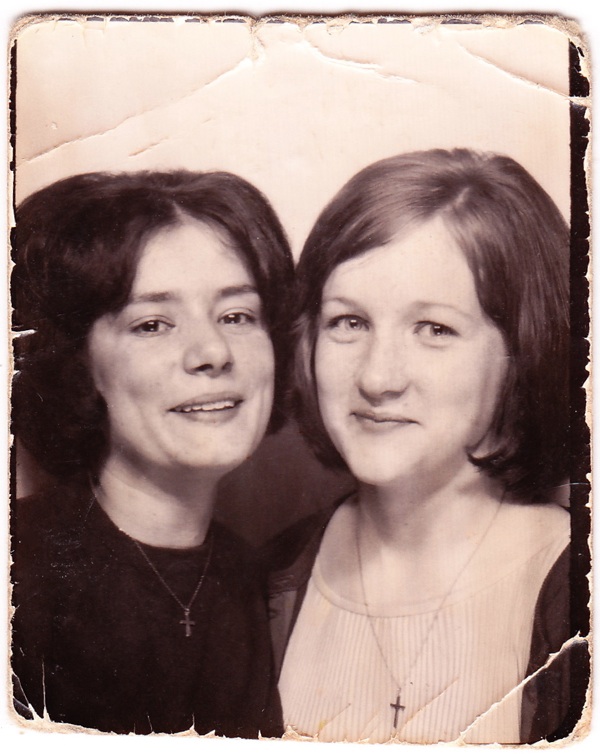
Joy (right) and her best friend Sandra (left), 1961. – “We were always together. We used to see each other every Wednesday night, even after we were married.”
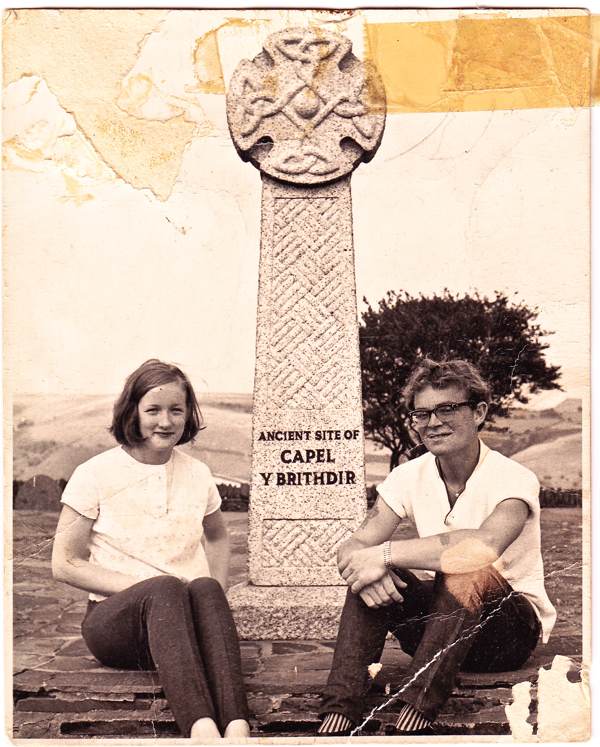
Joy and Larry up a mountain near Gelligaer, Glamorganshire, in 1963, when Joy was seventeen.
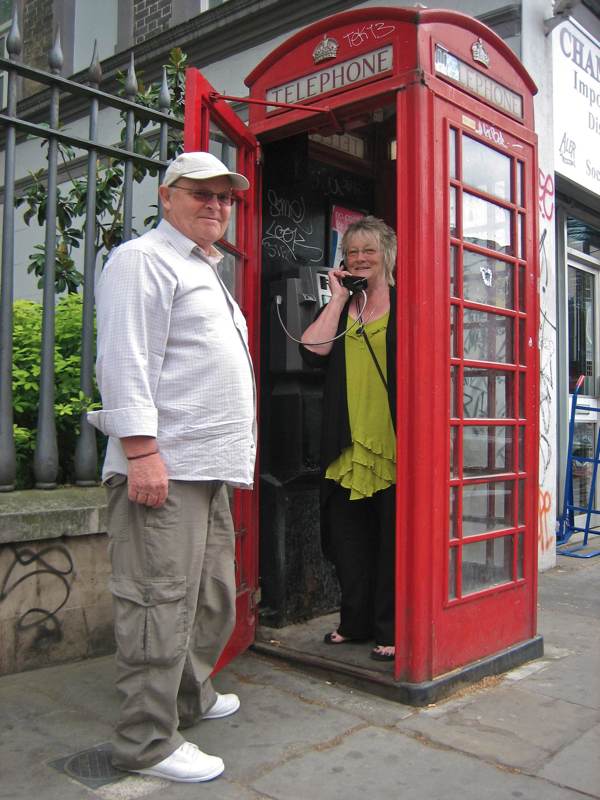
Joy and her husband Larry re-enact the phone call made from this box outside Christ Church Spitalfields in 1963 when Joy rang her sister to learn of the birth of her nephew.
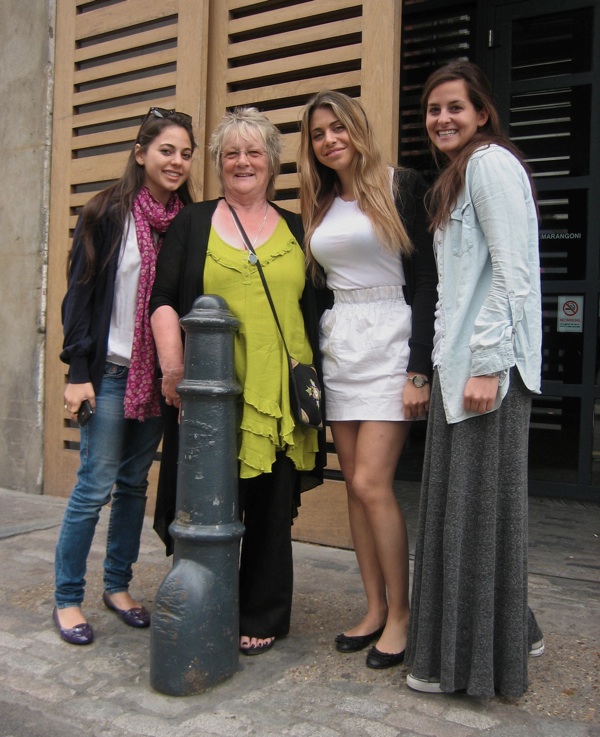
Joy meets Carina Arab, Gulia Felicani and Julie Adler, students at fashion school in Fashion St, on her first return visit since she worked there in a sweatshop in 1963.

Joy at the corner of Brick Lane and Wentworth St where she did her apprenticeship as a dressmaker in 1961, working for Eastex on the third floor. The building is now offices of the Sky network.

Joy Harris, Dressmaker
You may also like to read about
Leila’s Shop Report 3

Leila McAlister & I took a day trip yesterday, driving in her van down to the Kent Marshes to visit James Worley at Oakleigh Farm who grows the asparagus that she sells in her shop. Positioned under a wide estuarine sky, upon three hundred acres of low-lying land between Higham and Cooling where the farmland meets the marshland, James’ father began farming here thirty years ago.
We discovered James occupied draping the nets upon his acres of cherry trees that are just coming into fruit now yet, happily, he was not ungrateful of the excuse to leave this task to others and show us around. Farming just thirty miles from London, James is eager to establish a reputation for his asparagus, selling direct to wholesale greengrocers and restaurant suppliers, and thereby break free of the tyranny of supplying supermarkets – who exploit their control of over eighty per cent of the market, offering a raw deal to small independent producers. “As an individual farmer, it is almost impossible to approach them – the reason I packed up was that they could reject two lorry loads of fruit, claiming one tray was bad – simply as an excuse, if they had over-ordered.” he explained, speaking from bitter experience, “You have to minimise your risk.”
Yet even James’ single acre of asparagus constitutes a gamble, at a cost of ten thousand pounds for the plants and a three year wait for the first crop from his planting of asparagus heads, that will have a life of no more than nine years. We found the field of asparagus at the furthest extent of the farm, upon a gentle incline next to tall stand of willows beside the railway line, beyond which there is just meadow and marsh given over to wildlife. It was a sight of wonder – the bare earth of the field punctuated in surreal fashion by the sharp green spears of asparagus, like those spear heads of a buried army emerging from the earth in mythology. “We knew they would do well here because they grow wild, seeding themselves in the fruit orchards,” James explained brightly, surveying his proud experiment which constitutes a step towards a new direction for Oakleigh Farm. This is the third year and we were looking upon his first significant harvest of asparagus.
From March, the force of these tender stems cracks the hard soil apart and pushes great clods of dried earth aside, as the first green shoots of the year, even before the weeds appear. James has polythene tunnels to warm the soil and bring his crop forward, a redundant measure in this year’s exceptionally mild Spring. Given the sustained warm weather and the lack of rain, the question upon James’ mind is whether the harvest will last until the longest day, traditionally the end of the English asparagus season. The extraordinary rapid growth of these shoots means that picking must continue seven days a week. They grow a couple of inches each day, and in three days a stem can come from the soil to reach harvestable size – and in four days they are over and flowering. Weather conditions can have a radical affect upon growth, with a sudden change in temperature or strong winds resulting in mis-shapen wind-blown spears of asparagus.
“I could happily eat asparagus every day and live off it – I would!” admitted Leila, who supplies Oakleigh Farm asparagus to the Rochelle Canteen, Towpath Cafe and Violet Cakes as well as selling it in her shop. The resonant snap of the stem as it is cut, that I heard in the field that day, is a sound to gladden the heart of any asparagus lover, and regular deliveries from Kent to Calvert Avenue permit East Enders to buy it as fresh as it can be had while it is in season. When asparagus is this good, Leila recommends eating it as it is, though – when pushed – she also suggested serving it with Farro grain, chopped cucumber and fresh herbs.
I could not wait to get home with my brown paper packet of asparagus spears, slice off the ends and steam them for a couple of minutes while mixing a lemon juice and olive oil dressing, before carrying the dish down to the garden in the cool of the evening. I sat alone devouring the stack of delicious green stems – with a satisfying texture that is crisp to the first bite and then soft upon the tongue – one after the other, in a kind of trance. I thought about our sunlit drive through the winding lanes across the Kent marshes between hedges lined with cow parsley and dog roses, and punctuated by old clapperboard houses. I thought about getting lost on the way to Oakleigh Farm and ending up by accident at the church that Dickens put in Great Expectations. I recalled standing in the asparagus field listening to the chorus of frogs booming from the marshes. I could still feel the flush of wind and sun upon my face. And all of these impressions were to be savoured, contained in the experience of eating James Worley’s asparagus from Leila’s Shop.


You may also like to read
Leila’s weekly vegetable boxes are available for delivery throughout Shoreditch, Dalston, London Fields, Bethnal Green, Spitalfields and Whitechapel.
You can find the vegetable box blog by clicking here.
Adam Dant’s Map of Clerkenwell
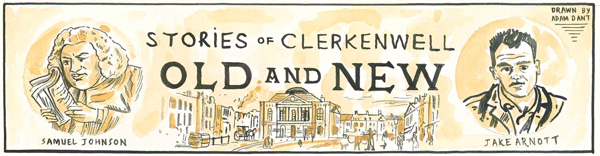
After the tremendous popularity of his Map of Shoreditch last year, Adam Dant has now created this Map of Clerkenwell and it is my great delight to publish here it for you today. (Click on the panels below to enlarge them.)
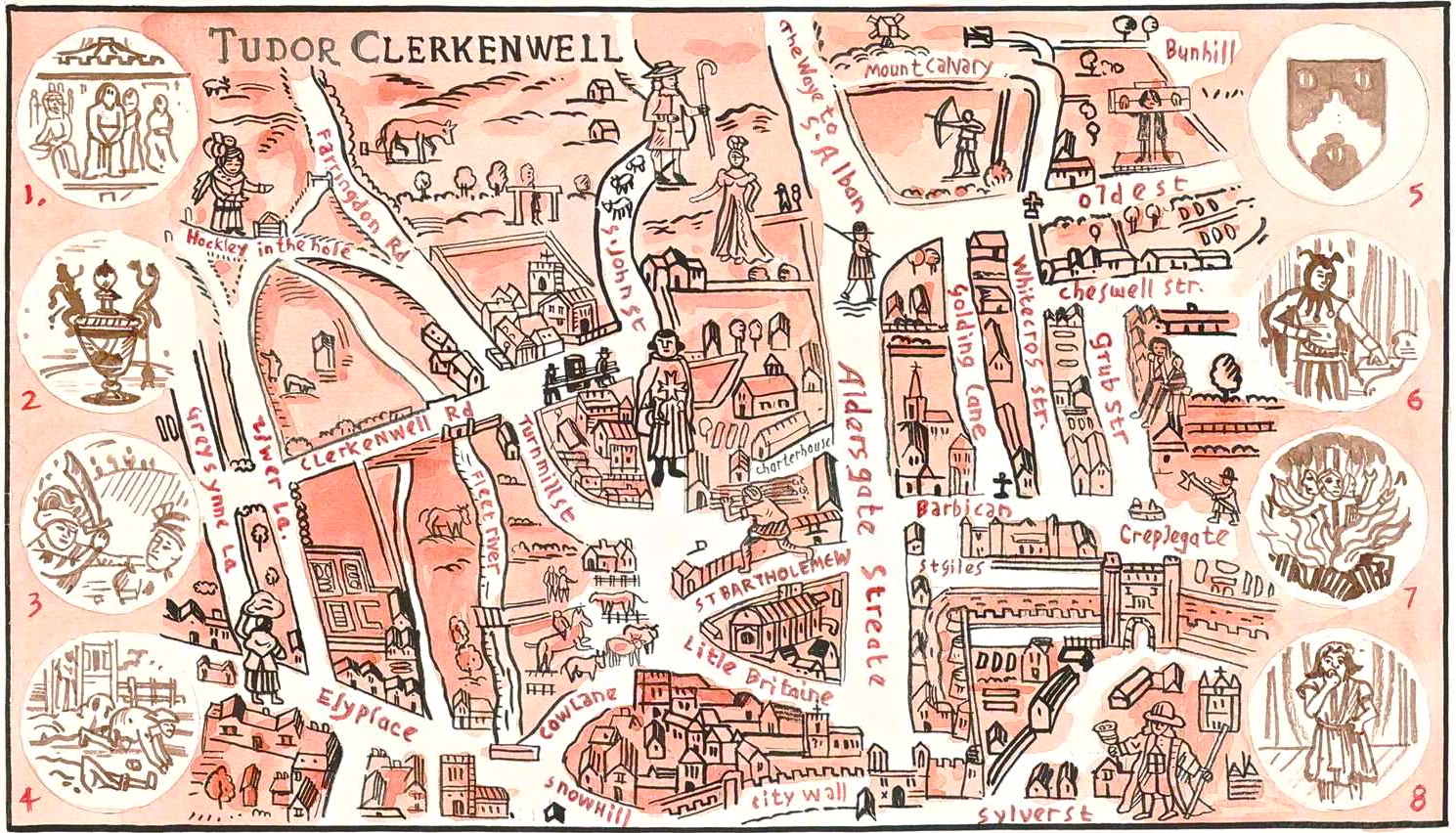
1. 1390. The annual Clerkenwell Mystery Play “Matter from the Creation of the World” is performed by parish clercs whose well can be be seen at 14 Farringdon Lane.
2. 1246. The Knights Templars of St John’s Priory return from the Crusades to present Henry III with a crystalline vase containing “blood of the saviour.”
3. 1290. Wat Tyler, leader of the Peasants’ Revolt is killed in Smithfield by Mayor William Walworth whose sword can be found at the Fishmongers’ Hall and on the City of London flag.
4. 1381. In the reign of Edward I, the water from the Fleet river is already so impure and containing such noxious exhalations and miasma that it kills many hooded brethren.
5. 1527. Sir Thomas Docwra, the last grand prior of the English Knights’ Hospitallers and architect of St John’s Gate is buried in the prior church.
6. 1123. Rayer, Henry I’s jester founded St Bartholomew’s Hospital.
7. Through the ages, great crowds have arrived at Smithfield for the St Bartholomew Fair, tournaments and for public burnings, such as Queen Mary’s two hundred and twenty-seven victims.
8. 1613. Some of the earliest female performers appear on stage at the Red Bull Theatre, Woodbridge St.
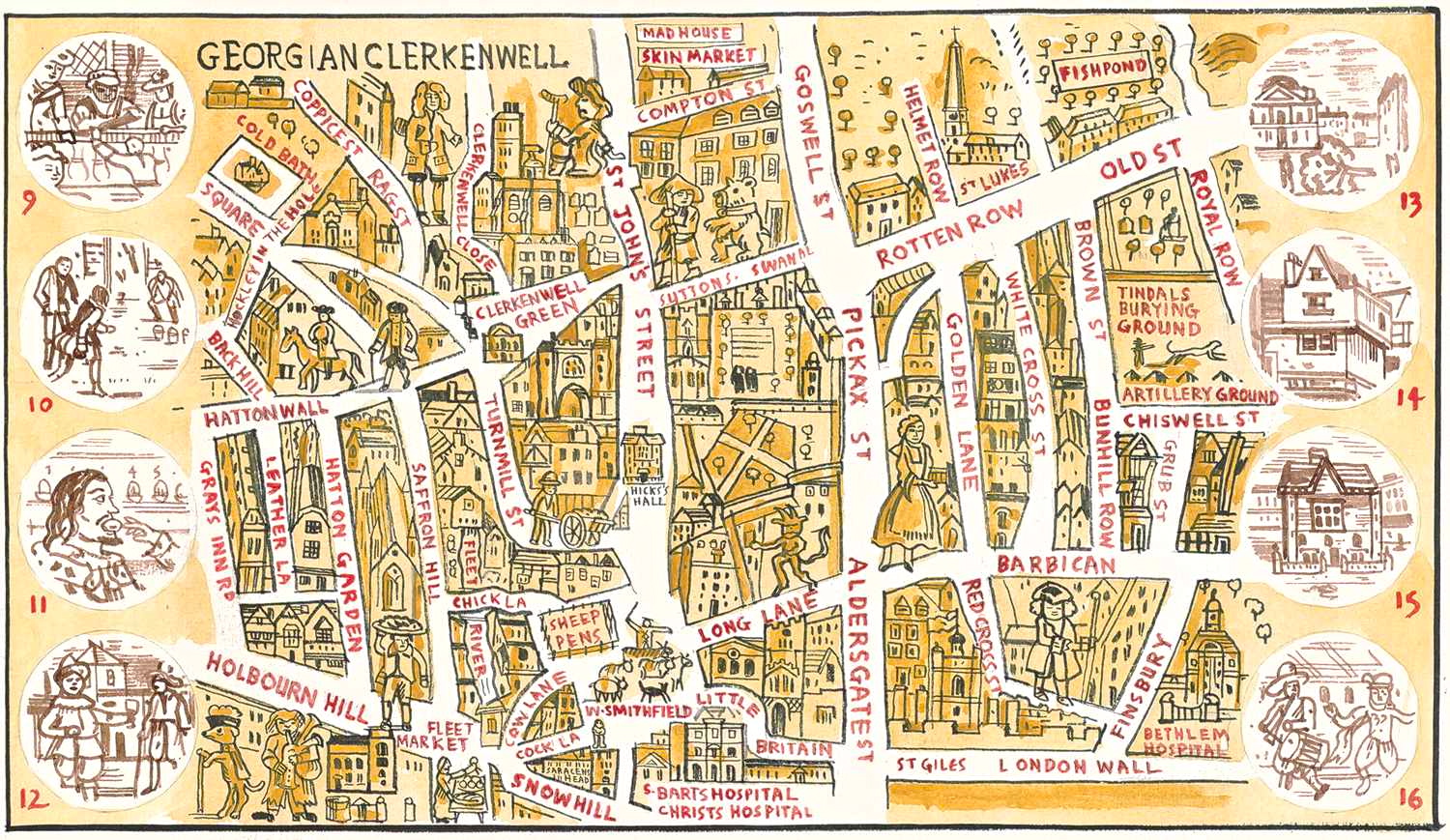
9. Nearby Bagnigge Wells House, home of Nell Gwyne, a black woman called Woolaston sells spring water from a fountain known as “Black Mary’s Hole.”
10. 1617. Seventeen bowling alleys at Bowling Green Lane are licenced by James I.
11. Charles I stops to enjoy a Dorset delicacy, “the pickled egg,” at Crawford’s Passage or “Pickled Egg Walk.”
12. Jack Adams, “The Clerkenwell Green Simpleton,” is regularly mentioned in pamphlets during Charles II’s reign.
13. 1747. The last tree on the North side of Clerkenwell Green is blown down during a storm.
14. The level of Cloth Fair remains much higher, even today, due to the accumulation of rubbish, dust and ashes.
15. 1610. Hick’s Hall, in the middle of St John’s St, was the last purpose-built sessions house, the point from where all distances from London were calculated and where criminals were dissected.
16. 1600-12. Shakespeare’s revels are rehearsed in the Great Hall at St John’s.
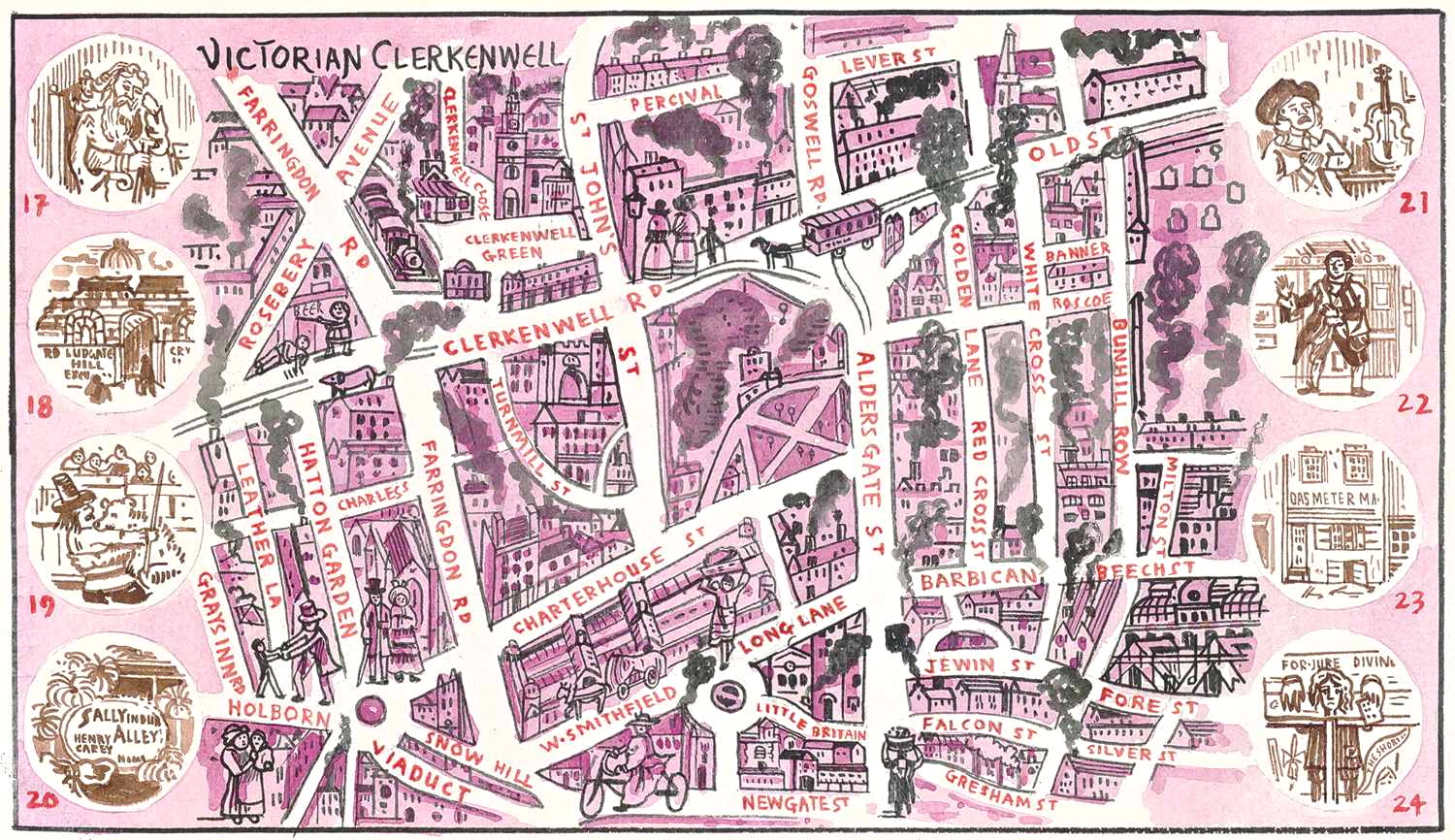
17. 1636. Henry Welby, the Hermit of Grub St, unseen by any human for forty years dies having bought, read, and mostly rejected all new books published.
18. 1641. Fleet Prison is reserved for debtors. 1726. Hogarth immortalises, in his engraving, the ghastly disclosures of witnesses, “fettering, spunging, damp and stench.”
19. 1709. Christopher Preston, bear gardens proprietor, is attacked and almost devoured by one of his own bears.
20. 1743. Henry Carey, for some time considered author of “God Save the King,” pens “Sally in our Alley” in Great Warner St.
21. Thomas Britton, “the musical smallcoal man,” whose musical club hosts Handel concerts is scared to death by a ventriloquist’s trick premonition.
22. 1737-41. Dr Johnson toils for Edward Cave’s “Gentleman’s Magazine” in St John’s Gate, where Garrick makes his London theatrical debut in Fielding’s “Mock Doctor.”
23. 1740. “Scratching Fanny,” the celebrated “Cock Lane Ghost” promises to manifest itself to Dr Johnson and friends at St John’s church.
24. Popular pamphleteer, Daniel Defoe is pelted with flowers rather than the usual household waste when put in the pillory for publishing ” The Shortest Way with the Dissenters.”
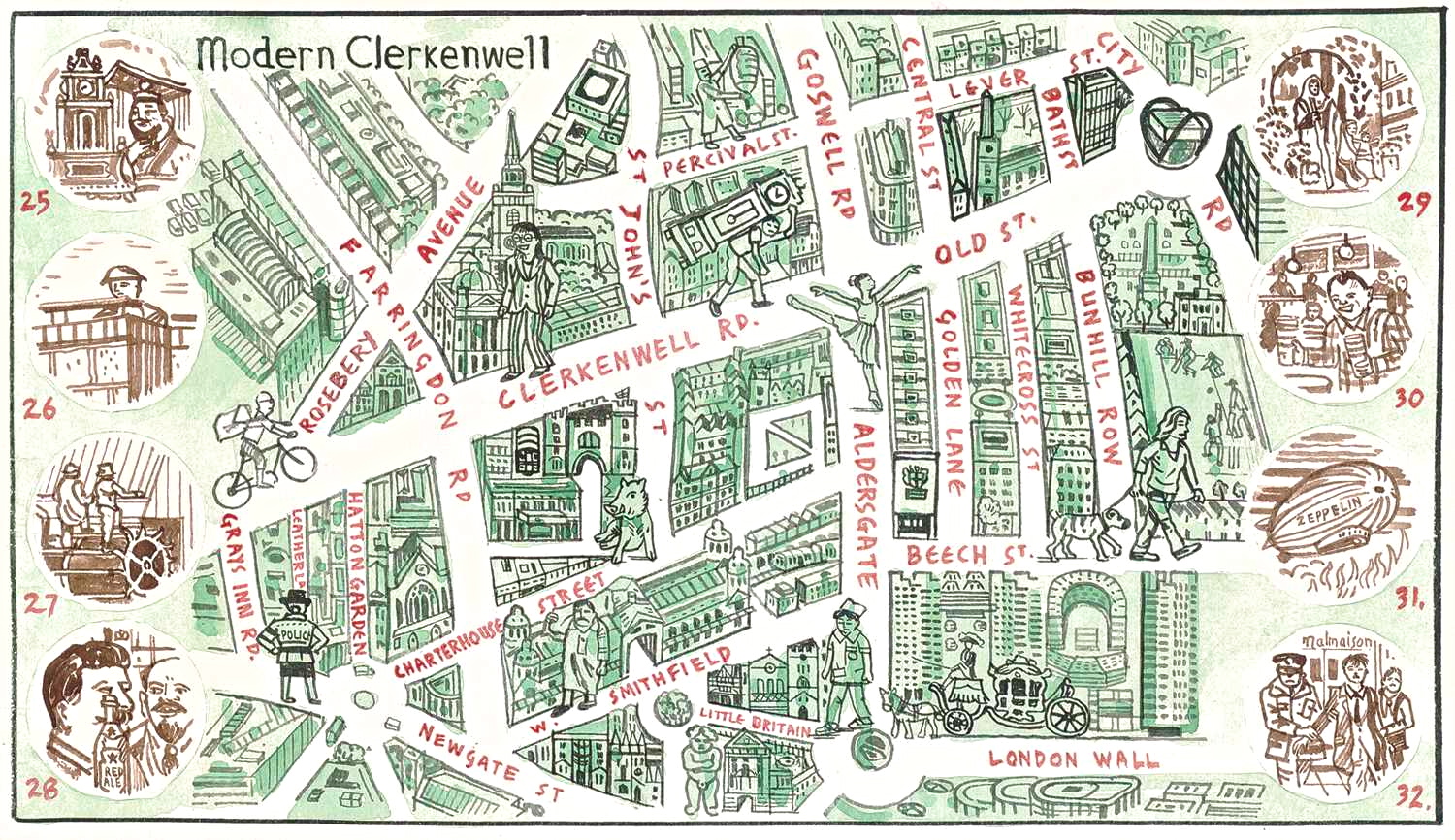
25. 1812. Once occupied by Colonel Magniac, maker of automaton-clocks for the Emperor of China, the birthplace of John Wilkes is pulled down.
26. 1908. The vast roof of the GPO sorting office is used as a rifle club shooting range.
27. 1820. Thistlewood and the Cato St conspirators are kept at Coldbath Fields Prison, home of the first treadmill.
28. 1903. Lenin meets a young Stalin at the Crown & Anchor pub (The Crown.)
29. Clerkenwell’s Italian community erect a life size “presepe” nativity scene every Christmas at St Peter’s Italian church.
30. TV presenter Graham Norton collects the empties at pioneering “gastro-pub” The Eagle.
31. 1917-19. Zeppelin raids destroy buildings in Passing Alley and St John’s Lane.
32. 2006. Rock star Pete Doherty is banned from The Malmaison after trashing a room at a cost of four thousand pounds to the Charterhouse Sq Hotel.
Map copyright © Adam Dant
You may also like to take a look at
Adam Dant’s Map of the History of Shoreditch,
or his Map of Shoreditch in the Year 3000,
or his Map of Shoreditch as New York,
or his Map of Shoreditch as the Globe,
or his Map of Shoreditch in Dreams.