
The Return of Anthony Eyton
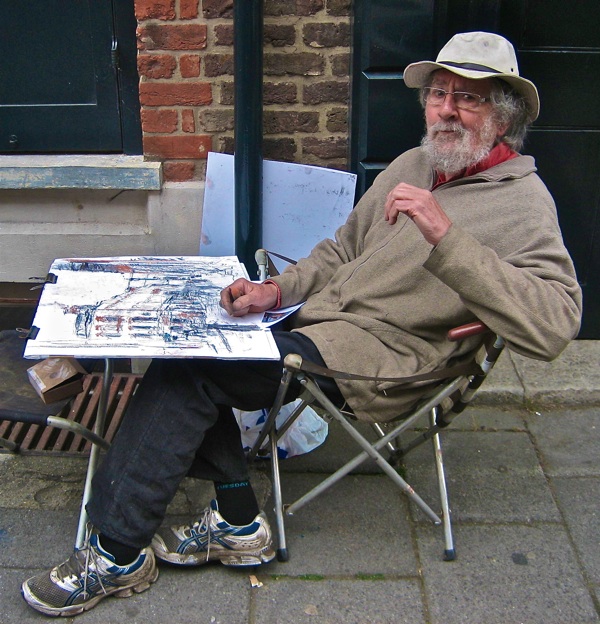
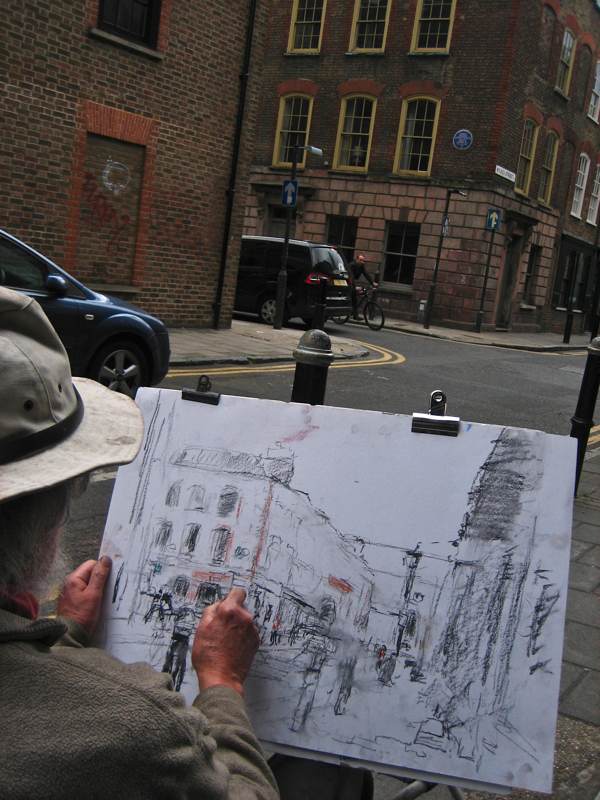
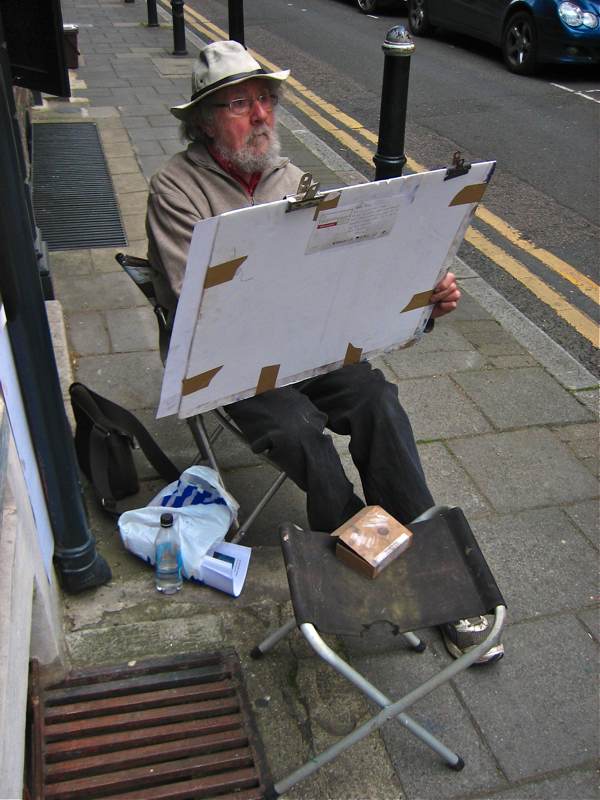
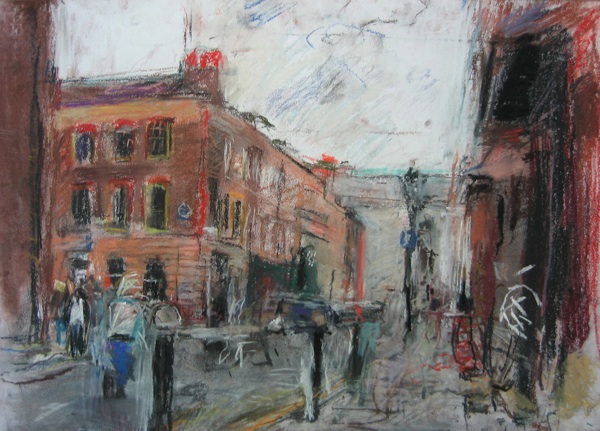
You may have noticed Anthony Eyton sitting in Wilkes St each day over the last few weeks. A discreet yet distinguished figure with his straggly white whiskers and extravagant flowing mane barely contained beneath a wide brimmed hat, perched upon his modest folding chair, holding his drawing board, and working intently at an intricate cityscape. He is pursuing a personal vision of these ancient narrow streets which is informed by his lifelong relationship with Spitalfields.
It was in 1948 that Anthony first walked up Brick Lane, after visiting the Mark Gertler retrospective at the Whitechapel Gallery. The unique quality of the place held such enduring fascination to the young art student from Camberwell, new to London after finishing military service, that he kept a studio here for fourteen years from 1968 until 1982, and still returns with undiminished interest today, more than sixty years since he first visited.
“What struck me when I came out of the Whitechapel Gallery were the barrows, where everybody looked bigger and creamier. I walked along Brick Lane and saw all the sweatshops. It must have been a colourful time, it was decrepit but I thought it was alive. You certainly get attached to an area, you feel embraced by it, and I still get that feeling now.” Anthony told me as I sat upon the kerb beside him, peering down Wilkes St, while he focused his attention back and forth between the drawing and the street.
“At art school, we were taught drawing, but nothing about drawing outside,” he continued, gazing at people on mobile phones, standing like apparitions in the street, “though I’ve always drawn people in situations, and this was re-inforced when I went to Italy after art school and drew people in the streets there – it’s so much part of Renaissance painting, placing figures in spaces.”
Looking down Wilkes St, I had the feeling we were looking down a tunnel, a tunnel of light and a tunnel through time. Directly in front of us was the red brick house on the corner of Wilkes St and Princelet St with a blue plaque commemorating the eighteenth century silk designer, Anna Maria Garthwaite, who once lived there, and beyond that 2 Wilkes St, the house where Anthony rented his first studio in 1968, up on the top in the weavers’ loft. Filling the end of the street was the unremitting mass of Nicholas Hawksmoor’s Christ Church with its line of circular windows along the side, like a vast ocean liner moored at a wharf. To the right was Puma Court, leading through to Commercial St which was the main source of the lunchtime passersby who were unaware of Anthony, even if they were central to the subject of his drawing.
“I wanted to do Wilkes St,” explained Anthony, “because the size of it is so perfect. A little wider than Princelet St, and Fournier St is so grand, but Wilkes St is the ideal scale for people. People look at home in this space, they go into a doorway and it has significance.” We sat in silence together and watched the people come and go, preoccupied with their mysterious intentions, and exchanged glances of amused fascination at this every day wonder, as if we were the sole audience to this spectacle of life and it was contrived for our diversion.
“My first impression, when I came back, was how drab it was,” admitted Anthony to me with a smirk, deliberating over his box of pastels, “In the old days it was all bright colours with so many factory signs, but now it is houses it’s all sombre colours. I remember blue front doors and the hum of machines.” And then he winced up at the sky in concern, hoping that the clouds would not break to let the sunshine through. “The sun gets in my eyes so much,” he confided, frowning, “the colours become blurred and misty. If it’s a dull light, the Dawlish cliffs (as he referred to house on the corner) become a wonderful rich ochre, there will be a yellow line round the windows and the bricks round the windows will be red, and all the colours will be much more intense. On a cloudy day, I can see colours in the shadows.”
I looked down Wilkes St again, and into the landscape of Anthony’s imagination, illuminated by more than sixty years of experience of this place, framed by the proportion of Renaissance painting, and enlivened by his love of the poetry of the fleeting life of the street.
“The friendly chap opposite, a Spanish architect called Hannibal, he kept on bringing me cups of tea and he even offered me a beer.” confessed Anthony, rolling his eyes in delight at the infinite adventure of being an artist working outdoors in the city, “And the lorry drivers, they glance down from their cabins and give me the thumbs up. “Alright uncle!” they say. And you feel you belong. A couple of times that happened, which is always nice. My theory is that everybody has a natural appreciation of art, so if a lorry driver likes it, that’s good enough for me.”
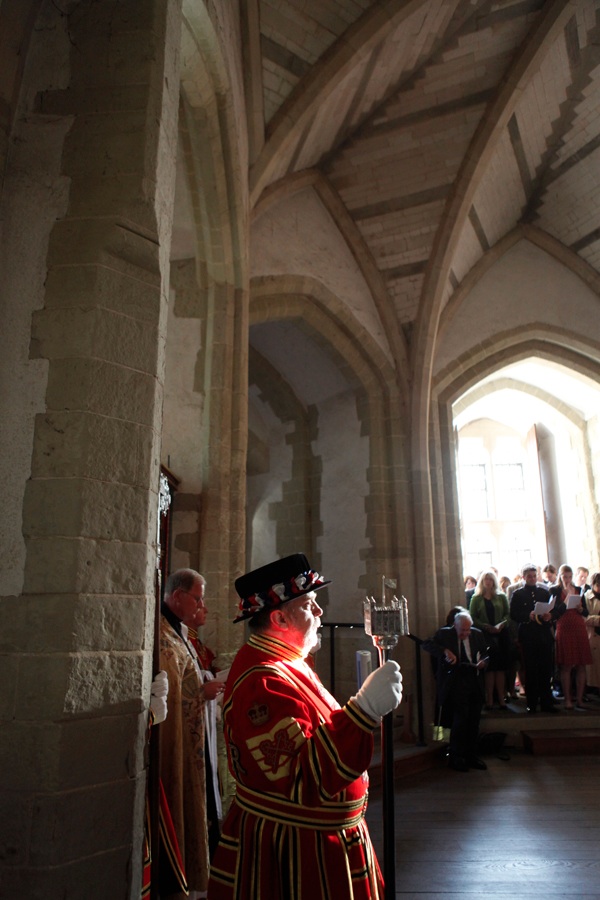
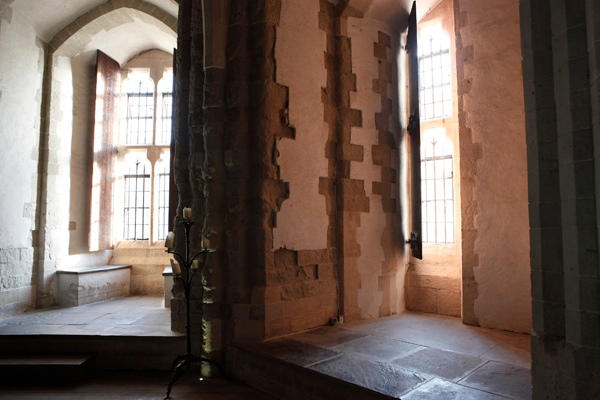
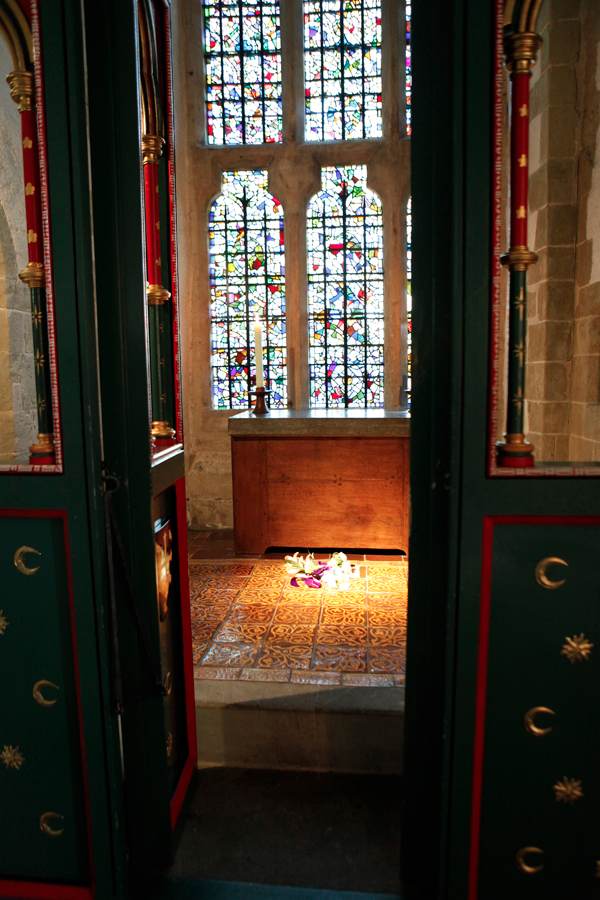
At the core of the ancient palace at the Tower of London is a fine octagonal room with a lofty vault of stone, the Presence Chamber where the medieval kings of England held court – with one entrance leading back into the Tower and the other out towards the City. The Plantagenet dynasty came to a violent end here in the Wakefield Tower when Henry VI was imprisoned and then murdered in 1471, allegedly whilst at prayer in the oratory on the night of 21st May, the Vigil of the Ascension.
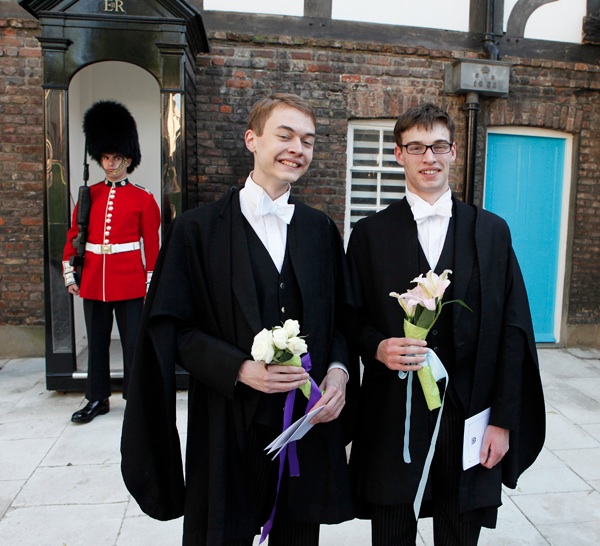
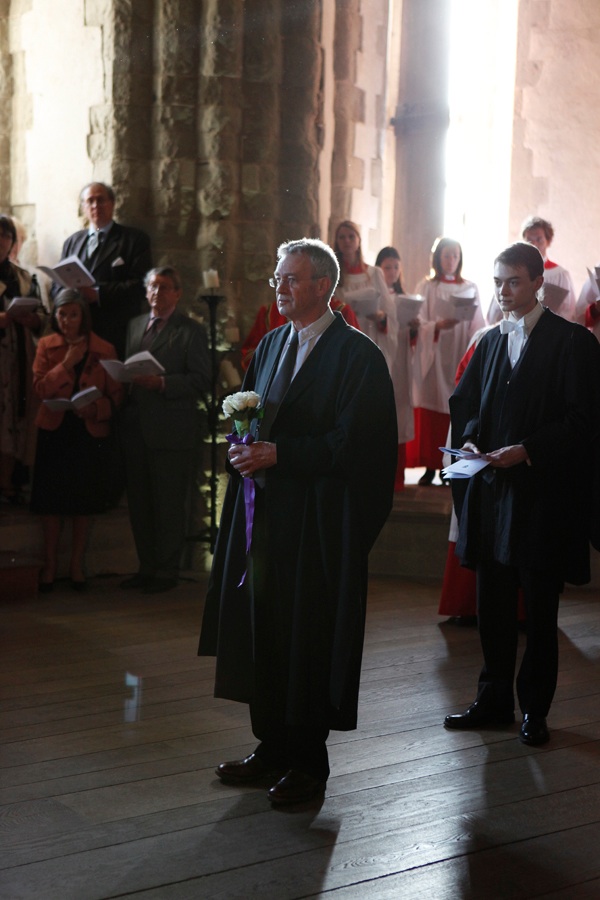
In 1923, a marble tablet was laid in the oratory floor in memory of Henry and since then lilies have been placed there by students of Eton College upon the evening of each anniversary, commemorating Henry as their founder. And since 1947, the lilies have been supplemented by roses, a token of King’s College Cambridge, the other of the two royal colleges founded by Henry, as the enduring legacy of his ill-fated reign.
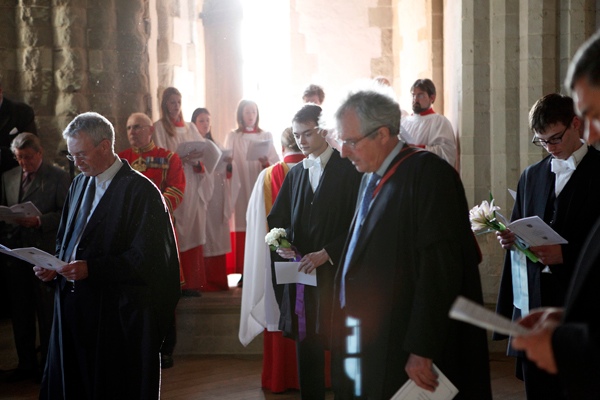
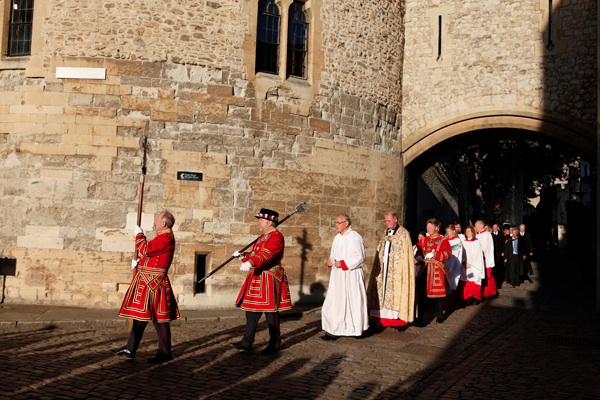
Held in private, by the fading rays of the evening sun, to the accompaniment of a small choir singing plainsong, this is a quiet ritual of remembrance, and I was granted the opportunity to attend this year as the guest of John Keohane, Chief Yeoman Warder in the company of Spitalfields Life contributing photographer Patricia Niven, who took these first pictures of the ceremony of the lilies and roses in decades.
Three weeks before Henry’s murder, his only son Edward was killed at the battle of Tewkesbury on May 4th where his wife, Margaret of Anjou, had been taken prisoner by the Yorkists – bringing the Wars of the Roses to an end. Seventeen years earlier, King Henry had suffered a breakdown and he declined into mental illness through the rest of his life, unleashing a power struggle within the kingdom that was only resolved by his death here upon the stone floor in this room in the Wakefield Tower.
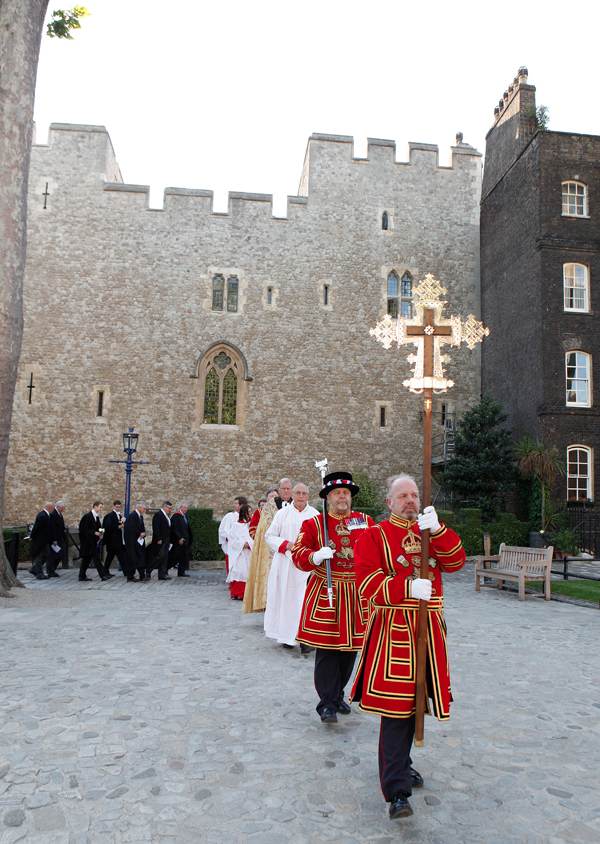
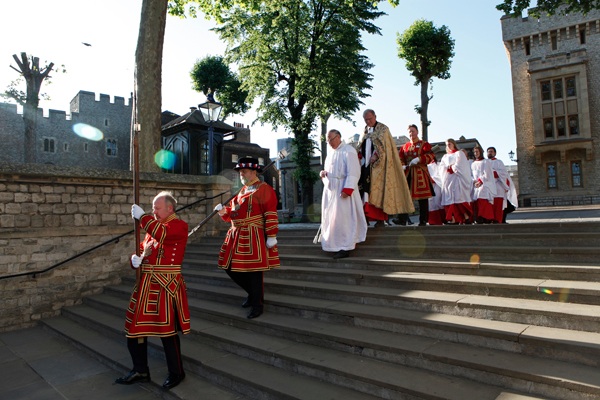
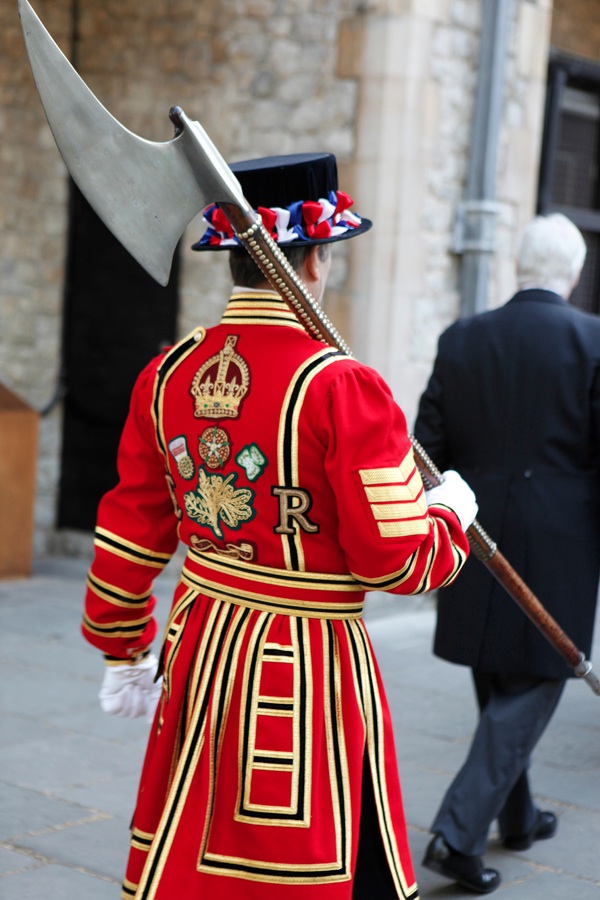
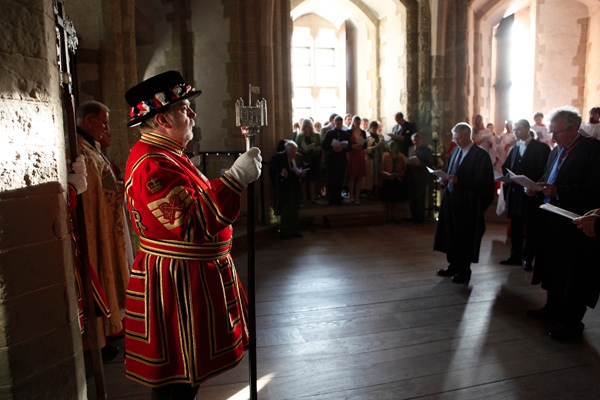
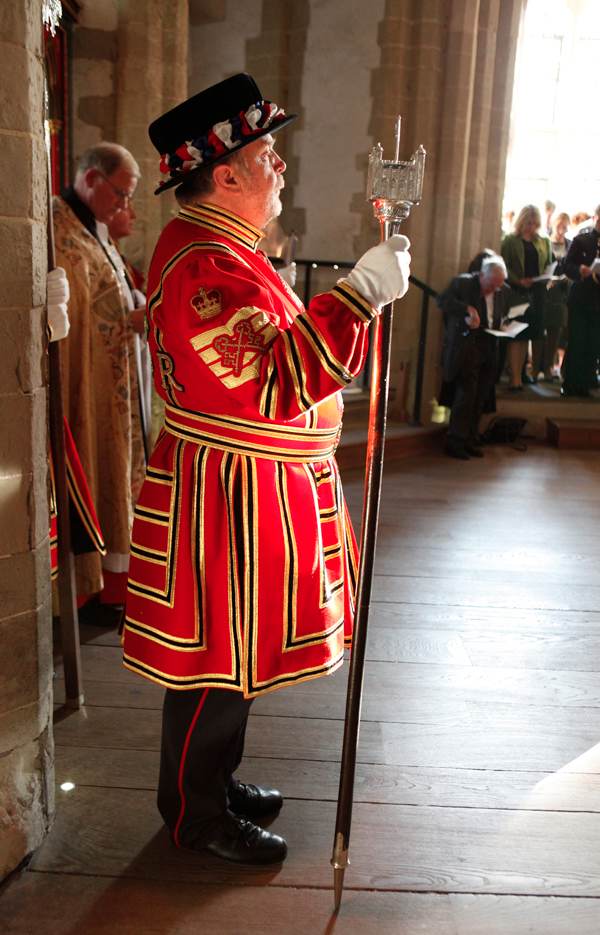
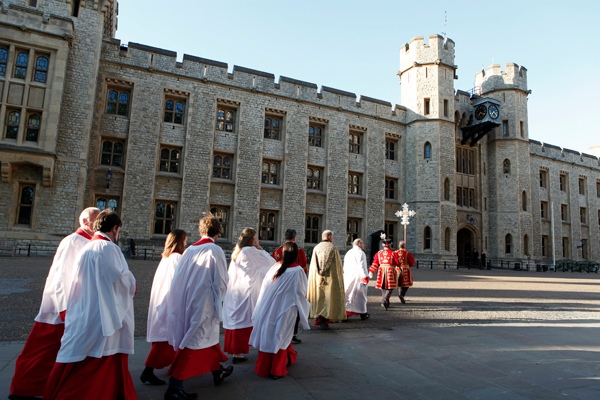
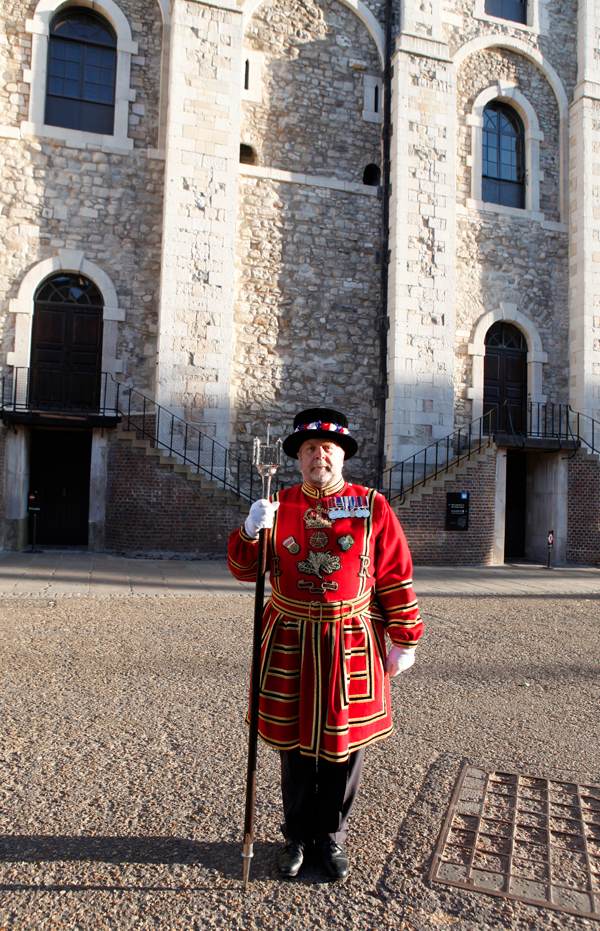
Once the Tower of London had emptied out of visitors at the end of the day, a procession gathered outside the Queen’s House on Tower Green, led by the Yeoman Warders. John Keohane first marched in this procession in 1992 as assistant Sexton, then in 1995 he was promoted to the Clerk’s position, rising to the role of Gaoler in 2000 before being appointed to Chief Yeoman Warder in 2004. Each role has its staff of office and John has carried every one, culminating in the solid silver mace with a finial in the shape of the Tower that he wields today.
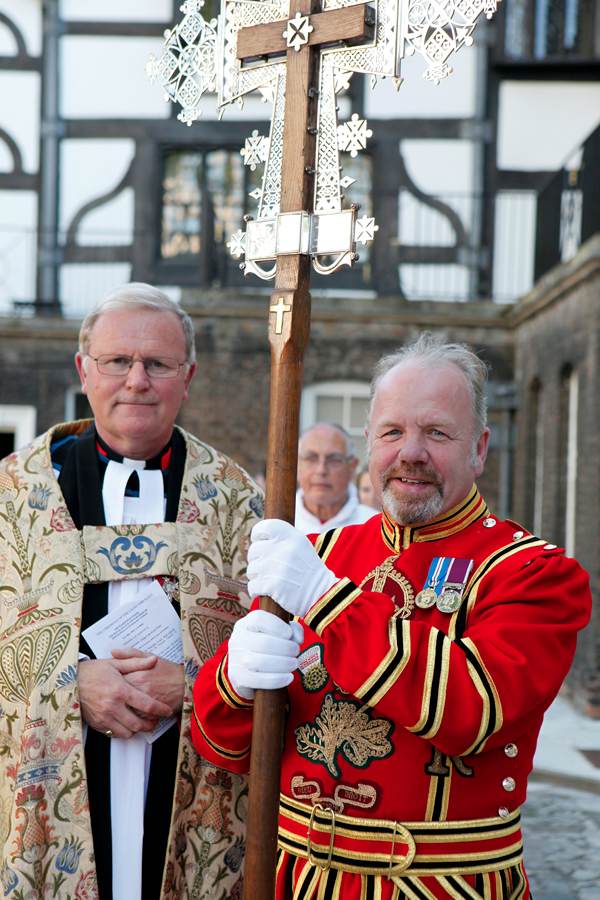
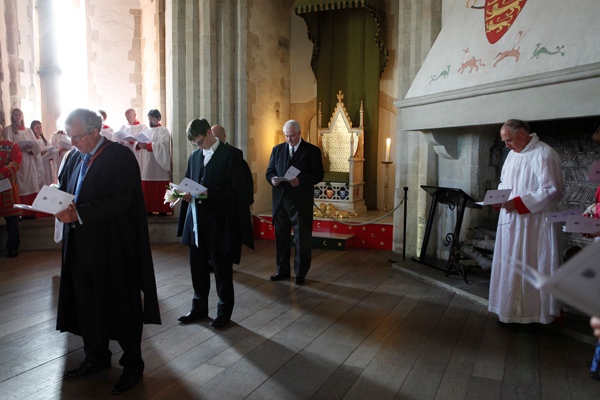
I accompanied the guests, winding up a narrow staircase of worn steps from Water Lane and crossing a stone bridge to enter the austere octagonal chamber where a single shaft of blazing sunlight traversed the space. From within the Tower, arriving through an ancient low doorway that required the crucifix to be lowered to enter, came the procession, warders with their maces, the chaplain and the governor of the Tower, the provosts of Eton and King’s Colleges in their dark gowns, the young scholars with their sheaves of lilies and roses, and the choir in their red vestments. Once this party took up their positions, facing the oratory and filling the chamber, the entire space took on its intended reality, as a place of ritual and the role play that accompanies the distinctions of hierarchy and responsibility.
Plainsong in the confines of a medieval chamber carries a resonance that is intense and immersive, as if the number of singers were multiplied – an effect that was vividly apparent when the priest led those gathered in prayer and the voices were augmented through echo, as if a host of unseen guests joined us in attendance for the ceremony. The solemn gathering at twilight and the prayers and the psalms, in this bare stone hall, created a circumstance in which the age of Henry VI no longer seemed beyond reach.
Outwith the quiet of the empty Tower of London at the end of the day, the City was busy, yet it dissolved into insubstantiality as we stood in silence together in the ancient Wakefield Tower – while the last shaft of sunlight travelled across the room and the young scholars laid their lilies and roses upon the site where the founder of their colleges was killed long ago, in another age.
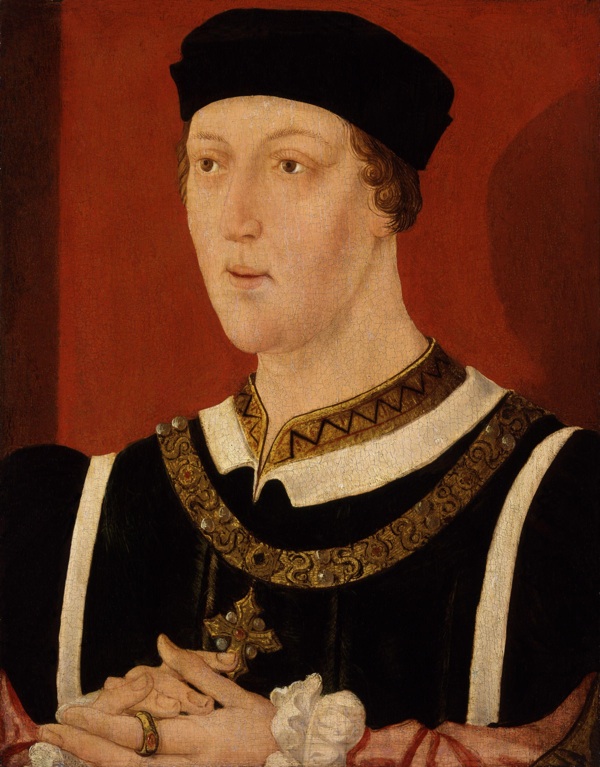
Henry VI ( 1421 -1471)
Photographs copyright © Patricia Niven
You may also like to read
The Bloody Romance of the Tower
John Keohane, Chief Yeoman Warder at the Tower of London
Among the Breaking Boys
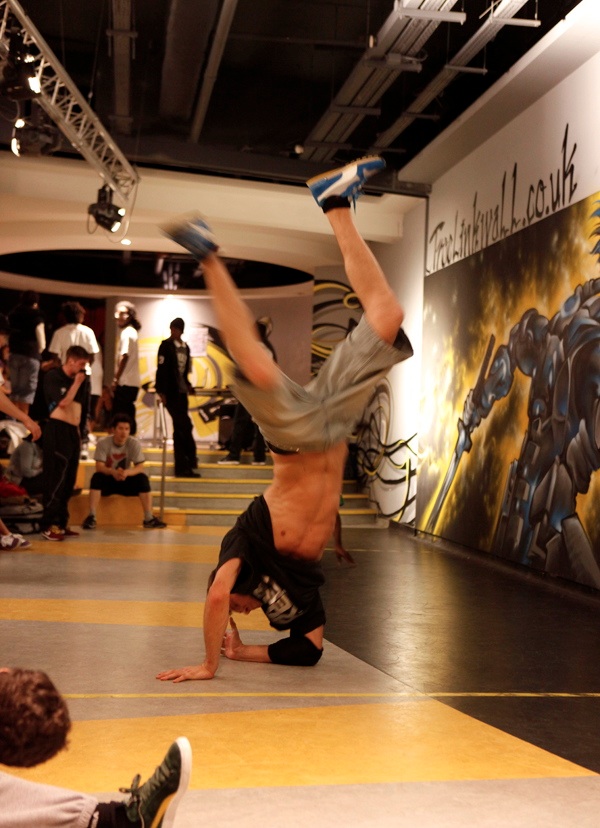
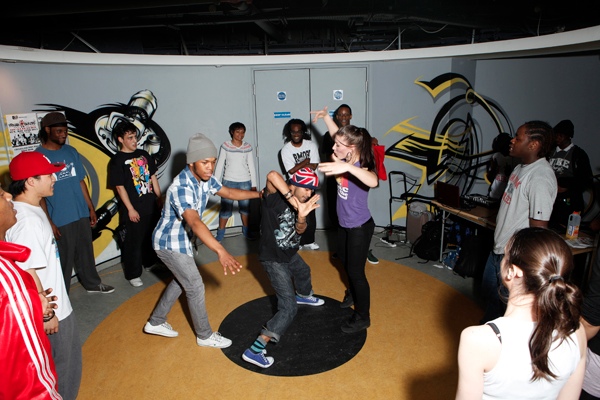
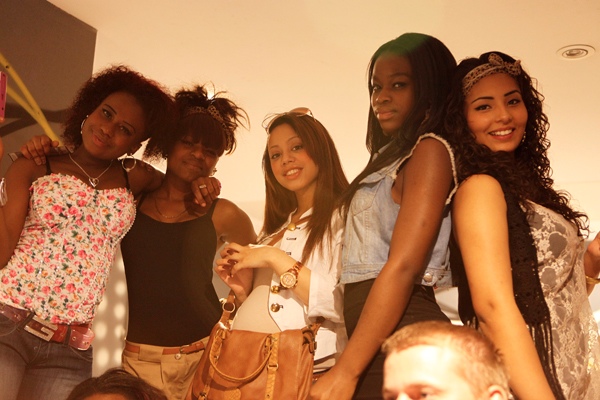
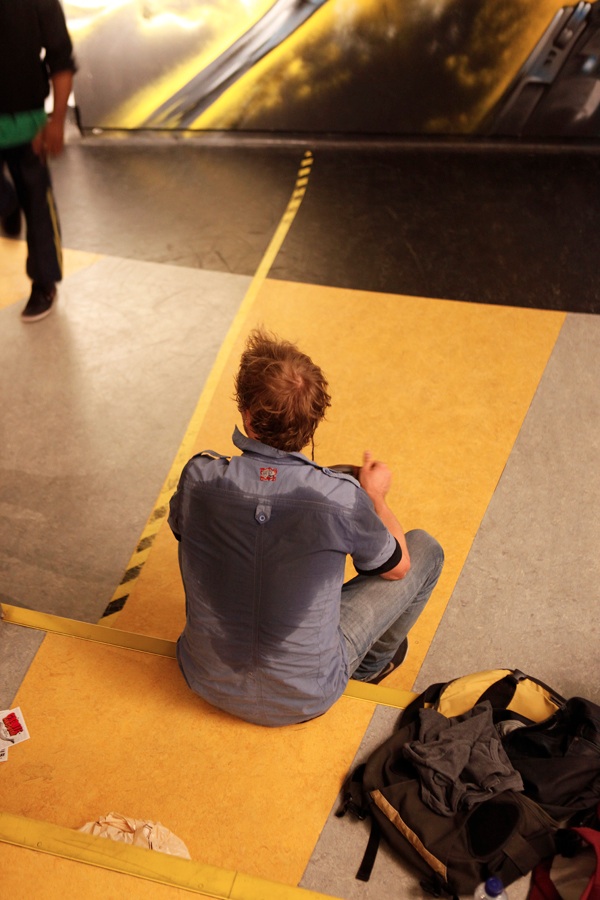
In the subterranean depths beneath Piccadilly Circus, something extraordinary is going on. My friend Prince of England, the Underground Dancer tipped me off about it, and so I took Spitalfields Life contributing photographer Patricia Niven along to see for myself what was happening down there in the tunnels under the Trocadero.
Above ground, tourists were gathering at Eros’ statue in the evening sunlight and sightseers were surging through Leicester Sq as the quickening of energy that accompanies Friday night filled the crowded streets with a crackling excitement. But stepping into the Trocadero, past the souvenir shops and fast food joints into the labyrinth of escalators and amusements arcades – apparently bound together only by eccentric towers of scaffolding and ceaseless jangling pop – and descending to the basement, you discover the secret heart of this place, the true source of heat and hullabaloo in Piccadilly.
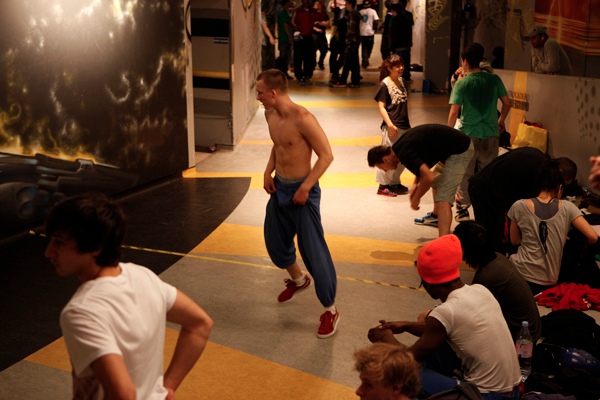
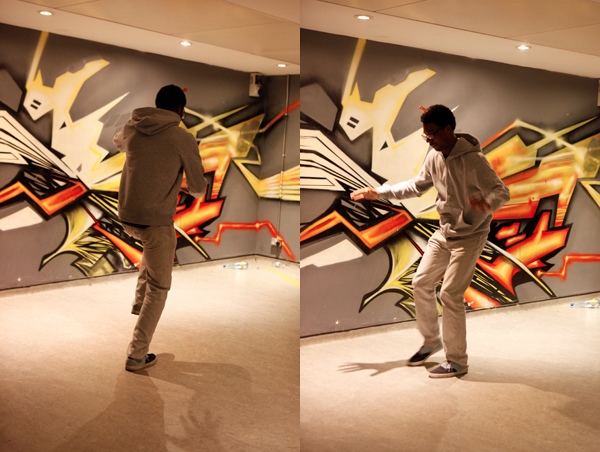
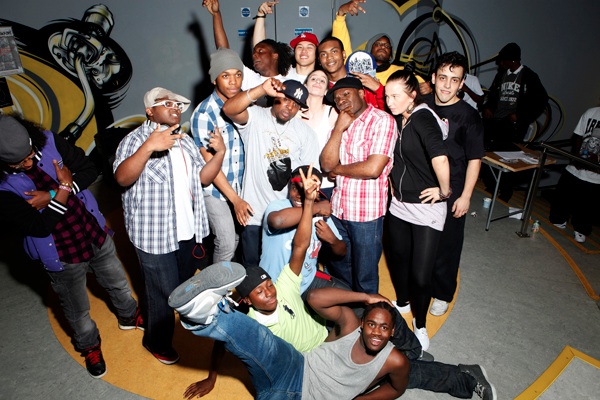
For more than a year now the tunnels connecting the Trocadero and the tube station have been appropriated by the street dancers of London as a rehearsal, practice and jamming space where they can meet together and display their superlative artistry. Upstairs above ground, almost every form of entertainment or culture involves money, but below ground it is all about talent, and daring, and wit, and showmanship, and the love of dance. As you enter the tunnels, you are aware of leaving a commercial environment and entering a space that has been reclaimed by people as a meeting place of equals, because among dancers of divergent ability and accomplishment, everyone has come to celebrate a shared enthusiasm, and the sense of goodwill is immediately apparent.
Turn left at the foot of the moving staircase on any night of the week and you will see people standing on their heads and attempting to spin. These are the neophytes on the periphery, those – like you and me – who are drawn to dance but as yet have only the modicum of technique. They come to aspire, to learn the moves and to win respect among their peers. They look a little lonely and a little needy, standing on their heads and falling over and trying again. Show them a nod of deference but please do not linger to make them self-conscious.
Next, at the entrance to the tunnel you discover a round space, like tiny circus ring where a DJ and and an MC preside over a jamming session of dancers circling constantly, coaxing each other forward, popping, locking, krumping, waacking – showing off, playing games and enjoying high jinks for the delight of a small overexcited audience. Jump up and join the crowd, and now you are part of it.
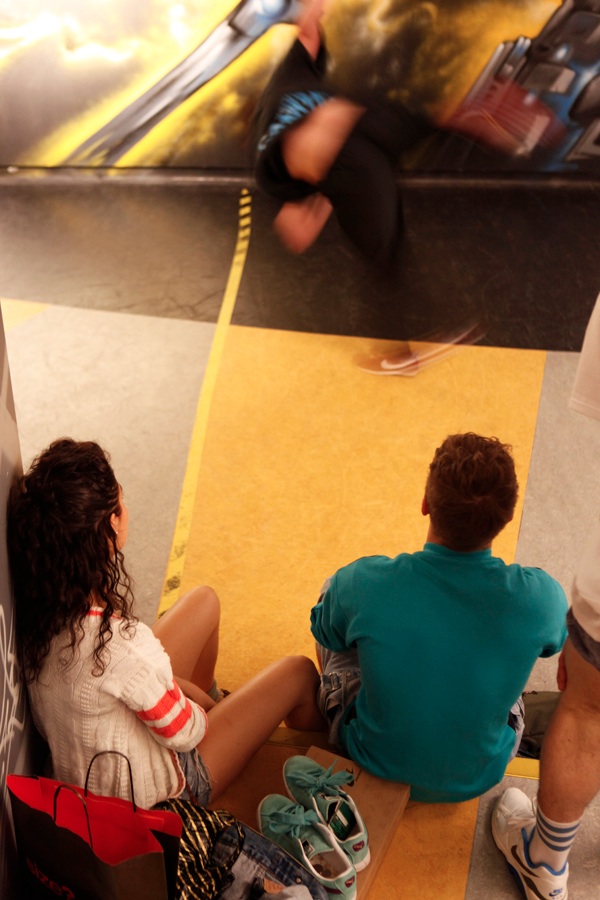
Look beyond this and you see the breaking boys – the stars of the underground dance scene – who command a wide floor with a painted backdrop where they practice their blow-ups. This is the prime space that those you saw standing on their heads at the entrance to the tunnel aspire to, where a quieter, more concentrated atmosphere presides. The breaking boys sit in a line upon a low bench, dripping with perspiration, loose limbed and wild eyed, collecting their faculties before taking it in turn to step up and lay down their moves – commonly halting mid-move and collapsing onto the floor in frustration, yet always going back to venture again. And there is plenty of mutual encouragement here, because the breaking boys are not battling each other but the limits of their own abilities.
From the opening movement of the comedic running on the spot movement known as “top rocking,” it is a swift transition for the breaking boy into “blow ups,” the extended heroic sequence of spinning upside down that is the tour de force of break dancing. Placing weight upon a single hand, or an elbow, or on his head, the breaking boy defies gravity, propelling himself ever round with supreme dexterity, obeying multiple rhythms within the music, yet halting and reversing the spin at whim – in cartoon-like self parody – just to distract you from the heart-stopping accomplishment of his moves. It is a brilliant and sophisticated expression of the strange experience of being human, in which the psyche is in constant motion, juggling myriad thoughts and actions simultaneously with extraordinary ease.
Once these gloomy tunnels beneath the Trocadero were empty, just the rare lone commuter coming through occasionally, taking a short cut and hoping not to get mugged. But today the management have granted licence to the dancers to be here and now those same commuters halt in their tracks to stand in open-mouthed amazement at the exuberance of the show.
London is the centre of the world in street dance and at the very centre of London the dance goes on relentlessly. A community has come together spontaneously and the wonder of it is that, surrounded by lofty cultural institutions, corporate-owned entertainment complexes, and chains – in spite of all that – these dancers are here for the hell of it. This is the party where everyone is welcome, the best show in town where you do not need a ticket. The breaking boys are here to express the joy of being alive, and being full of beans and in your moment of glory. Of all forms of human expression, I find dance the most emotional, and the sight of people leaping for sheer pleasure is one that never fails to touch my heart. So, if you go up West, this is where you have to go – because here and now in London, this is where it is at. And this is what I call culture.
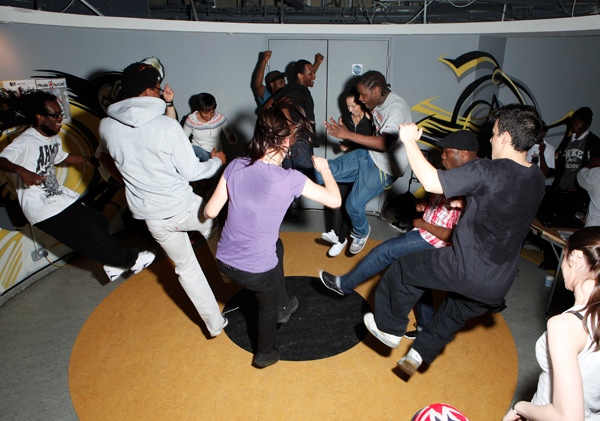
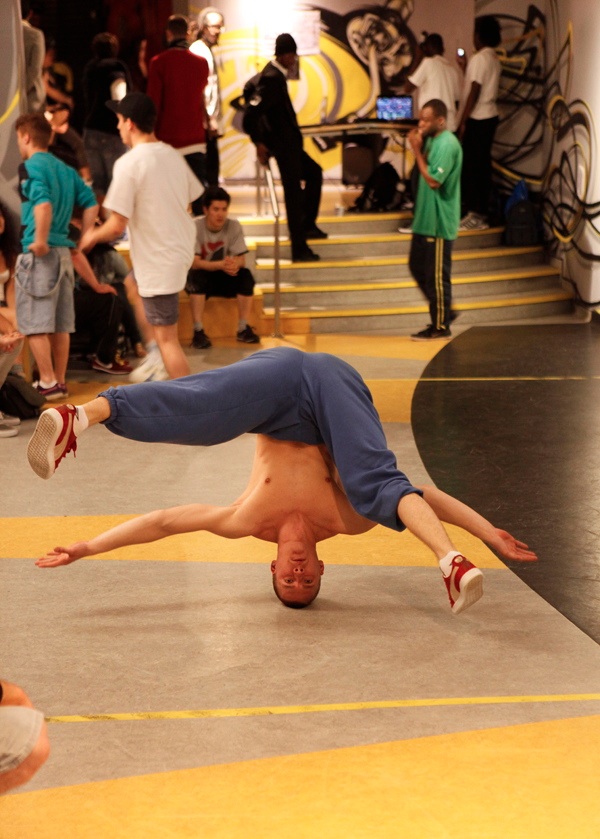


Photographs copyright © Patricia Niven
Heather Stevens, Head Gardener
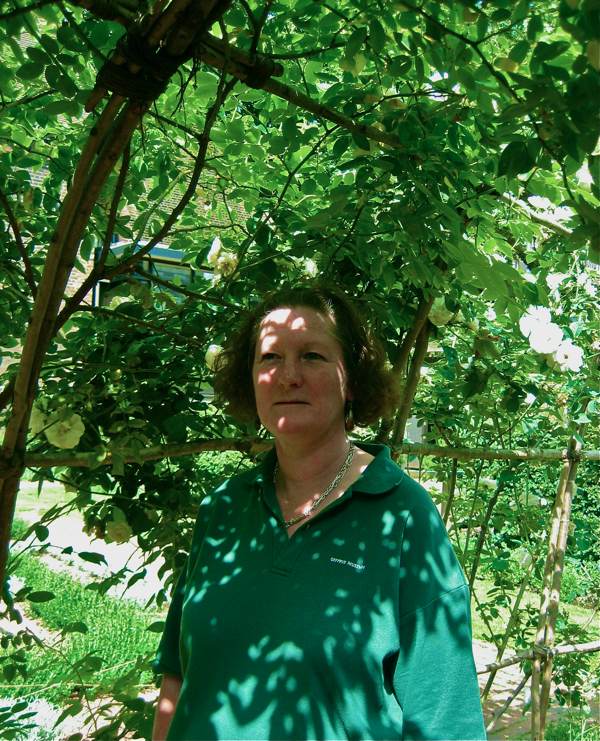
This is Heather Stevens, Head Gardener at the Geffrye Museum, seeking the green shade of the rose arbor in the magnificent garden she has created over the past fifteen years in partnership with Christine Lalumia, Deputy Directory of the Museum, telling the story of town gardens in London over four centuries through a series of outdoor rooms.
“I remember coming here as a schoolchild,” Heather confessed to me, “I am a Hackney girl.” Working originally as a florist, Heather was once responsible for all the pot plants at the Royal Festival Hall, and began gardening whilst working for the GLC parks department before joining the Geffrye Museum in 1996. At the job interview, Christine Lalumia led Heather out into the backyard of the museum, a semi-derelict, unloved space of random shrubs, tarmac and feral cats then. Standing in the same location today, Heather’s eyes shine with excitement when she recalls Christine saying to her, “Something I would like to do is create period gardens here…”
Fifteen years later, that dream has been realised and with such success that seems unimaginable that these gardens were not always here. “It was a big old job and I couldn’t have done it without Heather.” Christine admitted to me later,”We opened in 1999 and the wisteria is coming into its own now and this year the climbing hydrangea flowered for the first time. It’s not been instant, but it’s beginning to look as we hoped it would be.”
The herb garden – organised in sections by aromatic, culinary, medicinal and cosmetic usage, and salads – was where Heather and I began our conversation, by squeezing the leaves in our fingers to enjoy the scent of lemon verbena, a shared favourite. Nearby the traffic hurtled down the Kingsland Rd, but you would not know it, standing there among the hundreds of varieties of herbs flourishing between the tall brick walls that enclose the garden and trap the sunshine. From here a door leads to a brick path connecting five garden rooms, an ingenious arrangement taking visitors on a horticultural journey through time. Stepping through that door, we came first to the Elizabethan knot garden, accompanied by raised beds planted to illustrate the functional nature of gardens in the sixteenth century.
Then, simply by walking through a gap in the hedge we advanced into the eighteenth century. For the Georgians, gardens were appreciated as an extension of the house, a place of recreation where prized blooms were arranged with expanses of earth between them, or in pots – as in the splendid auricula theatre, used for the display of prime specimens of tulips, auriculas and then carnations through the Spring months.
Through another hedge and we found ourselves in the Victorian garden, where Heather was hard at work contriving a pyramid of pelargoniums as an epic central feature, typical of the ambition of the gardeners of this period who delighted in formal arrangements of bedding. And then, in the twentieth century “room,” I found myself strangely at home, recognising the plant combinations recommended by Gertrude Jekyll that I grew up with – irises and oriental poppies and blue geraniums and columbine and love-in-the-mist and lambs’ ears, to name just a few.
Heather and I sat on a bench, and she explained how the garden came into being. Once Christine did the historical research to discover what plants would be appropriate and how they should be combined, Heather was charged with tracking down specimens from nurseries, while an architect supervised the brick paths before Heather made sure the structural planting was in place for the opening in October 1999. “It was so nice to get the opportunity to work with so many varieties of plants – in the parks department, I never got the chance.” enthused Heather, gazing around in pleasure at the lush spectacle of this wonderful garden that is the result of so many years’ devoted work and will occupy her for years to come. “How it has changed and developed!” she said, as if seeing it anew.
This is a garden to visit and revisit over coming years as it settles down snugly in this unusual space bounded by the tall back wall of the old almshouses on one side and the new East London Line on the other. In an urban area once renowned for its gardens, it offers a beautifully tended enclave of green where you can enjoy the Spring bulbs and the Summer roses in a leafy refuge from the dusty streets.
Yet if you think this sounds a romantic existence – inhabiting Eden in the East End – remember Heather works outside all year round from seven thirty until four thirty. “We put on our waterproofs and we garden in the rain,” she says simply with characteristic resolve, “Each year, we’ve got to rake up all the leaves – that takes about three months – every single day.”
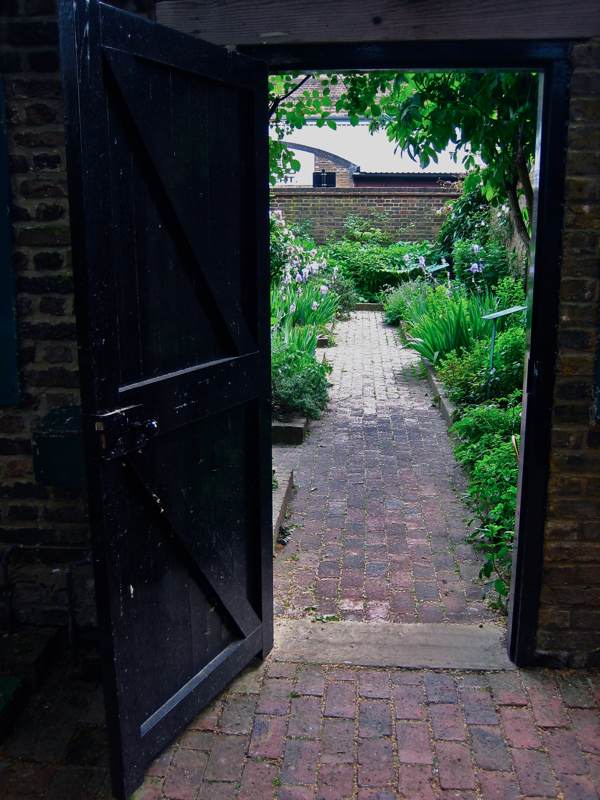
Doorway to the herb garden.
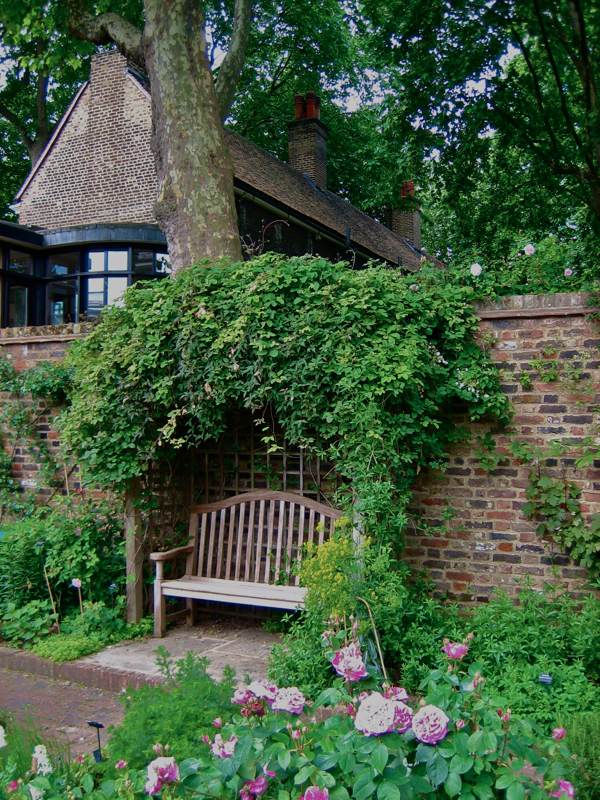
Looking from the herb garden towards the museum.

Looking through the series of outdoor rooms that tell the story of the London town garden.

In the last sixteenth/early seventeenth century garden.
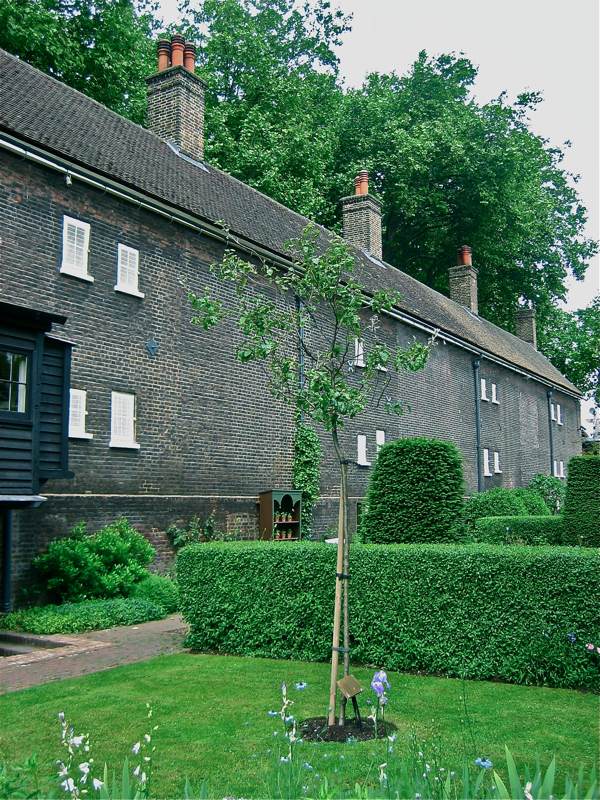
The auricula theatre nestles against the tall back wall of the old almshouses.
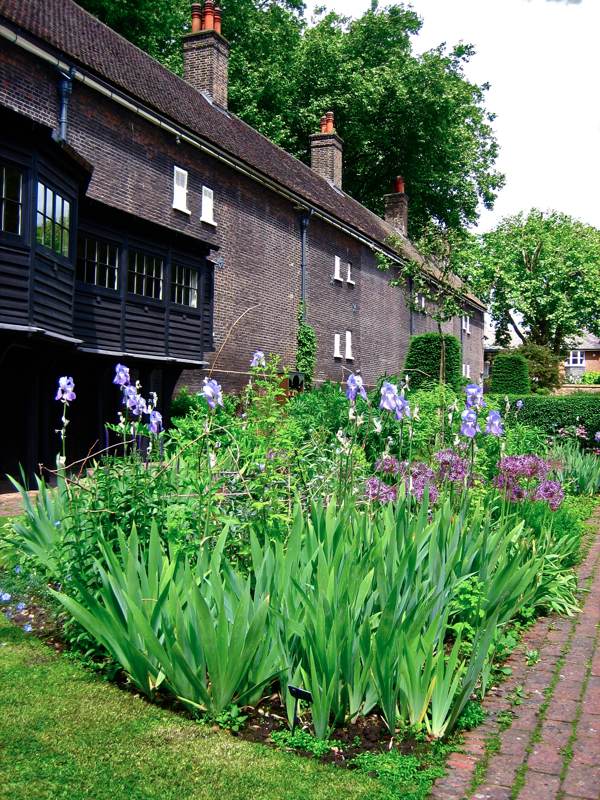
In the Victorian garden.

Heather Stevens.
The Caprice of Mr Pussy
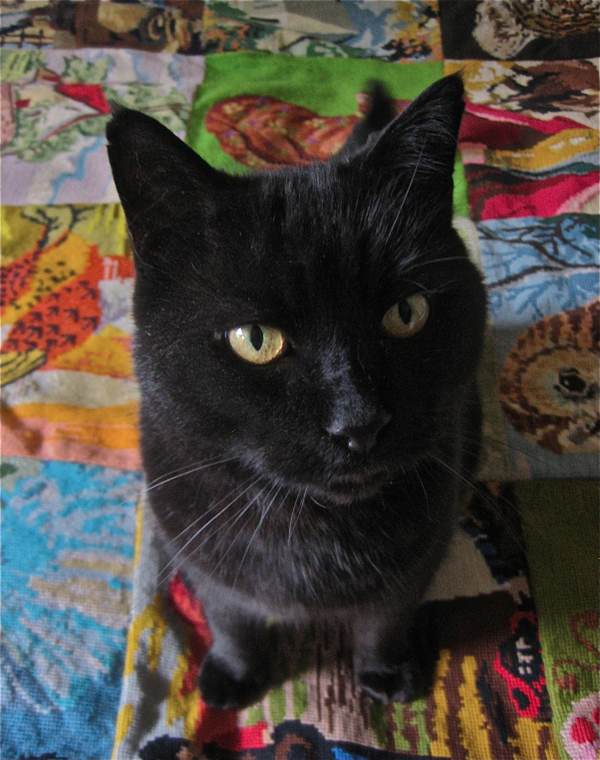
If I am looking more bleary-eyed than usual these days, it is not because I am sitting up any later writing my stories, but because Mr Pussy insists on waking me at dawn at this season of the year. The first yowl usually wakes me from my slumber in the glimmering of daylight, yet if I should try to deny it, descending quickly back to my former depths of sleep, a louder, more insistent cry tells me that he will not be ignored.
If I should persist in feigning sleep, he will extend his claw and reach up to the bedside bookshelf to hook the copy of King Lear by the spine and tug it off in one stroke to crash down onto the floor – employing a particular choice of title that I have yet to understand fully.
Then I open my eyes momentarily in weary exasperation to face his pitiful expression of need, quelling my anger. The question rises in my mind, did I put out any food for Mr Pussy last night? Now, in my half-awake moment of emotional vulnerability, the seed of doubt is sown and sympathy aroused for Mr Pussy, pleading for his rations whilst I indulge my luxuriant ease. But I am capable of indifference to his pain, rolling over in bed to seek another forty winks – even though experience has taught me that Mr Pussy will respond by running up the covers and leaping on my back with the agility of a mountain goat, so that he may repeat his yowl directly into my ear.
Thus I have learnt not to roll over, instead – without opening my eyes – I extend a crooked forefinger in an attempt to pacify Mr Pussy through petting, stroking him beneath his chin and on his brow – provoking a loud and emotional purring and snakelike twisting of the neck. Making a sound like his engine is revving, Mr Pussy bares his teeth and rubs them up against my finger several times in glee, which causes him ecstatic delight and coats my finger in saliva. He may repeat this action several times with an accumulating sense of excitement, glorying in the moment, knowing now that it is only a matter of time before I recognise that it is simpler to bow to his will than to resist.
Submitting to Mr Pussy’s inexorable persuasion, I stumble to the kitchen and commonly discover plenty of food in his dish – revealing that I have been played, his ruse was an exercise in pure manipulation, a power game. Too weary to recognise the humiliation I have suffered, I climb back into bed, put King Lear back on the shelf and resume my slumber.
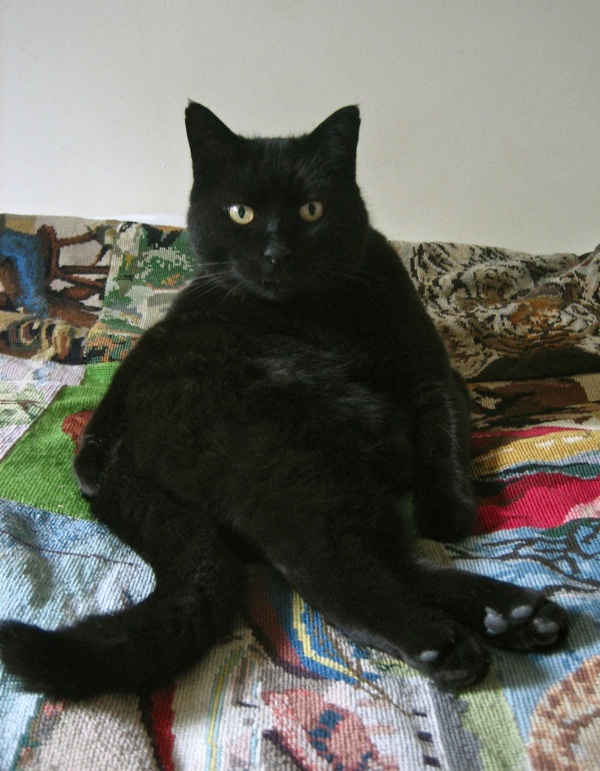
When I wake hours later, Mr Pussy is stretched out on the quilt, oblivious to me rising. Yet if I should wake him, he stretches out in pleasure. Mr Pussy has every reason to feel secure, because each night he tests me and confirms his control. Mr Pussy can relax in the knowledge that he is training me to become obedient to his will, and in my weakness I comply. I let him get away with murder.
You may also like to read
At Arthur’s Cafe
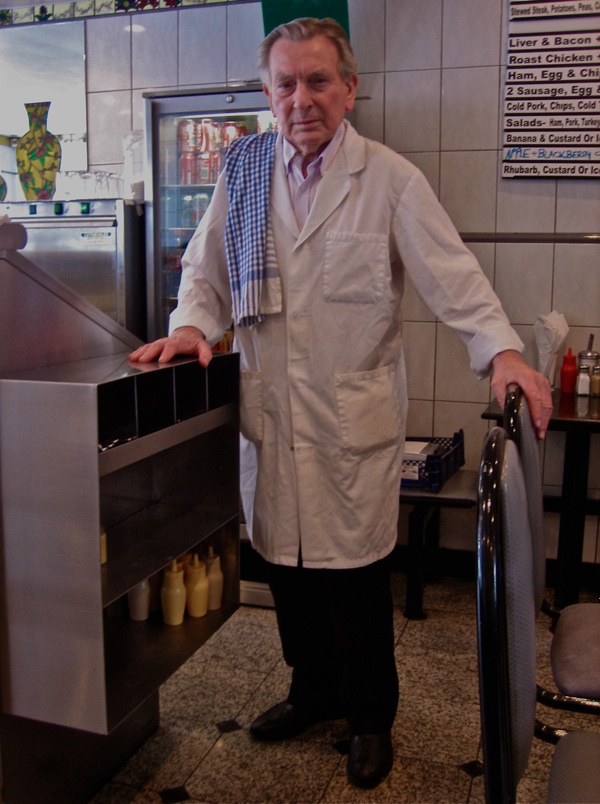
This is Arthur Woodham of the celebrated “Arthur’s Cafe” – in the Kingsland Rd since 1935. At eighty-four years old, Arthur is still running around his magnificent shining cafe, taking orders and serving customers with sprightly efficiency. Possessing the grace, good manners and handsome features of a young Trevor Howard, he is a charismatic figure, venerated in Dalston and throughout the East End – so imagine my excitement to see Arthur waiting in the doorway of his cafe in anticipation of my arrival.
My heart skipped a beat and I ran across the road to shake his hand. Then, taking advantage of the lull between the late breakfast trade and the early lunch trade, we sat down at the window table to enjoy the sunlight, and I found myself close up to his neatly styled grey locks and immaculately shaven jowls, while Arthur fixed his liquid grey eyes upon mine and commenced his story.
“I was born in Bethnal Green, and in 1935 we moved over to the Kingsland Rd and opened the cafe. My father was Arthur too and his cafe used to be further down the road, opposite the Geffrye Museum. If you was trying to buy a cafe, you tried to buy one with accommodation above, so if things got quiet you could rent the space, but I’ve always lived up there all this time.
Once I left school at fourteen, I worked with him behind the counter and I helped out before that too. I was the eldest son and you had no choice – you had to go into it whether you liked it or not. In those days, my father used to make his own ice cream and sarsaparilla, and my grandmother helped out in the kitchen with the washing up. At first, when the war came, I didn’t want to go into the shop but I have no regrets. I was about fifteen when war broke out, and I worked in the cafe all through the war. They dropped a bomb on the shelter across the road at the Geffrye Museum and my father kept open all night to make everyone a cup of tea. I’ll always remember one man was very bad, he lost thirteen in his family.
When I was a boy, it was either coffee shops with wooden floors or cafes that were more like sandwich bars, but after the war cafes starting doing hot dinners, roast beef, steak pie, lamb chops. I run my cafe the old fashioned way, we don’t do frozen stuff, it’s all fresh. I get up around twelve thirty/one o’clock, but people won’t believe you if you tell them that. I cook my own ham and cut all my chips by hand. My grandson gets in at five fifteen and we open at seven, serving breakfast until eleven thirty. No toast after eleven thirty and no chips before twelve. At eleven thirty we clean up and put serviettes and glasses on the tables, and I go upstairs and put on a clean coat. We have a different class of people for lunch. This is a working class cafe, we serve plain English food, we don’t serve pasta like some do.We’ve got a good mixed clientele, a nice class of people, white people and black people.
I like it, this is my life. You’ve got to like it to keep in it. I meet people. I speak to people. In the cafe, if you like it, you make a lot of friends. I’ve been serving people for over fifty years, people I grew up with. I opened up here when I was twenty-one in 1948, my father gave me a hand for a while and then he closed down the old cafe. I’ve been here ever since, four hundred and ninety-five Kingsland Rd. It’s been a cafe as long as I can remember and I’m eighty-five this year.It was me and my father and now it’s me and my grandson – since he was a boy, he’s worked for me – that’s three generations. I’ll go on as long as I can, I’m eighty-five on Christmas Day. The Pelliccis, they’re friends of mine – I’m the oldest cafe in the Kingsland Rd and they’re the oldest cafe in Bethnal Green.”
By now it was eleven thirty, no more toast would be served, and it became imperative that Arthur go upstairs at once to change his coat in the time-honoured fashion, whilst serviettes and glasses were swiftly laid upon the tables, as the tempo of the day’s proceedings went up a notch in anticipation of luncheon. Yet this flurry of activity allowed me the opportunity of a snatching a few words with Arthur’s grandson James, who in spite of his youthful demeanour revealed he had been there twenty years. “Since I was twelve, I worked here in my school holidays,” he confessed with a shy smile of pride,”And then my grandfather asked me to work with him, and I did.”
“My grandfather is an actor, and this is the stage where he performs best,” James continued, as if to introduce Arthur who appeared on cue from upstairs, now changed into an identical but perfectly clean white coat and seemingly revived with a new energy. “Do you think you will still be here at eighty-five?” I whispered to James across the table. “If I’ve got my grandfather’s energy, I’ll still be here!” he replied with an emotional smile as Arthur breezed past, making sure that everything was in order before assuming his heroic position at the head of the steel counter – as he has done each day since 1948 – tea towel over one shoulder, ready for whatever the lunch service would bring.
You can watch a film about Arthur here.

“I remember those custard tarts my dad was holding, they were threepence each” – Arthur at at twenty-one years old when he opened his own cafe in 1948 with the assistance of Arthur, his father. Inset shows, the third generation Arthur and his son James who works at Arthur’s Cafe today.

Arthur and his grandson James who has worked with him for the past twenty years.

Arthur arranges serviettes in readiness for the lunchtime rush.

James rustles up a mean sandwich.

“My grandfather is an actor and this is his stage where he performs best.”

Arthur’s wife Eileen lends a hand.

The lull between late breakfast and early lunch while Arthur goes upstairs to change into a fresh coat.

Arthur with his old friend Terry Dunfred.


Arthur Woodham
You may like to read about Maria Pellicci, the Meatball Queen of Bethnal Green.
Margaret Rope’s East End Saints
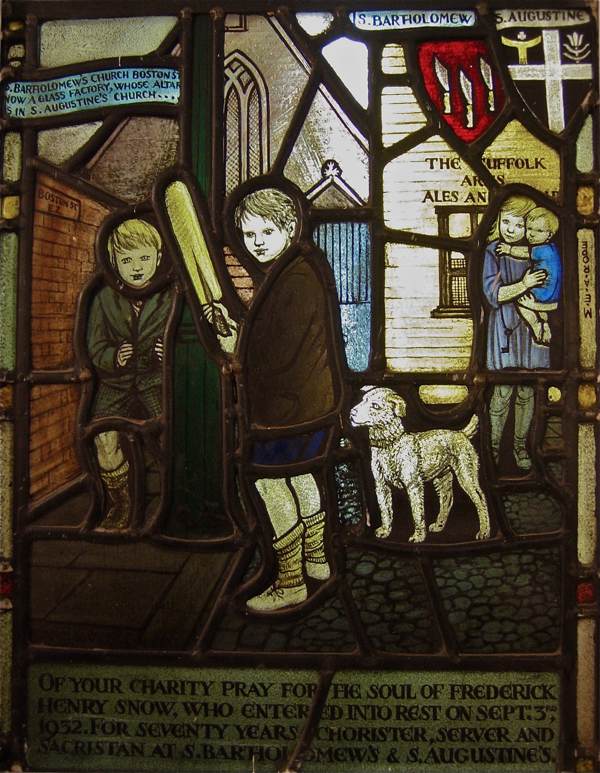
A familiar East End scene of 1933 – children playing cricket in the street and Nipper the dog joining in – yet it is transformed by the lyrical vision of the forgotten stained glass artist Margaret Rope, who created a whole sequence of these sublime works – now dispersed – depicting both saints of legend and residents of Haggerston with an equal religious intensity.
This panel is surmounted by a portrayal of St Leonard, the sixth century French saint, outside a recognisable St Leonard’s church, Shoreditch, with a red number six London bus going past. Margaret Rope’s extraordinary work mixes the temporal and the spiritual, rendering scenes from religious iconography as literal action and transforming everyday life into revelations – describing a universe that is simultaneously magical and human.
Between 1931 and 1947, the artist known simply to her family as ‘”Tor,” designed a series of eight windows depicting “East End Everyday Saints” for St Augustine’s church off the Hackney Rd, portraying miracles enacted within a recognisable East End environment. And for many years these charismatic visionary works were a popular attraction, until St Augustine’s was closed and Margaret Rope’s windows removed in the nineteen eighties, with two transferred across the road to St Saviour’s Priory in the Queensbridge Rd and the remaining six taken out of the East End to be installed in the crypt of St Mary Magdalene, Munster Sq. Intrigued by the attractive idea of Margaret Rope’s transcendent vision of the East End, I set out to find them for myself this week.
At St Saviour’s Priory, Sister Elizabeth was eager to show me their cherished windows of St Paul and St Margaret, both glowing with luminous rich colour and crammed with intricate detail. St Paul, the patron saint of London, is depicted at the moment of his transformative vision, beneath St Paul’s Cathedral – as if it were happening not on the road to Damascus but on Ludgate Circus. The other window, portraying St Margaret, has particular meaning for the sisters at St Saviours, because they are members of the Society of St Margaret, whose predecessors first came from Sussex to Spitalfields in 1866 to tend to the victims of cholera. In Margaret Rope’s window, St Margaret resolutely faces out a dragon while Christ hands a tiny version of the red brick priory to John Mason Neale, the priest who founded the order. Both windows are satisfyingly engaging exercises in magical thinking and the warmth of the colour, especially the turquoise greens and soft pinks, delights the eye with its glimmering life.
I found the other six windows in the crypt of St Mary Magdalene near Regents Park, used as a day centre for seniors, where they are illuminated from the reverse by fluorescent tubes. The first window you see as you walk in the door is St Anne, which contains an intimate scene of a mother and her two children, complete with a teddy bear lying on the floor and a tortoiseshell cat sleeping by the range. Next comes St George, who looks like a young athlete straight out of the Repton Boxing Club, followed by St Leonard, St Michael, then St Augustine and St Joseph. All share the same affectionate quality in their observation of human detail, rendered with a confidence that sets them above mere decorative windows. These are poems in stained glass that manifest the resilient spirit of the East End which endured World War II. Another window by Margaret Rope in St Peters in the London Docks, completed in 1940, showed people celebrating Midnight Mass at Christmas in a bomb shelter.
Margaret Edith Aldrich Rope was born in 1891 into a farming family on the Suffolk coast at Leiston. Her uncle George was a Royal Academician, and she was able to study at Chelsea College of Art and Central School of Arts & Crafts, where she specialised in stained glass. Unmarried, she pursued a long and prolific working life, creating over one hundred windows in her fifty year career, taking time out to join the Women’s Land Army in World War I and to care for evacuees at a hospital in North Wales during World War II, before returning to her native Suffolk at the age of eighty-seven in 1978.
Her nickname “Tor” was short for tortoise and she signed all her works with a tortoise discreetly concealed in the design – and upon close examination, every window reveals hidden texts inscribed into the richly coloured shadows. So much thought and imagination is evident in these modest works in the magical realist style – which transcend their period as neglected yet enduring masterpieces in the underrated art of stained glass – that I recommend you make your acquaintance with the stylish work of Margaret Rope, which celebrates the miraculous quality of the everyday.
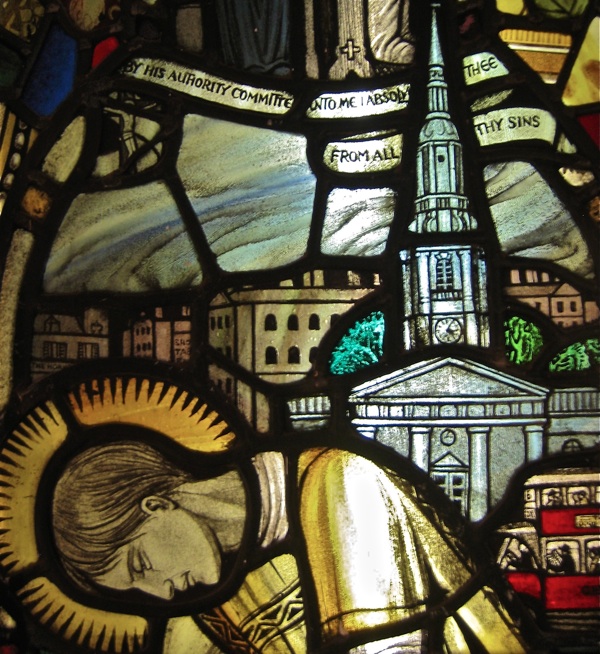
St Leonard is portrayed in a moment of revelation outside St Leonard’s Church, Shoreditch, with Arnold Circus in the background and a London bus passing in the foreground.
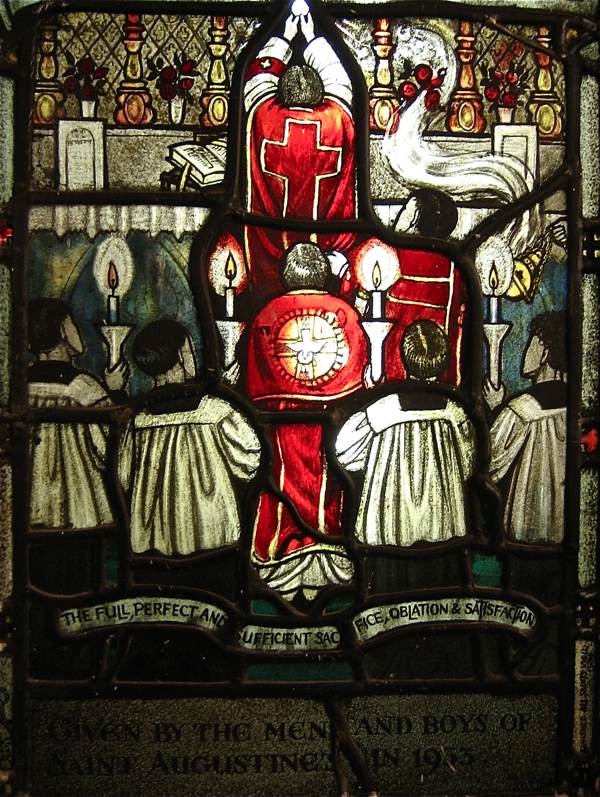
The lower panel of the St George window.
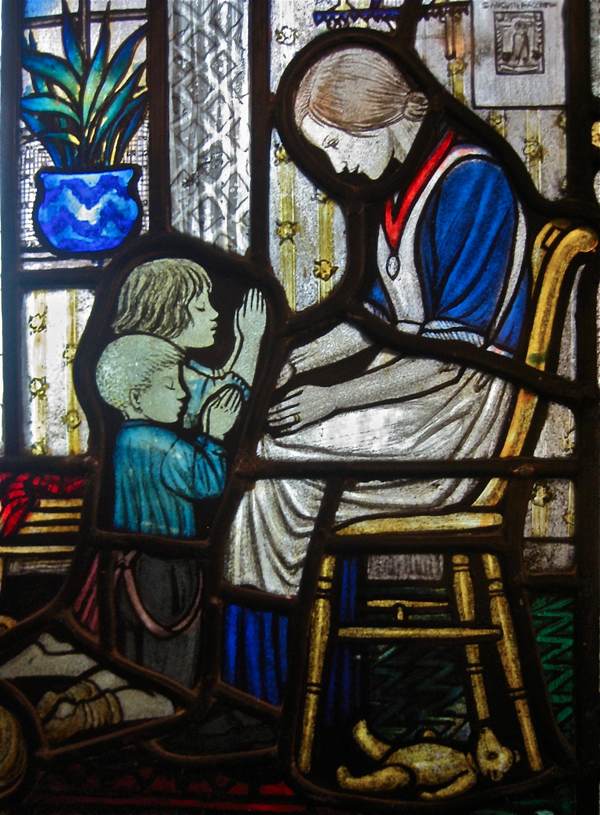
A domestic East End scene from the lower panel of the St Anne’s window.
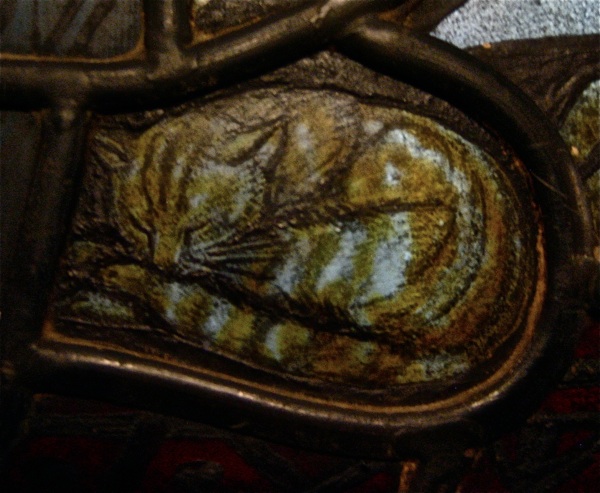
This tortoise-shell cat is a detail from the panel above.
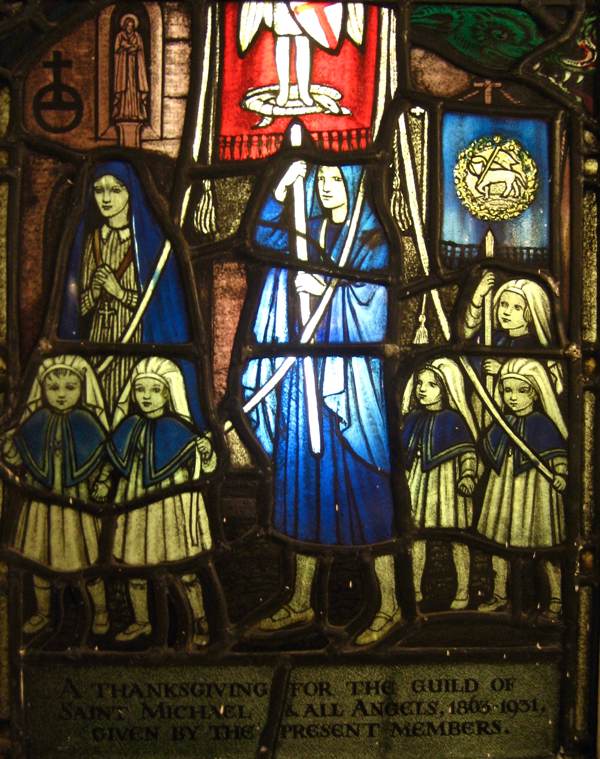
The lower panel from the St Michael window.
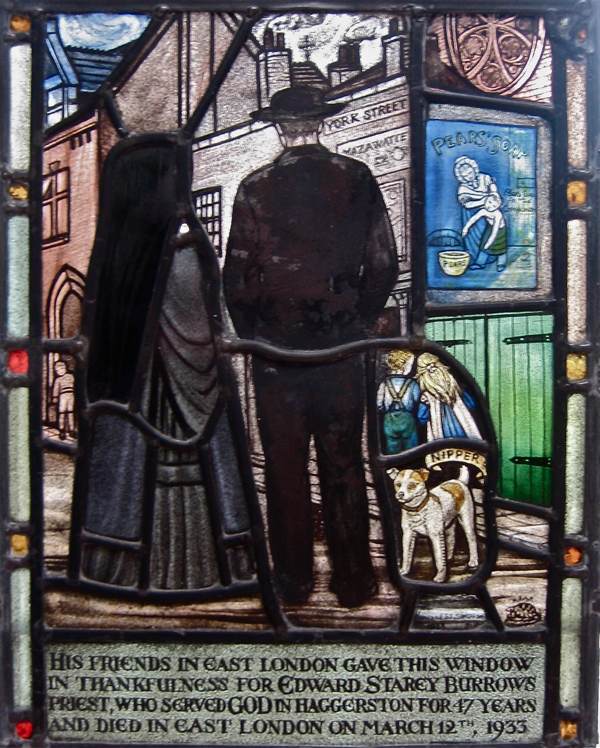
Mother Kate, Prioress of St Saviour’s and Father Burrows with his dog, Nipper, standing outside St Augustine’s in York St, now Yorkton St. In the right hand corner you can see the tortoise motif that Margaret Rope used to sign all her works.

Sisters of St Saviour’s Priory, portrayed in the lower panel of the St Margaret window, 1932.
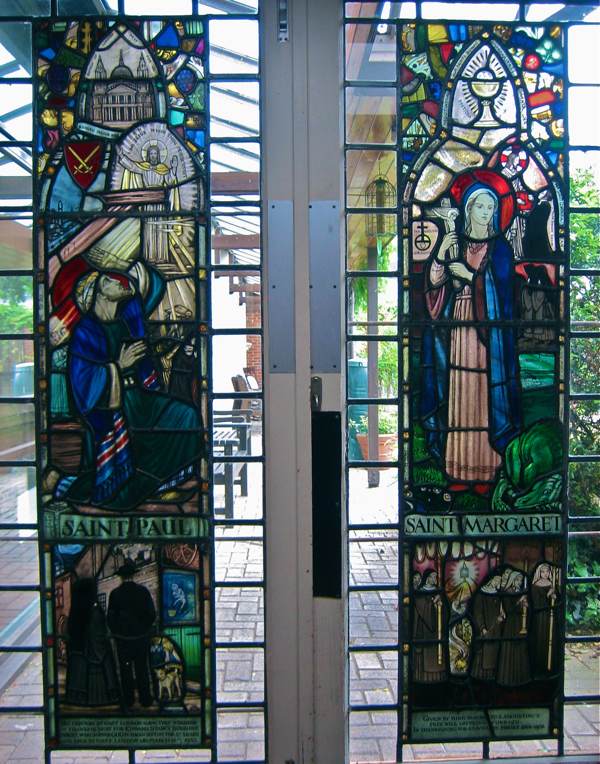
Margaret Rope’s St Paul and St Margaret, now in the entrance of Saviour’s Priory, Queensbridge Rd.
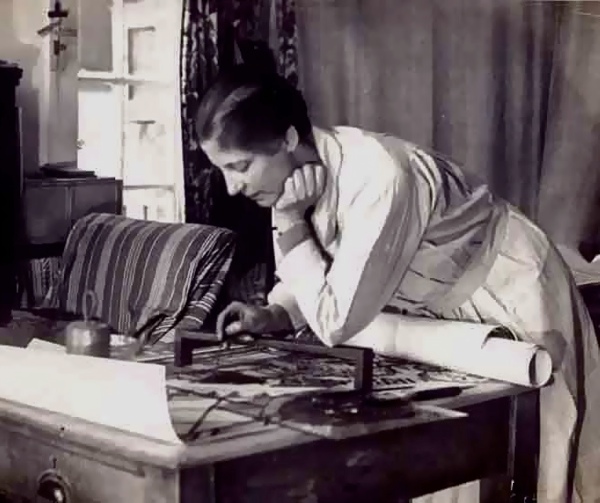
Stained glass artist, Margaret Edith Aldrich Rope known as “Tor” (1891-1988)












