Leon Thompson, Ringing Master
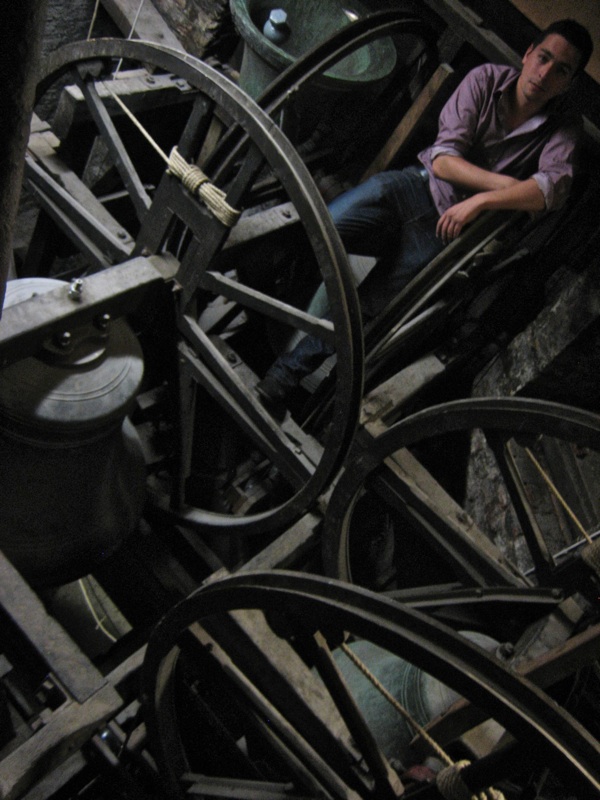
This is Leon Thompson, the young ringing master, lurking in the shadows of the belfry of St Matthew’s, Bethnal Green – a place where he has spent a lot of time recently, and where he feels happy and at home, keeping the old bells company. “I decided to start something,” he explained, “there’s been no ringing here since the war, so I decided to try and start a new team of ringers – in the past, the ringers here were described as ‘the best of the best’ and were invited to ring the first peal of bells when St Paul’s Cathedral was inaugurated.”
When Leon came along, he found that although the tower was neglected, the bells were still usable. And today, after raising twenty thousand pounds for some crucial restoration, much of which he did himself to save money, the bells have been rehung and the tower cleaned up, ready for a new beginning. Now, Leon is hanging up the old boards in the newly repainted ringers’ chamber, boards that record in graceful calligraphic signwriting the ringers of past centuries and commemorate famous peals such as the “Kent Treble Bob Major” of 27th April 1868 – the longest peal of bells in the world at that time – ringing continuously for nine hours and twelve minutes. It was an heroic achievement in the days when it required heft to ring bells, before modern bearings allowed them to swing smoothly with minimal friction.
Leon told me that most of the ringers whose names are recorded on the board worked in the London docks and would be used to physical labour, though J. Pettet was silk hat maker and H. Booth was a cigar maker, and neither are professions that require muscle. Yet the most significant name on the board for Leon personally is that of ringer Matthew Wood, a market porter whose family came from France as Huguenot refugees and Anglicised their name in the mid-nineteenth century. Three generations of men from this family were successive steeplekeepers and rang the bells in the tower, starting when it was built in 1746 and ending with the eighty-four-year-old Matthew Wood’s last peal in 1909, recorded upon a special board of its own. This particular Matthew Wood taught Arthur Hughes whose named is recorded on the same board as being there ringing beside him in 1909 – and Arthur Hughes taught Brooke Lunn – and when Brooke Lunn was an old man, he taught Leon Thompson.
This direct connection, that links him back to those who have rung before him, conjures an intense poetry for Leon. “When I stand here pulling this rope,” he explained, clutching the multi-coloured bell rope expertly in both hands and then sending it sliding through his fingers,” I am standing in the same spot that Matthew Wood stood in 1868, ringing the same bell, with the same clapper and hearing the same sound – the only thing that has changed is the piece of rope.”
And then the bell chimed from up above on cue, as if to applaud the notion.
St Matthew’s Church has seen better days – built by George Dance (who also designed St Leonard’s, Shoreditch) in 1746, it was burnt out in January 1859 when the fire brigade’s hoses froze and then was heavily rebuilt in 1861, only to take direct hit of an incendiary bomb on the very first night of the London blitz. All that remained was the shell and the tower but luckily the new set of bells, installed in 1861 after the first fire, survived the second conflagration.
Today the sixties rebuilding speaks more loudly that the work of Dance and you would be forgiven for not even realising it was an old church at all. But when Leon led me through a tiny door, barely three feet high, and we ascended a narrow spiral staircase within the thickness of the wall, I felt I was entering an older world. At first we came to the ringers’ chamber and then we ascended through a dark space that houses the working of the clock, up into the bell chamber. Here we sat upon the beams to chat in the silent presence of the bells made by the Whitechapel Bell Foundry in 1861, and Leon revealed that when he needed to order replacement clappers, he discovered the foundry still had the measurements on file from the original order.
“I learnt to ring at Oxford where I grew up. It’s very addictive – a hobby where you never stop learning.” he confided to me, eloquent in the half-light of the belfry and in the presence of these charismatic chimes, where he delighted in the intricate details of their configuration, adding enthusiastically, “The bell ringing community is very tight, so if you can ring fairly well, you can go anywhere in the world and you’ll always get a ring.”
“I’ve been in London for four years and I used to come up before that to ring at St Paul’s and Mary Le Bow,” Leon continued, “But I’ve always been drawn to the East End. My great-grandfather was from Bethnal Green and my parents grew up in Stepney.” And so I understood how it all came together for Leon Thompson here in the tower. These were the same bells that his great-grandfather would have heard.
Now Leon has discovered an engagement with the East End, through the magic of bells, he means to take it forward. “I want to start teaching people,” he declared, “My ambition is to get a band of local ringers who can be ‘the best of the best,’ like 1868.”
Leon Thompson needs volunteer bellringers, so if you would like to learn the art of bellringing at St Matthew’s, Bethnal Green, please email leon_thompson_541@hotmail.com Also, Leon will be hosting an open day on Saturday 16th July, from two until five, when visitors are welcome to explore the tower.

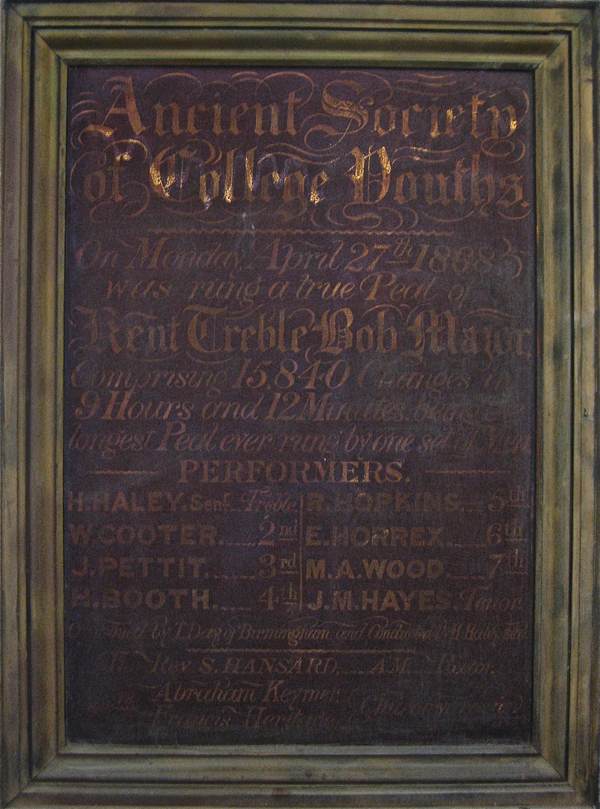
In 1868, the longest peal of bells ever rung was rung at St Matthew’s, Bethnal Green – nine hours and twelve minutes. Later, it provided the inspiration for Dorothy L. Sayers’ novel “The Nine Tailors.”
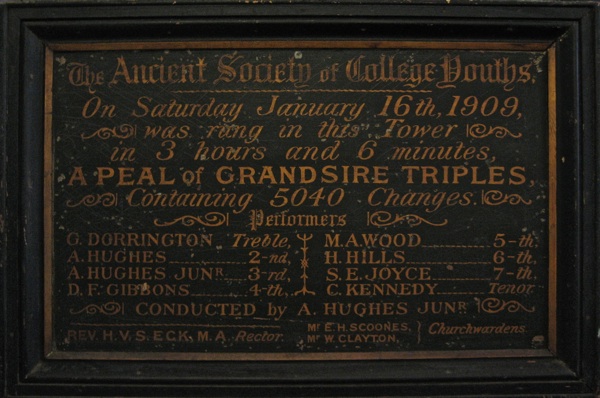
In 1909, the last recorded ringing by Matthew Wood, third generation steeplekeeper, whose grandfather rang the bells when the church was built in 1746.
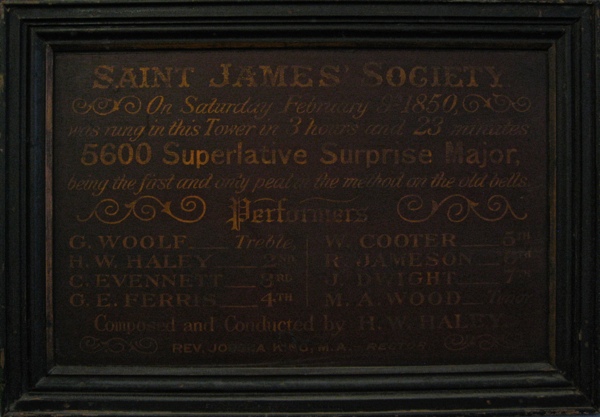
The only board surviving from before the fire of 1859.

Leon Thompson
You may also like to read these other stories about bells
Alan Hughes, Master Bellfounder
Max Levitas, Communist

Max Levitas became an East End hero when he was arrested in 1934, at the age of nineteen years old, for writing anti-Fascist slogans on Nelson’s Column in Trafalgar Square. “There were two of us, we did it at midnight and we wrote ‘All out on September 9th to fight Fascism,’ ‘Down with Fascism’ and ‘Fight Fascism,’ on Nelson’s Column in whitewash,” he told me, his eyes shining with pleasure, still fired up with ebullience at ninety-seven years of age, “And afterwards we went to Lyons Corner House to have something to eat and wash our hands, but when we had finished our tea we decided to go back to see how good it looked, and we got arrested – the police saw the paint on our shoes.”
On September 9th, Oswald Mosley, the leader of the British Union of Fascists, was due to speak at a rally in Hyde Park but – as Max is happy to remind you today – he was drowned out by the people of London who converged to express their contempt. It was both fortuitous and timely that the Times reprinted Max’s slogans on September 7th, two days before the rally, in the account of his appearance at Bow St Magistrates Court, thereby spreading the message.
Yet this event was merely the precursor to the confrontation with the Fascists that took place in the East End, two years later in October 1936, that became known as the Battle of Cable St, and in which Max is proud to have played a part – a story he tells today as an inspirational example of social solidarity in the face of prejudice and hatred. And, as we sat in a quiet corner of the Whitechapel Library last week, watching the rain fall upon the street market outside, it was a story that I was eager to hear in Max’s first hand account, especially now that he is one of last left of those who were there.
Politics have always been personal for Max Levitas, based upon family experience of some of the ugliest events of the twentieth century. His father Harry fled from Lithuania and his mother Leah from Latvia in 1913, both escaping the anti-semitic pogroms of Tsarist Russia. They met in Dublin and married but, on the other side of Europe, Harry’s sister Sara was burnt to death along with fellow-villagers in the synagogue of Akmeyan, and Leah’s sister Rachel was killed with her family by the Nazis in Riga.
“My father was a tailor and a trade unionist,” Max explained in the lively Dublin brogue that still colours his speech today, even after eighty years in the East End. “He formed an Irish/Jewish trade union and then employers blacklisted him, making sure he could never get a job,” Max continued with a philosophical grin, “The only option was to leave Dublin and we lived in Glasgow from 1927 until 1930, but my father had two sisters in London, so we came here to Durward St in Whitechapel in 1931 and stayed ever since.”
With this background, you can appreciate the passionate concern of Max – when he was nineteen and secretary of the Mile End Young Communist League – at a time when the British Government was supporting the Fascist General Franco in the Spanish Civil War. “Even after Hitler was appointed Chancellor in 1931, the British Government was developing arms with Germany,” Max informed me, widening his eyes in condemnation and bringing events into vivid reality that I had viewed only as history until he filled them with personal emotion.
“I was working as a tailor’s presser in a small workshop in Commercial St at the time. Mosley wanted to march through Whitechapel because it was where a large number of Jewish people lived and worked, and I knew the only way to stop him was to have unity of the people. I approached a number of unions, Jewish organisations and the Communist League to band together against the Fascists but although they agreed what I was doing was right, they wouldn’t support me.
But I give credit to the huge number of members of the Jewish and Irish communities and others who turned out that day, October the fourth, 1936. There were thousands that came together in Aldgate, and when we heard that Mosley’s intention was to march along Cable St from Tower Hill into Whitechapel, large numbers of people went to Cable St and barricades were set up. The police attempted to clear Cable St with horses, so that the march could go ahead, but the people of Cable St fought back and the police had to give in.
At three o’clock, we heard that police had decided that the march would not take place, because if it did a number of people would be killed. The Fascists were defeated by the ordinary people of Stepney, people who emptied buckets of water and chamber pots out of their houses, and marbles into the street. This was how they stopped Mosley marching through the East End of London. If he had been able to do so, more people would have joined him and he would have become stronger.”
Max Levitas spoke of being at the centre of a definitive moment in the history of the East End, seventy-five years ago, when three hundred thousand people came together to form a human chain – in the face of three thousand fascists with an escort of ten thousand police – to assert the nature of the territory as a place where Fascism and racism are unacceptable. It was a watershed in resistance to Fascism in Europe and the slogan that echoed around Stepney and Whitechapel that day was, “No paseran” – from the Spanish Civil War, “They shall not pass.”
After the war, Max became a highly respected Communist councillor in Stepney for fifteen years and, a natural orator, he remains eloquent about the nature of his politics.“It was never an issue to forge a Communist state like in the Soviet Union,” he informed me, just in case I got the wrong idea,“We wanted to ensure that the ordinary working people of England could lead decent lives – not to be unemployed, that people weren’t thrown out of their homes when they couldn’t pay their rent, that people weren’t homeless, as so many are today, living with their parents and crowded together in rooms.”
Max’s lifelong political drive is the manifestation of a tenacious spirit. When Max arrived in Whitechapel Library, I did not recognise him at first because he could pass for a man thirty years younger. And later, when I returned his photos to his flat nearby, I discovered Max lived up five flights of stairs and it became obvious that he walks everywhere in the neighbourhood, living independently even at his astounding age. “I used to smoke,” Max admitted to me shyly, when I complimented him on his energy.” I stopped at eighty-four, when my wife died – until then I used to smoke about twenty cigarettes a day, plus a pipe and cigars.” Max confessed, permitting himself a reckless grin of nostalgia.
“My mother and father both died at sixty-five,” Max revealed, turning contemplative,“I put that down to the way they suffered and poverty. My father worked around the clock to keep the family going. He died two years after my mother. At that time there was no National Health Service, and I phoned the doctor when she was sick, asking him to come, and he said, ‘You owe me some money. Unless you pay me, I won’t come.’ I said, ‘You come and see my mother.’ He said, ‘You will have to pay me extra for coming plus what you owe.’ But she died before he came and I had to get an ambulance.”
It was a story that revealed something more of the personal motivation for Max’s determination to fight for better conditions for the people of the East End – yet remarkably, in spite of the struggle of those around him and that he himself has known, Max is a happy man. “I’m always happy, because I can say that my life was worth living, ” he declared to me without qualification.
Max Levitas wants to live as long as possible to remind us of all the things he has seen. “I believe if racists marched through the East End today, people would stop them in the same way,” he assured me with the unique confidence granted only to those who have known ninety-seven years of life.


Max in 1945

Max campaigning in Stepney in the nineteen sixties.


Max with his wife on a trip to Israel in the nineteen seventies.
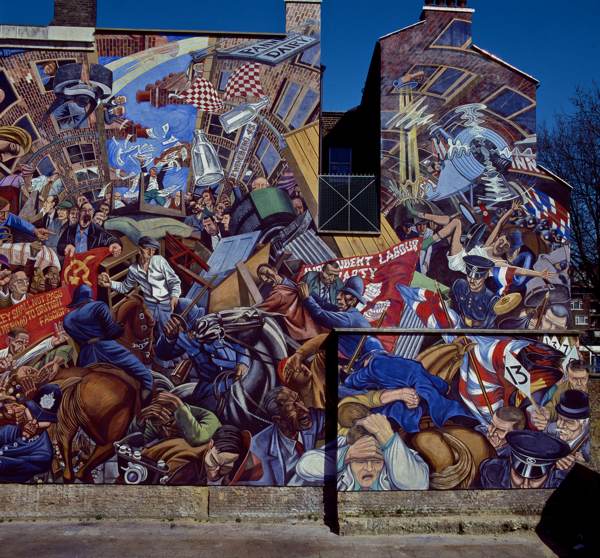
The Cable St mural
Portrait of Max Levitas copyright © Phil Maxwell
You can hear Max Levitas talking about the Battle of Cable St by clicking here
Watch original footage here
And learn more about Phil Maxwell & Hazuan Hashim’s film From Cable Street to Brick Lane featuring Max Levitas.
Leila’s Shop Report 4
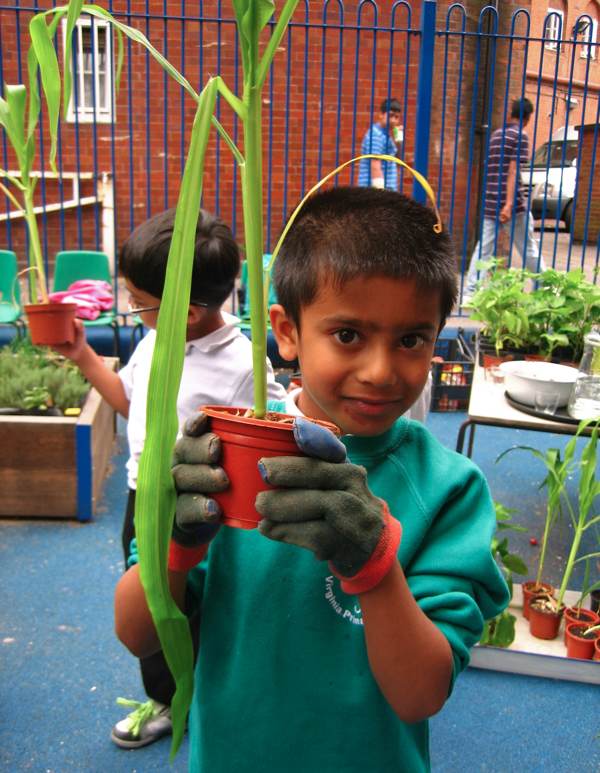
There is a tiny triangular yard at the front of Virginia Rd School next to Leila’s Cafe that has been transformed into the school vegetable patch over the last year – where, each Tuesday afternoon, Leila McAlister supervises the after-school gardening club encouraging pupils to grow their own produce. Most of the eager gardeners are residents of the Boundary Estate and do not have gardens of their own, which makes this an especially valuable experience.
“We used to do occasional gardening days in the park at Arnold Circus, when it was really overgrown and a bit of a jungle, clearing patches and planting wildflower seeds and spring bulbs.” Leila recalled fondly, as we sat among the raised beds waited for the pupils to arrive yesterday, “The kids used to love it, but it was apparent that they had done no gardening before. They called earth “dirt” and were afraid of getting dirty – and they didn’t know the difference between worms and snakes.”
However, since most of these children were from Bengali families, Leila found they had a cultural attachment to vegetables. At home, the families ate together every day, enjoying a meal cooked from fresh ingredients and so the children were familiar with vegetables being prepared. “They had a very positive attitude to tasting things,” Leila explained, “Even Spinach and Chard, which children often wince at.”
And then last year, in a surprising development, the pupils of Virginia Rd School (who have their own school council) won a grant of a thousand pounds, which they applied for themselves, from Tower Hamlets’ Healthy Lives Team, to encourage vegetable growing in the borough. “I’m a governor of the school and it came up in the meeting that they had won this grant, and so I volunteered to take it further.” Leila admitted to me in delighted amazement, as the twelve members of the gardening club – aged between six and eleven – streamed excitedly through the blue gate, eager to begin.
Once everyone helped themselves to cherries from the bowl, there was a short tour of the garden to assess the progress of the vegetables since last week, weaving our way among the raised beds and the pile of car tyres filled with soil that were now sprouting luxuriant growth. The giant pumpkins and sunflowers were ahead of themselves, and the lettuces and radishes grown from seed were making a healthy showing too, but once we got down on our knees it was apparent that some thinning out was necessary – an ideal job for nimble, small fingers.
Then Leila produced a tray of corn seedlings for each of the young gardeners to take one and plant it. Gloves on and trowels at the ready, they were particular to tap the pots and tip the plants into their hands before planting, without damaging the roots. But, in their enthusiasm, some had not yet dug the hole – a situation which required the dexterous accommodation of holding a seedling in one hand whilst digging a hole with the other. You will be relieved to know that everyone achieved the desired result, planting an array of corn plants equally spaced between the line of sunflowers.
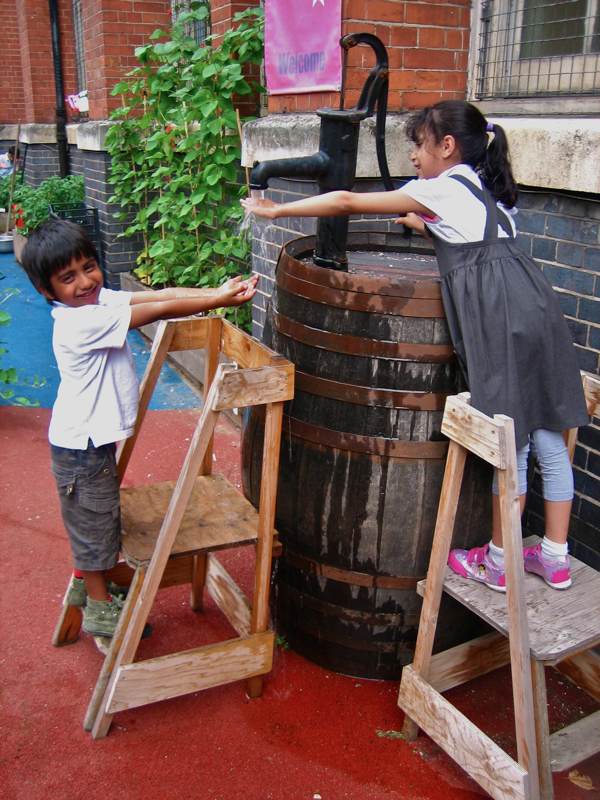
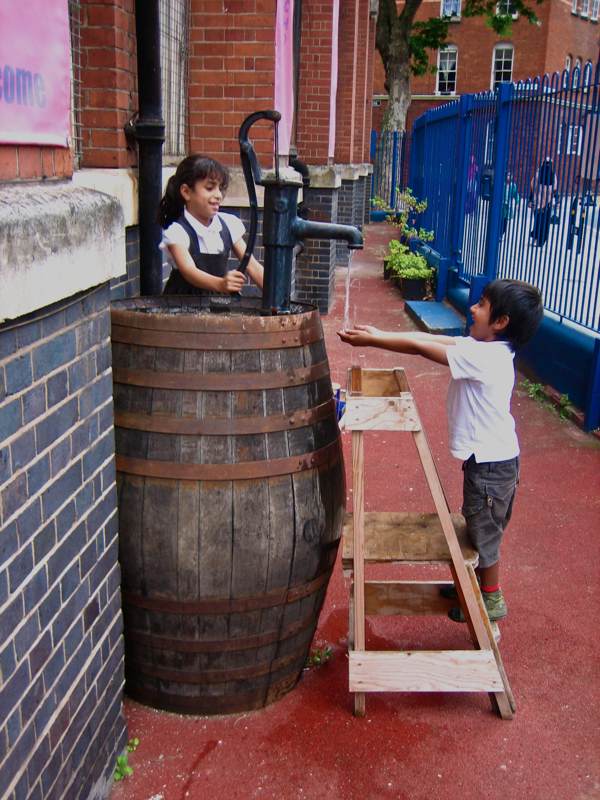
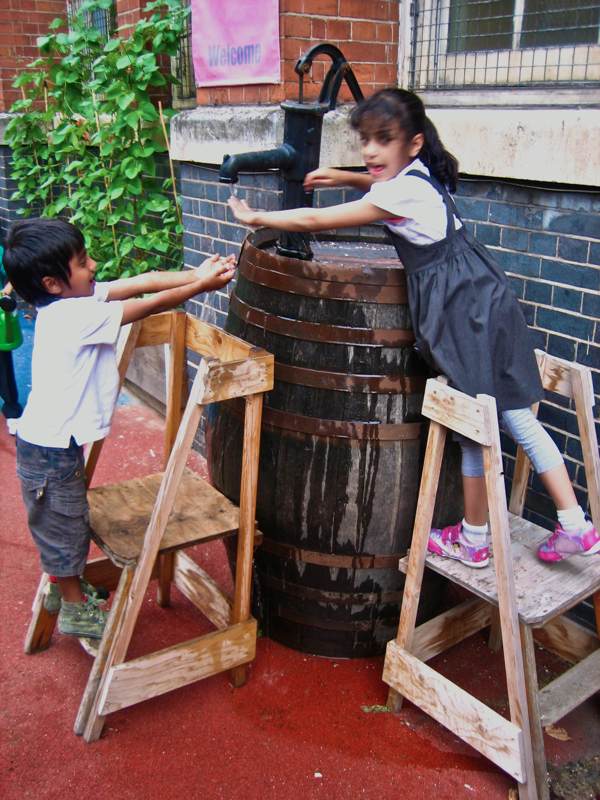
The time had arrived to bring out watering cans and fill them from the pump, always a highlight of an afternoon at the gardening club. One small person climbs up a ladder to reach the handle of the pump while another small person climbs up another ladder to hold the can under the spout where the water gushes out – the possibilities for high jinks are endless and never before has the filling of a watering can become such an adventure. The result is that members of the gardening club are eager to fill their cans as many times as possible and give their plants a good drenching.
Already, an hour had slipped away and, even as Leila produced some old olive oil tins and invited her young assistants to plant chilli pepper seedlings in them, parents were arriving and poking their heads through the railings, curious to observe the children’s horticultural achievements and smiling in approval. Then, from the lowering sky, where the clouds had been gathering upon this humid afternoon, came the first drip-drops of rain. And so, with a wave of thanks to Leila, the members of the gardening club helped themselves to the last of the cherries from the bowl and ran back to their homes scattered around Arnold Circus to shelter from the rain, leaving their newly planted vegetables to take care of themselves, in keen anticipation of new growth by next week.
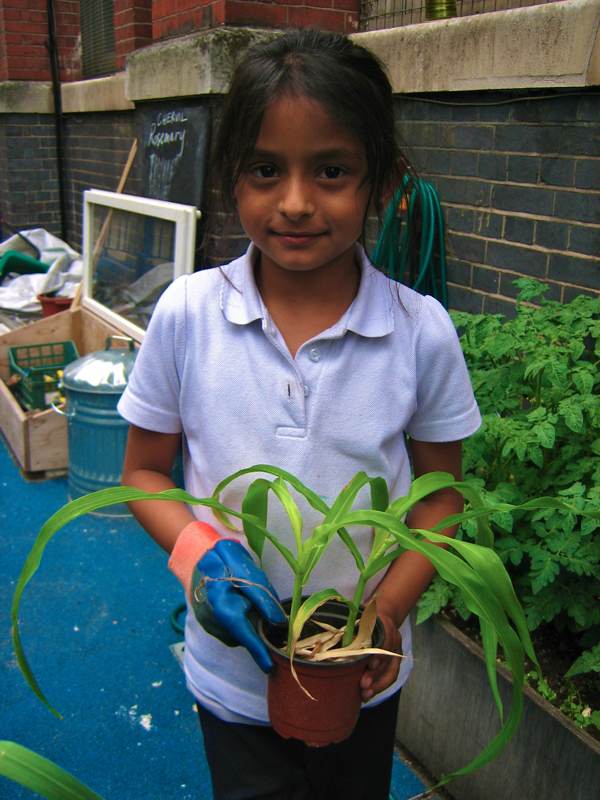

Planting the corn.

Collecting the pots.



Filling the watering cans from the pump is a highlight at the gardening club.


You may also like to read
Leila’s weekly vegetable boxes are available for delivery throughout Shoreditch, Dalston, London Fields, Bethnal Green, Spitalfields and Whitechapel.
You can find the vegetable box blog by clicking here.
Belinda Hay, the Painted Lady

“I came to London because I heard the streets were paved with gold,” revealed Belinda Hay with a winsome smile and a twinkle in her eye, as we sat in her hair salon The Painted Lady in Redchurch St. In a sassy black catsuit and displaying a tantalising selection of elaborate tattoos partially visible, she presides here with an unselfconscious poise that is worthy of a movie goddess. Make no mistake, Belinda Hay is “The Painted Lady.”
“I grew up in a small town in New Zealand and one day, when I was eighteen, a mobile tattoo van came and parked up outside school, so I thought it would be a good idea to sneak out and get one.” she confided with sprightly self-evident logic, indicating the discreet little drawing of a fairy upon her right foot, and raising her eyebrows to add, “My mother didn’t speak to me for a month.”
At first, Belinda was frustrated, training as a hair stylist in an old-fashioned salon back home where the only customers were senior ladies. Little did she know that the skills she learnt there, working with curlers and creating perms, would be in great demand in London one day. “I loved my old ladies, but I had to get away,” she confessed to me, clasping her hands and appealing to my understanding.
“I make money from it now!” Belinda continued excitedly, appreciating the irony of the situation, and brightening up as she explained that those who love vintage are hungry for her authentic “old lady styles.” In fact, such has been her success that Belinda has written the book on it, entitled Style Me Vintage and two years ago, with bold enterprise, opened her own salon which is now the epicentre of the vintage hair style universe in London.
“They don’t mean anything,” Belinda insisted, when I queried the iconography of her tattoos,“the meaning is more about the time you have them done.” Yet, acknowledging that the little fairy with wings on her foot marked an assertion of youthful independence, Belinda explained that her current, and developing collection, dates back to six years ago when she found herself in Shoreditch with money in her pocket, thanks to the craze for her vintage-inspired hairdos. Thus, these new tattoos manifest Belinda’s personal transformation into The Painted Lady – a proud identity of her own creation.
To start with, Belinda had “Alice in Wonderland” on her right arm and next, to balance it, she had a peacock on her left arm and then it was pointed out that having tattoos on just her upper arms would make her arms look short, and so she had the designs extended to three-quarter-length on both arms. And that was just the beginning. “I like looking at myself this way,” she explained to me, caressing her multi-coloured arms with pleasure, “it’s strange, looking at old photos when I didn’t have tattoos.”
“It’s really very important to plan your tattoos,” Belinda advised me conscientiously,“I spent a few years unbalanced, with a half sleeve on the left and a three-quarter sleeve on the right,” rolling her eyes to indicate the social unease of such a circumstance. Given the density of design upon her shoulders, I was relieved to learn that this area of the body is relatively painless to get a tattoo. Unlike the inner arm which made Belinda wince even to speak of it. Although she did take this opportunity to tell me about the fox – that will her eventually fill her right thigh and which at present is a work-in-progress with just two and half hours done and another four hours to go – revealing that this also had its painful moments.
Tattooing is a slow, onerous and expensive process (one hundred to hundred and fifty pounds per hour) which means that the luxuriant detail of Belinda’s designs has cost her dearly on many levels. Yet “The more I get, the more I’d like to concentrate on birds and animals – with the peacock and the fox and the butterflies on my calf.” she declared enthusiastically, her eyes misting over and making a convincing show of becoming a goddess of nature, before revealing her plain humanity by whispering, “though I am always scared I’ll fall over and graze my elbows, it would lose the colour.”
She took a moment’s thought, when I asked her why she had tattoos. “I guess deep down it’s for attention, though I wouldn’t like to admit it – I am a realist.” she said, qualifying it at once with a second thought, “Yet I get annoyed when people stare at me, though when I meet others with tattoos I feel I have the right to stare at them.”
Unlike clothes that we can put on and take off, tattoos manifest your history in permanent designs upon the body. In Belinda’s case, I was fascinated by the tension between the ladylike styles she creates and the ambivalent counter-cultural quality of tattoos – a contradiction that she embraces. Commonly to be seen in the demure floral tea dresses of the nineteen fifties with immaculate make-up and coiffure, her tattoos entirely subvert the look – thus Belinda Hay enjoys the feminine glamour of an earlier age, whilst retaining the power and self-possession of a modern independent woman too.
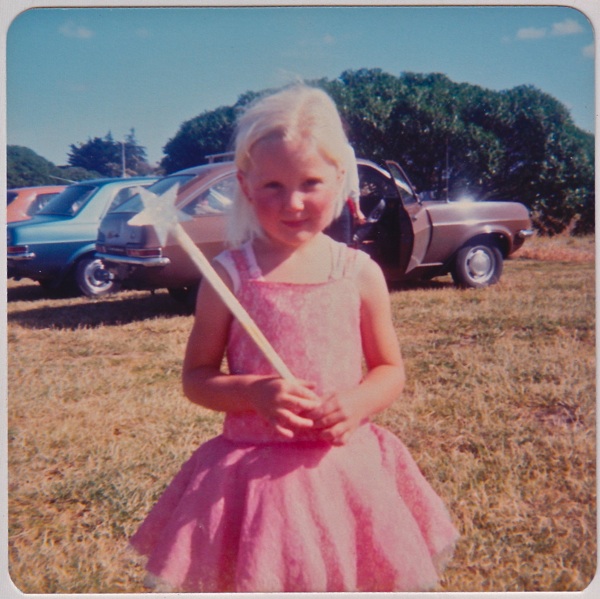
Belinda Hay dressed as a fairy, aged four in New Zealand.

“I like looking at myself this way – it’s strange, looking at old photos when I didn’t have tattoos.”

Belinda relaxes with her pet fox at her salon on Redchurch St.
You might also like to read about
Last Days of the White Vans of Whitechapel

For a couple of years now, I have enjoyed photographing the colourfully-painted “white vans” of Whitechapel – those shabby old jalopies that the market traders use as overnight storage, which you see parked in all the back streets. But, just recently, I realised that the imposition of the Low Emission Zone in Central London in six months time will see the end of all these vehicles, causing the gallery of paintings to vanish along with them.
Even as I have photographed them, I have observed an evolution in the designs and so, as we approach the final flowering of the white vans of Whitechapel, I thought I would play the art historian and attempt to trace the development of these paintings through the early to this late period, just as if they were Renaissance murals in Tuscan churches.
Keith, who proudly parks his painted van in Sclater St Market where he stalls out each Sunday, explained to me how it all began back in 2005 when, like many other traders, he found that his beloved old truck was attracting taggers and this in turn was drawing the attentions of the police who began to stop him regularly. Keith’s brother Des runs a junk shop in Bacon St – a popular location for street artists – and there Keith learnt of the powerful culture of respect that exist between the painters. “They’re a tight crew,” he informed me, “If someone sprays over another’s painting, it’s war!” And so Keith devised a cunning plan to invite one artist to paint his entire van, which thereby became sacrosanct to the taggers, and then, instead of attention from the police, he found that wherever he went people wanted to photograph his van out of admiration.
The notion quickly spread, because others traders had the same problem, and today there are dozens of these painted vans which bring the romance of the circus and the fairground to the markets of the East End – and are especially concentrated around Whitechapel Market. This unlikely alliance between the traders and the street artists has led to an unprecedented flourishing of popular public art in which the market traders, acting simply out of the wish to keep their vans neat have become unwitting art patrons – I call them, “the accidental Medicis of Whitechapel.”
Once this phenomenon took flight and the artists saw each other’s work upon the vans, then an immediate development took place in which basic tags were replaced by more elaborate and complex versions of the artists’ monikers filling the vans – possible now, since once they were invited there was not longer any need to be covert. As time has gone by, these evolved tags have been supplemented and then replaced by images, until now artists are composing each side of the van as if it were a canvas and their tag is only present in a corner as discreet signature upon the artwork. These ambitious compositions – some of which are photographed here – that have begun to appear in the last year, comprise the mature and, possibly the final period of the white vans of Whitechapel.
When I spoke to Keith, he was eager to show me the new painting by street artist Eska upon his van, which is of the evolved mode, filled an entire side of the vehicle. Over this period, since it all began, Keith had his van repainted by several artists and has delighted in becoming something of a connoisseur, developing a discriminating sensibility of his own with regard to the painting of vans and always insisting now upon seeing examples of artists’ work before he will let them loose on his vehicle.
“It makes me feel calm,” he said, stroking his chin and tilting his head, to contemplate the newly painted green abstract with satisfaction, before adding in disdain,“What’s on the other side is too busy, all squirls and clowns – it’s like something out of the hippy sixties.” In fact, Keith had parked his van against the wall to conceal the aesthetic offence of the reverse of his van, which is due for repainting imminently. “But what are you going to do next year?” I ventured, “When all these vans have to go…” And Keith replied without taking his fond gaze from the new painting. “I’m hoping to take the box off this van,” he said, “and put it on a new one.”
There may, even yet, be a future for the white vans of Whitechapel.


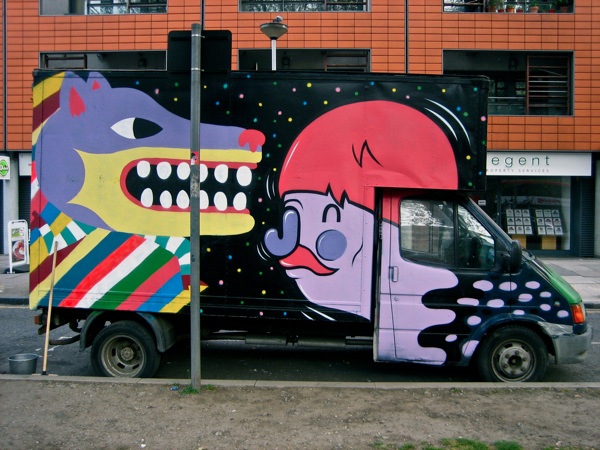





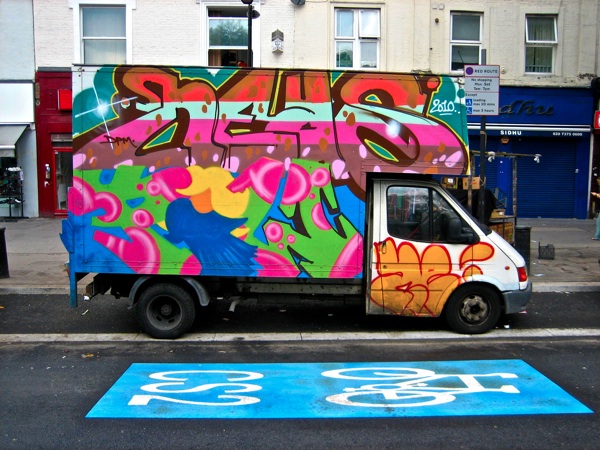
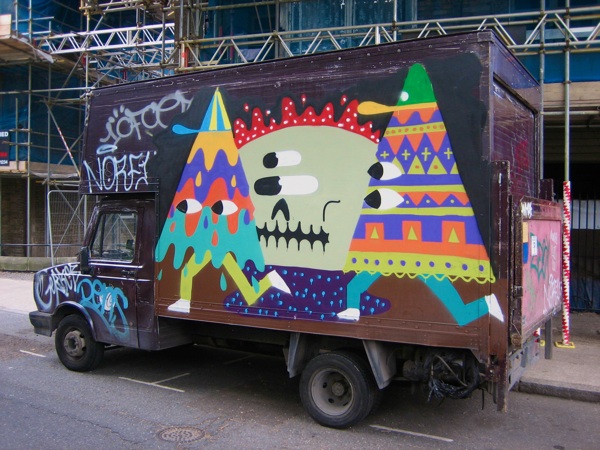


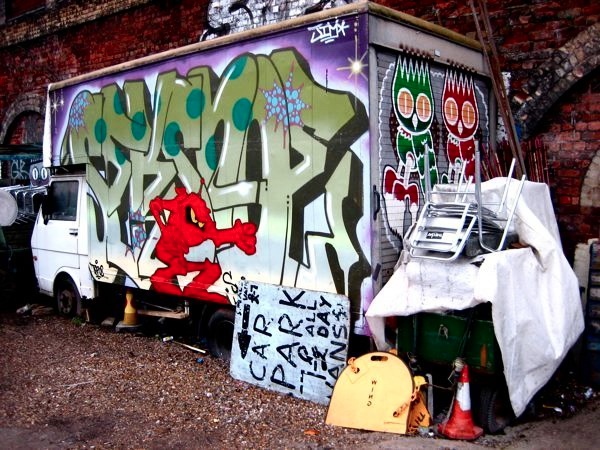

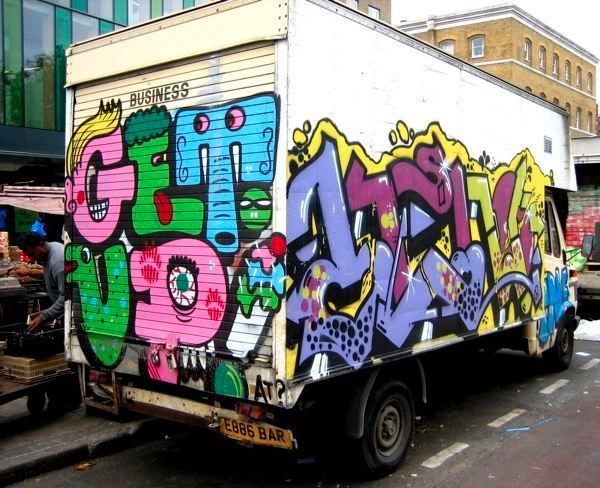
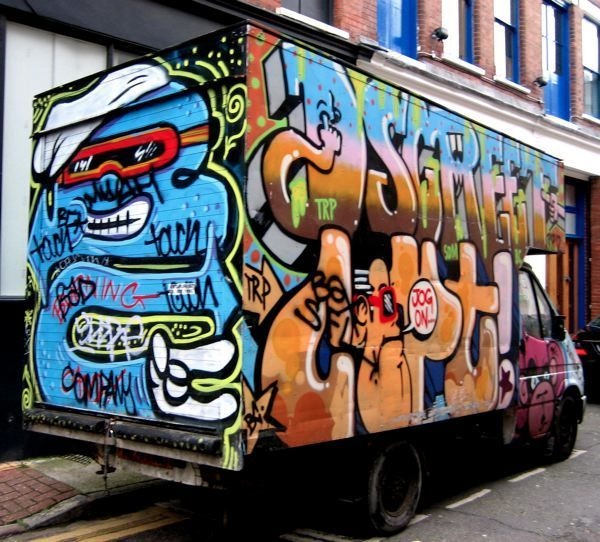


Keith’s van with the new painting by Eska
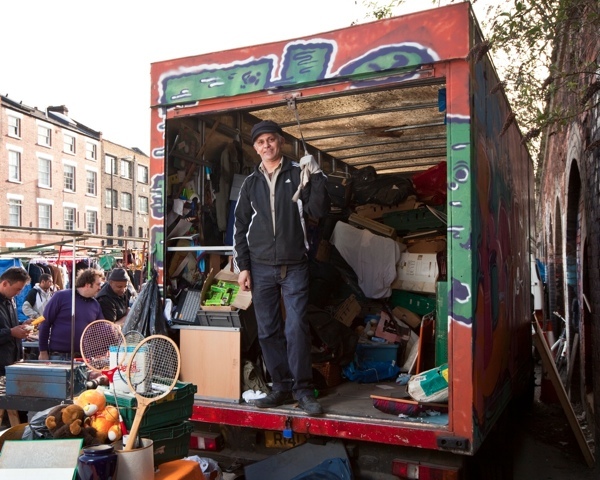
Keith of Sclater St Market
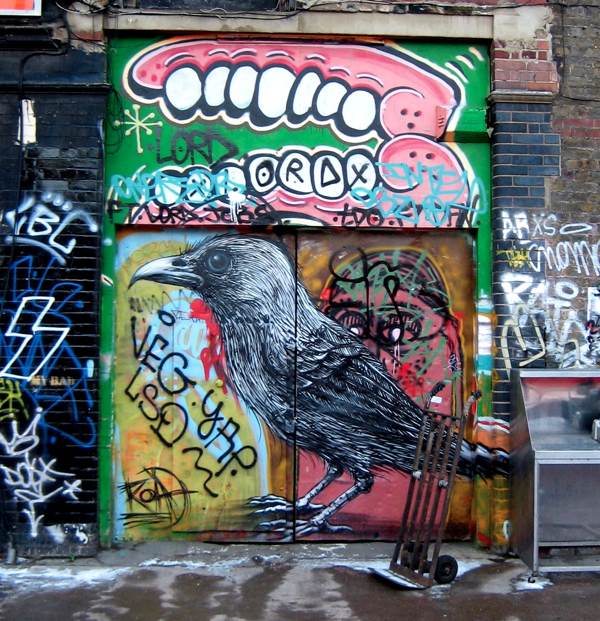
Crow by Belgian street artist Roa on the door of Keith’s brother Des’ junk shop in Bacon St
Portrait of Keith © copyright Jeremy Freedman
You may also like to read
Postcards from Petticoat Lane

Today I am sending you postcards from Petticoat Lane. Here are the eager crowds of a century ago, surging down Middlesex St and through Wentworth St, everyone hopeful for a bargain and hungry for wonders, dressed in their Sunday best and out to see the sights. Yet this parade of humanity is itself the spectacle, making its way from Spitalfields through Petticoat Lane Market and up to Aldgate, before disappearing into the hazy distance. There is an epic quality to these teeming processions which, a hundred years later, appear emblematic of the immigrants’ passage through this once densely populated neighbourhood, where so many came in search of a better life.
At a casual glance, these old postcards are so similar as to be indistinguishable – but it is the differences that are interesting. On closer examination, the landmarks and geography of the streets become apparent and then, as you scrutinise the details of these crowded compositions, individual faces and figures stand out from the multitude. Some are preoccupied with their Sunday morning, while others raise their gaze in vain curiosity – like those gentlemen above, comfortable at being snapped for perpetuity whilst all togged up in their finery.
When the rest of London was in church, these people congregated to assuage their Sunday yearning in a market instead, where all temporal requirements might be sought and a necessary sense of collective human presence appreciated within the excited throng. At the time these pictures were taken, there was almost nowhere else in London where Sunday trading was permitted and, since people got paid in cash on Friday, if you wanted to buy things cheap at the weekend, Petticoat Lane was the only place to go. It was a dramatic arena of infinite possibility where you could get anything you needed, and see life too.

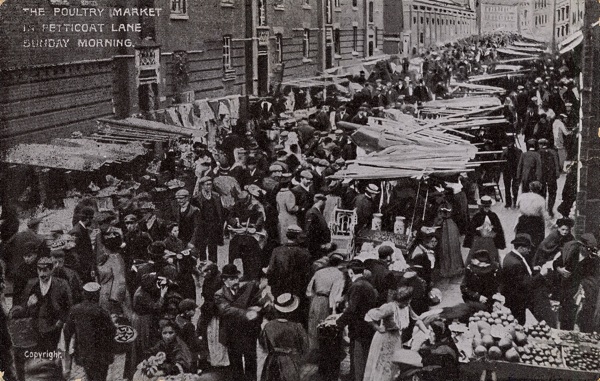


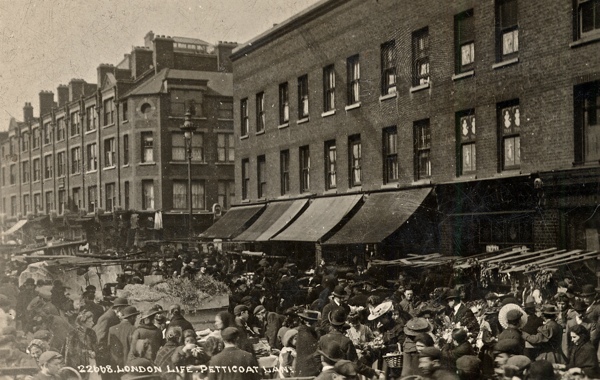


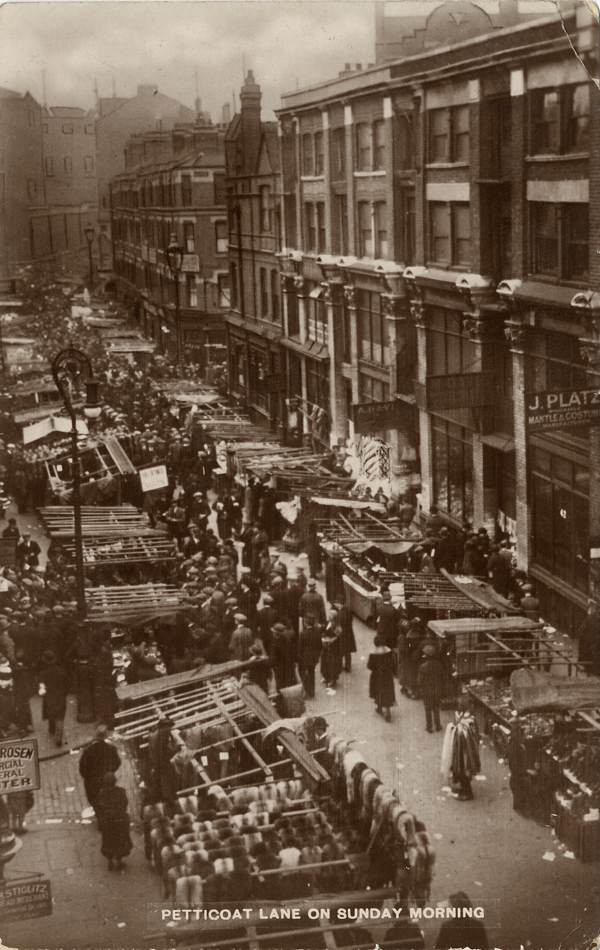


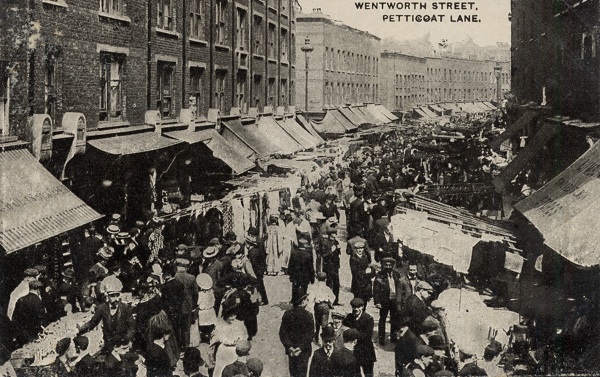
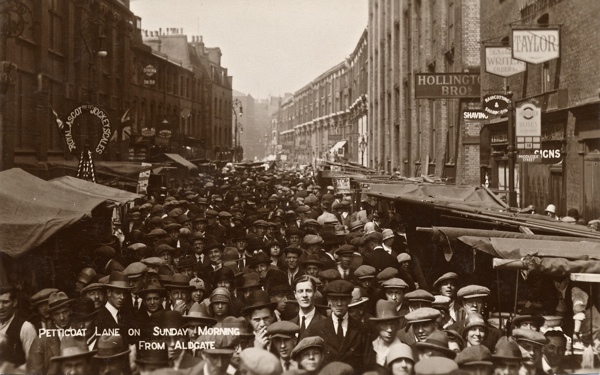

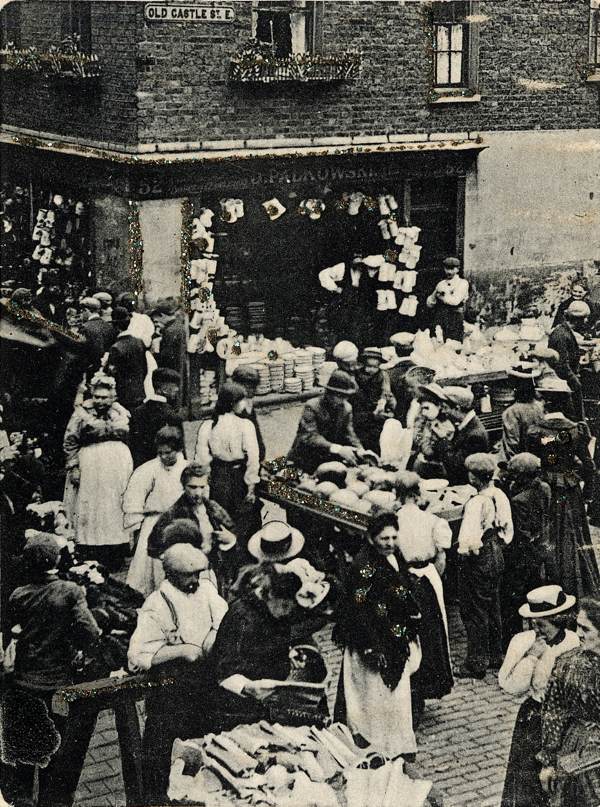
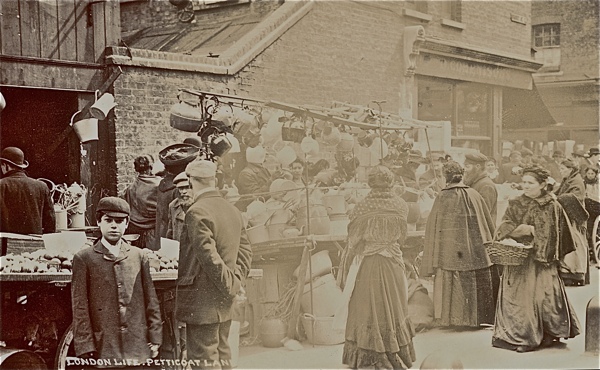


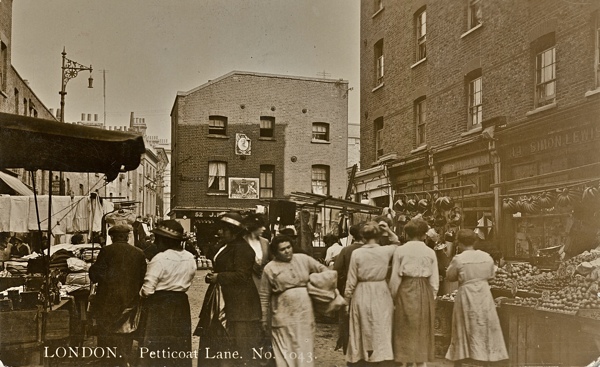

Images copyright © Bishopsgate Institute
You might also like to read about
Laurie Allen of Petticoat Lane
The Wax Sellers of Wentworth St
Larry Goldstein, Toyseller & Taxi Driver
Thomas Fairchild, Gardener of Hoxton

Next time you visit Columbia Rd Flower Market, once you have admired the infinite variety of plants on display, walk West until you come to the Hackney Rd. Directly ahead, you will discover a small neglected park and burial ground where, on the right hand side of the gate, is this stone which commemorates Thomas Fairchild (1667-1729) the Hoxton gardener.
Thomas Fairchild was the first to create a hybrid, making history in 1717 by the simple act of taking pollen from a Carnation and inserted it into a Sweet William in his Hoxton nursery, thereby producing a new variety that became known as “Fairchild’s Mule.” Everyone who loves Columbia Rd Market should lay flowers on this stone for Thomas Fairchild, because without his invention of the technique of hybridisation most of the plants on sale there would not exist. Yet when I went along with my Carnations in hand for Thomas Fairchild, I found the stone overgrown with moss that concealed most of the inscription.
Apprenticed at fifteen years old in 1682 to Jeremiah Seamer, a clothmaker in the City of London, Thomas Fairchild quickly decided that indoor work was not for him and decided to become a gardener. He had to wait until 1690 when he completed his apprenticeship to walk out of the City and up past Spitalfields to Shoreditch – where, in those days, the housing ended at St Leonards Church and beyond was only fields and market gardens. Thomas Fairchild found employment at a nursery in Hoxton, up beyond the market, but within a few years he took it over, expanding it and proceeding to garden there for the next thirty years.
In Hoxton, he kept a vineyard with more than fifty varieties of grapes, one of the last to be cultivated in England, and his nursery became a popular destination for people to wonder at all the exotic plants he grew, sent as specimens or seeds from overseas, including one of the first banana trees grown here. By 1704 he was made a freeman of the City of London as a member of the Worshipful Society of Gardeners and in 1722 he published, “The City Gardener. Containing the most experienced Method of Cultivating and Ordering such Ever-greens, Fruit-Trees, flowering Shrubs, Flowers, Exotic Plants, &c. as will be Ornamental and thrive best in the London Gardens.”
Drawing upon Thomas Fairchild’s thirty years of experience in Hoxton, it was the first book on town gardening, listing the plants that will grow in London, and how and where to plant them. He took into account the sequence of flowers through the seasons, and even included a section on window boxes and balconies. This slim volume, which has recently been reprinted, is a practical guide that could be used today, the only difference being that we do not have to contend with the smog caused by coal fires which Thomas Fairchild found challenging for many plants that he would like to grow.
When he died in 1729, it was his wish to be buried in the Poor’s Ground of St Leonard’s Church in the Hackney Rd and he bequeathed twenty-five pounds to the church for the endowment of an annual Whitsun sermon on either the wonderful works of God or the certainty of the creation. This annual event became known as the “Vegetable Sermon” and continued in Shoreditch until 1981 when, under the auspices of the Worshipful Society of Gardeners, it transferred to St Giles, Cripplegate.
Thomas Fairchild presented his hybrid to the Royal Society and, although its significance was recognised, the principle was not widely taken up by horticulturalists until a century later. In Thomas Fairchild’s day grafting and cuttings were the means of propagation and even “Fairchild’s Mule,” the extraordinary hybrid that flowered twice in a year, was bred through cuttings. Hybrids existed, accidentally, before Thomas Fairchild – Shakespeare makes reference to the debate as to their natural or unnatural qualities in “The Winters’ Tale” – yet Thomas Fairchild was the first to recognise the sexes of plants and cross-pollinate between species manually. Prefiguring the modern anxiety about genetic engineering, Thomas Fairchild’s bequest for the Vegetable Sermons was an expression of his own humility in the face of what he saw as the works of God’s creation.
I have no doubt Thomas Fairchild would be delighted by his position close to the flower market, but, as a passionate gardener and plantsman who made such an important and lasting contribution to horticulture, he would be disappointed at the sad, unkempt state of the patch of earth where he rests eternally. Given that his own work “The City Gardener” describes precisely how to lay out and plant such a space, it would be ideal if someone could take care of this place according to Thomas Fairchild’s instructions and let the old man rest in peace in a garden worthy of his achievements.

My Pinks bought from Columbia Rd Market last week.

From “The City Gardener,” 1722.

Plaque by the altar in Shoreditch Church commemorating Thomas Fairchild’s endowment for the “Vegetable Sermon.”


A pear tree in Spitalfields.

You may also like to read about