
James Boswell’s East End

Yesterday afternoon, I went up to a leafy North London suburb to meet Ruth Boswell – an elegant woman with an appealing sense of levity – and we sat in her beautiful garden surrounded by raspberries and lilies, while she told me about her visits to the East End with her late husband James Boswell who died in 1971. She pulled pictures off the wall and books off the shelf to show me his drawings, and then we went round to visit his daughter Sal who lives in the next street and she pulled more works out of her wardrobe for me to see. And when I left with two books of drawings by James Boswell under my arm as a gift, I realised it had been an unforgettable introduction to an artist who deserves to be better remembered.
From the vast range of work that James Boswell undertook, I have selected these lively drawings of the East End done over a thirty year period between the nineteen thirties and the fifties.There is a relaxed intimate quality to these – delighting in the human detail – which invites your empathy with the inhabitants of the street, who seem so completely at home it is as if the people and cityscape are merged into one. Yet, “He didn’t draw them on the spot,” Ruth revealed, as I pored over the line drawings trying to identify the locations, “he worked on them when he got back to his studio. He had a photographic memory, although he always carried a little black notebook and he’d just make few scribbles in there for reference.”
“He was in the Communist Party, that’s what took him to the East End originally,” she continued, “And he liked the liveliness, the life and the look of the streets, and and it inspired him.” In fact, James Boswell joined the Communist Party in 1932 after graduating from the Royal College of Art and his lifelong involvement with socialism informed his art, from drawing anti-German cartoons in style of George Grosz during the nineteen thirties to designing the posters for the successful Labour Party campaign of 1964.
During World War II, James Boswell served as a radiographer yet he continued to make innumerable humane and compassionate drawings throughout postings to Scotland and Iraq – and his work was acquired by the War Artists’ Committee even though his Communism prevented him from becoming an official war artist. After the war, as an ex-Communist, Boswell became art editor of Lilliput influencing younger artists such as Ronald Searle and Paul Hogarth – and he was described by critic William Feaver in 1978 as “one of the finest English graphic artists of this century.”
Ruth met James in the nineteen sixties and he introduced her to the East End. “We spent quite a bit of time going to Blooms in Whitechapel in the sixties. We went regularly to visit the Whitechapel when Robert Rauschenberg and the new Americans were being shown, and then we went for a walk afterwards.” she recalled fondly, “James had been going for years, and I was trying to make my way as a journalist and was looking at the housing, so we just wandered around together. It was a treat to go the East End for a day.”
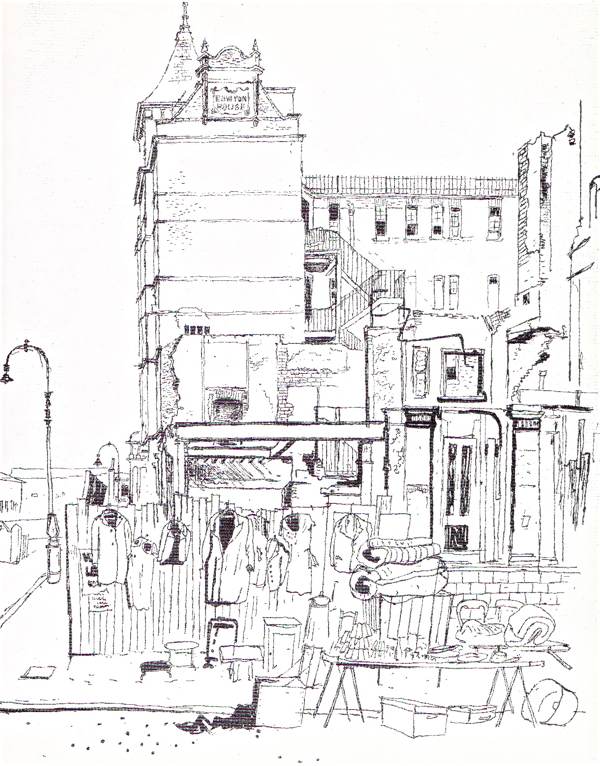
Rowton House

Old Montague St, Whitechapel

Gravel Lane, Wapping

Brushfield St, Spitalfields


Wentworth St, Spitalfields


Brick Lane


Fashion St, illustration by James Boswell from “A Kid for Two Farthings” by Wolf Mankowitz, 1953.

Russian Vapour Baths in Brick Lane from “A Kid for Two Farthings.”

James Boswell (1905-1971)


Leather Lane Market, 1937
Images copyright © Ruth Boswell
You can see more work by James Boswell at www.jboswell.info and copies of “James Boswell Unofficial War Artist” are available from Muswell Press.
You might also like to take a look at
In the footsteps of Geoffrey Fletcher
Aunt Busy Bee’s New London Cries

Living in Spitalfields, an area of London defined by its markets, I am constantly aware of the traders and the ever-changing drama of street life in which they are the star performers that draw the crowds. Interviewing the market traders in Spitalfields has taught me that although they are here to make a living, it is an endeavour which may be described as culture as much as it is commerce. In fact, the markets prove so engaging to some as a location of social exchange that they carry on coming for the sake of it, even if they are not making any money.
This fascination of mine with the culture and performance of market places has led me to delight in the diverse sets of the Cries Of London for the pictures they give of street traders in the capital down through the ages. Even though they were frequently sentimentalised, these portraits also reveal the affection with which Londoners held the traders, celebrating the ingenuity of the identities created by vendors and casting them as the celebrities of the thoroughfare – collectively expressive of the very personality of the city itself, when the streets were full of people with wares of every description to sell.
With the Cries of London, there is always a story behind each of the portraits and Aunt Busy Bee’s New London Cries from the nineteenth century, hand-tinted and produced in a pamphlet with a blue paper wrapper for sixpence, engages the readers with rhymes that complement the pictures and invite respect for the hawkers. The middle class woman in the frontispiece leading her daughter down the street shows deference to a Lavender Girl in a dress stained with mud around the hem, and this pamphlet can be read an interpretation of the lives of the traders for the mother to read to her child.
The Band Box Man is selling the hat boxes that are product of his cottage industry, manufactured at home and sold on the streets, while the Lavender Girl walked into London carrying the lavender she picked that morning in the fields. The Vegetable Seller is pursuing a trade as a Costermonger, buying his fruit at the wholesale market and hawking it around the street, as many once did at Covent Garden and Spitalfields Markets. And we are reminded that the Knife Grinder provides a public service in the home and workplace, while the Mackerel Girl has no choice but to carry her basket of fish around the city from Billingsgate, which she herself may not get to eat. The mishap of the Image Seller, in comic form, even illustrates the vulnerability of the street seller who relies upon trading to earn a crust and the responsibility of the customer to permit them a living.
For hundreds of years, popular prints and pamphlets of the Cries of London presented images of the outcast and the poor, yet permitted them dignity in performing their existence as traders. The Cries of London celebrate how thousands sought a living through street-selling and, by turning it into performance, gained esteem and moral ownership of the territory – both transcending their economic status and creating the vigorous culture of street markets that persists to this day.


Images copyright © Bishopsgate Institute
You may like to take a look at
Marcellus Laroon’s Cries of London
More John Player’s Cries of London
William Nicholson’s London Types
Francis Wheatley’s Cries of London
John Thomas Smith’s Vagabondiana of 1817
Thomas Rowlandson’s Lower Orders
Travellers’ Children in London Fields

Click to buy a signed copy of Colin O’Brien’s book for £10!
It is my pleasure to publish this splendid series of portraits of travellers’ children by Colin O’Brien, now published in a handsome hardback book. They are the result of a remarkable collaboration between a photographer and his subjects, in which the children command the frame with natural authority and strength of personality. And Colin O’Brien’s masterly photographs make an interesting comparison with Horace Warner’s Spitalfields Nippers of 1912, even though Colin O’Brien had never seen the work of Horace Warner when he set out with his camera through the East End seventy-five years later.
“I came across the travellers whilst I was photographing a deserted warehouse in the London Fields area in 1987. They had parked their caravans in and around Martello St, near the railway arches by the station. This part of Hackney was very run down in the eighties. The streets were littered with rubbish and many of the decaying Victorian terraces were being demolished. The area was neglected and dangerous, with graffiti everywhere.
The travellers were Irish, mostly families with three or four children, living in modern caravans which looked extremely cramped but comfortable. On the first week I started to take one or two Polaroid shots of the children which I gave to them to show their parents. Some of the parents then dressed the children up and sent them out for me to take more pictures.
I continued to take many more images over a period of three weeks and got to know some of the travellers well. They took me into their confidence and trusted me with their children. It was only when I started to print the images that I realised what an amazing set of photographs they were.
When I returned to the site on the fourth week the families had gone. I shouldn’t have been surprised, but I was – after all, this is what travellers do, they move on. I had no way of contacting them but I was left with an amazing set of pictures.”


Photographs copyright © Colin O’Brien
You may also like to take a look at the Spitalfields Nippers.

I have always been captivated by the romance of the Society for the Protection of Ancient Buildings, sequestered behind the blue front door of the tottering old house in Spital Square. Even the name has a kind of poetry for me. Yet I was not disappointed when I made it through that front door into the crowded panelled offices, filled with good furniture, oil paintings and filing cabinets, arranged to suit personal usage like the chambers of some Dickensian lawyers that had been there for generations and refreshingly free of modish notions.
Upstairs, in the modest back room painted an appealing sage green, works Philip Venning, Director of the Society for nearly thirty years, and I had the privilege of paying a call upon him there recently in his quiet den. “By law, a copy of every application to demolish a listed building is sent to us,” he explained, sounding rather grand, before changing tone to add, “and we’re given the opportunity to comment, although there is no obligation for anyone to pay attention to what we have to say.” And he smiled knowingly at this circumstance, that reveals the essence of this tiny charitable organisation founded by William Morris in 1877, which gave birth to the modern conservation movement, but has the power only of influence, based upon the authority of its reputation and the specialist knowledge that can be drawn upon from its eight thousand members – comprising the leading professionals in the restoration and care of ancient buildings.
“We have always been interested in how buildings are restored,” Philip continued, emphasising the importance of traditional crafts and trades in sympathetic maintenance and repair, “since the nineteen thirties we have run a training course for young architects and surveyors.” Teaching is done by practitioners rather than academics, reflecting the Society’s practical approach and commitment to keeping the skills alive that are required to maintain old buildings. Recently this educational programme has been extended to include craftsmen through William Morris Scholarships and now to caretakers of churches too, who are invited to undertake courses to learn how to be the best custodians of their charges. “It can be as simple as clearing gutters, that sort of thing,” Philip declares, “They may be concerned about poor stonework, but we can say “If it’s been like that for four hundred years, it’s probably alright.”
The Society moved to Spitalfields in 1984 and renovated the building they now inhabit, one of the very few original structures surviving of the magnificent lost Spital Square. “It was a typical empty and derelict Spitalfields house of the time,” said Philip – unable to resist telling me that they found medieval stonework in the foundations, which may come from the original priory of St Mary or be part of the earlier houses that stood upon this site, one of which was once inhabited by Thomas Culpeper.“We were visited by a Jewish family whose forbears lived and worked here as leather dealers, and they gave us the brass plate that used to be beside the door.” he added, satisfied to fill in the recent human history of the house and fetching the plate for me to see.
Yet Philip himself is also part of the history of Spitalfields, although he did not know it when he first came. “I’ve worked here since 1984 and only recently discovered my family connections, and now I feel much more connected to the place than I did,” he admitted, telling me of his great-great grandfather on his mother’s side, Benjamin Duncombe, a dentist in Bell Lane with a house in Hoxton Square, whose daughter Ann married Thomas Mann at Christ Church in 1787. Puzzled that a mere dentist could afford a grand house in Hoxton, Philip believes he found the answer in the crypt of Christ Church when many bodies were removed and discovered to possess gold teeth, suggesting that this might the source of Benjamin’s wealth.
Our conversation glanced continuously between a discussion of the Society’s aims and swapping tales of Spitalfields, and I realised that for Philip the protection of old buildings from decay, damage and demolition is inextricable from respecting the lives of those who built and inhabited them. William Morris articulated a similar sentiment in his manifesto founding the Society, calling for the protection of, “those buildings, the living spirit of which – it cannot be too often repeated – was an inseparable part of that religion and thought, and those past manners.”
“I had only been contracted to stay for five years but I stayed for ten,” Philip Venning informed me with a sigh of amazement in a moment of self-realisation as we came to the conclusion of our chat, adding after twenty-eight years in the job leading the campaign to preserve our ancient buildings, “I stayed because I find it so valuable an undertaking.”

Philip’s ancestor Benjamin Duncombe, a dentist who had his surgery in Bell Lane, Spitalfields, and a house in Hoxton Square.

Benjamin’s daughter Ann Duncombe, who married Thomas Mann of Harbury, Warwickshire, on 5th July 1787 at Christ Church, Spitalfields.

Thomas Mann of Harbury, Warwickshire – Philip’s mother’s maiden name was Mann.

The Society for the Protection of Ancient Buildings, Spital Square.

The brass plate that was once fixed beside the door.
You may also like to read about Bob Crome, the window cleaner who saw a ghost while cleaning the windows of the Society for the Protection of Ancient Buildings.
Colin O’Brien, Photographer

Observe this tender photograph of Raymond Scallionne and Razi Tuffano in Hatton Garden in 1948, one of the first pictures taken by Colin O’Brien – snapped when he was eight years old, the same age as his subjects. Colin forgot this photograph for over half a century until he discovered the negative recently and made a print, yet when he saw the image again, he immediately remembered the boys’ names and recalled arranging them in front of the car to construct the most pleasing composition for the lens of his prized box brownie.
Colin grew up fifty yards from Hatton Garden in Victoria Dwellings, a tenement at the junction of Faringdon Rd and Clerkenwell Rd – the centre of his childhood universe in Clerkenwell, which Colin portrayed in spellbinding photographs that evoke the poetry and pathos of the forgotten threadbare years in the aftermath of World War II. “We had little money or food, and shoes were a luxury. I remember being given my first banana and being told not to eat it in the street where someone might take it,” he told me, incredulous at the reality of his own past,“Victoria Dwellings were very run down and I remember in later years thinking, ‘How did people live in them?'”
Blessed with a vibrant talent for photography, Colin created images of his world with an assurance and flair that is astounding in one so young. And now these pictures exist as a compassionate testimony to a vanished way of life, created by a photographer with a personal relationship to all his subjects. “I just wanted to record the passage of time,” Colin told me with modest understatement, “There were no photographers in the family, but my Uncle Will interested me in photography. He was the black sheep, with a wife and children in Somerset and girlfriends in London, and he used to come for Sunday lunch in Victoria Dwellings sometimes. One day he brought me a contact printing set and he printed up some of my negatives, and even now I can remember the excitement of seeing my photographs appear on the paper.”
Colin O’Brien’s clear-eyed Clerkenwell pictures illustrate a world that was once familiar and has now receded far away, yet the emotionalism of these photographs speaks across time because the human detail is touching. Here is Colin’s mother spooning tea from the caddy into the teapot in the scullery and his father at breakfast in the living room before walking up the road to the Mount Pleasant Sorting Office, as he did every day of his working life. Here is Mrs Leinweber in the flat below, trying to eke out the Shepherd’s Pie for her large family coming round for dinner. Here is the Rio Cinema where Colin used to go to watch the continuous programme, taking sandwiches and a bottle of Tizer, and forced to consort with one of the dubious men in dirty raincoats in order to acquire the adult escort necessary to get into the cinema. Here is one of the innumerable car crashes at the junction of Clerkwenwell Rd and Faringdon Rd that punctuated life at Victoria Dwellings – caused by lights that were out of sync, instructing traffic to drive in both directions simultaneously – a cue for Colin to reach out the window of their top floor flat to capture the accident with his box brownie and for his mother to scream, “Colin, don’t lean out too far!”
At fifteen years old, Colin’s parents bought him Leica camera. “They couldn’t afford it and maybe it came off the back of a lorry, but it was a brilliant present – they realised this was what I wanted to do,” he admitted to me with an emotional smile. “My first job was at Fox Photo in the Faringdon Rd. I worked in the library, but I spent all my time hanging around in the dark room because that was where all the photographers were and I loved the smell of fixer and developer.” he recalled, “And if I stayed there I would have become a press photographer.” But instead Colin went to work in the office of a company of stockbrokers in Cornhill in the City and then for General Electric in Holborn –“I hated offices but I aways got jobs in them” – before becoming a photographic lab technician at St Martins School of Art and finally working for the Inner London Education authority in Media Resources, a role that enabled him to pursue his photography as he pleased throughout his career.
Over all this time, Colin O’Brien has pursued his talent and created a monumental body of photography that amounts to over half a million negatives, although his work is barely known because he never worked for publication or even for money, devoting himself single-mindedly to taking pictures for their own sake. Yet over the passage of time, as a consequence of the purism of his approach, the authority of Colin O’Brien’s superlative photography – distinguished by its human sympathy and aesthetic flair – stands comparison with any of the masters of twentieth century British photography.

Members of the Leinweber family playing darts at the Metropolitan Tavern, Clerkenwell Rd, 1954.

Girl in a party dress in the Clerkwenwell Rd, nineteen fifties.

Solmans Secondhand Shop, Skinner St, Clerkwenwell, 1963.

Colin’s mother puts tea in the teapot, in the scullery at Victoria Dwellings, nineteen fifties.

Linda Leinweber takes a nap, 117 Victoria Dwellings, nineteen fifties.

Colin’s father eats breakfast before work at the Mount Pleasant Sorting Office.

Jimmy Wragg and Bernard Roth jumping on a bomb site in Clerkenwell, late fifties.

Accident at the junction of Clerkwell Rd and Faringdon Rd, 1957.

Mrs Leinweber divides the Shepherd’s Pie among her family, Victoria Dwellings, 1959.

Rio Cinema, Skinner St, Clerkenwell, 1954.

Hazel Leinweber, Victoria Dwellings, nineteen fifties.

Fire at Victoria Dwellings, mid-fifties.

Colin’s mother outside her door, 99 Victoria Dwellings, nineteen fifties.

Boy at Woolworths, Exmouth Market, 1954.

Two women with a baby in Woolworths, Exmouth Market, 1954.

Cleaning the windows in the snow, Clerkenwell Rd, 1957.

Cowboy and girlfriend, 1960.

Nun sweeping in the Clerkenwell Rd, nineteen sixties.

Colin’s window at Victoria Dwellings was on the far right on the top floor.

An old lady listens, awaiting meals on wheels in Northcliffe House, Clerkenwell, late seventies.

The demolition of Victoria Dwellings in the nineteen seventies.
Photographs copyright © Colin O’Brien
At the Pagan Parade

When my friend Geraldine Beskin, the witch, who runs the Altlantis Bookshop invited me to attend the Pagan Pride Parade, I knew it was too good an opportunity to miss. From far and wide, emerging from their secret groves and leafy bowers, the pagans converged upon Red Lion Square this weekend. They dusted off their antlers, wove their garlands of green and desported themselves in floaty dresses to meet the morn. Many are old friends who have gathered here annually in this quiet corner of the old square in Holborn for the past fourteen years to celebrate pagan rites, and they were eager to embrace the spirit of the occasion, joining hands and frolicking mischievously in a long line weaving in and out of the crowd to the rhythm of the tabor.
On my arrival, I had the honour of shaking hands with the druid of Wormwood Scrubs, attired in an elegant white robe adorned with a fabulous green beetle. “I studied theology but I lost my faith,” he confessed, raising his eyebrows for dramatic effect, “but in 1997, I was rehoused next to Wormwood Scrubs and there was a crescent-shaped line of trees outside my house and – for some reason I don’t understand – I went out to greet the dawn and discovered I had Druidic tendencies.” Next I met Carol, an ethereal soul with ivy woven in her long flowing hair, in an ankle length emerald crushed velvet dress and eau de nil cape. “I feel so tremendously privileged to know that I am not on my own, that I am loved and protected.” she said, clasping her hands, casting her eyes towards the great trees overarching the square and smiling affectionately. Leaning against the railings nearby was Vaughan – naked from the waist and swaggering a pair of horns at a jaunty angle, he was eager to show me his panpipes. “I love Nature,” he declared, beaming, “I keep my bees and chickens and I grow herbs. I love collecting my eggs and I make my own remedies – it’s such a natural way of life…”
The cheery atmosphere was pervasive, but I was a little alarmed by the police van and officers placed strategically around the square, conjuring visions of all the pagans getting arrested for misrule and ending up in a cell. But Geraldine Beskin reassured me the police were there to stop the traffic to allow the pagans’ free passage through Holborn and up Southampton Row to Russell Square. “Once upon a time we wouldn’t be allowed to appear in public, but these days we are more accepted.” she revealed, flashing her sparkling eyes,“The council have given us their approval, now they realise we are not devil worshippers.” This year Geraldine Beskin was leading the Pagan Pride Parade in partnership with Jeanette Ellis who started it fourteen years ago, the first of its kind in the world. And when the heavenly orb reached its zenith these twin goddesses gave the nod to the officers, stepping forth regally as the police motorbikes roared into life to escort the procession of ladies in flowing gowns and gentlemen with horns protuberant.
They were a joyous sight with their coloured robes and long hair drifting on the breeze, as they advanced up Southampton Row and streamed into the gardens of Russell Square where they circled the fountains. Before long, an audacious red-haired maiden in a blue satin gown was prancing barefoot in the water to the beat of a drum, then a dog and other pagans followed to enjoy a good humoured splashing match. “We’re celebrating male energy and the sap rising at this time of the year,” Geraldine explained to me in delight, as we surveyed the watery mayhem erupting before our eyes.

Geraldine Beskin – “the council have given us their approval, now they realise we are not devil worshippers.”

J.T.Morgan, the Druid of Wormwood Scrubs – “for reasons I don’t understand I went out to greet the dawn.”

Jeanette Ellis started the Pagan Pride Parade fourteen years ago.

Vaughan Wingham -“I’m proud to be pagan”

Carol Mulcahy – “I feel tremendously privileged…”


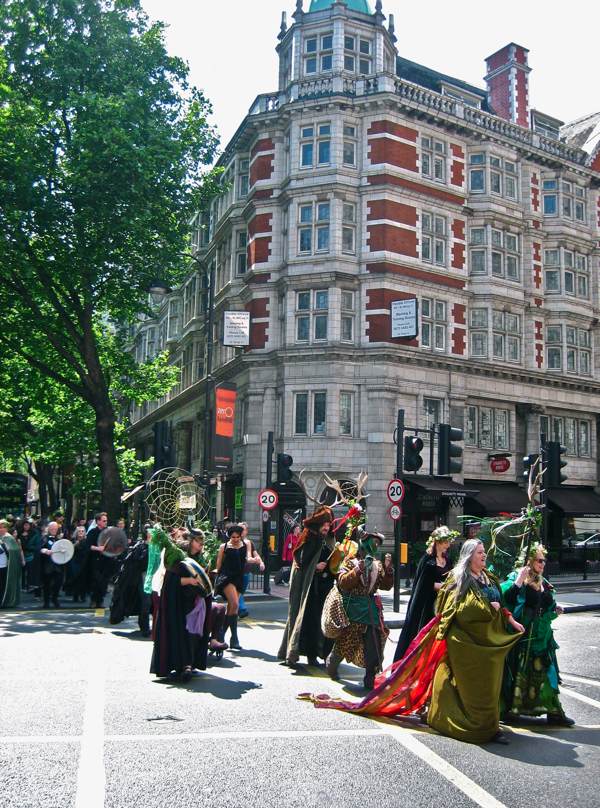


Pagans celebrate in Russell Square.
You may also like to read about
Brick Lane Market 11
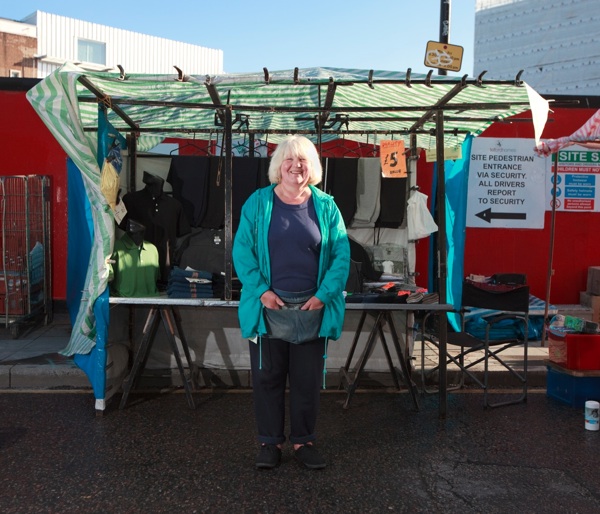
Patricia Green told me her father Ronald began selling menswear from this pitch when he obtained a licence in 1956 – although the family were in Sclater St long before that, when it was an animal market.
“Originally his father used to be down here selling birds,” explained Patricia, “and my father used to sell birdseed as a boy. He stayed until he was seventy-six, and was down here until a few weeks before he died.” Leaving school at fourteen, Ronald worked in a pawnbrokers and then a department store, before opening his own shop, selling menswear in Upton Park and on Sclater St each Sunday. “I started coming down here to the market with him when I was five years old,” admitted Patricia fondly, casting her eyes along the street to see the invisible crowds of long ago,“there were so many people you couldn’t walk through it, you just got carried along with the crowd. You never used to see any women, it was a men’s market – maybe one in fifty was a woman.”
“I don’t go to bed on Saturday night,” she explained with a grin of extraordinary vitality,“I just sit on the bed and maybe have forty winks, before I get up at ten past one to make the sandwiches and flask of tea. I get here around three o’clock and by the time I have set up and unloaded all the stuff it’s quarter to five, then at six o’clock I go and have a little chat with my friends.” It is a routine that few would choose, yet even though she is retired Patricia is keen to come every week. “I have regular customers and I know a lot of people who’ve been here for years – but every now and again someone disappears.” she confessed in a diplomatic whisper.

At the next stall is Patricia’s brother Robert Green, who helps out his friend Simon Lynch selling household goods. “I’ve been here since 1977, when I left school and started working alongside my father, “ he declared in triumph, “In forty years, I have only missed five Sundays – that was when I broke my leg and had to take five weeks off.”
When Robert reached fifty, he and his sister sold their father’s shop.“We used to work seven days,” he said, “Since I left school, my entire life had been the business and I wanted to have more time, but to tell you the truth I don’t have any more time than I had before.” – shaking his head in good-humoured perplexity. “After all these years, I still try to serve someone enthusiastically,” he informed me, raising a hand as a point of honour, “even if they are only buying a bottle of washing up liquid and, even though I don’t need the money, I treat them with as much respect as if they were buying a hundred pounds worth of stock years ago.”
With the ease of one who is at home in the world, Robert has an innate sense of decency and delight in what he does. “I hope to make money – but it doesn’t really matter, because I’ve always done it so I’d feel out of place if I didn’t do it. I am used to being down here at three in the morning in the freezing cold every week” he said, declaring both his own nature and affection for the market.“It’s a combination of things, tradition, culture and a lot of history – this is a very old market here.”
I stood at Robert’s side as eager customers paid for their purchases and he continued talking over his shoulder animatedly.“It’s tradition, because because years ago everything else used to shut and this was the only place open on a Sunday.” he told me, “It’s culture because there’s a lot of people on the other pitches who, even if we are not exactly friends, they always come and tell me what they are doing. And it’s history because some of the customers, I remember when they were young and now they are in their seventies and eighties. We’ve all grown old together. There’s a lot more to it than just coming down here to sell a few things.”
Photographs copyright © Jeremy Freedman


