
Adam Dant’s Map of Hoxton Square 2011
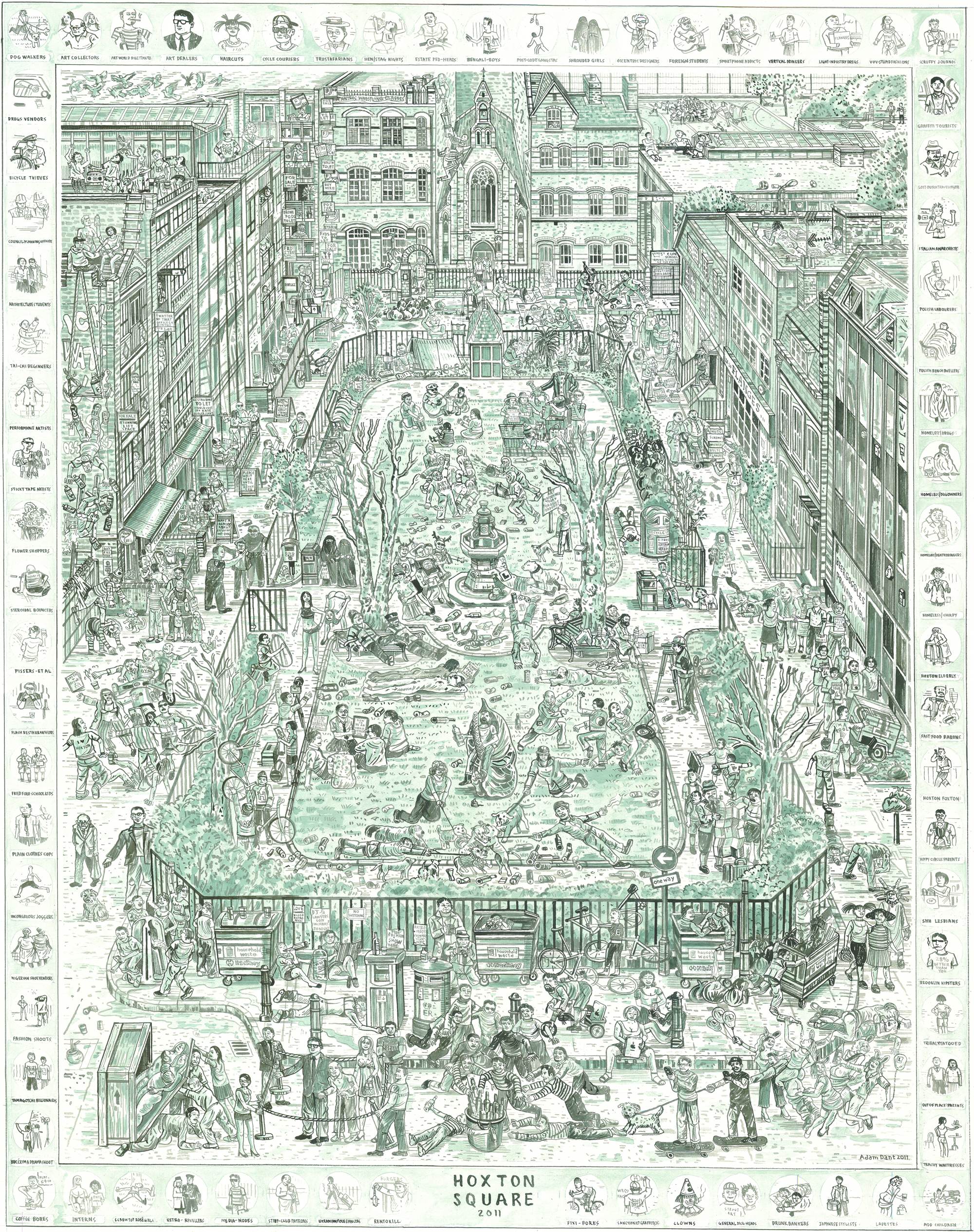
Click to see what goes on in Hoxton Square
Spitalfields Life contributing photographer Martin Usborne is leaving Hoxton Square, and he commissioned this map from Adam Dant as a momento. Once it was the life of the square that drew the photographer to live here but now it is the excess of life that is driving him away. The drama and the craziness have reached such a pitch that Martin has no choice but to take his leave, if he is ever to have another night’s uninterrupted sleep in his life.
Recently, Martin and Adam have identified more than seventy different “Hoxton Types” that may be spotted in the Square and which are illustrated here on the map. I imagine Martin looking down from his window in wonder, in the way that Mark Lester does in the film of “Oliver” when he awakens at Mr Brownlow’s house after being rescued from Fagin’s gang. Only, instead of the “Cries of London,” Martin looks out onto the rampage you see above, as portrayed in such loving graphic detail by Adam.
Whether you celebrate this as an exuberant libertarian paradise or whether you condemn it as the nadir of unpleasantness is a matter of mere opinion, but there is no doubt that in recent years Hoxton Square has become a phenomenon – a crowded playground where those who so desire are may lose their inhibitions and their wallets with ease. “It must have some charm or why would people come all the way from Essex to go there?” asked Adam, with a twinkle in his eye and his tongue firmly in his cheek.
Hoxton Square is the East End’s Garden of Earthly Delights, peopled with Dog Walkers, Art Collectors, Art World Dilettantes, Art Dealers, Haircuts,Cycle Couriers, Trustafarians, Hen/Stag Nights, Estate Ped-Heads, Bengali Boys, Postcode Gangstas, Shrouded Girls, Eccentric Designers, Foreign Students, Smartphone Addicts, Vertical Drinkers, Light Industry Dregs, VVV Stupid Fashions, Scruffy Journos, Graffiti Tourists, Lost Dutch Travellodgers, Italian Anarchists, Polish Labourers, Polish Benchdwellers, Homeless/Drugs, Homeless/Dogowners, Homeless/Chirpy, Hoxton Elderly,Fast Food Barons, Hippy Circus Parents, Shh! Lesbians, Brooklyn Hipsters, Tribally Tattooed Folk, Out of Place Parents, Trashy Waitresses, A.D.D. Children, Ladettes, Japanese Stylists, Drunk Bankers, General Dickheads, Clowns, Sanctioned Graffitists, Fixi Bores, Rentokill Workers, Ukranian Pole Dancers, Strip Club Patrons, Media Nodes, Screwtop Rosé Girls, Interns, Coffee Bores, BBC Drama Shoot Participants, Tamagotchi Billionaires, Fashion Shoots, Nigerian Shoe Vendors, Incongruous Joggers, Plain Clothes Cops, Fried Food Schoolkids, Flash Restaurateurs,Pissers, Sterodial Bouncers, Flower Shoppers, Sticky Tape Artists, Performance Artists, Tai Chi Beginners, Architecture Students, Council Planning Officers, Bicycle Thieves, Drugs Vendors – and Joseph Markovitch,and Martin Usborne and his dog Moose.

In the top left of this detail of the map you can see Martin Usborne (walking his dog Moose) and Joseph Markovitch, a native of Hoxton.
Images copyright © Adam Dant
You might like to look at Martin Usborne’s photographs of
and A Fox in Hoxton.
You may also like to see
Adam Dant’s Hackney Treasure Map
or his Redchurch St Rake’s Progress
or his Map of the History of Shoreditch,
or his Map of Shoreditch in the Year 3000,
or his Map of Shoreditch as New York,
or his Map of Shoreditch as the Globe,
or his Map of Shoreditch in Dreams,
or his Map of the History of Clerkenwell
Les Wilkes, Warehouse Manager

Since he retired from being a warehouse manager in 1995, Les Wilkes has helped out every day at the Mister City Sandwich Bar in Artillery Lane and become a popular figure there, well known among the City types who frequent this busy establishment. Although Les maintains a discreet presence, with his perfect manners, neatly pressed shirts and resolutely cheerful manner, he has become the presiding spirit of this celebrated shop, someone who has retained his sense of enthusiasm throughout a long life.
Roberto & Mirella Fiori, the proprietors of Mister City, introduced me to Leslie Arnold Wilkes with the respect due to a senior member of their family and when I discovered that he had been employed nearby for more than half a century, I was eager to hear his story. Fortunately, Les was passionate to speak of his experiences, talking with great pleasure of his working life around Bishopsgate.
After the number of years I’ve worked in the City and travelled all over London, I know all the little shortcuts, and the byways and alleys. Back in 1958, when I left school at sixteen, I went to work for a company of bookbinders, Richards & Keens, at the corner of Leadenhall St and Gracechurch St. My first employer was Jack Keens, he was the third generation in the business and I knew him simply as “the old man.”
I used to collate pages together by hand before they were numbered with a handheld numbering machine. When I was collating, I had to do it backwards so my colleague would be able to take the pages off the pile forwards. The binding was done with glue and staples. I used to heat up the glue on a gas ring. First I had to break it, like great big lumps of chocolate, and then put it in a pot of boiling water, using a paint brush to stir it up. Perforations were done by a special machine that could only take a few sheets at a time. So, to make fifty books took us a whole week! They were jolly days they were.
I did other jobs – if the boss went out of the office I used to answer the phone and take messages and orders for pens, pencils and envelopes. It was my job to pick up orders from the suppliers and deliver them to the customers, and that was the part I enjoyed the most, calling round to see the customers and having a little chat. I was an old-fashioned courier, I used to travel on foot around the City and sometimes I caught a bus. I used to get around so quick, they used to called me “speedy.” Back in the nineteen sixties I was in my twenties and I could bus around like a loony. I was actually employed as a warehouse manager but I used to do all these other jobs.
By the end, I worked there forty-nine years, from the age of sixteen in 1958 to sixty-five in 2007. I was the longest serving employee and the family who had run it for four generations since 1910, they kept it going until I retired. As the saying goes, “first in, last out.” A lot of people can’t believe that I would spend my life in one job. Oh yes, people are changing their jobs now, probably three or four times in their lifetime. I stayed because I enjoyed my job.
My last boss, Ian Keens, was two years older than me but he stayed on after retirement age for my benefit, to see me out. We shut it down together. The lease on the premises ran out and the business was put in the hands of the accountant. What we had to do was to send letters to all our customers, thanking them for their custom over the years but “regret that we are closing the business.” He’s living in Northern Ireland now and we only communicate by birthday and Christmas card. I have his phone number if I need to call him, and as far as I know he’s ok. Most of the other staff I don’t see them any more.
We moved premises twice, from Leadenhall St to Boar’s Head Passage and finally to Scrutton St in Shoreditch. I was the only one that went out for lunch, everyone else used to eat their sandwiches they had brought from home. Once I had made them coffee, I would go out for an hour. There were plenty of places to eat in Shoreditch but for some reason I chose to go down to the City Way Restaurant. It was proper Italian place where you could sit and have lunch. The chef at the City Way Restaurant was Pino Cimelli, Mirella’s father and I gradually became friends with him and he would come and sit at the table with me. It was all very nice and I got to know the whole family. This lasted from 1995 until 2007 when his son Luigi sold the shop. He works here at Mister City now on Fridays, so we are still in touch and have a good laugh.
I’ve come here every day to the Mister City Sandwich Bar for my lunch since I retired from work and I help out in the shop with a few jobs. I live in South East London, Grove Park, so it is quite a long journey. One of the jobs I do is I roll up the plastic knives and forks in the serviettes. I count the cups and see to the stock for the shop, and when they are short I phone up the supplier.
My family’s scattered around the globe. I’m not married and I’ve never been married, so I don’t have any children. I live alone and come here everyday for company, if I stayed at home it would drive me mad. The Fiori family are my adopted family. After I have checked everything and locked up, Mirella Fiori always walks over to Moorgate with me and we go to Marks and Spencer to buy food, and she helps me choose clothes if I need any.
At weekends, I do shopping and gardening. In the Summertime, depending on the weather, I do plenty of walking. I try to get out from London. From where I live, I am only two miles away from Chislehurst in Kent, so I am able to leave South East London behind by walking to Petts Wood and Orpington. And, sometimes, I walk to Bromley – it takes me about an hour at most.
I have always been partially blind, I am shortsighted in my right eye and I have no sight at all in my left eye, but it’s normal for me because I was born that way. I feel sorry for people who lose their sight.
Les’ story was fascinating to me, because it revealed him as a rare individual for whom work is never toil and who, through his openness of spirit, has personalised all his working relationships. As a consequence, Les has always drawn the respect and affection of his workmates and employers, reciprocating his lively humanity. I can think of no other example where a company owner kept the business running for an extra two years just till an employee reached retirement age. Les’ story reminds us of a different perception of business – in which the purpose of a company is as much to provide a living for its staff as it is to turn over a profit.
Although the City can seem impersonal to many, this has not discouraged Les from striking up unexpected friendships. It was his lunchtime conversations with Pino Cimelli that led to becoming a family friend of the Fioris of the Mister City Sandwich Bar. With radical initiative, Les chose not to sit at home after retirement but to continue his passionate involvement with the City by coming to the Fiori’s cafe in Spitalfields everyday. So next time you walk down Artillery Lane, be sure to drop in to the Mister City Sandwich Bar and shake hands with Les Wilkes – because he knows how to live.
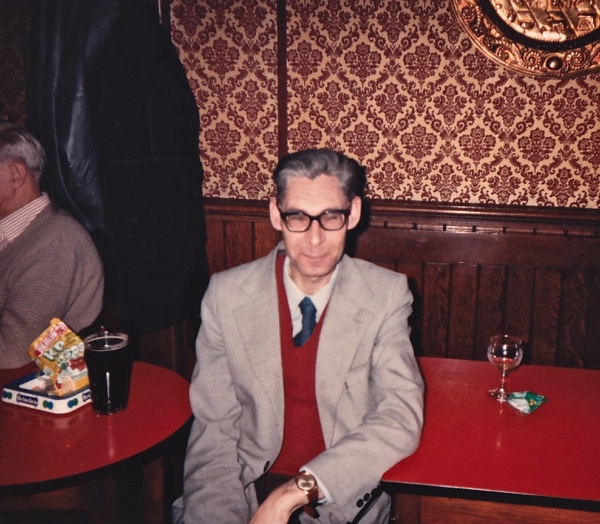
Les enjoys a pint of Guinness
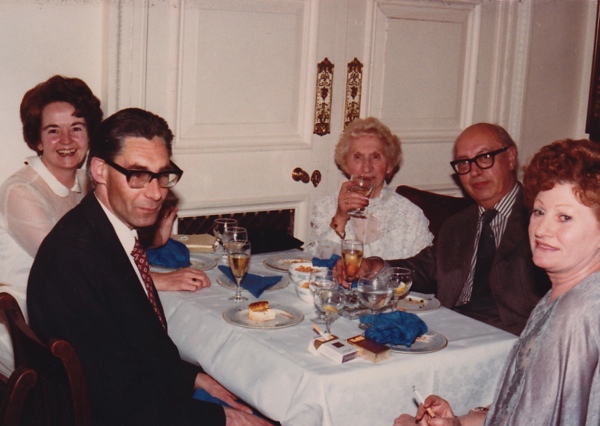
Les at dinner with “the old man” – Jack Keens in the nineteen eighties.
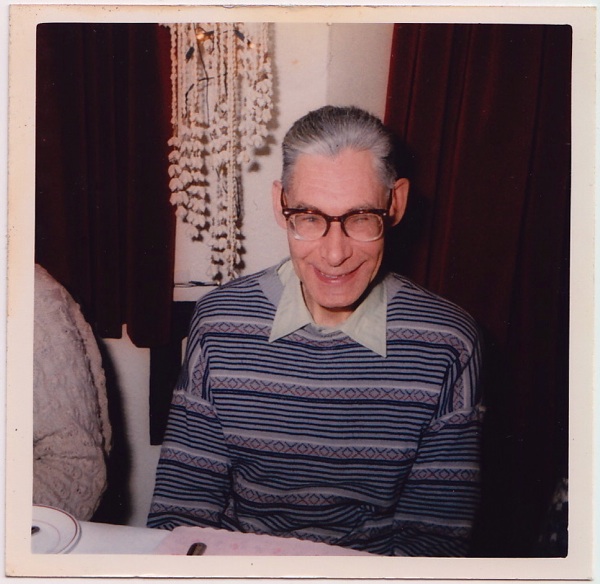
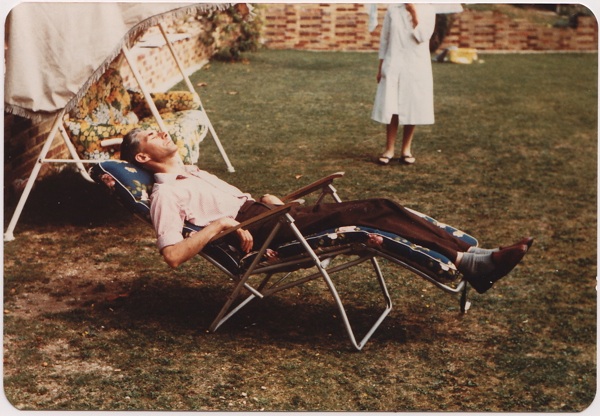
Jack Keens took this photo while Les was staying the weekend at his house.

Les Wilkes’ last boss, Ian Keens – “He was very keen on John Wayne, so between the staff we went out and bought that figure for him for his birthday on Christmas Eve.”
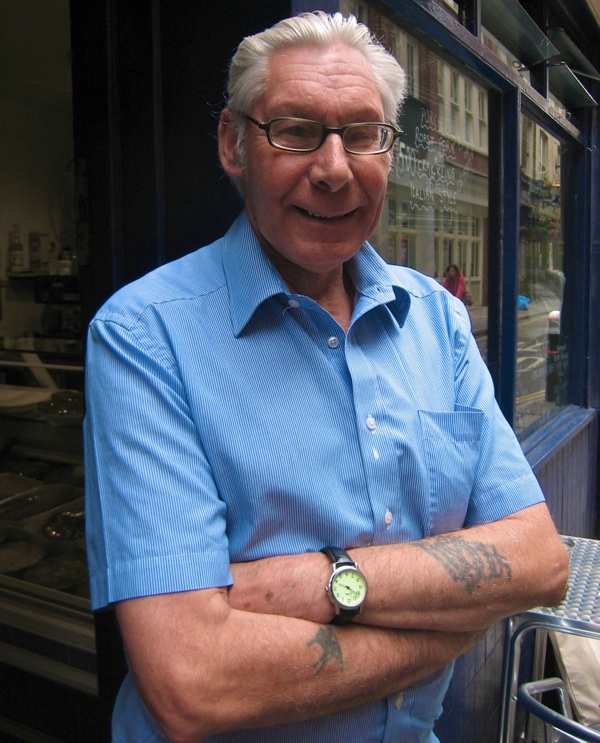
Les Wilkes
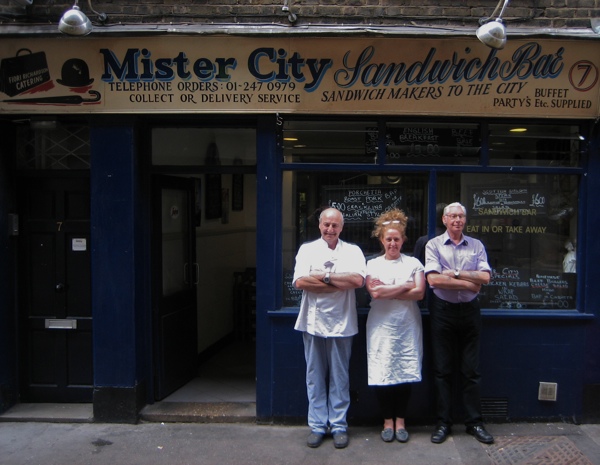
Les Wilkes with Roberto & Mirella Fiori
You may also like to read about At Mister City Sandwich Bar
At Mister City Sandwich Bar
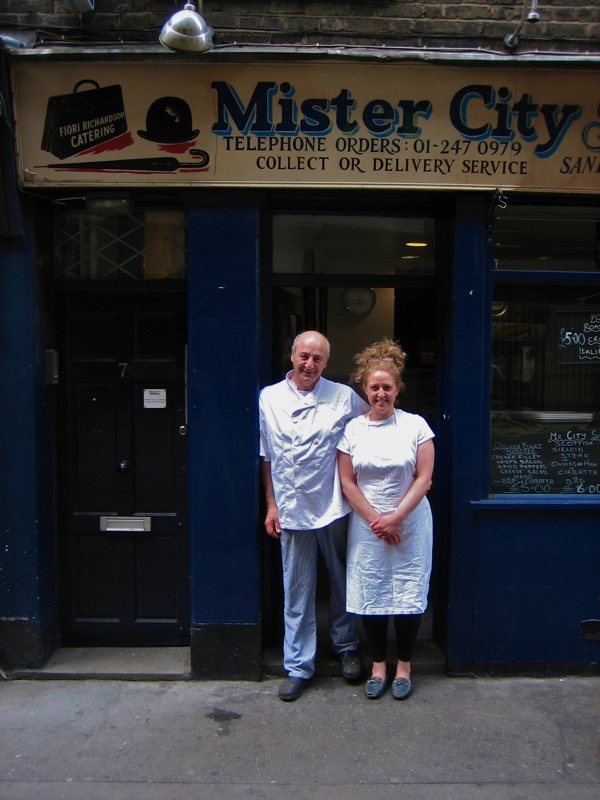
This is Roberto & Mirella Fiori, proprietors of the justly renowned Mister City Sandwich Bar in Artillery Lane, Spitalfields, open weekdays all year round except Christmas Day and Boxing Day. Celebrated among the offices of Bishopsgate and the City, this is the place where the hungry souls of those struggling in the corporate rat race can seek honest sustenance. Open from early, this tiny family establishment with its attractive blue livery and characterful signwriting offers a haven of sanity and good humour in the midst of the madness.
Step in amongst the throng at the Mister City Sandwich Bar on any lunchtime and you find yourself in a tiny theatre where the flame-haired Mirella sharpens her joyous repartee whilst keeping the orders moving at a ferocious rate. “We do have a laugh,” she confessed to me with a smirk, rolling her eyes knowingly and tossing her golden curls, “the customers, they’re not happy until I tell them off – they come for the abuse! Abuse first, food second, it’s the personal touch.”
When I arrived, the lunchtime rush had long departed and even Artillery Lane itself had emptied out of people. Afternoon shadows were lengthening in this ancient narrow street that miraculously retains the tranquil atmosphere of a backwater despite being so close to Bishopsgate.
I found Roberto had ascended from the kitchen to idle on the pavement discussing horticulture with a policemen, from the station round the corner opposite Liverpool St. Yet I was able to persuade him to join me for a cup of tea at his sole pavement table and tell me the story of his wonderful cafe that has such a distinguished pedigree within the noble tradition of Italian City cafes.
My dad’s cafe was Dino’s Cafe in Crispin St next to the Spitalfields Market and I worked there from the age of twenty-three until it closed, and I’m fifty-eight now. He was the cook for Dino Cura and his brother who first opened the cafe after World War II serving the market porters, and when they both retired at the age of forty-five and went back to Italy, they asked him to take over. Me and my brother Ernesto (known as Ernie) worked there with Terry Richardson (my brother in law), until the Spitalfields Fruit & Vegetable Market moved out to Leyton in 1991. They gave us a space for a cafe at the new market and Ernie & Terry still run Dino’s Cafe there today, while I came here to Mister City with Mirella, my wife, and Danieli, my son.
When I used to work in the market, I got up at three each morning and worked till midday, but now I’m finding it hard to get up at five and work until four-thirty. I go to Smithfield to buy fresh meat every morning and then I bring it back, and cook it, and sell it. All the other cafes, they buy it pre-cooked but we do it the old-fashioned way. It’s the only way I know, I learnt it from my father since I left school. Customers come in for breakfast and say “What’s for lunch?” I say, “I don’t know, I haven’t been to the market yet!”
My other son, Massimo, he works in Grosvenor House, he’s a proper chef – I’m a cook not a chef. I’m good but I could never go and work in a proper restaurant, I can cook a steak or a chop. He leaves me standing, talking about things I’ve never heard of. It’s all about sauces and cooking temperatures. He touches a steak to know if it is cooked, whereas I can look at a steak and I can tell if it’s cooked, or rare or well done. We sell a lot of roast pork, it’s a speciality of ours yet I can’t explain to you how to do it, I just know when to turn up the heat. It’s all experience. I do specials each day but I only cook so much because I like to make it fresh and sell out. I cook Bolognese sauce like my mother taught me. I always say, “If you go to Prêt à Manger, you’ve got to have what they give you, if you come here you can have what you want. We’ll make it in front of you, exactly how you like it.”
Ever since the crash, all my customers are constantly being shifted around. There’s one guy who comes in here whose job it is to shuffle everybody at the Royal Bank of Scotland. Another customer, he told me there used to be one hundred and eighty people in his division and now there’s thirty-five, and they’re expected to do the same work.
We used to have this lovely man, Richard, who came in every day for breakfast and lunch. Then, one day, he came in for breakfast and said, “See you for lunch,” but he never came back. When he arrived at work, they said, “Wait there,” gave him his things in a box and told him, “Your services are no longer required.” He came back after three weeks with his daughter to see us. He said,“I can’t get a job, my wife’s gone back to work.” Another man said to me, “If we make money, we get a bonus but if we make a loss, we just get our wages. We can’t lose because it’s not our money we’re gambling with, it’s other people’s money.” A lot of them have lost their jobs now.
I was fascinated by the recognition of mutual difference and the respect that exists between the members of the Fiori family and their customers from the world of high finance. While the rewards are potentially higher for City workers, there is appreciation that the Fiori family enjoy self-respect for working hard in their dignified endeavour over all these years – producing good quality food which is superior to the chains that surround them.
Roberto’s wife Mirella told me she also comes from an Italian family with a proud cafe tradition. “I used to work over in Scrutton St at the City Way Restaurant in Moorgate for my father Pino Cimelli and my mother Albina, with my brother Luigi.” she explained, “I didn’t want to study when I was at school, I wasn’t very academic, so my dad said, “You’re coming to work for me.””
“When I’m selling someone a roast pork ciabatta or a nice sirloin steak, I can see their body language, they’re rubbing their hands together because they can’t wait to eat it.” Mirella continued, her eyes sparkling with delighted emotion, “I sell food with confidence, because I know what goes into it. If it costs five pounds, I know it’s worth five pounds.” And the pride of the Fiori family and the triumph of the Mister City Sandwich Bar is that this is a concept of value which City workers have embraced enthusiastically.
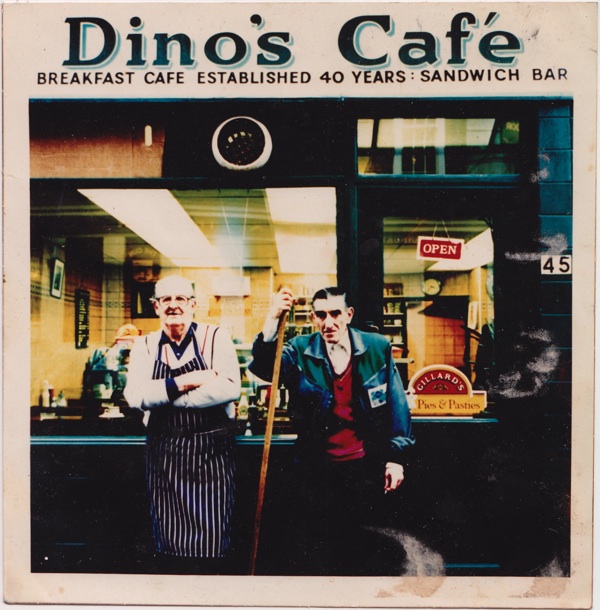
Roberto’s father Angelo Fiori with Cuzzi the street sweeper in the nineteen eighties outside the former Dino’s Cafe.
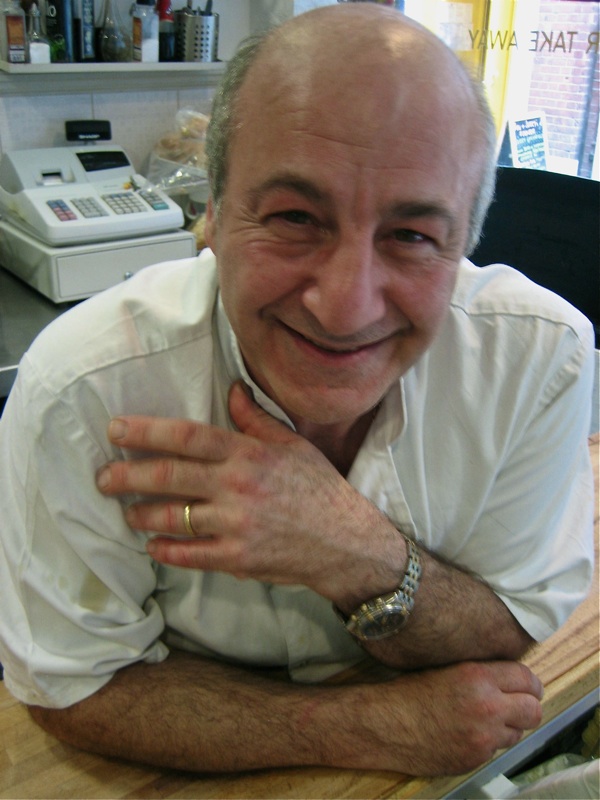
Roberto Fiori “- I cook Bolognese sauce like my mother taught me.”
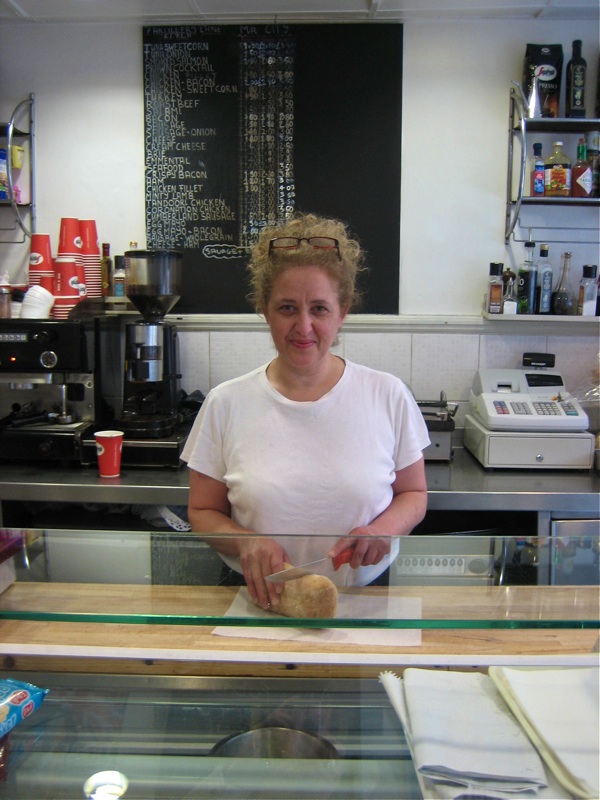
Mirella Fiori
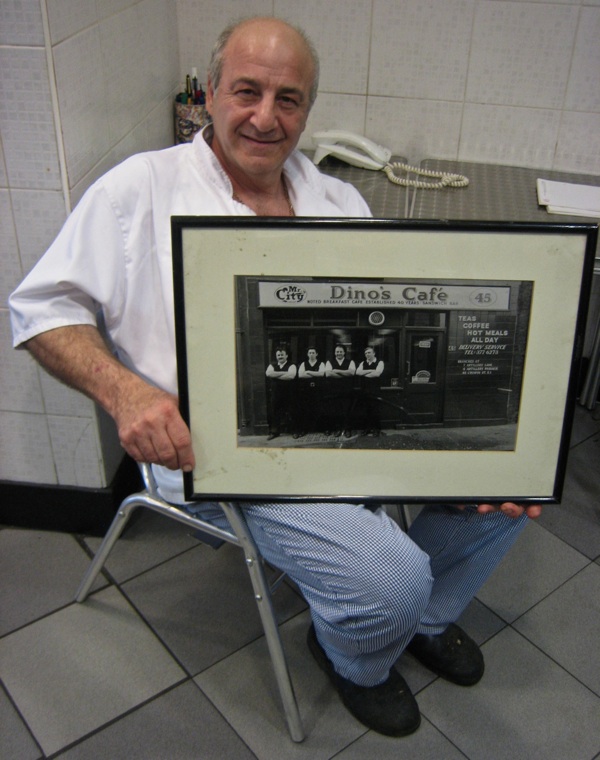
Roberto shows the picture of the former Dino’s Cafe in Crispin St, he is second from the right.
Robert & Mirella Fiori with Les Wilkes
You may also like to read about
Boundary Estate Cooking Portraits

This is Julie Begum of the Boundary Women’s Group dishing up a curry that she cooked for Spitalfields Life contributing photographer Sarah Ainslie. It was part of a collaboration between Sarah and members of the group, in which they cooked food and Sarah took pictures – and, as a consequence, both parties have enjoyed getting to know each other over some delicious meals. Naturally, I took the opportunity to join the feast, dropping in to one of the weekly meetings, that take place every Tuesday morning at the St Hilda’s Community Centre on the Boundary Estate, to learn something of what it is all about.
“I’ve been coming since 2005,” explained Sabeha Miah, who runs the group today, “I moved here and I had a young son, and I felt very isolated – but being in the group gives you a chance to breathe and you feel part of something bigger.” When Sabeha first joined, the need was for language classes and so the group all learnt English together. Subsequently, interests have broadened into other kinds of activities including a financial literacy course, the creation of an ambitious tapestry that was displayed at the Museum of London and the development of a food co-op which allows local people to buy food at low prices.
But at the core of the endeavour is cooking and conversation – providing a rare opportunity for these women to talk freely amongst their peers and discuss serious issues such as politics, sex education and the place of religion, all whilst preparing and eating a meal together. “I’m forty-two and I have been coming three or four years,” revealed Julie Begum, talking plainly, “We talk about being women in London, trying to run our lives and make other people happy too – all the things we need to do.”
Once the food was cooked, we helped ourselves from the dishes laid upon the counter, engendering lively curiosity over the different recipes employed, which gave full scope to the wit and raucous humour of the members of the group. “I really look forward to coming every Tuesday. My child is seven and I am at home the rest of the week,” the softly spoken Halima Khatun confided to me as the conversation level subsided and a hush descended upon the table while we savoured our food. “What could be more civilised?” I thought as a satisfied silence presided, “- than a group of women meeting each week to share their experiences over lunch.”
Sarah offered the opportunity to the members to have their portraits taken and you see some examples of these collaborations here. “The consensus was they wanted the portraits to be quite formal and they brought outfits to wear,” explained Sarah,“they chose how they wanted to present themselves.” From Sarah’s fascination and the excitement of the women at exploring photographic images of themselves, I could see this was only the beginning. “It quickly evolved to the point where they said, “Are you coming next week?”” Sarah confessed to me, delightedly, “I’ve become part of the group now and I’m going back to do more.”

Sabeha Miah’s recipe for Onion Bhajis Finely slice some onions, coriander, fresh chillies and ginger – roughly mix up together by hand. To this mixture add half and half mix bison (chick pea flower) and plain flour until all mixture is coated. Slowly add some warm water to this mixture until a smooth batter is formed around the onions etc (adding more water/bison/flour if you feel it is needed). In a deep frying pan with an inch depth of hot vegetable oil, slowly drop ping-pong ball sized blobs of the mixture in, turning once or twice until golden, then remove. Eat while fresh and warm!

Sufia’s Fish Curry Recipe Fry onion, green chili, bay leaves, curry powder, salt and coriander in oil, then add fish, then water. No need to cook long – the fish is ready quick.


Mahmuda Jaigirdas – in her Asian clothes

Sultana Begum – My husband likes to get in the kitchen. I used to say, “Get out, I’m the woman! The kitchen is my domain – if you got any suggestions you can cook it yourself!” Now he does cook, things he’s watched me make. He says, “You have to stand there and really lovingly watch your curry while it cooks.” I say, “No,” while it simmers, I go on the internet.

Mahmuda Jaigirdas – in her western clothes


Julie Begum’s recipe for Sardine Curry This is my favourite quick home cooking recipe after a long hard day’s work. Ingredients – half a kilo of sardines, two tomatoes, one onion, three green chilis, one teaspoon of red chili powder, half a teaspoon of turmeric powder, one teaspoon of coriander, one piece of ginger, eight cloves of garlic, one dessert spoon of lemon juice and salt as required. Procedure – Cut and clean the fresh sardines (score on both sides) or just open the tins ( I prefer the ones in tomato sauce). Heat oil in a pan. Add sliced onion, green chili, ginger, garlic and saute well.To this, add red chili powder, turmeric powder, salt, lemon juice and tomato slices. Saute well until tomatoes are done. Add water as required and until fish are cooked. Serve with fresh coriander and a slice of lemon with white basmati rice. Yum!

Sabeha Miah – her recipe for simple Dhal Add dhal (two hundred grams of red lentils) to a pot and wash until water runs clean. Put on a stove on a medium heat. Add a teaspoon of haldi (turmeric), salt to taste and a bay leaf. Leave pot covered, stirring from time to time, until all the dhal has turned mushy. Once at this stage – In a frying pan containing two tablespoons of hot oil, add four cloves of crushed garlic and three to four dried red chilis. When garlic has browned and chilis have turned a very dark red, add to the pot of dhal and stir in ( be careful as the oil and dhal will spit). Add chopped coriander to finish.

Jobeda’s recipe for Ghajjar Ka Halwar Ingredients: dozen grated carrots, half pint of milk, sugar, cinnamon sticks/cardamon, little bit of single cream, raisins, ghee and mixed nuts. Step one – boil milk with sugar, cinnamon sticks, cardamon, add the grated carrots and let it cook for thirty minutes. Step two – add single cream, for extra sweetness, and raisins after fifteen/twenty minutes. Step three – stir in ghee in the last five minutes. Step four – add mixed nuts for decoration. End result all milk should be gone.


Photographs copyright © Sarah Ainslie
You may also like to take a look at the Curry Chefs of Brick Lane
In Search of Untamed London
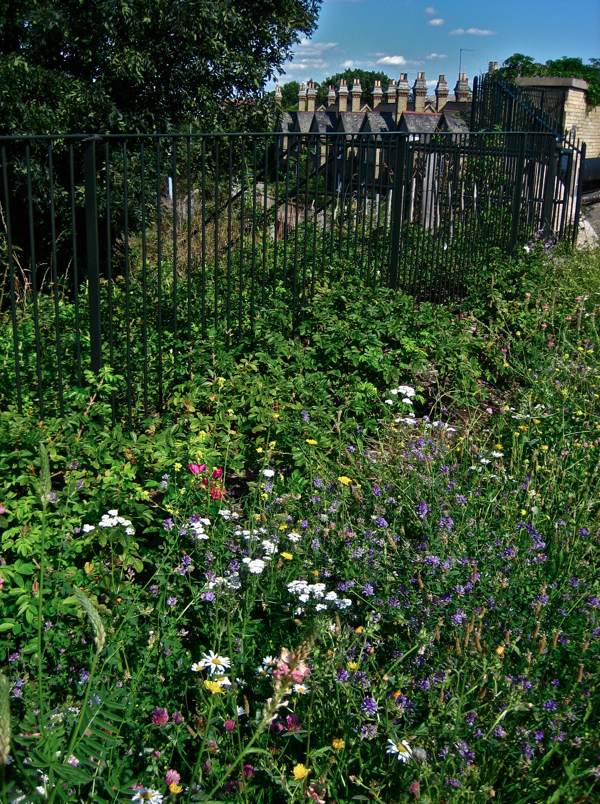
On these hot dusty Summer Sundays in July, I get a longing to go on country rambles – a desire that is not easily fulfilled in Spitalfields – but when the esteemed Herb Lester Associates asked me to contribute some introductory words to their map of Untamed London and then a copy arrived in the post this week, it inspired me to seek out the best approximation of such a walk without leaving East London.
I shall never forget the first time I was driven in a car from the West End out past Hyde Park as a child, and I thought “London is a big city, but we’re in the country now.” I had a similar feeling as I stepped onto the Green Way at Hackney Wick, with its innate bucolic promise. Yet, although there was a certain delight to be savoured from walking upon this former railway embankment lined with wildflowers while gazing upon the industrial landscape on either side, I had not bargained on the Green Way leading me through the centre of the site of the 2012 Olympics. On one side towered the vast white stadium, looking as if it had just landed from Outer Space, and on the other side bulldozers were at work, flattening acres of land as far as the eye could see – I think we may categorise this as “Tamed London.”
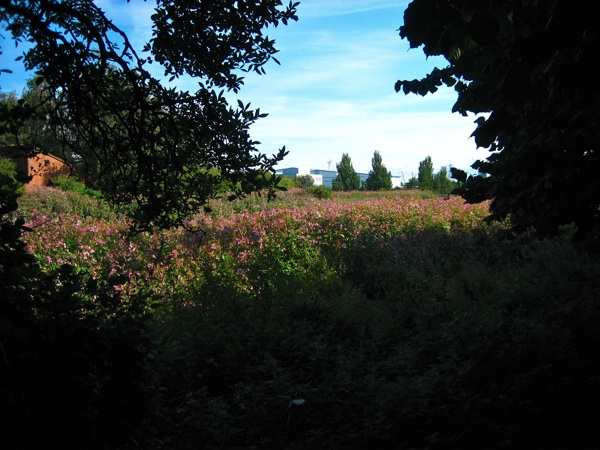
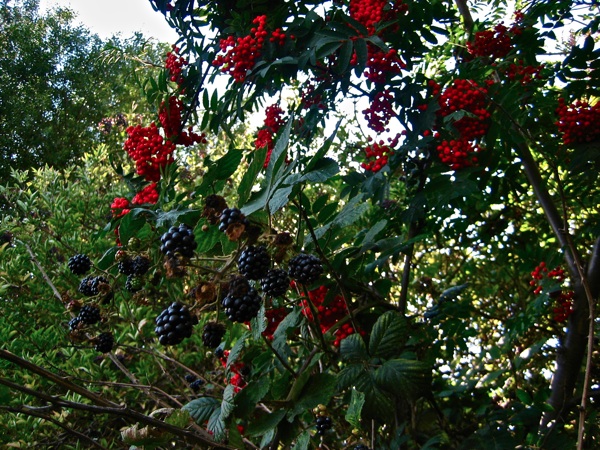
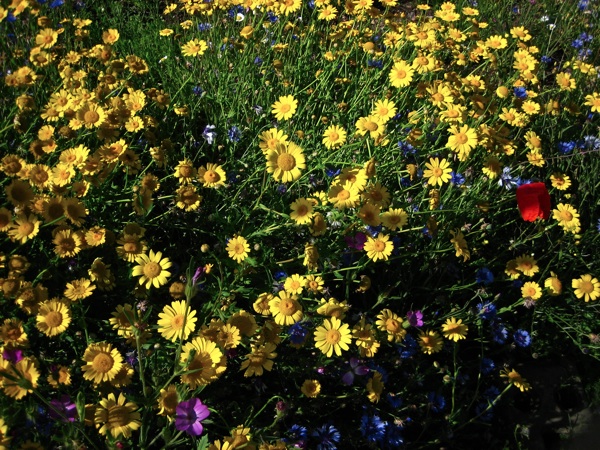
It was a relief to leave the Stratford Marshes behind – marshes only in name now – as I headed South-eastwards upon the Green Way towards the Mills Meads where I took time to appreciate the extraordinary dense variety of wild flowers growing beside the path including cow parsley, clover, yarrow, coltsfoot, vetch, rosebay willow-herb, buddleia and mallow. At this moment of high Summer, the dominant colours are pink and blue, and there is a sweet scent drifting on the soft breeze for anyone that choses to stand and contemplate. Already now in mid July, the rose hips have reddened and blackberries are ripe on the briars. And, from this raised causeway, I took great pleasure in pausing to peer down into some beautiful back gardens overgrown with creepers and verdant life – mysterious in their unreachable luxuriance of growth.
Reaching the wide bridge over the Channelsea River where the tide had withdrawn exposing car tyres scattered upon the expanse of mud, I was seized by an impulse to take the narrow overgrown trail that follows the river bank. Climbing down from the Green Way, I descended to a dirt path bounded by undergrowth where the surrounding developments are hidden by leaves. Here, for half a mile you can walk among balsam and willows, where rowan berries and hazelnuts hang over the path, and be shaded from the heat of the afternoon sun by deep foliage. In this narrow neglected strip of land on the river bank, beyond the perimeter fence, for the first time in my walk I could say I was in a place that could be described as “Untamed London.”
This path led me to to Three Mills Lock and, passing beside the ancient tidal mill, I crossed over to follow the bank of the River Lee – with a fine coat of green duckweed, undulating barely perceptibly and broken only by the trails of moorhens. And then at Bow Lock, I turned right, taking the cut back to the Limehouse basin (where it was necessary to visit the Grapes in Narrow St for refreshment), before crossing Commercial Rd and wandering up through Stepney to the fine old church of St Dunstans. From here I walked along the road where a path once ran across the fields to Spitalfields, now absorbed into the street network as Stepney Way, meeting the Whitechapel Rd at the Bell Foundry – here it still retains the name of Fieldgate St.
My hunger for roaming was satisfied, and in the very margins of the fringes of the city, I had discovered consolation in green places new to me. Although I set out to find “Untamed London,” as if it were a separate location, I realised that “untamed” is a relative concept, and everywhere a weed pokes its defiant head up may, to some degree, be described as “untamed.”
Nature accommodates and hangs on as tenaciously as we have been thorough to obliterate it. I often think of the dwarf oaks pointed out to me by the Mudlark in the river bed at Limehouse Reach, part of the primeval forest that was here before London, and of the broadleaf forest that has grown up and overtaken Bow Cemetery in recent years. One forest reminds me of the Untamed London that was here before we came and the other forest presages the Untamed London of that indeterminate future, after we have all gone.

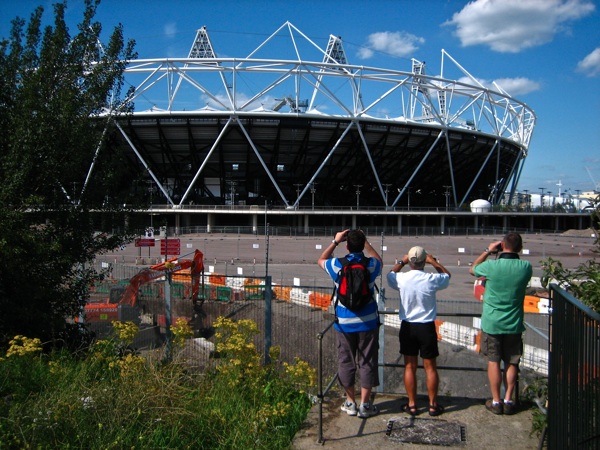
The vast white stadium, looking as if it had just landed from Outer Space

Beside the Green Way
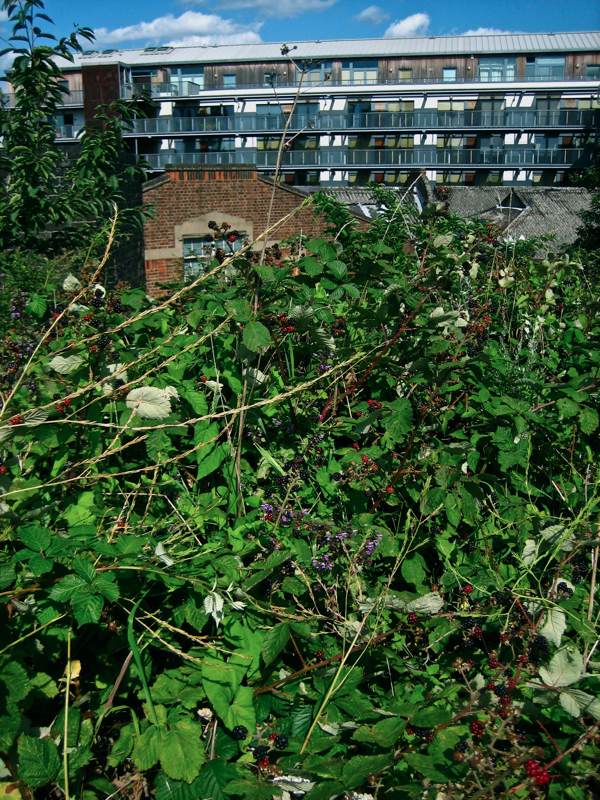

Gardens, mysterious in their unreachable luxuriance of growth
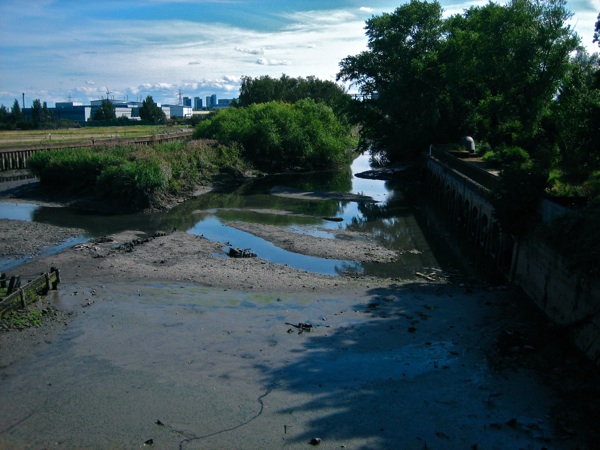

In the Channelsea River

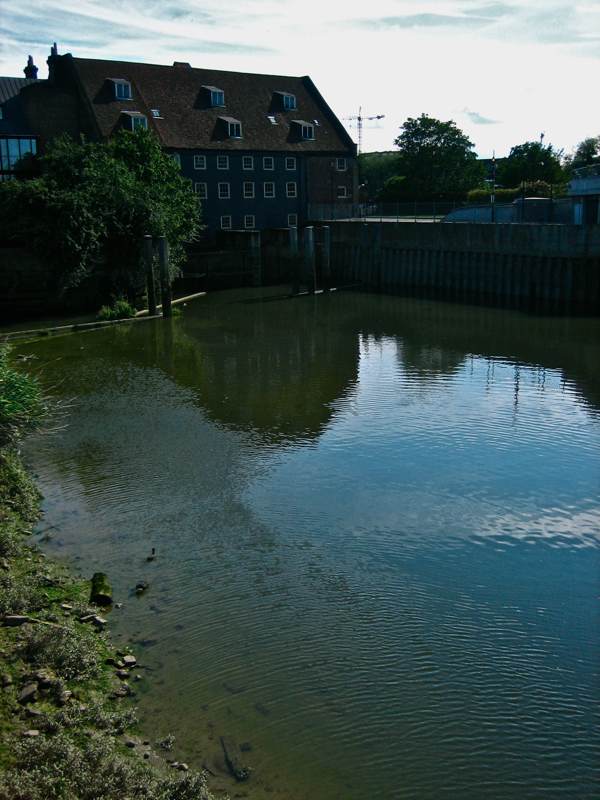
The Tidal Mill at Three Mills Island

Oasthouses at Three Mills Island
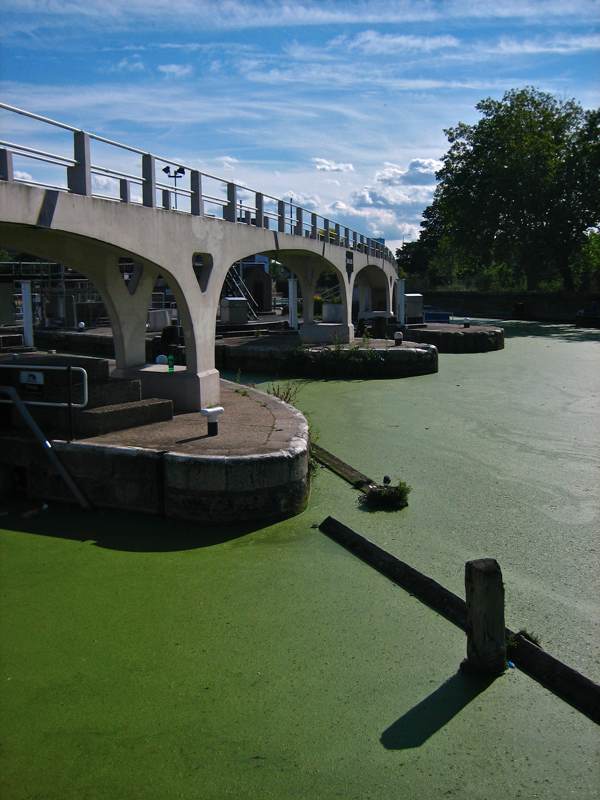
A lone moorhen’s nest

Duckweed at Bow Lock

The path home through St Dunstan’s churchyard.

The map of UNTAMED LONDON with some introductory words by yours truly is available directly from Herb Lester Associates
You may also like to read about
Phil Maxwell’s Brick Lane
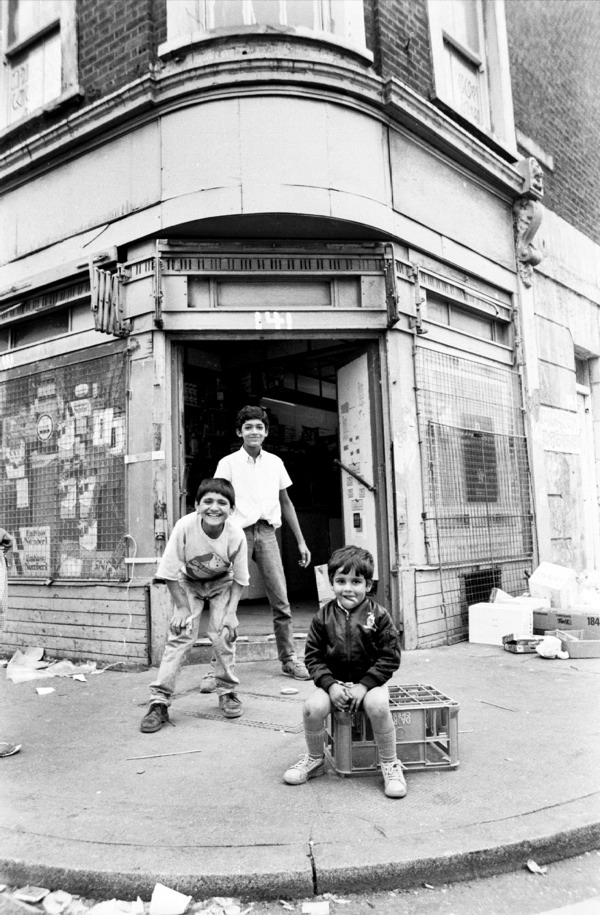
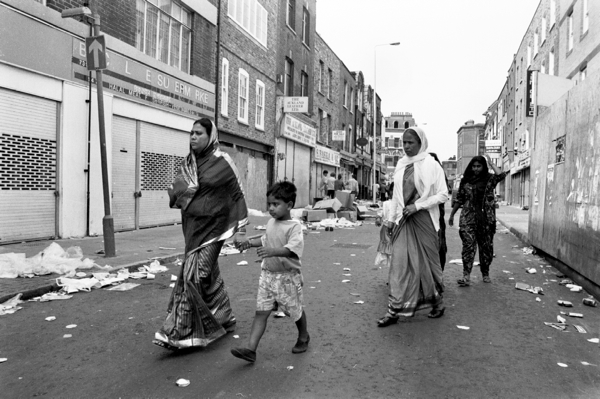
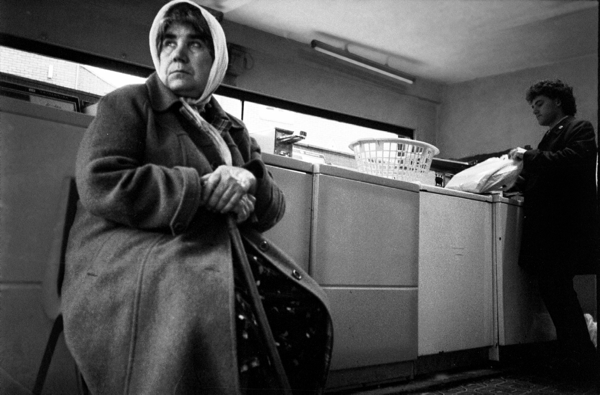
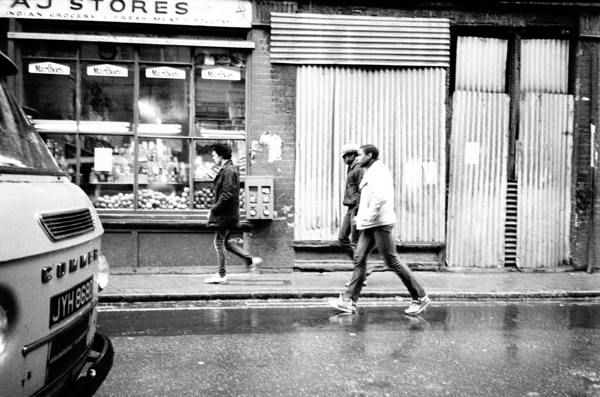
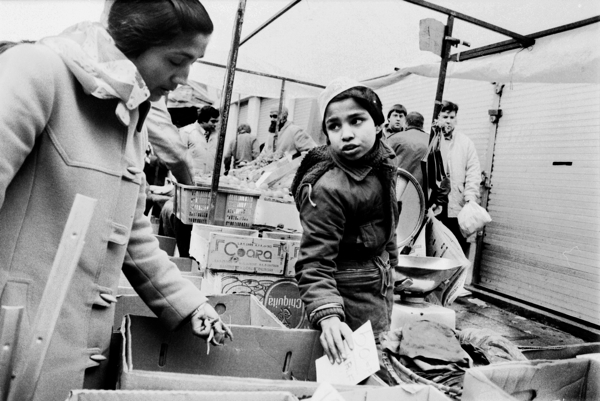
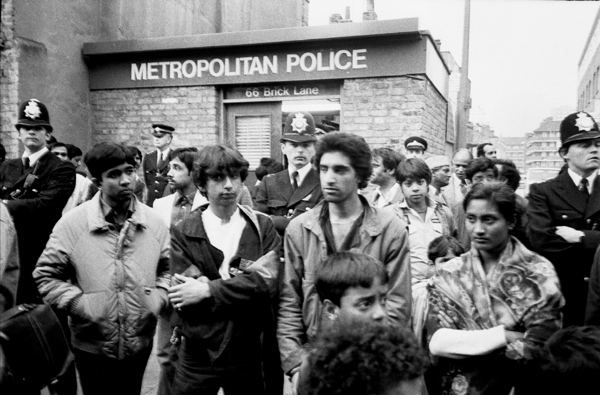
Phil Maxwell is the photographer of Brick Lane – no-one has taken more pictures here over the last thirty years than he. And now his astonishing body of work stands unparalleled in the canon of street photography, both in its range and in the quality of human observation that informs these eloquent images.
“More than anywhere else in London, Brick Lane has the organic quality of being constantly changing, even from week to week.” Phil told me when I asked him to explain the enduring fascination for a photographer. “Coming into Brick Lane is like coming into a theatre, where they change the scenery every time a different play comes in – a stage where each new set reflects the drama and tribulations of the wider world.”
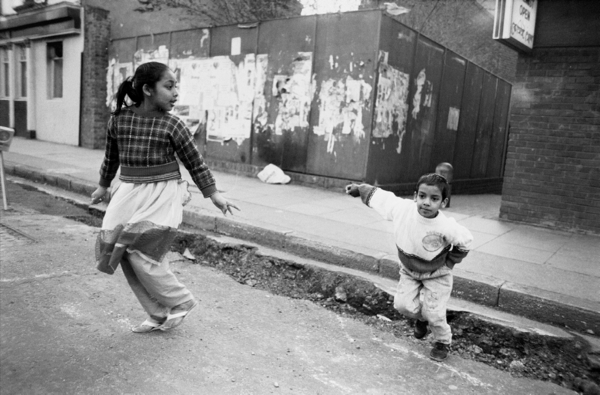
Phil’s work is distinguished by a strong empathy, drawing the viewer closer. In particular, he is one of few photographers to have photographed the Bengali people in Spitalfields successfully, winning the trust of the community and portraying many of his subjects with relaxed intimacy. “That’s because I live on the other side of the tracks, and the vast majority of my neighbours are Bengalis – I’ve been to Bangladesh at least half a dozen times.” Phil revealed, “The main problem that Bengali families face is overcrowding, with parents and four or five kids living in one bedroom flats. That means their living space is not enough to be able to socialise and express themselves freely. And so, Brick Lane tends to be the place where they can feel free to be themselves and communicate with each other, in a way they can’t at home.”
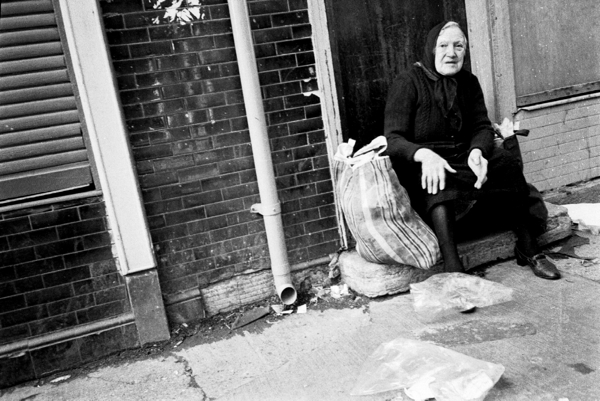
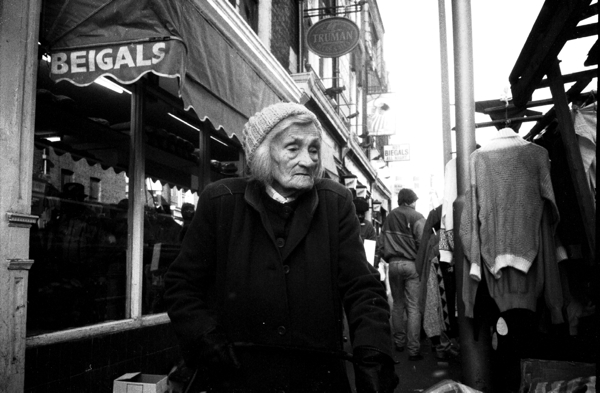
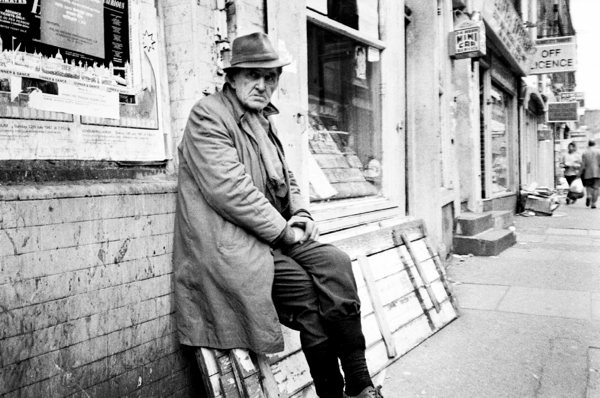
When I confided to Phil that the lyrical quality of his portraits of old people appealed to me especially, he pointed out the woman with white hair, enfolding herself in her pale overcoat. “She seems bemused by what is happening round her, but in her appearance she is very much part of the built environment that surrounds her.” he said, thinking back over the years “I find older people have a kind of demeanour which derives from the environment they’ve been living in, and because of that they’re more interesting to photograph.”
In its mutable nature, Brick Lane presents an ideal subject for photography – offering an endless source of fleeting moments, that expose a changing society within a changing environment. And, since the early eighties, Phil Maxwell made it the focus of his life’s work to record this place, becoming the pre-eminent photographer of Brick Lane. “Whenever there’s a big fight on Brick Lane, the papers will send a photographer down to get some images, but that photographer has no relationship to the community.” Phil explained to me, conceding, “If my work has any authenticity, it is only because I live here in the middle of the melting pot, and I prefer living here to anywhere else.”
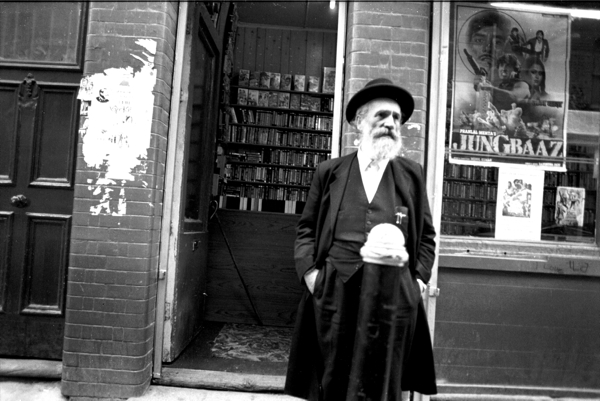
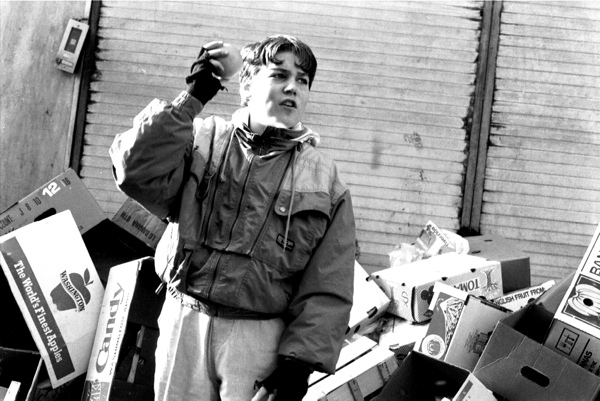
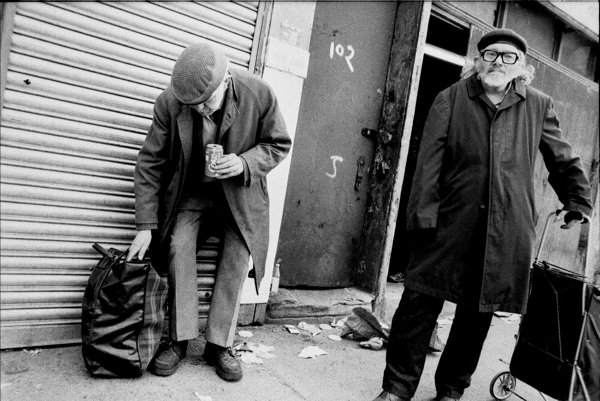
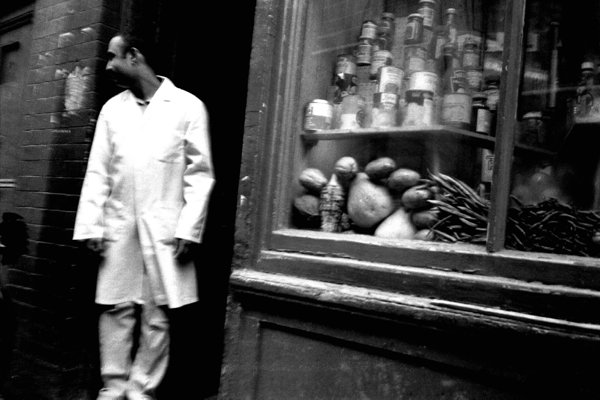
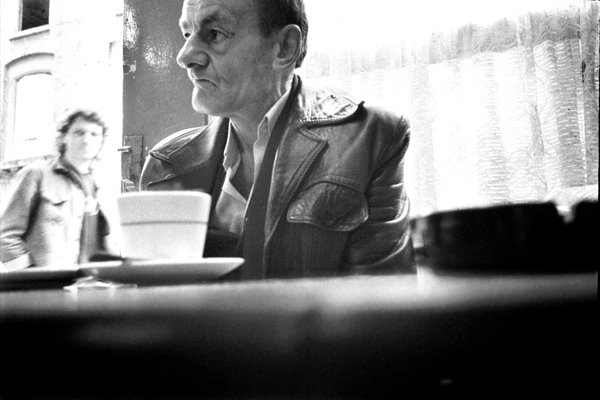
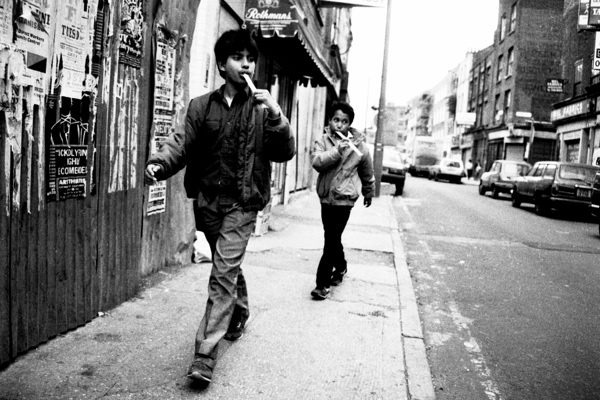
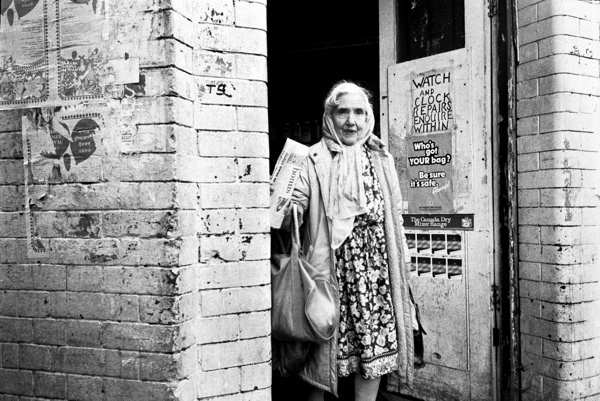
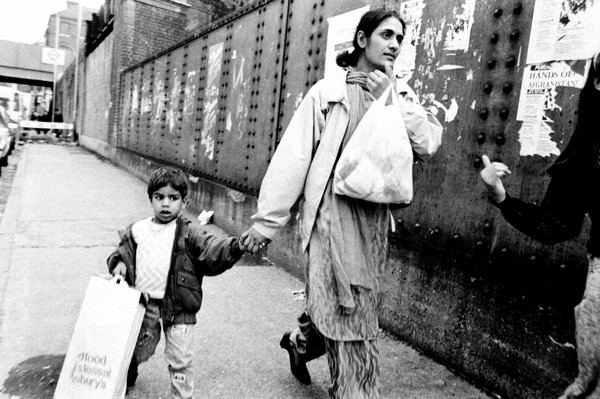
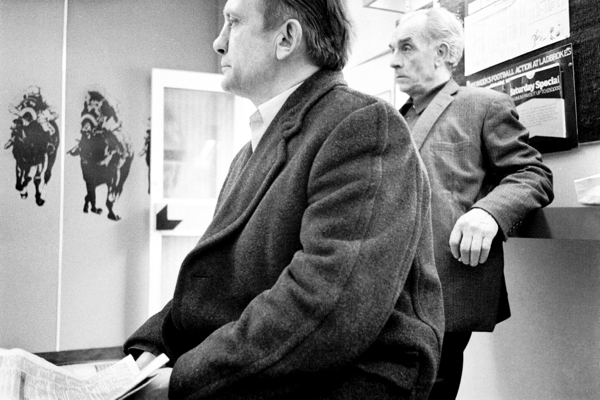

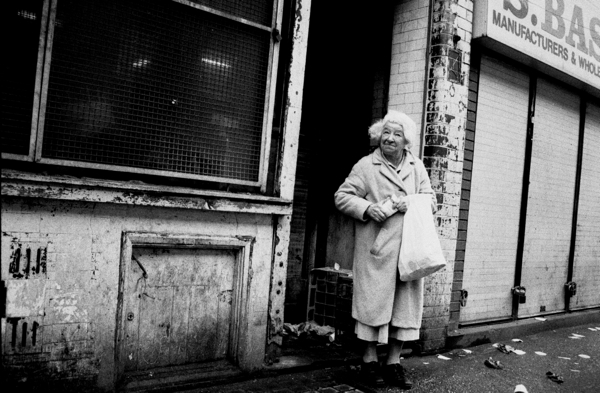
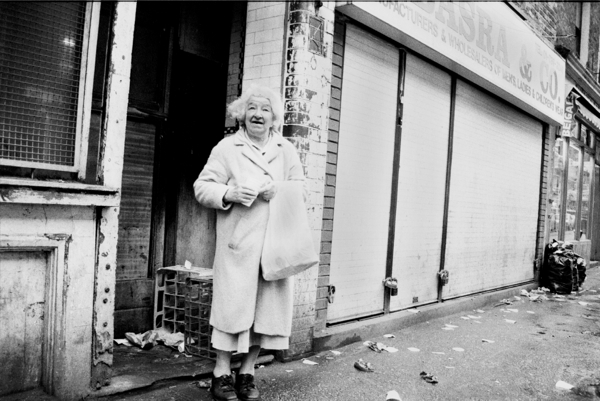
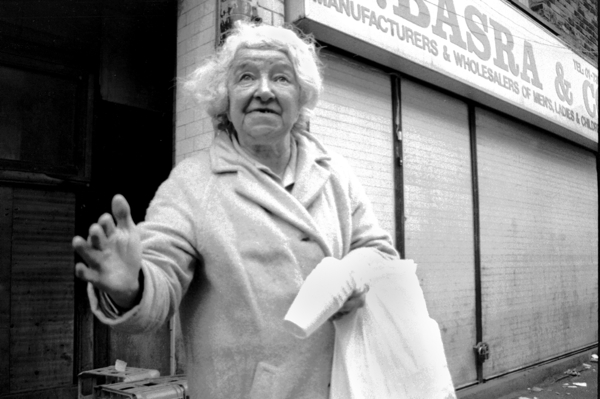
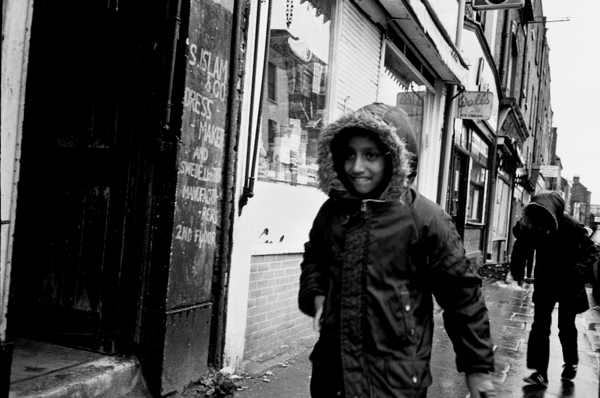
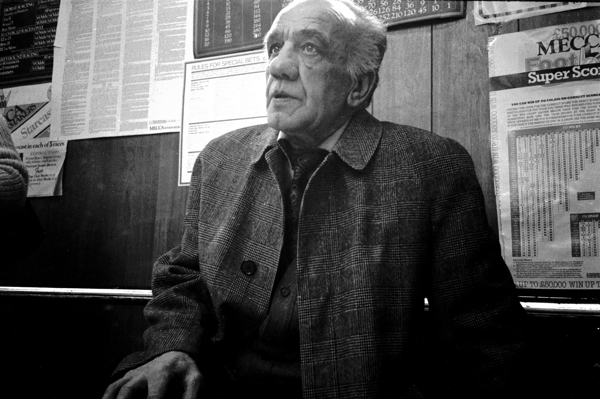
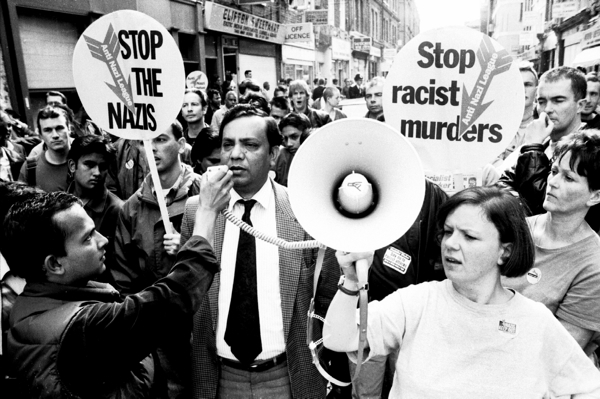
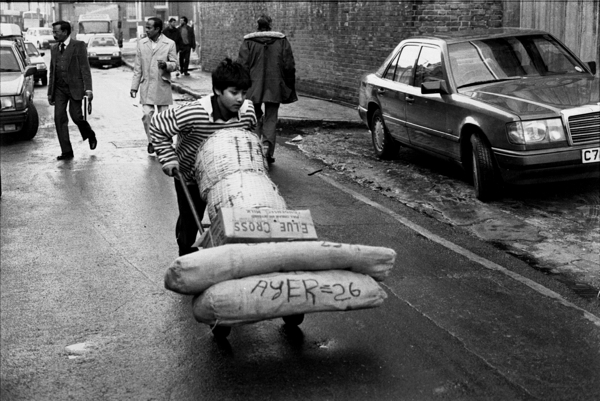
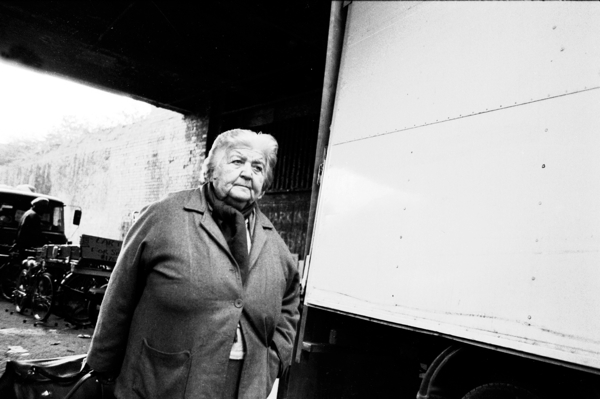
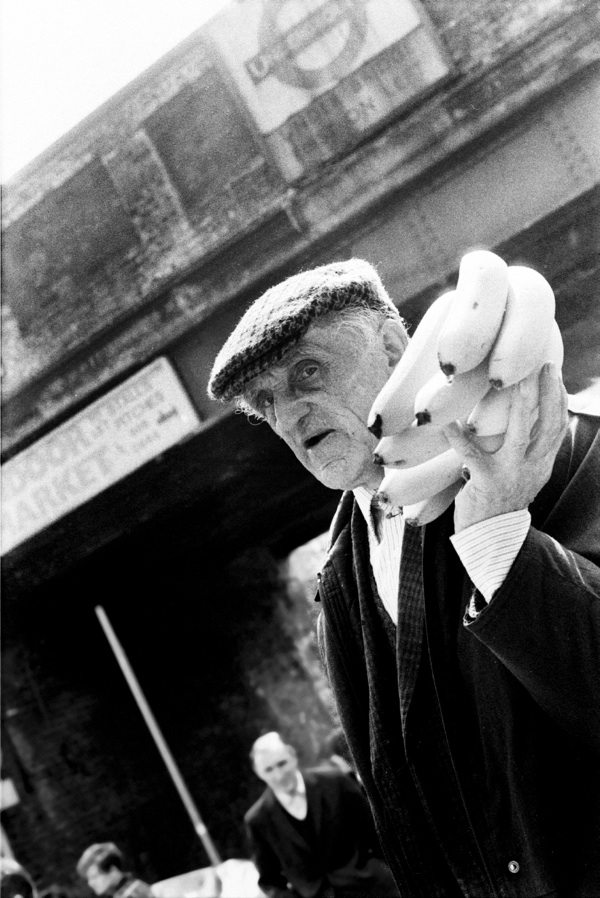
“The bananas, the bridge and the man are all gone now.”
Photographs copyright © Phil Maxwell
Phil Maxwell’s latest exhibition A Sense of Place: Living in the East End runs at the Rich Mix in the Bethnal Green Rd until Saturday 6th August, and I recommend Phil’s daily photoblog Playground of an East End Photographer.
More pictures by Phil Maxwell
Olive Besagni, Assistant Film Editor
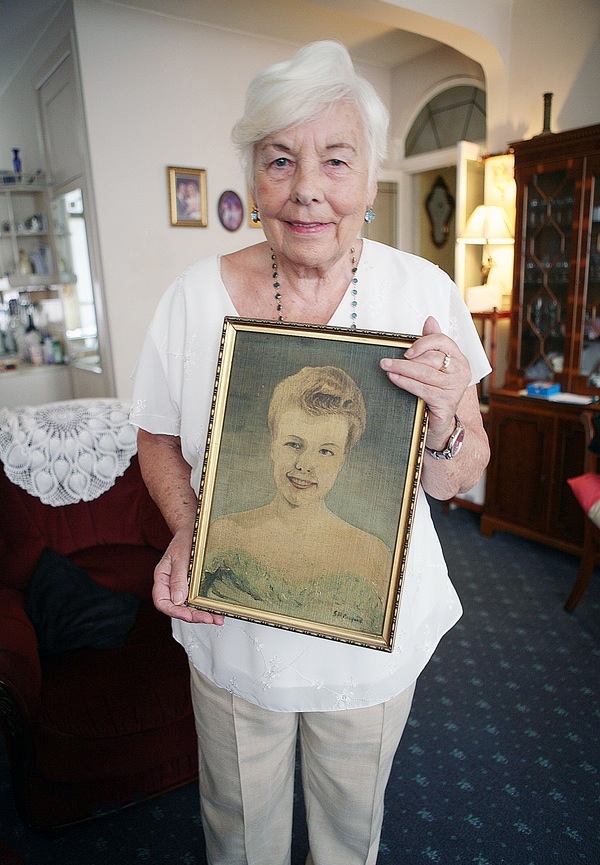
This is Olive Besagni at eighty-five displaying a portrait of herself at nineteen. I think I can detect a hint of swagger in her eye, but let us grant Olive this indulgence because she has embraced existence with such exuberance and good humour over all these years that it is her right to a little chutzpah.
Olive is standing in her flat in Myddleton Sq in Finsbury where she has lived since 1956, just half a mile North of Clerkwenwell where her grandfather Giovanni Ferrari arrived from Borgotaro in 1880 to teach English to the Italian immigrants. Giovanni was a clever young man who loved to teach, and since most of the Italians needed to learn English if they were to advance, he became a very popular figure, known as Maestro Ferrari.
Giovanni’s eldest son Guiseppe (known as Joe) married Netta Oxley, an Englishwoman, and they moved to Gospel Oak where Olive was born in 1925. Then, when Olive was eleven they moved to Hampstead and at fourteen, upon the outbreak of war, she was evacuated to Rutland where she delighted to write sketches for performances in the village hall. Consequently, Olive grew up knowing little of the crowded Italian slum centred around Back Hill in Clerkenwell, that was the focus of the Italian community in London.
When I finished school, my parents wanted me to go to work in an office but I preferred to spend my time at Parliament Hill Lido and so I went for a few interviews that I messed up purposely. Finally, my father got a letter from a friend who ran a factory making religious statues, saying “Do either of your sons want a job?” It was in Great Sutton St in Clerkenwell and I went to work there, painting the lace and the gold lines onto the statues. Since I grew up in the suburbs, this was the first time I saw Italians in the raw but, once they discovered I was Maestro Ferrari’s granddaughter, they were very kind to me. And amongst the younger men was a sixteen year old boy called Bruno Besagni who worked as an artistic sprayer.
But I got bored with it there, and I found a job as a trainee negative cutter at a small documentary company in Dean St called Realist Films. They made mostly black and white films for medical students with close-ups of operations. I was only eighteen and there was a film of triplets being born, in colour, that I found especially traumatising, even more so than people having their legs removed. Yet I became an assistant film editor eventually, and from there I went to the best job I ever had – at Pathé Films in Wardour St.
I worked for Alexander Wilson Gardner making short pieces of film that could be inserted into news reports. We made a sequence about Christian Dior’s “New Look.” They had a model to wear the short hem and I had to appear as the legs of the woman in a long skirt. While I was there we discovered all these old reels, from the nineteen twenties and earlier, in the basement. We had to sort them out and I remember finding the film of Churchill dodging the bullets at the Battle of Sidney St. It was quite something, all these old cans of film, and it was exciting because it was all new to me.
I loved it, I absolutely loved it, but when I married Bruno Besagni and had two children, I was at home for five years as a housewife and mum. Then Alexander Milner Gardner rang me up and said “Do you want a job?” So I said, “I’ll ask my mum,” and she came and stayed with my children each day, and I went back to work. But very shortly, Alexander Milner Gardner died and my mother decided to go to America to see her other daughters, and I had to leave again. I pottered about doing freelance work. Commercials started then and I edited Butlins’ first adverts. But I resented leaving Pathé and I never became an editor because you had to do six years as an assistant editor before you could qualify.
I did all sorts of bits and pieces until I got a job in the Media Resources department at Kingsway College in Sans Walk, Clerkenwell. I had to work this horrible dirty old printing machine, and the boss didn’t like me because he thought I wasn’t young and he wanted a glamorous girl – but I didn’t mind because I have a sense of humour. I said, “I write plays, I can be a bit of a nuisance sometimes.” And he said, “Never mind, do it here!” So I wrote my plays there and they printed them for me and life was a ball.
I love razzmatazz and I used to write stuff for my friends, old time music hall etc, to entertain the old people at my church. Then one of the youngsters said, “Can’t we do a proper play?” So I said, “I can write something about the Second World War – if I don’t know anything about anything, I know about that.” I wrote a play, “Blitz & Peaces” with a cast of thirty and I produced, directed and acted in it. It was easy for me, and it was so successful, it was full every night. After that, I was offered the theatre at the St Luke’s Conference Centre in Central St. And I wrote and directed shows, one each year, for twenty years – I had this lovely theatre, some very talented actors and we played to two hundred people a night.
These plays, that Olive wrote and directed, dramatised aspects of the experiences of the Italian people in Clerkenwell and were in effect a collective history, performed by descendants of immigrants in front of an audience of their community. Yet in spite of the accomplishment and popular emotional import of these epic dramatic works that occupied Olive for twenty years, the culmination of her talents was yet to come.
This year Olive Besagni published A Better Life, a collection of oral histories telling the story of Italian families in Clerkenwell going back over generations into the nineteenth century. In this authoritative book, Olive tells the story of an entire society, allowing people to speak for themselves yet supplying pertinent historical material to give background to the testimonies. With her experience as an editor and her trained ear as a playwright, Olive was the ideal person to make a record of her people. The only shortcoming – if it may be called that – is that Olive modestly includes very little of her own story, which is why I have endeavoured to tell it here.
I met Olive at the Italian Parade in Clerkenwell on Sunday which she has attended every year since it recommenced in 1946, except for 1948 – because Olive got married to Bruno on the day before the parade that year and she was away on her honeymoon. As a consequence, Olive & Bruno’s wedding anniversary is always the day before the parade and this year they celebrated their sixty-third. “I can’t believe it,” she confessed in wonder, “So many good things have happened to me.”

Olive looking like a Hollywood movie star in the nineteen forties
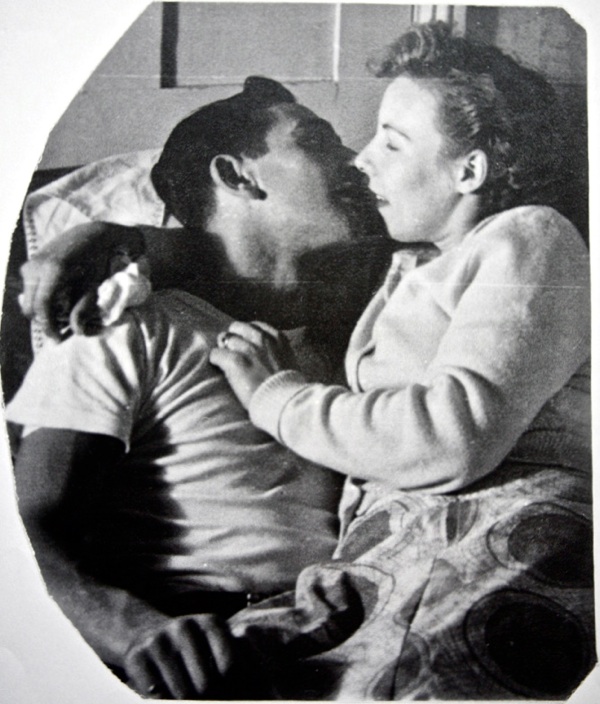
Olive & Bruno

Wedding at St Peter’s, the Italian church, in Clerkenwell, July 1948.

Olive arrives at the church with her father Guiseppe Ferrari (known as Joe).

Olive & Bruno on their honeymoon, 1948.


Olive & Bruno with their children Anita & Tony at Brambles Chine on the Isle of Wight.

Olive & Bruno with their children, Anita, Tony & Nicolette.

On New Year’s Eve

Bruno and Olive celebrated their sixty-third wedding anniversary this week.
 Olive Besagni
New portraits copyright © Colin O’Brien
Copies of A Better Life by Olive Besagni are available from the publisher Camden History Society
You might also like to take a look at the 126th Italian Parade in Clerkenwell












