
Joff Summerfield, Penny Farthing Maker

I met Joff Summerfield in Smithfield at the Penny Farthing Race during the Summer, and yesterday I paid a visit to his workshop at Trinity Buoy Wharf to catch up with him and learn about the extraordinary round-the-world trip he undertook on the homemade contraption in the picture above. At first, I thought Joff was spinning me a yarn when he claimed he had circumnavigated the globe on this eccentric vehicle that I recognised from the cover of “Professor Branestawm” but, in spite of his happy-go-lucky demeanour, there was something in Joff’s intense, almost prismatic, eyes that revealed a steely resolve – and I realised it must be real.
Yet sitting on the Docklands Light Railway in the foggy dusk with the tower of Canary Wharf vanishing into the low cloud and the Dome glowing as if it were alive, I realised I was travelling through a landscape of wonders and thus I was suitably prepared for my interview with Joff. In a modest nineteenth century workshop on the riverfront warmed by an old iron stove stoked with scrap timber, Joff spends his Winter making bicycles. The latest black beauty stood against the workbench, sleek and gleaming and ready to hit the road, while beside it sat the venerable boneshaker with pockmarked green paintwork which you can see in the thousands of photographs Joff took on his global trek, should evidence ever be required.
Outside, the darkness closed in upon us, as I perched upon a carpenter’s bench cradling a cup of tea while Joff stood opposite to tell me his story.
“My original background is motor-racing and I come from a motor-racing family. My dad restored pre-war Rolls Royces and Bentleys, and he raced motor cars. I grew up in a three hundred year old house near Southend, full of antiques and motor parts. Every book I read was about motor engineering. While my friends were kicking footballs around, I was standing in front of a lathe making things. I followed that path and ended up working in Formula One motor racing for five years as an engine builder – although the ultimate goal was always to work for myself.
But then I experienced the shock of having no pay cheque, and that’s when I started cycling to save petrol, getting to and from my workshop. And I fell in love with cycling again, being out on the bike and getting fit. That year for my holiday, I rode a pre-war BSA bicycle to Amsterdam. And I loved it so much, I thought, ‘This is how I’m going to see the world.’ I wanted to make a bike and the silliest thing I could think of was a Penny Farthing. So I went to museum and had a good look at some, and the first one I made took three months. No-one taught me to ride it, I just leant it up against a wall and climbed on and taught myself. Then I rode it to Paris for the millennium celebrations and I learnt a lot on that trip.
I made the second one lighter and rode it from Land’s End to John O’Groats. After that it was a big step, to bring all the knowledge I’d acquired from handling these bikes to cycling one around the world. I had a lot of problems. On my first attempt, I had to abort on the first day because of the pain in my tendons. On the second attempt, I got as far as Budapest but I had a different problem with my kneecaps and I had to come back and have an operation. On my third attempt, my tendons were strapped up and I took every precaution to make sure my legs would be ok, and apart from the odd pull in the knees they were fine. The journey took me two and a half years and I cycled twenty-two and a half thousand miles.
It changes you. Things that upset other people don’t bother me now, because I have seen people who have reason to be upset and they smile. It makes you realise how lucky you are. You see people complaining here about their lot and you just want to give them a shake and say, ‘We’re so damned lucky!’
You see the world news and it’s all stereotyping – but, especially when you’ve been among these people, you realise that the perception of any country is all about the government. Cultural differences don’t matter much if you turn up on a Penny Farthing. If you go through the villages, you meet people who’ve never seen the Westerners before, just those flying past on the freeway in their cars, and they’re very interested and welcoming. The people everywhere were lovely. If you’re going to feel vulnerable this is not the right kind of thing to be doing.
I carried a dog whip, because they can be a problem. The odd stray dogs ran after me in Eastern Europe, fortunately any that have rabies can’t run very fast. In Turkey, the goatherds have these dogs as large as St Bernard’s with big iron collars to stop the wolves biting their throats. You have to whip them off until the goatherd arrives to drag them off you.
Thomas Stevens was the first to cycle around the world on a Penny Farthing in 1884/7. He is buried in North Finchley and I started my journey at his grave. I took a stone with me and returned it when I got back, so he’s been round twice now. You couldn’t follow his route because the roads have moved and the world has changed. I wasn’t setting out to better anything he did. I rode more miles, but he’s always going to be the first.
A year after I got back, I found this little workshop. It’s perfect for me. This is where I make Penny Farthing bikes and pot notches – devices for hanging flower pots. You can’t make a living out of making bikes because they take too long to make. Other people around the world I know who make them all do something else as well. I charge £1500 for a Penny Farthing which is cheap for a handmade bike. I have just made two and I have time to make one more before Christmas. Of all the bikes I have made, only one was resold and it appreciated in value, which was very nice.
The revival in Penny Farthings has been going a lot longer in other countries. There’s a huge following in the USA and Australia – I took part in my first world championship in Tasmania – while here it has only just taken off because the British are snobbish about cycling modern built bikes. Yet we’ve had five races this year. It’s such a spectacle.
Anyone can ride a Penny Farthing. It’s no harder than a regular bicycle, but it takes a half a day to learn to get on and off. It hasn’t changed at all over time, still the same basic frame with hard tyres. You can still have an accident, just as you could in the nineteenth century and it hurts just as much, except the painkillers are better now.
I’d love to go around the world again, there’s lots of things I haven’t seen. I’ve never been to South America or Africa. I’d like to do different routes because there are always different things to see. You’ll never run out of places to visit.”

At the grave of Thomas Stevens, the first to cycle round the world on a Penny Farthing.

In Prague


In Istanbul
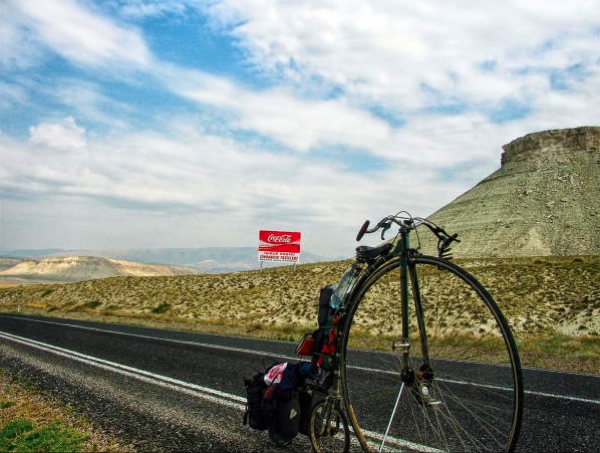

In Cappadocia


Competing in the World Championship in Tasmania


In Beijing.

At the Great Wall.


At the Yellow River

At Everest
[youtube iUbrh0Ac29M nolink]
Joff freewheels downhill into Death Valley, Arizona

Thomas Stevens cycled a Penny Farthing around the world in 1884/7.

Lewis Carr, resident of 11 Victoria Cottages, Spitalfields, with his Penny Farthing in the 1870s.
Photographs of the round the world trip copyright © Joff Summerfield
If you would like Joff to make you a Penny Farthing for Christmas contact joffslegs@gmail.com
You may also like to read about
Paul Bommer’s Wunderkabinett

Paul Bommer
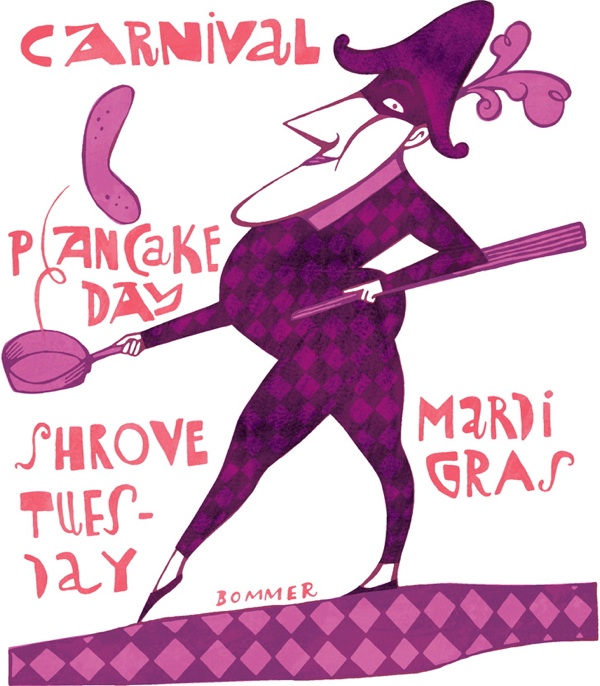
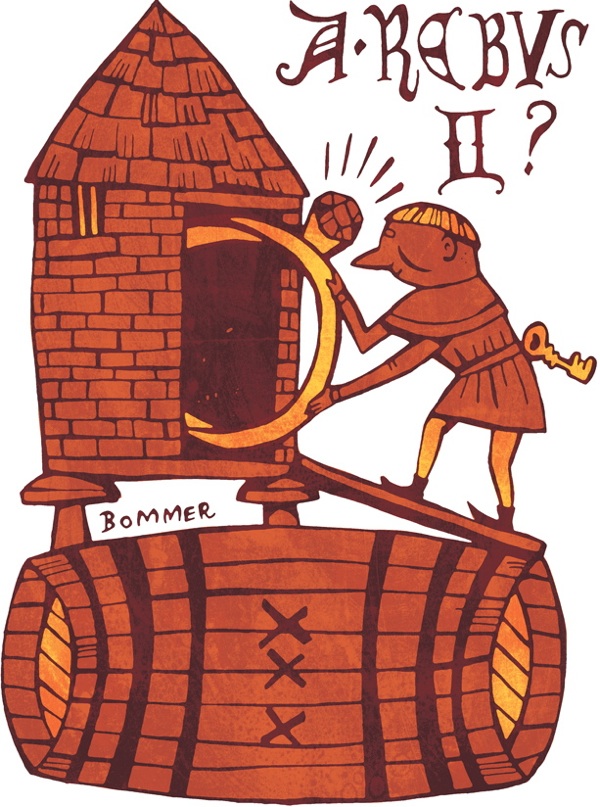
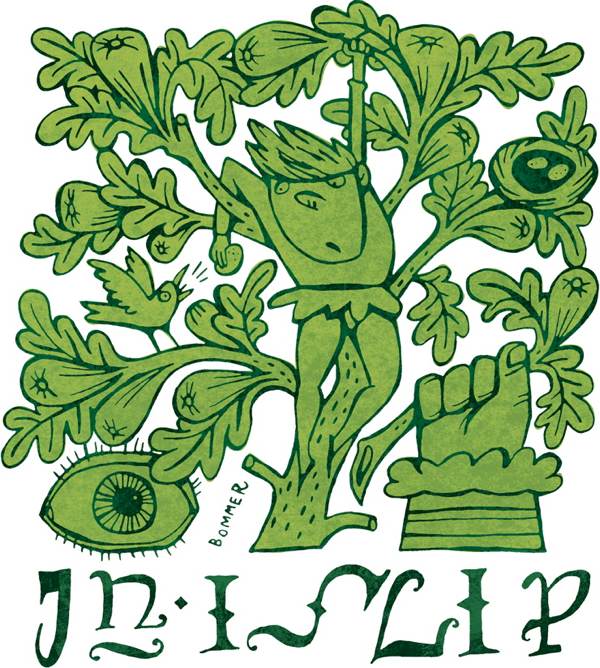
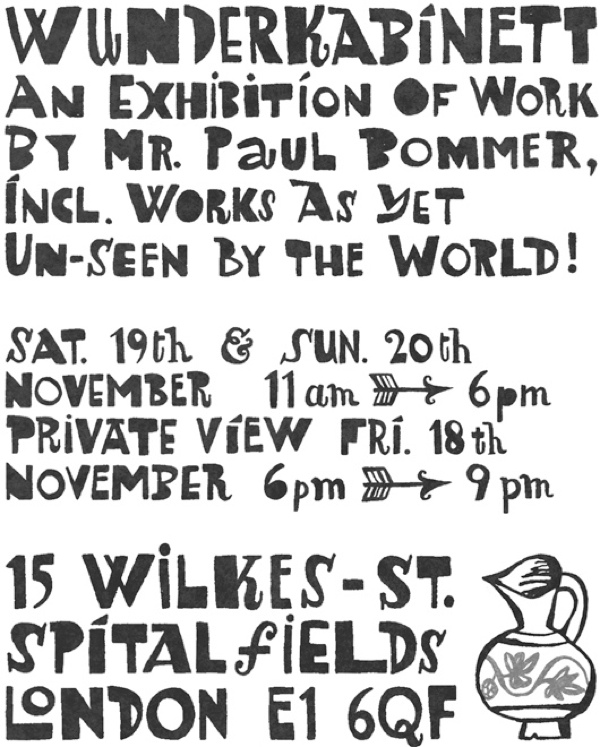
Roll up, roll up! Only days to go before the opening of Paul Bommer’s Wunderkabinett in Spitalfields next weekend! Paul is one of those rare artists whose work proposes an entire vision of the world, humanity and existence. And you can enter his charismatic universe simply by stepping through the green door of 15 Wilkes St, where a choice selection of his confections will be displayed for your pleasure on Saturday and Sunday.
Like Pieter Breughel, George Cruickshank and Ronald Searle, Paul’s generous work is firmly rooted in the European grotesque, populated with distinctive specimens of humanity – conjured into being through his unique quality of line, waggish, calligraphic and lyrical by turns. Fascinated by culture and lore, Paul celebrates the strange stories that interweave to create social identity and the fabric of history, from Joseph Grimaldi’s birthday to St David’s Day, from Alfred burning the cakes to L’Apres Midi d’un Faune, and from the origin of Mardi Gras to Robert Burns.
After ten years, forging a reputation through editorial illustrations published in many of Britain’s major print publications, Paul is now branching out into more personal work – paintings and prints – and, incredibly for one with such a significant body of work, this is his first solo exhibition. It is an event. Paul is calling it his “Wunderkabinett” since it comprises a retrospective of favourite works from the last ten years plus a collection of new screenprints celebrating his love of history, storytelling, folklore and folk art, broadsheets and street literature. But “You can also describe it as a ragbag, if you want,” he suggested to me with self-deprecatory largesse.
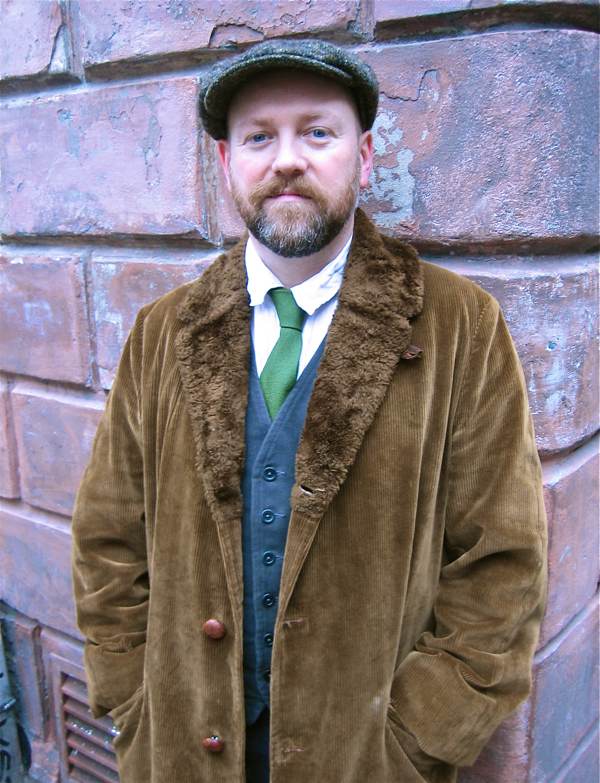
There is a sophisticated humour and sly ingenuity at work in all Paul’s contrivances, composed in a rich visual language this is his alone – an elegant aesthetic and a droll sensibility manifest in work of exuberant appeal. With his fresh face, heavy eyelids and intense blue eyes, Paul is regularly to be seen around Spitalfields in his trademark tweeds and flat cap, always with a new story to tell and a new wonder to impart. There is a brightness and delight in everything he does, irresistibly eye-catching, yet always repaying close attention with subtle details and visual jokes. “I struggle with the modern world and create a bubble around myself,” he confessed to me with a weary smile, but I think we may indulge this tendency for the sake of these sublime images – colourful postcards from the world of Paul Bommer.
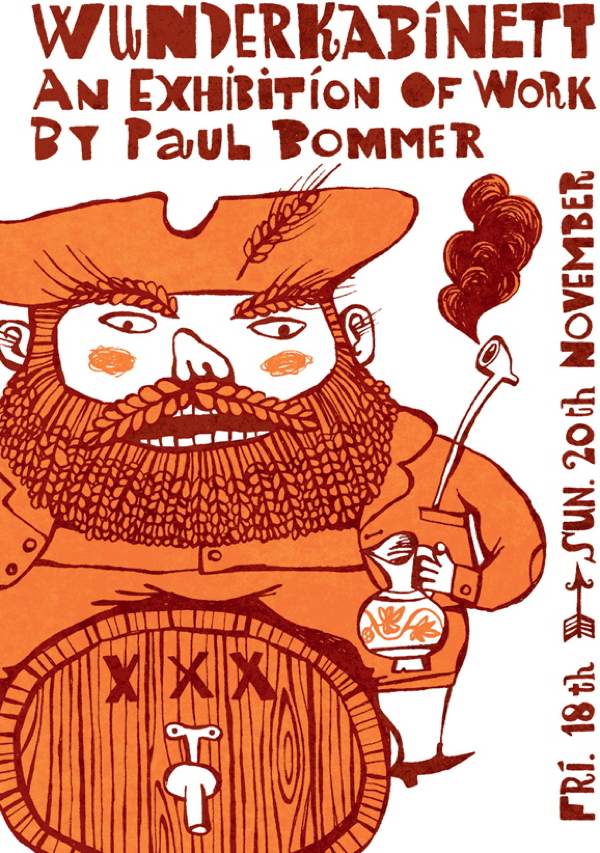
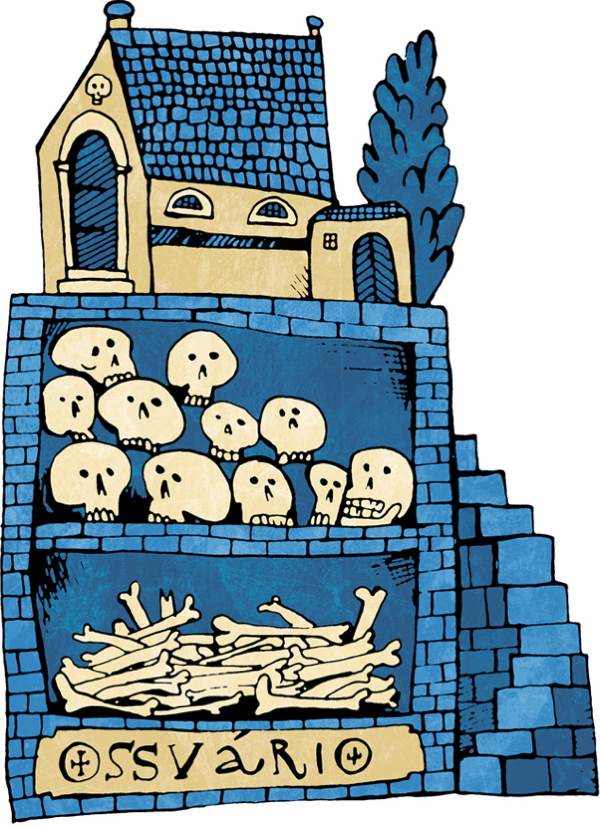
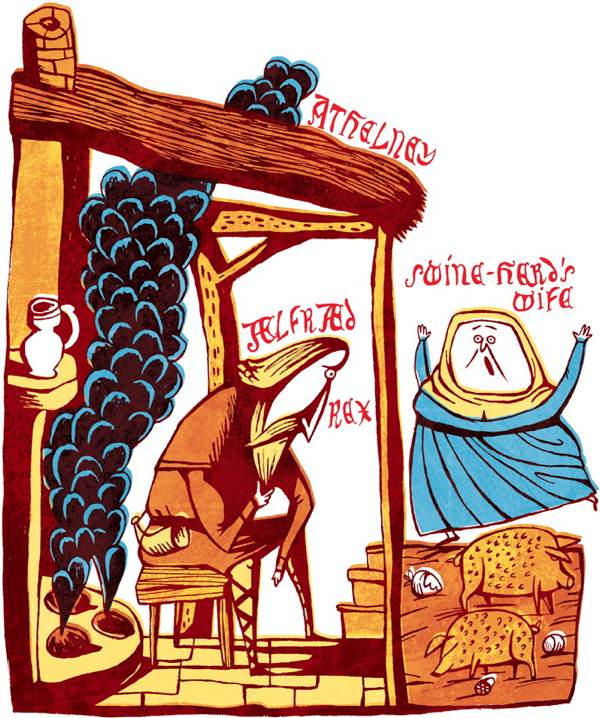
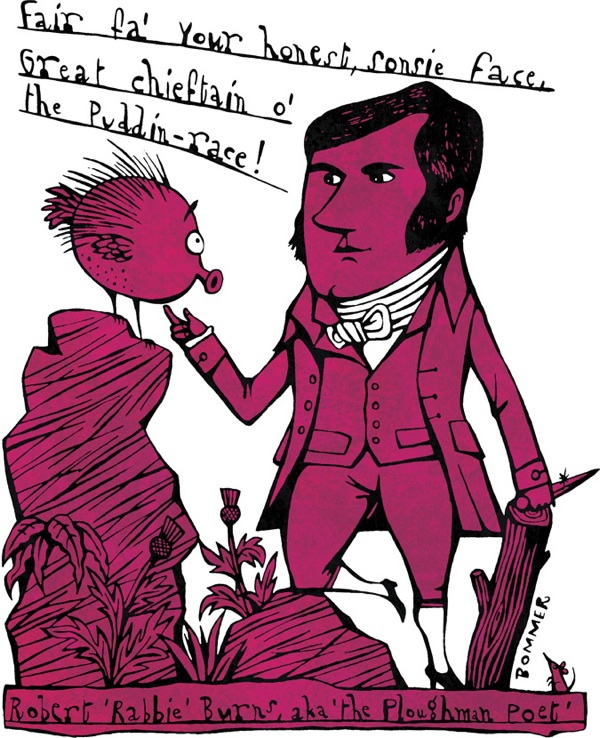

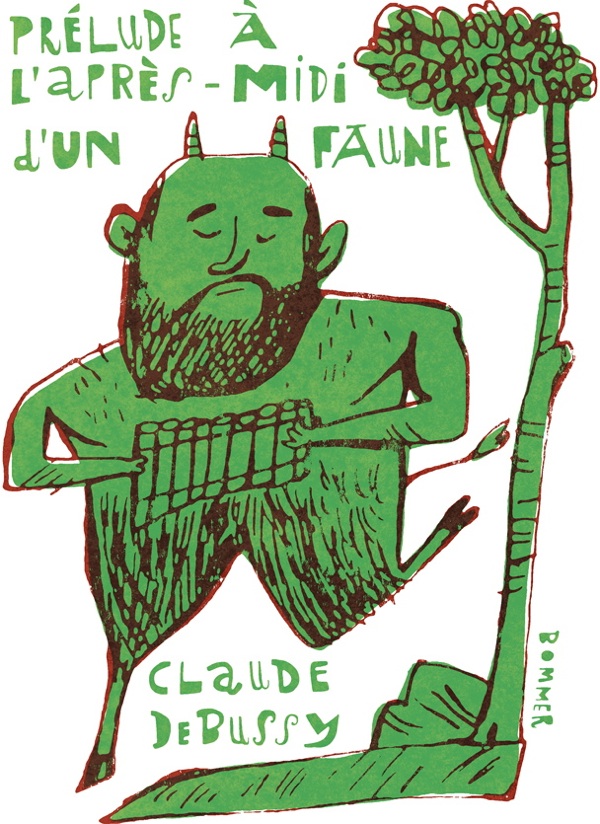
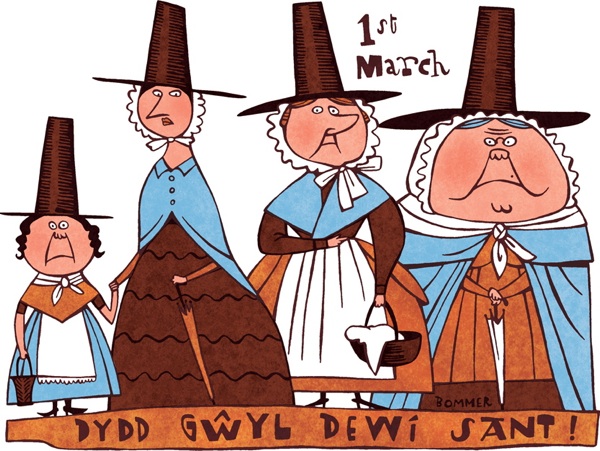
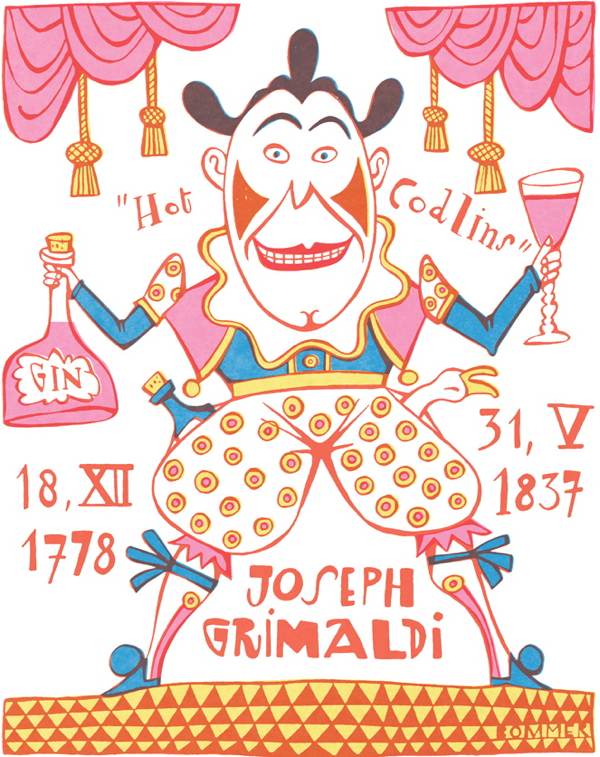


Artwork copyright © Paul Bommer
During the month of December, we will be running Paul Bommer’s Advent Calendar every day on Spitalfields Life.
You may also like to read about
Mr Gil, Street Preacher
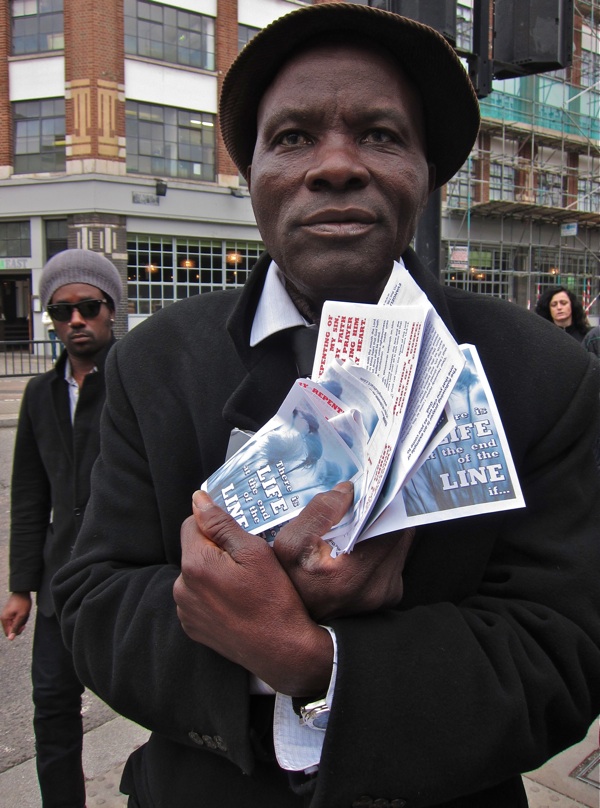
For street preacher Gilbert Eruchala – widely known as Mr Gil – the soaring arch of the railway bridge in Shoreditch High St is his cathedral and the fly-pitchers of the Bethnal Green Rd are his congregation. He is the self-appointed spiritual guardian of these pavement traders, who are constantly harassed by market inspectors trying to move them along – prior to the imminent opening of a shopping centre selling lifestyle brands from sea containers on this site.
You will find Mr Gil on the corner here every Sunday morning, a loose-limbed tall gangly evangelist reaching out his long arms to passersby, offering them tracts, pamphlets and the possibility of salvation. In the midst of the throng squeezing through this bottleneck at the junction of two roads, Mr Gil commands his position with gravity, speaking with a calm voice in the chaos of the market. And it was here that Spitalfields Life contributing photographer Colin O’Brien caught up with him last week to take this series of vibrant portraits.
An imposing figure in a long black coat and hat, Mr Gil is there from early morning and wears a sweater under his collar and tie to keep him warm while pursuing God’s work, which includes selling half a dozen pairs of old shoes and a few pieces of worn clothing hung on the fence behind him, to make the necessary fifteen pounds each week to top up his mobile phone and feed the electricity and gas meter. “I just buy a few things, I’ve never walked into a shop to buy anything,” he admitted, declaring an asceticism readily apparent in his demeanour and physique, “I don’t eat much. I hope to follow the precedent of those who came before.”
Gesturing discreetly to the traders seated upon the pavement around us, “You have to examine this as a microcosm – because people live in localities, so all politics are local.” he explained to me. “If John Wesley, or John Bunyan, or Thomas Cranmer, or if William Booth came back to England today, they would weep to see the disintegration of this land.”
I could see Mr Gil’s point. The situation of these vulnerable fly-pitchers who may shortly be denied selling a few items on a Sunday morning for the sake of a shopping centre selling global brands is itself a pitiful microcosm of the current crisis. Yet beyond this observation, it fascinated me to hear Mr Gil evoke the names of English preachers with an egalitarian sensibility – speaking of them with a vivid familiarity as if they were his fellows, and knowing their opinions and histories intimately. “We need to go back and read them, because the spirit is still here,” he assured me.
“These people are be able to make maybe fifteen pounds,” he continued, in paternal contemplation of the fly-pitchers, “They’ll be able to get milk, bread and cheese. They are content. That’s the best of English culture – you are content with little, compared with the Americans who just want more and more. The bankers may have money, but the question is – Do they have contentment? Contentment can be the antithesis of greed and violence. It can bring you rest, instead of pursuing passing fads like money, fame and pleasure.”
Born in West Africa, Mr Gil grew up the United States and studied for a Bachelor of Science at Oklahoma Graduate School before turning his attention to a Masters in Mythology and Divinity Studies. “I’m studying Greek at the moment because I want to understand the New Testament better,” he revealed to me, lowering his voice in modesty,“but I want to speak two other modern languages, so I am teaching myself French and Spanish.”
As the market quietened down, Mr Gil began packing up his wares into a bag in preparation for cycling off down Bishopsgate. “I’m going to St Paul’s to deliver a card expressing my solidarity with the Bishop of London,” he informed me brightly, “I want to say, ‘We’re praying for you.'” From there. Mr Gil planned to cycle up to Speaker’s Corner to join the discussion. One of fifteen Street Pastors in his group, working in partnership with the City of Westminster and the Metropolitan Police, Mr Gil’s week was entirely plotted out.“It fulfils me to do the work of Christ.” he confessed open-heartedly, “We should go to every man’s world and share the gospel gently.”
Mr Gil continued offering tracts to passersby throughout our conversation. Undeterred by constant rejections, he maintains a buoyant nature in spite of everything he witnesses on the street. “I try to take a redemptive view.” Mr Gil said simply, as he climbed onto his second-hand bicycle laden with bags, to leave the fly-pitchers for another week, “I hope the council will be sensitive to these people and not flush them out – because they can’t afford to open a shop.”
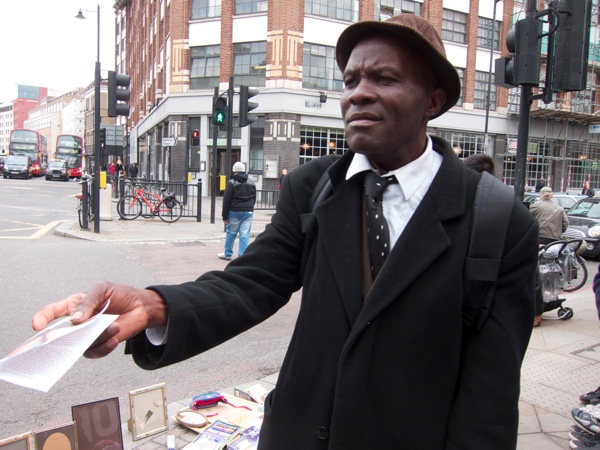
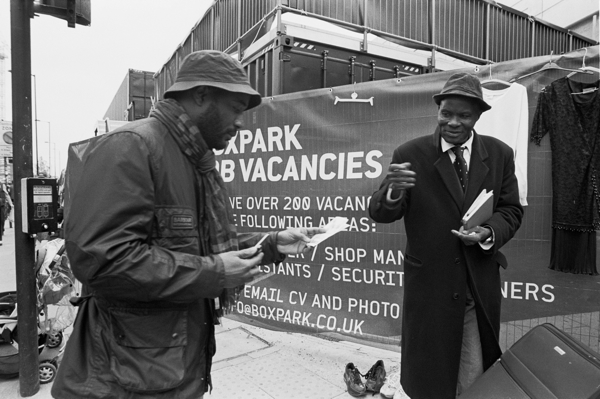
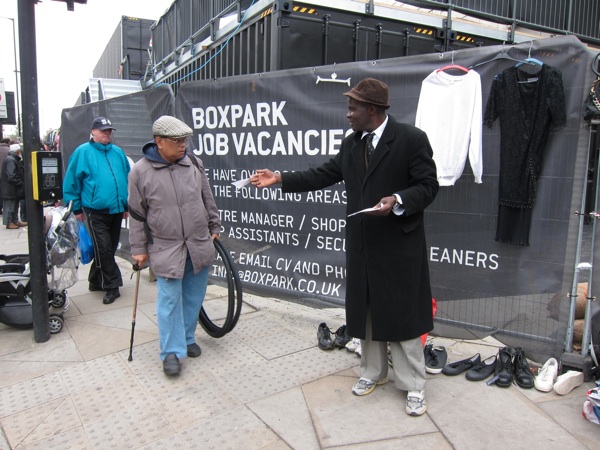
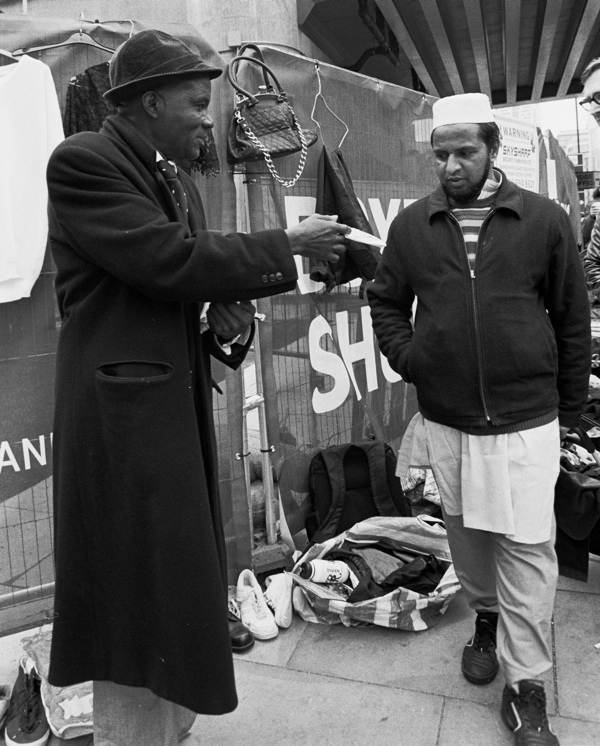

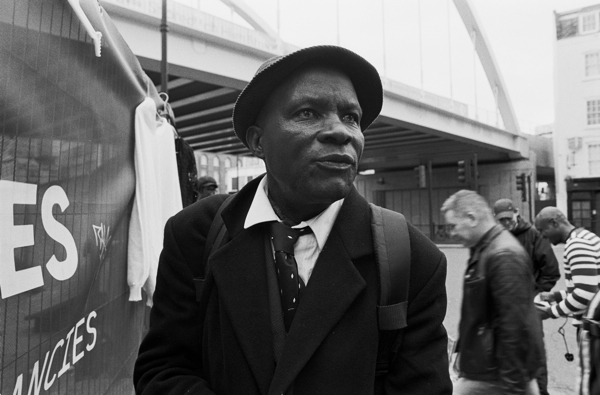
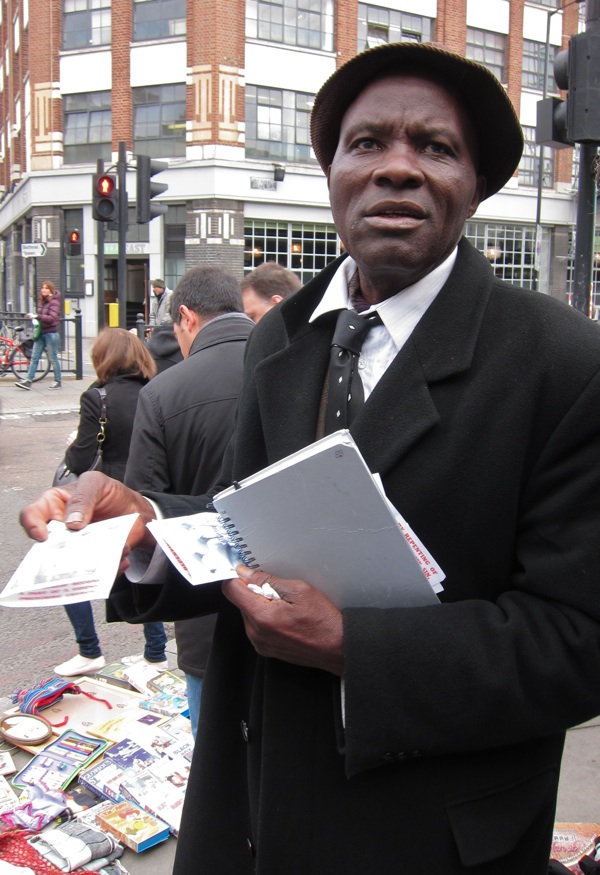
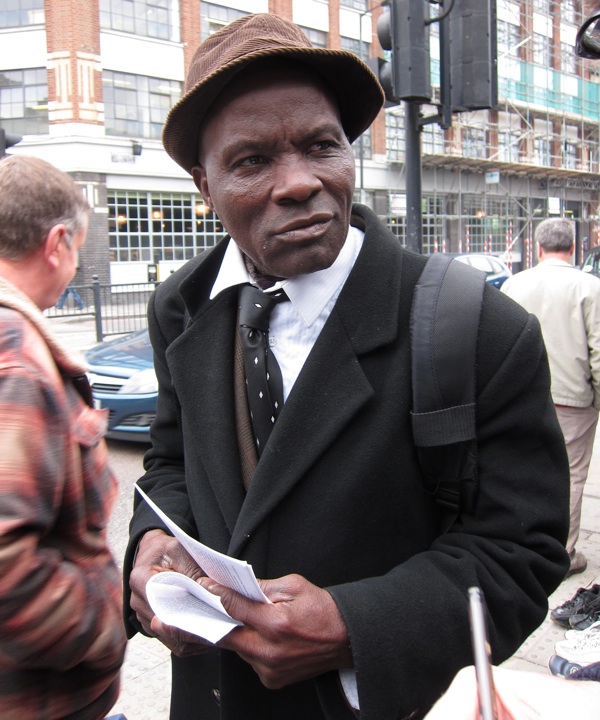
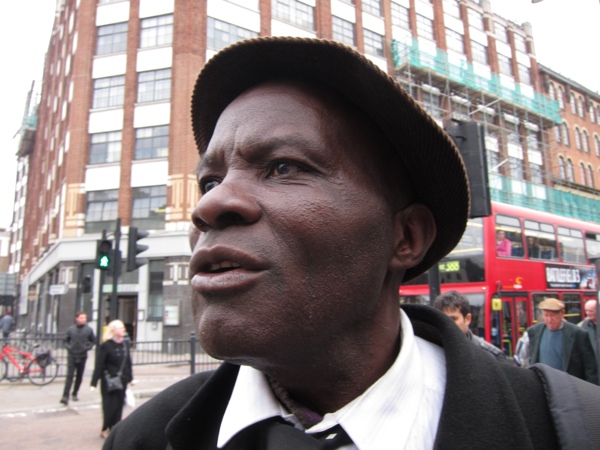
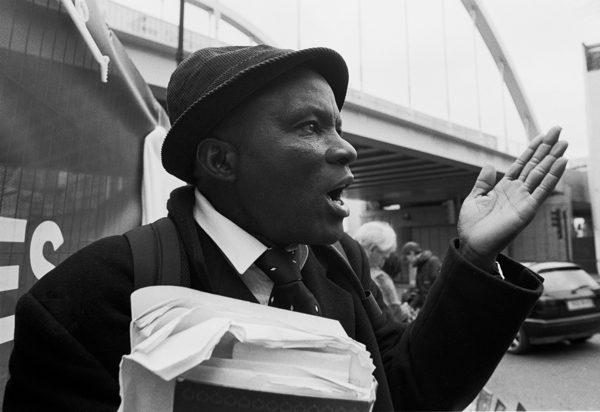
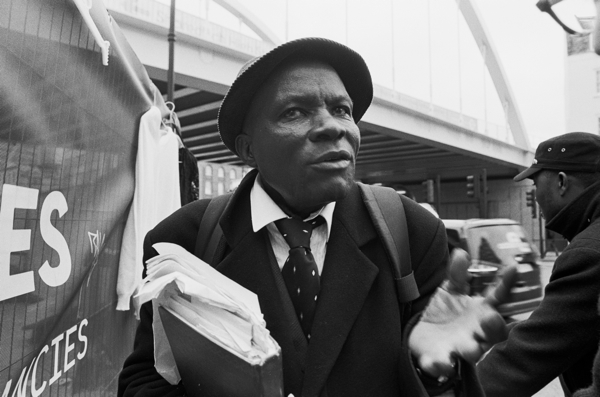
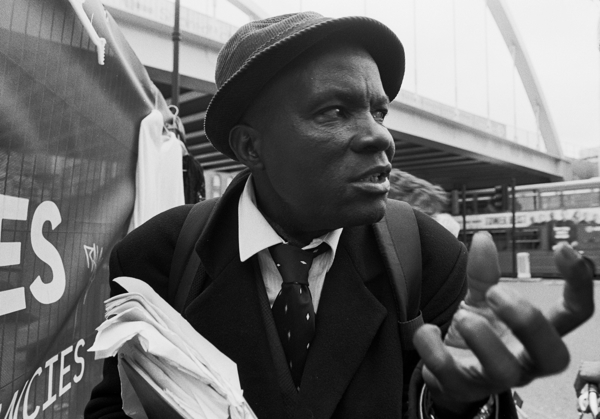
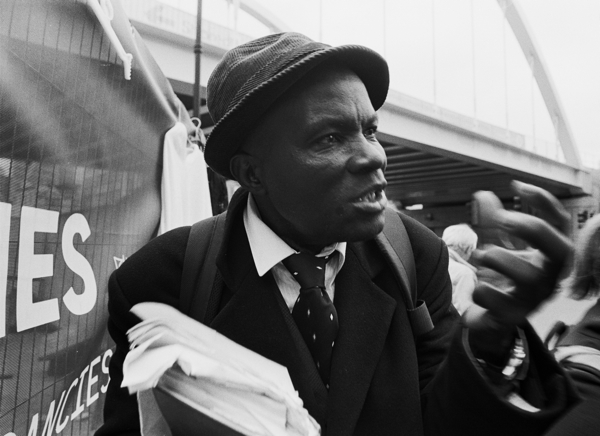
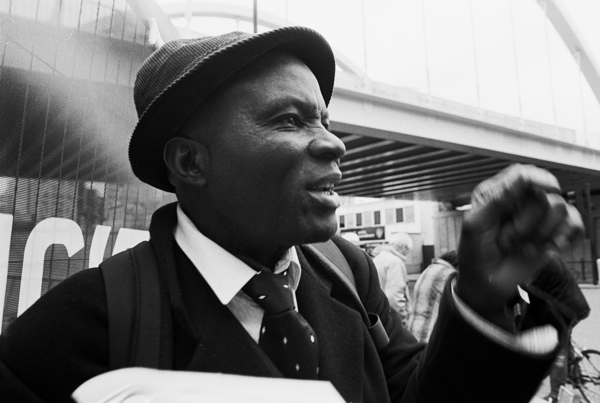
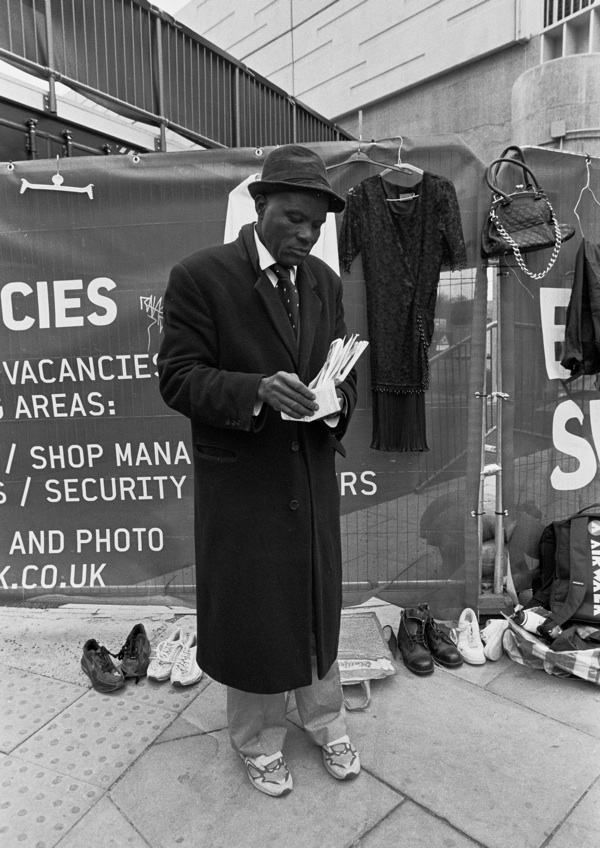
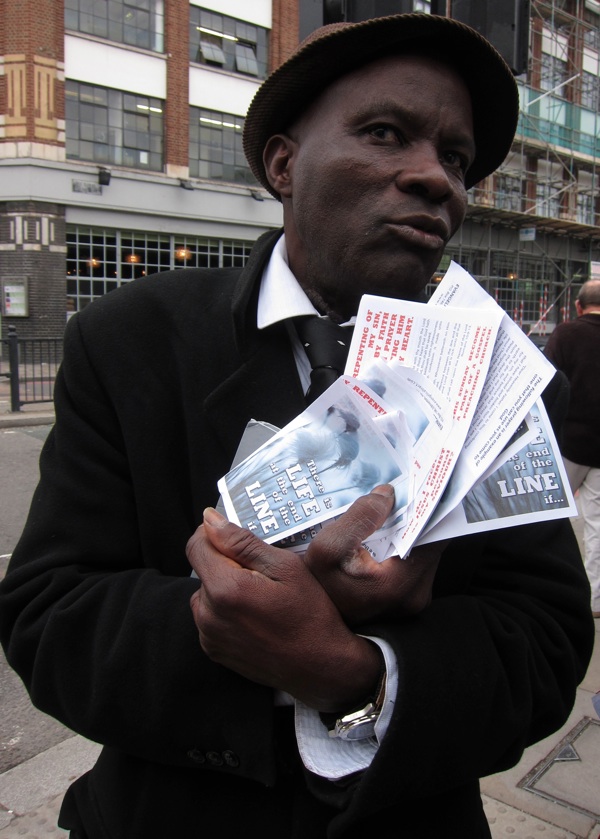
Gilbert Eruchala – “Contentment can be the antithesis of greed and violence.”
Photographs copyright © Colin O’Brien
You may also like to take a look at
The Fly-Pitchers of Spitalfields
and these other pictures by Colin O’Brien
Colin O’Brien’s Brick Lane Market
Colin O’Brien’s Clerkenwell Car Crashes
Travellers’ Children in London Fields
An Afternoon with Michael Albert
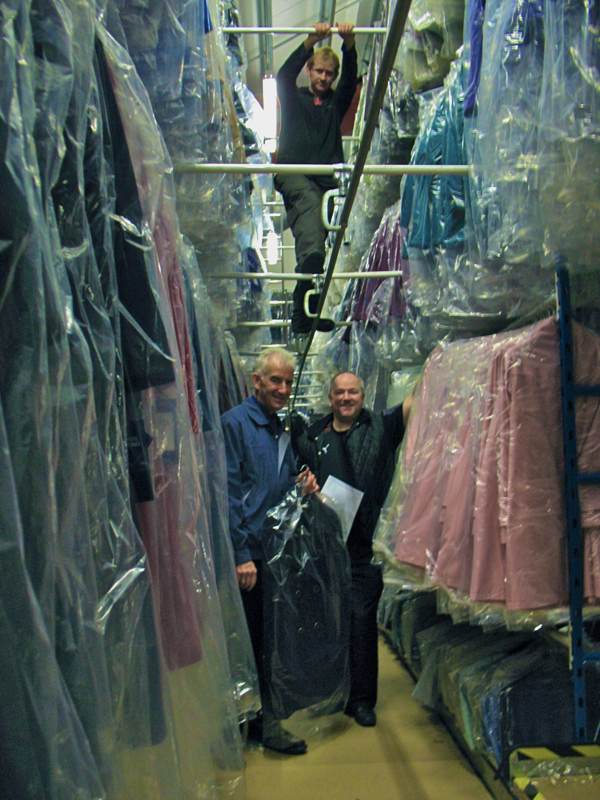
For twenty years, Michael Albert has been popping down to the East End every Thursday afternoon to buy new stock for Blustons of Kentish Town, the celebrated dress shop founded by his grandparents Samuel & Jane Bluston in the nineteen twenties, where today the majority of customers are between eighty and one hundred years old.
“In my dad’s day, everybody came to us in vans and, because they were small manufacturers, if they didn’t have the size or colour you wanted, you could have it by the next week.” Michael recalled fondly, as we drove Eastwards through the back streets circumventing Holloway Prison, on a dress buying expedition last week.
In fact, it makes a welcome change of scene for Michael – who has worked in his parents’ shop for six days a week since he was sixteen – to hang up the grilles upon the grade II listed Art Deco facade, switch out the lights, turn the key in the old brass lock, close the padlocks that secure the grilles in place and set out on his weekly outing each Thursday at one o’clock. The wonder is that even though the suppliers no longer come to Michael, he is still able to source the stock for his shop from a handful of wholesale suppliers in the East End and most of it is manufactured in this country.
“I’ve got a little list,” Michael informed me with a twinkle in his eye, as we parked up a side street in Whitechapel. Our first stop was The Nicole Lewis Collection, for thirty years the small family business of Richard Walker – named after his two children, Nicole & Lewis. Upstairs, Richard still has the long table where he once cut patterns – but these days he simply buys the cloth and has the clothes made up at factories in East Ham and Plaistow. “We’re not Top Shop, we’re classic ladieswear,” he explained, revealing the unexpected virtue of making clothes for older people in styles that never go out fashion, since there is no requirement for Michael to update his patterns and no dead stock or wastage. He can simply recycle his designs endlessly. It appears a very satisfactory arrangement for all concerned – fulfilling a need for those who are under-represented elsewhere in the clothing industry.
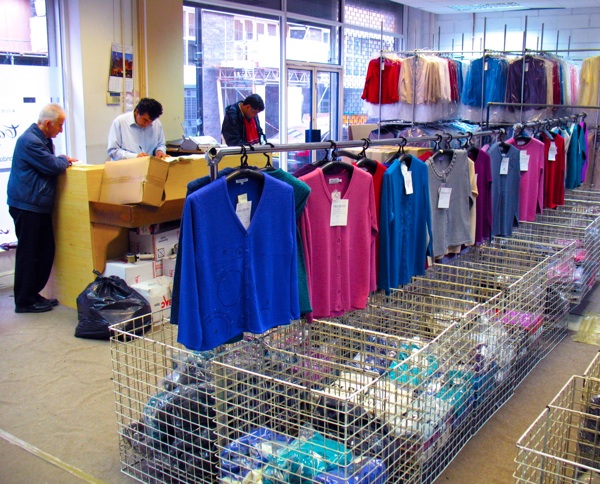
Round the corner at Capital Garment, Michael led me into a huge warehouse with ladies’ suits on rails lining the walls and knitwear in a variety of colours filling the floor. He prowled the aisles with an intent, self-absorbed expression, studying the colours and the cloth, and scratching his chin. Always, it seemed he was drawn to the plainest, least fussy designs, in a nineteen fifties palette – pale blue, shell pink, lilac, burgundy, teal and beige. “Colour is everything,” he admitted to me, “You buy a wonderful thing, but if it’s not the right colour you can’t sell it.” As Michael deliberated over a dark red sweater of conservative design knitted in a sparkly yarn, I asked if he thought his ladies might like it. “We sold something very like it in the past,” he informed me with a reserved smile.
We got back in the car and drove further East.”When my father was a boy, my grandparents had a factory in Arbour Sq and he was the delivery boy, using a great big black car for deliveries that they called “the family car.” He would call for my mother in it when they were courting, but when they got married he had to give it back to his brothers and his father,” Michael, confided me with significant look indicating how family politics and business can get mixed up.
Arriving at Michael Gold in Nelson St, Sajid Tailor welcomed us to the business his father bought from a Jewish gentleman in the seventies in Brick Lane and which today he runs with his brother from a modern showroom in Stepney. “I’ve a fair idea,” he whispered sagely, when I asked him if he knew in advance what Michael might buy. Sajid and his brother were surrounded by the patterns they send out to the factories to get their clothes made up – owners of a thriving business, they export fifty per cent overseas. “All the survivors of the East End,” declared Sajid, when he heard Michael’s itinerary for the afternoon. By now it was apparent that Michael was perhaps the longest standing customer at these companies, where they set their watches by his arrival each Thursday afternoon, a ritual extending as long as anyone can remember.
Our final destination was DBK London Ltd in Mile End, where Sales Manager Larry Peterson could not wait to show off his warehouse. “People’s eyes go pop when they see this!” he promised me, and I was not disappointed as we entered a space of seemingly indefinite dimensions where motorised clothes rails of coats ascended several storeys and warehouse men ran through the structure, clambering like monkeys among the tree tops to retrieve the required styles. “This must be the largest in the East End?” I asked. “In the world,” replied Larry with cool satisfaction.
Larry runs the business (David Barry Kester Ltd) with his brother David Barry and Maurice Kester, supplying coats to some of the biggest High St shops. “We’ve all done it our whole lives. We started off as salesmen in the market and worked our way up to where we are now,” he enthused, proudly handing me a colour catalogue of keenly priced Winter coats and a DBK corporate diary for 2012, and confessing, “I absolutely love what I do, I hardly ever go home.”
Michael and I accepted Larry’s offer of a cup of tea at a round table set with a tablecloth in the warehouse, and he admitted they were all grieving the recent loss of their former partner Laurence Matz. “I came in and found him wearing an oxygen mask. I thought it was a joke,” recounted Michael in regret, “‘I’m waiting for a lung transport,’ he said and the next thing he was dead.” We sat together in silence, contemplating mortality amongst the endless rails of coats.“I meet all my old friends in the East End each Thursday,” said Michael in recognition, shaking his head with a tender smile,“It’s ridiculous.”
“I was buying from your father thirty years ago, when this was called Snug Coats” he reminded Larry, getting lost in affectionate reminiscence now, yet adding for my benefit, “They used to make these beautiful double velour coats in pure wool with floss stitching.”
Later, as we climbed into the car outside, dusk had fallen and there was a November chill in the air. Just the right weather to sell Winter coats, Michael told me. As umbrella makers hope for rain, Michael longs for the cold weather to set in before Christmas. “Yet not so cold that old ladies won’t go out” he qualified, outlining the ideal meteorological conditions favoured by one who has been selling Winter coats since he was sixteen.
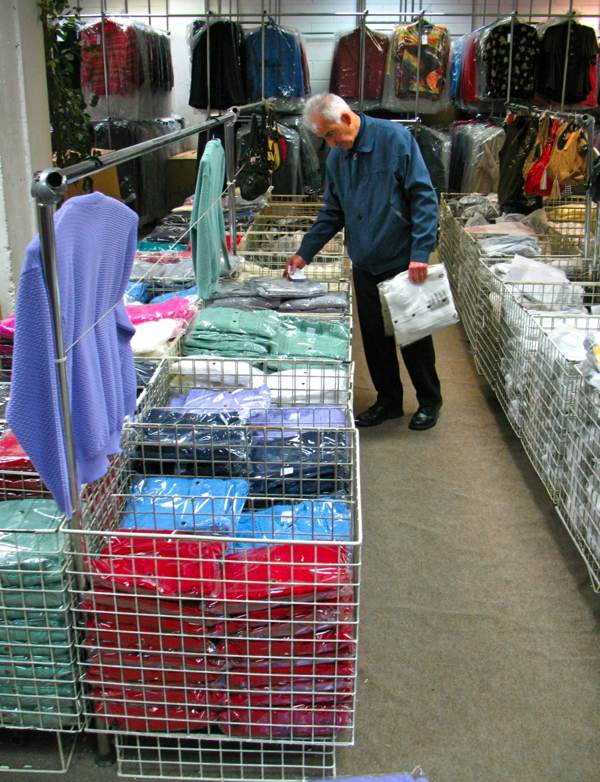
“Colour is everything – if it’s not the right colour you can’t sell it.”
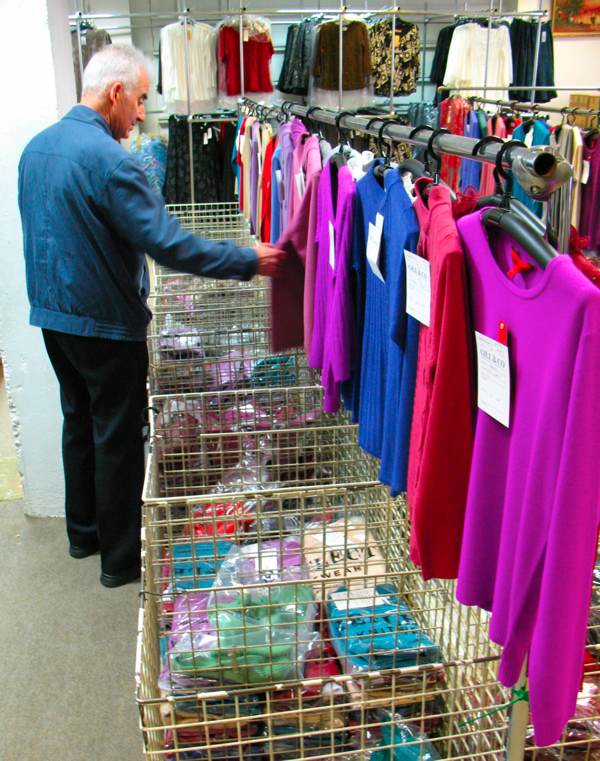
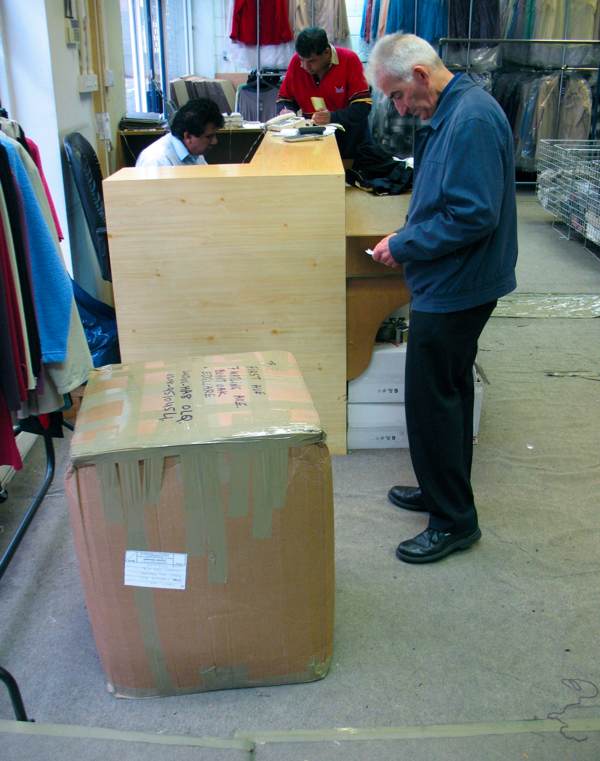
“I’ve got a little list”
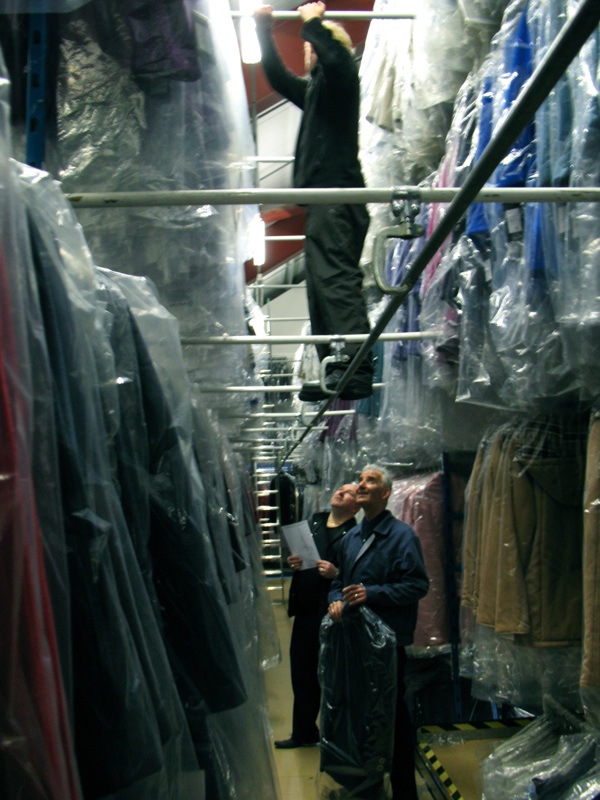
“warehouse men clambering like monkeys among the treetops”
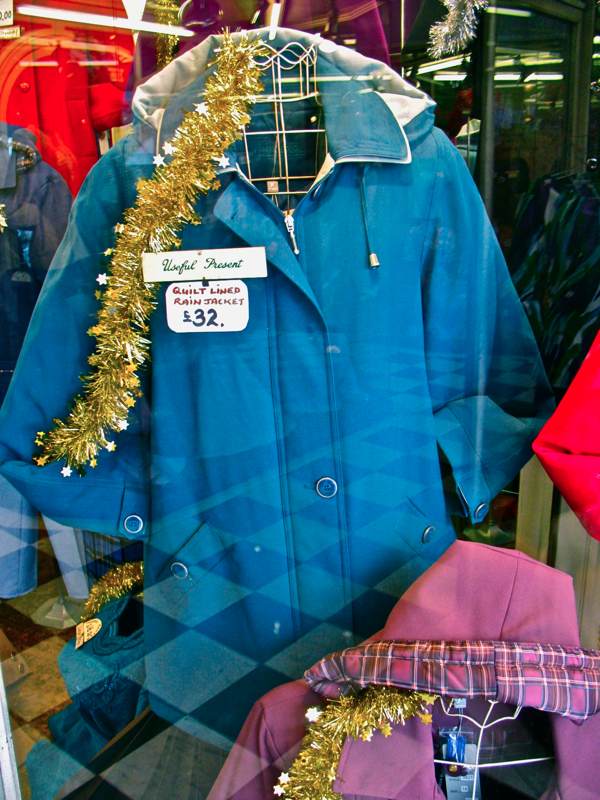
A useful Christmas present from Blustons.
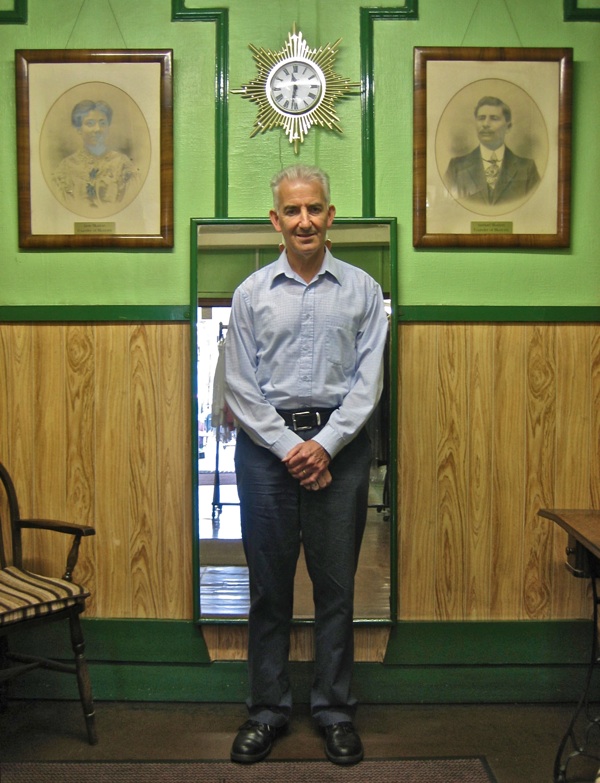
Michael Albert at the shrine to Samuel & Jane Bluston in Kentish Town.
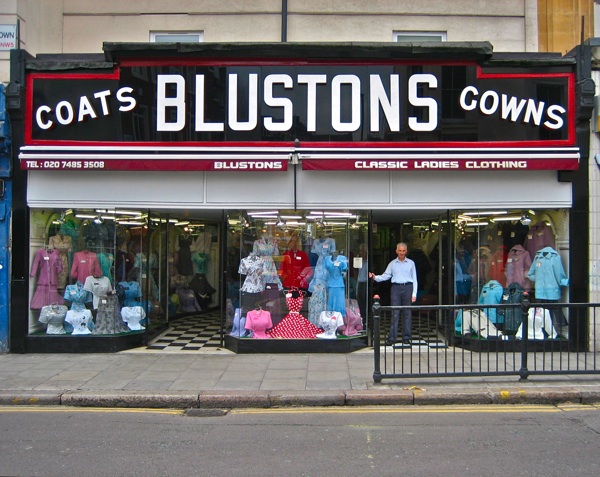
Blustons, 213 Kentish Town Road, London, NW5 2JU. 020 7485 3508
You may also like to read about
A Transformation in Princelet St

In 1996, when Architect Chris Dyson bought the last house at the end of Princelet St where it meets Brick Lane, the shabby twentieth century edifice looked like the poor relation amongst the fine eighteenth century terraces. Having collapsed in the nineteen thirties and been rebuilt successively, very little was left of this former seventeen twenties structure, yet the adjoining house – built as its twin – stood as a reminder of how it might have been. With a restoration no longer viable, instead Chris staged a transformation – using the house next door as his template, he brought a new order to the structure, allowing it to hold its own amongst its fellows once more.
“Living in this area and working on houses in Spitalfields for twenty years has taught me how me to handle the detailing, and the correct moves to make,” explained Chris, as we stood in the street and compared the facades of the neighbouring frontages. On the first and second floor, he has reinstated the windows to match those next door. Using second hand purple reds, bricklayer Keith Beckwith matched the brickwork closely and recreated the rubbed brick detailing above the windows. At street level, it was necessary to conceal a girder which had been installed in the front wall when the building was converted to a shop, so Chris chose to construct a Georgian shopfront, employing Ian Harper to paint oak grain on the facade and a contrasting burr walnut upon the door.
Within, joiner Matt Whittle has installed new panelling throughout the reception rooms in line with other Spitalfields houses of this period, while Chris has judiciously embellished the work with salvage finds to bring idiosyncrasy and detail to his design. In the hallway, a pair of fluted wooden columns from 1725 have been cleverly duplicated by carpenter Dave Thompson to frame the lobby. Similarly, in the first room, he has copied an original eighteenth niche cupboard which sits to the left of the fireplace, still flaunting its patina of two centuries, while its new counterpart sits demurely unsullied upon the right.
At the rear, Chris chose to install a large glass screen admitting the Southern light and opening onto the spectacular fern garden at basement level by Luis Buitrago. Stairs lead down to the kitchen lined with a collection of rich blue china and up to the panelled first floor drawing room, leading beyond to bedrooms and a bathroom on the second floor, and arriving at a wonderful loft space at the top that serves as master bedroom with spectacular views across the rooftops of Spitalfields towards Christchurch.
As we ascended through the narrow structure, the pair of cats that serve as the presiding spirits of the house wove their paths around us, pursuing each other playfully and competing to win our affections. Constantly, Chris drew my attention to the endless cunning details he has built into his house, secret cupboards and scavenged eighteenth century plasterwork, market finds of antiques arranged in niches that his children secretly rearrange, old fireguards from Chatsworth and elaborate beading from a Nash house in Regent’s Park.
So little remains of the original house that it is not a listed building, which gave Chris ample licence, yet he has gone to great lengths to restore the soul of the place. And today, the clutter of a busy family life and Chris’ charismatic collections countermand the elegant austerity of these finely tuned architectural spaces, confirming that this old house is alive once more – once more a home.

In the nineteen seventies

In 2009

In 2011

An eighteenth century niche cupboard retains two centuries of patina.


The terracotta urn was destined for the garden.


The view from the loft towards Christchurch, Spitalfields.
Archive image from the London Metropolitan Archive
Story includes photographs by Richard Clatworthy & Richard Powers
You may also like to read about
Laura Knight, Pottery Marks
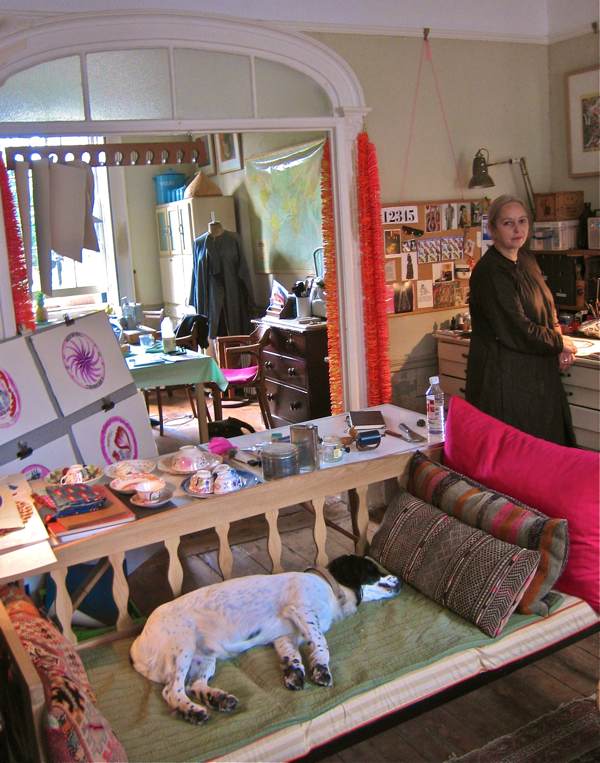
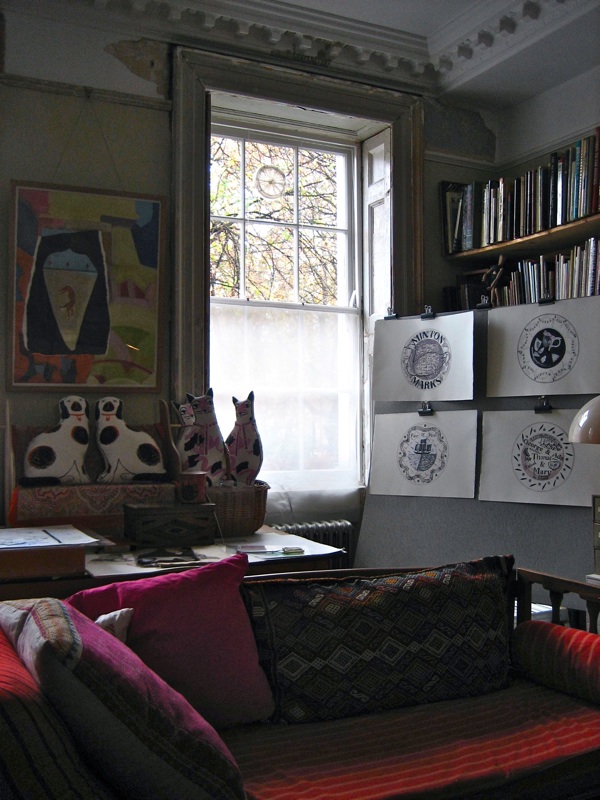
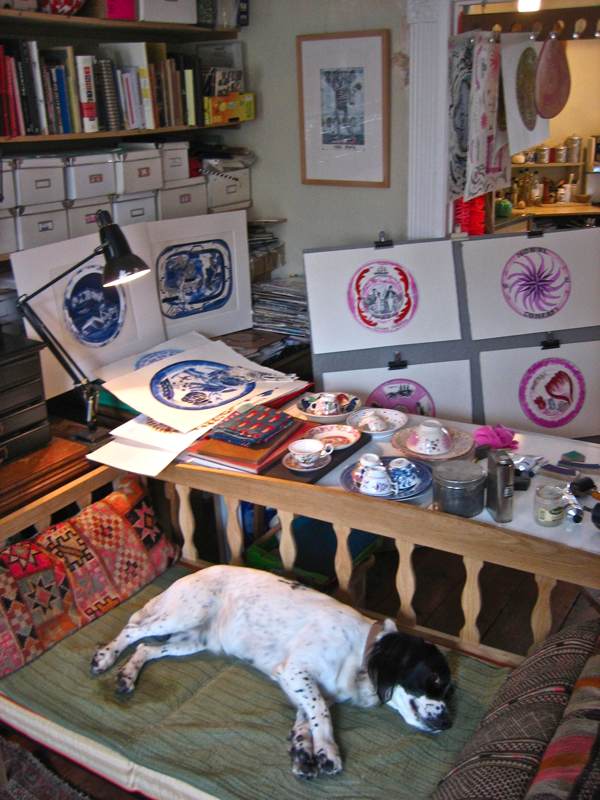
Laura Knight’s dog Moss wisely takes a nap and lets his mistress get on with completing her latest works ready for her exhibition Pottery Marks, opening at Town House in Spitalfields next Thursday 17th November. Contrary to what you might think, the cups on the table are not evidence of an imminent tea party, but placed there as a reference by Laura while making the new pictures she will be exhibiting, which have all been inspired by her collection of old china.
A graphic artist whose work is informed by a deep affection for vernacular English pottery of the nineteenth century, Laura Knight’s renderings of Staffordshire Figures, Willow Pattern plates and Sunderland Lustreware capture the spirit of these pieces with rare grace and economy of means. In the popular tradition of English Folk Art, using sinuous line and sensuous colour – hers is the assured work of a mature artist in control of her medium.
Working from a Georgian terrace in Clapton, Laura’s ground floor studio also serves as her living room and kitchen which makes it perfectly natural to have pieces of china to hand. “The funny collection of ceramics that one ends up inheriting or buying cheaply over the years.” as Laura describes it. Yet “When the original object is so appealing,” she revealed, “it’s about transforming it into something else rather than slavishly reproducing it.”
The grove of limes on the green outside were just turning gold and shedding their leaves when I paid Laura a visit, taking the opportunity to admire her collection of pictures, china, art books and other treasured paraphernalia, in these two beautifully-proportioned rooms that receive more sunlight when the trees are bare. Laura welcomed me with tea and home made apple cake at her kitchen table, before giving me a preview of the fresh pieces of work which were due at the framers later that day, including a table cloth – that Laura draped across the table – upon which she had painted calligraphic patterns and sewn images of Willow Pattern plates as if laid ready for a picnic.
Yet I was impatient to wolf my cake and stray into the other room to examine the spirited pictures on paper Laura had created using paint, ink, collage and printing – in sets of four – in blue as homages to Willow Pattern, in pink to celebrate Sunderland Lustreware and in subtle ochre referencing Minton pottery. Here was an image of a plate for good attendance at Sunday school inscribed with the names of Laura’s grandparents who grew up in Bethnal Green, George & Ada. Here were all the Minton date stamps from 1842 to 1942, including “V” for victory and an airplane during the war years. Here were scraps of Willow Pattern, inspired by the spontaneity manifest when women chopped up transfers and scattered them on the undersides of tureens in factories a hundred and fifty years ago. Laura’s witty graphic interventions always serving to reveal the maker’s presence behind these familiar artifacts, delighting in the flaws and random elements born of mass-production done by hand.
Pottery Marks came about as a result of my interview with Laura Knight a year ago, and now I cannot wait to see her vibrant images brought together in a gallery for your interest and delight. She appreciates the emotional resonance of beloved ceramic designs which have survived in the popular imagination over generations, and her tender and poetic work is the perfect tonic at the start of an English Winter.
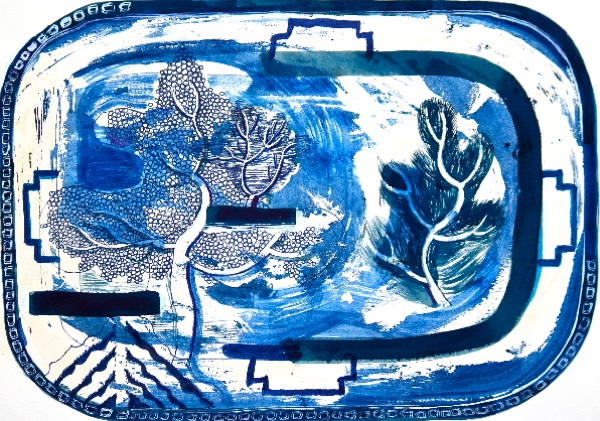

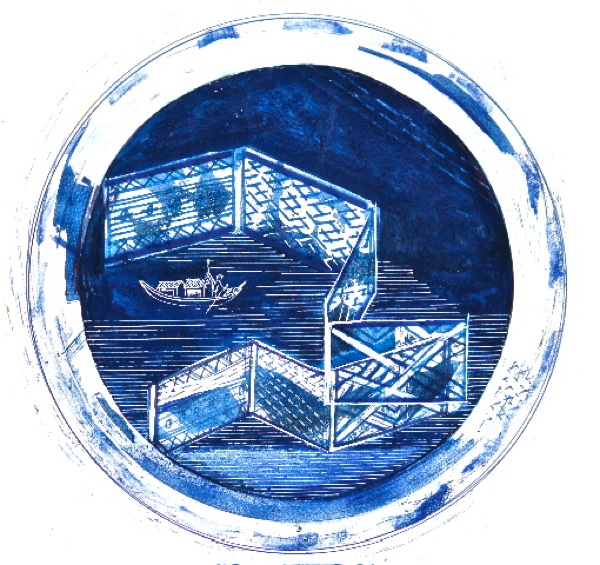
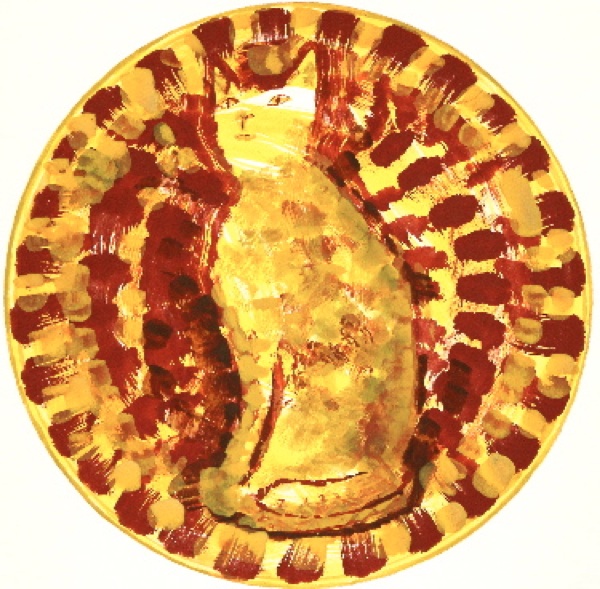
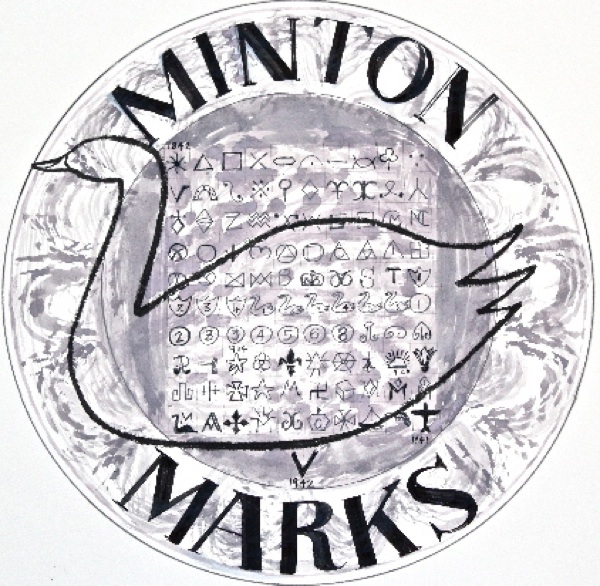
Artworks copyright © Laura Knight
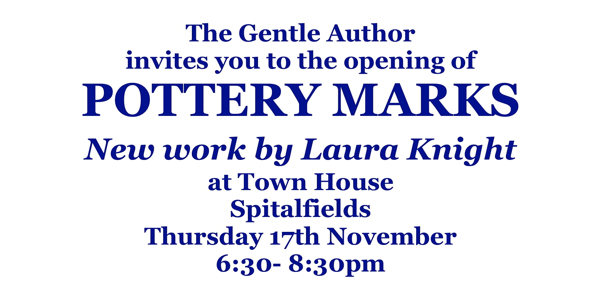
POTTERY MARKS – New work by Laura Knight, runs from Thursday 17th November – Saturday 3rd December at Town House, 5 Fournier St, Spitalfields, London, E1 6QE. Open from 11:30am – 6pm, Tuesday to Sunday.
You may also like to read about Laura Knight, Graphic Artist
Jason Cornelius John, Street Musician

Jason Cornelius John
He first sprang into my consciousness two weeks ago, early one Sunday morning, when I was down among the fly-pitchers in the Bethnal Green Rd. As if out of nowhere, he appeared from behind a telephone box with his guitar in hand declaring, “I am Jason John, I’m writing you a damn good song.” With charisma and intensity, he drew the attention of everyone within earshot and the pavement became his stage as he launched into one of his own compositions, opening his heart and channelling his emotions into a soulful ballad. Even at first sight, Jason John made an unforgettable impression.
And then yesterday, I came upon him sitting with his guitar in a doorway in Folgate St, sheltering from the drizzle on the first chilly day of the Winter, and – once we had re-established our acquaintance – we decided to take refuge in the barroom of the Water Poet where Jason spoke to me of his life as a street musician.
“I’m a West London lad. They know me around Shepherd’s Bush, Hammersmith and Acton because I grew up in Chiswick. I’ve played in Notting Hill and all over the West End, so I thought I’d travel to the East and get myself known here. Sometimes I play in Leadenhall Market, Hoxton Square and at Liverpool St. I write my own songs. I’ve always written, stories, poems and songs. I grew up playing the guitar and I can play bass, violin and piano. Being a musician, singing and playing, it’s like being a storyteller.
My first real involvement with the music scene was as roadie for the Bluetones. I knew them from school, and I stayed at their house and slept on the couch. It was a non-stop party and there were always girls. My first proper taste of the music industry – you got paid and there was always food and drink.
When they took off, I didn’t feel bad but I did wonder, “How could you just make it and leave us all behind?” Then Montrose Avenue came along and replaced the Bluetones, and they pulled more girls. My job went from being a roadie to becoming their minder, making sure they didn’t drink too much and keeping an eye on the girls too.
At smaller venues, I’d get ten to fifteen minutes to play my own songs. I played in Camden once, thirty-six people were cheering me and saying, “That was a good one,” I gave out my phone number and email many times that night. When I played the Hub at the Metropolitan University, there were rows of girls in front and they loved me – but I was frightened when they all shouted at once, I thought they were going to grab me. My girlfriend dropped me at that time – over my music – she said, “You can’t do any other job, and trying to live by playing and singing, it’s impossible.” When Montrose Avenue made it, I thought, “It’s not going to happen to me, this is the second time.” So I took off to France for a year, going down South and playing on the road, then I went to Amsterdam and lived there for a year.
I love playing and singing, that’s why I’ve dedicated my life to it. Two years ago, I was sitting playing in Allen Gardens when I found myself. I started to cry. I could literally see myself. Since that Summer, I’ve had a hunger to play to people. If I see a crowd of people, I want to win their spirit. It fills me with goodwill. When you are going around playing and singing you’ve got to feed your soul. I have a smoke and it gives me a nice merry feeling. In your head you behave like a giant. Sometimes the crowds roar and cheer for me. I walk down the street and people are hugging me.
All the businessmen in their suits and ties, they finish work and go to the pub. Then they go outside to have a smoke, and they see me and they say, “I like your look, what have you got?” I play them a song and they say, “I like that, play us another … and another, and another.” Then, if they’re still into you, they give you a card and say, “He’s never had busker for his birthday, we want you to come over.”
I’m living in Earls Court at the moment in a hotel, it’s forty pounds a night. I have to make that money each day playing on the street. You can’t give in. It’s all up to you. You’ve got to put your feeling into it, heart and soul – because how you feel, that’s how the listener’s going to feel. You got to feel emotion, I’ve played and cried in front of people, and they’ve cried too.
During the day, I rehearse in my room and then I come out and play my songs. Performing on the streets, it’s different from a pub, you’ve got to attract the people. At the end of the day, it’s for no-one else, just me and the listeners, and I’ll know that I played and sang and they felt good. You want everyone to feel a good feeling and think, “That Jason John he was a good man, he hasn’t lost the feeling.”
I walked here today from Earls Court, I followed the South Bank. I got jumped at Old St at the weekend and they took my phone – at four in the afternoon, I couldn’t believe it. The ups and downs of life. It made me cry because I needed those numbers badly. Now the weather’s getting cold, it makes it hard for me to keep playing on the street. I have to start playing in pubs and clubs but to do that I’ve got to find three people whose numbers were in my phone, so we can play together as a group. I was looking for a violinist who hangs around here, I was walking and hoping he’d turn up.”
When I expressed my concern over this immediate circumstance, Jason shrugged it off – self-reliant and philosophical, and taking one day at a time. A man of innate dignity and possessing a sympathetic nature, he impressed me with his single-minded pursuit of songwriting, risking himself and sacrificing conventional ambition for the sake of a purist desire to communicate through music. The street is an unforgiving arena for a performer yet Jason has embraced busking with consistent success and made himself at home on the pavement, creating a distinctive persona that is his alone. “I’ve always liked pin-striped flares and leather jackets, and I always wear shoes. I try to keep them as shiny as I can. If you dress smart with shoes and trousers, you can get in anywhere – but not with jeans and trainers.” he informed me authoritatively, when I complimented him on his style, layered up with old coats and silk scarves.
From the moment Jason first appeared in the market two weeks ago, it was obvious that he has a certain talent and personal charm which win him a degree of respect wherever he goes, and thus his relationship with existence is enviably untroubled, for the most part. At thirty-five years old, Jason Cornelius John knows who is and what he wants from life – as he confessed with a barely-concealed swagger, “I’m not a member of any party and I have no religion. My religion is drinking, smoking, playing music and making love to the ladies.”
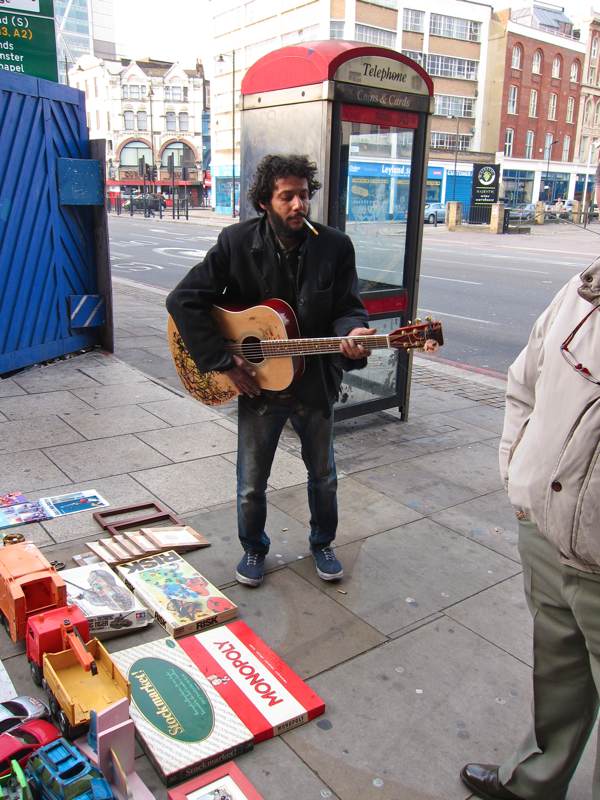
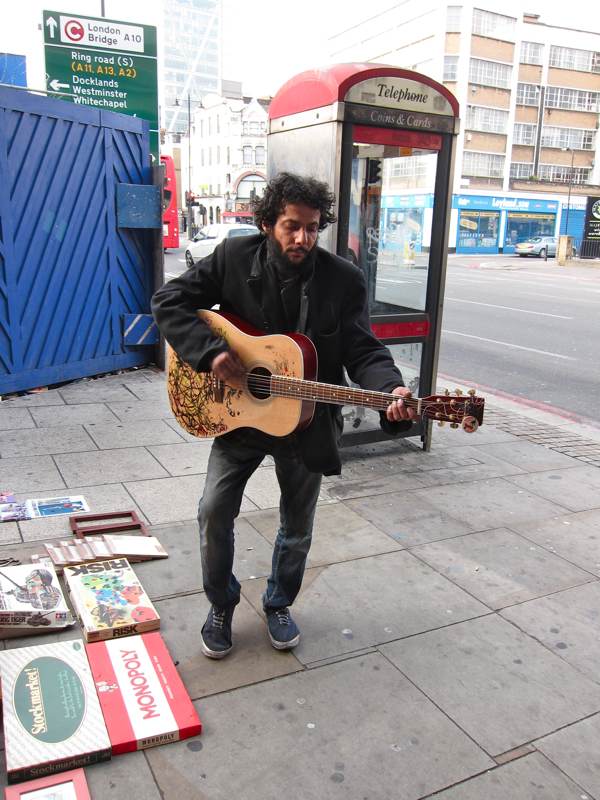
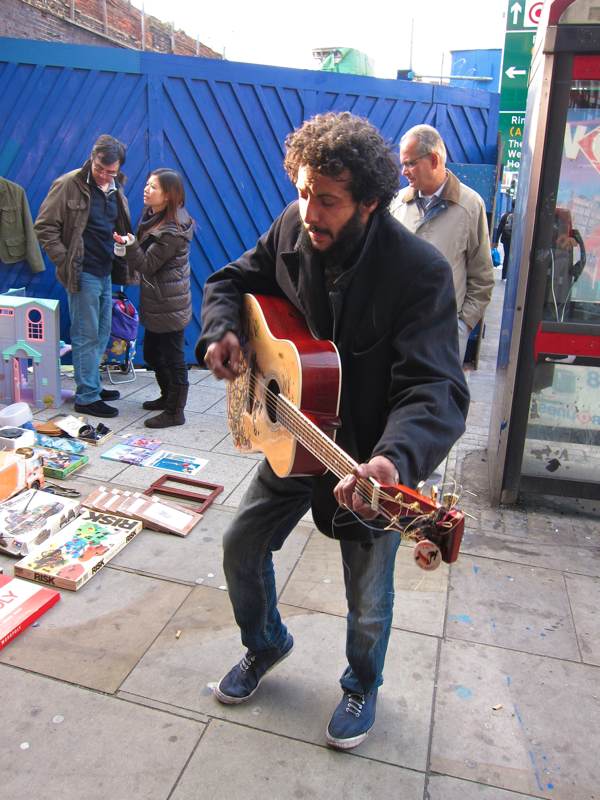
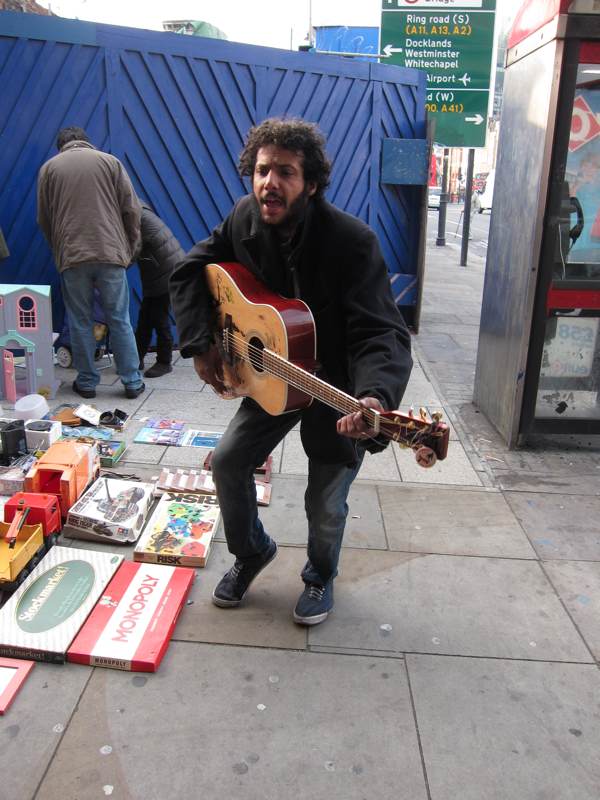
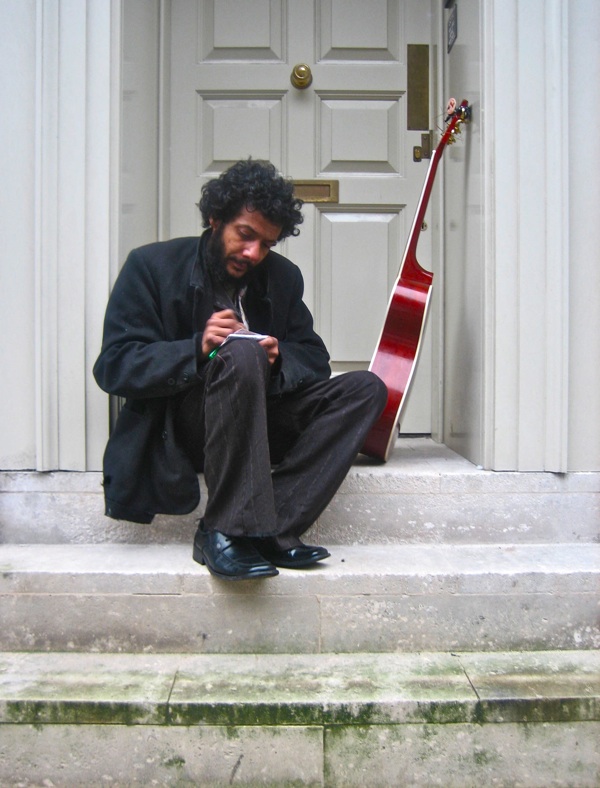
Photographs of Jason John performing copyright © Colin O’Brien
You may also like to read about












