
Vera Day, A Kid For Two Farthings

Vera Day knows horror when she sees it. In more than sixty years of movie acting she has been strangled by a gurning Boris Karloff, infected by the alien contagion of Quatermass II and involved in the writhing pseudopodia of The Woman-Eater (tagline: “SEE THE WOMAN EATER ENSNARE THE BEAUTIES OF TWO CONTINENTS!”) She survived all these terrifying experiences to give a grandstanding speech on the rules of poker in Guy Ritchie’s gangster flick Lock, Stock and Two Smoking Barrels. It’s one of the most memorable moments in the picture, and she did it in one take.
Vera, like her contemporary, Barbara Windsor, is a product of that post-war moment in which an unmistakably East London accent was no longer a bar to being a movie glamour girl. Other blonde bombshells of the period had to mind their language: Diana Dors submerged any trace of Swindon under a sassy transatlantic drawl; the Stockport-born Sabrina had to be content with stooging silently beside the comedian Arthur Askey. (Although the fan mags declared that the 1955 trackside melodrama Stock Car would be the first to allow audiences to hear her speak, the producers broke the deal, and dubbed her.) But nobody silenced or elocuted Vera Day. She sounded like a girl from Forest Gate. Triumphantly, she still does.
“Every girl was a glamour girl in those days, whether she was blonde, brunette or redhead,” she reflects. “It was obligatory to have the 37-22-24.” She traces the hour-glass shape in the air. I suspect the same calculations were made by Jack Hylton, the band-leader and impresario who plucked her from a hairdressing salon and put her into a show at the London Hippodrome – and by the movie director Val Guest, who first put her on the big screen in Dance Little Lady (1954).
She soon became one of British cinema’s most prolific showbiz blondes. At the 1955 Royal Variety Show she shared the bill with Morecambe and Wise, Gracie Fields and Alma Cogan. She spent a season crooning for the diners at the Edmundo Ros supper club on Regent Street – and much longer performing live TV dramas and comedies. (“By raising an eyebrow,” said The Times of Vera’s turn in the title role of The Red-Headed Blonde, “she can put down an opponent as if with a feather dipped in acid.”) The film work also came briskly. In Too Many Crooks (1959) she’s the moll in a gang of thieves led by George Cole and Sid James – in one brilliant scene, she stuffs fistfuls of stolen banknotes down the front of her dress, as a distracted Terry-Thomas attempts to yank them out again. In Fun at St Fanny’s (1956), she is a conniving actress who infiltrates a private school attended by a very little Ronnie Corbett and the agreeably horse-faced comic Cardew Robinson. In A Kid for Two Farthings (1955), Carol Reed’s strange symbolist drama set among the stalls and shops of Fashion Street, she fights Diana Dors for the attentions of an East End bodybuilder. Reed, Vera recalls, would instruct actors by performing the lines himself. “It was strange, watching him being me, and then Primo Carnera, this huge Italian wrestler.”
The press took an interest in her, too. Picture Show reported, quite erroneously, that she had been injured in a car crash on the way to the Danziger studios. (A merciful deliverance if it had happened, given the quality of Danziger productions.) The Mirror asserted, more accurately, that a German film company had offered her a £15,000 contract to play a stripper. (“It’s one thing to give them rocket bases,” they thundered, “but that’s no reason for Vera to show Deutschland Alles.”) Her separation from her first husband, a Charles Atlas model and masseur called Arthur Mason, attracted the attention of the gossip columnists – as did the details of his brushes with the law. While they were married, however, the copy was good: “Given a couple of extra inches all round,” exclaimed the Daily Mirror in April 1960, ‘Miss Day (husband Arthur Mason) might begin to challenge Miss Monroe (husband Arthur Miller)”
Mason wasn’t much of a Miller. But Vera did survive a skirmish with Marilyn Monroe. She had a small part in The Prince and the Showgirl (1957), and Monroe saw to it that it was as small as possible. “Marilyn insisted I wore a brown wig,” she remembers. “I’m a blonde and she didn’t want any competition at all.” But an attempt to sabotage her costume seems to have backfired. “Marilyn had this one white dress to wear which if you’ve seen the film you’ll know was very figure-hugging. One day the designer Beatrice Dawson called me to say they were making me a new dress. This dress when I got it clung to me like I couldn’t tell you. It was flesh-coloured and it looked as if I was nude. It was a dynamite dress. And I walked on that set and she nearly had a heart attack.”
Vera Day is now in her late seventies. I am pleased to report that she remains resolutely, furiously, ineluctably blonde.
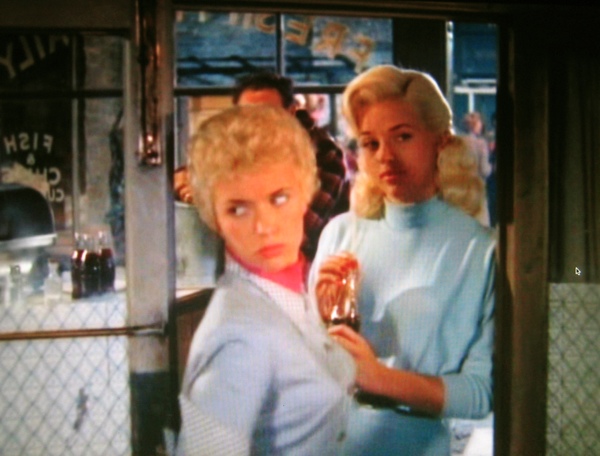
Vera Day (left) with rival blonde Dian Dors (right) in A Kid for Two Farthings.
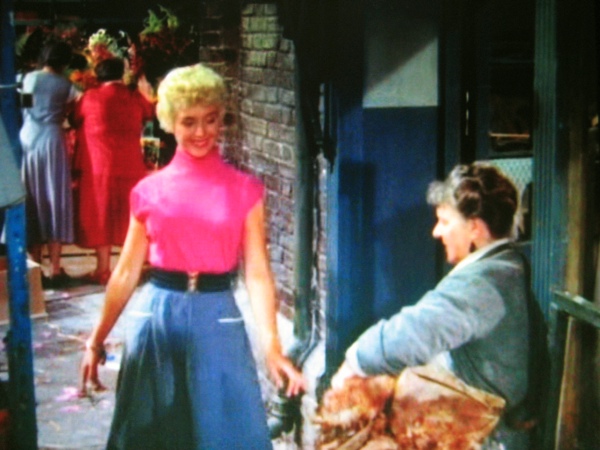
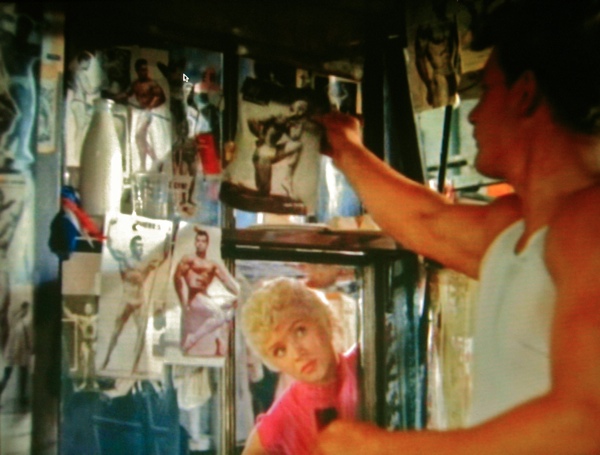
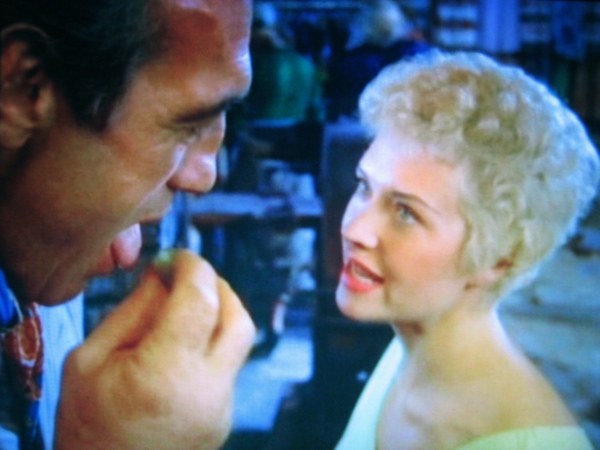
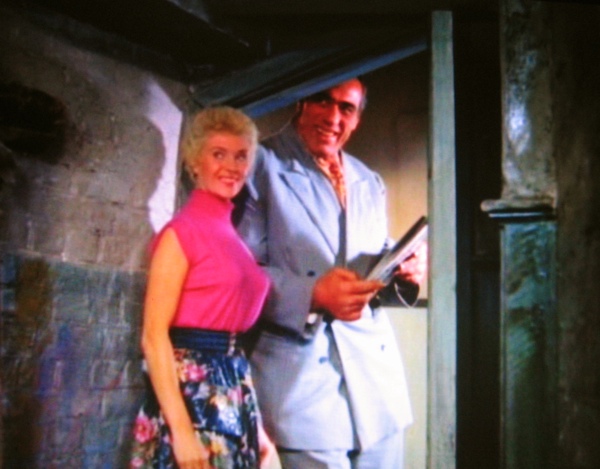
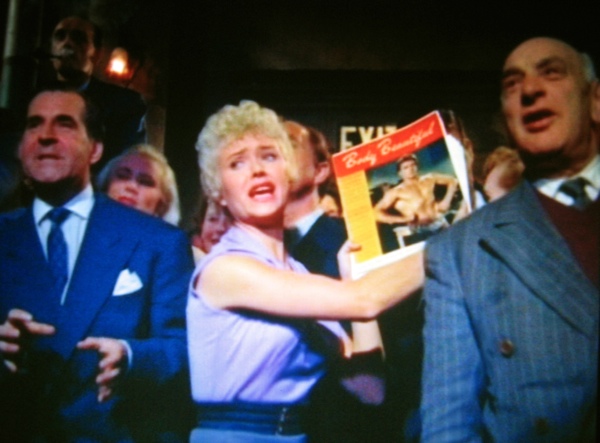
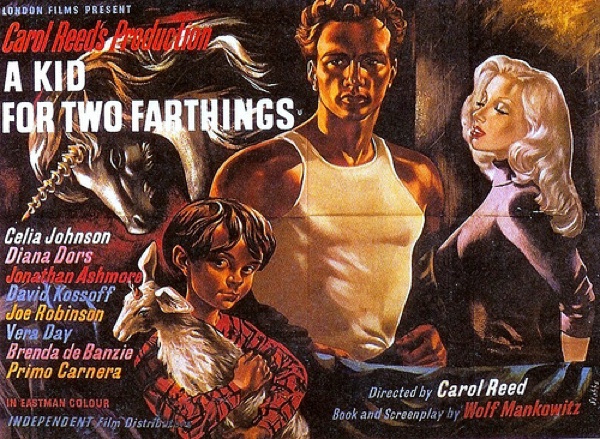
Carol Reed’s film of Wolf Mankowitz’s novel was filmed on location in Spitalfields in 1954.

Vera Day in 2006
portrait of Vera Day copyright © Definitive Images
You may also like to read about
Michael Shapiro, from Stepney to Peking
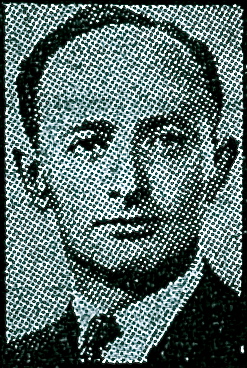
Michael Shapiro
There is no reason why you should know the name of Michael Shapiro. He is one of the missing people of East End history. Even his closest friends and colleagues knew little of his ultimate fate, and those still alive who remember him talk of him like a man lost at sea long ago.
In the 1930s, however, he was one of the principal intellectuals of radical politics in the capital; a lecturer at the London School of Economics who gave unofficial legal advice to the Communist Party of Great Britain. He was a campaigner passionately dedicated to liberating his neighbours from the miseries of damp flats and exploitative landlords – the author of a crusading pamphlet, Heartbreak Homes: An Indictment of the National Government’s Housing Policy (1935). He was one of the leaders of the group of demonstrators who, in September 1940, invaded the air raid shelter of the Savoy hotel to protest about the poor protection for those who lived in the areas where the bombs were falling most thickly. After the war, he was propelled into local government and took office as a Communist councillor for Stepney. But then began his love affair with Mao Zedong’s China – an affair that brought him close to destruction and estranged him from the country of his birth.
Owlish and prematurely bald, Michael Shapiro combined his devotion to theoretical Marxism with a passion for the quickstep, and once smuggled a ticketless girlfriend into a dance at St Pancras Town Hall by yanking her up through a window. The state treated him with suspicion: during the war, MI5 took an interest in his activities – though by 1943, the Ministry of Labour made enquiries about employing him and his fellow East End radical Phil Piratin to write official propaganda material in a sphere “where their technical qualifications could be utilised and their views do less harm.” Two years later, they both had something better than the indulgence of Whitehall. They had power.
In the summer of 1945, democracy returned to Britain. The General Election that brought Clement Attlee his landslide victory also gave the Savoy invaders cause to celebrate. Voters in the East End remembered how the Stepney Communists had campaigned for deep shelters; knew that fewer of their neighbours would have died in the fire and falling masonry if the National Government had listened to their demands. They handed out their reward at the ballot box. Twelve Communists took their seats on Stepney Borough Council. Among them were Michael Shapiro and the leading man of yesterday’s blog, Max Levitas. Phil Piratin was elected MP for Mile End.
Finding people with clear memories of Michael Shapiro was not easy, but I did talk to someone who knew him in the post-war years, as a prospective stepfather. Anna Shepherd told me about the romantic friendship that blossomed between her mother and Shapiro in the late 1940s, after his separation from his first wife, Eileen. Anna recalls the jaunts they took together – visits to the Tower of London, to a fortune-teller’s stall in Petticoat Lane market, and longer trips, under the aegis of the Communist Party, to campsites in the New Forest. Once the children had gone to bed, the adults danced into the night. “All this time,” Anna recalled, “he was studying Chinese and couldn’t wait to see the victory of Mao over the Kuomintang. I asked him why he was so interested in China. He knew all about the Long March and then said that Jews had settled in China thousands of years ago. I was very surprised.”
In 1950 Shapiro left England to work as an advisor to the state news agency in Peking. After his departure, few of his friends and family ever saw him again. In 1955 his name appeared in a Ministry of Defence report on the treatment of British Prisoners of War in North Korea. Two witnesses claimed to have encountered him as he toured the prison camps under the protection of the Chinese People’s Liberation Army. One, a sergeant in the Royal Ulster Rifles, alleged that Shapiro had threatened to have him executed by firing squad. The charge was never substantiated, but the damage was done.
Unable to return to England, Shapiro started a family in the serviced bungalow provided by the Peking government, wrote articles applauding his hosts and became a shadowy presence in hostile accounts of China in the British press. In the 1950s a Daily Express reporter clocked him at an official banquet in Peking and dismissed him as an “ingratiating, even obsequious figure [who] trotted about eagerly, trying to make friends, or at least acquaintances with the British visitors.” The Times reported him as being one of a number of expatriates who helped the Red Guard ransack the British Mission in Peking in August 1967. Another report cast him as the tormentor of Harry Lloyd, another British defector who suffered a nervous breakdown after being accused of anti-Maoism. “While he was in Peking recuperating, a group of radical foreigners led by British Communist Party member … Michael Shapiro came to his bedside to harangue him about his political errors.”
This zeal did not save him from suffering: the Chinese authorities rewarded his loyalty with five years of detention without trial. Shapiro was fortunate, however, in that he was rehabilitated without being killed first: when he died in 1986, Deng Xiaoping hailed him as “a staunch international soldier and sincere friend of the Chinese people.” In February 2010, I wrote to Michael’s brother, Jack, to request an interview. He died with the letter unopened on his kitchen table. At his funeral, tributes were offered by representatives of the governments of China and North Korea, and by the Communist Party of Great Britain (Marxist-Leninist), a minuscule group of die-hards of which he was Honorary President. At the time of writing, it is still possible to view Jack Shapiro on Youtube, denouncing Khrushchev’s revisionism. His brother Michael has his memorial, too – a journalism prize given to promising young reporters in Beijing. Perhaps the time will come when one of them will feel able to write an honest biography of the man after whom the award is named.
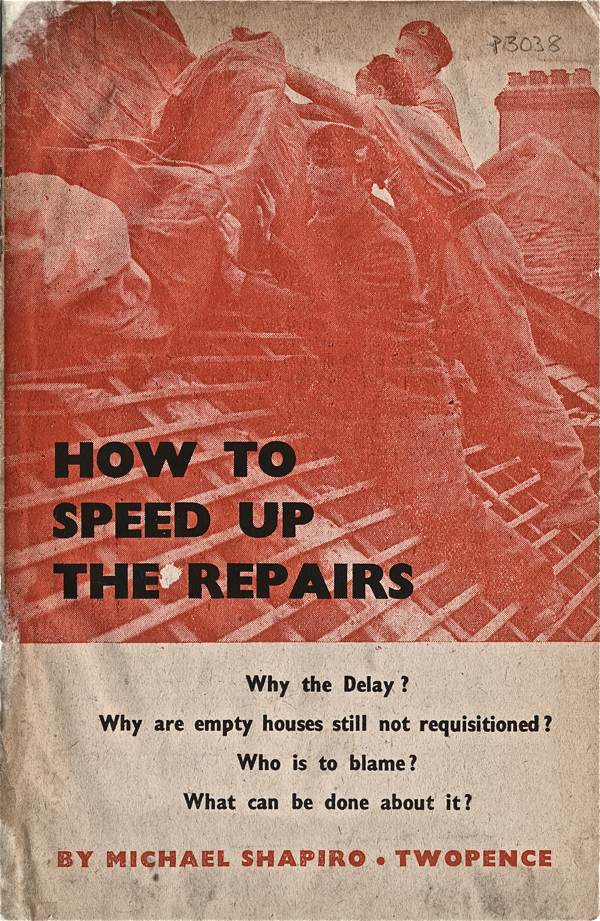
A pamphlet written by Michael Shapiro while a councillor for Stepney.
[youtube lWyBmPl8FVE nolink]
Michael Shapiro’s brother Jack (1907-2010) eulogises China in 2008.
Archive images from Bishopsgate Institute
You may also like to read about
When Max Levitas Stormed the Savoy
On the day of publication of Matthew Sweet’s The West End Front, we present this extract from his account of when East End Communists occupied the Savoy Hotel in 1940.

Max Levitas
There were forty of them. There were eighty. There were a hundred. They marched. They sauntered. They were angry. They were bewildered. They came with two dogs and they came with none. Theirs was a daring act that saved thousands of lives. Or it was a pretty piece of propaganda, gift-wrapped for the Führer. What happened beneath the Savoy Hotel on 14th September 1940, the eighth night of the Blitz, depended on the position of the observer: whether she or he was Red or anti-Red; East Ender or West Ender; dreaming of revolution or restoration. That Saturday night, when those forty or eighty or a hundred arrived at the doors of the hotel – with their dogs, or dogless – a small army of journalists was on the premises for a briefing by the Ministry of Information. Few, however, wrote about their uninvited fellow guests until the war was safely over. The government also maintained a public silence on the story, despite the urgent Cabinet discussion held the following Monday morning – a discussion with sinister undertones. But old comrades, years later, made that West End outing into a famous victory, a second Battle of Cable Street. It worked its way into plays and novels, into the mythology of the British Left. And though no horses charged and no batons swung, the Savoy Hotel invasion was the most serious political demonstration of the war – and dramatic evidence that conflict with Germany did not bring the class war to an end.
Max Levitas has spent most of his long life on the front line of that conflict. He was part of the famous human barricade that halted the Blackshirts’ progress through the East End in October 1936. He stood his ground at Brady Mansions during a twenty-one-week rent strike – brought to an end only by the government’s decision to freeze rents for the duration of the war. He was one of the dozen Communist councillors elected to the Borough of Stepney in 1945, during that giddy moment when the electorate could still see the avuncular side of Joe Stalin. He was there in 1991 when the Communist Party of Great Britain voted for dissolution and secured victory in the long war of attrition against itself. He was there, too, on that Blitz- struck Saturday night in 1940, shouldering the red banner of the Stepney Young Communist League as his group of demon- strators marched from the Embankment towards the silvered canopy of the Savoy. They marched for better air-raid shelters in the East End. They marched against the myth that the Luftwaffe had brought equality of suffering to Britain. And they received their marching orders from a series of urgent editorials in the Communist newspaper, the Daily Worker: ‘If you live in the Savoy Hotel you are called by telephone when the sirens sound and then tucked into bed by servants in a luxury bomb-proof shelter,’ the newspaper asserted. ‘But if you live in Paradise Court you may find yourself without a refuge of any kind.’ And above these words, in thick bold print: ‘The people must act.’
Max Levitas nods in agreement when I read the article back to him. ‘The surface shelters protected you from shrapnel, from flak, but not much else,’ he reflects. ‘If a bomb fell on one of those it would collapse and kill everybody in it. The Communist Party argued for deep shelters. But the National Government wouldn’t listen. They wouldn’t even open the Underground. It was easy to ignore that message if you were sitting in the basement of a very nice hotel. So we decided to march on one.’ I ask him why they chose the Savoy. Max Levitas smiles a tolerant smile. ‘It was the nearest.’
I meet Max Levitas at the Idea Store, that gleaming cultural institution planted in the East End to compensate locals for the assimilation of their much-loved public library into the Whitechapel Art Gallery. He is a small, cloth-capped nonagenarian, wrapped tightly in a raincoat and muffler. Standing on the studded purple rubber floor of the foyer, he looks like a preserved fragment of the old Stepney. It is a chilling morning in February, and he can spare me an hour before he goes for his Turkish bath – a weekly ritual since the 1920s, when his father took him to the long-vanished Schewik steam rooms on Brick Lane. We catch the lift to the top-floor café, secure two cups of tea and a table with a view of the bristling City skyline, and he tells the story of his association with the area: how his parents fled the Lithuanian pogroms in 1912 and made landfall in Dublin, where Max was born three years later; how his father took the family first to Glasgow, and finally to Stepney, where work could be found among a supportive community of Jewish exiles. History radicalised those members of the Levitas clan it did not destroy: Max’s Aunt Sara and her family were burned to death in the synagogue of the Lithuanian shtetl of Akmian; Max’s father became a leading member of the distinctly Semitic, distinctly Red-tinged International Tailors and Pressers’ Union; Max’s elder brother, Maurice, fought against Franco’s forces in the Spanish Civil War; Max gave his youth to the Communist Party of Great Britain and was name-checked by Oswald Mosley in a speech denouncing the enemies of British Fascism.
The organisers of the Savoy invasion shared a similar ideological background: they were all revolutionaries. ‘And they’re all dead,’ Max sighs. ‘Some were clothing workers. Some were bootmakers. Some were dockers.’ It is an inventory of lost trades. The first names he sifts from his memory are two stevedores, Ted Jones and Jack Murphy, veterans of pre-war campaigns for unemployment relief. The rest comprise a knot of men from the Stepney Tenants’ Defence League, which organised rent strikes against slum landlords in the East End: George Rosen, its bullish secretary, known as ‘Tubby’; Solly Klotnick, a furrier and a veteran of the Battle of Cable Street; Solomon Frankel, a clothing worker who took a bullet in Spain that robbed him of the use of his right hand. Michael Shapiro, a wiry young academic from the London School of Economics. At the head of the group stood Phil Piratin, Communist councillor for Spitalfields, chief spokesperson of the invaders, and the author of the most widely read account of their night at the Savoy. His memoir Our Flag Stays Red (1948) puts seventy in the hotel lobby, among them a number of children and pregnant women. Max’s memories are different. ‘There were forty of us,’ he affirms. ‘I’m sure of that.’ I ask if there were any dogs. He shakes his head. ‘No dogs,’ he says. ‘It was the Savoy.’

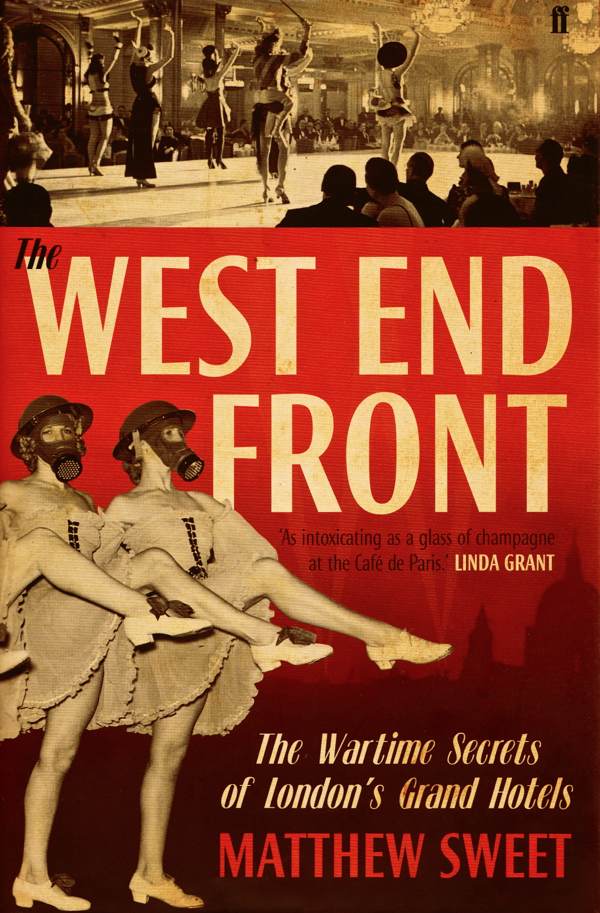
Portraits of Max Levitas copyright © Phil Maxwell
You may also like to read about
Anjum Ishtaq, Heba Women’s Project
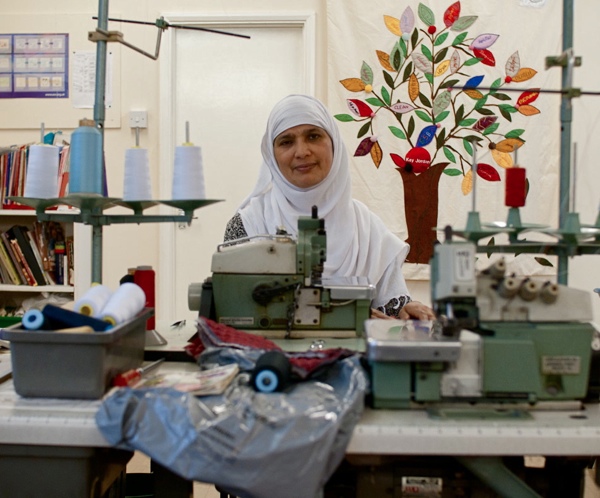
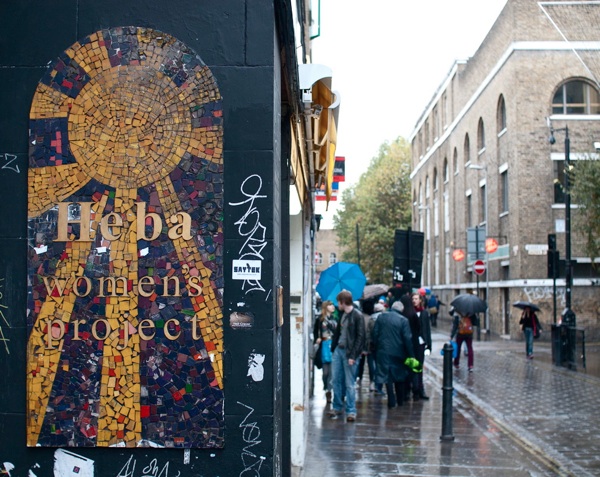
In a first-floor room above Brick Lane, a few doors south of the point at which the railway bridge bisects the street, is a modern kind of sanctuary: a place where, if you’re feeling unhappy, uncertain and isolated, you can find like-minded company and develop a few useful skills. For a place of recuperation, it can be pretty noisy, as the main room is filled with ranks of sewing machines. Up to thirty women at a time can be found hunkered down at them, feeding lengths of fabric through clattering metal teeth; shaping, stitching, talking over the squall of work. This is the Heba Women’s Project – the h-word means “women’s talent” in Arabic. That’s the force upon which this place runs – and the one it seeks to unlock in others.
Anjum Ishtaq, the ageless, quietly stylish woman who runs this centre, shows me around the premises: the meeting area with the crowded noticeboard and bookshelves; the little kitchen in which she makes me a mug of tea; the crèche, OFSTED-inspected, where the children of the Project’s clients are supervised; the sunlit workroom with its rows of workspaces; the storeroom packed with bolts of cloth, all begged and borrowed from a hundred donors. The Project has proved an unusual beneficiary of the slow death of the East End rag trade: much of its equipment and materials have come from businesses that have closed down. Nothing is wasted. And most of what is made here is sold: a stall at Spitalfields market, staffed by volunteers, ensures that the centre produces garments that end up on customers’ backs.
“We have all kinds of people here, all kinds of backgrounds. Some of the ladies who come here don’t even know how to thread the machine. Some of them have never held a pen in their lives. But sewing comes before English classes. And the first thing we do is to show them they have come to a safe place. Somewhere they can get some confidence.” The single-sex environment, Anjum says, is key to the success of the centre. “If the classes were mixed many of the women would not come. And their men would not let them come. There are many women who don’t feel comfortable even in Tower Hamlets College because of the presence of men. But they might feel confident enough to come here. And even then, a husband or a brother might come up here first to check it out.”
Like any good advocate, Anjum is much keener to talk about her cause than herself. She will, however, discuss the history that she shares with some of the users of the Project. On arriving in London from Pakistan twenty-five years ago, she felt the same disconnection from her host culture that many of her current clients can find so overpowering. “From my own experience,” she suggests, “I think you feel most comfortable in the place you spent your childhood. You know the slang, you know everything about it. And if you leave that place then you can feel there’s a kind of gap between you and everyone else. I had that gap when I first came here. But my children were born here and they don’t have it.”
The Project is not all Anjum’s own work. It owes its existence to a campaigning Yorkshirewoman named Kay Jordan, a community entrepreneur who is legendary in these parts. In 1983, Jordan, then an architect working for the Solon housing co-operative, founded the Spitalfields Small Business Association. Funded by the now-defunct Greater London Council, SSBA aimed to help local residents set up their own workshops and commercial premises in the East End. Jordan oversaw the refurbishment and development of over 62,000 square feet of derelict and underused buildings around Spitalfields. She was a socialist to whom Prince Charles came for advice on community architecture.
When Jordan died, suddenly, of meningitis, at the end of 2010, Anjum thought that the Centre might die with her. They lost funding. They endured their own financial crisis. There was a period when the possibility of closure was a problem that had to be addressed on a monthly basis. The Heba Women’s Project is now on a surer footing, but it is still in urgent need of funds. A new Saturday session, aimed, I sense, at some of the more middle-class make-do-and-menders of Spitalfields, is one new initiative that might help to secure its future.
Anjum won’t tut at anyone who drops a stitch. Come for three hours, she says, and you will go home with something to show for it. “I have ladies who tell me that they won’t be able to do anything, but they usually surprise themselves. And that look of satisfaction on their faces is what makes this job worth doing. If you have a bit of patience and you want to learn, there’s a way to learn.”
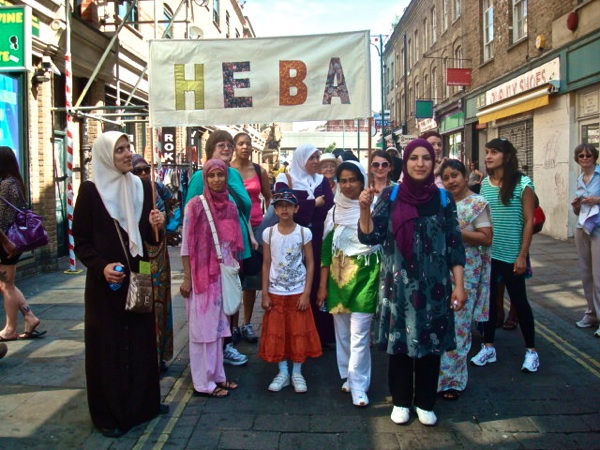
Members of Heba Women’s Project on Brick Lane.
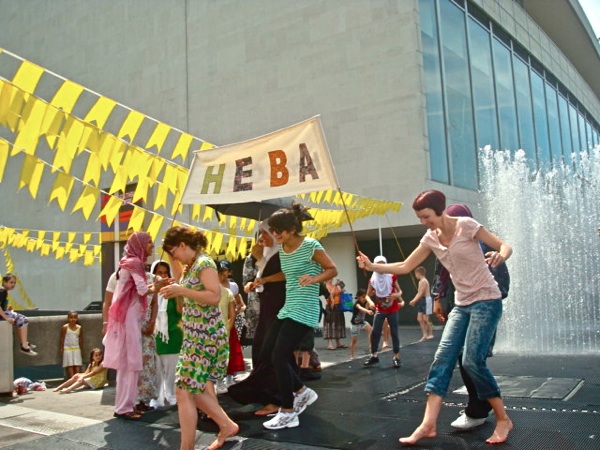
High jinks on the South Bank.
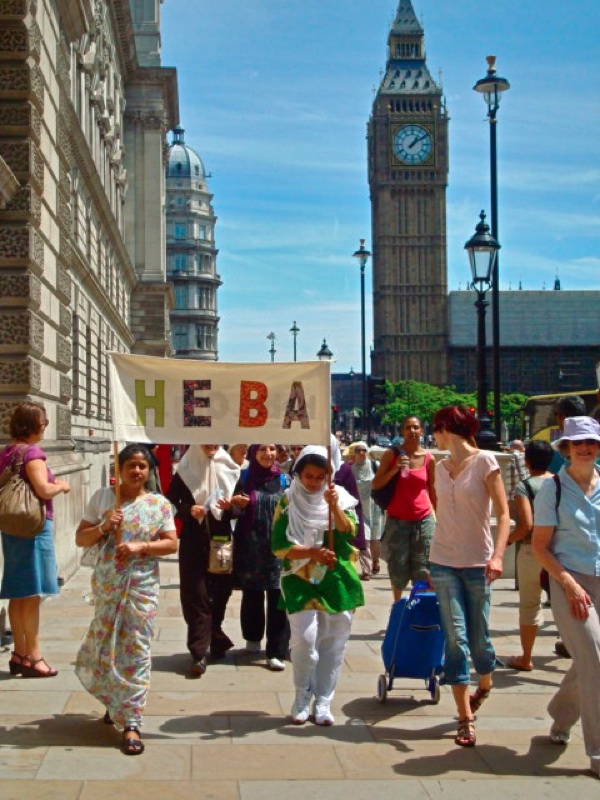
A sponsored walk.
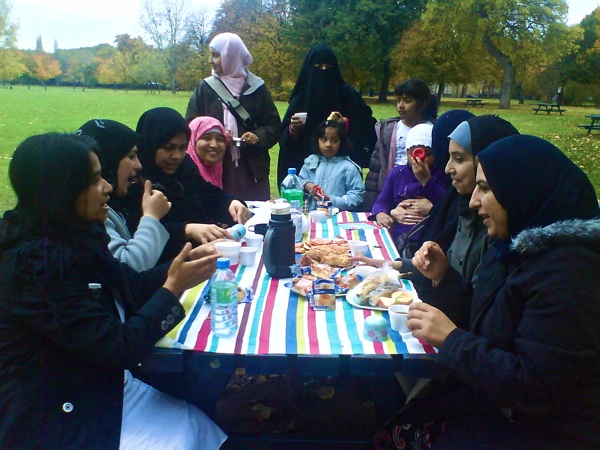
A trip to Victoria Park
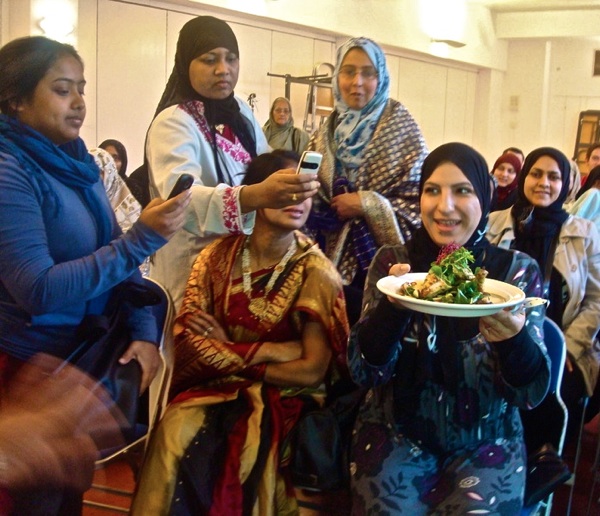
A healthy eating class.
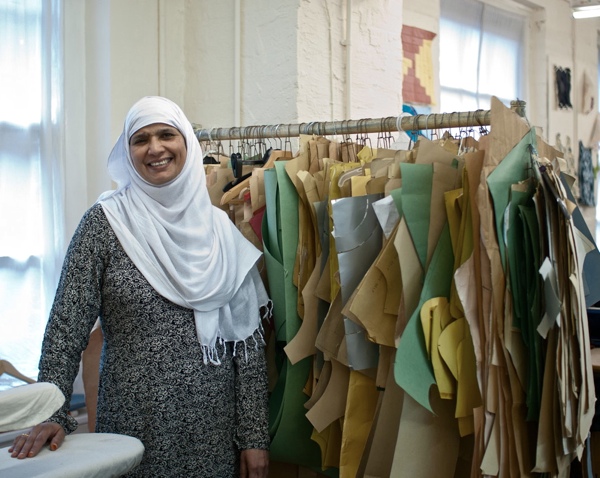
Anjum Ishtaq
Portraits of Anjum Ishtaq copyright © Sarah Ainslie
You may also like to take a look at
The Corner Shops of Spitalfields

Mohammed Ashraf Mujahid
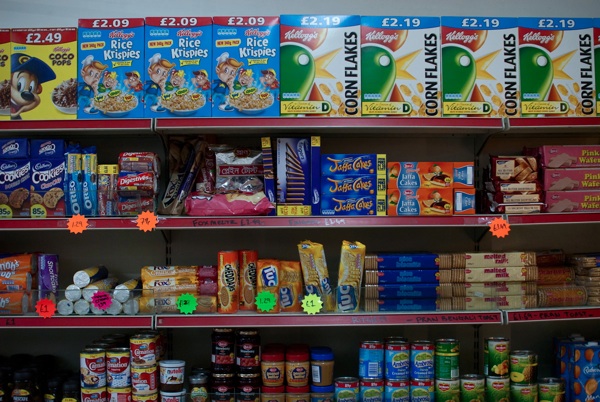
When Napoleon said that the English were a nation of shopkeepers, he meant it as an insult. But he’d never been to the Costprice Minimarket at the apex of Fashion Street and Brick Lane. It is a typical corner shop: large windows blinded by adverts for Guinness and lager, walls plastered with ads for international phonecards, a volume and variety of products that would turn stocktaking into an act of desperate heroism: Sambuca, cockroach traps, memory sticks, Veuve Cliquot champagne, hair dye, air pistols, rum cream, doorbells, Swedish cider, elastic bands, corn oil, chess sets, porridge oats, rat poison, screws, coat hangers, and bottles of brandy bearing a picture of a certain French Emperor who came off rather badly at the Battle of Waterloo.
The man behind the counter today is Shafik Uddin, to whom the photographer Sarah Ainslie and I have been chatting for ten minutes before his colleague, Ruma, suddenly appears, emerging from the trap door to the cellar below. Shafik and Ruma are kept busy – the flow of customers is constant, particularly at the weekend, when Brick Lane fills up with tourists randy for a Balti. (The East European visitors, he says, are most keen on the lurid hubble-bubble pipes he stocks – which punters imagine are smoked by the Asian locals.) Despite all the traffic, Shafik says that business might be better – and might be excellent if some strange mischance removed the new Tesco Express from Shoreditch High Street. He and his boss case the supermarket’s special offers each week. When he talks about the Tesco’s recent four-for-a-quid offer on a packet of biscuits that he has priced at a pound per packet, he is voicing the anxiety of every independent grocer in the country.
I heard nothing more optimistic from Mohammed Ashraf Mujahid, whose Grocers News and Convenient [sic] Store lies at the meeting point of Old Nichol Street and Chance Street. He has owned the place for four years, but he’s thinking of selling up and moving on. “The corner shop,” he says, “is going to die.” But he’s proud of his own store’s status as a hub of the local community, likes the fact that many of his customers are quite happy to come shopping in their pyjamas, and also understands the significance of his own role. “I see what’s going on round here. I’m security for people.” During the summer riots, his neighbours returned the favour, forming a protective cordon around the premises. The area, though, is changing subtly: the Asian families who colonised it thirty years ago are moving on. “They’re all moving east,” he says – and he means out to Dagenham rather than back to Bangladesh.
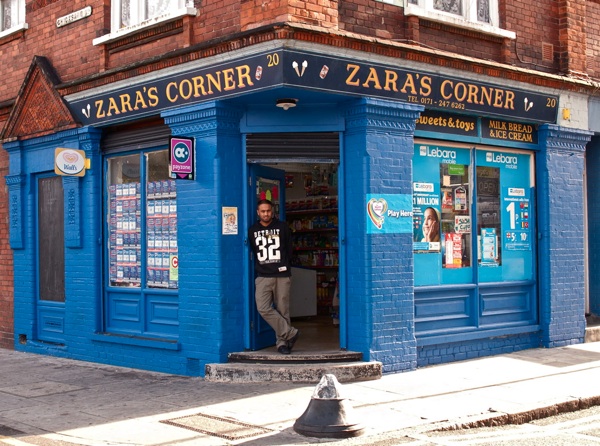
Zara’s Corner, where Spelman Street meets Chicksand Street, embodies the history of the last few decades – and a story told to me by the man minding the counter may help to explain why so many of these business are Asian-owned and run. “In the 1970s, if you were Asian and on your own, you’d get abuse if you went into a local shop,” explains Islam Uddin. “So if you ran out of milk, you’d have to phone up your mates and go in a group.” At the end of the Seventies, when the Uddins arrived on Spelman Street, there were only five families living in their block – the rest were squats, or boarded up. The original Zara was a Kenyan woman who set up the shop in the same period. There have been four changes of ownership since but, as Islam explains, the name stuck because each new proprietor had someone called Zara in their immediate family. (In the case of the current owner, it’s a niece.) Zara’s Corner occupies the ground floor of a beautiful Victorian housing development, rightly a listed building. The sign bears some tiny hand-painted images of ice-cream cones and cans of fizzy drinks. And it is another shop in which the community has a stake – a proposal to turn the place from a general store to an off-licence was met with subtle but stiff local opposition. So it remains what it was when Islam was a little boy, and was spending his pocket money on Pretzel Flipz. “We all get along here,” he says, “whatever race or religion you are. Everyone’s willing to help.”
When Sarah and I leave Zara’s Corner we strike north across Allen Gardens and the railway bridge, where a trio of street drinkers are occupying the concrete stairway. They’re in the thick of a beery argument, and the steps are wet with what I hope is Tennant’s Super. Ushaven and hare-eyed, these are fallen men who can fall no further. When Sarah and I appear, they apologise for blocking the way with touching primness.
Beyond them, where St Matthew’s Row joins the Bethnal Green Road, is Dhaka Corner, where, for the last four years, Mr Shajahan has been standing behind the sweet counter. He took on the place when the premises from which he ran a clothing company was sold from under him by the landlord. Business, he says, is bad. “We are dying,” he shrugs, echoing the words of his opposite number on Old Nichol Street. “People don’t have money to spend. They don’t have jobs. Every month you have to pay the rent, and then the rates, then electricity bills.” His shop window is evidence of his attempts to specialise: it is filled with rows of children’s shoes, school blouses and ties. One of Mr Shajahan’s suppliers, waiting to see him about an order of stock, offers his diagnosis: “There was a time when you could only get Chinese ingredients, Indian ingredients, Caribbean ingredients in a small corner shop. But now all of those have their own section in the supermarket.” I ask Mr Shajahan what he’s still selling. “Alcohol,” he replies, briskly. “To local people.” Local people, I suppose, like the men on the railway bridge.
Napoleon Bonaparte refused to accept he was beaten until his own marshals refused to take his orders. If the corner shops of England are as fated to oblivion as some of their proprietors suggest, then they are contemplating defeat with more good humour and dignity than the Emperor of France ever mustered. Here they are, among their fags and their sweets and their phonecards, finally facing their Waterloo.




Shafik Uddin
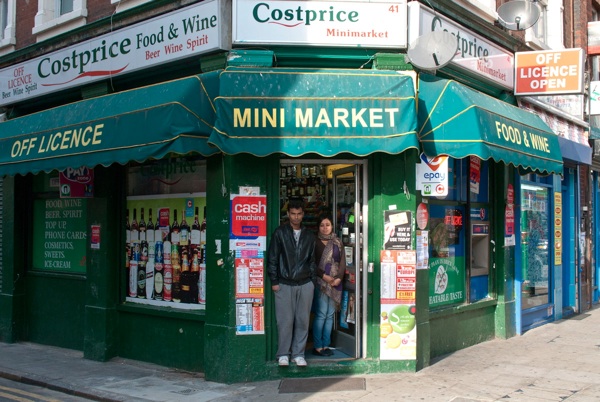


Islam Uddin

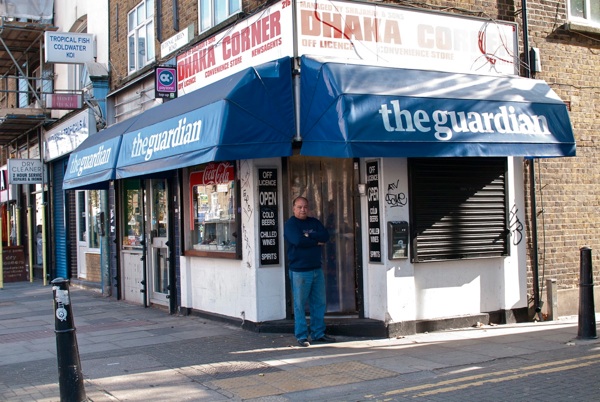
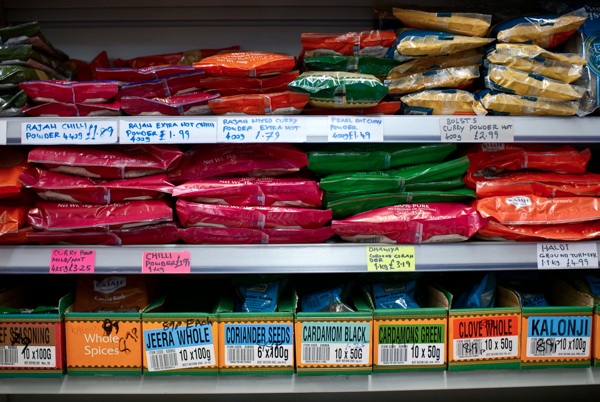

Mr Shajahan

Photographs copyright © Sarah Ainslie
You may also like to read about
The Lost World of the Laundrettes
The Stepney Witch-Bottle
“After nearly eight hundred stories, it is my pleasure to welcome Matthew Sweet to take over for a week in celebration of his new publication The West End Front by Faber & Faber on Thursday 3rd November. Matthew’s witty and erudite books have always proved an inspiration to me, and I can happily recommend his writing to you in the knowledge that you are in safe hands until my return on Monday 7th November” – the Gentle Author
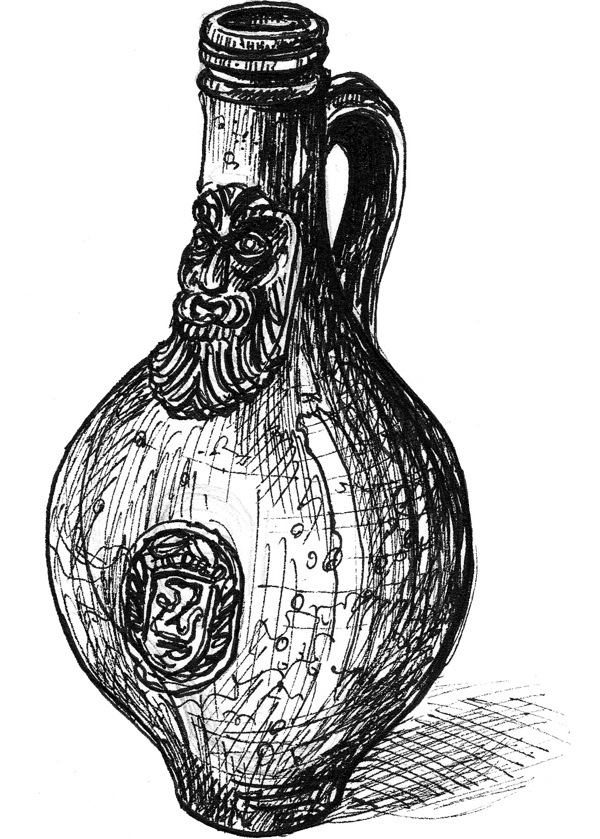
In March 1954, the mud of Stepney yielded a sinister piece of seventeenth-century treasure. Out it came, from under the earth of Pennington Street, on a plot where an orchard had once stood – a bulbous stoneware bottle, upon which had been carved the shape of a face: wide, goggling eyes, a prominent nose, a savage mouth, a devilish swoop of beard. The base of the bottle was in fragments. Not because it had been pulled from the ground too sharply, or smashed by its original owner – but because it had been cracked apart by forces it could not contain.
The contents of the bottle were also recovered: a small patch of cloth and the collection of objects that had once been wrapped and pinned inside. A twist of human hair, a handful of hand-made iron nails, a tangle of metal wire, and a small collection of fingernail clippings. These, according to the archaeology correspondent of The Times, revealed the true nature of the discovery. This was a “witch-bottle or Bellarmine jug … doubtless used to employ ‘sympathetic magic’ either to injure a victim or to ward off the supposed effects of witchcraft.”
In the popular imagination, witchcraft is rural. And yet, the record shows that belief in magic continued to thrive in East London as the cobbles advanced and the meadows and marshes retreated. In 1820, the American essayist Washington Irving reported that “an old woman that lives in Bull-and-Mouth Street makes a tolerable subsistence by detecting stolen goods, and promising the girls good husbands.”
In his essay Urbanisation and the Decline of Witchcraft, Owen Davies describes the case of Mary-Ann Gable, the wife of a coppersmith who lived on Russell Street in Stepney. In 1858 Gable told a court that she had ben so troubled with “frightful pains” that she suspected herself to be under some hostile supernatural influence. She sought the help of a Mrs McDonald of Cudworth Street, Bethnal Green, who confirmed her suspicions and sold her ten doses of powders at sixpence a twist. These Gable threw on the fire while reciting a prescribed incantation, with the intention of causing “torment” to her enemy. Gable took McDonald to court not because she had been sold a large amount of worthless remedies, but because she had discovered that the old woman was also in the employ of her antagonist, and was supplying that person with the same magical instruments.
The witch-bottle was, it seems, most often used as a counter-measure of this kind. According to Cotton Maher’s Late Memorable Providence (1691), those who felt themselves to be under attack by a witch could reverse the charm by filling a bottle with urine, into which would be dropped a little package of “Nails, Pins, and such instruments as carry a shew of Torture with them”. The sharp objects inside the symbolic body of the bottle would, if the magic worked, produce excruciating pain the corporeal body of the enchanter. The urine might be that of the witch, but it seems, more often and more pragmatically, to have been the urine of the bottle-maker. The reason being, according to Joseph Blagrave’s Astrological Practice of Physic (1671), that “there is part of the vital spirit of the Witch in it, for such is the subtlety of the Devil, that he will not suffer the witch to infuse any poysonous matter into the body of the man or beast, without some of the Witches blood mingled in with it.” If you wanted the witch to die of slow strangulation, you would then bury the bottle in the ground. If you preferred something more spectacular, you could throw it on the fire, though if the cork escaped before the stoneware exploded, then the charm would fail. The cocktail or urine an iron nails usually ensured that even those Bellarmine jugs buried under the earth would burst eventually – this is what happened to the Pennington Street specimen. Many such bottles have been disinterred, but so far only one has been found intact and stoppered.
One hundred and thirty of these objects have been recovered from sites all over Britain – though few of them are of British manufacture. Most were made in Germany, where the face carved on the neck of the bottle was held to represent a wild man figure from Teutonic folklore. The name Bellarmine is thought to derive from that of Cardinal Roberto Bellarmino, a hate-figure for Protestants across seventeenth-century Europe.
Are such objects still being fashioned? A modern Pagan whom I consulted for this article professed that she had used witch-bottles as part of her practice, though she stressed that unlike Mrs McDonald of Cudworth Street, she had never filled one for commercial gain. The fliers that come through the door from practitioners of African traditions, offering to improve my finances or cause trouble for my enemies suggest that sympathetic magic is alive in modern London.
In the 1950s, Ralph Merrifield, Assistant keeper of the Guildhall Museum in the City of London, bemoaned the lack of interest in discoveries such as the Pennington Street witch-bottle. “Unfortunately,” he reflected, “many archaeologists are curiously reluctant to show any interest in the less rational aspects of human behaviour, and finds of this nature are rarely publicised or discussed. It is not clear whether this is due to a modern superstition, contradicted by history, that man is a rational animal; or to the revival of an ancient one, that there is a risk of contagion in such studies, leading, if not to possession by the powers of darkness, at least to a collapse of scientific scepticism!”
My scientific scepticism is pretty robust. But I will concede to the believers on the question of sympathetic magic. The witch-bottle eased from the Stepney mud in 1954 is now housed, with many similar examples, in the Museum of London. You only have to gaze upon the strange, savage features of the faces that they bear to feel something of what they must have meant to the people who packed them, corked them, and bedded them in the earth.
Drawing of the Stepney Witch-Bottle by Joanna Moore
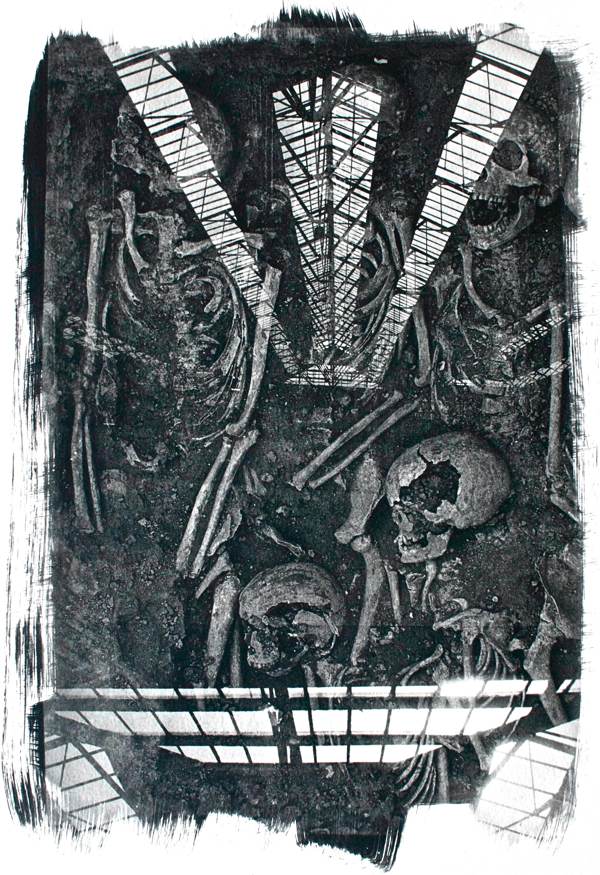
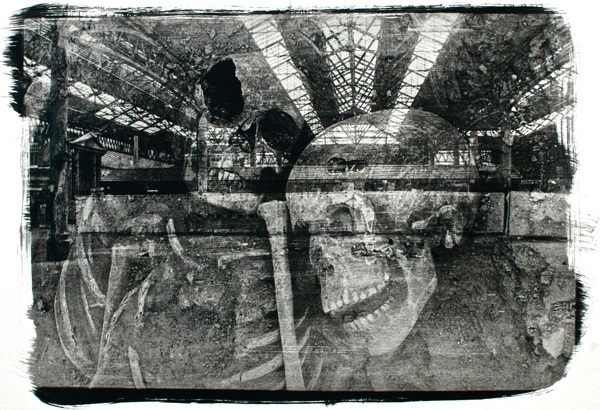
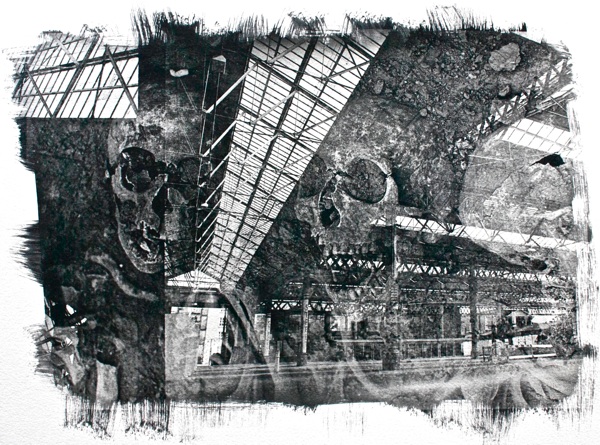
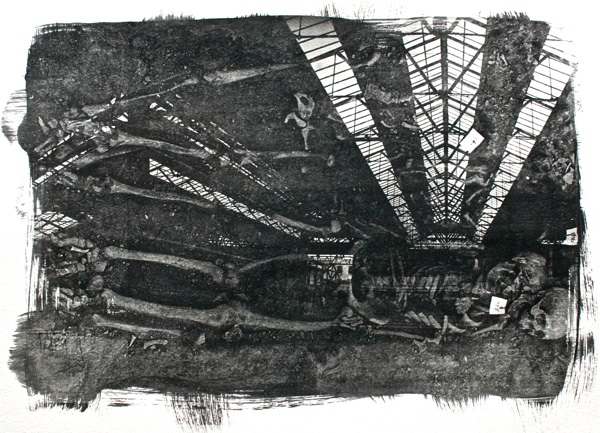

Montages by Sarah Ainslie using her photographs of skeletons exhumed during the rebuilding of the Spitalfields Market in 1999.
Drawing copyright © Joanna Moore
Montages copyright © Sarah Ainslie
You may also like to read about
The Fly-Pitchers of Spitalfields
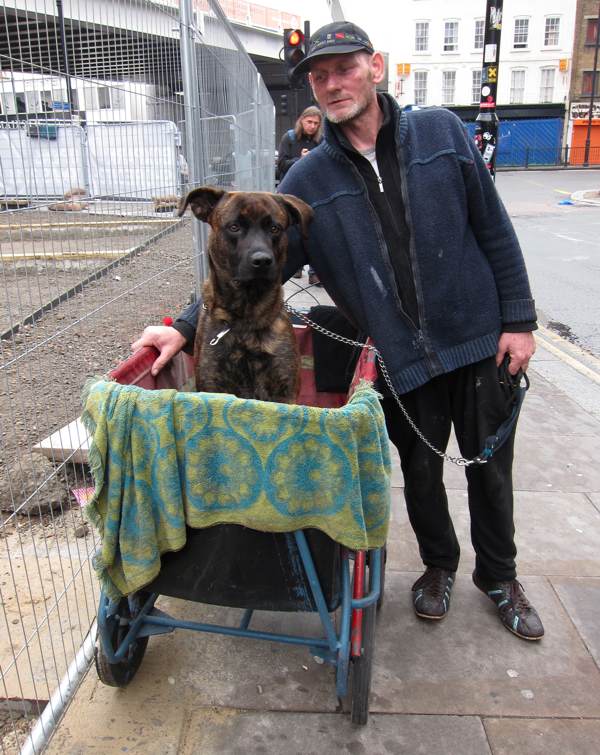
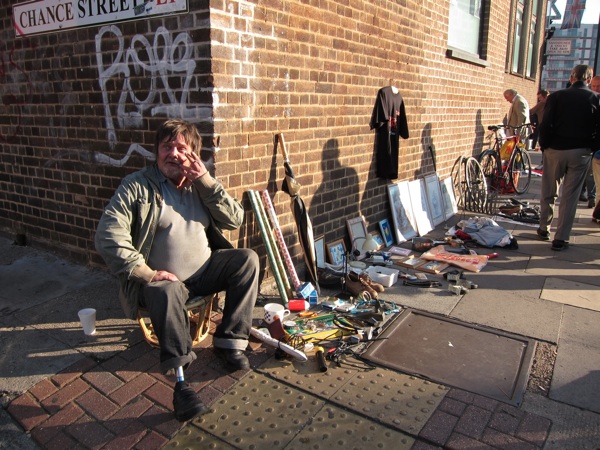
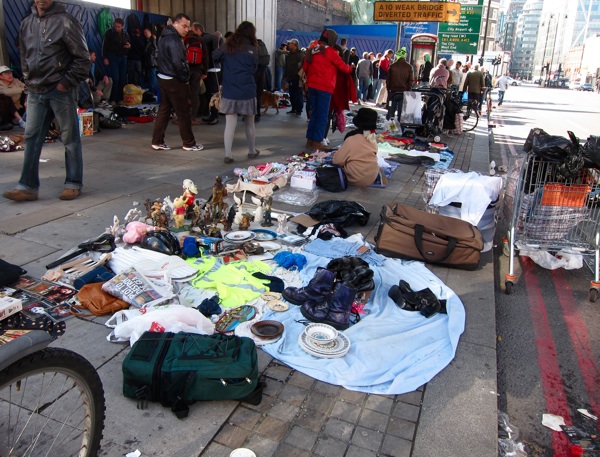
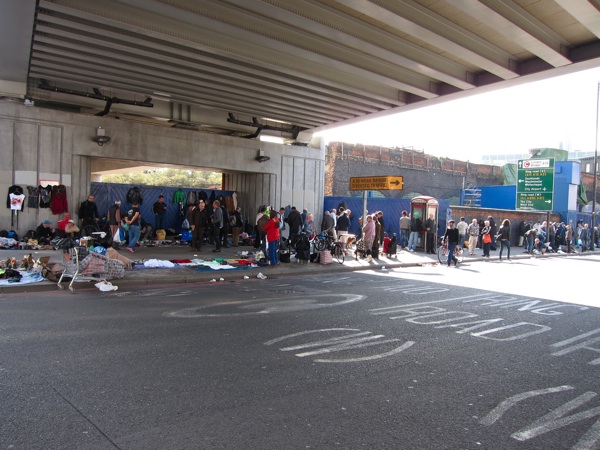
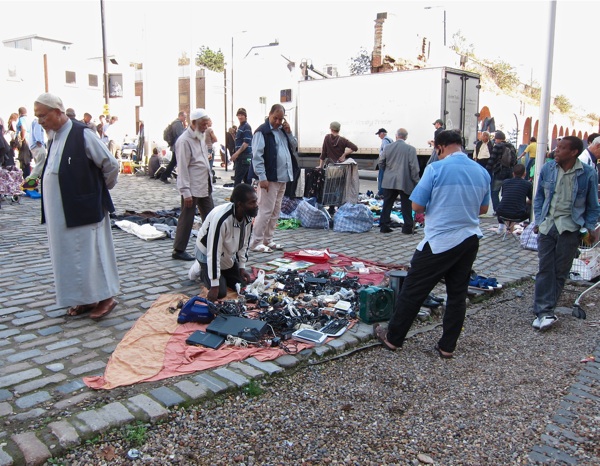
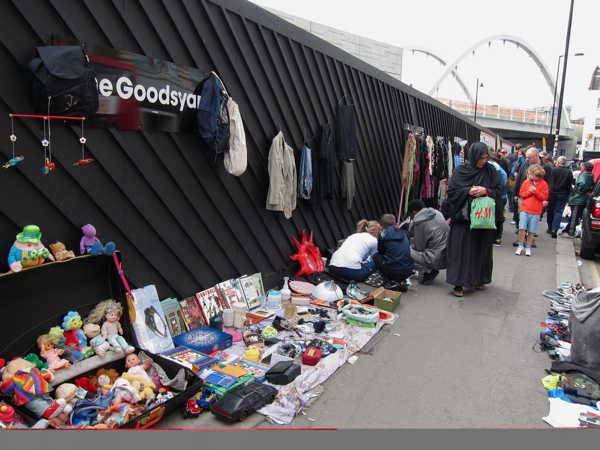
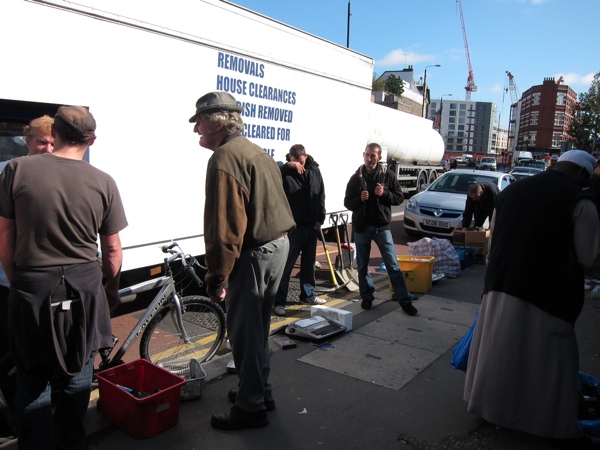
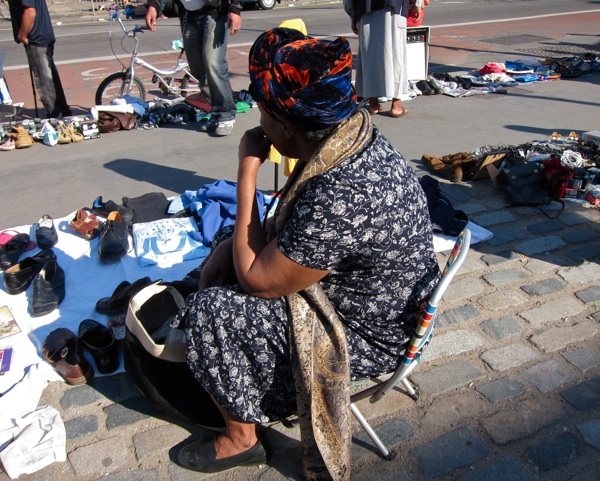
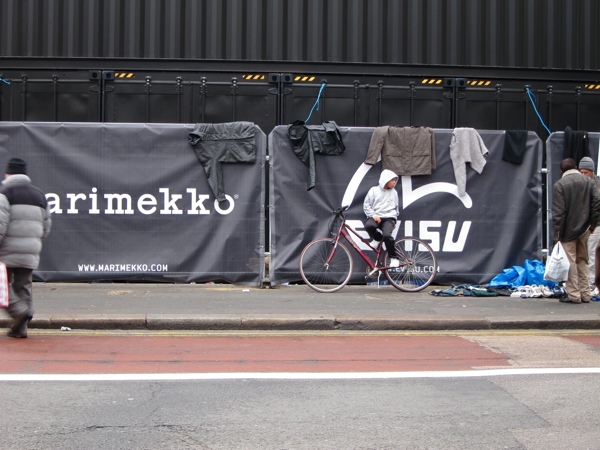
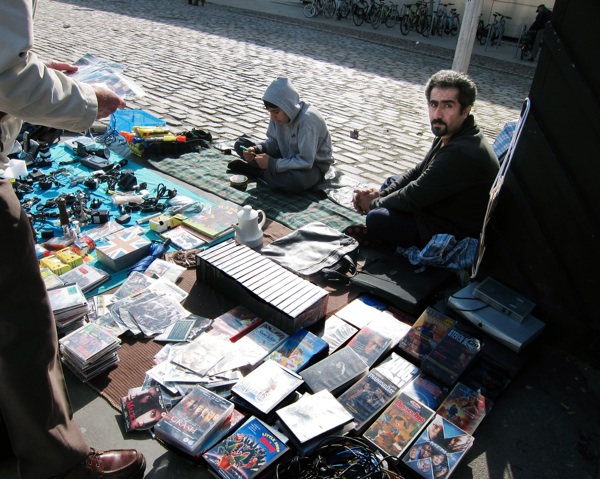
When I first came to Spitalfields, at dawn one Sunday morning in Winter long ago, I was amazed to find Brick Lane full of fly-pitchers – people selling a few items directly off the pavement. Yet as the years have gone by, these pavement traders have been pushed further and further out until they find themselves at the very edge of the territory now, crowded together along the Bethnal Green Rd upon a narrow strip of pavement beside the site of new a shopping mall. Literally at the margins, these people are suffering at the heavy hands of market inspectors constantly harassing and threatening them, causing them to pick up their things and flee – only to return later and do a little more trading before the next purge happens, in a tragic ongoing game of cat and mouse.
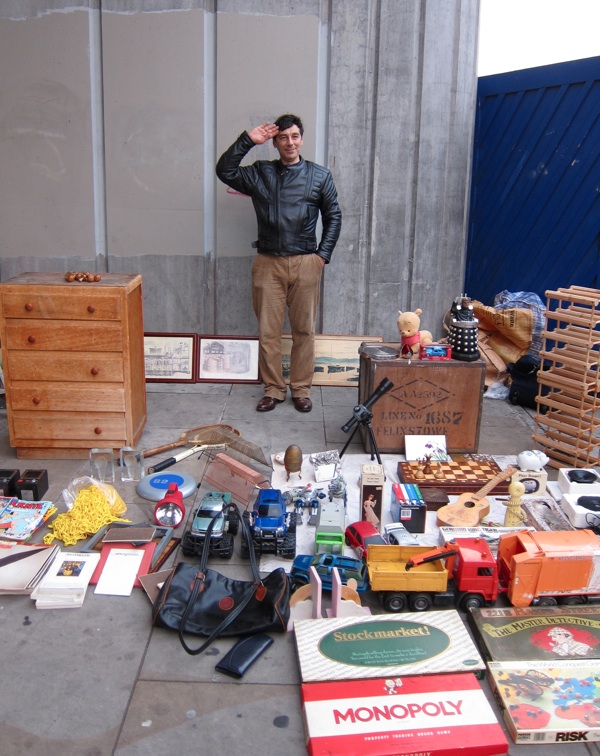
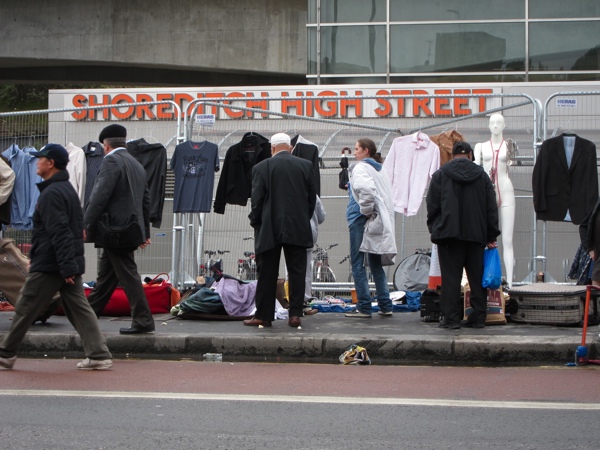
Commencing in the early hours and sometimes gone by first light, the existence of these traders in unknown to many visitors that come to Brick Lane on Sunday. So, for the last month, Spitalfields Life Contributing Photographer Colin O’Brien has been down there among the fly-pitchers and the result is this remarkable set of pictures which acknowledge the dignity of these people who are being subject to such unnecessary humiliation for sake of wanting to sell a little bric-a-brac.
“My name is Jason John, I’m writing you a damn good song” – these were the first words I heard when I came round the corner of the Bethnal Green Rd into Norton Folgate last Sunday morning, just as a street musician with curly dark locks appeared with theatrical aplomb from behind a telephone box, wielding his guitar and offering a tuneful accompaniment to the lively scene of pavement trading sheltered by the vast railway bridge arching over us. It can be a pitiful spectacle to witness the modest possessions that people are selling here, asking prices as little as 10p, and yet this market is remarkable for its vibrant life and sense of camaraderie that, ironically, has strengthened in the face of the current threat.
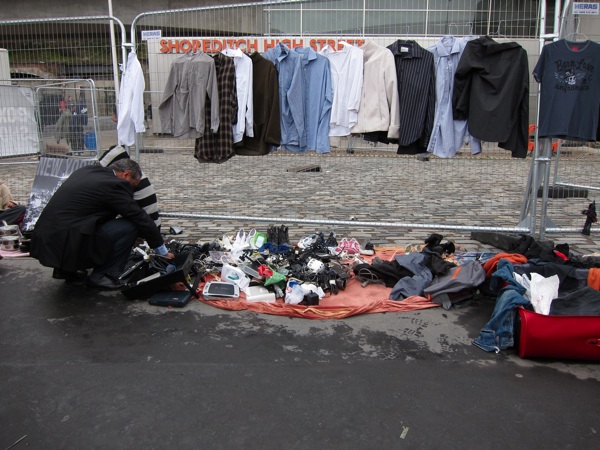
Over the weeks that Colin has taken his pictures, a stack of black sea-containers were put in place and the hoarding behind the fly-pitchers came down to reveal the pop-up shopping mall which will open here shortly. Now a fence with the logos of the international brands who will be selling their wares here in future serves as a backdrop to the fly-pitchers and the contrast between the two could not be more extreme. The developers who own the site are creating a temporary shopping mall to capitalise upon their investment whilst they raise the cash to construct a tower block for corporate clients and – for the sake of this – a few pensioners, the handicapped, those struggling on benefits and the dispossessed are being criminalised because they try to sell a few of their belongings to raise a little extra cash on a Sunday morning.
I spoke to a Jewish gentleman in his seventies as he arrived to place six worn shirts on the pavement for sale, casting glances nervously to either side. I bought one of his shirts for 50p in order to strike up a conversation with him, yet within minutes he was harshly moved on and my 50p proved to be his sole income for his effort that morning.“They’re trying to get rid of the poor people!” exclaimed one woman in grief, too scared to consent to a photograph by Colin.
The argument is used that the fly-pitchers are unlicensed and they are blocking the pavement. Yet the truth is that some have been coming to Brick Lane to trade for their entire lives, participating in the culture of unregulated pavement trading which has been in continuous existence in this corner of the East End on Sundays for centuries. And, if they are blocking the pavement now it is because they have been herded into this narrow space away from Brick Lane against their will.
Gina of Gina’s Restaurant in the Bethnal Green Rd, who started her first cafe in Brick Lane with her husband Philip Christou in 1961, opens each Sunday now to serve the same people who have been coming all these years. When they are ‘purged’ by the inspectors, they take refuge in her establishment and if the old people have failed to make enough money to pay for a Sunday lunch – which was their sole intent in getting up before dawn and coming down here – then Gina simply gives them a meal. It is a sombre experience to sit in Gina’s Restaurant among those who have taken flight and recognise that these spirited characters are the people who have been in the market longer than anyone.
The soul of the place resides with the fly-pitchers and their moral rights must be respected now – through the provision of a space where they can trade peacefully – rather than subjecting them to the current inhuman treatment which degrades us all.
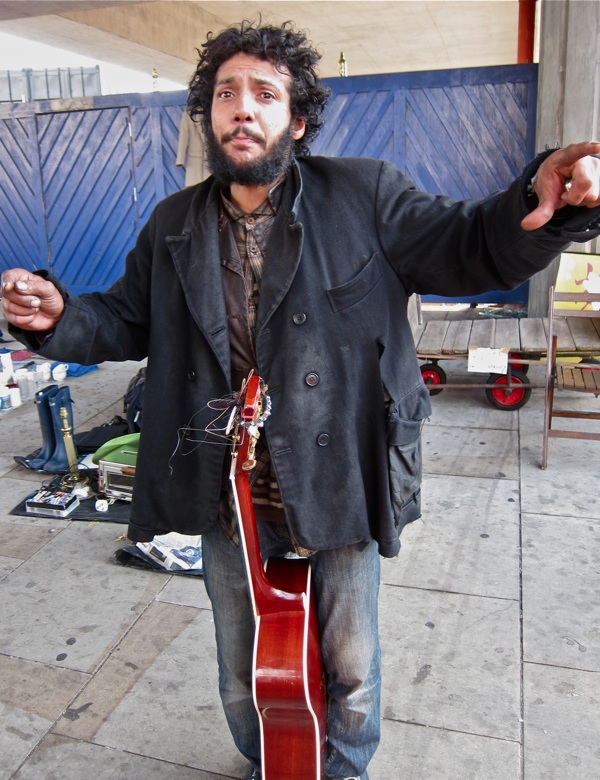
Jason John, Street Musician
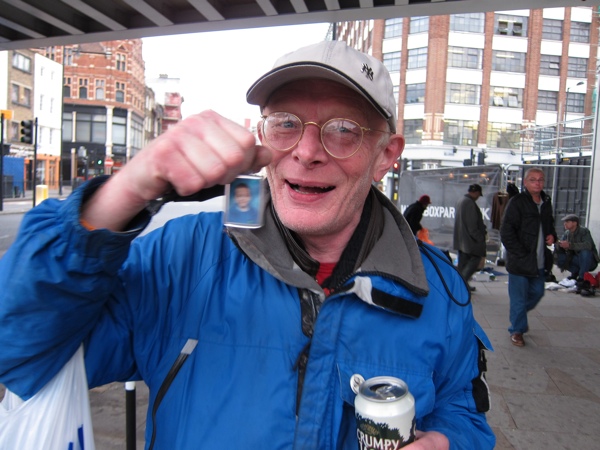
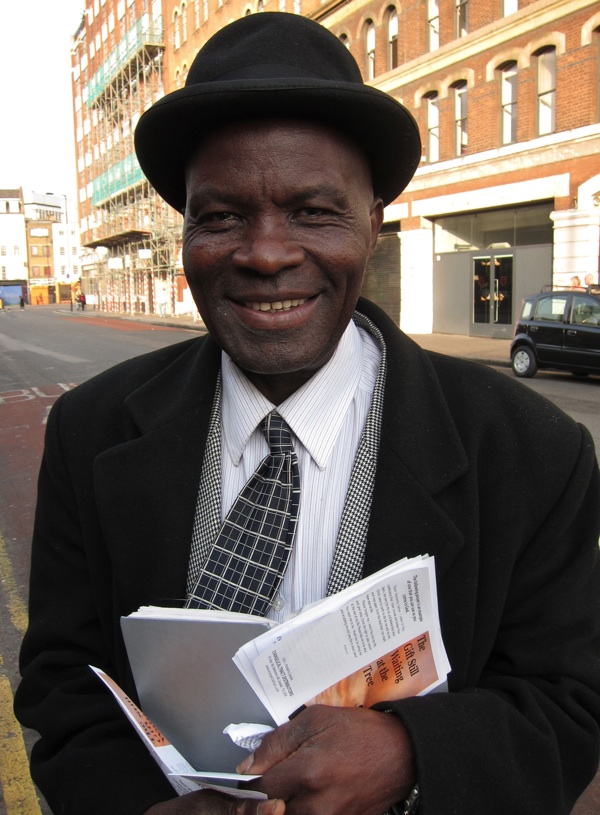
Mr Gil, Street Preacher
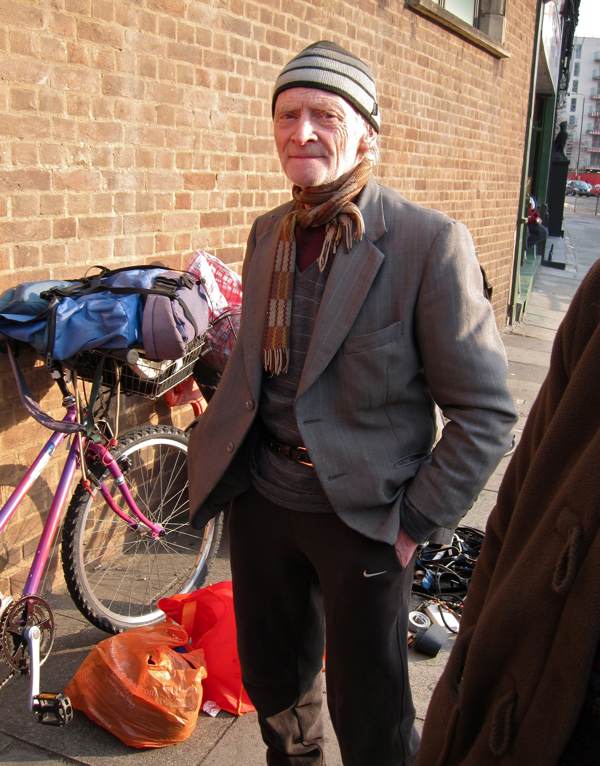
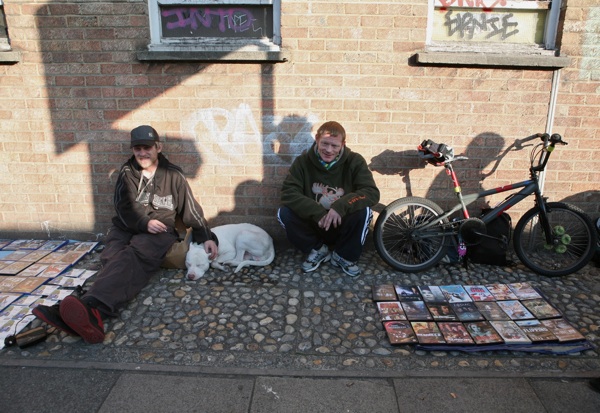
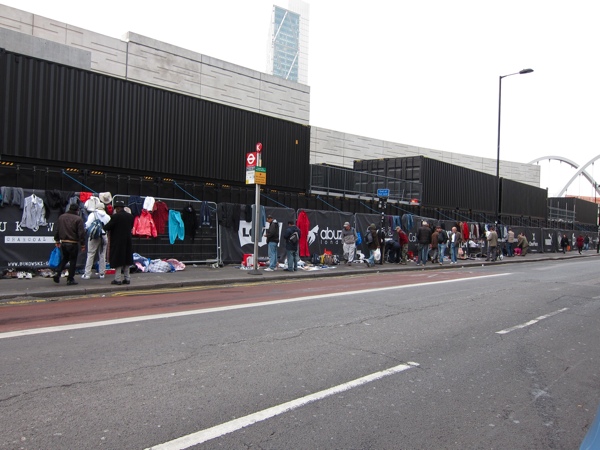
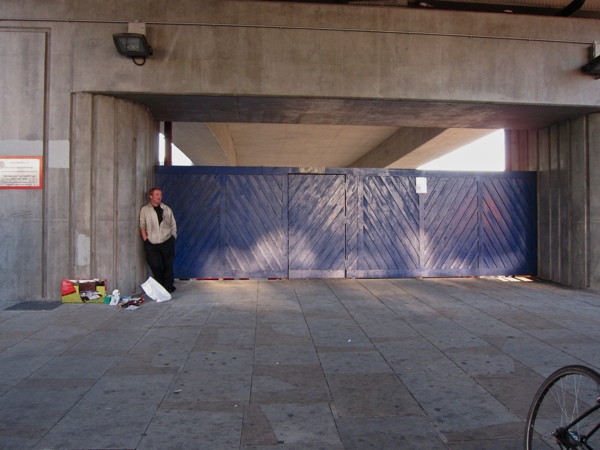
Photographs copyright © Colin O’Brien
You may also like to take a look at these other pictures by Colin O’Brien
Colin O’Brien’s Brick Lane Market
Colin O’Brien’s Clerkenwell Car Crashes
Travellers’ Children in London Fields












